

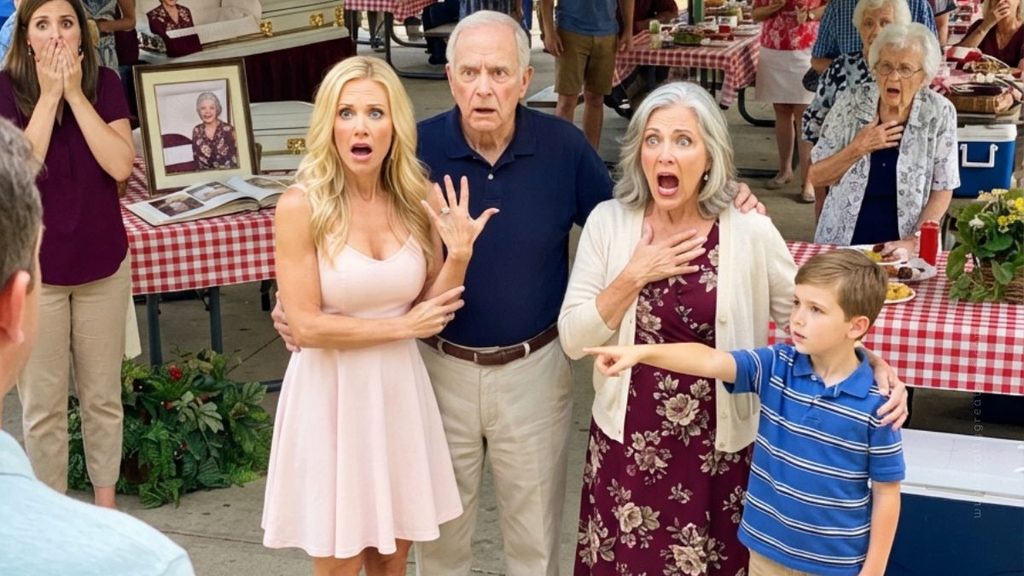
My husband’s mistress stood in front of sixty-three members of my family, raised her left hand, and announced that she and my husband were getting married.
I was standing ten feet away.
Still wearing my wedding ring.
Still legally married to the man she’d just called her fiancé.
And holding a plate of potato salad.
My husband, Richard, looked as though someone had punched him.
The woman smiled brightly.
“I know this might come as a surprise, but Richard and I have been together for almost three years, and we decided it was finally time to share our happy news.”
Nobody spoke.
My daughter dropped her fork.
My sister whispered, “Oh, my God.”
And my eighty-four-year-old mother gripped the edge of her chair.
Then my eight-year-old grandson, Noah, stood up.
He was holding his iPad.
He looked at the woman.
Then at me.
Then back at the woman.
“Grandpa?”
Richard swallowed.
“Yes, buddy?”
Noah turned the screen toward him.
“Why was she lying in Grandma’s coffin?”
The entire pavilion went silent.
Richard stared at the screen.
His face went completely white.
The mistress stopped smiling.
And my grandson, who had no idea he’d just exposed something far more disturbing than an affair, pointed at the photograph again.
“That’s Grandma’s purple dress,” he said. “But that’s not Grandma.”
I walked toward him.
Looked down at the iPad.
And saw a photograph of my husband’s mistress lying inside a polished mahogany coffin.
Her eyes were closed.
Her hands were folded over her stomach.
And she was wearing the lavender dress I’d purchased for my own funeral arrangements.
Behind her stood my husband.
Smiling.
I couldn’t breathe.
Then Noah asked another question.
“Grandma, why did Grandpa tell the funeral man you were already dead?”
My name is Margaret Collins.
I’m sixty-six years old.
Until that afternoon, I’d been married to Richard Collins for forty-four years.
We lived outside Lexington, Kentucky, in a beautiful farmhouse that had belonged to my grandparents.
Richard was sixty-eight.
He owned a commercial construction company.
I was a retired elementary school principal.
We had three adult children.
Jennifer, forty-two.
Michael, thirty-nine.
And Rebecca, thirty-six.
Seven grandchildren.
And a large extended family that gathered every summer for our annual reunion.
The reunion was always held at my brother Thomas’s farm.
There was a huge white pavilion.
Long folding tables.
A barbecue pit.
And a little pond where the children liked to fish.
My mother, Eleanor, had started the tradition nearly fifty years earlier.
Every July, relatives came from Tennessee, Ohio, Indiana, and West Virginia.
We played games.
Shared photographs.
Ate far too much food.
And celebrated the fact that our family had remained close despite living in different states.
That summer was supposed to be particularly special.
My mother had recently recovered from hip surgery.
My brother Thomas had turned seventy.
And Richard and I were approaching our forty-fifth wedding anniversary.
I’d even ordered a cake.
White frosting.
Fresh strawberries.
And the words:
Forty-Five Years of Love.
I had no idea my husband was planning to celebrate something entirely different.
Three months before the reunion, Richard started behaving strangely.
He’d always been affectionate.
Not overly romantic, but thoughtful.
He brought me coffee in the mornings.
Called me from work.
And insisted on kissing me goodbye before leaving the house.
Then suddenly, he became distant.
He stopped asking about my day.
Started sleeping in the guest bedroom.
And spent hours on his phone.
When I asked whether something was wrong, he blamed stress.
“The company’s going through a rough patch, Maggie.”
I believed him.
Construction was unpredictable.
Projects got delayed.
Clients paid late.
And Richard had always carried the weight of the business on his shoulders.
I offered to help.
He declined.
Then he began talking about our estate planning.
At first, I thought it was sensible.
We were getting older.
We had children.
Grandchildren.
Property.
Retirement accounts.
And the farmhouse.
Richard said we needed to update our wills.
I agreed.
But then he started asking questions that made me uncomfortable.
“Have you ever thought about what kind of funeral you’d want?”
I laughed.
“Richard, I’m not planning on dying anytime soon.”
He smiled.
“Neither am I. But we should be prepared.”
I nodded.
That seemed reasonable.
Then he asked whether I wanted to be buried or cremated.
I told him I’d always wanted to be buried beside my parents.
He nodded.
Then asked what kind of coffin I’d prefer.
I laughed again.
“Richard, I don’t know. Something simple.”
He looked disappointed.
“Maybe we should visit a funeral home.”
I stared at him.
“A funeral home?”
He shrugged.
“Preplanning can save the kids a lot of trouble.”
I eventually agreed.
It seemed practical.
I didn’t realize it would become one of the most frightening decisions of my life.
We visited Whitaker Funeral Home in May.
It was a beautiful building.
White columns.
Dark wood floors.
Soft lighting.
And an older gentleman named Mr. Whitaker who’d known my family for decades.
He’d handled my father’s funeral.
My aunt’s.
And several other relatives’.
Richard seemed unusually interested in the arrangements.
He asked about prepaid plans.
Burial permits.
Death certificates.
Transportation.
And how quickly services could be arranged.
Mr. Whitaker answered patiently.
I chose a simple mahogany coffin.
Not extravagant.
Not inexpensive.
Just something tasteful.
Then we discussed clothing.
I mentioned the lavender dress I’d purchased for my niece’s wedding but never worn.
It was elegant.
Long sleeves.
A modest neckline.
And a soft satin finish.
I joked that it would be perfectly suitable for my funeral someday.
Richard smiled.
“That’s a good choice, Maggie.”
I didn’t think anything of it.
Then Mr. Whitaker asked whether we’d like photographs of the selected coffin for our records.
Richard said yes.
He took several pictures with his phone.
I assumed that was the end of it.
It wasn’t.
Two weeks later, my lavender dress disappeared.
I kept it in the upstairs guest bedroom closet.
Still in its garment bag.
Still with the tags attached.
I noticed it was missing when I was organizing clothes for donation.
I searched everywhere.
Then asked Richard.
He shrugged.
“Maybe Rebecca borrowed it.”
I shook my head.
“Rebecca wouldn’t wear that style.”
He laughed.
“Well, I don’t know, Maggie. You have a lot of clothes.”
I was annoyed.
But I let it go.
Then I noticed something else.
A small jewelry box was missing from my dresser.
Inside had been my mother’s pearl necklace.
The one she’d worn on her wedding day.
The one she’d given me when I turned fifty.
I searched the house.
Nothing.
Richard suggested I might have misplaced it.
I started to worry about my memory.
Not seriously.
But enough that I wondered whether I was becoming forgetful.
I didn’t know my husband was deliberately removing things from our home.
And I certainly didn’t know where they were going.
The first real warning came from my daughter Jennifer.
She called one evening in June.
“Mom, can I ask you something?”
I smiled.
“Of course.”
She hesitated.
“Are you and Dad okay?”
I frowned.
“What do you mean?”
She sighed.
“He seems strange lately.”
I nodded.
“He’s stressed about work.”
Jennifer was quiet.
Then said, “Mom, he asked me something weird.”
I felt uneasy.
“What?”
She hesitated.
“He asked whether I’d be willing to take over managing your finances.”
I stared at the phone.
“My finances?”
“Yes.”
I frowned.
“Why?”
Jennifer sighed.
“He said you were getting overwhelmed.”
I felt cold.
“Overwhelmed?”
“He said you were forgetting things.”
I swallowed.
Jennifer continued.
“He said he was worried you couldn’t keep track of bills.”
I felt sick.
“Jennifer, I pay every bill on time.”
“I know, Mom.”
I stared at the wall.
Then she said:
“He asked whether I’d support him if he needed to make decisions for you.”
I couldn’t breathe.
“What decisions?”
Jennifer hesitated.
“He didn’t say.”
I swallowed.
Then she continued.
“Mom, I told him he needed to talk to you.”
I nodded.
“Good.”
She sighed.
“He got irritated.”
I felt cold.
Then Jennifer said something that stayed with me.
“Mom, I don’t like the way Dad talks about you when you’re not around.”
I closed my eyes.
“What does he say?”
She hesitated.
“He makes it sound like you’re not capable of taking care of yourself.”
I felt tears forming.
I thanked her.
Then hung up.
For the first time, I began wondering whether Richard’s behavior was more than stress.
A week later, I found a receipt.
It was tucked inside Richard’s jacket pocket.
From Whitaker Funeral Home.
Dated June seventeenth.
The description read:
Private viewing preparation and photography.
I stared at it.
Private viewing?
Photography?
I couldn’t understand why Richard had returned to the funeral home without me.
When he came home, I asked.
He looked surprised.
“Oh, that.”
I held up the receipt.
“Yes, that.”
He shrugged.
“I was finalizing our arrangements.”
I frowned.
“Without me?”
He sighed.
“Maggie, I was trying to do something nice.”
I stared at him.
“By arranging a private viewing?”
He looked irritated.
“It’s just terminology.”
I wasn’t convinced.
But he kissed my forehead.
Told me not to worry.
And changed the subject.
I should have pressed harder.
Instead, I put the receipt in a drawer.
The family reunion was scheduled for July nineteenth.
Richard seemed unusually excited.
He bought a new suit.
Had his hair trimmed.
And asked whether I’d mind if he invited a business associate.
I was surprised.
“A business associate?”
He nodded.
“Her name is Vanessa.”
I frowned.
“Why would she come to our family reunion?”
He shrugged.
“She’s new in town. Doesn’t have much family.”
I hesitated.
Then agreed.
We’d welcomed friends before.
It wasn’t unusual.
Richard smiled.
“Thanks, Maggie.”
Then he kissed my cheek.
And told me I was wonderful.
I had no idea I’d just agreed to invite his mistress to the gathering where she intended to announce their engagement.
The morning of the reunion was beautiful.
Warm.
Sunny.
A little humid.
I wore a blue floral dress.
Comfortable sandals.
And my grandmother’s gold bracelet.
I spent the morning helping my sister arrange food.
My grandchildren ran through the grass.
My mother sat beneath a shade tree, laughing with her nieces.
Everything felt normal.
Happy.
Safe.
Richard arrived around noon.
He’d told me he needed to stop by the office first.
He looked handsome.
Navy blazer.
White shirt.
Khaki pants.
And the expensive watch I’d given him for our fortieth anniversary.
He kissed my cheek.
“Happy reunion day, Maggie.”
I smiled.
“You’re late.”
He laughed.
“Work never stops.”
Then he glanced toward the parking area.
As though he was waiting for someone.
Vanessa arrived at 1:37.
I remember the time because I was checking whether the barbecue was ready.
She stepped out of a white Mercedes.
Tall.
Blonde.
Forty-one years old.
Wearing a pale pink dress and enormous sunglasses.
She was beautiful.
The kind of woman who looked as though she’d spent hours getting ready.
Richard hurried toward her.
I noticed how quickly he moved.
How eagerly he smiled.
And how naturally he placed his hand on the small of her back.
Something about it bothered me.
But I told myself I was being silly.
He brought her over.
“Maggie, this is Vanessa.”
She smiled.
“Margaret! I’ve heard so much about you.”
I shook her hand.
“Nice to meet you.”
She looked me up and down.
Then said:
“You look wonderful. Richard said you’ve been having a difficult year.”
I frowned.
“A difficult year?”
She smiled sympathetically.
“With your health.”
I stared at her.
“My health?”
Richard quickly interrupted.
“Vanessa, why don’t I show you around?”
She looked confused.
“Oh. Of course.”
He led her away.
I stood there holding a serving spoon.
Wondering why my husband’s business associate believed I was ill.
At two o’clock, my brother Thomas called everyone together.
He wanted to make a toast to our mother.
People gathered beneath the pavilion.
Children sat on picnic blankets.
Adults held lemonade and iced tea.
Thomas thanked everyone for coming.
He talked about family.
Tradition.
And how grateful we were to still have our mother with us.
Everyone applauded.
Then Richard stood.
“I’d like to say something too.”
I smiled.
I assumed he wanted to acknowledge our upcoming anniversary.
He took the microphone.
Looked around the pavilion.
And said, “Family is about love. And sometimes love takes us in unexpected directions.”
I frowned.
He continued.
“The last few years have taught me that life is short.”
I felt uneasy.
Then he looked toward Vanessa.
She stood.
Smiling.
And walked toward him.
My stomach tightened.
Richard took her hand.
Then said:
“Vanessa and I have something we’d like to share.”
I stared at them.
And before I could move, Vanessa raised her left hand.
A large diamond glittered in the sunlight.
She smiled brightly.
“We’re engaged!”
Nobody applauded.
Nobody laughed.
Nobody moved.
I stared at Richard.
He looked as though he wanted the ground to swallow him.
My daughter Jennifer stood.
“Dad?”
Richard swallowed.
“Jennifer, please.”
She stared at Vanessa.
Then at me.
“Mom?”
I couldn’t speak.
Vanessa continued smiling.
“I know this is a little unconventional.”
My sister whispered, “Unconventional?”
Vanessa laughed nervously.
“But Richard and I have been together almost three years.”
My mother gripped her chair.
Then Vanessa said something that made my blood run cold.
“And after everything Margaret’s been through, we thought it was finally time to move forward.”
I stared at her.
“What have I been through?”
Vanessa looked surprised.
She glanced at Richard.
He shook his head slightly.
But she didn’t understand the warning.
She smiled sympathetically.
“Margaret, I know this is emotional.”
I felt sick.
“Emotional?”
She nodded.
“After your diagnosis.”
I stared at her.
“What diagnosis?”
Richard stepped forward.
“Vanessa, stop.”
She looked confused.
Then my grandson Noah stood up.
He was holding his iPad.
He’d been sitting near the dessert table, watching something while the adults talked.
“Grandpa?”
Richard turned.
“Not now, buddy.”
Noah frowned.
“But I have a question.”
Richard looked irritated.
“Later.”
Noah walked toward him.
Then turned the screen around.
“Why was she lying in Grandma’s coffin?”
The pavilion went silent.
I looked at the screen.
There was Vanessa.
Lying inside a mahogany coffin.
Wearing my lavender dress.
My mother’s pearl necklace around her throat.
Her hands folded over her stomach.
Her eyes closed.
And Richard standing behind her.
Smiling.
I felt my knees weaken.
My daughter Jennifer rushed toward me.
“Mom?”
I couldn’t answer.
Noah pointed at the photograph.
“That’s Grandma’s dress.”
I nodded.
He looked confused.
“But that’s not Grandma.”
Then he looked at Richard.
And asked:
“Why did you tell the funeral man Grandma was already dead?”
My son Michael stepped forward.
“Dad, what is that?”
Richard looked furious.
“Noah, give me the iPad.”
Noah pulled it back.
“But Grandpa—”
“Now!”
My grandson started crying.
I moved between them.
“Don’t you dare shout at him.”
Richard stared at me.
Then looked around the pavilion.
Every member of my family was watching.
My brother Thomas approached.
“Richard, explain yourself.”
Richard swallowed.
“It’s not what it looks like.”
I almost laughed.
“Then tell me what it is.”
He looked at Vanessa.
She was pale.
I stepped closer.
“Why is that woman wearing my dress?”
Richard didn’t answer.
“Why is she wearing my mother’s pearls?”
He looked away.
“And why is she lying in the coffin we selected for my funeral?”
Vanessa covered her mouth.
Then whispered:
“Richard told me you were already dead.”
I stopped breathing.
“What?”
Vanessa started crying.
“He told me you died in June.”
I stared at her.
“June?”
She nodded.
“He said the family wasn’t ready to talk about it.”
I felt sick.
Richard stepped forward.
“Vanessa, that’s enough.”
She backed away.
“No.”
She looked at me.
“He told me the reunion was a memorial gathering.”
I couldn’t speak.
Then she whispered:
“He said we were announcing our engagement because the family had finally accepted your death.”
I stared at Richard.
He was sweating.
My brother Thomas stepped closer.
“Richard, what the hell have you done?”
Richard shook his head.
“Everyone needs to calm down.”
I felt cold.
Then Vanessa reached into her purse.
She pulled out a folded document.
Held it toward me.
And said:
“Margaret, I have your death certificate.”
I couldn’t breathe.
My daughter grabbed my arm.
Vanessa unfolded the paper.
It bore my full name.
Margaret Eleanor Collins.
My date of birth.
And a date of death.
June twenty-first.
Four weeks earlier.
I stared at it.
Then looked at Richard.
He didn’t move.
My son Michael took the document.
Examined it.
Then said:
“Dad, where did this come from?”
Richard swallowed.
“It’s complicated.”
Michael looked furious.
“Complicated?”
He held up the paper.
“This says Mom died a month ago!”
Vanessa started crying.
She looked at Richard.
“You told me she was dead.”
He closed his eyes.
She continued.
“You showed me pictures.”
I felt sick.
“What pictures?”
Vanessa hesitated.
“From the funeral home.”
I stared at her.
She looked devastated.
“He said Margaret wanted me to wear her dress.”
I couldn’t breathe.
She continued.
“He said she wanted me to have her pearls.”
I started shaking.
Then Vanessa whispered:
“He told me she chose me to take her place.”
My mother stood.
At eighty-four, she moved slowly.
But there was nothing weak about her voice.
“Richard Collins.”
Everyone turned.
She stepped toward him.
“Look at me.”
Richard swallowed.
“Eleanor—”
“Look at me.”
He did.
My mother pointed toward me.
“That is my daughter.”
Richard nodded.
“Yes.”
“She is alive.”
He looked away.
“And you have spent the afternoon standing beside another woman, telling my family you’re going to marry her.”
He swallowed.
My mother continued.
“Now I want you to explain why someone has a document saying my daughter died.”
Richard didn’t answer.
Then my mother said something that made him go pale.
“Because if you’ve been telling people Margaret is dead, I want to know what you’ve been doing with her money.”
My husband looked toward the parking lot.
Just once.
But I noticed.
So did my brother Thomas.
Thomas stepped closer.
“Richard, don’t even think about leaving.”
Richard raised his hands.
“I’m not going anywhere.”
But then his phone rang.
He glanced at the screen.
And his face changed.
I saw the caller’s name.
Whitaker Funeral Home.
Richard silenced it.
Immediately, it rang again.
Then a third time.
Finally, Thomas said, “Answer it.”
Richard shook his head.
“It’s business.”
My mother stared at him.
“Answer the phone.”
He reluctantly accepted the call.
We could hear a man’s voice speaking urgently.
Richard turned away.
But not before I heard the words:
“Mr. Collins, the transportation team is already at your house.”
I felt cold.
Transportation team?
My brother Thomas grabbed Richard’s arm.
“What transportation team?”
Richard pulled away.
“Let go of me.”
I stared at him.
“Richard, what’s happening at our house?”
He shook his head.
“Nothing.”
My son Michael took out his phone.
“I’m calling the sheriff.”
Richard’s expression changed.
“No.”
Michael looked at him.
“Why not?”
Richard swallowed.
“Because there’s been a misunderstanding.”
I stepped closer.
“What misunderstanding?”
He looked at me.
Then whispered:
“Maggie, I was going to explain everything tonight.”
I stared at him.
“Explain what?”
He hesitated.
Then said:
“Your arrangements.”
I felt sick.
“My funeral arrangements?”
He nodded.
I shook my head.
“Richard, I’m standing right here.”
He looked devastated.
“I know.”
I couldn’t speak.
Then he said something that made every person in the pavilion go silent.
“That’s the problem.”
My daughter Jennifer grabbed my hand.
I stared at Richard.
“What did you just say?”
He shook his head.
“Nothing.”
But I’d heard him.
Everyone had.
I stepped closer.
“Richard, what were you expecting to happen to me?”
He looked toward Vanessa.
Then at my mother.
Then at the ground.
And for the first time in forty-four years, I was genuinely afraid of my husband.
Not because he’d cheated.
Not because he’d humiliated me.
But because he had apparently arranged a funeral for a woman who was still alive.
And now someone was waiting at my house.
My brother Thomas called the sheriff’s office.
My son Michael drove toward our farmhouse with two cousins.
Jennifer stayed beside me.
Rebecca took Noah and the younger grandchildren into the house so they wouldn’t hear any more.
Vanessa sat at a picnic table crying.
And Richard kept insisting everything was a misunderstanding.
Then my phone rang.
It was my son Michael.
His voice sounded strange.
“Mom?”
I swallowed.
“Yes?”
He hesitated.
“Don’t come home.”
My stomach dropped.
“What?”
He took a breath.
“There’s a hearse in the driveway.”
I couldn’t breathe.
Then he said:
“And Mom, there are two men inside the house carrying your clothes out in garment bags.”
I stared at the phone.
“What?”
Michael sounded furious.
“They say Dad hired them.”
I felt sick.
“For what?”
He hesitated.
“To prepare the property.”
I swallowed.
“Prepare it for what?”
There was a pause.
Then my son said:
“Mom, they told me the house is supposed to be empty by tomorrow because the surviving spouse is moving in with his new wife.”
I looked toward Vanessa.
She was still crying.
Richard was arguing with my brother.
My mother sat silently, staring at the grass.
And I realized something horrifying.
Richard hadn’t simply been planning to leave me.
He’d apparently been planning to make me disappear.
At least on paper.
Maybe in other ways.
I couldn’t know yet.
But there was one thing I understood.
The photograph of Vanessa in my coffin wasn’t some bizarre joke.
It was part of a plan.
A plan involving my house.
My belongings.
My funeral arrangements.
And a death certificate bearing my name.
Then Michael spoke again.
“Mom, there’s something else.”
I closed my eyes.
“What?”
He hesitated.
“We found a folder on Dad’s desk.”
I swallowed.
“What folder?”
He took a breath.
“It’s labeled ‘Margaret Collins — Final Disposition.'”
I couldn’t move.
Michael continued.
“There’s a schedule.”
I felt cold.
“What schedule?”
He hesitated.
“Dates. Times. Instructions.”
I swallowed.
Then he said:
“And Mom, according to this, your funeral is supposed to happen tomorrow morning.”
My funeral was scheduled for nine o’clock the following morning.
That was what my son Michael had just discovered in a folder on my husband’s desk.
I was standing beneath a pavilion at our family reunion, surrounded by relatives who’d spent the afternoon eating barbecue and celebrating my mother’s recovery.
My husband had announced his engagement to another woman.
That woman had apparently posed for photographs inside the coffin I’d chosen for myself.
And now there was a hearse parked in my driveway.
I gripped my phone.
“Michael, read me the schedule.”
My son hesitated.
“Mom, I don’t think—”
“Read it.”
He took a breath.
“Eight a.m., property access. Eight-thirty, final preparations. Nine a.m., private family service.”
I closed my eyes.
“Keep going.”
He was quiet.
Then said, “Ten-thirty, transportation.”
I swallowed.
“Transportation where?”
He hesitated.
“Oak Hill Cemetery.”
My parents’ cemetery.
The place where I’d purchased a burial plot beside my father.
I felt physically sick.
Then Michael said something that made my knees weaken.
“Mom, the folder says you’re supposed to be cremated afterward.”
I stared at the grass.
Cremated.
I’d specifically told Richard I wanted to be buried.
We’d discussed it at Whitaker Funeral Home.
I’d selected a coffin.
A burial plot.
And a lavender dress.
Why would he arrange cremation?
I looked toward my husband.
He was standing beside my brother Thomas, insisting the entire situation was being misunderstood.
I raised my voice.
“Richard.”
He turned.
I walked toward him.
“Why does the paperwork say I’m being cremated?”
His expression changed.
For a moment, he looked genuinely frightened.
Then he said, “Maggie, you’re confused.”
My brother Thomas stepped forward.
“Don’t you dare.”
Richard looked at him.
“What?”
Thomas pointed toward me.
“Don’t stand here and tell my sister she’s confused when there’s a funeral scheduled for tomorrow.”
Richard swallowed.
I stared at him.
“Why cremation?”
He didn’t answer.
“Richard.”
He looked away.
Then said quietly:
“Because there wasn’t supposed to be a body.”
Nobody spoke.
My mother slowly stood.
“What did you say?”
Richard closed his eyes.
I felt cold.
“Richard, explain that.”
He shook his head.
“It’s not what you think.”
I stared at him.
“Then what is it?”
He looked toward the parking lot.
Then at Vanessa.
Then back at me.
Finally, he whispered, “It was supposed to be symbolic.”
My brother laughed bitterly.
“Symbolic?”
Richard nodded.
“A private memorial.”
I stared at him.
“For someone who’s alive?”
He swallowed.
“Yes.”
I felt sick.
Then I asked the question everyone was thinking.
“Why?”
Richard didn’t answer.
Vanessa suddenly stood.
“Because he told me Margaret had died.”
I turned toward her.
She was crying.
“He told me her family couldn’t accept it.”
Richard looked furious.
“Vanessa, stop talking.”
She ignored him.
“He said everyone was in denial.”
My mother gasped.
Vanessa continued.
“He said Margaret had been sick for months, and the family was refusing to acknowledge how serious it was.”
I couldn’t breathe.
Then she looked at me.
“And he said the service tomorrow was supposed to help everyone finally let go.”
I stared at her.
A memorial.
For a living woman.
With a forged death certificate.
A hearse.
And a scheduled cremation.
Nothing about it made sense.
Then I remembered my mother’s question.
What have you been doing with her money?
I turned toward Richard.
“Did you tell the bank I died?”
He went completely still.
That was answer enough.
My brother Thomas stepped closer.
“Richard?”
My husband swallowed.
“I haven’t done anything illegal.”
I almost laughed.
“Then why won’t you answer?”
He looked at me.
“Maggie, you don’t understand the financial situation.”
My stomach dropped.
“What financial situation?”
He rubbed his forehead.
“The company.”
I felt cold.
“What about it?”
He hesitated.
Then said:
“We’re in trouble.”
Richard’s construction company had been successful for decades.
Or so I’d believed.
He owned several commercial properties.
Had contracts throughout Kentucky and Tennessee.
Employed nearly eighty people.
And drove a truck that cost more than my first house.
We’d always lived comfortably.
Not extravagantly.
But comfortably.
Now he was telling me the business was in trouble.
I stared at him.
“How much trouble?”
He didn’t answer.
Thomas folded his arms.
“Richard.”
My husband swallowed.
“Several million.”
I felt sick.
“Several million dollars?”
He nodded.
I couldn’t speak.
Then he continued.
“There were some bad contracts.”
I stared at him.
“How many?”
He looked away.
“Enough.”
I felt tears forming.
“And what does that have to do with my funeral?”
Richard closed his eyes.
Then whispered:
“Your life insurance.”
My mother made a sound I’d never heard before.
My brother Thomas grabbed Richard by the collar.
“You son of a—”
“Thomas!” I shouted.
He released him.
Richard stumbled backward.
I stared at my husband.
“My life insurance?”
He nodded miserably.
I swallowed.
“How much?”
He hesitated.
“Two million.”
I felt cold.
Two million dollars.
I remembered signing the policy years earlier.
Richard said it was part of our estate planning.
Something to protect the family.
Something to make sure the children wouldn’t struggle if anything happened to me.
I hadn’t thought about it since.
Now I stared at him.
“Did you file a claim?”
He shook his head.
“Not yet.”
I felt sick.
“Not yet?”
He swallowed.
I stepped closer.
“Richard, were you planning to collect two million dollars by telling an insurance company I was dead?”
He didn’t answer.
Then Vanessa whispered:
“He already told me the money had been approved.”
I turned toward her.
“What?”
She looked devastated.
“He said the insurance money would pay off his debts.”
Richard shook his head.
“Vanessa, you misunderstood.”
She stared at him.
“No.”
She reached into her purse.
Pulled out her phone.
And opened a message.
Then she handed it to me.
It was from Richard.
Dated June twenty-sixth.
Five days after the date on my supposed death certificate.
Once the insurance clears, everything changes. No more hiding. No more debt. Just us.
I stared at the message.
Then looked at my husband.
He said nothing.
Vanessa started crying.
“He told me Margaret had died.”
I swallowed.
She continued.
“He told me the insurance company was processing the claim.”
I felt sick.
Then she said something that made my blood run cold.
“He told me the death certificate was already registered with the state.”
My brother Thomas called the sheriff’s office again.
This time, he explained that there appeared to be a false death certificate and a possible attempt to obtain life insurance proceeds.
The dispatcher told him deputies were already on their way.
Richard looked panicked.
“Thomas, you don’t need to involve the police.”
My brother stared at him.
“There’s a funeral scheduled for my living sister.”
Richard swallowed.
Thomas continued.
“There’s a document saying she died.”
He looked away.
“And you’ve apparently been discussing a two-million-dollar insurance payment.”
Richard didn’t answer.
Thomas stepped closer.
“You’re lucky the police are coming.”
The deputies arrived twenty minutes later.
They separated Richard from the rest of us.
Asked questions.
Reviewed the document Vanessa had brought.
And spoke with my son Michael at the farmhouse.
I gave them the funeral home receipt I’d kept.
The one dated June seventeenth.
Private viewing preparation and photography.
I explained about the missing lavender dress.
The pearls.
The estate planning.
The questions Richard had been asking about my health.
And the strange conversations he’d had with Jennifer.
Vanessa gave them messages.
Photographs.
And the purported death certificate.
The deputies didn’t immediately arrest Richard.
They explained that the document’s authenticity, any financial transactions, and the circumstances surrounding the funeral arrangements would need to be investigated.
But they took the situation seriously.
And they made sure I had somewhere safe to stay while everything was sorted out.
I decided to go home with Jennifer.
Richard would not be coming with me.
That evening, my son Michael called.
He’d remained at the farmhouse while investigators spoke with the men who’d arrived to remove belongings.
“Mom, you need to hear this.”
I sat down.
“What?”
He hesitated.
“The funeral home didn’t send the hearse.”
I frowned.
“What?”
He continued.
“The vehicle belongs to a private transportation company.”
I felt sick.
“Then why was it there?”
Michael sighed.
“Apparently Dad hired them to move some equipment and boxes.”
I stared at the wall.
“Equipment?”
He hesitated.
“That’s what they said.”
I swallowed.
“And the men inside the house?”
Michael continued.
“They were movers.”
I felt cold.
“Movers?”
“Yes.”
I closed my eyes.
He continued.
“Dad hired them to clear out some of your belongings.”
I felt sick.
“Where were they taking everything?”
Michael hesitated.
“Storage.”
I swallowed.
“Where?”
He took a breath.
“A unit rented in Vanessa’s name.”
I sat motionless.
My husband had been removing my belongings.
Putting them into storage.
Preparing to collect life insurance money.
And planning to move his mistress into our farmhouse.
I felt physically ill.
Then Michael continued.
“Mom, there’s something else.”
I swallowed.
“What?”
He hesitated.
“The movers had an inventory.”
I closed my eyes.
“What kind of inventory?”
He took a breath.
“Furniture. Jewelry. Artwork. Personal items.”
I felt cold.
“And?”
He sounded upset.
“Some of the things were marked for donation.”
I couldn’t breathe.
“Donation?”
“Yes.”
I stared at the wall.
Then Michael whispered:
“Mom, your wedding dress was on the list.”
My wedding dress.
The ivory lace gown I’d worn forty-four years earlier.
The one my mother had helped me choose.
The one I’d carefully preserved in a cedar chest.
Richard had apparently decided it was something to get rid of.
Along with photographs.
Furniture.
Jewelry.
And decades of memories.
I started crying.
Jennifer sat beside me.
She took my hand.
“Mom, we’re going to get everything back.”
I nodded.
But I couldn’t stop thinking about the inventory.
Because it meant Richard had planned this.
He’d gone through our house.
Chosen what to keep.
Chosen what to remove.
And made decisions about my belongings without asking me.
He’d treated me as though I no longer existed.
The next morning, my funeral was supposed to begin at nine o’clock.
Instead, I was sitting in Jennifer’s kitchen drinking coffee.
Alive.
Angry.
And waiting for my attorney to call.
My son Daniel had recommended a lawyer named Elaine Mercer.
She specialized in divorce and complex property disputes.
She called at eight-thirty.
“Mrs. Collins?”
“Yes.”
“I’ve reviewed the documents your family sent.”
I swallowed.
“And?”
She hesitated.
“We need to move quickly to protect your interests.”
I nodded.
“Okay.”
She continued.
“I also recommend that you contact your life insurance company directly.”
I felt cold.
“Why?”
She took a breath.
“Because we need to determine whether anyone has attempted to submit a claim or change the policy.”
I closed my eyes.
Then she said:
“And Margaret, don’t sign anything Richard gives you.”
I contacted the insurance company that morning.
After verifying my identity, I explained the situation.
The representative sounded alarmed.
She transferred me to a supervisor.
Then to a special investigations department.
They asked questions.
Requested documents.
And confirmed that the policy was active.
I asked whether a death claim had been filed.
There was a pause.
Then the investigator said:
“Mrs. Collins, we have received a notification of death.”
I stopped breathing.
“What?”
She continued.
“It was submitted electronically.”
I felt cold.
“When?”
She hesitated.
“June twenty-fourth.”
Three days after the date on the false death certificate.
I swallowed.
“By whom?”
She explained that she couldn’t disclose every detail immediately, but the notification was being investigated.
Then she said something that made my stomach drop.
“Mrs. Collins, the notification included a request to begin the claims process.”
I stared at the wall.
Richard had told Vanessa the insurance money was coming.
He’d apparently begun the process.
But he hadn’t expected me to find out.
I felt sick.
The investigator assured me that the company would not pay a death benefit merely because someone submitted a notification.
They would need to verify the death and supporting documentation.
I understood.
But the fact that anyone had attempted to start the process while I was alive was terrifying.
I gave the investigator my attorney’s contact information.
Then I called Elaine.
She listened carefully.
Then said:
“Margaret, this may be much more serious than an affair or a disputed property transfer.”
I swallowed.
“I know.”
She hesitated.
“There’s something else we need to consider.”
I felt cold.
“What?”
She took a breath.
“Whether Richard intended to make the false report appear true by arranging for you to disappear.”
I couldn’t speak.
Because that was the question I’d been trying not to ask.
The one that had been sitting in the back of my mind since the reunion.
Had Richard merely planned to tell people I was dead?
Or had he intended something worse?
I didn’t know.
And that uncertainty frightened me more than anything.
Later that afternoon, Detective Sarah Holloway came to Jennifer’s house.
She was a woman in her early forties.
Calm.
Professional.
And direct.
She sat across from me at the kitchen table.
“Mrs. Collins, I’d like to ask you about the weeks leading up to the reunion.”
I nodded.
She asked about Richard’s behavior.
His questions about my health.
The funeral home visit.
The missing dress.
The pearls.
The life insurance policy.
And whether he’d encouraged me to travel anywhere.
I frowned.
“Travel?”
She nodded.
“Yes.”
I thought for a moment.
Then remembered.
“Actually, yes.”
The detective leaned forward.
“When?”
I swallowed.
“Last week.”
She waited.
“Richard wanted me to go to a cabin.”
I felt cold.
“What cabin?”
I hesitated.
“A rental property near Cumberland Falls.”
She wrote something down.
“Why?”
I swallowed.
“He said we needed a weekend away.”
The detective looked serious.
“Did you go?”
I shook my head.
“No.”
She nodded.
“Why not?”
I felt sick.
“Because my mother had a doctor’s appointment, and I promised to take her.”
The detective paused.
Then asked:
“Mrs. Collins, did Richard seem upset when you canceled?”
I nodded.
“Very.”
She looked at me.
“How upset?”
I swallowed.
“He barely spoke to me for two days.”
The detective wrote something down.
Then asked whether I still had the reservation information.
I checked my email.
Richard had forwarded the confirmation.
The cabin was isolated.
Surrounded by woods.
With a private driveway.
And no nearby neighbors.
I handed the detective my phone.
She examined the reservation.
Then asked:
“Did Richard tell you why he chose this particular property?”
I shook my head.
“No.”
She nodded.
Then said:
“Mrs. Collins, we’d like to look into that reservation.”
Two days later, Detective Holloway called.
She sounded serious.
“We’ve obtained additional information about the cabin.”
I sat down.
“What information?”
She hesitated.
“Your husband made the reservation under a different name.”
I felt cold.
“What name?”
She took a breath.
“Robert Ellis.”
I frowned.
“Who is Robert Ellis?”
She continued.
“We haven’t established why he used that name.”
I swallowed.
Then she said:
“But he also rented a vehicle for that weekend.”
I stared at the phone.
“What kind of vehicle?”
She hesitated.
“A cargo van.”
I felt sick.
“Why would he need a cargo van?”
The detective was quiet.
Then said:
“That’s one of the questions we’re investigating.”
I closed my eyes.
She continued.
“We also found messages between your husband and Vanessa discussing that weekend.”
I swallowed.
“What did they say?”
The detective hesitated.
Then said:
“Vanessa asked whether everything would be finished by Sunday.”
I couldn’t breathe.
“Finished?”
She nodded.
I swallowed.
“What did Richard say?”
There was a pause.
Then the detective read the message.
Yes. After Sunday, Maggie won’t be a problem anymore.
I felt the blood drain from my face.
I couldn’t speak.
Then Detective Holloway continued.
“Vanessa replied with a question.”
I swallowed.
“What question?”
She took a breath.
“She asked whether you would suffer.”
I sat motionless.
For several seconds, I couldn’t hear anything.
Then I whispered, “What?”
The detective repeated it.
Vanessa had asked Richard whether I would suffer.
I started shaking.
I thought about the cabin.
The isolated location.
The cargo van.
The false death certificate.
The life insurance.
The funeral arrangements.
And the fact that Richard had been furious when I canceled.
I felt sick.
Then I asked:
“What did Richard say?”
The detective hesitated.
Finally, she answered.
“He told her, ‘She won’t know what’s happening until it’s over.'”
I began crying.
Not because I knew exactly what Richard intended.
I didn’t.
But because those messages suggested something far more frightening than financial fraud.
My husband had been discussing my disappearance with his mistress.
And she’d asked whether I would suffer.
I looked at Jennifer.
She was standing in the doorway.
Her face was white.
Then I asked the detective:
“Is Vanessa being questioned?”
She nodded.
“Yes.”
I swallowed.
“And Richard?”
She hesitated.
“Yes.”
I felt cold.
Then she said:
“Margaret, there’s another reason I called.”
I closed my eyes.
“What?”
She took a breath.
“Vanessa has given us a statement.”
I swallowed.
“And?”
The detective hesitated.
“She claims she believed Richard was arranging for you to enter a private medical facility.”
I frowned.
“What?”
She continued.
“She says he told her you had a terminal illness.”
I felt sick.
“And that you wanted to avoid a prolonged hospitalization.”
I shook my head.
“That’s ridiculous.”
The detective nodded.
“We’re examining her account against the messages and other evidence.”
I swallowed.
Then she said:
“But Vanessa also told us something we hadn’t known.”
I stared at the phone.
“What?”
The detective took a breath.
“She says Richard had another person helping him.”
I felt cold.
“Who?”
There was a pause.
Then she said:
“Someone who had access to your medical records.”
I couldn’t speak.
My medical records?
I thought about my doctor.
My appointments.
My medications.
My routine checkups.
I was healthy.
I had no terminal illness.
No serious diagnosis.
No reason to be admitted to a facility.
I swallowed.
“Who?”
The detective hesitated.
“We’re still verifying the information.”
I felt sick.
Then she continued.
“But Vanessa gave us a name.”
I closed my eyes.
“What name?”
The detective took a breath.
“Dr. Alan Mercer.”
I stopped breathing.
Dr. Alan Mercer.
My husband’s longtime friend.
Our family physician.
The man who’d treated me for more than twenty years.
The man who’d assured me at my last physical that I was in excellent health.
I stared at Jennifer.
Then whispered:
“That’s my doctor.”
The detective was quiet.
Then she said:
“Mrs. Collins, we need to ask you something important.”
I swallowed.
“What?”
She hesitated.
“Have you recently received any injections, medications, or treatments you didn’t fully understand?”
I felt cold.
I thought about my last appointment.
Three weeks earlier.
Dr. Mercer had recommended a vitamin injection.
He said it would help with fatigue.
I’d agreed.
I remembered feeling unusually dizzy afterward.
So dizzy that Richard had to drive me home.
I hadn’t thought much of it.
Now I felt physically ill.
I swallowed.
“Yes.”
The detective’s voice changed.
“What treatment?”
I took a breath.
Then whispered:
“Dr. Mercer gave me an injection three weeks ago.”
There was a long silence.
Then Detective Holloway said:
“Mrs. Collins, we’d like you to have an independent medical evaluation.”
I nodded.
“Okay.”
She continued.
“And until we know more, please don’t accept any medications or treatments arranged by your husband.”
I swallowed.
“I won’t.”
Then she said something that made my stomach drop.
“Because according to Vanessa, Richard was planning for Dr. Mercer to visit the cabin.”
I stared at the phone.
The cabin.
The cargo van.
The false death certificate.
The life insurance.
The funeral.
And now my doctor.
I felt sick.
Then the detective continued.
“Vanessa says Dr. Mercer was supposed to provide a medical assessment.”
I swallowed.
“What kind of assessment?”
She hesitated.
“She didn’t know.”
I closed my eyes.
Then Detective Holloway said:
“But Richard told her the doctor would make sure everything looked natural.”
I couldn’t breathe.
Natural.
I stared at the wall.
Then I remembered something else.
Something Richard had said after my last appointment.
I’d been lying on the sofa, dizzy and exhausted.
He’d brought me tea.
Sat beside me.
And stroked my hair.
Then he’d said:
Don’t worry, Maggie. Soon you won’t have to deal with any of this.
At the time, I’d thought he was comforting me.
Now I wondered what he’d meant.
The independent medical evaluation found no evidence that I had a terminal illness.
My doctor reviewed my records.
Asked about the injection.
And recommended additional testing based on the symptoms I’d experienced.
Investigators obtained the relevant medical documentation through proper channels.
They also examined Dr. Mercer’s involvement with Richard.
I was terrified.
But I was also determined.
Because I finally understood something.
My grandson hadn’t simply exposed an affair.
He’d interrupted a plan that might have cost me everything.
My home.
My money.
My independence.
And possibly my life.
Then, four days after the reunion, Detective Holloway called again.
Her voice was urgent.
“Margaret, are you somewhere safe?”
I sat up.
“Yes. I’m at Jennifer’s.”
She sounded relieved.
“Good.”
I felt cold.
“What’s happened?”
She hesitated.
“Richard has been taken into custody.”
I stopped breathing.
“What?”
She continued.
“We’ve obtained evidence supporting serious criminal charges.”
I started shaking.
“Against Richard?”
“Yes.”
I swallowed.
“And Dr. Mercer?”
She hesitated.
“He’s being investigated.”
I closed my eyes.
Then asked:
“What about Vanessa?”
There was a pause.
The detective took a breath.
“Margaret, Vanessa has admitted she knew you were alive.”
I stared at the phone.
“What?”
Detective Holloway continued.
“She says she knew you were alive before the reunion.”
I felt sick.
“But she told everyone Richard said I was dead.”
“Yes.”
I swallowed.
“Why would she do that?”
The detective hesitated.
“She claims Richard instructed her to announce the engagement and repeat the story he’d given her.”
I couldn’t speak.
Then the detective said something that made my blood run cold.
“Margaret, Vanessa wasn’t surprised to see you at the reunion.”
I sat motionless.
“Then why did she announce their engagement?”
The detective hesitated.
“She says it was supposed to provoke a confrontation.”
I frowned.
“A confrontation?”
“Yes.”
I felt sick.
“Why?”
There was a pause.
Then Detective Holloway said:
“Because Richard wanted witnesses to believe you were emotionally unstable.”
I closed my eyes.
Of course.
The comments about my memory.
The conversations with Jennifer.
The suggestions that I couldn’t manage my finances.
The mistress announcing an engagement in front of my entire family.
It had all been designed to make me react.
To make me angry.
To make me look irrational.
I swallowed.
“And the coffin photograph?”
The detective hesitated.
“Vanessa says Richard wanted that image to be discovered.”
I felt cold.
“What?”
She continued.
“He believed it would upset you.”
I couldn’t breathe.
Then she said:
“He wanted your family to think you were becoming paranoid and confused.”
I stared at the wall.
My husband had spent months trying to convince people I was losing my mind.
And he’d apparently arranged the most humiliating moment of my life to support that lie.
But he hadn’t counted on Noah.
My eight-year-old grandson.
The little boy who’d been playing with his iPad.
The little boy who’d asked one innocent question.
Why was she lying in Grandma’s coffin?
That question had changed everything.
Then Detective Holloway said something that made me sit up.
“Margaret, there’s one more thing.”
I swallowed.
“What?”
She hesitated.
“We’ve recovered additional messages.”
I felt cold.
“Between Richard and Vanessa?”
“Yes.”
I closed my eyes.
She continued.
“One was sent the morning of the reunion.”
I swallowed.
“What did it say?”
The detective took a breath.
Then read it.
If Maggie makes a scene, we’ll have everything we need to get her committed. If she doesn’t, we go with the original plan.
I stopped breathing.
Then whispered:
“What original plan?”
There was a pause.
Detective Holloway sounded grim.
“That’s what we’re still determining.”
I stared at the wall.
Then she continued.
“But Margaret, we found something at the cabin.”
I felt sick.
“What?”
She hesitated.
“A locked storage compartment.”
I swallowed.
“And?”
The detective took a breath.
“Inside were copies of your medical records, a second death certificate, and a prepaid burial permit.”
I couldn’t speak.
Then she said something that made my entire body go cold.
“And Margaret, the second death certificate had a different date.”
I swallowed.
“What date?”
The detective hesitated.
Then whispered:
“July twentieth.”
July twentieth.
The day after the reunion.
The day my funeral had been scheduled.
I stared at the wall.
And finally understood why Richard had been so angry when I canceled the cabin trip.
Why he’d been so desperate to convince everyone I was ill.
Why he’d arranged the funeral.
Why he’d chosen cremation.
And why he’d wanted Vanessa to provoke me in front of my family.
He’d prepared more than one version of my disappearance.
One in which I was already dead.
Another in which I was mentally incapable.
And another in which something was supposed to happen to me after the reunion.
I started crying.
Then whispered:
“Detective, was Richard planning to kill me?”
There was a long silence.
Finally, she answered:
“Margaret, we’re investigating evidence that suggests he may have been planning exactly that.”
The second death certificate had July twentieth written on it.
The day after our family reunion.
The same morning my funeral was scheduled to take place.
I sat in my daughter’s kitchen, staring at the telephone, trying to understand how my husband of forty-four years had reached a point where he was apparently planning my death.
Not our divorce.
Not our separation.
My death.
Detective Holloway had just told me investigators believed Richard might have intended to kill me.
And for the first time, I understood that the man I’d slept beside for more than four decades might have been the most dangerous person in my life.
“Margaret?” the detective asked.
“I’m here.”
“Are you alone?”
“No. Jennifer’s with me.”
“Good. I need you to listen carefully.”
I swallowed.
“Okay.”
“Richard is in custody. We’re continuing to investigate the involvement of other people, including Vanessa and Dr. Mercer. I don’t want you returning to the farmhouse alone.”
“I won’t.”
“And Margaret?”
“Yes?”
She hesitated.
“We found something else at the cabin.”
My stomach tightened.
“What?”
“A handwritten checklist.”
I closed my eyes.
“What kind of checklist?”
The detective took a breath.
“Your husband’s handwriting appears to be on it. We’re having that examined.”
I gripped the phone.
“What’s on the list?”
There was a pause.
Then she said, “Your name. The insurance policy number. Instructions about the house. And a section labeled ‘After Margaret.'”
I couldn’t speak.
Then Detective Holloway added:
“The last item says, ‘Make sure Noah doesn’t talk.'”
My eight-year-old grandson.
The little boy who’d asked why Vanessa was lying in my coffin.
I stopped breathing.
“What does that mean?”
“We don’t know yet.”
“Was Richard planning to hurt him?”
“We haven’t found evidence establishing that. But we’re taking the note seriously.”
I started crying.
Noah had been at our house two days before the reunion.
He’d spent the afternoon helping Richard wash his truck.
Afterward, he’d played games on his grandfather’s iPad because his own battery was dead.
That was how he’d found the photograph.
Richard’s iPad was connected to the same family photo account as Noah’s.
Apparently, my husband had forgotten that.
And when Noah opened the photos, he’d seen Vanessa lying in my coffin.
My grandson had recognized the dress.
Recognized the pearls.
And asked the one question Richard hadn’t prepared for.
I looked at Jennifer.
“Where’s Noah?”
“Upstairs with Rebecca.”
I stood.
“I want to see him.”
Noah was sitting on the bedroom floor building a castle out of plastic blocks.
When he saw me, he smiled.
“Grandma!”
I knelt beside him.
He hugged me.
“Are you okay?”
I held him tightly.
“Yes, sweetheart.”
He looked worried.
“Is Grandpa mad at me?”
My heart broke.
“No.”
He frowned.
“He yelled when I showed the picture.”
I brushed his hair away from his forehead.
“You didn’t do anything wrong.”
He looked down.
“I wasn’t supposed to look at Grandpa’s pictures.”
I swallowed.
“Did Grandpa tell you that?”
He nodded.
“When?”
“On Friday.”
I felt cold.
The day before the reunion.
“What did he say?”
Noah thought for a moment.
“He said there were grown-up things on there.”
I nodded.
“And?”
“He said if I saw something weird, I should keep it to myself.”
My stomach tightened.
“Did he say anything else?”
Noah looked at me.
Then whispered:
“He said you were going away, and it was supposed to be a surprise.”
I stared at my grandson.
“Going away where?”
He shrugged.
“I don’t know.”
“Did Grandpa tell you?”
Noah shook his head.
“He said it was a secret.”
I swallowed.
“Did he say when?”
Noah nodded.
“After the picnic.”
I felt tears filling my eyes.
Then he added something that made me go completely still.
“He said I couldn’t visit you.”
I stared at him.
“Why not?”
Noah looked confused.
“Because you weren’t coming back.”
I hugged him so tightly he complained that I was squeezing him.
I loosened my arms.
“I’m sorry, sweetheart.”
He smiled.
“It’s okay.”
I kissed his forehead.
Then told him I loved him.
I went downstairs and called Detective Holloway.
She arranged for a child-interview specialist to speak with Noah, so he wouldn’t have to keep answering frightening questions from adults.
I was grateful for that.
He’d already been through enough.
And I was determined that Richard would never make him feel responsible for what had happened.
The next several weeks were a blur of attorneys, investigators, financial records, and discoveries that made me question nearly every memory I had of my marriage.
The first major revelation concerned Richard’s construction company.
It wasn’t simply struggling.
It was collapsing.
Richard had personally guaranteed millions of dollars in loans.
Several projects had failed.
He’d borrowed against commercial properties.
Delayed payments to subcontractors.
And used money from one project to cover expenses on another.
According to the forensic accountant my attorney hired, the business had been in serious financial trouble for nearly two years.
Richard had hidden all of it.
He continued buying expensive gifts.
Taking vacations.
Driving luxury vehicles.
And telling everyone business had never been better.
Meanwhile, he was desperately searching for money.
My life insurance policy had become part of his plan.
But it wasn’t the only asset he wanted.
Our farmhouse was worth approximately $1.4 million.
The land had belonged to my grandparents.
My parents had transferred it to me years before Richard and I built our home.
Richard’s name appeared on some later property documents, but the history of ownership mattered.
My attorney began examining everything.
Then she discovered something disturbing.
Six months earlier, Richard had attempted to arrange financing secured by the property.
There was an application.
An appraisal.
And documents that appeared to contain my signature.
I stared at the copies.
“That’s not my handwriting.”
Elaine nodded.
“We’ll have it examined.”
I looked at the date.
March fourth.
I remembered that day.
I’d been in Cincinnati visiting my sister.
Richard had called and asked whether I was enjoying myself.
He’d told me he missed me.
Now I was looking at documents apparently signed by me in Lexington while I was more than a hundred miles away.
Elaine continued reviewing the paperwork.
Then she stopped.
“Margaret, did you know about a transfer-on-death arrangement involving your interest in the property?”
I shook my head.
“No.”
She turned the page toward me.
The document identified Richard as the intended beneficiary of certain interests upon my death.
I stared at it.
Then whispered:
“He was trying to arrange everything so he’d get the house when I died.”
Elaine didn’t speculate about which documents would ultimately be legally effective.
Some were incomplete.
Others appeared to have been submitted without proper authorization.
But the pattern was unmistakable.
Richard had been making plans involving my property without telling me.
And those plans repeatedly depended on my death or incapacity.
I sat in her office and cried.
Not because of the money.
But because of the farmhouse.
My grandparents had raised their children on that land.
My mother had taught me to bake biscuits in the original kitchen.
My father had planted the enormous oak tree near the driveway.
My children had learned to ride bicycles there.
My grandchildren had hunted Easter eggs beneath the apple trees.
Richard knew what that property meant to me.
And he’d apparently been willing to risk losing it to save himself.
Then came the revelation about Dr. Mercer.
For twenty-two years, he’d been my family physician.
I’d trusted him with my health.
My medications.
My medical history.
And the private concerns I didn’t discuss with anyone else.
Investigators found evidence that Richard had communicated with him about my supposed cognitive decline.
There were notes describing memory problems I’d never reported.
Statements suggesting I was becoming confused.
And a draft letter recommending that my family consider supervised care.
I was furious.
I’d never been diagnosed with dementia.
Never failed a cognitive screening.
Never been told I couldn’t manage my affairs.
Yet someone had been creating a paper trail suggesting otherwise.
Dr. Mercer claimed he’d relied on information Richard provided.
He denied knowingly participating in any plan to harm me.
But the records raised serious questions about his professional conduct.
And the injection I’d received three weeks before the reunion became another focus of the investigation.
Independent testing and medical review did not establish that I’d been poisoned.
The records did, however, reveal discrepancies in how the injection had been documented and what I’d been told about it.
Those findings were referred to the appropriate medical authorities.
Dr. Mercer eventually faced professional disciplinary proceedings.
I changed doctors immediately.
Vanessa was more complicated.
At the reunion, she’d appeared shocked to discover I was alive.
She’d cried.
Apologized.
And insisted Richard had deceived her.
But investigators recovered messages showing she’d known the truth.
She’d helped plan the announcement.
She’d known Richard wanted my family to believe I was unstable.
And she’d agreed to pose inside my coffin.
When detectives confronted her with the messages, her story changed.
She claimed Richard had promised her that no one would be physically harmed.
According to her, the plan was to provoke an outburst at the reunion, then use the resulting confrontation to argue that I needed psychiatric evaluation.
If that failed, Richard supposedly intended to pressure me into leaving the house.
But other messages suggested she knew more than she admitted.
One evening, Detective Holloway called me.
“Margaret, Vanessa has requested to speak with you.”
I stared at the phone.
“Why?”
“She says she wants to apologize.”
I almost laughed.
“She can apologize to the detectives.”
The detective was quiet.
Then said, “She’s also indicated she may have additional information.”
I swallowed.
“About Richard?”
“Yes.”
I thought for a moment.
Then said:
“If she knows something, she can tell you. I’m not giving her an audience just because she wants to feel better.”
Two weeks later, Vanessa gave investigators another statement.
And this time, she provided something significant.
A recording.
She’d made it during an argument with Richard several days before the reunion.
According to Vanessa, she’d begun to fear he was lying about what would happen to me.
She recorded part of their conversation on her phone.
The recording was eventually reviewed by investigators.
My attorney later explained the relevant portions to me.
Richard had been angry.
Vanessa had asked what would happen if I refused to leave the farmhouse.
He’d responded that he had several ways to handle the situation.
She asked whether he meant divorce.
He laughed.
Then said:
“Divorce costs money. Death pays.”
When Elaine repeated those words, I felt physically sick.
Vanessa had asked whether he was serious.
Richard replied that he wasn’t going to spend the rest of his life paying me while his business collapsed.
Then came the sentence that destroyed any remaining doubt about his attitude toward me.
“Maggie’s had forty-four good years with me. She doesn’t get to ruin the rest of my life.”
I stared at Elaine.
“He said that?”
She nodded.
I couldn’t speak.
Forty-four good years.
As though my marriage had been some generous favor Richard had bestowed upon me.
As though loving him, raising our children, helping with his business, caring for his parents, and supporting him through decades of difficulties had been a privilege for which I should have been grateful.
I looked at Elaine.
“Did he say how he planned to kill me?”
She hesitated.
“The recording doesn’t establish a specific method.”
I nodded.
“But combined with the other evidence, investigators believe it supports the case that he was planning serious harm.”
I closed my eyes.
Then asked:
“Do my children know?”
Elaine nodded.
“Yes.”
I started crying.
Because I hated that they had to learn these things about their father.
I hated that their memories of him were being destroyed.
And I hated that Noah’s innocent question had become the beginning of a criminal investigation.
The criminal case took more than a year to resolve.
Richard was charged with multiple offenses arising from the financial documents, false representations, and the alleged plot against me.
The prosecution had to establish what he’d actually done and intended.
The forged paperwork.
The insurance notification.
The cabin reservation.
The messages.
The recording.
The financial records.
And the testimony of people involved.
Not every allegation resulted in a conviction.
But the evidence was substantial.
Eventually, Richard entered a plea agreement resolving several charges, including fraud-related offenses and a conspiracy charge arising from the plan to harm me.
He received a lengthy prison sentence.
Vanessa also faced criminal consequences for her participation in the fraudulent arrangements and for her role in the conspiracy.
Her cooperation was considered in resolving her case.
Dr. Mercer’s professional disciplinary matter proceeded separately.
I didn’t attend every hearing.
I didn’t need to.
But I attended Richard’s sentencing.
Not because I wanted to see him suffer.
Because I wanted him to see me.
Alive.
Standing.
And no longer afraid of him.
The courtroom was smaller than I’d expected.
Richard sat beside his attorney.
His hair had gone almost completely white.
He looked thinner.
Older.
Nothing like the confident man who’d stood at our family reunion with his mistress.
My children sat beside me.
Jennifer held my hand.
Michael sat on my other side.
Rebecca was behind us with my brother Thomas.
My mother, now eighty-five, insisted on attending.
She wore a navy dress and the pearl earrings my father had given her on their thirtieth anniversary.
She sat with her back straight.
And never took her eyes off Richard.
When I was given the opportunity to speak, I stood.
My hands were trembling.
But my voice was steady.
“Richard, I spent forty-four years believing we were partners.”
He looked down.
I continued.
“I trusted you with our home, our finances, our children, and my life.”
He didn’t move.
“You knew everything about me. You knew what frightened me. You knew what mattered to me. You knew how much I loved our family.”
I swallowed.
“And you used that knowledge against me.”
The courtroom was silent.
I continued.
“You told people I was confused. You told your mistress I was dead. You arranged for my belongings to be removed. You tried to turn my own family against me.”
Richard stared at the table.
Then I said:
“You didn’t just want my money. You wanted a world in which I no longer existed to claim what was mine.”
I looked toward the judge.
Then back at Richard.
“I don’t know whether you ever loved me the way I loved you.”
My voice broke.
“But I do know this.”
I took a breath.
“You were wrong about one thing.”
Richard finally looked up.
I met his eyes.
“You thought I would disappear quietly.”
I paused.
“I’m still here.”
After the sentencing, Richard asked through his attorney whether I’d consider speaking with him.
I declined.
He wrote letters.
I didn’t answer.
He sent messages through relatives.
I asked them not to pass those messages along.
Eventually, he stopped.
Our divorce proceeded separately from the criminal case.
The financial situation was complicated.
There were creditors.
Business assets.
Disputed transfers.
And years of records to untangle.
But my attorney helped protect my interests.
The farmhouse remained mine after the relevant property disputes were resolved.
I sold several investments that had become entangled with Richard’s business.
And I worked with a financial adviser to rebuild my retirement plan.
It wasn’t the future I’d imagined.
But it was a future I controlled.
The hardest part was watching my children grieve their father.
Jennifer was furious.
Michael was devastated.
Rebecca struggled with guilt because she’d noticed Richard’s strange behavior but hadn’t understood what it meant.
I reminded them repeatedly that none of them was responsible.
Their father had made his own choices.
They hadn’t caused those choices.
And they couldn’t have been expected to predict something so extraordinary.
My mother was especially angry.
She’d known Richard since he was twenty-four.
She’d welcomed him into our family.
Fed him Sunday dinners.
Helped us buy our first furniture.
Watched him become a father.
And defended him when people criticized his long work hours.
One evening, she sat beside me on the porch.
The sun was setting behind the barn.
She looked at the fields.
Then said, “Margaret, I keep thinking about that reunion.”
I nodded.
“Me too.”
She swallowed.
“I wish I’d stood up sooner.”
I turned toward her.
“Mom, you stood up.”
She shook her head.
“I should have known something was wrong.”
I took her hand.
“None of us knew.”
She looked at me.
Then said:
“Well, I knew one thing the moment that woman announced her engagement.”
I smiled faintly.
“What?”
My mother straightened her shoulders.
“That she wasn’t leaving my family’s reunion with my daughter’s husband and my blessing.”
I laughed.
For the first time in months, I laughed so hard I cried.
And my mother laughed with me.
Noah needed time too.
He was confused by everything that happened.
He missed his grandfather.
He remembered fishing trips.
Birthday presents.
Trips to the hardware store.
And afternoons riding in Richard’s truck.
We arranged counseling with someone experienced in helping children navigate frightening family events.
I made sure he understood that he’d done nothing wrong.
One afternoon, about six months after the reunion, he asked me a question.
“Grandma?”
“Yes, sweetheart?”
“Did I get Grandpa in trouble?”
I put down my book.
“No.”
He frowned.
“But I showed the picture.”
I pulled him onto the sofa beside me.
“Noah, your grandfather got himself in trouble because of choices he made.”
He looked thoughtful.
I continued.
“You asked a question because something didn’t make sense.”
He nodded.
“And asking questions is okay.”
He leaned against me.
Then whispered, “I thought you were going to die.”
I held him close.
“I’m here, sweetheart.”
He started crying.
I kissed his forehead.
And promised him something I could honestly promise.
That I would do everything I could to keep myself safe.
The following summer, we held our family reunion again.
Same farm.
Same pavilion.
Same barbecue pit.
Same enormous tables covered with potato salad, baked beans, and desserts.
But everything felt different.
My brother Thomas had considered canceling the gathering.
He thought the memories might be too painful.
I told him absolutely not.
Our family reunion had existed long before Richard.
It belonged to my mother.
My grandparents.
My children.
My cousins.
And every person who’d gathered there over the years.
I wasn’t going to let Richard take that too.
So we held it.
Sixty-eight people attended.
Five more than the previous year.
My mother arrived wearing a bright pink blouse.
Jennifer brought a giant bowl of pasta salad.
Michael grilled hamburgers.
Rebecca organized games for the children.
And Noah spent most of the afternoon running around with his cousins.
At two o’clock, Thomas stood to make his traditional toast.
I felt my stomach tighten.
That was the moment Richard had taken the microphone the year before.
The moment everything had fallen apart.
Thomas looked toward me.
Then smiled.
“This year, I’d like to say something about my sister.”
I shook my head.
“Thomas, don’t you dare embarrass me.”
Everyone laughed.
He continued.
“Last summer, we learned that our family was facing something none of us could have imagined.”
The pavilion grew quiet.
Thomas looked at me.
“But we also learned something important.”
He paused.
“That Margaret Collins is the toughest woman I’ve ever known.”
People began applauding.
I covered my face.
Thomas laughed.
“And the most stubborn.”
My mother shouted, “She gets that from me!”
Everyone laughed again.
Then Thomas raised his glass.
“To Margaret.”
The family raised their glasses.
And for the first time since the previous reunion, I felt something I’d been afraid I’d never feel again.
Peace.
Later that afternoon, Noah came running toward me.
“Grandma!”
I smiled.
“What is it?”
He was holding a little wooden box.
“I made you something.”
I opened it.
Inside was a bracelet.
Plastic beads.
Blue.
Pink.
Yellow.
And white.
In the center were four letter beads.
A-L-I-V-E.
I stared at it.
Noah smiled proudly.
“It says alive.”
I started crying.
He looked worried.
“Don’t you like it?”
I pulled him into my arms.
“Oh, sweetheart. I love it.”
He grinned.
“I made it because you’re alive.”
I laughed through my tears.
“That’s a very good reason.”
He helped me put it on.
The beads were uneven.
The elastic was a little loose.
And it was the most beautiful piece of jewelry I’d ever owned.
I still wear that bracelet sometimes.
Especially on difficult days.
Especially when I remember the photograph of Vanessa lying in my coffin.
The forged death certificate.
The funeral scheduled for the following morning.
The cabin.
The insurance policy.
And the husband who’d spent months planning a future without me.
Sometimes I think about how differently things might have ended if Noah hadn’t opened that photograph.
I don’t dwell on it.
There’s no way to know exactly what would have happened.
But I know his question brought everything into the open.
And I know it gave my family the chance to act.
I turned sixty-eight that fall.
My children threw me a birthday party.
Nothing extravagant.
Just dinner at the farmhouse.
My favorite lemon cake.
Fresh flowers.
And all seven grandchildren gathered around the table.
After dinner, Jennifer asked me to make a wish.
I looked at the candles.
Then around the room.
At my mother.
My brother.
My children.
My grandchildren.
And the home I’d fought to keep.
I smiled.
“I don’t think I need one.”
Jennifer laughed.
“Mom, everybody gets a birthday wish.”
I looked at Noah.
He was sitting beside me.
Wearing a paper party hat.
Grinning.
I reached for his hand.
Then said, “All right.”
I closed my eyes.
Made my wish.
And blew out the candles.
People sometimes ask whether I’ll ever marry again.
I don’t know.
Maybe.
Maybe not.
I’m not afraid of love.
But I’m no longer afraid of being alone, either.
I have a beautiful home.
A family that loves me.
Friends who make me laugh.
A garden full of roses.
And more freedom than I’ve had in years.
I volunteer at the local library.
Take watercolor classes.
Travel with my sister.
And spend as much time with my grandchildren as they’ll allow.
Some mornings, I sit on the porch with my coffee and watch the sunrise over the fields.
And I think about the woman I was before that reunion.
The woman who believed her husband was simply stressed.
The woman who thought she was becoming forgetful because her belongings kept disappearing.
The woman who trusted the man planning her funeral.
I wish I could go back and tell her to trust herself.
To ask more questions.
To stop dismissing the things that didn’t make sense.
But I can’t.
All I can do is live differently now.
Last month, I finally visited Whitaker Funeral Home again.
Mr. Whitaker had retired.
His daughter was running the business.
I explained that I wanted to cancel the old arrangements and make new ones entirely under my own control.
She understood.
We reviewed everything carefully.
The paperwork.
The payment records.
The coffin selection.
And the unauthorized photographs.
The business had cooperated with investigators, and the earlier arrangements had already been suspended.
I selected a different plan.
Different clothing.
And made sure my children knew exactly what I wanted.
Then I went home.
Opened my closet.
And took out the lavender dress.
The same dress Vanessa had worn inside my coffin.
I’d gotten it back after the investigation.
For a long time, it had stayed in a garment bag.
I couldn’t bear to touch it.
But that afternoon, I put it on.
I stood in front of my bedroom mirror.
The dress still fit.
The color was beautiful.
And for the first time, I didn’t see Vanessa.
I saw myself.
I brushed my hair.
Put on my mother’s pearl necklace.
And smiled.
Then I called Jennifer.
“Sweetheart?”
“Hi, Mom.”
“Are you free for dinner tonight?”
She laughed.
“Sure. What’s the occasion?”
I looked at myself in the mirror.
Then said:
“I’ve got a beautiful dress, and I’ve decided it’s wasted on a coffin.”
That evening, my children took me to a lovely restaurant downtown.
I wore the lavender dress.
My mother’s pearls.
And Noah’s colorful bracelet.
We ordered steak.
Shared dessert.
And laughed until our sides hurt.
At one point, Jennifer took a photograph of me.
I was sitting at the table.
Smiling.
Holding a glass of sparkling cider.
Completely alive.
The next morning, she sent me the picture.
Underneath, she’d written:
This is how we’ll remember you, Mom.
I saved it immediately.
Then made it the background on my phone.
Because I finally had a photograph in that lavender dress that belonged entirely to me.
Not a coffin.
Not a funeral.
Not a husband’s twisted plans.
Just me.
Living my life.
Richard’s mistress announced their engagement at our family reunion.
She thought she was stepping into the future he’d promised her.
Richard thought he was about to take my home, my money, and my place in the family.
He’d even arranged a funeral for a woman who hadn’t died.
But he made one enormous mistake.
He underestimated an eight-year-old boy who loved his grandmother.
And when Noah looked at that photograph and asked why another woman was lying in Grandma’s coffin, the truth finally began coming out.
My husband planned my funeral.
My grandson helped save my life.
And the only thing we buried that summer was the marriage I’d spent forty-four years believing in.
