

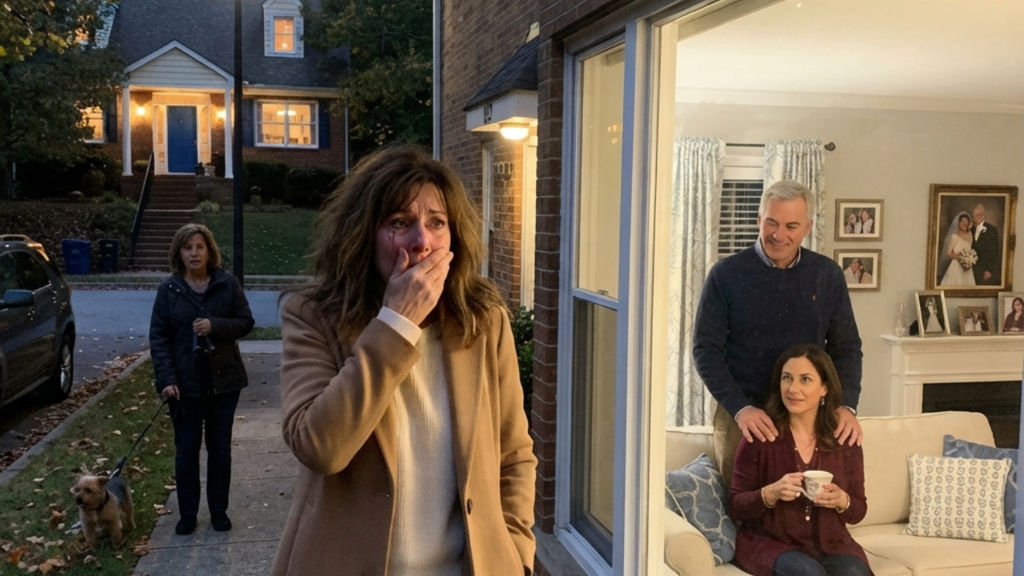
I discovered it because of a $1,450 charge on our bank statement.
At first, I thought it was a mistake.
The payment was listed under a property management company I’d never heard of.
When I called to ask about it, the woman on the phone cheerfully informed me that the payment was for Apartment 3B at 417 Willow Street.
I almost laughed.
“That can’t be right. My husband and I live at 412 Willow Street.”
There was a pause.
Then she said, “Oh! Well, isn’t that convenient? You’re right across from each other.”
I stared at the wall.
“What do you mean?”
“Apartment 3B faces your house. Your husband has been a wonderful tenant for years.”
I swallowed.
“How many years?”
She checked her computer.
Then said:
“Nineteen. He moved in on March fourteenth, 2007.”
My name is Helen Whitmore.
I’m sixty-four years old.
I’ve been married to my husband, David, for forty-one years.
We live in a beautiful old neighborhood in Columbus, Ohio.
Tree-lined streets.
Brick sidewalks.
Large front porches.
And houses built in the early 1900s.
Our home is a white two-story colonial with black shutters and a red front door.
We bought it in 1999.
Raised our three children there.
Celebrated birthdays.
Hosted Christmas dinners.
And watched our grandchildren play in the front yard.
David is sixty-seven.
He’s a financial adviser.
Handsome.
Well-spoken.
The kind of man who remembers everyone’s name and always knows exactly what to say.
For forty-one years, I believed we had a good marriage.
Not perfect.
But good.
He worked hard.
Provided for our family.
And rarely complained.
I was a high school guidance counselor before retiring four years ago.
We had three children.
Rebecca, thirty-nine.
Andrew, thirty-six.
And Caroline, thirty-three.
Five grandchildren.
A comfortable retirement.
And what I thought was a peaceful future ahead of us.
Then I discovered the apartment.
And everything changed.
The apartment building across the street had always been there.
Three stories.
Red brick.
White trim.
A small courtyard.
And six apartments.
I’d walked past it thousands of times.
Watched tenants move in and out.
Seen delivery trucks.
Maintenance workers.
And people carrying groceries through the front entrance.
I knew some of the residents.
An older woman named Mrs. Peterson had lived on the first floor for years.
A young couple rented the second floor.
And there was a quiet woman in the upstairs apartment who occasionally watered plants on her balcony.
But I never paid much attention to Apartment 3B.
Why would I?
It was just another apartment across the street.
I certainly never imagined my husband had been renting it since our youngest daughter was fourteen.
The charge appeared while I was reviewing our finances.
David had always handled most of our investments.
But after retiring, I decided I wanted to understand everything better.
I began going through statements.
Checking recurring payments.
Organizing insurance documents.
And making a list of accounts.
That’s when I noticed the property management charge.
$1,450.
Every month.
I checked the previous statement.
Same amount.
Then the month before.
Same.
I searched older records.
The payments went back years.
Some were smaller.
$850.
$975.
$1,100.
Then gradually increased.
I couldn’t understand it.
We didn’t own rental property.
At least, not that I knew of.
So I called the management company.
And discovered my husband had been paying for an apartment across the street.
For nineteen years.
I sat at my kitchen table after the call ended.
Staring through the window.
Directly across the street.
At Apartment 3B.
The curtains were partially open.
A lamp was glowing inside.
Someone was home.
I felt sick.
Was David having an affair?
Did he have another family?
Had he been secretly living there?
I couldn’t imagine how he’d managed it.
David came home every night.
Slept beside me.
Ate breakfast with me.
Went to church with me.
Attended family gatherings.
Took vacations.
And celebrated anniversaries.
He traveled occasionally for work.
But not often.
How could he maintain another apartment directly across the street without my noticing?
I stared at the building.
Then I noticed something.
A woman standing at the window.
She was looking toward our house.
I couldn’t see her face clearly.
But she was watching.
Not casually.
Not glancing outside.
Watching.
Then she stepped away.
And the curtains closed.
That evening, David came home at six-thirty.
He kissed my cheek.
Asked about my day.
And opened the refrigerator.
“What’s for dinner, sweetheart?”
I stared at him.
For a moment, I wanted to scream.
Demand answers.
Throw the bank statements onto the counter.
But something stopped me.
I wanted to know what was happening before he had a chance to explain it away.
So I smiled.
“Chicken.”
He nodded.
“Sounds good.”
Then he poured himself a glass of water.
And walked upstairs.
I watched him go.
Wondering whether he’d spent part of his afternoon across the street.
Wondering who was waiting there.
And wondering how many times he’d stood in that apartment looking into our home.
The next morning, David left for work at eight-fifteen.
I waited until his car disappeared.
Then walked across the street.
The building had a small entrance hall.
Mailboxes lined one wall.
There was a staircase leading upstairs.
And a notice board with maintenance announcements.
I climbed to the third floor.
Apartment 3B was at the end of the hallway.
The door was painted dark green.
There was a brass number plate.
And a small welcome mat.
I stood there for several seconds.
Then knocked.
Nothing.
I knocked again.
Still nothing.
I leaned closer.
I could hear music.
Soft classical music.
Someone was inside.
I knocked a third time.
The music stopped.
Then a woman’s voice called:
“Who is it?”
I swallowed.
“My name is Helen Whitmore.”
Silence.
I continued.
“I live across the street.”
There was a long pause.
Then the woman said:
“I know who you are.”
I stared at the door.
“Can we talk?”
No answer.
I waited.
Then she said:
“You shouldn’t be here.”
My stomach tightened.
“Why not?”
Silence.
I swallowed.
“Does my husband rent this apartment?”
I heard movement.
Then the sound of a lock turning.
The door opened approximately two inches.
A woman stood behind it.
She was in her late fifties.
Maybe early sixties.
Thin.
Pale.
With shoulder-length brown hair streaked with gray.
She wore a blue cardigan.
And glasses.
She looked exhausted.
But what struck me most was her expression.
She wasn’t surprised.
She wasn’t confused.
She looked terrified.
I stared at her.
“Who are you?”
She swallowed.
Then whispered:
“Helen, you need to leave before David finds out you’re here.”
I felt cold.
“How do you know my husband?”
She looked toward the staircase.
Then back at me.
“Please.”
I stepped closer.
“Are you having an affair with him?”
Her eyes filled with tears.
She shook her head.
“No.”
I swallowed.
“Then why is he paying your rent?”
She looked devastated.
Then whispered:
“Because he doesn’t want me to leave.”
I stared at her.
“What?”
She glanced down the hallway.
Then said:
“Please, Helen. Go home.”
I shook my head.
“No.”
She started crying.
I continued.
“My husband has been paying for this apartment for nineteen years.”
She nodded.
“I know.”
I felt sick.
“Why?”
She looked at me.
Then whispered:
“Because of what happened to your daughter.”
I stopped breathing.
“My daughter?”
She nodded.
I felt cold.
“Which daughter?”
The woman looked devastated.
Then said:
“Caroline.”
Caroline.
My youngest.
Thirty-three years old.
A kindergarten teacher.
Married.
Mother of two beautiful little girls.
I stared at the woman.
“What does Caroline have to do with this?”
She hesitated.
Then whispered:
“Ask David what happened the night she disappeared.”
I couldn’t breathe.
Caroline had disappeared for three days when she was fourteen.
It happened in March 2007.
She’d been staying with a friend.
Or so we’d believed.
When she didn’t come home, we called the police.
There were searches.
Interviews.
Flyers.
And three days of absolute terror.
Then Caroline returned.
She was found at a bus station approximately forty miles away.
She was frightened.
Exhausted.
And refused to explain where she’d been.
David told me the police believed she’d run away.
He said she’d been overwhelmed by school.
Friends.
Teenage problems.
Caroline eventually began therapy.
We tried to move forward.
But something about those three days had always bothered me.
Caroline never talked about them.
Not with me.
Not with her siblings.
And not even years later.
Now a stranger was standing in an apartment across the street, telling me David had been paying her rent because of what happened to Caroline.
I stared at her.
“What do you know about my daughter?”
She started crying.
Then whispered:
“I know she didn’t run away.”
My heart started pounding.
“What?”
The woman looked toward the staircase again.
Then said:
“She was brought here.”
I felt sick.
“Here?”
She nodded.
I stared past her.
Into the apartment.
I could see a hallway.
A small living room.
A lamp.
And several framed photographs.
Then I noticed something.
One photograph showed a teenage girl.
Long brown hair.
Blue eyes.
A familiar smile.
Caroline.
At fourteen.
I stepped forward.
“Why do you have a picture of my daughter?”
The woman tried to close the door.
I caught the edge with my hand.
“Please.”
She started crying.
“Helen, don’t.”
I looked at her.
Then whispered:
“What happened to my little girl?”
The woman stood motionless.
Then slowly opened the door.
“Come inside.”
I stepped into the apartment.
It smelled like lavender.
The furniture was old-fashioned.
A floral sofa.
A wooden coffee table.
Bookshelves.
And a small dining table beside the window.
Everything was neat.
Almost unnaturally neat.
Then I saw the photographs.
Dozens of them.
On shelves.
On walls.
In frames.
Caroline.
At fourteen.
Fifteen.
Sixteen.
Seventeen.
High school graduation.
College graduation.
Her wedding.
Her first baby.
Her second baby.
I stared at them.
My daughter’s entire life.
Displayed inside an apartment across the street from our house.
I felt sick.
“Where did you get these?”
The woman looked away.
“David brings them.”
I swallowed.
“Why?”
She didn’t answer.
I walked toward the window.
The curtains were partially open.
From that position, I could see directly into our living room.
Our kitchen.
And part of the upstairs hallway.
I felt cold.
Then I noticed a small camera on the windowsill.
Pointed toward our house.
I turned.
“Are you recording us?”
The woman started crying.
Then whispered:
“Not anymore.”
I stared at her.
“Not anymore?”
She nodded.
I felt sick.
“How long?”
She looked devastated.
Then said:
“Since Caroline came home.”
I couldn’t breathe.
Nineteen years.
Someone had been watching our house for nineteen years.
Recording us.
Photographing us.
Following my daughter’s life.
And my husband had been paying for it.
I looked at the woman.
“Who are you?”
She wiped her face.
Then said:
“My name is Patricia Vale.”
I swallowed.
“Why do you know Caroline?”
She looked toward the photographs.
Then whispered:
“Because I was the woman who found her.”
I stared at her.
“Found her?”
Patricia nodded.
“Yes.”
I felt cold.
“Where?”
She hesitated.
Then said:
“In the basement of a house your husband owned.”
I stopped breathing.
“My husband?”
She nodded.
I shook my head.
“David didn’t own another house.”
Patricia looked devastated.
“He did.”
I felt sick.
“Where?”
She swallowed.
“Outside Lancaster.”
I stared at her.
Then asked:
“What was Caroline doing there?”
Patricia closed her eyes.
Then whispered:
“She was locked inside.”
I couldn’t speak.
My daughter.
Fourteen years old.
Locked in a basement.
I grabbed the back of a chair.
Patricia reached toward me.
I stepped away.
“Who locked her in?”
She started crying.
Then whispered:
“I don’t know who put her there.”
I stared at her.
“But you found her?”
She nodded.
I swallowed.
“Then why didn’t you call the police?”
She looked ashamed.
“Because David told me he was handling it.”
I felt sick.
“Handling it?”
Patricia nodded.
“He said Caroline had been having problems.”
I shook my head.
“No.”
“He said she was confused.”
I started crying.
“No.”
Patricia continued.
“He told me she’d been hiding there.”
I stared at her.
“Then why was she locked inside?”
Patricia looked down.
“I asked him that.”
I swallowed.
“And?”
She hesitated.
Then whispered:
“He said it was for her own protection.”
I felt rage rising in my chest.
Protection.
My husband had told me Caroline ran away.
He’d told the police she was having teenage problems.
He’d encouraged therapy.
And he’d spent nineteen years paying for an apartment occupied by the woman who found her locked in a basement.
I stared at Patricia.
“Why are you telling me this now?”
She started crying.
“Because I can’t do it anymore.”
I swallowed.
“Do what?”
She looked toward the camera.
Then back at me.
“Watch your family for him.”
I stared at her.
“David made you watch us?”
She nodded.
I felt sick.
“Why?”
Patricia hesitated.
“Because he wanted to know whether Caroline remembered.”
I couldn’t breathe.
“Remembered what?”
She looked at me.
Then whispered:
“What she saw in that basement.”
I sat down.
My legs wouldn’t hold me.
Patricia brought me a glass of water.
I didn’t touch it.
I stared at the photographs.
My daughter’s entire life.
Recorded.
Watched.
Documented.
I looked at Patricia.
“What did Caroline see?”
She hesitated.
Then said:
“I don’t know everything.”
I swallowed.
“Tell me what you do know.”
Patricia sat across from me.
Her hands were trembling.
Then she began.
In March 2007, Patricia had been working as a housekeeper.
She cleaned several properties for wealthy families around Columbus.
One of her clients was David.
He’d hired her to maintain a house outside Lancaster.
He told her it was an investment property.
Mostly vacant.
Occasionally used by business associates.
She cleaned it twice a month.
On March twelfth, she arrived unexpectedly because a pipe had burst in the kitchen.
David had called and asked her to meet a plumber.
While waiting, she heard noises from the basement.
At first, she thought it was an animal.
Then she heard someone crying.
She went downstairs.
And found a locked door.
Behind it was a teenage girl.
Caroline.
Patricia recognized her from family photographs.
She called David.
He arrived forty minutes later.
Patricia demanded an explanation.
David said Caroline had been having behavioral problems.
He claimed she’d run away from home and he’d found her.
He said he was keeping her somewhere safe until she calmed down.
Patricia didn’t believe him.
She threatened to call the police.
David became furious.
Then he told her something that frightened her.
He said if she reported what she’d seen, she’d be blamed for helping conceal a missing child.
He reminded her that she’d been cleaning the house.
That her fingerprints were everywhere.
That she’d had access to the basement.
And that nobody would believe a housekeeper over a respected financial adviser.
Patricia was terrified.
She’d recently lost her husband.
Had no savings.
And was supporting her elderly mother.
David offered her money.
Then an apartment.
Then a monthly payment.
All she had to do was stay quiet.
I stared at her.
“You took the money?”
Patricia started crying.
“Yes.”
I felt sick.
“For nineteen years?”
She nodded.
I couldn’t speak.
Then she said:
“But that wasn’t the only reason he kept me here.”
I looked at her.
“What?”
She swallowed.
“David wanted me close enough to watch your house.”
I felt cold.
“Why?”
She hesitated.
“He said Caroline might eventually remember what happened.”
I stared at her.
“And?”
Patricia looked devastated.
“He wanted to know if she started asking questions.”
I swallowed.
“How would you know?”
She gestured toward the photographs.
“The family.”
I frowned.
“What?”
Patricia continued.
“David would bring me updates.”
I felt sick.
“He’d tell me when Caroline was visiting.”
I stared at her.
“He’d ask me to watch for unusual behavior.”
I swallowed.
“Like what?”
She hesitated.
“If she came to the house alone.”
I felt cold.
“If she looked upset.”
Patricia nodded.
“If she stayed late.”
I couldn’t speak.
Then she said:
“And if she ever came here.”
I stared at her.
“Why would Caroline come here?”
Patricia looked toward the window.
Then whispered:
“Because she used to.”
I stopped breathing.
“What?”
Patricia nodded.
“After she came home.”
I felt sick.
“Caroline came to this apartment?”
She started crying.
“Yes.”
I swallowed.
“When?”
Patricia hesitated.
“Several times.”
I couldn’t speak.
“Why?”
She looked devastated.
Then said:
“Because she knew I was the woman who found her.”
I stared at Patricia.
My daughter had been fourteen.
Frightened.
Traumatized.
And apparently visiting a woman across the street from our home.
Without telling me.
I swallowed.
“What did she say?”
Patricia closed her eyes.
“She wanted answers.”
I felt sick.
“About the basement?”
She nodded.
I leaned forward.
“What did you tell her?”
Patricia started crying.
“Nothing.”
I stared at her.
“Nothing?”
She shook her head.
“David told me not to.”
I felt rage rising.
“So you let a fourteen-year-old girl walk away without knowing what happened to her?”
Patricia covered her face.
“I was afraid.”
I stood.
“She was fourteen!”
Patricia sobbed.
“I know.”
I stared at her.
Then said:
“You weren’t the one locked in a basement.”
Patricia cried harder.
I didn’t comfort her.
I couldn’t.
Not yet.
Because my daughter had spent nineteen years living with something nobody had explained.
And the people who knew had been protecting themselves.
I looked at Patricia.
“Did Caroline ever tell you what she remembered?”
Patricia hesitated.
“Some things.”
I swallowed.
“What things?”
She looked terrified.
Then whispered:
“She said there was another girl.”
I stopped breathing.
“Another girl?”
Patricia nodded.
I felt cold.
“Where?”
She swallowed.
“In the basement.”
I stared at her.
“With Caroline?”
She nodded.
I couldn’t speak.
Then Patricia said:
“Caroline told me the other girl never came home.”
I felt sick.
I stared at Patricia.
“Who was she?”
Patricia shook her head.
“I don’t know.”
I swallowed.
“Did you see her?”
Patricia looked away.
“No.”
I felt cold.
“Then how do you know?”
She hesitated.
“Because Caroline described her.”
I leaned forward.
“What did she say?”
Patricia swallowed.
Then whispered:
“She said the girl had red hair, a blue backpack, and a silver bracelet with her name on it.”
I stared at her.
“Did Caroline tell you the name?”
Patricia closed her eyes.
Then nodded.
I felt sick.
“What was it?”
She hesitated.
Then whispered:
“Emily.”
I couldn’t breathe.
Emily.
A girl with red hair.
A blue backpack.
And a silver bracelet.
I stared at Patricia.
Then remembered something.
A missing girl.
Years earlier.
Her photograph had been everywhere.
On television.
In newspapers.
On flyers taped to grocery store windows.
A teenage girl who disappeared from a shopping center outside Columbus.
I felt cold.
I looked at Patricia.
“Emily Parker?”
Patricia went white.
Then whispered:
“Yes.”
I sat motionless.
Emily Parker had disappeared in March 2007.
She was fifteen.
Her parents had spent years searching for her.
There had been television interviews.
Candlelight vigils.
Fundraisers.
And annual appeals for information.
I remembered seeing her mother on the news.
Crying.
Holding a photograph.
Begging anyone who knew something to come forward.
And now Patricia was telling me my daughter had seen Emily inside a basement owned by my husband.
I stared at her.
“Did you tell the police?”
Patricia shook her head.
I couldn’t speak.
“Did David know?”
She looked devastated.
Then whispered:
“Helen, David knew exactly who Emily was.”
I felt cold.
“How?”
Patricia hesitated.
Then said:
“Because Emily was the reason Caroline was taken there.”
I couldn’t breathe.
“What?”
Patricia looked toward the window.
Then back at me.
She started crying again.
“Caroline wasn’t supposed to be at that house.”
I stared at her.
“Then why was she?”
Patricia swallowed.
“She followed David.”
I felt sick.
“Followed him?”
Patricia nodded.
“She thought he was having an affair.”
I couldn’t speak.
My fourteen-year-old daughter.
Following her father.
Trying to find out whether he was cheating.
Patricia continued.
“She saw him meeting someone.”
I swallowed.
“Who?”
She hesitated.
Then said:
“A woman who worked at his office.”
I stared at her.
“What woman?”
Patricia looked terrified.
Then whispered:
“Her name was Laura Bennett.”
Laura Bennett.
I knew that name.
She’d been David’s assistant.
Young.
Blonde.
Friendly.
She’d worked for him for several years.
Then suddenly resigned in 2007.
David told me she’d moved to Florida.
I hadn’t thought about her in nearly two decades.
I stared at Patricia.
“Laura?”
She nodded.
I swallowed.
“What did she have to do with Emily?”
Patricia hesitated.
Then whispered:
“Emily was her daughter.”
I stopped breathing.
Emily Parker.
Laura Bennett.
The names didn’t match.
Then I remembered.
Laura had been divorced.
Bennett was her maiden name.
Parker was her married name.
I felt sick.
I stared at Patricia.
“Are you telling me David’s assistant was Emily’s mother?”
She nodded.
I couldn’t speak.
Then Patricia said something that made my entire body go cold.
“And Laura disappeared two weeks after Emily.”
I stared at her.
“What?”
Patricia nodded.
“David told everyone she moved away.”
I felt sick.
“But she didn’t?”
Patricia looked devastated.
“I don’t know.”
I swallowed.
Then she whispered:
“But I saw her car at the house after Caroline came home.”
I couldn’t breathe.
I looked around the apartment.
The photographs.
The camera.
The window facing our home.
The nineteen years of rent payments.
And suddenly, I realized I was sitting in the apartment of a woman who might know what happened to two missing people.
I stood.
“I’m calling the police.”
Patricia grabbed my wrist.
“Helen, please.”
I pulled away.
“No.”
She started crying.
“David will know.”
I stared at her.
“Good.”
Then I reached for my phone.
But before I could dial, Patricia looked toward the window.
Her face changed.
She went completely white.
I followed her gaze.
Across the street.
In our driveway.
David’s car had just pulled up.
At eleven-thirty in the morning.
Three hours before he normally came home.
Patricia whispered:
“Helen, he’s early.”
I stared at my husband through the window.
He stepped out of his car.
Looked toward our house.
Then slowly turned his head.
Toward Apartment 3B.
Toward the window where we were standing.
Patricia grabbed my arm.
“Get away from there.”
I stepped back.
David took out his phone.
A second later, Patricia’s phone began ringing.
She looked at the screen.
Then at me.
Her hands were shaking.
“Don’t answer,” I whispered.
She shook her head.
“You don’t understand.”
I felt cold.
“What?”
Patricia started crying.
Then said:
“Helen, he knows when someone comes into this apartment.”
I stared at her.
“How?”
She pointed toward the ceiling.
I looked up.
There was a small black camera mounted near the hallway.
Then another above the kitchen doorway.
I felt sick.
Patricia whispered:
“He’s been watching me too.”
Across the street, David stood beside his car.
Still holding his phone.
Then he looked directly toward the apartment window.
And smiled.
Not a friendly smile.
Not the smile I’d seen across our dinner table for forty-one years.
Something else.
Something that made me feel as though I was looking at a stranger.
Then he started walking.
Across the street.
Toward the apartment building.
Patricia grabbed my hand.
“Helen, listen to me.”
I stared at her.
She looked terrified.
“There’s something in the bedroom.”
I swallowed.
“What?”
She pointed down the hallway.
“Under the floor.”
I felt cold.
“What?”
Her voice broke.
“It’s what Caroline left here the last time she came.”
I couldn’t breathe.
“What did she leave?”
Patricia started crying.
Then whispered:
“The proof.”
I stared at her.
“Proof of what?”
She looked toward the front door.
David’s footsteps were approaching the building.
Then Patricia turned back to me.
And said:
“Proof that Emily Parker wasn’t the only girl in that basement.”
My husband was coming up the stairs.
I could hear his footsteps through the apartment door.
For forty-one years, I’d recognized that sound. David had a slight limp from an old football injury, and his right shoe always struck the floor a little harder than his left.
I’d heard those footsteps coming home from work, climbing into bed, and walking down the hallway to kiss our children goodnight.
Now, standing inside the apartment he’d secretly rented across the street for nineteen years, I was terrified of hearing them.
Patricia grabbed my wrist.
“Helen, we have about thirty seconds.”
She pulled me toward the bedroom.
“What about the police?” I whispered.
“Call them. But get this first.”
She knelt beside the bed and lifted the corner of a faded blue rug.
Underneath was a narrow wooden floorboard with two screws missing.
Patricia hooked her fingers beneath it.
The board came loose.
Inside the shallow space was a plastic document pouch.
She handed it to me.
“Take it.”
I stared at the pouch.
“What is it?”
“Caroline brought it here eleven years ago. She made me promise I’d keep it somewhere David couldn’t find.”
“Why didn’t you tell me?”
Patricia’s eyes filled with tears.
“Because she made me promise something else.”
“What?”
“That I wouldn’t tell you until she was ready.”
Before I could answer, someone knocked.
Three firm knocks.
Then David’s voice.
“Patricia?”
We froze.
Another knock.
“I know you’re home.”
Patricia grabbed my arm and pointed toward a narrow door beside the closet.
“Fire stairs. Go down two floors, then out through the laundry room.”
“What about you?”
“I’ll keep him talking.”
I shook my head.
“He’s dangerous.”
She looked at me with an expression I couldn’t understand.
“I’ve known that for nineteen years.”
Then she pushed the pouch into my hands.
“Please, Helen. Whatever happens, don’t let him take this.”
I slipped into the narrow stairwell and closed the door behind me.
My hands were shaking so badly I could barely hold my phone.
I called 911.
I gave the dispatcher the apartment address, explained that I had just discovered information potentially connected to a nineteen-year-old missing-person case, and told her my husband was approaching a woman who appeared frightened of him.
She asked whether anyone had threatened me.
I told her about the hidden cameras, the photographs of my daughter, and Patricia’s account of Caroline being found locked inside a basement.
The dispatcher instructed me to leave the building and wait somewhere safe.
I was halfway down the stairs when I heard the apartment door open above me.
David’s voice carried through the hallway.
“Where is she?”
Patricia answered.
“Who?”
“Don’t play games with me.”
There was a pause.
Then he said something that stopped me cold.
“I saw Helen come inside. Where did you put her?”
I kept moving.
By the time I reached the laundry room, I was crying.
I slipped through the rear exit and hurried around the building.
Instead of going home, I crossed to my neighbor’s house.
Mrs. Peterson’s daughter, Elaine, happened to be visiting.
She let me inside immediately.
I stood in her kitchen, clutching the plastic pouch against my chest, while we waited for the police.
The first officer arrived eleven minutes later.
A second patrol car followed.
I watched from Elaine’s window as the officers entered the apartment building.
Then David came outside.
He looked irritated.
Not frightened.
Not guilty.
Just annoyed.
He spoke with one of the officers for several minutes, gesturing toward our house.
Then he took out his phone.
Mine started ringing.
I stared at his name on the screen.
David.
Forty-one years of marriage.
Three children.
Five grandchildren.
And I suddenly couldn’t bring myself to answer.
The call stopped.
A message appeared.
Helen, whatever Patricia told you, she’s confused. Come home and we’ll discuss this privately.
Another message followed.
You’re making a terrible mistake.
Then a third.
Caroline will never forgive you if you do this.
I stared at those words.
And for the first time, I wondered whether my daughter had known the truth about her father all along.
The officers spoke with Patricia separately.
They asked David to remain available for further questioning.
He wasn’t arrested that afternoon.
There wasn’t yet enough verified evidence to establish exactly what had happened nineteen years earlier.
But the information was referred to detectives, and arrangements were made to preserve the material I’d brought out of the apartment.
I gave them the pouch without opening it.
One officer asked whether I knew what was inside.
“No.”
“Who gave it to you?”
“Patricia Vale.”
“And she said it belonged to your daughter?”
I nodded.
“She said Caroline left it eleven years ago.”
He wrote that down.
Then asked whether Caroline was still alive.
I stared at him.
“Of course she is.”
He nodded.
“Do you know where she is?”
“She lives in Dublin. Ohio. With her husband and two daughters.”
The officer looked at his notebook.
“Would you be willing to contact her?”
I swallowed.
“Yes.”
But as I reached for my phone, I realized something.
I hadn’t spoken to Caroline in four days.
That wasn’t unusual.
She had two little girls and a full-time teaching job.
Still, I suddenly needed to hear her voice.
I called.
No answer.
I tried again.
Voicemail.
Then I called her husband, Nathan.
He answered immediately.
“Hi, Helen.”
“Nathan, is Caroline there?”
There was a pause.
“Actually, I was about to call you.”
My stomach dropped.
“Why?”
He sounded concerned.
“Caroline left yesterday morning, and I haven’t been able to reach her since.”
I gripped the counter.
“What?”
Nathan took a breath.
“She told me she needed to take care of something from her childhood.”
I couldn’t speak.
“Did she say what?”
“No. She said she’d explain when she got back.”
“Where did she go?”
“She wouldn’t tell me.”
I looked toward the apartment building.
“Did she take the girls?”
“No. They’re with me.”
I closed my eyes.
Nathan continued.
“Helen, she seemed upset. I thought maybe she’d had an argument with you or David.”
I swallowed.
“She hasn’t.”
There was a pause.
Then he asked, “Is something wrong?”
I looked at Elaine.
At the police cars.
At my husband standing across the street.
Then I said, “Nathan, I need you to listen carefully.”
Within an hour, my children knew.
Rebecca drove directly to Elaine’s house.
Andrew called from Cincinnati and said he was coming home.
Nathan contacted the police about Caroline.
And I learned that my daughter had told him something unusual before leaving.
She’d asked him to promise he wouldn’t let David take the girls anywhere.
At the time, Nathan thought it was a strange request.
Now he was frightened.
I asked him whether Caroline had seemed afraid of her father.
He hesitated.
Then said, “Helen, Caroline’s never liked being alone with David.”
I stared at the phone.
“What?”
Nathan sighed.
“I thought you knew.”
I couldn’t speak.
He continued.
“She gets anxious whenever he visits. She doesn’t want him picking the girls up from school. She doesn’t even like him taking them into another room.”
I felt tears forming.
“Why didn’t she tell me?”
Nathan was quiet.
Then he said:
“She told me you’d never believe her.”
That hurt more than I expected.
Because I wanted to believe I was the kind of mother my children could tell anything.
I’d been a guidance counselor for thirty years.
I’d helped hundreds of teenagers through difficult situations.
I’d encouraged them to speak up.
To trust their instincts.
To tell a safe adult when something was wrong.
And somehow, my own daughter had spent nineteen years believing I wouldn’t listen.
I sat down.
Rebecca knelt beside me.
“Mom?”
I looked at her.
“Did you know Caroline was afraid of your father?”
Rebecca’s expression changed.
She looked away.
I felt sick.
“Rebecca?”
She swallowed.
“Mom, there are things you don’t know.”
I stared at her.
“Then tell me.”
She sat beside me.
And began crying.
Rebecca was twenty years old when Caroline disappeared.
She was away at college.
When she came home, she found our house filled with police officers, relatives, and neighbors.
She remembered David being strangely calm.
I remembered that too.
I’d been hysterical.
Barely sleeping.
Barely eating.
David had kept telling me Caroline would come home.
That she was probably hiding with friends.
That teenagers did things like this.
At the time, I’d admired his composure.
Rebecca hadn’t.
“Mom, I heard Dad on the phone the second night.”
I stared at her.
“What did he say?”
She wiped her face.
“He was in the garage. He didn’t know I was there.”
I swallowed.
“And?”
“He said, ‘You need to move her before someone finds the house.'”
My blood ran cold.
I couldn’t speak.
Rebecca continued.
“I thought he was talking about Caroline.”
“Why didn’t you tell me?”
She started crying.
“I told him I’d heard.”
I stared at her.
“And?”
“He said he was talking to the private investigator he’d hired.”
I closed my eyes.
“He said they were trying to get Caroline away from someone dangerous.”
I swallowed.
“And you believed him?”
Rebecca looked devastated.
“I was twenty, Mom. My sister was missing. Dad told me the police already knew.”
I reached for her hand.
She continued.
“After Caroline came home, I asked her what happened.”
My heart started pounding.
“What did she say?”
Rebecca hesitated.
Then whispered:
“She told me Dad was the reason she couldn’t come home.”
I stared at her.
“Did she explain?”
Rebecca shook her head.
“She started crying. Then Dad came into the room, and she stopped talking.”
I couldn’t breathe.
Rebecca continued.
“He told me not to upset her with questions.”
I felt sick.
“And?”
“He said her therapist wanted us to let her move on.”
I remembered that.
David had repeated it constantly.
Don’t pressure Caroline.
Don’t make her relive it.
Let the professionals handle it.
I’d believed him.
Now I wondered whether he’d been using my concern for our daughter’s well-being to keep her silent.
That evening, Detective Daniel Ruiz arrived.
He was in his late forties, with graying hair and a quiet manner.
He’d been assigned to review the information about Caroline’s disappearance and its possible connection to Emily Parker.
He sat across from me at Elaine’s dining table.
“Mrs. Whitmore, we’ve begun reviewing the materials your daughter left with Patricia.”
I leaned forward.
“What did she leave?”
He opened a notebook.
“Photographs, handwritten notes, and copies of several documents.”
My stomach tightened.
“What kind of photographs?”
He hesitated.
“Some appear to show the interior of a basement.”
I swallowed.
“And?”
“There are images of a room with a locked door.”
I felt cold.
“Was Caroline in them?”
“Not in the photographs we’ve examined so far.”
I closed my eyes.
Then he continued.
“There’s also a handwritten account.”
I stared at him.
“From Caroline?”
“Yes.”
I felt tears forming.
“What does it say?”
He paused.
“Mrs. Whitmore, I’d prefer to discuss the relevant portions carefully. Some details may be upsetting, and we’re still verifying them.”
I nodded.
“Please.”
He took a breath.
Then said:
“Your daughter wrote that she followed her father to the Lancaster property because she believed he was meeting a woman there.”
I gripped my hands together.
“Laura Bennett?”
The detective nodded.
“That’s one of the names mentioned.”
I swallowed.
“Did Caroline see Emily?”
“According to her account, yes.”
I felt sick.
He continued.
“Caroline described entering the house through an unlocked side door. She heard voices downstairs and went to investigate.”
I couldn’t breathe.
“Then what?”
“She saw a teenage girl sitting in a basement room.”
I closed my eyes.
“Emily?”
“She believed it was Emily Parker.”
I started crying.
The detective waited.
Then continued.
“Caroline wrote that the girl appeared frightened. She asked Caroline to help her leave.”
I swallowed.
“And Caroline tried?”
He nodded.
“Yes.”
I felt a terrible ache in my chest.
My little girl.
Fourteen years old.
Trying to help another child.
The detective continued.
“Caroline said she heard someone approaching. She attempted to leave, but the basement door was locked before she could get upstairs.”
I stared at him.
“Who locked it?”
He hesitated.
“She believed it was your husband.”
I covered my mouth.
Detective Ruiz continued.
“Her account says David came downstairs and demanded to know why she was there.”
I couldn’t speak.
“She told him she’d followed him.”
I nodded through my tears.
“He became angry. He told her she had no idea what she’d walked into.”
I swallowed.
“And Emily?”
The detective looked at his notes.
“Caroline wrote that Emily began crying and begged David not to take her away.”
I felt sick.
“Take her where?”
“That isn’t clear.”
I closed my eyes.
Then the detective said:
“Caroline wrote that David told Emily, ‘Your mother should have thought about that before she threatened me.'”
I stared at him.
“Laura threatened David?”
“That’s one possibility we’re investigating.”
I swallowed.
“About what?”
He hesitated.
“We don’t know yet.”
I thought about Laura.
She’d worked for David for years.
She’d come to our house for holiday parties.
She’d brought homemade cookies at Christmas.
She’d been kind to my children.
And now I was discovering her daughter might have been held in a basement connected to my husband.
I looked at the detective.
“Did Caroline write what happened next?”
He nodded.
“She said David took Emily upstairs.”
I felt cold.
“And?”
“Caroline remained locked in the basement.”
I swallowed.
“For how long?”
“She wasn’t certain.”
I stared at him.
“Did Emily come back?”
The detective was quiet.
Then said:
“According to Caroline, she never saw Emily again.”
I began crying.
The detective gave me a moment.
Then continued.
“Caroline wrote that someone brought her food and water.”
I wiped my face.
“Who?”
“She didn’t identify the person with certainty.”
I swallowed.
“Did she describe them?”
He nodded.
“She described a woman.”
My heart started pounding.
“Patricia?”
“Possibly. But the timing in her account suggests there may have been someone else.”
I felt cold.
“Someone else?”
He nodded.
I stared at him.
Then asked:
“Did Caroline describe her?”
The detective hesitated.
“Yes.”
I swallowed.
“What did she look like?”
He glanced at his notes.
Then said:
“A woman with long blonde hair and a distinctive scar beneath her chin.”
I stopped breathing.
A scar beneath her chin.
I knew someone with that scar.
I’d seen it hundreds of times.
At birthday parties.
Christmas dinners.
Church picnics.
And family weddings.
I stared at Detective Ruiz.
“Are you sure?”
He nodded.
“That’s what Caroline wrote.”
I felt sick.
Then whispered:
“My sister-in-law has that scar.”
My husband’s younger sister.
Diane.
Sixty-two years old.
A retired nurse.
She’d been one of my closest friends for decades.
She’d helped me decorate the nursery when Caroline was born.
Brought casseroles when my father died.
Watched our children when David and I traveled.
And sat beside me during the three days Caroline was missing.
I remembered Diane holding my hand.
Telling me everything would be okay.
Promising Caroline would come home.
I looked at the detective.
“Her name is Diane Whitmore.”
He wrote it down.
Then asked:
“Was she working as a nurse in 2007?”
I nodded.
“Yes.”
He looked serious.
“Did she have access to the Lancaster property?”
I thought for a moment.
“I don’t know.”
Then I remembered something.
Diane had helped David renovate an investment property years earlier.
She’d complained about the long drive.
The dust.
The old plumbing.
I felt sick.
“She might have.”
The detective nodded.
Then asked:
“Mrs. Whitmore, did Diane ever tell you she knew where Caroline was during those three days?”
I shook my head.
“No.”
He waited.
Then I remembered.
The second night Caroline was missing, Diane had come to our house with groceries.
She’d brought soup.
Bread.
Coffee.
And a bottle of my favorite wine.
She’d insisted I eat.
When I refused, she’d become unusually emotional.
She’d hugged me and whispered:
Helen, sometimes the people we love do things we don’t understand.
I’d thought she was talking about Caroline running away.
Now I wondered whether she’d been talking about David.
Or herself.
Detective Ruiz asked for Diane’s contact information.
Then he asked another question.
“Mrs. Whitmore, have you spoken to your husband since this morning?”
I shook my head.
“Only through messages.”
“Has he contacted your children?”
“Yes.”
“What did he say?”
I showed him the messages Rebecca had received.
David had written:
Your mother is being manipulated by Patricia. She’s always been unstable.
Then:
Please don’t involve Caroline. She’s fragile, and this could destroy her.
And finally:
I need you to convince your mother to come home.
The detective read them carefully.
Then said, “For now, I’d recommend that you communicate through counsel and avoid meeting him alone.”
I nodded.
Then asked:
“What about Caroline?”
His expression softened.
“We’re working on locating her.”
I swallowed.
“Do you think she’s in danger?”
He hesitated.
“We don’t have enough information to determine that.”
I looked at him.
“But you’re concerned.”
He nodded.
“Yes.”
That night, I couldn’t sleep.
I stayed at Rebecca’s house.
David remained at ours.
I refused to go home until I understood what was happening.
At eleven-thirty, my phone rang.
Unknown number.
I almost ignored it.
Then something made me answer.
“Hello?”
Silence.
“Hello?”
A woman’s voice whispered:
“Mom?”
I sat straight up.
“Caroline?”
She started crying.
“Mom, I’m sorry.”
I felt tears rushing down my face.
“Sweetheart, where are you?”
She hesitated.
“I’m safe.”
“Where?”
“Please don’t ask me that yet.”
I swallowed.
“Caroline, the police are looking for you.”
“I know.”
I couldn’t speak.
Then she said:
“Mom, I need you to listen without interrupting.”
I gripped the phone.
“Okay.”
She took a shaky breath.
“I’ve been trying to tell you something for nineteen years.”
I started crying.
“Oh, sweetheart.”
She continued.
“I wanted to tell you when I came home.”
I swallowed.
“But Dad said you couldn’t handle it.”
I closed my eyes.
“He said you were already falling apart.”
I felt sick.
“He told me if I said anything, you’d have a nervous breakdown.”
I shook my head.
“Caroline—”
“Please, Mom. Let me finish.”
I went quiet.
She took another breath.
“He told me the police would think I was lying.”
I swallowed.
“He said I’d ruin the family.”
I started crying.
“And he said Emily’s mother would blame me for what happened.”
I felt cold.
“Caroline, what happened to Emily?”
There was a long silence.
Then my daughter whispered:
“Mom, I don’t think Emily ever left that property alive.”
I couldn’t breathe.
“Why?”
Caroline began crying.
“Because I heard something.”
I gripped the phone.
“What?”
She hesitated.
“That night. After Dad took her upstairs.”
I swallowed.
“What did you hear?”
She was quiet for several seconds.
Then whispered:
“I heard Emily screaming. Then I heard a terrible noise, and everything went quiet.”
I covered my mouth.
My daughter sobbed.
“I was fourteen, Mom. I didn’t know what to do.”
“Oh, sweetheart.”
“I kept calling for help.”
I started crying.
“Nobody came.”
She swallowed.
“Then Aunt Diane came downstairs.”
My stomach dropped.
“Diane?”
“Yes.”
I couldn’t speak.
Caroline continued.
“She told me Emily had been taken somewhere safe.”
I swallowed.
“But I didn’t believe her.”
I closed my eyes.
“Why not?”
Caroline’s voice broke.
“Because Diane was carrying Emily’s blue backpack.”
I stared into the darkness.
The blue backpack.
The one mentioned in missing-person reports.
The one Emily had been carrying when she disappeared.
I swallowed.
“Caroline, did Diane tell you what happened?”
“No.”
I felt sick.
“Then what did she do?”
My daughter hesitated.
“She gave me something.”
I sat up.
“What?”
“A necklace.”
I frowned.
“What necklace?”
Caroline began crying.
“Emily’s.”
I couldn’t breathe.
“Why?”
She swallowed.
“She said I should keep it as a reminder.”
“A reminder of what?”
My daughter was silent.
Then whispered:
“That bad things happen when girls don’t listen.”
I started crying so hard I could barely speak.
“Caroline, I’m so sorry.”
She sobbed.
“Mom, I tried to tell you.”
“I know.”
“No, you don’t understand.”
I swallowed.
She continued.
“I tried to tell you after I came home.”
I closed my eyes.
“But Dad was always there.”
I felt sick.
“He went to my therapy appointments.”
I nodded through my tears.
“He told the therapist I was making things up.”
I couldn’t speak.
“He told everyone I was confused.”
I swallowed.
Then Caroline said:
“Mom, Dad wasn’t trying to help me recover. He was trying to make sure nobody believed me.”
I sat motionless.
For nineteen years, I’d believed David had been protecting our daughter.
He’d arranged therapy.
Spoken with doctors.
Managed conversations with the police.
And encouraged everyone to give Caroline space.
Now I understood how those actions might have served another purpose.
He’d been controlling the story.
Controlling who Caroline spoke to.
And controlling what people believed about her.
I felt sick.
Then I asked:
“Caroline, why did you leave home yesterday?”
She hesitated.
“Because Patricia called me.”
I stared at the phone.
“Patricia?”
“Yes.”
I swallowed.
“What did she say?”
Caroline took a breath.
“She said Dad was getting ready to empty the apartment.”
I felt cold.
“Empty it?”
“Yes.”
“Why?”
Caroline hesitated.
“Because he found out I’d been there.”
I couldn’t speak.
Then she continued.
“Mom, I went back last week.”
I swallowed.
“To the apartment?”
“No.”
My stomach tightened.
“Where?”
She took a breath.
“To the house outside Lancaster.”
I sat straight up.
“The basement?”
“Yes.”
I felt sick.
“Why would you go there?”
She hesitated.
“Because I’ve been trying to remember something.”
I swallowed.
“What?”
She was quiet.
Then said:
“There was a room behind the basement wall.”
I stared at the phone.
“What room?”
Caroline took a breath.
“I remembered it a few months ago.”
I couldn’t speak.
She continued.
“I’d been having nightmares.”
I swallowed.
“And?”
“In the dreams, I kept hearing someone knocking.”
I felt cold.
“Knocking?”
“Yes.”
“From where?”
She hesitated.
Then whispered:
“Behind the wall.”
I couldn’t breathe.
“Caroline, what are you saying?”
She started crying.
“Mom, Emily wasn’t the only girl there.”
I felt sick.
“Who else?”
She swallowed.
“I don’t know.”
I closed my eyes.
Then she said:
“But I remember hearing someone crying on the other side of the wall after Emily was gone.”
I sat motionless.
Another girl.
Another room.
Another secret.
I looked toward Rebecca’s bedroom door.
Then whispered:
“Caroline, where are you right now?”
She hesitated.
“Near Lancaster.”
I felt cold.
“Are you alone?”
There was a pause.
Then she said:
“No.”
I swallowed.
“Who’s with you?”
She took a breath.
“Someone who remembers the house.”
I felt sick.
“Who?”
She hesitated.
Then whispered:
“Emily’s mother.”
I stopped breathing.
Laura Bennett.
The woman David had claimed moved to Florida nineteen years earlier.
The woman who’d disappeared two weeks after Emily.
I stared at the phone.
“Laura?”
Caroline started crying.
“Yes.”
I couldn’t speak.
Then she said:
“Mom, Laura’s been alive this whole time.”
I felt dizzy.
“Where has she been?”
Caroline hesitated.
“That’s what we’re trying to figure out.”
I frowned.
“What?”
She took a breath.
“Laura doesn’t remember everything.”
I felt sick.
“Why not?”
My daughter swallowed.
“She was badly injured.”
I couldn’t speak.
Then Caroline said:
“Mom, Laura’s been living under another name for almost nineteen years.”
I stared at the wall.
“Another name?”
“Yes.”
“Why?”
Caroline hesitated.
“Because someone told her she couldn’t go home.”
I felt cold.
“Who?”
There was a long pause.
Then my daughter whispered:
“Aunt Diane.”
I couldn’t breathe.
My husband’s sister.
The woman who’d comforted me while Caroline was missing.
The woman who’d brought soup to our house.
The woman who’d helped raise my children.
The woman with the scar beneath her chin.
I stared into the darkness.
Then asked:
“Caroline, where did you find Laura?”
My daughter hesitated.
“At a care facility.”
I felt sick.
“What kind of facility?”
She swallowed.
“A private residential home.”
I couldn’t speak.
“Where?”
Caroline took a breath.
Then whispered:
“About twenty miles from the Lancaster property.”
I felt cold.
“How did you find her?”
Caroline hesitated.
“Because Patricia gave me a name.”
I swallowed.
“What name?”
My daughter was quiet.
Then said:
“Mary Ellis.”
I stared at the phone.
Mary Ellis.
I didn’t recognize it.
Caroline continued.
“Patricia said Dad used to visit a woman named Mary Ellis.”
I felt sick.
“At the care home?”
“Yes.”
I swallowed.
“Why?”
Caroline hesitated.
“She didn’t know.”
I closed my eyes.
Then my daughter said:
“Mom, I found photographs of Dad with Laura at the facility.”
I couldn’t speak.
David had been visiting Laura.
The woman he’d claimed moved away.
The mother of the missing girl.
For years.
I felt sick.
Then Caroline continued.
“And Mom?”
I swallowed.
“Yes?”
She hesitated.
“Aunt Diane was listed as Laura’s emergency contact.”
I sat motionless.
My husband and his sister.
The missing girl.
Her mother.
The basement.
The secret apartment.
The photographs.
The nineteen years of lies.
Everything was connected.
But I still didn’t understand why.
Then Caroline whispered:
“Mom, there’s something else.”
I closed my eyes.
“What?”
She took a shaky breath.
“Laura remembers Emily.”
I swallowed.
“And?”
Caroline started crying.
“She remembers the house.”
I felt sick.
“And?”
My daughter hesitated.
Then whispered:
“She remembers what Dad did.”
I couldn’t breathe.
“What did he do?”
Caroline was quiet for several seconds.
Then said:
“Mom, I think you need to come here.”
I looked at the clock.
12:17 a.m.
My daughter was somewhere near Lancaster.
With a woman who’d been missing from our lives for nineteen years.
And she wanted me to come.
I swallowed.
“Where?”
Caroline gave me an address.
I wrote it down.
Then she said:
“Please don’t tell Dad.”
I closed my eyes.
“I won’t.”
“And Mom?”
“Yes?”
She hesitated.
“Don’t tell Aunt Diane either.”
I swallowed.
“Okay.”
Then my daughter said something that made my blood run cold.
“Because I don’t think Emily was the person Dad was trying to keep in that basement.”
I stared at the phone.
“What?”
Caroline took a breath.
“I think Emily was there because she found out something.”
I couldn’t speak.
“Found out what?”
My daughter hesitated.
Then whispered:
“What happened to the first girl.”
I felt sick.
“The first girl?”
Caroline started crying.
“Mom, there was another girl before Emily.”
I swallowed.
“Who?”
She hesitated.
Then said:
“I think she disappeared years before I was born.”
I couldn’t breathe.
My daughter continued.
“And Mom, I think she was related to us.”
I stared at the wall.
“Related how?”
Caroline’s voice broke.
Then she whispered:
“I think she was Dad’s daughter.”
I sat motionless.
David’s daughter.
Another daughter.
A girl I’d never known existed.
I felt cold.
Then Caroline said:
“Mom, I think Dad had a child before he married you.”
I couldn’t speak.
For forty-one years, I’d believed I knew my husband’s history.
His childhood.
His family.
His relationships.
His past.
But now my daughter was telling me there might have been another child.
A daughter.
One who’d disappeared.
One whose story might explain everything that happened in the basement.
I swallowed.
“Caroline, how do you know?”
She hesitated.
“Because Laura showed me something.”
I felt sick.
“What?”
My daughter took a breath.
Then whispered:
“A photograph.”
I closed my eyes.
“Of the girl?”
“Yes.”
I swallowed.
“What does she look like?”
Caroline was silent.
Then she said:
“Mom, she looks exactly like Rebecca.”
I couldn’t breathe.
Rebecca.
My oldest daughter.
Thirty-nine years old.
Sleeping upstairs.
I stared toward the staircase.
Then Caroline continued.
“Same eyes. Same smile. Same hair.”
I swallowed.
“Caroline—”
“Mom, Laura says the girl’s name was Sarah.”
I felt cold.
“Sarah what?”
There was a long pause.
Then my daughter whispered:
“Sarah Whitmore.”
I stared into the darkness.
A daughter I’d never known existed.
A missing girl.
A secret basement.
And a husband who’d been renting an apartment across the street for nineteen years to keep his secrets hidden.
Then Caroline said one final thing.
Something that made my entire body go cold.
“Mom, Laura says Sarah didn’t disappear.”
I couldn’t speak.
“What?”
Caroline started crying.
Then whispered:
“She says Sarah is still in that house.”
“Sarah is still in that house.”
My daughter Caroline had just spoken those words over the telephone.
It was 12:17 in the morning.
I was sitting in my oldest daughter’s guest bedroom, wearing a nightgown and holding a phone that suddenly felt too heavy for my hand.
For nineteen years, my husband had been renting an apartment directly across the street from our house.
For nineteen years, a woman named Patricia had been watching our family from its windows.
And now I was being told that David had another daughter.
A daughter named Sarah.
A daughter who’d apparently disappeared before I ever met him.
A daughter who might still be inside a house outside Lancaster, Ohio.
I swallowed.
“Caroline, what do you mean she’s still there?”
My daughter was quiet.
Then she said, “Mom, Laura says Sarah never left the property.”
I felt cold.
“Is she alive?”
There was a long pause.
“I don’t know.”
I closed my eyes.
“Sweetheart, have you called the police?”
“Yes.”
I felt a wave of relief.
“They’re coming?”
“Detective Ruiz is arranging for someone to meet us.”
I stood.
“Then I’m coming too.”
“Mom, please be careful.”
I reached for my clothes.
“Caroline, I have spent forty-one years trusting your father. I’m not going to spend another minute protecting his secrets.”
Rebecca insisted on driving.
We contacted Detective Ruiz before leaving, and he told us not to enter the property or approach anyone connected to the case.
We agreed to meet investigators at a nearby location.
The drive took almost an hour.
Rebecca barely spoke.
Neither did I.
We drove through dark country roads while the headlights illuminated stretches of farmland, trees, and empty fields.
I kept thinking about Sarah.
If David had fathered a child before marrying me, why had he never told me?
What had happened to her mother?
Why had Laura Bennett known about her?
And why would Sarah’s disappearance be connected to Emily Parker, the missing fifteen-year-old girl whose photograph had haunted local news broadcasts for nearly two decades?
Then Rebecca said something that made me turn.
“Mom, I remember Sarah.”
I stared at her.
“What?”
She gripped the steering wheel.
“Not the girl. The name.”
My heart started pounding.
“Where?”
Rebecca swallowed.
“When I was little, Dad used to talk in his sleep.”
I couldn’t speak.
She continued.
“I remember hearing him say, ‘Sarah, stay where you are.'”
I felt sick.
“How old were you?”
“Maybe seven or eight.”
I stared at her.
“Did you tell me?”
She nodded.
“You said he was probably dreaming about someone from work.”
I closed my eyes.
Rebecca continued.
“I forgot about it until Caroline said her name.”
I looked out the window.
Then whispered, “I wish I’d asked more questions.”
When we arrived, Caroline was waiting outside a small roadside restaurant.
She ran toward me.
I hadn’t seen her look that frightened since she was fourteen.
I held her tightly.
“I’m here, sweetheart.”
She began crying.
“I’m sorry, Mom.”
I shook my head.
“You have nothing to apologize for.”
She pulled away.
“There’s someone you need to meet.”
A woman stood beside a parked car.
She was in her late sixties.
Thin.
With silver-blonde hair and a deep scar near her temple.
Her face looked familiar.
But I couldn’t place it.
Then she stepped forward.
“Helen?”
I stared at her.
“Laura?”
She nodded.
And began crying.
Laura Bennett looked nothing like the cheerful young office assistant I remembered.
In 2007, she’d been forty-nine.
She wore bright lipstick, colorful scarves, and always seemed to have a funny story about something that happened at work.
Now she looked fragile.
Her hands trembled.
She walked with a slight limp.
And she seemed frightened of every passing car.
I reached for her hand.
“Laura, what happened to you?”
She looked at Caroline.
Then back at me.
“Your husband took my daughter.”
I felt sick.
“Emily?”
She nodded.
“And when I tried to get her back, he made sure nobody would believe me.”
I couldn’t speak.
Then Laura said:
“But Emily wasn’t the first child he took.”
Detective Ruiz arrived shortly afterward with another investigator.
We went inside the restaurant and sat in a quiet corner.
Laura had already begun giving a formal statement, but she wanted me to understand what she remembered.
The detective cautioned that some of her memories remained uncertain.
She’d suffered a serious head injury in 2007.
There were gaps.
Conflicting recollections.
And nearly two decades of medical records to examine.
But there were also documents.
Photographs.
And information that could be independently verified.
Laura reached into her bag.
She removed an old photograph.
A teenage girl stood beside a wooden fence.
She had long dark hair.
Blue eyes.
And a familiar smile.
I stared at her.
She looked so much like Rebecca that my hands began shaking.
“That’s Sarah?”
Laura nodded.
“Sarah Whitmore.”
I swallowed.
“David’s daughter?”
“Yes.”
I stared at the photograph.
“Who was her mother?”
Laura hesitated.
Then said:
“Diane.”
I stopped breathing.
“Diane?”
Laura nodded.
I stared at her.
“My sister-in-law?”
She shook her head.
“No, Helen. Not your sister-in-law.”
I couldn’t speak.
Laura continued.
“Sarah’s mother was Diane’s best friend. Her name was Christine Harper.”
I let out a breath I hadn’t realized I was holding.
Christine.
I’d heard that name before.
David had mentioned a girl he’d dated in high school.
Someone who moved away.
Someone he’d described as his first serious girlfriend.
I stared at Laura.
“Christine had David’s baby?”
She nodded.
“Sarah was born in 1972.”
I swallowed.
Fourteen years before Caroline.
Before Rebecca.
Before Andrew.
Before David and I married.
Laura continued.
“Christine was seventeen. David was thirteen years older.”
I felt sick.
“David would have been twenty-three.”
Laura nodded.
“Christine’s parents were furious. They wanted him to acknowledge the baby and provide support.”
I stared at the photograph.
“What happened?”
Laura looked devastated.
“Christine died when Sarah was six.”
I couldn’t speak.
“How?”
“A house fire.”
I swallowed.
“And Sarah?”
Laura hesitated.
“She went to live with Diane.”
I stared at her.
“Diane raised David’s daughter?”
Laura nodded.
“Quietly. Without telling anyone who Sarah’s father was.”
I felt sick.
“Why?”
“Because David didn’t want anyone to know.”
I closed my eyes.
Laura continued.
“Diane told people Sarah was a distant cousin.”
I remembered something.
A photograph I’d once seen in Diane’s hallway.
A dark-haired teenage girl standing beside a horse.
I’d asked who she was.
Diane told me she was a cousin who’d moved away.
I’d never asked another question.
Now I wondered whether I’d been looking at my husband’s daughter.
Laura explained that Sarah grew up knowing David was her father.
He visited occasionally.
Paid certain expenses.
And insisted she keep their relationship private.
But as Sarah got older, she wanted answers.
She wanted to meet his wife.
His children.
Her half-siblings.
She wanted to know why she had to remain a secret.
David refused.
Then, in 1989, Sarah disappeared.
She was seventeen.
I stared at Laura.
“What did the police say?”
Laura swallowed.
“Diane told them Sarah ran away.”
I felt cold.
“Just like David said Caroline ran away.”
Laura nodded.
I couldn’t speak.
Then she continued.
“Sarah was eventually located.”
I stared at her.
“What?”
Laura looked toward Caroline.
Then back at me.
“She was found living at a private residence under another name.”
I swallowed.
“Was she okay?”
Laura’s eyes filled with tears.
“No.”
Sarah had suffered a serious brain injury after an incident that remained poorly documented.
She needed ongoing assistance.
Her speech was limited.
And she had difficulty communicating her memories.
According to Laura, Diane had arranged for Sarah to be cared for privately.
David paid the expenses.
Over the years, Sarah had been moved between several facilities and residences.
Always under a different surname.
Always with Diane involved in the paperwork.
I stared at Laura.
“Where is she now?”
Laura hesitated.
“That’s what we’re trying to establish.”
I frowned.
“But Caroline said Sarah was still in the house.”
Laura nodded.
“Because that’s where she was taken when the last facility closed.”
I felt cold.
“When?”
“Three months ago.”
I couldn’t speak.
Then Laura whispered:
“Diane moved Sarah back to the Lancaster property.”
Detective Ruiz explained that investigators were seeking access to the property and reviewing records associated with Sarah’s care.
He wouldn’t allow us to go there.
I understood.
But every instinct I had was screaming to find her.
Somewhere in that house might be a woman who’d spent most of her life hidden from her own family.
A woman who was my husband’s daughter.
A woman my children had never been allowed to know.
I looked at Caroline.
“Is that why you went there last week?”
She nodded.
“I remembered the knocking.”
I swallowed.
“And?”
“I found the basement.”
I felt sick.
“Did you go inside?”
She shook her head.
“The house was locked.”
I nodded.
“But I looked through one of the windows.”
I stared at her.
“What did you see?”
Caroline started crying.
Then whispered:
“A hospital bed.”
I couldn’t breathe.
“Was anyone in it?”
She nodded.
I gripped her hand.
“Who?”
Caroline swallowed.
“I couldn’t see her face.”
I felt cold.
“But there was a woman.”
I closed my eyes.
“And someone was sitting beside her.”
I stared at my daughter.
“Who?”
Caroline’s voice broke.
“Aunt Diane.”
The next morning, investigators entered the Lancaster property.
I was at Rebecca’s house when Detective Ruiz called.
“Helen, we’ve located Sarah.”
I sat down so quickly I nearly missed the chair.
“Is she alive?”
“Yes.”
I began crying.
“Is she okay?”
“She’s receiving medical care.”
I covered my mouth.
The detective continued.
“She’s been taken to a hospital for evaluation.”
I couldn’t speak.
Then he said something I hadn’t expected.
“Helen, she asked for David.”
I stared at the phone.
“What?”
“She repeatedly said his name.”
I swallowed.
“Does she know what’s happened?”
“We don’t know yet.”
I felt sick.
Then the detective continued.
“She also said another name.”
I closed my eyes.
“What name?”
He hesitated.
“Emily.”
Emily Parker.
The missing fifteen-year-old girl.
The child whose mother had spent nineteen years searching for answers.
I gripped the phone.
“Does Sarah know what happened to Emily?”
“We’re trying to determine that.”
I swallowed.
Then asked the question I’d been afraid to ask.
“Did you find anything else in the house?”
The detective was quiet.
Finally, he said:
“Yes. We found evidence that the basement had been altered.”
Investigators discovered a concealed room behind a section of the basement wall.
It wasn’t a large room.
Just a narrow space with old shelving, a ventilation opening, and a heavy door that had been covered by paneling.
Inside were boxes.
Clothing.
Old documents.
And several personal belongings.
Among them was a blue backpack.
A silver bracelet.
And a school identification card bearing the name Emily Parker.
When Detective Ruiz told me, I started crying.
Because those were the same items Caroline had described.
The same backpack she’d seen Diane carrying.
The same bracelet Emily had worn when she disappeared.
For nineteen years, they’d been hidden inside a house connected to my husband.
But the most disturbing discovery wasn’t the backpack.
It was a collection of letters.
Dozens of them.
Written by Sarah.
Some were addressed to David.
Others to Diane.
And several were addressed to someone named Helen.
Me.
The detective explained that the letters would need to be examined and authenticated.
But he allowed me to read copies of several that appeared to have been written years earlier.
The first began:
Dear Helen,
You don’t know me, but I know about you.
My name is Sarah. David is my father.
I have wanted to meet you for a very long time.
I started crying.
The letter continued.
I don’t want to hurt your family. I just want to know my sisters and brother.
I know David doesn’t want me to contact you, but I don’t understand why.
I haven’t done anything wrong.
I pressed the paper against my chest.
Then read the final line.
“Please tell David that having another daughter doesn’t mean he has to stop loving the children he already has.”
I cried for a long time.
Because Sarah hadn’t been trying to destroy our family.
She’d been trying to join it.
And David had apparently spent decades making sure she couldn’t.
The investigation into Emily’s disappearance continued.
The recovered belongings provided important new evidence.
So did Laura’s testimony.
And Caroline’s account of what she’d seen in 2007.
But the biggest breakthrough came from Diane.
She was questioned repeatedly.
At first, she denied everything.
She claimed Sarah had been living privately because of her medical needs.
She insisted David had been supporting his daughter out of kindness.
And she said the basement had simply been used for storage.
Then investigators confronted her with the letters.
The photographs.
The records.
And the evidence connected to Emily.
Her story began to change.
Diane eventually admitted that she’d helped conceal Sarah’s identity.
She acknowledged arranging care under different names.
And she admitted that David had instructed her to keep Sarah away from our family.
But when investigators asked about Emily, Diane initially refused to answer.
Then she learned Laura was alive.
And that Laura had been speaking with police.
That changed everything.
According to Diane’s later statement, Emily discovered Sarah’s existence in early 2007.
Laura had been working for David.
She’d come across documents connected to a private care facility.
The payments were substantial.
The beneficiary was listed under an unfamiliar name.
And David had been using business funds to cover the expenses.
Laura began asking questions.
Eventually, she discovered Sarah was David’s daughter.
She confronted him.
David became furious.
He told her the matter was private.
But Laura believed the financial arrangements were improper.
She threatened to report what she’d found.
Emily overheard part of the argument.
And began asking questions of her own.
Then she disappeared.
I wanted to know exactly what happened.
So did Laura.
So did Emily’s family.
But Diane’s account was incomplete.
She claimed David had arranged for Emily to be brought to the Lancaster property to frighten Laura into silence.
She said Emily was held there against her will.
She admitted helping keep Caroline away from the police after Caroline discovered the basement.
But she denied knowing what ultimately happened to Emily.
Investigators did not accept every part of her explanation without verification.
They continued searching for evidence.
And eventually, they found something that gave Emily’s family the answer they’d waited nineteen years to receive.
It was a set of old photographs and records connected to a storage property David had leased outside Lancaster.
Investigators followed that lead.
A forensic search was conducted.
Human remains were discovered.
Testing later identified them as Emily Parker.
I was at home when Detective Ruiz called.
He didn’t give me graphic details.
He simply told me Emily had been found.
And that her family had been notified.
I sat in my living room and cried.
For Emily.
For Laura.
For Caroline.
And for every year that had passed while the people responsible for concealing the truth continued living their lives.
David was arrested.
The charges were serious.
The case involved allegations of kidnapping, unlawful confinement, homicide, financial crimes, and efforts to conceal evidence.
Diane also faced charges connected to her role in the events.
Patricia cooperated with investigators.
Her nineteen years of silence remained part of the investigation, but so did the evidence she preserved and eventually surrendered.
I didn’t feel sorry for any of them.
Not then.
Maybe not ever.
Because I kept thinking about Caroline.
Fourteen years old.
Locked in a basement.
Hearing another girl scream.
And being told that telling the truth would destroy her mother.
I kept thinking about Sarah.
A daughter who’d wanted nothing more than to meet her family.
And Laura.
A mother who’d spent years separated from her own identity and from the truth about her child.
All because David had decided his reputation mattered more than their lives.
When I finally saw my husband again, it was through the glass of a detention facility.
My attorney had advised me not to meet with him, and I initially refused.
But after discussing it with investigators and my lawyer, I agreed to one carefully arranged conversation.
David looked older.
His hair was disheveled.
His expensive clothes were gone.
And the confident smile I’d known for forty-one years had disappeared.
He sat down.
Picked up the telephone.
And stared at me.
“Helen.”
I said nothing.
He swallowed.
“I know you’re angry.”
I almost laughed.
“Angry?”
He looked away.
I continued.
“David, our daughter was locked in a basement.”
He closed his eyes.
“There’s more to the story.”
I stared at him.
“Then tell me.”
He hesitated.
“Caroline wasn’t supposed to be there.”
I felt sick.
“Neither was Emily.”
He looked down.
I continued.
“And Sarah?”
His face changed.
I leaned closer.
“Your daughter, David. The one you hid from me.”
He swallowed.
“I took care of Sarah.”
I stared at him.
“You kept her hidden.”
He shook his head.
“She needed help.”
“Then why didn’t you tell me?”
He didn’t answer.
I felt tears forming.
“Why didn’t you tell our children they had a sister?”
He looked away.
Then whispered:
“Because I knew you’d want to bring her into our family.”
I stared at him.
“Of course I would have.”
He nodded miserably.
“That’s why.”
I couldn’t speak.
He continued.
“You would’ve wanted to take care of her.”
I swallowed.
“Yes.”
“You would’ve wanted her living with us.”
“Maybe.”
He shook his head.
“Helen, you don’t understand.”
I stared at him.
“Then explain it.”
He hesitated.
Then said:
“I didn’t want my past becoming your responsibility.”
I felt something inside me harden.
Because even then, he was trying to make his secrecy sound considerate.
As though he’d hidden his daughter to protect me.
As though he’d lied to our children out of love.
As though everything he’d done had been some terrible burden he’d carried alone.
I shook my head.
“No, David.”
He looked at me.
“You didn’t protect me.”
He swallowed.
“You protected yourself.”
He said nothing.
I continued.
“You protected your reputation. Your business. Your comfortable life.”
My voice broke.
“And you made children pay for it.”
David began crying.
I watched him for a moment.
Then stood.
He pressed his hand against the glass.
“Helen, please.”
I looked at him.
“What?”
He swallowed.
“Don’t throw away forty-one years.”
I stared at him.
Then said:
“You threw them away when you decided the truth was something you could lock behind a door.”
I put down the telephone.
And walked out.
The criminal proceedings took years.
David’s attorneys challenged evidence.
Witnesses testified.
Records were examined.
And investigators continued reconstructing events that had occurred nearly two decades earlier.
Ultimately, David was convicted of multiple serious offenses, including crimes connected to Emily’s disappearance and death.
He received a sentence that meant he would spend the remainder of his life in prison unless the judgment was changed through the legal process.
Diane also faced substantial criminal consequences for her role.
I filed for divorce.
After forty-one years, the paperwork felt strangely simple.
My attorney asked whether I wanted to keep my married name.
I thought about it.
Then said yes.
Not because of David.
Because it was the name I’d used while raising my children.
The name my grandchildren knew.
The name I’d built my career under.
David didn’t own it.
And I wasn’t going to let him take it from me.
The apartment across the street was eventually emptied.
The cameras were removed.
The photographs were collected.
And the property management company changed the locks.
For months, I couldn’t bear to look at the building.
Every time I passed the front window, I remembered Patricia standing behind the curtains.
Watching.
Recording.
Reporting.
I wondered how many private moments David had seen from that apartment.
How many conversations.
How many arguments.
How many times Caroline had visited our house while someone across the street watched to see whether she remembered.
It made me feel violated in a way I struggled to explain.
Eventually, I had curtains installed.
I changed the locks.
Updated our security system.
And made sure David no longer had access to any of our accounts.
Then I began reclaiming my home.
Sarah’s recovery was complicated.
She was in her fifties by then.
She needed substantial medical care.
Some days, she communicated clearly.
Other days, she struggled.
Her memories were fragmented.
And nobody could promise how much she would recover.
But she was alive.
And for the first time in decades, she wasn’t being hidden.
Rebecca was the first of my children to meet her.
She brought flowers.
A photograph of our family.
And a small stuffed bear.
Sarah stared at Rebecca for a long time.
Then smiled.
“Pretty.”
Rebecca started crying.
Sarah touched her face.
Then whispered:
“Sister?”
When Rebecca told me, I cried for nearly an hour.
Because Sarah had spent most of her life wanting to meet her siblings.
And now, finally, she could.
Andrew visited next.
Then Caroline.
Caroline was especially emotional.
She’d carried the memories of that basement for nineteen years.
Now she could see Sarah in a safe place.
Alive.
Receiving care.
Surrounded by people who knew her real name.
One afternoon, Sarah reached for Caroline’s hand.
And whispered:
“Little girl.”
Caroline started crying.
“Yes.”
Sarah smiled faintly.
“You came back.”
Caroline squeezed her hand.
And said:
“I told you I would.”
Laura’s recovery was slower.
Learning what had happened to Emily was devastating.
There was no happy ending to that part of the story.
Her daughter was gone.
Nothing could change that.
But Laura finally knew where Emily was.
She could bury her daughter.
Visit her grave.
And stop wondering whether she was still somewhere waiting to be found.
I attended Emily’s funeral.
So did Caroline.
We sat quietly near the back.
Laura stood beside the coffin.
She looked exhausted.
But when she saw us, she came over.
She hugged Caroline first.
Then me.
And whispered:
“Thank you for believing her.”
I started crying.
Because I hadn’t believed Caroline when she was fourteen.
Not fully.
I’d accepted David’s explanation.
I’d let him convince me that silence was best.
And I’d spent nineteen years believing our daughter had simply run away.
I looked at Laura.
Then said:
“I’m sorry it took so long.”
She held my hand.
And whispered:
“At least now we know.”
The following Christmas, we did something we’d never done before.
We invited Sarah to spend the afternoon with us.
Her caregivers helped arrange the visit.
We made sure the house was comfortable.
That she had somewhere quiet to rest.
And that the day wouldn’t become overwhelming.
My children came.
All five grandchildren.
Rebecca’s husband.
Andrew’s wife.
Caroline and Nathan.
And Sarah.
My husband’s first daughter.
The sister my children had never known.
She sat in the living room beside the Christmas tree.
Watching the lights.
Smiling.
My youngest granddaughter brought her a stuffed reindeer.
Sarah laughed.
A soft, surprised laugh.
Then she reached for the little girl’s hand.
And for the first time, I felt that something good had emerged from the terrible truth we’d uncovered.
Not because the suffering had been worth it.
It hadn’t.
But because Sarah was finally being treated like a person.
Not a secret.
Not a problem.
Not an embarrassment.
A person.
A member of our family.
Later that evening, after everyone had gone home, Caroline stayed behind.
We sat together on the sofa.
The Christmas tree was still glowing.
Outside, snow had begun falling.
Caroline looked at me.
“Mom?”
“Yes, sweetheart?”
She hesitated.
“Are you angry with me?”
I stared at her.
“Why would I be angry with you?”
She looked down.
“Because I didn’t tell you.”
I felt tears forming.
“Oh, Caroline.”
She started crying.
“I should’ve told you sooner.”
I pulled her close.
“No.”
She shook her head.
“I knew things.”
I kissed her forehead.
“You were fourteen.”
She sobbed.
“And you were frightened.”
I held her tightly.
Then said something I wished I’d said nineteen years earlier.
“You were supposed to be protected by the adults in your life. You weren’t supposed to protect us from them.”
Caroline cried for a long time.
Then she told me something that broke my heart.
She said she’d spent years watching David.
Waiting for him to slip.
Waiting for him to say something.
Waiting for someone else to notice that the story about her disappearance didn’t make sense.
She’d married.
Had children.
Built a career.
And tried to live a normal life.
But every time she visited our house, she looked across the street.
At Apartment 3B.
Because she knew Patricia was there.
She knew someone was watching.
And she knew her father wanted her to stay silent.
I held her hand.
Then asked:
“Why didn’t you tell me about the apartment?”
She looked at me.
“Because Dad said if I did, you’d find out everything.”
I swallowed.
“And?”
She started crying.
“He told me you wouldn’t survive it.”
I closed my eyes.
Then looked at her.
“Sweetheart, I survived.”
She nodded.
I smiled through my tears.
“And I’m still here.”
Two years after I discovered the apartment, I sold our house.
Not because I was running away.
Because I wanted a fresh start.
I bought a smaller home about twenty minutes away.
A beautiful little ranch with a screened porch.
A garden.
And a kitchen large enough for family dinners.
My children helped me move.
Rebecca organized the boxes.
Andrew handled the furniture.
Caroline brought lunch.
And my grandchildren ran around choosing their favorite bedrooms for sleepovers.
On moving day, I stood in the empty living room of the old house.
I looked at the fireplace.
The staircase.
The windows.
And the front door.
Forty-one years of marriage.
Twenty-seven years in that house.
Thousands of memories.
Some wonderful.
Some terrible.
I walked to the front window.
And looked across the street.
Apartment 3B was empty.
The curtains were gone.
The lights were off.
And for the first time in nineteen years, nobody was watching me from that window.
I stood there for a moment.
Then closed the curtains.
And walked away.
People ask whether I regret discovering the apartment.
Whether I wish I’d never noticed that $1,450 charge.
Whether I’d have been happier if I’d simply continued living my comfortable retirement without knowing what David had done.
I understand the question.
Because the truth destroyed almost everything I believed about my marriage.
It exposed my husband’s lies.
Forced my children to confront painful memories.
And revealed suffering that should never have been hidden.
But I don’t regret discovering it.
Not for a second.
Because Sarah deserved to be found.
Emily deserved justice.
Laura deserved answers.
And Caroline deserved to stop carrying a secret that had never belonged to her.
Last spring, Sarah came to my new house for lunch.
She sat on the screened porch while Caroline’s daughters played in the yard.
I brought her lemonade.
She smiled.
“Thank you, Helen.”
I sat beside her.
For a while, we watched the girls playing.
Then Sarah looked at me.
“David?”
I felt my chest tighten.
I shook my head gently.
“He’s not here.”
She nodded.
Then asked:
“Family?”
I looked toward the yard.
At Caroline.
At the children.
At the people laughing in the sunshine.
I smiled.
“Yes, Sarah.”
I reached for her hand.
“This is your family.”
She smiled.
Then squeezed my fingers.
And we sat together until the sun began to set.
For nineteen years, my husband paid for an apartment across the street from our house.
He thought it would keep his secrets close enough to control.
He thought he could watch our family.
Monitor our daughter.
And make sure nobody discovered what happened inside that house outside Lancaster.
But secrets have a way of surviving the people who try to bury them.
Sometimes they survive in photographs.
Sometimes in letters.
Sometimes in the memories of frightened children.
And sometimes they survive because one woman finally decides she’s tired of being afraid.
I thought I was investigating an affair.
I thought I’d find another woman living across the street.
Instead, I found a hidden daughter, a missing girl’s belongings, and nineteen years of lies.
My husband spent decades watching us through a window.
But the day I finally looked back was the day his entire world began to fall apart.
