

People think power changes you all at once.
It doesn’t.
It happens slowly, in small decisions that feel reasonable at the time.
A comment here.
An assumption there.
A moment where you stop seeing people and start seeing categories.
I know that now.
But on the morning this story began, I thought I was excellent at my job.
I was thirty-eight years old and the youngest CEO in the history of Franklin & West Bank.
Every business magazine in the city had written some version of the same article about me.
Ruthless.
Precise.
Visionary.
Disciplined.
I wore those words like armor.
And I believed every single one.
The Kind of Morning That Felt Untouchable
That Tuesday started perfectly.
Sunlight poured through the lobby windows and turned the marble floor gold.
Employees straightened when I walked past them.
Advisors lowered their voices.
Tellers sat a little taller.
I liked that effect more than I admitted.
Franklin & West wasn’t just a bank.
It was an image.
Wealth.
Stability.
Exclusivity.
Clients trusted us because we looked successful.
At least that’s what I believed then.
I remember pausing near the concierge desk and adjusting the sleeve of my blazer while reviewing numbers on my tablet.
We were preparing for the largest acquisition deal in company history.
Three billion dollars.
If everything went well, it would secure my position permanently.
That morning, I thought my future was already decided.
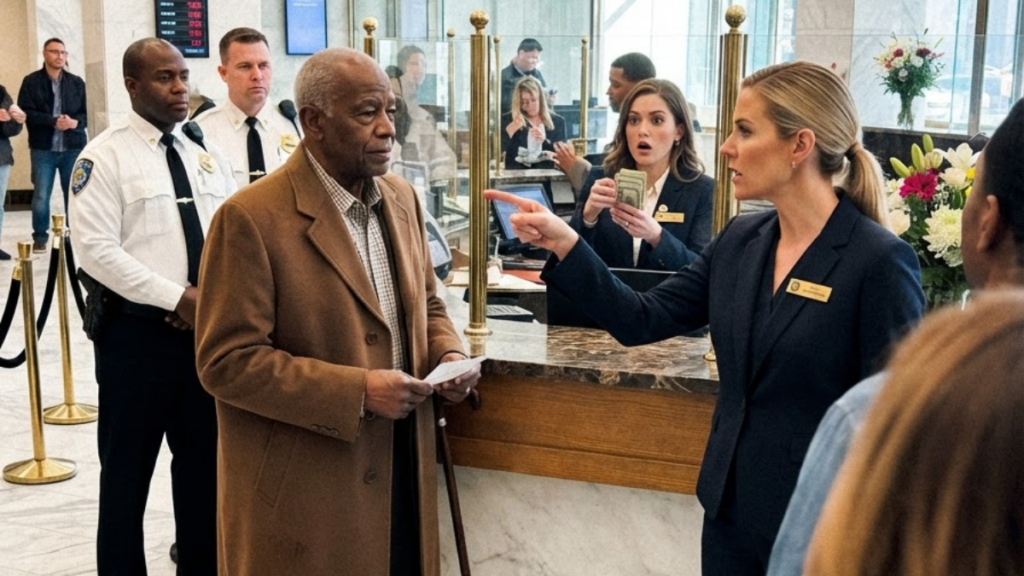
Then the elderly man walked through the front doors.
The Man in the Gray Coat
I noticed him immediately.
Not because he was loud.
Because he wasn’t.
He moved carefully, almost gently, like someone who didn’t want to inconvenience anyone.
His coat was old but pressed clean.
His shoes were worn at the edges, though polished carefully.
He approached one of the tellers with a warm smile.
“Good morning,” he said. “I’d like to withdraw fifty thousand dollars from my savings account.”
The teller blinked.
That amount always triggered additional procedures, especially in person.
I slowed my pace without meaning to.
Something about him felt out of place against the polished stone and glass around us.
The teller checked the account once.
Then again.
Her posture changed slightly.
And that was the moment I stepped in.
A Decision That Felt Reasonable
“Sir,” I said, “this branch serves our private clients. Are you certain you’re in the correct location?”
He turned toward me politely.
“Yes, ma’am,” he said. “I’ve banked here for over twenty years.”
Twenty years.
I remember thinking that couldn’t possibly be true.
Not at this branch.
Not with that appearance.
I hate admitting that now, but it’s the truth.
He handed over his ID calmly.
The teller looked uncertain, almost nervous.
I caught only a glimpse of the account balance before she tilted the screen away.
But it didn’t matter.
I had already made up my mind.
“We’ve had issues with suspicious activity recently,” I told him. “Large withdrawals require additional verification.”
His expression didn’t change.
“I understand,” he said quietly. “I can get whatever documents you need from my car.”
The lobby had gone silent by then.
Customers were pretending not to watch.
Employees absolutely were.
And suddenly I became aware that everyone was waiting to see how I handled the situation.
So I handled it the way I always did.
With certainty.
The Warning I Ignored
When the man returned from the parking lot, I already had security standing nearby.
Even now, I can still see the way he stopped for half a second when he noticed them.
Not angry.
Just tired.
“Sir,” I said firmly, “we won’t be processing this transaction today. I’m going to ask you to leave the premises.”
One of the guards shifted awkwardly beside me.
The man looked directly at me then.
Not at the guards.
Not at the teller.
At me.
And his voice stayed calm.
“You’re making a mistake.”
That should have unsettled me more than it did.
There was no desperation in his tone.
No panic.
No attempt to argue.
Just certainty.
I looked away first.
“This is how you safeguard a bank,” I announced to the employees nearby.
I remember feeling proud after I said it.
That’s the worst part.
The Deal That Was Supposed to Change Everything
By noon, I had nearly forgotten the entire incident.
I was focused on the acquisition meeting upstairs.
A major investment group was preparing to finalize a partnership with Franklin & West.
Months of negotiations had led to this moment.
Lawyers filled the conference room.
Financial analysts lined the walls.
Everyone looked tense except me.
I thought we had already won.
Then Martin, our chief legal officer, walked into the room looking pale.
At first I assumed something had shifted in the contract.
But he wasn’t holding legal documents.
He was holding a printed photograph.
“What happened here?” he asked quietly.
I frowned. “What are you talking about?”
He placed the photograph in front of me.
It was security footage from our lobby.
The elderly man standing beside two guards.
My stomach tightened.
“Why does this matter?” I asked.
Martin stared at me for a long second.
Then he asked a question that changed the entire day.
“Do you know who that man is?”
The Name That Changed the Room
I didn’t answer immediately.
Because suddenly the room felt different.
Too quiet.
Martin pulled out a folder with shaking hands.
“That,” he said carefully, “is Walter Reed.”
The name meant nothing to me at first.
Then he added four more words.
“He owns Reed Capital.”
Every sound in the room disappeared.
Reed Capital wasn’t just another investment company.
They were the investment company connected to the acquisition deal.
Three billion dollars.
My mouth went dry.
“That’s impossible,” I said.
Martin gave a humorless laugh.
“No,” he said. “What’s impossible is what you did downstairs.”
I remember standing up so quickly my chair rolled backward into the wall.
Someone in the room muttered, “Jesus Christ.”
Another executive covered his face with one hand.
And slowly, horribly, the pieces began fitting together in my head.
The teller checking the account twice.
The enormous balance.
The calmness.
The warning.
You’re making a mistake.
Trying to Undo It
I went downstairs immediately.
But he was gone.
Of course he was gone.
I demanded security footage.
Parking records.
Phone numbers.
Anything.
I told my assistant to contact Reed Capital directly.
No response.
Within an hour, the acquisition meeting had stalled.
Within two hours, rumors started moving through the building.
Employees talk.
They always do.
Especially when leadership panics.
I passed two junior advisors whispering near the elevators.
They stopped talking the second they saw me.
That was the first moment I realized I was no longer fully in control of the room.
And once that changes, everyone feels it.
The Story Escapes the Building
By late afternoon, the story was outside the bank.
I still don’t know who leaked it first.
Maybe an employee.
Maybe a client.
Maybe someone who had recorded part of the interaction on their phone.
But suddenly executives were receiving calls from reporters.
One headline appeared online before the market even closed.
CEO Removes Elderly Black Client From Private Banking Branch.
I stared at the screen in my office while my public relations team talked around me in frantic circles.
“We can contain this.”
“We need a statement immediately.”
“Say there was confusion regarding verification.”
“Do not admit wrongdoing yet.”
But none of those people had seen his face when he looked at me.
None of them had heard the warning in his voice.
I had.
And deep down, I already knew the truth.
This wasn’t confusion.
It was judgment.
And everyone could see it.
The Phone Call I Didn’t Expect
Around six that evening, my assistant transferred a call to my office.
“Ms. Carter,” the voice said calmly, “Mr. Reed is available now.”
I stood up so quickly I almost knocked over my chair.
“Put him through.”
There was a short silence.
Then his voice came on the line.
Still calm.
Still controlled.
“Good evening, Evelyn.”
Not Ms. Carter.
Evelyn.
I swallowed hard. “Mr. Reed, I owe you an apology.”
“You do,” he said.
No anger.
Somehow that made it worse.
I started explaining immediately.
Policies.
Procedures.
Security concerns.
Halfway through, he interrupted me gently.
“You decided who I was before I opened my mouth.”
The silence after that felt endless.
Because he was right.
And there wasn’t a single sentence I could use to escape it.
What He Told Me Next
“I built my first business forty years ago,” he said. “Back then, banks refused to lend to me. Some managers wouldn’t even shake my hand.”
I sat down slowly.
“I told myself things would change someday,” he continued. “And in many ways, they have.”
Then he paused.
“But every now and then, someone reminds me how fragile that progress really is.”
I closed my eyes.
Outside my office window, the city lights were coming on one by one.
For the first time in years, I felt deeply embarrassed by the person I had become.
Not because of the headlines.
Not because of the deal.
Because I had looked at another human being and decided appearance was enough evidence.
And I had done it with confidence.
The Deal Falls Apart
At eight-thirty that night, Reed Capital officially withdrew from the acquisition.
Three billion dollars disappeared in a single statement.
The board of directors requested an emergency meeting immediately.
Some members avoided eye contact with me entirely.
Others looked furious.
One older board member asked the question nobody else wanted to say out loud.
“Did you really remove him from the building?”
I answered honestly.
“Yes.”
The disappointment in that room felt heavier than anger.
Because disappointment means people expected better.
And maybe they should have.
The Part Nobody Saw Online
The internet turned the story into something simple.
Villain CEO humiliates billionaire investor.
People shared clips.
Comment sections exploded.
My face spread everywhere.
But the truth was uglier than the headlines.
Because the moment itself had been small.
Quiet.
Ordinary.
That’s what disturbed me most afterward.
I didn’t wake up planning to humiliate anyone.
I wasn’t shouting.
I wasn’t openly cruel.
I simply trusted my assumptions more than the person standing in front of me.
And that kind of thinking becomes automatic if nobody challenges it.
The Weeks After
The board didn’t fire me immediately.
Honestly, I think some of them wanted the scandal to calm down first.
But internally, everything changed.
Employees who once rushed to impress me became cautious around me.
Conversations stopped when I entered rooms.
Even people defending me sounded uncomfortable doing it.
I heard one executive say, “She didn’t mean it that way.”
But intention stops mattering after a certain point.
Actions speak louder.
And mine had already spoken to the entire world.
Seeing Things I Ignored Before
Over the next few weeks, I started noticing things I had spent years overlooking.
Who got interrupted in meetings.
Which clients received warmth instantly.
Which clients got suspicion first.
Which employees felt invisible unless they overperformed.
It was everywhere once I finally saw it.
Not dramatic enough to make headlines most days.
Just small moments.
Repeated over and over until they shape entire lives.
I kept thinking about Walter Reed walking back into that lobby carrying documents he never should have needed in the first place.
Still polite.
Still composed.
As if he already expected to be treated that way.
That thought stayed with me the longest.
The Last Conversation
About a month later, I asked Walter Reed if he would meet me in person.
I didn’t think he’d agree.
But he did.
We met in a quiet restaurant early in the morning before the lunch crowd arrived.
He wore the same gray coat.
I noticed that immediately.
“I wanted to apologize properly,” I told him.
He stirred his coffee slowly.
Then he looked at me and asked, “Have you figured out why this happened?”
Not the scandal.
Not the deal.
The moment itself.
I took a long time answering.
Finally I said, “Because I thought success had a certain look.”
He nodded once.
“That’s part of it.”
I waited.
Then he said something I still think about all the time.
“You also believed power meant you were always right.”
I didn’t argue.
Because that was true too.
Walking Away From the Version of Myself I Built
Three months later, I resigned from Franklin & West.
Officially, the statement called it a mutual decision.
It wasn’t.
The truth is simpler.
I no longer trusted the instincts that had built my career.
And once that certainty cracks, everything changes.
People still ask whether losing the deal ruined my life.
No.
Losing the illusion did.
The illusion that intelligence automatically makes someone fair.
The illusion that professionalism means wisdom.
The illusion that success excuses arrogance.
Those things are harder to rebuild than a career.
What I Remember Most
Not the headlines.
Not the board meetings.
Not even the lost billions.
What I remember most is his voice.
Calm.
Certain.
Almost patient.
“You’re making a mistake.”
At the time, I thought he meant the transaction.
I thought he meant the bank.
I thought he meant the deal.
But years later, I understand what he was really warning me about.
He was warning me about the kind of person I was becoming.
And by the time I finally understood that, the damage was already done.
