

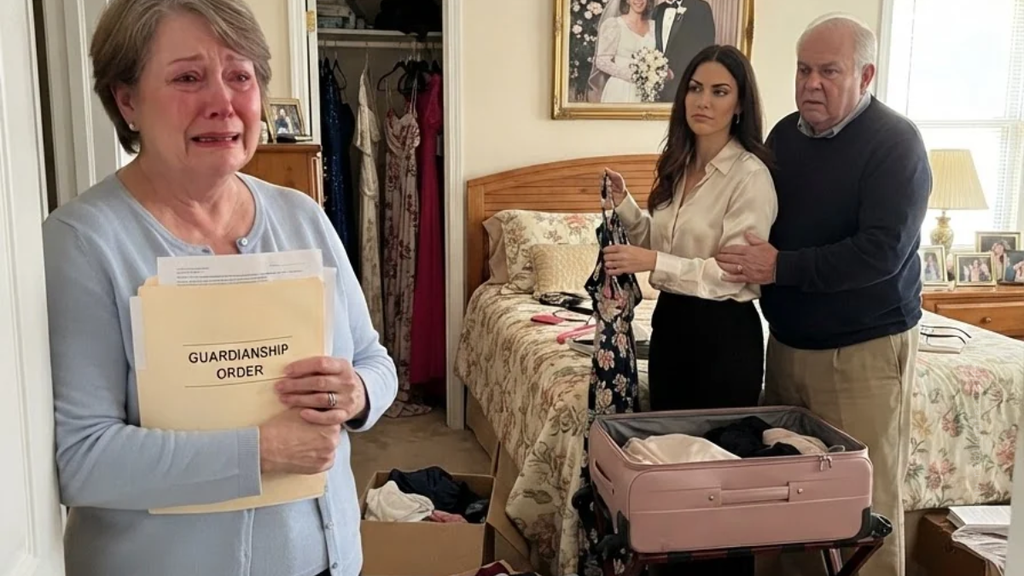
The first time I met my husband’s mistress, she was standing in my bedroom wearing my silk robe.
Not a robe that looked like mine.
My robe.
The ivory one my daughter had given me for Christmas.
She was barefoot, holding a glass of white wine, and examining the diamond earrings on my dresser.
When she saw me standing in the doorway, she smiled.
“Oh, good. You’re home.”
I stared at her.
“Who are you?”
She laughed softly.
“I’m Vanessa.”
I looked past her.
My jewelry box was open.
My wedding photograph had been removed from the nightstand.
And two enormous pink suitcases sat beside the bed I’d shared with my husband for thirty-five years.
I felt my stomach tighten.
“Why are you in my bedroom?”
Vanessa took another sip of wine.
Then said:
“Because your husband says it’s mine now.”
I stood there.
Sixty-two years old.
Thirty-five years married.
Three grown children.
And apparently, I’d just been replaced in my own home.
I turned toward the hallway.
“ROBERT!”
My husband appeared at the top of the stairs.
He was sixty-six.
Silver-haired.
Handsome.
Wearing the navy sweater I’d bought him for his birthday.
He looked at Vanessa.
Then at me.
And sighed.
“Elaine, please don’t start.”
I stared at him.
“Don’t start?”
He stepped closer.
“You’re upsetting yourself.”
I pointed toward the woman in my robe.
“Who is she?”
Robert closed his eyes.
Then said:
“Elaine, we’ve discussed this.”
I felt sick.
“No, we haven’t.”
He looked toward Vanessa.
Then back at me.
“Sweetheart, you know your memory hasn’t been reliable lately.”
I stared at him.
“What?”
He reached for my hand.
I pulled away.
“Robert, why is that woman in our bedroom?”
He sighed.
Then said the words that changed my life.
“Because the court has determined you’re no longer capable of making certain decisions for yourself.”
I stopped breathing.
“The court?”
He nodded.
“Elaine, we’ve been through this.”
I shook my head.
“No.”
Robert looked almost sad.
Then he reached into his pocket.
Pulled out a folded document.
And handed it to me.
At the top were the words:
Circuit Court of Fairfax County, Virginia.
Below that:
Order Appointing Guardian and Conservator.
My name.
Elaine Margaret Holloway.
And underneath it, in black ink:
Robert James Holloway — Guardian and Conservator.
I stared at the page.
My hands started shaking.
Then I whispered:
“You had me declared incompetent?”
Robert sighed.
“Elaine, that’s not the terminology we use.”
I looked at him.
Then toward Vanessa.
She was smiling.
Not broadly.
Not cruelly.
Just a little smile.
The kind people give when they’ve already won.
I looked back at my husband.
Then whispered:
“After thirty-five years?”
Robert reached for my arm.
“Sweetheart, this is for your own good.”
I pulled away.
And Vanessa finally spoke.
“Oh, Robert, don’t upset her.”
I turned toward her.
She was standing in my bedroom.
Wearing my robe.
Holding my wineglass.
And telling my husband not to upset me.
I stared at her.
Then said:
“Take that off.”
Vanessa blinked.
“Excuse me?”
I pointed toward the robe.
“Take. It. Off.”
Robert stepped between us.
“Elaine.”
I ignored him.
I looked directly at Vanessa.
Then said:
“You can sleep with my husband. Apparently, you’ve already been doing that. But you will not wear my clothes.”
Vanessa’s smile disappeared.
Robert grabbed my elbow.
“That’s enough.”
I pulled away.
“Don’t touch me.”
His expression hardened.
Then he said something I’ll never forget.
“Elaine, if you continue behaving like this, I’ll have no choice but to move you into a facility.”
I stopped breathing.
Vanessa looked toward the floor.
But not before I saw her smile.
And suddenly, I understood.
My husband hadn’t simply brought another woman into our marriage.
He’d found a way to make sure I couldn’t stop him.
At least, that’s what he believed.
My name is Elaine Holloway.
I’m sixty-two years old.
For thirty-five years, I was married to Robert Holloway.
We lived in a six-bedroom colonial house in McLean, Virginia.
A beautiful home with white columns, a curved staircase, and a garden I’d spent twenty years cultivating.
We had three children.
Our oldest, Michael, was thirty-four and worked as a corporate attorney in Chicago.
Our daughter, Sarah, was thirty-one, a pediatric nurse living in Richmond.
And our youngest, Daniel, was twenty-seven and worked in commercial construction.
Robert owned a successful property development company.
At least, I thought it was successful.
He was the kind of man who wore expensive watches and spoke confidently about investments.
He belonged to the country club.
Served on charitable boards.
And liked telling people he’d built everything from nothing.
That last part always bothered me.
Because Robert hadn’t built everything from nothing.
He’d built it with me.
When we married, I was twenty-seven.
I had a degree in accounting.
A good job.
And nearly eighty thousand dollars in savings from an inheritance my grandmother had left me.
Robert was thirty-one.
Ambitious.
Charming.
And starting his first real estate venture.
I invested my savings in his company.
I kept the books.
Managed the payroll.
Handled the tax records.
And worked nights at our kitchen table while he met with investors.
For the first twelve years of our marriage, I was the reason that company stayed afloat.
Then our third child was born.
Robert convinced me to step away.
“Let me take care of you now,” he said.
I agreed.
I raised our children.
Managed our home.
Volunteered at their schools.
And supported Robert as his business grew.
By the time he was fifty, we were wealthy.
Or so everyone believed.
We had the big house.
The vacation property.
The cars.
The country club membership.
And the beautiful life people admired.
But somewhere along the way, Robert stopped seeing me as his partner.
I became his wife.
The woman who hosted dinners.
Sent thank-you notes.
Remembered birthdays.
And smiled beside him in photographs.
I didn’t mind.
Not at first.
I loved our family.
I loved our home.
And I believed marriage was about building something together.
Then, two years before Vanessa appeared in my bedroom, Robert began behaving strangely.
He started questioning my memory.
Little things.
He’d tell me we’d discussed something.
Something I knew we’d never discussed.
He’d say I’d forgotten appointments.
Misplaced documents.
Repeated stories.
At first, I laughed.
“Robert, I’m sixty, not ninety.”
He’d smile.
Then say:
“Sweetheart, I’m just worried.”
I thought he was being protective.
Then he began taking over things I’d always handled.
Our household accounts.
My credit cards.
My medical appointments.
Even my car maintenance.
He said it was to make my life easier.
And I let him.
Because I trusted him.
Then came the incident at the country club.
We were having dinner with friends.
I mentioned that Robert and I were thinking about selling our beach house.
Robert looked at me.
Then laughed.
“Elaine, sweetheart, we sold that house six months ago.”
I stared at him.
“What?”
He smiled apologetically at our friends.
“She’s been having some memory trouble.”
I felt my face burn.
“Robert, we haven’t sold the beach house.”
He sighed.
Then reached for my hand.
“Elaine.”
I pulled away.
“We were there in August.”
He looked toward our friends.
Then said:
“This is exactly what I’ve been telling you about.”
Everyone went quiet.
I stared at him.
Then whispered:
“Robert, what are you talking about?”
He smiled sadly.
“Let’s discuss it at home.”
I looked around the table.
Our friends were watching me with concern.
Pity.
And something worse.
Belief.
They believed him.
Not me.
That night, I demanded to see the paperwork.
Robert told me it was in his office.
He promised to show me the next day.
But he never did.
And eventually, I stopped asking.
Not because I believed I’d forgotten.
But because every conversation ended with Robert telling me I was confused.
Then, six months later, he told me I needed a cognitive evaluation.
I refused.
He became angry.
“Elaine, I’m trying to help you.”
I stared at him.
“There’s nothing wrong with my memory.”
He sighed.
“That’s what worries me.”
I felt sick.
Because suddenly, no matter what I said, he could turn it into evidence against me.
If I disagreed, I was confused.
If I got upset, I was unstable.
If I demanded answers, I was paranoid.
And if I insisted I was fine?
Apparently, that meant I lacked insight into my condition.
It was a trap.
And I didn’t realize how carefully he’d constructed it until it was too late.
The guardianship petition arrived while I was visiting Sarah in Richmond.
At least, that’s what the court records later showed.
I never saw it.
Robert had arranged for papers to be delivered to our house.
Then submitted documents claiming I was unable to understand legal proceedings.
He provided statements from two people.
One was a physician I’d seen only briefly.
The other was a woman named Vanessa Clarke.
I didn’t know that name at the time.
But I would.
Oh, I would.
Vanessa was forty-one.
Twenty-one years younger than me.
She’d been working as a consultant for Robert’s company.
She was attractive.
Blonde.
Always impeccably dressed.
And apparently, she’d been sleeping with my husband for almost eighteen months.
She submitted a written statement describing my supposed confusion.
She claimed I’d forgotten where I lived.
That I’d become suspicious of strangers.
That I’d accused people of stealing from me.
And that I’d been unable to manage basic financial decisions.
None of it was true.
But Robert had prepared the story carefully.
He included medical records.
Financial statements.
Letters from people who’d witnessed my supposed decline.
And a declaration that I was too impaired to participate meaningfully in the proceedings.
I later learned there had been a court hearing.
A hearing I hadn’t attended.
A hearing I hadn’t even known about.
And somehow, through a series of misrepresentations and procedural failures, Robert had obtained an order giving him control over major parts of my life.
My finances.
My property.
Certain medical decisions.
And my living arrangements.
The order wasn’t supposed to erase every right I had.
But Robert acted as though it did.
He told everyone I was incompetent.
He told our children I was deteriorating.
And then he moved Vanessa into our bedroom.
I found out on a Wednesday.
I’d been at my sister’s house in Charlottesville for three days.
Robert had encouraged the trip.
“You need a break,” he said.
I thought he was being kind.
When I returned home, Vanessa was there.
In my robe.
In my bedroom.
And my husband was standing beside her, holding a court order.
I spent that first night in the guest room.
Not because I agreed.
But because I didn’t know what else to do.
Robert had taken my phone.
He said I’d been making inappropriate calls.
He’d also taken my car keys.
He said I wasn’t safe to drive.
And when I demanded access to our bank accounts, he told me I was no longer authorized to manage them.
I stared at him.
Then said:
“You cannot do this to me.”
Robert smiled.
“Elaine, the court says otherwise.”
I felt sick.
He stepped closer.
Then whispered:
“You need to understand something. I’m responsible for you now.”
I looked toward the stairs.
Vanessa was standing at the top.
Watching.
I turned back to Robert.
Then said:
“You’re responsible for me?”
He nodded.
I almost laughed.
“After thirty-five years of marriage, you think I’m your responsibility?”
His expression hardened.
“Elaine.”
I shook my head.
“No.”
He sighed.
“You’re becoming agitated.”
I stared at him.
Then whispered:
“You brought your mistress into my bedroom.”
He looked toward Vanessa.
Then back at me.
And said:
“She’s here to help.”
I stopped breathing.
“Help?”
He nodded.
“With the household.”
I almost laughed.
Vanessa descended the stairs.
She smiled.
“Elaine, I know this is difficult.”
I turned toward her.
Then said:
“Don’t speak to me.”
Her smile disappeared.
Robert stepped forward.
“That’s enough.”
I looked at him.
Then whispered:
“You have humiliated me in my own home.”
He sighed.
“You’re making this worse.”
I stared at him.
Then asked:
“What could possibly be worse?”
Robert looked toward Vanessa.
Then back at me.
And said:
“If you can’t adjust to the new arrangement, we’ll have to discuss residential care.”
I stopped breathing.
Residential care.
A facility.
Somewhere he could put me.
Somewhere I couldn’t interfere.
I looked toward Vanessa.
She smiled.
And suddenly, I realized something.
They weren’t simply waiting for me to accept their relationship.
They were waiting for me to give them a reason to remove me.
That night, I lay awake in the guest room.
Listening to footsteps upstairs.
My husband’s footsteps.
Vanessa’s laughter.
The sound of the television in the bedroom I’d slept in for twenty years.
I stared at the ceiling.
And cried.
Not quietly.
Not gracefully.
I sobbed.
Because I’d spent thirty-five years building that life.
And now I was being treated like an unwanted guest.
The following morning, I went downstairs at six.
I made coffee.
Sat at the kitchen table.
And opened the newspaper.
For a moment, everything felt normal.
Then Vanessa walked in.
She was wearing one of my sweaters.
A cream cashmere cardigan.
I recognized it immediately.
She smiled.
“Good morning, Elaine.”
I stared at her.
“That’s mine.”
She looked down.
“Oh.”
Then laughed.
“Robert said I could borrow it.”
I felt sick.
I set down my coffee.
Then said:
“Take it off.”
Vanessa sighed.
“Elaine, please.”
I stood.
“Take off my sweater.”
She looked toward the stairs.
Then back at me.
And said:
“Robert told me you might have trouble adjusting.”
I stared at her.
Then whispered:
“You are sleeping with my husband in my bed, wearing my clothes, and telling me I’m having trouble adjusting?”
She rolled her eyes.
“There’s no need to be dramatic.”
Something inside me snapped.
I stepped closer.
Then said:
“Get out of my house.”
Vanessa’s expression changed.
For a moment, she looked angry.
Then she smiled.
And said:
“Elaine, this isn’t your house anymore.”
I froze.
“What?”
She took a sip of coffee.
Then said:
“Robert transferred the property into a trust.”
I stared at her.
“What trust?”
She smiled.
“The Holloway Family Trust.”
I felt sick.
Then she added:
“He’s the trustee.”
I couldn’t move.
Our house.
The house I’d helped pay for.
The house where I’d raised our children.
The house where I’d planted every rosebush.
Apparently, Robert had transferred it into a trust.
Without telling me.
I stared at Vanessa.
Then whispered:
“When?”
She shrugged.
“A few months ago.”
I felt sick.
Then she smiled.
“Honestly, Elaine, you should be grateful.”
I stared at her.
“Grateful?”
She nodded.
“Robert’s making sure you’re taken care of.”
I almost laughed.
“By taking my home?”
Vanessa sighed.
“You’re not understanding.”
I looked directly at her.
Then said:
“I understand perfectly.”
Her smile faded.
I continued.
“My husband has taken control of my money.”
Silence.
“Moved you into my bedroom.”
Silence.
“And now you’re telling me I don’t own my own house.”
Vanessa looked toward the stairs.
Then back at me.
And whispered:
“That’s because you don’t.”
I stared at her.
Then she stepped closer.
And said something that made my blood run cold.
“And by next month, you won’t be living here either.”
I stopped breathing.
“What?”
Vanessa smiled.
“Robert’s found a lovely place for you.”
I felt sick.
“A place?”
She nodded.
“Very comfortable.”
I stared at her.
Then whispered:
“A facility.”
Vanessa didn’t answer.
She didn’t need to.
I looked toward the stairs.
Then back at her.
And suddenly, I understood.
They weren’t waiting to see whether I’d adjust.
They’d already made plans.
I was being removed.
And Vanessa was taking my place.
I turned.
Walked toward the hallway.
And reached for the telephone.
Vanessa followed me.
“Elaine, what are you doing?”
I ignored her.
I picked up the house phone.
Dialed Michael.
My oldest son.
The attorney.
The one person I believed could help me.
He answered on the fourth ring.
“Mom?”
I started crying.
“Michael, I need you.”
His voice changed.
“What’s wrong?”
I swallowed.
“Your father has had me declared incompetent.”
Silence.
Then Michael sighed.
“Mom.”
My stomach dropped.
That tone.
The same tone Robert used.
I gripped the telephone.
“Michael, listen to me.”
He was quiet.
I continued.
“He’s moved another woman into our bedroom.”
Silence.
“He’s taken my money.”
Silence.
“And he’s planning to put me in a facility.”
Michael didn’t answer.
I felt sick.
Then he whispered:
“Mom, Dad told me you were having a difficult time accepting the guardianship.”
I stopped breathing.
“What?”
He sighed.
“He said you’ve been very upset.”
I stared at the wall.
Then whispered:
“You knew?”
Michael was quiet.
I swallowed.
“You knew your father had me declared incompetent?”
He hesitated.
Then said:
“Mom, I signed a statement.”
I stopped breathing.
For a moment, I couldn’t speak.
Then whispered:
“What statement?”
Michael took a breath.
Then said:
“Dad asked me to confirm that you’d been having memory problems.”
I felt sick.
I gripped the counter.
Then asked:
“And you did?”
He didn’t answer.
I started crying.
“Michael.”
He swallowed.
Then whispered:
“Yes.”
I closed my eyes.
My son.
My oldest child.
The boy I’d taught to read.
The boy I’d driven to soccer practice.
The boy I’d helped through law school.
Had signed a statement saying I was mentally incompetent.
I could barely breathe.
Then I whispered:
“Why?”
Michael sounded upset.
“Mom, Dad said it was necessary.”
I shook my head.
“Necessary for what?”
He hesitated.
Then said:
“To protect you.”
I almost laughed.
Protect me.
That word again.
Robert was protecting me by taking my money.
By moving his mistress into my bedroom.
By threatening to put me in a facility.
And apparently, my son believed him.
I wiped my face.
Then whispered:
“Michael, have you actually seen me confused?”
He was quiet.
I continued.
“Have you ever seen me forget where I live?”
Silence.
“Have you ever seen me unable to manage money?”
He swallowed.
“Mom—”
I interrupted.
“Have you?”
He didn’t answer.
And that was answer enough.
I took a breath.
Then said:
“You signed a statement about something you’ve never witnessed.”
Michael was quiet.
Then whispered:
“Dad told me the doctors confirmed it.”
I closed my eyes.
Of course.
The doctors.
The records.
The supposed evaluations.
I looked toward the kitchen.
Vanessa was standing in the doorway.
Listening.
Smiling.
I turned away.
Then whispered:
“Michael, I need you to come home.”
He sighed.
“Mom, I’m in Chicago.”
I swallowed.
“I know.”
He continued.
“I have a trial next week.”
My heart broke.
I looked toward the stairs.
Then whispered:
“Your father is taking everything from me.”
Michael was quiet.
Then said:
“Mom, maybe we should all sit down and talk when you’re feeling calmer.”
I stopped breathing.
Calmer.
I stared at the telephone.
Then whispered:
“Goodbye, Michael.”
I hung up.
And stood there.
Shaking.
Because suddenly, I realized something.
My husband hadn’t simply convinced the court.
He’d convinced my children.
At least one of them.
And if Michael believed him, what chance did I have?
Vanessa stepped closer.
She smiled.
“That didn’t go very well, did it?”
I turned toward her.
Then said:
“Get away from me.”
She laughed softly.
“Elaine, you’re making this so much harder than it needs to be.”
I stared at her.
Then she stepped closer.
Lowered her voice.
And whispered:
“Robert told me you’d fight.”
I felt sick.
She continued.
“He said you were stubborn.”
Silence.
“He said you’d never accept losing control.”
I looked directly at her.
Then whispered:
“He’s right.”
Vanessa’s smile faded.
I stepped closer.
And said:
“I won’t.”
For a moment, neither of us moved.
Then Vanessa smiled again.
And whispered:
“Well, Elaine, we’ll see about that.”
That afternoon, Robert came home early.
He found me sitting in the library.
Our library.
The room where I’d kept our family photographs.
Our books.
Our children’s school awards.
He stood in the doorway.
Then sighed.
“Elaine, Vanessa tells me you’ve been difficult.”
I looked up.
“Vanessa is wearing my clothes.”
Robert rubbed his forehead.
“Sweetheart.”
I closed my book.
“Don’t.”
He frowned.
“What?”
I looked at him.
Then said:
“Don’t call me sweetheart while you’re sleeping with another woman in my bedroom.”
His face hardened.
“Elaine.”
I stood.
“I want a lawyer.”
Robert laughed.
“Sweetheart, you don’t need a lawyer.”
I stared at him.
Then said:
“I want one anyway.”
He sighed.
“You’re not in a position to make legal decisions.”
I felt sick.
Then he added:
“That’s what the guardianship is for.”
I stared at him.
And suddenly, I understood the full horror of what he’d done.
He’d taken control of my finances.
My property.
My medical decisions.
And now he was telling me I couldn’t even hire someone to challenge him.
I looked directly at Robert.
Then whispered:
“You planned this.”
He didn’t answer.
I continued.
“You knew I’d never agree to Vanessa.”
Silence.
“You knew I’d divorce you.”
Silence.
“And you knew I’d fight for what was mine.”
Robert looked toward the window.
Then back at me.
And said:
“Elaine, I didn’t want things to get ugly.”
I almost laughed.
“Ugly?”
He nodded.
“I wanted to handle this quietly.”
I stared at him.
Then whispered:
“By having me declared incompetent?”
He sighed.
“You’re making it sound worse than it is.”
I felt something inside me go cold.
I looked at my husband.
Then said:
“You have no idea what you’ve done to me.”
Robert was quiet.
Then he stepped closer.
And whispered:
“Actually, Elaine, I know exactly what I’ve done.”
I stopped breathing.
He looked toward the hallway.
Then back at me.
And said:
“I’ve made sure you can’t destroy everything I’ve built.”
I stared at him.
Then whispered:
“Everything you’ve built?”
He nodded.
“The company.”
I felt sick.
“The house.”
Silence.
“Our investments.”
I almost laughed.
Then I said:
“You mean everything we built.”
Robert’s expression hardened.
“Elaine.”
I stepped closer.
“My inheritance funded your first project.”
Silence.
“I kept your books.”
Silence.
“I worked for years without a salary.”
My voice broke.
“And you think you built everything alone?”
Robert looked away.
Then whispered:
“That was a long time ago.”
I stared at him.
And suddenly, I realized something.
He hadn’t forgotten.
He simply didn’t think it mattered anymore.
I looked toward the window.
Then back at him.
And whispered:
“What happens to me next month?”
Robert went still.
“What?”
I stepped closer.
“Vanessa told me you’re sending me somewhere.”
He sighed.
“Elaine, we’ve discussed—”
I interrupted.
“Where?”
He looked toward the floor.
Then said:
“A residential care facility.”
I stopped breathing.
I swallowed.
“Have you already arranged it?”
He hesitated.
Then nodded.
I felt sick.
“When?”
He looked away.
“November fifteenth.”
I stared at him.
Three weeks.
I had three weeks before my husband planned to remove me from my own home.
I looked toward Robert.
Then whispered:
“And what happens to my bedroom?”
He didn’t answer.
I continued.
“What happens to my clothes?”
Silence.
“My jewelry?”
Silence.
“My photographs?”
Robert rubbed his forehead.
“Elaine, we’ll make sure you have what you need.”
I almost laughed.
What I need.
After thirty-five years, my husband was going to decide which belongings I was allowed to keep.
I looked at him.
Then said:
“I want to speak to the judge.”
Robert smiled sadly.
“Sweetheart, that’s not how this works.”
I stared at him.
Then whispered:
“Then tell me how it works.”
He stepped closer.
Lowered his voice.
And said:
“It works because I have the authority now.”
I stopped breathing.
He continued.
“And if you keep fighting me, you’re only going to make things harder for yourself.”
I stared at him.
Then whispered:
“Is that a threat?”
Robert smiled.
“No, Elaine.”
He reached for my hand.
I pulled away.
Then he said:
“It’s a reminder.”
That night, I waited until the house was quiet.
Robert and Vanessa were upstairs.
I could hear the television.
Occasional laughter.
The sound of my life continuing without me.
I sat in the guest room.
Staring at the wall.
Then I remembered something.
A small detail.
Something I’d almost forgotten.
When Robert first started his company, I’d insisted on keeping copies of everything.
Every partnership agreement.
Every loan.
Every investment.
Every property transfer.
I’d kept them in a metal box.
A green one.
With a brass latch.
For years, it had sat in the back of my closet.
But when we renovated the house, I’d moved it.
Not to Robert’s office.
Not to the basement.
To the attic.
Behind a stack of old Christmas decorations.
I stood.
My heart pounding.
Then quietly opened the guest room door.
The hallway was dark.
I could hear Robert’s voice upstairs.
I moved toward the attic stairs.
Pulled down the ladder.
And climbed.
The attic smelled like cedar and dust.
I turned on the light.
Walked past the Christmas boxes.
The old baby clothes.
The suitcases.
And there it was.
The green metal box.
Exactly where I’d left it.
I knelt.
Opened the latch.
And found folders.
Old contracts.
Bank statements.
Property deeds.
Partnership agreements.
I started sorting through them.
Then I found a document dated thirty-four years earlier.
Holloway Development Group — Founding Partnership Agreement.
I stared at it.
Then opened it.
Robert’s name.
My name.
And beneath them:
Ownership Interests: Robert Holloway — 49%. Elaine Holloway — 51%.
I stopped breathing.
Fifty-one percent.
I stared at the document.
Then remembered.
Of course.
When we started the company, my inheritance had funded most of the initial investment.
Our accountant had insisted the ownership reflect that.
Robert had complained.
He’d said it didn’t matter.
That we were married.
That everything belonged to both of us.
And over time, I’d forgotten the exact percentages.
But here they were.
In black and white.
I owned fifty-one percent of the company my husband claimed he’d built alone.
My hands started shaking.
I kept reading.
There were amendments.
Meeting minutes.
Shareholder agreements.
Then I found something else.
A clause.
Buried in the original agreement.
It stated that any transfer of controlling ownership required my written consent.
I stared at it.
Then whispered:
“Oh my God.”
Robert had spent years telling everyone he owned the company.
He’d made decisions.
Signed contracts.
Moved money.
And apparently, he’d forgotten something.
Something I’d insisted on when we were young.
Something he’d never bothered to change.
I was the majority owner.
And certain major transactions required my approval.
I kept searching.
Then found a folder labeled:
PERSONAL TRUST — E.M.H.
I frowned.
I didn’t remember creating a trust.
I opened it.
Inside was a document dated fifteen years earlier.
An irrevocable trust.
Established by my mother.
I stared at it.
Then read the beneficiary section.
My name.
Elaine Margaret Holloway.
And beneath it:
Trustee: Margaret Bennett.
My mother.
She’d died eight years earlier.
I turned the page.
Then found a successor trustee provision.
I read it once.
Then again.
And suddenly, I started laughing.
Not because anything was funny.
But because my husband had spent two years convincing everyone I was incapable of managing my own affairs.
And he’d overlooked something extraordinary.
My mother’s trust.
The trust that held a substantial portion of our family’s original investment assets.
Had a successor trustee.
Someone who could act independently of Robert.
Someone who’d known me since I was a little girl.
Someone Robert had never liked.
I looked toward the name.
Then whispered:
“Aunt Ruth.”
Ruth Bennett.
My mother’s younger sister.
Seventy-nine years old.
A retired probate attorney.
Sharp as a tack.
And the only person in our family who’d never been impressed by Robert.
I stared at the document.
Then smiled.
Because for the first time since Vanessa moved into my bedroom, I had something Robert didn’t know about.
Something he couldn’t simply take away.
I reached for my phone.
Then remembered.
Robert had taken it.
I looked toward the attic stairs.
Then toward the old telephone sitting in a box beside me.
A cordless landline handset.
From years earlier.
I picked it up.
Dead.
Of course.
I almost laughed.
Then I remembered something else.
The little desk in the attic.
The one I’d used when the children were young.
It had a telephone jack.
And inside the drawer was an old corded telephone.
I found it.
Plugged it in.
And heard a dial tone.
I nearly cried.
I dialed Aunt Ruth’s number.
She answered after four rings.
“Hello?”
I swallowed.
“Aunt Ruth?”
There was a pause.
Then her voice changed.
“Elaine?”
I started crying.
She sounded surprised.
“Sweetheart, is that you?”
I nodded.
“Yes.”
She was quiet.
Then said:
“Honey, I’ve been trying to reach you for months.”
I stopped breathing.
“What?”
Ruth sighed.
“Your husband keeps telling me you’re too sick to talk.”
I felt sick.
Then she continued.
“And your daughter Sarah told me you were having memory problems.”
I started crying.
“Aunt Ruth, I’m not sick.”
There was a long silence.
Then she said:
“I know.”
I froze.
“What?”
Her voice hardened.
“Elaine, I’ve known Robert was lying for months.”
I stopped breathing.
I gripped the telephone.
Then whispered:
“How?”
Ruth took a breath.
Then said:
“Because he tried to get me to sign something.”
My stomach dropped.
“What?”
She was quiet.
Then whispered:
“A document surrendering control of your mother’s trust.”
I couldn’t move.
Ruth continued.
“He told me you were mentally incompetent.”
I felt sick.
“And that he needed access to the assets.”
I stared at the trust document.
Then whispered:
“Did you sign?”
Ruth laughed.
A sharp, humorless laugh.
“Elaine, I told that man to go straight to hell.”
I started sobbing.
For the first time in weeks, I laughed through my tears.
Ruth continued.
“And then I hired an attorney.”
I froze.
“What?”
She lowered her voice.
“Sweetheart, I’ve been investigating your husband.”
I couldn’t breathe.
I looked toward the attic stairs.
Then back at the document.
And whispered:
“What did you find?”
Ruth was quiet.
Then said:
“Elaine, Robert isn’t just trying to take your house.”
I felt sick.
“What?”
She swallowed.
“He’s trying to sell your company.”
I stopped breathing.
“Sell?”
Ruth nodded, though I couldn’t see her.
“All of it.”
My hands went numb.
Then she said:
“For eighteen million dollars.”
I stared at the papers.
Eighteen million.
Our company.
The business I’d helped build.
The business I apparently still controlled.
I swallowed.
Then whispered:
“Can he do that?”
Ruth was quiet.
Then said:
“Not legally without addressing your ownership rights.”
I felt relief wash over me.
But then she continued.
“Which is why he needed you declared incompetent.”
I stopped breathing.
Of course.
The guardianship.
The false medical records.
The court order.
Robert wasn’t simply trying to remove me from our home.
He was trying to gain control of my shares.
To sell the company.
To take the money.
And to start a new life with Vanessa.
I looked toward the attic stairs.
Then whispered:
“Aunt Ruth, he’s sending me to a facility in three weeks.”
There was a long silence.
Then Ruth said:
“Not if I have anything to say about it.”
I started crying.
She continued.
“Listen carefully, Elaine.”
I swallowed.
“Okay.”
Her voice became firm.
“Do not sign anything.”
I nodded.
“Okay.”
“Do not confront Robert.”
I looked toward the attic door.
“Okay.”
“And tomorrow morning, I want you to be ready.”
I frowned.
“Ready for what?”
Ruth paused.
Then said:
“I’m coming to get you.”
I stopped breathing.
“What?”
She continued.
“And I’m bringing someone.”
I swallowed.
“Who?”
Ruth’s voice changed.
Almost amused.
Then she said:
“The attorney who’s going to help us take your life back.”
I started crying.
But then she added something that made me go completely still.
“Elaine, there’s one more thing you need to know.”
I swallowed.
“What?”
Ruth hesitated.
Then whispered:
“Vanessa isn’t who Robert thinks she is.”
I stared at the telephone.
“What?”
Ruth took a breath.
Then said:
“She’s been married before.”
I frowned.
“So?”
Ruth was quiet.
Then whispered:
“Three times.”
I stopped breathing.
She continued.
“And all three husbands were wealthy older men.”
My stomach tightened.
Then she said:
“Two of them died while she was married to them.”
I couldn’t move.
Ruth continued.
“And the third?”
I swallowed.
“What happened to him?”
Ruth’s voice lowered.
“He was declared mentally incompetent.”
I stared at the papers in my lap.
The guardianship.
The property transfers.
The facility.
Vanessa.
My husband’s mistress.
The woman sleeping in my bed.
I looked toward the attic stairs.
Then whispered:
“What happened to him?”
Ruth was quiet.
Then said:
“He disappeared from the facility where she placed him.”
I stopped breathing.
And suddenly, I realized something.
Robert thought he’d found a way to get rid of me.
But the woman helping him had done this before.
And if Aunt Ruth was right, I wasn’t the only person in danger.
I looked toward the attic door.
Then whispered:
“Aunt Ruth, I think Robert’s made a terrible mistake.”
She was quiet.
Then said:
“Oh, sweetheart.”
Her voice hardened.
“He has no idea.”
I stayed in the attic for another twenty minutes after Aunt Ruth hung up.
Not because I was afraid to go downstairs.
Although I was.
But because I couldn’t stop looking at the papers spread across the dusty floor.
Thirty-five years of marriage.
Thirty-five years of sacrifice.
And there, in a yellowed folder I’d nearly forgotten existed, was proof that my husband had been lying about something far bigger than his affair.
I owned the majority of the company he was trying to sell.
I traced my finger over the original partnership agreement.
Fifty-one percent.
My name.
My signature.
Robert’s signature.
All perfectly clear.
I remembered the day we’d signed it.
Our first office had been a rented room above a dry cleaner.
The carpet smelled like cigarette smoke.
The air conditioner barely worked.
And Robert had been so excited he couldn’t sit still.
He’d kissed me across the desk and said, “Mrs. Holloway, we’re going to be rich.”
I’d laughed.
“Well, Mr. Holloway, let’s try making payroll first.”
We’d been happy then.
Or at least, I’d believed we were.
I looked at the papers again.
And wondered when Robert had stopped thinking of me as his partner.
When he’d decided my contribution didn’t matter.
When he’d begun seeing my ownership as an obstacle.
Then I heard footsteps below.
I froze.
Someone was walking down the second-floor hallway.
A door opened.
Then Vanessa’s voice.
“Robert?”
I held my breath.
“What?” he answered.
“Have you seen Elaine?”
My stomach tightened.
There was a pause.
Then Robert said, “She’s probably asleep.”
Vanessa laughed.
“She’s not in the guest room.”
Silence.
Then Robert’s voice changed.
“Where is she?”
“I don’t know.”
I quietly gathered the papers.
Placed them back inside the green box.
And slid it behind the Christmas decorations.
I kept the partnership agreement and the trust documents.
Folded them carefully.
And tucked them inside the waistband of my pajamas.
Then I turned off the attic light.
I was halfway down the ladder when Robert appeared at the bottom.
He stared up at me.
“Elaine?”
I stopped.
“Hello, Robert.”
He frowned.
“What are you doing up there?”
I forced a smile.
“Looking for my winter blankets.”
He stared at me.
“At eleven o’clock at night?”
I shrugged.
“I was cold.”
He didn’t smile.
His eyes moved toward the attic.
Then back to me.
“Did you find them?”
I shook my head.
“No.”
He stepped aside.
I climbed down.
Then he reached for my arm.
“Elaine, you know you shouldn’t be climbing ladders.”
I looked at him.
“Why?”
He sighed.
“Because you could hurt yourself.”
I almost laughed.
My husband had spent months convincing a court I couldn’t manage my own affairs.
And now he was pretending to worry about me falling off a ladder.
I looked directly at him.
Then said:
“Robert, I’ve been climbing that ladder for twenty years.”
He smiled sadly.
“That’s exactly my point. You’re not as young as you used to be.”
I walked past him.
He followed.
Then asked:
“Did you find anything else up there?”
I stopped.
Turned.
And looked at him.
“What would I find?”
His expression changed.
Just for a second.
Then he smiled.
“Nothing, sweetheart.”
I nodded.
“Then I suppose there’s nothing to worry about.”
I walked into the guest room.
Closed the door.
And locked it.
Then I sat on the edge of the bed, pulled the papers from my pajamas, and stared at them.
My hands were shaking.
But this time, it wasn’t fear.
It was anger.
For two years, Robert had made me question myself.
My memory.
My judgment.
My sanity.
And now I was holding proof that my instincts had been right all along.
I wasn’t confused.
I wasn’t incompetent.
I was inconvenient.
And my husband had decided the easiest way to deal with an inconvenient wife was to take away her ability to fight back.
The next morning, Aunt Ruth arrived at nine.
I was sitting at the kitchen table when the doorbell rang.
Vanessa was making breakfast.
Robert was reading the newspaper.
When he opened the front door and saw Ruth standing on the porch, his face went white.
“Ruth.”
She smiled.
“Robert.”
He hesitated.
“What a surprise.”
Ruth looked past him.
“Is Elaine home?”
Robert stepped slightly into the doorway.
“She’s resting.”
Ruth’s smile disappeared.
“At nine in the morning?”
He sighed.
“She’s been having a difficult time.”
Ruth nodded slowly.
“Yes. I’ve heard.”
Robert looked uncomfortable.
Then said, “Perhaps you should call before visiting.”
Ruth stepped closer.
“Perhaps you should stop telling people my niece is too ill to answer a telephone.”
Robert froze.
I stood from the kitchen table.
“Aunt Ruth!”
She looked past him.
Her face softened.
“There’s my girl.”
I hurried toward her.
Robert moved aside reluctantly.
Ruth wrapped her arms around me.
She smelled like the same rose perfume she’d worn since I was a child.
I started crying.
She held me tightly.
Then whispered:
“You’re not going anywhere you don’t want to go.”
I nodded against her shoulder.
When I pulled back, I noticed the woman standing beside her.
She was probably fifty-five.
Dark hair.
A charcoal suit.
A leather briefcase.
Ruth smiled.
“Elaine, this is Rebecca Sterling.”
The woman extended her hand.
“Mrs. Holloway.”
I shook it.
“Hello.”
She smiled.
“I’m an attorney. I specialize in guardianship litigation and financial exploitation.”
Robert stepped forward.
His expression hardened.
“Ruth, what exactly is going on?”
Ruth turned toward him.
“Elaine is getting legal advice.”
Robert laughed.
“That’s unnecessary.”
Rebecca looked at him.
“Mr. Holloway, your wife has the right to seek counsel regarding her guardianship.”
He frowned.
“I’m her legal guardian.”
Rebecca nodded.
“I’m aware.”
Robert crossed his arms.
“Then you understand that she’s not capable of making these decisions.”
Rebecca opened her briefcase.
“Actually, Mr. Holloway, that’s precisely what we’re here to examine.”
Vanessa appeared in the kitchen doorway.
She was wearing a pale pink blouse.
My pale pink blouse.
I looked at her.
Then toward Ruth.
Ruth’s eyes moved over Vanessa.
From her perfectly styled hair to the diamond bracelet on her wrist.
My diamond bracelet.
Then Ruth smiled.
“Well.”
Vanessa looked confused.
“Excuse me?”
Ruth tilted her head.
“You must be the replacement.”
I nearly laughed.
Vanessa’s face turned red.
Robert stepped forward.
“Ruth, that’s enough.”
Ruth looked at him.
“Robert, I’ve known you since you were thirty-one years old.”
He stared at her.
She continued.
“And in all that time, you’ve never once been clever enough to frighten me.”
Rebecca cleared her throat.
“Mrs. Holloway, would you be comfortable speaking privately?”
I nodded immediately.
“Yes.”
Robert frowned.
“Elaine, I don’t think—”
Rebecca interrupted.
“Mr. Holloway, we can discuss your concerns with the court. For now, I’d like to speak with your wife.”
Robert looked toward Vanessa.
Then back at me.
His expression changed.
Not anger.
Something worse.
Fear.
And for the first time, I realized he hadn’t expected anyone to challenge him.
He’d expected me to cry.
To argue.
To become upset.
To give him more examples of my supposed instability.
He hadn’t expected Aunt Ruth.
And he certainly hadn’t expected Rebecca Sterling.
We went into the library.
Ruth closed the door.
Rebecca sat across from me.
Then asked:
“Elaine, do you understand why we’re here?”
I nodded.
“To challenge the guardianship.”
She smiled.
“Exactly.”
She continued.
“I want you to know something important. A guardianship order does not mean you lose every legal right, and you have the right to challenge the order and the conduct of your guardian.”
I started crying.
Rebecca handed me a tissue.
Then said:
“And from what Ruth has told me, there are serious questions about how this guardianship was obtained.”
I nodded.
She opened a folder.
“We’ve obtained copies of the court records.”
My stomach tightened.
She continued.
“Your husband submitted a petition claiming you had significant cognitive impairment.”
I swallowed.
“I know.”
Rebecca nodded.
“But there’s something unusual.”
I looked at her.
“What?”
She turned a page.
“The petition says you were personally notified.”
I stopped breathing.
“What?”
She looked directly at me.
“According to the court file, you received notice of the proceedings.”
I shook my head.
“No.”
She nodded.
“That’s what I suspected.”
I felt sick.
“I never received anything.”
Rebecca turned another page.
“There’s a signed acknowledgment of service.”
I stared at her.
Then whispered:
“Whose signature?”
She slid the paper toward me.
At the bottom was my name.
Elaine M. Holloway.
In handwriting that looked almost like mine.
Almost.
But not quite.
I stared at it.
Then whispered:
“That’s not my signature.”
Rebecca nodded.
“Are you certain?”
I looked at her.
“Absolutely.”
I pointed toward the final letter.
“I never make my y like that.”
Ruth leaned forward.
“Show her the other one.”
Rebecca turned another page.
A medical consent form.
Again, my signature.
Again, not quite right.
I felt sick.
Then Rebecca said:
“Elaine, we believe someone forged your signature on multiple documents.”
I stared at her.
For a moment, I couldn’t speak.
Then I whispered:
“Robert.”
Rebecca nodded carefully.
“That’s one possibility. We need evidence establishing who signed them.”
I looked toward the door.
My husband was on the other side.
The man I’d slept beside for thirty-five years.
The man who’d held my hand through childbirth.
The man who’d cried when our youngest son graduated from college.
And he’d apparently been forging my name.
I felt something inside me break.
Then Ruth reached for my hand.
“Sweetheart, there’s more.”
I looked at her.
She hesitated.
Then said:
“The physician who evaluated you has a business relationship with Robert.”
I froze.
“What?”
Rebecca nodded.
“Dr. Howard Mercer.”
I frowned.
I remembered him.
A pleasant man.
Gray hair.
A neat office.
Robert had taken me to see him the previous spring.
He’d told me it was a routine wellness appointment.
I’d answered questions.
Remembered words.
Drawn a clock.
Completed a short memory screening.
I hadn’t thought anything of it.
Then Robert had told me the doctor was concerned.
I looked toward Rebecca.
“He said I had cognitive impairment?”
She nodded.
“His report describes substantial deficits.”
I shook my head.
“That’s impossible.”
Rebecca leaned forward.
“Elaine, do you remember the appointment?”
“Every minute of it.”
She smiled slightly.
“Tell me.”
So I did.
I told her about the questions.
The clock.
The word recall.
The conversation about my medications.
And the fact that Dr. Mercer had congratulated me on doing well.
Rebecca took notes.
Then asked:
“Did he tell you that you were unable to manage your finances?”
I shook my head.
“No.”
“Did he recommend guardianship?”
“No.”
“Did he tell you that you needed residential care?”
I almost laughed.
“Absolutely not.”
Rebecca nodded.
Then said:
“His written report says all three.”
I stared at her.
My hands went numb.
Then I whispered:
“He lied.”
Rebecca closed the folder.
“We’re going to find out.”
That afternoon, Rebecca filed an emergency petition requesting review of the guardianship, independent medical evaluation, and protection of my assets.
She also requested that Robert be temporarily suspended from making major financial decisions involving my property while the court examined the allegations.
She warned me that the judge would need evidence.
That the process might take time.
And that the court wouldn’t simply accept my word over Robert’s.
I understood.
But for the first time, someone was listening.
Someone was asking questions.
Someone was treating me like an adult.
And that alone felt extraordinary.
Before she left, Rebecca asked whether I had any documents relating to the company.
I smiled.
Then reached into my handbag.
And handed her the original partnership agreement.
She unfolded it.
Read the first page.
Then stopped.
She looked at me.
Then back at the document.
“Elaine.”
I nodded.
“Yes?”
She turned another page.
Then whispered:
“Do you understand what this is?”
I smiled.
“I think so.”
Rebecca looked toward Ruth.
Then back at me.
And said:
“This could change everything.”
I felt my heart pounding.
She continued.
“If these ownership interests remain valid, you may have significant rights in the company that your husband has been trying to exercise without your consent.”
I nodded.
Then asked:
“Can he sell it?”
Rebecca looked at the agreement.
Then said:
“Not necessarily. And certainly not without resolving some very serious questions.”
I started crying.
Ruth squeezed my hand.
And for the first time in weeks, I smiled.
Not because I’d won.
Not yet.
But because Robert had spent two years convincing everyone I couldn’t understand financial documents.
And now the financial documents were the very thing that might save me.
That evening, Robert came into the guest room.
He closed the door behind him.
I was sitting on the bed reading.
He stood there for a moment.
Then said:
“Elaine, we need to talk.”
I looked up.
“About what?”
He sighed.
“Ruth.”
I closed my book.
“What about her?”
His expression hardened.
“She’s interfering.”
I smiled faintly.
“She’s helping me.”
Robert shook his head.
“She’s filling your head with nonsense.”
I stared at him.
Then asked:
“Did you forge my signature?”
He froze.
For a moment, he didn’t move.
Then he laughed.
“Elaine, don’t be ridiculous.”
I nodded slowly.
“So you didn’t?”
He stepped closer.
“Of course not.”
I looked at him.
Then asked:
“Did you tell the court I received papers I never saw?”
Robert’s expression changed.
He looked toward the door.
Then back at me.
“Sweetheart, the legal process is complicated.”
I almost laughed.
“Is it?”
He sighed.
“You wouldn’t understand.”
I stared at him.
Then whispered:
“Try me.”
Robert was quiet.
Then he sat beside me.
Too close.
I moved away.
He sighed.
“Elaine, I know this has been difficult.”
I looked at him.
He continued.
“But I need you to trust me.”
I almost laughed.
Trust him.
After everything.
I stared at my husband.
Then said:
“Robert, I trusted you for thirty-five years.”
He looked down.
I continued.
“And look where it got me.”
Silence.
He rubbed his forehead.
Then said:
“Vanessa thinks it would be best if you moved sooner.”
I froze.
“What?”
He nodded.
“She’s concerned about the tension.”
I stared at him.
Then whispered:
“Vanessa is concerned?”
Robert sighed.
“Elaine.”
I stood.
“She’s wearing my clothes.”
He looked away.
“She’s sleeping in my bed.”
Silence.
“And now she’s deciding when I get removed from my own home?”
Robert stood.
“Enough.”
I stared at him.
Then whispered:
“No.”
He frowned.
“What?”
I stepped closer.
“I’ve had enough.”
His expression hardened.
“Elaine, you need to calm down.”
I looked directly into his eyes.
Then said:
“I’m not confused. I’m not incompetent. And I’m not leaving this house because your girlfriend finds my presence inconvenient.”
Robert stared at me.
For a moment, he looked genuinely surprised.
Then he smiled.
A cold, unpleasant smile.
And said:
“We’ll see what the judge thinks.”
I smiled back.
“Yes, Robert.”
I paused.
“We will.”
He left without another word.
But that night, something happened that made me realize how dangerous the situation had become.
At two in the morning, I woke to voices downstairs.
Robert.
Vanessa.
They were arguing.
Quietly at first.
Then louder.
I got out of bed.
Opened the door.
And stepped into the hallway.
Their voices carried up from the library.
Vanessa sounded furious.
“You said she wouldn’t have anyone helping her!”
Robert whispered something I couldn’t hear.
Then Vanessa snapped:
“You told me the paperwork was airtight!”
I froze.
Robert answered.
“Keep your voice down.”
Vanessa laughed bitterly.
“That lawyer is going to ruin everything.”
I held my breath.
Robert said:
“We can still handle this.”
Vanessa replied:
“Not if she finds the original records.”
My heart pounded.
Original records.
What records?
Robert was quiet.
Then he said:
“She doesn’t know where they are.”
Vanessa laughed.
“Are you sure?”
Silence.
Then she continued.
“Because you were sure she wouldn’t remember the company agreement either.”
I stopped breathing.
They knew.
Somehow, they knew I’d found the partnership agreement.
Robert said something sharp.
Vanessa answered:
“I am not going to lose everything because you couldn’t control your wife.”
I gripped the railing.
Then Robert said:
“Vanessa, I have it under control.”
She laughed.
“That’s what you said about the last one.”
Silence.
A long silence.
Then Robert whispered:
“Don’t bring him into this.”
I froze.
Him.
The last one.
Vanessa’s former husband.
The man who’d been declared incompetent.
The man who’d disappeared from a facility.
My heart started pounding.
Then Vanessa said something that made my blood run cold.
“You know what happened to Thomas when he started asking questions.”
I stopped breathing.
Robert didn’t answer.
Vanessa continued.
“And Elaine is asking a lot of questions.”
I backed away from the railing.
My hands were shaking.
Then I heard Robert whisper:
“We’re not doing that.”
Vanessa laughed.
“Then you’d better find another way.”
I hurried back into the guest room.
Closed the door.
And locked it.
Then I sat on the bed.
Trying to breathe.
Because suddenly, I understood something.
Robert had wanted to get rid of me.
Vanessa had helped him.
But now that I was fighting back, she was becoming impatient.
And she’d just mentioned a man who’d disappeared after being declared incompetent.
I reached for the old prepaid phone Ruth had given me that morning.
She’d told me to keep it hidden.
For emergencies.
I turned it on.
Then called her.
She answered on the second ring.
“Elaine?”
I whispered:
“Aunt Ruth, I think Vanessa is planning something.”
Ruth was immediately alert.
“What happened?”
I told her everything.
The argument.
The paperwork.
The reference to Thomas.
The way Robert had said they weren’t doing that.
Ruth was quiet for a moment.
Then said:
“Elaine, I need you to listen carefully.”
I swallowed.
“Okay.”
She continued.
“Lock your door.”
I nodded.
“It’s locked.”
“Keep your phone with you.”
“Okay.”
“And don’t eat or drink anything Vanessa gives you.”
I froze.
“What?”
Ruth hesitated.
Then whispered:
“We’ve learned something about her second husband.”
My stomach tightened.
“What?”
Ruth took a breath.
Then said:
“He died after a sudden illness.”
I stared at the wall.
She continued.
“And his family always believed something wasn’t right.”
I felt sick.
Then whispered:
“What kind of illness?”
Ruth was quiet.
Then said:
“He became weak. Confused. Disoriented.”
I couldn’t breathe.
She continued.
“His doctors couldn’t explain why he deteriorated so quickly.”
I looked toward the door.
Then whispered:
“And he died?”
Ruth nodded.
“Yes.”
I felt sick.
Then she added:
“Elaine, his daughter has been trying to get someone to reopen the case for years.”
I stared at the wall.
Then whispered:
“Do you think Vanessa killed him?”
Ruth was quiet.
Then said:
“I don’t know. But I think the authorities need to hear what you just overheard.”
I swallowed.
“Okay.”
Ruth continued.
“And Elaine?”
I closed my eyes.
“Yes?”
Her voice softened.
“I’m coming back in the morning. You’re not facing this alone.”
I started crying.
“Thank you.”
She paused.
Then said:
“And sweetheart, there’s something else.”
I swallowed.
“What?”
Ruth hesitated.
Then whispered:
“Rebecca found the man Vanessa had declared incompetent.”
I froze.
“What?”
She continued.
“Thomas.”
I sat upright.
“He’s alive?”
Ruth took a breath.
Then said:
“Yes.”
I started crying.
“Where?”
Ruth was quiet.
Then whispered:
“In a long-term care facility in Pennsylvania.”
I frowned.
“But you said he disappeared.”
She nodded.
“He did. From the original facility.”
I felt sick.
Then she continued.
“He was transferred under a different surname.”
I stopped breathing.
“What?”
Ruth took a breath.
Then said:
“And Elaine, according to the records Rebecca obtained, Vanessa was the person who arranged it.”
I stared at the wall.
Then whispered:
“Why?”
Ruth was quiet.
Then said:
“Because Thomas had been trying to challenge his guardianship.”
I couldn’t move.
The same thing I was doing.
I looked toward the door.
Then whispered:
“What happened to him?”
Ruth hesitated.
Then said:
“He lost almost everything.”
My heart broke.
She continued.
“His house.”
Silence.
“His investments.”
Silence.
“His business.”
I closed my eyes.
Then Ruth whispered:
“And when he tried to fight back, Vanessa had him moved somewhere his family couldn’t find him.”
I started crying.
Because suddenly, I saw my future.
The facility.
The isolation.
The missing phone.
The court order.
The woman wearing my clothes.
It wasn’t just a cruel way to end a marriage.
It was a system.
A plan.
And Vanessa had done it before.
The next morning, Rebecca arrived with Ruth.
They didn’t come alone.
Two investigators from adult protective services accompanied them.
And a police detective.
Robert looked furious.
Vanessa looked terrified.
I stood in the foyer.
Watching.
Rebecca stepped toward me.
“Elaine, are you ready?”
I nodded.
“Yes.”
She smiled.
“Good.”
Then she turned toward Robert.
And said:
“Mr. Holloway, we’ve filed an emergency request for protective relief and an expedited hearing.”
Robert stared at her.
“What?”
Rebecca continued.
“We’ve also asked the court to appoint an independent temporary fiduciary while the financial allegations are investigated.”
His face went white.
Vanessa stepped forward.
“This is ridiculous.”
The detective looked toward her.
“Ms. Clarke?”
She froze.
“Yes?”
He nodded.
“We’d like to ask you some questions.”
Vanessa looked toward Robert.
Then back at the detective.
“About what?”
He opened a folder.
Then said:
“Thomas Whitaker.”
Vanessa stopped breathing.
I watched her face.
For the first time since she’d moved into my bedroom, she looked genuinely frightened.
She swallowed.
Then whispered:
“I don’t know what you’re talking about.”
The detective nodded.
“That’s interesting.”
He turned a page.
Then said:
“Because Mr. Whitaker remembers you very well.”
Vanessa’s face went completely white.
Robert looked at her.
Then asked:
“Vanessa?”
She didn’t answer.
The detective continued.
“And he’d like to speak with investigators about what happened to his property.”
Vanessa stepped backward.
Robert stared at her.
Then whispered:
“What is he talking about?”
She shook her head.
“Nothing.”
The detective looked toward Robert.
Then back at Vanessa.
And said:
“Mr. Whitaker claims Ms. Clarke used a guardianship arrangement to take control of his assets.”
Robert went still.
Vanessa started crying.
Then she looked toward my husband.
And whispered:
“Don’t listen to him.”
I watched Robert.
The man who’d believed every word she’d said about me.
The man who’d moved her into my bedroom.
The man who’d let her wear my clothes.
The man who’d helped her plan my removal.
He stared at Vanessa.
Then asked:
“You told me Thomas was dead.”
I stopped breathing.
Vanessa went completely still.
The detective looked toward Robert.
Then asked:
“She told you that?”
Robert nodded slowly.
His face white.
“She said her ex-husband died years ago.”
Vanessa shook her head.
“Robert, please.”
He stared at her.
Then whispered:
“What else have you lied about?”
I almost laughed.
Not because it was funny.
But because after thirty-five years of lying to me, my husband had finally discovered what it felt like to be deceived.
Vanessa started sobbing.
Then she looked toward me.
Her expression changed.
The fear disappeared.
And something colder took its place.
She pointed at me.
Then screamed:
“This is all her fault!”
Everyone went silent.
Vanessa stepped toward me.
“She was supposed to be gone!”
Robert grabbed her arm.
“Vanessa.”
She pulled away.
Then shouted:
“You promised me she’d be gone before the sale!”
I stopped breathing.
The sale.
The eighteen-million-dollar company sale.
The one Robert had been planning.
Vanessa looked toward him.
Then continued:
“You said we’d have the money by Christmas!”
Robert’s face went white.
Rebecca looked toward the detective.
The detective was already writing.
And I stood there.
Watching my husband’s carefully constructed story fall apart.
Vanessa started crying harder.
Then she said something that made the entire room go silent.
“You told me the doctor would make sure she failed the evaluation!”
I froze.
Robert looked toward her.
“Vanessa, stop.”
She shook her head.
“No!”
She pointed at him.
“You paid Mercer! You arranged the paperwork! You told me she’d never be able to challenge it!”
I couldn’t breathe.
The doctor.
The evaluation.
The guardianship.
Robert had paid someone to make me look incompetent.
I stared at my husband.
Then whispered:
“You paid him?”
Robert didn’t answer.
I stepped closer.
“Robert.”
He looked at me.
His eyes filled with tears.
Then he whispered:
“Elaine, I can explain.”
I stared at him.
For a moment, I thought about every time he’d told me I was confused.
Every time he’d questioned my memory.
Every time he’d smiled sadly and told other people I wasn’t well.
Then I looked toward Vanessa.
The woman who’d been sleeping in my bedroom.
The woman who’d planned to send me away.
And suddenly, I understood something.
They’d both underestimated me.
Robert thought he could make me doubt myself.
Vanessa thought she could frighten me into silence.
But neither of them had counted on the woman I’d been before I married Robert.
The accountant.
The business partner.
The woman who’d invested her own money.
The woman who’d kept copies of everything.
I looked directly at my husband.
Then said:
“You know what your mistake was, Robert?”
He stared at me.
I continued.
“You spent thirty-five years convincing yourself I couldn’t do anything without you.”
Silence.
I smiled.
“And you forgot that before you had a company, you had me.”
Robert looked away.
I turned toward Rebecca.
Then said:
“Let’s go to court.”
She smiled.
And for the first time in two years, I walked out of my own front door without asking anyone’s permission.
But the biggest surprise came three days later.
We were preparing for the emergency hearing when Rebecca called.
Her voice sounded different.
Excited.
Almost disbelieving.
“Elaine, are you sitting down?”
I laughed.
“Should I be?”
She took a breath.
Then said:
“We found the original corporate records.”
I stopped breathing.
“The ones Vanessa mentioned?”
“Yes.”
My heart pounded.
“What do they say?”
Rebecca was quiet.
Then whispered:
“Elaine, your husband hasn’t been the legal controlling shareholder for years.”
I froze.
“What?”
She continued.
“We traced the ownership records, the amendments, and the corporate filings.”
I couldn’t breathe.
Then she said:
“Your fifty-one percent was never validly transferred.”
I stared at the wall.
Rebecca continued.
“And there’s something else.”
I swallowed.
“What?”
She hesitated.
Then whispered:
“Robert has been using your signature to authorize transactions worth millions.”
I stopped breathing.
“How many?”
Rebecca took a breath.
Then said:
“At least eleven.”
My hands went numb.
Eleven transactions.
Eleven times my husband had apparently signed my name.
I looked toward the window.
Then whispered:
“What kind of transactions?”
Rebecca was quiet.
Then said:
“Property transfers. Loans. Corporate guarantees.”
I felt sick.
Then she added:
“And one transaction involving the beach house.”
I froze.
Our beach house.
The one Robert had told our friends we’d sold.
The one I’d insisted we still owned.
I stared at the phone.
Then whispered:
“What about it?”
Rebecca took a breath.
Then said:
“Elaine, you were right.”
I couldn’t move.
She continued.
“The beach house wasn’t sold six months before that dinner.”
I started crying.
She paused.
Then whispered:
“Robert transferred it into a company controlled by Vanessa.”
I stopped breathing.
The country club dinner.
The embarrassment.
The way he’d laughed and told everyone my memory was failing.
I’d been right.
All along.
I stared at the phone.
Then whispered:
“He made me look crazy because I remembered the truth.”
Rebecca was quiet.
Then said:
“Yes.”
I started sobbing.
Not because of the money.
Not because of the house.
But because for two years, I’d been questioning my own mind.
I’d lain awake wondering whether I really was forgetting things.
Whether I was becoming confused.
Whether Robert was right.
And now I had proof.
He hadn’t been correcting my memory.
He’d been trying to erase it.
Rebecca continued.
“Elaine, there’s one more thing.”
I wiped my face.
“What?”
She hesitated.
Then said:
“The buyer for the company has withdrawn from the deal.”
I froze.
“What?”
She continued.
“They learned about the ownership dispute.”
My heart pounded.
“And?”
Rebecca smiled through the phone.
“They’re refusing to proceed until the legal issues are resolved.”
I started crying.
The sale.
The eighteen million dollars.
The money Robert and Vanessa had been planning to divide.
It was slipping away.
I looked toward the window.
Then whispered:
“Good.”
Rebecca laughed softly.
“Elaine, I think you’re going to like what happens next.”
I smiled.
“Why?”
She took a breath.
Then said:
“Because the judge has ordered an emergency hearing.”
My heart pounded.
“When?”
Rebecca paused.
Then said:
“Tomorrow morning.”
I stopped breathing.
Tomorrow.
After two years of being told I couldn’t make decisions.
After weeks of being threatened with a facility.
After watching another woman move into my bedroom.
Tomorrow, I’d finally have the chance to speak.
To a judge.
To someone who could hear the truth.
I looked toward the green metal box sitting beside me.
Then toward my father’s photograph on the shelf.
And smiled.
Because Robert had spent thirty-five years telling everyone he was the one who built our life.
But tomorrow, he was going to learn something.
The woman he’d tried to erase was the woman who’d made it all possible.
The morning of the hearing, I put on the navy-blue suit I’d worn to my daughter’s college graduation.
It was fifteen years old.
The skirt was a little tighter than I remembered.
And the jacket needed pressing.
But I didn’t care.
It was mine.
Not something Vanessa had borrowed.
Not something Robert had chosen.
Mine.
I stood in front of Aunt Ruth’s guest bedroom mirror and fastened a pearl necklace around my neck.
Then I looked at myself.
Sixty-two years old.
Thirty-five years married.
And for the first time in two years, I recognized the woman staring back.
Aunt Ruth appeared in the doorway.
She smiled.
“Well, look at you.”
I laughed nervously.
“Do I look like someone who knows what she’s doing?”
Ruth stepped closer.
Then said:
“Elaine, you look like the woman who kept a real estate company alive while her husband was busy taking credit for it.”
I started laughing.
Then crying.
Ruth wrapped her arms around me.
And whispered:
“Now go remind them.”
The courthouse was crowded.
Not with spectators.
With attorneys.
Court employees.
People carrying folders and briefcases.
People whose lives were being decided in rooms with wooden benches and fluorescent lights.
I sat beside Rebecca Sterling.
Aunt Ruth was on my other side.
Across the aisle sat Robert.
He wore a dark gray suit.
His hair was perfectly combed.
His expensive watch gleamed beneath his cuff.
He looked exactly like the man I’d been married to for thirty-five years.
Confident.
Respectable.
Successful.
But when he saw me, his expression changed.
He hadn’t expected me to look like myself.
He’d expected a frightened woman.
A confused woman.
Someone who needed him to speak for her.
Instead, I sat up straight.
Opened my folder.
And waited.
Vanessa wasn’t there.
Rebecca told me she’d retained an attorney and was being questioned in connection with the investigation involving Thomas Whitaker.
I was relieved.
I didn’t want to see her.
Not yet.
The judge entered shortly after ten.
Everyone stood.
When we sat down, Rebecca leaned toward me.
“Remember, Elaine, answer the questions honestly. If you don’t know something, say so.”
I nodded.
She smiled.
“And don’t let Robert intimidate you.”
I looked across the aisle.
My husband was whispering to his attorney.
Then he glanced toward me.
I held his gaze.
And for the first time in thirty-five years, he looked away first.
The judge reviewed the emergency petition.
Rebecca explained that I was challenging the guardianship because of serious concerns about notice, the medical evidence, and Robert’s conduct as my guardian and conservator.
She presented the disputed signatures.
The corporate records.
The proposed company sale.
And evidence that Robert had transferred property to an entity connected to Vanessa.
Then Robert’s attorney stood.
He spoke calmly.
Respectfully.
He said Robert was a devoted husband.
That he’d acted out of concern.
That my cognitive condition had been deteriorating.
And that my sudden objections were consistent with the very impairment the court had previously recognized.
I sat there.
Listening.
And felt something inside me go cold.
Because that was the trap Robert had built.
If I cried, I was unstable.
If I got angry, I was irrational.
If I disagreed, I lacked insight.
And if I insisted I was perfectly capable of making my own decisions, that supposedly proved I didn’t understand my condition.
Robert’s attorney continued.
“Mr. Holloway has spent the past two years ensuring his wife receives appropriate care.”
I almost laughed.
Appropriate care.
Apparently, that included moving his mistress into my bedroom.
The attorney turned toward the judge.
“Mrs. Holloway has become increasingly suspicious of her husband.”
I looked toward Robert.
He lowered his eyes.
Then his attorney said:
“She has made accusations that are not supported by medical evidence.”
Rebecca stood.
“Your Honor, we dispute that characterization, and we have evidence directly contradicting the petitioner’s original claims.”
The judge nodded.
“Proceed.”
Rebecca turned toward me.
“Mrs. Holloway, would you please come forward?”
My heart started pounding.
I stood.
Walked to the witness stand.
And took the oath.
Then I sat down.
For a moment, I looked toward the courtroom.
Aunt Ruth smiled.
Rebecca opened her folder.
And my husband stared at the floor.
Rebecca began gently.
“Mrs. Holloway, how long have you been married to Robert Holloway?”
“Thirty-five years.”
“Do you have children?”
“Three.”
“Can you tell the court their names and ages?”
I did.
“Where do you live?”
I gave our address.
“Can you describe your involvement in Holloway Development Group?”
I took a breath.
Then told the truth.
About my inheritance.
The eighty thousand dollars I’d invested.
The books I’d kept.
The payroll I’d managed.
The years I’d spent working beside Robert.
And the ownership agreement we’d signed when the company was founded.
Rebecca handed me a document.
“Do you recognize this?”
I nodded.
“Yes.”
“What is it?”
“Our original partnership agreement.”
“And what does it say about ownership?”
I looked directly toward the judge.
Then said:
“I owned fifty-one percent.”
Robert shifted in his chair.
Rebecca continued.
“Did you ever knowingly transfer that ownership to your husband?”
“No.”
“Did you authorize him to sign your name on corporate documents?”
“No.”
“Did you agree to sell the company?”
“Absolutely not.”
The judge made a note.
Then Rebecca asked:
“Mrs. Holloway, do you believe you are cognitively impaired?”
I swallowed.
“No.”
“Why not?”
I looked toward Robert.
Then back at her.
“Because I remember my life.”
The courtroom was quiet.
I continued.
“I remember my children being born.”
Silence.
“I remember building our company.”
Silence.
“I remember the house we bought.”
My voice broke.
“And I remember every time my husband told me I was confused when I questioned something he’d done.”
Rebecca nodded.
Then asked:
“Did you receive notice of the original guardianship hearing?”
“No.”
“Did you sign this acknowledgment of service?”
She handed me the document.
I looked at it.
Then shook my head.
“No.”
“How do you know?”
I pointed toward the signature.
“Because that’s not how I sign my name.”
Rebecca nodded.
Then asked:
“Mrs. Holloway, what happened when you returned from visiting your sister?”
I looked toward Robert.
For a moment, I couldn’t speak.
Then I said:
“I found my husband’s mistress in my bedroom.”
The courtroom went silent.
I continued.
“She was wearing my robe.”
Robert closed his eyes.
“She had moved her belongings into my closet.”
My voice shook.
“And my husband told me I had no right to object because he’d been appointed my guardian.”
Rebecca waited.
Then asked:
“What happened when you objected?”
I swallowed.
“He threatened to put me in a facility.”
“Had you agreed to that?”
“No.”
“Had you been told about the arrangement beforehand?”
“No.”
“And did you want to leave your home?”
I looked directly at the judge.
Then said:
“Your Honor, I wanted to leave my marriage. I did not want to leave my life.”
The judge looked at me for a long moment.
Then nodded.
Rebecca returned to her table.
Robert’s attorney stood.
He approached slowly.
“Mrs. Holloway, you understand that memory problems can sometimes be difficult for a person to recognize?”
I nodded.
“Yes.”
He smiled.
“And you understand that your husband was concerned about your safety?”
I looked at him.
Then said:
“My husband was concerned about selling a company without my permission.”
The attorney paused.
“Mrs. Holloway, that’s not what I asked.”
I smiled faintly.
“I know.”
Aunt Ruth coughed behind me.
I suspected she was hiding a laugh.
The attorney continued.
“Isn’t it true that you’ve forgotten important financial transactions?”
I shook my head.
“No.”
He lifted a document.
“What about the sale of your beach house?”
I felt my heart pound.
There it was.
The country club dinner.
The moment Robert had humiliated me in front of our friends.
I looked toward the attorney.
Then said:
“I didn’t forget that transaction. I never authorized it.”
He frowned.
“Your husband says otherwise.”
I nodded.
“Yes. He does.”
The attorney looked toward the judge.
Then back at me.
“And you believe your husband has been lying?”
I took a breath.
Then said:
“I don’t believe it. I have documents showing it.”
The courtroom was silent.
The attorney looked down at his notes.
Then said he had no further questions.
When I stepped down, Rebecca squeezed my hand.
“You did well.”
I started crying.
Not because I’d won.
But because I’d finally been allowed to speak.
And nobody had interrupted me to explain what I supposedly meant.
The judge didn’t immediately end the guardianship.
Rebecca had warned me that might happen.
Instead, the court issued temporary protective orders.
Robert was suspended from exercising financial authority over my property while the allegations were investigated.
An independent professional was appointed to oversee the disputed assets.
The proposed company sale was blocked pending further review.
And the court ordered an independent medical evaluation and an expedited hearing on whether the guardianship should continue.
The judge also directed that I have access to counsel and that my wishes regarding my living arrangements be heard.
It wasn’t everything.
But it was enough.
When we left the courtroom, Robert was waiting in the hallway.
He stepped toward me.
“Elaine.”
I stopped.
Rebecca stood beside me.
Robert looked exhausted.
“Can we talk?”
I stared at him.
Then said:
“You had two years to talk to me.”
He swallowed.
“Please.”
I looked toward his attorney.
Then back at him.
“Speak through your lawyer.”
Robert’s face crumpled.
For a moment, he looked like he might cry.
Then he whispered:
“You’re destroying everything.”
I stared at him.
And suddenly, I felt something I hadn’t expected.
Not anger.
Not sadness.
Clarity.
I stepped closer.
Then said:
“Robert, I spent thirty-five years helping you build everything.”
He looked at me.
I continued.
“You’re the one who tried to sell it out from under me.”
Then I walked away.
The independent evaluation took place the following week.
I met with a neurologist and a neuropsychologist who had no connection to Robert.
They reviewed my history.
Performed cognitive testing.
Asked about my daily functioning.
And examined the records used to justify the original guardianship.
I answered every question.
I remembered the words.
Completed the tasks.
Explained my finances.
And described the events leading up to the court proceedings.
When the results came back, the neurologist looked at me.
Then smiled.
“Mrs. Holloway, your testing does not support the severe cognitive impairment described in the earlier report.”
I stared at her.
For a moment, I couldn’t speak.
Then whispered:
“So I’m not incompetent?”
She shook her head.
“Your evaluation shows that you can understand and communicate decisions. We don’t see evidence supporting the level of impairment previously alleged.”
I started crying.
The doctor handed me a tissue.
Then said:
“That doesn’t mean you never forget things. Everyone does.”
I laughed through my tears.
She smiled.
“But forgetting where you put your glasses is not the same as being unable to manage your own affairs.”
I started sobbing.
Because for two years, Robert had made me afraid of ordinary things.
Misplacing my keys.
Forgetting a name.
Walking into a room and wondering why I’d gone there.
Every little mistake had become evidence against me.
And now, finally, someone was telling me what I’d known all along.
I was still myself.
The investigation into Robert’s finances moved quickly after that.
An independent forensic accountant reviewed the company records.
And what she found was worse than anything I’d imagined.
Robert hadn’t simply been trying to sell the company.
He’d been borrowing against assets he didn’t have the authority to pledge.
He’d used my signature on corporate guarantees.
Transferred property into companies controlled by people connected to Vanessa.
And concealed millions of dollars in debt.
The eighteen-million-dollar sale wasn’t going to make us rich.
It was going to cover his losses.
At least, some of them.
Robert had been gambling with our financial future for years.
Bad investments.
Risky developments.
Loans he’d hidden.
And when the numbers stopped working, he’d begun looking for a way out.
That’s when Vanessa entered the picture.
She was beautiful.
Charming.
And apparently very good at finding wealthy men with financial problems.
The detective investigating Thomas Whitaker uncovered evidence that Vanessa had helped manipulate guardianship proceedings in his case.
She’d gained control over significant assets.
Moved money through companies she controlled.
And arranged for Thomas to be transferred between facilities after his family began asking questions.
The investigation into the deaths of her previous husbands was reopened.
But the authorities were careful.
They couldn’t simply assume she’d killed anyone.
They needed evidence.
Medical records.
Financial transactions.
Witnesses.
And proof of what had actually happened.
The more they investigated, the more disturbing the pattern became.
Vanessa had entered relationships with older, financially established men.
She’d gained access to their finances.
Isolated them from family.
And positioned herself to benefit when they became ill or lost control of their affairs.
In Thomas’s case, investigators found substantial evidence of financial exploitation.
He’d been moved to a facility in Pennsylvania under an administrative name variation that made him difficult for relatives to locate.
He was alive.
But he’d lost years of his life.
When I heard that, I cried.
Because I’d come so close to becoming him.
The facility.
The isolation.
The missing phone.
The forged documents.
The people telling everyone I was confused.
It could have been me.
Then came the discovery that changed everything.
The forensic accountant found a transfer from Holloway Development Group to a company called V.C. Holdings.
Three million dollars.
Transferred over eighteen months.
The company was controlled by Vanessa.
But the money hadn’t simply disappeared.
It had been used to purchase property.
Luxury vehicles.
And investments.
Robert had been giving his mistress millions of dollars.
Money from a company I still majority-owned.
Money he’d claimed was unavailable for our children’s education.
Money he’d told me we needed to save for retirement.
I stared at the records.
Then asked Rebecca:
“Did he know where it was going?”
She nodded.
“The transactions appear to have been authorized by him.”
I felt sick.
Then whispered:
“So he wasn’t just being manipulated.”
Rebecca looked at me carefully.
“Elaine, we can’t know everything he believed. But the evidence indicates he participated in the transfers.”
I nodded.
And suddenly, I understood.
Robert wasn’t simply Vanessa’s victim.
He’d been her partner.
He’d helped her.
He’d lied for her.
And he’d used the guardianship to try to prevent me from interfering.
The man I’d loved had chosen his mistress over his wife.
Then chosen money over his marriage.
Then chosen control over my freedom.
And finally, he’d chosen to destroy me rather than admit what he’d done.
The next court hearing was different.
This time, the judge had the independent medical evaluation.
The evidence of disputed signatures.
The financial records.
And testimony about Robert’s conduct.
The court terminated the guardianship and conservatorship.
The order was entered.
Robert’s authority over me ended.
Just like that.
After two years of being told I couldn’t make decisions, I was legally free to make them again.
I sat beside Rebecca.
Holding Aunt Ruth’s hand.
And started crying.
The judge looked toward me.
Then said:
“Mrs. Holloway, you may make your own decisions regarding your affairs.”
I nodded.
My voice broke.
“Thank you, Your Honor.”
When we walked outside, I stood on the courthouse steps.
The sun was shining.
Cars moved along the street.
People hurried past carrying coffee and briefcases.
The world looked exactly the same.
But everything had changed.
I turned toward Ruth.
Then whispered:
“I’m free.”
She smiled.
“Yes, sweetheart.”
I started sobbing.
She wrapped her arms around me.
Then whispered:
“And now we get your life back.”
The first thing I did was return to my house.
Not to move back in.
Not yet.
I wanted to see it.
I wanted to stand in the place where I’d raised my children.
Where I’d hosted Christmas dinners.
Where I’d spent thirty-five years building a life.
And I wanted to walk through the front door knowing Robert couldn’t order me around anymore.
Rebecca arranged the visit through the attorneys.
Robert was required to stay away during the appointment.
Vanessa had already left.
The house was quiet when I entered.
I stood in the foyer.
Looking at the curved staircase.
The chandelier.
The family photographs.
For a moment, I felt like a stranger.
Then I walked upstairs.
Slowly.
One step at a time.
I reached the master bedroom.
My bedroom.
The door was open.
I stepped inside.
And stopped.
Vanessa’s suitcases were gone.
Her clothes were gone.
Her perfume bottles had disappeared from the dresser.
But my wedding photograph was still missing.
My jewelry box sat open.
And the ivory silk robe was hanging on the bathroom door.
I stared at it.
Then walked over.
Took it down.
And held it in my hands.
For a moment, I remembered the day my daughter Sarah had given it to me.
Christmas morning.
The children laughing.
Robert taking photographs.
I’d put the robe on over my pajamas.
Sarah had smiled.
“Mom, you look like a movie star.”
I started crying.
Then I folded the robe.
Placed it inside a bag.
And walked downstairs.
I didn’t want it anymore.
Not because it wasn’t mine.
But because I didn’t need a reminder of the woman who’d worn it while trying to take my place.
I went into the library.
The room where Robert had threatened me.
The room where I’d first demanded a lawyer.
And sat at the desk.
For a moment, I looked around.
Then I opened the bottom drawer.
Inside was an old photograph.
Robert and me.
Standing outside our first office.
He was thirty-one.
I was twenty-seven.
We were smiling.
Young.
Hopeful.
I held the photograph.
And started crying.
Because I missed that man.
The man I thought I’d married.
The man who’d kissed me across a desk and promised we’d build something together.
But then I realized something.
Maybe that man had existed once.
Maybe he’d loved me.
Maybe he’d meant those promises.
But the man who’d tried to have me declared incompetent wasn’t that man anymore.
And I couldn’t spend the rest of my life mourning someone who was still alive but had chosen to become a stranger.
I placed the photograph back in the drawer.
Closed it.
And walked away.
The divorce took almost a year.
Robert fought it at first.
He claimed I’d been influenced by Aunt Ruth.
That Rebecca had turned me against him.
That the guardianship had been necessary.
That Vanessa had manipulated him.
But the financial records told another story.
The forged documents.
The unauthorized transfers.
The concealed debts.
The payments to Vanessa.
The attempts to sell the company.
Eventually, Robert stopped fighting.
He signed the divorce settlement.
And our thirty-five-year marriage ended.
The company was placed under independent management while the financial disputes were resolved.
I retained my ownership interest.
Recovered a substantial portion of the assets that had been transferred improperly.
And worked with professionals to stabilize the business.
I didn’t want to run it day to day.
Not anymore.
But I wanted to make sure the employees were protected.
The people who’d worked there for years.
The families who depended on those paychecks.
I wasn’t going to let Robert’s mistakes destroy their livelihoods.
Eventually, we negotiated a legitimate sale of the company.
One that respected my ownership rights.
One that didn’t involve forged signatures.
And one that didn’t require me to disappear.
When the sale closed, Rebecca called.
“Elaine?”
I smiled.
“Yes?”
She laughed.
“It’s done.”
I closed my eyes.
For a moment, I thought about the young woman who’d invested eighty thousand dollars in a tiny real estate company.
The woman who’d kept the books.
Made payroll.
And believed she was building a future with the man she loved.
Then I whispered:
“We finally did it.”
Rebecca smiled through the phone.
“Yes, you did.”
I started crying.
Because after thirty-five years, I finally received recognition for something I’d helped create.
Not as Robert’s wife.
Not as the woman behind the man.
But as Elaine Holloway.
The majority owner.
The founding partner.
The woman who’d been there from the beginning.
The criminal investigations continued.
Robert eventually faced charges related to financial fraud and falsified documents.
Vanessa faced charges connected to financial exploitation and the scheme involving Thomas Whitaker.
Dr. Mercer was investigated for his role in the guardianship proceedings.
The authorities also continued examining the suspicious circumstances surrounding Vanessa’s former husbands.
Not every allegation resulted in a criminal charge.
And not every question was answered.
But the financial crimes were enough to bring serious consequences.
Robert ultimately pleaded guilty to several offenses.
Vanessa was convicted of crimes connected to the exploitation of Thomas and the fraudulent transactions.
And Dr. Mercer lost his medical license after disciplinary proceedings found serious misconduct.
I attended Robert’s sentencing.
Not because I wanted revenge.
But because I wanted him to see me.
Healthy.
Independent.
Standing on my own.
When the judge asked whether I wanted to speak, I stood.
My hands were shaking.
But my voice was steady.
I looked directly at Robert.
Then said:
“For thirty-five years, I was your wife.”
He looked up.
His eyes filled with tears.
I continued.
“I raised our children.”
Silence.
“I helped build our company.”
Silence.
“I stood beside you through every difficult year.”
My voice broke.
“And when you decided you wanted another woman, you didn’t simply leave me.”
Robert looked down.
I continued.
“You tried to convince the world I was incapable of living without you.”
The courtroom was silent.
I swallowed.
“You took my money.”
Silence.
“My home.”
Silence.
“My right to make decisions.”
My eyes filled with tears.
“And you threatened to put me somewhere I couldn’t fight back.”
Robert started crying.
I looked at him.
Then said:
“You didn’t just betray our marriage.”
I paused.
“You tried to erase me.”
The room was completely quiet.
I took a breath.
Then continued.
“But you forgot something.”
Robert looked toward me.
I smiled sadly.
“I was a whole person before I married you.”
His face crumpled.
“And I’m a whole person now that you’re gone.”
I sat down.
And for the first time since this nightmare began, I felt no need to explain myself.
No need to defend my memory.
No need to prove I was capable.
I already had.
The following spring, I bought a house.
Not a mansion.
Not a six-bedroom colonial.
A beautiful little home outside Charlottesville.
Three bedrooms.
A wraparound porch.
A garden.
And a kitchen with enormous windows.
I loved it immediately.
The first thing I did was plant roses.
Pink ones.
White ones.
Yellow ones.
The same varieties I’d grown at the old house.
Only this time, I planted them exactly where I wanted.
Nobody told me they were too close to the walkway.
Nobody complained about the cost.
Nobody suggested I hire someone else.
I dug the holes myself.
Planted the bushes.
Watered them.
And stood back to admire my work.
Then I started crying.
Because for two years, I’d been told I couldn’t make decisions.
And now I was deciding where to plant roses.
Such a small thing.
Such an ordinary thing.
But it felt like freedom.
My children struggled with what had happened.
Michael most of all.
He’d signed the statement Robert used against me.
He’d believed his father.
And when the truth came out, he was devastated.
One afternoon, he came to visit.
He stood on my porch holding a bouquet of flowers.
He looked nervous.
“Hi, Mom.”
I smiled.
“Hello, sweetheart.”
He stepped inside.
Then sat at the kitchen table.
For a long moment, he didn’t speak.
Then he whispered:
“I need to apologize.”
I looked at him.
He swallowed.
“I should have listened to you.”
My eyes filled with tears.
He continued.
“I signed that statement because Dad told me you were sick.”
I nodded.
“I know.”
Michael started crying.
“But I never actually saw you confused.”
I reached for his hand.
He looked down.
“I just believed him.”
I swallowed.
Then whispered:
“You trusted your father.”
He nodded.
I continued.
“And he used that trust.”
Michael started sobbing.
“I’m so sorry, Mom.”
I pulled him into my arms.
And held him.
Because I knew something important.
My son had made a terrible mistake.
But he hadn’t been the one who created the lie.
And unlike Robert, Michael was willing to admit what he’d done.
We talked for hours.
About the guardianship.
The court proceedings.
The humiliation.
The fear.
And the way Robert had manipulated everyone around him.
By the time Michael left, we were both exhausted.
But something had changed.
We’d finally begun repairing what Robert had broken.
Sarah came to visit more often.
Daniel helped me build raised garden beds.
And every Sunday, my children called.
Not to check whether I was confused.
Not to ask whether I’d remembered to take medication.
Just to talk.
About work.
The grandchildren.
The weather.
Life.
And I loved every minute.
One summer afternoon, Aunt Ruth came over for lunch.
She was eighty now.
Still sharp.
Still opinionated.
Still wearing that rose perfume.
We sat on the porch drinking iced tea.
She looked toward the garden.
Then smiled.
“Your mother would have loved this place.”
I nodded.
“I think so too.”
Ruth was quiet for a moment.
Then said:
“You know, Elaine, I always worried about Robert.”
I looked at her.
“Why?”
She sighed.
“He liked being admired.”
I nodded.
“He liked being the smartest man in the room.”
I laughed softly.
“Yes.”
Ruth looked toward me.
Then said:
“And he never liked it when you knew something he didn’t.”
I stared at her.
For a moment, I thought about the company.
The accounting.
The ownership agreement.
The way Robert had slowly pushed me out.
The way he’d dismissed my questions.
Then I whispered:
“I think you’re right.”
Ruth smiled sadly.
“Sweetheart, he didn’t need you to be incompetent.”
I looked at her.
She continued.
“He just needed everyone to believe you were.”
I started crying.
Because that was exactly it.
Robert hadn’t been afraid of my memory failing.
He’d been afraid of my memory working.
Afraid I’d remember the company agreement.
Afraid I’d question the property transfers.
Afraid I’d notice the money.
Afraid I’d discover Vanessa.
And afraid I’d realize how much power I’d always had.
I looked toward Ruth.
Then whispered:
“He almost succeeded.”
She shook her head.
“No.”
I smiled sadly.
“Aunt Ruth—”
She interrupted.
“He underestimated you. That’s not the same thing.”
I started laughing.
Then crying.
And Ruth reached for my hand.
We sat there for a long time.
Watching the roses move in the breeze.
The following Christmas, I hosted dinner.
My first Christmas in the new house.
Michael came with his family.
Sarah brought dessert.
Daniel arrived early to help me cook.
The grandchildren ran through the living room.
And Aunt Ruth sat in the kitchen giving everyone instructions.
It was chaotic.
Loud.
Wonderful.
I loved every second.
After dinner, my granddaughter Sophie climbed into my lap.
She was eight.
She looked around the room.
Then asked:
“Grandma?”
I smiled.
“Yes, sweetheart?”
She frowned.
“Why don’t you live in the big house anymore?”
I looked at her.
For a moment, I didn’t know what to say.
Then I smiled.
“Because I wanted a different house.”
She thought about that.
Then asked:
“Did you get to pick this one?”
I started crying.
I nodded.
“Yes, sweetheart.”
She smiled.
“All by yourself?”
I laughed through my tears.
“All by myself.”
Sophie looked around.
Then said:
“I like this one better.”
I kissed her forehead.
“Me too.”
Later that evening, after everyone had gone home, I walked into my bedroom.
My bedroom.
The one I’d chosen.
The one I’d decorated.
The one where every drawer held my own clothes.
Every photograph was where I wanted it.
And nobody could tell me I didn’t belong there.
I stood in front of the dresser.
Then opened the top drawer.
Inside was a small green folder.
The original partnership agreement.
The document I’d found in the attic.
The document that had helped expose everything.
I took it out.
Looked at the faded signatures.
Then smiled.
Because that piece of paper had reminded me of something I’d almost forgotten.
Not that I owned fifty-one percent of a company.
Not that I had financial rights.
Not that Robert had been lying.
But that I’d once been a young woman who believed in herself.
A woman who knew how to manage money.
Who knew how to build something.
Who knew how to make decisions.
And who didn’t need anyone’s permission to live her life.
Robert had spent two years trying to convince me that woman was gone.
But she hadn’t gone anywhere.
She’d been there the whole time.
Waiting.
Remembering.
And finally, fighting back.
I placed the document in the drawer.
Closed it.
And looked around my bedroom.
No Vanessa.
No Robert.
No threats.
No court order hanging over my head.
Just me.
Elaine Holloway.
Sixty-three years old.
Divorced.
Independent.
And happier than I’d been in years.
I used to think the worst thing that could happen after thirty-five years of marriage was discovering your husband loved someone else.
Now I know something worse.
It’s discovering that the person who promised to protect you has been quietly taking away your ability to protect yourself.
Because betrayal doesn’t always look like lipstick on a collar.
Sometimes it looks like a medical report.
A forged signature.
A court order.
A concerned husband telling everyone you’re confused.
And a younger woman standing in your bedroom wearing your robe.
But I learned something else too.
You can lose your marriage.
Your home.
Your reputation.
Even your confidence.
And still find your way back.
You can ask questions.
You can demand answers.
You can challenge the people who tell you you’re powerless.
And you can remember who you were before someone convinced you that you couldn’t trust yourself.
My husband had me declared incompetent after thirty-five years of marriage.
He moved his mistress into my bedroom.
He tried to sell the company I’d helped build.
And he planned to send me away so he could start a new life without me.
But he made one terrible mistake.
He forgot that the woman he’d spent thirty-five years underestimating was the same woman who’d helped make him successful.
And when I finally stood up for myself, I didn’t just get my money back.
I didn’t just get my freedom back.
I got myself back.
