

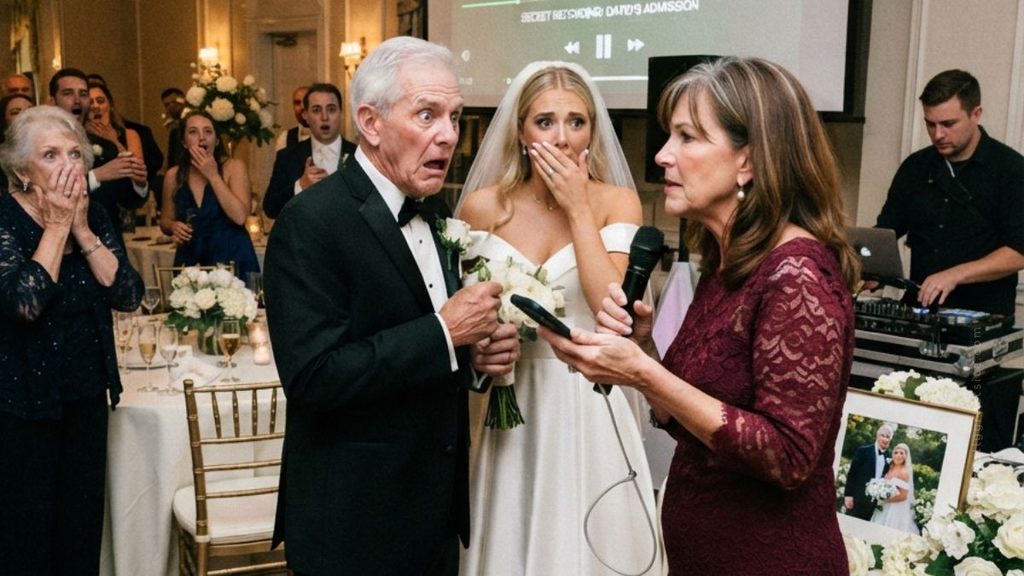
My husband stood at the altar beside his thirty-one-year-old mistress, smiling at two hundred wedding guests, when the speakers suddenly filled with his voice. “Once they declare Margaret incompetent, she won’t be able to stop us. I’ll have control of the house, the accounts, and everything her father left her.”
The bride stopped smiling.
My husband turned toward the sound booth.
And I stood up from the back pew.
I was sixty-six years old, wearing the same navy-blue dress I’d worn to our daughter’s wedding, and holding a folder containing forty-seven years of marriage, three months of medical records, and enough evidence to send my husband to prison.
But I hadn’t come to stop the wedding.
I wanted him to say his vows.
I wanted him to stand in front of everyone we knew and promise to love another woman.
And then I wanted every person in that church to hear exactly what he’d done to make that wedding possible.
Because six months earlier, my husband had convinced our children, our neighbors, and two doctors that I was losing my mind.
He’d told everyone I had dementia.
He’d moved me into a memory-care facility.
He’d obtained control of my finances.
And he’d started planning a wedding to a woman young enough to be our daughter.
What he didn’t know was that I’d been recording him too.
And the most devastating recording wasn’t the one where he admitted he was stealing my money.
It was the one where he explained what had happened to his first wife.
The woman he’d told me died in 1978.
The woman whose wedding ring his mistress was now wearing.
My name is Margaret Holloway.
I married my husband, Robert, in June 1979, when I was nineteen and he was twenty-four.
We lived outside Richmond, Virginia, in a white colonial house my father helped us purchase.
Robert worked in commercial real estate.
I taught fourth grade for thirty-two years.
We raised three children.
Our oldest, Caroline, was forty-four.
Our son, Andrew, was forty-one.
And our youngest, Rebecca, was thirty-seven.
We had seven grandchildren.
A dog named Murphy.
A lake house in North Carolina.
And what I believed was a comfortable retirement.
Robert was seventy-one.
He’d retired three years earlier after selling his real estate company.
We were supposed to spend our golden years traveling.
Gardening.
Visiting our grandchildren.
Instead, Robert decided he wanted to spend them with a thirty-one-year-old woman named Vanessa Pierce.
Vanessa had been his executive assistant before he retired.
She was blonde, beautiful, and always dressed like she was attending a cocktail party.
I’d met her dozens of times.
She came to our Christmas parties.
She brought gifts for our grandchildren.
She even attended my mother’s funeral.
I remember her standing beside me at the graveside, squeezing my hand and saying, “Mrs. Holloway, please let me know if there’s anything I can do.”
Apparently, what she could do was sleep with my husband.
I didn’t discover the affair until much later.
By then, Robert had already begun convincing everyone I was mentally deteriorating.
It started with little things.
Missing keys.
Forgotten appointments.
Misplaced jewelry.
One afternoon, I couldn’t find my car keys.
I searched the kitchen.
The bedroom.
My purse.
Robert watched me for nearly twenty minutes.
Then he sighed.
“Margaret, sweetheart, they’re in the freezer.”
I stared at him.
“What?”
He opened the freezer.
There they were.
My car keys.
Sitting beside a bag of frozen peas.
I laughed nervously.
“Well, that’s strange.”
Robert didn’t laugh.
He looked concerned.
“Margaret, this is the third time this month.”
I frowned.
“The third time what?”
“You’ve put something somewhere it doesn’t belong.”
I shook my head.
“Robert, everyone misplaces things.”
He kissed my forehead.
“Of course they do.”
Then he added:
“But maybe we should mention it to Dr. Ellis.”
I didn’t think much of it.
Until the next week.
I was supposed to pick up my granddaughter Sophie from school.
I’d done it every Thursday for three years.
That afternoon, I arrived at 3:15, just like always.
But Sophie wasn’t there.
Her teacher came outside.
“Mrs. Holloway, Caroline picked her up.”
I frowned.
“Why?”
The teacher looked uncomfortable.
“Your daughter said you forgot.”
I stared at her.
“Forgot what?”
“That you weren’t supposed to come today.”
I called Caroline.
She answered immediately.
“Mom?”
“Sweetheart, why did you pick up Sophie?”
A pause.
“Dad called me.”
I froze.
“What?”
“He said you were confused about the schedule.”
I felt a strange tightness in my chest.
“Caroline, I wasn’t confused.”
She sighed.
“Mom, Dad said you called him three times asking what day it was.”
I stared at the phone.
“I never called him.”
Silence.
Then Caroline said gently:
“Mom, maybe you just don’t remember.”
That was the first time one of my children looked at me like I was becoming someone they didn’t recognize.
Over the next several weeks, things got worse.
Robert told our neighbors I’d been wandering outside at night.
He told our pastor I’d forgotten how to get home from the grocery store.
He told our children I’d left the stove on.
None of those things had happened.
But every time I tried to explain, Robert would give me a sad smile.
Then he’d say:
“Margaret, honey, that’s exactly what worries us. You don’t remember.”
I began keeping a notebook.
Every appointment.
Every conversation.
Every errand.
Every medication.
I wrote everything down.
Robert found it one evening.
He stood in the kitchen, flipping through the pages.
“What’s this?”
“My schedule.”
He frowned.
“Why are you writing down every little thing?”
“Because you keep telling people I’m forgetting things.”
His expression changed.
Then he smiled.
“Sweetheart, that’s a good idea.”
I felt relieved.
Until he added:
“People with early dementia often benefit from memory journals.”
I stared at him.
“Robert, I don’t have dementia.”
He looked at me sadly.
Then said:
“That’s what your mother used to say.”
My mother had died at eighty-seven.
She’d been forgetful during her final year.
But she’d never been diagnosed with dementia.
Robert knew that.
He also knew it was the one thing I feared most.
Losing my memory.
Losing my independence.
Becoming a burden to my children.
He used that fear against me.
And for a while, it worked.
I began doubting myself.
I’d walk into a room and forget why I’d gone there.
Then panic.
I’d misplace my reading glasses and wonder whether Robert was right.
I’d wake up in the middle of the night and try to remember what I’d eaten for dinner.
The more frightened I became, the more forgetful I felt.
And Robert was always there.
Watching.
Taking notes.
Making phone calls.
Telling everyone how difficult things had become.
Then came the doctor’s appointment.
Dr. Ellis had been our family physician for twenty years.
Robert insisted on coming with me.
He sat beside me during the examination.
Answered questions before I could.
Corrected my recollections.
When Dr. Ellis asked whether I’d experienced confusion, Robert sighed.
“She’s been having episodes.”
I turned toward him.
“What episodes?”
He looked at the doctor.
“See?”
I stared at him.
“Robert, stop.”
He reached for my hand.
“Margaret, please don’t get upset.”
Dr. Ellis looked uncomfortable.
He asked me several questions.
I answered them.
I knew the date.
The president.
My address.
My children’s birthdays.
I completed a brief cognitive screening without difficulty.
Dr. Ellis told us he didn’t see clear evidence of dementia but recommended a more thorough evaluation if concerns continued.
I felt relieved.
Robert didn’t.
On the drive home, he was silent.
Then he said:
“Dr. Ellis doesn’t know what you’re like at home.”
I looked at him.
“Because I’m perfectly fine at home.”
He gripped the steering wheel.
Then whispered:
“Not for much longer.”
I turned toward him.
“What?”
He smiled.
“Nothing, sweetheart.”
But I remembered those words.
And I wish I’d understood them sooner.
Two weeks later, I woke up in the hospital.
I had no memory of how I’d gotten there.
My mouth was dry.
My head was pounding.
My daughter Caroline was sitting beside the bed.
She was crying.
“Mom?”
I tried to sit up.
“What happened?”
She squeezed my hand.
“Dad found you on the kitchen floor.”
I stared at her.
“What?”
She nodded.
“He said you’d taken too much medication.”
I felt sick.
“What medication?”
Caroline looked devastated.
“Your sleeping pills.”
I shook my head.
“I don’t take sleeping pills.”
She stared at me.
Then whispered:
“Mom, Dad says you’ve been taking them for months.”
I couldn’t breathe.
I looked toward the doorway.
Robert was standing there.
Holding a bouquet of flowers.
He smiled.
“There’s my girl.”
I stared at him.
He walked toward the bed.
Kissed my forehead.
Then whispered:
“You gave us quite a scare, sweetheart.”
I looked at Caroline.
Then back at Robert.
And for the first time in forty-seven years, I was afraid of my husband.
Not irritated.
Not disappointed.
Afraid.
Because I knew I hadn’t taken sleeping pills.
And I knew Robert was lying.
But everyone believed him.
Three days later, I was discharged.
Not home.
To a memory-care facility called Willowbrook Gardens.
Robert told me it was temporary.
“Just until we know you’re safe.”
I cried.
I begged him to take me home.
He held my hands.
Looked directly into my eyes.
And said:
“Margaret, you need help.”
Our children agreed.
Caroline cried.
Andrew looked miserable.
Rebecca promised she’d visit every day.
I felt like I was watching my own funeral.
Everyone was grieving a woman who was still alive.
And nobody would listen when I told them I was perfectly capable of caring for myself.
The first week at Willowbrook was humiliating.
Staff members spoke to me slowly.
They reminded me what day it was.
They checked whether I’d eaten.
They asked if I remembered my children’s names.
I wanted to scream.
Instead, I smiled.
Answered their questions.
And waited.
Because I’d noticed something.
The other residents had medical files.
Treatment plans.
Documented diagnoses.
But whenever I asked to see mine, the staff told me Robert was handling the paperwork.
One afternoon, I asked a nurse named Angela whether I could have a copy of my records.
She looked surprised.
“Of course.”
I stared at her.
“Really?”
She smiled.
“Mrs. Holloway, they’re your records.”
I almost cried.
Angela printed the documents.
I sat in my room and read every page.
And discovered something that made my blood run cold.
There was no confirmed dementia diagnosis.
The hospital records described an episode of altered consciousness, with sedating medication detected in my system.
The memory-care placement had been arranged after Robert reported repeated confusion and unsafe behavior at home.
But the notes also documented that I’d consistently denied those incidents.
I stared at the pages.
Then read one sentence again.
PATIENT REPORTS CONCERN THAT SPOUSE MAY BE ADMINISTERING MEDICATION WITHOUT HER KNOWLEDGE.
Someone had written it down.
Someone had listened.
I turned the page.
There was a recommendation for an independent neurological evaluation.
It had never been completed.
Instead, Robert had arranged for me to be transferred to Willowbrook.
I sat on my bed.
And started crying.
Not because I was helpless.
Because I finally had proof that my fears were reasonable.
That evening, Angela came to check on me.
She noticed the papers.
“Mrs. Holloway?”
I looked up.
She sat beside me.
“Is everything okay?”
I hesitated.
Then asked:
“Angela, do you think I have dementia?”
She looked uncomfortable.
“I’m not qualified to diagnose you.”
“I understand.”
She paused.
Then said:
“But I think you deserve a complete evaluation.”
I nodded.
Then whispered:
“I think my husband is trying to make me disappear.”
Angela didn’t laugh.
She didn’t dismiss me.
She didn’t tell me I was confused.
She looked at me for a long moment.
Then said:
“Would you like me to help you contact an attorney?”
I started crying.
Because after months of being treated like a child, someone had finally asked me what I wanted.
The attorney’s name was Daniel Mercer.
He specialized in elder law.
Angela helped me arrange a private consultation.
I told him everything.
The missing keys.
The false reports.
The hospital.
The medication.
The memory-care placement.
He listened carefully.
Then asked:
“Mrs. Holloway, has your husband obtained a court order declaring you incapacitated?”
I shook my head.
“Not that I know of.”
He nodded.
“Then we need to establish exactly what authority he’s claiming.”
I swallowed.
“Can he keep me here?”
“Not simply because he says you have dementia.”
I started crying.
Daniel continued.
“We’ll obtain your records, arrange an independent evaluation, and review any powers of attorney or court filings.”
I stared at him.
Then whispered:
“I think he’s stealing from me.”
He looked up.
“Why?”
I told him about the house.
The bank accounts.
The inheritance from my father.
My father had owned several commercial properties.
When he died, he’d left me a trust worth approximately six million dollars.
Robert had always managed the investments.
I trusted him.
I signed whatever documents he brought home.
I never imagined he’d use that trust to finance a new life with another woman.
Daniel made several phone calls.
Three days later, he returned with a folder.
His expression was grim.
“Margaret, we have a problem.”
I felt sick.
“What?”
He opened the folder.
“Your husband filed a petition seeking guardianship over your finances.”
I froze.
“When?”
“Last month.”
I stared at him.
“Before I went to the hospital?”
Daniel nodded.
I couldn’t breathe.
“He planned this.”
Daniel didn’t answer.
He turned another page.
“He’s also initiated divorce proceedings.”
I stopped breathing.
“Divorce?”
He nodded.
I stared at him.
“Robert never told me.”
Daniel looked devastated.
“According to the filing, he claims you were served with notice.”
I shook my head.
“I wasn’t.”
He handed me a document.
At the bottom was a signature.
Margaret Holloway.
Mine.
Except it wasn’t.
I stared at it.
Then whispered:
“That’s not my handwriting.”
Daniel nodded.
“We’re going to challenge it.”
I looked at him.
Then asked:
“Is he seeing someone else?”
Daniel hesitated.
I felt my stomach drop.
“Please.”
He opened another folder.
Inside was a photograph.
Robert standing outside a restaurant.
His arm around a young blonde woman.
Vanessa Pierce.
I recognized her immediately.
Daniel looked at me.
“Do you know her?”
I nodded.
My throat tightened.
“She used to work for him.”
He swallowed.
“They’ve been living together for approximately four months.”
I stared at the photograph.
Then whispered:
“In my house?”
Daniel looked devastated.
Then nodded.
I couldn’t breathe.
My house.
The home where I’d raised our children.
The house my father had helped us buy.
The house where Robert had supposedly found me unconscious.
He’d moved his mistress into it while I was locked away in memory care.
I started crying.
Then Daniel said something that changed everything.
“Margaret, there’s more.”
I looked up.
He opened another document.
A marriage license application.
Robert Holloway.
Vanessa Pierce.
Wedding date: October 17.
Six weeks away.
I stared at it.
Then whispered:
“He’s planning to marry her?”
Daniel nodded.
I felt sick.
“But we’re still married.”
“He’s seeking an expedited divorce.”
I shook my head.
“He can’t.”
Daniel looked at me.
“Not without resolving the legal issues.”
I stared at the document.
Then noticed something.
The wedding venue.
St. Andrew’s Episcopal Church.
The same church where Robert and I had married forty-seven years earlier.
I started laughing.
Not because it was funny.
Because the cruelty was almost unbelievable.
He wasn’t simply replacing me.
He was planning to marry his mistress in the same church where he’d promised to love me forever.
I looked at Daniel.
Then whispered:
“I want to go to that wedding.”
He frowned.
“Margaret—”
“I want to be there.”
He looked concerned.
“Let’s focus on protecting you first.”
I nodded.
But I already knew.
I wasn’t going to let Robert tell the world I was confused, helpless, and incapable of understanding what was happening.
I was going to stand in that church.
And make him look me in the eye.
What I didn’t know was that Robert had already made a mistake.
A very expensive mistake.
Because three years earlier, he’d installed a sophisticated home security system.
Cameras.
Motion sensors.
Audio recording in his home office.
He’d insisted on it after several burglaries in our neighborhood.
The system automatically saved recordings to a cloud account.
And when Robert set it up, he’d used my email address.
He’d forgotten.
I hadn’t.
I still had access to that account.
And once Daniel helped me recover the password, we discovered something extraordinary.
The cameras had been recording for months.
Including the nights Robert and Vanessa sat in his office discussing what they planned to do with me.
I remember the first recording we watched.
It was dated February 12.
Robert was sitting behind his desk.
Vanessa was perched on the edge of the chair beside him.
She was wearing my silk robe.
The pale pink one Caroline had given me for Christmas.
Robert was pouring champagne.
Vanessa laughed.
“How much longer do we have to wait?”
Robert smiled.
“Not long.”
She leaned closer.
“Are you sure the doctors will believe it?”
Robert shrugged.
“Margaret’s sixty-six. People expect women her age to start forgetting things.”
I felt sick.
Vanessa laughed.
“And the kids?”
Robert smiled.
“They’ll believe whatever I tell them.”
I started crying.
Then he said:
“Once they declare her incompetent, she won’t be able to stop us. I’ll have control of the house, the accounts, and everything her father left her.”
Daniel paused the recording.
We sat in silence.
Then he looked at me.
“Margaret, this is evidence.”
I nodded.
He continued.
“We need to preserve the original files.”
I swallowed.
Then whispered:
“Keep playing.”
He hesitated.
I looked at him.
“Please.”
He pressed play.
Vanessa took a sip of champagne.
“What about the medication?”
Robert smiled.
“Dr. Kessler said a little extra at night won’t hurt.”
I froze.
Dr. Kessler.
My new specialist.
The physician Robert had insisted I see after Dr. Ellis refused to diagnose me with dementia.
Vanessa frowned.
“Isn’t that dangerous?”
Robert shrugged.
“Only if someone asks the wrong questions.”
I felt physically ill.
Then Vanessa asked:
“What if Margaret remembers?”
Robert leaned back.
And smiled.
“That’s the beauty of it. Anything she says just makes her sound more confused.”
I covered my mouth.
Daniel stopped the recording.
He looked at me.
“Margaret, we’re going to the police.”
I nodded.
But I couldn’t stop staring at the screen.
My husband.
The man I’d slept beside for forty-seven years.
The father of my children.
The grandfather who dressed up as Santa Claus every Christmas.
Was calmly discussing how to drug me, discredit me, and steal my inheritance.
And he was smiling.
That was the moment I stopped thinking of Robert as my husband.
He was a stranger.
A dangerous stranger.
And I was going to find out exactly how much damage he’d done.
Over the next two weeks, Daniel helped me obtain an independent neurological evaluation.
The specialist found no evidence of dementia.
My cognitive testing was normal.
My medication records raised serious concerns.
And the guardianship petition was challenged.
I was able to leave Willowbrook.
I moved into a small furnished apartment under a temporary arrangement while the legal proceedings continued.
I didn’t tell Robert where I was staying.
Instead, I let him believe I was still at the facility.
And I kept watching the recordings.
There were dozens.
Robert and Vanessa discussing the wedding.
Robert meeting with Dr. Kessler.
Robert speaking to a financial adviser about transferring my trust assets.
And one recording that made me sit completely still.
It was dated March 3.
Robert was alone in his office.
He was speaking on the phone.
I couldn’t hear the person on the other end.
But I could hear Robert.
He sounded angry.
“I told you not to contact me.”
A pause.
Then:
“That was forty-eight years ago.”
I frowned.
Forty-eight years.
Robert continued.
“She’s dead. That’s what everyone believes.”
I felt a chill.
He listened.
Then snapped:
“If you come anywhere near my wedding, I’ll make sure you disappear again.”
The call ended.
Robert sat motionless for nearly a minute.
Then opened his desk drawer.
He removed a small black box.
Inside was a wedding ring.
Not mine.
A plain gold band.
He held it for a moment.
Then whispered:
“You should’ve stayed buried.”
I stared at the screen.
Then turned toward Daniel.
“Who was he talking about?”
Daniel looked troubled.
“I don’t know.”
I swallowed.
“Robert was married before me.”
Daniel looked up.
“What?”
I nodded.
“He told me his first wife died in a car accident in 1978.”
Daniel frowned.
“Do you know her name?”
I thought for a moment.
Then said:
“Eleanor.”
He started typing.
“Eleanor what?”
I swallowed.
“Eleanor Whitcomb.”
Daniel searched public records.
Then stopped.
His expression changed.
“Margaret.”
I looked at him.
“What?”
He turned the computer toward me.
A marriage record.
Robert Holloway.
Eleanor Whitcomb.
June 1976.
I stared at it.
Then Daniel opened another record.
A divorce petition.
Filed in 1980.
I froze.
“1980?”
Daniel nodded.
I couldn’t breathe.
“Robert and I married in 1979.”
He looked at me.
Then whispered:
“Margaret, your husband was still legally married to Eleanor when he married you.”
I stopped breathing.
Forty-seven years.
Three children.
A lifetime together.
And apparently, our marriage had begun with a lie.
I stared at the screen.
Then whispered:
“What happened to Eleanor?”
Daniel opened another document.
The divorce petition had been dismissed.
No final decree.
No death certificate.
No record of Eleanor’s supposed car accident.
I felt sick.
Then Daniel said:
“Margaret, I don’t think Eleanor died.”
I stared at him.
He continued.
“I think she’s still alive.”
I swallowed.
“Then where is she?”
Daniel looked toward the computer.
Then said:
“Let’s find out.”
Three days later, we found Eleanor Whitcomb.
She was seventy-two.
Living in a small town in Pennsylvania.
Under a different surname.
Daniel contacted her through an attorney.
At first, she refused to speak with us.
Then he mentioned Robert’s upcoming wedding.
She changed her mind.
We met at a diner halfway between Richmond and her home.
I arrived early.
Ordered coffee.
Sat in a booth near the window.
Then a woman walked in.
Gray hair.
Glasses.
A brown cardigan.
She looked around.
Then saw me.
And stopped.
For a moment, neither of us moved.
Then she walked toward the table.
“Margaret?”
I nodded.
She sat down.
Her hands were shaking.
“I’m Eleanor.”
I stared at her.
Then whispered:
“Robert told me you died.”
She smiled sadly.
“I know.”
I felt sick.
“How?”
Eleanor looked down.
Then said:
“Because he told everyone you were the reason I disappeared.”
I froze.
“What?”
She looked at me.
Her eyes filled with tears.
Then whispered:
“Margaret, Robert didn’t just lie about my death.”
I stared at her.
She swallowed.
Then said:
“He tried to kill me.”
I couldn’t breathe.
Eleanor began telling me about her marriage.
Robert had been charming.
Ambitious.
Attentive.
He bought her flowers.
Wrote love letters.
Promised her the world.
Then she inherited money from her grandmother.
And everything changed.
Robert began managing her finances.
He convinced her to sign documents.
He opened accounts in her name.
He told friends she was emotionally unstable.
Then he started seeing another woman.
A younger woman.
A woman he planned to marry.
Me.
I stared at Eleanor.
Then whispered:
“I didn’t know.”
She nodded.
“I believe you.”
I started crying.
Eleanor reached across the table.
Then said:
“He told me you were pregnant.”
I froze.
“What?”
She nodded.
“He said you were carrying his baby.”
I shook my head.
“Robert and I didn’t have Caroline until 1982.”
Eleanor looked devastated.
Then whispered:
“That’s not what he told me.”
I stared at her.
“He said you were pregnant in 1978.”
I couldn’t breathe.
1978.
The year before our wedding.
The year I spent six months living with my aunt in Maryland.
The year I’d been hospitalized after what my parents called a miscarriage.
I stared at Eleanor.
Then whispered:
“I was pregnant.”
She froze.
“What?”
I swallowed.
“I lost the baby.”
Eleanor looked at me.
Then whispered:
“Did you?”
I stopped breathing.
I stared at her.
“What do you mean?”
She reached into her purse.
Pulled out an envelope.
And slid it across the table.
Inside was a photograph.
A newborn baby.
Wrapped in a yellow blanket.
A little girl.
On the back, someone had written:
BABY HOLLOWAY — SEPTEMBER 1978.
I stared at it.
Then looked at Eleanor.
“Where did you get this?”
She started crying.
Then whispered:
“Robert gave her to me.”
I couldn’t breathe.
“What?”
Eleanor nodded.
I stared at her.
Then she said:
“He told me she was yours.”
I stopped breathing.
My baby.
The child I’d believed I’d lost.
Had apparently been born alive.
And Robert had given her to his first wife.
I stared at Eleanor.
Then whispered:
“Where is she?”
Eleanor looked devastated.
Then said:
“I don’t know.”
I started shaking.
“What?”
She began crying.
“Robert took her back.”
I couldn’t breathe.
“When?”
“Three months later.”
I stared at her.
“Why?”
Eleanor looked toward the window.
Then whispered:
“Because I refused to sign the adoption papers.”
I felt sick.
She continued.
“He told me if I didn’t cooperate, he’d make sure I never saw her again.”
I started crying.
“Did you go to the police?”
Eleanor nodded.
“I tried.”
I stared at her.
Then she whispered:
“That’s when he tried to kill me.”
She told me Robert had pushed her down the basement stairs.
She’d broken her hip.
Suffered a concussion.
Spent weeks in the hospital.
When she recovered, Robert was gone.
So was the baby.
And the money.
She filed for divorce.
But Robert never appeared in court.
Eventually, she moved away.
Changed her surname.
Started over.
For decades, she’d believed the little girl had been returned to me.
I stared at the photograph.
Then whispered:
“I never knew she existed.”
Eleanor started crying.
I looked at her.
Then asked:
“Did Robert ever tell you her name?”
She nodded.
I swallowed.
“What was it?”
Eleanor looked devastated.
Then whispered:
“Vanessa.”
I stopped breathing.
Vanessa.
My husband’s thirty-one-year-old mistress.
The woman he was planning to marry.
The woman who’d helped him convince everyone I had dementia.
I stared at Eleanor.
Then whispered:
“That’s impossible.”
She looked confused.
I swallowed.
“Vanessa is thirty-one.”
Eleanor nodded slowly.
I stared at her.
“The baby was born in 1978.”
She looked devastated.
Then whispered:
“Robert changed her birth records.”
I couldn’t breathe.
“By forty-seven years?”
Eleanor shook her head.
“No, Margaret.”
She looked at the photograph.
Then said:
“The woman he’s marrying isn’t the baby.”
I froze.
“What?”
Eleanor looked toward the diner entrance.
Then whispered:
“She’s the baby’s daughter.”
I stopped breathing.
Vanessa.
My husband’s mistress.
Was apparently my granddaughter.
I stared at Eleanor.
Then whispered:
“How do you know?”
She started crying.
Then said:
“Because I found your daughter.”
I couldn’t breathe.
“When?”
“Six years ago.”
I stared at her.
“Where?”
Eleanor looked devastated.
Then whispered:
“In a psychiatric hospital.”
I stopped breathing.
My daughter.
The baby I’d believed I’d lost.
Had spent decades somewhere I didn’t know.
And Eleanor had found her.
I stared at her.
Then whispered:
“Is she alive?”
Eleanor nodded.
I started crying.
“Where is she?”
She reached into her purse.
Pulled out another photograph.
A woman in her late forties.
Dark hair.
Brown eyes.
My eyes.
She was standing in a garden.
Smiling.
I covered my mouth.
Eleanor whispered:
“Her name is Laura.”
I started sobbing.
Laura.
My firstborn daughter.
Alive.
Then Eleanor said something that made my stomach drop.
“And she’s the one who told Vanessa to marry Robert.”
I froze.
“What?”
Eleanor looked devastated.
Then whispered:
“Because they’ve been planning to destroy him for years.”
I stared at her.
Vanessa.
The mistress.
The woman who’d helped Robert steal my life.
Was apparently working with my daughter.
My daughter who’d been taken from me nearly forty-eight years earlier.
I looked at Eleanor.
Then whispered:
“Why would they do this to me?”
She started crying.
Then said:
“Because Robert told them you were the one who gave Laura away.”
I couldn’t breathe.
The lies.
The missing baby.
The first wife.
The mistress.
The dementia scheme.
Everything was connected.
I stared at Eleanor.
Then whispered:
“Does Vanessa know I’m her grandmother?”
Eleanor nodded.
I felt sick.
“Then why did she help him?”
Eleanor looked devastated.
Then said:
“Because she wanted him to trust her.”
I froze.
“What?”
She continued.
“Vanessa needed access to his office. His accounts. His recordings.”
I stared at her.
Then whispered:
“The recordings?”
Eleanor nodded.
I couldn’t breathe.
“She knew about them?”
Eleanor looked at me.
Then said:
“Margaret, Vanessa is the one who made sure you could find them.”
I stopped breathing.
The cloud account.
The password.
The recordings.
The evidence.
I stared at Eleanor.
Then whispered:
“She wanted me to hear everything?”
Eleanor nodded.
I started crying.
“Then why didn’t she tell me?”
Eleanor looked devastated.
Then said:
“Because she needed Robert to believe you were still helpless.”
I couldn’t breathe.
The wedding.
The church.
The guests.
The recordings.
I stared at Eleanor.
Then whispered:
“What happens at the wedding?”
She looked toward the window.
Then said:
“That’s when Robert finds out who Vanessa really is.”
I froze.
“What?”
Eleanor looked directly at me.
Then whispered:
“And that’s when your daughter comes home.”
I sat across from my husband’s first wife in a Pennsylvania diner, holding a photograph of the daughter I’d been told was dead for forty-eight years.
Her name was Laura.
She was forty-eight years old.
She had my brown eyes, my mother’s cheekbones, and a daughter named Vanessa who was currently planning to marry my seventy-one-year-old husband.
The same husband who was Laura’s biological father.
The same husband who was Vanessa’s grandfather.
I looked at Eleanor.
“Tell me she isn’t actually sleeping with him.”
Eleanor’s expression changed.
“Margaret—”
“Please.”
She reached across the table.
“Vanessa says she never has.”
I closed my eyes.
For the first time in weeks, I felt something resembling relief.
“Then why does Robert think she is?”
Eleanor looked uncomfortable.
“Because she let him.”
I stared at her.
“She’s been living in my house.”
“I know.”
“She’s been sleeping in my bedroom.”
Eleanor shook her head.
“Not with Robert. She told Laura she sleeps in the guest room and locks the door.”
I wanted to believe her.
But after everything I’d discovered, I wasn’t prepared to take anyone’s word for anything.
“Why would Robert agree to marry a woman who won’t sleep with him?”
Eleanor gave me a strange look.
Then said:
“Because he doesn’t know she’s his granddaughter.”
I stared at her.
“That doesn’t answer my question.”
She lowered her voice.
“Vanessa told him she wanted to wait until the wedding.”
I sat back.
Of course.
Robert had spent decades presenting himself as a respectable, churchgoing family man.
He’d probably found the idea charming.
A beautiful younger woman insisting on a traditional wedding before they became intimate.
I almost laughed.
Then I remembered the recordings.
Vanessa wearing my robe.
Vanessa sitting beside Robert in his office.
Vanessa laughing while he explained how he’d convince everyone I had dementia.
I looked at Eleanor.
“She sounded like she was enjoying it.”
Eleanor’s eyes filled with tears.
“She was playing a part.”
“She helped him drug me.”
Eleanor shook her head.
“No. She didn’t know about that until she heard the recording.”
I stared at her.
“She was sitting beside him when he discussed it.”
“She thought he was exaggerating. She didn’t realize he’d actually done it.”
I looked down at my coffee.
There was a difference between pretending to love a dangerous man and helping him destroy an innocent woman.
Vanessa might have started with one intention.
But she’d still watched me get taken away from my own home.
She’d still allowed my children to believe I was losing my mind.
And she’d still stood beside Robert while he planned to take everything I owned.
I looked at Eleanor.
“She could have warned me.”
Eleanor nodded.
“Yes.”
“She could have called my children.”
“Yes.”
“She could have stopped him before I ended up in that facility.”
Eleanor began crying.
“I know.”
I stared at the photograph of Laura.
Then asked:
“Does my daughter know what Vanessa did to me?”
Eleanor looked away.
And that was answer enough.
I pushed my coffee aside.
“I want to speak to Laura.”
Eleanor nodded.
“She’s expecting you.”
I froze.
“What?”
Eleanor reached into her purse.
Pulled out her phone.
And turned the screen toward me.
A text message.
Did she believe you?
It was from Laura.
Sent twelve minutes earlier.
I stared at it.
Then looked at Eleanor.
“She knew we were meeting?”
Eleanor swallowed.
“Yes.”
I felt something cold settle in my stomach.
“Then why isn’t she here?”
Eleanor looked toward the diner entrance.
Then whispered:
“Because she’s afraid you’ll recognize her.”
I stared at her.
“Recognize her?”
Eleanor nodded.
I looked at the photograph again.
Laura’s face.
Her dark hair.
Her brown eyes.
There was something familiar about her.
Something I couldn’t place.
Then Eleanor said:
“Margaret, you’ve met your daughter before.”
I stopped breathing.
“When?”
Eleanor looked devastated.
Then whispered:
“At Willowbrook Gardens.”
The memory-care facility.
The place Robert had sent me.
I stared at Eleanor.
“What?”
She nodded.
“Laura worked there.”
My heart began pounding.
“Doing what?”
Eleanor looked toward the photograph.
Then said:
“She was your nurse.”
I couldn’t move.
A nurse.
At Willowbrook.
I thought about the women who’d cared for me.
The ones who spoke to me slowly.
The ones who reminded me what day it was.
The ones who treated me like I was incapable of understanding simple questions.
Then I remembered Angela.
The nurse who’d printed my medical records.
The nurse who’d believed me when I said Robert was trying to make me disappear.
The nurse who’d helped me contact an attorney.
I looked at Eleanor.
“Angela?”
She nodded.
I stared at her.
“Angela is Laura?”
Eleanor started crying.
“Angela is her middle name. She uses it professionally.”
I covered my mouth.
My daughter.
My firstborn.
The baby I’d mourned for nearly forty-eight years.
Had been sitting beside my bed.
Holding my hand.
Helping me escape.
And I’d never known.
I looked at Eleanor.
Then whispered:
“Why didn’t she tell me?”
Eleanor wiped her eyes.
“Because she wasn’t sure you were her mother.”
I frowned.
“What?”
She nodded.
“Robert told her you abandoned her. She spent most of her life believing you wanted nothing to do with her.”
I started crying.
“That’s not true.”
“I know.”
“Robert told me she died.”
Eleanor reached for my hand.
“Laura knows that now.”
I stared at her.
“Then why is she hiding?”
Eleanor hesitated.
Then said:
“Because she thinks Robert will kill her if he finds out she’s alive.”
I felt sick.
The woman who’d helped me escape Willowbrook wasn’t simply trying to expose my husband.
She was hiding from her own father.
And she’d been doing it for years.
I looked at Eleanor.
“Where is she?”
Eleanor glanced toward the parking lot.
Then whispered:
“She’s outside.”
I turned.
A silver sedan was parked near the far end of the lot.
A woman sat behind the wheel.
Dark hair.
Sunglasses.
Watching the diner.
I stood so quickly my chair scraped against the floor.
Eleanor reached for me.
“Margaret, wait.”
But I was already walking.
I pushed through the diner doors.
Crossed the parking lot.
And stopped beside the driver’s window.
The woman looked up.
Then slowly removed her sunglasses.
Angela.
My nurse.
My daughter.
She started crying before I said a word.
“Mrs. Holloway.”
I shook my head.
“Don’t call me that.”
Her face crumpled.
I reached through the open window.
Touched her cheek.
And whispered:
“I’ve been looking for you since the day you were born.”
She started sobbing.
I opened the car door.
She stepped out.
And for the first time in forty-eight years, I held my daughter.
Not a photograph.
Not a memory.
Not a baby I’d been told was dead.
My daughter.
Alive.
Standing in front of me.
She buried her face against my shoulder.
“I thought you didn’t want me.”
I held her tighter.
“Oh, sweetheart.”
She started crying harder.
“I thought you gave me away.”
I kissed her hair.
“Never.”
She shook her head.
“He told me you signed the papers.”
I pulled back.
“Robert?”
She nodded.
I looked into her eyes.
“Laura, I was nineteen years old. They told me you died.”
She stared at me.
I continued.
“I held you for less than an hour. Then a nurse took you away. Robert told me there had been complications.”
Laura covered her mouth.
I started crying.
“I spent months grieving you.”
She shook her head.
“I didn’t know.”
I held her face between my hands.
“How could you?”
She started sobbing again.
And we stood in that parking lot for nearly ten minutes, holding each other.
Then Laura whispered something that made me go still.
“Mom, there’s something I need to tell you.”
I looked at her.
“What?”
She swallowed.
“Robert knows I’m alive.”
I froze.
“What?”
She nodded.
I stared at her.
“Then why would he threaten you?”
Laura looked toward Eleanor.
Then back at me.
And whispered:
“Because he thinks I have something that belongs to him.”
I felt sick.
“What?”
She reached into her purse.
Pulled out a small flash drive.
And placed it in my hand.
I stared at it.
“What’s this?”
Laura looked devastated.
Then said:
“The recording of what happened to Eleanor.”
I stopped breathing.
Eleanor.
Robert’s first wife.
The woman he’d supposedly pushed down the basement stairs.
I looked at Laura.
Then whispered:
“There’s a recording?”
She nodded.
I stared at the flash drive.
“From 1978?”
Laura shook her head.
“No.”
I frowned.
“Then when?”
She swallowed.
Then said:
“From three months ago.”
I couldn’t move.
Three months ago.
The same time Robert began convincing everyone I had dementia.
The same time Vanessa moved into our house.
The same time I started finding things in strange places.
I looked at Laura.
“What happened three months ago?”
She looked toward Eleanor.
Then whispered:
“Robert tried to kill her again.”
I stared at Eleanor.
She was standing beside us.
Her face had gone pale.
I looked at Laura.
“Why?”
She swallowed.
“Because Eleanor threatened to tell you about me.”
I felt sick.
Then Laura continued.
“Robert invited her to your house. He told her he’d finally tell you the truth.”
I stared at her.
“When?”
“February ninth.”
My heart dropped.
February ninth.
I remembered that day.
Robert had insisted I visit my sister in Charlottesville.
He’d packed my overnight bag.
Told me I needed a break.
I returned the next afternoon.
And found a broken vase in the hallway.
Robert told me Murphy had knocked it over.
I stared at Laura.
“She came to my house?”
Laura nodded.
I looked at Eleanor.
She started crying.
Then whispered:
“He tried to push me down the basement stairs.”
I couldn’t breathe.
“Again?”
She nodded.
I stared at her.
“How did you get away?”
Eleanor looked toward Laura.
Then said:
“Vanessa.”
I froze.
Vanessa.
The mistress.
The woman planning to marry Robert.
Eleanor continued.
“She came into the house while Robert was threatening me.”
I stared at her.
“She stopped him?”
Eleanor nodded.
“She told him she’d called the police.”
I felt sick.
“Had she?”
Eleanor shook her head.
“No. She was bluffing.”
I stared at Laura.
Then whispered:
“That’s why Vanessa started helping you?”
She nodded.
“She realized Robert was dangerous.”
I looked down at the flash drive.
Then asked:
“What’s on it?”
Laura swallowed.
Then said:
“Everything.”
That evening, Daniel Mercer and I watched the recording.
It came from a camera Robert had installed near the basement stairs.
The image was grainy.
The audio wasn’t perfect.
But it was clear enough.
Robert stood in the hallway.
Eleanor was beside the basement door.
She looked frightened.
Robert was shouting.
“You should have stayed away.”
Eleanor shook her head.
“Margaret deserves to know.”
Robert stepped closer.
“Margaret doesn’t deserve anything.”
I felt sick.
Eleanor continued.
“You stole her baby.”
Robert laughed.
“That was forty-eight years ago.”
Eleanor started crying.
“You told her the child died.”
Robert shrugged.
“And she believed me.”
I covered my mouth.
Then Eleanor said:
“Laura knows what you did.”
Robert went still.
“What?”
Eleanor looked directly at him.
“Your daughter knows.”
Robert’s expression changed.
Then he whispered:
“Where is she?”
Eleanor shook her head.
“I’m not telling you.”
Robert grabbed her arm.
She screamed.
He pulled her toward the basement stairs.
Then Vanessa appeared in the hallway.
“ROBERT!”
He turned.
Vanessa was holding her phone.
She shouted:
“LET HER GO OR I’M CALLING THE POLICE!”
Robert released Eleanor.
She stumbled backward.
Vanessa rushed toward her.
And Robert stood there.
Breathing heavily.
Then he looked at Vanessa.
And said:
“You have no idea what you’ve just interrupted.”
Vanessa stared at him.
Then whispered:
“I know exactly what you are.”
The recording ended.
Daniel paused the video.
We sat in silence.
Then he looked at me.
“Margaret, we need to turn this over to the police.”
I nodded.
He continued.
“And I think we should reconsider your plan to attend the wedding.”
I looked at him.
“Why?”
He hesitated.
“Because Robert is dangerous.”
I stared at the screen.
My husband.
The man I’d trusted for forty-seven years.
The man who’d stolen my daughter.
Drugged me.
Convinced my children I had dementia.
And apparently tried to kill his first wife twice.
I looked at Daniel.
Then said:
“That’s exactly why I need to be there.”
He frowned.
“Margaret—”
I shook my head.
“Not alone. Not without the police. But I want everyone to hear what he did.”
Daniel studied me.
Then nodded slowly.
“We can discuss that with the investigators.”
I looked at the wedding invitation.
October 17.
St. Andrew’s Episcopal Church.
Two hundred guests.
Our friends.
Our family.
Our neighbors.
The people Robert had convinced I was losing my mind.
I wanted them to know the truth.
And I wanted Robert to hear it in his own voice.
Over the next several weeks, the investigation moved quietly.
Police interviewed Eleanor.
They reviewed the recordings.
They obtained my medical records.
They questioned Dr. Kessler.
And they discovered that Robert had been transferring money from my trust into accounts connected to Vanessa.
At first, I was furious.
Then Daniel showed me something interesting.
The accounts weren’t actually controlled by Vanessa.
They were controlled by a company Robert had created years earlier.
Vanessa was listed as a beneficiary.
But she couldn’t access the money.
Robert had been using her name to move assets.
If the transactions were discovered, he could blame her.
Just as he’d blamed me for forgetting things.
I stared at Daniel.
“He was setting her up.”
Daniel nodded.
“That’s what it looks like.”
I thought about Vanessa.
Thirty-one years old.
My granddaughter.
A woman who’d allowed Robert to believe she loved him.
A woman who’d helped him convince everyone I was losing my mind.
But also a woman who’d apparently stopped him from attacking Eleanor.
And helped Laura recover the recordings.
I didn’t know whether to hate her.
Or thank her.
Maybe both.
Then, three days before the wedding, Vanessa called me.
I answered cautiously.
“Hello?”
A pause.
Then a young woman’s voice.
“Margaret?”
I closed my eyes.
“Vanessa.”
She started crying.
“I’m sorry.”
I didn’t answer.
She continued.
“I know you probably hate me.”
I stared out the window.
“Vanessa, you watched Robert put me in a memory-care facility.”
She started sobbing.
“I know.”
“You let my children believe I was losing my mind.”
“I know.”
“You wore my clothes. Lived in my house. Helped him plan a wedding.”
She cried harder.
I swallowed.
“Why?”
There was a long silence.
Then she whispered:
“Because I thought if I got close enough, he’d tell me where my mother was.”
I froze.
“Laura?”
Vanessa nodded.
“Yes.”
I frowned.
“But you knew Laura.”
She started crying.
“Not at first.”
I stared at the phone.
“What?”
She swallowed.
“Robert told me my mother died when I was little.”
I felt sick.
“He told me I was adopted.”
I closed my eyes.
“Vanessa—”
She interrupted.
“Then I found a photograph of Laura. I started asking questions. Robert told me to stop.”
I swallowed.
“And you didn’t.”
She shook her head.
“No.”
I stared at the phone.
Then whispered:
“When did you find her?”
Vanessa started crying.
“Two months ago.”
I froze.
Two months.
That meant she’d spent months helping Robert before she knew the truth.
I closed my eyes.
“Vanessa, you could have stopped.”
She sobbed.
“I know.”
I swallowed.
Then she whispered:
“I was afraid he’d kill me.”
I felt sick.
“Did he threaten you?”
She hesitated.
Then said:
“He told me what happened to the last woman who tried to leave him.”
I froze.
“What woman?”
Vanessa started crying.
Then whispered:
“His second wife.”
I stopped breathing.
Second wife.
I stared at the phone.
“Vanessa, I’m his second wife.”
Silence.
Then she whispered:
“No, Margaret.”
My heart pounded.
“What?”
She swallowed.
Then said:
“You’re his third.”
I couldn’t move.
Third wife.
Robert had married Eleanor in 1976.
He’d married me in 1979.
Who else?
I stared at the phone.
Then whispered:
“Who was the second?”
Vanessa looked devastated.
Then said:
“A woman named Susan Whitcomb.”
I froze.
Whitcomb.
Eleanor’s maiden name.
I stared at the phone.
“Was she related to Eleanor?”
Vanessa swallowed.
Then whispered:
“She was her younger sister.”
I stopped breathing.
Eleanor’s sister.
Robert had apparently married two sisters.
Then married me.
I stared at the phone.
“When?”
Vanessa hesitated.
Then said:
“1977.”
I couldn’t breathe.
1977.
While he was still married to Eleanor.
Before he married me.
I stared at the wall.
Then whispered:
“What happened to Susan?”
Vanessa started crying.
Then said:
“That’s what Robert doesn’t want anyone to find out.”
I froze.
“What?”
She swallowed.
Then whispered:
“Because Susan didn’t disappear.”
I stared at the phone.
Then Vanessa said:
“She’s buried beneath the house.”
I stopped breathing.
Beneath the house.
My house.
The home where I’d raised three children.
The home where I’d lived for forty-seven years.
The home Robert had moved his mistress into.
I stared at the phone.
Then whispered:
“Where?”
Vanessa looked devastated.
Then said:
“Under the basement floor.”
I couldn’t breathe.
The basement.
The stairs.
The broken vase.
The camera.
The recordings.
I stared at the phone.
Then whispered:
“How do you know?”
Vanessa swallowed.
Then said:
“Because Robert told me.”
I froze.
“What?”
She started crying.
“He was drunk.”
I stared at her.
“He said he’d buried one wife already, and he could bury another.”
I felt sick.
Then Vanessa whispered:
“Margaret, he wasn’t talking about Eleanor.”
I stopped breathing.
I stared at the phone.
Then said:
“I’m calling the police.”
Vanessa started crying.
“Please.”
I swallowed.
“Vanessa, you need to get out of that house.”
She hesitated.
Then whispered:
“I can’t.”
I froze.
“Why?”
She started sobbing.
Then said:
“Robert locked me in.”
I couldn’t breathe.
“What?”
She whispered:
“He’s downstairs.”
My heart pounded.
“Where are you?”
She started crying.
“In the guest bedroom.”
I stared at the phone.
“Is the door locked?”
She nodded.
“From the outside.”
I grabbed my keys.
Then stopped.
I wasn’t going to make the mistake of rushing into danger.
I called Daniel.
He called the police.
Within minutes, officers were on their way to the house.
I stayed on the phone with Vanessa.
“Sweetheart, listen to me.”
She was crying.
“I’m scared.”
“I know.”
I swallowed.
“But help is coming.”
She sniffled.
“Margaret?”
“Yes?”
She whispered:
“If something happens to me, tell my mother I love her.”
I started crying.
“You’re going to tell her yourself.”
Then I heard footsteps.
Heavy footsteps.
Coming down the hallway.
Vanessa stopped speaking.
I froze.
“Vanessa?”
Silence.
Then a man’s voice.
Robert.
“Who are you talking to?”
I couldn’t breathe.
Vanessa whispered:
“No one.”
A key turned.
The door opened.
Robert said:
“Give me the phone.”
Vanessa started crying.
Then the line went dead.
I stared at my phone.
For a moment, I couldn’t move.
Then I called Detective Harris, the investigator assigned to the case.
He answered immediately.
“Mrs. Holloway?”
I told him everything.
The second wife.
The basement.
The locked bedroom.
Vanessa.
He listened.
Then said:
“Officers are approaching the property now.”
I swallowed.
“Please hurry.”
He paused.
Then said:
“Margaret, there’s something you should know.”
I froze.
“What?”
He hesitated.
Then said:
“We already have a warrant to search your basement.”
I stared at the phone.
“What?”
He continued.
“We’ve been investigating a missing-person case connected to your husband.”
My heart pounded.
“Susan Whitcomb?”
He paused.
Then said:
“Yes.”
I couldn’t breathe.
I stared at the wall.
Then whispered:
“Did you know she was buried there?”
Detective Harris hesitated.
Then said:
“We had reason to believe human remains were beneath the foundation.”
I closed my eyes.
Forty-seven years.
I’d walked across that basement floor thousands of times.
I’d stored Christmas decorations there.
Folded laundry.
Wrapped birthday presents.
Helped my children with school projects.
And apparently, there had been a woman buried beneath it.
A woman Robert had married.
A woman he’d killed.
I started crying.
Then Detective Harris said:
“Mrs. Holloway, we have officers inside the house.”
I held my breath.
There was shouting in the background.
A door slamming.
Then silence.
I waited.
Ten seconds.
Twenty.
Thirty.
Finally, he spoke.
“Vanessa is safe.”
I started sobbing.
“Thank God.”
He continued.
“Your husband is in custody.”
I covered my mouth.
Robert.
Arrested.
Finally.
I sat down.
Then whispered:
“What about the wedding?”
Detective Harris was silent.
Then he said:
“Mrs. Holloway, I don’t think there will be a wedding.”
I looked at the invitation on my kitchen table.
October 17.
Three days away.
St. Andrew’s Episcopal Church.
Two hundred guests.
The same church where Robert had promised to love me forever.
I stared at it.
Then said:
“There will be something.”
Detective Harris frowned.
“What?”
I looked at the recordings.
The photographs.
The forged signatures.
The medical reports.
And whispered:
“Because two hundred people are expecting to hear Robert Holloway tell them about his new beginning.”
I paused.
Then said:
“I think it’s time they heard about his past.”
Three days before my husband’s wedding, police officers broke through the basement floor of the house where I’d lived for forty-seven years.
By midnight, they’d found human remains.
By morning, they’d found a second body.
And by noon, Detective Harris called to tell me that my husband had confessed to something so horrifying that even the investigators hadn’t believed him at first.
The first body belonged to Susan Whitcomb.
Eleanor’s younger sister.
The woman Robert had secretly married in 1977 while he was still married to Eleanor.
The second body belonged to a woman named Diane Foster.
I’d never heard her name before.
But Robert had.
And when detectives showed him her photograph, he started crying.
Not because he was sorry.
Because he realized they finally knew.
I was sitting in Daniel Mercer’s office when Detective Harris called.
“Mrs. Holloway, we need to ask you about a woman named Diane Foster.”
I frowned.
“I don’t know anyone by that name.”
He paused.
“She worked for your husband’s real estate company in the early 1990s.”
I tried to remember.
Robert had employed dozens of women over the years.
Secretaries.
Receptionists.
Office managers.
But one name came back to me.
“Diane?”
“Yes.”
I swallowed.
“She was his bookkeeper.”
Detective Harris was silent.
I continued.
“She disappeared in 1994.”
I remembered it clearly.
Diane was thirty-six.
Divorced.
A single mother with a little boy.
She’d worked for Robert for nearly seven years.
Then one Monday morning, she didn’t come to work.
Robert told me she’d stolen money from the company and fled to Florida.
I remembered feeling terrible for her son.
I’d even asked Robert whether we should contact her family.
He told me to stay out of it.
I stared at the phone.
Then whispered:
“Robert told me she ran away.”
Detective Harris sighed.
“She didn’t.”
I closed my eyes.
Then he said:
“Her son has been looking for her for thirty-two years.”
I started crying.
Thirty-two years.
A little boy who’d grown up believing his mother abandoned him.
A woman buried beneath my basement.
And a husband who’d spent decades telling everyone what a wonderful family man he was.
I looked toward Daniel.
He was watching me.
Then Detective Harris said something that made my stomach drop.
“Mrs. Holloway, we found several sealed containers beneath the foundation.”
I froze.
“What kind of containers?”
He hesitated.
“Documents. Photographs. Jewelry.”
I swallowed.
“And?”
He paused.
Then said:
“A collection of wedding rings.”
I couldn’t breathe.
“How many?”
Detective Harris was silent for a moment.
Then whispered:
“Eleven.”
Eleven rings.
I stared at the phone.
Robert had been married to Eleanor.
Susan.
Me.
And now he’d been planning to marry Vanessa.
But eleven wedding rings?
I looked at Daniel.
Then whispered:
“How many women did he marry?”
Detective Harris took a breath.
“That’s what we’re trying to determine.”
I sat there for a long time.
Thinking about the women.
Eleanor.
Susan.
Diane.
The women who’d trusted Robert.
The women who’d believed his promises.
The women who’d apparently disappeared when they became inconvenient.
Then I asked:
“Did he kill all of them?”
Detective Harris didn’t answer directly.
“We’re investigating every name associated with those items.”
I closed my eyes.
And for the first time since this nightmare began, I stopped wondering whether Robert had ever loved me.
It didn’t matter anymore.
Because whatever he’d felt for me, it hadn’t stopped him from trying to destroy me.
And I wasn’t going to spend another minute trying to understand a man who’d spent his life treating women as disposable.
The next morning, I visited Vanessa.
She was staying with Laura.
My daughter.
The daughter Robert had stolen from me in 1978.
The woman I’d known as Angela at Willowbrook Gardens.
When I arrived, Laura opened the door.
She looked exhausted.
But when she saw me, she smiled.
“Mom.”
I still wasn’t used to hearing that word from her.
I hugged her.
Then stepped inside.
Vanessa was sitting on the couch.
She had a bruise on her wrist.
Her eyes were swollen from crying.
When she saw me, she stood.
“Margaret.”
I looked at her.
For several seconds, neither of us spoke.
Then she whispered:
“I’m sorry.”
I nodded.
She started crying.
“I never wanted you to get hurt.”
I looked at her.
“But you let it happen.”
She lowered her head.
“I know.”
I sat across from her.
“Vanessa, I need you to understand something.”
She nodded.
I continued.
“You don’t get to erase what you did just because Robert turned out to be worse than you imagined.”
She started sobbing.
“I know.”
“You helped him convince my children I was losing my mind.”
She nodded.
“You watched him move me into a memory-care facility.”
Another nod.
“And you stood beside him while he planned to take everything I owned.”
Vanessa covered her face.
I waited.
Then I said:
“But you also helped save Eleanor. And you helped Laura find me.”
She looked up.
I swallowed.
“Both things can be true.”
Vanessa started crying harder.
Then whispered:
“I thought if I could get him to marry me, I’d finally have proof of everything.”
I frowned.
“What proof?”
She looked toward Laura.
Then said:
“The documents he kept in his safe.”
I froze.
“What documents?”
Vanessa wiped her face.
“Robert had a private safe in his office.”
I nodded.
I knew about it.
He’d always told me it contained business contracts.
Vanessa continued.
“He promised that after the wedding, he’d add me to the accounts and give me access.”
I stared at her.
“And you believed him?”
She shook her head.
“No. I thought if I got close enough, I could find out what he’d done to my mother.”
I looked toward Laura.
She was crying quietly.
Vanessa continued.
“Then I found the recordings. And the financial documents. And the marriage records.”
I swallowed.
“How many marriage records?”
She looked devastated.
Then whispered:
“More than three.”
I felt sick.
“How many?”
Vanessa hesitated.
Then said:
“Seven.”
I stared at her.
Seven marriages.
Eleven rings.
Two bodies beneath my basement.
And potentially more women whose families had spent decades wondering where they’d gone.
I looked at Laura.
Then whispered:
“Did you know?”
She shook her head.
“Not until Vanessa found the documents.”
I closed my eyes.
Then Vanessa said:
“There’s something else.”
I looked at her.
She reached into her purse.
Pulled out a small envelope.
And handed it to me.
Inside was a photograph.
Robert standing beside a young woman.
She was wearing a wedding dress.
Her hair was dark.
Her face was beautiful.
And she looked remarkably like me.
I stared at the photograph.
Then whispered:
“Who is she?”
Vanessa swallowed.
“Her name was Catherine Bell.”
I frowned.
I didn’t recognize the name.
Vanessa continued.
“Robert married her in 1975.”
I froze.
1975.
Before Eleanor.
Before Susan.
Before me.
I stared at the photograph.
Then whispered:
“What happened to her?”
Vanessa looked devastated.
Then said:
“Nobody knows.”
I stared at her.
Then noticed something.
The photograph had been taken outside a church.
A familiar church.
St. Andrew’s Episcopal.
The same church where Robert and I had married.
The same church where he planned to marry Vanessa.
I looked closer.
And saw something that made my stomach turn.
Standing behind Robert was a woman.
Older.
Gray hair.
A dark dress.
My mother.
I stopped breathing.
My mother had died in 2009.
She’d always told me she met Robert when I brought him home for dinner in 1978.
But there she was.
Standing at his wedding in 1975.
Three years before I’d supposedly introduced them.
I stared at the photograph.
Then whispered:
“My mother knew him.”
Laura leaned closer.
“What?”
I pointed.
“That’s Grandma.”
She stared at the photograph.
Then looked at me.
“Mom, are you sure?”
I nodded.
I couldn’t breathe.
My mother.
The woman who’d encouraged me to marry Robert.
The woman who’d told me to forgive his temper.
The woman who’d insisted he was a good provider.
Had apparently known him before we ever met.
I stared at Vanessa.
“Where did you find this?”
She swallowed.
“In the safe.”
I looked at the photograph again.
Then whispered:
“Why would my mother be at his wedding?”
Laura looked devastated.
Then said:
“Maybe she introduced them.”
I shook my head.
“My mother never mentioned Catherine.”
Vanessa looked toward the window.
Then whispered:
“Maybe Catherine wasn’t the woman your mother wanted him to marry.”
I stared at her.
And suddenly, I remembered something.
My mother had never liked my boyfriends.
Not one.
She’d criticized their jobs.
Their families.
Their education.
But when I brought Robert home, she loved him immediately.
She told me he was dependable.
Ambitious.
Respectable.
She encouraged us to get engaged.
Even though I’d known him only a few months.
I stared at the photograph.
Then whispered:
“She chose him.”
Laura frowned.
“What?”
I looked at her.
“My mother chose Robert for me.”
I started crying.
Then whispered:
“And I think she knew exactly what kind of man he was.”
That afternoon, I called my older sister, Judith.
She was seventy-one.
Living in North Carolina.
We hadn’t been especially close in recent years.
But she knew things about our parents that I didn’t.
When I told her about the photograph, she went silent.
Then whispered:
“Where did you find that?”
My heart pounded.
“Judith?”
She started crying.
“Oh, Margaret.”
I felt sick.
“You knew?”
She didn’t answer.
I stared at the phone.
“Judith, did Mom know Robert before I met him?”
She started sobbing.
Then whispered:
“Yes.”
I closed my eyes.
“How?”
Judith took a shaky breath.
Then said:
“He worked for Dad.”
I froze.
Our father.
A quiet accountant who’d died in 1996.
I stared at the phone.
“What?”
Judith continued.
“Robert worked for Dad’s investment firm.”
I swallowed.
“When?”
“From 1974 to 1978.”
I couldn’t breathe.
My parents had known Robert for years before I met him.
I stared at the wall.
Then whispered:
“Why didn’t they tell me?”
Judith started crying.
Then said:
“Because Dad fired him.”
I froze.
“What?”
She swallowed.
“Robert was stealing money.”
I felt sick.
“How much?”
Judith hesitated.
Then whispered:
“Almost four hundred thousand dollars.”
I couldn’t breathe.
Four hundred thousand dollars.
In the 1970s.
A fortune.
I stared at the phone.
“Why wasn’t he arrested?”
Judith started sobbing.
Then said:
“Because Mom convinced Dad not to report him.”
I froze.
“Why?”
She hesitated.
Then whispered:
“Because Robert had photographs.”
I felt sick.
“What photographs?”
Judith started crying harder.
Then said:
“Of Mom and another man.”
I stopped breathing.
My mother.
An affair.
Blackmail.
I stared at the phone.
Then whispered:
“Robert blackmailed our parents?”
Judith nodded.
“Yes.”
I felt sick.
Then she said:
“And when Dad refused to give him more money, Robert threatened to tell you everything.”
I frowned.
“Tell me what?”
Judith was silent.
I felt my heart pounding.
“Judith.”
She started crying.
Then whispered:
“That Dad wasn’t your biological father.”
I stopped breathing.
I stared at the wall.
“What?”
Judith sobbed.
“Mom had an affair in 1959.”
I couldn’t move.
“With whom?”
She swallowed.
Then said:
“Robert’s father.”
I stopped breathing.
Robert’s father.
I stared at the phone.
Then whispered:
“What?”
Judith started crying.
“Mom had an affair with his father.”
I felt sick.
I tried to understand.
Robert was seventy-one.
I was sixty-six.
His father would have been an adult when I was conceived.
I stared at the phone.
Then whispered:
“Are you telling me Robert is my brother?”
Judith started sobbing.
Then whispered:
“That’s what Mom believed.”
I couldn’t breathe.
Forty-seven years.
Three children.
Seven grandchildren.
And now my sister was telling me my husband might be my biological half-brother.
I stared at the phone.
Then whispered:
“Did Robert know?”
Judith hesitated.
Then said:
“Yes.”
I stopped breathing.
“He knew?”
She started crying.
“Mom told him.”
I felt sick.
“When?”
Judith swallowed.
Then whispered:
“Before he married you.”
I couldn’t move.
My husband had known.
My mother had known.
My sister had known.
And nobody had told me.
I stared at the phone.
Then whispered:
“Why would he marry me?”
Judith was crying.
Then said:
“Because Dad was going to leave you everything.”
I closed my eyes.
The inheritance.
The trust.
The house.
The commercial properties.
Robert had married me for money.
And he’d known we might be related.
I felt physically ill.
Then Judith said:
“Margaret, there’s something else.”
I stared at the phone.
“What?”
She swallowed.
Then whispered:
“Mom wasn’t sure Robert’s father was your father.”
I froze.
“What?”
Judith continued.
“She’d been seeing two men.”
I couldn’t breathe.
“Two?”
She nodded.
I stared at the wall.
Then whispered:
“Who was the other one?”
Judith started crying.
Then said:
“Robert’s uncle.”
I stopped breathing.
Two brothers.
My mother had apparently been involved with both.
And she’d never known which one fathered me.
I stared at the phone.
Then whispered:
“So Robert might be my cousin?”
Judith nodded.
I felt sick.
“Or my brother?”
She started crying.
“Yes.”
I closed my eyes.
Then whispered:
“And Mom let me marry him.”
Judith sobbed.
“I’m sorry.”
I stared at the photograph of my wedding.
Robert smiling.
Me in my white dress.
My mother standing beside us.
Looking proud.
I felt something inside me break.
Then I looked at the date.
October 17.
The wedding.
Tomorrow.
Robert was in custody.
Vanessa was safe.
The police had the recordings.
And the church had already been reserved.
I stared at the invitation.
Then made a decision.
I wasn’t going to cancel the gathering.
I was going to invite everyone.
Our children.
Our friends.
Our neighbors.
The people Robert had convinced I was losing my mind.
And I was going to tell them the truth.
Not every terrible detail.
Not every secret that belonged to someone else.
But enough.
Enough for them to understand that I wasn’t confused.
I wasn’t helpless.
And I wasn’t going to disappear.
The next morning, I walked into St. Andrew’s Episcopal Church.
The same church where I’d married Robert forty-seven years earlier.
The same church where he’d planned to marry Vanessa.
Two hundred guests had received an updated invitation explaining that there would be an important family announcement.
Many came.
Some looked uncomfortable.
Others whispered.
A few hugged me.
My children sat in the front pew.
Caroline.
Andrew.
Rebecca.
Laura sat beside them.
Vanessa sat beside Laura.
Eleanor sat across the aisle.
And I stood at the back of the church.
Wearing my navy-blue dress.
Holding a folder.
My hands were shaking.
But my mind was clear.
I walked toward the altar.
The room went silent.
I looked at the guests.
Then said:
“Thank you for coming.”
I swallowed.
“I know many of you were expecting a wedding.”
A few people shifted uncomfortably.
I continued.
“My husband, Robert Holloway, told many of you that I was suffering from dementia.”
I paused.
“He told you I was confused.”
Another pause.
“He told you I couldn’t care for myself.”
I looked toward my children.
Caroline was crying.
I continued.
“He told you I needed to be placed in a memory-care facility.”
My voice shook.
“But what he didn’t tell you was that he’d been giving me medication without my knowledge.”
The room went silent.
I looked toward the sound booth.
Daniel Mercer nodded.
Then I said:
“I’d like you to hear something.”
The speakers crackled.
And Robert’s voice filled the church.
“Once they declare Margaret incompetent, she won’t be able to stop us. I’ll have control of the house, the accounts, and everything her father left her.”
People gasped.
I stood still.
The recording continued.
Vanessa’s voice.
“What about the medication?”
Robert laughed.
“Dr. Kessler said a little extra at night won’t hurt.”
Someone started crying.
Then Robert said:
“That’s the beauty of it. Anything she says just makes her sound more confused.”
The church erupted.
People whispered.
Someone shouted, “Oh my God.”
I waited.
Then the next recording played.
Robert speaking to Eleanor.
“You should have stayed away.”
Eleanor crying.
“Margaret deserves to know.”
Robert snapping:
“Margaret doesn’t deserve anything.”
Then the sound of a struggle.
Eleanor screaming.
Vanessa shouting:
“LET HER GO OR I’M CALLING THE POLICE!”
The recording ended.
I stood at the altar.
My hands were shaking.
Then I looked at the guests.
And said:
“That is the man many of you believed over me.”
The room went silent.
I looked toward my children.
They were crying.
I continued.
“I don’t blame you for being frightened. Robert made sure you were.”
I swallowed.
“But I need you to understand something.”
I looked around the church.
“A woman does not become incompetent because her husband says she is.”
Several people nodded.
I continued.
“And growing older does not mean we lose the right to be believed.”
My voice cracked.
“Robert counted on all of you seeing me as a confused old woman.”
I looked toward the back pew.
Then said:
“He never expected me to remember everything.”
The church was silent.
I took a breath.
Then looked toward Laura.
My daughter stood.
She walked toward the altar.
I reached for her hand.
And said:
“There’s someone I’d like you to meet.”
Laura was crying.
I looked at the guests.
“This is my daughter.”
Several people looked confused.
I continued.
“Her name is Laura.”
I swallowed.
“She was born in 1978.”
Caroline covered her mouth.
Andrew stared.
Rebecca started crying.
I looked at them.
“Robert told me she died.”
Laura squeezed my hand.
I continued.
“But she didn’t.”
I looked toward Eleanor.
“She was taken from me.”
My voice broke.
“And for forty-eight years, I believed I’d buried my firstborn child.”
The church was completely silent.
I looked at Laura.
Then whispered:
“But she’s here.”
Laura started sobbing.
I held her.
And for a moment, I forgot about the guests.
The church.
The recordings.
The terrible secrets.
I just held my daughter.
Then Vanessa stood.
She walked toward us.
Her face was wet with tears.
She looked at me.
Then whispered:
“Grandma?”
I started crying.
I reached for her hand.
And for the first time, I allowed myself to hold both of them.
My daughter.
My granddaughter.
Three generations of women.
All hurt by the same man.
All standing together.
The guests rose.
Some applauded.
Others cried.
I didn’t care.
Because the only thing I could think was that Robert had spent decades trying to separate us.
And he’d failed.
The investigation continued for more than a year.
Robert faced charges connected to the medication, financial fraud, and the deaths of Susan Whitcomb and Diane Foster.
Dr. Kessler lost his medical license and faced criminal proceedings for his role in my treatment.
The other marriage records led investigators to several women who’d survived relationships with Robert.
Some had been financially ruined.
Others had fled.
A few had spent decades believing nobody would ever believe them.
The recovered evidence finally gave them a chance to be heard.
The questions about my biological father were resolved through genetic testing.
Robert and I were not biological siblings or first cousins.
My mother had been wrong about the paternity.
But she’d still concealed the possibility and allowed me to marry a man she knew was dangerous.
I never found a way to forgive that.
I did find a way to stop carrying it.
My divorce and the disputes over Robert’s earlier marriages took time to resolve.
My father’s trust was placed under independent management.
The fraudulent transfers were challenged.
And I sold the house.
I couldn’t bear the thought of living above the place where two women had been buried.
I moved into a smaller home near Caroline.
A little brick ranch with a garden.
I planted roses.
Bought a new dining table.
And hung photographs of all four of my children.
Caroline.
Andrew.
Rebecca.
Laura.
I added a photograph of Vanessa beside them.
My granddaughter.
The girl who’d once stood in my kitchen wearing my robe.
The girl who’d nearly married her own grandfather without knowing their relationship.
The girl who’d made terrible choices while trying to uncover the truth.
We didn’t become close overnight.
There were difficult conversations.
Tears.
Anger.
Apologies.
But there was also something Robert had never allowed any of us to have.
The truth.
And that gave us somewhere to begin.
Six months after the church gathering, Laura came over for dinner.
She brought Vanessa.
Caroline brought the grandchildren.
Andrew made lasagna.
Rebecca brought dessert.
The house was loud.
Messy.
Full of laughter.
And for the first time in years, nobody was watching me for signs that I’d forgotten something.
Nobody corrected my stories.
Nobody asked whether I’d taken my medication.
Nobody looked at me with pity.
I was simply Margaret.
A mother.
A grandmother.
A woman who’d survived something terrible.
After dinner, Laura helped me wash the dishes.
She stood beside me at the sink.
Then whispered:
“Mom?”
I looked at her.
“Yes, sweetheart?”
She smiled.
“I’m glad you found me.”
I started crying.
I reached for her hand.
Then whispered:
“I’m glad you came back.”
That night, after everyone left, I sat on my porch with a cup of tea.
The air was cool.
The garden smelled like roses.
And I thought about Robert.
The man who’d stood beside me for forty-seven years.
The man who’d convinced everyone I was losing my mind.
The man who’d tried to steal my home, my money, my freedom, and my children.
He’d planned to marry his mistress in the same church where we’d exchanged our vows.
He’d expected me to spend the rest of my life locked away, confused and forgotten.
Instead, the woman he’d tried to silence had stood at the altar.
And played his own words for everyone to hear.
Robert had spent months telling people I couldn’t remember anything.
But he made one terrible mistake.
He forgot that I could still tell the truth.
