

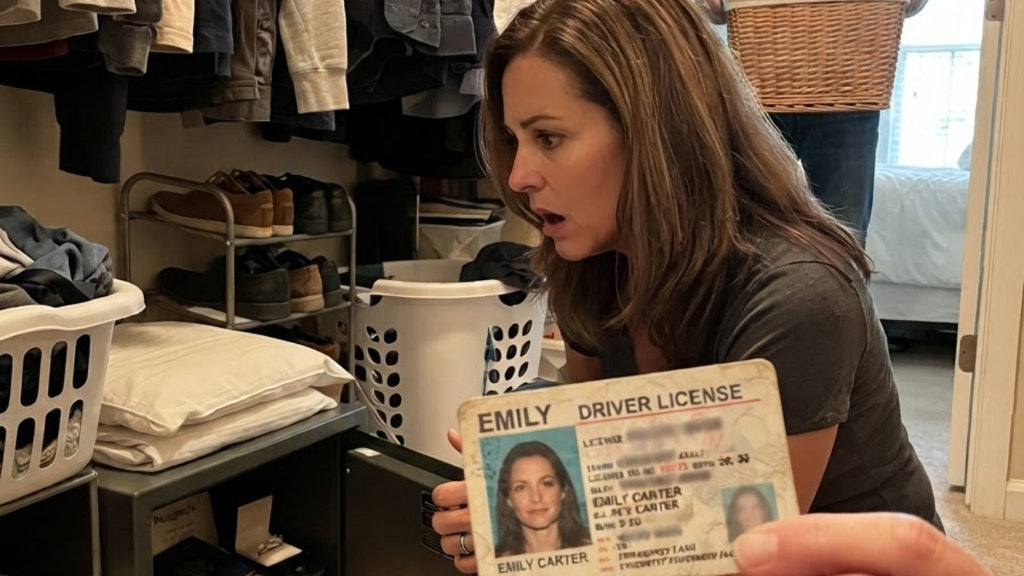
I knew it was there.
I knew the combination.
That is important because when I eventually opened it and found a missing woman’s driver’s license inside, my husband tried to make the safe sound like some secret thing I had broken into.
It was not.
My name is Carol.
I was fifty-seven when this happened, and my husband, Richard, was sixty.
We had been married for thirty-two years.
Our daughter, Allison, was twenty-nine, and our son, Tyler, was twenty-six.
Richard worked in commercial real estate for most of our marriage.
He was not a broker.
He worked on the property management and acquisition side, which meant he spent years walking through empty buildings, meeting contractors, checking properties and driving around parts of the city I had no reason to visit.
The safe held exactly the kind of things you would expect.
Passports.
Our marriage certificate.
Some cash.
The title to Richard’s old Mustang.
My mother’s wedding ring.
A few business documents.
I opened it because Allison needed her birth certificate.
She was applying for something at work and could not find her copy.
I told her I probably had one.
Richard was golfing.
I went into his office.
I opened the desk.
I entered the combination.
The birth certificates were in an envelope underneath our passports.
When I pulled the envelope out, something plastic slid from behind it and landed facedown on the carpet.
I picked it up.
Driver’s license.
I assumed it belonged to Allison.
Then I turned it over.
The woman in the photograph was not my daughter.
Her name was Katherine Elaine Foster.
She was thirty-four in the photograph.
Brown hair.
Green eyes.
The license had expired eight years earlier.
I did not recognize her.
I thought maybe Richard found it somewhere.
Maybe a tenant left it behind.
Maybe it belonged to an employee.
Then I noticed something familiar about the name.
Katherine Foster.
I sat at Richard’s desk and searched it.
The first result was a missing-person article.
LOCAL MOTHER STILL MISSING SEVEN MONTHS AFTER DISAPPEARANCE.
I clicked.
Same woman.
Same face.
Katherine Foster disappeared on October 3, 2017.
Nine years earlier.
She left work shortly after six.
Her car was found the following morning at a commuter lot.
Her purse was inside.
Her phone was never recovered.
Neither was Katherine.
She had a husband.
Two children.
There were interviews with her parents.
Photographs of volunteers searching.
A more recent article marking the eighth anniversary.
Her husband had remarried.
Her children were teenagers now.
I sat there holding her driver’s license.
One detail in the article made my hands start shaking.
Katherine’s purse was found inside her car.
Her wallet was inside the purse.
Her driver’s license was missing.
Police had never publicly explained whether they believed Katherine took it with her or someone removed it.
I called Allison.
She answered immediately.
I told her I could not help with the birth certificate yet.
She asked why.
I said something had happened.
She wanted to come over.
I told her no.
Then I called my sister, Joan.
Joan lived fifteen minutes away.
I sent her the article first.
Then a photograph of the license.
She called instead of texting.
“Where did you get that?”
“Richard’s safe.”
There was silence.
Then Joan said, “Call the police.”
I said maybe there was an explanation.
Joan said, “Carol, that woman has been missing for nine years.”
I said Richard worked in property management.
Maybe Katherine was connected to one of his buildings.
Maybe someone turned the license in.
Maybe Richard forgot he had it.
Joan said, “Then the police can hear that explanation.”
I called.
Two officers came first.
Then a detective named Samuel Ortiz.
He asked me to show him exactly where I found the license.
I did.
He photographed everything.
Then he asked whether I had removed anything else.
No.
He asked whether Richard knew Katherine.
I did not know.
Ortiz looked at the license for a long time.
Then he stepped into the hallway and made a phone call.
When he returned, his entire demeanor had changed.
He asked me not to contact Richard.
I said Richard would be home in a few hours.
Ortiz said officers would handle that.
I asked if the license was definitely Katherine’s.
He said the license number matched information in the original investigation.
I asked why it mattered so much.
He said something I had not found online.
Katherine’s driver’s license was one of the few personal items investigators could never account for.
Her wallet contained credit cards, insurance cards and cash.
Only the license was gone.
Richard came home at 3:17.
I know because I watched his truck pull into the driveway from our bedroom window.
There were two unmarked police cars outside.
Richard walked through the front door.
He saw Ortiz.
He saw me.
Then he looked toward his office.
That was the moment I knew.
Not that he killed Katherine.
I did not know that.
But Richard knew why police were there.
Ortiz asked whether he knew Katherine Foster.
Richard said, “I think she rented from one of our properties years ago.”
Ortiz asked which property.
Richard could not remember.
Then Ortiz showed him the license.
Richard’s face changed.
He said, “Where did you find that?”
I said, “Your safe.”
Richard looked at me.
Not the detective.
Me.
Then he said, “Carol, I can explain.”
Ortiz asked him to explain.
Richard said he wanted an attorney.
Police asked Richard to leave the house while they applied for a warrant.
He went with his brother.
I went to Joan’s.
By midnight, police were searching our house.
The next morning, Ortiz called.
They found photographs.
Not of Katherine.
At least not initially.
There were photographs of an empty office building Richard’s company managed in 2017.
They were in a box in our basement.
Ordinary property photographs.
Broken windows.
Water damage.
Electrical panels.
Then investigators noticed the date.
October 4, 2017.
The morning after Katherine disappeared.
Richard photographed the building at 6:12 a.m.
I asked why that mattered.
Ortiz said Katherine’s car had been found approximately four miles away.
Richard had never mentioned being in that area during the original investigation.
I asked whether police interviewed him in 2017.
No.
His name never came up.
Then they found the connection between Richard and Katherine.
She was not a tenant.
She was an accountant.
Her company handled financial audits for several commercial properties.
One of them belonged to Richard’s employer.
Katherine had been reviewing expenses.
Richard had approved some of those expenses.
I asked if she found fraud.
Ortiz said they did not know yet.
Then Katherine’s old work emails were recovered from archives.
Three weeks before she disappeared, she emailed her supervisor.
I need clarification on the maintenance invoices from Northfield Property Services. Several appear duplicated.
Northfield was a contractor Richard used.
A week later:
Richard Lawson says the invoices are legitimate, but the supporting documents don’t match.
Richard Lawson is my husband.
Katherine knew him.
He knew her.
He had lied before the detective finished asking the first question.
Then Ortiz told me something else.
Richard had been questioned indirectly during the original investigation.
Not by police.
By Katherine’s husband, Mark.
Mark Foster had spent years investigating his wife’s disappearance himself.
He contacted everyone she worked with.
In 2018, he emailed Richard.
Richard responded that he barely remembered Katherine.
He said he had met her once at a property inspection.
Police found the email on an old server.
I asked how many times Richard actually met her.
At least twelve.
There were calendar appointments.
Emails.
A lunch meeting.
Several site visits.
Then they found Katherine’s name in Richard’s personal planner.
October 3, 2017.
The day she disappeared.
K — 7:30. Riverton.
Riverton was the empty office building Richard photographed the next morning.
I asked whether they searched it.
Ortiz said they were getting permission.
The building still existed.
It had been renovated and converted into medical offices.
Police searched the basement.
Nothing.
Then they reviewed the original construction records.
A section of the basement floor had been replaced in November 2017.
Richard authorized the work.
Reason:
Drainage repair.
Investigators broke through the concrete.
They found a woman’s shoe.
Then a necklace.
Then human remains.
Katherine Foster had been four miles from her abandoned car for nine years.
Under the floor of a building my husband managed.
I was with Joan when Ortiz called.
I do not remember hanging up.
I remember saying, “Her children.”
That was all I could think about.
Her children had been six and nine when she disappeared.
They grew up without knowing whether their mother abandoned them.
Whether she was alive.
Whether she suffered.
Whether she would come home.
Meanwhile Richard drove past that building hundreds of times.
He attended our children’s graduations.
He walked Allison down the aisle.
He held our granddaughter.
He complained when people did not return shopping carts.
He knew where Katherine was.
Police arrested him.
Richard denied killing her.
His explanation was that Katherine died accidentally.
According to him, Katherine discovered that Northfield Property Services was submitting fraudulent invoices.
Richard was receiving kickbacks.
He agreed to meet Katherine at the Riverton building because she wanted an explanation before reporting him.
They argued.
Katherine threatened to go to police.
Richard claimed she fell down the basement stairs.
She hit her head.
She died.
He panicked.
He moved her car.
He kept her license because it was in her coat pocket.
Later, when drainage work was already scheduled, he concealed her body beneath the new concrete.
I asked why anyone would keep the driver’s license.
Richard said he did not know.
That answer mattered later.
At first, prosecutors thought Katherine’s death might actually have begun as an accident followed by concealment.
Then the medical examiner found fractures inconsistent with a simple fall.
Katherine had injuries to both arms.
Defensive injuries were possible.
Richard’s story started collapsing.
Then police searched the old Northfield records.
The company had dissolved in 2020.
The owner, a man named Peter Caldwell, was still alive.
Peter admitted the invoices were fraudulent.
He and Richard split the money.
Approximately $240,000 over six years.
I asked if Katherine disappeared because she found financial fraud.
That seemed to be the answer.
It was horrible, but it made sense.
Then Peter said something that changed it.
Katherine was not the first person who noticed.
Another accountant had questioned the invoices in 2014.
Her name was Sandra Mills.
Sandra died in 2015.
Car accident.
I felt the same sensation I had felt when I searched Katherine’s name.
A physical drop in my stomach.
Police reopened Sandra’s death.
Her car went off a rural road.
She was alone.
It had been raining.
No evidence of another vehicle.
Nothing immediately connected Richard.
Then they searched his safe again.
Not the small desk safe.
A safe-deposit box.
Richard had one at a bank I did not know about.
Inside were cash, old business documents and a hotel key card.
The card was labeled in Richard’s handwriting.
S.M. — 214
Sandra Mills.
Police contacted the hotel.
Records from 2014 were limited.
But Sandra had attended a financial conference there.
Richard’s company had a property-management convention in the same hotel.
Room 214 was Sandra’s.
I asked why Richard had her key.
Nobody knew.
Then Peter admitted Richard had been obsessed with “insurance.”
That was Peter’s word.
Richard kept things.
Documents.
Emails.
Objects.
Anything that could prove what people had done or where they had been.
Peter said Richard called it leverage.
If Peter ever turned on him, Richard had records proving Peter participated in the fraud.
I asked if Katherine’s driver’s license was leverage.
Against a dead woman?
That made no sense.
Ortiz agreed.
Then they found another safe-deposit box.
This one was rented under the name of an LLC Richard controlled.
Inside were eleven envelopes.
Each envelope contained a woman’s name.
Sandra Mills.
Katherine Foster.
A woman named Deborah Lane.
Monica Price.
Julie Benton.
Heather Walsh.
Nancy Cole.
Rebecca Ames.
Tracy Nolan.
Elizabeth Grant.
And Angela Reeves.
I asked who they were.
Ortiz said they were figuring that out.
Sandra was dead.
Katherine was dead.
Deborah Lane was alive.
Monica Price was alive.
Julie Benton died in 2009.
Heather Walsh disappeared in 2003.
Nancy Cole was alive.
Rebecca Ames died in 1998.
Tracy Nolan was alive.
Elizabeth Grant disappeared in 1994.
Angela Reeves died in 1991.
I stopped breathing normally.
I asked what was inside the envelopes.
Personal items.
A library card.
An employee badge.
A bracelet.
A photograph.
A motel receipt.
A key.
A driver’s license.
Small things.
Things someone might not immediately notice were gone.
Katherine’s envelope was empty.
Because her driver’s license was in our house.
I asked Ortiz why.
He said they did not know.
Then investigators noticed the dates.
Richard’s financial fraud began around 2011.
Most of the women predated it.
Angela Reeves died twenty years before Northfield existed.
Elizabeth Grant disappeared seventeen years before the fraudulent invoices.
Katherine had uncovered something real.
But whatever Richard had done to Katherine was not created by the fraud.
The fraud simply put her in his path.
Then police identified the connection between the women.
Every one had accused Richard of something.
Not murder.
Not necessarily anything criminal.
Angela Reeves reported him to their college housing office for entering her dorm room without permission.
Elizabeth Grant told coworkers Richard followed her after she rejected him.
Rebecca Ames accused him of stealing mail from her apartment building.
Julie Benton filed a workplace complaint because Richard repeatedly accessed her office after hours.
Heather Walsh told a friend she thought Richard was watching her.
Deborah Lane complained to his employer that he entered her apartment during a property inspection without notice.
Monica Price caught him reading documents on her desk.
Nancy Cole accused him of taking a spare key.
Tracy Nolan threatened to report him for accessing security-camera footage without authorization.
Sandra discovered fraudulent invoices.
Katherine discovered them too.
Different decades.
Different women.
Same man.
I asked what happened to the women who were alive.
Police interviewed them.
Deborah remembered Richard clearly.
She had been twenty-six.
Richard managed her apartment complex.
She came home one afternoon and found him inside.
He said he was checking a leak.
There was no leak.
Later, Deborah realized underwear had been moved in her dresser.
She reported him.
Richard’s employer said it was a misunderstanding.
She moved.
Monica worked in an office building Richard managed.
She caught him reading a personnel file on her desk.
Richard apologized.
He claimed he thought it was a maintenance document.
She complained.
Nothing happened.
Nancy caught Richard using a key to enter a storage area assigned to her company.
Tracy discovered Richard had pulled security footage of her repeatedly without a legitimate reason.
None of them knew about each other.
Then Ortiz told me something I did not understand.
The envelopes were chronological.
Angela.
Elizabeth.
Rebecca.
Heather.
Julie.
Then the living women mixed among them.
There was no obvious distinction between women who died and women who survived.
Richard was not collecting trophies from murder victims.
He was collecting something from every woman who challenged him.
I asked why.
Peter gave police the answer.
Richard called them receipts.
Not financial receipts.
Proof.
If someone accused Richard of something, he became obsessed with knowing everything about her.
Where she lived.
Who she dated.
What she did wrong.
Whether she lied.
Whether she cheated.
Whether she drank.
Whether she had financial problems.
He wanted something that made her accusation less dangerous.
Peter said Richard believed everyone had something.
You only had to look long enough.
That explained the objects.
A hotel key could prove a woman was somewhere.
A photograph could prove she met someone.
An employee badge could give access.
A library card could reveal an address.
The objects were entry points.
I asked about the dead women.
That was the question nobody could answer.
Then they reopened Heather Walsh’s disappearance.
Heather disappeared in 2003.
She worked for a company renting space in one of Richard’s buildings.
She complained that Richard entered her locked office repeatedly.
Her friend remembered Heather saying:
“If that creepy property guy comes in again, I’m calling the police.”
Heather disappeared eleven days later.
Her car was found at home.
Nothing missing except her keys.
Richard’s envelope contained one key.
Police tested it against archived property records.
It was Heather’s office key.
I asked whether Richard killed her.
They did not know.
Then they searched properties Richard managed in 2003.
There were forty-six.
Most had changed owners.
Several had been demolished.
One caught investigators’ attention.
A warehouse outside the city.
Richard authorized emergency concrete work six days after Heather disappeared.
I knew what that meant before Ortiz finished the sentence.
They searched.
No body.
I almost felt relieved.
Then they found a sealed cavity behind a basement wall.
Inside were Heather’s purse and clothing.
No Heather.
Someone had hidden her belongings there.
I asked where her body was.
Nobody knew.
Then they found a handwritten note inside Richard’s envelope.
H would not stop. Temporary solution became permanent problem.
That was not proof of murder.
But it was not the note of an innocent property manager.
Then Elizabeth Grant.
She worked with Richard.
She told friends he followed her.
Then she disappeared.
Her envelope contained a motel key.
Police traced the motel through old records.
It had been demolished.
The land was now a shopping center.
Nothing.
Then Elizabeth’s sister remembered something.
Richard attended the search.
He helped distribute flyers.
He hugged Elizabeth’s mother.
He told people he barely knew Elizabeth.
Photographs from the search showed him standing behind her family.
I found one online.
Richard was thirty.
We had been married less than a year.
I was pregnant with Allison.
I remembered that weekend.
Richard told me a coworker’s sister was missing.
He said he wanted to help search.
I made sandwiches for volunteers.
I stood in my kitchen thirty-three years later looking at the photograph and realized I had packed lunch for my husband to search for a woman he may have made disappear.
Then police found my handwriting in Elizabeth’s file.
A note.
Richard — don’t forget your lunch. Love you, Carol.
I had written it on a paper bag.
He kept it.
I do not know why that detail broke me.
Maybe because it connected the woman I had been to the man he already was.
I was twenty-four.
Pregnant.
Making turkey sandwiches.
He was carrying around a motel key belonging to a missing woman.
Then investigators identified Angela Reeves.
The earliest envelope.
Angela had died after falling from the balcony of her apartment.
Richard was twenty-five.
Police ruled it accidental.
She had been drinking.
No witnesses.
Two months earlier, Angela reported Richard for entering her dorm room at the graduate housing complex where he worked part-time.
Richard claimed he was performing maintenance.
Angela insisted nobody requested maintenance.
She told a friend Richard had been watching her.
Then she died.
Her envelope contained a photograph.
Angela standing on her balcony.
Taken from another building.
On the back:
She thinks she’s smarter than everyone.
That was Richard’s handwriting.
I asked Ortiz how far back this went.
He said they had not found anything earlier.
Then they found something in our attic.
An old cardboard box from Richard’s parents’ house.
Yearbooks.
Baseball trophies.
College papers.
Underneath everything was a wallet.
Not Katherine’s.
Not any woman from the eleven envelopes.
The driver’s license belonged to a woman named Laura McKenzie.
The license expired in 1988.
Laura disappeared in 1987.
Four years before Angela died.
Four years before the earliest envelope.
I looked at her photograph.
She was twenty-two.
I asked whether Richard knew her.
Ortiz said yes.
Laura McKenzie had been Richard’s girlfriend before me.
I had never heard her name.
Richard told me he had one serious girlfriend in college named Beth.
There was no Beth.
There was Laura.
They dated for almost three years.
Then Laura disappeared.
Richard told friends she broke up with him and moved.
Her family reported her missing.
Richard was interviewed.
He said they had ended their relationship several weeks earlier.
Police found no evidence connecting him to her disappearance.
Then he moved.
Two years later, he met me.
I asked why her license was in his parents’ box instead of the safe-deposit box.
Ortiz said they thought the envelope system had not existed yet.
Laura was before the system.
I asked if that meant she was the first.
He said they did not know.
Then police found Richard’s old college roommate.
His name was Dennis.
Dennis remembered Laura.
He also remembered why Laura broke up with Richard.
She caught him inside her apartment.
Not once.
Repeatedly.
Richard had copied her key.
He read her mail.
Went through her drawers.
Checked her answering machine.
Laura found a notebook where Richard recorded where she went and who she saw.
She threatened to report him.
Richard begged her not to.
Then Laura disappeared.
Dennis told police Richard was devastated.
He searched constantly.
He barely slept.
Dennis believed that proved Richard could not have hurt her.
Then he remembered something.
Richard never asked where Laura might have gone.
He only asked what police knew.
Who they interviewed.
What they found.
Whether they had searched certain places.
Dennis thought Richard was trying to help.
Now he wondered if Richard was monitoring the investigation.
Then Ortiz showed me an old photograph police found in Richard’s college papers.
Laura standing beside a lake.
On the back:
She shouldn’t have made me prove it.
I asked what he proved.
Nobody knew.
Then Richard requested another meeting with investigators.
His attorney was present.
Richard admitted he had been with Laura the night she disappeared.
He claimed she agreed to meet him because he wanted to apologize.
They argued.
Laura left.
He followed her.
She got into someone else’s car.
That was the last time he saw her.
I asked why he had her driver’s license.
Richard said Laura left her wallet in his car.
He threw away everything except the license.
Why keep it?
He said he did not know.
Same answer as Katherine.
Then Ortiz noticed something.
Richard always said he did not know why he kept the objects.
But he had kept them carefully.
For decades.
Moved them from apartment to apartment.
From his parents’ house to ours.
From filing cabinets to bank boxes.
He knew exactly where they were.
Then police found Richard’s journals.
Not diaries.
Work notebooks.
Most pages were boring.
Appointments.
Properties.
Numbers.
Then certain pages contained initials.
L — first time. Bad outcome.
A — should have ignored.
E — same mistake.
R — easier when nobody knows.
H — storage problem.
K — almost perfect.
Katherine.
Almost perfect.
I asked what that meant.
The entry continued.
Car creates voluntary-departure possibility. License mistake. Should have returned with wallet.
Richard had not accidentally kept Katherine’s license.
He considered it a mistake because it could connect him to her.
Then why not destroy it?
The next line answered that.
Could not.
That was all.
Could not.
He needed the objects.
Not because they gave him leverage anymore.
Not because they were useful.
Because once a woman challenged him and something happened, Richard needed to keep one piece.
Then Ortiz showed me another line.
Written three days after Katherine disappeared.
Nine years should be enough before I can stop checking.
I asked checking what.
Katherine’s family.
Richard had been following them.
Her husband.
Her parents.
Her children.
For nine years.
He attended public memorials from a distance.
He monitored Mark Foster’s social media.
He knew when Mark remarried.
He knew Katherine’s daughter changed schools.
He knew her son played baseball.
He kept newspaper articles.
Not because he cared.
Because he was watching for suspicion.
Then they found photographs.
Katherine’s husband entering the police station.
Her mother speaking to reporters.
Her daughter at a candlelight vigil.
Richard had been watching the family of the woman buried under his building.
Then Ortiz told me something that made me think of the eleven envelopes differently.
The living women had surveillance too.
Deborah.
Monica.
Nancy.
Tracy.
Richard checked on them for years after their complaints.
If they stayed quiet, nothing happened.
If they moved on, he moved on.
The women who died or disappeared were the ones who kept pushing.
Angela filed a second complaint.
Elizabeth told coworkers she was going to police.
Heather threatened him.
Sandra began documenting the invoice fraud.
Katherine scheduled a meeting with her supervisor for the morning after she disappeared.
Laura told him she was going to expose everything.
The pattern was not women Richard hated.
It was women who refused to let him control the narrative.
Then police found one more envelope.
Not at the bank.
In our house.
Taped beneath a drawer in Richard’s desk.
My name was on it.
CAROL LAWSON.
Inside were photographs.
Me.
Not family photographs.
Me leaving Joan’s house.
Me having lunch with a friend.
Me at work.
Me sitting in my car.
The oldest was from 1990.
Two years before Richard and I started dating.
I felt almost numb.
I asked Ortiz why Richard had followed me.
He said the notes suggested Richard first noticed me at a coffee shop near his office.
He watched me for nearly two years.
Then he arranged to meet me through mutual friends.
I asked whether that meant I was another Laura.
Ortiz said he could not answer that.
The notes could.
Carol stable.
Close to sister.
Predictable.
Doesn’t pry.
Then after our first date:
Easy to talk to.
After six months:
No suspicion.
Then:
Could build normal life here.
I understood.
Richard did not meet me after Laura and become normal.
He selected me because he wanted a normal life.
A wife.
Children.
House.
Career.
Respectability.
I was not the opposite of his secret life.
I was part of its architecture.
Then I found the final photograph in my envelope.
It had been taken six weeks before I opened the safe.
I was standing outside Richard’s office talking to a woman.
I recognized her.
Her name was Megan Shaw.
She worked for the company that purchased several of Richard’s old properties after his retirement.
Megan had contacted me because she was organizing a retirement tribute.
At least that was what she said.
We talked for fifteen minutes.
I gave her my phone number.
The photograph showed us from across the parking lot.
Underneath, Richard had written:
Need to know what Megan asked Carol.
I remembered telling Richard about Megan.
He barely reacted.
He asked what she wanted.
I said retirement stories.
That was apparently not true.
Police interviewed Megan.
She had been reviewing old property records.
She found irregularities involving Northfield.
Then she found Katherine Foster’s name.
Then Sandra Mills.
Megan suspected Richard.
She approached me because she wanted to know whether I had ever heard Katherine’s name.
She disguised the conversation as retirement planning because she did not want to alarm me.
I told her no.
Richard saw us together.
He started following Megan.
Ortiz asked whether I knew where Megan was.
I said no.
He said her employer had reported her missing that morning.
She had not come to work.
Her family had not heard from her since the previous evening.
I remember gripping the edge of the table.
I said, “Richard is in custody.”
Ortiz said yes.
Then I understood why he looked frightened.
If Richard was already in custody, he could not have taken Megan that morning.
Someone else had.
I asked who.
Ortiz said they were trying to find out.
Then he showed me something recovered from Richard’s phone.
A message sent two days before I opened the safe.
Not to Peter Caldwell.
To a number saved only as D.
Megan is asking questions. Same problem again.
The reply:
I’ll handle it.
Richard:
No mistakes this time.
I stared at the screen.
For weeks, I had believed I was discovering what my husband had done.
Katherine.
Sandra.
Heather.
Elizabeth.
Laura.
Women stretching back almost forty years.
I had never once considered that he might not have been doing all of it alone.
Then Ortiz put a photograph on the table.
The man was older now.
Gray hair.
Glasses.
I recognized him immediately.
Dennis.
Richard’s college roommate.
The man who had just told police that Richard was devastated when Laura disappeared.
The man who claimed Richard spent weeks searching for her.
The man who had helped convince everyone, forty years earlier, that Richard Lawson was a heartbroken boyfriend instead of the last person known to have followed Laura McKenzie.
Dennis had been at our wedding.
He was Allison’s godfather.
Our children called him Uncle Dennis.
And according to phone records, Richard had been calling him every time one of the women became a problem.
Including Katherine Foster.
Dennis had been in my house four days before I found Katherine’s driver’s license.
That was the first thing I thought when Detective Ortiz told me.
Richard had grilled steaks.
Dennis brought a bottle of wine.
We sat on the patio.
He asked about Allison’s new job and Tyler’s girlfriend.
He played with our granddaughter.
At one point Richard went inside, and Dennis told me retirement looked good on him.
Four days later, I learned they had been talking about a missing woman.
I asked Ortiz whether Dennis had been arrested.
Not yet.
They were watching him.
Megan was still missing.
Finding her mattered more than confronting Dennis immediately.
Police traced Dennis’s phone.
He had turned it off the previous evening.
His car was gone.
His wife, Linda, said he told her he was going fishing.
Dennis did fish.
He had a cabin near a lake approximately two hours north.
Police went there.
Empty.
Then Linda gave them another property.
Dennis inherited his father’s house after he died.
It had been vacant for years.
Police searched it.
Megan was in the basement.
Alive.
She had been there approximately eighteen hours.
Dennis had restrained her.
I will not describe the details because they do not matter beyond what Megan later told police.
Dennis approached her outside her apartment.
He said Richard wanted to speak with her.
Megan knew Richard was in custody.
That frightened her.
Dennis forced the situation from there.
He kept asking what she had found.
Who she told.
Whether she had spoken to police.
Whether she had given anything to me.
Megan lied.
She told him everything was stored at her office and multiple people already had copies.
That probably saved her life.
Dennis left.
Police arrived less than an hour later.
They found him driving south.
He was arrested.
I asked whether Richard knew Dennis had Megan.
Ortiz said Richard’s attorney advised him not to answer.
Then Dennis started talking.
Not because he suddenly developed a conscience.
Because Megan was alive.
There was physical evidence.
Phone records.
Richard’s message.
Dennis apparently decided Richard was not worth protecting anymore.
He asked for a deal.
I asked what he told them.
Ortiz said, “A lot.”
Dennis met Richard when they were freshmen in college.
Laura McKenzie was not originally Richard’s girlfriend.
She dated Dennis first.
Not seriously.
A few months.
Then Richard became interested in her.
Dennis introduced them.
Richard and Laura started dating.
Dennis said Richard became possessive almost immediately.
He wanted to know where Laura went.
Who she talked to.
Whether she still spoke to Dennis.
Dennis thought it was jealousy.
Then Laura found the copied key.
The notebook.
The letters Richard had opened.
She ended the relationship.
Richard kept following her.
Dennis knew.
I asked why he helped.
He said Richard had something on him.
I almost laughed when Ortiz told me.
Of course.
Richard always had something.
Dennis had been selling drugs casually in college.
Nothing enormous.
Marijuana.
Pills.
Richard documented it.
Photographs.
Names.
Transactions.
When Laura threatened to report Richard for stalking her, Richard told Dennis he needed help talking to her.
Dennis agreed.
He thought they were going to scare her.
They followed Laura after work.
Richard confronted her.
Laura said she was going to police the next morning.
Richard asked Dennis to drive.
They took her somewhere isolated.
Dennis insisted she was alive when he left.
I had heard versions of that sentence too many times already.
I asked where he left her.
At Richard’s parents’ cottage.
Richard told Dennis to go home.
He said he would calm Laura down and bring her back.
Dennis left.
Laura was never seen again.
I asked if Dennis believed Richard killed her.
Yes.
Not immediately.
Richard told him Laura escaped.
Then he produced the story about her leaving town.
Dennis suspected.
But if he went to police, he had to explain why he helped take Laura to the cottage.
Richard also still had the drug evidence.
So Dennis stayed quiet.
Then Richard called him months later.
He needed help.
Not with a woman.
With the cottage.
Richard’s parents were planning renovations.
Richard wanted something moved.
Dennis asked what.
Richard would not say.
Dennis refused.
Richard reminded him about Laura.
Dennis went.
They moved a large metal trunk from beneath the cottage to a wooded property owned by Dennis’s father.
I asked Ortiz whether police searched it.
They were already there.
They found the trunk.
Laura was not inside.
There were clothing and personal items.
Her purse.
Shoes.
A jacket.
The trunk was evidence storage.
Not her grave.
Dennis claimed he did not know where Richard put Laura.
Then Ortiz told me something I had not expected.
Dennis did not help with every woman.
Richard’s message history made it look that way because he contacted Dennis whenever something became dangerous.
But for years, Dennis’s role was primarily cleanup.
Information.
Alibis.
Moving objects.
Occasionally creating a false lead.
He knew about more than he participated in.
I asked about Angela Reeves.
Dennis knew Richard was watching her.
After Angela died, Richard called him.
Richard said she fell.
Dennis asked whether he pushed her.
Richard said:
“She wouldn’t stop screaming.”
Dennis never asked again.
Elizabeth Grant.
Richard called Dennis the night she disappeared.
He needed someone to drive Elizabeth’s car.
Dennis did.
I asked where.
A bus station.
That detail had never been public.
Elizabeth’s car was found at a bus station two days after she disappeared.
Police assumed she might have left voluntarily.
Dennis parked it there.
Richard had constructed the story.
Then I asked where Elizabeth was.
Dennis said he did not know.
Richard never told him.
Heather Walsh.
Dennis helped remove belongings from the warehouse.
That explained the purse and clothing behind the wall.
But Heather was still alive when Dennis saw her.
I asked where.
Ortiz hesitated.
Then he told me.
Our house.
Not the house we lived in now.
Our previous house.
The one where Allison and Tyler grew up.
Heather Walsh had been inside my home.
In 2003, Richard told me there was a plumbing issue in the basement.
He sent me and the kids to my parents’ cottage for a weekend.
I remembered it.
The basement smelled awful when we returned.
Richard said a drain backed up.
Dennis told police there was no plumbing problem.
Richard kept Heather in the basement for approximately two days.
Dennis saw her once.
He said she was terrified.
He begged Richard to let her go.
Richard said Heather had threatened police and knew about other things.
Dennis asked what other things.
Richard would not say.
Then Richard told Dennis to leave.
Heather disappeared.
A week later, Richard tore out part of our basement.
He told me there had been water damage.
I helped choose the new carpet.
I asked Ortiz whether Heather died in my house.
They did not know.
Police searched our old property.
The current owners let them remove portions of the basement floor and walls.
They found blood.
Heather’s.
Not enough to establish where or how she died.
Then they found another woman’s DNA.
Unknown.
That was when the story expanded again.
Because there were eleven envelopes.
But the unknown DNA did not match any of those eleven women.
Police ran it through missing-person databases.
No immediate match.
Then they tested against genealogy databases through legal channels.
The woman was eventually identified as Colleen Ramsey.
Colleen disappeared in 2001.
Her name was not in Richard’s safe.
Not in either bank box.
Not in his journals.
I asked why.
Nobody knew.
Then Dennis did.
When detectives showed him Colleen’s photograph, he said:
“Oh, Jesus.”
He knew her.
Colleen was not Richard’s problem.
She was Dennis’s.
That was the moment police realized they had misunderstood the relationship.
Richard was not a predator with a frightened accomplice.
Dennis was not simply a man trapped by one terrible decision in college.
They had been protecting each other.
Dennis met Colleen at a bar.
They had an affair.
Linda never knew.
Colleen wanted Dennis to leave his wife.
Dennis refused.
Colleen threatened to tell Linda.
Dennis asked Richard for help.
Richard had decades of experience by then.
I asked what kind of help.
Dennis claimed he only wanted Richard to talk to her.
Colleen disappeared.
I asked whether Richard killed her.
Dennis said he did not know.
Then why was her blood in our basement two years later?
Dennis finally admitted Colleen had been brought there too.
Not in 2001.
Her disappearance had been staged then.
She was alive afterward.
Richard and Dennis had hidden her somewhere for several days while Dennis tried to convince her to stay quiet.
Then they released her.
Colleen left the state.
For almost two years, she stayed away.
Then she came back.
She contacted Dennis.
She wanted money.
She threatened to tell Linda everything and go to police about what they had done to her.
Dennis contacted Richard.
Colleen vanished again.
This time permanently.
Her family believed she had already abandoned them once, so the second disappearance barely received attention.
I asked where her body was.
Dennis said Richard handled it.
Richard said Dennis did.
They were blaming each other.
Then investigators found something Richard had kept.
Not an envelope.
A ledger.
Two columns.
R
D
Richard.
Dennis.
Names underneath.
Some I recognized.
Laura was under both.
Angela under R.
Elizabeth under R, with D written beside CAR.
Colleen under D, with R beside ASSIST.
Heather under R, D beside CLEAN.
Sandra under R.
Katherine under R.
Then other names.
Men.
I had spent weeks thinking the pattern was women.
It was not.
The women were Richard’s pattern.
Dennis had his own.
A contractor named Paul Givens died in 2006.
A business partner named Stephen Rowe disappeared in 2010.
A man named Carl Henderson died in what police believed was a hunting accident in 2014.
All had connections to Dennis.
Richard’s notes connected him to each aftermath.
I asked Ortiz how many people they thought these two men had hurt.
He said they did not know.
Then he said something that frightened me more.
They did not know whether there were only two men.
The ledger contained another initial.
P.
Not Peter Caldwell.
Police confirmed that quickly.
P appeared only six times.
Laura.
Elizabeth.
Colleen.
Heather.
Stephen Rowe.
Katherine.
I asked who P was.
Dennis refused to say.
Richard refused too.
Then investigators found a photograph from Katherine’s memorial.
Richard was in the background.
I already knew he had watched the family.
Dennis was there too.
Farther back.
Then another man.
Older.
White hair.
I recognized him.
Patrick Lawson.
Richard’s older brother.
My brother-in-law.
The man Richard went to stay with the afternoon I found Katherine’s license.
Patrick was seventy.
Retired police officer.
I felt physically sick.
Patrick had spent thirty-one years in law enforcement.
Not in homicide.
Mostly patrol, then administration.
He was the person our family called whenever something happened.
Car accident.
Break-in.
Traffic ticket.
When Allison was assaulted by a drunk man at a college party, Patrick helped us understand the police process.
When my mother died, Patrick handled paperwork.
He was calm.
Practical.
Trustworthy.
I asked if P was Patrick.
Ortiz said they were investigating.
Then they found Richard’s call records from the day Katherine disappeared.
7:14 p.m.
Richard called Dennis.
Two minutes.
8:03.
Richard called Patrick.
Eleven minutes.
10:48.
Patrick called Richard.
Four minutes.
The next morning, Katherine’s car was found.
Patrick worked that day.
He was not assigned to the case.
But he accessed the report.
Then he accessed it again three days later.
Then six more times over the next month.
I asked why nobody noticed.
Because police access records were not routinely audited that way in 2017.
Patrick had legitimate system access.
He looked at cases all the time.
Then investigators checked other women.
Heather Walsh.
Patrick accessed her report.
Elizabeth Grant.
Old system records were incomplete, but his name appeared on a supplemental routing sheet.
Colleen Ramsey.
Patrick had personally spoken to Dennis during the first disappearance.
He never documented that Dennis had an affair with Colleen.
I asked Ortiz whether Patrick had been protecting them for forty years.
He said they were about to find out.
Patrick was arrested.
He denied everything.
Then police searched his house.
There were no trophies.
No women’s belongings.
Nothing dramatic.
They found a locked fireproof box.
Inside were copies of police reports.
Laura.
Angela.
Elizabeth.
Colleen.
Heather.
Stephen Rowe.
Katherine.
Every name marked P in Richard’s ledger.
Some documents were not copies.
They were originals that should have been in evidence or archives.
A witness statement from Elizabeth’s case.
A photograph from Heather’s investigation.
A handwritten note from Katherine’s case.
Patrick had removed information.
Then Ortiz showed me Katherine’s note.
It had been written by a patrol officer after speaking to a witness.
The witness saw a dark SUV behind Katherine’s car near the commuter lot.
Partial plate:
D7L
Richard drove a dark SUV in 2017.
His plate ended:
D7L.
That witness statement disappeared before detectives reviewed the case.
Patrick had it in his house.
Richard did not get away with Katherine’s murder because he was clever enough to fool everyone.
His brother removed the clue that pointed toward him.
I asked why Patrick would do that.
The answer went back to Laura.
Patrick was twenty-five when Laura disappeared.
Already a police officer.
Richard called him from the cottage.
Laura was dead.
Whatever happened there, she was dead.
Patrick arrived.
He did not call police.
He helped Richard.
Dennis was involved too.
Three young men made a decision.
Richard had done something terrible.
Dennis had helped get Laura there.
Patrick could expose them and possibly destroy his own family, or he could make the problem disappear.
He chose his brother.
Then Richard owned him.
For forty-two years.
Every time Richard had another problem, Patrick faced the same choice.
Expose Richard now and reveal that he covered up Laura then.
Or help again.
So he helped again.
And again.
Then Dennis started using the same system.
Patrick eventually was not protecting one crime.
He was maintaining an entire structure.
I asked whether Patrick ever tried to stop.
Apparently yes.
After Heather.
Richard’s ledger contained:
P says no more.
Then:
Reminded L.
Laura.
That was all Richard needed.
Then Patrick retired.
Katherine disappeared after his retirement.
He still had contacts.
Still knew systems.
Still had enough access through part-time administrative work to view records.
He removed the witness statement.
He checked the investigation.
He told Richard what police knew.
Then he attended Katherine’s memorial.
I asked why.
Patrick told investigators he felt guilty.
I had stopped being impressed by guilt.
Guilt had not saved anyone.
Then Megan explained why Dennis took her.
She had not only found Katherine and Sandra.
She found Patrick.
An old property file included a copy of a police inquiry Richard should never have possessed.
Patrick’s initials were on it.
Megan realized someone inside law enforcement had been feeding Richard information.
She planned to bring everything to state police instead of local police because she did not know whether the connection was still active.
Richard saw her talking to me.
He contacted Dennis.
Dennis panicked.
Patrick apparently refused to help this time.
That was why Dennis handled Megan himself.
For the first time, their system fractured.
Richard was already under investigation because I found Katherine’s license.
Patrick knew the old secrets were about to surface.
Dennis tried to preserve himself.
Everyone stopped trusting everyone else.
Then Richard started talking.
Not fully.
Strategically.
He blamed Dennis for Colleen.
Patrick for the cover-ups.
He admitted concealing Katherine’s body but still claimed her death was accidental.
He denied killing Laura.
Denied Elizabeth.
Denied Heather.
Then prosecutors showed him Dennis’s statements.
Richard changed his story.
Laura died during an argument.
Elizabeth died because she “panicked.”
Heather “forced the situation.”
Katherine attacked him.
Every dead woman apparently caused her own death.
I asked Ortiz if Richard had ever said the words “I killed her.”
No.
Not once.
Then they found Sandra Mills’s car.
Not the car she died in.
Her previous car.
She sold it six months before her death.
Police located it through vehicle records.
The current owner allowed a search.
Under the trunk lining, investigators found a tracking device.
Old.
Dead battery.
Installed years earlier.
Richard had been tracking Sandra before the invoice investigation.
That destroyed another explanation.
Richard claimed Sandra became a problem because she discovered fraud.
But he had been monitoring her before she found anything.
Just like Laura.
Just like me.
Just like the women who complained about him.
The fraud was not why Richard became interested in Sandra.
Sandra discovered the fraud because Richard was already in her life.
Then investigators went back through his journals.
They realized the initials were not only records of problems.
Some began before complaints.
Richard watched people.
Entered spaces.
Collected information.
Eventually someone noticed.
Then that person became a threat.
I had been thinking Richard kept encountering women who threatened him.
The truth was that Richard created the threat himself.
He invaded their lives.
They noticed.
They confronted him.
Then he treated their reaction as the problem.
That was the same logic Dennis used.
The same logic Patrick used.
Every escalation was justified by the previous secret.
Then Ortiz called me one morning and said they found Elizabeth Grant.
Richard’s journal had an entry from 1994:
E — south foundation before pour.
Police identified a commercial building Richard managed during construction.
The south foundation had been poured three days after Elizabeth disappeared.
They searched.
Her remains were there.
Thirty-two years.
Her sister was seventy-four.
She had spent more than three decades wondering whether Elizabeth left voluntarily.
Richard had helped search.
I had made sandwiches.
Then they found Heather.
The ledger said:
H — transfer D.
Dennis initially denied knowing what it meant.
Eventually he admitted Richard transferred Heather to him after the basement.
Richard needed to leave town with me for Tyler’s preschool event.
I remembered the trip.
Richard drove three hours to attend our son’s school program.
He sat beside me.
He took photographs.
He bought Tyler ice cream afterward.
Before leaving, he handed a captive woman over to Dennis.
Dennis moved Heather to his father’s vacant property.
Heather tried to escape.
Dennis said she fell.
Another fall.
There were so many falls around these men.
Police searched the property.
Heather’s remains were found near an old drainage ditch.
Dennis blamed Richard.
Richard blamed Dennis.
It did not matter to Heather’s family which man’s hands caused the final injury.
Both put her there.
Then Laura.
Patrick finally gave them the location.
Not because he suddenly became brave.
Because investigators found enough evidence that his attorney advised cooperation.
Laura was buried near the old Lawson family cottage.
Patrick had helped Richard move her.
Dennis had helped earlier.
All three lied.
All three built adult lives afterward.
Patrick became a respected police officer.
Dennis built a successful construction business.
Richard married me.
Laura stayed in the ground.
When police found her, Michael Bennett was there.
Not at the excavation.
Nearby.
He had been twenty when his sister disappeared.
He was sixty-two when she came home.
Then Ortiz called me about the envelope with my name.
There was something they had not shown me initially.
A note written shortly before Richard and I started dating.
Carol could solve appearance problem.
I asked what appearance problem.
Richard had become a person connected, quietly, to too many strange situations.
Laura disappeared.
Angela died.
People at work had started describing him as intrusive.
He wanted stability.
A wife would help.
Family would help.
Children would help.
A normal social life would help.
I was not simply a woman he watched and then fell for.
At least initially, I was useful.
Then later notes changed.
Actually love her.
Carol makes things quiet.
Don’t involve Carol.
After Allison was born:
Need this finished.
For a few years, Richard’s strange behavior apparently decreased.
Then Elizabeth.
Then more.
I asked whether that meant he loved me.
Ortiz said he could not answer that.
I think Richard did.
That does not improve anything.
People want evil to be clean.
They want the monster to hate his wife.
Fake every birthday.
Fake every vacation.
Fake holding his newborn daughter.
Richard was more frightening than that.
He could love us and still do everything else.
He could take Tyler fishing on Saturday and help conceal a woman on Monday.
He could adore his granddaughter and monitor Katherine’s children to see whether they suspected him.
He could genuinely want a normal life while repeatedly destroying other people’s lives to preserve it.
Then I remembered the driver’s license.
The thing that started everything.
I asked Richard about it during the only jail visit I made.
I wanted to know why he kept it in our house.
Not at the bank.
Not with the other women.
Our safe.
Behind our passports.
Beside our children’s birth certificates.
He said he moved it after Patrick warned him Megan was reviewing old records.
He wanted Katherine’s envelope separated from the others.
I asked why he did not destroy the license.
Richard looked at me.
Then he said, “I tried.”
I asked what that meant.
He said he threw it away once.
Then retrieved it.
I asked why.
He said he did not know.
I said, “You know.”
He stayed quiet.
I said, “Was it because she was dead?”
He said nothing.
“Because you needed something from her?”
Nothing.
Then I asked whether he kept something from Laura too.
His face changed.
That answered me.
Police had found Laura’s license in the attic.
Katherine’s license in the safe.
Elizabeth’s motel key.
Heather’s office key.
Angela’s photograph.
Objects from the women who had challenged him.
Richard finally said:
“They remind me what happened.”
I asked whether he was afraid he would forget.
“No.”
Then why?
He said:
“So I don’t make the same mistakes.”
That was the closest Richard ever came to explaining the collection.
The objects were not sentimental trophies.
They were lessons.
Laura taught him not to involve people he could not control.
Angela taught him that complaints created records.
Elizabeth taught him abandoned cars could create a false trail.
Heather taught him properties left evidence.
Sandra taught him financial records could survive.
Katherine taught him not to keep identification.
And yet he kept the identification anyway.
That contradiction was Richard.
He wanted evidence because evidence helped him remember.
He feared evidence because evidence could expose him.
He spent his entire adult life collecting information on other people while trying to erase information about himself.
Then one afternoon his wife opened a safe looking for a birth certificate.
I asked him one final question.
“If I hadn’t found Katherine’s license, what would have happened to Megan?”
Richard said Dennis acted without permission.
I told him I had seen the text.
Same problem again.
I’ll handle it.
No mistakes this time.
Richard said he only wanted Dennis to find out what Megan knew.
I said, “That’s how every story starts with you.”
Someone knows something.
Someone asks a question.
Someone threatens the life you built.
Then somehow she ends up missing.
Richard said, “Carol, I never wanted any of this.”
I laughed.
I could not help it.
Laura disappeared in 1987.
Megan was taken in 2026.
Thirty-nine years.
At some point, “never wanted” stops meaning anything.
I stood to leave.
Richard said my name.
I turned around.
He said, “Our life was real.”
I told him I knew.
That seemed to surprise him.
I said, “That’s what makes you worse.”
Because our life was real.
Our children were real.
Christmas mornings were real.
The anniversary trips were real.
The way he cried when his mother died was real.
The way he held my hand through my father’s funeral was real.
The dinners on the patio were real.
So were Laura and Elizabeth and Heather and Katherine.
Richard had spent decades behaving as though only one set of those things could matter at a time.
His family mattered when he was home.
The women mattered when they became problems.
Dennis mattered when Richard needed help.
Patrick mattered when police got close.
Then everyone returned to their assigned place.
That system worked for almost forty years.
It survived missing women.
Dead women.
Police reports.
Families searching.
A corrupt brother.
A frightened accomplice who eventually became something worse than an accomplice.
It survived because every person inside it knew only a piece.
I knew Richard as my husband.
Dennis’s wife knew him as Dennis’s old college friend.
Patrick’s family knew him as the younger brother who always needed advice.
Katherine’s family knew him, if they knew him at all, as a man from work.
Laura’s family knew him as the boyfriend who said she ran away.
Nobody had the whole story.
Not even Dennis.
Not even Patrick.
Richard made sure of that.
The only person who knew where all the pieces belonged was Richard.
Then he made one stupid decision.
He put Katherine Foster’s driver’s license behind our passports.
Nine years later, I opened the safe.
The license fell onto the carpet.
And for the first time in thirty-nine years, one of Richard’s little pieces landed in front of someone who was not supposed to see it.
