

His name was Michael.
He was sixty-three.
I was sixty.
We had been married for thirty-six years.
Michael died from a heart attack while driving home from the hardware store.
His truck went off the road at low speed and hit a mailbox.
A woman who lived nearby called 911.
By the time I reached the hospital, he was gone.
There was nothing suspicious about his death.
No investigation.
No strange final phone call.
No dramatic last words.
My husband left the house on a Saturday morning because he needed screws for a shelving project and never came home.
Our daughters, Jessica and Lauren, came to stay with me.
For the first week, the house was full of people.
Food.
Flowers.
Family.
Neighbors.
Funeral arrangements.
Then everyone started going home.
That was when I noticed the smell.
It was faint.
Musty.
Almost sweet.
I assumed something had died in the wall.
Michael and I lived in a large farmhouse we bought in 1998.
The original portion was built in the 1920s, but previous owners added onto it several times.
Michael loved renovating.
He spent thirty years changing rooms.
Moving walls.
Building closets.
Finishing the basement.
Turning an old porch into a sunroom.
I used to joke that if I left for a weekend, I might come home and discover the kitchen somewhere else.
The smell seemed strongest in the upstairs hallway outside Michael’s office.
I called a pest-control company.
A technician came.
He checked the attic.
Nothing.
He checked vents.
Nothing.
Then he measured the wall.
I remember him standing in Michael’s office with a little laser device.
He measured from the exterior wall to the hallway.
Then he measured the interior dimensions of the office.
Then he did it again.
He asked whether there was a closet behind the bookcase.
I said no.
He said there should be approximately six feet of space between Michael’s office and the guest bedroom.
I thought he was measuring wrong.
He asked if the house had old plans.
Michael kept everything.
I found renovation drawings in the basement.
The technician looked at them.
Then he pointed to an area marked:
STORAGE.
I said there was no storage room there.
He asked whether Michael renovated that part of the house.
Yes.
In 2004.
He suggested I call a contractor.
I called my son-in-law, Daniel, first.
Daniel is an engineer.
He came over that evening.
He measured.
Then he looked at me.
“There is a room in there.”
I laughed.
I genuinely laughed.
I said there could not be.
Daniel knocked along the wall.
Most of it sounded solid.
Then one section sounded different.
He moved Michael’s bookcase.
Behind it was ordinary drywall.
Daniel noticed four screws along one edge.
Not nails.
Screws.
He removed them.
A section of wall pulled outward.
Behind it was a narrow passage.
There was a door approximately three feet inside.
Locked.
Jessica wanted to call police immediately.
I said that was ridiculous.
I thought Michael had built some hidden storage area for tools or valuables.
Daniel forced the lock.
He opened the door.
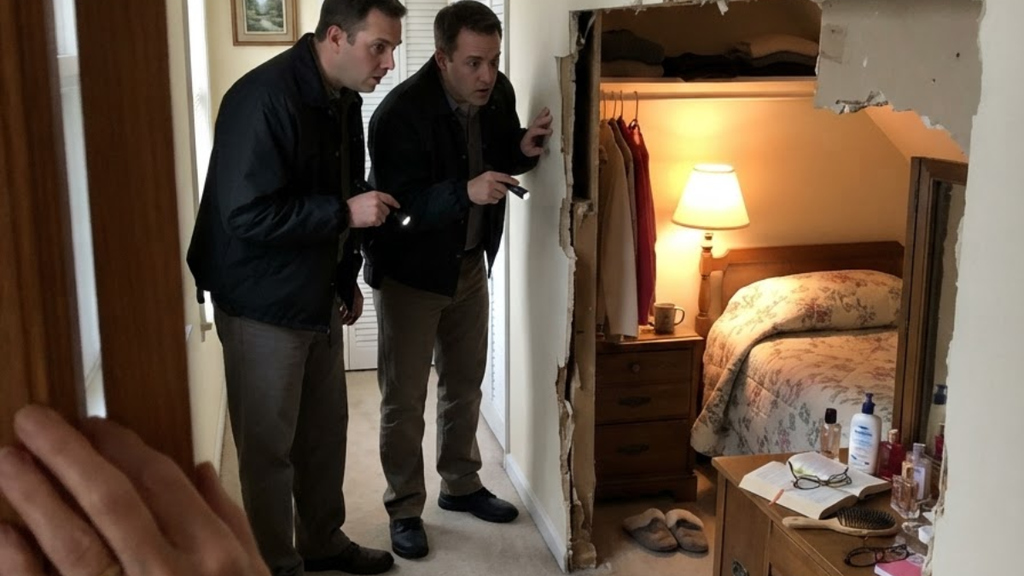
There was a bedroom.
Not storage.
A bedroom.
A twin bed.
A dresser.
A small desk.
A lamp.
Books.
Women’s clothing.
A hairbrush.
A pair of slippers.
A blanket folded neatly across the foot of the bed.
The walls were painted pale yellow.
There were framed pictures.
Not family photographs.
Landscapes.
Flowers.
Generic things you would buy at a home store.
There was no window.
There was a vent near the ceiling.
Then Jessica opened the dresser.
Women’s underwear.
Socks.
T-shirts.
Jeans.
Different sizes.
Some old.
Some relatively new.
Lauren said, “Mom, call the police.”
This time I did.
The first officer who entered the room came back out and told us not to touch anything.
Then detectives arrived.
Then crime-scene technicians.
They asked us to leave the upstairs.
I sat at my kitchen table staring at condolence flowers while strangers photographed a secret bedroom inside my house.
A detective named Rachel Kim sat with me.
She asked whether I knew the room existed.
No.
Had Michael ever mentioned it?
No.
Did anyone live with us besides our daughters?
No.
Had we ever rented rooms?
No.
Did Michael have female relatives who stayed for long periods?
No.
Then she asked whether Michael ever spent time upstairs alone.
Constantly.
His office was there.
He worked from home several days a week before retirement.
After retirement, he spent hours in the office.
I thought he was reading.
Doing taxes.
Watching woodworking videos.
Apparently there had been a woman’s bedroom six feet away.
I asked if someone had been living there.
Kim said they did not know.
Then investigators found the bathroom.
There was another hidden door inside the bedroom.
Behind it was a tiny bathroom.
Toilet.
Sink.
Shower.
No window.
The plumbing connected to our guest bathroom.
Michael installed it during the 2004 renovation.
I remembered that renovation.
We lived downstairs for almost two months because the upstairs was torn apart.
Michael did most of the work himself with a contractor named Gary.
I asked whether Gary built the room.
Police tried to find him.
Gary had died in 2019.
His widow remembered the project.
She said Gary quit halfway through after an argument with Michael.
I remembered that too.
Michael told me Gary was unreliable.
Gary’s widow said her husband refused to talk about why he quit.
Then police found a lock.
Not on the bedroom door.
On the outside of the hidden passage.
The bedroom could be locked from Michael’s office.
There was no way to unlock it from inside.
That changed everything.
Detective Kim asked us to stay somewhere else.
Jessica took me to her house.
The next morning, Kim called.
They found DNA.
Multiple women.
Some from hair.
Some from clothing.
Some from the mattress.
They were trying to identify them.
I asked how many.
She said at least three distinct female profiles.
I said, “Three women lived in there?”
Kim said DNA could have been transferred in many ways.
They did not know yet.
Then they found the first name.
It was written inside a paperback book.
Emily Carson.
I searched it before Kim finished explaining.
Emily Carson disappeared in 2006.
She was twenty-seven.
She worked at a veterinary clinic.
Her car was found outside a grocery store.
Police believed she disappeared sometime after leaving work.
She had never been found.
I looked at her photograph.
I did not know her.
Then I noticed where she worked.
The clinic was approximately ten minutes from our house.
We had a dog in 2006.
Buddy.
Michael took Buddy to the veterinarian.
I asked Kim if Michael knew Emily.
She said they were checking.
The clinic’s old records showed Michael brought Buddy in seven times while Emily worked there.
Then police found another connection.
Emily’s sister remembered Michael.
Not by name.
By photograph.
Police showed her old pictures.
She said Emily once complained about an older married man who kept finding reasons to bring his dog into the clinic.
Michael was forty-three.
Emily was twenty-seven.
I asked if Michael had an affair with her.
Nobody knew.
Then investigators found a photograph inside the hidden room.
Emily.
Sitting on the bed.
Alive.
She looked thinner than in her missing-person photographs.
Her hair was shorter.
On the back:
Month 4.
I had to sit down.
Month four.
Emily had been inside my house for at least four months.
I started trying to remember 2006.
Jessica was seventeen.
Lauren was fourteen.
We lived there.
Our daughters lived there.
We ate dinner downstairs.
We watched television.
We had birthday parties.
Christmas.
Friends sleeping over.
Emily Carson was behind the wall.
I asked how that was possible.
Then police found the ventilation system.
Michael had installed an independent vent connecting the hidden room to his office.
The bathroom fan vented outside through what looked like an ordinary roof vent.
The room had insulation.
Soundproofing.
I had complained during the renovation that Michael spent too much money insulating interior walls.
He told me it would make his office quieter.
He was making the hidden room quieter.
Then they found a small panel near the floor.
It opened into the back of a cabinet in Michael’s office.
Food could be passed through.
Objects.
Medication.
Anything small.
I asked Kim how long Emily had been there.
They did not know.
Then they identified DNA from the hairbrush.
Emily.
No doubt.
Her sister provided comparison DNA.
I asked if Emily died in the room.
No evidence yet.
Then police found another name.
Sarah Mitchell.
Sarah disappeared in 2011.
Age thirty-two.
Married.
One child.
She worked at a bank.
Her car was found at a shopping center.
I knew Sarah.
Not personally.
I recognized her immediately.
She had worked at our bank.
I had spoken to her.
Michael had too.
Sarah’s DNA was on clothing in the hidden room.
Then another photograph.
Sarah sitting on the bed.
On the back:
Week 7.
I asked Kim whether the women were kept there one after another.
Probably.
Then they identified the third DNA profile.
A woman named Natalie Greene.
Natalie was alive.
She was fifty-one.
Police found her living three states away.
She disappeared voluntarily from our area in 2016.
At least that was what everyone believed.
Natalie had left her husband.
Her family received a letter saying she needed a new life.
She eventually contacted them from another state.
There had never been a criminal investigation.
When police called her about Michael, Natalie refused to talk.
Then they told her Michael was dead.
She agreed.
Natalie had been in the room.
For five months.
She was the first person who could tell us what happened inside.
I was not present for her interview.
Kim later told me the basics.
Michael approached Natalie through a volunteer organization.
He was charming.
Helpful.
Married.
Natalie was going through a difficult separation.
Michael listened.
He told her he knew somewhere she could stay temporarily if she needed to get away from her husband.
Natalie trusted him.
She agreed to see the room.
She thought it was a private guest suite.
Once she was inside, Michael locked the door.
Natalie initially thought it was a mistake.
Then Michael returned through the office.
He told her she needed time to calm down.
She demanded to leave.
He refused.
He said her husband was looking for her.
He said police might think she was unstable.
He said he was protecting her.
Natalie was trapped for five months.
I asked how she escaped.
Michael released her.
That surprised everyone.
According to Natalie, he came into the room one evening and said she could leave if she agreed to disappear.
She had to write letters.
Her husband.
Her parents.
Her employer.
She had to say she left voluntarily.
Then Michael drove her several hours away.
He gave her cash.
He told her if she ever told anyone, he would show police evidence that she had been planning to abandon her family.
Natalie believed him.
She moved.
She never came back.
I asked why Michael let her go.
Natalie did not know.
Then she told police something else.
She was not alone the entire time.
For approximately three weeks, there had been another woman in the room.
I said, “At the same time?”
Yes.
The room had one bed.
Michael brought another mattress.
The woman’s name was Rachel.
Natalie did not know her last name.
Rachel was younger.
Maybe late twenties.
She was terrified.
She said Michael had been watching her.
Rachel disappeared from the room one night.
Michael told Natalie she went home.
Natalie never believed him.
Police searched missing-person cases.
They found Rachel Dean.
Twenty-nine.
Disappeared in 2016.
Same period Natalie was confined.
Her car was found near a hiking trail.
Rachel had never been found.
I asked why her DNA was not identified in the room.
It was.
Investigators initially thought it belonged to Natalie because the samples were mixed.
Once they knew to look for another woman, they separated a fourth profile.
Rachel.
Four women.
Two missing.
One alive.
One missing from the same period as the survivor.
Then police found the dates.
Michael had kept records.
Not in the bedroom.
On an external hard drive in his office.
Folders.
Emily.
Sarah.
Natalie.
Rachel.
And others.
Seven women.
The hidden room was built in 2004.
The first folder was dated 2005.
Her name was Karen Lowe.
Karen was alive.
Police found her.
She had never been reported missing.
Because Karen went home.
She had been confined for nine days.
Michael knew her through a contractor.
Karen said Michael invited her to the house to look at furniture I was supposedly selling.
I was visiting my mother.
Our daughters were at school.
Michael locked Karen inside the room.
Karen screamed.
Fought.
Refused food.
Threatened him constantly.
On the ninth day, Michael opened the door.
Karen attacked him.
She ran.
Michael did not chase her.
Karen went home.
She told her boyfriend.
He did not believe her.
Michael was married.
Respected.
Karen had struggled with addiction.
Her boyfriend accused her of using again.
Karen went to police.
She said she had been held in a hidden room but could not identify exactly where because Michael drove her there in a vehicle with covered windows.
Police interviewed Michael.
He denied it.
I remembered officers coming to our house in 2005.
Michael told me someone accused him of damaging a car in a parking lot.
I believed him.
Police never searched the house.
Karen had no physical evidence.
The case went nowhere.
Michael learned.
That was the word Detective Kim used.
He learned.
After Karen, the room changed.
The inside door handle was removed.
Soundproofing was added.
A camera was installed.
Michael had documented the modifications.
K screamed too much.
Need better control before next.
Next.
That word made me vomit.
Karen was not a terrible mistake.
She was a trial run.
Then Emily.
Michael watched her for months before she disappeared.
Photographs.
Work schedule.
Apartment.
Friends.
Her dog.
He knew when she worked late.
He knew she trusted him because of Buddy.
Emily was inside the room for at least eleven months.
Not four.
The photograph labeled Month 4 was simply one of many.
Month 1.
Month 2.
Month 4.
Month 7.
Month 9.
Month 11.
I asked what happened after Month 11.
No more photographs.
Then a note.
E no longer workable.
I asked what that meant.
Nobody knew.
Then Sarah.
Four years after Emily’s file ended.
I asked what Michael did between them.
That was when Detective Kim told me there were more folders.
Not women who entered the room.
Women Michael considered.
He had photographed dozens.
Followed them.
Learned routines.
Most never knew.
The seven were the ones he selected.
I asked selected for what.
Kim said Michael used a word repeatedly.
Stay.
Not victim.
Not captive.
Stay.
Possible stay.
Bad candidate for stay.
Too connected for stay.
Lives alone. Better stay possibility.
He wrote about women as though he were choosing someone for a guest room.
Then investigators found a folder with my name.
DIANE.
I expected photographs of me.
There were.
But the folder started in 1987.
Three years before Michael and I met.
I was twenty-one.
Michael had photographed me at a restaurant.
Then outside my apartment.
Then at work.
Then with my sister.
He followed me for almost two years before arranging to meet me at a friend’s birthday party.
I asked why.
Kim showed me his notes.
Diane strong family.
Parents nearby.
Stable employment.
Social.
Then:
Not stay.
I did not understand.
Kim did.
Michael divided women into two categories.
Women he wanted to enter his public life.
And women he wanted to remove from theirs.
I was not a candidate for the room.
I was a candidate for marriage.
Diane makes sense for outside.
Outside.
That was what he called my life.
Outside.
Then:
Marriage would stabilize appearance.
I stared at the sentence.
Michael chose me partly because marrying me would make him look normal.
I asked whether he loved me.
Nobody could answer that.
His later notes suggested he did.
Diane pregnant. Happy.
Jessica born. Never thought I would want this.
Diane makes home feel real.
Then years later:
Need separate home from stay.
The hidden room was his solution.
Before 2004, whatever he did with women happened elsewhere.
After we renovated the farmhouse, Michael built a place where his two lives could exist under one roof.
His wife and daughters on one side of the wall.
His “stay” on the other.
Then investigators found the fifth woman who had been inside.
Her name was Rebecca Shaw.
Rebecca was alive.
Michael confined her for three weeks in 2009.
She escaped.
Not from the room.
From Michael’s car.
He was moving her somewhere.
Rebecca jumped out at a gas station and ran into the store.
She screamed for help.
Michael drove away.
Rebecca gave police his vehicle description.
Not the plate.
Michael had borrowed a work van.
Rebecca could not identify where she had been held.
She had been blindfolded entering and leaving.
She described a small yellow bedroom with no windows.
Police searched properties connected to similar reports.
Nothing.
I asked why nobody connected Karen and Rebecca.
Different jurisdictions.
Different descriptions.
Karen knew Michael’s first name and face but not location.
Rebecca knew the room but not Michael’s identity.
Michael had learned again.
Then I asked where he was taking Rebecca.
His notes said:
R unsuitable for release. Transfer.
Transfer where?
That became the next question.
Then police found a key on Michael’s key ring.
I knew most of his keys.
House.
Truck.
Shed.
Mailbox.
My car.
One small brass key meant nothing to me.
It belonged to a storage facility.
Michael rented a unit under an LLC.
Police opened it.
Inside were boxes.
Seven.
One for each woman.
Karen.
Emily.
Rebecca.
Sarah.
Natalie.
Rachel.
And another name.
LUCY.
The boxes contained clothing.
Personal items.
Photographs.
Identification.
Letters.
Things taken from their homes.
Then police opened Lucy’s box.
There was a child’s bracelet.
Pink plastic beads.
The kind children make at summer camp.
I asked how old Lucy was.
Detective Kim said Lucy was thirty-eight when she disappeared.
The bracelet belonged to her daughter.
Lucy had three children.
She disappeared in 2021.
Her husband was initially suspected.
He was never charged.
I remembered the case.
Everyone did.
Lucy Morgan disappeared after leaving a restaurant.
Her husband had been publicly destroyed.
People called him a murderer online.
His children lost friends.
He lost his job.
Michael had newspaper clippings about him.
One note:
Husband absorbing attention. Good.
I sat there staring at those words.
Michael had watched another man spend five years being suspected of murdering his wife and considered it useful.
Lucy’s DNA was in the hidden room.
She was the seventh woman.
I asked whether she was still alive.
Nobody knew.
Then investigators found something underneath the bed.
Scratched into the wooden frame.
Names.
Not all seven.
EMILY
SARAH
RACHEL
LUCY
Four missing women.
Below Lucy:
HE TAKES US TO THE FARM.
I said, “This is the farm.”
Kim shook her head.
Apparently not.
Michael called our house HOME in his notes.
There was another location.
FARM.
I asked where.
They did not know.
Michael owned no farm.
Neither did his parents.
Neither did mine.
Then Lauren remembered something.
When she was a child, Michael used to disappear for weekends to help a friend with a hunting property.
We called it “Tom’s farm.”
Tom was Michael’s friend from high school.
I had not seen him in years.
His full name was Thomas Avery.
Police contacted him.
Tom said he never owned a farm.
Michael never hunted with him.
He had no idea what we were talking about.
My husband invented a friend’s farm for more than twenty years.
Then investigators searched financial records.
Every October, Michael withdrew cash.
Property taxes.
Repairs.
Supplies.
Regular amounts.
They traced one payment.
A rural property two counties away.
Owned by a company called DMS Holdings.
Diane.
Michael.
S?
I asked what S stood for.
Nobody knew.
Police drove to the property.
It was a farm.
Eighty-six acres.
Old farmhouse.
Barn.
Machine shed.
Michael had owned half of it since 1999.
I knew nothing about it.
The other half belonged to someone named Samuel Pierce.
I did not know Samuel Pierce.
Police did.
He had been a sheriff’s deputy.
Retired.
Michael’s friend.
Not socially.
At least not in any life I knew.
Then Detective Kim asked me whether I remembered a police officer coming to our house in 2005 after Karen Lowe accused Michael.
Yes.
I remembered.
She showed me a photograph.
Samuel Pierce.
He was one of the officers.
The officer who took Karen’s report had co-owned a secret farm with my husband for six years.
I asked if Samuel knew about the hidden room.
Kim said they were going to find out.
Police searched the farm.
The farmhouse looked abandoned.
Dust.
Old furniture.
No food.
No sign anyone lived there.
Then they opened the basement.
There were two bedrooms.
Both had locks on the outside.
One was empty.
The other contained a mattress.
Blankets.
Women’s clothing.
Then they searched the barn.
Behind a newer interior wall, they found another room.
Larger.
Plumbing.
A shower.
A bed.
A table.
A camera.
Then they found photographs.
Emily.
Sarah.
Rachel.
Lucy.
All four women whose names were scratched into the bed at my house.
They had been transferred.
The hidden bedroom in my house was not where Michael kept women permanently.
It was where he started.
The farm was where he took the women he decided he could not release.
I asked if they found them.
Not yet.
Then police found a freezer in the barn.
Not bodies.
Files.
Vacuum-sealed documents.
Photographs.
Letters.
Copies of missing-person reports.
Samuel had access to police information.
He had been monitoring investigations.
Karen reported Michael in 2005.
Samuel made sure nothing happened.
Rebecca escaped in 2009.
Different jurisdiction, but Samuel obtained her report.
Sarah disappeared in 2011.
Samuel checked the case repeatedly.
Natalie left in 2016.
Samuel helped Michael construct the appearance that she left voluntarily.
Rachel disappeared the same year.
Samuel accessed her file.
Lucy disappeared in 2021.
Samuel had been retired for years, but he still knew people.
He still obtained reports.
I asked how long Samuel had been involved.
Then they found the deed.
DMS Holdings.
David Michael Sutton.
My husband’s full name was David Michael Sutton.
He went by Michael.
The D and M were both him.
S was not Samuel.
The company existed before Samuel became co-owner.
The farm had originally belonged entirely to my husband.
Samuel bought half in 2003.
One year before Michael built the hidden bedroom.
I asked why.
Then police arrested Samuel.
He was seventy.
His wife had died.
His children were adults.
He initially denied knowing anything about the women.
Then investigators showed him the farm photographs.
He asked for an attorney.
Police searched his house.
They found a box.
Inside were letters.
From Emily Carson.
Written while she was missing.
Addressed to her sister.
Her mother.
One to police.
They had never been mailed.
One said:
There are two of them.
I asked Kim if Michael and Samuel had been doing this together.
She said they were still determining exactly what Samuel’s role was.
Then they found an older letter.
Before the farm.
Before the hidden bedroom.
Before Samuel co-owned anything.
The woman who wrote it was named Catherine Doyle.
I had never heard of her.
The letter said:
Mike says Sam won’t let me go to the police.
Catherine disappeared in 1998.
One year before Michael bought the farm.
Six years before he built the room.
Police had just found the eighth woman.
And for the first time, I realized the hidden bedroom might not have been Michael’s idea at all.
Catherine Doyle disappeared on August 17, 1998.
Michael and I bought our farmhouse in November.
Three months later.
That timeline mattered.
Until then, I had been thinking about our house as something Michael eventually corrupted.
We bought it.
We raised our daughters there.
Six years later, he built the hidden room.
But if Catherine had already been confined somewhere before we even bought the house, then Michael had not invented this life during our marriage.
He brought it with him.
Catherine was twenty-five.
She worked at a hotel.
She disappeared after an evening shift.
Her car was found at a gas station two days later.
Samuel Pierce was one of the deputies involved in the original search.
Michael’s name never appeared in the file.
Then investigators found a photograph.
Catherine sitting on a mattress.
Concrete wall behind her.
Not our house.
Not the farm.
The photograph was dated September 1998.
A month after she officially disappeared.
She was alive.
On the back, in Samuel’s handwriting:
Still refuses.
I asked what she refused.
Nobody knew.
Then they found another photograph.
October 1998.
Catherine looked thinner.
Beside her on the floor was a newspaper.
Detective Kim enlarged the image.
The newspaper was dated October 22.
Catherine had been alive for at least two months after she disappeared.
Then Michael and I bought the farmhouse.
I asked Kim whether Catherine had ever been there.
No DNA match yet.
Then Samuel started cooperating.
Partially.
His attorney negotiated.
Samuel admitted knowing about Catherine.
He denied taking her.
According to him, Michael called him because Catherine had “gotten herself into a bad situation.”
I asked what that meant.
Kim said Samuel used language exactly like Michael did.
Things happened around women.
Women created problems.
Women became difficult.
Nobody ever said:
We did this.
Catherine had been dating Michael.
That sentence almost made me laugh.
Not because it was funny.
Because I had reached the point where discovering my dead husband had another girlfriend barely registered compared to everything else.
The affair lasted approximately eight months.
Michael told Catherine he was separated.
We were not.
Lauren was seven.
Jessica was ten.
Catherine eventually discovered he was married.
She threatened to tell me.
Michael tried to end the relationship.
Catherine threatened to come to our house.
Then she disappeared.
I asked whether Samuel helped because Michael was his friend.
No.
That was the next lie to fall apart.
Samuel and Michael had known each other since 1982.
Michael was nineteen.
Samuel was twenty-six and already working in law enforcement.
Michael had been arrested.
I had never known that.
Burglary.
He broke into a woman’s apartment.
The woman was named Elaine Porter.
Michael said he entered because he believed Elaine had something belonging to him.
Elaine said Michael had been following her.
She had already told friends she was afraid.
Samuel was one of the responding officers.
The case went nowhere.
The report was incomplete.
Evidence was lost.
Charges were reduced and eventually dismissed.
I asked why Samuel helped him.
Samuel claimed Michael gave him money.
Investigators did not believe that.
Then they found photographs of Elaine.
Not in Michael’s belongings.
In Samuel’s.
Samuel had been watching her too.
That was the beginning.
Not Michael corrupting a police officer.
Not a police officer reluctantly protecting Michael.
They were doing it together.
Elaine was twenty-four.
She worked at a restaurant both men frequented.
Samuel asked her out.
She said no.
Michael became interested in her too.
The two men started following her.
Samuel later described it as “stupid young-guy stuff.”
Samuel was twenty-six.
He was a police officer.
Michael was nineteen.
They followed Elaine home.
Learned her schedule.
Entered her apartment.
Michael got caught.
Samuel made the problem disappear.
Elaine moved away.
She was still alive.
Police found her.
She was sixty-eight.
When investigators told her Michael was dead and Samuel had been arrested, Elaine said:
“I wondered my whole life whether anyone would ever believe me.”
She remembered both men.
She said Samuel used his badge to frighten her.
He told her Michael had made a mistake.
He told her if she pursued charges, people would learn things about her.
She asked what things.
Samuel mentioned a married man Elaine had briefly dated.
She had told almost nobody.
Michael and Samuel had followed her long enough to know.
Elaine dropped the complaint.
Then she moved.
The tactic worked.
That was the real beginning.
Not the bedroom.
Not the farm.
Information.
Watch a woman.
Learn something private.
Cross a boundary.
If she objects, use what you know to make her doubt whether reporting is worth it.
Most women backed down.
The ones who did not became something else.
Then investigators found another woman.
Marjorie Bell.
Missing.
Michael was twenty-three.
Samuel thirty.
Marjorie worked at an insurance office.
She reported Samuel for repeatedly stopping her car without cause.
She told her sister another younger man had started appearing near her apartment.
Michael.
Marjorie disappeared.
Samuel participated in the search.
Her case was never solved.
I asked if Michael had kept anything from her.
Yes.
A ring.
It was found in the farm safe.
The farm did not exist yet.
Michael kept Marjorie’s ring for thirteen years before buying the property.
Then another.
Teresa Nolan.
Alive.
She accused Michael of entering her house.
Samuel convinced her not to press charges.
Another.
Bethany Cross.
Dead.
Officially overdose.
She had told friends Samuel and another man were harassing her.
Another.
Rebecca Holt.
Alive.
Moved across the country after finding photographs of herself inside her mailbox.
Then Catherine in 1998.
The eight women connected to the hidden bedroom were not the beginning.
They were the later phase.
The bedroom was an improvement.
The farm was an improvement.
Michael and Samuel spent decades refining a system.
Then Samuel told police where Catherine had been kept.
An abandoned hunting cabin owned by his uncle.
The cabin had been demolished.
The land was now privately owned.
Police searched.
They found Catherine’s remains.
I asked how she died.
Kim said they could not determine exactly.
There was evidence of a significant head injury.
Samuel claimed Michael hit her.
Michael was dead.
He could not answer.
Then investigators found Michael’s notes.
Catherine still thinks Diane will help her.
I read that sentence three times.
Catherine knew my name.
Of course she did.
She knew Michael was married.
She wanted to tell me.
Then:
She thinks wife knowing changes situation. It doesn’t.
Another:
C asked Sam to contact Diane. Ridiculous.
I had been thirty-two.
I was living less than twenty miles away.
I was packing school lunches.
Driving Jessica to dance.
Taking Lauren to birthday parties.
Somewhere nearby, a woman was begging two men to contact me because she believed I would help her.
They laughed about it.
Then Catherine died.
Three months later, Michael bought our farmhouse.
I asked why.
Samuel answered that too.
Michael wanted privacy.
Our previous house was in a subdivision.
Neighbors close.
No basement access from outside.
No large renovation possibilities.
The farmhouse was isolated.
The property had several acres.
Old construction.
Thick walls.
Michael specifically wanted a house he could modify.
I asked whether that meant he chose our family home because he planned to keep women there.
Samuel said yes.
I stopped speaking to him after that.
Not directly.
I mean I stopped asking Detective Kim to tell me what Samuel said about Michael’s motivations.
There are answers you think you want until you receive them.
Then police found the original plans Michael drew before we bought the house.
Not 2004.
He had sketched modifications before closing.
A room behind the upstairs office.
Smaller than what he eventually built.
No bathroom yet.
A passage.
A lock.
Ventilation.
Michael considered building it from the beginning.
He waited six years.
Why?
Our daughters.
That was what his notes suggested.
Jessica and Lauren were young.
Too unpredictable.
Always running through the house.
Friends over.
Sleepovers.
Michael wrote:
Wait until girls older.
Then in 2003:
Jessica driving soon. Lauren independent. Upstairs quieter.
Construction began in 2004.
My daughters growing up made the hidden bedroom feasible.
That fact hurt Lauren particularly badly.
She said, “So he was waiting for us to stop being children.”
Yes.
He was.
Then police found something else in the plans.
Two rooms.
Not one.
The hidden bedroom we discovered was labeled A.
Another area was labeled B.
B should have been behind the downstairs pantry.
Investigators measured.
There was missing space.
Again.
I had lived in that house twenty-eight years.
There was another hidden room.
Police opened the wall.
It was smaller.
No bed.
Concrete floor.
Shelving.
Drain.
Old hooks in the wall.
The room had been sealed from our side.
No removable panel.
Access had once been through the exterior of the house.
Michael later covered the outside door during a siding project.
Inside, investigators found old blood.
Multiple people.
One profile matched Emily Carson.
Another matched Sarah Mitchell.
Another matched Rachel Dean.
Lucy Morgan.
And Catherine.
Catherine had been in our house after all.
Her blood was in a room that did not officially exist.
But Catherine died in 1998.
We did not buy the farmhouse until November 1998.
I thought the timeline was impossible.
Then police checked closing records.
Michael had access to the house before we owned it.
The property sat vacant.
The previous owner lived out of state.
Michael worked for a company doing repairs before sale.
He had keys.
He knew the house months before I ever saw it.
He brought Catherine there.
Our farmhouse had been one of the places she was confined.
Then Michael convinced me to buy it.
I remembered the first time he showed it to me.
I hated it.
Too old.
Too far from town.
Needed too much work.
Michael loved it.
He walked me through every room.
He stood in the kitchen and described what we could change.
He showed me where the girls could have bedrooms.
He talked about Christmas.
Grandchildren someday.
A garden.
He sold me our future.
He had already brought a captive woman there.
I asked Kim whether Catherine was killed in the house.
They could not tell.
But her blood was in Room B.
Samuel said she injured herself trying to escape.
Of course she did.
Every woman around those men apparently injured herself while trying to escape.
Then investigators realized what Room B was.
It was not another bedroom.
It was transitional.
Women were brought through the exterior door into B.
From there, Michael could move them elsewhere when the house was empty.
After he built the upstairs room, B became unnecessary.
He sealed it.
But not before Emily.
Sarah.
Rachel.
Lucy.
Their blood meant Michael still used it occasionally.
Then they found the tunnel.
Calling it a tunnel makes it sound dramatic.
It was an old utility passage beneath part of the house.
The farmhouse once had a coal delivery area.
Michael expanded it.
It connected the basement to an exterior hatch hidden behind landscaping.
Someone could enter or leave without using the main doors.
I had planted hydrangeas in front of that hatch.
Michael suggested them.
I used to complain they never grew well there.
He said the soil was bad.
He needed them tall enough to hide the entrance.
Police started excavating around the property.
I asked what they were looking for.
I knew.
They did not find bodies.
They found objects.
A watch.
Two earrings.
A shoe.
A button.
Some could be connected to the women.
Some could not.
Then they found a buried metal container.
Inside were letters.
Dozens.
Written by women from the hidden room.
Not just the ones we knew.
Some were never mailed.
Some were addressed to families.
Some to police.
Some to Michael.
One was from Emily.
She wrote:
Diane, if you ever see this, I don’t think you know.
My name.
Again.
Emily knew about me too.
She had heard Michael talk about his family.
She wrote:
He talks about you like he loves you. I think that makes this worse because it means he can choose when to be normal.
I had to stop reading.
Jessica read the rest.
Emily wrote that Michael showed her family photographs.
Not to comfort her.
To explain why she could never be part of his real life.
He told her she needed to “accept the arrangement.”
She did not understand what arrangement meant.
Neither did I.
Then investigators found Michael’s journal from that period.
Emily was different.
He had kept her longer than most.
Almost a year.
His notes became personal.
E easier now.
E reads most days.
E asked about girls.
E says she understands boundaries.
Then:
Could maintain indefinitely.
I asked what happened.
Samuel knew.
Michael became attached to Emily.
Not romantic in any normal sense.
Possessive.
He liked knowing she was there.
He would sit in his office while she sat six feet away.
Sometimes he entered the room just to talk.
He told Samuel he had finally found the right balance.
Wife outside.
Woman inside.
Samuel thought Michael was losing control.
Not morally.
Operationally.
Emily had been there too long.
She knew too much.
She knew our names.
Our daughters.
Our schedules.
Michael started trusting her.
Then Emily pretended to accept the arrangement.
She convinced Michael she would stay voluntarily.
He began giving her small freedoms.
Then she tried to escape.
She reached Room B.
Michael caught her.
There was a struggle.
That explained her blood.
Afterward, Samuel insisted she be transferred to the farm.
Emily went to the farm.
Then disappeared from the records.
I asked where she was.
Samuel said Michael took her somewhere alone.
He never saw Emily again.
Michael returned the next morning.
He told Samuel:
It’s handled.
Police searched places Michael had access to in 2007.
Nothing.
Then Lauren found something.
Not police.
Lauren.
She was going through old family photographs because she wanted pictures of her father before everything became evidence.
She found a photograph from summer 2007.
Michael standing beside our boat.
Behind him was a lake.
I recognized it.
My parents had owned a cottage there.
Michael went alone sometimes to check the property after my father became ill.
Lauren noticed the date.
Three days after Emily’s final journal entry.
Police searched records.
Michael used his credit card at a gas station near the lake that night.
Then they searched the lake.
Emily was there.
Her remains were recovered near a deep section not far from my parents’ old cottage.
My father had died believing Michael was the best son-in-law anyone could ask for.
Michael helped maintain his cottage.
Cut the grass.
Fixed the dock.
Apparently he also used the lake to hide Emily Carson.
Then Sarah.
Sarah’s records showed Michael had become more cautious.
She was kept in our house only seven weeks.
Then transferred.
The farm.
Samuel said Sarah discovered the camera.
She removed part of the vent.
She found wiring.
She damaged it.
Michael became furious.
Samuel wanted to release her somewhere and intimidate her.
Michael refused.
Sarah had seen his face.
Knew his name.
Knew where she was.
She knew I existed.
Then Samuel said something strange.
Sarah knew more than that.
She knew Catherine.
Not personally.
The case.
Sarah had seen a missing-person poster years earlier.
Michael had mentioned Catherine accidentally.
Sarah connected it.
She realized Michael had been doing this for years.
That made her, in Michael’s words:
Impossible to return.
Sarah was transferred to the farm.
Then Samuel claimed he stopped participating.
He said Michael took Sarah somewhere else.
Again.
Police found a journal entry.
S — old quarry.
They searched.
They found Sarah.
Then Rachel.
Rachel’s disappearance had always bothered Samuel because Natalie was there.
A witness.
Michael wanted Natalie gone too.
Samuel refused.
That was why Michael released Natalie.
Not mercy.
Samuel told him two disappearances connected to the same period would attract attention.
Natalie had already told people she wanted to leave her husband.
She could be made into a voluntary disappearance.
So they forced her to write letters.
Gave her money.
Sent her away.
Rachel did not have that option.
Her family relationships were good.
Her job stable.
No plausible reason to disappear.
So Rachel went to the farm.
Police found her remains there.
Buried behind the barn.
Then Lucy.
By then Michael was fifty-eight.
Samuel was seventy.
I asked why they were still doing this.
Samuel said he had tried to stop years earlier.
I no longer cared what Samuel claimed.
Michael had Lucy.
Samuel knew.
Lucy was in the upstairs room for almost three months.
Then the farm.
The photographs showed her there.
Her husband was being investigated.
Michael followed news coverage.
Husband absorbing attention. Good.
Then Lucy did something none of the other women had done.
She got Samuel on her side.
Not because Samuel became decent.
Lucy figured out the dynamic.
Michael was in control.
Samuel resented him.
Lucy started telling Samuel that Michael would eventually blame everything on him.
She was right.
She told him Michael had records.
Photographs.
Evidence.
She told Samuel he was not Michael’s partner.
He was Michael’s insurance policy.
Samuel started searching Michael’s things.
He found journals.
Copies of reports.
Proof Michael documented Samuel’s involvement from the beginning.
Samuel panicked.
He wanted out.
He told Michael Lucy needed to be released.
Michael refused.
They fought.
Then one night Samuel removed Lucy from the farm.
He claimed he drove her several hours away and let her go.
I asked whether Lucy was alive.
Samuel said yes.
Police asked where.
He gave them the location.
A bus station.
There were old security records but no footage preserved.
Then detectives checked national databases.
A woman matching Lucy’s description had been treated at an emergency room two states away three days later.
She gave a false name.
Left before discharge.
Then nothing.
Her family provided DNA.
Hospital samples no longer existed.
They could not prove it was her.
But Samuel insisted Lucy survived.
Then police found Michael’s note from two weeks after Samuel claimed to release her.
Lucy unresolved. Sam lied.
That changed everything.
Michael did not believe Samuel.
He spent the next five years looking for Lucy.
Searches on his computer.
Public records.
Social media.
Missing-person forums.
Homeless shelters.
Hospitals.
Obituaries.
He never found her.
Then police found an email account.
Anonymous.
Created in 2022.
It had sent one message to Michael.
I remember the yellow room.
Michael replied within three minutes.
Who is this?
No response.
Two months later:
I remember the farm too.
Michael:
Lucy?
No response.
Then:
Sam told me where Catherine is.
Michael sent sixteen messages.
Who are you?
What do you want?
Call me.
You’re lying.
Samuel doesn’t know.
Then the account disappeared.
I asked if it was Lucy.
Nobody knew.
Then another message.
Different account.
Sent to Michael’s personal email.
Emily didn’t fall.
Michael deleted it.
Recovered later.
He never replied.
Then 2025:
Your wife still doesn’t know what is inside her house.
That one made me stop breathing.
Someone knew.
Someone knew about the room.
Someone knew about me.
Michael replied:
Leave Diane out of this.
The sender:
You put Diane in this when you built it behind her wall.
Michael:
What do you want?
No response.
Then six months before Michael died:
You should tell her before I do.
Michael never did.
I asked whether police could trace the emails.
They were working on it.
Then Detective Kim asked if I remembered anything unusual about Michael in the months before his death.
I did.
He became restless.
He checked locks repeatedly.
He installed new cameras outside.
He wanted to sell the farm.
I laughed when Kim told me that because I did not know we owned a farm.
Michael told me he wanted to sell “some old investment land.”
He started shredding documents.
He spent more time in his office.
Then two weeks before he died, he asked me a bizarre question.
“If someone told you something terrible about me, would you believe them?”
I thought he was joking.
I said it depended what they said.
Michael asked:
“What if they had proof?”
I asked if he had a secret family.
He laughed.
I laughed.
Then he said:
“You know me.”
I said of course I did.
He looked relieved.
Eleven days after his heart attack, police opened the wall.
Then Kim called me again.
They traced one of the anonymous accounts.
Not to Lucy.
To a public library computer.
Security footage was long gone.
But the library card used to reserve the computer still existed.
The name was Rebecca Sutton.
I did not know Rebecca Sutton.
Same last name as us.
I asked whether she was related to Michael.
Kim said yes.
Then she asked whether Michael ever told me he had a sister.
Michael had one brother.
David.
Died young.
No sister.
Kim said Michael had a half-sister.
Born in 1975.
Rebecca was fifty-one.
Michael knew about her.
Samuel knew about her.
I asked how.
Michael’s father had an affair.
Rebecca was the child.
The families had limited contact.
Then investigators found Rebecca’s name in Michael’s oldest notebooks.
Not as family.
As:
R.S.
Watching.
Rebecca had discovered Michael and Samuel’s behavior in the 1990s.
She suspected them in Marjorie Bell’s disappearance.
She confronted Michael.
Then Rebecca disappeared from the family’s life.
Everyone assumed she wanted nothing to do with them.
She changed her name.
Moved.
Stayed hidden.
I asked whether she was alive.
Kim said they believed so.
Then she showed me a photograph recovered from Michael’s deleted files.
A woman approximately fifty.
Standing across the street from our house.
Taken three months before Michael died.
On the back of a printed copy, Michael had written:
Rebecca found me again.
Then another note.
She knows about room.
Then:
She says Lucy is alive.
I looked at Kim.
“Lucy is alive?”
“We don’t know.”
Then they found Rebecca.
She had been living less than an hour away under her married name.
She agreed to speak to police.
And what she told them changed the story again.
Lucy was alive.
Rebecca had met her.
Lucy had been the one sending some of the emails.
Rebecca sent others.
Samuel really did release Lucy in 2021.
Lucy survived.
She eventually found Rebecca because Samuel gave her one thing before letting her go.
A name.
Rebecca Sutton.
He told Lucy:
“If anyone can make people believe you, find her.”
Rebecca had spent almost thirty years waiting for someone to come looking.
She knew Michael and Samuel had hurt women.
She knew about Marjorie.
She knew about Catherine.
She suspected there were others.
But she never had proof.
Then Lucy appeared.
Lucy told her about the yellow room.
The farm.
Rachel.
The other women.
Rebecca wanted to go to police immediately.
Lucy refused.
She was terrified.
She believed Samuel still had police connections.
She believed Michael would find her.
Rebecca spent years convincing her.
Then they began contacting Michael.
Not to torment him.
To make him panic.
They hoped he would move evidence.
Contact Samuel.
Reveal locations.
And he did.
Michael visited the quarry where Sarah was buried.
He visited the lake where Emily was.
He went to the farm.
He opened old storage units.
Rebecca and Lucy followed him.
Photographed him.
Documented everything.
They were building a map.
I asked why they never contacted me.
Rebecca said Lucy wanted to.
Rebecca stopped her.
She did not know whether I was innocent.
That hurt.
Then Rebecca said:
“We didn’t know what you were.”
I understood.
From outside, I had been Michael’s wife for thirty-six years.
The farmhouse was in both our names.
Women were held inside it.
How could they know?
Then Rebecca showed police the last photograph she ever took of Michael.
The morning he died.
Michael leaving our house.
Getting into his truck.
Driving to the hardware store.
Except he did not go directly to the hardware store.
He drove to a park.
Rebecca followed.
Michael met Samuel.
They argued.
Rebecca photographed them.
Then Michael left.
Twenty minutes later, he had the heart attack.
I asked what they argued about.
Samuel eventually admitted it.
Michael wanted to move Lucy’s box.
The letters.
The photographs.
Everything connecting her to the farm.
Samuel refused.
Michael accused him of telling Lucy about Rebecca.
Samuel admitted he did.
Michael said Samuel had ruined everything.
Samuel said:
“No, Mike. You did that forty years ago.”
Then Michael drove away.
His heart stopped before he could destroy the evidence.
I sat in silence after Kim finished.
Then I asked where Lucy was.
Alive.
Safe.
She had finally agreed to come forward.
I did not meet her.
I do not think I ever should.
But she gave police a statement.
At the end, she included one sentence for me.
Kim asked if I wanted to read it.
I did.
Tell Diane I heard her laughing with her daughters through the wall, and it reminded me there was still a world outside that room.
I cried harder over that sentence than I cried at Michael’s funeral.
Because suddenly I could hear our house the way Lucy heard it.
Jessica calling me from downstairs.
Lauren laughing.
The television.
The dog barking.
Cabinet doors.
Vacuum cleaner.
Birthday songs.
Christmas music.
My footsteps.
Normal life happening inches away.
I had thought the horror was that Michael hid women inside our home without me knowing.
It was worse.
The women knew I was there.
They could hear me.
Emily knew my name.
Catherine believed I might save her.
Lucy listened to my daughters laugh.
Michael had not simply hidden a room from his family.
He had used our family as part of the room.
Our normal life was camouflage.
A wife downstairs meant nobody wondered why Michael was home.
Children meant neighbors saw a family.
Birthday parties meant cars in the driveway had explanations.
Renovations explained noise.
A farmhouse explained privacy.
And whenever a woman inside that room wondered whether anyone would believe what Michael was doing, all she had to do was listen through the wall to hear the reason he thought nobody ever would.
He had us.
