

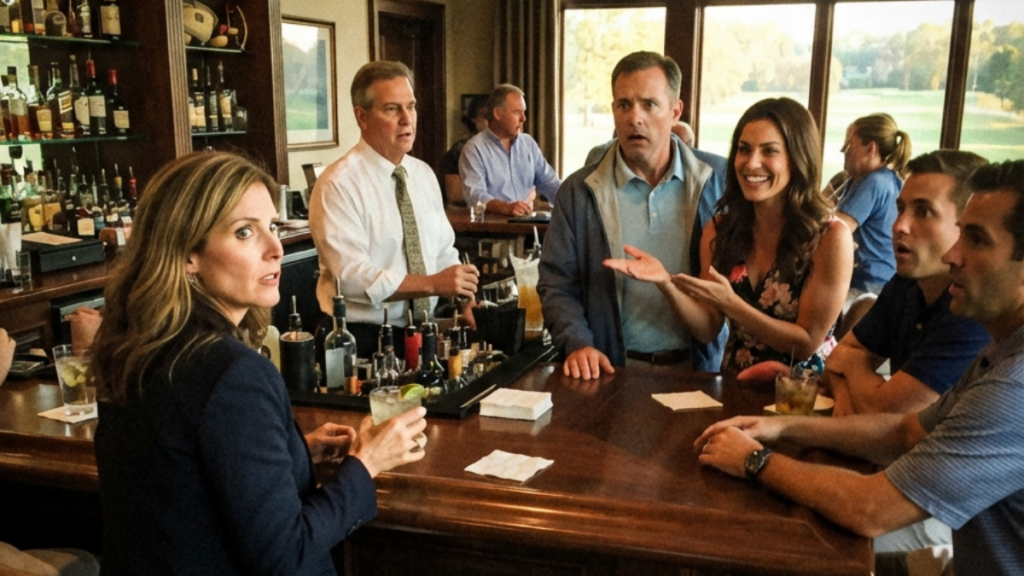
I found out my husband was having an affair because another woman introduced herself as his wife.
At our country club.
While I was sitting about twenty feet away.
With a martini in my hand.
I genuinely thought I had misheard her.
Then the bartender looked directly at me.
That was when I knew I hadn’t.
I’m 60F.
My husband, Richard, is 63M.
We’ve been married 36 years.
Two adult children.
Kate, 34, and Andrew, 31.
Three grandchildren.
And apparently Richard has two wives.
At least depending on which room he’s standing in.
We joined our country club almost fifteen years ago.
Richard golfs.
I don’t.
I use the pool.
Go to dinners.
Meet friends there for drinks.
We attend holiday parties.
The kids grew up swimming there.
Kate had part of her bridal shower there.
It isn’t some place Richard goes where nobody knows me.
People know us.
Together.
Richard and Susan.
That’s us.
Or was.
Which becomes important.
The woman is Vanessa, 52.
I had heard her name before.
Richard told me she worked with one of his company’s larger clients.
Apparently she had become part of a group that occasionally golfed together.
Fine.
I had even met her once.
Briefly.
At a charity dinner.
She was beautiful.
Dark hair.
Very polished.
Friendly.
Richard introduced her as:
“Vanessa from Stonebridge.”
She shook my hand.
Said:
“I’ve heard so much about you.”
Of course.
That sentence should just be illegal at this point.
Nothing felt strange then.
Maybe it should have.
But when you’ve been married thirty-six years, you don’t inspect every woman your husband speaks to like you’re conducting a criminal investigation.
You trust the person you married.
Anyway.
This happened about four months ago.
It was a Thursday.
Richard told me that morning he was playing golf after work with some clients.
Normal.
He said:
“Probably eating at the club after.”
I said:
“Okay.”
Then my friend Nancy texted around four.
She said:
Drinks?
I said:
Club?
She said:
Yes.
Perfect.
I didn’t tell Richard.
Not because it was secret.
Because why would I?
I don’t provide my husband with minute-by-minute updates when I meet a friend for happy hour.
Nancy and I got there around five-thirty.
Sat at the bar.
Ordered drinks.
Talked about her daughter’s divorce.
Irony.
Around six-fifteen, I saw Richard through the windows coming off the course.
Vanessa was with him.
And two men.
I recognized one of the men as someone from his work.
Fine.
Exactly what Richard had told me.
Clients.
Golf.
Nothing.
I remember thinking:
Oh, I’ll surprise him.
Then I watched Richard put his hand on Vanessa’s back as they walked inside.
Not lower back.
Not exactly.
But familiar.
I noticed.
Nancy noticed too.
She looked at me.
I shrugged.
Maybe directing her through the door.
Whatever.
Again.
The human brain is excellent at defending the world it prefers.
Richard didn’t see me.
The group went toward the locker rooms.
Nancy said:
“Are you going to say hi?”
I said:
“When he comes back.”
We kept talking.
About fifteen minutes later, Vanessa came into the bar.
Alone.
She had changed.
Golf clothes gone.
Black dress.
Hair down.
Richard was nowhere in sight.
She walked toward the hostess stand near the dining room.
A couple was standing there.
People I knew casually.
Jim and Ellen Parker.
Ellen saw Vanessa.
Smiled.
Then said something I couldn’t hear.
Vanessa laughed.
I wasn’t paying attention.
Until Ellen looked toward the golf course and asked:
“Are you here with Richard?”
Vanessa smiled.
And said:
“Yes.”
Then Ellen apparently asked how they knew each other.
Because Vanessa said, clearly:
“Oh, he’s my husband.”
There it was.
My husband.
Her husband.
Same man.
I actually froze with my drink halfway to my mouth.
Nancy heard it too.
She turned her entire body toward me.
I said:
“Did she just—”
Nancy whispered:
“Yes.”
I laughed.
I don’t know why.
Shock.
Then the bartender, Mike, looked at me.
Mike has known me for years.
He heard it.
His face was indescribable.
I put my glass down.
Vanessa was still talking.
Ellen said:
“I didn’t realize you were married.”
And Vanessa laughed.
Then:
“It’s fairly new.”
There it was.
Fairly new.
My thirty-six-year-old husband had apparently acquired a fairly new wife.
I stood up.
Nancy grabbed my arm.
Not to stop me.
Just:
Are you okay?
I said:
“No.”
Then I walked over.
Ellen saw me first.
Her face changed.
Then Jim.
Then Vanessa turned.
And went completely white.
There it was.
I smiled.
“Hi.”
Vanessa stared at me.
“Susan.”
My name.
Of course.
I said:
“Sorry.”
Then:
“I couldn’t help overhearing.”
Silence.
Ellen looked like she wanted to crawl under the hostess stand.
I said:
“Did you just introduce yourself as Richard’s wife?”
Vanessa looked toward the hallway.
Looking for him.
I said:
“No.”
She looked back.
“I’m asking you.”
Then she whispered:
“He told me you knew.”
There it was.
Of course.
The sentence.
I laughed.
“Knew what?”
She started crying.
Ellen said:
“Should we—”
I looked at her.
“This has nothing to do with you.”
God bless her.
She and Jim disappeared instantly.
Then Vanessa said:
“That you two were separated.”
I laughed.
“We had breakfast together this morning.”
Her face changed.
Then:
“That doesn’t mean—”
“We slept in the same bed last night.”
There it was.
She stared at me.
Then:
“He told me he moved into the guest room.”
I laughed.
“Our guest room currently has two cribs in it for our grandchildren.”
Silence.
Then Richard walked into the bar.
He was buttoning the cuff of a clean shirt.
He looked up.
Saw Vanessa.
Saw me.
Stopped.
I will never forget his face.
Absolutely drained.
I smiled.
“Hi, honey.”
Nancy told me later that was terrifying.
Richard said:
“Susan.”
There it was.
My name.
When there is no lie available fast enough, apparently husbands just say your name.
I said:
“Your wife was just introducing herself.”
Vanessa started crying harder.
Richard closed his eyes.
Then:
“Can we talk somewhere private?”
I laughed.
“No.”
“Susan.”
“No.”
Then:
“Which wife did you mean?”
Mike the bartender suddenly became extremely interested in polishing a glass.
Richard said:
“Please.”
I looked at Vanessa.
“Are you sleeping with my husband?”
Silence.
She nodded.
“Yes.”
There it was.
Thirty-six years.
One nod.
I said:
“How long?”
Richard said:
“Not here.”
Vanessa answered.
“Eighteen months.”
Interesting.
I looked at Richard.
He said:
“About a year.”
I laughed.
“Wonderful.”
Then:
“Which answer is closest to the truth?”
Silence.
Vanessa said:
“Twenty months.”
Of course.
I laughed.
“Excellent.”
Richard covered his face.
Then I asked:
“Why does she think she’s your wife?”
He started:
“She doesn’t—”
Vanessa snapped:
“You told me to.”
Interesting.
I turned to her.
“What?”
She was angry now.
At him.
Good.
She said:
“He told me when we’re here together, I can stop pretending we’re just friends.”
Richard said:
“That is not what I said.”
She laughed.
“Yes, it is.”
Then she pulled out her phone.
Of course.
Messages.
She found one.
Held it toward me.
Richard:
Thursday will be mostly people who don’t know Susan personally.
Then:
We can just be normal.
Vanessa:
Meaning?
Richard:
If someone asks, don’t make it weird.
Vanessa:
Can I say wife?
Long pause in the thread.
Then:
If it comes up naturally.
There it was.
I actually laughed.
“IF IT COMES UP NATURALLY?”
Richard started crying.
“Susan.”
“No.”
Then:
“You gave your girlfriend permission to call herself your wife at OUR country club.”
“I thought you’d never—”
He stopped.
Too late.
I smiled.
“Never what?”
Silence.
There it was.
“Come here on a Thursday?”
He started sobbing.
“Yes.”
I laughed.
“What an airtight strategy.”
Then Vanessa said:
“He told me most people here thought you were separated anyway.”
I stared at Richard.
“What?”
Silence.
There it was.
I said:
“Who thinks we’re separated?”
He started crying harder.
“Some people.”
“Which people?”
No answer.
Then I looked at Mike.
Poor Mike.
He looked horrified.
I said:
“Mike, did you think Richard and I were separated?”
He shook his head immediately.
“No.”
Good.
Then another man at the end of the bar, who I know from the pool committee, said:
“I definitely didn’t.”
Excellent.
Public fact-checking.
Richard said:
“Susan, please.”
I ignored him.
Then:
“Vanessa, how long have you believed we’re separated?”
“Almost the entire relationship.”
“Legally?”
She hesitated.
There it was.
“No.”
“Living separately?”
She went quiet.
There it was.
“I thought emotionally.”
I laughed.
“Emotional separation apparently involves Cape Cod.”
Her face changed.
There it was.
“What?”
Richard said:
“Susan.”
I looked at her.
“We went to Cape Cod in June.”
She stared at him.
“You said that was with your brother.”
I laughed.
“No.”
“Ten days.”
“Same hotel room.”
“Very little brother involved.”
Richard covered his face.
Then Vanessa said:
“You told me you hadn’t traveled alone with her in years.”
I said:
“We went to Naples in February.”
Another look.
There it was.
He had lied to her too.
Then I said:
“And before anyone gets imaginative, yes, we still have sex.”
Richard said:
“Please stop.”
I laughed.
“Why?”
Then:
“Does she think we’re celibate?”
Vanessa looked at him.
“He told me it had been almost two years.”
I said:
“Sunday.”
Silence.
There it was.
Vanessa’s face crumpled.
Then she said:
“You fucking liar.”
At least we agreed on something.
Richard whispered:
“I can explain.”
Both of us said:
“No.”
At the same time.
That almost made me laugh.
Then I asked Vanessa:
“Why did you call yourself his wife instead of girlfriend?”
She looked embarrassed.
Then angry again.
“Because I’m tired of being treated like a secret.”
There it was.
Of course.
Then:
“He tells me I’m his partner.”
“He talks about our future.”
“He tells me I’m the person he wants to grow old with.”
I flinched at that one.
She continued:
“Then whenever we’re around anyone who knows his real life, I become some woman from work.”
There it was.
I understood.
Did not sympathize enough to excuse it.
But understood.
Then she said:
“He told me tonight was different.”
I looked at Richard.
“What was different about tonight?”
Silence.
Vanessa answered.
“The tournament dinner.”
I said:
“What tournament?”
Apparently there had been a member-guest golf event that afternoon.
Richard had entered Vanessa as his guest.
Nothing romantic about that necessarily.
Except the dinner afterward had spouse tables and couple photos.
Vanessa said:
“He told me tonight we could act like a real couple.”
There it was.
I said:
“Did you think people would meet you as his wife?”
She nodded.
“Yes.”
“Did you think I knew?”
Silence.
Then:
“I thought you knew enough.”
There it was.
Again.
Knew enough.
I laughed.
“What exactly is enough?”
She started crying.
“That the marriage was ending.”
“No.”
“That he loved someone else.”
“No.”
“That he planned to leave.”
“No.”
Then:
“Does he?”
I looked at Richard.
Silence.
“Do you plan to leave me?”
He started sobbing.
“Yes.”
There it was.
I swallowed.
“Since when?”
“Last year.”
“And when were you planning to tell me?”
He cried harder.
“I kept trying.”
“No.”
“When?”
“After Kate’s anniversary.”
Of course.
Our daughter and son-in-law were celebrating ten years the following month.
I laughed.
“What does Kate’s anniversary have to do with our marriage?”
“I didn’t want to ruin anything.”
I looked around.
At the bar.
At Vanessa.
At the people pretending not to listen.
Then:
“Excellent strategy.”
He cried.
Then I asked:
“And after Kate’s anniversary?”
Silence.
There it was.
“What?”
Vanessa answered.
“After Andrew’s daughter’s christening.”
Of course.
Another deadline.
I laughed.
“So you’ve got a rolling calendar.”
Richard said:
“Susan.”
I said:
“No.”
Then:
“Christmas?”
He said nothing.
I knew.
I laughed.
“Was Christmas another option?”
“Yes.”
There it was.
Always after something.
Never today.
Then I asked Vanessa:
“Does he tell you the kids will accept you?”
She started crying.
“Yes.”
Of course.
“Kate?”
“Yes.”
“Andrew?”
“Yes.”
“The grandkids?”
Silence.
There it was.
“Yes.”
I laughed.
“Did they agree?”
“No.”
“Do they know about you?”
She hesitated.
There it was.
“Sort of.”
Of course.
“What does sort of mean?”
She had met them.
Of course.
I looked at Richard.
“When?”
He covered his face.
“Club picnic.”
I remembered.
A summer family day.
Kate brought her kids.
Andrew brought his.
Vanessa was there.
Richard introduced her as someone from his client company.
She played cornhole with my grandson.
Held my granddaughter’s juice box while she tied her shoe.
I felt sick.
I looked at Vanessa.
“Did you know who they were?”
“Yes.”
“Did they know who you were?”
“No.”
There it was.
Not innocent.
Then:
“Why did you want to meet them?”
She cried.
“Because Richard said eventually I’d be part of their lives.”
Eventually.
Of course.
I looked at him.
“You promised her my grandchildren.”
He started sobbing.
“I didn’t promise—”
I held up my hand.
“Did you tell her she’d have a relationship with them?”
Silence.
“Yes.”
“Did Kate agree?”
“No.”
“Andrew?”
“No.”
“Me?”
“No.”
“Then you promised something you did not own.”
Silence.
There it was.
Vanessa whispered:
“I know that now.”
I looked at her.
“No.”
“Not yet.”
Then:
“Did you think you’d be Grandma Vanessa?”
Immediate:
“No.”
Good.
Then hesitation.
There it was.
Of course.
“What?”
She looked ashamed.
“We talked about what they’d call me.”
I actually laughed.
Of course you did.
“What did you settle on?”
Richard said:
“Nothing.”
Vanessa said:
“I said I didn’t want a grandma title.”
Great.
“So what?”
She cried.
“Just Vanessa.”
Fine.
Then:
“But Richard said eventually maybe something would happen naturally.”
There it was.
I said:
“You discussed what my grandchildren might call your girlfriend before their parents knew there was a girlfriend.”
“Yes.”
Richard was crying.
Vanessa was crying.
I was strangely calm now.
Then I asked:
“Where were you two planning to live?”
Richard’s face changed.
There it was.
Of course.
Vanessa answered.
“We’re buying a condo.”
Not looking.
Buying.
I went cold.
“What?”
Richard said:
“We haven’t closed.”
There it was.
I laughed.
“Even better.”
“When?”
“Next month.”
“Price?”
Silence.
“Richard.”
“Eight hundred forty.”
“Thousand?”
“Yes.”
Of course.
I said:
“Down payment?”
His face changed.
There it was.
Separate account.
Of course.
“How much?”
“About two hundred thousand.”
“Do I know about it?”
“No.”
“How long?”
“Seven years.”
Before Vanessa.
Of course.
Always before.
I laughed.
“You’ve had a $200,000 exit fund for seven years.”
“I wouldn’t call it—”
“Don’t.”
He stopped.
Then:
“Does Vanessa know?”
“Yes.”
“Does she know I don’t?”
Long silence.
There it was.
“Yes.”
Not innocent.
I looked at her.
“You knew?”
She started crying.
“He told me it was his money.”
I laughed.
“We’ve been married thirty-six years.”
Then:
“What did you think that meant?”
Silence.
No answer.
Then I asked:
“How many bedrooms?”
Vanessa looked at Richard.
There it was.
Of course.
“Three.”
“Why three?”
“Us.”
“Office.”
Then silence.
I knew.
“And?”
She cried.
“Guest room.”
“For who?”
“Family.”
There it was.
Of course.
I laughed.
“Whose?”
“His.”
Of course.
Then:
“Grandchildren?”
“Yes.”
There it was.
Again.
A room for grandchildren whose parents had no idea Grandpa had another wife depending on which bar conversation they overheard.
I said:
“Did Kate agree her children would sleep there?”
“No.”
“Andrew?”
“No.”
“Did you ask?”
“No.”
“So you’ve furnished a room with hypothetical access.”
Silence.
“Yes.”
Then Vanessa said:
“We haven’t furnished it yet.”
I looked at her.
“Congratulations on restraint.”
She cried harder.
Then the club photographer appeared.
Yes.
Of course.
Apparently they were taking member-guest photos near the patio.
He saw Richard and Vanessa.
Then me.
Confusion.
He said:
“Richard, are we ready for your couple photo?”
There it was.
You cannot make this up.
I started laughing.
Hard.
Richard looked like he wanted to die.
Vanessa covered her face.
The photographer said:
“I’m sorry.”
I said:
“No.”
Then:
“Please.”
Everyone looked at me.
I smiled.
“Take their picture.”
Richard whispered:
“Susan.”
I said:
“You brought your wife.”
Then:
“Document the occasion.”
Not my finest moment.
Worth it.
Vanessa said:
“I can’t.”
I looked at her.
“You introduced yourself.”
Then:
“Stand by your title.”
She actually laughed once through tears.
Horrified.
Richard did not.
They did not take the picture.
Probably for the best.
Then I noticed something on Vanessa’s hand.
Right hand.
Diamond ring.
Not giant.
But unmistakably engagement-ish.
I pointed.
“What is that?”
Her face changed.
There it was.
Of course.
“Vanessa.”
She looked at Richard.
I laughed.
“Everyone stop looking at Richard.”
Then:
“What is the ring?”
She started crying again.
“Promise ring.”
I stared.
“A WHAT?”
Richard said:
“It isn’t an engagement ring.”
Vanessa snapped:
“You told me it was temporary until you were divorced.”
There it was.
I laughed.
“Wonderful.”
Then:
“Did you propose?”
He started crying.
“Not exactly.”
Of course.
“What did you say?”
Vanessa answered.
“He said he wants me to be his wife.”
There it was.
Again.
Future wife.
Current wife standing there.
Very efficient.
I said:
“Did you tell her you were marrying her?”
“Yes.”
“When?”
“Six months ago.”
I nodded.
Then:
“Did you come home afterward?”
“Yes.”
“Sleep beside me?”
“Yes.”
“Attend our grandson’s birthday?”
“Yes.”
“Take me to dinner for our anniversary?”
Silence.
“Yes.”
There it was.
Thirty-six years.
Apparently overlapping with future-wife planning.
I looked at Vanessa.
“Did you know about our anniversary dinner?”
Her face changed.
“No.”
Interesting.
I said:
“Three weeks ago.”
She looked at Richard.
“You told me you were with Andrew.”
I laughed.
“He was with his wife.”
There it was.
Again.
The lies collapsing in both directions.
Vanessa finally said:
“I need to leave.”
I nodded.
“Probably.”
Richard said:
“Vanessa.”
She turned on him.
“No.”
Then:
“You told me she knew you were leaving.”
He cried.
“I thought—”
“No.”
Then Vanessa looked at me.
“I am sorry.”
I said:
“You were lied to.”
She cried.
Then I continued:
“But you also knowingly met my children and grandchildren under a false identity.”
Silence.
“Yes.”
“You knowingly discussed their future relationship with you before they knew there was a relationship to discuss.”
“Yes.”
“You knew there was hidden money.”
“Yes.”
“You agreed to buy a home with a married man whose wife did not know she was supposedly being divorced.”
She closed her eyes.
“Yes.”
There it was.
Good.
Then she said:
“I wanted the future he promised me.”
I said:
“I believe you.”
That surprised her.
Then:
“But wanting it didn’t make the people inside it available to you.”
She nodded.
Then left.
Richard tried to follow.
I said:
“No.”
He stopped.
I said:
“You stay.”
“Susan.”
“This is your country club.”
“Your friends.”
“Your clients.”
“Your public couple.”
Then:
“Sit down.”
He did.
I went back to the bar.
Nancy was still there.
God bless her.
She pushed my martini toward me.
I said:
“I need another.”
Mike said:
“Already making it.”
Excellent service.
Richard came over eventually.
Sat two stools away.
Not beside me.
Good.
He cried quietly.
I said:
“Who here knows?”
Silence.
There it was.
“Richard.”
“A few people.”
“Who?”
Two golf friends.
One business associate.
And the club’s golf director.
Of course.
The golf director apparently believed Richard and I were “in the process of separating.”
I laughed.
“I was at the Christmas party.”
Richard said:
“I know.”
“You kissed me at midnight.”
“Yes.”
“Did everyone think that was some kind of progressive divorce ritual?”
Nancy nearly choked.
Richard covered his face.
Then:
“Does Kate know?”
“No.”
“Andrew?”
“No.”
“Your brother?”
Silence.
There it was.
“Yes.”
Of course.
His brother knew for almost a year.
Fantastic.
I said:
“Go stay with him.”
He looked at me.
Then nodded.
Good.
I drove home with Nancy.
Richard stayed at the club.
I don’t know where Vanessa went.
I didn’t care.
Yet.
The next morning, I called a lawyer.
Her name is Rachel.
I haven’t filed.
Yet.
We are tracing everything.
The $200,000.
Condo.
Trips.
Gifts.
Anything else.
There is always anything else.
Kate and Andrew know.
That was awful.
Kate cried.
Then:
“She called herself his wife?”
“Yes.”
“At the club?”
“Yes.”
“While you were there?”
“Yes.”
Then:
“Dad is an idiot.”
Fair.
But then I told her about the picnic.
Vanessa meeting the kids.
Kate went quiet.
“She knew?”
“Yes.”
“When she played with Emma?”
“Yes.”
“Did she know I thought she was Dad’s work friend?”
“Yes.”
That hurt her much more than the country-club story.
She said:
“So they were testing her on us.”
Exactly.
Then:
“Dad wanted us to like her before we knew why liking her mattered.”
“Yes.”
Kate called him.
Apparently she said:
“You don’t get to use my children as a focus group for your affair.”
Excellent.
Then:
“You wanted to be able to say, ‘But the kids love Vanessa.’”
Richard cried.
Kate said:
“That’s manipulative.”
“Yes.”
Good.
Andrew got angrier about the condo.
He said:
“You planned a bedroom for our kids?”
“Yes.”
Then:
“Did you think we’d just send them over because you’re Grandpa?”
Richard said:
“I hoped eventually—”
Wrong answer.
Andrew hung up.
Of course.
Richard wants counseling.
I agreed.
Not reconciliation.
Information.
Thirty-six years is a long time.
I need to understand what happened.
And I need to understand why Richard thought our country club was somehow a separate universe where another woman could be his wife.
Vanessa emailed me yesterday.
Of course.
Subject:
I’m sorry I called myself his wife.
I almost deleted it.
Then read.
She wrote:
Richard told me you knew your marriage was ending.
Of course.
Then:
But I knew you did not know about me specifically.
There it was.
Good.
Then:
I knew Kate and Andrew did not know.
Good.
Then:
I knew their children knew me only as one of Richard’s golf friends.
There it was.
Not innocent.
She continued:
I agreed to that because I thought familiarity would make acceptance easier later.
Exactly.
Then:
I see now how manipulative that was.
Good.
Then she wrote:
Calling myself his wife was deliberate.
There it was.
I already knew.
Then:
I was angry that Richard had spent months calling me his future wife privately while making me disappear publicly.
There it was.
Then:
He had told me the club was one place where we could finally act like a real couple.
Then:
When Ellen asked who I was, I wanted Richard to have to live with what he had promised me.
Clear.
She continued:
I knew there was some risk someone who knew you would hear.
Interesting.
I stared at that.
Then:
I did not expect you to be sitting there.
Of course not.
Neither did he.
She wrote:
I was trying to force Richard to stop hiding me.
Then:
I did not care enough that doing so might humiliate you.
Good.
Honest.
I replied:
You used my identity as his wife to fight with him about your identity as his girlfriend.
Long pause.
Then:
Yes.
There it was.
She apologized again.
Then:
I also understand now that Richard being a father and grandfather did not mean I automatically had a future relationship with his family.
Good.
Then:
I wanted the guest room, holidays, grandchildren, and family events because those things made the future feel legitimate.
There it was.
Again.
Physical proof.
Social proof.
Family proof.
She wrote:
None of those relationships belonged to Richard to give me.
Exactly.
I responded:
No. They didn’t.
She wrote:
I’m sorry.
I haven’t answered again.
Maybe I won’t.
The strangest part is the word wife.
That’s the part that keeps replaying.
Because for thirty-six years, that was me.
Not a prize.
Not a title I guarded.
Just fact.
Susan.
Richard’s wife.
Then one Thursday afternoon, another woman walked into a place full of people who knew my husband and used the same word.
And Richard had given her permission.
That’s what I can’t get past.
Not that Vanessa wanted the title.
Of course she did.
She thought she was building a future with him.
It’s that Richard thought he could distribute the word depending on context.
At home:
Susan is my wife.
At the club when Susan isn’t here:
Vanessa can be my wife.
In legal reality:
Susan.
In his imagined future:
Vanessa.
And apparently he thought none of those versions would collide until he was ready.
Then I ordered a martini on the wrong Thursday.
Or maybe the right one.
We’ll see.
For now, Richard is staying with his brother.
Vanessa has apparently told him she needs space.
The condo closing is on hold.
The lawyer is looking at the money.
My children are furious.
My grandchildren know nothing.
Good.
Let them think country clubs are just places where Grandpa plays golf and Grandma drinks overpriced cocktails.
They have plenty of time to learn adults are ridiculous.
And me?
I’m still technically Richard’s wife.
For now.
One thing I can say with absolute certainty:
I’m the only one who gets to decide how much longer that remains true.
UPDATE — TEN MONTHS LATER
I filed for divorce.
The $200,000 account was not $200,000.
The condo never closed.
Kate and Andrew are both speaking to Richard again, although in very different ways.
Richard and Vanessa tried to have the “real” relationship they had been planning once I filed.
It lasted four months.
And I found out Vanessa had already attended one of my grandson’s soccer games with Richard and sat three rows behind me.
That was the detail that finally made me stop wondering whether I was reacting too strongly.
But first, the money.
Rachel brought in a forensic accountant.
By then I knew better than to believe the first number.
The $200,000 account existed.
There was also another brokerage account.
About $91,000.
A high-yield savings account with roughly $63,000.
And some money moved through Richard’s consulting business that needed to be separated from legitimate expenses.
By the time everything was untangled, the amount he had hidden, diverted, or privately designated over seven years was a little over $390,000.
Most of it was still there.
Some wasn’t.
Hotels.
Trips.
Jewelry.
The promise ring.
Inspection costs.
The condo deposit.
Furniture deposits.
Golf weekends.
And one expense that made me stop.
Two tickets to a youth soccer tournament.
I stared at the charge.
It was from eight months earlier.
My grandson Noah plays soccer.
Andrew’s oldest.
I called Andrew.
I said:
“Did Dad come to Noah’s tournament last fall?”
He said:
“Yeah.”
Then:
“You were there too.”
I remembered.
Of course I did.
Cold Saturday.
Terrible coffee.
Metal bleachers.
Noah’s team lost in the semifinal.
I said:
“Was Vanessa there?”
Silence.
Then:
“Vanessa?”
I felt sick.
He didn’t know.
I called Richard.
“Did you take Vanessa to Noah’s soccer tournament?”
Silence.
There it was.
“Richard.”
“Yes.”
I actually laughed.
“You brought your mistress to our grandson’s soccer game?”
“Yes.”
“Was I there?”
Silence.
“Yes.”
There it was.
I stood up.
“Where was she?”
“Behind us.”
“How far?”
He started crying.
“A few rows.”
I felt physically ill.
I remembered people behind me.
Parents.
Grandparents.
Random families.
I had no reason to scan faces.
I said:
“Did she know I was there?”
“Yes.”
“Did she know Andrew didn’t know who she was?”
“Yes.”
“Did she know Noah didn’t?”
“Yes.”
“And she came anyway.”
“Yes.”
There it was.
Then:
“Why?”
He cried.
“She wanted to see him play.”
That sentence.
I said:
“Why would she want to see MY grandson play?”
Silence.
Then:
“Because I talked about him.”
Of course.
Again.
Information mistaken for relationship.
I said:
“Did she think she had a relationship with Noah?”
“No.”
Then hesitation.
There it was.
“What?”
“She felt connected.”
I laughed bitterly.
“From three rows behind his grandmother?”
He sobbed.
“I know.”
“No.”
“You knew then.”
Silence.
That distinction still matters.
Then:
“Did she cheer?”
He went quiet.
There it was.
“Yes.”
I almost couldn’t process that.
I said:
“For Noah?”
“Yes.”
“Did Andrew hear her?”
“I don’t know.”
“Did I?”
“I don’t know.”
Then:
“Did she say his name?”
Silence.
“Yes.”
There it was.
I put my hand over my mouth.
There is something unbelievably invasive about imagining a stranger in your family’s secret life cheering for your grandson by name while you sit a few rows away thinking she’s just another spectator.
I called Vanessa.
Yes.
Again.
I said:
“Were you at Noah’s soccer tournament?”
Silence.
Then:
“Yes.”
“Why?”
She started crying.
“Richard said it would be okay.”
I laughed.
“Did Andrew say that?”
“No.”
“Did I?”
“No.”
“Did Noah even know you existed?”
“No.”
“Then whose okay were you operating under?”
Silence.
There it was.
Richard’s.
Of course.
She said:
“I wanted to see him.”
“Why?”
“Because Richard talked about him all the time.”
There it was.
Again.
I said:
“You knew facts about him.”
“Yes.”
“That does not mean you knew him.”
“I know.”
“No.”
“You know now.”
She cried harder.
“Yes.”
Then I asked:
“Did Richard tell you someday you’d go openly?”
Long silence.
There it was.
“Yes.”
Of course.
Then:
“Did you think you’d attend games as his partner?”
“Yes.”
“Sit with Andrew?”
Silence.
“Yes.”
“Sit with me?”
She cried.
“I thought eventually things would be different.”
Eventually.
Of course.
Always.
I said:
“So that day was practice.”
She went completely quiet.
There it was.
I knew.
“Wasn’t it?”
She whispered:
“Yes.”
I laughed.
Not happy.
“You were rehearsing being part of the family.”
“Yes.”
“And I was sitting three rows in front of you.”
“Yes.”
That was enough.
I hung up.
Then called Andrew.
I hated telling him.
But it involved his child.
He went completely silent.
Then:
“She was at Noah’s game?”
“Yes.”
“While Mom was there?”
“Yes.”
“Where?”
“Behind us.”
He swore.
Then:
“Did Noah talk to her?”
“I don’t think so.”
Good.
Then:
“Did Dad bring her with him?”
“Yes.”
“Did he introduce her to anyone?”
“Not that I know.”
Andrew got quiet.
Then said:
“So he was watching how it would feel.”
There it was.
Exactly.
I said:
“Yes.”
He called Richard.
Apparently said:
“You used my kid’s soccer game to test your future girlfriend’s place in the family.”
Richard cried.
“Yes.”
Then:
“Did you think if she sat there enough times, we’d eventually act like she had always belonged?”
Silence.
Then:
“Yes.”
There it was.
Andrew said:
“That’s not how consent works.”
Exactly.
That word again.
Consent.
Relational consent.
People get to know who they’re forming a relationship with.
They get relevant information.
They get to decide.
Richard had been systematically removing that step.
He wanted everyone familiar first.
Truth later.
That became a huge part of counseling.
Yes, Richard and I went.
For about two months.
Our therapist was Dr. Levin.
She asked Richard:
“What were you hoping familiarity would accomplish?”
He said:
“I thought it would reduce the shock.”
I said:
“No.”
He looked at me.
I continued:
“You thought it would reduce resistance.”
Silence.
There it was.
He started crying.
“Yes.”
Dr. Levin asked:
“Can you explain the difference?”
I said:
“If Kate already liked Vanessa, maybe she’d feel guilty rejecting her.”
“If Andrew’s kids already knew her, maybe he’d think cutting her out was hurting them.”
“If club members already saw them together, maybe the relationship would feel established.”
“If people were familiar enough, Richard thought the truth would have less room to change their behavior.”
Richard covered his face.
Then:
“Yes.”
That was it.
I think that was when I knew.
Not when Vanessa called herself his wife.
Not even when I found the hidden money.
This.
The strategy.
The manipulation.
The idea that everyone should be gradually conditioned before being given the information required to react freely.
Dr. Levin asked me:
“What does knowing that change?”
I cried.
Then:
“It makes me not want to stay married.”
Richard started sobbing immediately.
He said:
“Susan.”
I shook my head.
“I don’t want to spend the rest of my life wondering whether an ordinary dinner, party, game, or trip is secretly part of somebody else’s rollout plan.”
He cried harder.
“I’ll never do this again.”
“I believe you mean that.”
Then:
“But I don’t want to be the person who has to verify it.”
That was it.
I filed the next week.
Richard moved into an apartment.
Alone.
At first.
The condo deal died completely.
Once divorce attorneys and marital assets got involved, financing became impossible on the original timeline.
They lost money.
I didn’t care.
Then Kate found something else.
Of course.
She was going through old pictures on her phone after learning about the picnic.
She sent me one.
Family day at the club.
Us.
Kids.
Grandchildren.
And in the background:
Vanessa.
Not surprising.
We knew she was there.
Then Kate zoomed.
Vanessa was wearing a bracelet.
I recognized it.
Because Richard had once shown me that bracelet online and asked:
“Do you like this?”
I said:
“Yes, but I wouldn’t wear it.”
I thought he was considering it for me.
Apparently not.
Kate said:
“Mom, did Dad buy this?”
I didn’t know.
So I asked him.
Yes.
Of course.
Then Kate said:
“Zoom in on the charm.”
I did.
Tiny initials.
R + V.
There it was.
She wore a bracelet with their initials to a family event where everyone thought she was a work friend.
Again.
Tiny private claim inside public deception.
I called Richard.
“Why?”
He cried.
“She wanted something she could wear.”
“While pretending not to be your girlfriend.”
“Yes.”
“So she had a secret symbol.”
“Yes.”
That detail was almost pathetic.
Not harmless.
Just revealing.
They wanted acknowledgment so badly that they kept embedding themselves into places they weren’t allowed to exist honestly.
Club events.
Grandchildren’s games.
Jewelry.
A condo.
Guest rooms.
The word wife.
All little attempts to make a hidden relationship feel public enough to survive.
Kate was furious when I told her.
She said:
“So even at the picnic she was walking around with some little secret couple marker.”
“Yes.”
Then:
“Did Dad think we’d find that romantic later?”
No idea.
Probably.
Eventually.
Of course.
Kate’s relationship with Richard got worse before it improved.
She went nearly five months with very little contact.
Then she asked him to coffee.
She told me afterward.
She said:
“Did you actually think I would accept Vanessa because my kids had already met her?”
Richard cried.
“Yes.”
Then:
“That means you were counting on me loving my kids more than I hated what you did.”
Silence.
There it was.
He said:
“I didn’t think of it like that.”
Kate said:
“Think harder.”
Good.
Then:
“You were building emotional obstacles to me saying no.”
That one wrecked him.
He admitted yes.
Eventually.
There it is.
Again.
Now they speak.
Not often.
But genuinely.
Andrew rebuilt a little faster.
His biggest boundary:
No involving the kids.
Period.
Richard sees Noah and his siblings now.
Only after Andrew decided he was ready.
No new partners.
No taking them to the club alone initially.
No posting pictures.
Richard follows everything.
That matters.
Noah knows nothing about Vanessa.
Good.
He is ten.
Let him worry about soccer.
The first time Richard came to one of Noah’s games after all this, he called Andrew beforehand.
Asked:
“Is it okay if I come?”
Andrew said:
“Yes.”
Then Richard asked:
“Where do you want me to sit?”
That mattered.
Andrew said:
“With us.”
Simple.
So Richard sat with the family.
Invited.
No one hiding three rows back.
That is the difference.
Then Richard and Vanessa got together officially.
About two months after I filed.
He told me himself.
Progress.
He said:
“I don’t want you hearing it another way.”
Good.
Still hurt.
A lot.
Even though I had filed.
Even though I knew I didn’t want him back.
The idea of them becoming ordinary after all that secrecy was brutal.
She moved into his apartment.
Her clothes there.
Her car outside.
Dinner together.
Normal couple.
They lasted four months.
The first problem was the condo.
Of course.
Vanessa wanted to restart the purchase.
Richard didn’t.
She said:
“You told me this was our future.”
He said:
“I was wrong.”
Good.
Then the family.
She wanted to attend Kate’s birthday dinner.
No.
Andrew’s kids’ games.
No.
Holiday planning.
No.
She said:
“You promised me once everything was public—”
Richard stopped her.
“I couldn’t promise you those relationships.”
There it was.
Finally.
She got angry.
Understandably.
She had spent nearly two years being told:
Eventually.
Eventually.
Eventually.
Now eventually arrived and apparently nobody had agreed.
Then she asked:
“Do you still love Susan?”
Yes.
Immediate.
Of course.
Then:
“If Susan wanted you back, would you go?”
Long silence.
There it was.
Done.
Vanessa left.
Then emailed me.
Of course.
Subject:
I owe you an apology about Noah’s game.
I almost deleted it.
Then read.
She wrote:
I knew I should not have gone.
Good.
Then:
Richard told me it would help me understand what being part of the family might feel like.
There it was.
Then:
I knew Andrew did not know who I was.
Then:
I knew you were there.
Good.
Then:
I still sat behind you and cheered for your grandson because I wanted to imagine that someday I would be allowed to sit beside you.
That was an interesting sentence.
Beside me.
Not replace me exactly.
Just be included in the reorganized family.
She continued:
I thought if I saw enough family events from the edges, eventually I would know how to fit into them.
There it was.
Again.
Rehearsal.
Observation.
Preparation.
I wrote:
Families are not jobs you shadow before you start.
Long pause.
Then:
You’re right.
Good.
She also admitted something else.
The bracelet was my idea.
Of course.
Then:
I wanted something that acknowledged our relationship in places where Richard would not.
There it was.
She wrote:
I understand now that I was trying to make secret recognition feel like legitimate recognition.
That was actually insightful.
Then:
It wasn’t.
Exactly.
She apologized for calling herself his wife.
Then:
I did it because I wanted him to hear the title publicly.
There it was.
I knew.
Then:
Part of me hoped someone would tell you.
That stopped me.
I stared.
Then responded:
You hoped?
She wrote:
I was tired of waiting for him to tell the truth.
There it was.
Not innocent.
Again.
She continued:
I didn’t want to contact you myself because then I would have had to admit what I was doing.
Honest.
Then:
So I started taking risks and telling myself that if you found out, it would be Richard’s fault for putting me in that position.
Interesting.
There it was.
She had been escalating.
The bracelet.
The club.
Calling herself wife.
All attempts to force collision without taking direct responsibility for causing it.
I wrote:
You were using public exposure to force a married man to make a private decision.
She responded:
Yes.
Then:
And I’m sorry you were the person who had to absorb that.
Good.
That was enough.
I wrote:
Thank you for being honest.
Blocked.
Done.
The divorce is almost final.
The financial settlement is fair.
The hidden money is accounted for.
The condo is gone.
Richard is living alone.
He is still in therapy.
He has not dated since Vanessa.
As far as I know.
I don’t ask.
The club?
I resigned my spouse membership.
That was oddly satisfying.
Not dramatic.
Filled out a form.
Turned in the card.
Mike the bartender said:
“End of an era.”
I said:
“Apparently.”
Then he poured me one final martini.
On the house.
Excellent.
Nancy came.
We sat at the same bar.
Same seats.
I looked toward the hostess stand.
I could practically see Vanessa standing there.
He’s my husband.
It didn’t make me sick anymore.
Mostly.
Progress.
Mike said:
“You okay?”
I said:
“Yeah.”
Then:
“Do you remember your face?”
He laughed.
“I remember EVERYONE’S face.”
Fair.
Apparently people talked about the incident for months.
Of course.
Richard eventually resigned too.
Not because I made him.
He said the place felt humiliating now.
Consequences.
He joined another club.
I laughed when Kate told me.
Then:
“Good luck to them.”
Maybe unfair.
Maybe not.
I kept one thing from Green Hills.
A little cocktail napkin.
No.
I’m kidding.
I kept nothing.
I’m not turning every betrayal into memorabilia.
I did keep the martini glasses Richard hated.
Petty.
Useful.
Kate came over last weekend.
Her kids were running around.
We were sitting outside.
She asked:
“Do you ever miss Dad?”
I said:
“Yes.”
Immediate.
She looked surprised.
I said:
“I was married to him for thirty-six years.”
Then:
“Missing him isn’t the same thing as wanting the marriage back.”
That distinction matters.
I miss the man who brought me coffee.
The person who knew which side of the bed I sleep on.
The person who remembers my parents.
The person who raised our kids beside me.
I do not miss wondering whether I’m the only person in a room who doesn’t know what role everyone is actually playing.
I said that to Richard recently.
He came by to sign some paperwork.
He asked:
“Do you think we’ll ever be friends?”
I said:
“Maybe.”
Then:
“But I need our relationship to become something we actually choose in the present.”
He looked at me.
I continued:
“Not something you assume will eventually happen because we have history.”
He smiled sadly.
Then:
“I understand.”
Good.
That word.
Eventually.
Again.
We all keep coming back to it.
Richard and Vanessa built everything around eventually.
Eventually divorced.
Eventually married.
Eventually accepted.
Eventually holidays.
Eventually grandchildren.
Eventually guest room.
Eventually public.
Eventually wife.
They treated the future like certainty and the present like an inconvenience.
Now I am much more interested in present tense.
Kate is angry but healing.
Andrew is cautious but speaking to his father.
The grandkids are happy.
Richard is alone and working on himself.
I am divorcing him.
Those things are true.
Maybe they change.
We’ll see.
And the word wife?
I’m still technically his wife for maybe another month.
Then I won’t be.
For thirty-six years, that word described something real.
Then Richard started using it as a private promise to another woman before ending the reality attached to me.
That used to make me feel erased.
Now it doesn’t.
Because titles don’t erase history.
Vanessa calling herself his wife did not make my marriage disappear.
It made the dishonesty visible.
That’s all.
And once the truth was visible, everyone got to choose what they wanted to do with it.
Including me.
Turns out that was the part Richard never planned for.
EPILOGUE — FIVE YEARS LATER
I’m 65 now.
Richard is 68.
We’ve been divorced for a little over four years.
Kate and Andrew both have good relationships with their father again.
The grandchildren barely remember Vanessa.
Richard never went back to Green Hills.
And yes, Mike still makes my martini exactly the way I like it.
I know.
I went back.
Not immediately.
It took almost two years.
Nancy convinced me.
She said:
“You’re really going to let one idiot man and one ambitious mistress ruin a perfectly good bar?”
Fair.
So one Thursday, we went.
Same time.
Same seats.
I walked in expecting some kind of emotional thunderclap.
Nothing.
Mike looked up.
Smiled.
Then:
“Well, look who decided we’re not cursed.”
I laughed.
“Don’t get cocky.”
He made my drink.
Nancy ordered hers.
We sat down.
I looked toward the hostess stand.
For half a second I saw it exactly as it had been.
Vanessa in the black dress.
Ellen standing there.
Richard walking in and seeing both of us.
Then it disappeared.
Just furniture.
People waiting for tables.
A hostess checking reservations.
That was it.
I took a sip.
Mike said:
“How’s that?”
“Expensive.”
“Good.”
Perfect.
The divorce finalized about a month after my last update.
Richard cried.
I cried.
Of course.
Thirty-six years ending still hurts even when ending is the right thing.
Afterward, we stood outside the courthouse.
He said:
“I’m sorry for everything.”
I said:
“I know.”
Then:
“I hope you understand someday.”
He looked at me.
I immediately started laughing.
He did too.
Eventually.
Of course.
I said:
“Bad word.”
He smiled.
“Very.”
Then we went to separate cars.
That was probably the cleanest ending our marriage got.
Richard stayed in therapy.
For years.
That mattered much more to Kate and Andrew than apologies did.
Because apologies were easy for him by then.
He could cry and say:
“I’m sorry.”
What he had to learn was how to stop assuming access.
To people.
To forgiveness.
To future relationships.
That took longer.
Kate was the hardest.
Especially because of the club picnic.
Her kids had liked Vanessa.
That haunted her.
Not because the children did anything wrong.
Because Richard had counted on it.
About a year after the divorce, Kate finally said to him:
“You were trying to make me feel cruel if I rejected her.”
Richard cried.
Then:
“Yes.”
There it was.
No:
That wasn’t my intention.
No:
I only wanted everyone comfortable.
Just yes.
Kate said:
“You wanted my children attached first.”
“Yes.”
“So once I knew the truth, I’d have to weigh my anger against whether they liked her.”
He covered his face.
“Yes.”
Then Kate said:
“That is the part I may never fully forgive.”
Richard nodded.
“I understand.”
And for once, that was enough.
He didn’t ask:
When?
He didn’t say:
Eventually?
Good.
They rebuilt slowly.
Coffee.
Birthdays.
Then holidays.
Now Richard sees Kate and the kids regularly.
But everything changed in one important way:
He asks.
Can I come?
Can I take them?
Can I bring someone?
Is it okay if I post this?
Do you want me there?
That sounds basic.
It is basic.
Basic is underrated.
Andrew rebuilt differently.
He was angrier about Noah’s soccer game than almost anything else.
He told Richard:
“You brought a stranger into a memory I thought belonged to our family.”
Richard said:
“Yes.”
Then:
“You sat with her behind us while Mom was right there.”
“Yes.”
“And you were imagining eventually moving her into our row.”
Silence.
Then:
“Yes.”
There it was.
Andrew told him:
“You don’t get to preoccupy a seat in someone else’s future.”
That one became family shorthand.
Whenever anyone starts overplanning something ridiculous now, Kate says:
“Careful. Don’t preoccupy seats.”
Dark humor.
Useful.
Noah is fifteen now.
He knows a simplified version.
That Grandpa had a girlfriend before he and Grandma were divorced.
That everyone was hurt.
That adults made bad decisions.
He does not know Vanessa was sitting three rows behind him at that tournament.
Maybe someday.
Maybe never.
Not every truth needs to become a child’s burden just because adults mishandled it.
Richard is still Grandpa.
That role survived.
But not automatically.
He repaired it.
That distinction matters.
Vanessa contacted me one last time about three years ago.
Of course.
Subject:
I think I finally understand the word wife.
I almost didn’t open it.
Then curiosity won.
She wrote:
I spent almost two years wanting Richard to call me his wife because I thought the title would prove the relationship was real.
Then:
I understand now that I was focused on recognition because the relationship itself was built around secrecy.
There it was.
Good.
She continued:
The more hidden I felt, the more I wanted visible symbols.
The bracelet.
The condo.
The club.
The grandchildren’s events.
The word wife.
Exactly.
Then:
I used the title to force Richard to acknowledge me publicly.
Then:
I knew doing that could humiliate you, and I did it anyway.
Clear.
No innocence performance.
Good.
Then she wrote:
What I did not understand was that calling myself his wife did not make me your replacement.
That stopped me.
She continued:
It only exposed that Richard was trying to live two incompatible realities at once.
There it was.
Exactly.
Then:
I am ashamed that I treated your family as part of the life I would inherit if I married him.
Good.
Then:
I thought becoming Richard’s wife meant eventually gaining access to his children, grandchildren, traditions, and social world.
Then:
None of those things were his to transfer.
Exactly.
She apologized for Noah’s game again.
For the picnic.
For the bracelet.
For introducing herself as his wife.
Then:
I’m sorry I used your public humiliation as leverage in my private relationship.
That was probably the clearest thing she ever said.
I replied:
Thank you for understanding that.
Nothing more.
She never contacted me again.
I don’t know where she is now.
I don’t check.
That is freedom.
Richard stayed single for almost three years.
Then he met Elaine.
She’s 64.
Divorced.
Very funny.
Not a golfer.
That delighted me more than it should have.
The first time Kate invited Elaine to a family dinner, Richard called Kate beforehand.
Not to ask if he could bring her.
Kate had already invited her.
He called to say:
“I just want to make sure you actually want this and aren’t doing it because you think I expect it.”
There it was.
Growth.
Kate said:
“I invited her because I like her.”
Richard said:
“Okay.”
That was it.
Elaine came.
No weird titles.
No “bonus grandma.”
No assuming.
The kids call her Elaine.
She likes that.
One of Kate’s daughters once asked:
“Are you Grandpa’s wife?”
Elaine laughed.
“No.”
Then:
“I’m Grandpa’s girlfriend.”
Simple.
No role inflation.
No future claim.
Just true.
Richard and Elaine have been together almost two years.
Maybe they’ll marry.
Maybe they won’t.
Nobody is running a campaign.
Good.
As for me…
I stayed single for a while.
Then I met Peter.
He’s 67.
Widowed.
We met at Nancy’s birthday dinner.
He ordered bourbon.
I ordered a martini.
Mike looked at me afterward and said:
“Finally, somebody who doesn’t golf.”
I said:
“Shut up.”
Peter knows the entire country-club story.
Of course.
I told him maybe a month in.
He said:
“So another woman introduced herself as your husband’s wife while you were sitting at the bar?”
“Yes.”
“At your club?”
“Yes.”
“And he had told her she could?”
“Yes.”
Peter stared at me.
Then:
“That man really underestimated happy hour.”
I laughed.
Accurate.
We’ve been together a little over two years.
We don’t live together.
No rush.
Peter has met Richard.
Family events.
Awkward at first.
Then less so.
At Kate’s oldest daughter’s graduation party, they ended up moving tables together.
Of course.
Peter later asked:
“Was that strange for you?”
I thought about it.
Then:
“No.”
And I meant it.
That surprised me.
Because for years, the idea of Richard building a life with someone else felt like proof that my old life had been taken.
Now?
It’s just evidence that life kept moving.
Mine too.
The biggest surprise is that our family can now sometimes occupy the same room.
Not because everyone “eventually accepted” what Richard had planned.
Important.
That future never happened.
This one did.
Different.
Chosen.
Separately.
Kate chose to rebuild with her father.
Andrew chose to rebuild with his father.
The grandchildren chose Grandpa.
Kate chose to invite Elaine.
Andrew sometimes chooses not to.
Both are fine.
I chose to become cordial with Richard.
Peter chooses to attend some things and skip others.
No one inherited anyone.
That’s the difference.
Last Christmas, we were all at Kate’s.
Richard.
Elaine.
Me.
Peter.
Andrew and his family.
Kids everywhere.
At one point, Kate’s youngest asked Elaine:
“Are you Grandma Susan’s friend too?”
Elaine looked at me.
I laughed.
Then Elaine said:
“I think we’re friendly.”
I said:
“Correct.”
Child satisfied.
Done.
No adult needed a title.
Imagine that.
Richard and I had a conversation later that night.
Nothing dramatic.
We were both standing in the kitchen.
Everyone else was in the living room.
He said:
“You know what I think about sometimes?”
“What?”
“The club.”
I laughed.
“Of course.”
Then:
“I really thought I had separated everything.”
There it was.
Again.
He said:
“At home, you were my wife.”
“At the club, she could be my partner.”
“In my head, she was my future wife.”
“I thought if I controlled the timing, those realities wouldn’t collide until I was ready.”
I said:
“You forgot I was a member.”
He laughed.
“Yes.”
Then:
“And you forgot Nancy likes happy hour.”
He laughed harder.
“Yes.”
Then he got serious.
“I’m sorry I made the word wife feel like something disposable.”
That surprised me.
Because that was exactly what hurt.
Not that Vanessa said it.
That Richard had treated the title like it could be temporarily reassigned.
I said:
“You didn’t make it disposable.”
He looked at me.
I continued:
“You made it inaccurate.”
Then:
“Our marriage was real until it wasn’t.”
“Her calling herself your wife didn’t erase thirty-six years.”
“It just exposed that you were lying about what you wanted next.”
He nodded.
Then:
“I understand.”
Good.
No tears.
No asking forgiveness.
Just understood.
Progress.
And Green Hills?
I’m a social member again.
I know.
Hilarious.
I don’t golf.
Still.
Never will.
But I like the pool.
I like Nancy.
I like the martinis.
And I refused to give Richard and Vanessa permanent ownership of a place I had enjoyed for fifteen years.
Richard belongs to another club now.
We do not discuss it.
Sometimes I see Ellen Parker.
The woman Vanessa originally introduced herself to.
The first time we crossed paths after I returned, Ellen looked horrified.
She said:
“Susan, I have wanted to apologize for years.”
I laughed.
“For what?”
“I asked her how she knew Richard.”
I stared at her.
Then:
“You accidentally did me a favor.”
She looked relieved.
Then said:
“I still can’t believe she said wife.”
I laughed.
“Neither could I.”
Now we joke about it.
Once.
Only once.
Ellen walked toward me at the bar and said:
“Hi. I’m Richard’s wife.”
I nearly fell off the stool laughing.
Mike told her she was banned.
Good.
The word doesn’t hurt anymore.
That might be the strangest part.
For thirty-six years, I was Richard’s wife.
Then Vanessa wanted to be Richard’s wife.
Now neither of those things describes me.
And I’m still me.
Turns out I had attached more of my identity to that word than I realized.
Not because marriage was all I had.
Because thirty-six years makes any role feel permanent.
Wife.
Then suddenly:
Ex-wife.
I thought that would feel like losing status.
It didn’t.
Eventually.
There it is.
Used correctly.
It felt like losing an obligation to participate in someone else’s confusion.
Last month, Nancy and I were at Green Hills.
Thursday.
Of course.
We were sitting at the bar.
Same stools.
Mike made my martini.
Peter was meeting us later.
A woman I didn’t know came over and started chatting.
New member.
She asked Nancy if she was married.
Nancy said yes.
Then she looked at me.
“And you?”
I smiled.
“No.”
Then:
“I have a boyfriend.”
Simple.
She nodded.
Conversation moved on.
No explanation.
No history.
No title battle.
Just the present.
I looked toward the hostess stand.
Nothing.
No ghost of Vanessa.
No Richard walking in.
No humiliation.
Just a hostess.
Then Mike put my drink down and said:
“You’re smiling.”
I said:
“I was thinking.”
“Dangerous.”
I laughed.
Then raised my glass.
Five years ago, another woman stood twenty feet away and called herself my husband’s wife.
At the time, I thought the worst part was that she had taken my title.
She hadn’t.
The worst part was that Richard had tried to decide everyone’s roles before anyone else got a say.
Vanessa: wife.
Susan: ex-wife.
Kate and Andrew: accepting.
Grandchildren: attached.
Club friends: adjusted.
Future: settled.
All according to schedule.
Then I happened to be sitting at the bar.
And suddenly everyone got information.
Then choices.
That was the thing Richard had never planned for.
Five years later, I’m grateful he didn’t get to.
Because the life I chose after that is much better than the one he had assigned me.
