

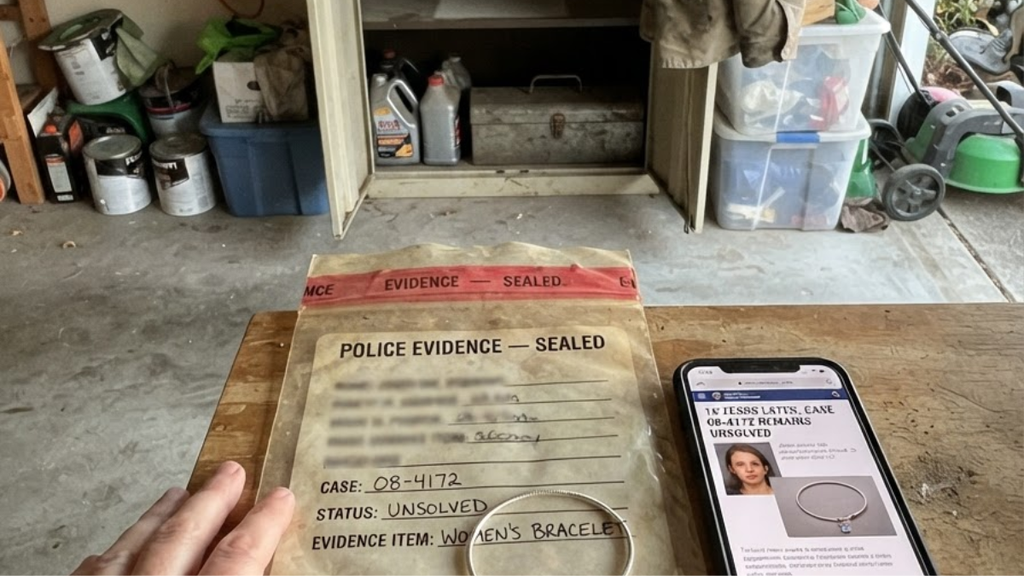
I found the evidence bag because I knocked over a container of grass seed.My husband, Mark, had been telling me for at least five years that he was going to clean out our garage, and I had finally accepted that this was one of those marital promises that existed mostly as a concept.
Mark was fifty-seven and treated throwing anything away like a personal attack.
We had extension cords that belonged to appliances we no longer owned, half-empty cans of paint from rooms we had repainted twice since then, and enough scrap wood to rebuild part of the house.
Mark always insisted he knew where everything was.
Then he would spend forty minutes looking for a screwdriver.
We had been married for twenty-nine years.
Our oldest daughter, Emily, was twenty-seven and married.
Our younger daughter, Grace, was twenty-three and had moved to Chicago the previous year.
Mark and I had recently started talking about downsizing.
We had four bedrooms for two people, a yard neither of us enjoyed maintaining anymore, and a garage that had slowly transformed into a museum dedicated to every household project Mark had completed since 1997.
One Saturday morning, I decided to start clearing it myself.
Mark was golfing.
I was not snooping.
I need to make that clear because later Mark would accuse me repeatedly of going through his things.
I was cleaning our garage.
I moved a plastic container of grass seed from a shelf, lost my grip and dumped half of it onto the floor.
Some spilled behind a metal storage cabinet.
When I pulled the cabinet away from the wall to sweep, I noticed one of the baseboards behind it was loose.
I assumed mice had gotten back there.
Instead, there was a rectangular opening in the drywall.
Inside was a small black duffel bag.
That was strange enough that I stopped cleaning.
The duffel was dusty, but not as dusty as everything around it.
I pulled it out.
Inside were three things.
A woman’s silver watch.
A folded newspaper clipping.
And a clear plastic bag with a white label across the top.
I recognized what it was immediately.
It was a police evidence bag.
Not something that looked vaguely official.
An actual evidence bag with a police department name, case number, item number, barcode and handwriting across the label.
The seal had been cut.
Inside was a red scarf.
I unfolded the newspaper clipping.
The headline said:
TEN YEARS LATER, FAMILY STILL SEARCHING FOR ANSWERS IN KELLY MORAN DISAPPEARANCE
I knew the case.
Almost everyone in our area did.
Kelly Moran was twenty-six when she disappeared in 2008.
She left a restaurant after having dinner with friends and never made it home.
Her car was found the next morning in the parking lot of a closed garden center.
Her purse and phone were inside.
There was no sign of Kelly.
There were searches for weeks.
Her boyfriend was investigated.
A coworker was investigated.
A man who claimed he saw her walking along a road was investigated.
Nobody was ever charged.
Every few years, the local news ran another story.
Her mother kept giving interviews.
There were billboards for a while.
I remembered the photograph of Kelly because she had very distinctive curly red hair.
I looked at the evidence bag again.
The case number meant nothing to me.
The label underneath it did.
MORAN, KELLY
I sat down on an overturned bucket.
My first thought was that Mark had found it.
That sounds ridiculous now, but my brain was desperate for something ordinary.
Mark worked in facilities management for the county.
He had access to municipal buildings.
Maybe somebody threw out old evidence accidentally.
Maybe Mark found the bag at work and brought it home because he thought it was interesting.
That would still have been completely inappropriate, but it was an explanation that did not immediately destroy my life.
Then I read the rest of the label.
ITEM 14
RED WOOL SCARF
RECOVERED: 11/22/08
Kelly disappeared November 18, 2008.
The scarf had been recovered four days later.
I searched the case on my phone.
I found an article from 2009.
Police had recovered several personal items during the investigation, but they never publicly identified all of them.
I searched specifically for a scarf.
Nothing.
Then I looked at the watch.
There was an inscription on the back.
K.M. Love, Dad. 2004
I called police.
I did not call Mark.
Two officers arrived first.
Then a detective.
His name was Detective Aaron Shaw.
He was probably around my age.
The moment he saw the evidence bag, his entire demeanor changed.
He asked me where I found it.
I showed him the opening in the wall.
He asked who had access to the garage.
Mark and me.
Our daughters when they lived at home.
Occasionally family.
Nobody else had a key.
He asked how long the cabinet had been against that wall.
I did not know.
Probably fifteen years.
Maybe longer.
He asked whether Mark installed it.
Yes.
Then Shaw asked me to leave the garage.
I stood in my own driveway while police photographed everything.
My neighbor across the street came outside twice pretending to check her mailbox.
I called Mark.
Shaw had asked me not to tell him exactly what police found.
I told Mark he needed to come home because police were at the house.
He asked why.
I said I found something in the garage.
There was a pause.
It was not long.
Maybe two seconds.
Then Mark asked, “Behind the cabinet?”
I felt my entire body go cold.
I had not told him where.
I said, “What?”
He said, “Did something happen with the electrical panel?”
The electrical panel was on the opposite wall.
I said no.
He asked again what I found.
I said the police wanted to talk to him.
Mark hung up.
He did not come home.
Detective Shaw called him.
No answer.
Then I called again.
Straight to voicemail.
His location was no longer visible on our family tracking app.
Mark had turned it off.
That was the moment I stopped trying to convince myself the evidence bag had accidentally ended up in our garage.
Police found Mark three hours later.
He was not fleeing the state.
He was sitting in his truck at a boat launch about twenty miles away.
He agreed to speak with detectives.
Then he asked for a lawyer.
I did not see him that night.
I stayed with Emily.
Grace drove home from Chicago.
I had to tell my daughters that police found evidence from an unsolved missing-person case hidden inside our garage wall.
There is no correct way to tell your children something like that.
Emily kept asking whether Mark had worked for the police.
He had not.
Grace kept saying there had to be an explanation.
I agreed with both of them because I was their mother and because I desperately wanted them to be right.
The next morning, Detective Shaw asked me to come to the station.
He explained that the evidence bag was genuine.
It came from the Kelly Moran investigation.
The scarf had been logged into evidence in November 2008.
Then it disappeared.
I asked when.
He said nobody knew exactly.
The case had been transferred between investigators several times.
Evidence was moved when the department renovated its storage facility in 2012.
An audit in 2016 identified discrepancies in several older cases.
Item 14 from the Moran case was listed as missing.
So was Item 9.
I asked what Item 9 was.
Kelly’s watch.
The watch from the duffel bag.
I asked how my husband got them.
Shaw said that was what they were investigating.
Then he asked about Mark’s job history.
Mark had worked for the county for twenty-two years.
Before facilities management, he worked for a private company that had county maintenance contracts.
One of the buildings that company serviced was the police department.
Mark had performed maintenance there in 2009 and 2010.
I almost felt relieved.
I said, “So he stole them from evidence.”
Shaw looked at me.
I realized what I had just said.
I had reached a point where my husband stealing evidence from a missing woman’s case felt like the good explanation.
I asked whether that was possible.
Yes.
I asked whether the scarf or watch implicated Mark in Kelly’s disappearance.
Not necessarily.
Both had been recovered after Kelly disappeared.
The watch was found near the garden center where her car was located.
The scarf was recovered from a drainage ditch about six miles away.
Neither contained evidence that identified a suspect at the time.
I asked why anyone would steal them.
Shaw said he did not know.
Then he asked whether Mark followed the Kelly Moran case.
I said everybody did.
He asked whether Mark ever talked about it more than other people.
I tried to remember.
There was something.
When Kelly disappeared, I remember Mark saying the boyfriend probably did it.
That was hardly unusual.
Half the town thought the boyfriend did it.
Later, when police publicly cleared him, Mark said police sometimes clear people too quickly.
Again, not memorable enough that I had thought about it in eighteen years.
Then Shaw showed me the newspaper clipping from the duffel.
It was dated 2018.
Ten years after Kelly disappeared.
Mark had kept following the case long after the evidence was stolen.
I asked if he had admitted taking the evidence.
No.
His attorney advised him not to answer questions.
Police obtained a search warrant for our house.
They found nothing else connected to Kelly.
Then they searched Mark’s truck.
Nothing.
His office.
Nothing.
A storage locker I knew about.
Christmas decorations and camping equipment.
Nothing.
For approximately forty-eight hours, the explanation remained bizarre but contained.
Mark had access to the police building.
Two pieces of evidence disappeared.
Those pieces were found hidden in our garage.
That was terrible.
It was not murder.
Then police searched an old county maintenance facility.
Mark had worked there until 2015.
Most of the building was used for equipment storage.
He still had access because facilities management oversaw it.
There was a locked cabinet assigned to Mark.
Inside were old work orders.
Tools.
A coffee mug.
A rain jacket.
And photographs of Kelly Moran.
Not newspaper photographs.
Personal photographs.
Kelly at a birthday party.
Kelly standing beside a lake.
Kelly in a Halloween costume.
Kelly sitting on someone’s couch.
I asked if Mark took them from evidence too.
Shaw said no.
They had never been part of the police file.
I asked where they came from.
He did not know yet.
Then Kelly’s sister identified them.
They had belonged to Kelly.
Several came from a photo album that disappeared from Kelly’s apartment after she vanished.
That had never been publicly disclosed.
I said, “Mark was in her apartment.”
Shaw said that appeared possible.
I asked whether Mark knew Kelly.
He had denied knowing her.
Then investigators checked employment records.
In 2006, two years before Kelly disappeared, Mark’s private maintenance company had done renovation work at the medical office where Kelly worked.
Mark was assigned to the project.
They had been in the same building for approximately six weeks.
I tried to remember 2006.
Emily was eight.
Grace was four.
Mark worked constantly.
He came home dirty and exhausted.
We were saving for a bigger house.
Our marriage was normal.
At least that is how I remember it.
Police interviewed Kelly’s former coworkers.
One remembered Mark.
Not by name.
She remembered “the married maintenance guy.”
He flirted with Kelly.
Kelly was not interested.
The coworker said Mark kept finding reasons to come into their office even after his part of the renovation was finished.
He brought coffee.
Asked Kelly about restaurants.
Asked whether she lived alone.
Kelly complained to the project supervisor.
Mark stopped coming around.
I asked whether Kelly had told her boyfriend.
Apparently yes.
Her boyfriend confronted a worker at the building.
Police had interviewed him about that during the original investigation.
The worker was not Mark.
Kelly’s boyfriend thought it was another maintenance employee.
He had the wrong man.
I asked why police had never found Mark.
The complaint was informal.
No written report.
The coworker did not know Mark’s name.
The boyfriend described a man in his forties.
Mark was thirty-nine.
There were dozens of contractors on the project.
Nothing led investigators to him.
Then Shaw asked me where Mark had been on November 18, 2008.
Again, he was asking me to reconstruct an ordinary Tuesday from almost eighteen years earlier.
I could not.
Then Emily remembered something.
Not that night specifically.
That month.
I had surgery in November 2008.
Gallbladder.
I stayed with my mother for almost two weeks afterward because Mark was working nights and my mother did not want me alone with two young children while recovering.
Emily and Grace stayed with me.
Mark was alone at our house.
I checked the date.
My surgery was November 13.
Kelly disappeared November 18.
I was at my mother’s house.
Our daughters were with me.
Mark had told me he was working overnight shifts at a county building.
Employment records showed he was scheduled to work until 11 p.m.
Kelly left the restaurant at 9:37.
The county building was less than ten minutes away.
Mark clocked out at 9:12.
He told his supervisor he felt sick.
I sat in Detective Shaw’s office staring at the time sheet.
I asked whether Mark’s fingerprints were on the evidence.
Shaw said Mark’s prints were on the exterior of the bags.
That could have happened when he stole them from police storage.
I asked about Kelly’s car.
No usable evidence connecting Mark.
I asked about her apartment.
Nothing preserved that could now be connected to him.
I asked about the photographs.
Mark’s fingerprints were on some.
That proved possession, not when he obtained them.
Everything kept circling the same conclusion.
My husband had done something.
Nobody could tell me what.
Then Kelly’s mother asked to speak with me.
Her name was Denise.
She was seventy-nine.
I did not want to meet her.
I felt ashamed even though I had done nothing.
Eventually I agreed.
We met at the police station.
Denise brought a photograph of Kelly.
Not because I needed to know what she looked like.
Because she wanted me to see her as a person instead of a case.
Kelly had red hair.
Brown eyes.
A gap between her front teeth.
She loved old movies.
She hated tomatoes.
She wanted children.
She had been saving to buy a house.
I cried.
Denise did not.
Then she asked if Mark ever owned a blue pickup.
I said yes.
He had one when the girls were little.
Denise looked at Detective Shaw.
Apparently a witness saw a blue pickup near Kelly’s abandoned car early the morning after she disappeared.
The witness could not identify the make.
Mark sold his blue truck in December 2008.
Less than a month later.
I remembered.
He told me the transmission was failing.
We could barely afford another vehicle.
I was furious with him for buying a newer truck right before Christmas.
Police tracked down the old truck.
It had been scrapped years ago.
Then Denise asked me something else.
“Did Mark ever go by Tony?”
I said no.
His middle name was Anthony.
Some relatives called him Tony when he was young.
I had never heard anyone call him that as an adult.
Kelly had mentioned a man named Tony to her sister.
Not a boyfriend.
Someone bothering her.
She said Tony was married.
She said he knew where she lived.
Her sister assumed Tony was a patient from work.
Police searched for men named Tony connected to the office.
They never identified him.
I asked Mark about it.
By then, he was staying with his brother under advice from his attorney.
He would not come home.
I called him anyway.
I said, “Did Kelly call you Tony?”
He did not answer.
I asked again.
He said, “People used to.”
I asked if Kelly did.
He said, “I barely knew her.”
I asked why he had her photographs.
He said he did not know what I was talking about.
I asked why her watch and scarf were inside our garage wall.
He said his attorney told him not to discuss evidence.
I said, “You hid them in our house.”
He said, “You don’t know that.”
I almost screamed.
I said, “You knew where I found the bag before I told you.”
He said I had mentioned the garage.
I reminded him that he specifically asked whether I found something behind the cabinet.
He said he was guessing.
Then I asked why he stole evidence.
He said, “Who says I stole it?”
I said, “Then how did you get it?”
He hung up.
Two days later, police found another evidence bag.
Not in our house.
In Mark’s brother’s barn.
His brother, Steven, had an old workbench Mark used occasionally.
Behind a drawer was an evidence envelope from a completely different case.
This one was from 2003.
A homicide.
A woman named Laura Jensen had been found dead inside her apartment.
She was thirty-one.
The case remained unsolved.
The evidence envelope had once contained a key.
The key was still inside.
Steven said he had never seen it.
Mark had helped build the workbench in 2011.
I asked Detective Shaw whether Mark had worked in the police building in 2003.
Yes.
The private maintenance company began its contract in 2001.
I asked whether Laura’s evidence had also been listed as missing.
Yes.
During the same 2016 audit.
Then Shaw said there were fourteen missing items from unsolved or unresolved cases during the years Mark had access to the building.
Fourteen.
I asked whether all fourteen were connected to women.
Eleven were.
The other three came from burglaries.
I asked whether police thought Mark stole all of them.
They did not know.
Then they found a third.
A necklace from a 2005 missing-person case.
It was inside a tackle box in Mark’s storage locker.
The missing person was a woman named Andrea Bell.
Her body was never found.
Mark had worked at her apartment complex six months before she disappeared.
I stopped asking whether this was coincidence.
Instead, I asked the question that mattered.
“Did Mark steal evidence because he was involved in the cases, or did he become interested in the cases because he had access to the evidence?”
Shaw said that was exactly what they were trying to determine.
Those were two completely different monsters.
One version of my husband harmed women and later stole evidence from his own cases.
The other version developed some grotesque fascination with unsolved crimes and stole souvenirs from police storage.
Both were horrifying.
Only one meant Kelly Moran might have disappeared because of him.
Then investigators found Mark’s old laptop.
I had forgotten it existed.
It was in a box of electronics in our attic.
The battery was swollen.
The screen barely worked.
The hard drive did.
There were folders.
Not labeled with women’s names.
Case numbers.
Police case numbers.
Dozens of them.
Mark had copied information.
Photographs.
Reports.
Evidence inventories.
Witness lists.
Some appeared to come from files he could have accessed physically while working in the police building.
Others were public news articles.
He had been following unsolved cases for years.
Then police found a spreadsheet.
The columns were:
CASE
ITEM
LOCATION
STATUS
USEFUL
I asked what “useful” meant.
Shaw said they did not know.
There were fourteen entries highlighted.
The same fourteen items missing from evidence.
Kelly’s scarf was listed.
MORAN — ITEM 14 — DITCH — REMOVED — YES
Her watch:
MORAN — ITEM 9 — GARDEN CENTER — REMOVED — YES
Laura Jensen’s key:
JENSEN — ITEM 6 — KITCHEN — REMOVED — NO
Andrea Bell’s necklace:
BELL — ITEM 22 — BEDROOM — REMOVED — YES
I asked useful for what.
Nobody knew.
Then they recovered deleted files.
One was titled:
CLEAN
Inside were instructions Mark had written to himself.
Not instructions for committing crimes.
Instructions for tracking what police knew.
Which detectives were assigned.
Which evidence had been tested.
Which items were scheduled for retesting.
Which cases had media attention.
Which files had been digitized.
Mark had not simply stolen random souvenirs.
He was monitoring investigations.
Then police found a note attached to Kelly’s case.
Scarf should never have been found.
I asked what that meant.
Shaw would not speculate.
Another:
Watch location creates wrong timeline. Good.
I felt nauseated.
That did not sound like somebody fascinated by a crime after the fact.
It sounded like somebody who knew what the timeline was supposed to be.
I asked where Kelly’s scarf had originally come from.
Police reexamined old photographs.
Kelly was wearing a red scarf in a picture taken the afternoon she disappeared.
Her friend remembered it.
When Kelly left dinner that night, she was no longer wearing it.
Nobody had considered that significant.
Maybe she left it somewhere.
Maybe it was in her car.
Four days later, the scarf was found in a drainage ditch six miles from the garden center.
Mark’s note said it should never have been found.
I asked how he could know that unless he put it somewhere.
Shaw said, “That’s one of the questions we have for him.”
Mark stopped speaking to police entirely.
Then the lab retested the scarf.
Technology had changed since 2008.
There was DNA.
Kelly’s, obviously.
There was also male DNA.
Partial.
Degraded.
Not enough initially for a useful profile.
Now it was.
It matched Mark.
His attorney argued Mark handled the scarf after stealing it from evidence.
That was possible.
The evidence bag had been opened.
There was no way to establish when his DNA got onto the fabric.
I hated how every answer produced another escape route.
Then police tested the watch.
Same problem.
Mark had handled it.
Nothing established when.
Then Shaw asked me whether Mark had ever owned a cabin.
No.
Hunting property.
No.
Family property.
His parents had owned land near a lake.
Sold in 2010.
I had been there many times.
Then he asked about Mark’s grandfather.
That seemed random.
Mark’s grandfather had owned an old farmhouse outside town.
It passed to Mark’s mother.
She sold it after his grandfather died.
I asked why.
The Moran spreadsheet contained coordinates.
Not an address.
Coordinates.
They corresponded to a wooded parcel behind the old farmhouse.
Police searched it.
They found nothing.
Then they brought dogs.
The dogs alerted near an old collapsed well.
The well had been filled years earlier.
Excavation began.
I sat at Emily’s house waiting.
I knew what they were going to find before anyone called.
I was wrong.
They did not find Kelly.
They found a purse.
It belonged to Andrea Bell.
The woman who disappeared in 2005.
Her necklace had been in Mark’s storage locker.
Her purse was buried on land connected to Mark’s family.
Inside were her driver’s license and keys.
I asked if Mark killed Andrea.
Shaw said they now considered him a suspect.
I asked why the coordinates were in Kelly’s file.
He did not know.
Then investigators found something else in the well.
A plastic container.
Inside were photographs.
Women.
Some I recognized from the cases.
Kelly.
Andrea.
Laura Jensen.
Others were strangers.
Some photographs appeared to have been taken without the women’s knowledge.
Outside workplaces.
In parking lots.
Through restaurant windows.
I asked how many women.
Seventeen.
I asked whether all seventeen were dead or missing.
No.
Nine were alive.
Police contacted them.
That was when the entire thing became worse.
One of the living women was named Michelle Avery.
She remembered Mark.
He had asked her out in 2004.
She said no because she knew he was married.
Afterward, he started appearing around her.
She complained to the company where he worked.
The behavior stopped.
Michelle was alive.
Another woman, Rachel Gomez, had a similar story.
Mark did maintenance work in her office.
He asked personal questions.
She became uncomfortable.
She requested that another employee handle her building.
Mark stopped contacting her.
Rachel was alive.
Then there was Karen Doyle.
Karen dated Mark.
In 1993.
Two years before he met me.
I had never heard her name.
Karen said Mark became controlling.
She ended the relationship.
He followed her for months.
Then one night somebody broke into her apartment.
Nothing valuable was taken.
Only photographs and underwear.
Karen moved to another state.
She was alive.
I asked Shaw what separated the living women from the dead and missing women.
He said they were still working on it.
Then one of the photographs answered part of the question.
Kelly Moran was photographed beside Mark.
Not secretly.
They were standing together at a bar.
The timestamp was 2007.
A year before she disappeared.
Mark had his arm around her.
Kelly was smiling.
They did not barely know each other.
They knew each other well enough to pose together.
Police showed the photograph to Kelly’s sister.
She recognized the night.
A friend’s birthday.
Kelly had mentioned meeting a married man named Tony.
The relationship lasted several months.
Kelly ended it.
She told her sister Tony was becoming obsessive.
He wanted her to leave her boyfriend.
She refused.
Then Tony started threatening to tell her boyfriend about the affair.
Kelly finally told him herself.
The boyfriend was furious.
They separated briefly.
Then reconciled.
Kelly told Tony to stay away.
Tony did not.
The married maintenance worker was not some stranger who flirted with her at work.
He was my husband.
He had an affair with Kelly.
I asked whether the police had known about Tony in 2008.
They knew there had been a married man.
Kelly’s sister could not provide a last name.
Kelly had deleted most of the messages because she was ashamed.
Investigators pursued several possibilities.
They never identified him.
Mark had been sitting at home watching news coverage of a disappearance in which he knew he was a secret person of interest nobody had identified.
Then he got access to the evidence room.
I finally understood the spreadsheet.
He did not steal evidence because he enjoyed collecting police souvenirs.
He stole evidence from cases where something inside the evidence could connect back to him.
The question was why Laura Jensen’s key had been marked NO under useful.
Why steal something that was not useful?
Detective Shaw thought the answer might be simple.
Mark did not always know what mattered.
He removed items preemptively.
Anything he remembered touching.
Anything he feared could carry DNA.
Anything connected to a location he had been.
The evidence room became his second chance.
If he made a mistake during a crime, he could remove it later.
That was why Kelly’s scarf “should never have been found.”
He thought it could connect him to her.
He stole it.
The watch location created the wrong timeline.
That benefited him.
He stole it anyway, possibly because he had handled it.
Then I asked how Mark knew exactly what police had recovered.
He worked maintenance.
He did not have legitimate access to investigative files.
Shaw said that was another problem.
Somebody had helped him.
I thought he meant another maintenance worker.
He did not.
Access logs from the old system were incomplete.
But several of Mark’s copied documents had metadata.
They came from a police employee account.
The account belonged to Detective Robert Hale.
I knew that name too.
Everyone who followed Kelly Moran’s case did.
Robert Hale had been one of the original detectives assigned to her disappearance.
He retired in 2014.
I asked whether Mark knew him.
Shaw said they were investigating.
I knew.
Robert Hale had been to my house.
Not as a detective.
As Mark’s friend.
Bob.
I knew him as Bob.
They golfed together.
They watched football together.
He came to our Fourth of July cookout for years.
His wife brought baked beans.
I had served dinner to the detective investigating Kelly Moran while the man who had been secretly involved with Kelly stood beside him at my grill.
I asked Shaw whether Hale knew.
He said, “We don’t know yet.”
Then they searched Hale’s house.
What they found made the evidence bag in my garage look like the smallest part of the story.
Because Mark had not broken into a police evidence room and stolen fourteen items over the years.
According to records found in Hale’s house, the evidence had been given to him.
And Kelly Moran was not the first case they had done it with.
Robert Hale kept records.
That was the part Detective Shaw could not understand.
If Hale had spent years helping Mark remove evidence from active investigations, why keep anything documenting it?
The answer turned out to be that Hale did not trust Mark.
There were two file boxes in the back of Hale’s basement storage room.
They contained copies of reports, handwritten notes, evidence inventories and photographs from six cases.
Kelly Moran.
Andrea Bell.
Laura Jensen.
Two women whose names I had never heard.
And a man named Patrick Lowe who died in 2011.
Hale had written notes in the margins.
Some were mundane.
Others were not.
Beside Kelly’s red scarf:
Mark says accidental transfer possible. Remove anyway.
Beside Andrea’s necklace:
He doesn’t remember touching it. Not taking chance.
Beside a photograph from Laura Jensen’s apartment:
M visible reflection? Original removed before scan.
I read that sentence several times.
Mark visible reflection.
Original removed before scan.
Hale had apparently removed evidence before some of it was even fully documented.
That meant the fourteen missing items from the 2016 audit were only the things the department knew had existed.
There could have been more.
I asked Detective Shaw how long Hale had been helping Mark.
The earliest record they found was from 2003.
Laura Jensen.
I asked whether Mark killed Laura.
Shaw said they were now investigating that possibility very seriously.
Laura had been stabbed in her apartment.
There was no sign of forced entry.
Police believed she knew whoever came inside.
Her boyfriend had been the primary suspect for years.
He had an alibi that was good but not perfect.
He eventually moved away.
The case went cold.
Mark had done maintenance work in Laura’s apartment building.
Not months earlier.
The week she died.
Then Hale had been assigned to her homicide.
I asked whether Hale deliberately took the case.
Shaw said assignments did not work that neatly, but Hale had volunteered to assist because another detective was overloaded.
That made me feel physically ill.
Mark did not merely have a friend inside the police department.
He had a friend who inserted himself into investigations.
Then investigators interviewed Hale.
He was seventy-two.
His wife had died three years earlier.
He lived alone.
At first, he denied everything.
Then police showed him the records from his own basement.
Hale said he had kept them because he knew eventually Mark would turn on him.
I asked what that meant.
Apparently Mark and Hale had known each other since high school.
I knew they went back a long way.
I did not know how far.
They were not close in school.
Hale was two years older.
Their friendship began later.
In 1992.
Three years before I met Mark.
That year, a woman named Natalie Pierce disappeared.
She was twenty-four.
Her body was found four months later.
Her murder remained unsolved.
Mark knew Natalie.
They had dated briefly.
Hale was a patrol officer then.
According to Hale, Mark called him the night Natalie disappeared.
Not after.
During.
Hale claimed Mark was panicking.
Mark said he had been with Natalie.
They argued.
She left.
Mark was afraid police would think he did something.
Hale told him to calm down.
The next morning, Natalie’s family reported her missing.
Mark never came forward.
Hale did not report the call.
Four months later, Natalie was found dead.
I asked how she died.
Shaw said he would rather not go into unnecessary detail with me.
I appreciated that.
I asked whether Hale believed Mark killed her.
Hale now claimed he did.
I asked whether he believed that in 1992.
He said no.
That was his story.
Mark was his friend.
Mark was married to nobody then.
He had no criminal record.
Hale thought Mark had been scared because he knew being the last person with a missing woman would make him a suspect.
Then evidence surfaced.
A witness remembered Mark’s truck near the area where Natalie was last seen.
Hale learned about the witness before Mark did.
He warned him.
Mark sold the truck.
That was the first favor.
Not stealing evidence.
Information.
Hale told Mark what police knew.
Mark adjusted.
The case went cold.
I asked why Hale continued helping after Natalie’s body was found.
Hale said he felt trapped.
If he told investigators Mark had called him the night Natalie disappeared, he would have to explain why he concealed it for months.
His career would be over.
Possibly worse.
Mark knew that.
So Mark asked for another favor.
Then another.
By the time Hale realized what Mark might actually be, exposing him meant exposing himself.
That explanation made Hale sound almost sympathetic.
Then police found evidence that contradicted it.
Hale had received money.
A lot of it.
Not obvious payments.
Mark did electrical work on Hale’s houses for free.
He renovated Hale’s basement.
He paid cash toward a boat they supposedly co-owned.
He covered gambling debts.
Over twenty years, investigators estimated Mark transferred or provided more than $90,000 in money, labor and benefits to Hale.
I asked whether that made Hale an accomplice.
Shaw said prosecutors would decide what charges fit the evidence.
Then Hale started talking.
Once he understood police had the basement files, he apparently decided cooperation was his best option.
He gave them names.
More than I wanted.
Natalie Pierce in 1992.
Laura Jensen in 2003.
Andrea Bell in 2005.
Kelly Moran in 2008.
Patrick Lowe in 2011.
Stephanie Ward in 2013.
Megan Cross in 2015.
Seven cases.
I asked how many Mark had killed.
Hale claimed he only knew for certain about three.
That sentence was so insane I asked Shaw to repeat it.
Hale said Mark confessed to Natalie, Laura and Kelly.
Not immediately.
Over years.
Different conversations.
Usually after drinking.
Andrea was different.
Mark never admitted killing her.
He only said Hale needed to make sure police did not look at a specific maintenance vehicle.
Patrick Lowe was a man.
I asked why he was on the list.
Hale said Patrick had seen Mark with Megan Cross.
That made no sense because Megan disappeared four years after Patrick died.
Then Shaw corrected himself.
Different Megan.
Megan Cross was not the woman Patrick saw.
He saw Mark with Kelly.
Patrick worked security at the garden center where Kelly’s car was found.
He was off duty the night Kelly disappeared, but he lived nearby.
He saw Mark’s truck near the garden center early the next morning.
Patrick did not tell police immediately.
He knew Mark socially.
He asked Mark about it first.
Mark said he had been helping somebody whose car broke down.
Years later, Patrick began drinking heavily.
He told Hale he thought he had made a mistake by staying quiet.
Hale warned Mark.
Patrick died six weeks later.
Official cause was an accidental fall from a hunting stand.
I asked if Mark hunted with him.
Yes.
They were together that morning.
Mark told investigators Patrick fell while Mark was several hundred yards away.
No reason to suspect otherwise.
Hale had been one of the people who reassured the responding officers that Mark and Patrick were longtime friends.
I said, “He didn’t just protect Mark after crimes. He protected him during the investigation.”
Shaw said yes.
Then came Stephanie Ward.
She was alive.
That confused me.
Hale’s list was not a murder list.
It was a list of cases where he had interfered.
Stephanie was assaulted in a parking garage in 2013.
She survived.
She could not identify the man.
Her purse was taken.
Mark had worked in the building.
Police interviewed him with dozens of other employees and contractors.
Hale made sure another detective handled the interview.
Then an item recovered from the garage disappeared before laboratory testing.
A work glove.
Hale took it.
He gave it to Mark.
Mark burned it.
Hale admitted that.
I asked whether Hale knew Mark attacked Stephanie.
He said he suspected it.
I asked why he helped.
Hale said by then he was “too far in.”
I hated that phrase.
Too far in.
As though twenty years of choices had somehow happened to him.
Then Shaw told me Hale had said something about me.
I did not want to hear it.
I said that.
Then I changed my mind before Shaw could respond.
Hale said I had saved women without knowing it.
I asked what that meant.
After Mark married me, the incidents decreased.
There were long gaps.
Hale believed Mark wanted to stop.
He said Mark loved me.
I almost walked out.
Shaw told me he was reporting Hale’s statement, not endorsing it.
Hale claimed Mark talked about wanting a normal life.
Marriage.
Children.
House.
Career.
For periods of time, apparently, he had one.
Then something happened.
A woman rejected him.
A woman discovered something.
A woman reminded him of someone.
A conflict escalated.
Hale described Mark as if he had an addiction he occasionally relapsed into.
I refused to accept that framing.
Kelly did not disappear because my husband relapsed.
Kelly was a human being.
Then Hale said something investigators initially thought was self-serving.
He claimed Kelly’s death was different.
Mark had not intended to kill her.
I asked how Hale could possibly know.
Because Mark called him that night.
Just like Natalie.
Mark told Hale he had met Kelly after dinner.
They argued.
Kelly threatened to tell me everything.
Not merely about their affair.
About Mark.
She had found something.
I asked what.
Hale did not know.
Mark said Kelly had been going through his things.
She found photographs.
Not of her.
Other women.
Kelly threatened to take them to police.
Mark convinced her to meet him.
They argued.
According to Hale, Mark claimed Kelly’s death happened during that confrontation.
I did not care whether he called it an accident.
The important part was that Kelly had discovered Mark was connected to other women years before Sarah’s family or police ever knew.
Then I remembered the photographs found in the well.
Some were of Kelly.
Some Andrea.
Some Laura.
Some living women.
Maybe Kelly had seen the collection.
I asked whether that was why Mark stole photographs from Kelly’s apartment after she disappeared.
Shaw said possibly.
Mark needed to know what Kelly had copied or kept.
He went into her apartment.
He removed a photo album because it contained photographs from nights when Mark had been around her.
He may have removed other things police never knew existed.
Then Hale helped him monitor the investigation.
The scarf.
The watch.
Witness statements.
Evidence inventories.
Mark knew almost everything detectives knew.
No wonder the case stayed unsolved.
The suspect had a detective reading the case file for him.
I asked where Kelly was.
That was the one thing Hale claimed Mark never told him.
He knew Mark moved her.
He knew the abandoned car was staged.
He knew Mark had used the garden center because Patrick Lowe had seen him there.
He did not know where Kelly’s body was.
Mark had kept that from him.
I thought that was interesting.
Even after twenty years of blackmail, bribery and mutual destruction, Mark still had secrets from Hale.
Then investigators found another folder on Mark’s laptop.
It was encrypted.
Eventually they opened it.
The folder was called INSURANCE.
I assumed money.
It was not.
It was insurance against Hale.
Photographs.
Audio recordings.
Copies of payments.
Emails.
Mark had documented Hale helping him.
Every stolen evidence item.
Every warning.
Every favor.
If Hale ever turned on him, Mark could destroy him.
Hale had kept basement files because he did not trust Mark.
Mark had kept an entire digital archive because he did not trust Hale.
They had spent more than twenty years protecting each other while simultaneously preparing to betray each other.
Then police found an audio recording from 2018.
Mark and Hale.
I listened to part of it.
Mark apparently recorded conversations without Hale knowing.
Hale was angry about Kelly’s case appearing in the news again on the ten-year anniversary.
He told Mark the family would never stop.
Mark said, “Families get tired.”
Hale said, “Hers hasn’t.”
Mark answered, “Then they’ll die eventually.”
I had to stop listening.
That was my husband.
Not angry.
Not panicked.
Casual.
The same voice he used to ask whether we needed milk.
Then Hale said:
“What about your wife?”
There was a pause.
Mark said:
“What about her?”
Hale said:
“If she ever finds any of this, what are you going to do?”
Another pause.
Then Mark laughed.
He said:
“Diane doesn’t look behind things.”
My name is Diane.
I had spent twenty-nine years being teased by my husband because I could never find anything.
My glasses.
My keys.
The remote.
Mark would say, “You only look where something is supposed to be.”
He thought it was funny.
Apparently it was also part of why he felt safe hiding a police evidence bag behind a cabinet in our garage.
I listened to the rest.
Hale asked again what Mark would do if I found out.
Mark said:
“She won’t.”
Hale said:
“You don’t know that.”
Mark answered:
“If Diane ever finds out, Bob, it’ll be because I’m already gone.”
I sat there staring at Detective Shaw.
Mark had said that eight years before I found the bag.
I asked what he meant.
Shaw did not know.
I did.
Mark never planned to tell me.
He expected his secrets to outlive him.
The evidence bag had probably been behind that cabinet for years.
He assumed I would never move it.
Maybe he assumed after he died I would throw everything away without looking.
Instead, I knocked over grass seed.
Then Shaw told me they had found Kelly.
Not because Hale finally confessed.
Because of Mark’s coordinates.
The coordinates in the Moran folder that led to the old family farmhouse had been misinterpreted.
Investigators assumed they marked one location.
There were actually several coordinate sets embedded in old file metadata.
One led to the well where Andrea’s purse and the photographs were found.
Another led approximately nine miles away.
Land that had once belonged to a friend of Mark’s father.
There was an abandoned gravel pit.
Search teams found human remains.
Dental records confirmed Kelly.
I met Denise again after identification.
This time she cried.
She said something I will never forget.
“At least I know where she is.”
That was what twenty years of my husband’s secrets had reduced a mother to being grateful for.
Knowing where her daughter was buried.
Mark was arrested.
The charges initially focused on Kelly because investigators had her remains, Hale’s testimony, Mark’s records, evidence of the affair and the stolen police evidence.
Then more followed.
Evidence tampering.
Obstruction.
Conspiracy.
Charges connected to Laura Jensen.
Andrea Bell’s case remained active because her body had not been found.
Hale was arrested too.
His attorney immediately began describing him as a frightened man manipulated by a killer.
I wanted to throw something at the television.
Then Grace called me.
She had been going through old family photographs.
She found one from 2005.
Our backyard.
Grace was seven.
Emily was eleven.
Mark stood behind the grill.
Robert Hale was beside him holding a beer.
In the background was another man.
I recognized him after staring for a while.
Patrick Lowe.
The security guard who later saw Mark near Kelly’s abandoned car.
All three men had been at my daughter’s birthday party.
I asked why Patrick was there.
I could not remember.
Then Emily did.
Patrick’s wife had been friends with one of our neighbors.
They came with their children.
Normal.
Everything kept coming back to normal.
Birthday parties.
Barbecues.
Golf.
Work.
School.
The people involved in the worst thing that ever happened to Kelly Moran had stood in my backyard eating hamburgers while my children opened presents.
Then Patrick saw something three years later.
He stayed quiet.
Years after that, he decided he wanted to talk.
Then he died.
Police reopened his death.
They found no physical evidence proving Mark caused the fall.
Hale’s testimony was all they had.
Hale said Mark called him afterward and said:
Patrick isn’t a problem anymore.
Maybe that meant murder.
Maybe it meant exactly what it sounded like.
Maybe Mark would take that answer to his grave.
Then the case produced one final surprise.
It came from Laura Jensen’s key.
The evidence envelope found in Steven’s barn.
The key Hale marked as NO under useful.
Investigators had always assumed it was Laura’s spare apartment key.
It was not.
It opened a safe-deposit box.
The box still existed.
Nobody had accessed it since 2003.
Laura had rented it three weeks before she died.
Inside were documents.
Photographs.
And a cassette tape.
Laura had known Mark too.
Not through building maintenance.
They had been having an affair.
Just like Kelly.
Laura apparently became suspicious of Mark after finding photographs in his truck.
Women.
Some she recognized.
Natalie Pierce was one.
Laura knew Natalie’s case.
Everybody local did.
She confronted Mark.
He told her the photographs were old.
Laura did not believe him.
She began collecting information.
The cassette was a recording of Mark.
Laura secretly recorded a conversation with him.
She asked about Natalie.
Mark became angry.
Laura said she had spoken to someone who remembered seeing them together the night Natalie disappeared.
Mark told her to stop digging.
Then Laura said:
“If something happens to me, people are going to know where to look.”
That was why she rented the safe-deposit box.
Except nobody knew about the box.
The key was found in Laura’s apartment after her murder.
Robert Hale took it from evidence before detectives figured out what it opened.
He gave it to Mark.
Mark never found the box because he apparently assumed the key was unimportant.
That was why his spreadsheet eventually marked it NO.
Not useful.
For twenty-three years, the evidence that could have connected Mark to the earliest suspected murder sat safely inside a bank because the two men covering up Laura’s death did not know what the key opened.
The tape changed everything.
Mark had not merely known Natalie.
He had lied repeatedly about when he last saw her.
Laura confronted him with details only somebody close to the case would know.
Mark said something on the recording investigators considered significant.
Laura asked:
“Did Bob clean this up for you too?”
Mark responded:
“You don’t know anything about Bob.”
That was recorded in 2003.
It established that Hale’s involvement was not something that gradually developed after Laura’s death.
Laura already suspected Hale was protecting Mark.
Which meant other people may have known.
Police went back through Natalie’s case again.
A retired dispatcher remembered Hale asking unusual questions.
A former detective remembered evidence being misplaced.
An old report had been amended.
The deeper investigators went, the less the story looked like one killer who happened to have a corrupt friend.
It looked like Mark had survived his first serious investigation because Hale protected him, and once both men understood what they had gotten away with, the arrangement became permanent.
Mark knew he had someone inside.
Hale knew Mark could expose what he had already done.
Every future crime tightened the knot.
I asked Detective Shaw whether Hale’s protection made Mark more dangerous.
He said nobody could answer that scientifically.
I could.
Maybe Mark would have stopped after Natalie if he had been investigated properly.
Maybe he would have gone to prison.
Maybe Laura would be alive.
Andrea.
Kelly.
Patrick.
Maybe women I still did not know about.
Hale did not simply hide what Mark had done.
He taught him that consequences could be managed.
Then Shaw told me there was something in Mark’s encrypted archive labeled with my name.
I almost told him I did not want it.
I was exhausted.
Every revelation made twenty-nine years of memories feel contaminated.
Then he said it was not what I probably thought.
There were no plans to hurt me.
No photographs of me sleeping.
No evidence I had been another intended victim.
It was a document Mark updated over the years.
Dates.
Things I had noticed.
Questions I had asked.
Times I came close.
In 2008:
Diane asked why I changed trucks. Told her transmission. Accepted.
In 2012:
Diane found Bob’s department envelope. Said old football pool paperwork.
I remembered that.
Barely.
In 2016:
Garage cabinet shifted. Move bag farther back.
I had moved the cabinet while painting.
Mark noticed.
He moved the evidence deeper into the wall afterward.
In 2018:
Diane watched Moran anniversary story. Asked if I remembered it. Said vaguely. No concern.
Then in 2023:
Diane wants to clean garage. Delay.
Then:
Downsizing becoming issue. Need relocate Moran items.
He knew the house would eventually be sold.
He knew I wanted the garage cleared.
He had been planning to move the evidence.
He just had not done it yet.
I found the bag before he could.
At the bottom of the document was the most recent entry.
Written six days before I knocked over the grass seed.
Diane scheduled donation pickup for garage next month. Move everything Saturday while golfing excuse works.
Saturday.
The day I found it.
Mark had not actually been golfing.
Police checked.
There was no tee time.
He had told me he was golfing because he planned to return later and move the evidence while I was out running errands.
I started cleaning earlier than he expected.
That was why he asked, “Behind the cabinet?”
He knew exactly what was there.
When I told him police were at the house, he knew I had found it.
He drove to the boat launch because he needed time to decide what to do.
Twenty-nine years of marriage ended because I spilled grass seed three hours before my husband planned to remove the evidence himself.
There are still cases investigators are reviewing.
I no longer try to keep all the names straight.
That sounds cold.
It is not.
I learned very quickly that turning every dead or missing woman into another chapter of my marriage felt disrespectful.
They had lives that had nothing to do with me.
Kelly was not the woman my husband had an affair with.
She was Kelly.
Laura was not evidence against Mark.
She was Laura.
Natalie was not the beginning of his pattern.
She was Natalie.
Their families had been living with questions while Mark and I raised daughters, remodeled kitchens, went to Disney World, argued about money, attended parent-teacher conferences and celebrated anniversaries.
Robert Hale came to our house dozens of times.
Sometimes I think about him sitting at my kitchen table.
He knew.
Not everything, apparently.
But enough.
He looked at my daughters.
He ate my food.
He asked how work was going.
He once helped Mark carry a new mattress upstairs.
For years, I thought Bob was one of Mark’s oldest friends.
Now I know he was something much more important.
He was the reason Mark believed evidence could disappear.
The bag I found had been sealed by police after Kelly vanished.
Some officer wrote her name across the label.
Someone cataloged the scarf.
Someone believed placing it into evidence meant it was safe until investigators understood what it could tell them.
Then Robert Hale took it.
He gave it to Mark.
Mark cut the seal.
He hid it inside the wall of our garage.
For years, I parked approximately four feet away from it.
I carried groceries past it.
Our daughters stored college furniture beside it.
Mark stood in that garage hundreds of times knowing an object from an unsolved disappearance was behind the wall.
He knew the detective assigned to that disappearance had helped him put it there.
That was the part of the whole story I struggled with most.
Not that Mark had secrets.
Not even that he had lied to me.
It was how safe he felt.
He had a wife who trusted him.
A friend inside the police department.
A respectable job that gave him access to buildings and people.
He had learned that if something dangerous was discovered, it could sometimes simply be removed.
A scarf.
A watch.
A key.
A report.
A witness.
A woman.
For almost thirty years, Mark’s life depended on people not looking behind things.
Kelly looked.
Laura looked.
Patrick eventually looked.
Robert Hale looked and decided to help him hide what he saw.
I was the person Mark never worried about because, as he told Hale, Diane doesn’t look behind things.
He was right for twenty-nine years.
Then one Saturday morning, I knocked over a container of grass seed.
And for the first time, something Mark had hidden stayed found.
