

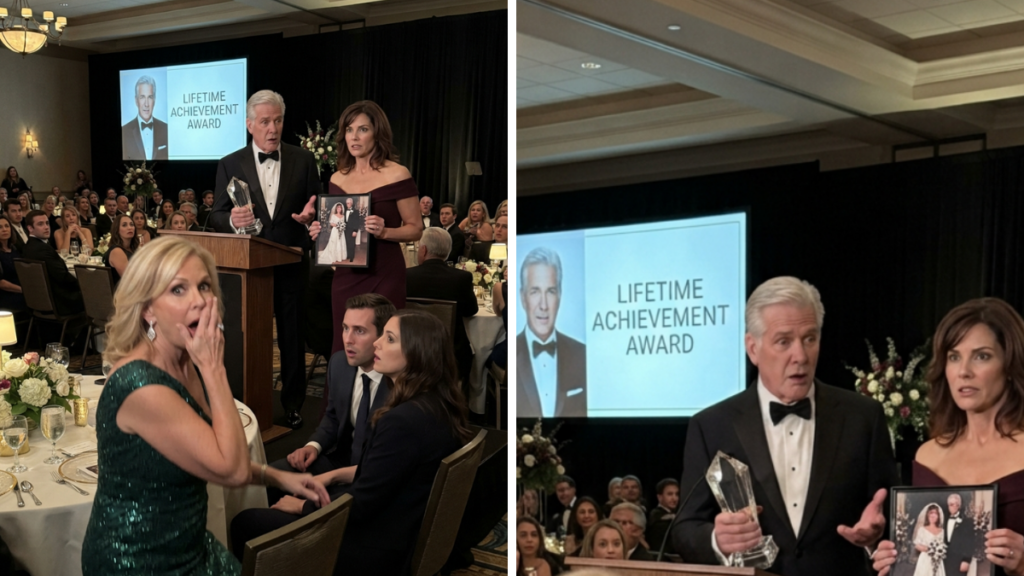
The night my husband received a lifetime achievement award, I sat at the front table wearing a $1,200 navy-blue gown and a diamond necklace he’d given me for our thirtieth anniversary.
There were nearly four hundred people in the ballroom.
Business executives.
Politicians.
Reporters.
Our children.
Our closest friends.
And every important person my husband had spent forty years trying to impress.
When they announced his name, the entire room stood.
My husband, Charles Whitmore, seventy-one years old, walked onto the stage to accept the most prestigious honor of his career.
The presenter called him a visionary.
A philanthropist.
A devoted husband.
And a man whose integrity had shaped an entire generation of business leaders.
I applauded.
I even cried.
Because after forty-two years of marriage, I genuinely believed he deserved every word.
Then Charles stepped up to the microphone.
He thanked his colleagues.
His employees.
His children.
And finally, me.
“My beautiful wife, Eleanor,” he said, smiling toward our table. “Forty-two years ago, this woman took a chance on a young man with nothing but a dream.”
The audience applauded.
Charles pressed a hand against his heart.
“Everything I’ve accomplished, I owe to her.”
I smiled through my tears.
Then he added:
“And if I had the chance to live my life over again, I’d marry her a thousand times.”
That’s when a woman in a red dress stood up near the back of the ballroom.
She was beautiful.
Probably in her late sixties.
Silver-blonde hair.
Perfect posture.
And a look on her face that made my stomach tighten.
She walked straight toward the stage.
At first, I assumed she was part of the presentation.
Perhaps a former colleague.
An old friend.
Someone coming to surprise Charles.
But then I noticed the security guard following her.
And the way Charles stopped smiling.
The woman climbed the three steps onto the stage.
Walked directly to the microphone.
And said:
“That’s a lovely speech, Charles. But there’s one problem.”
The ballroom went silent.
Charles stared at her.
His face drained of color.
The woman smiled.
Then looked directly toward my table.
“You can’t marry Eleanor a thousand times when you’ve never divorced me once.”
I stopped breathing.
A murmur spread through the ballroom.
Charles stepped toward her.
“Vivian.”
She turned to him.
“Hello, husband.”
He grabbed her arm.
She pulled away.
Then reached into her handbag.
And held up a yellowed document.
“For anyone wondering, this is our marriage certificate. June 14, 1978. Forty-eight years ago.”
My heart stopped.
1978.
Charles and I had married in 1984.
Six years later.
The woman looked toward me again.
And said:
“Eleanor, I’m sorry you have to find out this way. But I’ve been waiting forty-two years for him to tell you the truth.”
Charles lunged for the microphone.
The woman stepped back.
Then said something that made the entire ballroom gasp.
“And while we’re discussing your lifetime achievements, Charles, perhaps you’d like to explain what happened to our daughter.”
I couldn’t move.
Our daughter?
I stared at my husband.
The man I’d loved for forty-two years.
The father of my three children.
The man who’d just received an award for his integrity.
And watched him whisper:
“Vivian, please. Not here.”
She looked at him.
Then said:
“You should’ve thought about that before you told everyone she was dead.”
For a moment, nobody moved.
Then the ballroom erupted.
People started whispering.
Phones came out.
Someone near the back shouted a question.
The event organizer hurried toward the stage.
And Charles stood beneath the bright lights, looking like a man who’d just watched his entire life collapse.
I couldn’t breathe.
My daughter, Rebecca, grabbed my hand.
“Mom?”
I stared at the stage.
Rebecca squeezed harder.
“Mom, are you okay?”
I shook my head.
Because I wasn’t.
Not even close.
My name is Eleanor Whitmore.
I’m sixty-eight years old.
I live in Greenwich, Connecticut.
For forty-two years, I believed I had a wonderful marriage.
Not perfect.
No marriage is.
But wonderful.
Charles was successful.
Generous.
Respected.
He’d built Whitmore Development Group from a small construction company into one of the largest privately owned commercial real estate firms in the Northeast.
We had a beautiful home.
A summer property in Nantucket.
A condominium in Manhattan.
And three grown children.
Our oldest, Rebecca, was forty.
Our son, Andrew, was thirty-seven.
And our youngest, Sophie, was thirty-three.
Charles had always been a busy man.
Business trips.
Conferences.
Meetings.
Charity events.
But he’d never forgotten our anniversary.
Never missed a birthday.
And always made sure there were flowers waiting for me when he returned from traveling.
I’d never questioned his loyalty.
Not seriously.
There had been little things over the years.
A hotel receipt from a city he claimed he hadn’t visited.
A woman’s name that appeared repeatedly on an old business contact list.
A Christmas card from someone in Vermont that Charles immediately threw away.
But whenever I asked, he had an explanation.
And I believed him.
Because that’s what you do when you’ve spent your entire adult life building a family with someone.
You trust them.
Until one night, a stranger walks onto a stage and tells four hundred people that your husband belongs to her.
I watched Charles reach for Vivian’s arm again.
“Please,” he whispered.
She pulled away.
“No.”
The event organizer approached the microphone.
“Ma’am, we’re going to have to ask you to—”
Vivian turned toward him.
Then said:
“Before you remove me, you might want to ask why your honoree’s first wife has been receiving payments from his company for forty years.”
The organizer froze.
Charles looked toward the audience.
His face was gray.
Vivian continued.
“Ask him about the consulting contracts.”
Silence.
“The offshore accounts.”
Silence.
“And the foundation he created in our daughter’s name.”
I stared at the stage.
The foundation?
The Whitmore Children’s Foundation.
Charles’s pride and joy.
The charity he’d established in 1992 to support children with serious medical conditions.
It had raised millions.
Funded hospital wings.
Paid for scholarships.
And helped hundreds of families.
I’d served on its board for nearly thirty years.
I knew its mission.
Its donors.
Its annual reports.
At least, I thought I did.
I looked toward Rebecca.
She was staring at the stage.
Then whispered:
“Mom, what is she talking about?”
I shook my head.
“I don’t know.”
But I had a terrible feeling we were about to find out.
Charles stepped toward the microphone.
“Ladies and gentlemen, I apologize for this interruption.”
His voice sounded strained.
“This woman is someone I knew many years ago.”
Vivian laughed.
“Knew?”
She held up the marriage certificate again.
“Charles, we have a daughter together.”
The room went silent.
Charles closed his eyes.
Then said:
“Our daughter died, Vivian.”
Vivian’s expression changed.
For a moment, she looked genuinely devastated.
Then she whispered:
“That’s what you told me.”
Charles froze.
She continued.
“You told me she died in 1986.”
My heart pounded.
1986.
Two years after Charles and I married.
The same year Rebecca was born.
I stared at my husband.
Then toward Vivian.
And suddenly, something felt terribly wrong.
Vivian looked toward my table.
Her eyes filled with tears.
Then she said:
“But Eleanor, your husband has been lying to both of us.”
I couldn’t move.
She swallowed.
Then whispered:
“Our daughter didn’t die in 1986.”
Charles stepped forward.
“Vivian, stop.”
She shook her head.
Then said:
“She’s alive.”
The ballroom erupted again.
Charles reached for the microphone.
Vivian held it tightly.
And shouted:
“AND HE KNOWS EXACTLY WHERE SHE IS!”
I stood.
I don’t remember deciding to.
One moment I was sitting.
The next, I was on my feet.
Rebecca reached for me.
“Mom.”
I pulled away.
I walked toward the stage.
Past the tables.
Past the reporters.
Past the people who’d spent decades calling my husband a wonderful man.
Charles saw me approaching.
His face changed.
“Eleanor.”
I climbed the steps.
The event organizer tried to stop me.
I ignored him.
I walked directly toward my husband.
Then whispered:
“Who is she?”
Charles looked at Vivian.
Then back at me.
“Eleanor, sweetheart, this is complicated.”
I stared at him.
“Are you married to her?”
He swallowed.
“That was a long time ago.”
I shook my head.
“Are you divorced?”
He didn’t answer.
I stepped closer.
“CHARLES. ARE YOU DIVORCED?”
He closed his eyes.
Then whispered:
“No.”
The entire ballroom went silent.
I felt like someone had punched me in the chest.
Forty-two years.
Three children.
A lifetime together.
And my husband had just admitted, in front of hundreds of people, that he’d never divorced his first wife.
I stared at him.
Then whispered:
“You married me while you were still married to her?”
Charles looked down.
“Yes.”
I couldn’t breathe.
Vivian started crying.
Then she reached toward me.
“Eleanor, I’m sorry.”
I pulled away.
“Don’t.”
She lowered her hand.
I looked at her.
Then asked:
“Did you know about me?”
She hesitated.
Then nodded.
I started crying.
“How long?”
Her eyes filled with tears.
Then she whispered:
“Since 1985.”
I stopped breathing.
One year after my wedding.
She’d known.
For forty-one years.
I stared at her.
Then asked:
“Why didn’t you tell me?”
Vivian looked toward Charles.
And said:
“Because he threatened to take my daughter away.”
I couldn’t move.
Charles turned toward her.
“That’s not what happened.”
Vivian started crying.
“You told me if I contacted Eleanor, I’d never see Caroline again.”
My heart pounded.
Caroline.
Their daughter.
I looked toward Charles.
Then whispered:
“Where is she?”
He didn’t answer.
Vivian stepped closer.
Then said:
“That’s what I came here to find out.”
I stared at her.
“You don’t know?”
She shook her head.
“No.”
I felt sick.
Then she whispered:
“I haven’t seen my daughter in forty years.”
I couldn’t breathe.
Vivian started sobbing.
And suddenly, I realized something.
This woman hadn’t walked onto the stage simply to humiliate my husband.
She’d come because she was desperate.
Because she’d spent forty years searching for her child.
And because Charles was the only person who knew what happened to her.
I looked toward him.
Then said:
“Tell her where her daughter is.”
Charles looked away.
I stepped closer.
“Charles.”
He shook his head.
“Eleanor, this isn’t the place.”
I stared at him.
Then whispered:
“You made it the place when you lied to everyone in this room.”
The audience was completely silent.
Phones were still recording.
Reporters were watching.
And Charles looked like a man trapped.
Then he whispered:
“Caroline is alive.”
Vivian gasped.
I stopped breathing.
Charles continued.
“She’s safe.”
Vivian started crying.
“Where?”
He looked down.
Then said:
“I can’t tell you.”
The room erupted.
Vivian grabbed his arm.
“WHY?”
Charles pulled away.
“Because she doesn’t know who you are.”
I froze.
Vivian stared at him.
Then whispered:
“What?”
Charles looked toward me.
And said:
“She was adopted.”
I couldn’t move.
Vivian started sobbing.
“No.”
Charles nodded.
“She was placed with a family.”
Vivian shook her head.
“I never signed adoption papers.”
Charles looked down.
Then whispered:
“I know.”
I felt sick.
Vivian collapsed into a chair someone had brought onto the stage.
She covered her face.
And started sobbing.
I looked toward Charles.
Then whispered:
“You gave away your daughter without her mother’s permission?”
He didn’t answer.
I stepped closer.
“Did you?”
He nodded.
I stared at him.
Then whispered:
“Why?”
Charles closed his eyes.
And said:
“Because I couldn’t afford for Eleanor to find out.”
I stopped breathing.
I looked at him.
Then whispered:
“Find out what?”
Charles looked toward Vivian.
Then back at me.
And said:
“That Caroline was born after our wedding.”
My heart pounded.
I stared at him.
Then whispered:
“You were still having children with her after you married me?”
He looked down.
I started crying.
Because suddenly, the timeline was becoming clear.
Charles hadn’t simply failed to divorce his first wife.
He’d been living two lives.
Two marriages.
Two families.
And when those lives threatened to collide, he’d gotten rid of the evidence.
His own daughter.
I looked toward Vivian.
Then whispered:
“How old was Caroline when he took her?”
Vivian’s voice broke.
“Three.”
I stopped breathing.
Three years old.
A little girl.
Old enough to know her mother.
Old enough to call for her.
Old enough to remember being taken away.
I stared at Charles.
Then whispered:
“You took a three-year-old child from her mother?”
He started crying.
“Eleanor, please.”
I shook my head.
“No.”
He reached for me.
I stepped back.
Then whispered:
“You don’t get to call me sweetheart anymore.”
For a moment, nobody spoke.
Then someone near the back of the ballroom shouted:
“Mr. Whitmore, did you use foundation money to pay for the adoption?”
Charles froze.
I turned toward the audience.
A reporter was standing.
Holding a microphone.
Charles looked toward the event organizer.
Then said:
“This event is over.”
He stepped away from the microphone.
But Vivian stood.
And said:
“Not yet.”
Charles stopped.
She reached into her handbag.
Pulled out another envelope.
And held it up.
I stared at it.
Then she said:
“There’s something else Eleanor deserves to know.”
Charles turned toward her.
His face changed.
“Vivian.”
She ignored him.
She opened the envelope.
Removed a photograph.
And handed it to me.
It showed a little girl.
About three years old.
Dark hair.
Blue eyes.
A yellow dress.
Standing beside a woman I recognized.
I stared at the photograph.
Then whispered:
“That’s Margaret.”
Margaret.
Our longtime housekeeper.
The woman who’d worked for our family for nearly forty years.
The woman who’d helped raise my children.
The woman who’d been like a second mother to Rebecca, Andrew, and Sophie.
Vivian nodded.
“Yes.”
My heart pounded.
I looked toward Charles.
Then whispered:
“Why is Margaret holding your daughter?”
He closed his eyes.
I stared at the photograph again.
The little girl.
The yellow dress.
Margaret’s familiar face.
And suddenly, I remembered something.
Margaret had started working for us in 1987.
One year after Rebecca was born.
She’d arrived with a young daughter.
A little girl named Annie.
I’d always believed Annie was Margaret’s biological child.
She’d grown up alongside my children.
Spent holidays with us.
Attended birthday parties.
Played in our backyard.
I’d watched her graduate from high school.
I’d attended her wedding.
I’d held her babies.
And now, staring at the photograph, I felt something terrible settle in my chest.
I looked toward Charles.
Then whispered:
“Annie?”
He didn’t answer.
I stepped closer.
“Is Annie your daughter?”
Charles closed his eyes.
And whispered:
“Yes.”
I stopped breathing.
The room went completely silent.
Vivian started crying.
I stared at my husband.
Then whispered:
“You hid your daughter in our house?”
He looked down.
I couldn’t breathe.
“YOU HAD HER LIVING UNDER OUR ROOF?”
Charles started sobbing.
“Eleanor, I thought it was best.”
I stared at him.
Then whispered:
“You let me raise her?”
He nodded.
I covered my mouth.
Because Annie had been part of our family for nearly forty years.
I’d loved her.
Protected her.
Helped pay for her education.
Given her a wedding gift.
And never once suspected she was my husband’s daughter.
I looked toward Vivian.
Then whispered:
“Does Annie know?”
Vivian shook her head.
“No.”
I felt sick.
Then she said:
“Margaret knows.”
I froze.
“What?”
Vivian nodded.
“She knew the whole time.”
I stared at the photograph.
Then toward Charles.
And suddenly, I understood why Margaret had always been so protective of Annie.
Why she’d refused to discuss Annie’s father.
Why she’d stayed with our family for decades despite having opportunities elsewhere.
Why Charles had insisted on paying Annie’s college tuition.
And why he’d always treated her with a tenderness I couldn’t explain.
I looked toward him.
Then whispered:
“You paid Margaret to pretend Annie was hers?”
Charles nodded.
I started crying.
Then asked:
“How much?”
He looked down.
I stepped closer.
“How much did you pay her to steal another woman’s child?”
He swallowed.
Then whispered:
“Two hundred thousand dollars.”
I stopped breathing.
Two hundred thousand dollars.
In 1987.
A fortune.
I stared at him.
Then whispered:
“You bought your own daughter.”
Charles started crying.
I shook my head.
And whispered:
“And you made me love her without ever knowing who she was.”
He looked toward me.
Then said:
“You did love her.”
I froze.
He continued.
“You gave her a good life.”
I stared at him.
Then whispered:
“That doesn’t make what you did right.”
Charles closed his eyes.
I stepped closer.
And said:
“You didn’t protect Annie. You stole her mother.”
Vivian started sobbing.
And suddenly, I realized something.
Annie was at the gala.
She’d come with Margaret.
They were sitting at a table near the back.
I looked toward the audience.
Searching.
Then I saw them.
Margaret was standing.
Her face white.
And beside her was Annie.
Forty years old.
Beautiful.
Confused.
Staring at the stage.
I couldn’t breathe.
Because Annie had heard everything.
Every word.
I watched her turn toward Margaret.
Then mouth:
Mom?
Margaret started crying.
Annie stepped back.
Shook her head.
Then turned toward the stage.
Her eyes found Charles.
Then Vivian.
Then me.
And suddenly, she started walking.
Down the aisle.
Past the tables.
Toward the stage.
I couldn’t move.
She climbed the steps.
Looked directly at Charles.
And whispered:
“Dad?”
Charles started sobbing.
Annie shook her head.
Then looked toward Vivian.
Her voice broke.
“Are you my mother?”
Vivian collapsed into tears.
She nodded.
Annie covered her mouth.
And for a moment, the entire ballroom was silent.
Then Annie whispered:
“I’ve been living with my father my whole life?”
Charles nodded.
She stared at him.
Then whispered:
“And you let me believe I didn’t have one?”
He started crying.
“Annie, sweetheart—”
She stepped back.
“Don’t call me that.”
I started sobbing.
Because I’d never seen Annie look so devastated.
The little girl I’d watched grow up.
The woman I’d loved like a daughter.
Was discovering that her entire childhood had been built on lies.
Annie looked toward Margaret.
Then whispered:
“Did you know?”
Margaret was standing at the edge of the stage.
Crying.
She nodded.
Annie shook her head.
“No.”
Margaret reached for her.
“Baby—”
Annie pulled away.
“DON’T.”
Margaret started sobbing.
Annie looked toward Vivian.
Then whispered:
“Did you want me?”
Vivian collapsed into tears.
“Oh, sweetheart.”
She stepped closer.
Then said:
“I’ve wanted you every single day of my life.”
Annie started crying.
Vivian reached for her hand.
And whispered:
“I never stopped looking.”
Annie stared at her.
Then slowly reached forward.
And took her hand.
The entire ballroom was silent.
I watched them.
Mother and daughter.
Separated for forty years.
Finally standing together.
And I realized that whatever happened to my marriage, whatever happened to Charles, whatever happened to the foundation, one thing mattered more than anything else.
Annie finally knew the truth.
But then Rebecca stepped onto the stage.
My oldest daughter.
Forty years old.
Born in 1986.
She looked pale.
Her hands were shaking.
She stared at Annie.
Then toward Charles.
And whispered:
“Dad, there’s something I don’t understand.”
Charles looked at her.
Rebecca swallowed.
Then said:
“Annie was born in 1983?”
Vivian nodded.
“Yes.”
Rebecca looked toward me.
Then back at Charles.
And whispered:
“Then why does her birth certificate say 1986?”
I froze.
What?
Annie looked toward Rebecca.
Then said:
“What are you talking about?”
Rebecca reached into her purse.
Pulled out her phone.
And showed us a photograph.
It was a birth certificate.
Annie’s.
Or at least, the one Margaret had given her years earlier.
The date of birth was April 18, 1986.
Not 1983.
I stared at it.
Then toward Vivian.
Vivian’s face changed.
She shook her head.
“No.”
Rebecca looked toward Charles.
Then whispered:
“Dad, what’s going on?”
Charles closed his eyes.
And suddenly, I understood something.
The dates.
The photographs.
The foundation.
The money.
The adoption.
Something was terribly wrong.
I looked toward Vivian.
Then asked:
“When exactly was your daughter born?”
She swallowed.
“April 18, 1983.”
I stopped breathing.
I looked toward Annie.
Then Rebecca.
Then Charles.
And whispered:
“Rebecca was born April 18, 1986.”
The room went silent.
Three years apart.
Same birthday.
Same hospital.
Same doctor.
I stared at Charles.
Then whispered:
“Why did you give Annie Rebecca’s birth date?”
He didn’t answer.
I stepped closer.
“Charles.”
His face was gray.
Then he whispered:
“Because there were two girls.”
I stopped breathing.
“What?”
Charles looked toward Vivian.
Then toward me.
And said:
“Annie wasn’t the only daughter I hid.”
I couldn’t move.
He swallowed.
Then whispered:
“The other one is sitting at your table.”
I stared at him.
Then toward Rebecca.
My daughter.
My firstborn.
The child I’d carried for nine months.
The little girl I’d held in the delivery room.
The woman I’d watched grow up.
I started crying.
Then whispered:
“What are you saying?”
Charles closed his eyes.
And said:
“Rebecca isn’t your biological daughter.”
I stopped breathing.
The entire ballroom went silent.
I stared at my husband.
Then whispered:
“Whose daughter is she?”
Charles looked toward Vivian.
And whispered:
“Hers.”
For forty-two years, I’d believed my husband was the most honorable man I knew.
Then, in front of four hundred people, he admitted he’d been married to another woman the entire time.
He admitted he’d stolen their daughter.
He admitted he’d hidden that child in our home, allowing me to help raise her without knowing who she really was.
And then he looked at my oldest daughter, Rebecca, and said:
“She’s Vivian’s daughter too.”
I stared at him.
Then at Rebecca.
Then at Vivian.
For a moment, I couldn’t speak.
Because Rebecca was forty years old.
I’d given birth to her.
I’d carried her for nine months.
I’d felt her kick.
I’d gone through seventeen hours of labor.
I’d held her against my chest while Charles cried beside my hospital bed.
I remembered every moment.
I looked at my husband.
Then whispered:
“That’s impossible.”
Charles closed his eyes.
“Eleanor—”
I shook my head.
“No.”
Rebecca stepped closer.
“Dad, what are you talking about?”
Charles looked toward her.
Then whispered:
“I’m sorry, sweetheart.”
I felt sick.
I grabbed his arm.
“I GAVE BIRTH TO HER!”
The microphone was still on.
My voice echoed through the ballroom.
Charles looked toward the audience.
Then back at me.
And said:
“You gave birth to a baby girl.”
I froze.
He swallowed.
Then whispered:
“But that baby wasn’t Rebecca.”
The room went completely silent.
I stared at him.
My heart pounding.
Then whispered:
“What?”
Charles looked down.
And said:
“Your daughter died.”
I stopped breathing.
For a moment, I couldn’t move.
Then I whispered:
“No.”
He nodded.
“She died the night she was born.”
I shook my head.
“No.”
Rebecca started crying.
“Stop.”
Charles looked toward her.
Then said:
“I couldn’t tell your mother.”
I stared at him.
He continued.
“She’d had such a difficult pregnancy.”
Silence.
“She’d lost a baby two years earlier.”
Silence.
“And the doctors were worried about her.”
I couldn’t breathe.
Then he whispered:
“I thought losing another child would destroy her.”
I stared at him.
And suddenly, I remembered something.
The delivery.
The bright lights.
The pain.
The doctor telling me to push.
Then a baby crying.
I remembered that.
I remembered hearing my daughter cry.
I remembered a nurse placing her against my chest.
Then nothing.
The next clear memory was waking up in a hospital room.
Charles sitting beside me.
Holding a baby.
He’d smiled.
And said:
Look who’s waiting for her mommy.
I’d never questioned it.
Why would I?
I looked toward him.
Then whispered:
“I heard her cry.”
Charles nodded.
“I know.”
I started crying.
“I HELD HER!”
He looked down.
Then whispered:
“For a few minutes.”
I couldn’t breathe.
He continued.
“Then she stopped breathing.”
I covered my mouth.
Rebecca was sobbing.
Vivian stood frozen.
And Annie looked as though she might faint.
I stared at Charles.
Then whispered:
“What happened to my baby?”
He closed his eyes.
And said:
“There was a complication.”
I stepped closer.
“What complication?”
He shook his head.
“Eleanor, please.”
I grabbed his jacket.
“WHAT HAPPENED TO MY DAUGHTER?”
Charles started crying.
Then whispered:
“I don’t know.”
I froze.
“What?”
He swallowed.
“I wasn’t there when it happened.”
My heart pounded.
I stared at him.
Then whispered:
“Then who told you she died?”
Charles looked toward Vivian.
And for the first time that night, I saw something strange pass between them.
Not grief.
Not guilt.
Recognition.
I turned toward Vivian.
She was staring at Charles.
Her face had gone completely white.
Then she whispered:
“Charles, don’t.”
I stopped breathing.
I looked at her.
Then asked:
“What do you know about my daughter?”
Vivian shook her head.
“Nothing.”
I stared at her.
She looked away.
And suddenly, I knew.
She was lying.
I stepped closer.
“VIVIAN.”
She started crying.
Then whispered:
“I didn’t know what he was going to do.”
The room went silent.
I stared at her.
Then asked:
“What did he do?”
She covered her face.
Charles stepped forward.
“Vivian, enough.”
She shook her head.
“No.”
He looked frightened.
“Please.”
Vivian lowered her hands.
Then whispered:
“He took Rebecca from me.”
I froze.
She continued.
“She was three months old.”
I stared at her.
Then whispered:
“What?”
Vivian started crying.
“Charles told me she needed medical treatment.”
Silence.
“He said he’d take her to a specialist.”
Silence.
“And then he told me she’d died.”
I couldn’t breathe.
I looked toward Annie.
Then Rebecca.
Then Charles.
And suddenly, the dates made no sense.
Vivian had supposedly given birth to Caroline—Annie—in 1983.
And now she was saying she’d given birth to Rebecca in 1986.
While Charles was married to me.
I stared at her.
Then whispered:
“You had another baby with my husband?”
Vivian nodded.
I started crying.
She continued.
“I thought he was coming back to me.”
I stared at her.
Then she whispered:
“He kept telling me you were temporary.”
I felt sick.
She started sobbing.
“He said he’d married you for business reasons.”
Silence.
“That once his company was established, he’d come home.”
I stared at Charles.
Then whispered:
“You told her that?”
He didn’t answer.
I shook my head.
Forty-two years.
Forty-two years of anniversaries.
Birthdays.
Family vacations.
Holidays.
And he’d been telling another woman that our marriage wasn’t real.
I looked toward Vivian.
Then asked:
“Why did you keep having children with him?”
She started crying harder.
“Because I loved him.”
I stared at her.
Then she whispered:
“And because he kept promising he’d come back.”
For a moment, I couldn’t speak.
Then Rebecca stepped forward.
Her voice was shaking.
“So who am I?”
Nobody answered.
She looked toward Charles.
Then Vivian.
Then me.
And whispered:
“Who is my mother?”
I started sobbing.
I reached for her.
“Rebecca—”
She stepped back.
Not because she didn’t love me.
But because she was overwhelmed.
Her entire life had just been rewritten.
She looked toward Vivian.
Then whispered:
“Did you name me Rebecca?”
Vivian shook her head.
“No.”
Rebecca started crying.
Then asked:
“What was my name?”
Vivian covered her mouth.
For a moment, she couldn’t speak.
Then whispered:
“Grace.”
I stopped breathing.
Grace.
My daughter’s name had been Grace.
Rebecca stared at her.
Then whispered:
“You named me Grace?”
Vivian nodded.
“Grace Elizabeth.”
Rebecca started sobbing.
I covered my face.
Because suddenly, I realized something.
Charles hadn’t simply taken a baby from one woman and given her to another.
He’d taken away her name.
Her history.
Her mother.
Her identity.
And he’d done it to two different little girls.
I looked toward Annie.
She was standing beside Margaret.
The woman who’d raised her.
Both were crying.
Then Annie whispered:
“What happened to Eleanor’s baby?”
The room went silent.
Everyone turned toward Charles.
He looked down.
Annie stepped closer.
“You said she died.”
Charles nodded.
Annie shook her head.
“Where is she buried?”
He didn’t answer.
My heart pounded.
I stared at him.
Then whispered:
“Where is my daughter’s grave?”
Charles looked toward the floor.
I stepped closer.
“CHARLES.”
He closed his eyes.
Then whispered:
“There isn’t one.”
I stopped breathing.
“What?”
He swallowed.
Then said:
“The hospital handled everything.”
I stared at him.
And whispered:
“Without telling me?”
He nodded.
I started crying.
Then asked:
“Did you ever see her body?”
Charles froze.
For a moment, he didn’t answer.
Then whispered:
“No.”
I couldn’t breathe.
I stared at him.
Then asked:
“Did you ever see a death certificate?”
He shook his head.
“No.”
The room went silent.
And suddenly, I understood something.
My daughter might not have died.
My daughter might have been taken.
Just like Annie.
Just like Rebecca.
I looked toward Vivian.
Then whispered:
“Do you think my baby is alive?”
Vivian started crying.
“I don’t know.”
I stared at Charles.
Then asked:
“What happened at that hospital?”
He looked toward the audience.
Hundreds of people.
Watching.
Recording.
Whispering.
Then he said:
“We need to leave.”
I shook my head.
“No.”
He stepped closer.
“Eleanor, please.”
I stared at him.
And whispered:
“I’m not going anywhere until you tell me what happened to my daughter.”
Charles looked toward the event organizer.
Then toward the security guards.
Then he did something that shocked me.
He reached for the microphone.
And said:
“Ladies and gentlemen, I have made mistakes in my personal life.”
The room went silent.
He continued.
“Serious mistakes.”
Silence.
“But I will not allow my family to be humiliated any further.”
I stared at him.
He looked toward me.
Then said:
“My wife is understandably emotional.”
I froze.
He continued.
“She’s just learned some difficult information.”
Silence.
“And I ask that you respect her privacy.”
I felt something inside me snap.
He was doing it again.
Controlling the story.
Making me sound unstable.
Turning himself into the reasonable one.
I stepped toward the microphone.
And said:
“My husband has just admitted that he took two children from their mother and lied to me about the death of my own baby.”
The ballroom erupted.
Charles grabbed my arm.
“Eleanor!”
I pulled away.
Then said:
“And now he’s asking you to respect his privacy because he doesn’t want anyone asking where my daughter went.”
People started shouting questions.
A reporter near the front stood.
“Mr. Whitmore, are you saying there was an illegal adoption?”
Another shouted:
“Did your foundation facilitate the transfers?”
Charles stepped back.
His face went gray.
Then Vivian spoke.
Her voice was shaking.
“There were other children.”
I stopped breathing.
The room went silent.
I turned toward her.
“What?”
Vivian looked toward Charles.
Then said:
“Caroline and Grace weren’t the only ones.”
My heart pounded.
She reached into her handbag.
Pulled out a small notebook.
And held it up.
Charles froze.
I stared at her.
Then whispered:
“What is that?”
Vivian swallowed.
Then said:
“A list.”
I frowned.
“Of what?”
She opened it.
Turned to a page.
And whispered:
“Children Charles placed with other families.”
I stopped breathing.
The ballroom went completely silent.
Vivian started crying.
Then said:
“I found it in his office twenty years ago.”
I stared at her.
“Twenty years?”
She nodded.
“He told me it was foundation paperwork.”
Silence.
“Medical referrals.”
Silence.
“Children who needed homes.”
I couldn’t breathe.
Then she whispered:
“But when I started looking into the names, I realized some of those children had living parents who’d been told they died.”
I felt sick.
I looked toward Charles.
His face was white.
Then Vivian said:
“There are fourteen names in this notebook.”
The room erupted.
Fourteen.
Fourteen children.
Fourteen families.
Fourteen lives.
I stared at her.
Then whispered:
“Why didn’t you go to the police?”
Vivian started crying.
“I tried.”
I frowned.
“What?”
She nodded.
“In 2006.”
My heart pounded.
“I went to a detective.”
Silence.
“I gave him copies.”
Silence.
“And three days later, Charles came to my house.”
I stared at her.
Then she whispered:
“He knew everything I’d told them.”
Charles closed his eyes.
Vivian continued.
“He said if I ever spoke again, I’d never find my daughters.”
I felt sick.
Then she said:
“And the detective stopped returning my calls.”
I looked toward Charles.
Then whispered:
“You bribed the police?”
He didn’t answer.
I stepped closer.
“Did you?”
Charles looked away.
And suddenly, the room felt different.
This wasn’t just a family scandal anymore.
This wasn’t simply a cheating husband.
Or a secret marriage.
Or even a stolen child.
This was something much bigger.
Something organized.
Something Charles had spent decades protecting.
And the charity I’d helped run might have been part of it.
I looked toward Vivian.
Then asked:
“Why tonight?”
She swallowed.
“What?”
I stepped closer.
“Why did you wait until tonight to expose him?”
Vivian looked toward the audience.
Then back at me.
And whispered:
“Because I found your daughter.”
I stopped breathing.
The room went silent.
I stared at her.
Then whispered:
“What?”
Vivian’s eyes filled with tears.
She nodded.
“I found her.”
My heart pounded.
I couldn’t move.
Then whispered:
“Where?”
Vivian looked toward the ballroom doors.
Then said:
“She’s here.”
I stopped breathing.
For a moment, I couldn’t speak.
Then I whispered:
“Here?”
Vivian nodded.
“In this building.”
I stared at her.
Then toward the doors.
My heart pounding so hard I thought I might faint.
I looked toward Charles.
He was shaking.
Actually shaking.
Then I whispered:
“You knew?”
He closed his eyes.
I stepped closer.
“YOU KNEW SHE WAS ALIVE?”
He didn’t answer.
I grabbed his arm.
“CHARLES!”
He looked at me.
Then whispered:
“Eleanor, please.”
I started crying.
And said:
“Where is my daughter?”
Vivian stepped beside me.
Then whispered:
“She’s waiting outside.”
I couldn’t breathe.
She reached for my hand.
And said:
“I wanted you to know the truth before you met her.”
I stared at her.
Then whispered:
“Why?”
Vivian’s expression changed.
For a moment, she looked frightened.
Then she said:
“Because she’s not who you think she is.”
I stopped breathing.
I looked toward the ballroom doors.
Then toward Vivian.
And whispered:
“What does that mean?”
She swallowed.
Then said:
“Eleanor, your daughter didn’t grow up in a normal family.”
My heart pounded.
She continued.
“She was raised by someone connected to Charles.”
Silence.
“Someone who knew exactly who she was.”
I stared at her.
Then whispered:
“Who?”
Vivian looked toward the stage.
Then toward Charles.
And said:
“His business partner.”
I froze.
My husband’s business partner.
The man who’d helped build Whitmore Development Group.
The man who’d served as chairman of the foundation.
The man who’d stood beside Charles at every major event for thirty years.
Edward Langford.
Seventy-four years old.
A billionaire.
A philanthropist.
And one of our closest family friends.
I stared at Vivian.
Then whispered:
“Edward raised my daughter?”
She nodded.
I couldn’t breathe.
Then I remembered something.
Edward had a daughter.
A woman in her late thirties.
Beautiful.
Successful.
A lawyer.
She’d grown up in London.
Attended boarding schools.
And rarely attended our family gatherings.
I’d met her only a handful of times.
Her name was Claire.
I looked toward Vivian.
Then whispered:
“Claire?”
Vivian nodded.
I stopped breathing.
Claire Langford.
Edward’s daughter.
The woman I’d watched grow up from a distance.
The woman who’d sent us Christmas cards.
The woman who’d recently joined the foundation’s board.
I stared at Charles.
Then whispered:
“Claire is my daughter?”
He closed his eyes.
And nodded.
I started sobbing.
Because suddenly, I remembered every time I’d met her.
Every time I’d admired her.
Every time I’d told Charles what a lovely young woman she was.
And he’d known.
He’d known she was mine.
I looked toward Vivian.
Then whispered:
“Does she know?”
Vivian nodded.
“Yes.”
My heart pounded.
“How long?”
She swallowed.
Then said:
“Since she was sixteen.”
I stopped breathing.
Sixteen.
My daughter had known who I was for more than twenty years.
And she’d never told me.
I stared at Vivian.
Then whispered:
“Why didn’t she come to me?”
Vivian looked toward Charles.
Then said:
“Because she was told you gave her away.”
I couldn’t breathe.
I started crying.
Then whispered:
“No.”
Vivian nodded.
“She was told you didn’t want her.”
I shook my head.
“No.”
She continued.
“That you’d chosen your marriage and your other children.”
I started sobbing.
Because somewhere, my daughter had grown up believing I rejected her.
That I didn’t love her.
That I’d chosen a different family.
And all the while, I’d believed she was dead.
I looked toward the ballroom doors.
Then whispered:
“I need to see her.”
Vivian nodded.
She turned toward the event organizer.
Spoke quietly.
Then the ballroom doors opened.
And a woman walked inside.
Tall.
Dark-haired.
Wearing a simple black dress.
Her face pale.
Her eyes filled with tears.
I recognized her immediately.
Claire Langford.
The woman I’d met at charity dinners.
The woman I’d once complimented on her resemblance to my younger self.
The woman I’d watched accept a scholarship award years earlier.
My daughter.
I started crying.
Claire stopped at the edge of the ballroom.
She looked toward the stage.
Toward Charles.
Toward Vivian.
Then toward me.
For a moment, neither of us moved.
Then she whispered:
“Eleanor?”
I stepped forward.
My legs shaking.
And whispered:
“Claire?”
She nodded.
I started sobbing.
She walked toward me.
Slowly.
Then stopped a few feet away.
And asked:
“Is it true?”
I stared at her.
“What?”
Her voice broke.
“Did you really think I was dead?”
I collapsed into tears.
“Oh, sweetheart.”
She started crying.
I reached for her hands.
And whispered:
“I never knew.”
She stared at me.
Then asked:
“You didn’t give me away?”
I shook my head.
“No.”
She started sobbing.
I stepped closer.
“I wanted you.”
Her face crumpled.
I continued.
“I loved you before you were born.”
She covered her mouth.
I started crying harder.
“And if I’d known you were alive, I would’ve spent every day looking for you.”
Claire broke.
She stepped into my arms.
And I held her.
My daughter.
The baby I’d believed was dead.
The little girl I’d never watched grow up.
The woman I’d unknowingly met so many times.
I held her tightly.
And cried.
Because for forty years, she’d been alive.
And I’d missed everything.
Her first steps.
Her first words.
Her birthdays.
Her graduations.
Her heartbreaks.
Her wedding.
Her children.
Everything.
I kissed her forehead.
Then whispered:
“I’m so sorry.”
She shook her head.
“No.”
I held her tighter.
And whispered:
“I’m here now.”
She started crying harder.
Then she said something that made my heart stop.
“Mom, there’s something you need to know about Edward.”
I pulled back.
Looked at her.
Then whispered:
“What?”
Claire glanced toward Charles.
Her face changed.
Then she said:
“He wasn’t just the man who raised me.”
I frowned.
“What?”
She swallowed.
Then whispered:
“He was the one who took me from the hospital.”
I stopped breathing.
Claire looked toward the ballroom doors.
Then back at me.
And said:
“And he’s here tonight.”
I froze.
She continued.
“He’s been watching everything.”
My heart pounded.
I looked toward the back of the ballroom.
And there he was.
Edward Langford.
Standing near the doors.
Wearing a black tuxedo.
His face expressionless.
Watching us.
I stared at him.
Then Claire whispered:
“Mom, you need to be careful.”
I looked at her.
She swallowed.
Then said:
“Because Edward didn’t raise me out of kindness.”
My heart pounded.
“Why did he?”
Claire’s eyes filled with tears.
And she whispered:
“Because he was waiting for me to turn forty.”
I stopped breathing.
I stared at her.
Then asked:
“Why?”
Claire looked toward Charles.
Then toward Edward.
And said:
“Because when I turn forty, I inherit the controlling interest in Whitmore Development Group.”
I couldn’t breathe.
She swallowed.
Then whispered:
“And Edward has been planning to kill me before that happens.”
My daughter had been alive for forty years.
For forty years, I’d believed she died the night she was born.
For forty years, she’d believed I abandoned her.
And now, standing in the ballroom where my husband had just received a lifetime achievement award, she was telling me that the man who raised her intended to kill her.
I stared at Claire.
Then whispered:
“Why would Edward want you dead?”
She looked toward the back of the ballroom.
Edward Langford was standing beside the doors.
Watching us.
His expression hadn’t changed.
He looked perfectly calm.
Like a man waiting for a valet to bring his car around.
Claire grabbed my hand.
Then whispered:
“Because I found out what he did to my grandfather.”
I froze.
“What grandfather?”
She swallowed.
Then said:
“Your father.”
My heart stopped.
My father, William Prescott, had died in 1991.
He’d been seventy-three.
A successful businessman.
A respected philanthropist.
And one of the original investors in Whitmore Development Group.
He’d loved Charles.
Treated him like a son.
Helped him start his company.
And invested millions in his early projects.
When my father died, Charles had been devastated.
Or at least, that’s what I’d believed.
I stared at Claire.
Then whispered:
“What does my father have to do with this?”
She reached into her handbag.
Pulled out a folded document.
And handed it to me.
It was a trust agreement.
Dated September 1985.
Signed by my father.
I stared at the document.
Then whispered:
“I’ve never seen this.”
Claire nodded.
“I know.”
I looked toward her.
Then she said:
“Your father created a trust for your firstborn biological child.”
I frowned.
“What?”
She pointed toward a paragraph.
I leaned forward.
Read it.
Then read it again.
Because I couldn’t believe what I was seeing.
My father had transferred a controlling block of shares in Whitmore Development Group into a trust.
The beneficiary was my firstborn biological child.
The shares were to remain under professional management until that child reached forty.
At that point, the beneficiary would receive full voting control.
I stared at the page.
Then whispered:
“But Rebecca turned forty this year.”
Claire nodded.
“That’s what Charles and Edward were counting on.”
I stopped breathing.
She continued.
“They thought Rebecca would inherit.”
Silence.
“That she would sign whatever they put in front of her.”
Silence.
“And that nobody would question it.”
I stared at her.
Then whispered:
“But Rebecca isn’t my biological daughter.”
Claire nodded.
“No.”
I looked toward Charles.
He was standing near the podium.
His face gray.
His hands trembling.
Then Claire said:
“Which means Rebecca isn’t the beneficiary.”
I looked back at her.
My heart pounding.
Then whispered:
“You are.”
Claire nodded.
“Yes.”
I couldn’t breathe.
My father had created a trust for a grandchild he’d never met.
A grandchild Charles had told me was dead.
And now, forty years later, that child was standing in front of me.
Alive.
Terrified.
And holding the documents that could destroy my husband’s empire.
I looked toward Edward.
He was still watching us.
Then I whispered:
“How did you find out?”
Claire swallowed.
“Six months ago, I started reviewing the foundation’s records.”
I frowned.
“Why?”
She looked toward Charles.
Then said:
“Because I found payments to a doctor who’d supposedly retired in 1987.”
My heart pounded.
“What doctor?”
Claire hesitated.
Then whispered:
“Dr. Harold Mercer.”
I froze.
Dr. Mercer.
The obstetrician who’d delivered Rebecca.
Or rather, the baby I’d believed was Rebecca.
The man who’d told me my daughter was healthy.
The man who’d visited my hospital room the morning after delivery.
I stared at Claire.
Then whispered:
“He delivered my baby.”
She nodded.
“And Annie.”
I stopped breathing.
“What?”
Claire continued.
“He handled the paperwork for several children connected to the foundation.”
Silence.
“Children whose birth certificates were altered.”
Silence.
“Children who were placed with families without proper adoption records.”
I felt sick.
Then she said:
“And he was still receiving money from Charles and Edward.”
I stared at her.
Then whispered:
“How much?”
Claire swallowed.
“Nearly two hundred thousand dollars a year.”
I couldn’t breathe.
For decades.
A doctor who’d supposedly retired almost forty years earlier had been receiving hundreds of thousands of dollars from my husband’s company.
I looked toward Charles.
Then toward Edward.
And suddenly, I understood.
They hadn’t simply hidden the truth.
They’d been paying to keep it buried.
I looked toward Claire.
Then asked:
“Where is Dr. Mercer now?”
Her expression changed.
She looked down.
Then whispered:
“He died three weeks ago.”
I stopped breathing.
“What?”
She nodded.
“Officially, a heart attack.”
My heart pounded.
Then she whispered:
“But he called me the night before.”
I stared at her.
“What did he say?”
Claire’s eyes filled with tears.
Then she whispered:
“He said he was afraid Edward was going to kill him.”
I couldn’t move.
The ballroom seemed to tilt.
I grabbed the back of a chair.
Claire reached for me.
“Mom?”
I stared at her.
Then whispered:
“Did you tell the police?”
She nodded.
“Yes.”
I swallowed.
“And?”
She looked toward Edward.
Then whispered:
“They told me there wasn’t enough evidence.”
I felt sick.
Then she continued.
“But I recorded the call.”
My heart pounded.
I looked toward her.
Then whispered:
“What did he tell you?”
Claire reached into her handbag.
Pulled out her phone.
And pressed play.
A man’s voice filled the space between us.
Weak.
Frightened.
But clear.
“Claire, I need you to listen.”
A pause.
“Your father and Edward have been lying to you.”
I stopped breathing.
The recording continued.
“They didn’t take you because your mother abandoned you.”
Silence.
“They took you because of the trust.”
My heart pounded.
Then the doctor said:
“Your grandfather found out what they were doing.”
I froze.
Claire squeezed my hand.
The recording continued.
“He confronted Charles in 1991.”
Silence.
“He threatened to remove him from the company.”
Silence.
“And two days later, your grandfather died.”
I covered my mouth.
My father.
He’d died suddenly.
A stroke.
That’s what we’d been told.
I’d been devastated.
Charles had handled everything.
The hospital.
The funeral.
The estate.
All of it.
I stared at Claire.
Then whispered:
“They killed my father?”
She shook her head.
“I don’t know.”
Then she pressed play again.
The doctor’s voice returned.
“Edward arranged the medication.”
Silence.
“Charles signed the paperwork.”
Silence.
“And I falsified the medical records.”
I stopped breathing.
The recording crackled.
Then Dr. Mercer whispered:
“I’m sorry. God help me, I’m so sorry.”
The recording ended.
I stared at the phone.
For a moment, I couldn’t speak.
Then I looked toward Charles.
My husband.
The man I’d trusted for forty-two years.
And suddenly, I saw him differently.
Not as a loving husband who’d made terrible mistakes.
Not as a businessman who’d gotten caught in a scandal.
But as a man who’d spent decades stealing from the people closest to him.
His wives.
His daughters.
His father-in-law.
And anyone else who stood between him and money.
I started walking toward him.
Claire grabbed my arm.
“Mom, wait.”
I pulled away.
I crossed the stage.
Walked directly toward Charles.
And slapped him.
Hard.
The sound echoed through the ballroom.
Charles stumbled backward.
The audience gasped.
I stared at him.
Then whispered:
“You killed my father.”
He froze.
For a moment, nobody spoke.
Then he whispered:
“Eleanor.”
I stepped closer.
“YOU KILLED MY FATHER!”
Charles looked toward Edward.
And that was all the confirmation I needed.
Because he didn’t deny it.
He didn’t act confused.
He didn’t ask what I was talking about.
He looked toward the man who’d helped him do it.
I started crying.
Then whispered:
“He loved you.”
Charles closed his eyes.
I stepped closer.
“My father loved you like a son.”
His face crumpled.
I continued.
“He gave you money.”
Silence.
“He gave you opportunities.”
Silence.
“He gave you his blessing to marry me.”
I started sobbing.
Then whispered:
“And you murdered him.”
Charles shook his head.
“It wasn’t supposed to happen that way.”
I froze.
“What?”
He swallowed.
Then whispered:
“Edward said it would only make him sick.”
I stopped breathing.
The room went silent.
Charles looked toward Edward.
Then said:
“He said your father would recover.”
I stared at him.
And whispered:
“You poisoned him?”
Charles started crying.
“Eleanor, please.”
I shook my head.
“No.”
He looked toward me.
Then whispered:
“I didn’t know he’d die.”
I couldn’t breathe.
I stared at him.
Then said:
“But you knew what you were doing.”
Charles looked down.
I stepped back.
And suddenly, I heard a voice behind me.
“That’s enough, Charles.”
Edward.
He was standing at the edge of the stage.
His expression calm.
His hands folded.
Like he was about to chair a board meeting.
I turned toward him.
Then whispered:
“You killed my father.”
Edward looked at me.
And said:
“Your father was a difficult man.”
I froze.
“What?”
He stepped closer.
“He didn’t understand business.”
I stared at him.
Then he said:
“He was going to destroy everything we’d built.”
I started crying.
Then whispered:
“So you murdered him?”
Edward sighed.
“Eleanor, don’t be dramatic.”
Something inside me snapped.
I stepped toward him.
“DON’T YOU DARE.”
He stopped.
I continued.
“Don’t you dare stand here and tell me not to be dramatic after you’ve stolen my child, murdered my father, and spent forty years lying to my family!”
The ballroom erupted.
People started shouting.
Security guards moved toward the stage.
Edward looked toward the audience.
Then smiled.
A small, cold smile.
And said:
“You have no idea how much your husband has protected you from.”
I froze.
“What?”
Edward looked toward Charles.
Then back at me.
And whispered:
“Ask him about the night your daughter was born.”
I stopped breathing.
I stared at Charles.
He looked terrified.
Then I whispered:
“What happened that night?”
Edward smiled.
And said:
“Your husband didn’t simply replace one baby with another.”
My heart pounded.
He continued.
“He arranged the entire pregnancy.”
I froze.
“What?”
Edward looked toward Claire.
Then toward me.
And said:
“The trust required a biological heir.”
I couldn’t breathe.
He continued.
“Your father was already suspicious of Charles.”
Silence.
“He’d begun asking questions about the company’s finances.”
Silence.
“And Charles needed to secure the inheritance.”
I stared at him.
Then whispered:
“What are you saying?”
Edward looked toward Charles.
Then said:
“He needed you to have a child.”
I shook my head.
“I wanted a child.”
Edward smiled.
“Of course you did.”
My heart pounded.
Then he said:
“But Charles needed a child he could control.”
I stared at him.
Then whispered:
“What does that mean?”
Edward looked toward Claire.
Then said:
“When Eleanor became pregnant, Charles knew the trust would eventually pass to her firstborn.”
Silence.
“But he also knew Eleanor’s father might remove him from the company.”
Silence.
“So he created a backup plan.”
I couldn’t breathe.
Then Edward whispered:
“He had another child with Vivian.”
I froze.
He continued.
“A daughter born the same year.”
Silence.
“A daughter he could place in Eleanor’s arms if anything went wrong.”
I stared at Charles.
Then whispered:
“You planned to replace my baby before she was even born?”
Charles started crying.
“Eleanor, I didn’t—”
Edward interrupted.
“Of course you did.”
I couldn’t move.
Then Edward said:
“The only problem was that Eleanor’s baby survived.”
The room went silent.
I stopped breathing.
I stared at him.
Then whispered:
“What?”
Edward looked toward Claire.
Then toward me.
And said:
“Your daughter never died.”
I started crying.
“I know.”
He shook his head.
“No.”
I froze.
Edward smiled.
Then whispered:
“I’m not talking about Claire.”
The room went completely silent.
I stared at him.
Then whispered:
“What?”
Edward looked toward Charles.
And said:
“You never told her, did you?”
Charles closed his eyes.
I stepped closer.
“Told me what?”
Edward smiled.
Then said:
“Claire isn’t your daughter.”
I stopped breathing.
The room seemed to spin.
I looked toward Claire.
She was standing beside Vivian.
Her face white.
Her eyes filled with tears.
I shook my head.
“No.”
Edward nodded.
“Claire is Vivian’s daughter.”
I stared at him.
Then whispered:
“But the trust—”
Edward interrupted.
“That’s why Charles needed her.”
I couldn’t breathe.
He continued.
“He needed someone who could pass as your biological child.”
Silence.
“Someone whose records he could manipulate.”
Silence.
“Someone who could inherit the shares without anyone asking questions.”
I stared at Charles.
Then whispered:
“Where is my baby?”
He didn’t answer.
I stepped closer.
“CHARLES!”
He started crying.
Then whispered:
“She’s alive.”
I stopped breathing.
My heart pounded.
I couldn’t move.
Then I whispered:
“Where?”
Charles looked toward the audience.
Then toward the stage.
And said:
“She’s here.”
I froze.
“What?”
He swallowed.
Then whispered:
“She’s been here all night.”
I stared at him.
Then toward the ballroom.
Hundreds of faces.
Watching.
Waiting.
I looked toward Rebecca.
Then Annie.
Then Claire.
Then Vivian.
And suddenly, I realized something.
There were three daughters standing near the stage.
Three women.
Three lives.
Three children whose identities had been manipulated.
I looked toward Charles.
Then whispered:
“Which one?”
He closed his eyes.
I stepped closer.
“WHICH ONE IS MINE?”
Charles started sobbing.
Then whispered:
“Annie.”
I stopped breathing.
The entire ballroom went silent.
I stared at Annie.
The woman I’d helped raise.
The little girl who’d lived in our house.
The child Margaret had called her daughter.
The woman I’d watched grow up.
The woman I’d loved like family.
I couldn’t breathe.
Then I whispered:
“Annie is my daughter?”
Charles nodded.
“Yes.”
I started crying.
I looked toward Annie.
She was shaking.
Her face pale.
Her eyes wide.
Then she whispered:
“What?”
Charles looked toward her.
And said:
“You’re Eleanor’s biological daughter.”
Annie started sobbing.
I covered my mouth.
Because suddenly, everything made sense.
Why Margaret had been hired.
Why Annie had lived in our house.
Why Charles had paid for her education.
Why he’d always insisted she be included in family celebrations.
He hadn’t simply hidden a daughter from Vivian.
He’d hidden my daughter from me.
In plain sight.
For forty years.
I started crying.
Then whispered:
“You let me raise my own daughter as someone else’s child?”
Charles nodded.
I stared at him.
Then said:
“You let me love her without knowing she was mine?”
He started sobbing.
“Eleanor, I thought—”
I shook my head.
“No.”
He reached for me.
I stepped back.
And whispered:
“You don’t get to explain this away.”
I turned toward Annie.
She was crying.
I walked toward her.
Slowly.
Then whispered:
“Annie?”
She looked at me.
Her voice broke.
“Eleanor?”
I started sobbing.
I reached for her hand.
And whispered:
“I think I’m your mother.”
Annie covered her mouth.
Then she stepped into my arms.
And we held each other.
For a long time.
Neither of us spoke.
Because there was nothing to say.
Forty years.
Forty years of birthdays.
Holidays.
School plays.
Family dinners.
And I’d been standing beside my own daughter the entire time.
I held her tightly.
Then whispered:
“I loved you before I knew.”
She started crying harder.
And whispered:
“I know.”
I kissed her forehead.
Then held her tighter.
But even as I stood there, something bothered me.
Something about Edward’s story.
The trust.
The babies.
The dates.
The fact that he’d waited until now to tell the truth.
I pulled back.
Looked toward him.
Then whispered:
“Why are you telling me this?”
Edward smiled.
“Because it’s over.”
I frowned.
“What?”
He looked toward Charles.
Then toward Claire.
And said:
“The trust expires at midnight.”
I stopped breathing.
The room went silent.
Edward continued.
“At midnight, the shares transfer.”
Silence.
“Unless the beneficiary is legally challenged.”
I stared at him.
Then whispered:
“What?”
He smiled.
“There’s a dispute now.”
My heart pounded.
He continued.
“Three women.”
Silence.
“Three different birth certificates.”
Silence.
“Three possible heirs.”
I felt sick.
Then Edward said:
“And while the courts sort it out, the shares remain under management.”
I stared at him.
Then whispered:
“Your management.”
Edward smiled.
“Exactly.”
I stopped breathing.
And suddenly, I understood.
He’d never intended to kill Claire.
Not necessarily.
He’d wanted to create enough confusion to freeze the trust.
To keep control.
To prevent any of the women from inheriting.
And he’d used the award ceremony to do it.
I looked toward Vivian.
Then Claire.
Then Annie.
Then Rebecca.
And realized something else.
Edward had manipulated all of us.
Every single one.
He’d allowed Vivian to believe Claire was my daughter.
He’d allowed Claire to believe she was the rightful heir.
He’d allowed Annie to believe Margaret was her mother.
He’d allowed Rebecca to believe she was mine.
And he’d counted on us turning against one another.
Fighting.
Accusing.
Destroying each other.
While he kept the company.
I looked toward Edward.
Then whispered:
“You planned this.”
He smiled.
“I planned for every possibility.”
I stared at him.
Then said:
“Except one.”
His smile faded.
I turned toward the women beside me.
Vivian.
Claire.
Annie.
Rebecca.
Four women.
Four lives.
All connected by Charles’s lies.
I looked toward them.
Then whispered:
“We’re not fighting each other.”
Edward froze.
I continued.
“We’re fighting you.”
The ballroom went silent.
Then Claire stepped forward.
She reached into her handbag.
Pulled out another envelope.
And said:
“That’s what I was hoping you’d say.”
Edward’s face changed.
I looked toward Claire.
Then whispered:
“What is that?”
She smiled through her tears.
And said:
“The original trust documents.”
Edward froze.
Claire continued.
“The ones you thought Dr. Mercer destroyed.”
I stared at her.
Then she said:
“He didn’t.”
Edward stepped forward.
“Claire.”
She shook her head.
“No.”
He looked frightened.
For the first time all night.
Then Claire said:
“The trust doesn’t require a biological heir to take control at forty.”
I frowned.
“What?”
She smiled.
“It requires the firstborn biological child to be identified.”
Silence.
“But if that child’s identity is disputed, the shares transfer to the child’s legal guardian at the time the trust was created.”
I stared at her.
Then whispered:
“Who was that?”
Claire looked toward me.
And smiled.
“You.”
I stopped breathing.
The room went silent.
Claire continued.
“Your father anticipated Charles might try something.”
Silence.
“He included a protection clause.”
Silence.
“And Edward never knew it existed.”
I stared at the documents.
Then toward Edward.
His face had gone completely white.
Claire stepped closer.
Then said:
“Eleanor, your father left the company to you.”
I couldn’t breathe.
For a moment, I couldn’t move.
Then I started crying.
Because my father had known.
He’d known Charles couldn’t be trusted.
He’d known the company was vulnerable.
And he’d tried to protect me.
Even after his death.
I looked toward Edward.
Then whispered:
“You’re finished.”
He stared at me.
Then laughed.
A short, bitter laugh.
“You think a piece of paper changes anything?”
I stepped closer.
“No.”
He smiled.
Then I said:
“But the police do.”
His smile disappeared.
I looked toward the ballroom doors.
And watched as several officers entered.
They’d been called earlier.
By Claire.
Before the ceremony.
She’d given them the recording.
The financial documents.
The evidence of altered birth certificates.
And the records connecting Edward to Dr. Mercer.
They’d been waiting.
Watching.
And now, they were moving toward the stage.
Edward stepped back.
Then turned toward the exit.
But two officers blocked his path.
I watched them approach.
Watched his expression change.
Watched the man who’d spent decades controlling everyone around him realize he couldn’t control what happened next.
He was escorted from the ballroom.
Charles followed.
The reporters surged forward.
People shouted questions.
The award sat abandoned on the podium.
A gold statue.
A symbol of a lifetime of achievement.
And suddenly, it looked ridiculous.
Because the man who’d received it had built his entire life on lies.
I stood there.
Surrounded by my children.
My husband’s first wife.
And the women whose lives he’d stolen.
Then I looked toward Annie.
My daughter.
And whispered:
“Let’s go home.”
She started crying.
Then nodded.
And for the first time in forty years, I took my daughter home knowing who she really was.
The months that followed were difficult.
There were investigations.
Court hearings.
DNA tests.
Financial audits.
And more revelations than I ever imagined possible.
The DNA tests confirmed that Annie was my biological daughter.
Rebecca and Claire were Vivian’s daughters.
And Charles was the biological father of all three.
Margaret admitted she’d been paid to raise Annie as her own.
She said Charles had threatened to take Annie away if she ever told me the truth.
She’d spent decades living with that fear.
I didn’t know whether I could forgive her.
Maybe someday.
But I couldn’t ignore the fact that she’d helped keep my daughter from me.
The financial investigation uncovered years of fraud.
Foundation money had been diverted.
Birth records had been altered.
And several families came forward with stories that matched the names in Vivian’s notebook.
The authorities began investigating those cases.
Some parents found children they’d believed were dead.
Others discovered their children had been placed with families under false identities.
The scope of what Charles and Edward had done was staggering.
And the more investigators uncovered, the more I realized how little I’d known about the man I’d married.
Charles was charged with multiple crimes.
So was Edward.
The investigation into my father’s death was reopened.
Dr. Mercer’s records became central evidence.
And eventually, prosecutors brought additional charges connected to the circumstances surrounding his death.
I attended every hearing.
Not because I wanted revenge.
But because I wanted answers.
For my father.
For my daughters.
For Vivian.
And for every family whose life had been destroyed.
The trust litigation took nearly a year.
But the court ultimately recognized the protective provisions my father had included.
The company was placed under independent oversight while the ownership dispute was resolved.
And the assets Charles and Edward had controlled were frozen.
I didn’t care about the money.
Not anymore.
I’d spent forty-two years believing wealth meant security.
That a beautiful home and a successful husband meant I’d built a good life.
But I learned something.
Money can hide terrible things.
It can buy silence.
It can protect lies.
And it can make people believe they’re untouchable.
But it can’t erase the truth forever.
The first Christmas after the gala, I invited everyone to my house.
Not Charles.
Not Edward.
Not the people who’d helped them.
But my children.
Rebecca.
Andrew.
Sophie.
Annie.
Claire.
And Vivian.
Yes.
Vivian.
The woman who’d walked onto the stage and destroyed my marriage.
The woman I’d initially wanted to hate.
The woman who’d spent forty years grieving children who were still alive.
I didn’t know what our relationship would become.
We weren’t friends.
Not exactly.
But we understood each other.
We’d both loved the same man.
We’d both been deceived.
We’d both lost children.
And we’d both spent decades living inside a story Charles had written for us.
Now, we were finally writing our own.
That Christmas, Annie helped me decorate the tree.
Rebecca made cookies.
Claire brought wine.
Andrew and Sophie argued over which Christmas movie to watch.
And Vivian sat beside the fireplace, holding a photograph of her daughters.
For the first time, all three women knew who their mother was.
And I knew who my daughter was.
Later that evening, after everyone had gone home, Annie stayed behind.
We sat in the living room.
The Christmas tree glowing.
The house quiet.
She looked toward me.
Then whispered:
“Can I ask you something?”
I smiled.
“Of course.”
She hesitated.
Then said:
“When I was little, did you ever wish I was yours?”
I stopped breathing.
I looked at her.
Then started crying.
Because I remembered.
So many moments.
When Annie was a little girl.
When she’d run into my arms.
When she’d fall asleep on my lap.
When she’d call me Aunt Eleanor.
I’d always felt a special connection to her.
A tenderness I couldn’t explain.
And now, I understood why.
I reached for her hand.
Then whispered:
“Every day.”
She started crying.
I squeezed her hand.
And said:
“I used to tell Charles that if Margaret ever needed help, we’d take you in.”
Annie smiled through her tears.
I continued.
“I told him you felt like one of mine.”
She started sobbing.
I pulled her into my arms.
And whispered:
“I guess I knew, sweetheart.”
She held me tightly.
Then whispered:
“I wish we’d known sooner.”
I nodded.
“Me too.”
We sat there for a long time.
Holding each other.
Crying.
Laughing.
Remembering.
And for the first time, I wasn’t thinking about what Charles had taken from me.
I was thinking about what I’d found.
My daughter.
My family.
My freedom.
And the truth.
I looked toward the fireplace.
Where Charles’s lifetime achievement award had once stood.
I’d removed it the morning after the gala.
Put it in a box.
And sent it back to the organization.
Because there was nothing honorable about the life he’d built.
Nothing admirable about the lies he’d told.
Nothing worth celebrating about the pain he’d caused.
But I did keep one thing from that night.
A photograph.
Taken by a reporter.
It showed me standing on the stage.
Annie on one side.
Rebecca on the other.
Claire beside Vivian.
All of us crying.
All of us holding hands.
And Charles standing in the background.
Alone.
I’d framed that photograph.
Not because I wanted to remember the humiliation.
But because I wanted to remember the moment everything changed.
The moment I stopped being the wife of a powerful man.
And became a woman who finally knew the truth.
Forty-two years of marriage.
Three children I’d believed were mine.
A husband I’d trusted.
A life I’d thought was perfect.
All of it shattered in one night.
But something better came out of the wreckage.
A family built on truth.
Not lies.
And a daughter who’d been right in front of me all along.
Sometimes I think about what would’ve happened if Vivian hadn’t walked onto that stage.
If she’d stayed silent.
If Charles had accepted his award.
If we’d gone home.
If I’d spent the rest of my life believing he was the man everyone said he was.
I would’ve died without knowing Annie was my daughter.
Rebecca would’ve died without knowing Vivian was her mother.
Claire would’ve inherited a lie.
And Charles would’ve gone to his grave celebrated as a wonderful husband, father, and philanthropist.
But Vivian didn’t stay silent.
She stood up.
Walked onto that stage.
And told the truth.
And because of that, everything changed.
I used to think the worst thing that could happen to a marriage was discovering your husband had another wife.
Now I know better.
The worst thing is discovering that the man you trusted most has spent your entire life deciding which truths you’re allowed to know.
And the greatest gift?
Finally taking that power back.
