

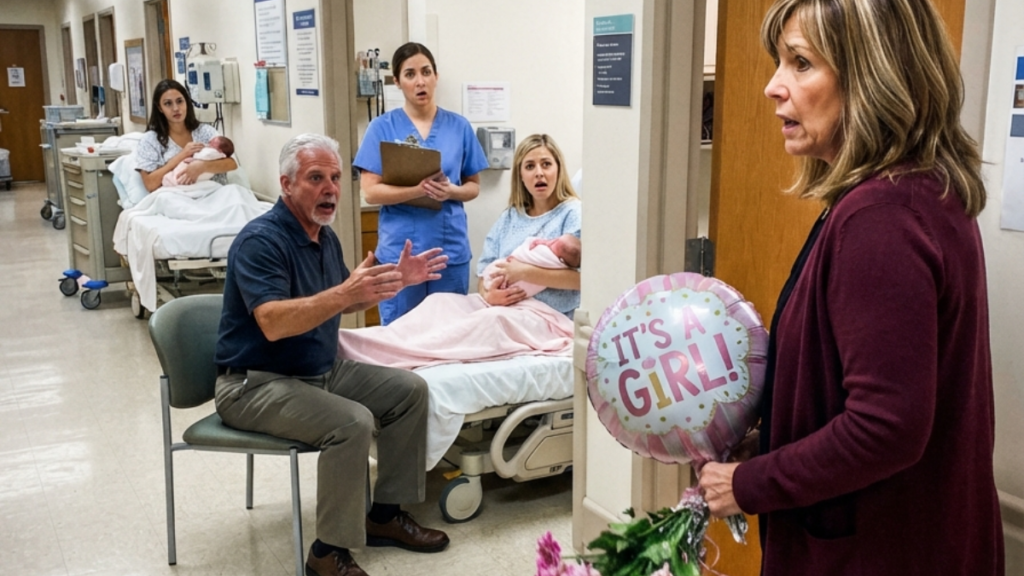
I was carrying a bouquet of pink roses and a little stuffed elephant when I walked into the hospital room where I thought my daughter had just given birth.
Instead, I found my sixty-seven-year-old husband sitting beside a young woman who was holding a newborn baby.
He was kissing her forehead.
And as I stood in the doorway, trying to understand what I was seeing, I heard him say something that made me drop everything in my hands.
“She’s beautiful, sweetheart. Our little girl is absolutely perfect.”
The woman looked toward me.
My husband turned around.
And the expression on his face told me everything I needed to know.
But before either of us could speak, a nurse appeared behind me.
“Oh, I’m so sorry! Your daughter is in room 418. This is 416. We had some confusion with the room assignments earlier.”
I barely heard her.
I was staring at the newborn in the young woman’s arms.
Then I noticed the little whiteboard beside her hospital bed.
Written beneath the mother’s name was the father’s name.
Thomas Whitaker.
My husband.
The man I’d been married to for forty years.
The man who was supposed to be down the hallway welcoming our first granddaughter into the world.
Instead, he was welcoming his own daughter.
My name is Susan Whitaker.
I’m sixty-three years old, and until that morning, I thought the happiest moment of my retirement would be becoming a grandmother.
Our daughter, Lauren, was thirty-four.
She and her husband, David, had spent nearly five years trying to have a baby.
There had been fertility treatments.
Three miscarriages.
Countless appointments.
And more tears than I could remember.
When Lauren finally told us she was pregnant, Thomas and I cried together at our kitchen table.
We helped decorate the nursery.
Purchased the crib.
Paid for a beautiful rocking chair.
Thomas even spent an entire Saturday assembling a dresser for the baby.
He’d seemed genuinely excited about becoming a grandfather.
Looking back, I wondered whether he’d been thinking about a different baby altogether.
Lauren went into labor on a Thursday evening, nearly two weeks before her due date.
David called us shortly after midnight.
I immediately started getting dressed.
Thomas told me he’d meet me at the hospital.
He claimed he needed to finish something at his office before coming.
Although he’d officially retired from his position as president of a regional manufacturing company, he still served on its board and occasionally went into work.
I didn’t question him.
I drove to the hospital.
Spent the night sitting beside my daughter.
Held her hand through contractions.
And cried when the doctors finally placed a beautiful little girl on her chest.
Lauren named her Charlotte.
She weighed six pounds, eleven ounces.
She was healthy.
She was perfect.
And when I called Thomas to tell him the news, he sounded distracted.
“That’s wonderful, Susan.”
I laughed.
“You’re a grandfather!”
He was silent for a moment.
Then said:
“I’ll be there soon.”
I assumed he was emotional.
Several hours later, I went downstairs to purchase flowers from the hospital gift shop.
While I was gone, Lauren was moved from labor and delivery to a postpartum room.
A nurse at the desk gave me the wrong room number.
And that simple mistake destroyed my marriage.
I stood in room 416, staring at my husband.
Thomas slowly rose from his chair.
“Susan.”
I looked toward the woman.
She appeared to be around thirty years old.
Long blonde hair.
Delicate features.
A diamond ring on her right hand.
She clutched the baby against her chest.
I pointed toward Thomas.
“Who is this?”
He took a step toward me.
“Susan, please.”
I backed away.
“WHO IS SHE?”
The nurse immediately intervened.
“Ma’am, I’m going to need you to step into the hallway.”
I ignored her.
I looked toward the whiteboard.
The woman’s name was Vanessa Miller.
I turned toward my husband.
“Is that your baby?”
Thomas closed his eyes.
I asked again.
“Is that your baby?”
He whispered:
“Yes.”
I felt my knees buckle.
The nurse reached for my arm.
I pulled away.
Then looked toward Vanessa.
“How old are you?”
She swallowed.
“Twenty-eight.”
I started laughing.
My daughter was six years older than her.
My husband was nearly forty years older than her.
And she’d just given birth to his child in the same hospital where our daughter had delivered his granddaughter.
I looked toward Thomas.
“Did you know Lauren was here?”
He nodded.
I stared at him.
“Did you know she was in labor last night?”
He nodded again.
I started crying.
“You weren’t at your office, were you?”
He looked down.
“No.”
I covered my mouth.
While I’d been sitting beside our daughter, holding her hand through the most frightening night of her life, my husband had been down the hallway holding another woman’s hand.
I looked toward Vanessa.
Then toward the baby.
And walked out.
Thomas followed me into the hallway.
“Susan, wait.”
I kept walking.
He grabbed my arm.
I turned around.
“Don’t touch me.”
He immediately let go.
Then whispered:
“I was going to tell you.”
I laughed bitterly.
“When?”
He didn’t answer.
“After Charlotte’s first birthday? At Christmas? When your daughter started kindergarten?”
He looked toward the floor.
I stared at him.
“How long?”
He hesitated.
“Almost three years.”
I closed my eyes.
Three years.
During those three years, Lauren had suffered two miscarriages.
Thomas had comforted her.
He’d told her that someday she’d have the family she’d always wanted.
And apparently, he’d been building another family of his own.
I looked directly at him.
“Does Lauren know?”
He immediately shook his head.
“No.”
“Does Michael?”
Our thirty-seven-year-old son lived in Chicago with his wife.
Thomas shook his head again.
“Nobody knows.”
I stared at him.
Then said:
“Well, they will now.”
He grabbed my arm again.
“Susan, please don’t ruin Lauren’s day.”
I looked down at his hand.
Then back at him.
“You brought your mistress to the same hospital where your daughter was giving birth, and you’re worried about me ruining her day?”
He released my arm.
I walked away.
When I reached Lauren’s room, I stood outside the door for several minutes.
I could hear David laughing.
Lauren was talking softly to Charlotte.
I wiped my face.
Tried to compose myself.
Then walked inside.
Lauren smiled.
“Mom! Where are the flowers?”
I looked down at my empty hands.
Then started crying.
Her smile disappeared.
“Mom?”
David stood.
“What’s wrong?”
I shook my head.
“Nothing, sweetheart.”
Lauren frowned.
“Where’s Dad?”
I couldn’t answer.
She looked toward David.
Then back at me.
“Did something happen to him?”
I sat beside her bed.
I didn’t want to tell her.
Not while she was holding the baby she’d waited five years to meet.
But before I could decide what to say, Thomas appeared in the doorway.
Lauren smiled.
“Dad!”
He stepped inside.
Walked toward her bed.
And looked down at Charlotte.
“She’s beautiful.”
I stared at him.
The exact same words he’d said about his own newborn daughter less than ten minutes earlier.
Lauren held Charlotte toward him.
“Do you want to hold her?”
Thomas hesitated.
Then reached for the baby.
I stood.
Walked toward the window.
And watched my husband cradle his granddaughter.
He kissed her forehead.
Told Lauren how proud he was.
And asked David whether he’d gotten any sleep.
He was acting as though nothing had happened.
Then his phone rang.
He glanced at the screen.
And immediately handed Charlotte back to Lauren.
“I need to take this.”
Lauren nodded.
Thomas walked into the hallway.
I watched him through the glass panel beside the door.
He answered the phone.
Listened for several seconds.
Then began walking toward room 416.
I turned toward Lauren.
And she was staring at me.
“Mom?”
I swallowed.
“What, sweetheart?”
She frowned.
“Why are you looking at Dad like that?”
I started crying again.
David pulled out a chair.
“Susan, what’s going on?”
I sat down.
Looked toward my daughter.
And whispered:
“Your father just had a baby.”
Lauren stared at me.
For several seconds, she didn’t react.
Then she laughed nervously.
“What?”
I wiped my face.
“There’s a woman down the hallway. She’s just given birth to your father’s daughter.”
David went completely still.
Lauren shook her head.
“Mom, that doesn’t make sense.”
I nodded.
“I know.”
She looked toward the door.
Then back at me.
“You’re saying Dad has a girlfriend?”
I nodded.
Her eyes filled with tears.
“And she’s here?”
“Yes.”
Lauren looked down at Charlotte.
Then whispered:
“My daughter and my sister were born on the same day?”
I started sobbing.
David took Charlotte from her arms.
Lauren covered her face.
And suddenly, my daughter’s happiest day became one of the worst days of her life.
Thomas returned approximately fifteen minutes later.
The moment he walked inside, Lauren looked at him.
“Is it true?”
He stopped.
Looked toward me.
Then closed his eyes.
“Lauren.”
She began crying.
“Is it true?”
He nodded.
Lauren turned away.
“Get out.”
Thomas stepped forward.
“Sweetheart, please.”
She shook her head.
“GET OUT!”
David stood.
“Thomas, you need to leave.”
My husband looked toward me.
As though he expected me to defend him.
I didn’t.
He walked out.
And I stayed beside my daughter until she fell asleep.
Later that afternoon, while David was caring for Charlotte, I went downstairs to get some coffee.
As I approached the elevators, I heard someone calling my name.
“Susan?”
I turned.
Vanessa was standing in the hallway.
She was wearing a hospital gown beneath a gray robe.
Her hair was pulled into a messy ponytail.
She looked exhausted.
I immediately turned away.
“Please,” she said.
“I need to talk to you.”
I stopped.
Then looked toward her.
“What could you possibly have to say to me?”
She glanced around the hallway.
Then whispered:
“Thomas told me you were dead.”
I stared at her.
“What?”
She nodded.
“He told me his wife died three years ago.”
I started laughing.
“You expect me to believe that?”
She began crying.
“He showed me an obituary.”
I froze.
“What obituary?”
She reached into the pocket of her robe.
Pulled out her phone.
And opened a photograph.
It was a screenshot of an obituary.
My photograph appeared at the top.
My full name.
My date of birth.
And a date of death from three years earlier.
I stared at it.
Then took the phone from her hand.
The obituary described my career as a high school guidance counselor.
Mentioned my love of gardening.
Listed Thomas as my surviving husband.
And stated that I was survived by two adult children.
Lauren and Michael.
I couldn’t move.
My husband hadn’t simply told his mistress he was a widower.
He’d created an obituary announcing my death.
I looked toward Vanessa.
“Where did you get this?”
“He sent it to me when we first started dating.”
I stared at the photograph.
It had been taken at Lauren’s wedding.
I’d been wearing a lavender dress.
Thomas had cropped himself out of the picture.
I handed the phone back.
Then whispered:
“Did you ever look me up?”
She nodded.
“He told me you didn’t use social media.”
I shook my head.
“Did you ever meet my children?”
“No. He said they were struggling with his decision to date again.”
I stared at her.
“Where have you been living?”
She hesitated.
Then said:
“In a house Thomas bought for us.”
My stomach tightened.
“Where?”
She named a town approximately forty minutes from our home in Connecticut.
I asked how long she’d lived there.
“Two years.”
I swallowed.
“How much did the house cost?”
She looked down.
“About eight hundred thousand dollars.”
I closed my eyes.
Thomas had told me two years earlier that he’d invested in a commercial property.
He’d withdrawn a substantial amount from our joint investment account.
I’d never asked for details.
Now I wondered whether that commercial property had a nursery and a woman waiting for him to come home.
Vanessa looked toward me.
Then said:
“We were supposed to get married next month.”
I stared at her.
She held up her right hand.
The diamond ring.
“He told me he wanted to wait until after the baby was born.”
I shook my head.
“Well, he can’t marry you. He’s still married to me.”
She started crying harder.
“I know that now.”
I turned toward the elevator.
But she grabbed my sleeve.
“Susan, there’s something else.”
I looked back.
She swallowed.
Then whispered:
“I don’t think he just told me you were dead.”
I frowned.
“What do you mean?”
She opened her phone again.
Searched through her emails.
And showed me a document.
It appeared to be a death certificate.
My name was printed at the top.
My date of birth.
My address.
My husband’s name.
And beneath the section identifying the cause of death were the words:
Complications following a cerebrovascular accident.
I stared at it.
I’d never had a stroke.
I was standing in front of her.
Alive.
Perfectly healthy.
I looked toward Vanessa.
“Why would he show you this?”
She shook her head.
“He didn’t. I found it in his desk last month.”
I swallowed.
“Did you ask him about it?”
She nodded.
“He said it was paperwork he’d needed to settle your estate.”
My heart began pounding.
My estate.
I looked at the certificate again.
Then asked her to send me copies of everything.
She agreed.
But as she began forwarding the documents, another nurse approached us.
“Vanessa, you need to return to your room. Your baby’s ready to feed.”
Vanessa nodded.
Then looked toward me.
“Can I have your number?”
I hesitated.
Finally, I gave it to her.
And as she walked away, I realized that the young woman I’d discovered in my husband’s arms might have been deceived almost as thoroughly as I had.
Almost.
I returned to Lauren’s room.
Called Michael.
And told him what had happened.
He was on the next available flight to Connecticut.
Then I contacted my younger sister, Diane, who’d worked as a paralegal for nearly thirty years.
I sent her the obituary and the death certificate.
She called me immediately.
“Susan, where did you get these?”
I explained.
She was silent for several seconds.
Then said:
“You need to find out whether that death certificate was ever used for anything.”
I frowned.
“Like what?”
“Insurance. Property transfers. Beneficiary claims. Retirement accounts.”
I felt sick.
She continued.
“Creating a fake obituary to deceive a girlfriend is one thing. Creating a death certificate is something else entirely.”
I looked toward Lauren.
She was sleeping.
Charlotte was resting in her bassinet.
I lowered my voice.
“Diane, what if Thomas has been telling financial institutions that I’m dead?”
She took a breath.
“That’s exactly what I’m worried about.”
The following morning, I met with an attorney Diane recommended.
Her name was Patricia Morgan.
She examined the documents.
Then asked me to obtain copies of my recent financial statements, insurance policies, and property records.
I spent most of the afternoon making calls.
The first bank confirmed that our joint checking account was still active.
The second confirmed that my retirement account remained in my name.
But when I contacted the insurance company that held a life insurance policy Thomas and I had purchased twenty years earlier, something strange happened.
The representative asked me to verify my identity.
I provided the information she requested.
Then she placed me on hold.
When she returned, her voice sounded different.
“Mrs. Whitaker, I’m going to need to transfer you to our special investigations department.”
I frowned.
“Why?”
She hesitated.
“There’s an issue concerning your policy.”
I swallowed.
“What kind of issue?”
She said she couldn’t discuss the details until additional verification had been completed.
But after several more calls, a secure identity verification process, and a conversation involving my attorney, I finally learned why the representative had been so concerned.
A death claim had been submitted on my policy three years earlier.
It had included a death certificate bearing my name.
And although the claim had initially been flagged for inconsistencies, it had eventually been approved following the submission of additional documentation.
I stared at Patricia.
Then whispered:
“How much did they pay him?”
She looked toward the records we’d received.
“One million, five hundred thousand dollars.”
I covered my mouth.
My husband had collected a $1.5 million life insurance payment while I was still alive.
He’d kissed me goodbye in the mornings.
Taken me out to dinner.
Celebrated our wedding anniversary.
And somewhere, according to an insurance company, I was already dead.
Patricia immediately contacted the insurer’s fraud investigators.
Then she turned toward me.
“Susan, we need to establish who provided the supporting documentation.”
I nodded.
But before we could continue, my phone rang.
It was Lauren.
She sounded frightened.
“Mom, can you come back to the hospital?”
I stood.
“What’s wrong?”
She began crying.
“Something happened with Charlotte.”
My heart started pounding.
“What happened?”
She struggled to speak.
Then David took the phone.
“Susan, there’s been a problem with the baby’s discharge paperwork.”
I grabbed my handbag.
“What kind of problem?”
He hesitated.
Then said:
“Someone submitted documents claiming that Lauren agreed to place Charlotte for adoption.”
I froze.
“What?”
He continued.
“The hospital’s social worker is here. Nobody’s releasing Charlotte to anyone, but they need to determine where these documents came from.”
I couldn’t breathe.
“Lauren never agreed to anything like that.”
“We know.”
I looked toward Patricia.
Then whispered into the phone:
“Who submitted them?”
David was silent.
Then said:
“There’s a woman here from a private adoption agency.”
I gripped the phone.
“And?”
He took a breath.
“She says Thomas arranged everything months ago.”
I stared at the wall.
My husband had spent years pretending I was dead.
He’d collected my life insurance.
He’d purchased a house for his pregnant mistress.
And now, somehow, he’d become involved in an adoption arrangement concerning the granddaughter my daughter had spent five years trying to conceive.
I grabbed my car keys.
Patricia stood.
“I’m coming with you.”
When we arrived at the hospital, Lauren was sitting in her bed, clutching Charlotte against her chest.
David was arguing with a hospital administrator.
A social worker stood near the window.
And sitting beside the door was a well-dressed woman in her fifties holding a leather briefcase.
I looked directly at her.
“Who are you?”
She stood.
Introduced herself as Helen Crawford.
She explained that she coordinated private adoption arrangements.
Patricia immediately asked to examine the documents.
Helen handed her a folder.
Inside was a purported agreement identifying Lauren as an expectant mother who intended to place her child with prospective adoptive parents.
There were signatures.
Financial disclosures.
And correspondence supposedly written by my daughter.
Lauren began screaming.
“I NEVER SIGNED ANY OF THAT!”
Helen looked increasingly uncomfortable.
She explained that she’d communicated primarily through Thomas, who’d claimed Lauren wanted the arrangement handled discreetly.
I stared at her.
“Did you ever meet my daughter?”
She shook her head.
“Mr. Whitaker said she wasn’t comfortable meeting anyone until after delivery.”
Patricia looked furious.
“Then you have no valid consent from this mother.”
Helen nodded.
She insisted that no adoption could proceed without proper verification and legally required consent.
But then she said something that made everyone in the room stop talking.
“I think there may have been a misunderstanding about which baby was intended for the arrangement.”
I stared at her.
“What does that mean?”
She opened another folder.
Removed a second set of documents.
And placed them beside the first.
There was another expectant mother’s name.
Vanessa Miller.
I looked toward Lauren.
Then back at Helen.
“Why do you have paperwork for both women?”
Helen swallowed.
“Mr. Whitaker initially contacted us regarding Ms. Miller’s pregnancy.”
I frowned.
“Then why is my daughter’s name on the other documents?”
Helen looked down.
“He contacted me approximately two months ago and said the circumstances had changed.”
Patricia leaned forward.
“What circumstances?”
Helen hesitated.
Then whispered:
“He said the prospective adoptive parents had been promised a healthy baby girl, and he needed to make sure he could fulfill that promise.”
Lauren began sobbing.
David immediately stepped toward her.
I stared at Helen.
“Who are these prospective adoptive parents?”
She shook her head.
“I can’t disclose their identities without authorization.”
Patricia pointed toward the disputed documents.
“Then I suggest you preserve every communication you’ve had with Thomas Whitaker.”
Helen nodded.
But as she gathered her paperwork, I noticed something attached to one of the agreements.
A photograph.
It was an ultrasound image.
I recognized it immediately.
Lauren had given me a copy of that exact photograph at her baby shower.
I’d framed it.
Thomas had taken a picture of it on his phone.
I looked toward Helen.
Then asked:
“Did my husband send you this?”
She nodded.
“He provided several ultrasound images.”
I swallowed.
“Did he receive money from these people?”
Helen looked uncomfortable.
“That’s something the investigators will need to establish.”
I stared at her.
“How much?”
She hesitated.
Then said:
“The prospective parents transferred four hundred thousand dollars to an account he designated.”
I grabbed the edge of Lauren’s bed.
Four hundred thousand dollars.
My husband had apparently promised someone a baby in exchange for an enormous amount of money.
And he’d been preparing paperwork involving both his mistress’s unborn daughter and his own granddaughter.
I looked toward Charlotte.
Then whispered:
“Why would he need that much money?”
Nobody answered.
But twenty minutes later, Vanessa called me.
She was crying so hard I could barely understand her.
“Susan, I need you to come to my room.”
I stood.
“What’s happened?”
She took a shaky breath.
“Thomas left his bag here yesterday.”
I frowned.
“And?”
“I started going through it.”
I walked toward the door.
“What did you find?”
She began sobbing.
“There are photographs of other babies.”
I stopped walking.
“What babies?”
She struggled to speak.
“Newborns. Hospital photographs. Ultrasounds.”
My heart pounded.
“How many?”
She hesitated.
Then whispered:
“At least seventeen.”
I looked toward Patricia.
Then back at Lauren.
But Vanessa wasn’t finished.
“There are names and dates written on the back of the photographs.”
I swallowed.
“Do you recognize any of them?”
She started crying harder.
Then said:
“Susan, one of the photographs has your daughter’s name on it.”
I closed my eyes.
“Charlotte?”
“No.”
My heart began pounding.
“What do you mean?”
She took a shaky breath.
“The photograph is dated four years ago.”
Four years ago.
Lauren’s second pregnancy.
The pregnancy that had ended at twenty-six weeks.
The baby we’d been told hadn’t survived.
I grabbed the doorframe.
Then whispered:
“What does the photograph say?”
Vanessa was sobbing.
And when she finally read the handwritten note on the back of the photograph, I felt the entire hospital hallway begin to spin.
“Baby Girl Whitaker. Released to receiving family. Payment completed.”
I asked Vanessa to read the words again.
She did.
Slowly.
“Baby Girl Whitaker. Released to receiving family. Payment completed.”
I pressed my hand against my mouth.
Four years earlier, I’d sat beside Lauren in a hospital room while she cried over the death of her daughter.
I’d helped her pack away the little clothes she’d purchased.
I’d watched David dismantle the crib.
I’d gone with them to a memorial service where my daughter had placed a tiny pink blanket beside a photograph of her ultrasound.
And now my husband’s mistress was holding a photograph suggesting that the baby might never have died.
I looked toward Patricia.
“We need to see that photograph.”
She nodded.
We walked directly to Vanessa’s room.
She was sitting on the edge of her hospital bed with Thomas’s leather bag beside her.
Her newborn daughter was asleep in the bassinet.
Photographs were scattered across the blanket.
Vanessa handed me the one she’d been describing.
It showed a premature infant inside a hospital incubator.
The baby was connected to medical equipment.
Her eyes were closed.
She was impossibly small.
I turned the photograph over.
There was Lauren’s maiden name.
The date of her delivery.
And those terrible words.
Payment completed.
I sat down.
Patricia examined the photograph without touching it unnecessarily.
Then she asked Vanessa whether she’d found anything else relating to that particular baby.
Vanessa reached into the bag.
Pulled out a folded sheet of paper.
And handed it to her.
It contained a series of initials, dates, and dollar amounts.
Beside the date of Lauren’s premature delivery was a figure.
$275,000.
I stared at it.
“Did my husband sell our granddaughter?”
Patricia looked directly at me.
“Susan, we don’t know that yet. But we need the police here immediately.”
Vanessa began crying again.
I looked toward her newborn daughter.
Then asked:
“Did you know Thomas was involved with an adoption agency?”
She shook her head.
“He told me he was establishing a charitable foundation for children.”
I frowned.
“What kind of foundation?”
“He said he helped families who couldn’t afford fertility treatments.”
Patricia looked up.
“Did the foundation have a name?”
Vanessa nodded.
“New Beginnings Family Foundation.”
I recognized it.
Thomas had established that foundation six years earlier.
I’d attended its inaugural fundraising dinner.
I’d helped select the decorations.
I’d even donated ten thousand dollars from my personal savings.
Thomas had stood on a stage in front of nearly two hundred people and spoken about the heartbreak experienced by couples who couldn’t conceive.
He’d mentioned our daughter’s struggles.
People had applauded.
Some had cried.
And I’d been so proud of him.
I looked down at the photographs.
Seventeen newborn babies.
Seventeen sets of handwritten notes.
And an organization that had supposedly been created to help desperate families.
I felt physically sick.
Patricia contacted the police and hospital administration.
The photographs and documents were secured for investigators.
Then I returned to Lauren’s room.
I dreaded what I was about to tell her.
David was sitting beside the bed, holding Charlotte.
Lauren looked up when I entered.
“Mom?”
I pulled out a chair.
Sat down.
And reached for her hand.
“Sweetheart, I need you to tell me everything you remember about the night Emma was born.”
Her expression changed immediately.
Emma.
That was the name she’d chosen for the daughter she’d lost four years earlier.
“Why?”
I swallowed.
“Something has come up.”
She stared at me.
“What?”
David looked toward Patricia, who’d accompanied me.
Then back at Lauren.
I explained what Vanessa had discovered.
Lauren listened without interrupting.
When I finished, she looked down at Charlotte.
Then whispered:
“Are you telling me Emma might be alive?”
I started crying.
“We don’t know.”
She shook her head.
“But there’s a photograph?”
I nodded.
“Of her alive?”
“Yes.”
Lauren began sobbing.
David placed Charlotte in the bassinet and wrapped his arms around his wife.
I waited until Lauren could speak again.
Then asked her what she remembered about Emma’s delivery.
She wiped her face.
“I heard her cry.”
I stared at her.
“What?”
Lauren nodded.
“Just once. It was very faint.”
David looked toward her.
“You never told me that.”
She started crying harder.
“Because everyone kept telling me I was confused.”
I felt my stomach tighten.
“Who told you that?”
She looked directly at me.
“Dad.”
I closed my eyes.
Lauren explained that she’d been heavily medicated following her emergency delivery.
David had been downstairs completing paperwork when a physician informed her that the baby hadn’t survived.
Thomas had been beside her.
He’d told her that seeing Emma would only make her grief worse.
When David returned, Thomas had already begun discussing arrangements with hospital staff.
I remembered those conversations.
My husband had insisted on handling everything.
He’d told us Lauren and David had suffered enough.
He’d arranged for what we believed were Emma’s remains to be cremated.
He’d organized the memorial service.
He’d even purchased the little white urn that Lauren kept on a shelf in her bedroom.
Lauren suddenly grabbed David’s arm.
“What’s inside Emma’s urn?”
David covered his mouth.
I started crying.
None of us knew.
Then Lauren said something that made Patricia immediately reach for her notebook.
“Mom, do you remember Dr. Harrison?”
I nodded.
Dr. Richard Harrison had been Lauren’s obstetrician during her first two pregnancies.
He’d retired shortly after Emma’s death.
Lauren continued.
“Dad recommended him.”
I remembered.
Thomas had known Richard through his business connections.
He’d insisted Lauren would receive exceptional care.
And when Emma died, Richard had personally reassured us that nothing could have been done to save her.
Patricia looked toward Lauren.
“Was Dr. Harrison the person who told you Emma had died?”
Lauren nodded.
Then whispered:
“He was also the person who introduced Dad to Vanessa.”
I stared at her.
“What?”
Lauren looked confused by my reaction.
“I didn’t know who she was until you told me her name yesterday.”
She explained that she’d attended a fundraising dinner for Thomas’s foundation three years earlier.
Richard Harrison had introduced Thomas to a young woman named Vanessa Miller.
Lauren remembered her because she’d been working for Richard’s medical practice.
I immediately returned to Vanessa’s room.
When I asked her about Richard Harrison, she nodded.
“I worked for him for almost four years.”
“Doing what?”
“Administrative work. Patient scheduling. Insurance paperwork.”
I stared at her.
“Did you ever work with my daughter’s records?”
She shook her head.
“I don’t remember her name.”
I told her about Emma.
About the photograph.
About Richard’s involvement in the delivery.
Vanessa’s expression changed.
Then she said:
“Richard wasn’t just Thomas’s friend.”
I waited.
She swallowed.
“He was his business partner.”
Within the next several hours, investigators began examining the connection between Thomas’s foundation, Richard Harrison’s former medical practice, and the private adoption arrangements.
The hospital placed additional safeguards around Lauren, Vanessa, and their newborns.
Both women were understandably terrified.
But neither had authorized anyone to take their babies.
And no legitimate adoption could proceed on the basis of the disputed documents.
For the first time since I’d discovered Thomas in Vanessa’s room, I felt that the situation was no longer entirely under his control.
Then my son arrived.
Michael walked into Lauren’s hospital room shortly after seven that evening.
He hugged his sister.
Held Charlotte.
Then looked toward me.
“Where’s Dad?”
I shook my head.
“I don’t know.”
Thomas hadn’t answered any of my calls.
His car was no longer in the hospital parking garage.
Vanessa hadn’t heard from him either.
Michael placed Charlotte back in her bassinet.
Then pulled me into the hallway.
“Mom, there’s something you need to know.”
I stared at him.
“What?”
He looked down.
“Dad called me this morning.”
I frowned.
“What did he want?”
Michael hesitated.
“He asked whether I still had access to the family’s old storage unit.”
I remembered the unit.
We’d rented it when Thomas’s mother died.
It contained furniture, boxes of photographs, and records from his father’s former business.
“Why?”
Michael shook his head.
“He said there were some documents he needed.”
I immediately contacted Patricia.
Michael provided the information to investigators.
But before we returned to Lauren’s room, he grabbed my hand.
“Mom, there’s something else.”
I looked toward him.
He appeared frightened.
“About six months ago, Dad asked me whether I’d consider becoming a trustee of his foundation.”
I nodded slowly.
“And?”
“He sent me some financial records.”
“What did they show?”
Michael swallowed.
“The foundation was receiving millions of dollars in donations.”
I frowned.
“That’s good, isn’t it?”
He shook his head.
“Not when almost none of the money is being spent on charitable programs.”
He explained that large payments were being made to consulting companies, medical providers, and private intermediaries.
When he’d questioned Thomas about the expenses, his father had become defensive.
Michael had declined the trustee position.
Then Thomas had asked him to delete the documents.
“Did you?” I asked.
Michael shook his head.
“I kept everything.”
By the following morning, investigators had identified several financial transactions connecting Thomas to individuals named in the documents Vanessa had discovered.
Richard Harrison was contacted.
Through his attorney, he denied involvement in any unlawful activity.
But when investigators began requesting Lauren’s historical medical records, they encountered an unexpected problem.
There were inconsistencies between the records maintained by Richard’s former practice and those retained by the hospital.
According to the hospital’s records, Emma had been born alive.
She’d been admitted to neonatal intensive care.
And she’d received treatment for several days.
According to the documents provided to Lauren and David, she’d died shortly after delivery.
I was sitting beside Lauren when Patricia explained this.
My daughter stared at her.
“Several days?”
Patricia nodded.
Lauren began shaking.
“My baby was alive for several days, and nobody told me?”
Patricia reached for her hand.
“We’re still establishing exactly what happened.”
Lauren started screaming.
“I WAS RIGHT THERE!”
David held her.
“I WAS IN THAT HOSPITAL!”
I covered my face.
While Lauren had been crying over the loss of her daughter, Emma had apparently been receiving medical care somewhere in the same building.
And someone had made sure her parents never knew.
But there was another discrepancy.
The hospital’s archived records contained a notation indicating that Emma had been transferred to another neonatal facility.
The transfer documentation identified a different legal surname for the baby.
It also identified an individual authorized to coordinate the arrangements.
Richard Harrison.
The police began tracing the transfer.
And three days later, we received the first piece of genuinely hopeful news.
Investigators had located records of a premature infant admitted to another medical facility on the date Emma had been transferred.
The baby’s medical history matched.
Her birth weight matched.
Even the details of a minor congenital heart condition matched.
She’d survived.
She’d eventually been discharged.
And she’d been placed with a couple who lived in New Jersey.
Lauren fell to her knees when she heard.
“She’s alive?”
The investigator cautioned her that the child’s identity still needed to be independently established.
But the available evidence was compelling.
Lauren grabbed David’s hands.
“OUR BABY IS ALIVE!”
They held each other and cried.
I sat beside them, unable to speak.
Four years.
Four birthdays.
Four Christmas mornings.
Four years of watching my daughter grieve a child who might have been growing up less than three hours away.
Then Lauren looked toward the investigator.
“What’s her name?”
He hesitated.
“We believe she’s been raised under the name Olivia.”
Lauren covered her mouth.
“Olivia.”
She repeated it.
Then whispered:
“Does she know about us?”
He shook his head.
“We don’t believe so.”
Lauren began crying again.
“I want to see her.”
The investigator explained that the situation would require careful handling.
The people raising Olivia might not have known that anything improper had occurred.
There were legal questions concerning her placement.
And above all, there was a four-year-old child whose entire world could be disrupted by the discovery.
Lauren nodded.
But then she asked:
“Did they pay my father for her?”
The investigator didn’t answer immediately.
Finally, he said:
“We’ve identified a substantial payment connected to the placement.”
Lauren closed her eyes.
And whispered:
“He sold my baby.”
That afternoon, Thomas was arrested.
Investigators located him at a property owned by one of the companies connected to his foundation.
Several boxes of documents were recovered.
Among them were records that appeared to connect additional children to questionable adoption arrangements.
Richard Harrison was subsequently arrested as well.
But the investigation into Thomas’s activities revealed something I hadn’t anticipated.
The $1.5 million life insurance claim submitted in my name hadn’t been an isolated act of fraud.
It had been connected to the same network of people who’d helped Thomas conceal financial transactions involving the foundation.
Several individuals had assisted in creating or authenticating false documents.
Thomas had used the insurance proceeds to cover substantial financial obligations.
Some of the money had purchased Vanessa’s house.
Some had gone toward maintaining his business interests.
And some had been used to repay individuals who’d demanded refunds after promised adoption arrangements fell through.
My husband hadn’t simply been living a double life.
He’d been operating a business that exploited people at their most vulnerable.
Women who’d lost children.
Couples desperate to become parents.
Families facing medical emergencies.
And even his own daughter.
When Patricia finally obtained additional financial records concerning Lauren’s pregnancies, we discovered something that made me question every act of generosity Thomas had ever performed.
He’d paid several of Lauren’s medical expenses.
He’d recommended her physicians.
He’d offered to handle insurance disputes.
He’d insisted on attending appointments whenever David couldn’t.
I’d always thought he was being a wonderful father.
But those arrangements had given him access to information about Lauren’s pregnancies and medical care.
And he’d used that access against her.
The most devastating evidence came from an exchange between Thomas and Richard that investigators recovered.
It had occurred shortly after Emma’s birth.
Richard had expressed concern about the risks associated with the arrangement.
Thomas had responded by assuring him that Lauren trusted him completely.
Then he’d written:
“She’ll believe whatever I tell her. She’s my daughter.”
When Lauren read those words, she threw the document across the room.
David immediately wrapped his arms around her.
She screamed.
Not words.
Just a terrible, heartbroken scream.
I’d never heard anything like it.
Then she looked toward me.
“How could he do that to me?”
I started crying.
“I don’t know, sweetheart.”
“He held me while I cried!”
I nodded.
“He told me Emma was in heaven!”
I covered my face.
“He helped me choose her memorial flowers!”
David held her tighter.
And Lauren kept repeating the same question.
“How could my own father do that to me?”
I had no answer.
Because I’d spent forty years loving the man who’d done it.
Several weeks later, investigators contacted the couple raising Olivia.
Their names were Matthew and Rebecca Ellis.
They were in their early forties.
They’d struggled with infertility for more than a decade.
They’d been told Olivia’s biological mother had voluntarily arranged a confidential adoption and didn’t wish to have contact with the child.
They’d been provided with documents that appeared legitimate.
They’d paid substantial sums that had been represented as medical expenses, legal fees, and other costs associated with the arrangement.
And they’d spent four years believing they’d adopted a child whose birth mother had willingly relinquished her.
When they learned the truth, Rebecca reportedly became physically ill.
Matthew immediately contacted an attorney.
Both agreed to cooperate with investigators.
Independent DNA testing eventually confirmed what we’d been hoping and fearing.
Olivia was Lauren and David’s biological daughter.
Emma.
She was alive.
The first time Lauren saw a recent photograph of her, she cried for nearly an hour.
The little girl had David’s brown eyes.
Lauren’s dimples.
And the same little curls Lauren had possessed as a child.
She was wearing a yellow dress and holding a stuffed rabbit.
Lauren touched the photograph.
Then whispered:
“That’s my little girl.”
But finding Emma was only the beginning.
There were court proceedings.
Psychological assessments.
Meetings involving attorneys and child welfare professionals.
Rebecca and Matthew were devastated by the discovery that their daughter’s placement had been founded on deception.
Lauren and David were devastated by the years they’d lost.
And there was no simple solution that could erase the suffering Thomas had caused.
Eventually, arrangements were made for Lauren and David to begin meeting their daughter under professional guidance.
I wasn’t present for the first meeting.
Lauren wanted it to be as calm and uncomplicated as possible.
But when she returned home, she walked into my kitchen, sat down, and began crying.
I put my arms around her.
“How was it?”
She smiled through her tears.
“She likes butterflies.”
I laughed softly.
Lauren continued.
“And pancakes. And purple. And she has a little stuffed rabbit she takes everywhere.”
She wiped her face.
“She showed me how she can count to twenty.”
I started crying.
Then Lauren looked toward Charlotte, who was sleeping in her bassinet.
And whispered:
“I have two daughters, Mom.”
I hugged her.
“Yes, sweetheart. You do.”
Meanwhile, Vanessa had begun cooperating extensively with investigators.
Her relationship with Thomas had ended.
The house he’d purchased for her became part of the financial proceedings.
And she was left facing the reality that the man she’d intended to marry had lied about virtually every aspect of his life.
But there was still one question concerning her baby that needed to be answered.
Why had Thomas originally arranged for Vanessa’s daughter to be placed with prospective adoptive parents?
And why had he subsequently attempted to substitute Charlotte?
The answer emerged from correspondence recovered during the investigation.
Thomas had initially told the prospective parents that Vanessa intended to relinquish her baby.
Vanessa had never agreed to such an arrangement.
He’d accepted their money months before the delivery.
But as Vanessa’s pregnancy progressed, she’d become increasingly vocal about wanting to raise her daughter herself.
She’d purchased nursery furniture.
Chosen a name.
Discussed their future as a family.
And Thomas had apparently decided that rather than return the money he’d already spent, he would provide the couple with another newborn.
Charlotte.
The investigators believed he’d anticipated both women delivering within a similar period.
He’d prepared documents concerning both pregnancies.
And he’d attempted to exploit the confusion surrounding the births.
But the accidental room-number mix-up had exposed his relationship with Vanessa before he could carry out the arrangement.
The adoption coordinator’s subsequent appearance had exposed the disputed paperwork.
And Vanessa’s discovery of the photographs had exposed the history he’d spent years concealing.
When Vanessa learned what Thomas had intended to do with her daughter, she called me.
She was sobbing.
“He was going to take her from me.”
I closed my eyes.
“I know.”
“He told me he couldn’t wait to be a father again.”
I didn’t answer.
She continued.
“He painted her nursery himself.”
I thought about Thomas assembling Charlotte’s dresser.
The excitement he’d expressed about becoming a grandfather.
The photographs he’d taken at Lauren’s baby shower.
All the ordinary, loving gestures that had concealed something monstrous.
Vanessa whispered:
“Do you think he ever loved either of us?”
I looked toward the framed photograph of my children on the mantel.
Then said:
“I think he loved being trusted.”
Thomas’s criminal proceedings lasted nearly two years.
The investigation identified multiple families affected by fraudulent or seriously irregular placements.
Not every photograph in his possession represented an unlawfully transferred child.
Some concerned legitimate medical cases.
Others were connected to arrangements that had never been completed.
But several families learned that the circumstances surrounding their children’s births and placements were substantially different from what they’d been told.
Thomas and Richard faced numerous criminal charges arising from their conduct.
Other individuals connected to the financial and placement arrangements were also prosecuted.
Thomas eventually pleaded guilty to multiple serious offenses under an agreement that required him to provide information about the network and its records.
He received a lengthy prison sentence.
Richard was also convicted and sentenced.
The insurance company pursued recovery of the fraudulent payment.
My divorce attorneys worked to separate my legitimate assets from the proceeds of Thomas’s crimes.
And although the financial consequences were substantial, I considered myself fortunate.
I still had my home.
I still had my children.
And my daughter had something infinitely more important than money.
She had the opportunity to know the little girl she’d spent four years mourning.
Before Thomas was sentenced, he requested a meeting with Lauren.
She refused.
He requested another.
She refused again.
Finally, he wrote her a letter.
She brought it to my house.
“I don’t want to read it alone.”
We sat at the kitchen table.
She opened the envelope.
Thomas began by apologizing for the pain he’d caused.
He claimed he’d been under enormous financial pressure.
He insisted he’d believed Emma would receive excellent medical care and be raised by loving parents.
Then came a sentence that made Lauren stop reading.
I convinced myself that because you and David were still young, you would eventually have another child.
Lauren stared at the words.
Then slowly looked toward me.
“He thought Charlotte would replace her.”
I started crying.
Lauren continued reading.
Thomas claimed he’d always intended to ensure Emma was financially secure.
He wrote that he’d followed her progress through photographs.
He’d received updates about her health.
Her development.
Her birthdays.
Lauren suddenly stood.
“What?”
I looked toward her.
She pointed at the letter.
“He had pictures of her growing up?”
I took the letter.
Read the paragraph.
And felt sick.
Thomas had known where Emma was.
He’d known she’d survived.
He’d apparently received information about her for years.
While Lauren had been visiting the little memorial garden she’d created for her daughter, Thomas had been looking at photographs of the living child.
Lauren grabbed her phone.
Called the prosecutor’s office.
And asked whether those photographs had been recovered.
They had.
Several weeks later, after the appropriate arrangements were made, Lauren received copies.
There was Emma at six months old.
Emma sitting in a high chair.
Emma taking her first steps.
Emma wearing a little pumpkin costume.
Emma opening birthday presents.
And Emma standing beside a Christmas tree.
Lauren cried over every photograph.
But when she reached the picture from Emma’s third birthday, she noticed something.
A large stuffed elephant sat beside the little girl’s presents.
Lauren enlarged the photograph.
Then looked toward me.
“Mom.”
I frowned.
“What?”
She pointed toward the elephant.
“I remember Dad buying that.”
I stared at it.
Then remembered.
Thomas had purchased two stuffed elephants shortly before Christmas.
He’d told me they were donations for children receiving assistance through his foundation.
One had been gray.
The other had been pink.
The elephant in Emma’s photograph was gray.
Lauren started sobbing.
“He was sending my daughter birthday presents while I was crying because she was dead.”
I put my arms around her.
There were no words that could make that discovery less cruel.
At Thomas’s sentencing, Lauren chose to speak.
She stood before the courtroom holding a photograph of Emma.
Thomas looked toward her.
She didn’t look back.
“Four years ago, my father told me my daughter had died.”
Her voice shook.
“I believed him because he was my father.”
She took a breath.
“He helped arrange a memorial service for a child he knew was alive.”
Thomas lowered his head.
Lauren continued.
“He watched my husband and me grieve. He watched us struggle through birthdays and holidays. He watched us try to conceive again.”
She held up the photograph.
“And all that time, he knew where she was.”
The courtroom was silent.
“My daughter didn’t die that night. But the person I believed my father was did.”
Thomas began crying.
Lauren finally looked directly at him.
“You didn’t just steal four years from me. You stole four years from your own granddaughter.”
She lowered the photograph.
“And I hope you understand that no amount of money will ever buy those years back.”
Then she returned to her seat.
I reached for her hand.
She held mine tightly.
I had never been prouder of her.
The arrangements concerning Emma’s future were eventually resolved through the courts, with extensive professional involvement and agreement among the adults responsible for her care.
Lauren and David were recognized as her biological parents and gradually assumed a greater role in raising her.
Matthew and Rebecca remained important figures in her life.
They’d loved her sincerely.
They hadn’t knowingly participated in Thomas’s deception.
And Lauren refused to punish her daughter by abruptly removing everyone she’d ever known.
It wasn’t an ordinary family arrangement.
But nothing about our family was ordinary anymore.
Emma continued using the name Olivia, the name she’d known her entire life.
Lauren sometimes called her Liv.
And she kept the name Emma in a special place in her heart.
Vanessa moved into a smaller home closer to her own family.
She found work outside the medical practice where she’d met Thomas.
And she raised her daughter, Lily, without him.
Occasionally, she sent me photographs.
I didn’t consider her a close friend.
There was too much pain associated with the circumstances of our meeting.
But I believed her when she told me she’d thought I was dead.
And I refused to hold an innocent little girl responsible for the actions of her father.
Two years after that terrible morning at the hospital, we celebrated Charlotte’s birthday in Lauren’s backyard.
There were balloons.
A butterfly-shaped birthday cake.
A little inflatable pool.
And children running across the grass.
I was arranging presents when Olivia came running toward me.
“Grandma!”
I turned.
She threw her arms around my waist.
“Can you help me?”
I smiled.
“Of course.”
She grabbed my hand and led me toward Charlotte, who was attempting to put a party hat on a stuffed elephant.
The two sisters began laughing.
I stood there watching them.
And suddenly, I remembered the morning Charlotte was born.
The flowers I’d dropped.
The hospital room I’d entered by mistake.
My husband kissing Vanessa’s forehead.
The nurse apologizing for giving me the wrong room number.
For months afterward, I’d wondered what would have happened if that nurse had directed me to the correct room.
Perhaps Thomas would have continued pretending to be a devoted husband.
Perhaps Vanessa would have continued believing I was dead.
Perhaps Charlotte would have become another photograph in his leather bag.
And perhaps Olivia would have grown up without ever knowing that somewhere, her biological mother had spent years crying over a little white urn.
I thought about that nurse often.
She probably never knew what her mistake had uncovered.
She probably went home that evening, ate dinner, and forgot all about the woman she’d accidentally directed to room 416.
But I would remember her for the rest of my life.
Because she’d sent me through the wrong door.
And behind that door was the truth my husband had spent years keeping from me.
He’d lost his freedom.
His marriage.
His fortune.
And the trust of the children who’d once admired him.
But Lauren had regained something far more valuable than anything he’d lost.
As everyone gathered around the birthday cake, Olivia stood beside Charlotte.
Lauren wrapped an arm around each of her daughters.
David lit the candles.
And I took a photograph.
For years, my husband had kept photographs of children whose lives he’d secretly altered.
He’d written dates, names, and dollar amounts on the backs of them.
But the photograph I took that afternoon would never have a price attached to it.
I printed it the following week.
Placed it in a silver frame.
And wrote a little message on the back.
Charlotte’s second birthday. Olivia helping her blow out the candles. Both girls home with their family.
I placed it on my mantel.
Then stood back and smiled.
My husband had believed that babies could be treated like transactions.
That grieving mothers could be manipulated.
That a father’s love could be imitated convincingly enough to conceal the most unforgivable betrayal.
But he had underestimated the women in his life.
His mistress had handed over the evidence.
His daughter had stood against him in court.
And the wife he’d declared dead had lived long enough to expose everything he’d done.
I’d gone to the hospital that morning expecting to become a grandmother for the first time.
Instead, I’d discovered that I’d been a grandmother for four years.
And the greatest gift I received wasn’t the justice that eventually came.
It wasn’t the money I recovered.
It wasn’t even watching Thomas finally face the consequences of his actions.
It was hearing two little girls run across the backyard, calling me Grandma.
Two little girls my husband had tried to take away from us.
And this time, nobody was taking them anywhere.
