

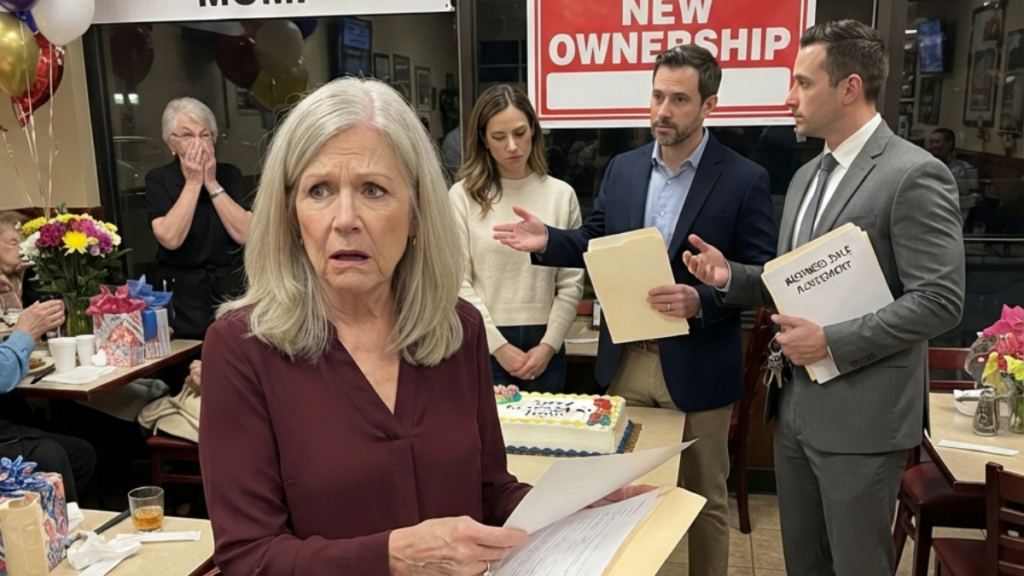
The day my family threw me a surprise retirement party, I walked into my restaurant expecting to inspect the kitchen before the dinner rush.
Instead, sixty people jumped out from behind tables and shouted:
“SURPRISE!”
There were balloons everywhere.
Gold streamers hanging from the ceiling.
A three-tiered cake shaped like my restaurant.
And a giant banner stretched across the dining room that read:
HAPPY RETIREMENT, PATRICIA! 38 AMAZING YEARS!
I stopped in the doorway.
Confused.
Because I wasn’t retiring.
In fact, I’d just signed a five-year lease extension.
My daughter, Melissa, rushed toward me.
She was forty-two, beautiful, and wearing the same expensive cream-colored pantsuit she’d worn to her last real estate closing.
“Mom!” she squealed, throwing her arms around me. “We got you!”
I looked around the room.
My son, Daniel, was standing beside the bar.
My husband, Robert, was holding a champagne glass.
My grandchildren were waving little signs.
And every employee I’d worked with for the past twenty years was applauding.
I forced a smile.
“What’s going on?”
Melissa laughed.
“Your retirement party, silly!”
I stared at her.
“My what?”
She squeezed my hands.
“Mom, you don’t have to pretend anymore. We know how hard you’ve worked.”
I looked toward Robert.
He smiled.
Then raised his glass.
“To my beautiful wife,” he announced. “The hardest-working woman I’ve ever known. After thirty-eight years, she’s finally getting the rest she deserves.”
Everyone cheered.
I stood there.
Frozen.
Because three days earlier, I’d told Robert I was planning to open a second location.
Not retire.
Not slow down.
Expand.
I looked toward Melissa.
Then whispered:
“Who told you I was retiring?”
Her smile faltered.
She glanced toward Daniel.
Then toward Robert.
And for the first time, I noticed something strange.
Nobody looked surprised by my confusion.
They looked nervous.
Melissa squeezed my hands again.
“Mom, let’s not do this right now.”
I pulled away.
“Do what?”
She smiled tightly.
“Make a scene.”
I stared at her.
Then whispered:
“Melissa, I am not retiring.”
The room went quiet.
Someone stopped clapping.
Robert set down his champagne.
Daniel started walking toward us.
And Melissa’s expression changed.
“Mom,” she said softly, “we talked about this.”
I shook my head.
“No, we didn’t.”
She looked toward her brother.
Then whispered:
“Daniel, tell her.”
My son stopped beside me.
He was thirty-nine.
An accountant.
The same man who’d handled my restaurant’s books for the past eleven years.
He looked uncomfortable.
Then said:
“Mom, the decision’s already been made.”
I stared at him.
“What decision?”
Daniel swallowed.
Then looked toward Robert.
My husband stepped forward.
Put a hand on my shoulder.
And said:
“Patricia, sweetheart, the restaurant has been sold.”
I stopped breathing.
For a moment, I thought I’d misheard him.
I looked at Robert.
Then at Daniel.
Then Melissa.
And whispered:
“What?”
Robert smiled nervously.
“The sale closed yesterday.”
My heart started pounding.
I looked around the dining room.
The restaurant I’d built from nothing.
The restaurant I’d worked in six days a week for nearly four decades.
The restaurant where I’d raised my children, buried my parents, celebrated birthdays, paid mortgages, and spent more nights than I could count.
I stared at my husband.
Then whispered:
“You sold my restaurant?”
Robert sighed.
“Patricia, don’t make this difficult.”
I stepped back.
“YOU SOLD MY RESTAURANT?”
The room went completely silent.
Melissa grabbed my arm.
“Mom, please.”
I pulled away.
Then looked directly at Daniel.
“How much?”
He froze.
I stepped closer.
“HOW MUCH DID YOU SELL IT FOR?”
Daniel swallowed.
Then whispered:
“Four point eight million dollars.”
I stopped breathing.
Four million.
Eight hundred thousand dollars.
My restaurant.
My business.
My life’s work.
Sold.
Without my permission.
I stared at my family.
Then whispered:
“Where’s the money?”
Nobody answered.
I looked toward Robert.
He looked away.
Melissa started crying.
Daniel stared at the floor.
And suddenly, I knew.
Whatever they’d done, selling my restaurant wasn’t the worst part.
I stepped closer to my husband.
Then whispered:
“Robert. Where is my money?”
He swallowed.
And said:
“We used it.”
I couldn’t breathe.
“For what?”
He looked toward our children.
Then back at me.
And whispered:
“To save the family.”
My name is Patricia Bennett.
I’m sixty-six years old.
And until that afternoon, I believed I’d built a successful business and a loving family.
I’d opened Bennett’s Kitchen in 1988.
I was twenty-eight.
Pregnant with Melissa.
And working two jobs.
Robert was a salesman at the time.
We had very little money.
But I’d inherited $18,000 from my grandmother.
And instead of using it for a down payment on a house, I used it to open a small breakfast restaurant.
Twelve tables.
A tiny kitchen.
Secondhand equipment.
And a menu I’d typed myself on my mother’s old typewriter.
For the first six months, I barely broke even.
I arrived at four every morning.
Made biscuits.
Prepared soups.
Cooked breakfast.
Washed dishes.
And stayed until the last customer left.
When Melissa was born, I brought her to work.
She slept in a bassinet behind the office.
When Daniel came along three years later, I did the same.
My children grew up in that restaurant.
They did homework at the counter.
Ate pancakes in the kitchen.
And learned to count change before they learned multiplication.
By the time they were teenagers, Bennett’s Kitchen had become a local institution.
We expanded.
Added a dining room.
Bought the neighboring property.
And eventually opened a catering division.
I employed forty-three people.
Some had worked for me for more than twenty years.
And every year, I made sure they received Christmas bonuses.
Health insurance.
Paid vacation.
And a place to work where they were treated like family.
Because that’s what the restaurant was to me.
Family.
Robert had never been particularly interested in running it.
He preferred sales.
Then consulting.
Then, eventually, retirement.
When he stopped working at sixty-two, I supported him.
I paid the mortgage.
Covered our expenses.
And encouraged him to enjoy himself.
Golf.
Fishing.
Travel.
Whatever made him happy.
Melissa became a real estate agent.
Daniel became an accountant.
And when Daniel offered to handle my restaurant’s finances, I was thrilled.
I trusted him.
He was my son.
Why wouldn’t I?
For eleven years, he prepared payroll reports.
Handled taxes.
Managed vendor payments.
And reviewed financial statements.
I signed what needed signing.
Approved budgets.
And focused on what I loved.
Cooking.
Customers.
Employees.
Building something that mattered.
I thought everything was going beautifully.
Until the day my family threw me a retirement party I hadn’t agreed to.
I looked around the dining room.
At the balloons.
The cake.
The smiling photographs.
The banner celebrating a decision I’d never made.
Then I looked toward Robert.
And whispered:
“What do you mean you used the money?”
He glanced toward our guests.
“Patricia, let’s talk privately.”
I shook my head.
“No.”
Melissa stepped closer.
“Mom, please.”
I looked at her.
Then said:
“You invited sixty people to celebrate the sale of my business. You can explain it in front of them.”
Nobody moved.
Robert’s face turned red.
Then he said:
“Daniel had some financial difficulties.”
I turned toward my son.
He stared at the floor.
I felt sick.
“What financial difficulties?”
Daniel swallowed.
Then whispered:
“I made some investments.”
I stared at him.
“What investments?”
He looked toward Melissa.
Then back at me.
“Real estate.”
I frowned.
“Your sister’s business?”
He nodded.
I looked toward Melissa.
She started crying.
And suddenly, I remembered something.
Two years earlier, Melissa had begun buying distressed properties.
She’d told us she was building a portfolio.
Small apartment buildings.
Vacation rentals.
Commercial properties.
She’d been incredibly excited.
Always talking about investors.
Projected returns.
And how she’d be financially independent before fifty.
I’d been proud of her.
But now, standing in my restaurant, I realized I hadn’t asked enough questions.
I looked toward Melissa.
Then whispered:
“How much money did you lose?”
She started sobbing.
Robert stepped between us.
“Patricia, that’s not important.”
I stared at him.
Then said:
“Get out of my way.”
He froze.
I stepped around him.
Looked directly at my daughter.
And asked again:
“How much?”
Melissa wiped her face.
Then whispered:
“Six million dollars.”
I stopped breathing.
Six million.
I stared at her.
Then at Daniel.
Then Robert.
And whispered:
“You lost six million dollars?”
Melissa nodded.
I couldn’t move.
Then she said:
“It wasn’t all ours.”
My heart pounded.
“What does that mean?”
She looked toward Daniel.
He closed his eyes.
Then whispered:
“We had investors.”
I felt sick.
I looked at my son.
Then asked:
“Whose investors?”
He didn’t answer.
I stepped closer.
“Daniel.”
He swallowed.
Then whispered:
“People from the restaurant.”
I froze.
“What?”
He looked down.
“Some customers.”
Silence.
“A few employees.”
Silence.
“And some of your friends.”
I couldn’t breathe.
My customers.
My employees.
People who’d trusted me for decades.
I stared at him.
Then whispered:
“You used my name?”
Daniel started crying.
I stepped closer.
“DID YOU USE MY NAME TO GET THEIR MONEY?”
He nodded.
I felt sick.
Then he whispered:
“We told them you were backing the investments.”
The room went silent.
I looked around.
Several employees were standing near the kitchen.
My longtime manager, Denise, had her hand over her mouth.
My head chef, Marco, was staring at Daniel.
And near the back of the dining room, I saw my oldest friend, Susan.
She was crying.
I looked toward her.
Then whispered:
“Susan?”
She stepped forward.
Her face pale.
And said:
“Patty, they told me you were guaranteeing it.”
I stopped breathing.
I stared at her.
Then whispered:
“How much did you invest?”
She swallowed.
And said:
“Two hundred and fifty thousand dollars.”
I felt sick.
Susan.
My best friend since high school.
A widow.
Retired schoolteacher.
She’d invested nearly all the money she’d received after selling her late husband’s house.
I stared at her.
Then whispered:
“Susan, I didn’t know.”
She started crying.
“I believe you.”
I covered my mouth.
Then another voice spoke.
Denise.
My manager.
She stepped forward.
And said:
“They told me you were going to give me part ownership.”
I turned toward her.
“What?”
She looked toward Daniel.
Then whispered:
“If I invested my retirement savings.”
I stopped breathing.
I stared at my son.
Then whispered:
“You took Denise’s retirement money?”
He started crying.
I stepped closer.
“HOW MUCH?”
Denise answered.
“Eighty thousand.”
I felt sick.
Then Marco spoke.
“Forty-five thousand.”
Another employee raised her hand.
“Twenty.”
Someone near the bar said:
“Thirty-five.”
My heart pounded.
I looked around the room.
And suddenly, I realized something horrifying.
My family hadn’t simply lost money.
They’d been using my reputation to convince the people I loved to hand over their savings.
And now those people were standing in my restaurant.
At a party celebrating the sale of the business that had supposedly guaranteed their investments.
I turned toward Robert.
Then whispered:
“You knew?”
He looked down.
I stepped closer.
“You knew they were taking money from my employees?”
He swallowed.
Then whispered:
“We were trying to fix it.”
I stared at him.
Then said:
“By selling my restaurant?”
Robert nodded.
I felt sick.
Then he said:
“We had to make the investors whole.”
I looked toward Daniel.
Then whispered:
“Did you?”
He didn’t answer.
I stepped closer.
“Did you pay them back?”
Daniel shook his head.
I stopped breathing.
Then whispered:
“Where did the four point eight million go?”
He looked toward Robert.
Then Melissa.
And finally said:
“To the lender.”
I froze.
“What lender?”
Daniel swallowed.
Then whispered:
“The one who financed the last property.”
I stared at him.
Then asked:
“How much did you owe?”
He closed his eyes.
And said:
“Four point six million.”
I couldn’t breathe.
Four point six million dollars.
Almost the entire sale price.
Gone.
To pay a debt I’d never agreed to.
A debt I hadn’t even known existed.
I looked toward Robert.
Then whispered:
“So the investors still haven’t been paid?”
He shook his head.
I started crying.
Then said:
“And my restaurant is gone?”
Nobody answered.
I looked around the room.
At the employees.
The customers.
The photographs.
The little brass plaque beside the entrance that read:
Bennett’s Kitchen — Established 1988.
And suddenly, something occurred to me.
I looked toward Daniel.
Then asked:
“How did you sell it?”
He froze.
I stepped closer.
“The restaurant is in my name.”
Daniel swallowed.
I continued.
“The property is in my name.”
Silence.
“The business license is in my name.”
Silence.
“And I never signed a purchase agreement.”
Daniel looked toward Robert.
Then Melissa.
And I knew.
Before anyone said another word, I knew.
I stepped closer.
Then whispered:
“Whose signature is on the sale documents?”
Daniel started crying.
I stared at him.
And asked:
“DANIEL.”
He looked down.
Then whispered:
“Yours.”
I stopped breathing.
For a moment, the room went completely silent.
Then I whispered:
“You forged my signature?”
Daniel shook his head.
“No.”
I frowned.
“What?”
He looked toward Robert.
Then said:
“Dad had power of attorney.”
I froze.
Power of attorney.
Three years earlier, I’d undergone knee replacement surgery.
Robert had suggested we prepare some legal documents in case something went wrong.
A medical directive.
A healthcare proxy.
A financial power of attorney.
I’d signed them at our attorney’s office.
I’d assumed they were for emergencies.
Nothing more.
I stared at Robert.
Then whispered:
“You used the power of attorney?”
He nodded.
I felt sick.
Then he said:
“It was legal.”
I stared at him.
And whispered:
“You sold my business without asking me.”
He sighed.
“Patricia, I was trying to protect our family.”
I shook my head.
“No.”
He stepped closer.
“Sweetheart—”
I raised my hand.
“Don’t call me that.”
He froze.
I looked toward Daniel.
Then Melissa.
Then Robert.
And said:
“All three of you knew.”
Nobody answered.
I continued.
“You planned this.”
Silence.
“You invited my employees.”
Silence.
“You ordered a cake.”
Silence.
“You hung balloons.”
I started crying.
Then whispered:
“And you expected me to smile while you told me you’d sold everything I worked for.”
Melissa started sobbing.
“Mom, we thought you’d understand.”
I stared at her.
Then whispered:
“Understand what?”
She stepped closer.
“That family comes first.”
I felt something inside me snap.
I looked directly at her.
Then said:
“Family doesn’t steal from family.”
The room went silent.
Melissa covered her face.
Robert stepped forward.
“Patricia, enough.”
I turned toward him.
And whispered:
“Get out.”
He froze.
“What?”
I pointed toward the door.
“Get out of my restaurant.”
Robert stared at me.
Then said:
“It’s not your restaurant anymore.”
I stopped breathing.
The words hung in the air.
And suddenly, I realized he wasn’t ashamed.
He wasn’t sorry.
He was reminding me that he’d taken away the one thing I loved most.
I stared at him.
Then whispered:
“Who bought it?”
Robert looked away.
I stepped closer.
“WHO BOUGHT MY RESTAURANT?”
Daniel swallowed.
Then whispered:
“A private investment company.”
I frowned.
“What company?”
He looked toward Melissa.
Then said:
“Hawthorne Hospitality Group.”
I stopped breathing.
I’d heard that name before.
Six months earlier, a man named Victor Hawthorne had approached me about buying Bennett’s Kitchen.
He was a wealthy developer.
Owned hotels.
Restaurants.
Commercial properties.
He’d offered me three million dollars.
I’d refused.
He’d increased the offer to three and a half.
I’d refused again.
Then he’d told me something strange.
Everyone has a price, Patricia.
I’d laughed.
Told him mine wasn’t for sale.
And walked away.
Now, apparently, he’d bought it for four point eight million.
Without ever speaking to me.
I looked toward Robert.
Then whispered:
“Victor Hawthorne?”
He nodded.
I felt sick.
Then I remembered something else.
Two weeks earlier, Robert had gone golfing with Victor.
He’d told me they were discussing a charity tournament.
I hadn’t questioned it.
Now I knew.
They’d been negotiating the sale of my business.
I stared at my husband.
Then whispered:
“You met with him behind my back.”
Robert sighed.
“Patricia—”
I stepped closer.
“YOU MET WITH HIM WHILE I WAS WORKING IN THE KITCHEN?”
He looked away.
I started crying.
Then whispered:
“You sat across from a man who wanted to buy my life’s work and helped him take it from me.”
Robert didn’t answer.
I looked toward Daniel.
Then asked:
“When does he take possession?”
My son swallowed.
Then whispered:
“Monday.”
I stopped breathing.
Monday.
Three days away.
I looked around the restaurant.
At the tables.
The booths.
The kitchen.
The photographs.
And suddenly, I realized something.
I had three days left.
Three days before the business I’d built disappeared.
I looked toward Denise.
Then Marco.
Then my employees.
And said:
“Everyone, I’m sorry.”
Denise started crying.
I continued.
“I didn’t know any of this.”
Silence.
“I never approved those investments.”
Silence.
“And I never agreed to sell Bennett’s Kitchen.”
Susan stepped forward.
She took my hand.
And whispered:
“We know, Patty.”
I started crying.
Then she said:
“But there’s something else you need to know.”
I looked at her.
“What?”
Susan glanced toward Robert.
Then toward Daniel.
Her face changed.
And she whispered:
“They didn’t just sell the restaurant.”
My heart pounded.
I stared at her.
Then asked:
“What else did they sell?”
Susan swallowed.
Then said:
“Your mother’s house.”
I stopped breathing.
My mother’s house.
A little white farmhouse on twelve acres outside town.
My parents had lived there for forty years.
When my mother died, she’d left it to me.
I’d kept it.
Maintained it.
Paid the taxes.
And rented it to a young family for a modest amount.
I stared at Susan.
Then whispered:
“What?”
She started crying.
Then said:
“The family living there got an eviction notice yesterday.”
I couldn’t breathe.
I looked toward Robert.
He closed his eyes.
Then I whispered:
“You sold my mother’s house?”
He didn’t answer.
I stepped closer.
“ROBERT!”
He swallowed.
Then said:
“We needed additional collateral.”
I froze.
“Collateral?”
He nodded.
I stared at him.
Then whispered:
“For what?”
Robert looked toward Daniel.
My son started crying.
And then he said something that made my blood run cold.
“Mom, the restaurant wasn’t enough.”
I stopped breathing.
Daniel continued.
“We had to put up the house too.”
I couldn’t move.
Then I whispered:
“How much more do you owe?”
He looked down.
And said:
“Another three million.”
I stared at him.
Then whispered:
“To who?”
Daniel swallowed.
And said:
“Victor Hawthorne.”
The room went silent.
I looked toward Robert.
Then Melissa.
Then Daniel.
And suddenly, I understood.
Victor Hawthorne hadn’t simply bought my restaurant.
He’d lent my children money.
Taken my business as payment.
And now he was coming for my mother’s house.
I stared at my family.
Then whispered:
“You didn’t sell my restaurant to save yourselves.”
Nobody answered.
I stepped closer.
And said:
“You gave it to the man you owed money to.”
Robert looked away.
I felt sick.
Then Susan squeezed my hand.
And whispered:
“Patty, there’s one more thing.”
I turned toward her.
She was shaking.
Then she said:
“I was at the county records office yesterday.”
I frowned.
“Why?”
She swallowed.
“Because I wanted to see whether my investment was secured.”
My heart pounded.
She continued.
“And I saw the property transfer.”
I stared at her.
Then whispered:
“What transfer?”
Susan looked toward Robert.
Then said:
“The restaurant property.”
I nodded.
“I know.”
She shook her head.
“No, Patty.”
I froze.
Susan’s eyes filled with tears.
Then she whispered:
“It wasn’t transferred to Hawthorne Hospitality Group.”
I stared at her.
“What?”
She reached into her purse.
Pulled out a folded document.
And handed it to me.
A property deed.
Recorded the previous afternoon.
I stared at the name of the new owner.
Then read it again.
Because I couldn’t believe what I was seeing.
The property hadn’t been transferred to Victor Hawthorne’s company.
It had been transferred to a newly formed corporation.
Bennett Family Holdings, LLC.
I frowned.
Then looked toward the ownership information.
Three names.
Three equal shares.
Robert Bennett.
Melissa Bennett.
Daniel Bennett.
I stopped breathing.
I stared at the document.
Then toward my husband.
And whispered:
“You bought my restaurant?”
Robert’s face went white.
I stepped closer.
“YOU THREE BOUGHT MY RESTAURANT?”
Nobody answered.
I looked toward Daniel.
Then Melissa.
And suddenly, the entire scheme became clear.
They hadn’t simply sold my business.
They’d used my power of attorney to transfer it to themselves.
Then arranged financing through Victor Hawthorne.
Then used the proceeds to cover their debts.
And now they owned the restaurant.
My restaurant.
The business I’d built from nothing.
I stared at Robert.
Then whispered:
“You didn’t want me to retire.”
He didn’t answer.
I stepped closer.
“You wanted me out.”
Robert looked down.
I started crying.
Then whispered:
“Why?”
For a moment, nobody spoke.
Then Melissa said something I will never forget.
“Because, Mom, you were never going to give us control while you were alive.”
I stopped breathing.
I stared at my daughter.
Then whispered:
“What?”
She wiped her face.
And said:
“We’ve been waiting for years.”
I couldn’t move.
She continued.
“You promised the restaurant would stay in the family.”
Silence.
“You always said it would be ours someday.”
Silence.
“But every time we asked about succession, you changed the subject.”
I stared at her.
Then whispered:
“Because I wasn’t ready to retire.”
Melissa shook her head.
“Exactly.”
I felt sick.
She continued.
“You were never going to be ready.”
Silence.
“You’d work there until you died.”
Silence.
“And we’d spend our entire lives waiting.”
I stared at my daughter.
The little girl I’d brought to work in a bassinet.
The child I’d taught to bake cookies.
The woman whose college tuition I’d paid.
And suddenly, I realized something.
She didn’t see the restaurant as my life’s work.
She saw it as something I was withholding from her.
I looked toward Daniel.
Then Robert.
And whispered:
“You all feel that way?”
Nobody answered.
Then Robert sighed.
And said:
“Patricia, you’re sixty-six. It’s time.”
I stared at him.
Then whispered:
“Time for what?”
He looked toward our children.
Then back at me.
And said:
“Time to let the next generation take over.”
I couldn’t breathe.
I looked around the dining room.
At the employees.
The customers.
The people who’d trusted me.
Then I looked toward the banner.
HAPPY RETIREMENT, PATRICIA!
And suddenly, I understood why they’d thrown the party.
It wasn’t to celebrate me.
It wasn’t to honor my work.
It wasn’t even to soften the blow.
They wanted sixty witnesses to see me accept my retirement.
They wanted photographs.
Videos.
Speeches.
A room full of people applauding while I smiled.
So that later, when I challenged the sale, they could say I’d agreed.
That I’d been happy.
That I’d celebrated.
I stared at Robert.
Then whispered:
“You planned this party as evidence.”
His face changed.
I stepped closer.
And said:
“You wanted everyone here to see me retire willingly.”
Melissa looked away.
Daniel closed his eyes.
And Robert didn’t deny it.
I felt something inside me go cold.
Then I did something none of them expected.
I walked toward the bar.
Picked up the microphone the DJ had been using.
And turned toward the room.
Sixty people stared at me.
My family stood frozen.
I took a breath.
Then said:
“Ladies and gentlemen, thank you for coming.”
Nobody moved.
I continued.
“My family invited you here to celebrate my retirement.”
Silence.
“But I want to make something very clear.”
I looked toward Robert.
Then Melissa.
Then Daniel.
And said:
“I am not retiring.”
The room went completely silent.
I continued.
“I did not authorize the sale of Bennett’s Kitchen.”
Silence.
“I did not approve the transfer of my mother’s property.”
Silence.
“And I did not give my husband or children permission to use my business to pay their personal debts.”
Someone gasped.
I looked toward Denise.
Then Susan.
Then Marco.
And said:
“As of this moment, I am challenging every transaction made in my name.”
Robert stepped toward me.
“Patricia, stop.”
I ignored him.
Then I said:
“And tomorrow morning, I’m meeting with an attorney.”
Melissa started crying.
Daniel looked terrified.
Robert’s face turned red.
But I wasn’t finished.
I looked toward my employees.
And said:
“If anyone here invested money because my children told you I was guaranteeing it, please come see me before you leave.”
The room went silent.
I continued.
“I want every name.”
Silence.
“Every amount.”
Silence.
“Every document.”
I looked toward Daniel.
Then whispered into the microphone:
“Because someone is going to answer for what happened here.”
I set the microphone down.
The room remained silent.
Then Denise started clapping.
Slowly.
One clap.
Then another.
Marco joined her.
Then Susan.
Then the rest of my employees.
And suddenly, the room erupted.
Not for my retirement.
Not for my family.
For me.
I started crying.
Because for the first time that afternoon, I remembered something important.
Bennett’s Kitchen wasn’t built by Robert.
Or Melissa.
Or Daniel.
It was built by me.
And the people standing in that room.
And I wasn’t going to let anyone take it without a fight.
But as the applause faded, I noticed someone standing near the entrance.
A man in a dark suit.
Probably in his late fifties.
Holding a leather briefcase.
He hadn’t been there earlier.
At least, I hadn’t noticed him.
He walked toward me.
Then said:
“Mrs. Bennett?”
I nodded.
He reached into his jacket.
Pulled out a business card.
And handed it to me.
Victor Hawthorne.
My heart stopped.
I stared at him.
Then whispered:
“You’re the man who bought my restaurant.”
He smiled.
“Not exactly.”
I frowned.
“What?”
He looked toward Robert.
Then Melissa.
Then Daniel.
And said:
“I’m the man who financed their purchase.”
I stared at him.
Then whispered:
“Why are you here?”
Victor’s smile disappeared.
He looked toward the dining room.
Then back at me.
And said:
“Because I think you should know what your family actually agreed to.”
My heart pounded.
I looked toward Robert.
His face had gone completely white.
Victor opened his briefcase.
Pulled out a thick folder.
And handed it to me.
I stared at the first page.
A loan agreement.
Signed by Robert.
Melissa.
Daniel.
Then I saw something that made my stomach turn.
A clause highlighted in yellow.
I read it.
Then read it again.
Because I couldn’t believe what I was seeing.
If the loan wasn’t repaid within ninety days, Victor Hawthorne would acquire full ownership of Bennett Family Holdings.
Including the restaurant.
The property.
The catering division.
And every asset associated with the business.
I looked toward Victor.
Then whispered:
“How much do they owe you?”
He looked toward Robert.
Then back at me.
And said:
“Seven point eight million dollars.”
I stopped breathing.
Seven million.
Eight hundred thousand dollars.
My family had borrowed nearly eight million dollars against everything I owned.
And the loan was due in ninety days.
I stared at Victor.
Then whispered:
“Why would you lend them that much?”
He smiled sadly.
Then said:
“Because I knew they couldn’t repay it.”
I couldn’t breathe.
I stared at him.
Then whispered:
“You wanted my restaurant.”
He nodded.
“Yes.”
I looked toward Robert.
Then Melissa.
Then Daniel.
And suddenly, I understood.
They’d walked straight into a trap.
They’d thought they were taking control of my business.
But Victor had been planning to take it from all of us.
I stared at him.
Then whispered:
“You set them up.”
Victor smiled.
And said:
“Actually, Patricia, your husband came to me.”
I froze.
“What?”
Victor looked toward Robert.
Then said:
“He offered me the restaurant before I ever offered him a loan.”
My heart pounded.
I turned toward my husband.
Then whispered:
“You went to him?”
Robert didn’t answer.
Victor continued.
“He told me you were becoming difficult.”
Silence.
“That you wouldn’t step aside.”
Silence.
“And that he needed a way to force the transition.”
I felt sick.
Then Victor said:
“But there’s something else you should know.”
I stared at him.
He reached into his briefcase.
Pulled out another document.
And handed it to me.
It was a medical evaluation.
My name at the top.
My date of birth.
My address.
And a diagnosis.
Moderate cognitive impairment with impaired financial judgment.
I stopped breathing.
I stared at the document.
Then whispered:
“What is this?”
Victor looked toward Robert.
Then said:
“Your husband provided this to justify using the power of attorney.”
I couldn’t move.
I stared at the doctor’s signature.
Then at the date.
Three months earlier.
I’d never seen this doctor.
Never undergone a cognitive evaluation.
Never been told I had memory problems.
I looked toward Robert.
Then whispered:
“You told them I had dementia?”
He closed his eyes.
I stepped closer.
“YOU TOLD THEM I WAS LOSING MY MIND?”
Melissa started crying.
Daniel looked away.
And Robert whispered:
“It was the only way.”
I stopped breathing.
The only way.
To take my restaurant.
To steal my inheritance.
To force me into retirement.
My husband had told people I was mentally incompetent.
I stared at him.
Then whispered:
“What else have you done?”
He didn’t answer.
Victor looked toward me.
Then said:
“Mrs. Bennett, there’s one final document.”
I turned toward him.
He opened the folder.
Removed a notarized petition.
And handed it to me.
I stared at the title.
Then read it again.
Because my hands were shaking so badly I could barely hold the paper.
PETITION FOR APPOINTMENT OF GENERAL GUARDIAN.
My name.
My husband’s name.
My children’s names.
All three listed as petitioners.
I looked toward Robert.
Then whispered:
“You’re trying to have me declared incompetent?”
He didn’t answer.
I looked toward Melissa.
Then Daniel.
And suddenly, I noticed the date.
The hearing.
Scheduled for the following Tuesday.
Four days away.
I stared at the document.
Then whispered:
“You were going to put me under guardianship?”
Robert swallowed.
Then said:
“Only temporarily.”
I stopped breathing.
I looked at him.
Then whispered:
“And where was I supposed to go?”
He looked away.
Melissa started sobbing.
And Daniel covered his face.
I stepped closer.
“WHERE WERE YOU GOING TO PUT ME?”
Robert closed his eyes.
Then whispered:
“We found a lovely assisted-living facility.”
I couldn’t breathe.
My husband.
My children.
The people I’d worked my entire life to provide for.
Had planned to take my restaurant.
Sell my mother’s house.
Declare me mentally incompetent.
And put me in assisted living.
All while throwing me a surprise retirement party.
I stared at them.
Then whispered:
“You weren’t planning my retirement.”
Nobody answered.
I stepped closer.
And said:
“You were planning to get rid of me.”
Robert looked down.
Melissa started crying harder.
Daniel wouldn’t meet my eyes.
Then Victor said something that made everyone freeze.
“Actually, Mrs. Bennett, I don’t think they were planning to stop at assisted living.”
I turned toward him.
My heart pounding.
“What?”
He looked toward Robert.
Then said:
“Your husband also asked me whether the loan would be forgiven if you died before the ninety days were up.”
The room went completely silent.
I stared at Robert.
Then whispered:
“What?”
Victor’s expression darkened.
He reached into his briefcase.
Pulled out one final document.
And handed it to me.
It was a life insurance policy.
Taken out six weeks earlier.
Insured: Patricia Bennett.
Beneficiary: Robert Bennett.
Coverage amount:
Ten million dollars.
I stopped breathing.
Then I noticed the signature.
My signature.
Except I hadn’t signed it.
I looked toward Robert.
And whispered:
“You took out a ten-million-dollar life insurance policy on me?”
He didn’t answer.
I stepped closer.
“ROBERT.”
His face was gray.
Then he whispered:
“Patricia, I can explain.”
I stared at him.
And said:
“Then explain why you needed ten million dollars if I died.”
Robert opened his mouth.
Closed it.
Then looked toward the door.
And for the first time that afternoon, I wasn’t just angry.
I was afraid.
Because suddenly, I realized my family hadn’t simply planned to take everything I’d built.
They’d made arrangements for what would happen after I was gone.
And I was beginning to wonder whether they intended to wait for that to happen naturally.
I stood in the middle of the restaurant I’d owned for thirty-eight years, holding a ten-million-dollar life insurance policy I had never signed.
My husband was the beneficiary.
My children had helped him sell my business.
They’d arranged to have me declared mentally incompetent.
They’d already selected an assisted-living facility.
And now a man who’d been trying to buy my restaurant for six months was telling me that my husband had asked what would happen to his debt if I died.
I stared at Robert.
Then whispered:
“Were you planning to kill me?”
The room went completely silent.
Robert’s face turned bright red.
“Patricia, don’t be ridiculous.”
I stepped closer.
“Answer me.”
He looked toward our children.
Melissa was crying.
Daniel was staring at the floor.
Then Robert said:
“Of course I wasn’t planning to kill you.”
I held up the insurance policy.
“Then why did you forge my signature on a ten-million-dollar policy?”
He swallowed.
“That was Daniel’s idea.”
My son looked up.
“What?”
Robert pointed toward him.
“You said we needed additional protection.”
Daniel stared at his father.
Then whispered:
“You told me Mom agreed to it.”
I froze.
Robert turned toward him.
“Daniel, shut up.”
My son stepped back.
“No.”
I stared at them.
Daniel’s face crumpled.
Then he looked at me.
And whispered:
“Mom, I didn’t know you hadn’t signed it.”
I wanted to believe him.
God help me, I wanted to believe him.
But this was the same man who’d helped transfer my restaurant into a company I didn’t own.
The same man who’d concealed millions in debt.
The same man who’d stood beneath a retirement banner and told me the decision had already been made.
I looked at Daniel.
Then asked:
“Did you know about the guardianship petition?”
He hesitated.
I felt sick.
“Daniel.”
He nodded.
I started crying.
Then asked:
“Did you know they were going to put me in assisted living?”
He looked toward Melissa.
Then whispered:
“Yes.”
I couldn’t breathe.
I stared at my son.
And asked:
“Did you think I was incompetent?”
He shook his head.
“No.”
The room went silent.
I stepped closer.
“Then why did you sign the petition?”
Daniel started sobbing.
And whispered:
“Because Dad said if we didn’t, we’d all go to prison.”
I froze.
“What?”
Robert lunged toward him.
“Daniel!”
My son stepped away.
“No, Dad. I’m done.”
Robert’s face changed.
Daniel looked at me.
Then said:
“Mom, there’s something you need to know about the money.”
I stared at him.
He swallowed.
Then whispered:
“Melissa didn’t lose six million dollars in real estate.”
I stopped breathing.
My daughter looked up.
Her face white.
“Daniel, don’t.”
He ignored her.
Then said:
“There were never any investment properties.”
For a moment, I couldn’t speak.
I looked toward Melissa.
Then Robert.
Then Daniel.
And whispered:
“What?”
Daniel started crying.
“The apartment buildings were fake.”
Silence.
“The vacation rentals were fake.”
Silence.
“The investor reports were fake.”
I felt sick.
Then he whispered:
“We were taking money from new investors to pay the old ones.”
I stared at him.
And suddenly, I understood.
The six million dollars.
The customers.
The employees.
The friends who’d trusted my name.
It hadn’t been a failed investment.
It had been a Ponzi scheme.
I looked toward Melissa.
Then whispered:
“You stole from my employees?”
She started sobbing.
“Mom, I was going to pay everyone back.”
I shook my head.
“You took Denise’s retirement savings.”
Melissa covered her face.
“You took Susan’s money.”
She started crying harder.
“You took money from people who trusted me.”
Robert stepped forward.
“Patricia, we can still fix this.”
I turned toward him.
And said:
“You don’t get to use that word anymore.”
He frowned.
“What?”
I stared at him.
“Fix.”
Silence.
“You’ve been telling me for years that everything you did was to fix something.”
Silence.
“Fix our finances.”
Silence.
“Fix the business.”
Silence.
“Fix the family.”
I stepped closer.
“And every time you tried to fix something, you destroyed something else.”
Robert looked away.
Then Victor Hawthorne cleared his throat.
“Mrs. Bennett, I think you should call the police.”
I turned toward him.
For a moment, I almost laughed.
The man who’d knowingly lent my family money they couldn’t repay.
The man who’d hoped to acquire my restaurant through default.
Was standing in my dining room suggesting I call the police.
I stared at him.
Then said:
“You’re not leaving either.”
His expression changed.
“Excuse me?”
I stepped closer.
“You knew the power of attorney was being used to transfer my property.”
He nodded.
“Yes.”
“You knew my family was borrowing against assets they didn’t own.”
He hesitated.
“The documents appeared valid.”
I held up the forged medical evaluation.
“And you accepted this?”
Victor looked down.
I stepped closer.
“A medical evaluation from a doctor I’ve never met?”
He swallowed.
Then said:
“Mrs. Bennett, I had no reason to believe—”
I interrupted him.
“You told me ten minutes ago that you lent them money because you knew they couldn’t repay it.”
The room went silent.
Victor’s expression hardened.
I continued.
“You wanted my restaurant.”
He didn’t answer.
“You wanted my mother’s house.”
Silence.
“And you didn’t care how you got them.”
Victor closed his briefcase.
“I think this conversation is over.”
He turned toward the door.
Then Denise stepped in front of him.
My manager.
Sixty-one years old.
Five feet three.
The sweetest woman I’d ever known.
And at that moment, the most intimidating person in the room.
She crossed her arms.
Then said:
“Nobody’s stopping you from leaving, Mr. Hawthorne. But I suggest you leave those papers.”
Victor stared at her.
She smiled.
“And I wouldn’t count on anyone here keeping quiet.”
He looked around.
At the employees.
The customers.
The phones recording.
The witnesses.
Then he opened his briefcase.
Removed copies of the documents.
And placed them on the bar.
He walked out without another word.
I watched him leave.
Then turned toward Denise.
And whispered:
“Call the police.”
She nodded.
But before she could reach for her phone, Melissa screamed.
“NO!”
Everyone froze.
My daughter rushed toward me.
Grabbed my arm.
And started sobbing.
“Mom, please.”
I pulled away.
She fell to her knees.
Right there in the middle of the dining room.
In front of everyone.
And cried:
“If you call the police, they’re going to take my children!”
I stopped breathing.
My grandchildren.
Olivia, sixteen.
Mason, thirteen.
And little Emma, nine.
They were standing near the dessert table.
Watching their mother fall apart.
I felt my heart break.
Because no matter what Melissa had done, those children were innocent.
I looked toward them.
Then back at my daughter.
And whispered:
“Get up.”
Melissa shook her head.
“Mom, please.”
I stepped closer.
“Get up, Melissa.”
She slowly stood.
I looked into her eyes.
Then said:
“Your children deserve to know that stealing is wrong.”
She started crying.
I continued.
“They deserve to know that lying has consequences.”
Silence.
“And they deserve a mother who takes responsibility for what she’s done.”
Melissa covered her face.
I looked toward Denise.
Then said:
“Make the call.”
She did.
And twenty minutes later, two police officers walked into Bennett’s Kitchen.
By then, most of the guests had left.
My employees remained.
So did Susan.
And my family.
Robert sat at the bar.
Melissa was crying into a napkin.
Daniel was pacing.
I stood beside the hostess station.
Holding a folder full of documents that proved my husband and children had spent months planning to take everything I owned.
When the officers approached, I explained what had happened.
The restaurant sale.
The power of attorney.
The forged medical evaluation.
The guardianship petition.
The life insurance policy.
The investor money.
Everything.
One officer took notes.
The other examined the documents.
Then he looked toward Robert.
And asked:
“Sir, did you execute the sale using your wife’s power of attorney?”
Robert nodded.
“Yes.”
The officer looked toward me.
“Mrs. Bennett, did you authorize the transaction?”
I shook my head.
“No.”
He looked toward Robert.
Then asked:
“Did you inform your wife before the sale?”
Robert hesitated.
Then whispered:
“No.”
The officer nodded.
Then asked:
“Who prepared the medical evaluation?”
Robert looked down.
And said:
“Our family physician.”
I froze.
Our family physician?
Dr. Alan Foster.
The man who’d treated us for more than twenty years.
The man who’d prescribed my blood pressure medication.
The man who’d examined me just two months earlier and told me I was in excellent health.
I stared at Robert.
Then whispered:
“Alan signed that?”
He nodded.
I felt sick.
The officer looked toward me.
“Mrs. Bennett, have you been evaluated for cognitive impairment?”
I shook my head.
“Never.”
He made another note.
Then said:
“We’re going to need to investigate this.”
I nodded.
But suddenly, something occurred to me.
I looked toward Robert.
Then whispered:
“When did you start telling people I was losing my memory?”
He didn’t answer.
I stepped closer.
“Robert.”
He sighed.
“Patricia, you’ve been forgetful.”
I stared at him.
Then whispered:
“Forgetful how?”
He looked toward the officer.
Then said:
“She’s misplaced things.”
I froze.
My keys.
My purse.
My glasses.
Over the past six months, I’d been losing things constantly.
I’d put my keys on the kitchen counter.
Then found them in the laundry room.
I’d left my purse beside the sofa.
Then discovered it in the garage.
I’d written appointments on my calendar.
Then found them crossed out.
Robert had started making little comments.
Patty, you already told me that.
Sweetheart, you’re repeating yourself.
Maybe you should slow down.
I’d laughed.
Blamed stress.
Blamed age.
Blamed working too hard.
But now, standing in my restaurant, I felt something cold settle in my stomach.
I looked at Robert.
Then whispered:
“Were you moving my things?”
He froze.
I stepped closer.
“My keys. My purse. My appointment book.”
He didn’t answer.
I felt sick.
Then I whispered:
“Were you doing that to make me think I was losing my memory?”
Robert looked away.
And that was answer enough.
I started crying.
Because suddenly, I remembered every moment I’d questioned myself.
Every time I’d apologized for forgetting something.
Every time I’d worried that maybe I really was getting older.
Every time I’d asked Robert whether he thought something was wrong with me.
And he’d always smiled.
Put his arm around me.
And said:
Don’t worry, sweetheart. I’ll take care of you.
I stared at him.
Then whispered:
“You were trying to make me believe I was sick.”
He didn’t answer.
I looked toward the police officer.
And said:
“I want that included in the report.”
He nodded.
But Daniel suddenly stepped forward.
“Mom.”
I turned toward him.
His face was pale.
Then he said:
“There’s something else.”
I closed my eyes.
I couldn’t imagine what else there could possibly be.
But my son was shaking.
He looked toward Robert.
Then whispered:
“Dad’s been giving you something.”
I froze.
“What?”
Robert stood.
“Daniel, stop talking.”
My son ignored him.
He looked at me.
Then said:
“In your tea.”
I stopped breathing.
My tea.
Every night, Robert made me a cup of chamomile tea.
He’d started doing it about six months earlier.
Said it would help me relax.
Help me sleep.
Help me unwind after long days at the restaurant.
I drank it almost every night.
I stared at Daniel.
Then whispered:
“What was in my tea?”
He shook his head.
“I don’t know.”
Robert stepped toward him.
“Daniel!”
One of the officers moved between them.
“Sir, stay where you are.”
Daniel started crying.
Then said:
“I saw Dad crushing pills.”
I couldn’t breathe.
He continued.
“About two months ago.”
Silence.
“He told me they were supplements.”
Silence.
“But he put them in Mom’s tea.”
I stared at Robert.
Then whispered:
“What pills?”
He shook his head.
“Patricia, he’s confused.”
I stepped closer.
“WHAT PILLS?”
Robert didn’t answer.
The officer looked toward him.
Then asked:
“Sir, have you been administering medication to your wife without her knowledge?”
Robert swallowed.
Then said:
“I think I need an attorney.”
The room went silent.
I felt my knees weaken.
Denise grabbed my arm.
“Patty?”
I couldn’t breathe.
Because suddenly, I remembered something.
The exhaustion.
The dizziness.
The mornings I’d struggled to wake up.
The afternoons when I’d felt foggy.
I’d blamed stress.
Blamed age.
Blamed working too hard.
But what if it wasn’t any of those things?
What if my husband had been drugging me?
I looked toward the officer.
Then whispered:
“I want to go to the hospital.”
He nodded.
And within minutes, an ambulance was on its way.
I don’t remember much about the ride.
I remember Denise sitting beside me.
Holding my hand.
I remember the paramedic asking questions.
I remember crying.
And I remember thinking about all the nights I’d trusted Robert enough to drink whatever he handed me.
At the hospital, doctors examined me.
They drew blood.
Ordered tests.
Asked about medications.
And listened while I explained what my son had said.
A physician told me that some substances might not be detectable after enough time had passed.
But they would document everything.
And they wanted me to stop consuming anything Robert prepared.
I nodded.
Then asked:
“Could someone give you something that makes you seem confused?”
The doctor looked at me carefully.
“Some medications can affect alertness, memory, and judgment.”
I started crying.
Then whispered:
“Could they make someone think they had dementia?”
He hesitated.
Then said:
“They could produce symptoms that might be mistaken for cognitive problems. But we’d need more information to know what happened in your case.”
I nodded.
And for the first time that day, I felt something besides fear.
Anger.
Pure anger.
Because my husband hadn’t simply taken my restaurant.
He’d tried to take my confidence in my own mind.
And that was something I wasn’t willing to forgive.
The next morning, I met with an attorney.
Not our family attorney.
Not the lawyer who’d prepared the power of attorney.
A woman named Catherine Brooks.
She specialized in business litigation and financial exploitation.
I brought every document.
Every bank statement.
Every deed.
Every insurance policy.
And every piece of paperwork Victor Hawthorne had left behind.
Catherine spent nearly two hours reviewing everything.
Then she looked at me.
And said:
“Patricia, I need you to understand something.”
I nodded.
She continued.
“Your husband may have had authority to act under the power of attorney, but that doesn’t mean he had authority to enrich himself.”
I stared at her.
She pointed toward the sale documents.
“He transferred your business into an entity he and your children owned.”
Silence.
“He used your assets to secure their debts.”
Silence.
“And he concealed the transactions from you.”
I nodded.
Then she said:
“We have grounds to challenge this.”
I started crying.
For the first time since the party, I felt hope.
I looked at her.
Then whispered:
“Can I get my restaurant back?”
She hesitated.
“I can’t promise that.”
My heart sank.
Then she continued.
“But we can move quickly to ask the court to stop further transfers while the case is investigated.”
I nodded.
She reached for another document.
The guardianship petition.
Then she said:
“And we’re going to address this immediately.”
I looked at her.
She smiled slightly.
“Your family is claiming you’re incapable of managing your own affairs.”
I nodded.
She continued.
“Yet you’ve been operating a successful restaurant for nearly four decades.”
Silence.
“You signed a lease extension.”
Silence.
“You managed employees.”
Silence.
“And you identified the suspicious transactions the moment you learned about them.”
I started crying.
Then Catherine said:
“We’re going to make sure the court hears that.”
Within forty-eight hours, she filed emergency motions challenging the property transfers and seeking to prevent further changes in ownership.
She also filed objections to the guardianship petition.
And arranged for me to undergo an independent medical evaluation.
I passed.
No dementia.
No moderate cognitive impairment.
No evidence that I lacked the capacity to manage my affairs.
The doctor reviewed my history.
Asked questions.
Administered cognitive testing.
And concluded that I was fully capable of making my own decisions.
When Catherine called with the results, I cried.
Not because I’d doubted my own mind.
But because Robert had spent months trying to convince me I should.
The guardianship hearing was postponed while the allegations were investigated.
And the court issued temporary orders restricting further transfers of the disputed assets.
I wasn’t out of danger.
But I finally had people fighting for me.
Then, three days later, Catherine called.
Her voice sounded different.
Serious.
Urgent.
“Patricia, I need you to come to my office.”
I frowned.
“What’s wrong?”
She hesitated.
Then said:
“We found something in the corporate records.”
My heart pounded.
“What?”
She swallowed.
Then whispered:
“Your husband wasn’t the person who organized the sale.”
I froze.
“What?”
Catherine continued.
“He signed the documents.”
Silence.
“He benefited from the transaction.”
Silence.
“But the company structure was created by someone else.”
I stared at the phone.
Then whispered:
“Who?”
Catherine hesitated.
And said:
“Your daughter.”
I stopped breathing.
Melissa.
I stared at the wall.
Then whispered:
“What?”
Catherine continued.
“She registered Bennett Family Holdings.”
Silence.
“She arranged the financing.”
Silence.
“She prepared the initial transfer documents.”
I felt sick.
Then Catherine said:
“And Patricia, there’s something else.”
I closed my eyes.
“What?”
She swallowed.
Then whispered:
“The company wasn’t created three months ago.”
I froze.
“What?”
Catherine continued.
“It was created four years ago.”
I stopped breathing.
Four years.
My daughter had been planning to take my restaurant for four years.
Long before the supposed investment losses.
Long before the loan.
Long before the retirement party.
I stared at the phone.
Then whispered:
“Why?”
Catherine hesitated.
Then said:
“Because she wasn’t planning to sell the business.”
My heart pounded.
“What?”
She continued.
“She was planning to franchise it.”
I froze.
Franchise?
Bennett’s Kitchen?
My little restaurant?
Catherine continued.
“She’d been negotiating with a national hospitality group.”
Silence.
“They wanted to expand your brand.”
Silence.
“Use your recipes.”
Silence.
“Your name.”
I couldn’t breathe.
Then Catherine said:
“Patricia, they were discussing a deal worth more than thirty million dollars.”
I stopped breathing.
Thirty million.
I stared at the phone.
Then whispered:
“What?”
Catherine continued.
“Your daughter had been representing herself as the future owner.”
Silence.
“She told them you were retiring.”
Silence.
“And that she’d be taking control of the company.”
I felt sick.
Then Catherine whispered:
“But there was one problem.”
I closed my eyes.
“What?”
She said:
“They needed your signature.”
I stopped breathing.
I stared at the phone.
Then whispered:
“For what?”
Catherine took a breath.
And said:
“To transfer the trademarks and recipes.”
My heart pounded.
My recipes.
My grandmother’s biscuit recipe.
My mother’s chicken pot pie.
My homemade cinnamon rolls.
My soups.
My pies.
The recipes I’d spent decades perfecting.
The recipes that made Bennett’s Kitchen what it was.
I stared at the phone.
Then whispered:
“I never signed anything.”
Catherine hesitated.
Then said:
“I know.”
I froze.
Then she whispered:
“But someone did.”
I stopped breathing.
I stared at the wall.
Then asked:
“Who?”
Catherine swallowed.
And said:
“Your daughter submitted a document bearing your signature.”
I couldn’t move.
Then she continued.
“And Patricia, it wasn’t signed under the power of attorney.”
My heart pounded.
I whispered:
“What does that mean?”
Catherine’s voice dropped.
And she said:
“It means someone forged your signature on a thirty-million-dollar franchise agreement.”
I stopped breathing.
Then she said something that made my blood run cold.
“And the agreement contains a clause requiring you to remain with the company for five years.”
I frowned.
“What?”
Catherine continued.
“As the public face of the brand.”
I stared at the phone.
Then whispered:
“But they told everyone I was retiring.”
Catherine was silent.
Then she said:
“Exactly.”
I couldn’t breathe.
And suddenly, I understood.
They didn’t want me to retire.
They wanted me out of control.
They wanted my name.
My face.
My recipes.
My reputation.
But they didn’t want me making decisions.
I stared at the phone.
Then whispered:
“They were going to make me work for them?”
Catherine hesitated.
Then said:
“According to the agreement, yes.”
I started crying.
Because after thirty-eight years of building my business, my daughter had planned to turn me into an employee.
An employee of the company she’d stolen from me.
But then Catherine said:
“Patricia, there’s one more thing.”
I closed my eyes.
I couldn’t take much more.
“What?”
She swallowed.
Then said:
“The franchise agreement wasn’t the only document she signed.”
My heart pounded.
I whispered:
“What else?”
Catherine hesitated.
Then said:
“She also signed a personal services agreement.”
I frowned.
“What does that mean?”
Catherine took a breath.
Then whispered:
“It gives the hospitality group the right to use your name, likeness, recipes, and personal story in advertising.”
I stared at the phone.
Then she continued.
“And it requires you to appear in commercials, promotional videos, and public events.”
I couldn’t breathe.
Then she said:
“For ten years.”
I stopped breathing.
Ten years.
My daughter had sold my future.
My image.
My name.
My work.
And now, apparently, my time.
I stared at the phone.
Then whispered:
“What happens if I refuse?”
Catherine hesitated.
Then said:
“That’s the problem.”
My heart pounded.
“What?”
She swallowed.
Then whispered:
“The agreement includes a fifty-million-dollar penalty for failure to perform.”
I stopped breathing.
Fifty million dollars.
I stared at the wall.
Then whispered:
“Who owes that?”
Catherine was silent.
Then she said:
“According to the documents, you do.”
I couldn’t breathe.
My daughter hadn’t simply stolen my business.
She’d forged my signature on contracts that could destroy me financially.
And if I refused to cooperate, the company could try to enforce a penalty larger than everything I owned.
I stared at the phone.
Then whispered:
“Catherine, what do I do?”
She took a breath.
Then said:
“First, we prove the signature was forged.”
I nodded.
Then she continued.
“Second, we stop the franchise deal.”
I swallowed.
“And third?”
Catherine hesitated.
Then said:
“We find out who else was involved.”
I frowned.
“What do you mean?”
She took a breath.
And whispered:
“Because Patricia, the company that signed the franchise agreement is owned by Victor Hawthorne.”
I stopped breathing.
Victor.
The man who’d financed my family’s purchase.
The man who’d warned me about the insurance policy.
The man who’d pretended to help me.
I stared at the phone.
Then whispered:
“He knew.”
Catherine was silent.
I started crying.
Then whispered:
“He knew everything.”
She sighed.
“That’s what we need to investigate.”
I looked toward the window.
At the trees outside.
At the quiet street.
At the ordinary world continuing around me.
And suddenly, I realized something.
Victor hadn’t come to my retirement party to save me.
He’d come to make sure I understood how trapped I was.
He’d handed me the documents.
Exposed my family.
Made himself look like the only honest person in the room.
And all the while, he’d been negotiating to turn my restaurant into a national franchise.
I stared at the phone.
Then whispered:
“Catherine, I want to see every document.”
She nodded.
“Of course.”
I swallowed.
Then said:
“And I want to know exactly what Victor Hawthorne is planning.”
Because one thing was becoming clear.
My husband and children might have started this.
But Victor Hawthorne was the man standing to profit from all of it.
And I wasn’t going to let him.
Not after thirty-eight years.
Not after everything I’d built.
Not after everything they’d done.
I looked toward the framed photograph on my desk.
A picture of me standing outside Bennett’s Kitchen on opening day.
Twenty-eight years old.
Pregnant.
Terrified.
Smiling.
Holding a handwritten sign that read:
GRAND OPENING.
I stared at that young woman.
Then whispered:
“You didn’t work this hard for nothing.”
And for the first time since the retirement party, I made a decision.
I wasn’t going to spend the rest of my life defending myself.
I was going to fight back.
But before I could call Catherine again, my phone rang.
An unknown number.
I answered.
“Hello?”
A woman’s voice spoke.
“Mrs. Bennett?”
“Yes?”
She hesitated.
Then said:
“My name is Laura Hawthorne.”
I froze.
Hawthorne.
Victor’s wife.
I knew her vaguely.
We’d met at charity events.
She’d eaten at my restaurant a few times.
But we’d never been close.
I swallowed.
“What can I do for you?”
She took a shaky breath.
Then whispered:
“I need to tell you something about your husband.”
My heart pounded.
“What?”
Laura started crying.
Then said:
“Robert isn’t working with Victor because of the money.”
I stopped breathing.
I stared at the phone.
Then whispered:
“What do you mean?”
She swallowed.
And said:
“He’s working with him because of me.”
I froze.
“What?”
Laura’s voice broke.
Then she whispered:
“Patricia, I’ve been having an affair with your husband for eleven years.”
I couldn’t breathe.
Eleven years.
I stared at the wall.
Then whispered:
“What?”
She started sobbing.
And said:
“But that’s not why I’m calling.”
My heart pounded.
I gripped the phone.
Then asked:
“Why are you calling?”
Laura took a breath.
And whispered:
“Because Victor found out.”
I stopped breathing.
Then she said:
“And he told Robert that if he didn’t help take your business, he’d destroy both of us.”
I stared at the phone.
Then whispered:
“Destroy you how?”
Laura was silent.
For a moment, I thought the call had dropped.
Then she whispered:
“Patricia, my husband has been recording us for years.”
I felt sick.
She continued.
“He has photographs.”
Silence.
“Messages.”
Silence.
“Bank records.”
I stared at the phone.
Then whispered:
“What bank records?”
Laura started crying harder.
And said:
“The money Robert has been giving me.”
I froze.
“What money?”
She swallowed.
Then whispered:
“Patricia, your husband has been taking money from your restaurant for more than a decade.”
I stopped breathing.
I stared at the wall.
Then whispered:
“How much?”
Laura hesitated.
Then said:
“Almost two million dollars.”
I couldn’t breathe.
Two million dollars.
From my restaurant.
From my work.
From my employees.
From my future.
I started crying.
Then Laura said something that made my heart stop.
“And Patricia, I think Victor is going to kill Robert.”
I froze.
“What?”
She started sobbing.
Then whispered:
“He told me he doesn’t need him anymore.”
My heart pounded.
I stared at the phone.
Then asked:
“Where is Robert?”
Laura was silent.
Then she whispered:
“That’s the problem.”
I stopped breathing.
“What?”
She took a shaky breath.
And said:
“He was supposed to meet Victor this morning.”
Silence.
“At the old warehouse outside town.”
Silence.
“And nobody’s heard from him since.”
I stared at the phone.
Then whispered:
“What warehouse?”
Laura swallowed.
And said:
“The one Victor bought from your daughter.”
I stopped breathing.
My daughter.
Melissa.
The fake real estate investments.
The warehouse.
The money.
Suddenly, pieces were falling into place.
I looked toward the documents on my desk.
Then whispered:
“Laura, did Melissa actually own that warehouse?”
She hesitated.
Then said:
“Yes.”
I froze.
“What?”
Laura continued.
“Victor bought it from her three years ago.”
My heart pounded.
Then she whispered:
“But Patricia, there’s something you need to know about that property.”
I closed my eyes.
“What?”
Laura’s voice dropped.
And she said:
“It’s where Victor keeps the records of every business he’s taken from someone.”
I stopped breathing.
Then she whispered:
“And your restaurant isn’t the first.”
I stood in my kitchen, holding the phone so tightly my fingers hurt.
My husband’s mistress had just told me that Victor Hawthorne had been stealing businesses for years.
That my restaurant wasn’t his first target.
That my husband had been siphoning money from my company to support their eleven-year affair.
And that Robert had disappeared after meeting Victor at an abandoned warehouse.
For a moment, I couldn’t speak.
Then I asked Laura a question.
“How many businesses?”
She was silent.
“Laura?”
Her voice trembled.
“At least seventeen.”
I stopped breathing.
Seventeen.
Seventeen business owners.
Seventeen families.
Seventeen people who’d spent their lives building something, only to have Victor Hawthorne take it away.
I looked toward the framed photograph of Bennett’s Kitchen hanging beside my refrigerator.
Then whispered:
“How did he do it?”
Laura started crying.
“The same way he did it to you.”
My heart pounded.
She continued.
“He found someone close to the owner.”
Silence.
“A spouse. A child. A business partner.”
Silence.
“Someone with access to the finances.”
I felt sick.
Then she whispered:
“He helped them create a financial crisis.”
I froze.
“What?”
Laura swallowed.
“Sometimes he encouraged bad investments.”
Silence.
“Sometimes he arranged loans.”
Silence.
“Sometimes he paid someone to make the business appear to be failing.”
I stared at the phone.
Then whispered:
“And then he offered to buy it.”
“Yes.”
I closed my eyes.
She continued.
“Usually for a fraction of what it was worth.”
My heart pounded.
Then she said:
“But your restaurant was different.”
I frowned.
“Different how?”
Laura hesitated.
Then whispered:
“Victor didn’t want to sell Bennett’s Kitchen.”
I stopped breathing.
“What?”
She swallowed.
“He wanted to turn it into a national chain.”
I stared at the wall.
The thirty-million-dollar franchise agreement.
The forged signatures.
The personal services contract.
The fifty-million-dollar penalty.
Suddenly, it all made sense.
Victor wasn’t interested in my restaurant’s property.
He wanted my name.
My recipes.
My reputation.
And the customers who’d trusted me for nearly forty years.
I looked toward the phone.
Then whispered:
“Where are the records?”
Laura hesitated.
“The warehouse.”
I swallowed.
“Where?”
She gave me the address.
An industrial building on the outskirts of town.
I recognized it immediately.
It had once been a furniture distribution center.
I’d catered a Christmas party there twenty years earlier.
I wrote down the address.
Then asked:
“Does Victor know you’re calling me?”
Laura was silent.
Then whispered:
“No.”
I took a breath.
“Laura, you need to go to the police.”
She started crying.
“I can’t.”
“Why?”
Her voice broke.
“Because I’m involved.”
I froze.
“What?”
She swallowed.
Then whispered:
“I helped him.”
I couldn’t breathe.
I stared at the phone.
Then asked:
“Helped him do what?”
Laura started sobbing.
“Move the money.”
Silence.
“Set up the companies.”
Silence.
“Prepare the documents.”
I felt sick.
Then she whispered:
“I was the one who created Bennett Family Holdings.”
I stopped breathing.
My daughter had signed the formation documents.
But Laura had prepared them.
I stared at the phone.
Then whispered:
“You knew he was stealing my business?”
She started crying harder.
“Yes.”
I closed my eyes.
Eleven years.
She’d been sleeping with my husband.
Taking my money.
Helping Victor steal my business.
And now she was calling me because she was afraid.
I felt no sympathy.
Not yet.
I took a breath.
Then said:
“Laura, listen carefully.”
She stopped crying.
I continued.
“I’m going to give this information to my attorney and the police.”
Silence.
“If you have evidence, you need to preserve it.”
Silence.
“And if Robert is missing, you need to tell them everything you know.”
She whispered:
“Okay.”
I stared at the wall.
Then said:
“And Laura?”
“Yes?”
My voice hardened.
“Don’t ever mistake my willingness to listen for forgiveness.”
I ended the call.
Then immediately called Catherine.
My attorney answered on the second ring.
“Patricia?”
I took a breath.
And said:
“I think we just found out how Victor Hawthorne makes his money.”
Within an hour, I was sitting in Catherine’s office.
I told her everything.
The affair.
The stolen money.
The warehouse.
The seventeen businesses.
The forged documents.
And Robert’s disappearance.
Catherine listened without interrupting.
Then she picked up her phone.
And made three calls.
The first was to the detective handling my financial exploitation complaint.
The second was to a federal investigator she’d worked with on a previous fraud case.
And the third was to an attorney representing several former business owners who’d been involved in disputes with Victor Hawthorne.
When she finished, she looked toward me.
Then said:
“Patricia, this is much bigger than your restaurant.”
I nodded.
“I know.”
She leaned forward.
“And if Laura is telling the truth, there may be enough evidence to investigate a coordinated fraud operation.”
I swallowed.
“Can we stop him?”
Catherine hesitated.
Then said:
“We can try.”
I stared at her.
Then whispered:
“What about Robert?”
She looked at me carefully.
“Do you want us to look for him?”
I closed my eyes.
My husband.
The man I’d married forty-four years earlier.
The father of my children.
The man who’d betrayed me in nearly every way imaginable.
I didn’t love him anymore.
Not the way I once had.
But I didn’t want him dead.
I opened my eyes.
Then whispered:
“Yes.”
Catherine nodded.
“I’ll make sure the authorities know he’s missing.”
I looked down at my hands.
Then said:
“But if they find him, I want him held accountable.”
She nodded again.
And for the first time, I realized something.
I could want my husband alive without wanting him back.
I could want justice without wanting revenge.
And I could fight for my business without protecting the people who’d stolen it.
The next two days were chaos.
Investigators interviewed Laura.
They reviewed financial records.
They contacted former business owners.
And they began examining the companies connected to Victor Hawthorne.
The warehouse was searched under a warrant.
Inside, investigators found filing cabinets.
Computer servers.
Boxes of contracts.
And records connected to numerous business acquisitions.
There were loan agreements.
Property transfers.
Bank statements.
Insurance policies.
And documents bearing signatures that former owners said they hadn’t authorized.
But the most important discovery wasn’t in the filing cabinets.
It was in a locked office at the back of the warehouse.
A computer.
A small recording system.
And dozens of video files.
Investigators recovered footage from meetings Victor had held with business owners and their families.
Meetings that had supposedly been private.
Meetings where people had been pressured.
Threatened.
Manipulated.
And convinced to sign away businesses they’d spent decades building.
One recording showed Victor speaking with an elderly bakery owner.
Another showed him pressuring a widowed woman to sell her husband’s auto repair shop.
A third showed him discussing a loan with a man who later lost his construction company.
And then investigators found a video involving Robert.
My husband.
Recorded three days before my retirement party.
I watched it in Catherine’s office.
The detective had warned me that it might be upsetting.
I told him I wanted to see it.
The video showed Robert sitting across from Victor.
They were in a conference room.
A folder lay between them.
Victor was speaking.
“Once Patricia signs the retirement acknowledgment, the transfer becomes much easier to defend.”
Robert nodded.
“She’ll sign.”
Victor leaned back.
“Are you sure?”
Robert smiled.
A smile I recognized.
The same smile he’d used whenever he wanted to convince me of something.
Then he said:
“Patricia doesn’t like embarrassing the family.”
My stomach turned.
Victor nodded.
“So she’ll cooperate.”
Robert laughed.
“Of course she will.”
I felt sick.
Then Victor asked:
“What if she refuses?”
Robert’s expression changed.
He leaned forward.
And said:
“Then we use the medical evaluation.”
I stopped breathing.
Victor nodded.
“And the guardianship petition?”
Robert smiled.
“Already prepared.”
I stared at the screen.
Then Robert said something I’ll never forget.
“Once she’s declared incompetent, she won’t have a choice.”
I started crying.
Catherine reached for my hand.
But I kept watching.
Victor leaned forward.
“And the insurance?”
Robert hesitated.
Then said:
“Ten million.”
Victor nodded.
“That would cover the debt.”
Robert looked down.
Then whispered:
“If it comes to that.”
I stopped breathing.
The room went silent.
The detective paused the video.
I stared at the screen.
Then whispered:
“Play it again.”
He hesitated.
“Mrs. Bennett—”
I looked at him.
“Please.”
He pressed play.
I watched Robert say it again.
If it comes to that.
I covered my mouth.
Because suddenly, I understood why he’d been putting things in my tea.
Why he’d been moving my belongings.
Why he’d been telling everyone I was losing my memory.
Why he’d taken out the insurance policy.
And why he’d arranged for me to be placed in assisted living.
He’d been preparing multiple ways to remove me from my own life.
And if one didn’t work, he had another.
I looked toward Catherine.
Then whispered:
“He was planning to kill me.”
She squeezed my hand.
“The recording raises serious concerns, Patricia.”
I started crying.
Then she said:
“But we need to let investigators establish exactly what happened.”
I nodded.
Because she was right.
I wanted answers.
Not assumptions.
And the truth was already terrible enough.
The next morning, Robert was found.
Alive.
He’d checked into a motel two counties away under a false name.
Investigators located him after reviewing vehicle records and financial transactions.
He hadn’t been kidnapped.
He hadn’t been murdered.
He’d disappeared.
According to the police, he’d fled after realizing the restaurant sale was being challenged and the authorities were investigating the forged documents.
When I learned he’d been found, I felt something unexpected.
Relief.
Not because I wanted him home.
But because I wanted him to answer for what he’d done.
Robert was arrested.
So was Victor.
And within weeks, the investigation expanded.
Laura began cooperating with prosecutors.
Daniel provided financial records.
Melissa hired an attorney.
And the people who’d invested money through my children began filing complaints.
The more investigators uncovered, the worse it became.
Victor had used a network of companies to acquire distressed businesses.
In several cases, the financial distress had been deliberately manufactured.
People close to the owners had been recruited.
Some had been bribed.
Some had been threatened.
Others had willingly participated because they expected to profit.
My family had been part of that network.
Not innocent victims.
Not helpless people caught in a bad situation.
Participants.
And that was the hardest truth of all.
Because I could understand someone making a terrible investment.
I could understand someone panicking over debt.
I could even understand someone lying out of fear.
But I couldn’t understand my own children helping a stranger take my life’s work.
I couldn’t understand them using my employees’ retirement savings.
I couldn’t understand them watching me work sixty-hour weeks while secretly planning to take control of everything I’d built.
And I couldn’t understand Robert.
The man who’d stood beside me when I opened Bennett’s Kitchen.
The man who’d watched me work through pregnancies, illnesses, funerals, and financial crises.
The man who’d eaten dinner every night in a home my restaurant paid for.
He’d known exactly what the business meant to me.
And he’d tried to take it anyway.
Three months after the party, Melissa asked to see me.
I almost refused.
But Catherine encouraged me to hear what she had to say, provided I didn’t discuss the pending legal matters without counsel.
We met in a quiet conference room at my attorney’s office.
Melissa looked terrible.
She’d lost weight.
Her hair was pulled into a messy ponytail.
And the expensive clothes she’d always worn had been replaced by jeans and a plain sweater.
She sat across from me.
Then whispered:
“Mom, I’m sorry.”
I stared at her.
For a moment, I didn’t answer.
Then I asked:
“When did you decide I didn’t deserve my own business anymore?”
She started crying.
“Mom—”
I shook my head.
“No. I want an answer.”
She wiped her face.
Then whispered:
“I was jealous.”
I froze.
“What?”
Melissa looked down.
Then said:
“Everyone loved you.”
I stared at her.
She continued.
“Everyone respected you.”
Silence.
“People came into the restaurant just to see you.”
Silence.
“And no matter what I did, I was always Patricia Bennett’s daughter.”
I couldn’t breathe.
She started crying harder.
“I wanted something of my own.”
I stared at her.
Then whispered:
“So you took mine?”
She covered her face.
I leaned forward.
And said:
“Melissa, I would’ve helped you build anything.”
She started sobbing.
I continued.
“I would’ve invested in a legitimate business.”
Silence.
“I would’ve introduced you to people.”
Silence.
“I would’ve taught you everything I knew.”
I started crying.
Then whispered:
“But you never asked me to help you build something.”
She looked up.
I continued.
“You asked me to disappear so you could take what I’d already built.”
Melissa broke down.
She cried for several minutes.
Then whispered:
“I didn’t know Dad was putting things in your tea.”
I stared at her.
She continued.
“I swear.”
I wanted to believe her.
But I couldn’t simply accept it.
Not anymore.
I looked at her.
Then asked:
“Did you know about the medical evaluation?”
She nodded.
I swallowed.
“Did you know it was false?”
She started crying.
Then whispered:
“Yes.”
I felt my heart break.
I looked down.
Then said:
“Then you knew enough.”
Melissa covered her face.
I stood.
She reached for me.
“Mom, please.”
I stepped back.
And whispered:
“I love you, Melissa.”
She started sobbing.
I continued.
“But loving you doesn’t mean protecting you from the consequences of what you’ve done.”
I walked out.
And for the first time in my life, I didn’t turn around when my daughter cried for me.
The legal battle over Bennett’s Kitchen lasted nearly a year.
The courts examined the power of attorney.
The property transfers.
The financing agreements.
The forged medical records.
And the franchise contracts.
Catherine and her team challenged the transactions.
The authorities investigated the fraud.
And eventually, the disputed sale was set aside as part of a court-approved resolution.
Bennett Family Holdings lost its claim to the restaurant.
Victor’s companies lost their claim to the property.
The franchise agreement was invalidated.
And Bennett’s Kitchen returned to my control.
When Catherine called with the news, I sat down on my kitchen floor.
And cried.
Not because I’d won millions of dollars.
Not because I’d beaten Victor.
Not because Robert was facing criminal charges.
But because the restaurant was mine again.
The place I’d built.
The place I’d raised my children.
The place I’d spent nearly four decades working.
It was mine.
I called Denise.
She answered on the first ring.
“Patty?”
I started crying.
Then whispered:
“We’re getting it back.”
She screamed.
Actually screamed.
Then started sobbing.
“Oh, thank God.”
I laughed through my tears.
And said:
“Tell Marco to get the kitchen ready.”
She laughed.
Then whispered:
“He’s already been planning the menu.”
I smiled.
And for the first time in nearly a year, I felt something I’d almost forgotten.
Joy.
The restaurant reopened under my full control six weeks later.
We didn’t have a big celebration.
No balloons.
No surprise party.
No giant banner.
Just a simple sign on the front door.
BENNETT’S KITCHEN — STILL FAMILY OWNED. STILL SERVING YOU.
I arrived at four in the morning.
Just like I had in 1988.
I turned on the lights.
Walked into the kitchen.
Tied on my apron.
And started making biscuits.
Marco arrived twenty minutes later.
He stopped in the doorway.
Looked at me.
Then smiled.
“You’re early, boss.”
I laughed.
“Somebody has to make sure you’re doing it right.”
He grinned.
Then came over and hugged me.
And I started crying.
Because for thirty-eight years, I’d walked into that kitchen without thinking twice.
I’d taken it for granted.
The smell of coffee.
The sound of the ovens.
The familiar clatter of dishes.
The employees arriving.
The customers waiting outside.
But now, every little thing felt precious.
At six-thirty, Denise unlocked the doors.
And people started coming in.
Our regulars.
Our neighbors.
Our friends.
Some brought flowers.
Some brought cards.
Some just wanted breakfast.
But every single person had something kind to say.
And when Susan walked in, I started crying all over again.
She hugged me.
Then whispered:
“I knew you’d get it back.”
I smiled.
And said:
“I couldn’t have done it without you.”
She laughed.
“Well, somebody had to tell you what those fools were doing.”
We both started crying.
Then I took her to her favorite booth.
Poured her coffee.
And brought her a plate of cinnamon rolls.
On the house.
Of course.
But the story didn’t end with the restaurant.
Because there were still people who’d lost money.
My employees.
My friends.
My customers.
People who’d trusted my family because they trusted me.
And I couldn’t simply reopen my business and pretend their losses didn’t matter.
So I worked with Catherine to establish a restitution fund.
Some money came from recovered assets.
Some came from settlements.
Some came from the liquidation of properties connected to the fraudulent investments.
And some came from me.
Not because I was legally responsible for what my children had done.
But because I couldn’t stand the thought of Denise losing her retirement savings.
Or Susan losing the money her husband had worked his entire life to earn.
Or Marco losing the savings he’d planned to use for his daughter’s college education.
The recovery process took time.
Not everyone was made whole immediately.
And some losses remained unresolved.
But we kept working.
And eventually, many of the people who’d invested through my children recovered substantial portions of their money.
Susan cried when she received her first payment.
Denise hugged me so tightly I could barely breathe.
And Marco brought me a homemade cake.
On top, in blue frosting, he’d written:
YOU CAN’T RETIRE A LEGEND.
I laughed so hard I cried.
Then I cut everyone a slice.
The criminal cases took longer.
Robert eventually pleaded guilty to multiple offenses connected to the financial scheme, including fraud involving the business transfers.
The investigation into the medication he’d allegedly given me also produced evidence.
Investigators recovered prescription records, messages, and medication containers from our home.
A physician testified about the potential effects of the substances involved.
Robert admitted he’d administered medication without my knowledge.
He claimed he’d only wanted me to sleep.
The prosecutors challenged that explanation.
And the court considered the conduct during sentencing.
Robert received a prison sentence.
Victor received a longer one after prosecutors established his role in the broader fraud operation.
Laura cooperated with investigators and faced consequences for her participation.
Daniel and Melissa also faced criminal charges.
Their cases were resolved separately.
I attended the hearings.
Every single one.
Not because I enjoyed watching my family suffer.
But because I needed to see the truth acknowledged.
For decades, I’d been the person who fixed everything.
If Robert lost a job, I worked more hours.
If Melissa needed money, I helped.
If Daniel made a mistake, I found a solution.
If someone in the family was struggling, I stepped in.
But this time, I couldn’t fix it.
And I finally understood that I wasn’t supposed to.
My children were adults.
They’d made choices.
They’d hurt people.
And they needed to face the consequences.
I could love them.
I could hope they changed.
But I couldn’t rescue them from accountability.
Two years after the retirement party, I received a letter from Robert.
It arrived on a Tuesday.
I recognized his handwriting immediately.
For a long time, I just stared at the envelope.
Then I opened it.
Inside was a four-page letter.
He apologized.
For the affair.
For the money.
For the restaurant.
For the medical evaluation.
For the medication.
For the guardianship petition.
For everything.
He wrote that he’d been ashamed of how dependent he’d become on my income.
That he’d resented my success.
That he’d felt like a failure beside me.
And that Victor had exploited those feelings.
I read every word.
Then I folded the letter.
Placed it back in the envelope.
And put it in a drawer.
I didn’t write back.
Because after forty-four years of marriage, I finally understood something.
An explanation isn’t the same thing as an excuse.
And an apology doesn’t erase what someone chose to do.
I filed for divorce.
The process was complicated.
There were assets to divide.
Debts to untangle.
And legal issues that took months to resolve.
But eventually, I was free.
Not just legally.
Emotionally.
For the first time since I was twenty-two, I wasn’t someone’s wife.
I was simply Patricia.
And I discovered I liked her.
I liked waking up early.
I liked drinking coffee on my porch.
I liked working in my restaurant.
I liked making decisions without asking anyone’s permission.
And I liked knowing that everything I had was mine because I’d earned it.
Not because someone had given it to me.
Not because someone had allowed me to keep it.
Because I’d built it.
One morning, about three years after the party, Denise came into my office.
She was holding a folder.
And smiling.
“Patty, I’ve got something for you.”
I looked up.
“What?”
She handed me the folder.
Inside was a proposal.
A new location.
A small storefront in the neighboring town.
Thirty seats.
A beautiful kitchen.
And a reasonable lease.
I stared at the photographs.
Then looked toward Denise.
And whispered:
“What’s this?”
She smiled.
“Your second restaurant.”
I laughed.
“Denise, I’m sixty-nine.”
She shrugged.
“So?”
I shook my head.
“I’m supposed to be slowing down.”
Denise grinned.
“According to who?”
I started laughing.
Then looked at the photographs again.
The little storefront.
The kitchen.
The dining room.
The possibilities.
And suddenly, I felt twenty-eight again.
Standing in front of an empty building.
Holding a dream.
Wondering whether I could make it work.
I looked toward Denise.
Then whispered:
“You really think we could do it?”
She smiled.
“Patty, you’ve already done it once.”
I laughed.
Then said:
“All right. Let’s take a look.”
Six months later, we opened Bennett’s Kitchen & Bakery.
A smaller restaurant.
A simpler menu.
Breakfast.
Lunch.
Fresh bread.
Homemade pies.
And, of course, my grandmother’s biscuits.
Denise became a minority owner.
Marco helped develop the menu.
And several longtime employees took on leadership roles.
I didn’t expand because I wanted to prove anything to my family.
I expanded because I still loved what I did.
Because I wasn’t finished.
And because, after everything I’d survived, I wanted to build something new.
Something nobody could take from me.
On opening day, I stood outside the new restaurant.
Wearing a blue apron.
Holding a pair of oversized scissors.
Surrounded by my employees.
My friends.
And the people who’d helped me rebuild.
Susan stood beside me.
Denise was crying.
Marco was grinning.
And a local reporter asked me a question.
“Patricia, after everything you’ve been through, why didn’t you just retire?”
I smiled.
Then looked toward the restaurant.
The windows.
The sign.
The people waiting outside.
And said:
“Because I never wanted to retire.”
The reporter laughed.
Then asked:
“Do you think you’ll ever slow down?”
I thought about it.
Then smiled.
“Probably.”
She nodded.
“When?”
I laughed.
And said:
“When I decide to.”
Everyone cheered.
I cut the ribbon.
And walked inside.
That evening, after the last customer left, I sat alone at a table near the window.
The restaurant was quiet.
The lights were dim.
And the smell of fresh bread still lingered in the air.
I thought about the surprise retirement party.
The balloons.
The cake.
The banner.
The people shouting Surprise!
I remembered standing in my own restaurant while my husband and children told me it wasn’t mine anymore.
I remembered the humiliation.
The fear.
The betrayal.
The moment I realized they’d planned to take away my independence.
My business.
My home.
My reputation.
And possibly my life.
Then I looked around the little bakery.
At the tables.
The chairs.
The photographs.
The handwritten menu.
And I smiled.
Because they’d failed.
They’d tried to take everything.
But they’d underestimated the one thing that mattered most.
Me.
They’d thought I was an old woman who would quietly step aside.
They’d thought I’d be too embarrassed to fight.
Too afraid to call the police.
Too loyal to hold them accountable.
Too tired to start over.
But they were wrong.
I wasn’t weak.
I wasn’t confused.
I wasn’t finished.
And I certainly wasn’t retiring.
I stood.
Turned off the lights.
And walked toward the door.
Then I noticed something hanging beside the register.
A framed photograph.
Denise had put it there.
It was a picture from the original Bennett’s Kitchen opening day in 1988.
Me.
Twenty-eight years old.
Pregnant.
Smiling.
Standing beside a little handwritten sign.
GRAND OPENING.
Beneath the photograph, Denise had added a small brass plaque.
It read:
PATRICIA BENNETT
FOUNDER. OWNER. STILL IN CHARGE.
I started crying.
Then laughed.
Because after everything, that was exactly what I was.
My family threw me a surprise retirement party because they thought they could decide when my life was over.
They sold my business.
Forged my signature.
Tried to have me declared incompetent.
And planned to profit from everything I’d spent thirty-eight years building.
But they forgot something.
You can steal someone’s money.
You can steal their property.
You can even steal their name.
But you can’t steal the determination that built it all in the first place.
And as I locked the door that night, I made myself a promise.
One day, I might retire.
I might travel.
I might spend my mornings reading on the porch instead of baking biscuits.
I might finally take that trip to Italy I’d been talking about for twenty years.
But when that day came, it would be my decision.
Not Robert’s.
Not Melissa’s.
Not Daniel’s.
Not Victor Hawthorne’s.
Mine.
Because after nearly losing everything, I’d learned the most important lesson of my life.
Nobody gets to decide when you’re finished except you.
