That was the first thing that should have warned me.
Patricia had many faults. She was vain. She was manipulative. She had turned our divorce into a public performance of victimhood, somehow convincing half of Barcelona that I had abandoned her for my work when the truth was that she had emptied me slowly, year by year, until there was nothing left to save.
But she always performed.
Especially when someone might be watching.
She should have thrown her arms around my neck, called me “Adrián” in that soft, breathy voice she used when she wanted something, asked how Tokyo was, pretended we were still civilized people for the benefit of the neighbors or the housekeeper or whoever else might be near enough to hear.
Instead, she kept walking.
“Patricia,” I said, turning with my suitcase still in my hand. “Wait.”
She stopped at the door, but only halfway. One hand already on the handle. One foot already outside.
“What?”
“Where’s Valentina?”
“I told you. In her room.”
Her tone was too sharp.
“She didn’t come down.”
Patricia smiled then, but it was not a smile. It was a warning disguised as one.
“She’s seven, Adrián. She doesn’t have to sprint into your arms every time you come home from a business trip.”
That stung more than it should have, because a small, terrified part of me had already wondered the same thing.
Had I been away too much?
Had I missed too many mornings, too many dinners, too many school pickups while trying to keep the company alive and pay for the very house Patricia still treated like a throne?
But then I looked at her hand.
Her knuckles were white around the door handle.
“Is she sick?” I asked.
“No.”
“Did something happen?”
“No.”
“Then why are you leaving like this?”
Her face changed so quickly that anyone else might have missed it. The smile hardened. The eyes cooled. Patricia had always been beautiful, but when she got angry, her beauty became almost frightening, like marble carved into the shape of a woman.
“I don’t need permission to go to the salon,” she said. “You’re home now. Be a father.”
Then she opened the door.
The afternoon light spilled in, bright and cruel.
Before she stepped out, she glanced once toward the hallway that led to Valentina’s bedroom.
It lasted less than a second.
But I saw it.
And in that second, something deep in my stomach went cold.
“Patricia.”
She didn’t stop this time.
The front door closed behind her with a soft, final click.
For a moment, I stood in the foyer surrounded by all the evidence of our carefully curated life. The crystal chandelier. The framed black-and-white photographs from happier years. The vase of fresh white lilies Patricia ordered every Monday even after she stopped living here full time, because appearances mattered more to her than the truth.
My suitcase tipped slightly beside me.
I let go of the handle.
“Valentina?” I called.
Nothing.
I walked down the hallway.
Each step seemed louder than it should have been. My shoes against marble. Then wood. Then the thick runner that led to the children’s wing, though there was only one child in this house and she had always hated that we called it that.
Her bedroom door was closed.
Valentina never closed her door.
Not fully.
She liked it open at least a hand’s width, especially when she slept. She said she liked to hear the house breathing. She said closed doors made rooms feel “too alone.”
I raised my hand to knock, then stopped.
From behind the door came the faintest sound.
Not crying.
Breathing.
Small, uneven, careful breathing.
I knocked softly.
“Mi amor?”
The breathing stopped.
My heart clenched.
“It’s Daddy.”
There was a rustle inside the room, followed by a tiny thud, like something being knocked off a bed.
“Can I come in?”
No answer.
I tried the handle.
Unlocked.
I opened the door slowly.
The room was darker than it should have been. The curtains were drawn against the late afternoon sun, casting everything in a gray-blue shadow. Her stuffed animals were lined along the wall exactly the way she liked them. Her schoolbooks were stacked on the desk. A half-finished drawing lay on the floor beside a box of colored pencils.
And Valentina was standing beside her bed.
Not running to me.
Not smiling.
Standing.
Perfectly still.
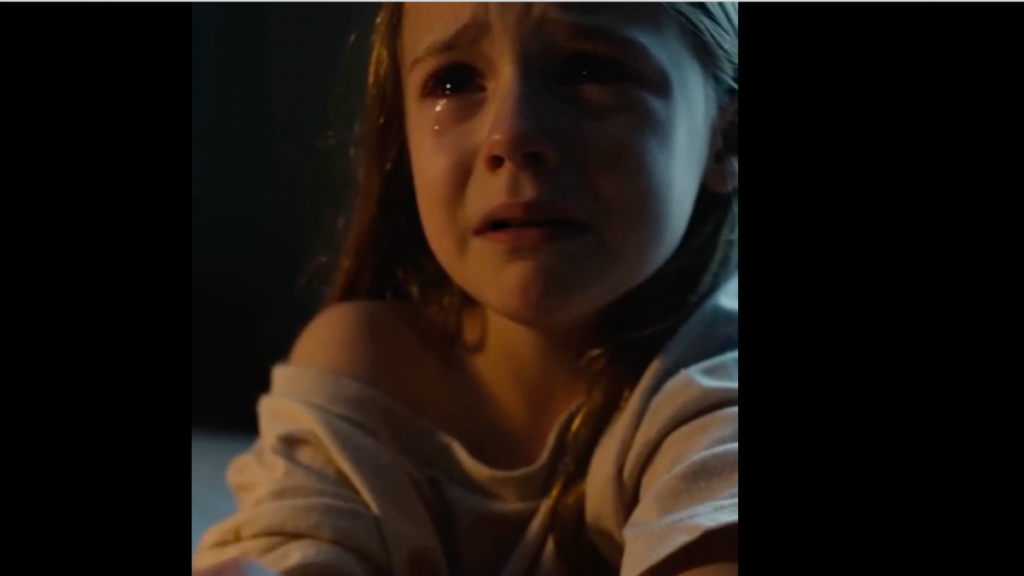
She wore a long-sleeved sweatshirt even though it was June and the room was warm. The sleeves hung past her wrists. Her dark curls, usually wild and impossible to tame, were pulled back in a crooked ponytail. Her face looked smaller than I remembered, paler, with shadows under her eyes that had no place on a seven-year-old child.
“Daddy,” she whispered.
That one word broke me.
I crossed the room and dropped to my knees in front of her, careful not to grab her too fast, though every instinct in me wanted to pull her into my arms and never let go.
“Hey, my little star,” I said, forcing my voice to stay soft. “I missed you so much.”
She looked at me.
Then at the door.
Then back at me.
“Is Mommy gone?”
The question was so quiet I almost didn’t hear it.
“Yes,” I said slowly. “She just left.”
Valentina’s lips trembled.
“Gone gone?”
I felt the first true surge of fear.
“Yes. She left the house.”
Only then did my daughter move.
She stepped into me with a sound that was not quite a sob and not quite a breath. Her little arms wrapped around my neck, but loosely at first, like she was testing whether it was safe. Then all at once, she collapsed against me.
I held her.
I held her so carefully.
Her whole body was shaking.
“Valentina,” I whispered into her hair. “What happened?”
She shook her head against my shoulder.
“It’s okay,” I said. “You can tell me anything.”
Her fingers twisted into the back of my jacket.
“I can’t.”
Two words.
That was all.
I closed my eyes.
I had negotiated with investors in three languages. I had sat across tables from men who would have smiled while bankrupting my family. I had signed contracts worth more money than my grandparents had ever seen in their lives.
But nothing had ever frightened me like my child saying, “I can’t.”
“Why not?”
She pulled back just enough to look at me.
Her eyes were enormous.
“Because she said nobody would believe me.”
My mouth went dry.
The room seemed to tilt.
“Who said that?”
Valentina didn’t answer.
She only looked at the door again.
I turned my head toward the hallway. Empty. Silent.
“Mommy?” I asked, though I already knew.
Her chin quivered.
I took both her hands gently in mine.
That was when she flinched.
Not a dramatic flinch. Not the kind adults pretend not to notice.
It was small and automatic.
The moment my fingers touched her wrists, she jerked back as if I had burned her.
I froze.
“Did I hurt you?”
She shook her head too quickly.
“No.”
“Valentina.”
“No, Daddy. Please.”
Her voice cracked on the word please.
I looked down at her sleeves.
Long sleeves.
In June.
In a warm, dark bedroom.
I reached again, slower this time, stopping before I touched her.
“Sweetheart,” I said, and my voice no longer sounded like mine. “Can you show me your arms?”
She backed away.
“No.”
“I won’t be angry.”
“No.”
“I promise.”
Her breathing started to change. Too fast. Too shallow. Panic rising in her tiny chest while she looked around the room as if searching for someplace to disappear.
“I’m not supposed to,” she said.
The words came out like a rule she had memorized.
I swallowed hard.
“Says who?”
She pressed her lips together.
The answer was already in the room with us.
I sat back on my heels and forced myself not to move. Forced myself not to let the rage show on my face, because rage would only teach her that the truth was dangerous.
“Okay,” I said softly. “Okay. You don’t have to show me right now.”
Her shoulders lowered the smallest amount.
“But I need to ask you something,” I continued. “Are you hurt?”
She looked at the floor.
No answer.
“Valentina.”
A tear slipped down her cheek.
She nodded.
Something inside me cracked so cleanly I could almost hear it.
“Where?”
She hugged herself.
I looked at the sweatshirt again. At the way the fabric bunched around her arms. At the way she stood with one side of her body slightly turned away from me, protecting it.
My daughter had been hiding in her own bedroom like a prisoner.
And her mother had walked out the door in a hurry.
“I need to see,” I said, barely above a whisper.
Valentina began to cry.
Not loudly. That would have been easier.
She cried silently, tears falling down her face while her mouth stayed closed, like she had learned that even pain had to be quiet.
“I’m sorry,” she said.
I almost fell apart right there.
“No,” I said immediately. “No, no, no. You don’t apologize. You never apologize for being hurt.”
Her eyes searched mine, desperate and terrified.
“She said you’d send me away.”
I stared at her.
“What?”
“She said if I told, you’d think I was bad and you’d send me away.”
For a second, I could not breathe.
Then I stood, walked to the bedroom door, and closed it.
Not because I wanted her trapped.
Because I wanted her to know nobody else was coming in.
I turned back to my daughter and lowered myself onto the floor, sitting cross-legged in front of her like I used to when she was small and we built towers out of wooden blocks.
“Listen to me,” I said. “Look at me, Valentina.”
She did.
“You are my daughter. You are my heart. There is nothing you could say, nothing you could show me, nothing anyone could tell me that would make me send you away.”
Her face crumpled.
“Promise?”
“I swear on my life.”
She stood there for several long seconds.
Then, with trembling fingers, she reached for the hem of her sweatshirt.
I had thought I was prepared.
I was not.
She lifted the fabric only a few inches at first, then stopped, sobbing too hard to continue. I helped her only when she gave the smallest nod. The sweatshirt came up slowly.
And there, beneath the clothes her mother had chosen for her, beneath the silence and the fear and the lies, was the secret my seven-year-old daughter had been forced to hide.
I saw the marks.
I saw the bruises.
I saw enough to understand that what had happened in my house while I was away was not an accident.
And then Valentina whispered the sentence that turned my blood to ice.
“Mommy said next time, she won’t miss.”
For a moment, I genuinely thought I had misheard her.
The room seemed to narrow until there was nothing left except my daughter’s face and the roaring sound of blood in my ears.
“…What did you say?”
Valentina’s eyes immediately darted toward the door again.
The fear in that glance was worse than the bruises.
Children could be frightened of punishment. They could be frightened of getting in trouble. They could be frightened of disappointing a parent.
This was different.
This was the fear of someone who believed a threat.
“Mommy was angry,” she whispered.
I forced myself to breathe.
One breath.
Then another.
I had spent years building a life based on control. Control of my emotions. Control of negotiations. Control of crises.
But at that moment, all I wanted to do was get in my car, find Patricia, and drag the truth out of her with my bare hands.
Instead, I focused on Valentina.
“What happened?”
Her little fingers twisted together.
“I spilled juice.”
I stared at her.
“Juice?”
She nodded.
“It got on the sofa.”
The sofa.
A cream-colored designer sofa Patricia had purchased three years ago after seeing it in an Italian architecture magazine.
The sofa she treated better than most people.
The sofa she once made a housekeeper cry over because a decorative pillow had been placed at the wrong angle.
“Valentina,” I said carefully, “did Mommy hit you because you spilled juice?”
She started crying again.
I immediately regretted the question.
Children didn’t cry like that when they were exaggerating.
Children didn’t shake like that when they were inventing stories.
“She said I ruin everything.”
The words shattered me.
Because they sounded rehearsed.
Like something she had heard many times.
“She said she can’t have one nice thing because of me.”
I closed my eyes.
My stomach churned.
“How long?”
She frowned.
“How long what?”
“How long has Mommy been saying things like that?”
Her face changed.
And in that instant, I knew the answer wasn’t days.
Or weeks.
The answer was long enough that she didn’t even understand why I was asking.
“Sometimes,” she said quietly.
The room felt colder.
I looked again at the bruises on her side.
There were several.
Different colors.
Some fresh.
Some older.
Not one incident.
Not one bad day.
A pattern.
God help me, a pattern.
I felt sick.
“Sweetheart,” I said carefully. “Did Mommy do this?”
Valentina didn’t answer.
She didn’t need to.
The tears told me everything.
I pulled my phone from my pocket.
Immediately she panicked.
“No!”
I froze.
“It’s okay.”
“No, Daddy, please!”
“Valentina—”
“She’ll know!”
The terror in her voice was so intense that she nearly hyperventilated.
I put the phone down immediately.
“Okay. Okay. I’m not calling her.”
She was shaking uncontrollably now.
I moved slowly, keeping my voice calm.
“You’re safe.”
“No.”
“Yes.”
“No.”
The word came out automatically.
Instinctively.
Like she no longer believed safety existed.
I swallowed hard.
“Valentina.”
Her eyes met mine.
“Mommy isn’t here.”
“She comes back.”
I had no response to that.
Because she was right.
As far as Valentina knew, Patricia always came back.
And if her mother had been hurting her for months—or longer—then why would today be any different?
I realized something then.
Something horrifying.
My daughter wasn’t relieved because I was home.
She was relieved because she thought I might be able to stop it.
The realization nearly broke me.
I stood and walked to the dresser.
Inside the top drawer was a small notebook decorated with stars.
Valentina’s journal.
I remembered buying it for her at a bookstore near Passeig de Gràcia.
At the time she’d filled it with drawings of unicorns and cats.
“Can I see this?”
She hesitated.
Then nodded.
I opened it.
The first few pages were exactly what I expected.
Crayon drawings.
School friends.
A crooked picture of our dog that had died two years earlier.
Then I reached a page that made my heart stop.
A stick figure.
A little girl.
A large woman.
The woman was colored entirely in black marker.
The girl was crying.
Above them, written in a child’s uneven handwriting, were four words.
MOMMY IS MAD AGAIN.
I turned the page.
Another drawing.
Another crying girl.
This time the woman was holding something.
A belt.
I felt my hands begin to shake.
Another page.
The little girl hiding beneath a bed.
Another page.
A woman standing outside a locked door.
Another page.
The same words repeated over and over.
DON’T TELL DADDY.
DON’T TELL DADDY.
DON’T TELL DADDY.
I stopped breathing.
Valentina was watching me.
Waiting.
Judging my reaction.
Trying to determine whether she had made a terrible mistake.
I set the notebook down carefully.
Then I looked at her.
“Has anyone else seen these?”
She shook her head.
“Did Mommy know you drew them?”
“No.”
“Where do you keep this?”
She pointed beneath a loose board under her bookshelf.
A hiding place.
My seven-year-old had created a hiding place.
I wanted to scream.
Instead I sat beside her.
“Valentina.”
She stared at the floor.
“Have you ever told anyone?”
“No.”
“A teacher?”
“No.”
“A friend?”
“No.”
“Grandma?”
“No.”
“Why?”
She looked confused.
The question genuinely puzzled her.
Because in her mind, the answer was obvious.
“Because Mommy said.”
I pressed my hands against my face.
Every abuser relied on secrecy.
Every one.
But hearing that obedience come from a child was unbearable.
“What exactly did she tell you?”
Valentina swallowed.
“She said families have secrets.”
My chest tightened.
“She said people wouldn’t understand.”
I listened.
“She said if I told anybody, they’d take me away.”
The manipulation was meticulous.
Deliberate.
Calculated.
Not an accident.
Not losing her temper.
Not one moment of bad judgment.
A system.
A prison built inside a child’s mind.
“Did she ever hurt you somewhere else?”
Valentina hesitated.
Then slowly nodded.
I felt physically ill.
“How?”
Her voice dropped so low I could barely hear it.
“She grabs.”
“Where?”
“My arm.”
“Anywhere else?”
She didn’t answer.
Instead she looked away.
That silence was answer enough.
I stood so quickly my knees hit the edge of the desk.
The notebook slid onto the floor.
I couldn’t stay still anymore.
I paced across the room.
One end.
Then the other.
Trying desperately to think.
Police.
Hospital.
Lawyer.
Photographs.
Documentation.
Evidence.
The rational part of my brain was screaming instructions.
The emotional part wanted to burn the world down.
Then something occurred to me.
Something that made me stop cold.
“Valentina.”
She looked up.
“When did this happen?”
“The bruises?”
“Yes.”
“Yesterday.”
My heart dropped.
Yesterday.
Patricia had done this yesterday.
Then smiled at me twenty minutes ago.
Then gone to the salon.
Then acted annoyed that I was asking questions.
I walked to the window and pulled the curtain aside.
Patricia’s car was gone.
The driveway sat empty.
The sun was beginning to set beyond the neighboring rooftops.
I was already reaching for my phone again when I noticed something outside.
A silver SUV.
Parked across the street.
Engine running.
I frowned.
The vehicle looked familiar.
Very familiar.
Too familiar.
Then I recognized it.
Patricia’s friend Sonia drove a silver SUV exactly like that.
The same woman who constantly covered for Patricia.
The same woman who had testified during parts of our custody battle.
The same woman who swore Patricia was a devoted mother.
The SUV had been sitting there long enough for condensation to form on the windshield.
Watching the house.
Watching my house.
A chill crawled down my spine.
I looked closer.
The driver’s seat was occupied.
Someone was inside.
And the second I stepped nearer to the glass, the SUV pulled away.
Not quickly.
Not dramatically.
Just smoothly.
As if whoever had been watching had seen enough.
I turned back toward Valentina.
A terrible possibility was beginning to form.
How many people knew?
How many people had seen signs and looked away?
How many adults had helped Patricia maintain her perfect image while my daughter suffered behind closed doors?
Then Valentina said something that made every hair on my arms stand up.
“Daddy?”
I looked at her.
“What’s wrong?”
She seemed uncertain.
Like she wasn’t sure whether she should tell me.
“Mommy wasn’t alone yesterday.”
My pulse exploded.
“What?”
“There was a man.”
The room went silent.
“What man?”
She shrugged nervously.
“I don’t know.”
“What did he look like?”
“He had a beard.”
A beard.
Not exactly helpful in Barcelona.
But then she added one more sentence.
One sentence that changed everything.
“He told Mommy she had to be more careful because the last little girl almost ruined everything.”
The words hung in the air.
For several seconds, I simply stared at my daughter.
I was certain I had misunderstood.
“…What did he say?”
Valentina shifted nervously on the edge of the bed.
“The man.”
“Yes.”
“He said she had to be careful.”
“Careful about what?”
She frowned, trying to remember.
Children often remembered details adults overlooked. Not because they understood them, but because they didn’t know which parts were important.
“He said…” She paused. “He said the last little girl almost ruined everything.”
The room felt suddenly too small.
Too warm.
Too quiet.
“What little girl?”
“I don’t know.”
“Did he say a name?”
She shook her head.
“No.”
“Have you seen him before?”
Another pause.
Then a slow nod.
My stomach dropped.
“How many times?”
“I don’t know.”
“More than once?”
“Yes.”
I sat down heavily in the desk chair.
A strange pressure had begun building behind my eyes.
This story was changing shape.
Five minutes earlier, I thought I had come home to discover a terrible secret involving my ex-wife and my daughter.
Now there was an unknown man.
An unknown child.
And a sentence that sounded less like a family problem and more like a threat.
“What was Mommy doing when he said that?”
Valentina stared at the floor.
“She was crying.”
That surprised me.
Patricia crying?
Patricia rarely cried.
Not real tears.
She weaponized tears. Performed tears.
But genuine fear?
That was different.
“What happened after he said it?”
“He grabbed her arm.”
I felt another jolt.
“Like this?”
I gently held my own forearm.
Valentina nodded.
“Was he angry?”
“Yes.”
“Did he yell?”
“Yes.”
“What about?”
She squeezed her eyes shut.
Trying to remember.
“He said she was stupid.”
My jaw tightened.
“And?”
“He said she was getting sloppy.”
A chill ran through me.
Not emotional language.
Operational language.
The language of someone worried about being exposed.
I suddenly became very aware of how little I actually knew.
Patricia and I had been divorced for nearly two years.
I knew where she lived.
I knew where she shopped.
I knew what restaurants she liked posting on social media.
But I had stopped knowing her life.
Who she spent time with.
Who she trusted.
Who she feared.
And apparently, who she brought around my daughter.
My daughter.
The realization ignited fresh rage.
I stood again and paced.
The lawyer in me—because years of corporate negotiations had trained me to think strategically—was beginning to overpower the father.
Good.
I needed both.
The father wanted revenge.
The strategist wanted evidence.
Evidence won.
Every time.
“Valentina.”
She looked up.
“I need to ask you some difficult questions.”
She nodded hesitantly.
“Has Mommy ever taken you somewhere and told you not to tell me?”
The answer came immediately.
“Yes.”
I stopped pacing.
“Where?”
She shrugged.
“I don’t know.”
“Can you describe it?”
She thought for a moment.
“There were bunk beds.”
The room seemed to tilt.
“Bunk beds?”
“Yes.”
“How many?”
“A lot.”
My pulse quickened.
“Were there other children there?”
She nodded.
“How many?”
“I don’t know.”
“Ten?”
“Maybe.”
Twenty?”
“Maybe.”
My mouth went dry.
“Did they live there?”
“I think so.”
The pressure behind my eyes became unbearable.
“What was this place?”
She looked confused.
“I don’t know.”
“Did Mommy work there?”
“No.”
“Did the man with the beard go there?”
Her face immediately changed.
“Yes.”
My heart slammed against my ribs.
“How often?”
“I don’t know.”
“What happened there?”
Valentina’s expression became distant.
Not scared.
Worse.
Detached.
The way people look when remembering something they don’t want to revisit.
“We brought things.”
“What things?”
“Toys.”
“Toys?”
“And clothes.”
I stared at her.
“Why?”
She shrugged.
“Mommy said we were helping.”
That sounded innocent.
Normal.
Almost reassuring.
Then I noticed something.
Valentina wasn’t looking at me anymore.
She was staring at the corner of the room.
Children often did that when they were trying not to think about something.
“Valentina.”
Silence.
“Sweetheart.”
She swallowed.
“Some kids cried.”
The room went still.
“Why?”
“I don’t know.”
“Did anyone hurt them?”
“I don’t know.”
“Did they look hurt?”
A long pause.
Then a tiny nod.
I closed my eyes.
The image forming in my mind was becoming darker by the minute.
And I still had no proof.
Just fragments.
Pieces.
A frightened child describing things she didn’t understand.
I needed facts.
Real facts.
Then I remembered something.
The house security system.
I opened my eyes.
Of course.
The cameras.
The property had cameras covering every entrance.
Patricia hated them.
Complained about them constantly.
But I had insisted after several burglaries in the neighborhood years ago.
If Patricia had brought someone to the house yesterday…
The footage might still exist.
My heart raced.
I pulled out my phone.
This time I ignored Valentina’s nervous glance.
“I’m checking the cameras,” I said gently.
“Okay.”
The app loaded.
Front gate.
Driveway.
Back garden.
Side entrance.
I selected yesterday’s recordings.
The wheel spun.
Then loaded.
12:14 PM.
Patricia’s car arriving.
Nothing unusual.
I fast-forwarded.
2:36 PM.
The front gate opened.
A black Mercedes entered.
Not silver.
Not Sonia.
Someone else.
The vehicle stopped near the front entrance.
A man stepped out.
Even through the grainy footage, I immediately recognized the beard.
Valentina had described him perfectly.
Tall.
Broad shoulders.
Dark sunglasses.
Maybe fifty years old.
He moved with confidence.
The confidence of someone who believed he belonged there.
I watched him enter the house.
Then I fast-forwarded again.
Three hours later, the front door burst open.
My stomach clenched.
Patricia emerged.
Crying.
Actually crying.
The man followed her.
He grabbed her arm.
Exactly as Valentina had described.
Even through the camera footage, I could see the violence in the movement.
Not enough to leave evidence.
Enough to establish dominance.
Patricia jerked away.
The man stepped closer.
They argued.
No audio.
Just body language.
Threatening.
Aggressive.
Then the man pointed toward the house.
Toward where my daughter would have been.
Patricia visibly recoiled.
A few seconds later, he left.
I replayed the footage twice.
Three times.
Four times.
Every viewing raised more questions.
Until finally I zoomed in.
And saw something that made my blood freeze.
The man’s face.
Not completely.
Just enough.
Enough to recognize him.
I knew exactly who he was.
Because six months earlier I had shaken his hand.
At a charity gala.
A children’s charity gala.
His name was Javier Solano.
One of Barcelona’s most celebrated philanthropists.
A man whose foundation supposedly helped vulnerable children across Spain.
A man featured in magazines.
On television.
At fundraisers.
A man politicians lined up to be photographed with.
My pulse thundered.
No.
No.
That couldn’t be right.
I enlarged the image again.
Same face.
Same beard.
Same man.
The room began spinning.
“Daddy?”
Valentina’s voice sounded far away.
I stared at the screen.
The last little girl almost ruined everything.
The words echoed through my head.
A children’s foundation.
A mysterious building full of kids.
A wealthy philanthropist.
An angry secret meeting.
And my ex-wife somehow tangled in the middle of it.
Then my phone rang.
The sound nearly made me jump.
An unknown number.
I hesitated.
Then answered.
“Hello?”
For several seconds, there was only silence.
Then a woman’s voice.
Soft.
Shaking.
Terrified.
“Is this Adrián Moreno?”
“Yes.”
Another pause.
“You don’t know me.”
“Who is this?”
The woman inhaled sharply.
As if fighting tears.
“I used to work for Javier Solano.”
Every muscle in my body tightened.
“What do you want?”
“You need to listen very carefully.”
Her voice was breaking now.
Panicked.
Rushed.
Like someone running out of time.
“Your daughter isn’t the first child.”
The blood drained from my face.
“What?”
“I saw things.”
“What things?”
“Things they told me to forget.”
My grip tightened on the phone.
“Who is they?”
The woman didn’t answer.
Instead she asked a question.
A question that made my heart stop.
“Have you taken your daughter to a doctor yet?”
“No.”
“Then stop talking and go.”
Fear exploded through me.
“Why?”
The woman began crying.
Actual sobbing.
The sound was horrific.
Because it carried the weight of someone who already knew the answer.
“Because if your daughter has the same symptoms as the others,” she whispered, “you have less than forty-eight hours.”
The call ended.
Just like that.
No explanation.
No goodbye.
No chance for me to ask another question.
One second I was listening to a terrified stranger breathe into the phone, and the next I was staring at my own reflection in a black screen.
Less than forty-eight hours.
My heart was hammering so hard I could feel it in my throat.
“Daddy?”
Valentina’s voice snapped me back.
I looked at her.
She was sitting on the edge of the bed, clutching a stuffed rabbit to her chest.
The same rabbit she’d had since she was three.
The same rabbit she’d carried through fevers, thunderstorms, and the night our divorce papers were finalized.
She looked impossibly small.
And suddenly every second felt dangerous.
I moved.
Fast.
“Get your shoes.”
Her eyes widened.
“Why?”
“We need to go somewhere.”
“Where?”
“The hospital.”
The word frightened her immediately.
“No.”
I knelt in front of her.
“Listen to me. You’re not in trouble.”
“I don’t want shots.”
“You might not need any.”
“Mommy says hospitals are dangerous.”
Of course she did.
Because hospitals ask questions.
Hospitals document injuries.
Hospitals create records.
Records become evidence.
Evidence destroys lies.
I forced a smile.
“Mommy is wrong.”
Valentina studied my face.
Then, for the first time since I’d come home, she seemed to believe me.
A little.
Only a little.
But enough.
“Okay.”
Ten minutes later we were in my car.
I had thrown together a bag with clothes, her journal, my laptop, and copies of the security footage uploaded to cloud storage.
The moment I backed out of the driveway, another realization hit me.
I didn’t trust anyone.
Not Patricia.
Not her friends.
Not whoever Javier Solano really was.
And definitely not the police—not yet.
Not until I understood what was happening.
People with Javier’s money had lawyers.
Connections.
Influence.
If I made one wrong move, evidence could disappear.
Witnesses could vanish.
Stories could change.
I needed facts first.
The pediatric emergency department at Hospital Sant Joan de Déu was crowded despite the hour.
Children with broken arms.
Children with fevers.
Exhausted parents.
The normal chaos of a hospital.
And somehow that normalcy made me feel safer.
Doctors dealt with facts.
Facts couldn’t be manipulated forever.
A nurse brought us into an examination room.
Within minutes a pediatrician named Dr. Ruiz arrived.
She was probably in her forties, calm-eyed and direct.
The kind of person who immediately earned trust.
She smiled at Valentina.
Then looked at me.
“What seems to be the problem?”
I opened my mouth.
Nothing came out.
Because suddenly saying it aloud made it real.
“My daughter has bruises.”
The doctor’s expression changed instantly.
Professional.
Alert.
Serious.
“Can you tell me how she got them?”
I looked at Valentina.
Then back at the doctor.
“I think her mother caused them.”
The room went silent.
Dr. Ruiz nodded slowly.
“Okay.”
No shock.
No disbelief.
No judgment.
Just okay.
“We’ll take very good care of her.”
For the next hour, they examined Valentina carefully.
Gently.
Patiently.
The doctor never pushed.
Never pressured.
And slowly, piece by piece, my daughter began talking.
Not everything.
But enough.
Enough for Dr. Ruiz to stop writing several times and simply stare at the page.
Enough for a social worker to be called.
Enough for concern to spread across every face that entered the room.
Then something unexpected happened.
Dr. Ruiz returned holding a file.
She looked troubled.
Not concerned.
Troubled.
“Mr. Moreno.”
My stomach tightened.
“Yes?”
“Has your daughter been sick recently?”
“No.”
“Fatigue?”
“No.”
“Dizziness?”
“Not that I’ve noticed.”
“Headaches?”
I frowned.
“Maybe.”
The doctor looked at Valentina.
“Sweetheart, do you get headaches?”
A tiny nod.
“How often?”
“Lots.”
The doctor’s expression darkened.
“How long?”
“Since Christmas.”
Christmas.
Six months.
My chest tightened.
“Why are you asking?” I said.
Dr. Ruiz sat down.
Then she said something that made my blood run cold.
“There are bruises that concern me.”
I stared at her.
“Because of abuse?”
“No.”
The answer shocked me.
“Then what?”
She took a breath.
“Some bruising patterns can indicate underlying medical conditions.”
The room seemed to tilt.
“What kind of conditions?”
She chose her words carefully.
Too carefully.
“Blood disorders.”
My heart dropped.
“No.”
“We don’t know yet.”
“No.”
“We need tests.”
I felt sick.
The anonymous caller’s words echoed inside my head.
Have you taken your daughter to a doctor yet?
Less than forty-eight hours.
Not abuse.
Not just abuse.
Something else.
Something worse.
The tests began immediately.
Blood work.
Additional examinations.
Questions.
More questions.
Hours passed.
Night settled over Barcelona.
Valentina eventually fell asleep in a hospital bed.
I sat beside her.
Watching.
Waiting.
Terrified.
At 11:43 PM, Dr. Ruiz returned.
She wasn’t alone.
Another doctor entered with her.
Older.
Hematology specialist.
My stomach sank.
Doctors brought specialists when things were bad.
“Mr. Moreno,” Dr. Ruiz said quietly.
“Tell me.”
The specialist sat down.
“Your daughter’s blood counts are abnormal.”
I couldn’t breathe.
“How abnormal?”
He opened a folder.
Then closed it again.
Like he couldn’t decide how to say what came next.
“We need further testing before we make a diagnosis.”
“Diagnosis of what?”
Silence.
Then:
“Leukemia is one possibility.”
The world stopped.
Everything.
The room.
The sounds.
My thoughts.
Everything.
“No.”
My voice barely existed.
“No.”
“We don’t know yet.”
“No.”
“It may be something else.”
“No.”
I looked at my sleeping daughter.
At her curls against the pillow.
At the stuffed rabbit under her arm.
At her tiny hand resting on the blanket.
And for the first time in years, I felt completely powerless.
Then the specialist said something strange.
Something that cut through the panic.
“There’s another reason we’re concerned.”
I looked up.
“What?”
He exchanged a glance with Dr. Ruiz.
Then answered.
“Some of the results don’t fit.”
I stared at him.
“What does that mean?”
“Leukemia explains some findings.”
“Some?”
“Yes.”
“What about the others?”
The doctor hesitated.
A bad sign.
A very bad sign.
Finally he spoke.
“We found elevated levels of a substance in her blood.”
“Which substance?”
Neither doctor answered immediately.
My pulse accelerated.
“What substance?”
The specialist opened the folder again.
“Arsenic.”
The word didn’t register.
Not at first.
It felt disconnected.
Meaningless.
Then my brain caught up.
Arsenic.
Poison.
Poison.
Poison.
I stood so quickly the chair crashed backward.
“No.”
Neither doctor moved.
Neither doctor spoke.
Because they didn’t need to.
My daughter’s bruises.
The headaches.
The fatigue.
The caller.
The children.
The foundation.
The last little girl almost ruined everything.
All the puzzle pieces suddenly snapped together.
And I hated the picture they formed.
“Are you saying someone poisoned my daughter?”
The silence answered before either doctor could.
Then Dr. Ruiz nodded.
Very slowly.
“Yes.”
The room began spinning.
“Can you treat it?”
“Yes.”
The word nearly made me collapse with relief.
“But?”
She looked away.
Doctors always had a but.
“Tell me.”
“We caught it relatively early.”
“Relatively?”
“Yes.”
My stomach twisted.
“Tell me the truth.”
The doctor inhaled.
Then delivered the sentence that changed everything.
“If she’d arrived two or three days later, she likely wouldn’t have survived.”
I couldn’t speak.
Couldn’t move.
Couldn’t think.
Because suddenly I understood why that woman had called.
Why she had been crying.
Why she’d sounded so desperate.
She wasn’t warning me about abuse.
She was warning me about murder.
And whoever had poisoned my daughter believed they were still getting away with it.
Then my phone buzzed.
A text message.
Unknown number.
One photograph.
Nothing else.
My blood froze.
The picture showed a little girl.
Maybe eight years old.
Dark hair.
Brown eyes.
Smiling.
A school portrait.
Across the image, someone had typed four words.
SHE WAS THE LAST ONE.
Beneath the photograph was a second message.
Three words.
YOU’RE NEXT.
For a moment, I couldn’t move.
The photograph filled the screen.
The smiling girl looked ordinary.
That’s what made it horrifying.
She wasn’t a missing-person poster.
She wasn’t a news headline.
She wasn’t some dramatic image pulled from a crime documentary.
She looked like a child who should have been arguing about homework and cartoons and what flavor ice cream to get after school.
Instead, someone had sent me her picture as a warning.
Or a confession.
Or both.
Dr. Ruiz was still talking.
I barely heard her.
“…Mr. Moreno?”
I looked up.
The doctors were watching me.
Concerned.
“What is it?”
Without speaking, I handed over the phone.
Dr. Ruiz studied the image.
Then the message.
Her face went white.
The hematologist immediately pulled out his own phone.
“I’m calling hospital security.”
“No,” I said automatically.
Both doctors looked at me.
“No?”
I ran a hand through my hair.
My thoughts were racing.
If this was connected to Javier Solano…
If wealthy people were involved…
If children had already died…
Then this was bigger than a custody dispute.
Bigger than abuse.
Potentially much bigger than the police officer who happened to answer a phone call tonight.
Then I looked at my sleeping daughter.
And realized I was thinking like a businessman again.
Not a father.
A father protected his child first.
Everything else came later.
“Call them.”
The doctor nodded.
Within minutes, security arrived.
Then local police.
Then more questions.
So many questions.
I showed them the bruises.
The journal.
The security footage.
The text messages.
The anonymous call.
The officer taking notes eventually stopped writing.
He looked exhausted.
Overwhelmed.
“Mr. Moreno.”
“Yes.”
“Do you understand how serious these allegations are?”
“Yes.”
“Do you understand who Javier Solano is?”
“Yes.”
The officer exchanged a look with his partner.
I knew that look.
Everybody in Barcelona knew Javier.
Everybody.
He funded children’s hospitals.
Built schools.
Hosted charity galas.
Appeared in magazines.
If I accused him publicly tomorrow, half the city would assume I was lying.
Maybe more.
Then a detective arrived.
Not a patrol officer.
A detective.
Middle-aged.
Sharp eyes.
No nonsense.
She introduced herself as Inspector Elena Navarro.
The moment she entered the room, everything changed.
She listened.
Really listened.
She didn’t interrupt.
Didn’t dismiss.
Didn’t rush.
She spent nearly forty minutes reviewing everything.
Then she asked one question.
“May I see the photo again?”
I handed over my phone.
She stared at the smiling girl.
Longer than anyone else had.
Far longer.
Something in her face changed.
“Inspector?”
She looked up slowly.
“Where did you get this image?”
“The text message.”
“No.”
Her voice was different now.
Tighter.
Controlled.
“The photograph itself.”
“I don’t know.”
The inspector inhaled sharply.
Then sat down.
For the first time all evening, she looked shaken.
“What’s wrong?”
Silence.
Then:
“I know who she is.”
Every muscle in my body tightened.
“What?”
The inspector looked at the picture again.
“She disappeared three years ago.”
The room went silent.
“She what?”
“Her name was Clara Vidal.”
I stared at her.
“She was reported missing at age eight.”
The words felt unreal.
“Missing?”
“Yes.”
“Was she ever found?”
The inspector didn’t answer immediately.
And that answer was enough.
“No.”
The detective slowly shook her head.
“No.”
A terrible feeling spread through my chest.
The smiling girl.
The message.
She was the last one.
Not a threat.
A statement.
Whoever sent that text knew exactly what happened to her.
Then Inspector Navarro said something even worse.
“She wasn’t the only one.”
The room seemed to shrink.
“What?”
The inspector leaned back.
“There have been four disappearances.”
My blood turned cold.
“Four?”
She nodded.
“All girls.”
Nobody spoke.
“All between seven and ten years old.”
The hematologist cursed quietly under his breath.
The inspector continued.
“They occurred over a five-year period.”
“Were they connected?”
“We could never prove it.”
“Why not?”
She laughed.
Not because anything was funny.
Because the alternative was rage.
“Because every lead disappeared.”
I immediately thought of money.
Influence.
Connections.
People protecting powerful people.
Then the inspector surprised me.
“Until tonight.”
My pulse quickened.
“What changed?”
She looked directly at me.
“You.”
I frowned.
“What does that mean?”
“Your daughter survived.”
The words landed like a bomb.
Because suddenly I understood.
Every other child had disappeared.
No witness.
No testimony.
No evidence.
No living victim.
But Valentina was alive.
Alive enough to talk.
Alive enough to identify people.
Alive enough to expose whatever this really was.
Then another thought hit me.
A horrifying thought.
“Does Patricia know?”
The inspector’s expression darkened.
“Know what?”
“That Valentina is alive?”
Nobody answered.
Because none of us knew.
Not yet.
But we all understood the implication.
If Patricia believed the poisoning was working…
If she believed her daughter was dying slowly…
Then tonight changed everything.
Because now there were blood tests.
Medical records.
Police reports.
Evidence.
Panic.
And desperate people made mistakes.
Suddenly a knock sounded at the hospital room door.
Everyone turned.
A nurse entered.
She looked nervous.
“Inspector?”
“Yes?”
“There is someone downstairs asking for Mr. Moreno.”
The room went still.
“Who?”
The nurse swallowed.
“His ex-wife.”
Every muscle in my body locked.
Patricia.
The inspector stood immediately.
“Absolutely not.”
The nurse nodded.
“She insists.”
“Of course she does.”
I stared at the detective.
“How did she know we were here?”
Nobody answered.
Because that question was terrifying.
The hospital hadn’t contacted her.
I hadn’t contacted her.
Valentina hadn’t contacted her.
Yet somehow she’d found us.
Which meant one thing.
Someone was watching.
Still.
The inspector’s phone rang.
She answered immediately.
Listened.
Then her expression changed.
Fast.
Very fast.
“Repeat that.”
Silence.
Then:
“When?”
More silence.
Then the inspector slowly lowered the phone.
The color had drained from her face.
“What happened?” I asked.
She looked at me.
“Javier Solano is dead.”
The room exploded with confusion.
“What?”
“He was found thirty minutes ago.”
Nobody moved.
Nobody breathed.
“How?”
The inspector swallowed.
“Single gunshot wound.”
My mind raced.
Dead?
Now?
Right when everything was starting to unravel?
It felt impossible.
Convenient.
Too convenient.
The detective seemed to be thinking the same thing.
“Where?”
“At his home.”
“Suicide?”
“No.”
The inspector’s eyes locked onto mine.
“Murder.”
The room fell silent.
Then came the next sentence.
The sentence that changed everything again.
“A witness saw a woman leaving the property.”
I already knew.
Before she said it.
Somehow I already knew.
“Who?”
The inspector opened her notebook.
Read a line.
Then looked up.
“The witness identified Patricia Moreno.”
For several seconds, nobody spoke.
Then, from the hospital bed behind us, came a tiny voice.
A frightened voice.
A voice none of us realized had been awake.
“Daddy?”
I turned.
Valentina was sitting upright.
Clutching her rabbit.
Wide-eyed.
Terrified.
“What is it, sweetheart?”
Tears began running down her cheeks.
She looked at the detective.
Then at me.
Then whispered the sentence that made every adult in the room go completely still.
“Mommy didn’t poison me.”
My heart stopped.
“What?”
Valentina’s lips trembled.
“It wasn’t Mommy.”
The detective stepped closer.
“Valentina,” she said gently, “who was it?”
My daughter stared at the floor.
And answered with a name none of us were expecting.
“Grandpa.”
For a second, I thought exhaustion had finally broken my brain.
Grandpa.
The word didn’t fit.
Nothing about it fit.
My father had been dead for eleven years.
Patricia’s father lived in Valencia and saw Valentina twice a year.
Neither possibility made sense.
Yet the reaction in the room told me I wasn’t the only one struggling to process it.
Inspector Navarro crouched beside the bed.
“Valentina,” she said gently, “which grandpa?”
My daughter wiped at her eyes.
“The nice one.”
That wasn’t remotely helpful.
But to a frightened seven-year-old, it probably made perfect sense.
“The nice one?” the inspector repeated.
Valentina nodded.
“The one at the house.”
Every muscle in my body tightened.
“What house?”
“The place with the bunk beds.”
The room fell silent.
The place with the bunk beds.
The mysterious building.
The children.
The toys.
The crying.
The foundation.
Suddenly, the pieces began moving again.
“Sweetheart,” I said carefully, “was he really your grandpa?”
She frowned.
“No.”
“Then why did you call him that?”
“Everybody did.”
A chill crawled up my spine.
Everybody called him Grandpa.
The inspector and I exchanged a look.
We were thinking the same thing.
Someone running a children’s facility.
Someone older.
Someone trusted.
Someone children would automatically obey.
“Can you tell us his name?”
Valentina thought hard.
Then slowly shook her head.
“I don’t know.”
“Did other children call him Grandpa?”
“Yes.”
“How many?”
“A lot.”
The answer landed like a stone.
A lot.
The inspector stood.
I could practically see her mind working.
Building timelines.
Searching old case files.
Connecting dots.
Then she turned to me.
“Mr. Moreno, I need a moment outside.”
I followed her into the hallway.
The second the door closed behind us, her professional mask cracked.
“Jesus Christ.”
“What?”
She ran a hand through her hair.
“Three years ago we had a witness.”
My pulse quickened.
“A witness?”
She nodded.
“One of the missing girls attended a charity retreat shortly before disappearing.”
“Which charity?”
The inspector didn’t answer.
She didn’t have to.
I already knew.
Javier Solano’s.
“The witness described an older man everyone called Grandpa.”
My stomach dropped.
“You knew about him?”
“We knew the nickname.”
“Then why wasn’t he investigated?”
The inspector laughed bitterly.
“Because nobody could identify him.”
I stared at her.
“What do you mean?”
“The witness was nine years old.”
I said nothing.
“She didn’t know his name.”
The inspector looked exhausted.
“She said he was old. She said he worked with the children. She said everyone called him Grandpa.”
“That’s it?”
“That was all we had.”
The realization hit me hard.
For years, investigators had been chasing shadows.
Meanwhile, whoever this man was had continued operating.
Continued hiding.
Continued accessing children.
Then another thought hit me.
A darker one.
“What if Javier wasn’t in charge?”
The inspector’s eyes met mine.
Exactly.
“What if he was just the face?”
The words hung between us.
Because suddenly that made far more sense.
A charismatic philanthropist.
Public-facing.
Media-friendly.
The perfect shield.
While someone else operated behind the scenes.
Someone children trusted.
Someone invisible.
Someone called Grandpa.
The inspector’s phone buzzed.
She checked the screen.
Then immediately stiffened.
“What?”
Her eyes narrowed.
“We found Patricia.”
My heart jumped.
“Where?”
“In custody.”
I waited.
“She’s demanding to speak with you.”
I almost laughed.
After everything?
After the bruises?
After the lies?
After the poisoning?
Now she wanted to talk?
“No.”
The answer came instantly.
The inspector didn’t argue.
Then her phone buzzed again.
Another message.
She read it.
Then looked up.
And for the second time that night, I watched the color leave her face.
“What now?”
The inspector swallowed.
“Patricia says she didn’t kill Javier.”
I stared at her.
“Of course she does.”
“No.”
The inspector shook her head.
“That’s not the important part.”
“What is?”
“She says Javier was already dead when she got there.”
The hallway suddenly felt much colder.
“What?”
“She claims someone called her.”
“Who?”
“She doesn’t know.”
“Convenient.”
“I agree.”
The inspector hesitated.
Then continued.
“But she knew something.”
My pulse accelerated.
“What?”
“She told detectives they need to stop looking at Javier.”
I stared at her.
“And?”
The inspector looked directly into my eyes.
“She said they need to find Grandpa before Grandpa finds Valentina.”
For several seconds, neither of us spoke.
Because if Patricia was telling the truth—even partially—then the situation was far worse than we’d imagined.
Javier wasn’t the mastermind.
Javier wasn’t the final piece.
Javier might not even have been the most dangerous person involved.
Someone else was still out there.
Someone who knew Valentina had survived.
Someone who now knew she could talk.
The realization hit me like a freight train.
“She’s not safe.”
The inspector immediately nodded.
“I know.”
“No, you don’t understand.”
“I do.”
“No.”
I stepped closer.
“If this organization poisoned children—”
“We don’t know that yet.”
“Yes, we do.”
The words came out harder than I intended.
The inspector didn’t argue.
Because she knew I was right.
“They poisoned my daughter.”
Silence.
“They threatened me.”
Silence.
“One child is already confirmed missing.”
“Four.”
“Exactly.”
I looked toward Valentina’s room.
Toward the sleeping child inside.
“They aren’t going to stop.”
The inspector followed my gaze.
“No.”
The honesty in her voice was terrifying.
Then another officer appeared at the end of the hallway.
Running.
Actually running.
The moment I saw his expression, my stomach dropped.
Bad news.
Very bad news.
“Inspector!”
She turned.
“What?”
The officer stopped in front of us, breathing hard.
“There’s been a problem.”
“What kind of problem?”
The officer looked around before lowering his voice.
“Hospital security footage.”
Every nerve in my body came alive.
“What about it?”
The officer swallowed.
“Someone accessed the pediatric wing thirty-seven minutes ago.”
The inspector frowned.
“Who?”
“We don’t know.”
“Show me.”
The officer handed over a tablet.
The inspector looked.
Then froze.
I knew immediately.
Whatever she was seeing was bad.
Very bad.
“What is it?”
She slowly turned the screen toward me.
The footage showed a hallway.
This hallway.
Outside Valentina’s room.
The timestamp was from earlier that evening.
Before security arrived.
Before police arrived.
Before anyone knew what was happening.
A man stood outside the room.
Motionless.
Watching the door.
My blood turned to ice.
Because I recognized him immediately.
Not Javier.
Not the bearded man.
Someone else.
Someone older.
Seventy, maybe seventy-five.
White hair.
Glasses.
Kind face.
The sort of grandfatherly face people trusted instinctively.
The sort of face children would never fear.
The sort of face that could walk into almost any room unnoticed.
Then the man looked directly into the camera.
And smiled.
Not a normal smile.
Not a friendly smile.
A smile that somehow felt personal.
Deliberate.
As if he knew someone would eventually watch this footage.
As if the smile itself was a message.
Then he raised one finger.
Pointed toward Valentina’s room.
And walked away.
The hallway became very quiet.
The inspector stared at the screen.
Then whispered:
“Oh my God.”
“What?”
She looked at me.
The fear in her eyes was unlike anything I’d seen all night.
Not concern.
Not uncertainty.
Recognition.
“You know him.”
It wasn’t a question.
She nodded slowly.
“Yes.”
My pulse thundered.
“Who is he?”
The inspector swallowed.
Then gave the answer.
The answer that shattered every remaining assumption.
“That,” she said quietly, “is Judge Luis Herrera.”
I stared at her.
The name meant nothing to me.
But her reaction told me it should.
“Who is that?”
The inspector looked almost sick.
“He’s the retired family court judge who approved every single custody placement connected to Javier Solano’s foundation.”
The world seemed to stop.
Every single placement.
Every child.
Every case.
Every disappearance.
All connected.
And the man everyone called Grandpa had been hiding in plain sight the entire time.
For several seconds, nobody moved.
The image of the smiling old man remained frozen on the tablet.
Judge Luis Herrera.
A retired family court judge.
A man who had spent decades deciding where vulnerable children would live.
Which homes they would enter.
Which adults they would trust.
Which futures they would have.
The implications were staggering.
And suddenly the nickname made perfect sense.
Grandpa.
Not because he was anyone’s grandfather.
Because he had spent years cultivating that image.
Kind.
Safe.
Trustworthy.
The grandfather figure.
The man everyone automatically trusted around children.
The inspector was already on her phone.
“Get me everything we have on Herrera.”
She listened.
“No, everything.”
Pause.
“Retirement records, financials, known associates, travel history. I don’t care how old it is.”
She hung up.
Then immediately dialed another number.
The machine was moving now.
Fast.
Very fast.
Good.
Because my instincts were screaming.
We were behind.
Terribly behind.
Someone had poisoned my daughter.
Someone had watched her hospital room.
Someone had sent me a photograph of a missing child.
And that someone clearly knew we were getting close.
Then the realization hit me.
The hospital room.
I turned.
“Valentina.”
The word came out like a shot.
I was already moving.
The inspector followed instantly.
We pushed through the door.
And stopped.
Valentina was still there.
Thank God.
Still asleep.
Still breathing.
Still holding the stuffed rabbit.
Relief flooded through me so violently my knees nearly buckled.
The inspector exhaled too.
Then we both noticed the envelope.
Sitting on the bedside table.
White.
Unmarked.
My stomach dropped.
Nobody had been near that table five minutes ago.
Nobody.
The inspector drew a sharp breath.
“Don’t touch it.”
Too late.
I had already stepped closer.
Not touching.
Just looking.
There was only one thing written on the front.
Valentina.
Nothing else.
No address.
No stamp.
No handwriting I recognized.
Just my daughter’s name.
The room suddenly felt suffocating.
“How did that get here?”
Nobody answered.
Because nobody knew.
Hospital security was supposed to be guarding the floor.
Police were everywhere.
Yet somehow someone had entered the room.
Or gotten close enough.
Again.
The inspector carefully slipped on gloves.
Then lifted the envelope.
Inside was a single sheet of paper.
Nothing more.
No fingerprints visible.
No signature.
Just a typed message.
The inspector read it.
Then went pale.
“What?”
She looked at me.
“Adrián…”
“What?”
Slowly, she handed me the page.
I read it.
Once.
Then again.
Then a third time.
Because my brain refused to accept what my eyes were seeing.
THE WRONG CHILD WAS POISONED.
The words seemed to vibrate on the page.
The wrong child.
Not a random victim.
Not an accident.
A target.
Specific.
Chosen.
My pulse exploded.
Below that sentence was another.
PATRICIA WAS NEVER SUPPOSED TO BRING HER.
I stared.
Then another line.
THEY WERE AFTER YOU.
The room tilted.
No.
No.
That didn’t make sense.
It couldn’t.
I read it again.
THEY WERE AFTER YOU.
My mouth went dry.
Someone wasn’t targeting Valentina.
Someone had been targeting me.
The inspector took the paper back.
Her face had gone completely expressionless.
A bad sign.
Very bad.
“What are you thinking?”
She didn’t answer immediately.
Because she was organizing the implications.
There were too many.
Finally she spoke.
“Tell me about your company.”
The question hit me like a slap.
“My company?”
“Yes.”
“What does that have to do with this?”
“Answer.”
I frowned.
“Technology consulting.”
“That’s what the website says.”
The way she said it made me uneasy.
“What are you asking?”
The inspector crossed her arms.
“What did your company actually do?”
My stomach tightened.
Not because I was hiding something.
Because suddenly I understood where her mind was going.
Years ago, before the consulting work, before Tokyo and investors and acquisitions, I had helped build compliance software for European financial institutions.
Nothing exciting.
Nothing glamorous.
But we handled data.
Massive amounts of data.
Cross-border transactions.
Financial records.
Audit trails.
The sort of information most people never saw.
The sort of information that occasionally revealed things people wanted hidden.
The inspector watched my face.
And immediately knew she’d hit something.
“What?”
I looked away.
“Four years ago we discovered irregularities.”
The room went silent.
“What kind?”
I swallowed.
“Charity money.”
The inspector’s eyes narrowed.
“What charity?”
I already knew.
Even before I said the name.
Because suddenly all the timelines were lining up.
All the puzzle pieces were snapping together.
“Javier Solano’s foundation.”
Nobody spoke.
Not for several seconds.
Then the inspector sat down.
Slowly.
As if she needed to.
“What happened?”
“We reported it.”
“To whom?”
“The board.”
“And?”
“An investigation was opened.”
My pulse accelerated.
“Nothing came of it.”
“Why not?”
I laughed bitterly.
Because I finally understood.
“They said it was a bookkeeping error.”
The inspector shook her head.
Of course they did.
“Did you believe that?”
“No.”
“Then why didn’t you pursue it?”
The question hit harder than she intended.
Because the answer was embarrassing.
Cowardly.
Human.
“I had a newborn daughter.”
Silence.
“I had a marriage falling apart.”
Silence.
“I had investors threatening lawsuits.”
Silence.
“I convinced myself it wasn’t my problem.”
The words tasted like poison.
The inspector nodded slowly.
Not judging.
Just listening.
“How much money?”
“Millions.”
Her eyes widened.
“Millions?”
“Yes.”
“Missing?”
“Unaccounted for.”
The distinction barely mattered.
Not anymore.
Then another realization struck me.
A realization so obvious I couldn’t believe I’d missed it.
“Patricia.”
The inspector looked up.
“What about her?”
“She knew.”
My heart was racing now.
“She knew everything.”
The inspector frowned.
“How?”
“Because she was there.”
“What?”
“She worked with me.”
The memory slammed into me.
Years ago.
Before the divorce.
Before everything collapsed.
Patricia had helped organize records during the audit.
She’d seen the same reports.
The same discrepancies.
The same suspicious transactions.
She’d known.
All along.
The inspector immediately stood.
“She wasn’t helping them.”
The words came out before I could stop them.
The detective stared.
“What?”
I shook my head.
Pieces were finally clicking into place.
Patricia’s fear.
The bruises.
The crying.
The argument with Javier.
The threat.
The poison.
“Patricia wasn’t helping them.”
“Adrián—”
“She was trapped.”
The room fell silent.
Because suddenly it fit.
Not perfectly.
But better.
Far better.
Patricia wasn’t protecting herself.
She was protecting Valentina.
Or trying to.
And somewhere along the way she’d failed.
Then my phone buzzed.
Again.
Unknown number.
Every person in the room froze.
I answered immediately.
“Hello?”
A man’s voice.
Calm.
Older.
Cultured.
The sort of voice people instinctively trusted.
“Mr. Moreno.”
Every hair on my arms stood up.
I knew.
Immediately.
Somehow I knew.
“Who is this?”
The man chuckled softly.
“Your daughter calls me Grandpa.”
The room went dead silent.
The inspector was already motioning for officers to trace the call.
I put the phone on speaker.
“Where are you?”
“Close.”
The answer came smoothly.
Too smoothly.
“Did you poison my daughter?”
Silence.
Then:
“No.”
I nearly screamed.
“Liar.”
“I’m many things, Mr. Moreno.”
The voice remained calm.
“I’m not a liar.”
The certainty in his tone was terrifying.
Then he said something that made my blood freeze.
“Your daughter was never supposed to be harmed.”
The exact same message from the note.
The wrong child.
The wrong target.
“What do you want?”
His answer came immediately.
“You.”
The room seemed to stop breathing.
“Why?”
A soft sigh.
Almost regretful.
“Because four years ago you saw something you weren’t supposed to see.”
My pulse thundered.
The audit.
The money.
The foundation.
Everything.
“You should have walked away.”
“I did.”
“No.”
The old man sounded disappointed.
“You remembered.”
I gripped the phone tighter.
“Where are the children?”
For the first time, the man laughed.
Not loudly.
Not crazily.
Just genuine amusement.
And somehow that was worse.
“Always the wrong question.”
My heart slammed against my ribs.
“What does that mean?”
The answer came quietly.
Almost kindly.
“The children were never the product.”
The room went completely still.
Every officer.
Every doctor.
Every detective.
Frozen.
Because suddenly we all understood.
Whatever this was…
Whatever operation had been hidden behind the foundation…
It was far bigger than anyone had imagined.
And then Grandpa delivered the final sentence before the line went dead.
The sentence that changed the entire investigation.
“Ask Patricia what happened on the island.”
The line went dead.
Ask Patricia what happened on the island.
For several seconds, nobody in the room spoke.
The inspector was already issuing orders.
“Lock down every entrance.”
Officers moved immediately.
“Trace every communication.”
More officers.
“Get me transport ready.”
Then she turned to me.
“We need to talk to Patricia.”
I nodded.
Because for the first time all night, I agreed.
An hour later, we sat across from Patricia in an interrogation room.
She looked nothing like the woman who had hurried out of my house that afternoon.
Her makeup was gone.
Her hair was a mess.
Her eyes were swollen from crying.
Real crying.
Not performance.
Not manipulation.
Fear.
Pure fear.
The moment she saw me, she broke.
“Is she alive?”
The question came out instantly.
Not hello.
Not how are you.
Not anything about herself.
“Is she alive?”
I stared at her.
“Yes.”
Patricia began sobbing.
The relief looked genuine.
And that scared me more than anything.
Because it meant she had believed Valentina might die.
The inspector slid a file across the table.
“Tell us about the island.”
Patricia immediately froze.
Every color drained from her face.
“No.”
The inspector leaned forward.
“Patricia.”
“No.”
“Your daughter was poisoned.”
Tears spilled down Patricia’s cheeks.
“I know.”
The room went silent.
I felt rage surge through me.
“You knew?”
Patricia looked at me.
And for the first time in years, I saw genuine shame in her eyes.
“Not at first.”
My fists clenched.
“What does that mean?”
She looked away.
Then whispered:
“They were supposed to poison you.”
The room became perfectly silent.
The exact same message.
The note.
The phone call.
Now Patricia.
All saying the same thing.
“Start talking,” the inspector said.
Patricia closed her eyes.
Then finally began.
Five years earlier, shortly after the financial audit, Javier Solano had approached her privately.
He knew about the discrepancies.
He knew she had seen them.
And he knew Adrián hadn’t completely forgotten them.
At first it was subtle.
Dinner invitations.
Fundraisers.
Networking events.
People trying to determine how much Adrián remembered.
How much Adrián had saved.
How much Adrián might eventually tell.
Then came the island.
A private retreat off the coast.
Exclusive.
Invitation-only.
Wealthy donors.
Politicians.
Judges.
Executives.
Philanthropists.
The people nobody questioned.
The people who controlled investigations instead of being investigated by them.
Patricia attended because Javier insisted.
And what she discovered there terrified her.
The foundation wasn’t built to make money.
Money was easy.
The foundation existed to gather secrets.
The room fell silent.
“What?”
Patricia nodded through tears.
“Secrets.”
The wealthy donated.
The powerful attended retreats.
Children from vulnerable families were brought into programs.
Background information was collected.
Personal information.
Medical information.
Financial information.
Everything.
The organization built files.
Massive files.
On everyone.
Judges.
Politicians.
Business leaders.
Anyone useful.
Anyone powerful.
Anyone vulnerable.
“Blackmail,” the inspector said quietly.
Patricia nodded.
“Yes.”
The children weren’t the product.
Information was.
Leverage was.
Control was.
The entire operation had been a machine for collecting power.
And anyone who became a threat disappeared.
Sometimes financially.
Sometimes professionally.
Sometimes permanently.
My stomach turned.
“What about the missing girls?”
Patricia broke down again.
“I don’t know.”
The answer sounded honest.
“I swear I don’t know.”
The inspector watched carefully.
Determining whether she was lying.
Finally she looked away.
Because Patricia probably wasn’t.
Not about that.
Then came the question none of us wanted to ask.
“Who killed Javier?”
Patricia immediately answered.
“Luis.”
The name landed like a bomb.
Judge Herrera.
Grandpa.
“He was losing control.”
Patricia’s voice shook.
“Javier wanted out.”
The room fell silent.
“He wanted the operation dismantled.”
The inspector frowned.
“Why?”
“Because children started dying.”
Nobody moved.
Nobody breathed.
Patricia buried her face in her hands.
“It wasn’t supposed to happen.”
The words sounded pathetic.
Meaningless.
Too late.
Children were gone.
Children were dead.
Nothing would change that.
Then she looked directly at me.
And delivered the final piece.
“The poison wasn’t intentional.”
I stared at her.
“What?”
“The original plan wasn’t murder.”
My pulse quickened.
“Then what was it?”
Patricia swallowed.
“They were testing people.”
The room seemed to tilt.
“Testing?”
“A chemical.”
Nobody spoke.
Because nobody wanted to hear the answer.
“They wanted to see if it could mimic illness.”
The horror spread slowly.
Like poison itself.
A substance that could make someone appear sick.
Natural.
Untreatable.
A death nobody questioned.
The room became very quiet.
Because suddenly the disappearances looked very different.
Then the inspector’s phone rang.
She answered.
Listened.
And smiled for the first time all night.
“What?”
She looked up.
“We found him.”
Nobody moved.
“Where?”
“A marina outside Sitges.”
Judge Herrera.
Grandpa.
Finally.
The hunt was over.
Or so we thought.
Three hours later, the police assault team stormed the marina.
Herrera’s yacht sat docked in darkness.
Officers moved in.
Fast.
Professional.
Silent.
Then came the radio call.
The one nobody wanted.
“Target located.”
The inspector exhaled.
“Alive?”
A pause.
Then:
“Negative.”
Herrera had beaten them.
Again.
He was dead.
Single gunshot wound.
The same way Javier died.
The same way people disappeared.
Someone was cleaning house.
Someone still hidden.
Someone still free.
But this time they had something they never had before.
Evidence.
Records.
Computers recovered from the yacht.
Financial files.
Names.
Transactions.
Thousands of pages.
Enough to destroy careers across Europe.
Enough to expose the entire operation.
Enough to finally explain what had happened to the missing children.
And enough to send dozens of people to prison.
Including Patricia.
Because despite everything…
She had known.
Not all of it.
Not the worst parts.
But enough.
And she had stayed silent.
Months later, the trial dominated headlines.
Politicians fell.
Judges resigned.
Executives disappeared from public life.
The foundation ceased to exist.
And for the first time, families received answers.
Not every answer.
Some truths died with Herrera.
Some secrets would never be recovered.
But enough.
Enough to bring justice.
Patricia accepted a plea deal.
Years in prison.
No escape.
No special treatment.
The day she was sentenced, she looked at me across the courtroom.
Then at Valentina.
And quietly mouthed two words.
I’m sorry.
Valentina didn’t respond.
Neither did I.
Some apologies arrive too late.
A year later, Valentina stood on a beach outside Barcelona.
Healthy.
Cancer-free.
Poison-free.
Alive.
The doctors called her recovery remarkable.
I called it a miracle.
She ran along the water with her shoes in her hand, laughing as waves chased her feet.
The sound still caught me off guard sometimes.
Because there had been a moment when I thought I would never hear it again.
“Daddy!”
I looked up.
She was waving.
Smiling.
Alive.
I smiled back.
Then started toward her.
And as I did, my phone vibrated.
One new message.
Unknown sender.
My stomach tightened.
Slowly, I opened it.
There was no text.
Only a photograph.
An old photograph.
Taken years earlier.
A group picture from the island.
Dozens of smiling faces.
Politicians.
Business leaders.
Judges.
Donors.
And standing in the back row, partially obscured by the crowd, was a man none of us had ever identified.
A man with his arm around Javier Solano.
A man whose face had never appeared in any file recovered from the yacht.
Never appeared in any police report.
Never appeared in any witness statement.
On the back of the photo, someone had typed a single sentence.
YOU NEVER FOUND THE FOUNDER.
I stared at it.
Then looked up at my daughter playing in the surf.
The case was over.
The trials were over.
The prison sentences were over.
But deep down, I knew something terrifying.
The story wasn’t.
Not really.
And somewhere out there, the person who started everything was still watching.
Lily stood in the center aisle clutching the phone with both hands.
Eight years old.
Tiny.
Terrified.
Yet somehow braver than any adult in the room.
Daniel’s face had gone white.
Not pale.
White.
The kind of color that disappears when someone realizes a secret is no longer safe.
“Your Honor,” his attorney said quickly, rising to his feet. “This is highly irregular. We have no idea what this video contains—”
“Neither do I,” the judge replied calmly.
The attorney opened his mouth again.
The judge held up a hand.
“Sit down.”
The man sat.
Reluctantly.
Meanwhile, Daniel stared at Lily like she was holding a live grenade.
The sight made my stomach twist.
Because whatever was on that phone…
He already knew.
Then the judge looked at my niece.
“Lily.”
Her small shoulders straightened.
“Yes, sir?”
“Where did you get this video?”
Lily swallowed.
Then pointed.
“At Uncle Daniel’s house.”
The room stirred immediately.
My breath caught.
What?
Daniel shot to his feet.
“That doesn’t mean anything.”
The panic in his voice was impossible to miss.
Everyone heard it.
The judge certainly did.
“Sit down, Mr. Foster.”
Daniel remained standing.
“Your Honor, this is absurd.”
“Sit.”
The single word carried enough authority that Daniel slowly lowered himself back into his chair.
But the damage was done.
For the first time all morning, he looked nervous.
Really nervous.
Then Lily approached the bench.
The bailiff took the phone.
Connected it to the courtroom display.
A large monitor mounted near the judge flickered to life.
The file name appeared.
VIDEO_2147.
No title.
No explanation.
Just a video.
The judge glanced toward Daniel.
Then toward me.
Then nodded.
“Play it.”
The screen went black.
For a second nothing happened.
Then shaky footage appeared.
The angle was strange.
Low.
Partially obstructed.
Like someone had accidentally started recording.
The image settled.
And suddenly I recognized the room.
My heart stopped.
Daniel’s home office.
Not our home office.
His new home office.
The one in the apartment he’d rented three months earlier.
The apartment he claimed was necessary because “we needed space.”
The room became still.
Then a voice appeared.
Daniel’s voice.
Crystal clear.
The image showed him sitting behind his desk.
Talking to someone.
A woman.
She sat with her back to the camera.
Only her blonde hair was visible.
Then Daniel laughed.
The familiar laugh made my stomach churn.
Because I hadn’t heard it in months.
Not directed at me.
Not anymore.
Then the woman spoke.
“Are you sure she’ll sign?”
Daniel shrugged.
“She’ll have to.”
The room froze.
My hands gripped the edge of the table.
Then Daniel continued.
“She doesn’t know about the accounts.”
Silence.
“She doesn’t know about any of it.”
The courtroom erupted into whispers.
Accounts?
What accounts?
The judge immediately banged his gavel.
“Order.”
The whispers died.
The video continued.
The blonde woman laughed.
“Twenty years together and she still trusts you.”
Daniel smirked.
The expression made me feel sick.
Because it wasn’t the man I’d married.
It was someone else entirely.
Then came the sentence that changed everything.
“I started planning this two years ago.”
The room stopped breathing.
Two years.
Not two months.
Not after marital problems.
Not after counseling failed.
Two years.
Before he ever mentioned divorce.
Before he ever claimed we were unhappy.
Before he ever told friends we’d “grown apart.”
Then the woman asked:
“What about the business?”
Daniel leaned back in his chair.
Completely relaxed.
Completely unaware he was being recorded.
“She thinks we’re struggling.”
My pulse accelerated.
No.
Then he laughed again.
“We’re making more money than ever.”
The room exploded into whispers.
Because everyone knew.
The divorce filing claimed financial hardship.
Reduced assets.
Business decline.
Every document submitted to the court reflected that narrative.
The judge’s expression changed.
Immediately.
Then Daniel’s attorney stood.
“Your Honor—”
“Sit down.”
The attorney sat.
Again.
The judge never looked away from the screen.
Neither did anyone else.
Then Daniel’s voice continued.
“The harder she thinks things are, the less she’ll ask for.”
The room became silent again.
Dead silent.
Then the woman asked:
“And if she fights?”
Daniel smiled.
Actually smiled.
The sight made me feel like I’d been punched.
Because I’d never seen that smile before.
Not that version.
Cold.
Calculated.
Cruel.
Then he answered.
“She won’t.”
A pause.
“She still thinks I’m a good man.”
The words hit harder than anything else.
Because for twenty years…
I had.
Then Lily quietly stepped beside me.
Her small hand slipped into mine.
And for the first time all morning, I realized something.
My niece wasn’t trembling anymore.
Daniel was.
The courtroom sat in stunned silence.
Nobody looked at me anymore.
Nobody looked at the judge.
Nobody looked at the attorneys.
Every eye remained fixed on Daniel.
And for the first time that day, he couldn’t hide behind paperwork.
Or legal language.
Or carefully prepared statements.
Because his own voice was speaking for him.
Then the video continued.
The blonde woman laughed softly.
“So what happens after the divorce?”
Daniel shrugged.
The casualness of it made my stomach turn.
“We sell.”
The room froze.
Sell?
Then another document appeared on the desk behind him.
The camera angle shifted slightly.
Just enough to capture it.
The woman pointed.
“The lake property too?”
Daniel nodded.
“Especially the lake property.”
My breath caught.
No.
The lake property belonged to my family.
Not his.
My parents left it to me years earlier.
The divorce filing specifically stated he had no interest in it.
Then Daniel smiled.
“She’ll sign whatever I put in front of her.”
The judge’s expression hardened.
Noticeably.
Then the woman asked:
“You really think she’s that trusting?”
Daniel laughed.
“She’s loyal.”
A pause.
“Same thing.”
The room became silent again.
Because suddenly everyone understood something.
This wasn’t a marriage ending.
This was a plan.
A long one.
Then the woman leaned forward.
“What about the money you moved?”
Daniel froze.
Only for a second.
But the camera caught it.
The courtroom caught it too.
Then he lowered his voice.
“Keep your voice down.”
The woman laughed.
“Relax.”
Another pause.
“How much was it?”
Daniel glanced toward the office door.
Then answered.
“Three point six million.”
The room exploded.
Gasps.
Whispers.
Shock.
The judge slammed the gavel repeatedly.
“Order!”
Nobody could believe what they were hearing.
Least of all me.
Three point six million dollars?
What money?
What accounts?
Then Daniel’s attorney looked physically ill.
Actually ill.
Because unlike his client, this appeared to be news to him.
Then the woman smiled.
“Worth it?”
Daniel didn’t hesitate.
“Absolutely.”
The answer landed like a bomb.
Then the woman tilted her head.
“Do you ever feel guilty?”
For the first time, Daniel looked annoyed.
Not remorseful.
Annoyed.
“About what?”
The question itself seemed to stun the room.
Then she laughed.
“About lying to your wife?”
Daniel rolled his eyes.
Actually rolled his eyes.
Twenty years.
Twenty years together.
And that was his reaction.
Then came the sentence that changed the entire case.
“She’s not the victim.”
The room went still.
Daniel leaned back.
Comfortable.
Confident.
Certain he’d never be exposed.
Then he continued.
“She’ll be fine.”
A pause.
“She always lands on her feet.”
Another pause.
“And besides…”
He smirked.
“She still has the house.”
The woman laughed.
“The house that’s secretly mortgaged?”
The room stopped.
Completely.
Then Daniel grinned.
“Exactly.”
The air left my lungs.
No.
No.
No.
The house?
Our house?
The home where we’d raised our children?
The home he repeatedly promised was protected?
The home he swore would remain mine?
Then the woman asked:
“She doesn’t know?”
Daniel shook his head.
“Nope.”
The courtroom became silent.
Because now this wasn’t just deception.
It was fraud.
Then the judge leaned forward.
Watching carefully.
Very carefully.
Then something unexpected happened.
The video shifted.
Apparently whoever recorded it moved.
A rustling sound filled the room.
The angle changed slightly.
And suddenly everyone understood where the recording came from.
A bookshelf.
Low to the floor.
Hidden.
Then Lily quietly spoke.
“That’s where I was.”
The courtroom turned toward her.
The little girl looked embarrassed.
“I was playing hide-and-seek.”
Silence.
Then she pointed at the screen.
“I fell asleep.”
The realization spread through the room.
The recording wasn’t intentional.
She hadn’t been spying.
She’d hidden in the office during a family barbecue.
Started playing with the phone.
Accidentally recorded everything.
Then forgotten about it.
Until recently.
Then the judge asked:
“When did you find this?”
Lily looked down.
“Last week.”
My sister immediately looked horrified.
Apparently this was news to her too.
Then Lily continued.
“I wanted to show Aunt Sarah pictures.”
The room softened slightly.
Because of course she did.
She was eight.
Not an investigator.
Not a whistleblower.
Just a little girl looking through videos.
Then her expression changed.
Sad.
“I heard Uncle Daniel talking.”
A pause.
“And he didn’t sound like Uncle Daniel.”
The simplicity of it hurt.
Because she was right.
The man on that screen didn’t sound like the man we thought we knew.
Then the video continued.
The woman stood.
Gathered her purse.
Prepared to leave.
Then she asked one final question.
The question that would ultimately destroy Daniel’s entire story.
“What if she finds out?”
Daniel laughed.
The same laugh.
The one nobody in the courtroom liked anymore.
Then he delivered the sentence that turned every head in the room toward him.
“She won’t.”
A pause.
“Because the one person who could expose me already signed the nondisclosure agreement.”
The room froze.
The judge froze.
The attorneys froze.
Even Daniel froze.
Because suddenly he realized what he’d just revealed.
And for the first time all morning…
He looked scared.
Really scared.
The courtroom became eerily quiet.
Because suddenly nobody was thinking about the divorce anymore.
They were thinking about the nondisclosure agreement.
The one person who could expose me.
The phrase hung in the air like smoke.
Then the judge paused the video.
For the first time since it began.
He removed his glasses.
Set them carefully on the bench.
And looked directly at Daniel.
“Mr. Foster.”
Daniel didn’t answer.
The man looked like someone watching a bridge collapse beneath his feet.
“Who signed that agreement?”
Silence.
“Mr. Foster?”
Daniel swallowed.
Hard.
Then his attorney stood.
“Your Honor, I advise my client not to answer.”
The judge nodded slowly.
“Wise.”
The word wasn’t a compliment.
Everyone knew it.
Then he looked back at the screen.
Then at Lily.
Then at me.
Then finally at Daniel again.
And suddenly the atmosphere in the room changed.
The judge wasn’t viewing this as a divorce hearing anymore.
He was viewing it as something much larger.
Then he pressed play.
The video resumed.
The blonde woman stopped at the office door.
“One person?”
Daniel nodded.
“One person.”
“Who?”
For a second, Daniel hesitated.
Then he answered.
And the entire courtroom gasped.
“Martin.”
The name hit me like a truck.
Martin Reyes.
Our former accountant.
Our friend.
The man who attended our anniversary parties.
The man who helped us build the business from a tiny operation into a regional company.
The man who abruptly quit eighteen months earlier.
The man Daniel claimed had suffered “burnout.”
Then the woman laughed.
“The accountant?”
Daniel nodded.
“He found everything.”
The room became silent.
Then Daniel smirked.
“But money solves most problems.”
Several people visibly recoiled.
Because now the picture was becoming clear.
Painfully clear.
Then the blonde woman asked:
“How much did you pay him?”
Daniel shrugged.
“Enough.”
The screen went black.
The recording ended.
Just like that.
No dramatic finale.
No confession.
No apology.
Just the truth.
And somehow the truth was worse.
The judge sat motionless for several seconds.
Nobody dared speak.
Then he looked at Daniel.
“Is there anything you’d like to tell the court?”
The question hung there.
Heavy.
Final.
Daniel stared at the table.
For the first time all morning, he looked small.
Then his attorney leaned over.
Whispered something.
Daniel nodded.
Slowly.
Then stood.
The room watched.
Waiting.
Expecting.
Praying for some explanation that would make sense of everything.
Instead, Daniel looked at me.
Actually looked at me.
For the first time in months.
And what I saw there wasn’t remorse.
It was regret.
The regret of getting caught.
Not the regret of hurting someone.
Then he said:
“I want a recess.”
The judge almost laughed.
Almost.
“No.”
The answer came immediately.
Firmly.
Then the judge leaned forward.
“Mr. Foster, your divorce petition alleges financial decline.”
Silence.
“You claim significant losses.”
More silence.
“You claim limited assets.”
Then he pointed toward the screen.
“The video suggests otherwise.”
The room remained frozen.
Then Daniel’s attorney tried again.
“Your Honor, we have not verified—”
The judge cut him off.
“Would you like me to subpoena the records?”
Silence.
Because everyone knew the answer.
The records existed.
The question was whether Daniel wanted them found.
Then something unexpected happened.
A voice came from the gallery.
“Actually…”
The room turned.
An older man stood near the back row.
Gray hair.
Dark suit.
Nervous expression.
I didn’t recognize him.
Daniel did.
The color drained from his face immediately.
“No.”
The whisper escaped before he could stop it.
The man swallowed.
Then looked at the judge.
“My name is Martin Reyes.”
The room exploded.
Gasps everywhere.
The accountant.
The accountant.
The accountant.
Then Martin slowly walked forward.
His hands shaking.
Not from fear.
From guilt.
Years of guilt.
The kind that becomes heavy.
Then he stopped near the witness stand.
And looked directly at me.
Tears filled his eyes.
“I’m sorry.”
The words landed softly.
But they hit hard.
Then Martin turned toward the judge.
“He told the truth about one thing.”
The room became silent.
“What thing?”
Martin looked at Daniel.
Then answered.
“I found everything.”
My pulse accelerated.
Then Martin reached into his briefcase.
Removed a thick folder.
Then another.
Then another.
The stack seemed endless.
Financial statements.
Transfers.
Contracts.
Property records.
Years of documentation.
Then Martin whispered:
“I kept copies.”
The courtroom stopped breathing.
Because suddenly Daniel’s biggest mistake became obvious.
He thought he bought silence.
He never bought peace.
Then Martin looked at me again.
The guilt in his face was unmistakable.
“I signed the agreement.”
A pause.
“But I never signed away my conscience.”
The room erupted.
And for the first time all day, people weren’t looking at Daniel with sympathy.
They were looking at him with disbelief.
Because the story he’d spent years creating was falling apart.
Page by page.
Lie by lie.
And it was being undone by an eight-year-old girl who simply wanted to show her aunt some pictures.
The courtroom never recovered after that.
Not really.
Because once Martin Reyes opened the first folder, the entire case changed.
The divorce proceeding was supposed to take thirty minutes.
It lasted seven hours.
Seven.
The judge postponed every other matter on the docket.
Lawyers came and went.
Court staff rotated shifts.
And still the evidence kept coming.
Page after page.
Transfer after transfer.
Account after account.
By noon, the truth looked very different from the story Daniel had filed with the court.
The struggling business wasn’t struggling.
The missing assets weren’t missing.
And the man who claimed he wanted a “quick and clean” divorce had apparently spent years building a financial maze designed to leave me with almost nothing.
Then Martin revealed the part that hurt the most.
Not the money.
Not the hidden accounts.
Not the mortgages.
The betrayal.
He explained how Daniel started planning the divorce nearly two years earlier.
Not after a major fight.
Not after counseling failed.
Not after our marriage collapsed.
Before any of that.
While we were still taking family vacations.
While we were still hosting Christmas dinners.
While we were still discussing retirement.
The realization made me physically ill.
Because suddenly I wasn’t mourning a marriage that failed.
I was mourning a marriage that had been quietly abandoned without my knowledge.
Then the judge asked the question everyone was thinking.
“Why?”
The room turned toward Daniel.
Waiting.
Silence stretched.
Then Daniel finally answered.
And somehow the truth sounded smaller than all the lies.
“I was tired.”
The courtroom froze.
Tired.
Twenty years.
Two children.
A life.
And that was the explanation.
Then Daniel continued.
“I wanted something different.”
His voice sounded weak now.
Not powerful.
Not convincing.
Just weak.
Then Martin spoke.
Quietly.
“Tell the whole truth.”
Daniel’s eyes flashed.
For a second the real Daniel appeared.
Angry.
Cornered.
Dangerous.
Then Martin held up another document.
The room became still.
“Or I will.”
Silence.
Then Daniel sat back in his chair.
Defeated.
Because he knew.
It was over.
Then the truth finally emerged.
The blonde woman from the video wasn’t a business consultant.
Or a colleague.
Or an advisor.
She was his girlfriend.
For nearly three years.
Three years.
The affair started before he ever mentioned separation.
Before he ever claimed unhappiness.
Before he ever stopped wearing his wedding ring.
The room became silent again.
Not shocked.
Just disappointed.
Because the mystery everyone expected turned out to be ordinary.
Selfishness.
Cowardice.
Entitlement.
The oldest story in the world.
Then the judge looked at me.
For the first time all day.
Not with pity.
With understanding.
And somehow that felt worse.
Then he looked at Daniel.
“Mr. Foster.”
The courtroom waited.
“You spent two years preparing to leave your wife.”
Silence.
“You hid assets.”
More silence.
“You misrepresented financial information.”
The judge glanced toward the evidence table.
Then back at Daniel.
“And you attempted to use this court to finalize those deceptions.”
Nobody moved.
Then came the sentence that changed everything.
“The court will be ordering a complete forensic review.”
The air left Daniel’s lungs.
Because everyone knew what that meant.
Every account.
Every transfer.
Every property.
Every lie.
Then the judge continued.
“All marital assets are frozen effective immediately.”
The room exploded.
Daniel’s attorney buried his face in his hands.
Actually buried it.
Then the judge looked toward me.
“Mrs. Foster.”
My heart pounded.
“Yes, Your Honor?”
His expression softened.
Not much.
Just enough.
“This court will not be issuing a final judgment today.”
A pause.
“Because the facts presented this morning are clearly incomplete.”
The words landed heavily.
Because for the first time in two years, someone believed me.
Someone finally saw what I’d been trying to understand.
The story didn’t make sense because it wasn’t true.
Then the judge looked toward Lily.
My niece sat beside my sister clutching the phone.
Still too young to fully understand what she’d done.
Then the judge smiled.
A real smile.
The first one all day.
“Miss Lily.”
The little girl blinked.
“Yes?”
The judge nodded toward the phone.
“Good work.”
The courtroom laughed softly.
And Lily immediately turned bright red.
Then whispered:
“I just wanted Aunt Sarah to know.”
The simplicity of it broke everyone.
Because that was the truth.
She wasn’t trying to expose corruption.
Or save a marriage.
Or stop a divorce.
She loved her aunt.
And she knew something was wrong.
That was all.
Then court adjourned.
People filed out slowly.
Still talking.
Still stunned.
Still trying to process what they’d witnessed.
I gathered my purse.
My hands shaking.
Not from fear anymore.
From exhaustion.
Then a voice stopped me.
“Sarah.”
Daniel.
I froze.
The sound of his voice used to mean comfort.
Now it meant uncertainty.
Slowly, I turned around.
For a moment neither of us spoke.
Twenty years stood between us.
Twenty years and a courtroom full of truth.
Then Daniel looked at me.
Really looked at me.
And finally said the words I expected all morning.
“I’m sorry.”
The silence stretched.
Waiting.
Expecting.
But the strange thing was…
I felt nothing.
No satisfaction.
No anger.
No relief.
Just tired.
Then I nodded once.
Not because I forgave him.
Not because I believed him.
Because the apology no longer mattered.
The truth already happened.
Then I walked away.
And for the first time in years…
I didn’t look back.
Six months later, I was standing in my kitchen when the final ruling arrived.
Not in a courtroom.
Not in front of reporters.
Not surrounded by lawyers.
Just me.
A cup of coffee.
And a thick envelope that represented the end of twenty-two years of my life.
Outside, rain tapped softly against the windows.
Inside, Lily sat at the table doing homework.
The same little girl who accidentally changed everything.
She looked up.
“Is it here?”
I smiled.
“It’s here.”
The forensic review had taken months.
Long, exhausting months.
Months filled with audits, subpoenas, interviews, and discoveries.
Every week seemed to reveal something new.
Another hidden account.
Another undisclosed asset.
Another lie.
By the time investigators finished, the picture was impossible to ignore.
Daniel hadn’t hidden three point six million dollars.
He’d hidden nearly six million.
The mortgage on the house.
The shell companies.
The transfers.
Everything.
Documented.
Verified.
Real.
Then I opened the envelope.
Read the first page.
And laughed.
Actually laughed.
Not because it was funny.
Because after everything, the truth looked almost absurd written in legal language.
Then Lily grinned.
“Well?”
I looked at her.
The girl who wandered into a courtroom holding a phone and accidentally became the bravest person in the family.
Then I smiled.
“We won.”
Her scream probably startled half the neighborhood.
Then she launched herself across the kitchen and hugged me so hard I nearly spilled my coffee.
The ruling awarded me exactly what the evidence justified.
My share of the business.
The house.
The lake property.
The accounts Daniel tried to hide.
But strangely, none of that felt like the victory.
The real victory happened months earlier.
The moment I realized I wasn’t crazy.
The moment someone finally believed me.
The moment the truth came into the light.
Everything else was paperwork.
Then life moved forward.
Slowly.
The way it always does.
My daughter started college.
My son learned to drive.
Lily grew taller.
The house became peaceful again.
Not because bad things stopped happening.
Because I stopped waiting for them.
Then one evening, nearly three years after the divorce hearing, I found a small box while cleaning the attic.
A memory box.
One I hadn’t opened since before the separation.
Inside were photographs.
Ticket stubs.
Birthday cards.
Tiny pieces of a life that no longer existed.
Then I found something unexpected.
A video camera.
Old.
Dusty.
The kind nobody uses anymore.
Curious, I charged it.
Pressed play.
And suddenly I was twenty years younger.
There we were.
Tiny apartment.
Cheap furniture.
No money.
No plan.
Just hope.
Daniel stood in the kitchen wearing an apron.
Burning dinner.
Laughing.
The real Daniel.
The man I married.
Not the one who sat in that courtroom.
The one before fear.
Before ego.
Before all the choices that eventually led us apart.
I watched for nearly an hour.
Not crying.
Not angry.
Just remembering.
Because healing isn’t pretending the good parts never happened.
It’s learning they can exist alongside the bad ones.
Then my son walked into the room.
“What’s that?”
I turned the screen.
His eyes widened.
“Dad.”
The younger version of Daniel waved at the camera.
Accidentally knocked over a bowl.
And started laughing.
The same laugh.
The laugh I hadn’t heard in years.
Then my son sat beside me.
And watched.
Quietly.
For a long time.
Finally he spoke.
“You know what’s weird?”
“What?”
He smiled.
“I don’t really remember the divorce anymore.”
The words caught me off guard.
Then he shrugged.
“I remember Lily.”
I laughed.
Of course he did.
Then he continued.
“I remember the video.”
A pause.
“I remember you.”
The room became quiet.
Because children remember different things than adults.
Not court filings.
Not financial statements.
Not legal arguments.
They remember who stayed.
Who loved them.
Who made them feel safe.
Then he smiled.
“That’s the part that matters.”
Later that night, after everyone went to bed, I sat on the back porch and thought about that.
About memory.
About truth.
About how one small moment can change an entire life.
People still ask me about the courtroom sometimes.
The judge.
The hidden money.
The scandal.
They always want to know what it felt like when Daniel got exposed.
What they don’t understand is that my favorite part wasn’t the evidence.
Or the ruling.
Or even the victory.
It was watching an eight-year-old girl stand in a room full of adults and choose honesty when everyone else chose silence.
Because that’s the moment that changed everything.
Not the lies being uncovered.
The truth being protected.
Years later, Lily would roll her eyes whenever anyone brought it up.
“I was just showing a video.”
She’d always say it the same way.
Embarrassed.
Dismissive.
As if she hadn’t altered the course of multiple lives.
And maybe that’s exactly why she succeeded.
She wasn’t trying to be brave.
She was trying to be kind.
Sometimes that’s the same thing.
Then, on the anniversary of the court hearing, I received a text from Lily.
Richard Cole used to believe there was a solution to every problem.
At forty-five, he had built one of the largest real estate empires in the Pacific Northwest from nothing more than stubbornness, long hours, and an unwillingness to quit.
If a project stalled, he found another investor.
If a building failed inspection, he hired better engineers.
If the market crashed, he bought what everyone else was selling.
For twenty years, Richard had won.
Then, three years ago, his wife died.
And for the first time in his life, there was nothing he could build to fix what had broken.
Not for himself.
And certainly not for his son.
Ethan had been eight years old when the accident happened.
A bright, energetic boy with endless questions and a laugh that could fill an entire house.
The kind of laugh that made strangers smile.
The kind of laugh Richard had taken for granted.
Then one rainy November evening changed everything.
The SUV skidded.
The guardrail gave way.
The world flipped upside down.
Richard remembered pieces of it.
Glass.
Rain.
Screaming.
Cold water.
He remembered waking up in a hospital bed.
Broken ribs.
A concussion.
Doctors standing around him.
Then the question.
“Where’s Sofia?”
The silence that followed told him everything.
His wife was gone.
And Ethan had never been the same.
The boy still attended school.
Still ate dinner.
Still answered questions when people spoke directly to him.
But something inside him had disappeared.
Teachers called it trauma.
Therapists called it complicated grief.
Doctors called it emotional withdrawal.
Richard called it heartbreaking.
Because every morning he watched his son walk through life like someone carrying a weight nobody else could see.
Three years.
Three years without hearing real laughter.
Three years without seeing genuine joy.
Three years of wondering whether his little boy would ever come back.
Nothing helped.
Not therapists.
Not private schools.
Not vacations.
Not the horse ranch Richard bought because Ethan used to love animals.
Nothing.
Then Maria arrived.
The housekeeper had been hired only two weeks earlier.
She was quiet.
Polite.
Middle-aged.
The type of person most people barely noticed.
Richard certainly hadn’t.
She cleaned.
Cooked.
Stayed out of the way.
That was all.
Or so he thought.
On a cold Thursday evening in October, Richard returned home later than usual.
A zoning dispute had consumed his entire day.
The meeting had stretched for hours.
By the time he pulled into the circular driveway overlooking Puget Sound, exhaustion sat heavy in his bones.
The mansion looked exactly as it always did.
Beautiful.
Massive.
Empty.
Richard grabbed his briefcase.
Walked through the front door.
And stopped.
Because he heard something.
At first he thought he imagined it.
The sound seemed so impossible his brain rejected it immediately.
Then it came again.
Laughter.
A child’s laughter.
Bright.
Unrestrained.
Joyful.
Richard froze.
His heart began pounding.
No.
It couldn’t be.
Then he heard it again.
And this time he recognized it.
Ethan.
His son.
Richard’s briefcase slipped from his hand and hit the marble floor.
The sound didn’t matter.
Nothing mattered.
Not when Ethan was laughing.
Actually laughing.
Richard moved through the house almost in a daze.
Past the staircase.
Past the dining room.
Following the sound.
Every step felt surreal.
Because he had spent three years hoping for this moment.
Dreaming about it.
Praying for it.
And now it was happening.
The laughter grew louder.
Coming from the living room.
Richard reached the doorway.
Then stopped dead.
The world seemed to tilt beneath him.
There, kneeling on the carpet, was Maria.
The quiet housekeeper.
The woman he’d barely spoken to since hiring her.
She sat cross-legged on the floor beside Ethan.
And Ethan—
God.
Ethan was laughing so hard tears streamed down his face.
His cheeks were red.
His eyes sparkled.
The expression looked so familiar Richard almost couldn’t bear it.
Because for the first time in three years, his son looked like himself again.
“What is happening here?”
The words came out sharper than intended.
The room instantly froze.
Ethan’s laughter vanished.
Maria jumped to her feet.
Fear flashed across her face.
Real fear.
Like she’d been caught doing something she shouldn’t.
“Mr. Cole.”
Richard stared.
Unable to process what he was seeing.
“How?”
Neither answered.
Richard looked at Ethan.
The boy seemed nervous now.
Guilty.
Almost.
“Dad.”
“How?”
The question came again.
Because nothing else made sense.
Therapists had failed.
Specialists had failed.
Every expert money could buy had failed.
Yet somehow this woman had succeeded in two weeks.
Two weeks.
Then Richard noticed something on the floor.
A collection of drawings.
Dozens of them.
Scattered across the carpet.
His stomach tightened.
Because Ethan hadn’t drawn anything in years.
Not since the accident.
Richard slowly bent down.
Picked one up.
The paper trembled in his hand.
It showed a lake.
Mountains.
Trees.
A small cabin.
And standing beside the cabin…
A woman.
His pulse accelerated.
No.
No.
No.
Richard grabbed another drawing.
The same woman.
Another.
The same woman again.
Every drawing.
The same woman.
Then he noticed the detail that made his blood run cold.
Ethan had labeled her.
In careful handwriting.
Mom.
The room became silent.
Painfully silent.
Richard slowly turned toward his son.
“What is this?”
Ethan looked down.
Maria closed her eyes.
As though she already knew what was coming.
“Ethan.”
The boy swallowed.
Then whispered:
“Mom wanted me to remember.”
The air left Richard’s lungs.
“What?”
The child looked frightened.
Not confused.
Not mistaken.
Certain.
Terribly certain.
“Mom wanted me to remember.”
Richard’s pulse hammered.
His eyes shifted to Maria.
The woman looked devastated.
Caught between fear and determination.
Then he noticed something else.
Something small.
Something impossible.
Around Maria’s neck hung a silver necklace.
A simple silver pendant.
Richard’s knees nearly gave out.
Because he’d seen that necklace before.
Thousands of times.
His wife wore it every day.
Every single day.
The necklace had supposedly been recovered from the crash site three years ago.
Supposedly.
Yet somehow it was hanging around Maria’s neck.
Right now.
In his living room.
Richard stared.
Unable to breathe.
Unable to think.
Then Maria whispered six words that shattered everything he believed about the last three years.
“She never stopped looking for him.”
The room went silent.
Not the ordinary kind of silence.
The kind that feels alive.
Heavy.
Waiting.
Richard stared at the necklace.
His wife’s necklace.
The silver pendant Sofia never removed.
Not for showers.
Not for vacations.
Not even for surgery.
She once joked she’d be buried wearing it.
And according to every police report…
She was.
So how was it hanging around Maria’s neck?
“How did you get that?”
Maria’s face paled.
“Mr. Cole—”
“How.”
The word cracked through the room.
Ethan flinched.
Immediately Richard regretted it.
But he couldn’t stop.
Three years of grief had suddenly become three years of questions.
Maria looked toward Ethan.
Then back at Richard.
And for a moment he saw something surprising.
Not guilt.
Not fear.
Sadness.
Deep sadness.
Then she slowly removed the necklace.
Placed it in Richard’s shaking hand.
The metal felt warm.
Real.
Familiar.
His stomach twisted.
Because there was no doubt.
None.
This was Sofia’s.
The tiny scratch near the clasp.
The dent from the camping trip in Oregon.
Every detail.
Every memory.
“Where did you get this?”
Maria closed her eyes.
Then answered.
“She gave it to me.”
The world stopped.
Richard laughed.
A horrible sound.
“She gave it to you?”
“Yes.”
“No.”
The answer came instantly.
Because it was impossible.
“She died.”
Maria looked like she wanted to cry.
“Richard.”
The use of his first name made his blood run cold.
Because employees didn’t call him Richard.
Friends did.
Family did.
Sofia did.
“How do you know my name?”
The question escaped before he could stop it.
Maria froze.
Only for a second.
But Richard saw it.
Then Ethan spoke.
Quietly.
“She talks about Mom a lot.”
The room tilted.
Richard looked at his son.
“What?”
Ethan shrugged.
Like it was obvious.
“Maria knows lots of stuff.”
His pulse accelerated.
“What kind of stuff?”
The boy pointed toward a shelf.
“Like the lighthouse.”
Richard froze.
The lighthouse.
No.
No.
Nobody knew about the lighthouse.
Not anymore.
Twenty years earlier, before Ethan was born, Richard and Sofia had spent a weekend on the Oregon coast.
They discovered an abandoned lighthouse.
Made promises.
Shared secrets.
It became their place.
Their private place.
Not even family knew about it.
Certainly not housekeepers.
Then Ethan continued.
“And the yellow canoe.”
Richard’s heart nearly stopped.
The canoe.
Another private memory.
Another impossible detail.
“What is happening?”
Nobody answered.
Then Richard noticed something.
Maria wasn’t looking at him.
She was looking at Ethan.
The same way Sofia used to.
The realization struck so suddenly it nearly made him sick.
The protective glance.
The soft smile.
The instinctive concern.
Tiny things.
But unmistakable.
Then Maria reached into her apron pocket.
And removed a photograph.
Old.
Folded.
Worn from handling.
She handed it to him.
Richard accepted it slowly.
Then stared.
The world vanished.
The photograph showed Sofia.
Alive.
Standing beside a lake.
Holding Ethan.
The date in the corner read:
Eight months ago.
His legs nearly gave out.
No.
No.
No.
Eight months.
Not three years.
Eight months.
The photograph slipped from his fingers.
Richard collapsed into the nearest chair.
Unable to breathe.
Unable to think.
Because the impossible was becoming real.
And the real was becoming impossible.
Then Maria knelt in front of him.
Carefully.
Gently.
“Richard.”
The sound of his name coming from her voice felt wrong.
Dangerous.
Familiar.
“Tell me she’s alive.”
The plea escaped before he could stop it.
Maria looked devastated.
Then she nodded.
Once.
Richard broke.
Completely.
Three years.
Three years.
Three years of funerals.
Memorials.
Lonely dinners.
Watching Ethan suffer.
Three years.
And Sofia was alive.
“Where is she?”
The question came immediately.
Desperately.
“Where is she?”
Maria looked away.
The hesitation terrified him.
Because suddenly he knew.
This wasn’t a happy reunion story.
Not yet.
Something was wrong.
Very wrong.
Then Ethan spoke.
“She wanted to come.”
Richard turned.
His son looked heartbroken.
Actually heartbroken.
“She tried.”
The room became silent.
“What does that mean?”
Ethan’s eyes filled with tears.
The child had been carrying this secret for years.
Far too many years.
Then he whispered:
“They wouldn’t let her.”
Richard felt ice crawl through his veins.
They.
Not she.
Not an accident.
They.
“Who?”
The answer came from Maria.
And it changed everything.
“The people who caused the crash.”
The room stopped.
“What?”
Maria stood slowly.
Then walked toward the fireplace.
Above it hung a framed newspaper article.
The accident.
The rescue efforts.
The tragedy.
Richard had stopped reading it years ago.
Maria pointed toward a man standing beside him in the photograph.
A man Richard trusted completely.
A man he’d known for fifteen years.
A man who helped build half his company.
Daniel Mercer.
His business partner.
Richard frowned.
“What about him?”
Maria looked like she was about to walk off a cliff.
Then she whispered:
“The crash wasn’t an accident.”
The room became silent.
Every clock.
Every breath.
Every thought.
Gone.
Because suddenly Richard understood something horrifying.
If Sofia was alive…
Then somebody knew she survived.
And if somebody knew she survived…
Then somebody had spent three years making sure she never came home.
Then Maria delivered the sentence that made the blood drain from his face.
“And tomorrow morning, they’re moving her somewhere you’ll never find her.”
Richard was already standing before she finished the sentence.
“What?”
His voice echoed through the room.
Maria flinched.
Ethan looked frightened.
But Richard couldn’t stop.
Three years.
Three years believing his wife was dead.
Three years watching his son disappear into silence.
And now he was being told Sofia was alive and about to vanish again.
“No.”
The word came out like a vow.
“No.”
Maria looked relieved.
Strangely relieved.
As though this was exactly the reaction she’d been hoping for.
Then Richard realized something.
“You knew.”
Maria nodded.
“Yes.”
“How long?”
The answer hit him like a truck.
“Two years.”
The room tilted.
Two years.
She’d known for two years.
His hands curled into fists.
“Two years?”
Tears filled her eyes.
“I promised her.”
“Promised her what?”
Maria looked toward Ethan.
Then back at Richard.
“To wait until it was safe.”
Richard laughed.
A terrible laugh.
“There is nothing safe about this.”
“No.”
Maria agreed immediately.
“There isn’t.”
Then she walked to the coffee table.
Picked up one of Ethan’s drawings.
The cabin by the lake.
The mountains.
The woman.
“Ethan drew where she’s being kept.”
Richard stared.
“What?”
The boy looked nervous.
Guilty.
Like he’d revealed something important without meaning to.
Maria laid out several drawings.
One after another.
The same cabin.
The same mountains.
The same lake.
Again.
Again.
Again.
At first glance they looked like children’s drawings.
But suddenly Richard noticed details.
Specific details.
Consistent details.
The shape of the mountain peaks.
The position of the dock.
The orientation of the cabin.
Not imagination.
Memory.
His pulse accelerated.
“Ethan.”
The boy looked up.
“Have you seen this place?”
A long silence followed.
Then the child nodded.
Once.
Richard’s heart stopped.
“What?”
Another nod.
“Mom showed me.”
The room went silent.
“Showed you?”
Ethan swallowed.
“She calls sometimes.”
The world shattered again.
Calls.
Not called.
Calls.
Present tense.
Ongoing.
Regular.
Richard stared at his son.
Unable to process it.
“Mom calls you?”
The little boy immediately looked guilty.
As though he’d broken a promise.
“She said not to tell.”
His voice cracked.
“But I missed laughing.”
The simple honesty nearly broke Richard.
Three years.
This child had been carrying something impossible.
Trying to protect his mother.
Trying to keep a promise.
Trying to survive.
Then Maria handed Richard a cellphone.
An old prepaid phone.
Cheap.
Disposable.
“What is this?”
“The phone she uses.”
Richard felt his pulse hammer.
“Where is she?”
Maria took a deep breath.
Then answered.
“A private property near Lake Chelan.”
The room froze.
Lake Chelan.
Three hours away.
Remote.
Mountainous.
The kind of place someone could disappear.
Then she added:
“The cabin belongs to Daniel Mercer.”
The air left Richard’s lungs.
His business partner.
His closest friend.
The man who stood beside him at Sofia’s funeral.
The man who helped carry her coffin.
The man who comforted Ethan.
The man who attended every memorial.
No.
No.
No.
“Why?”
Maria’s expression darkened.
Because now they had reached the part she feared most.
The truth.
“Because Sofia discovered what he was doing.”
Richard stared.
“What was he doing?”
The answer came quietly.
“Stealing from you.”
The room fell silent.
“Millions.”
Richard shook his head.
“No.”
“Hundreds of millions.”
His stomach dropped.
No.
Daniel couldn’t.
Wouldn’t.
Yet suddenly dozens of strange moments resurfaced.
Missing reports.
Accounting discrepancies.
Audits that never quite made sense.
Questions Daniel always answered before anyone else could.
The pieces began falling into place.
Then Maria said something worse.
“That’s not why he tried to kill her.”
Richard froze.
“Then why?”
The answer took a moment.
As though even Maria struggled to say it aloud.
Because once spoken, it would become real.
Then she whispered:
“Because she wasn’t the first person who found out.”
The room stopped.
Not the first.
Richard felt sick.
Actually sick.
“How many?”
Maria looked away.
The silence itself became the answer.
Too many.
Far too many.
Then Ethan tugged on Richard’s sleeve.
“Dad?”
Richard looked down.
The boy’s eyes were wet.
Scared.
Hopeful.
“Can we go get Mom?”
The question shattered whatever hesitation remained.
Because suddenly this wasn’t about fraud.
Or business.
Or betrayal.
It was about a little boy who hadn’t hugged his mother in three years.
Richard dropped to one knee.
Placed both hands on Ethan’s shoulders.
“Yes.”
The answer came instantly.
Without doubt.
“Yes.”
The relief on Ethan’s face was heartbreaking.
Then the prepaid phone suddenly rang.
The sound made everyone jump.
The room became silent.
The screen displayed:
UNKNOWN NUMBER
Maria’s face went white.
Absolute white.
“No.”
Richard’s pulse accelerated.
“What?”
“She only calls once a week.”
The phone continued ringing.
Maria stared at it.
Terrified.
Then whispered:
“Something’s wrong.”
Richard answered immediately.
“Hello?”
Silence.
Static.
Wind.
Then a voice.
Weak.
Broken.
Familiar.
So familiar it nearly stopped his heart.
“Richard?”
The room vanished.
Everything vanished.
Because it was Sofia.
Alive.
Actually alive.
Three years of grief evaporated in a single second.
“Sofia.”
A sob escaped him.
“Sofia.”
On the other end, he heard her crying too.
Then came the words he’d dreamed about for over a thousand nights.
“I love you.”
Richard couldn’t speak.
Couldn’t breathe.
Couldn’t survive it.
Then her voice changed.
Fear flooding every syllable.
“Listen carefully.”
His pulse exploded.
“What?”
“You don’t have much time.”
The wind grew louder.
Somewhere in the distance, a vehicle door slammed.
Then Sofia whispered the sentence that turned the entire nightmare into a race against the clock.
“Daniel knows Maria found you.”
The room froze.
Every muscle in Richard’s body locked.
Daniel knows Maria found you.
The words echoed through the house.
Through the years.
Through every memory he had of the man he once called his closest friend.
“Richard.”
Sofia’s voice trembled through the phone.
“Listen to me.”
“Where are you?”
“Richard—”
“Where are you?”
The desperation tore out of him.
Three years.
Three years.
He wasn’t wasting another second.
Then he heard something on the other end.
A door slamming.
Men shouting.
Footsteps.
Sofia immediately lowered her voice.
“North side of the lake.”
Richard grabbed a pen.
Started writing.
“There’s a boathouse.”
His hand shook.
“A red roof.”
The line crackled.
Then Sofia said something that made Maria close her eyes.
“He’s moving me tonight.”
The room went silent.
Because everyone understood.
Tonight.
Not tomorrow.
Not next week.
Tonight.
Then another voice appeared in the background.
Male.
Close.
Too close.
“Who are you talking to?”
Sofia gasped.
The call disconnected.
Dead silence.
Richard stared at the phone.
His pulse hammering.
Then he looked up.
“We’re leaving.”
No hesitation.
No discussion.
Maria immediately nodded.
Ethan was already grabbing his coat.
The little boy moved with the determination of someone who had waited three years for this moment.
Then Richard’s phone rang.
Daniel.
The name appeared on the screen.
The sight of it made his stomach turn.
“Answer it,” Maria whispered.
Richard did.
“Daniel.”
The man’s familiar voice filled the line.
Friendly.
Relaxed.
Exactly the way it always sounded.
“Hey.”
Richard said nothing.
“Everything okay?”
The question felt poisonous now.
Every word.
Every syllable.
A lie.
“Why wouldn’t it be?”
A pause.
Tiny.
But there.
Then Daniel laughed.
“Just checking.”
Richard’s grip tightened around the phone.
“Checking what?”
Another pause.
Longer this time.
Then Daniel’s tone changed.
Only slightly.
But enough.
“Richard.”
The friendliness vanished.
Gone.
Like it never existed.
“Don’t drive to Chelan.”
The room became silent.
Daniel knew.
Somehow.
Some way.
He knew.
Richard’s pulse exploded.
“What did you do?”
The answer came calmly.
Terrifyingly calmly.
“Nothing yet.”
The threat hung in the air.
Unfinished.
Dangerous.
Then Daniel added:
“But if you keep looking…”
The sentence trailed off.
It didn’t need finishing.
Richard understood perfectly.
Then Daniel sighed.
Almost sadly.
“Just let her go.”
The words hit like a punch.
“Three years.”
Richard’s voice cracked.
“Three years.”
“She’s alive.”
The answer came instantly.
As though Daniel expected gratitude.
“She survived.”
Richard felt sick.
“You tried to kill her.”
“No.”
The answer shocked him.
“No.”
Then Daniel whispered:
“That wasn’t the plan.”
The room stopped.
Richard’s stomach dropped.
“What?”
Silence.
Then:
“The crash happened.”
The words came carefully.
Measured.
“The guardrail failed.”
Richard listened.
Every nerve alive.
“Sofia wasn’t supposed to survive.”
The confession landed heavily.
“But she did.”
Another pause.
“Then she found things she shouldn’t have found.”
The air left Richard’s lungs.
And suddenly he realized something.
Daniel wasn’t angry.
He wasn’t panicked.
He sounded tired.
Very tired.
Like a man carrying a secret for too long.
Then Daniel said something unexpected.
“Do you know what your company is worth?”
Richard stared.
“What?”
“Do you?”
The question sounded absurd.
Meaningless.
Yet Daniel pressed on.
“Twelve billion.”
Silence.
“Twelve billion dollars.”
Then came the line that changed everything.
“You think I stole from you.”
Richard frowned.
“You did.”
“No.”
Daniel’s voice darkened.
“I stole from them.”
The room went still.
Them.
Not you.
Them.
“Who?”
The answer arrived like a thunderclap.
“The people who really own it.”
Richard’s blood ran cold.
Because suddenly this wasn’t sounding like embezzlement anymore.
Then Daniel whispered:
“The money was never yours.”
The room became silent.
Painfully silent.
Because deep down…
Richard knew.
Not exactly.
But enough.
There were investors.
Silent investors.
People Daniel handled.
People Richard never met.
People whose names rarely appeared.
Then Daniel spoke again.
Quieter now.
Almost defeated.
“Ask yourself one question.”
Richard waited.
“Why do you think the FBI never investigated?”
His stomach dropped.
No.
No.
No.
Then Daniel laughed.
A broken laugh.
“Because some of the people stealing from you work for the government.”
The room tilted.
Maria looked horrified.
Ethan looked confused.
Richard simply stared.
Because suddenly the world had become much bigger.
Much darker.
Then Daniel said something that made every hair on Richard’s body stand up.
“The crash wasn’t about money.”
Silence.
“It was about a witness.”
The words echoed.
Witness.
Not victim.
Witness.
Sofia saw something.
Something important enough to destroy lives.
Something important enough to fake a death.
Something important enough to keep her hidden for three years.
Then Daniel’s voice softened.
The way it used to.
The way friends talk.
The way brothers talk.
The way traitors talk when they wish things had gone differently.
“Richard.”
The name sounded almost sincere.
“Take Ethan.”
Silence.
“Leave Seattle.”
More silence.
“Forget Sofia.”
Richard laughed.
A dangerous laugh.
Because now there was no fear left.
Only certainty.
“You don’t know me at all.”
Then he ended the call.
The room remained silent.
Finally Ethan spoke.
“Dad?”
Richard looked down.
The boy held the toy train.
The one that started everything.
“Are we really going?”
Richard stared at the train.
At his son.
At Maria.
At the life he’d spent three years trying to rebuild.
Then he looked toward the dark windows overlooking Seattle.
Toward the city he thought he controlled.
The city he suddenly realized he knew almost nothing about.
And then he smiled.
Not because he was happy.
Because he finally had a target.
“Yes.”
The answer came instantly.
“We’re getting Mom.”
Then Maria whispered something that made the room fall silent one last time.
Because she’d just remembered the final thing Sofia told her.
The one thing she’d been too afraid to say.
“Richard.”
He turned.
Maria looked absolutely terrified.
“The people after Sofia…”
Her voice cracked.
“They aren’t trying to stop her from talking.”
The room became still.
“Then what are they trying to do?”
Maria swallowed.
Then delivered the sentence that changed everything.
“They think she has something.”
“What?”
Maria’s eyes filled with tears.
“A list.”
Silence.
“A list of every person involved.”
Richard’s pulse exploded.
Then Maria whispered:
“And Sofia hid it somewhere only Ethan would ever think to look.”
The room went silent.
Richard slowly turned toward his son.
Ethan froze.
The toy train slipped slightly in his hands.
“A list?”
Maria nodded.
Tears filling her eyes.
“Sofia found it.”
Richard’s pulse hammered.
“What kind of list?”
The answer came quietly.
“Names.”
The word hung in the air.
Heavy.
Dangerous.
“Investors.”
Another pause.
“Politicians.”
Another.
“Federal officials.”
The room felt smaller.
Much smaller.
Then Maria whispered:
“People who made fortunes disappear.”
Richard felt sick.
Because suddenly Daniel’s words made sense.
Not all of them.
But enough.
This was bigger than real estate.
Bigger than stolen money.
Bigger than business.
Then he looked at Ethan.
His son had gone pale.
“Buddy.”
The boy looked up.
“Did Mom tell you about a list?”
A long silence followed.
Too long.
Then Ethan nodded.
Once.
Richard’s heart stopped.
No.
No.
No.
“She did?”
Another nod.
Maria closed her eyes.
As though she’d feared exactly this.
Then Ethan whispered:
“I promised not to tell.”
The innocence of it hurt.
Because children took promises seriously.
Far more seriously than adults.
Richard crouched beside him.
“Ethan.”
The boy stared at the carpet.
“She said only if something happened.”
His pulse accelerated.
“What did she say?”
The answer came slowly.
Carefully.
Like Ethan was trying to remember exact words.
“She said secrets are safer inside stories.”
The room froze.
Maria looked up immediately.
Richard frowned.
“What does that mean?”
Then he saw it.
The drawings.
Still scattered across the floor.
The cabin.
The lake.
The mountains.
Again.
Again.
Again.
Not random.
Never random.
His stomach dropped.
“No.”
Maria saw it too.
The same realization.
Then Ethan quietly said:
“Mom made me draw them.”
The room became silent.
Painfully silent.
Because suddenly every drawing looked different.
Not art.
Instructions.
Then Ethan pointed to one.
The cabin.
The red roof.
The dock.
“That’s where she is.”
Then another.
A mountain.
A strange shape near the peak.
“That’s where she hid something.”
Richard’s pulse exploded.
Then another drawing.
A tree.
An oddly shaped tree.
One he’d dismissed as childish imagination.
Except now it appeared in every picture.
Always.
Always.
Always.
The same tree.
The same location.
The same details.
Not imagination.
A map.
Maria grabbed the papers.
Spread them across the coffee table.
Richard moved beside her.
Together they began examining every drawing.
Every line.
Every symbol.
Every detail.
And slowly…
A location emerged.
Not the cabin.
Somewhere else.
Higher up the mountain.
Hidden.
Remote.
Then Maria pointed.
“There.”
Richard followed her finger.
A small mark.
Repeated on seven different drawings.
A circle beneath the tree.
His pulse accelerated.
“What is it?”
Ethan answered.
“The treasure.”
The room froze.
“Treasure?”
The boy nodded.
“Mom said grown-ups call it evidence.”
The air left Richard’s lungs.
Then suddenly everything made sense.
Sofia knew she might not survive.
She knew people were watching.
She knew Ethan was the only person she could trust.
So she turned evidence into a treasure hunt.
A game.
A story.
Something a child could remember.
Something nobody else would understand.
Until now.
Then Maria looked at Richard.
“We have to leave.”
He nodded immediately.
Because she was right.
Every minute mattered now.
Sofia was being moved.
The list was hidden.
And Daniel already knew they were coming.
Then headlights flashed across the front windows.
The room froze.
A vehicle pulling into the driveway.
No.
Not one vehicle.
Several.
Richard crossed to the window.
Looked outside.
And felt his blood run cold.
Three black SUVs.
Identical.
Unmarked.
The engines remained running.
Nobody got out.
Not yet.
Maria went white.
“Richard.”
He already knew.
The timing wasn’t coincidence.
Not remotely.
Daniel had called less than fifteen minutes ago.
Now three black SUVs sat outside.
The message was obvious.
They found them.
Then one of the vehicle doors opened.
A man stepped out.
Tall.
Gray suit.
Silver hair.
Richard didn’t recognize him.
But Maria did.
The reaction was immediate.
Absolute terror.
She staggered backward.
Actually staggered.
“No.”
Richard turned.
“What?”
The woman looked like she’d seen a ghost.
“No.”
“Who is that?”
Maria’s voice barely existed.
“The prosecutor.”
The room stopped.
“What prosecutor?”
She looked toward the window.
Toward the man walking calmly toward the house.
Then whispered:
“The one who signed Sofia’s death certificate.”
Every hair on Richard’s body stood up.
No.
No.
No.
The prosecutor who declared Sofia dead.
The prosecutor Daniel supposedly worked around.
The prosecutor who helped close the case.
Walking up his driveway.
Personally.
Then the doorbell rang.
Once.
Calmly.
Politely.
Like this was a social visit.
Nobody moved.
The bell rang again.
Then came a voice through the intercom.
Smooth.
Professional.
Dangerously relaxed.
“Mr. Cole.”
The room froze.
The man knew he was home.
“I’m afraid we need to talk.”
Richard stared at the speaker.
Every instinct screaming.
Then the voice continued.
“Your wife has done something very unfortunate.”
The blood drained from his face.
No.
Then the man delivered the sentence that made Ethan start crying.
And made Richard realize they were already running out of time.
“She escaped.”
For a second, nobody breathed.
Then Richard’s heart slammed against his ribs.
Escaped.
Not dead.
Not missing.
Escaped.
The single word confirmed everything.
Every lie.
Every secret.
Every impossible thing Maria had told him.
Sofia had been alive all along.
And now the people holding her had lost control.
Ethan grabbed Richard’s arm.
“Dad.”
The little boy looked terrified.
“Mom got away?”
Richard looked down.
And realized something.
Ethan wasn’t scared because Sofia escaped.
He was scared because he understood what happened next.
The bad people would go looking for her.
Maria understood too.
The color had completely drained from her face.
Then the voice came through the intercom again.
“Mr. Cole.”
Calm.
Patient.
Like a man ordering coffee.
“We know Maria is inside.”
Richard felt rage flood his chest.
“We know Ethan has the drawings.”
Maria froze.
The room stopped.
Because suddenly they understood.
The drawings.
The treasure map.
The list.
The people outside knew.
At least part of it.
Then the man continued.
“Open the door.”
No one moved.
The voice softened.
Dangerously.
“Or things become complicated.”
Richard laughed.
A sharp, humorless laugh.
“Complicated?”
Silence.
Then:
“Yes.”
The threat hung in the air.
Clear enough.
Then Ethan tugged on Richard’s sleeve again.
“Dad.”
Richard looked down.
The boy pointed toward one of the drawings.
The tree.
The strange tree.
The one repeated over and over.
“What?”
Ethan swallowed.
“Mom said if they came…”
His voice trembled.
Richard knelt.
“What did she say?”
The little boy pointed again.
“To turn it over.”
The room froze.
Richard immediately flipped the drawing.
Nothing.
Then he looked closer.
Faint pencil marks.
Nearly invisible.
His pulse accelerated.
There was writing.
Tiny writing.
The kind only visible under certain light.
Maria grabbed a lamp.
Held it over the page.
And suddenly words appeared.
Coordinates.
GPS coordinates.
The room became silent.
Because now they had it.
The actual location.
Not the cabin.
Not the lake.
The hiding place.
The place where Sofia left the evidence.
Then the front door shook violently.
A loud bang echoed through the mansion.
The people outside were done waiting.
“Richard.”
Maria’s voice cracked.
“We have to go.”
He nodded immediately.
The question was how.
The front entrance was blocked.
The driveway was blocked.
Then Ethan spoke.
Again.
Quietly.
“The tunnel.”
Richard blinked.
“What tunnel?”
The boy looked confused.
“Mom’s tunnel.”
The room stopped.
“Ethan.”
Richard’s pulse accelerated.
“What tunnel?”
The little boy pointed toward the fireplace.
Everyone followed his finger.
The massive stone fireplace dominated the room.
Beautiful.
Expensive.
Immovable.
Or so Richard thought.
Then Ethan walked over.
Pressed against a specific stone.
And part of the wall clicked.
The room froze.
No.
A section of stone shifted slightly.
Revealing darkness beyond.
Richard stared.
His mansion had a secret passage?
Maria looked stunned too.
Apparently this was news to her as well.
Then Ethan shrugged.
“Mom showed me.”
Of course she did.
Somehow that answer explained everything and nothing.
Another crash echoed from the front of the house.
Wood splintering.
The people outside were coming in.
Now.
Richard didn’t hesitate.
“Move.”
They entered the passage.
One by one.
Maria.
Ethan.
Richard last.
The hidden door sealed behind them.
Darkness swallowed everything.
Then emergency lights flickered on.
Dim.
Yellow.
Old.
The tunnel stretched beneath the house.
Far longer than it should have.
Richard could barely process any of it.
The mansion was only seven years old.
How did it have a hidden tunnel?
Then another realization hit him.
Sofia designed the house.
Personally.
Every detail.
Every room.
Every blueprint.
His pulse accelerated.
She built this.
She planned this.
Years ago.
Long before the crash.
Long before any of this.
Then Maria whispered:
“She knew.”
Richard looked at her.
“What?”
The woman shook her head.
Almost in disbelief.
“She knew she might need somewhere to run.”
The realization chilled him.
Because suddenly Sofia’s fear wasn’t recent.
It wasn’t connected only to the crash.
She’d been afraid for years.
Then they reached the end of the tunnel.
A steel door.
Hidden inside a detached boathouse near the edge of the property.
Richard shoved it open.
Cold night air flooded in.
Behind them, faint shouting echoed through the tunnel.
The men had discovered the passage.
They didn’t have much time.
Then Richard’s phone rang.
Unknown number.
Everyone froze.
The same way people freeze when they hear something impossible.
Because somehow they all knew.
Richard answered immediately.
“Hello?”
Heavy breathing.
Then a voice.
Weak.
Exhausted.
Familiar.
“Sofia.”
Richard nearly collapsed.
The sound of her voice hit harder than seeing the photograph.
Harder than hearing she was alive.
Because now she was real.
Actually real.
“Richard.”
A sob escaped him.
“Sofia.”
For a moment neither spoke.
Three years of grief filling the silence.
Then Sofia whispered:
“I found the list.”
The world stopped.
Not a copy.
Not clues.
The actual list.
Then she added something worse.
“Richard.”
His pulse hammered.
“What?”
“I’m not alone.”
The fear in her voice was unmistakable.
Raw.
Immediate.
Then he heard another sound.
A child.
Crying.
A little girl.
Richard frowned.
“What was that?”
Silence.
Then Sofia answered.
And the words changed everything.
“There’s another survivor.”
The night seemed to stop around them.
“What?”
The crying continued.
A young child.
Maybe six.
Maybe seven.
Then Sofia whispered:
“The crash wasn’t the first one.”
The blood drained from Richard’s face.
No.
No.
No.
Then came the sentence that blew the entire mystery wide open.
“There are eight families, Richard.”
Silence.
“Eight families who were told their loved ones died.”
The world tilted.
Because suddenly this wasn’t about Sofia.
Or Daniel.
Or stolen money.
It was something far bigger.
Something far darker.
And somewhere in the darkness beyond Lake Chelan, eight missing people—and a list powerful enough to destroy careers, governments, and fortunes—were waiting for someone to finally bring them home.
Richard drove through the night.
Rain hammered the windshield.
The mountain roads twisted endlessly through darkness.
Beside him, Ethan sat clutching the drawings.
The same drawings everyone had dismissed as a grieving child’s imagination.
Now they were the most important documents in the world.
Maria sat in the back seat.
Watching every vehicle behind them.
Every set of headlights.
Every movement.
Nobody trusted coincidence anymore.
Not tonight.
Especially not tonight.
Richard’s phone remained connected to Sofia.
The signal faded in and out as they climbed higher into the mountains.
But neither wanted to hang up.
Three years.
Three years without hearing each other’s voices.
Neither could bear the silence again.
“Are you okay?”
Richard asked.
The question sounded ridiculous the moment it left his mouth.
Of course she wasn’t okay.
None of them were.
Yet Sofia laughed softly.
The same laugh.
The same beautiful laugh he’d thought was gone forever.
“I don’t know.”
His chest tightened.
Because even now, after everything, she sounded like herself.
Then Ethan leaned closer to the phone.
“Mom?”
Silence.
Then a sob.
A real one.
Raw.
Broken.
“Hi, baby.”
The little boy immediately started crying.
Richard looked away.
Giving him privacy.
The conversation belonged to them.
Not him.
“I kept the train.”
Ethan’s voice cracked.
“I know.”
“I never stopped.”
“I know.”
More tears.
More silence.
Three years collapsing into a handful of words.
Then Sofia whispered:
“You were so brave.”
The little boy broke completely.
And Richard felt something inside him break too.
Because no child should have to be brave for three years.
No child should have to carry secrets that heavy.
Then the line crackled.
A warning tone sounded.
Weak signal.
Sofia immediately became serious.
“Richard.”
His pulse accelerated.
“What?”
“They know you’re coming.”
Of course they did.
Nothing was easy anymore.
“Who?”
Silence.
Then:
“Not Daniel.”
The answer surprised him.
“What?”
“Daniel isn’t in charge.”
The road suddenly felt much darker.
Much more dangerous.
Because Richard had spent the last several hours assuming Daniel was the villain.
The mastermind.
The architect.
Apparently he was wrong.
Then Sofia whispered a name.
A name Richard hadn’t heard in years.
And one that immediately made his blood run cold.
“Thomas Voss.”
The SUV drifted slightly.
Richard gripped the steering wheel harder.
No.
No.
No.
Thomas Voss.
The billionaire investor.
The man who funded Richard’s first major project.
The man who appeared on magazine covers.
The man who donated to politicians.
The man everyone trusted.
The man everyone admired.
“No.”
Sofia laughed bitterly.
“That’s what I said.”
The mountain road stretched ahead.
Dark.
Empty.
Endless.
Then she continued.
“He owns everything.”
Silence.
“The companies.”
Another pause.
“The prosecutors.”
Another.
“The judges.”
Richard felt sick.
Because suddenly years of strange events made sense.
Projects approved too easily.
Investigations disappearing.
Competitors collapsing.
It wasn’t luck.
It wasn’t influence.
It was power.
Then Sofia said something even worse.
“The list isn’t just names.”
The room—if a moving SUV could be called a room—became silent.
“What is it?”
The answer came quietly.
“Proof.”
Richard’s pulse hammered.
“Proof of what?”
Sofia took a deep breath.
Then answered.
“Murder.”
The word hung in the darkness.
Heavy.
Final.
Then she added:
“Lots of it.”
The road seemed to vanish beneath them.
Because suddenly eight missing families didn’t sound impossible anymore.
They sounded connected.
Then Sofia told him the truth.
Years earlier, Thomas Voss and several powerful associates created a network.
Not criminal in the traditional sense.
Something cleaner.
Something harder to detect.
They bought companies.
Manipulated contracts.
Moved money.
Destroyed careers.
And when someone became a problem…
They disappeared.
Not always killed.
Sometimes hidden.
Sometimes relocated.
Sometimes declared dead.
Whatever solved the problem.
Richard listened in horror.
Then one detail caught his attention.
“Wait.”
The realization hit him.
“Sofia.”
“What?”
“You said there are eight families.”
Silence.
“Why only eight?”
The line became quiet.
Dangerously quiet.
Then Sofia whispered:
“Because those are the survivors.”
The air left his lungs.
No.
No.
No.
Then he understood.
Eight families survived.
Which meant others didn’t.
Many others.
Then headlights appeared behind them.
Fast.
Too fast.
Maria immediately sat forward.
“Richard.”
His pulse accelerated.
“What?”
The woman pointed.
A black SUV.
Closing quickly.
Then another appeared behind it.
And another.
The nightmare had caught up.
Richard pressed harder on the accelerator.
The engine roared.
The mountain road narrowed.
Rain intensified.
Then Sofia’s voice exploded through the phone.
“Richard!”
“What?”
“Take the old logging road.”
His pulse hammered.
“What?”
“Now!”
The command came instantly.
Without hesitation.
Like she’d known this route.
Like she’d planned for it.
Then he saw it.
A narrow dirt road branching off the highway.
Barely visible.
Richard yanked the wheel.
The SUV fishtailed violently.
Ethan screamed.
Maria grabbed the seat.
Mud exploded beneath the tires.
The vehicle bounced onto the logging road.
Behind them, one of the pursuing SUVs missed the turn completely.
It flew past.
Gone.
The second attempted the turn.
Too fast.
The vehicle slid sideways.
Then vanished over the edge of the mountain.
The darkness swallowed it.
Richard didn’t look back.
Couldn’t.
Then Sofia whispered:
“Good.”
The calmness of her voice was unsettling.
Almost like she’d expected it.
Then she added something that made every hair on Richard’s body stand up.
“That’s exactly where your father used to meet them.”
The world stopped.
His father.
Not Daniel.
Not Voss.
His father.
The man who died fifteen years earlier.
The man Richard spent his entire life trying to impress.
The man whose photograph still sat in his office.
“No.”
The word escaped automatically.
No.
No.
No.
Then Sofia delivered the sentence that shattered everything Richard thought he knew about his family.
“Your father helped build the network.”
The SUV swerved.
For one terrifying second, Richard almost drove straight into a ditch.
His father.
The words echoed through his skull.
His father helped build the network.
“No.”
The denial came automatically.
Instinctively.
Because some truths are too large to accept all at once.
“Richard.”
Sofia’s voice softened.
“I know.”
“No.”
His hands tightened around the steering wheel.
Rain lashed the windshield.
Mud sprayed beneath the tires.
Everything felt unreal.
“My father was a contractor.”
The argument sounded weak even to him.
“He built schools.”
Silence.
“He coached Little League.”
More silence.
“He—”
“Richard.”
The interruption came gently.
Painfully.
“Your father loved you.”
The words hit harder than any accusation.
Because Sofia wasn’t arguing.
She wasn’t attacking.
She was separating two truths.
A man could love his son.
And still do terrible things.
The realization made him sick.
Then Sofia continued.
“He started as a transporter.”
The logging road stretched deeper into the mountains.
Dark pines surrounded them.
The world narrowing to headlights and secrets.
“He moved money.”
Another pause.
“Then people.”
Richard felt his stomach twist.
No.
Then he remembered things.
Small things.
Conversations he’d never understood.
His father disappearing for days.
Business trips that made no sense.
Large sums of money arriving unexpectedly.
Things his mother used to ask about.
Questions his father never answered.
The memories felt different now.
Dangerous.
Then Sofia said something that changed everything again.
“He tried to leave.”
Richard blinked.
“What?”
Silence.
Then:
“Your father wasn’t one of the worst ones.”
The distinction landed heavily.
Not innocent.
Not good.
Just not the worst.
“He wanted out.”
Rain hammered the roof.
The road climbed higher.
Then Sofia whispered:
“That’s why he died.”
The world stopped.
Richard’s father had supposedly died of a heart attack.
Fifteen years earlier.
Sudden.
Unexpected.
Tragic.
“No.”
The word came out weak.
Sofia didn’t argue.
Instead she asked a question.
“Did they do an autopsy?”
Richard froze.
Because suddenly he couldn’t remember.
Not clearly.
His mother was devastated.
The funeral happened quickly.
Very quickly.
Then the body was cremated.
The realization sent a chill through him.
Then Sofia continued.
“Your father found out about the disappearances.”
The air left Richard’s lungs.
“He wanted to expose them.”
Another pause.
“So they exposed him first.”
The SUV became silent.
Because Richard understood.
The network didn’t need innocent people.
It needed compromised people.
People trapped by secrets.
People trapped by guilt.
Then Sofia delivered another bomb.
“He left something behind.”
Richard laughed bitterly.
“Everybody leaves something behind.”
“Not like this.”
Her voice was different now.
Certain.
Then she said:
“The first list.”
The road seemed to vanish.
“What?”
“The original list.”
The realization hit him slowly.
There wasn’t one list.
There were two.
His father created the first.
Sofia created the second.
Both trying to expose the same people.
Years apart.
Then Ethan suddenly sat forward.
“Dad.”
Richard glanced over.
The boy pointed through the windshield.
A light.
Far ahead.
Deep in the forest.
Single.
Faint.
But there.
Maria saw it too.
“That’s not a cabin.”
Richard’s pulse accelerated.
“No.”
It wasn’t.
The structure was too large.
Too industrial.
Almost like a warehouse.
Then Sofia’s voice came through the phone.
“You found it.”
The words made everyone freeze.
“What is it?”
Silence.
Then:
“The place where they keep people.”
The blood drained from Richard’s face.
No.
No.
No.
The building grew larger.
More detailed.
More real.
And suddenly he noticed something.
Vehicles.
Dozens of them.
Parked around the structure.
The place was active.
Very active.
Then he saw movement.
People.
Armed people.
His pulse exploded.
“Sofia.”
“What?”
“There are guards.”
“I know.”
The answer came immediately.
Like she’d expected that too.
Then Richard realized something.
“Wait.”
His stomach dropped.
“How do you know exactly where I am?”
The line became silent.
Dangerously silent.
Then Sofia answered.
And the answer chilled him.
“Because I’m inside.”
The world stopped.
Richard slammed on the brakes.
The SUV skidded through mud.
Everyone lurched forward.
“What?”
The building sat less than half a mile away now.
Dark.
Massive.
Terrifying.
Then Sofia whispered:
“I never escaped.”
The words hit like a bomb.
Everything stopped.
Every assumption.
Every plan.
Every hope.
“What?”
Tears filled her voice.
“They wanted you to come.”
The realization crashed into him.
The phone call.
The clues.
The chase.
The timing.
All of it.
A trap.
Every bit of it.
Then Maria went pale.
Absolute pale.
Because she’d realized something too.
“They knew about Ethan.”
Richard turned.
“What?”
The woman looked horrified.
“The drawings.”
Silence.
“The phone.”
More silence.
“The tunnel.”
The pieces began fitting together.
Someone had been feeding them information.
Guiding them.
Leading them.
Exactly where they wanted them.
Then a bright light flooded the forest.
A spotlight.
Then another.
Then another.
The darkness disappeared.
The SUV sat exposed.
Caught.
Trapped.
Dozens of armed figures emerged from the trees.
Not three.
Not ten.
Dozens.
The trap snapped shut.
Then Sofia’s voice broke completely.
“I’m sorry.”
Richard stared at the warehouse.
Heart hammering.
Because suddenly he understood.
Sofia hadn’t called to lure him there.
She’d called because she knew they’d come anyway.
And she wanted one last chance to hear Ethan’s voice.
Then a familiar voice crackled through the phone.
A man’s voice.
Calm.
Polite.
Terrifying.
“Mr. Cole.”
The blood drained from his face.
Thomas Voss.
The billionaire.
The investor.
The ghost behind everything.
“Thank you for bringing us the other half of the list.”
The room—or rather the SUV—became silent.
Other half.
Richard’s pulse exploded.
Then he slowly turned toward Ethan.
The little boy was clutching the toy train.
The same train from the beginning.
The train Sofia insisted he keep.
The train he’d carried for three years.
And suddenly Richard understood.
The list wasn’t hidden under a tree.
Or inside a cabin.
Or buried in the mountains.
It had been sitting in Ethan’s hands the entire time.
For a moment, nobody moved.
Not Richard.
Not Maria.
Not even Ethan.
The spotlight beams cut through the rain and illuminated the toy train in the boy’s hands.
The same train.
The one that survived the crash.
The one Ethan refused to part with.
The one Sofia had somehow made sure stayed with him.
Richard’s pulse hammered.
No.
Then he remembered.
The train had always seemed heavier than it should have.
Sofia used to insist Ethan never lose it.
Never.
Not once.
At the time it seemed sentimental.
Now it felt strategic.
Then Thomas Voss’s voice crackled through the phone again.
“Clever woman.”
The words were almost admiring.
“She always was.”
Richard stared through the windshield.
The warehouse.
The armed guards.
The floodlights.
The trap.
Then he looked at Ethan.
“Buddy.”
The boy looked up.
Terrified.
“Can I see the train?”
Ethan hesitated.
Not because he didn’t trust his father.
Because Sofia had made him promise.
The realization hurt.
Even now.
Even after three years.
The child was trying to protect his mother.
Then Ethan slowly handed it over.
Richard examined it carefully.
Every scratch.
Every dent.
Every detail.
Then he noticed something he’d never seen before.
A tiny seam beneath the missing wheel.
His stomach dropped.
“No.”
Maria saw it too.
The hidden compartment.
Then Thomas Voss laughed.
The sound came through the phone speaker.
Smooth.
Confident.
Because he believed he’d already won.
“Open it.”
Richard’s grip tightened.
“No.”
“Open it.”
The command came again.
More forceful.
Then Voss added:
“You’ll understand why none of this was personal.”
Richard felt rage surge through him.
“My wife spent three years imprisoned.”
Silence.
“My son lost his childhood.”
More silence.
“My father died.”
The rain intensified.
The warehouse lights glowed brighter.
Then Voss answered.
And somehow the response was worse than an apology.
“I know.”
Not regret.
Not guilt.
Simple acknowledgment.
The kind only monsters manage.
Then Richard carefully pried open the compartment.
A click.
A tiny section slid free.
Inside sat a flash drive.
Nothing more.
Just a small black flash drive.
The object responsible for three years of suffering.
Three years of lies.
Three years of grief.
Then Maria whispered:
“Oh my God.”
Because there was something else.
Engraved into the metal.
A date.
Twenty-two years earlier.
Long before Sofia.
Long before Ethan.
Long before the crash.
Richard felt sick.
The evidence was older than he’d imagined.
Much older.
Then Voss spoke again.
“The original archive.”
The world stopped.
Original.
Not a copy.
Not a backup.
The original.
Then Richard understood.
His father.
The first list.
The names.
Everything.
Someone had been collecting evidence for decades.
Then Ethan quietly asked a question.
The kind only a child would ask.
“Why didn’t they just destroy it?”
The forest became silent.
Even Voss didn’t answer immediately.
Interesting.
Very interesting.
Then the billionaire finally spoke.
“Because we couldn’t find it.”
The answer hung in the darkness.
Years.
Decades.
All this power.
All this influence.
And they’d never found the evidence.
Then Voss laughed softly.
“Your mother hid it beautifully.”
Richard looked at the train.
Then at Ethan.
And suddenly he knew.
Sofia hadn’t hidden the evidence.
She’d hidden it inside the one thing nobody would ever suspect.
A grieving child’s favorite toy.
Brilliant.
Absolutely brilliant.
Then a warehouse door opened.
Slowly.
Mechanically.
The massive steel structure groaned.
And a figure emerged.
Richard stopped breathing.
Sofia.
Alive.
Actually alive.
Not a photograph.
Not a voice.
Not a memory.
Her.
Standing beneath the floodlights.
Thinner.
Paler.
Older.
But her.
The world disappeared.
Three years vanished.
Everything vanished.
Sofia looked toward the SUV.
Toward Richard.
Toward Ethan.
And for one heartbreaking moment, nobody moved.
Then Ethan broke first.
“Mom!”
The scream echoed through the mountains.
Sofia’s face crumpled instantly.
Three years of composure.
Gone.
Then she started running.
Not away.
Toward them.
Toward her family.
Toward home.
And suddenly chaos erupted.
Men shouted.
Guards moved.
Orders echoed across the compound.
Because Sofia wasn’t supposed to run.
Not anymore.
Then something unexpected happened.
A spotlight exploded.
Glass shattered.
The light went dark.
Everyone froze.
A second spotlight shattered.
Then a third.
Gunfire.
Precise.
Controlled.
Coming from somewhere in the trees.
The compound erupted.
People dove for cover.
Voss shouted.
The guards scattered.
Then Maria whispered:
“No way.”
Richard followed her gaze.
Dozens of figures emerged from the forest.
Men.
Women.
Families.
Not armed soldiers.
Survivors.
The missing people.
The eight families.
And they weren’t alone.
Federal agents moved with them.
Real federal agents.
Not the compromised ones.
Not Voss’s people.
The real thing.
Then Sofia reached the SUV.
Richard was already out of the vehicle.
The distance between them disappeared.
Three years.
Three impossible years.
Gone in a single embrace.
Neither spoke.
Neither could.
Then Ethan crashed into both of them.
And suddenly the three of them were holding each other in the rain.
Laughing.
Crying.
Breathing.
Alive.
The moment lasted only seconds.
Because reality came back quickly.
Then Sofia grabbed Richard’s face.
Urgently.
“Listen to me.”
He nodded.
“What?”
Her eyes filled with fear.
Not for herself.
For him.
“For the list.”
Richard frowned.
“What about it?”
Then Sofia delivered the sentence that revealed the final twist.
The one nobody saw coming.
“The names aren’t the evidence.”
The world stopped.
“What?”
Sofia looked toward the flash drive.
Then back at him.
“The evidence is who isn’t on it.”
The mountains fell silent.
Even the gunfire seemed distant.
Because suddenly Richard realized something terrifying.
The list wasn’t exposing guilty people.
It was exposing protected people.
People everyone believed were involved.
People framed.
People sacrificed.
The real architects had remained hidden.
Completely hidden.
For more than twenty years.
Then Sofia whispered the words that made Thomas Voss start running toward a waiting helicopter.
“Voss isn’t at the top.”
And for the first time all night…
The billionaire looked afraid.
Thomas Voss ran.
That alone told Richard everything.
For twenty years, Thomas Voss had been the man people feared.
The billionaire.
The kingmaker.
The investor whose phone calls moved markets and ended careers.
Yet now, beneath the rain and floodlights, he was running toward a helicopter like a frightened man trying to outrun his own shadow.
Because Sofia was right.
He wasn’t at the top.
And whatever was on that flash drive terrified him.
The helicopter blades began spinning faster.
Federal agents surged from the trees.
Gunfire echoed.
The compound descended into chaos.
Then Sofia grabbed Richard’s wrist.
“Forget Voss.”
He stared.
“What?”
“The flash drive.”
The urgency in her voice stopped him cold.
“Richard.”
Rain streamed down her face.
“End this.”
Not catch Voss.
Not save the company.
End it.
Then Ethan stepped between them.
The little boy looked exhausted.
Overwhelmed.
Yet somehow calmer than either adult.
Because children often understand what’s important long before adults do.
“Mom.”
Sofia looked down.
Ethan pointed toward the flash drive.
“Grandpa wanted you to have it.”
The words landed heavily.
Grandpa.
Richard’s father.
The man he’d spent most of the night learning he never truly knew.
Then a voice shouted from the compound.
“HE’S LEAVING!”
Richard looked up.
The helicopter was lifting.
Slowly.
The storm buffeted it.
Agents raced toward it.
Too far away.
Too late.
Then an explosion echoed across the mountains.
Not from the helicopter.
From the warehouse.
The massive structure shook violently.
Windows shattered.
Flames erupted from the roof.
The flash drive.
The lists.
The records.
Everything Voss couldn’t take with him was being destroyed.
Then Sofia whispered:
“He always planned for this.”
The realization hit immediately.
The compound wasn’t evidence.
The compound was bait.
The real evidence had always been somewhere else.
Then Richard looked at the flash drive.
The thing people had killed for.
The thing people had hidden for decades.
The thing Ethan unknowingly carried through three years of grief.
And suddenly he understood.
This wasn’t about money.
It never was.
It was about truth.
The helicopter climbed higher.
Almost clear.
Then a bright spotlight illuminated it from above.
Everyone froze.
Another helicopter.
Larger.
Federal markings.
The real FBI.
The aircraft descended aggressively.
Blocking Voss’s escape route.
The billionaire’s helicopter banked sharply.
Trying to turn.
Trying to flee.
Then a warning shot flashed across the sky.
The pilot immediately backed down.
Seconds later, the helicopter settled back onto the ground.
For the first time in twenty years, Thomas Voss had nowhere left to go.
Hours later, dawn broke over Lake Chelan.
The storm had passed.
The compound smoldered.
Agents moved everywhere.
Survivors were being identified.
Families reunited.
Statements taken.
Lives returned.
Richard sat beside Sofia on the tailgate of an FBI vehicle.
Neither had slept.
Neither cared.
Ethan rested against Sofia’s shoulder.
Refusing to let go.
Every few minutes he reached up and touched her arm.
Just to make sure she was real.
Then an agent approached.
“Mr. Cole.”
Richard looked up.
“We opened the drive.”
His pulse accelerated.
“What was on it?”
The agent laughed softly.
A stunned laugh.
“The largest corruption archive I’ve ever seen.”
Thousands of files.
Bank records.
Wire transfers.
Video recordings.
Witness statements.
Names.
Dates.
Evidence spanning almost thirty years.
Enough to destroy corporations.
Enough to imprison politicians.
Enough to bring down judges, executives, prosecutors, and billionaires.
Enough to expose an entire hidden network.
Then Richard asked the question.
“The person above Voss?”
The agent’s expression changed.
Immediately.
Interesting.
Very interesting.
Then he handed Richard a photograph.
The moment Richard saw it, his breath caught.
No.
No.
No.
The photograph showed a smiling man shaking hands with presidents.
Governors.
World leaders.
A beloved philanthropist.
A humanitarian.
A man whose face appeared on hospitals, schools, and charitable foundations across the country.
Charles Whitmore.
The most admired businessman in America.
The man everyone trusted.
The man nobody suspected.
The real architect.
The top.
Richard stared.
Because suddenly he understood why Voss was afraid.
Not of prison.
Of betrayal.
Whitmore had spent decades building the perfect image.
The perfect reputation.
The perfect shield.
And now it was gone.
Then the agent handed him another file.
“This one is about your father.”
Richard’s chest tightened.
Slowly, he opened it.
And felt tears fill his eyes.
Because for the first time in fifteen years, he learned the truth.
His father wasn’t one of the architects.
He wasn’t even one of the loyal soldiers.
He’d become an informant.
Secretly.
Quietly.
Dangerously.
The first list.
The original evidence.
The original attempt to expose the network.
The thing that eventually cost him his life.
Richard stared at the final report.
Cause of death: poisoning.
Not a heart attack.
Never a heart attack.
His father had died trying to bring down the same people Sofia exposed.
The realization hit hard.
Then Sofia squeezed his hand.
“He’d be proud of you.”
Richard looked away.
Because for the first time since childhood, he wished he could ask his father a question.
Just one.
Then Ethan interrupted.
“Dad.”
Richard smiled.
“Yeah?”
The little boy pointed toward the sunrise.
A group of families stood together near the lake.
Crying.
Laughing.
Reuniting.
The missing people.
The survivors.
Finally going home.
“Look.”
Richard watched.
And realized something.
This was the point.
Not the arrests.
Not the headlines.
Not the money.
People going home.
Months later, the trials dominated international news.
Thomas Voss testified.
Charles Whitmore was arrested.
The network collapsed.
Dozens went to prison.
Hundreds lost power.
Thousands learned the truth.
And for the first time in decades, the families stopped searching.
Because they finally had answers.
The mansion overlooking Seattle changed too.
Not immediately.
Healing never happens immediately.
But slowly.
Gradually.
Life returned.
One evening nearly a year later, Richard arrived home from work.
The front door opened.
Warm light spilled across the entryway.
And then he heard it.
Laughter.
Bright.
Unrestrained.
Unmistakable.
Ethan.
Richard stopped.
The exact same way he had that night.
The night everything began.
Then he followed the sound into the living room.
And smiled.
Because Ethan sat on the floor surrounded by friends.
Laughing so hard he could barely breathe.
The toy train rested nearby.
Still missing a wheel.
Still carrying secrets.
But no longer carrying burdens.
Sofia sat on the couch watching him.
Healthy.
Free.
Home.
Richard crossed the room.
His wife reached for his hand.
And together they watched their son laugh.
Really laugh.
For the first time in years.
Not because he’d forgotten what happened.
Because he’d survived it.
Then Ethan looked up.
Caught his father’s eye.
And grinned.
The same grin Richard thought he’d lost forever.
“Dad!”
“Yeah?”
“Come play.”
Richard laughed.
A real laugh.
The kind that comes after grief finally loosens its grip.
Then he joined them on the floor.
Beside his son.
Beside his wife.
Beside the life he’d nearly lost.
And for the first time in three years, Richard understood something simple.
The greatest thing he’d ever built wasn’t a tower.
That was the first thing that should have warned me.
Patricia had many faults. She was vain. She was manipulative. She had turned our divorce into a public performance of victimhood, somehow convincing half of Barcelona that I had abandoned her for my work when the truth was that she had emptied me slowly, year by year, until there was nothing left to save.
But she always performed.
Especially when someone might be watching.
She should have thrown her arms around my neck, called me “Adrián” in that soft, breathy voice she used when she wanted something, asked how Tokyo was, pretended we were still civilized people for the benefit of the neighbors or the housekeeper or whoever else might be near enough to hear.
Instead, she kept walking.
“Patricia,” I said, turning with my suitcase still in my hand. “Wait.”
She stopped at the door, but only halfway. One hand already on the handle. One foot already outside.
“What?”
“Where’s Valentina?”
“I told you. In her room.”
Her tone was too sharp.
“She didn’t come down.”
Patricia smiled then, but it was not a smile. It was a warning disguised as one.
“She’s seven, Adrián. She doesn’t have to sprint into your arms every time you come home from a business trip.”
That stung more than it should have, because a small, terrified part of me had already wondered the same thing.
Had I been away too much?
Had I missed too many mornings, too many dinners, too many school pickups while trying to keep the company alive and pay for the very house Patricia still treated like a throne?
But then I looked at her hand.
Her knuckles were white around the door handle.
“Is she sick?” I asked.
“No.”
“Did something happen?”
“No.”
“Then why are you leaving like this?”
Her face changed so quickly that anyone else might have missed it. The smile hardened. The eyes cooled. Patricia had always been beautiful, but when she got angry, her beauty became almost frightening, like marble carved into the shape of a woman.
“I don’t need permission to go to the salon,” she said. “You’re home now. Be a father.”
Then she opened the door.
The afternoon light spilled in, bright and cruel.
Before she stepped out, she glanced once toward the hallway that led to Valentina’s bedroom.
It lasted less than a second.
But I saw it.
And in that second, something deep in my stomach went cold.
“Patricia.”
She didn’t stop this time.
The front door closed behind her with a soft, final click.
For a moment, I stood in the foyer surrounded by all the evidence of our carefully curated life. The crystal chandelier. The framed black-and-white photographs from happier years. The vase of fresh white lilies Patricia ordered every Monday even after she stopped living here full time, because appearances mattered more to her than the truth.
My suitcase tipped slightly beside me.
I let go of the handle.
“Valentina?” I called.
Nothing.
I walked down the hallway.
Each step seemed louder than it should have been. My shoes against marble. Then wood. Then the thick runner that led to the children’s wing, though there was only one child in this house and she had always hated that we called it that.
Her bedroom door was closed.
Valentina never closed her door.
Not fully.
She liked it open at least a hand’s width, especially when she slept. She said she liked to hear the house breathing. She said closed doors made rooms feel “too alone.”
I raised my hand to knock, then stopped.
From behind the door came the faintest sound.
Not crying.
Breathing.
Small, uneven, careful breathing.
I knocked softly.
“Mi amor?”
The breathing stopped.
My heart clenched.
“It’s Daddy.”
There was a rustle inside the room, followed by a tiny thud, like something being knocked off a bed.
“Can I come in?”
No answer.
I tried the handle.
Unlocked.
I opened the door slowly.
The room was darker than it should have been. The curtains were drawn against the late afternoon sun, casting everything in a gray-blue shadow. Her stuffed animals were lined along the wall exactly the way she liked them. Her schoolbooks were stacked on the desk. A half-finished drawing lay on the floor beside a box of colored pencils.
And Valentina was standing beside her bed.
Not running to me.
Not smiling.
Standing.
Perfectly still.
She wore a long-sleeved sweatshirt even though it was June and the room was warm. The sleeves hung past her wrists. Her dark curls, usually wild and impossible to tame, were pulled back in a crooked ponytail. Her face looked smaller than I remembered, paler, with shadows under her eyes that had no place on a seven-year-old child.
“Daddy,” she whispered.
That one word broke me.
I crossed the room and dropped to my knees in front of her, careful not to grab her too fast, though every instinct in me wanted to pull her into my arms and never let go.
“Hey, my little star,” I said, forcing my voice to stay soft. “I missed you so much.”
She looked at me.
Then at the door.
Then back at me.
“Is Mommy gone?”
The question was so quiet I almost didn’t hear it.
“Yes,” I said slowly. “She just left.”
Valentina’s lips trembled.
“Gone gone?”
I felt the first true surge of fear.
“Yes. She left the house.”
Only then did my daughter move.
She stepped into me with a sound that was not quite a sob and not quite a breath. Her little arms wrapped around my neck, but loosely at first, like she was testing whether it was safe. Then all at once, she collapsed against me.
I held her.
I held her so carefully.
Her whole body was shaking.
“Valentina,” I whispered into her hair. “What happened?”
She shook her head against my shoulder.
“It’s okay,” I said. “You can tell me anything.”
Her fingers twisted into the back of my jacket.
“I can’t.”
Two words.
That was all.
I closed my eyes.
I had negotiated with investors in three languages. I had sat across tables from men who would have smiled while bankrupting my family. I had signed contracts worth more money than my grandparents had ever seen in their lives.
But nothing had ever frightened me like my child saying, “I can’t.”
“Why not?”
She pulled back just enough to look at me.
Her eyes were enormous.
“Because she said nobody would believe me.”
My mouth went dry.
The room seemed to tilt.
“Who said that?”
Valentina didn’t answer.
She only looked at the door again.
I turned my head toward the hallway. Empty. Silent.
“Mommy?” I asked, though I already knew.
Her chin quivered.
I took both her hands gently in mine.
That was when she flinched.
Not a dramatic flinch. Not the kind adults pretend not to notice.
It was small and automatic.
The moment my fingers touched her wrists, she jerked back as if I had burned her.
I froze.
“Did I hurt you?”
She shook her head too quickly.
“No.”
“Valentina.”
“No, Daddy. Please.”
Her voice cracked on the word please.
I looked down at her sleeves.
Long sleeves.
In June.
In a warm, dark bedroom.
I reached again, slower this time, stopping before I touched her.
“Sweetheart,” I said, and my voice no longer sounded like mine. “Can you show me your arms?”
She backed away.
“No.”
“I won’t be angry.”
“No.”
“I promise.”
Her breathing started to change. Too fast. Too shallow. Panic rising in her tiny chest while she looked around the room as if searching for someplace to disappear.
“I’m not supposed to,” she said.
The words came out like a rule she had memorized.
I swallowed hard.
“Says who?”
She pressed her lips together.
The answer was already in the room with us.
I sat back on my heels and forced myself not to move. Forced myself not to let the rage show on my face, because rage would only teach her that the truth was dangerous.
“Okay,” I said softly. “Okay. You don’t have to show me right now.”
Her shoulders lowered the smallest amount.
“But I need to ask you something,” I continued. “Are you hurt?”
She looked at the floor.
No answer.
“Valentina.”
A tear slipped down her cheek.
She nodded.
Something inside me cracked so cleanly I could almost hear it.
“Where?”
She hugged herself.
I looked at the sweatshirt again. At the way the fabric bunched around her arms. At the way she stood with one side of her body slightly turned away from me, protecting it.
My daughter had been hiding in her own bedroom like a prisoner.
And her mother had walked out the door in a hurry.
“I need to see,” I said, barely above a whisper.
Valentina began to cry.
Not loudly. That would have been easier.
She cried silently, tears falling down her face while her mouth stayed closed, like she had learned that even pain had to be quiet.
“I’m sorry,” she said.
I almost fell apart right there.
“No,” I said immediately. “No, no, no. You don’t apologize. You never apologize for being hurt.”
Her eyes searched mine, desperate and terrified.
“She said you’d send me away.”
I stared at her.
“What?”
“She said if I told, you’d think I was bad and you’d send me away.”
For a second, I could not breathe.
Then I stood, walked to the bedroom door, and closed it.
Not because I wanted her trapped.
Because I wanted her to know nobody else was coming in.
I turned back to my daughter and lowered myself onto the floor, sitting cross-legged in front of her like I used to when she was small and we built towers out of wooden blocks.
“Listen to me,” I said. “Look at me, Valentina.”
She did.
“You are my daughter. You are my heart. There is nothing you could say, nothing you could show me, nothing anyone could tell me that would make me send you away.”
Her face crumpled.
“Promise?”
“I swear on my life.”
She stood there for several long seconds.
Then, with trembling fingers, she reached for the hem of her sweatshirt.
I had thought I was prepared.
I was not.
She lifted the fabric only a few inches at first, then stopped, sobbing too hard to continue. I helped her only when she gave the smallest nod. The sweatshirt came up slowly.
And there, beneath the clothes her mother had chosen for her, beneath the silence and the fear and the lies, was the secret my seven-year-old daughter had been forced to hide.
I saw the marks.
I saw the bruises.
I saw enough to understand that what had happened in my house while I was away was not an accident.
And then Valentina whispered the sentence that turned my blood to ice.
“Mommy said next time, she won’t miss.”
For a moment, I genuinely thought I had misheard her.
The room seemed to narrow until there was nothing left except my daughter’s face and the roaring sound of blood in my ears.
“…What did you say?”
Valentina’s eyes immediately darted toward the door again.
The fear in that glance was worse than the bruises.
Children could be frightened of punishment. They could be frightened of getting in trouble. They could be frightened of disappointing a parent.
This was different.
This was the fear of someone who believed a threat.
“Mommy was angry,” she whispered.
I forced myself to breathe.
One breath.
Then another.
I had spent years building a life based on control. Control of my emotions. Control of negotiations. Control of crises.
But at that moment, all I wanted to do was get in my car, find Patricia, and drag the truth out of her with my bare hands.
Instead, I focused on Valentina.
“What happened?”
Her little fingers twisted together.
“I spilled juice.”
I stared at her.
“Juice?”
She nodded.
“It got on the sofa.”
The sofa.
A cream-colored designer sofa Patricia had purchased three years ago after seeing it in an Italian architecture magazine.
The sofa she treated better than most people.
The sofa she once made a housekeeper cry over because a decorative pillow had been placed at the wrong angle.
“Valentina,” I said carefully, “did Mommy hit you because you spilled juice?”
She started crying again.
I immediately regretted the question.
Children didn’t cry like that when they were exaggerating.
Children didn’t shake like that when they were inventing stories.
“She said I ruin everything.”
The words shattered me.
Because they sounded rehearsed.
Like something she had heard many times.
“She said she can’t have one nice thing because of me.”
I closed my eyes.
My stomach churned.
“How long?”
She frowned.
“How long what?”
“How long has Mommy been saying things like that?”
Her face changed.
And in that instant, I knew the answer wasn’t days.
Or weeks.
The answer was long enough that she didn’t even understand why I was asking.
“Sometimes,” she said quietly.
The room felt colder.
I looked again at the bruises on her side.
There were several.
Different colors.
Some fresh.
Some older.
Not one incident.
Not one bad day.
A pattern.
God help me, a pattern.
I felt sick.
“Sweetheart,” I said carefully. “Did Mommy do this?”
Valentina didn’t answer.
She didn’t need to.
The tears told me everything.
I pulled my phone from my pocket.
Immediately she panicked.
“No!”
I froze.
“It’s okay.”
“No, Daddy, please!”
“Valentina—”
“She’ll know!”
The terror in her voice was so intense that she nearly hyperventilated.
I put the phone down immediately.
“Okay. Okay. I’m not calling her.”
She was shaking uncontrollably now.
I moved slowly, keeping my voice calm.
“You’re safe.”
“No.”
“Yes.”
“No.”
The word came out automatically.
Instinctively.
Like she no longer believed safety existed.
I swallowed hard.
“Valentina.”
Her eyes met mine.
“Mommy isn’t here.”
“She comes back.”
I had no response to that.
Because she was right.
As far as Valentina knew, Patricia always came back.
And if her mother had been hurting her for months—or longer—then why would today be any different?
I realized something then.
Something horrifying.
My daughter wasn’t relieved because I was home.
She was relieved because she thought I might be able to stop it.
The realization nearly broke me.
I stood and walked to the dresser.
Inside the top drawer was a small notebook decorated with stars.
Valentina’s journal.
I remembered buying it for her at a bookstore near Passeig de Gràcia.
At the time she’d filled it with drawings of unicorns and cats.
“Can I see this?”
She hesitated.
Then nodded.
I opened it.
The first few pages were exactly what I expected.
Crayon drawings.
School friends.
A crooked picture of our dog that had died two years earlier.
Then I reached a page that made my heart stop.
A stick figure.
A little girl.
A large woman.
The woman was colored entirely in black marker.
The girl was crying.
Above them, written in a child’s uneven handwriting, were four words.
MOMMY IS MAD AGAIN.
I turned the page.
Another drawing.
Another crying girl.
This time the woman was holding something.
A belt.
I felt my hands begin to shake.
Another page.
The little girl hiding beneath a bed.
Another page.
A woman standing outside a locked door.
Another page.
The same words repeated over and over.
DON’T TELL DADDY.
DON’T TELL DADDY.
DON’T TELL DADDY.
I stopped breathing.
Valentina was watching me.
Waiting.
Judging my reaction.
Trying to determine whether she had made a terrible mistake.
I set the notebook down carefully.
Then I looked at her.
“Has anyone else seen these?”
She shook her head.
“Did Mommy know you drew them?”
“No.”
“Where do you keep this?”
She pointed beneath a loose board under her bookshelf.
A hiding place.
My seven-year-old had created a hiding place.
I wanted to scream.
Instead I sat beside her.
“Valentina.”
She stared at the floor.
“Have you ever told anyone?”
“No.”
“A teacher?”
“No.”
“A friend?”
“No.”
“Grandma?”
“No.”
“Why?”
She looked confused.
The question genuinely puzzled her.
Because in her mind, the answer was obvious.
“Because Mommy said.”
I pressed my hands against my face.
Every abuser relied on secrecy.
Every one.
But hearing that obedience come from a child was unbearable.
“What exactly did she tell you?”
Valentina swallowed.
“She said families have secrets.”
My chest tightened.
“She said people wouldn’t understand.”
I listened.
“She said if I told anybody, they’d take me away.”
The manipulation was meticulous.
Deliberate.
Calculated.
Not an accident.
Not losing her temper.
Not one moment of bad judgment.
A system.
A prison built inside a child’s mind.
“Did she ever hurt you somewhere else?”
Valentina hesitated.
Then slowly nodded.
I felt physically ill.
“How?”
Her voice dropped so low I could barely hear it.
“She grabs.”
“Where?”
“My arm.”
“Anywhere else?”
She didn’t answer.
Instead she looked away.
That silence was answer enough.
I stood so quickly my knees hit the edge of the desk.
The notebook slid onto the floor.
I couldn’t stay still anymore.
I paced across the room.
One end.
Then the other.
Trying desperately to think.
Police.
Hospital.
Lawyer.
Photographs.
Documentation.
Evidence.
The rational part of my brain was screaming instructions.
The emotional part wanted to burn the world down.
Then something occurred to me.
Something that made me stop cold.
“Valentina.”
She looked up.
“When did this happen?”
“The bruises?”
“Yes.”
“Yesterday.”
My heart dropped.
Yesterday.
Patricia had done this yesterday.
Then smiled at me twenty minutes ago.
Then gone to the salon.
Then acted annoyed that I was asking questions.
I walked to the window and pulled the curtain aside.
Patricia’s car was gone.
The driveway sat empty.
The sun was beginning to set beyond the neighboring rooftops.
I was already reaching for my phone again when I noticed something outside.
A silver SUV.
Parked across the street.
Engine running.
I frowned.
The vehicle looked familiar.
Very familiar.
Too familiar.
Then I recognized it.
Patricia’s friend Sonia drove a silver SUV exactly like that.
The same woman who constantly covered for Patricia.
The same woman who had testified during parts of our custody battle.
The same woman who swore Patricia was a devoted mother.
The SUV had been sitting there long enough for condensation to form on the windshield.
Watching the house.
Watching my house.
A chill crawled down my spine.
I looked closer.
The driver’s seat was occupied.
Someone was inside.
And the second I stepped nearer to the glass, the SUV pulled away.
Not quickly.
Not dramatically.
Just smoothly.
As if whoever had been watching had seen enough.
I turned back toward Valentina.
A terrible possibility was beginning to form.
How many people knew?
How many people had seen signs and looked away?
How many adults had helped Patricia maintain her perfect image while my daughter suffered behind closed doors?
Then Valentina said something that made every hair on my arms stand up.
“Daddy?”
I looked at her.
“What’s wrong?”
She seemed uncertain.
Like she wasn’t sure whether she should tell me.
“Mommy wasn’t alone yesterday.”
My pulse exploded.
“What?”
“There was a man.”
The room went silent.
“What man?”
She shrugged nervously.
“I don’t know.”
“What did he look like?”
“He had a beard.”
A beard.
Not exactly helpful in Barcelona.
But then she added one more sentence.
One sentence that changed everything.
“He told Mommy she had to be more careful because the last little girl almost ruined everything.”
The words hung in the air.
For several seconds, I simply stared at my daughter.
I was certain I had misunderstood.
“…What did he say?”
Valentina shifted nervously on the edge of the bed.
“The man.”
“Yes.”
“He said she had to be careful.”
“Careful about what?”
She frowned, trying to remember.
Children often remembered details adults overlooked. Not because they understood them, but because they didn’t know which parts were important.
“He said…” She paused. “He said the last little girl almost ruined everything.”
The room felt suddenly too small.
Too warm.
Too quiet.
“What little girl?”
“I don’t know.”
“Did he say a name?”
She shook her head.
“No.”
“Have you seen him before?”
Another pause.
Then a slow nod.
My stomach dropped.
“How many times?”
“I don’t know.”
“More than once?”
“Yes.”
I sat down heavily in the desk chair.
A strange pressure had begun building behind my eyes.
This story was changing shape.
Five minutes earlier, I thought I had come home to discover a terrible secret involving my ex-wife and my daughter.
Now there was an unknown man.
An unknown child.
And a sentence that sounded less like a family problem and more like a threat.
“What was Mommy doing when he said that?”
Valentina stared at the floor.
“She was crying.”
That surprised me.
Patricia crying?
Patricia rarely cried.
Not real tears.
She weaponized tears. Performed tears.
But genuine fear?
That was different.
“What happened after he said it?”
“He grabbed her arm.”
I felt another jolt.
“Like this?”
I gently held my own forearm.
Valentina nodded.
“Was he angry?”
“Yes.”
“Did he yell?”
“Yes.”
“What about?”
She squeezed her eyes shut.
Trying to remember.
“He said she was stupid.”
My jaw tightened.
“And?”
“He said she was getting sloppy.”
A chill ran through me.
Not emotional language.
Operational language.
The language of someone worried about being exposed.
I suddenly became very aware of how little I actually knew.
Patricia and I had been divorced for nearly two years.
I knew where she lived.
I knew where she shopped.
I knew what restaurants she liked posting on social media.
But I had stopped knowing her life.
Who she spent time with.
Who she trusted.
Who she feared.
And apparently, who she brought around my daughter.
My daughter.
The realization ignited fresh rage.
I stood again and paced.
The lawyer in me—because years of corporate negotiations had trained me to think strategically—was beginning to overpower the father.
Good.
I needed both.
The father wanted revenge.
The strategist wanted evidence.
Evidence won.
Every time.
“Valentina.”
She looked up.
“I need to ask you some difficult questions.”
She nodded hesitantly.
“Has Mommy ever taken you somewhere and told you not to tell me?”
The answer came immediately.
“Yes.”
I stopped pacing.
“Where?”
She shrugged.
“I don’t know.”
“Can you describe it?”
She thought for a moment.
“There were bunk beds.”
The room seemed to tilt.
“Bunk beds?”
“Yes.”
“How many?”
“A lot.”
My pulse quickened.
“Were there other children there?”
She nodded.
“How many?”
“I don’t know.”
“Ten?”
“Maybe.”
Twenty?”
“Maybe.”
My mouth went dry.
“Did they live there?”
“I think so.”
The pressure behind my eyes became unbearable.
“What was this place?”
She looked confused.
“I don’t know.”
“Did Mommy work there?”
“No.”
“Did the man with the beard go there?”
Her face immediately changed.
“Yes.”
My heart slammed against my ribs.
“How often?”
“I don’t know.”
“What happened there?”
Valentina’s expression became distant.
Not scared.
Worse.
Detached.
The way people look when remembering something they don’t want to revisit.
“We brought things.”
“What things?”
“Toys.”
“Toys?”
“And clothes.”
I stared at her.
“Why?”
She shrugged.
“Mommy said we were helping.”
That sounded innocent.
Normal.
Almost reassuring.
Then I noticed something.
Valentina wasn’t looking at me anymore.
She was staring at the corner of the room.
Children often did that when they were trying not to think about something.
“Valentina.”
Silence.
“Sweetheart.”
She swallowed.
“Some kids cried.”
The room went still.
“Why?”
“I don’t know.”
“Did anyone hurt them?”
“I don’t know.”
“Did they look hurt?”
A long pause.
Then a tiny nod.
I closed my eyes.
The image forming in my mind was becoming darker by the minute.
And I still had no proof.
Just fragments.
Pieces.
A frightened child describing things she didn’t understand.
I needed facts.
Real facts.
Then I remembered something.
The house security system.
I opened my eyes.
Of course.
The cameras.
The property had cameras covering every entrance.
Patricia hated them.
Complained about them constantly.
But I had insisted after several burglaries in the neighborhood years ago.
If Patricia had brought someone to the house yesterday…
The footage might still exist.
My heart raced.
I pulled out my phone.
This time I ignored Valentina’s nervous glance.
“I’m checking the cameras,” I said gently.
“Okay.”
The app loaded.
Front gate.
Driveway.
Back garden.
Side entrance.
I selected yesterday’s recordings.
The wheel spun.
Then loaded.
12:14 PM.
Patricia’s car arriving.
Nothing unusual.
I fast-forwarded.
2:36 PM.
The front gate opened.
A black Mercedes entered.
Not silver.
Not Sonia.
Someone else.
The vehicle stopped near the front entrance.
A man stepped out.
Even through the grainy footage, I immediately recognized the beard.
Valentina had described him perfectly.
Tall.
Broad shoulders.
Dark sunglasses.
Maybe fifty years old.
He moved with confidence.
The confidence of someone who believed he belonged there.
I watched him enter the house.
Then I fast-forwarded again.
Three hours later, the front door burst open.
My stomach clenched.
Patricia emerged.
Crying.
Actually crying.
The man followed her.
He grabbed her arm.
Exactly as Valentina had described.
Even through the camera footage, I could see the violence in the movement.
Not enough to leave evidence.
Enough to establish dominance.
Patricia jerked away.
The man stepped closer.
They argued.
No audio.
Just body language.
Threatening.
Aggressive.
Then the man pointed toward the house.
Toward where my daughter would have been.
Patricia visibly recoiled.
A few seconds later, he left.
I replayed the footage twice.
Three times.
Four times.
Every viewing raised more questions.
Until finally I zoomed in.
And saw something that made my blood freeze.
The man’s face.
Not completely.
Just enough.
Enough to recognize him.
I knew exactly who he was.
Because six months earlier I had shaken his hand.
At a charity gala.
A children’s charity gala.
His name was Javier Solano.
One of Barcelona’s most celebrated philanthropists.
A man whose foundation supposedly helped vulnerable children across Spain.
A man featured in magazines.
On television.
At fundraisers.
A man politicians lined up to be photographed with.
My pulse thundered.
No.
No.
That couldn’t be right.
I enlarged the image again.
Same face.
Same beard.
Same man.
The room began spinning.
“Daddy?”
Valentina’s voice sounded far away.
I stared at the screen.
The last little girl almost ruined everything.
The words echoed through my head.
A children’s foundation.
A mysterious building full of kids.
A wealthy philanthropist.
An angry secret meeting.
And my ex-wife somehow tangled in the middle of it.
Then my phone rang.
The sound nearly made me jump.
An unknown number.
I hesitated.
Then answered.
“Hello?”
For several seconds, there was only silence.
Then a woman’s voice.
Soft.
Shaking.
Terrified.
“Is this Adrián Moreno?”
“Yes.”
Another pause.
“You don’t know me.”
“Who is this?”
The woman inhaled sharply.
As if fighting tears.
“I used to work for Javier Solano.”
Every muscle in my body tightened.
“What do you want?”
“You need to listen very carefully.”
Her voice was breaking now.
Panicked.
Rushed.
Like someone running out of time.
“Your daughter isn’t the first child.”
The blood drained from my face.
“What?”
“I saw things.”
“What things?”
“Things they told me to forget.”
My grip tightened on the phone.
“Who is they?”
The woman didn’t answer.
Instead she asked a question.
A question that made my heart stop.
“Have you taken your daughter to a doctor yet?”
“No.”
“Then stop talking and go.”
Fear exploded through me.
“Why?”
The woman began crying.
Actual sobbing.
The sound was horrific.
Because it carried the weight of someone who already knew the answer.
“Because if your daughter has the same symptoms as the others,” she whispered, “you have less than forty-eight hours.”
The call ended.
Just like that.
No explanation.
No goodbye.
No chance for me to ask another question.
One second I was listening to a terrified stranger breathe into the phone, and the next I was staring at my own reflection in a black screen.
Less than forty-eight hours.
My heart was hammering so hard I could feel it in my throat.
“Daddy?”
Valentina’s voice snapped me back.
I looked at her.
She was sitting on the edge of the bed, clutching a stuffed rabbit to her chest.
The same rabbit she’d had since she was three.
The same rabbit she’d carried through fevers, thunderstorms, and the night our divorce papers were finalized.
She looked impossibly small.
And suddenly every second felt dangerous.
I moved.
Fast.
“Get your shoes.”
Her eyes widened.
“Why?”
“We need to go somewhere.”
“Where?”
“The hospital.”
The word frightened her immediately.
“No.”
I knelt in front of her.
“Listen to me. You’re not in trouble.”
“I don’t want shots.”
“You might not need any.”
“Mommy says hospitals are dangerous.”
Of course she did.
Because hospitals ask questions.
Hospitals document injuries.
Hospitals create records.
Records become evidence.
Evidence destroys lies.
I forced a smile.
“Mommy is wrong.”
Valentina studied my face.
Then, for the first time since I’d come home, she seemed to believe me.
A little.
Only a little.
But enough.
“Okay.”
Ten minutes later we were in my car.
I had thrown together a bag with clothes, her journal, my laptop, and copies of the security footage uploaded to cloud storage.
The moment I backed out of the driveway, another realization hit me.
I didn’t trust anyone.
Not Patricia.
Not her friends.
Not whoever Javier Solano really was.
And definitely not the police—not yet.
Not until I understood what was happening.
People with Javier’s money had lawyers.
Connections.
Influence.
If I made one wrong move, evidence could disappear.
Witnesses could vanish.
Stories could change.
I needed facts first.
The pediatric emergency department at Hospital Sant Joan de Déu was crowded despite the hour.
Children with broken arms.
Children with fevers.
Exhausted parents.
The normal chaos of a hospital.
And somehow that normalcy made me feel safer.
Doctors dealt with facts.
Facts couldn’t be manipulated forever.
A nurse brought us into an examination room.
Within minutes a pediatrician named Dr. Ruiz arrived.
She was probably in her forties, calm-eyed and direct.
The kind of person who immediately earned trust.
She smiled at Valentina.
Then looked at me.
“What seems to be the problem?”
I opened my mouth.
Nothing came out.
Because suddenly saying it aloud made it real.
“My daughter has bruises.”
The doctor’s expression changed instantly.
Professional.
Alert.
Serious.
“Can you tell me how she got them?”
I looked at Valentina.
Then back at the doctor.
“I think her mother caused them.”
The room went silent.
Dr. Ruiz nodded slowly.
“Okay.”
No shock.
No disbelief.
No judgment.
Just okay.
“We’ll take very good care of her.”
For the next hour, they examined Valentina carefully.
Gently.
Patiently.
The doctor never pushed.
Never pressured.
And slowly, piece by piece, my daughter began talking.
Not everything.
But enough.
Enough for Dr. Ruiz to stop writing several times and simply stare at the page.
Enough for a social worker to be called.
Enough for concern to spread across every face that entered the room.
Then something unexpected happened.
Dr. Ruiz returned holding a file.
She looked troubled.
Not concerned.
Troubled.
“Mr. Moreno.”
My stomach tightened.
“Yes?”
“Has your daughter been sick recently?”
“No.”
“Fatigue?”
“No.”
“Dizziness?”
“Not that I’ve noticed.”
“Headaches?”
I frowned.
“Maybe.”
The doctor looked at Valentina.
“Sweetheart, do you get headaches?”
A tiny nod.
“How often?”
“Lots.”
The doctor’s expression darkened.
“How long?”
“Since Christmas.”
Christmas.
Six months.
My chest tightened.
“Why are you asking?” I said.
Dr. Ruiz sat down.
Then she said something that made my blood run cold.
“There are bruises that concern me.”
I stared at her.
“Because of abuse?”
“No.”
The answer shocked me.
“Then what?”
She took a breath.
“Some bruising patterns can indicate underlying medical conditions.”
The room seemed to tilt.
“What kind of conditions?”
She chose her words carefully.
Too carefully.
“Blood disorders.”
My heart dropped.
“No.”
“We don’t know yet.”
“No.”
“We need tests.”
I felt sick.
The anonymous caller’s words echoed inside my head.
Have you taken your daughter to a doctor yet?
Less than forty-eight hours.
Not abuse.
Not just abuse.
Something else.
Something worse.
The tests began immediately.
Blood work.
Additional examinations.
Questions.
More questions.
Hours passed.
Night settled over Barcelona.
Valentina eventually fell asleep in a hospital bed.
I sat beside her.
Watching.
Waiting.
Terrified.
At 11:43 PM, Dr. Ruiz returned.
She wasn’t alone.
Another doctor entered with her.
Older.
Hematology specialist.
My stomach sank.
Doctors brought specialists when things were bad.
“Mr. Moreno,” Dr. Ruiz said quietly.
“Tell me.”
The specialist sat down.
“Your daughter’s blood counts are abnormal.”
I couldn’t breathe.
“How abnormal?”
He opened a folder.
Then closed it again.
Like he couldn’t decide how to say what came next.
“We need further testing before we make a diagnosis.”
“Diagnosis of what?”
Silence.
Then:
“Leukemia is one possibility.”
The world stopped.
Everything.
The room.
The sounds.
My thoughts.
Everything.
“No.”
My voice barely existed.
“No.”
“We don’t know yet.”
“No.”
“It may be something else.”
“No.”
I looked at my sleeping daughter.
At her curls against the pillow.
At the stuffed rabbit under her arm.
At her tiny hand resting on the blanket.
And for the first time in years, I felt completely powerless.
Then the specialist said something strange.
Something that cut through the panic.
“There’s another reason we’re concerned.”
I looked up.
“What?”
He exchanged a glance with Dr. Ruiz.
Then answered.
“Some of the results don’t fit.”
I stared at him.
“What does that mean?”
“Leukemia explains some findings.”
“Some?”
“Yes.”
“What about the others?”
The doctor hesitated.
A bad sign.
A very bad sign.
Finally he spoke.
“We found elevated levels of a substance in her blood.”
“Which substance?”
Neither doctor answered immediately.
My pulse accelerated.
“What substance?”
The specialist opened the folder again.
“Arsenic.”
The word didn’t register.
Not at first.
It felt disconnected.
Meaningless.
Then my brain caught up.
Arsenic.
Poison.
Poison.
Poison.
I stood so quickly the chair crashed backward.
“No.”
Neither doctor moved.
Neither doctor spoke.
Because they didn’t need to.
My daughter’s bruises.
The headaches.
The fatigue.
The caller.
The children.
The foundation.
The last little girl almost ruined everything.
All the puzzle pieces suddenly snapped together.
And I hated the picture they formed.
“Are you saying someone poisoned my daughter?”
The silence answered before either doctor could.
Then Dr. Ruiz nodded.
Very slowly.
“Yes.”
The room began spinning.
“Can you treat it?”
“Yes.”
The word nearly made me collapse with relief.
“But?”
She looked away.
Doctors always had a but.
“Tell me.”
“We caught it relatively early.”
“Relatively?”
“Yes.”
My stomach twisted.
“Tell me the truth.”
The doctor inhaled.
Then delivered the sentence that changed everything.
“If she’d arrived two or three days later, she likely wouldn’t have survived.”
I couldn’t speak.
Couldn’t move.
Couldn’t think.
Because suddenly I understood why that woman had called.
Why she had been crying.
Why she’d sounded so desperate.
She wasn’t warning me about abuse.
She was warning me about murder.
And whoever had poisoned my daughter believed they were still getting away with it.
Then my phone buzzed.
A text message.
Unknown number.
One photograph.
Nothing else.
My blood froze.
The picture showed a little girl.
Maybe eight years old.
Dark hair.
Brown eyes.
Smiling.
A school portrait.
Across the image, someone had typed four words.
SHE WAS THE LAST ONE.
Beneath the photograph was a second message.
Three words.
YOU’RE NEXT.
For a moment, I couldn’t move.
The photograph filled the screen.
The smiling girl looked ordinary.
That’s what made it horrifying.
She wasn’t a missing-person poster.
She wasn’t a news headline.
She wasn’t some dramatic image pulled from a crime documentary.
She looked like a child who should have been arguing about homework and cartoons and what flavor ice cream to get after school.
Instead, someone had sent me her picture as a warning.
Or a confession.
Or both.
Dr. Ruiz was still talking.
I barely heard her.
“…Mr. Moreno?”
I looked up.
The doctors were watching me.
Concerned.
“What is it?”
Without speaking, I handed over the phone.
Dr. Ruiz studied the image.
Then the message.
Her face went white.
The hematologist immediately pulled out his own phone.
“I’m calling hospital security.”
“No,” I said automatically.
Both doctors looked at me.
“No?”
I ran a hand through my hair.
My thoughts were racing.
If this was connected to Javier Solano…
If wealthy people were involved…
If children had already died…
Then this was bigger than a custody dispute.
Bigger than abuse.
Potentially much bigger than the police officer who happened to answer a phone call tonight.
Then I looked at my sleeping daughter.
And realized I was thinking like a businessman again.
Not a father.
A father protected his child first.
Everything else came later.
“Call them.”
The doctor nodded.
Within minutes, security arrived.
Then local police.
Then more questions.
So many questions.
I showed them the bruises.
The journal.
The security footage.
The text messages.
The anonymous call.
The officer taking notes eventually stopped writing.
He looked exhausted.
Overwhelmed.
“Mr. Moreno.”
“Yes.”
“Do you understand how serious these allegations are?”
“Yes.”
“Do you understand who Javier Solano is?”
“Yes.”
The officer exchanged a look with his partner.
I knew that look.
Everybody in Barcelona knew Javier.
Everybody.
He funded children’s hospitals.
Built schools.
Hosted charity galas.
Appeared in magazines.
If I accused him publicly tomorrow, half the city would assume I was lying.
Maybe more.
Then a detective arrived.
Not a patrol officer.
A detective.
Middle-aged.
Sharp eyes.
No nonsense.
She introduced herself as Inspector Elena Navarro.
The moment she entered the room, everything changed.
She listened.
Really listened.
She didn’t interrupt.
Didn’t dismiss.
Didn’t rush.
She spent nearly forty minutes reviewing everything.
Then she asked one question.
“May I see the photo again?”
I handed over my phone.
She stared at the smiling girl.
Longer than anyone else had.
Far longer.
Something in her face changed.
“Inspector?”
She looked up slowly.
“Where did you get this image?”
“The text message.”
“No.”
Her voice was different now.
Tighter.
Controlled.
“The photograph itself.”
“I don’t know.”
The inspector inhaled sharply.
Then sat down.
For the first time all evening, she looked shaken.
“What’s wrong?”
Silence.
Then:
“I know who she is.”
Every muscle in my body tightened.
“What?”
The inspector looked at the picture again.
“She disappeared three years ago.”
The room went silent.
“She what?”
“Her name was Clara Vidal.”
I stared at her.
“She was reported missing at age eight.”
The words felt unreal.
“Missing?”
“Yes.”
“Was she ever found?”
The inspector didn’t answer immediately.
And that answer was enough.
“No.”
The detective slowly shook her head.
“No.”
A terrible feeling spread through my chest.
The smiling girl.
The message.
She was the last one.
Not a threat.
A statement.
Whoever sent that text knew exactly what happened to her.
Then Inspector Navarro said something even worse.
“She wasn’t the only one.”
The room seemed to shrink.
“What?”
The inspector leaned back.
“There have been four disappearances.”
My blood turned cold.
“Four?”
She nodded.
“All girls.”
Nobody spoke.
“All between seven and ten years old.”
The hematologist cursed quietly under his breath.
The inspector continued.
“They occurred over a five-year period.”
“Were they connected?”
“We could never prove it.”
“Why not?”
She laughed.
Not because anything was funny.
Because the alternative was rage.
“Because every lead disappeared.”
I immediately thought of money.
Influence.
Connections.
People protecting powerful people.
Then the inspector surprised me.
“Until tonight.”
My pulse quickened.
“What changed?”
She looked directly at me.
“You.”
I frowned.
“What does that mean?”
“Your daughter survived.”
The words landed like a bomb.
Because suddenly I understood.
Every other child had disappeared.
No witness.
No testimony.
No evidence.
No living victim.
But Valentina was alive.
Alive enough to talk.
Alive enough to identify people.
Alive enough to expose whatever this really was.
Then another thought hit me.
A horrifying thought.
“Does Patricia know?”
The inspector’s expression darkened.
“Know what?”
“That Valentina is alive?”
Nobody answered.
Because none of us knew.
Not yet.
But we all understood the implication.
If Patricia believed the poisoning was working…
If she believed her daughter was dying slowly…
Then tonight changed everything.
Because now there were blood tests.
Medical records.
Police reports.
Evidence.
Panic.
And desperate people made mistakes.
Suddenly a knock sounded at the hospital room door.
Everyone turned.
A nurse entered.
She looked nervous.
“Inspector?”
“Yes?”
“There is someone downstairs asking for Mr. Moreno.”
The room went still.
“Who?”
The nurse swallowed.
“His ex-wife.”
Every muscle in my body locked.
Patricia.
The inspector stood immediately.
“Absolutely not.”
The nurse nodded.
“She insists.”
“Of course she does.”
I stared at the detective.
“How did she know we were here?”
Nobody answered.
Because that question was terrifying.
The hospital hadn’t contacted her.
I hadn’t contacted her.
Valentina hadn’t contacted her.
Yet somehow she’d found us.
Which meant one thing.
Someone was watching.
Still.
The inspector’s phone rang.
She answered immediately.
Listened.
Then her expression changed.
Fast.
Very fast.
“Repeat that.”
Silence.
Then:
“When?”
More silence.
Then the inspector slowly lowered the phone.
The color had drained from her face.
“What happened?” I asked.
She looked at me.
“Javier Solano is dead.”
The room exploded with confusion.
“What?”
“He was found thirty minutes ago.”
Nobody moved.
Nobody breathed.
“How?”
The inspector swallowed.
“Single gunshot wound.”
My mind raced.
Dead?
Now?
Right when everything was starting to unravel?
It felt impossible.
Convenient.
Too convenient.
The detective seemed to be thinking the same thing.
“Where?”
“At his home.”
“Suicide?”
“No.”
The inspector’s eyes locked onto mine.
“Murder.”
The room fell silent.
Then came the next sentence.
The sentence that changed everything again.
“A witness saw a woman leaving the property.”
I already knew.
Before she said it.
Somehow I already knew.
“Who?”
The inspector opened her notebook.
Read a line.
Then looked up.
“The witness identified Patricia Moreno.”
For several seconds, nobody spoke.
Then, from the hospital bed behind us, came a tiny voice.
A frightened voice.
A voice none of us realized had been awake.
“Daddy?”
I turned.
Valentina was sitting upright.
Clutching her rabbit.
Wide-eyed.
Terrified.
“What is it, sweetheart?”
Tears began running down her cheeks.
She looked at the detective.
Then at me.
Then whispered the sentence that made every adult in the room go completely still.
“Mommy didn’t poison me.”
My heart stopped.
“What?”
Valentina’s lips trembled.
“It wasn’t Mommy.”
The detective stepped closer.
“Valentina,” she said gently, “who was it?”
My daughter stared at the floor.
And answered with a name none of us were expecting.
“Grandpa.”
For a second, I thought exhaustion had finally broken my brain.
Grandpa.
The word didn’t fit.
Nothing about it fit.
My father had been dead for eleven years.
Patricia’s father lived in Valencia and saw Valentina twice a year.
Neither possibility made sense.
Yet the reaction in the room told me I wasn’t the only one struggling to process it.
Inspector Navarro crouched beside the bed.
“Valentina,” she said gently, “which grandpa?”
My daughter wiped at her eyes.
“The nice one.”
That wasn’t remotely helpful.
But to a frightened seven-year-old, it probably made perfect sense.
“The nice one?” the inspector repeated.
Valentina nodded.
“The one at the house.”
Every muscle in my body tightened.
“What house?”
“The place with the bunk beds.”
The room fell silent.
The place with the bunk beds.
The mysterious building.
The children.
The toys.
The crying.
The foundation.
Suddenly, the pieces began moving again.
“Sweetheart,” I said carefully, “was he really your grandpa?”
She frowned.
“No.”
“Then why did you call him that?”
“Everybody did.”
A chill crawled up my spine.
Everybody called him Grandpa.
The inspector and I exchanged a look.
We were thinking the same thing.
Someone running a children’s facility.
Someone older.
Someone trusted.
Someone children would automatically obey.
“Can you tell us his name?”
Valentina thought hard.
Then slowly shook her head.
“I don’t know.”
“Did other children call him Grandpa?”
“Yes.”
“How many?”
“A lot.”
The answer landed like a stone.
A lot.
The inspector stood.
I could practically see her mind working.
Building timelines.
Searching old case files.
Connecting dots.
Then she turned to me.
“Mr. Moreno, I need a moment outside.”
I followed her into the hallway.
The second the door closed behind us, her professional mask cracked.
“Jesus Christ.”
“What?”
She ran a hand through her hair.
“Three years ago we had a witness.”
My pulse quickened.
“A witness?”
She nodded.
“One of the missing girls attended a charity retreat shortly before disappearing.”
“Which charity?”
The inspector didn’t answer.
She didn’t have to.
I already knew.
Javier Solano’s.
“The witness described an older man everyone called Grandpa.”
My stomach dropped.
“You knew about him?”
“We knew the nickname.”
“Then why wasn’t he investigated?”
The inspector laughed bitterly.
“Because nobody could identify him.”
I stared at her.
“What do you mean?”
“The witness was nine years old.”
I said nothing.
“She didn’t know his name.”
The inspector looked exhausted.
“She said he was old. She said he worked with the children. She said everyone called him Grandpa.”
“That’s it?”
“That was all we had.”
The realization hit me hard.
For years, investigators had been chasing shadows.
Meanwhile, whoever this man was had continued operating.
Continued hiding.
Continued accessing children.
Then another thought hit me.
A darker one.
“What if Javier wasn’t in charge?”
The inspector’s eyes met mine.
Exactly.
“What if he was just the face?”
The words hung between us.
Because suddenly that made far more sense.
A charismatic philanthropist.
Public-facing.
Media-friendly.
The perfect shield.
While someone else operated behind the scenes.
Someone children trusted.
Someone invisible.
Someone called Grandpa.
The inspector’s phone buzzed.
She checked the screen.
Then immediately stiffened.
“What?”
Her eyes narrowed.
“We found Patricia.”
My heart jumped.
“Where?”
“In custody.”
I waited.
“She’s demanding to speak with you.”
I almost laughed.
After everything?
After the bruises?
After the lies?
After the poisoning?
Now she wanted to talk?
“No.”
The answer came instantly.
The inspector didn’t argue.
Then her phone buzzed again.
Another message.
She read it.
Then looked up.
And for the second time that night, I watched the color leave her face.
“What now?”
The inspector swallowed.
“Patricia says she didn’t kill Javier.”
I stared at her.
“Of course she does.”
“No.”
The inspector shook her head.
“That’s not the important part.”
“What is?”
“She says Javier was already dead when she got there.”
The hallway suddenly felt much colder.
“What?”
“She claims someone called her.”
“Who?”
“She doesn’t know.”
“Convenient.”
“I agree.”
The inspector hesitated.
Then continued.
“But she knew something.”
My pulse accelerated.
“What?”
“She told detectives they need to stop looking at Javier.”
I stared at her.
“And?”
The inspector looked directly into my eyes.
“She said they need to find Grandpa before Grandpa finds Valentina.”
For several seconds, neither of us spoke.
Because if Patricia was telling the truth—even partially—then the situation was far worse than we’d imagined.
Javier wasn’t the mastermind.
Javier wasn’t the final piece.
Javier might not even have been the most dangerous person involved.
Someone else was still out there.
Someone who knew Valentina had survived.
Someone who now knew she could talk.
The realization hit me like a freight train.
“She’s not safe.”
The inspector immediately nodded.
“I know.”
“No, you don’t understand.”
“I do.”
“No.”
I stepped closer.
“If this organization poisoned children—”
“We don’t know that yet.”
“Yes, we do.”
The words came out harder than I intended.
The inspector didn’t argue.
Because she knew I was right.
“They poisoned my daughter.”
Silence.
“They threatened me.”
Silence.
“One child is already confirmed missing.”
“Four.”
“Exactly.”
I looked toward Valentina’s room.
Toward the sleeping child inside.
“They aren’t going to stop.”
The inspector followed my gaze.
“No.”
The honesty in her voice was terrifying.
Then another officer appeared at the end of the hallway.
Running.
Actually running.
The moment I saw his expression, my stomach dropped.
Bad news.
Very bad news.
“Inspector!”
She turned.
“What?”
The officer stopped in front of us, breathing hard.
“There’s been a problem.”
“What kind of problem?”
The officer looked around before lowering his voice.
“Hospital security footage.”
Every nerve in my body came alive.
“What about it?”
The officer swallowed.
“Someone accessed the pediatric wing thirty-seven minutes ago.”
The inspector frowned.
“Who?”
“We don’t know.”
“Show me.”
The officer handed over a tablet.
The inspector looked.
Then froze.
I knew immediately.
Whatever she was seeing was bad.
Very bad.
“What is it?”
She slowly turned the screen toward me.
The footage showed a hallway.
This hallway.
Outside Valentina’s room.
The timestamp was from earlier that evening.
Before security arrived.
Before police arrived.
Before anyone knew what was happening.
A man stood outside the room.
Motionless.
Watching the door.
My blood turned to ice.
Because I recognized him immediately.
Not Javier.
Not the bearded man.
Someone else.
Someone older.
Seventy, maybe seventy-five.
White hair.
Glasses.
Kind face.
The sort of grandfatherly face people trusted instinctively.
The sort of face children would never fear.
The sort of face that could walk into almost any room unnoticed.
Then the man looked directly into the camera.
And smiled.
Not a normal smile.
Not a friendly smile.
A smile that somehow felt personal.
Deliberate.
As if he knew someone would eventually watch this footage.
As if the smile itself was a message.
Then he raised one finger.
Pointed toward Valentina’s room.
And walked away.
The hallway became very quiet.
The inspector stared at the screen.
Then whispered:
“Oh my God.”
“What?”
She looked at me.
The fear in her eyes was unlike anything I’d seen all night.
Not concern.
Not uncertainty.
Recognition.
“You know him.”
It wasn’t a question.
She nodded slowly.
“Yes.”
My pulse thundered.
“Who is he?”
The inspector swallowed.
Then gave the answer.
The answer that shattered every remaining assumption.
“That,” she said quietly, “is Judge Luis Herrera.”
I stared at her.
The name meant nothing to me.
But her reaction told me it should.
“Who is that?”
The inspector looked almost sick.
“He’s the retired family court judge who approved every single custody placement connected to Javier Solano’s foundation.”
The world seemed to stop.
Every single placement.
Every child.
Every case.
Every disappearance.
All connected.
And the man everyone called Grandpa had been hiding in plain sight the entire time.
For several seconds, nobody moved.
The image of the smiling old man remained frozen on the tablet.
Judge Luis Herrera.
A retired family court judge.
A man who had spent decades deciding where vulnerable children would live.
Which homes they would enter.
Which adults they would trust.
Which futures they would have.
The implications were staggering.
And suddenly the nickname made perfect sense.
Grandpa.
Not because he was anyone’s grandfather.
Because he had spent years cultivating that image.
Kind.
Safe.
Trustworthy.
The grandfather figure.
The man everyone automatically trusted around children.
The inspector was already on her phone.
“Get me everything we have on Herrera.”
She listened.
“No, everything.”
Pause.
“Retirement records, financials, known associates, travel history. I don’t care how old it is.”
She hung up.
Then immediately dialed another number.
The machine was moving now.
Fast.
Very fast.
Good.
Because my instincts were screaming.
We were behind.
Terribly behind.
Someone had poisoned my daughter.
Someone had watched her hospital room.
Someone had sent me a photograph of a missing child.
And that someone clearly knew we were getting close.
Then the realization hit me.
The hospital room.
I turned.
“Valentina.”
The word came out like a shot.
I was already moving.
The inspector followed instantly.
We pushed through the door.
And stopped.
Valentina was still there.
Thank God.
Still asleep.
Still breathing.
Still holding the stuffed rabbit.
Relief flooded through me so violently my knees nearly buckled.
The inspector exhaled too.
Then we both noticed the envelope.
Sitting on the bedside table.
White.
Unmarked.
My stomach dropped.
Nobody had been near that table five minutes ago.
Nobody.
The inspector drew a sharp breath.
“Don’t touch it.”
Too late.
I had already stepped closer.
Not touching.
Just looking.
There was only one thing written on the front.
Valentina.
Nothing else.
No address.
No stamp.
No handwriting I recognized.
Just my daughter’s name.
The room suddenly felt suffocating.
“How did that get here?”
Nobody answered.
Because nobody knew.
Hospital security was supposed to be guarding the floor.
Police were everywhere.
Yet somehow someone had entered the room.
Or gotten close enough.
Again.
The inspector carefully slipped on gloves.
Then lifted the envelope.
Inside was a single sheet of paper.
Nothing more.
No fingerprints visible.
No signature.
Just a typed message.
The inspector read it.
Then went pale.
“What?”
She looked at me.
“Adrián…”
“What?”
Slowly, she handed me the page.
I read it.
Once.
Then again.
Then a third time.
Because my brain refused to accept what my eyes were seeing.
THE WRONG CHILD WAS POISONED.
The words seemed to vibrate on the page.
The wrong child.
Not a random victim.
Not an accident.
A target.
Specific.
Chosen.
My pulse exploded.
Below that sentence was another.
PATRICIA WAS NEVER SUPPOSED TO BRING HER.
I stared.
Then another line.
THEY WERE AFTER YOU.
The room tilted.
No.
No.
That didn’t make sense.
It couldn’t.
I read it again.
THEY WERE AFTER YOU.
My mouth went dry.
Someone wasn’t targeting Valentina.
Someone had been targeting me.
The inspector took the paper back.
Her face had gone completely expressionless.
A bad sign.
Very bad.
“What are you thinking?”
She didn’t answer immediately.
Because she was organizing the implications.
There were too many.
Finally she spoke.
“Tell me about your company.”
The question hit me like a slap.
“My company?”
“Yes.”
“What does that have to do with this?”
“Answer.”
I frowned.
“Technology consulting.”
“That’s what the website says.”
The way she said it made me uneasy.
“What are you asking?”
The inspector crossed her arms.
“What did your company actually do?”
My stomach tightened.
Not because I was hiding something.
Because suddenly I understood where her mind was going.
Years ago, before the consulting work, before Tokyo and investors and acquisitions, I had helped build compliance software for European financial institutions.
Nothing exciting.
Nothing glamorous.
But we handled data.
Massive amounts of data.
Cross-border transactions.
Financial records.
Audit trails.
The sort of information most people never saw.
The sort of information that occasionally revealed things people wanted hidden.
The inspector watched my face.
And immediately knew she’d hit something.
“What?”
I looked away.
“Four years ago we discovered irregularities.”
The room went silent.
“What kind?”
I swallowed.
“Charity money.”
The inspector’s eyes narrowed.
“What charity?”
I already knew.
Even before I said the name.
Because suddenly all the timelines were lining up.
All the puzzle pieces were snapping together.
“Javier Solano’s foundation.”
Nobody spoke.
Not for several seconds.
Then the inspector sat down.
Slowly.
As if she needed to.
“What happened?”
“We reported it.”
“To whom?”
“The board.”
“And?”
“An investigation was opened.”
My pulse accelerated.
“Nothing came of it.”
“Why not?”
I laughed bitterly.
Because I finally understood.
“They said it was a bookkeeping error.”
The inspector shook her head.
Of course they did.
“Did you believe that?”
“No.”
“Then why didn’t you pursue it?”
The question hit harder than she intended.
Because the answer was embarrassing.
Cowardly.
Human.
“I had a newborn daughter.”
Silence.
“I had a marriage falling apart.”
Silence.
“I had investors threatening lawsuits.”
Silence.
“I convinced myself it wasn’t my problem.”
The words tasted like poison.
The inspector nodded slowly.
Not judging.
Just listening.
“How much money?”
“Millions.”
Her eyes widened.
“Millions?”
“Yes.”
“Missing?”
“Unaccounted for.”
The distinction barely mattered.
Not anymore.
Then another realization struck me.
A realization so obvious I couldn’t believe I’d missed it.
“Patricia.”
The inspector looked up.
“What about her?”
“She knew.”
My heart was racing now.
“She knew everything.”
The inspector frowned.
“How?”
“Because she was there.”
“What?”
“She worked with me.”
The memory slammed into me.
Years ago.
Before the divorce.
Before everything collapsed.
Patricia had helped organize records during the audit.
She’d seen the same reports.
The same discrepancies.
The same suspicious transactions.
She’d known.
All along.
The inspector immediately stood.
“She wasn’t helping them.”
The words came out before I could stop them.
The detective stared.
“What?”
I shook my head.
Pieces were finally clicking into place.
Patricia’s fear.
The bruises.
The crying.
The argument with Javier.
The threat.
The poison.
“Patricia wasn’t helping them.”
“Adrián—”
“She was trapped.”
The room fell silent.
Because suddenly it fit.
Not perfectly.
But better.
Far better.
Patricia wasn’t protecting herself.
She was protecting Valentina.
Or trying to.
And somewhere along the way she’d failed.
Then my phone buzzed.
Again.
Unknown number.
Every person in the room froze.
I answered immediately.
“Hello?”
A man’s voice.
Calm.
Older.
Cultured.
The sort of voice people instinctively trusted.
“Mr. Moreno.”
Every hair on my arms stood up.
I knew.
Immediately.
Somehow I knew.
“Who is this?”
The man chuckled softly.
“Your daughter calls me Grandpa.”
The room went dead silent.
The inspector was already motioning for officers to trace the call.
I put the phone on speaker.
“Where are you?”
“Close.”
The answer came smoothly.
Too smoothly.
“Did you poison my daughter?”
Silence.
Then:
“No.”
I nearly screamed.
“Liar.”
“I’m many things, Mr. Moreno.”
The voice remained calm.
“I’m not a liar.”
The certainty in his tone was terrifying.
Then he said something that made my blood freeze.
“Your daughter was never supposed to be harmed.”
The exact same message from the note.
The wrong child.
The wrong target.
“What do you want?”
His answer came immediately.
“You.”
The room seemed to stop breathing.
“Why?”
A soft sigh.
Almost regretful.
“Because four years ago you saw something you weren’t supposed to see.”
My pulse thundered.
The audit.
The money.
The foundation.
Everything.
“You should have walked away.”
“I did.”
“No.”
The old man sounded disappointed.
“You remembered.”
I gripped the phone tighter.
“Where are the children?”
For the first time, the man laughed.
Not loudly.
Not crazily.
Just genuine amusement.
And somehow that was worse.
“Always the wrong question.”
My heart slammed against my ribs.
“What does that mean?”
The answer came quietly.
Almost kindly.
“The children were never the product.”
The room went completely still.
Every officer.
Every doctor.
Every detective.
Frozen.
Because suddenly we all understood.
Whatever this was…
Whatever operation had been hidden behind the foundation…
It was far bigger than anyone had imagined.
And then Grandpa delivered the final sentence before the line went dead.
The sentence that changed the entire investigation.
“Ask Patricia what happened on the island.”
The line went dead.
Ask Patricia what happened on the island.
For several seconds, nobody in the room spoke.
The inspector was already issuing orders.
“Lock down every entrance.”
Officers moved immediately.
“Trace every communication.”
More officers.
“Get me transport ready.”
Then she turned to me.
“We need to talk to Patricia.”
I nodded.
Because for the first time all night, I agreed.
An hour later, we sat across from Patricia in an interrogation room.
She looked nothing like the woman who had hurried out of my house that afternoon.
Her makeup was gone.
Her hair was a mess.
Her eyes were swollen from crying.
Real crying.
Not performance.
Not manipulation.
Fear.
Pure fear.
The moment she saw me, she broke.
“Is she alive?”
The question came out instantly.
Not hello.
Not how are you.
Not anything about herself.
“Is she alive?”
I stared at her.
“Yes.”
Patricia began sobbing.
The relief looked genuine.
And that scared me more than anything.
Because it meant she had believed Valentina might die.
The inspector slid a file across the table.
“Tell us about the island.”
Patricia immediately froze.
Every color drained from her face.
“No.”
The inspector leaned forward.
“Patricia.”
“No.”
“Your daughter was poisoned.”
Tears spilled down Patricia’s cheeks.
“I know.”
The room went silent.
I felt rage surge through me.
“You knew?”
Patricia looked at me.
And for the first time in years, I saw genuine shame in her eyes.
“Not at first.”
My fists clenched.
“What does that mean?”
She looked away.
Then whispered:
“They were supposed to poison you.”
The room became perfectly silent.
The exact same message.
The note.
The phone call.
Now Patricia.
All saying the same thing.
“Start talking,” the inspector said.
Patricia closed her eyes.
Then finally began.
Five years earlier, shortly after the financial audit, Javier Solano had approached her privately.
He knew about the discrepancies.
He knew she had seen them.
And he knew Adrián hadn’t completely forgotten them.
At first it was subtle.
Dinner invitations.
Fundraisers.
Networking events.
People trying to determine how much Adrián remembered.
How much Adrián had saved.
How much Adrián might eventually tell.
Then came the island.
A private retreat off the coast.
Exclusive.
Invitation-only.
Wealthy donors.
Politicians.
Judges.
Executives.
Philanthropists.
The people nobody questioned.
The people who controlled investigations instead of being investigated by them.
Patricia attended because Javier insisted.
And what she discovered there terrified her.
The foundation wasn’t built to make money.
Money was easy.
The foundation existed to gather secrets.
The room fell silent.
“What?”
Patricia nodded through tears.
“Secrets.”
The wealthy donated.
The powerful attended retreats.
Children from vulnerable families were brought into programs.
Background information was collected.
Personal information.
Medical information.
Financial information.
Everything.
The organization built files.
Massive files.
On everyone.
Judges.
Politicians.
Business leaders.
Anyone useful.
Anyone powerful.
Anyone vulnerable.
“Blackmail,” the inspector said quietly.
Patricia nodded.
“Yes.”
The children weren’t the product.
Information was.
Leverage was.
Control was.
The entire operation had been a machine for collecting power.
And anyone who became a threat disappeared.
Sometimes financially.
Sometimes professionally.
Sometimes permanently.
My stomach turned.
“What about the missing girls?”
Patricia broke down again.
“I don’t know.”
The answer sounded honest.
“I swear I don’t know.”
The inspector watched carefully.
Determining whether she was lying.
Finally she looked away.
Because Patricia probably wasn’t.
Not about that.
Then came the question none of us wanted to ask.
“Who killed Javier?”
Patricia immediately answered.
“Luis.”
The name landed like a bomb.
Judge Herrera.
Grandpa.
“He was losing control.”
Patricia’s voice shook.
“Javier wanted out.”
The room fell silent.
“He wanted the operation dismantled.”
The inspector frowned.
“Why?”
“Because children started dying.”
Nobody moved.
Nobody breathed.
Patricia buried her face in her hands.
“It wasn’t supposed to happen.”
The words sounded pathetic.
Meaningless.
Too late.
Children were gone.
Children were dead.
Nothing would change that.
Then she looked directly at me.
And delivered the final piece.
“The poison wasn’t intentional.”
I stared at her.
“What?”
“The original plan wasn’t murder.”
My pulse quickened.
“Then what was it?”
Patricia swallowed.
“They were testing people.”
The room seemed to tilt.
“Testing?”
“A chemical.”
Nobody spoke.
Because nobody wanted to hear the answer.
“They wanted to see if it could mimic illness.”
The horror spread slowly.
Like poison itself.
A substance that could make someone appear sick.
Natural.
Untreatable.
A death nobody questioned.
The room became very quiet.
Because suddenly the disappearances looked very different.
Then the inspector’s phone rang.
She answered.
Listened.
And smiled for the first time all night.
“What?”
She looked up.
“We found him.”
Nobody moved.
“Where?”
“A marina outside Sitges.”
Judge Herrera.
Grandpa.
Finally.
The hunt was over.
Or so we thought.
Three hours later, the police assault team stormed the marina.
Herrera’s yacht sat docked in darkness.
Officers moved in.
Fast.
Professional.
Silent.
Then came the radio call.
The one nobody wanted.
“Target located.”
The inspector exhaled.
“Alive?”
A pause.
Then:
“Negative.”
Herrera had beaten them.
Again.
He was dead.
Single gunshot wound.
The same way Javier died.
The same way people disappeared.
Someone was cleaning house.
Someone still hidden.
Someone still free.
But this time they had something they never had before.
Evidence.
Records.
Computers recovered from the yacht.
Financial files.
Names.
Transactions.
Thousands of pages.
Enough to destroy careers across Europe.
Enough to expose the entire operation.
Enough to finally explain what had happened to the missing children.
And enough to send dozens of people to prison.
Including Patricia.
Because despite everything…
She had known.
Not all of it.
Not the worst parts.
But enough.
And she had stayed silent.
Months later, the trial dominated headlines.
Politicians fell.
Judges resigned.
Executives disappeared from public life.
The foundation ceased to exist.
And for the first time, families received answers.
Not every answer.
Some truths died with Herrera.
Some secrets would never be recovered.
But enough.
Enough to bring justice.
Patricia accepted a plea deal.
Years in prison.
No escape.
No special treatment.
The day she was sentenced, she looked at me across the courtroom.
Then at Valentina.
And quietly mouthed two words.
I’m sorry.
Valentina didn’t respond.
Neither did I.
Some apologies arrive too late.
A year later, Valentina stood on a beach outside Barcelona.
Healthy.
Cancer-free.
Poison-free.
Alive.
The doctors called her recovery remarkable.
I called it a miracle.
She ran along the water with her shoes in her hand, laughing as waves chased her feet.
The sound still caught me off guard sometimes.
Because there had been a moment when I thought I would never hear it again.
“Daddy!”
I looked up.
She was waving.
Smiling.
Alive.
I smiled back.
Then started toward her.
And as I did, my phone vibrated.
One new message.
Unknown sender.
My stomach tightened.
Slowly, I opened it.
There was no text.
Only a photograph.
An old photograph.
Taken years earlier.
A group picture from the island.
Dozens of smiling faces.
Politicians.
Business leaders.
Judges.
Donors.
And standing in the back row, partially obscured by the crowd, was a man none of us had ever identified.
A man with his arm around Javier Solano.
A man whose face had never appeared in any file recovered from the yacht.
Never appeared in any police report.
Never appeared in any witness statement.
On the back of the photo, someone had typed a single sentence.
YOU NEVER FOUND THE FOUNDER.
I stared at it.
Then looked up at my daughter playing in the surf.
The case was over.
The trials were over.
The prison sentences were over.
But deep down, I knew something terrifying.
The story wasn’t.
Not really.
And somewhere out there, the person who started everything was still watching.
I was fourteen years old when I told my little brother I would bring him home.
I didn’t know how I was supposed to do that.
I didn’t have a job.
I didn’t have a driver’s license.
I didn’t even know how court worked.
But Caleb looked at me like I could fix everything.
So I lied.
Not the cruel kind of lie.
The kind you tell a six-year-old because the truth would break them.
“This isn’t forever,” I told him outside the courthouse. “I’m going to bring you home.”
He stood beside a gray caseworker’s car with tears running down his face.
His stuffed bear was tucked under one arm, and both his hands were gripping my jacket like if he held on tight enough, nobody could separate us.
“You’re coming too, right?” he asked.
That question still lives in my head.
I remember crouching down so I could look him in the eye.
I remember forcing myself to smile because he was already scared enough.
And I remember the moment the caseworker gently pulled him away from me.
I watched that car disappear from the parking lot while I stood there with my fists clenched so tight my nails cut into my palms.
That was the moment my life stopped being about me.
Everything after that was about keeping a promise I had no idea how to keep.
Before Everything Fell Apart
People always ask when things started going wrong with our family.
The truth is, I don’t know.
When you grow up inside chaos, it doesn’t feel chaotic at first.
It just feels normal.
Our mom could be amazing sometimes.
She would dance around the kitchen while making grilled cheese sandwiches.
She told stories that made Caleb laugh so hard milk came out of his nose.
On good days, our apartment felt warm even in winter.
But the bad days slowly became more common.
Some mornings she wouldn’t get out of bed.
Some nights she disappeared for hours and came back acting like nothing happened.
By the time I hit middle school, I already knew how to cook boxed macaroni, stretch cereal for three days, and make excuses when Caleb showed up late to school.
“He was sick.”
“The bus didn’t come.”
“Mom had an appointment.”
I became good at lying for survival.
And Caleb believed me every time.
That made it worse somehow.
Learning How to Be the Adult
I don’t think there was one exact moment I became more of a parent than a brother.
It happened slowly.
I tied Caleb’s shoes before school.
I checked his homework.
I sat beside him during thunderstorms because he hated loud noises.
If he woke up crying from nightmares, he came to me.
Not our mom.
Me.
I remember one winter night when the heat stopped working in our apartment.
Caleb was shivering under two blankets, asking if we were going to freeze.
I told him no.
Then I stayed awake until morning pretending not to be cold because I didn’t want him to panic.
I was thirteen.
Sometimes I look back and realize how strange that was.
At the time, it just felt like another Tuesday.
The Night Everything Changed
The social workers came on a Thursday evening.
I remember that because Caleb and I were eating pancakes for dinner.
Breakfast food was cheap, and he loved it, so I made pancakes a lot.
There was a knock at the door.
Then another.
Harder.
My stomach dropped before I even opened it.
Two women stood outside with tired eyes and heavy coats.
A police officer waited near the stairs.
One of the women asked if our mother was home.
She wasn’t.
I already knew what was happening before they stepped inside.
Caleb didn’t understand at first.
He just sat at the table holding his fork while the women spoke softly to each other and looked around our apartment.
Then one of them started putting his clothes into a trash bag.
That’s when he started crying.
Not loud at first.
Just confused.
“What’s happening?”
Nobody answered him directly.
The whole apartment suddenly felt smaller.
Too bright.
Too quiet except for Caleb crying harder and harder while clutching that stuffed bear against his chest.
I tried to calm him down.
I tried to sound older than I was.
“It’s okay,” I kept saying. “I’m right here.”
But the truth was, I had no control over any of it.
And deep down, I think he knew that.
Separate Directions
They didn’t take us together.
That was the part I couldn’t understand.
I kept asking why.
One of the caseworkers explained that I was too old for the same foster placement Caleb qualified for.
They said they were “working on options.”
I hated that phrase.
Working on options.
It sounded clean and organized.
Like people weren’t tearing apart what little family we had left.
The next morning, we sat outside the courthouse waiting for transportation.
Caleb leaned against me quietly.
He looked so small.
When the caseworker finally called his name, he grabbed my sleeve in panic.
“You’re coming too, right?”
That was when I made the promise.
The one that followed me for years afterward.
The Visits That Never Got Easier
At first, I thought things would move quickly.
I honestly believed the adults had some kind of plan.
Instead, weeks turned into months.
Caleb bounced between foster homes while I stayed behind in Cedar Rapids, trying to survive high school while meeting with counselors and court workers who kept telling me to “focus on my future.”
My future was six years old and sleeping in strangers’ houses.
But nobody seemed to understand that.
During supervised visits, Caleb always asked the same thing.
“When can I live with you again?”
And every single time, I said, “Soon.”
I started hating that word.
Soon meant nothing.
Soon was just another way of saying not yet.
Every Dollar Meant Something
I got my first real job at fifteen.
A grocery store let me stock shelves before school because the manager felt bad for me.
That job turned into two jobs.
Then three.
I cleaned tables at a diner after school.
I hauled boxes at a warehouse on weekends.
I studied for my GED late at night because regular school stopped making sense with my schedule.
I was always tired.
The kind of tired where your bones hurt.
But every dollar had a purpose.
I rented a tiny basement apartment the week I turned eighteen.
The carpet smelled old, the pipes rattled, and the kitchen barely fit one person at a time.
I loved it instantly.
Because it was the first place that could eventually become ours.
I bought secondhand furniture from thrift stores.
I clipped grocery coupons.
I kept an envelope taped beneath my mattress labeled “Caleb’s Room.”
Inside was every extra dollar I could save.
There was also a small photo of Caleb holding his dinosaur blanket.
Whenever I felt exhausted, I looked at that picture.
Then I kept going.
The Problem With “Not Enough”
The hardest part wasn’t working.
The hardest part was realizing effort didn’t automatically matter.
Every court review felt the same.
“Mason is making progress.”
“Mason has shown responsibility.”
“Mason clearly cares deeply for his brother.”
Then came the part that crushed me every time.
“However…”
There was always a however.
My apartment was too small.
My income wasn’t stable enough.
I was too young.
Too inexperienced.
Too something.
I started feeling like I was climbing stairs that never ended.
And Caleb was getting older while I climbed them.
Mrs. Whitaker Upstairs
My landlady lived above me.
Mrs. Whitaker.
Retired school secretary.
Silver hair.
Sharp eyes.
The kind of person who acted nosy without technically being nosy.
She noticed everything.
If I came home late, she noticed.
If I skipped meals to save money, she noticed.
If I looked exhausted after court, she definitely noticed.
One evening, she knocked on my basement door holding a plate of oatmeal cookies.
“Another hearing?” she asked.
I nodded.
“They said this place still isn’t enough.”
She looked past me into the apartment.
The couch was old but clean.
Caleb’s school drawings were taped carefully onto one wall even though he didn’t live there yet.
Mrs. Whitaker stayed quiet for a moment.
Then she asked, “Have they seen the upstairs room?”
I frowned. “What upstairs room?”
“The spare bedroom,” she said casually. “Been empty for years.”
I stared at her.
And suddenly, for the first time in months, something inside me shifted.
The Room Upstairs
The room upstairs wasn’t fancy.
Small bed.
Slanted ceiling.
Old wooden dresser.
But it had a window overlooking the street and enough space for a child.
Enough space for Caleb.
Mrs. Whitaker stood in the doorway while I looked around silently.
“You could rent it cheap,” she said. “If the court needs him to have his own room.”
I honestly didn’t know what to say.
Nobody had really helped before.
Most people just told me how sad my situation was.
But this woman was handing me an actual solution.
“I can’t afford much extra,” I admitted.
“We’ll figure it out.”
That sentence almost broke me.
We’ll figure it out.
I hadn’t heard words like that in years.
The Home Inspection
The inspection happened three weeks later.
I barely slept the night before.
I cleaned the apartment twice.
Then I cleaned it again.
I stocked the fridge with groceries I could barely afford because I was terrified they’d think I wasn’t prepared.
When the social worker arrived, my hands were shaking so badly I kept dropping things.
She walked through every room quietly while writing notes on a clipboard.
Kitchen.
Bathroom.
Smoke detectors.
Bedroom upstairs.
I watched her face the whole time trying to guess what she was thinking.
At one point she stopped beside the dresser in Caleb’s room.
There was a photo taped to the mirror.
Just me and Caleb sitting on a park swing years earlier.
She looked at it for a long moment.
Then she wrote something down.
I spent the next two weeks replaying that moment over and over in my head.
“He Needs Stability”
The hearing came in November.
I wore the only button-up shirt I owned.
The courtroom felt too warm.
Too quiet.
The state attorney argued Caleb needed “long-term stability.”
They talked about foster placement continuity and emotional adjustment.
I understood the words.
What I didn’t understand was how strangers could decide my brother belonged somewhere else permanently.
Then one of them said something that hit me harder than anything else.
“Mr. Reed has admirable intentions, but intention alone does not create a stable home.”
I remember staring down at the table because I could feel anger crawling up my throat.
Admirable intentions.
Like loving my brother was some kind of hobby.
Caleb’s Voice
Then the judge asked Caleb if he wanted to speak.
I wasn’t prepared for that.
Neither was anyone else, apparently.
Caleb looked tiny sitting in that courtroom chair.
His feet didn’t even reach the floor.
At first, his voice barely came out.
Then he looked directly at the judge and said something I will never forget.
“My brother already raised me.”
The entire room went silent.
Caleb swallowed hard and kept going.
“He made dinner when nobody else did. He walked me to school. He stayed awake when I got scared.”
I couldn’t even look at him anymore.
I was trying too hard not to cry.
Then Caleb said the sentence that changed everything.
“Everyone keeps asking if Mason is ready now. But he’s been ready since he was fourteen.”
Even the judge looked shaken.
And for the first time in years, I thought maybe somebody was finally listening.
The Decision
The ruling didn’t happen immediately.
We waited another month.
Longest month of my life.
I barely slept.
Every phone call made my chest tighten.
Then one afternoon, while unloading boxes at work, I got the call.
I walked outside into the freezing Iowa air to answer it.
The caseworker sounded different this time.
Softer.
“The court approved reunification,” she said.
I stopped breathing for a second.
She kept talking about transition plans and paperwork, but I honestly don’t remember most of it.
Because all I could think was this:
I kept my promise.
Bringing Him Home
The day Caleb moved in, he carried one duffel bag and the same stuffed bear from years earlier.
It looked smaller now.
So did he, somehow.
Mrs. Whitaker cried before either of us did.
She hugged Caleb tightly, then pointed upstairs.
“Your room’s waiting.”
He ran up the stairs two at a time.
I stood there listening to his footsteps moving around above me.
Opening drawers.
Closing them.
Walking back and forth.
Like he was making sure it was real.
Then he shouted down the stairs, “Mason?”
“Yeah?”
“Can I put glow-in-the-dark stars on the ceiling?”
I laughed so suddenly it caught me off guard.
“Yeah,” I said. “You can.”
That night, after he fell asleep upstairs, I sat alone in the kitchen for a long time.
The apartment was finally quiet in a different way.
Not lonely quiet.
Safe quiet.
What Nobody Talks About After
People think endings feel bigger than they actually do.
Like everything suddenly becomes perfect.
It doesn’t.
Caleb had nightmares for a while after moving in.
I still worried constantly about money.
Sometimes he panicked if I came home late from work because part of him still thought people disappeared.
And honestly?
Part of me thought that too.
Healing turned out to be slower than survival.
But it was still healing.
That mattered.
The Promise Changed Me Too
I’m older now than I ever imagined being back then.
Sometimes I look at fourteen-year-old me and wonder how that kid kept going.
He should’ve been worried about homework or football games or dumb teenage problems.
Instead, he was learning court procedures and budgeting grocery money.
But if I could talk to him now, I think I’d understand why he kept pushing.
Because some promises become part of who you are.
And once that happens, quitting stops being an option.
One Last Thing Caleb Told Me
A few months after moving in, Caleb and I were building cheap furniture for his room.
The instructions made no sense. We were both frustrated.
At one point he looked at me and said, “You know what I used to think?”
“What?”
“I used to think maybe you forgot about me.”
That hit harder than anything said in court.
I set the screwdriver down and stared at him.
“Never,” I said.
He nodded like he already knew the answer.
Then he picked up another piece of the bookshelf and said quietly, “I know.”
And somehow, after everything, those two words healed something in me too.