

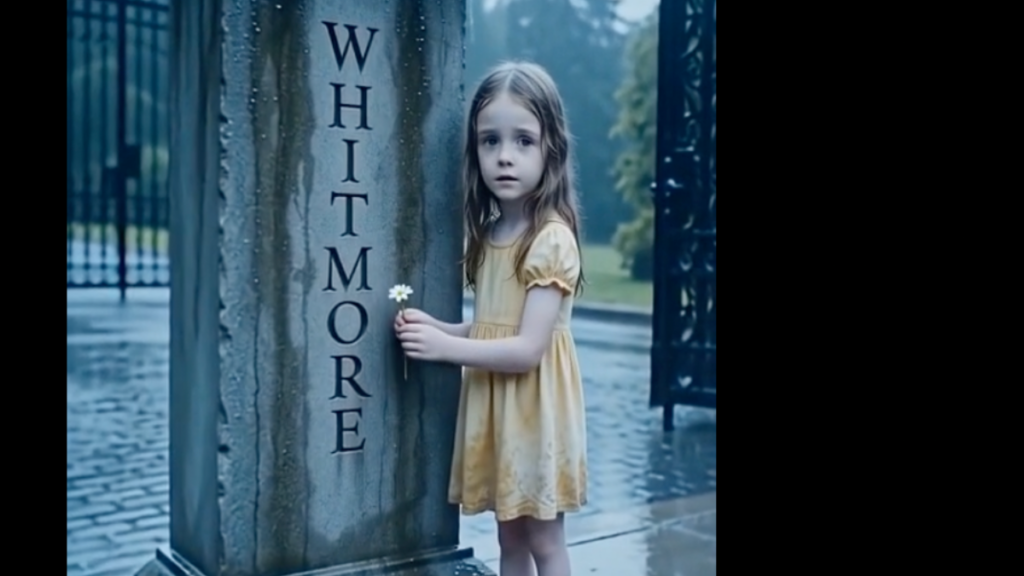
I still remember the first day I saw her.
A tiny girl in a faded yellow dress stood barefoot in front of the black iron gates of Whitmore Estate.
She couldn’t have been more than ten years old.
Her hair was tied back with a frayed blue ribbon, the kind that had probably been washed so many times it should have fallen apart months ago.
She stood perfectly still.
Not crying.
Not begging.
Not trying to get anyone’s attention.
Just staring.
At the stone pillars.
At the carved letters etched into the granite.
WHITMORE.
My last name.
Back then, I was thirty-two years old and living the kind of life people imagine when they talk about old money.
Whitmore Estate sat on nearly forty acres overlooking Lake Ashton.
Glass walls.
Imported marble.
Gardens so meticulously maintained they looked painted.
Every room spotless.
Every conversation measured.
Every problem solved with enough money.
Or buried by it.
Depending on which was more convenient.
I grew up believing that was normal.
That families were supposed to be quiet.
Controlled.
Perfect.
Then that little girl appeared at the gates.
And something shifted.
At first, nobody paid much attention.
The guards laughed.
“She’ll get bored.”
The house staff whispered.
My mother called her “that delusional child.”
But the girl kept coming.
Every single day.
Three o’clock sharp.
The same yellow dress.
The same blue ribbon.
The same careful walk up the hill.
She would stop directly in front of the gates.
Press a small flower against the iron bars.
Whisper something too soft to hear.
Then leave exactly five minutes later.
Not four.
Not six.
Five.
The routine became so precise it felt intentional.
Almost ceremonial.
Weeks passed.
Then months.
Still she came.
Rain.
Sunshine.
Wind.
Didn’t matter.
The girl never missed a day.
Eventually, curiosity got the better of me.
One afternoon, I pulled the security footage.
I expected to discover she was staring at the mansion.
Most people did.
Whitmore Estate attracted attention.
Tourists occasionally stopped to take photographs.
Local teenagers dared each other to touch the gates.
But the footage showed something else entirely.
The girl never looked at the house.
Not once.
She looked only at the name.
Whitmore.
Whitmore.
Whitmore.
Her eyes traced the letters every day.
Studying them.
Memorizing them.
Like they meant something important.
The discovery bothered me more than it should have.
Then one evening at dinner, I made the mistake of mentioning her.
“Who is the little girl at the gate?”
The reaction was immediate.
My father stopped eating.
My mother froze.
Even my grandmother looked up.
The room became silent.
Not confused.
Not curious.
Silent.
As though I’d accidentally spoken a forbidden word.
Then my mother recovered first.
“Oh.”
She picked up her wine glass.
“That child.”
The way she said it made my stomach tighten.
“Who is she?”
“No one.”
My father returned to his meal.
Conversation over.
At least that’s what they wanted.
But I’d spent thirty-two years around wealthy people.
And wealthy people have tells.
Tiny cracks in the performance.
Tiny moments when the truth slips through.
My father’s jaw tightened.
My grandmother wouldn’t meet my eyes.
My mother drained half her wine in a single swallow.
No one.
That answer was a lie.
I knew it.
Then two days later, I saw something that changed everything.
The girl arrived at the gates.
As always.
Three o’clock.
Yellow dress.
Blue ribbon.
Flower in hand.
But this time, she wasn’t alone.
An older woman walked beside her.
Thin.
Tired.
Holding a paper grocery bag.
The moment I saw her, something tugged at my memory.
I knew that face.
Not well.
But enough.
Then it hit me.
The housekeeper.
No.
Not the housekeeper.
The housekeeper’s daughter.
Years ago, a woman named Rosa worked at Whitmore Estate.
I couldn’t have been more than twelve when she disappeared.
One day she was there.
The next she wasn’t.
Nobody ever explained why.
Nobody ever mentioned her again.
The same way my family handled every uncomfortable subject.
Erase it.
Move on.
Pretend it never existed.
Then I made another mistake.
I went outside.
The guards immediately noticed.
“Mr. Whitmore?”
I ignored them.
Walked straight toward the gates.
Toward the girl.
Toward the mystery my family seemed desperate to avoid.
The child looked surprised when she saw me.
Then nervous.
Then determined.
All in the span of three seconds.
I stopped a few feet away.
“Hi.”
She blinked.
Then smiled politely.
“Hi.”
Up close she looked even younger.
Small.
Fragile.
But her eyes weren’t fragile.
They were steady.
The eyes of someone who had come for a reason.
Then I asked:
“What’s your name?”
The answer came instantly.
“Emma.”
A pause.
Then:
“Emma Whitmore.”
My heart stopped.
The woman beside her immediately grabbed her shoulder.
“Emma.”
A warning.
Sharp.
Protective.
But it was too late.
The name was already hanging between us.
Whitmore.
Then the little girl looked up at me.
Not afraid.
Hopeful.
And asked the question that shattered the comfortable life I’d spent thirty-two years believing was real.
“Are you my brother?”
For a moment, I couldn’t breathe.
Not because of what she said.
Because of how she said it.
Like it wasn’t an accusation.
Or a trick.
Or some elaborate scheme.
Just a question she’d been carrying for a very long time.
“Emma.”
The woman beside her squeezed her shoulder again.
Harder this time.
“We should go.”
But Emma didn’t move.
Her eyes remained fixed on mine.
Waiting.
Hoping.
Then she asked again.
More quietly.
“Are you?”
The world seemed to narrow around us.
The gates.
The driveway.
The lake beyond the estate.
Everything fading into the background.
Then I looked at the woman.
Really looked at her.
And suddenly the resemblance became obvious.
Not to me.
To my father.
The shape of her eyes.
The line of her jaw.
The same stubborn expression.
No.
No.
Then I heard my mother’s voice.
“Arthur.”
I turned.
She stood halfway down the driveway.
Perfectly dressed.
Perfectly composed.
Except for one thing.
Fear.
Real fear.
For the first time in my life, I saw it plainly on her face.
Then she smiled.
The fake smile.
The one she used whenever she was trying to control a situation.
“Come inside.”
The command was gentle.
But it was still a command.
Then she looked toward Emma and the woman.
The smile disappeared instantly.
“Now.”
The temperature around us seemed to drop.
Then the woman grabbed Emma’s hand.
“We’re leaving.”
The little girl resisted.
Just slightly.
“Mom—”
Mom.
The word caught my attention immediately.
Then I froze.
Not because Emma said it.
Because my mother flinched.
Actually flinched.
The reaction lasted less than a second.
But I saw it.
And once you see something like that, you can’t unsee it.
Then Emma’s mother began pulling her away.
The child looked back over her shoulder.
Still watching me.
Still waiting for an answer.
Then she called out:
“I’ll come back tomorrow!”
My mother visibly stiffened.
The woman hurried Emma down the hill.
Away from the gates.
Away from the estate.
Away from whatever truth my family had buried.
Then my mother marched toward me.
The second they disappeared from sight, her pleasant expression vanished.
“What were you thinking?”
The sharpness of her voice shocked me.
Because my mother never raised her voice.
Not in public.
Not in private.
Not ever.
“Who is she?”
Silence.
“Mother.”
More silence.
Then she grabbed my arm.
Actually grabbed it.
“Leave this alone.”
The words landed heavily.
Because she wasn’t denying anything.
Not a single thing.
Then I laughed.
A short, humorless laugh.
“She’s my sister, isn’t she?”
The color drained from her face.
And that was answer enough.
The realization hit like a freight train.
A sister.
A ten-year-old sister.
A child standing outside our gates every day while my family pretended she didn’t exist.
Then my father appeared.
Walking quickly.
Too quickly.
The moment he saw my mother’s expression, he understood.
Immediately.
Then he looked at me.
And for the first time in thirty-two years, my father looked ashamed.
Not angry.
Ashamed.
Then I whispered:
“It’s true.”
Nobody answered.
They didn’t need to.
Then I looked toward the road where Emma disappeared.
The tiny yellow dress was gone now.
But I could still see her in my mind.
Standing at the gates.
Holding flowers.
Tracing the family name she wasn’t allowed to claim.
Then another realization struck me.
A much worse one.
“She’s ten.”
My father closed his eyes.
Briefly.
Painfully.
Then I did the math.
Ten years.
Exactly ten years.
The same year my father disappeared for six months.
The same year he claimed he was overseeing a development project overseas.
The same year my mother stopped speaking to him for nearly a year.
Memories I never understood suddenly clicked into place.
Then I asked the question that mattered.
“Does she know?”
Silence.
“Does Emma know who her father is?”
My father looked away.
The answer terrified me before he even spoke.
Then he whispered:
“No.”
The world stopped.
No.
Emma didn’t know.
The little girl standing outside the gates every day didn’t know.
She only knew the name.
The resemblance.
The rumors.
The fragments.
Then I looked at him.
At the man who raised me.
The man whose portrait hung in every hallway of the estate.
The man everyone admired.
And suddenly he looked very small.
Very ordinary.
Then I asked:
“Why does she keep coming here?”
This time it wasn’t my mother who answered.
It was my father.
And the sadness in his voice shocked me.
“Because her grandmother told her.”
I frowned.
“What?”
He swallowed hard.
Then looked toward the gates.
“She told Emma that if she ever wanted to find her family…”
His voice broke.
Just slightly.
The first crack I’d ever seen.
Then he finished.
“She should look for the Whitmores.”
The silence that followed felt endless.
Because somewhere along the way, a little girl had been told she belonged to us.
And every day for months, she’d been standing outside our gates waiting for someone to tell her she was right.
Tomorrow, she’d come back.
The way she always did.
Only now I knew the truth.
And so did my parents.
Which meant tomorrow wasn’t going to be another ordinary visit.
Tomorrow was the day twenty years of secrets finally came home.
I barely slept that night.
Every time I closed my eyes, I saw Emma standing at the gates.
Barefoot.
Holding a flower.
Asking if I was her brother.
And the worst part wasn’t that she asked.
It was that she asked hopefully.
As though she’d already decided the answer.
As though she believed family would be happy to find her.
The innocence of that belief made my chest ache.
Then sometime after midnight, I went looking for answers.
Real answers.
Not the carefully edited versions my parents preferred.
Whitmore Estate had a library larger than most homes.
Three floors.
Thousands of books.
Locked filing cabinets tucked behind oak paneling.
Family records stretching back more than a century.
My grandfather kept everything.
Letters.
Contracts.
Photographs.
Nothing ever disappeared.
At least not officially.
Which meant if Emma existed, traces of her story probably did too.
An hour later, I found them.
Hidden inside a file labeled:
ASHTON DEVELOPMENT PROJECT.
Not exactly subtle.
But apparently nobody expected anyone to look.
Inside were photographs.
Letters.
Financial records.
Hospital bills.
And one birth certificate.
Emma Rose Alvarez.
Date of birth.
Ten years earlier.
Father:
Blank.
Mother:
Sofia Alvarez.
I stared at the document.
Then at the photographs.
There she was.
A younger version of Emma’s mother.
Beautiful.
Smiling.
Standing beside my father.
Not as employer and employee.
Not as strangers.
Something more.
Something real.
Then I found a letter.
Handwritten.
Addressed to my father.
The paper trembled in my hands as I read.
Edward,
I know what your wife asked you to do.
I know why you’re leaving.
But Emma deserves better than silence.
The room felt smaller.
Much smaller.
Then I continued.
She asks about you every day.
I tell her you’re a good man.
Please don’t make me a liar.
I stopped reading.
Couldn’t continue.
Not yet.
Because suddenly this wasn’t an affair.
It wasn’t a scandal.
It wasn’t gossip.
It was a child.
A child who grew up waiting.
Then I heard footsteps.
I looked up.
My father stood in the doorway.
Neither of us spoke.
For a long moment, he simply stared at the file in my hands.
Then he nodded.
Slowly.
Defeated.
“You found it.”
Not anger.
Not denial.
Acceptance.
Then he walked into the library and sat across from me.
Older than I’d ever seen him.
Older than yesterday.
Older than an hour ago.
Then he said something unexpected.
“I loved her.”
The confession landed heavily.
Not because it shocked me.
Because it sounded true.
Then he looked toward the photographs.
“At least I think I did.”
Silence.
“Your mother found out.”
There it was.
The beginning.
Then the story came out.
Ten years earlier, my father met Sofia while overseeing one of the company’s charitable housing projects.
She wasn’t an employee.
She wasn’t staff.
She was a teacher volunteering with local families.
Smart.
Funny.
Kind.
Everything my father wasn’t looking for.
Everything he found anyway.
Then came the affair.
Brief.
Messy.
Human.
And when Sofia became pregnant, everything exploded.
My mother discovered the relationship before Emma was born.
The confrontation nearly destroyed the family.
Divorce papers were prepared.
Lawyers hired.
Assets divided.
Until my grandfather stepped in.
The realization hit me immediately.
No.
Then my father nodded.
As if he’d read my thoughts.
“Yes.”
My grandfather.
The family patriarch.
The man whose portrait hung above every fireplace.
The man everyone respected.
The man everyone feared.
“He gave me a choice.”
My pulse accelerated.
“What choice?”
My father laughed bitterly.
A humorless sound.
“Family or Emma.”
The room became silent.
No.
No.
No.
Then my father looked down.
Ashamed.
“I chose wrong.”
The honesty hurt more than excuses ever could.
Because he knew.
He’d known for ten years.
Every single day.
Then he whispered:
“I thought money would be enough.”
The words hung in the air.
Ugly.
Familiar.
Whitmore.
The answer to every problem.
Money.
Then he continued.
He paid for everything.
The house.
School.
Medical care.
Food.
Every expense.
Quietly.
Secretly.
Without ever acknowledging why.
Without ever acknowledging her.
Then I remembered the flowers.
The gates.
The visits.
“Why is she coming now?”
My father looked toward the dark windows.
Then answered.
“Sofia is dying.”
The air left my lungs.
No.
Then everything clicked.
The grandmother.
The instructions.
Find the Whitmores.
The flowers.
The visits.
The desperate hope.
Emma wasn’t searching for family because she was curious.
She was searching because she was running out of time.
Then my father said the one thing that shattered whatever composure remained.
“She has maybe three months.”
The library disappeared around me.
Three months.
Emma’s mother had three months.
Maybe less.
Then I understood why the little girl kept coming.
Why she memorized the name.
Why she stood at the gates every afternoon.
She wasn’t looking for a mansion.
Or money.
Or answers.
She was looking for someone to belong to before she lost the only person she had left.
Then my father looked at me.
And for the first time in my life, he wasn’t speaking as a Whitmore.
Or a businessman.
Or the head of a dynasty.
He was speaking as a frightened father.
“What do I do?”
The question stunned me.
Because the answer felt obvious.
Not easy.
Not convenient.
But obvious.
Then I thought about Emma.
The yellow dress.
The blue ribbon.
The flowers.
The hope.
And I said the only thing that mattered.
“Tomorrow.”
My father looked up.
“Tomorrow what?”
I stared toward the gates where she’d be standing again.
Three o’clock sharp.
The way she always did.
Then I answered.
“Tomorrow, when Emma comes back…”
A pause.
“Open the gate.”
Three o’clock arrived slower than any hour I had ever lived through.
The entire estate seemed to know.
The staff whispered.
The guards kept checking the front drive.
Even my mother barely touched her lunch.
Nobody said Emma’s name.
But everyone was thinking it.
Then, at exactly 2:58 p.m., I saw her.
The yellow dress.
The blue ribbon.
The careful walk up the hill.
Right on time.
My father stood beside me in the security room.
Silent.
Rigid.
Terrified.
The emotion surprised me.
Because I had never seen Edward Whitmore afraid of anything.
Not business failures.
Not lawsuits.
Not public scandals.
Yet a ten-year-old girl walking toward a gate had reduced him to silence.
Then Emma reached the entrance.
Stopped.
And pulled a small white flower from her pocket.
The same ritual.
The same five minutes.
The same hope.
Only today was different.
Today, the gates opened.
The iron bars slowly swung apart.
Emma froze.
Completely.
The flower slipped from her fingers.
For a second she looked genuinely frightened.
Not because she expected danger.
Because she never expected success.
Then one of the guards stepped forward.
The same guard who had watched her for months.
The same guard who used to laugh.
“Emma.”
Her eyes widened.
“Yes?”
The man’s voice softened.
“You can come in.”
The little girl didn’t move.
The words seemed too impossible to process.
Then she looked around.
Waiting for someone to tell her it was a joke.
Nobody did.
Then she carefully stepped through the gates.
One foot.
Then the other.
As though crossing an invisible border.
And in many ways, she was.
The moment she entered the estate, her entire life changed.
She just didn’t know it yet.
Then I walked toward her.
Alone.
My father couldn’t.
Not yet.
The shame was still too large.
Emma immediately recognized me.
“You came back.”
The statement carried genuine surprise.
I smiled.
“I said I would.”
She considered that.
Then nodded.
Apparently satisfied.
Children have a remarkable ability to judge character quickly.
Then her eyes moved toward the mansion.
The enormous white structure she’d spent months staring at from a distance.
“It’s bigger inside the gates.”
I laughed.
“It is.”
She looked nervous.
Excited.
Overwhelmed.
All at once.
Then she asked the question she’d clearly been carrying for months.
“Am I really a Whitmore?”
The simplicity of it nearly broke me.
Not:
Why didn’t anyone tell me?
Not:
Where’s my father?
Not:
Do I get to live here?
Just:
Am I really a Whitmore?
A child asking whether she belonged.
Then I knelt beside her.
And answered honestly.
“Yes.”
The word hit her like sunlight.
Her entire face changed.
Not because of the name.
Because of what the name represented.
Family.
Then tears appeared in her eyes.
Fast.
Unexpectedly.
“Okay.”
Just okay.
But somehow that single word carried years of loneliness.
Then another voice spoke.
“Emma.”
She turned.
My father stood twenty feet away.
Frozen.
Unable to move closer.
Unable to stay where he was.
The sight of him made something shift in Emma’s expression.
Recognition.
Not because she’d met him.
Because she’d imagined him.
A thousand times.
Then she whispered:
“Oh.”
The sound was so small I almost missed it.
Then she looked at me.
Then back at him.
Then back at me.
“That’s him, isn’t it?”
Nobody answered.
Nobody needed to.
Then Emma did something remarkable.
Something only children can do.
She walked straight toward him.
No anger.
No accusations.
No hesitation.
Just curiosity.
My father remained completely still.
Then Emma stopped in front of him.
Studied his face.
The shape of his nose.
His eyes.
The same eyes she saw every morning in the mirror.
Then she smiled.
A tiny smile.
“Hi.”
My father’s composure shattered.
Twenty years of business negotiations.
Forty years of privilege.
A lifetime of control.
Gone.
The man started crying.
Actually crying.
Right there in the driveway.
Then Emma tilted her head.
Concerned.
“Did I do something wrong?”
The question nearly destroyed him.
“No.”
His voice broke.
“No, sweetheart.”
Sweetheart.
The first fatherly word he’d ever spoken to her.
Ten years late.
But finally there.
Then he dropped to one knee.
Face level with hers.
And whispered:
“I’m so sorry.”
The silence that followed felt endless.
Because what do you do with an apology that large?
What do you do with ten years?
Then Emma reached out.
Touched his cheek.
And asked the question nobody expected.
“Are you coming to see Mom?”
The world stopped.
Because suddenly this wasn’t about my father.
Or the Whitmores.
Or the family secret.
It was about Sofia.
A woman with three months left.
Maybe less.
Then Emma smiled hopefully.
“She talks about you.”
The pain on my father’s face was almost unbearable.
Because he knew.
Every second she spent speaking kindly about him was a gift he hadn’t earned.
Then Emma took his hand.
Small fingers wrapping around a trembling adult hand.
And said:
“You should come today.”
The invitation hung in the air.
Simple.
Generous.
Uncomplicated.
Then she added the sentence that changed everything.
“She keeps saving a chair for you.”
And suddenly my father wasn’t crying because he’d found his daughter.
He was crying because somewhere, after ten years of silence and disappointment, Sofia Alvarez was still saving him a seat.
Nobody spoke for several seconds.
The image was too painful.
A chair.
One empty chair.
Saved for ten years.
Not because Sofia was foolish.
Not because she expected miracles.
Because hope is stubborn.
Sometimes heartbreakingly so.
Then Emma tugged gently on my father’s hand.
“Come on.”
The simplicity of it left no room for excuses.
No room for delay.
No room for Whitmore-style avoidance.
Just come.
My father looked at me.
Then toward the mansion.
Then toward the gates.
For the first time in his life, I think he understood something.
Money had carried him through almost every problem he’d ever faced.
Not this one.
There was no check large enough to buy back ten years.
Then he nodded.
Slowly.
“Okay.”
Emma smiled.
A huge smile.
The kind children reserve for wishes coming true.
Then she immediately started walking toward the road.
Still holding his hand.
As though it was the most natural thing in the world.
My father followed.
Looking completely lost.
I fell into step beside them.
Neither of us said much during the drive.
Emma did enough talking for all three of us.
She told us about school.
Her favorite teacher.
A stray cat she was trying to convince her mother to adopt.
The flower garden she’d planted behind their house.
Ordinary things.
Beautiful things.
The kind of things parents are supposed to hear as they happen.
Not ten years later.
Every sentence seemed to wound my father a little more.
Because every story represented a moment he’d missed.
Then forty minutes later, we arrived.
The house was small.
Very small.
White paint peeling in places.
A sagging porch.
Flower beds carefully maintained despite obvious financial hardship.
Nothing about it looked impressive.
And somehow it felt more alive than Whitmore Estate ever had.
Then Emma jumped out of the car.
“Mom!”
She ran toward the front door.
Then stopped.
Turned.
And smiled.
“You coming?”
My father couldn’t answer.
He simply nodded.
Then we walked inside.
The house smelled faintly of lavender.
And medicine.
The combination broke my heart immediately.
Because it told the whole story.
Comfort.
And illness.
Hope.
And reality.
Then we entered the living room.
And there it was.
The chair.
The empty chair.
Positioned beside a couch.
Facing a television.
As though someone had just stepped away for a moment.
Waiting to return.
My father stopped walking.
Completely.
Because Emma hadn’t exaggerated.
Someone really had been saving it.
Then a weak voice came from the hallway.
“Emma?”
The room became still.
Then Sofia appeared.
She looked nothing like the woman in the photographs.
And exactly like her.
Cancer had changed her.
Made her thinner.
Pal er.
Fragile.
But her eyes were the same.
Warm.
Intelligent.
Kind.
Then she saw Emma.
And smiled.
Then she saw me.
The smile widened politely.
Then she saw my father.
Everything stopped.
The smile disappeared.
The color drained from her face.
The room seemed to tilt.
For a moment nobody moved.
Nobody breathed.
Ten years.
All standing between them.
Then Sofia whispered:
“No.”
Not angry.
Not afraid.
Just overwhelmed.
Then she laughed once.
A disbelieving laugh.
“I must be dreaming.”
My father took a step forward.
Then another.
And suddenly all the rehearsed speeches disappeared.
Every explanation.
Every apology.
Every excuse.
Gone.
Because none of them were big enough.
Then he said the only truthful thing he had left.
“I should’ve come sooner.”
Sofia stared at him.
For a long time.
Then she looked toward the empty chair.
The one she’d been saving all these years.
Then back at him.
And said something none of us expected.
“You’re late.”
The words landed softly.
Without cruelty.
Without anger.
Just truth.
The purest truth in the room.
And somehow they hurt more than shouting ever could.
Then my father nodded.
Tears already falling.
“I know.”
Sofia closed her eyes.
Briefly.
As though gathering strength.
Then she looked toward the chair.
And pointed.
“Sit down.”
The room became silent.
Because everyone understood what that meant.
The invitation wasn’t forgiveness.
Not yet.
It wasn’t reconciliation.
Not yet.
It was simply this:
The chair was empty.
And after ten years…
He was finally allowed to sit in it.
My father crossed the room slowly.
Like a man approaching a sacred place.
Then he sat.
The chair creaked softly.
A tiny sound.
But somehow it felt enormous.
Because for ten years it had represented absence.
Now it represented possibility.
Then Emma climbed onto the couch beside her mother.
Looked at both of them.
And smiled.
Completely unaware she had just accomplished what none of the adults could.
Then she asked:
“So…”
The room waited.
Then Emma grinned.
“Can we have dinner together?”
And for the first time in a very long time…
Nobody had a reason to say no.
Dinner should have been awkward.
Painful.
Impossible.
In many ways, it was.
And yet it was also one of the most beautiful meals I’ve ever witnessed.
Because nobody pretended.
Not anymore.
The lies had already done enough damage.
The silence had already stolen enough years.
There was nothing left to protect.
Nothing left to hide behind.
Just four people sitting around a small wooden table.
Trying to figure out what family meant after a decade of absence.
Emma talked constantly.
Bless her.
Without realizing it, she carried the entire evening.
Every time a silence became uncomfortable, she filled it.
Every time emotion threatened to overwhelm someone, she changed the subject.
She told stories about school.
About her science project.
About the neighbor’s dog that kept stealing socks.
And every single time she spoke, my father listened like a starving man being handed food.
Because he wasn’t just hearing stories.
He was meeting his daughter.
Finally.
Then at one point Emma disappeared into her bedroom.
Only for a minute.
But the moment she left, the atmosphere changed.
The adults were alone.
And suddenly there was nowhere left to hide.
Sofia sat quietly.
My father stared at the table.
Neither seemed to know where to begin.
Then Sofia saved him.
The way she probably always had.
“She’s a good kid.”
My father nodded immediately.
“The best.”
The answer came too quickly.
Too emotionally.
And for the first time that evening, Sofia smiled.
A real smile.
Small.
Sad.
But real.
“She gets that from me.”
The joke landed perfectly.
Even my father laughed.
Then the laughter faded.
And reality returned.
Then Sofia asked the question she’d probably carried for ten years.
“Why?”
The room went silent.
Not because anyone was confused.
Because everyone knew what she meant.
Why didn’t you come?
Why didn’t you fight?
Why didn’t you choose her?
My father closed his eyes.
Then opened them again.
And finally told the whole truth.
Not the polished version.
Not the version he told himself.
The ugly version.
The honest version.
“I was weak.”
Sofia didn’t respond.
Neither did I.
Then he continued.
“My father threatened to cut me off.”
A pause.
“He threatened to destroy your life.”
Another.
“And I convinced myself that sending money was enough.”
The shame in his voice was impossible to miss.
Then he laughed bitterly.
“Which is another way of saying I was a coward.”
The word hung in the air.
Coward.
Not victim.
Not trapped.
Coward.
Then Sofia looked down.
Quiet for a long time.
Finally she nodded.
“Yeah.”
The honesty surprised me.
No anger.
No cruelty.
Just agreement.
Then she added:
“You were.”
And somehow that was the beginning.
Not the end.
The beginning.
Because for the first time, nobody was arguing about the truth.
They were standing inside it together.
Then Emma returned carrying a photo album.
And the mood shifted again.
The little girl climbed into her chair and opened it excitedly.
“Look.”
Photographs spilled across the table.
Birthdays.
School plays.
Christmas mornings.
Soccer games.
A decade of life.
A decade my father never saw.
Then Emma pointed to a picture.
“That’s my first recital.”
Another.
“That was when I broke my arm.”
Another.
“I won second place.”
Every page felt like both a gift and a punishment.
Because every memory was beautiful.
And every memory reminded him he wasn’t there.
Then suddenly Emma stopped.
She turned to a page near the back.
And smiled.
“This one’s my favorite.”
She slid the album across the table.
My father looked down.
Then froze.
The photograph showed a little girl.
Maybe six years old.
Standing in front of the gates of Whitmore Estate.
Holding a flower.
Smiling proudly.
Then he noticed something else.
Beside the photograph, written in careful childish handwriting, were four words.
Waiting for my family.
The room became silent.
Completely.
Because suddenly everyone understood.
Those visits weren’t random.
They weren’t curiosity.
They weren’t childish games.
For years, Emma believed she had family waiting for her.
And every day she showed up.
Just in case.
Then Sofia quietly wiped a tear away.
“She never stopped believing.”
My father couldn’t speak.
Not for a while.
Because some heartbreak arrives gently.
Not with anger.
With love.
And that’s somehow worse.
Then Emma looked between them.
Confused by the sudden sadness.
“Did I do something wrong?”
The question immediately snapped everyone back.
“No.”
Sofia smiled.
“Not even a little.”
Then my father reached across the table.
Slowly.
Carefully.
And took Emma’s hand.
The first time he’d ever done it.
The first time in ten years.
Then he whispered:
“You did everything right.”
And for a moment, nobody cried.
Nobody argued.
Nobody regretted.
They simply sat together.
A father.
A mother.
A daughter.
And the family that almost never happened.
Then later that night, as we prepared to leave, Emma walked my father to the porch.
The sun had started setting.
Orange light across the hills.
The kind of evening that makes everything feel softer.
Then Emma asked him a question.
One simple question.
The kind only a child would ask.
The kind that changes everything.
“Are you coming back tomorrow?”
My father looked at her.
Really looked at her.
And for the first time in ten years, the answer came easily.
Without hesitation.
Without fear.
Without anyone else’s permission.
“Yes.”
Emma grinned.
The huge, hopeful grin she’d carried to those gates every day.
Then she nodded.
“Good.”
A pause.
Then:
“I’ve been waiting a long time.”
And standing there on that porch, with the sunset behind her and ten lost years between them, I realized something.
Emma Whitmore had spent her entire life waiting for a family.
And somehow, against all odds…
She was finally getting one.
