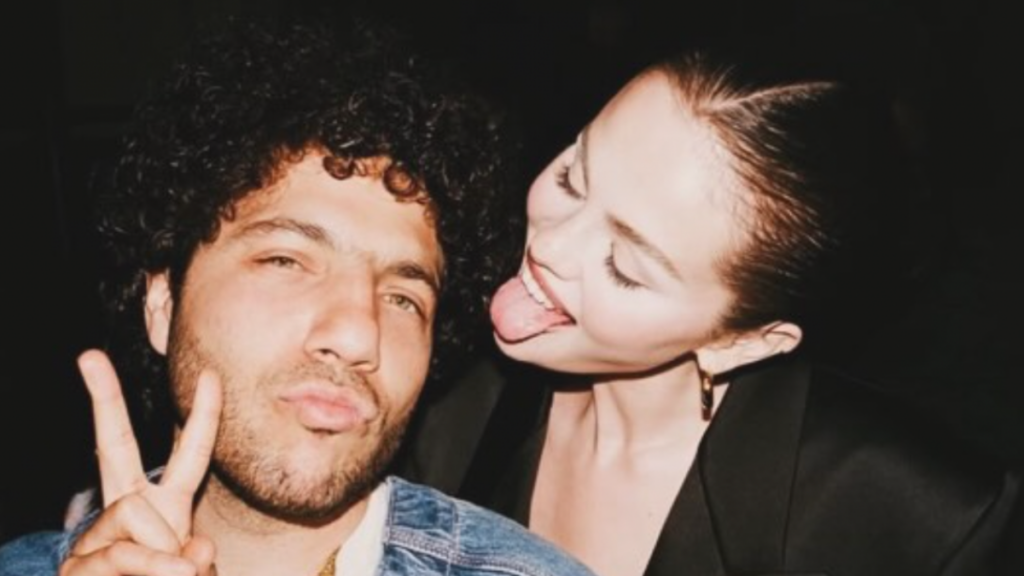
Singer and actress Selena Gomez surprised fans during a recent episode of the podcast Friends Keep Secrets podcast. The show is hosted by music producer Benny Blanco along with other collaborators. The moment quickly went viral across social media platforms.
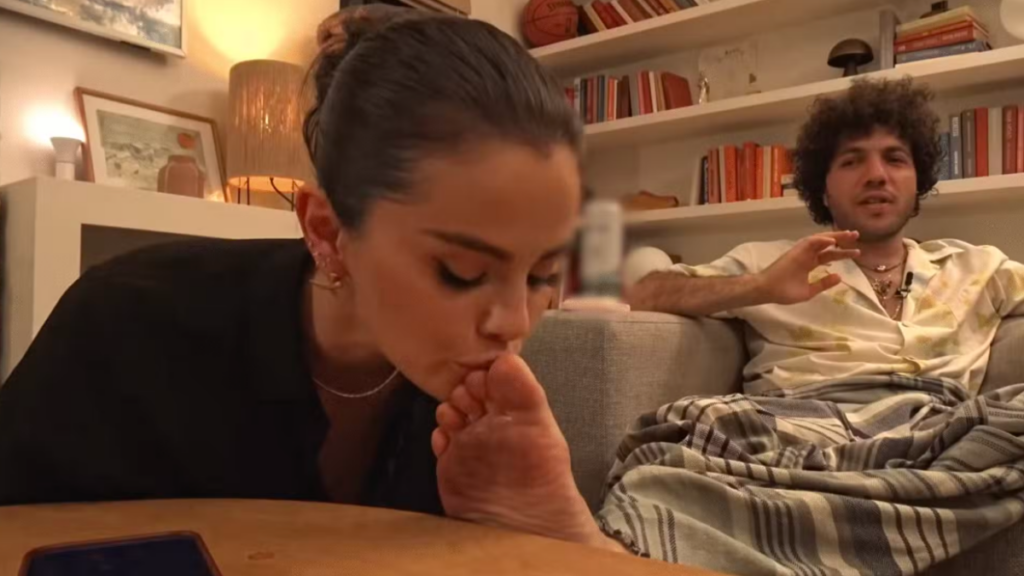
During the episode, Gomez appeared relaxed and playful while sitting on the studio floor. She leaned forward and kissed Blanco’s toe while the hosts continued their conversation. The spontaneous action immediately caught the attention from viewers and listeners.
Blanco reacted with surprise and humor during the moment. He paused mid-conversation and asked Gomez if she enjoyed the gesture. Gomez laughed and playfully told him not to turn the moment into something dramatic. The exchange showed the couple’s casual and affectionate dynamic.
The singer then rested her head against his foot while they continued talking. The relaxed scene highlighted their comfort with each other during the podcast recording. Many viewers described the moment as unusual but undeniably authentic.
Clips from the podcast spread rapidly online within hours. Fans began sharing reactions across platforms such as TikTok and X. The gesture sparked heated discussions about the couple’s playful relationship style.
Some fans praised the moment as harmless and affectionate. Others criticized the act and questioned the couple’s behavior. The split reactions quickly turned the short clip into a trending celebrity topic.
Media outlets also reported on the moment as it gained traction. Entertainment news sites covered the story and analyzed the public response. The unusual display of affection created one of the week’s biggest celebrity debates.
The “Dirty Feet” Controversy That Started It All
The viral podcast moment did not appear in isolation. It followed an earlier controversy involving Blanco’s bare feet during another episode. Fans had already criticized the producer online weeks before the new clip appeared.
During a previous recording of the Friends Keep Secrets podcast, Blanco appeared barefoot. His feet rested visibly on furniture during the discussion. Viewers noticed that his feet looked dusty and slightly dirty.
The internet reacted quickly to the visual detail. Many fans flooded comment sections with jokes and complaints. Some viewers described the scene as unpleasant or unhygienic.
One commenter wrote that they could not believe Gomez allowed Blanco to behave that way. Others questioned why she chose to marry him. The criticism became widespread across several social media platforms.
The controversy escalated further when Blanco made a crude joke during the same episode. The moment added to the already negative reaction online. Fans began debating the couple’s dynamic and public image.
Several posts even suggested Gomez deserved better treatment. Some critics urged her to reconsider the relationship. Others simply mocked the situation with memes and sarcastic commentary.
Despite the criticism, the couple never appeared bothered by the backlash. They continued sharing lighthearted moments with fans online. The foot-kissing moment seemed to respond directly to the earlier controversy.
Many viewers interpreted the act as a playful reaction to the internet drama. Instead of avoiding the issue, Gomez leaned into the joke publicly. The move transformed the controversy into an even bigger conversation.
Selena Gomez and Benny Blanco’s Playful Relationship
Despite online criticism, Gomez and Blanco continue to publicly display strong affection. Their relationship often appears relaxed and humorous rather than overly polished. The podcast moment clearly reflected that playful dynamic.
During the episode, Blanco reacted warmly after the unexpected kiss. He smiled and told Gomez that the gesture made him feel good. He also expressed his love for her during the conversation.
The exchange showed genuine warmth between the two celebrities. Instead of reacting with embarrassment, they joked about the situation. Their lighthearted response helped shift the mood during the show.
Gomez has also spoken about the strength of their relationship. She described their connection as healthy and supportive. She said their partnership represents one of the best aspects of her life.
The couple’s willingness to embrace unusual moments also sets them apart from other celebrity relationships. Many public figures carefully manage their public image. Gomez and Blanco appear comfortable showing their quirky personalities.
Fans who support the couple often highlight this authenticity. They argue that the pair feels genuine and relatable. Their humor and openness make them stand out in celebrity culture.
Supporters also note that every couple expresses affection differently. Some people prefer grand romantic gestures. Others communicate love through playful actions and jokes.
The podcast moment reflected that casual style perfectly. Instead of delivering a staged romantic statement, Gomez made a spontaneous gesture. That authenticity likely explains why the clip spread so quickly online.
Fans React: From Disgust to Support
Public reaction to the viral moment quickly divided fans into opposing groups. Some viewers found the scene funny and harmless. Others reacted with visible disgust or confusion.
Critics focused mainly on the earlier “dirty feet” controversy. They argued that the new clip made the situation even stranger. For them, the gesture crossed a line between playful and uncomfortable.
Several social media users posted harsh reactions online. Some called the moment disgusting. Others questioned Gomez’s decision to show affection in that way.
A few commenters even encouraged Gomez to leave the relationship. They argued that Blanco’s behavior embarrassed the singer publicly. These strong opinions fueled further debate among fans.
Supporters, however, defended the couple strongly. They argued that critics overreacted to a simple moment of affection. Many fans said the gesture showed genuine love and comfort between partners.
Others also pointed out that Blanco’s feet appeared cleaner in the newer clip. Some viewers joked that the producer had improved his hygiene after the backlash. The comment added humor to the ongoing conversation.
Entertainment media also weighed in on the situation. Several outlets described the moment as quirky but affectionate. They emphasized the couple’s relaxed dynamic rather than the controversy.
The intense reaction highlights how quickly celebrity moments can explode online. A few seconds of video can create global debate within hours. In this case, a simple kiss became a major trending topic.
What the Viral Moment Says About Celebrity Culture
The viral reaction to Gomez and Blanco reveals larger trends in celebrity culture. Fans today examine every detail of a star’s personal life. Even minor actions can trigger major public conversations.
Social media amplifies these moments dramatically. A short clip can reach millions of viewers within hours. This rapid spread often transforms casual moments into global debates.
Celebrities must constantly navigate this intense attention. Every public appearance invites scrutiny from fans and critics. Even playful gestures can spark unexpected controversy.
Gomez and Blanco handled the situation with humor. Instead of ignoring the criticism, they responded with a lighthearted moment. Their reaction helped turn criticism into entertainment.
The incident also shows how authenticity resonates with audiences. Many fans appreciate celebrities who show genuine personalities. Gomez and Blanco displayed their real dynamic rather than hiding it.
At the same time, the moment demonstrates how divided online communities can become. Supporters celebrate unusual expressions of love. Critics often interpret the same behavior negatively.
Despite the mixed reactions, the couple appears unfazed by the attention. They continue to share playful interactions with fans. Their willingness to laugh at themselves keeps the conversation alive.
Ultimately, the viral moment reflects a simple truth about relationships. Every couple expresses love in unique ways. For Gomez and Blanco, that expression sometimes includes unexpected gestures and a sense of humor.
The ultrasound was scheduled for a Thursday morning, early enough that the clinic still felt quiet when I arrived.
My husband had apologized the night before, saying work meetings kept piling up and he couldn’t reschedule again without raising questions.
I told him it was fine.
Pregnancy teaches you quickly that plans change constantly, and I didn’t want to be the wife who made everything harder while he tried to provide for us.
Still, as I checked in alone, I felt the absence beside me more than I expected.
Ultrasounds are moments people imagine sharing.
I Told Myself It Didn’t Matter
The receptionist handed me paperwork and smiled warmly, asking if this was my first pregnancy.
I nodded, trying to match her enthusiasm even though nerves sat heavy in my chest.
Other couples filled the waiting room, leaning toward each other quietly, hands resting over growing stomachs.
Someone laughed softly across the room as a partner pointed at baby name ideas on their phone.
I looked down at mine instead, rereading appointment reminders I already knew by heart.
It wasn’t loneliness exactly.
Just a feeling that something important was happening without a witness.
He Had Missed the Last One Too
The thought slipped in before I could stop it.
He missed the previous appointment as well, also because of work.
At the time, I defended him automatically when friends asked why he wasn’t there.
“He really wants to be,” I’d said.
“His schedule is just crazy right now.”
I believed that explanation completely.
Marriage teaches you to interpret absence generously.
The Technician Called My Name
A woman in navy scrubs appeared at the doorway holding a tablet.
She greeted me warmly and guided me down a softly lit hallway toward the exam room.
The space felt calm and clinical at the same time, monitors glowing quietly beside the bed.
She chatted casually while preparing equipment, asking normal questions meant to ease nerves.
“How far along now?” she asked.
“Twenty weeks,” I answered.
She smiled. “Perfect timing for a detailed scan.”
Everything felt ordinary.
Until it didn’t.
The Comment That Didn’t Fit
As she reviewed my chart, she paused briefly.
“Oh,” she said lightly, almost conversationally, “so your husband couldn’t make it again today?”
I laughed softly. “Yeah, work’s been insane.”
She nodded absently, still scrolling.
“That makes sense,” she said. “He was able to come to the earlier appointment though, which is great.”
The room went quiet.
I blinked at her.
“I’m sorry,” I said slowly. “What appointment?”
Confusion Settled In Gradually
She looked up, clearly assuming I was joking.
“The scan last week,” she replied. “He came in with you.”
My stomach tightened immediately.
“I wasn’t here last week,” I said.
Her expression changed — professional composure slipping just slightly.
She looked back at the screen.
Then at me.
Then back again.
The First Wave of Unease
“Oh,” she said carefully. “Let me double-check something.”
She turned the tablet slightly away, scrolling faster now.
I watched her posture shift from casual to cautious.
The room suddenly felt colder, though nothing had changed physically.
I told myself it had to be a simple mix-up.
Patients share last names all the time.
Appointments overlap.
Administrative errors happen.
But deep down, a quiet instinct told me this wasn’t random.
The Details Didn’t Match
She cleared her throat gently.
“There was an ultrasound under your husband’s name listed as partner attendance,” she said.
“It looks like he accompanied a patient with the same due date window.”
The words sounded technical, harmless even.
But my heart started beating harder.
“Was the patient name similar to mine?” I asked.
She hesitated.
And hesitation answers questions before words do.
Professional Boundaries Closed the Conversation
“I’m sorry,” she said carefully. “I can’t discuss another patient’s information.”
Her tone shifted fully into professional distance.
I nodded quickly, pretending to understand.
But the damage was already done.
Because she hadn’t denied the mistake outright.
She had simply stopped talking.
The Ultrasound Continued Anyway
She dimmed the lights and began the scan, pointing out tiny details on the monitor.
Hands. Spine. The steady rhythm of a heartbeat filling the room.
Normally, I would have cried from happiness.
Instead, my thoughts ran in circles.
He was here last week.
With someone.
At this clinic.
While telling me he was at work.
Joy and dread collided in ways I didn’t know how to separate.
I Watched the Screen Without Seeing It
The baby moved gently on the monitor, perfectly unaware of the storm forming around this moment.
The technician continued explaining measurements, her voice soft and reassuring.
I nodded when appropriate, smiling when expected.
But my mind replayed every recent excuse.
Late meetings. Sudden schedule changes. Phone calls taken in another room.
Details I once ignored rearranged themselves rapidly.
And suddenly coincidence felt impossible.
I Asked One Careful Question
As she printed images for me to take home, I spoke quietly.
“Was… the woman here alone before he arrived?”
The technician froze slightly before answering.
“I really can’t discuss anything about another patient,” she said gently.
But her expression softened.
Sympathetic.
And sympathy confirmed more than information ever could.
The Drive Home Felt Longer
I sat in my car for several minutes before starting the engine.
The ultrasound photos rested in my lap — proof of new life mixed with growing uncertainty.
Part of me wanted to confront him immediately.
Another part needed certainty first.
Pregnancy amplifies emotion, and I refused to accuse him based on assumption alone.
If something was happening, I needed undeniable truth.
The Idea Formed Slowly
By the time I reached home, a plan had begun taking shape.
The clinic allowed partner attendance by appointment confirmation.
All I had to do was schedule another scan.
One he believed was routine.
One where everyone would be present at the same time.
No accusations.
No guessing.
Just reality in the same room.
I Called the Clinic Back
My voice sounded steady when I requested a follow-up imaging appointment.
The receptionist offered several available times.
I chose the earliest opening next week.
Then added casually, “My husband should be able to attend this one.”
She confirmed without hesitation.
Appointment scheduled.
Simple.
Ordinary.
Irreversible.
Waiting Changed Everything
The days leading up to the appointment felt surreal.
He acted completely normal — affectionate, attentive, even excited about the baby.
Watching him now felt like observing two realities at once.
The man I loved.
And the man who might have already stood in that ultrasound room with someone else.
Every conversation carried hidden weight.
Every smile felt like a question.
The Night Before
He asked what time the appointment was, adding it to his calendar immediately.
“I wouldn’t miss this one,” he said warmly.
I nodded, studying his face carefully.
He looked relaxed.
Confident.
Completely unaware of what I already knew.
And as I lay awake that night feeling the baby move gently beneath my ribs, one realization settled heavily in my chest.
Tomorrow wasn’t just another ultrasound.
It was the moment two versions of the truth were about to meet in the same room.
And only one of them could survive it.
The Waiting Room Felt Different This Time
The clinic looked exactly the same as it had the week before, but everything felt heavier now that I understood what might have happened there.
Couples sat close together flipping through pamphlets, their quiet excitement filling the space with an intimacy I suddenly felt outside of.
My husband checked us in at the front desk, smiling easily as if this were his first visit.
He squeezed my hand and joked about finally getting to see the baby properly.
I watched him carefully, searching for hesitation or recognition.
There was none.
And somehow that made everything worse.
He Played the Part Perfectly
He asked normal questions while we waited — whether we should start setting up the nursery soon, if I had felt the baby kick more lately.
His excitement sounded genuine, warm enough that doubt tried creeping back in.
Maybe it really had been a misunderstanding.
Maybe the technician confused another couple entirely.
I almost wanted that to be true.
But the memory of her sympathetic expression refused to fade.
The Technician Recognized Him Immediately
When the exam room door opened, it was the same technician.
Her smile appeared automatically when she saw me.
Then she noticed him.
The change in her expression lasted less than a second, but it was unmistakable — recognition followed by immediate professionalism.
“Oh,” she said softly, recovering. “Hi again.”
The word again hung in the air.
My husband didn’t react.
He simply nodded politely, like someone meeting a stranger.
Silence Filled the Room
We followed her down the hallway together.
I walked slightly ahead, listening to footsteps behind me — hers careful, his relaxed.
The tension existed only for two people in the room.
Her.
And me.
Inside the exam room, she prepared the equipment quietly, avoiding unnecessary conversation.
The atmosphere felt fragile, like glass waiting to crack.
The Scan Began Normally
The lights dimmed, and the familiar hum of the ultrasound machine filled the space. She applied gel and positioned the monitor so both of us could see.
Our baby appeared instantly on the screen, moving gently.
My husband laughed softly in awe.
“That’s incredible,” he whispered.
For a moment, emotion almost pulled me away from why I was there.
Almost.
I Waited for Confirmation
She measured quietly, narrating medical details with practiced calm.
But her movements felt tense whenever she reached toward the keyboard.
Like she was carefully choosing every action.
My husband leaned closer to the monitor, completely absorbed.
He didn’t look at her once.
And that avoidance confirmed what words hadn’t yet.
I Asked the Question Calmly
“How many ultrasounds do partners usually attend?” I asked casually.
She hesitated.
“It varies,” she said carefully. “Some attend all of them.”
I nodded slowly.
“And sometimes they come… more than once in the same week?”
The room went still.
My husband finally looked at me.
Confusion crossed his face first.
Then concern.
The Truth Arrived Without Drama
“I think we should clarify something,” I said gently, turning toward him.
My voice stayed steady despite my heartbeat racing.
“The technician mentioned you were here last week.”
He laughed lightly.
“That’s impossible. I was at work.”
I looked at her.
She froze, clearly realizing she had been pulled into something unavoidable.
Professional boundaries fought visibly with honesty.
Reality Collided
“I’m sorry,” she said softly, choosing words carefully.
“I assumed you already knew.”
My husband’s smile disappeared.
“What are you talking about?” he asked.
She swallowed, then turned slightly toward me instead of him.
“The patient listed him as her partner during an appointment last Thursday.”
The words landed quietly.
But their impact filled the entire room.
His Reaction Told Me Everything
He didn’t argue immediately.
Didn’t laugh it off.
Didn’t demand clarification.
He just stared at the floor.
And silence — that long, heavy silence — confirmed more than denial ever could.
I Asked the Only Question Left
“Were you here with someone else?” I asked.
No anger.
No raised voice.
Just truth waiting to be acknowledged.
He exhaled slowly, shoulders dropping.
“Yes,” he said.
One word.
Enough to change everything.
The Technician Stepped Back
She quietly adjusted the monitor and moved toward the doorway.
“I’ll give you a moment,” she said gently before leaving.
The door closed softly behind her.
Leaving us alone with the sound of our baby’s heartbeat echoing through the speakers.
The Explanation Came Too Late
“It wasn’t serious,” he said quickly.
The sentence felt surreal inside a room meant for beginnings.
“She told me she was pregnant too,” he added weakly.
“I didn’t know how to tell you.”
The logic collapsed under its own weight.
He hadn’t been protecting me.
He had been protecting himself.
The Sacred Space Changed Meaning
I looked back at the screen.
Our baby moved peacefully, unaware of the conversation unfolding inches away.
This room was supposed to hold shared joy, reassurance, partnership.
Instead, it held proof of betrayal timed alongside the most vulnerable chapter of my life.
And suddenly I understood why the technician had looked at me with sympathy before.
She had already witnessed part of this story.
I Made One Thing Clear
“I didn’t bring you here to argue,” I said quietly.
He looked up, confused.
“I brought you here so the truth would exist in the same room as both of us.”
No denial later.
No rewritten timeline.
Just reality.
The Appointment Finished Quietly
The technician returned, completing measurements with gentle professionalism.
No one spoke beyond medical instructions.
She printed ultrasound photos and handed them to me carefully.
Her eyes held compassion but no judgment.
Outside the room, the waiting area sounded normal again.
Life continued uninterrupted.
Walking Out Together
We walked through the hallway side by side, but distance existed between us now that couldn’t be closed physically.
He tried to speak twice.
Stopped both times.
Some truths remove language entirely.
The Parking Lot Realization
Outside, sunlight felt too bright for the moment.
He reached for my hand instinctively.
I stepped back.
Not dramatically.
Just enough.
Because boundaries form quietly before decisions ever do.
The Final Understanding
Pregnancy teaches you trust — in your body, your future, your partner.
I had walked into that clinic expecting reassurance.
Instead, I received clarity.
And clarity, I realized, is sometimes more painful than uncertainty.
As I drove away holding ultrasound photos in one hand, one thought repeated steadily in my mind.
I didn’t go to that appointment alone.
I just didn’t realize until the end that I had been sharing it with another woman’s truth too.
The Public Reaction to Kelly Osbourne’s Weight Loss
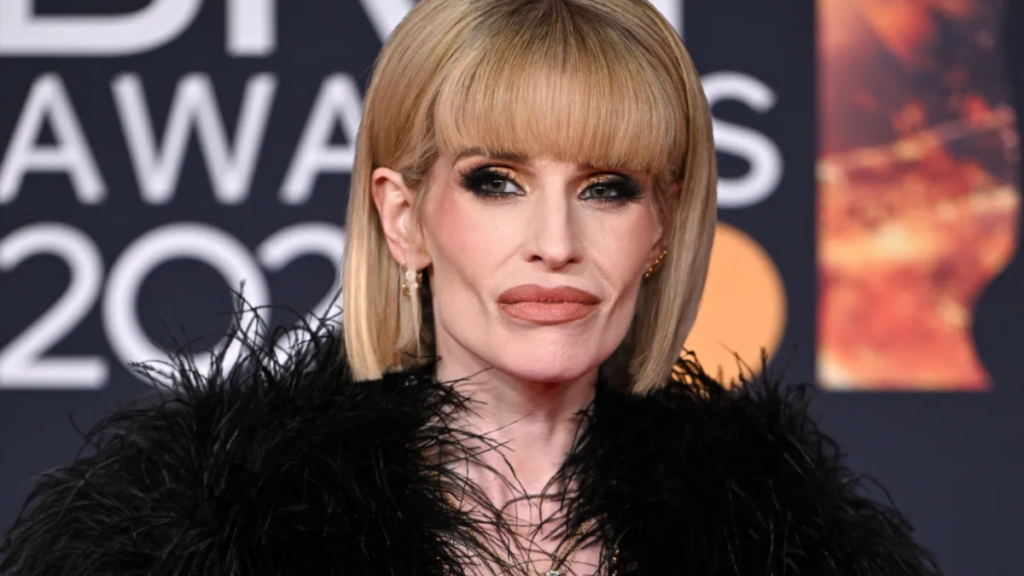
Kelly Osbourne has sparked intense public concern after losing noticeable weight in recent months. Her friends have expressed worry about her appearance, but they say they understand why it’s happening. Close sources tell TMZ that much of the change relates to the grief she’s processing after her father’s death. People first noticed her slimmer profile when she appeared at the 2026 BRIT Awards in Manchester alongside her mother, Sharon.
More than seven months have passed since Kelly’s father, rock legend Ozzy Osbourne, died in July 2025. His passing affected the entire Osbourne family, but Kelly seemed especially touched. Friends say she’s still struggling to eat properly as she grieves. They also say she isn’t ignoring her physical change, but emotional pain makes self-care harder.
Kelly’s friends insist they support her no matter what. They know grief affects people in different ways, including appetite loss and weight fluctuation. Grief often changes routines, and these sources say that Kelly’s weight loss is part of her healing process. Many supporters have urged patience and compassion instead of judgment. Grief isn’t linear, and Kelly is still coping with immense emotional loss.
Despite concern, many public voices reacted with criticism instead of empathy. Social media users flooded comments with harsh remarks about her appearance. Some went as far as alleging drug use or extreme dieting. These comments hit Kelly hard because they ignore her emotional state.
The conversation now surrounds how society treats grief and vulnerability in the public eye. Many argue that celebrity bodies shouldn’t become public property. Instead, friends and family insist that Kelly deserves patience, understanding, and space to heal away from judgment.
Kelly Osbourne’s weight loss surprised many fans and observers, but her inner circle sees it differently. Friends have told media that the weight loss ties directly to the intense grief she still carries. Grief can affect appetite, sleep, and energy, especially after losing someone as influential as a parent. Kelly’s father, Ozzy Osbourne, shaped her public life and personal identity, and losing him has hit her deeply.
Insiders noted that Kelly is aware of her changed appearance, but she struggles to prioritize physical health during emotional distress. Friends say it’s hard for her to focus on eating when she feels weighed down by sadness. This type of grief response isn’t unusual, but public viewers rarely consider emotional causes when commenting on appearance.
At the 2026 BRIT Awards, Kelly stepped out with her mother, Sharon Osbourne, to accept a Lifetime Achievement Award for her late father. The event marked an emotional moment, but online commentary quickly shifted from celebration to scrutiny of her body. Fans and critics alike reacted without context. That reaction intensified public debate about how weight loss should be discussed.
Friends stressed that they aren’t dismissing concern entirely. They want Kelly to be healthy, but they also want people to understand grief’s effects. Some people find food grounding after loss, while others lose interest entirely. Everyone grieves differently.
Close supporters also praised Kelly’s resilience in navigating public attention while enduring private sorrow. They acknowledge that seeing her in the spotlight with such visible changes takes courage. Ultimately, friends call for compassion over speculation, reminding the public that mourning is not a performance.
Kelly’s Response and Pushback to Critics
Kelly Osbourne has not stayed silent amid the rising body commentary. After online critics targeted her physical appearance, she responded directly and forcefully on social media. Kelly wrote that there is “a special kind of cruelty in harming someone who is clearly going through something.” She said that doubting her pain and spreading her struggles as gossip shows a lack of compassion.
Her message came after harsh comments labeling her appearance as “scary thin,” comparing her body to illness or frailty. Some insults even referenced her late father’s death in cruel ways. Kelly called out these remarks for lacking humanity and respect. She wrote that she shouldn’t have to defend herself while grieving.
Kelly also reshared supportive posts from others who empathized with her experience. One notable voice was fellow celebrity Mia Tyler, daughter of Aerosmith’s Steven Tyler, who penned a defense of Kelly’s right to grieve away from judgment. Tyler wrote that “public grief is not public property” and urged critics to choose kindness over criticism.
Kelly’s pushback highlighted a broader cultural issue. Many people discussed how grief can change a person’s body and behavior, yet society tends to critique physical appearance before asking about emotional context. Kelly’s willingness to address criticism openly showed strength, especially during such a difficult period. She emphasized that going through grief and still showing up publicly is a form of perseverance.
Her public defense also opened dialogue about how celebrities are treated when vulnerable. Fans applauded her for standing up to trolls and demanding empathy. Critics were reminded that behind every news story is a human being experiencing real pain.
The Broader Conversation on Compassion and Public Scrutiny
Kelly Osbourne’s recent experience has ignited a wider conversation about compassion and public scrutiny. Many people argue that the rush to judge her body reflects societal tendencies to prioritize appearance over emotional context. A strong message from supporters is that grief shouldn’t become a topic for debate. Instead, observers say people should consider what someone is carrying emotionally before commenting on their body.
Public reactions varied greatly. Some people expressed concern for Kelly’s health, while others responded with harsh criticism. Supporters like Mia Tyler encouraged kindness and emphasized that cruelty costs nothing. Her message reminded followers that celebrities are humans with feelings, not objects for social commentary.
This debate also shines a light on how social media amplifies judgment. Online platforms often turn bodies into topics for debate, regardless of emotional state or personal hardship. Critics argued that society should pause and consider the emotional impact of words before posting. Many experienced observers noted that grief can affect physical health significantly, including appetite and energy levels. They urged the public to respond with empathy, not speculation.
Some commentators also highlighted that comments about weight can trigger deeper issues for those struggling with grief or body image. Kelly’s experience became a catalyst for a broader conversation about how people treat one another publicly. Her response invited others to reflect on the language they use online.
Overall, this situation reveals how easily conversation about physical appearance can overshadow empathy. Public dialogue increasingly focuses on deeper emotional understanding rather than superficial judgment. Many now call this moment a lesson in human decency and emotional intelligence.
Moving Forward—Support, Healing, and Public Responsibility
As Kelly Osbourne continues navigating her grief journey, the focus now shifts to support and healing. Friends remain by her side, offering love and understanding rather than judgment. They emphasize that true concern should come from compassion and kindness during difficult times. Kelly’s weight loss won’t be understood fully until people recognize the emotional pain behind it. Friends and family hope the public gives her room to heal.
Kelly’s public pushback to criticism also sparked support from many fans. Messages of encouragement flooded social media after she defended herself. Followers praised her courage and urged others to treat her with respect. Supporters reminded the public that grief isn’t a performance and that healing takes time.
Mental health experts have also weighed in on how grief can manifest physically. Stress and emotional trauma can reduce appetite and disrupt daily routines. In some cases, those effects are temporary, but they may take months to resolve. Acknowledging this context helps reduce stigma and increases empathy toward those who are grieving.
This situation also highlights the responsibility of public discourse. Celebrities live much of their lives in view of others, but that doesn’t mean they forfeit dignity or privacy. Observers say respectful communication can coexist with curiosity. When emotional struggles become public, the response should center on kindness, not criticism.
In the end, Kelly’s experience stands as a reminder that support should always outweigh speculation. Healing from loss takes time, and compassion goes a long way. As friends and fans rally around her, many hope this moment ignites more empathetic conversations about vulnerability and human experience in the public eye.
Photo Credit: Tom Holland and Zendaya/DFree/Shutterstock
A Surprise Report Shakes Hollywood
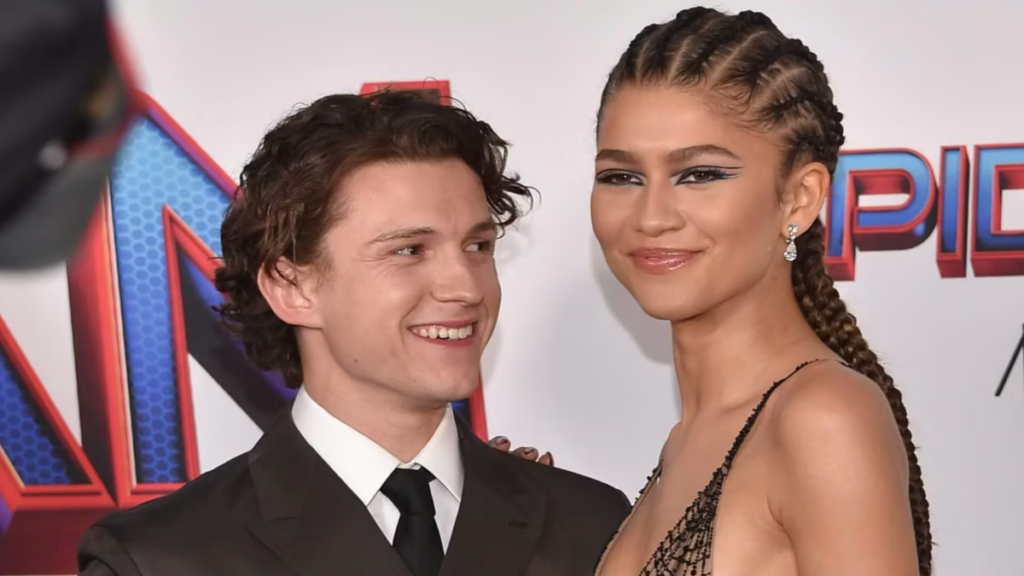
Zendaya and Tom Holland may have married in secret, according to a surprising claim by a close friend. Celebrity stylist Law Roach shared the revelation during a red carpet appearance in Los Angeles. He stated that their wedding had already happened and joked that many people missed it. His remarks immediately ignited headlines and fan speculation across social media. Neither Zendaya nor Holland confirmed the claim after his statement. Fans and media outlets continue waiting for official confirmation from the couple or their representatives.
Zendaya and Holland first met while filming Spider-Man: Homecoming in 2016. They developed a strong friendship that lasted for years before romance rumors surfaced. The pair confirmed their relationship publicly in 2021 after paparazzi photos revealed their bond. Since then, they have carefully balanced public appearances with strict personal privacy. Their connection quickly became one of Hollywood’s most beloved relationships.
Engagement rumors intensified in early 2025 when Zendaya wore a large diamond ring at the Golden Globes. Observers immediately speculated about a proposal. Holland later confirmed that he proposed, which thrilled fans worldwide. However, the couple continued keeping specific details private. Roach’s unexpected comment now suggests that they may have quietly married without fanfare. If true, their secret ceremony would rank among the most discreet celebrity weddings in recent memory.
The Evolution of a Beloved Relationship
Zendaya and Tom Holland’s journey from co-stars to rumored spouses spans nearly a decade. They met on the set of Spider-Man: Homecoming while portraying Peter Parker and MJ. Their on-screen chemistry captivated audiences and fueled early dating rumors. However, both actors denied romance speculation for years. They insisted that friendship defined their relationship at the time.
In 2021, photographers captured the pair sharing a kiss inside a car. Those images confirmed what fans long suspected. After that moment, they gradually became more open about their connection. They attended events together and supported each other’s major career milestones. Despite increased attention, they avoided oversharing personal details. Their restraint strengthened public admiration for their authenticity.
The engagement milestone marked a new chapter in their story. Zendaya displayed a striking east-west diamond ring during a major awards ceremony. Fashion critics praised the elegant design and subtle presentation. Holland later acknowledged the engagement in interviews. Even then, he withheld private information about timing and planning. Their consistent discretion shaped how fans viewed their relationship.
Roach’s recent comments align with this pattern of secrecy. The couple has never prioritized spectacle over intimacy. They prefer to reveal milestones only when they feel comfortable. A private wedding would reflect that same philosophy. Their evolution shows how two global stars can protect love while thriving in the spotlight.
Interpreting Law Roach’s Revelation
Law Roach’s remarks became the center of the wedding speculation. He told reporters that Zendaya and Holland had already married. He implied that the public simply failed to notice the ceremony. His tone mixed humor with apparent sincerity. The statement carried weight because of his long relationship with Zendaya.
Roach has styled Zendaya for over a decade. He has guided her through award seasons, premieres, and historic fashion moments. His close professional relationship gives him insider credibility. However, he did not share details about a venue, date, or guests. The absence of specifics leaves room for interpretation. Neither actor clarified his remarks publicly.
Observers quickly examined visual clues from recent appearances. Zendaya stepped out wearing a simple gold band in Los Angeles. Fans interpreted the ring as possible confirmation. Meanwhile, Holland appeared in public without a visible wedding band days earlier. These contrasting details complicated assumptions about their marital status.
Some commentators believe Roach spoke truthfully but playfully. Others suspect exaggeration or misunderstanding. Without official confirmation, the claim remains speculative. However, his words fueled intense curiosity. The situation highlights how insider comments often shape celebrity narratives. It also underscores how carefully managed privacy can amplify intrigue.
Media Reaction and Fan Speculation
Media outlets rapidly compiled timelines of Zendaya and Holland’s relationship. Writers revisited their first meeting, public kiss, and engagement reveal. Fans flooded social platforms with congratulatory messages and theories. Many celebrated the possibility of a secret wedding. Others urged caution until confirmation emerges.
Entertainment analysts debated whether a private ceremony matches their personalities. Both actors have expressed discomfort with excessive publicity. They rarely discuss intimate details during interviews. Their pattern suggests they value shared experiences away from cameras. That consistency makes a quiet wedding plausible.
At the same time, reputable outlets advised patience. Journalists emphasized that Roach’s comments did not constitute official confirmation. They reminded readers that celebrity rumors often spread quickly without verification. Responsible reporting requires waiting for direct statements. Until then, speculation remains just that.
The public response demonstrates the couple’s cultural impact. Fans feel invested in their relationship because it grew naturally over time. Their love story unfolded gradually rather than explosively. That slow progression built emotional attachment among followers. Whether married or not, they continue captivating global audiences.
What the Future Holds for the Couple
Regardless of marital status, Zendaya and Tom Holland remain career powerhouses. Both actors maintain packed professional schedules in 2026. Zendaya continues leading major film projects and fashion campaigns. Holland prepares for upcoming blockbuster appearances. Their individual success strengthens their collective influence.
If they married privately, the decision reflects maturity and intention. They have consistently prioritized emotional privacy over public validation. A secret ceremony would align with their established boundaries. It would also protect sacred memories from media intrusion. Such a choice demonstrates control over their narrative.
Fans now await clarity from the couple themselves. An official confirmation could arrive through interviews or social media. Alternatively, they may choose continued silence. Either approach would remain consistent with their history of measured disclosure. Their relationship thrives regardless of external commentary.
Zendaya and Holland represent a modern version of celebrity romance. They balance visibility with intentional restraint. They cultivate admiration without oversharing vulnerability. Their rumored wedding underscores that fame does not eliminate privacy. Whether confirmed or denied, this moment adds another fascinating chapter to their enduring love story.
Selena Gomez and her husband, Benny Blanco, opened up about managing her bipolar disorder. They spoke on Blanco’s podcast Friends Keep Secrets in March 2026.
Gomez described her diagnosis journey as “f-king complicated,” a phrase she used with honesty. She explained that therapists and rehab stays helped her find clarity. Blanco added that the road to diagnosis was long and confusing. The couple shared that bipolar disorder includes unpredictable shifts in mood and energy. Overall, they portrayed the experience with emotional truth and vulnerability.
Blanco noted that Gomez sometimes experiences periods of manic thinking. He said she may not remember manic episodes after they occur. The producer explained that addressing a manic moment directly can make things worse in real time. Gomez confirmed that self-awareness has grown over time. She said she often identifies her own symptoms more quickly now.
Talking openly helped Gomez reclaim control over her mental health. She explained that the diagnosis freed her to understand her reactions. She said recognizing patterns helped her interpret past behavior.
Their discussion showed how mental health challenges can exist alongside loving support. Gomez’s openness invites others to speak honestly about their journeys. Their conversation made mental illness less stigmatized for fans and observers. Overall, the couple framed bipolar disorder as a human, treatable condition rather than a shameful secret.
Understanding Mania and Self-Awareness
Blanco and Gomez offered insight into mania, a key part of bipolar disorder. Mania can include extreme energy, rapid thoughts, and emotional highs.
Blanco explained that manic episodes sometimes catch even Gomez by surprise. He said she often realizes the episode only after it ends. In those moments, he avoids direct confrontation to prevent escalation. The technique he described helps maintain calm in their home environment. Blanco’s approach showed patience, sensitivity, and understanding.
Gomez said she no longer feels ashamed of manic periods. She explained that recognizing the symptoms helps her intervene sooner. She said self-awareness allows her to protect her mental health more effectively. Over time, she learned to map her emotional states and respond compassionately.
She also shared that a bipolar diagnosis gave her tools to interpret past behavior. She used to react based on fear, passion, or confusion, she said. Now, she attributes actions to identifiable emotional patterns. This clarity helped her live life more freely with less internal conflict.
Gomez’s honesty about self-understanding offers hope to others. Her story shows that awareness grows with experience and reflection. It also bridges the gap between abstract diagnosis and real human experience. By describing these internal shifts, Gomez humanizes a condition many struggle to explain.
The Importance of Support and Partnership
Selena Gomez and Benny Blanco emphasized the value of supportive relationships in coping with bipolar disorder. Gomez said having someone who understands her state makes all the difference.
Blanco described how he approaches her emotional shifts. He listens first and then provides grounding support without trying to correct her behavior mid-episode. This method promotes trust and safety between them.
Gomez’s description highlighted that companionship matters during instability. When she feels overwhelmed, she relies on a small circle of trusted individuals. She said being around people who make her feel safe and heard always helps. In episodes of emotional distress, trusted support becomes a stabilizing force.
The couple did not just talk about challenges. They also shared how marriage strengthened their joint resilience. Supporting one another in hard moments deepened their bond, they said. Their partnership became a space for shared understanding rather than judgment.
Their reflections demonstrate that support systems matter for mental health management. Having a loving partner and trusted friends can help navigate difficult days. This message resonates beyond celebrity experiences and applies to anyone facing mental health challenges.
Strategies for Mental Health and Coping
Beyond emotional support, Gomez pointed to various strategies she uses to manage bipolar disorder. She said that being properly medicated has given her mental stability.
Gomez also talked about sensory tools she uses in moments of distress. Temperature changes such as cold water or heaters can provide physical focus. She said these techniques help balance emotional and physiological states. These coping mechanisms act as immediate ways to regulate intense feelings.
She shared that isolating herself in bad moments can feel scary. Negative internal thoughts often rush in during those times. However, Gomez explained that being with supportive people helps more than isolation. Choosing connection over solitude became part of her healing process.
In the podcast, she emphasized that life with bipolar disorder involves trial and error. Some strategies work better on certain days than others. Flexibility, self-reflection, and patience all play a role in her routine. These personal insights offer valuable, relatable coping tips for others.
Her transparency about recovery and struggle makes her story relatable. By sharing practical tools alongside personal emotions, Gomez opens space for others to seek help and find methods that work for them.
Normalizing Mental Health Conversations
Selena Gomez’s candid discussion with Benny Blanco reflects a broader shift toward open mental health dialogue. In past years, she has spoken publicly about bipolar disorder. This continued honesty helps normalize mental health conversations.
Her story started publicly in 2020 after a breakdown in 2018. Since then, she has talked about her condition in interviews and creative projects. Her willingness to share this part of her life invites empathy and understanding.
Gomez’s journey shows that vulnerability can create community and connection. She uses her platform to advocate for awareness rather than stigma. Fans often praise her courage in sharing deeply personal experiences.
Blanco’s participation in these conversations also highlights the role partners can play in support systems. Together, they show teamwork, patience, and mutual respect in care. Their story encourages others to seek connection and understanding in their relationships.
Ultimately, their discussion moves mental health into everyday dialogue. It encourages people not to suffer in silence. By reframing bipolar disorder as part of life rather than a secret, Gomez and Blanco help reduce shame and promote healing for many.
Photo Credit: ddlovato, selena gomez, miley cyrus / Instagram
Confronting Childhood Fame and Public Comparisons
Demi Lovato recently opened up about the challenges of growing up in the public eye. On the March 3 episode of Baby, This Is Keke Palmer, she discussed her teenage years with honesty and reflection. The singer rose to fame as a teenager on the Disney Channel. She shared the screen with stars like Miley Cyrus and Selena Gomez, which heightened public comparisons.
Lovato said growing up famous was far from carefree. She starred in hits like Camp Rock and Sonny with a Chance while navigating teenage turmoil behind the scenes. The expectations of fans and media made ordinary insecurities feel amplified. During the podcast, she noted how people constantly ranked young stars against one another. These comparisons often made her doubt her own worth and talent.
Despite the competitive talk in the media, Lovato maintained friendships with her peers. She explained that her bond with Selena Gomez began before Disney, which gave her emotional support in an otherwise pressurized environment. She expressed gratitude for these friendships and said they helped her stay grounded. Her mother’s advice helped her reject rivalry and embrace cooperation instead.
In the interview, Lovato said her mom told her, “There’s room for everyone. It’s not a competition.” This message stayed with her throughout her career. Rather than seeing others as threats, she chose to cheer on her fellow performers. This mindset helped her navigate both success and setbacks.
Looking back now, Lovato sees the experience with mixed emotions. She cherishes her achievements and friendships. Yet, she remembers the mental and emotional toll that fame took in her youth.
Identity and Personal Struggles Behind the Fame
Lovato’s candid comments uncover the fragile human side of a global star. Growing up under constant public scrutiny shaped her identity in difficult ways. She explained that everyday growing pains become exaggerated when cameras and headlines capture every moment.
As a young teen, Lovato found herself pulled in many directions. She juggled filming TV shows, recording music, and engaging with fans. Each task demanded perfection, but she often felt unsure of herself. Teen insecurities aren’t unusual, but for her they were intensified. The world watched her grow, judge, and evolve.
In the podcast conversation, she spoke about what it felt like to be compared to Miley Cyrus and Selena Gomez. These two performers were also massive Disney Channel stars at the time. The network’s spotlight fell on all of them, yet it seemed to reward competition in headlines. Sometimes fans and media treated them as rivals instead of peers.
Lovato’s mental health journey began during these formative years. She has been open about her struggles with disordered eating and self-image. Experiences like these shaped her view of fame and her own sense of worth. Media comparisons didn’t help her confidence, she said. They often made her feel smaller than she was.
Despite these challenges, Lovato learned valuable lessons about identity and support. She now emphasizes compassion for her younger self. She recognizes that introspection and personal growth came from adversity. In reflecting on her past, she shows that strength often stems from vulnerability.
Breaking Down Disney’s “Number One” Mentality
The Disney Channel era produced many beloved young stars. Lovato, Cyrus, and Gomez all achieved incredible success in the late 2000s. However, Lovato acknowledged that the network culture sometimes fostered competition instead of collaboration.
When Disney promoted multiple stars at once, the public often compared them. Fans wanted to know who was “the best” or “the number one girl.” This narrative encouraged comparisons over camaraderie. It shaped public expectations unfairly. Lovato said this competitive environment was hard for young performers.
Lovato said she felt uncomfortable with the comparison culture early on. She explained that insecurities were already present because she was just a teenager. The added public scrutiny amplified these feelings. Her friends and peers experienced similar pressure, but few spoke publicly about it.
Instead of joining the competition, Lovato chose empathy. She said she always rooted for others. She believed in supporting her peers, even during times when media created narratives of rivalry. Her mom’s guidance helped her see that every artist could thrive.
Despite the pressure, Lovato found beauty in her friendships. She kept her bond with Gomez strong over the years. They reconciled publicly and supported each other’s work later in their careers. Their relationship shows that support can outweigh competition, even in an industry built on comparison.
Today, Lovato uses her platform to change the narrative around competition. She advocates for unity among artists and encourages younger performers to prioritize empathy over rivalry.
Mental Health, Eating Disorders, and Emotional Growth
Lovato has long been vocal about mental health issues. Her struggles with eating disorders and body image are well documented. These challenges began in her youth and continued into adulthood. They took place during the peak of Disney fame.
In the podcast, she shared how those early experiences shaped her view of herself. Being on camera while struggling with eating issues was extremely difficult. She felt pressure to maintain a public image while fighting personal battles privately. These dual pressures forced her to confront her insecurities at a young age.
Lovato’s honesty about her struggles helps break down stigma. She shows that even world-famous performers can face deep personal challenges. Her story reminds others that fame does not protect someone from pain or self-criticism. It also points to the importance of mental health support systems.
Her journey continues outside of the Disney spotlight. She has discussed recovery and resilience in various interviews and documentaries. For example, the documentary Demi Lovato: Dancing with the Devil highlighted her recovery after a near-fatal overdose.
Today, Lovato encourages young people to prioritize mental well-being over perfection. She models how vulnerability can inspire others. Her openness has resonated with fans worldwide. It shows that success and struggle often coexist.
Legacy, Support, and Moving Forward
Today, Demi Lovato reflects on her past with both gratitude and honesty. She acknowledges that growing up famous came with highs and lows. Yet she uses her platform to support others who face pressure and expectation.
Lovato’s legacy reaches beyond her music and acting. Her willingness to discuss vulnerability makes her a role model. Fans and peers alike admire her for speaking openly about challenges. Her perspective helps younger artists navigate their own public journeys.
Lovato also highlights the power of supportive relationships. Her longstanding friendship with Selena Gomez stands as proof. Despite early comparisons, they remained close and supportive of each other’s work. This bond shows that empathy can overcome rivalry.
In recent years, Lovato has continued to evolve as an artist. She announced It’s Not That Deep Tour to support her 2025 album, celebrating her growth and resilience. Her work reflects both her struggles and her triumphs. It shows that while fame shaped her, it did not define her entirely.
Overall, Lovato’s journey teaches us that fame can be difficult, but it can also foster strength. Her honesty invites fans to rethink how we view success and challenge. She proves that personal growth often comes from the hardest moments.
When my sister said she wanted to plan my bachelorette party, I didn’t even hesitate.
She sounded excited.
Almost emotional.
“You only get this once,” she told me. “Let me do this for you.”
We’ve never been the kind of sisters who hug for no reason.
So that sentence stayed with me longer than it should have.
It felt like a peace offering.
Which is why I ignored the small voice in my head that asked why she suddenly cared so much.
The Version of Us I Wanted to Believe In
Growing up, she was always the louder one.
The fun one.
The dramatic one.
The one people noticed.
I was the organized one.
The calm one.
The one who fixed things after she broke them.
So when she started a group chat called Bride Squad 💍, I told myself this was her way of showing love.
Even when she didn’t include me in it.
“It’s a surprise,” she said. “You’re not allowed to see anything.”
And I laughed, because that’s what you’re supposed to do when someone is planning something for you.
You don’t ask questions.
You say thank you.
The First Small Shift
About a week later, she started asking strange questions.
Not about what I’d like.
About who would be uncomfortable in the same room.
“What do you mean?” I asked.
“Oh, you know. Old friends. Your past. Any drama?”
She said it lightly.
Like gossip.
I told her no.
Because as far as I knew, there wasn’t any.
That should have been the end of it.
But she kept pressing.
“What about him?”
She didn’t say his name.
She didn’t have to.
And suddenly, the room felt smaller.
The Name We Don’t Use
I hadn’t spoken to my ex in three years.
Three very calm, very intentional years.
No drunk messages.
No late-night stalking.
No “just checking in.”
He was a closed chapter.
My fiancé had never even met him.
So when she brought him up, I laughed it off.
“Why would he matter?” I said.
She shrugged.
“Just making sure there’s no awkward history with anyone.”
Anyone.
The word stayed with me longer than the conversation.
The First Crack in the Surprise
Two nights later, she left her laptop open on the kitchen table.
I wasn’t snooping.
I was looking for a charger.
But the screen was already awake.
And there it was.
A spreadsheet.
Color-coded.
Names, phone numbers, little notes in the corner.
Dietary restrictions.
Travel times.
Drink preferences.
She had planned this like a corporate event.
I smiled at first.
She was really trying.
And then I saw a name that didn’t belong there.
It Didn’t Feel Real at First
I actually thought it was someone with the same name.
It’s not an uncommon name.
I even leaned closer, like the letters might rearrange themselves if I looked long enough.
But next to it was a note.
“College friend — important for the ‘surprise moment.’”
He wasn’t my college friend.
He was the person I almost didn’t recover from.
The Memory I Keep Folded Away
We didn’t have a dramatic breakup.
No screaming.
No cheating.
Just slow erosion.
He lied in small, polite ways.
He made me feel unreasonable for noticing.
He turned every boundary into a personal attack.
By the time it ended, I didn’t recognize the person I had been in that relationship.
And it took me a long time to like myself again.
My sister knew all of this.
She was there for the phone calls.
The crying.
The silence after.
Which is why seeing his name on that list didn’t feel like a mistake.
It felt deliberate.
I Closed the Laptop
Very gently.
Like it might explode if I moved too fast.
My first instinct was denial.
There had to be an explanation.
Maybe it was a different person.
Maybe she added him by accident.
Maybe she was planning some kind of joke I didn’t understand.
I stood there for a full minute trying to build a version of reality where this made sense.
None of them worked.
Testing the Story She Was Telling Me
That evening, I asked her how the planning was going.
She lit up.
“Oh my god, it’s going to be amazing. You’re going to cry.”
“I don’t like being the center of attention,” I reminded her.
“That’s the point,” she said. “You don’t know what’s coming.”
She looked so pleased with herself.
So proud.
And I realized she wasn’t worried about whether I’d be comfortable.
She was excited about the impact.
The Word “Accident”
The next day I brought it up casually.
“I ran into someone from college today,” I said.
Her reaction was instant.
“Who?”
I said his name.
She blinked once.
Too slow to be natural.
“Oh. That’s… random.”
Random.
Not: How is he?
Not: That’s weird.
Not: Why are you telling me this?
Just random.
Like she had rehearsed the response.
When You Start Watching More Closely
After that, everything she did felt different.
She took calls in another room.
She stopped showing me decorations she’d ordered.
She started saying things like, “Trust me. This is going to be unforgettable.”
Unforgettable.
The word landed wrong every time.
The Conversation With My Best Friend
I told my best friend I had a strange feeling.
Not the whole truth.
Just that something was off.
She went quiet.
Then she asked, “Is your sister inviting people you wouldn’t invite?”
I didn’t answer right away.
Because saying it out loud would make it real.
And I wasn’t ready for that.
The Screenshot
Three days before the party, I got a message from a number I didn’t have saved.
It was a screenshot.
A group chat.
My sister had written: “Timing matters. He comes in after the first round of drinks. Let her see him when she’s relaxed.”
Below that:
“Don’t tell her. It’s going to be iconic.”
Iconic.
Like my life was a performance.
The Moment Denial Finally Broke
I stared at the message for a long time.
Not crying.
Not shaking.
Just very still.
Because it wasn’t about whether he was invited anymore.
It was about why.
She wanted a reaction.
She wanted a moment.
She wanted my past to walk into the room during a party that was supposed to celebrate my future.
And suddenly every memory of us as sisters rearranged itself into a different story.
The Question I Couldn’t Stop Asking
What kind of person plans a surprise like that?
And the worse question:
Why did she want to do it to me?
Playing Along
When she called that night, I answered like nothing had changed.
We talked about dresses.
Cocktails.
Party games.
She was glowing through the phone.
“I just want it to be the best night of your life,” she said.
And I told her I couldn’t wait.
Because in that moment, I understood something very clearly.
She thought I was still the version of me that wouldn’t see it coming.
Making My Own Plan
After we hung up, I opened my notes app.
Not to write a message.
Not to confront her.
To make a list.
If she wanted a moment, she was going to get one.
Just not the one she had planned.
The Calm Before the Party
The day of the bachelorette party, she hugged me at the door.
“You look so happy,” she said.
“I am,” I told her.
Which was true in a way she couldn’t understand.
Because for the first time since I saw that spreadsheet, I wasn’t confused anymore.
I wasn’t in denial.
I wasn’t trying to fix the story.
I knew exactly what was going to happen.
And more importantly…
I knew what I was going to do when he walked into that room.
Walking Into My Own Setup
By the time we got to the bar, I was already tired.
Not from the heels.
Not from the heat.
From pretending I didn’t know.
Pink balloons were tied to the railing outside.
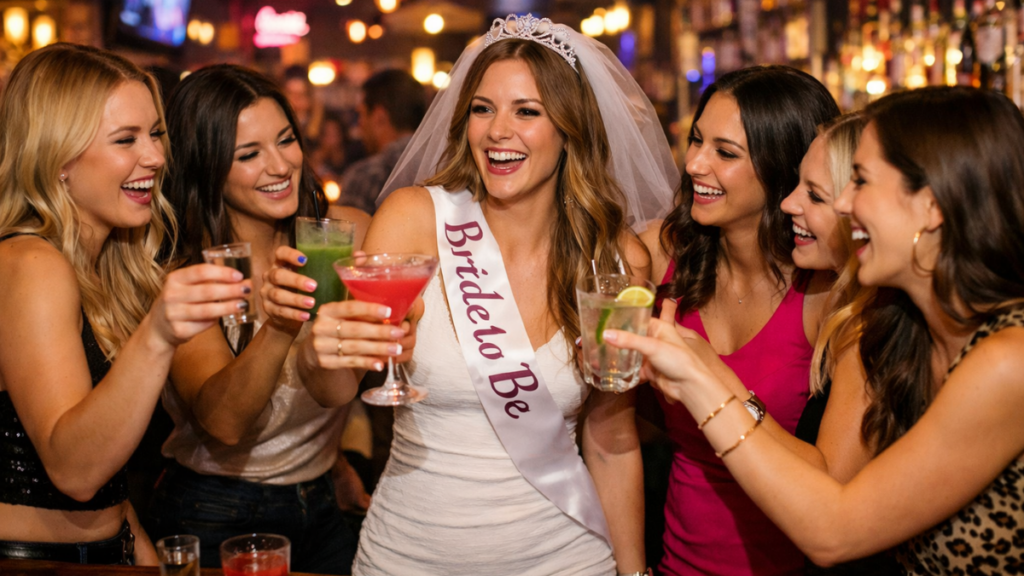
A neon sign inside said BRIDE TO BE in a way that made the whole place glow.
She had really done it up.
Custom drinks.
A table by the window.
Matching little gift bags.
Anyone else would have called it perfect.
I called it staging.
Watching Her Watch Me
She didn’t stay in one place.
She kept moving around the table, checking her phone, whispering to people, adjusting things that didn’t need adjusting.
Every few minutes she looked at me.
Not in a soft way.
In a waiting way.
Like she was counting down to something.
So I gave her what she wanted.
I laughed.
I took photos.
I let them put a plastic tiara on my head.
I even let her pull me into a hug while someone filmed it.
If this was going to be a performance, I was going to hit my marks.
The First Round of Drinks
The cocktails arrived with sparklers.
Someone shouted, “Speech!”
My best friend stood up and said the kindest things anyone has ever said about me.
I almost forgot what was coming.
And that scared me more than anything.
Because for a second, it felt like a real celebration.
Which meant she had almost succeeded.
The Signal
She checked her phone again.
Then she looked at the door.
Then back at me.
And she smiled.
It was small, but it was there.
That was the moment I knew he was close.
When the Past Walks In
The room didn’t go quiet.
That only happens in movies.
Music was still playing.
Glasses were clinking.
Someone at the next table was laughing too loudly.
But my body knew.
I felt it before I saw him.
That strange drop in your stomach when something familiar enters your space.
I turned my head.
And there he was.
Same posture.
Same careful smile.
Like he had rehearsed it in the mirror.
He even did that little half-wave he used to do when he didn’t know how welcome he was.
For a split second, nobody else noticed.
Except my sister.
She was watching me.
Not him.
Me.
Waiting for the shock.
The tears.
The chaos.
The Reaction She Didn’t Get
I didn’t stand up.
I didn’t freeze.
I didn’t look away.
I lifted my glass and took a sip.
Then I said, very calmly, “Oh. You invited my ex.”
The table went silent in a way the music couldn’t fix.
The Word “Accident” — Live and In Public
My sister let out a quick laugh.
“Oh my god — I forgot you two dated. That’s my fault.”
Forgot.
Like he was a plus-one she hadn’t meant to add.
Like three years of my life were a scheduling error.
I tilted my head.
“You planned this for two months,” I said. “You made a spreadsheet.”
Someone at the table stopped filming.
When Everyone Starts Understanding at the Same Time
You could actually see it happening.
The way people looked from me to her.
From her to him.
From him back to me.
The energy shifted so fast it felt physical.
My best friend slowly put her drink down.
“Wait,” she said. “You knew?”
Saying the Quiet Part Out Loud
“That’s the interesting part,” I said.
I reached into my bag and pulled out my phone.
“I wasn’t supposed to.”
I didn’t raise my voice.
I didn’t need to.
“You told people to bring him in after I had a drink so I’d be ‘relaxed.’”
My sister’s face changed.
Not into guilt.
Into calculation.
Her Last Attempt to Control the Story
“You went through my messages?” she asked.
Not: I’m sorry.
Not: I didn’t mean to hurt you.
That was her move.
Make me the problem.
I almost admired the consistency.
Why He Was Really There
“This was never about him,” I said.
I looked around the table so everyone could see my face.
“This was about you wanting a moment. You wanted me to fall apart at my own party so you could be the one who ‘fixed’ it. Or filmed it. Or told the story later.”
I let that sit for a second.
“You don’t celebrate me. You stage me.”
The Part I Didn’t Expect
He spoke.
“I didn’t know she hadn’t told you,” he said.
His voice was careful.
Polite.
Exactly the way it used to be when he was lying by omission.
And something in me just… closed.
“You knew enough to come,” I said.
That was the only thing I gave him.
No history.
No emotion.
Just a fact.
When the Party Stops Being a Party
Nobody was drinking anymore.
The music suddenly felt too loud.
One of the girls from my sister’s side quietly took off the sash she had insisted I wear.
My best friend moved her chair closer to mine without saying a word.
The photographer — because of course there was a photographer — lowered her camera.
The night she had designed started dissolving in real time.
My Sister, Without the Script
“You’re overreacting,” she said.
But her voice didn’t have its usual confidence.
“It was supposed to be a funny surprise.”
Funny.
I thought about every night she had listened to me cry about that relationship.
About how small I had felt.
About how long it took to trust someone again.
“You don’t get to rewrite my pain into entertainment,” I said.
The Choice
I stood up.
Not dramatically.
Just enough to reach for my coat.
“I’m not staying in a room where my past was invited without my consent,” I said.
Then I looked at the people who had come for me.
“If you want to keep celebrating, you should. This isn’t your mess.”
Nobody moved.
The Real Bachelorette Party
My best friend stood up too.
“So we’re leaving,” she said.
One by one, the others followed.
Chairs scraping.
Bags being picked up.
Glasses left half full.
The neon sign still said BRIDE TO BE.
But the table under it was empty.
My sister stayed sitting.
For the first time in her life, she wasn’t the center of the room.
Outside, In the Cold Air
The night felt different without the music.
Quieter.
Real.
Someone handed me a different tiara they had bought as a joke. It was crooked and cheap and perfect.
We went to a small bar around the corner.
No decorations.
No plan.
Just people who actually knew me.
And for the first time that evening, I laughed without performing.
The Message She Sent Later
Around 2 a.m., my phone buzzed.
“I was trying to do something memorable. You ruined it.”
I read it twice.
Then I put my phone away.
Because she was right about one thing.
It was memorable.
Just not for the reason she wanted.
What I Took With Me
I didn’t get the cinematic bachelorette party.
There were no coordinated photos.
No viral moments.
What I got was a very clear line.
Between the life I’m building and the version of me she still thinks she can use.
I’m still marrying the person who never once asked me to be someone else.
I’m still surrounded by friends who stood up when it mattered.
And I finally stopped hoping my sister would become the person I needed her to be.
The Last Thing I Heard About That Night
A week later, someone told me the bar charged her for the full package anyway.
Custom drinks.
Decorations.
Photographer.
All of it.
Non-refundable.
I didn’t feel satisfied.
I didn’t feel vindicated.
Just… done.
Closure Isn’t Loud
We haven’t had a real conversation since.
Maybe we will.
Maybe we won’t.
But when I think about that night now, I don’t see him walking through the door.
I see myself staying in my chair.
Calm.
Certain.
Finished with pretending.
And that’s the moment that actually feels like a celebration.