

I knew their daughter’s face.
Everyone in our area did.
Her name was Natalie Pierce.
She had been missing for eleven days.
Her photograph was everywhere.
Facebook.
Local news.
Flyers taped to the windows of gas stations and grocery stores.
Thirty-two years old.
Brown hair.
Green eyes.
Last seen leaving a restaurant downtown on a Wednesday night.
Her car was found the next morning in the parking lot of a trailhead approximately six miles outside town.
Her purse was inside.
Her phone was gone.
Police had searched the woods.
Volunteers had organized weekend searches.
There had been no sign of her.
I had shared one of the missing-person posts myself.
Then her parents showed up at my house.
My name is Laura.
I am fifty.
My husband, Eric, is fifty-two.
We have been married for twenty-four years.
We have two children.
Megan is twenty-two and finishing college.
Caleb is nineteen and in his first year.
Eric owns a small commercial electrical company.
I work for a medical billing company.
We are not exciting people.
At least I did not think we were.
The doorbell rang at approximately two in the afternoon.
Eric was in the garage.
I opened the door.
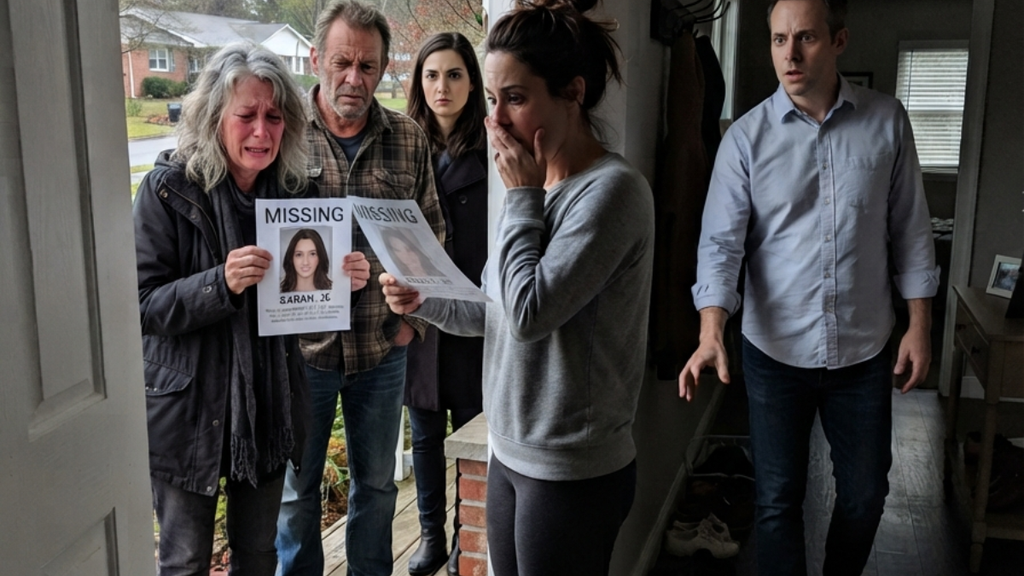
A man and woman stood on the porch.
Both looked exhausted.
The woman was holding her phone.
The man asked:
“Is Eric Dalton here?”
I said yes.
Then I asked who they were.
The woman said:
“We’re Natalie Pierce’s parents.”
My stomach dropped immediately.
I knew the last name.
I looked at her face.
She looked like Natalie.
Same eyes.
I said:
“Oh my God.”
I assumed they were canvassing.
Maybe asking about cameras.
Maybe Natalie had driven through our neighborhood.
I told them how sorry I was.
The woman’s face changed.
Not softened.
Tightened.
Then she said:
“We need to talk to Eric.”
I asked why.
The father said:
“Your husband was the last person our daughter called before she disappeared.”
I actually looked behind me.
I do not know why.
Maybe part of my brain thought there must be another Eric Dalton in the house.
I said:
“I’m sorry, what?”
The mother held up her phone.
She had a screenshot.
Call log.
Natalie’s number.
Outgoing call.
Wednesday, 10:41 p.m.
Eric Dalton — 7 minutes.
I stared at it.
I asked whether that was definitely my husband.
The father said:
“We called the number.”
My home phone was not ringing.
Eric’s cell was.
From the garage.
I could hear it.
The father said:
“That’s the number.”
I did not know what to say.
Then Eric came inside.
He had apparently heard voices.
He was wiping his hands on a rag.
He saw the couple.
He stopped walking.
That was the moment I knew he knew exactly who they were.
Natalie’s mother said:
“Eric.”
He said:
“Denise.”
Not Mrs. Pierce.
Not “I’m sorry, do I know you?”
Denise.
I looked at him.
I asked:
“You know them?”
Eric did not answer me.
He looked at Natalie’s father.
He said:
“Tom.”
Tom stepped toward him.
I thought he was going to hit him.
He did not.
He said:
“Where is she?”
Eric said:
“I don’t know.”
Denise started crying.
She asked:
“Then tell us what she said.”
Eric looked at me.
I said:
“What is happening?”
He told me we should go inside.
Tom said he was not going anywhere until Eric explained why Natalie called him.
I asked the same question.
Eric said:
“Laura, please.”
I told everyone to come in.
We sat in my living room.
Nobody took off their coats.
Eric sat beside me.
The Pierces sat across from us.
I asked Eric how he knew Natalie.
He said:
“She used to work for me.”
That was technically plausible.
Eric employs approximately twenty people depending on the season.
Office staff.
Electricians.
Apprentices.
Temporary workers.
I do not know everyone.
I asked when.
He said approximately eight years earlier.
I looked at Denise.
She said:
“Natalie never worked for you.”
Eric said:
“Yes, she did.”
Tom said:
“No, she didn’t.”
Eric said she worked in the office for several months.
Denise shook her head.
Natalie had been twenty-four eight years ago.
She worked at an insurance agency.
Before that, she worked at a restaurant.
She never worked for an electrical contractor.
Eric said:
“It wasn’t official.”
I asked what that meant.
He said Natalie helped with some bookkeeping.
Cash.
Occasionally.
I asked why.
He said:
“Because she needed money.”
Denise looked furious.
She said:
“Our daughter did not do your bookkeeping for cash.”
Eric said:
“You didn’t know everything Natalie did.”
Tom stood up.
I thought again he might hit him.
I told everyone to stop.
Then I asked Eric why Natalie called him at 10:41 at night on the evening she disappeared.
He said she was upset.
About what?
He would not answer.
Denise said:
“She called you for seven minutes.”
Eric said he knew.
I asked whether he told police.
Yes.
That surprised me.
I asked when.
The morning after Natalie disappeared.
He said detectives contacted him because his number appeared in her records.
I stared at him.
I asked:
“The police interviewed you?”
Yes.
I asked why he had not told me.
He said because they asked him not to discuss the investigation.
Tom laughed.
He said:
“They didn’t tell you not to tell your wife you knew our missing daughter.”
Eric said nothing.
I asked where police interviewed him.
At the station.
I asked when.
Nine days earlier.
Eric had told me that morning he had an early supplier meeting.
I looked at him.
He said:
“I didn’t want to scare you.”
I asked whether he understood that I was considerably more scared now.
Then Denise asked:
“What did she say?”
Eric rubbed his hands together.
He said Natalie was frightened.
I asked of what.
He said:
“She thought someone was following her.”
Tom and Denise both went still.
Apparently Eric had not told them that.
Denise asked who.
Eric said Natalie did not know.
She said she had seen the same vehicle several times.
She thought someone had been outside her apartment.
She asked Eric what she should do.
I asked why she called my husband instead of the police.
Eric said:
“Because she trusted me.”
I asked why.
He looked at me.
Then he said:
“I’ve known Natalie since she was a teenager.”
Everything stopped.
Denise started crying.
Tom stared at Eric.
I asked how.
Eric said he met her through a youth mentoring program.
I knew about the program.
Years ago, Eric volunteered with an organization that paired adults with teenagers who were aging out of foster care or dealing with difficult home situations.
He stopped volunteering approximately thirteen years ago.
Natalie would have been nineteen thirteen years ago.
I looked at her parents.
That made no sense.
Denise said:
“Natalie was never in foster care.”
Eric said he knew.
I asked whether Natalie had been part of the program.
No.
Then how did he meet her?
He said:
“Through someone who was.”
I asked who.
He would not answer.
Tom said:
“Say his name.”
Eric looked at him.
Tom already knew.
I could see it.
He said:
“Say it.”
Eric finally said:
“Daniel.”
Denise covered her face.
I had never heard the name.
I asked who Daniel was.
Nobody answered me.
Then Tom said:
“Daniel was our son.”
Was.
I asked what happened.
Denise said:
“He died.”
I said I was sorry.
She said it happened fourteen years earlier.
Daniel was twenty.
Natalie was eighteen.
I asked how Eric knew him.
Daniel had gotten into trouble as a teenager.
Nothing violent.
Car theft.
Drugs.
Skipping school.
He was referred to the mentoring program.
Eric became his mentor.
I vaguely remembered a boy.
Not his name.
Eric used to mention a teenager he was helping.
I remembered him leaving the house some evenings.
Basketball.
Job applications.
Driving lessons.
Then one day it stopped.
Eric told me the kid moved away.
I looked at him.
I said:
“You told me he moved.”
Eric nodded.
I asked why.
He said he did not know how to tell me Daniel died.
That made absolutely no sense.
Why would he hide the death of someone he mentored?
Then Denise said:
“Because Eric was with him.”
I felt cold.
I asked what she meant.
Tom looked at Eric.
Then at me.
He said:
“Your husband was the last person to see our son alive too.”
I could hear the clock on our wall.
That is what I remember.
The stupid ticking.
I looked at Eric.
He said:
“It isn’t what you’re thinking.”
I said:
“I don’t know what I’m thinking.”
Then Tom told me.
Daniel died in a car accident.
He had been driving alone.
His car went off a rural road and hit a tree.
He died at the scene.
Police determined speed and alcohol were factors.
I asked where Eric came into it.
Eric had been with Daniel approximately forty minutes earlier.
Daniel called him from a party.
He was drunk.
He asked Eric for a ride.
Eric went.
I asked whether Eric drove him home.
No.
He drove Daniel to a gas station.
I stared at him.
Why?
Because Daniel became angry.
They argued.
Daniel demanded Eric stop.
Eric let him out.
Daniel said a friend would pick him up.
Instead, Daniel apparently walked approximately half a mile to where he had left his own car earlier.
Then he drove.
He crashed.
I asked why Eric had lied to me.
He said he felt responsible.
I asked whether the Pierces blamed him.
Tom said:
“Yes.”
Denise said:
“Not anymore.”
Tom looked at her.
She said they had blamed him for years.
Eric had been the adult.
Daniel was drunk.
Eric knew it.
He left him at a gas station anyway.
Eric said he did not know Daniel would retrieve his car.
Tom said:
“You knew my son.”
Eric said:
“Yes.”
Tom said:
“You knew exactly what he would do.”
Eric looked down.
I asked whether police investigated Eric.
No crime.
He did not give Daniel alcohol.
He did not give him the car.
He tried to help.
He made a terrible decision.
Then I asked why this connected him to Natalie fourteen years later.
Denise said after Daniel died, Natalie contacted Eric.
At first, she hated him.
She blamed him.
She called him.
Emailed him.
Once she showed up at his workplace.
I asked whether I knew any of this.
No.
Eventually, Natalie and Eric started talking.
Eric told her about Daniel.
Things Daniel had shared during mentoring.
His plans.
His fears.
The night he died.
Natalie wanted to understand her brother.
Over time, anger turned into something else.
Not romantic.
Denise was adamant about that.
A strange relationship built out of grief.
Eric became someone Natalie called when she was struggling.
I asked how often.
Eric said it varied.
Sometimes they went a year without speaking.
Sometimes several times in a month.
I asked whether he saw her.
Occasionally.
Coffee.
Lunch.
I asked whether he gave her money.
He hesitated.
Yes.
That was the “bookkeeping.”
There had been no bookkeeping.
He gave Natalie cash because she was struggling financially.
He invented work to make her feel less embarrassed about accepting it.
I asked how much.
Over fourteen years?
Maybe $30,000.
I stared at him.
I asked where it came from.
Mostly his personal spending account.
Sometimes business cash.
I told him business cash was not personal.
He said he knew.
I asked whether he ever told me.
No.
Then Denise said:
“We didn’t know either.”
Apparently Natalie kept her relationship with Eric mostly hidden from her parents because they hated him.
Tom still blamed him for Daniel.
Natalie knew bringing up Eric caused fights.
So she did what Eric did.
She created a private compartment in her life.
I asked why the Pierces came to our house now.
Tom said police told them Eric was cooperating.
But the detective would not give them details of the call.
Natalie’s phone had not been recovered.
The family obtained some records themselves.
They saw Eric’s number.
Denise recognized it.
She had kept his number from years earlier.
They came because they wanted answers.
I asked Eric what exactly Natalie said during the seven-minute call.
He said she was leaving dinner.
She was walking toward her car.
She thought she saw the vehicle again.
I asked what vehicle.
A dark SUV.
Maybe black.
She had seen it outside her apartment twice.
Then near her job.
Then that night.
I asked whether she described the driver.
No.
I asked whether Eric told her to call police.
Yes.
I asked whether she did.
He did not know.
I asked why he did not call police himself after she hung up.
He said Natalie told him she was probably being paranoid.
She said she was going to drive home.
He told her to call when she got there.
She never did.
I asked whether he called her back.
Three times.
No answer.
I asked what he did next.
He waited.
Then approximately thirty minutes later, he drove toward her apartment.
I stared at him.
I asked:
“You went looking for her?”
Yes.
He drove by her apartment.
Her car was not there.
He called again.
Then he drove toward the restaurant.
He did not see her.
I asked whether he told police that.
Yes.
I asked whether that was why they interviewed him.
Partly.
His movements placed him near areas relevant to the investigation.
I asked where he went after the restaurant.
Home.
I remembered that night.
Eric came home around midnight.
He told me there had been a problem at a job site.
I was already in bed.
He showered.
He seemed distracted.
The next morning, Natalie was reported missing.
I asked whether he knew before the news broke.
Yes.
Her mother called him at approximately seven.
I looked at Denise.
She nodded.
She had found Eric’s number in an old notebook Natalie kept from the period after Daniel died.
She asked whether he had heard from Natalie.
He told her about the call.
Then police became involved.
I asked Eric why he had not told me any of this when Natalie appeared on the news.
He said:
“Because then I would have had to tell you everything.”
I laughed.
It was becoming a familiar sentence.
I asked whether he understood how suspicious that made him look.
He said yes.
Then Tom asked:
“Did she tell you about the envelope?”
Eric looked confused.
“What envelope?”
Tom said Natalie had been acting strangely for approximately a month.
She told Denise she had found something of Daniel’s.
Something she thought had been lost.
She would not explain.
Denise thought it was photographs.
Then Natalie said she needed to talk to “someone who was there.”
Tom now believed she meant Eric.
Eric said Natalie never mentioned an envelope.
Tom did not believe him.
Neither did I.
I asked whether Natalie had been asking about Daniel recently.
Eric hesitated.
Yes.
More than usual.
I asked why.
He said approximately six weeks earlier, Natalie called and asked him to tell her again what happened the night Daniel died.
I asked what she wanted to know.
Everything.
What Daniel was wearing.
What he said.
Where Eric picked him up.
Where they drove.
Why they argued.
Where Eric dropped him.
I asked whether that was unusual.
Yes.
Natalie had asked those questions years earlier.
She knew the story.
This time she wanted exact times.
I asked why.
Eric said she would not tell him.
Then she asked one question that frightened him.
“What happened to Daniel’s backpack?”
Tom sat forward.
He asked what Eric said.
Eric said he did not know.
Tom said Daniel had a backpack at the party.
It was never recovered from the crash.
The family assumed he left it at the party.
The people hosting the party said they never found it.
I asked what was inside.
Nobody knew.
Daniel carried everything in it.
Clothes.
Notebooks.
CDs.
Probably drugs.
Who knew.
But Natalie apparently believed something important had been inside.
I asked why.
Denise reached into her purse.
She pulled out a folded piece of paper.
A photocopy.
She handed it to me.
It was a page from what looked like a journal.
Daniel’s handwriting.
Dated three days before he died.
Most of it was ordinary.
Angry twenty-year-old writing.
Complaints about work.
His parents.
A girlfriend.
Then:
E says I need to stop asking questions about the money. Says I’m getting into something I don’t understand.
I looked at Eric.
I asked whether E was him.
Eric said he did not know.
Tom laughed.
He said:
“Who else?”
I continued.
I told him I copied everything. He got pissed. Says I’m trying to act like a hero. Maybe I am.
Then:
If something happens, Nat knows where I keep it.
Natalie.
I read it again.
I asked where the page came from.
Denise said Natalie found an old box in their attic approximately two months earlier.
It contained Daniel’s journals.
Most had been packed away after his death.
That page was inside.
I asked whether police had it.
Yes.
They had copies of everything.
I asked what “the money” meant.
Tom looked at Eric.
Eric looked sick.
I asked again.
Then Eric said:
“Daniel thought someone at the mentoring program was stealing.”
Everything went quiet.
I asked who.
He said he did not know.
The program received grants.
Donations.
Money for job training.
Transportation.
Emergency housing.
Daniel claimed some of it was being diverted.
I asked whether Eric believed him.
At the time, no.
Daniel had a history of making accusations when he was angry.
Eric thought he had misunderstood something.
I asked whether Daniel showed him evidence.
No.
He said he had copied records.
Eric told him to stay out of it and bring anything real to the program director.
Daniel refused.
He did not trust the director.
I asked whether Eric was the “E” in the journal.
Probably.
I asked why he had never mentioned this.
Eric said because it had nothing to do with Daniel’s death.
I asked how he knew.
The crash was investigated.
Daniel was intoxicated.
There were no other vehicles involved.
No sign of foul play.
I asked about the backpack.
Eric said he never saw it.
Tom said:
“You picked him up.”
Eric said Daniel did not have it when he got into the car.
Tom asked whether Eric was sure.
Yes.
Then Denise said something quietly.
“Natalie said you did.”
Eric looked at her.
Denise said approximately three weeks before disappearing, Natalie told her she had spoken to someone from the party.
A woman named Kelly.
Kelly remembered Daniel leaving with his backpack.
She remembered because he nearly forgot it.
She handed it to him before he got into a truck.
Eric’s truck.
I looked at my husband.
He said:
“That’s not true.”
Tom stood.
He asked whether Eric was calling Kelly a liar.
Eric said memories from fourteen years ago were unreliable.
Tom said:
“Convenient.”
I asked whether police had spoken to Kelly.
Yes.
I asked what she told them.
The same thing.
Daniel left the party carrying a dark backpack.
He got into Eric’s truck with it.
I asked Eric again.
He said:
“I don’t remember a backpack.”
Not the same as no.
I pointed that out.
He became angry.
He said he had spent fourteen years replaying the worst night of his life.
He remembered Daniel screaming at him.
He remembered pulling into the gas station.
He remembered Daniel slamming the door.
He did not remember what was on the floor of his truck.
I asked whether he cleaned the truck afterward.
He said probably.
I asked whether he found a backpack.
No.
Then Tom said:
“Natalie thought you took it.”
Eric looked at him.
Tom said Natalie had been investigating the last weeks of Daniel’s life.
She had spoken to former employees of the mentoring program.
Former volunteers.
Kids who had been there.
She believed Daniel had discovered financial fraud.
She believed he copied records.
She believed the records were in the missing backpack.
And she believed Eric knew more than he had admitted.
I looked at my husband.
I asked whether that was why Natalie called him the night she disappeared.
He said he did not know.
I asked whether she accused him.
He hesitated.
Then he said:
“She asked me if I had lied about Daniel.”
Tom moved toward him.
Denise grabbed her husband’s arm.
I asked what Eric said.
He told Natalie no.
Then she said she had spoken to Kelly.
She told him Kelly remembered the backpack.
Eric told her Kelly was wrong.
Then Natalie said:
“I know what was in it.”
I felt cold.
I asked what happened next.
Eric said Natalie told him she had found a copy.
A copy of what Daniel had collected.
I asked where.
She did not say.
I asked whether Eric asked.
Yes.
She refused.
Then she said:
“Daniel was right.”
I asked what that meant.
Eric said he did not know.
Then Natalie noticed the SUV.
The conversation changed.
She said someone had been following her.
Eric told her to get in her car.
Lock the doors.
Call police.
Then the call ended.
I asked whether Eric believed the SUV was connected to whatever Natalie found.
He said:
“I do now.”
I asked whether he told police that.
Yes.
Then Denise asked:
“Why didn’t you tell us?”
Eric said because detectives asked him not to interfere.
Tom told him to stop hiding behind the police.
I agreed.
Then I asked the question nobody had asked.
If Daniel discovered financial fraud fourteen years earlier, who from the mentoring program was still around now?
Eric looked at me.
The organization had closed eleven years ago.
The executive director died six years ago.
Several staff members moved.
One person still lived locally.
The former finance director.
His name was Raymond Cole.
I recognized the name.
Not from the mentoring program.
From Eric’s company.
I asked:
“Ray Cole?”
Eric looked at the floor.
Ray had been Eric’s accountant for almost eighteen years.
He still did our business taxes.
He had been in my house.
He attended our company Christmas party.
I asked whether Ray worked for the mentoring program.
Eric said yes.
I felt sick.
I asked whether Daniel suspected Ray.
Eric said:
“I don’t know.”
Tom said:
“Bullshit.”
Eric stood.
He said he genuinely did not know.
Daniel never named anyone.
He only said “they.”
I asked why Eric hired Ray later.
Because they knew each other through the program.
Ray was good at his job.
I asked whether Eric ever told Ray about Daniel’s accusations.
Eric said no.
Then he corrected himself.
Once.
I stared at him.
When?
The day after Daniel died.
Eric was distraught.
He went to the program office.
He told Ray that Daniel had been saying strange things about missing money and copied records.
Ray told him Daniel had probably been confused.
He said there had been an audit recently and everything was fine.
Eric believed him.
I asked whether Ray knew about the backpack.
Eric said he mentioned Daniel claiming he had copies.
I could barely speak.
If Daniel had discovered something involving Ray, then Eric had potentially told the person Daniel suspected that evidence existed.
Eric said:
“I didn’t know.”
I said I understood.
But fourteen years later, Natalie started investigating.
Then someone began following her.
Then she disappeared.
I asked whether Ray knew Natalie.
Eric said probably.
She came to the program several times to see Daniel.
I asked whether Ray knew she had been asking questions recently.
Eric said he had no idea.
Then his face changed.
I asked what.
He said approximately two months earlier, Ray called him unexpectedly.
Not about taxes.
Ray asked whether Eric ever heard from Daniel’s family.
I felt every hair on my arms rise.
I asked what Eric said.
He told Ray he occasionally spoke to Natalie.
Ray asked how she was.
Eric said fine.
Then Ray said something like:
“Funny how people start digging through the past when their parents clean out the attic.”
I asked whether Eric thought that was strange.
Yes.
I asked whether he asked how Ray knew about the attic.
No.
He assumed small-town gossip.
I asked whether he told Natalie.
No.
I asked whether he told police.
He said:
“Yes.”
I was relieved.
Then Tom asked when.
Eric said three days earlier.
Tom became furious.
He asked why Eric waited eight days after Natalie disappeared.
Eric said he did not remember the conversation with Ray immediately.
Then something reminded him.
I asked what.
A voicemail.
Ray called Eric two days after Natalie disappeared.
I asked what he said.
Eric pulled out his phone.
The police already had a copy.
He played it.
Ray’s voice.
Calm.
Casual.
Hey, Eric. Heard about Natalie. Crazy stuff. I know you two stayed in touch after Daniel, so I figured I’d check in. If police ask you about the old program, just remember there was a lot of confusion back then. Those kids said all kinds of things. Call me.
Nobody spoke.
I asked whether Ray had ever called Eric to “check in” about Natalie before.
No.
I asked whether he knew Eric was the last person she called.
Eric said that information was not public.
Tom swore.
Denise started crying again.
Then there was a knock on our door.
All four of us froze.
I stood.
Eric told me not to answer.
I asked why.
He said he was not expecting anyone.
I almost laughed.
Neither had I when a missing woman’s parents arrived.
The knock came again.
Then someone called:
“Eric?”
I recognized the voice.
Ray.
Nobody moved.
Ray knocked again.
Then:
“Your truck’s here, man. I know you’re home.”
Tom stood.
Eric told him to sit down.
Tom ignored him.
I whispered that we should call police.
Eric already was.
He walked toward the door but did not open it.
He told the dispatcher who was outside.
Ray knocked a third time.
Then his phone rang.
Eric’s.
Ray calling.
We watched it vibrate on the coffee table.
Eric did not answer.
Approximately thirty seconds later, we heard footsteps.
Then a car door.
Then an engine.
Eric looked through the window.
He said Ray was leaving.
Police arrived twelve minutes later.
By then, I was shaking.
They separated us.
A detective I later learned was named Morales spoke to Eric first.
Another officer took statements from me and the Pierces.
I told them everything I had heard.
The officer did not react much.
When I mentioned Ray arriving unexpectedly, she wrote for a long time.
Eventually Detective Morales asked to speak to me.
He told me Ray was already someone they wanted to interview again.
Again.
Apparently police had spoken to him two days after Natalie disappeared because his name appeared in notes found in her apartment.
I asked whether he was a suspect.
Morales said he could not discuss that.
I asked whether they knew someone had been following Natalie.
Yes.
I asked whether they knew about the SUV.
Yes.
I asked whether Ray owned one.
Morales did not answer.
Then he asked me something.
“Does your husband still have the truck he owned fourteen years ago?”
No.
Eric sold it approximately ten years earlier.
I asked why.
Morales said they were trying to establish what happened to Daniel’s backpack.
I asked whether they believed Eric took it.
He said they did not know.
Then he asked whether Eric ever kept boxes from the mentoring program.
I said not that I knew.
He asked about our garage.
Basement.
Attic.
Business office.
Storage units.
I said Eric had a locked records room at his company.
The detective wrote that down.
I asked whether Eric had consented to searches.
Morales said:
“Your husband has been cooperative.”
That did not answer the question.
Eventually police left.
The Pierces left too.
Denise hugged me before she went.
I do not know why.
Maybe because we were both standing inside versions of our lives that had changed in one afternoon.
Eric and I were alone.
I asked him:
“Is there anything else?”
He said no.
I told him to think carefully.
He said:
“Laura, I swear.”
I asked whether he had ever taken anything from Daniel’s backpack.
He said he did not remember seeing the backpack.
I asked whether he had ever found papers in his truck after Daniel died.
No.
I asked whether he had ever helped Ray hide money.
Absolutely not.
I asked whether his business had any financial relationship with Ray beyond accounting.
Yes.
Ray had helped Eric obtain his first major business loan.
He had introduced him to clients.
He had helped him structure the company.
I asked whether any money from the old mentoring organization had gone into Eric’s business.
Eric looked horrified.
No.
I asked whether he was sure.
Yes.
Then I asked whether Ray invested in the company.
Silence.
I knew.
I asked how much.
When Eric started the business seventeen years earlier, Ray loaned him $40,000.
I stared at him.
I knew Eric had borrowed startup money.
He told me it came from a private investor connected to the mentoring program.
He never told me it was Ray.
I asked whether he repaid it.
Yes.
Within five years.
Interest and everything.
I asked why he hid Ray’s name.
He said I did not know Ray then, so it did not seem important.
I said:
“You have a very flexible definition of important.”
Then I asked when Daniel started asking about missing money.
Fourteen years ago.
Three years after Ray gave Eric the $40,000.
I asked whether Eric had ever wondered whether the loan came from the program.
He said no.
I asked whether he was wondering now.
He did not answer.
That night, Eric slept on the couch.
I went through our old financial records.
I found the original loan agreement.
Raymond Cole.
$40,000.
The money had been wired from an LLC.
Northfield Community Holdings.
I searched the name online.
Nothing obvious.
Old company.
Dissolved.
Then I found an archived state business record.
Northfield Community Holdings had been registered by Raymond Cole.
The address was familiar.
It was the same building where the youth mentoring program had operated.
I woke Eric.
I showed him.
He sat up.
He said:
“Oh my God.”
I asked whether he genuinely had never noticed.
He said no.
Ray told him Northfield was an investment company.
Eric was thirty-five.
Desperate to start his business.
Ray offered financing.
Eric accepted.
I asked whether there were other loans.
Eric did not know.
I asked whether he still had records from the program.
Maybe.
When the organization closed, Eric took several boxes because nobody knew what to do with them.
I stared at him.
I asked where.
His company’s records room.
I almost screamed.
Police had asked about boxes.
Eric said he forgot.
I told him to call Detective Morales immediately.
He did.
The police collected the boxes the next morning.
Eric was not allowed to go through them first.
Good.
I did not trust anyone’s memory anymore.
Two days passed.
Natalie was still missing.
Searches continued.
Ray stopped answering calls.
His office was closed.
Police would not tell us where he was.
Then, on Wednesday morning, Denise called me.
She was crying so hard I could barely understand her.
Police had found Natalie.
Alive.
She was in a hospital.
That was all Denise could tell me.
I sat on my kitchen floor and cried.
Eric cried too.
We did not know what happened.
We did not know whether Ray was involved.
We did not know where Natalie had been for fourteen days.
But she was alive.
Hours later, news reports said Natalie had been found approximately seventy miles away after walking into a roadside convenience store and asking the clerk to call police.
No other details.
Eric wanted to go to the hospital.
I told him absolutely not.
Natalie and her family would decide whether they wanted him anywhere near her.
The next evening, Tom called.
He asked if Eric was there.
I said yes.
He asked to speak on speakerphone.
Then Natalie came on.
Her voice was weak.
She said:
“Eric?”
He started crying.
He said:
“I’m here.”
Natalie said:
“You lied to me.”
Eric went silent.
I felt cold.
He asked about what.
She said:
“The backpack.”
Eric said:
“Natalie, I swear I don’t remember—”
She interrupted him.
“You took it.”
I stared at my husband.
Eric went completely still.
Natalie said:
“You told me yourself.”
Eric said:
“What?”
Then she said:
“You just don’t remember why.”
And for the first time since her parents knocked on our door, I realized the biggest secret in the story might not be something my husband had deliberately kept from me.
It might be something he had spent fourteen years trying not to remember.
Eric asked Natalie what she meant.
She said:
“You took Daniel’s backpack out of your truck after he died.”
Eric kept saying no.
Not angrily.
Almost desperately.
He said he did not remember doing that.
Natalie said:
“I know.”
That confused me.
I asked how she knew he took it.
There was a pause.
Then Natalie said she needed to start earlier.
Approximately two months before she disappeared, her parents decided to finally clean out several boxes that had been sitting in their attic since Daniel died.
Most contained his things.
Clothes.
School papers.
CDs.
Photographs.
Journals.
Natalie took the journals home.
That was where she found the page about the money.
But there was something else.
A microcassette.
Daniel used to carry a tiny handheld recorder.
I remembered those things.
People used them for notes before everyone had smartphones.
Daniel apparently used his to record song ideas, reminders, and sometimes conversations.
Natalie found one tape loose at the bottom of a box.
She bought an old recorder online so she could listen to it.
Most of the tape was meaningless.
Daniel talking to himself.
Music from a car radio.
Someone laughing.
Then she heard Eric.
The recording was from the night Daniel died.
I looked at my husband.
He looked terrified.
Natalie said she had given police the original recording before she disappeared.
That was why police knew far more than they had told us.
Then she told us what was on it.
Daniel had apparently turned the recorder on while he was in Eric’s truck.
Maybe deliberately.
Maybe accidentally.
The tape began in the middle of their argument.
Daniel was drunk.
That part was obvious.
He was slurring.
He was angry.
Eric kept telling him to calm down.
Then Daniel said:
“You already told him.”
Eric asked:
“Told who?”
Daniel said:
“Ray.”
There was silence.
Then Eric said:
“I asked him about the money.”
Daniel:
“You told him I copied it.”
Eric said:
“I didn’t know it was some huge secret.”
Daniel called him an idiot.
Eric told him not to speak to him that way.
Then Daniel said:
“If anything happens to me, this is on you.”
That sentence had apparently haunted Eric for fourteen years.
I looked at him.
He was crying.
Natalie continued.
On the recording, Eric told Daniel he was being dramatic.
Daniel said the records proved Ray had been moving grant money through fake companies.
One of those companies was Northfield Community Holdings.
The same company that loaned Eric $40,000.
Eric said:
“What are you talking about?”
Daniel told him.
According to what Daniel found, Northfield received payments supposedly for transitional housing and transportation services.
Those services either did not exist or were wildly inflated.
Money went into Northfield.
Then some of it was loaned or invested elsewhere.
Including Eric’s company.
On the recording, Eric sounded genuinely shocked.
That mattered.
He was not arguing because he had been caught.
He sounded like a man realizing his business might have been funded with stolen money.
Daniel told him the documents were in his backpack.
Then Eric said:
“Give it to me.”
Daniel refused.
They argued.
Eric said Daniel was drunk and could lose everything.
Daniel said he was taking the records to a reporter.
Eric told him he needed to go to police.
Daniel said he did not trust police because Ray knew everyone.
Then the truck stopped.
Eric told Daniel:
“Give me the bag and I’ll deal with it tomorrow.”
Daniel refused again.
Then there was movement.
A door.
Shouting.
The recording became muffled.
Finally Eric said:
“Fine. Walk home.”
Then the tape ended.
I asked Eric whether hearing that brought anything back.
He was staring at the floor.
He said:
“I remember asking for the bag.”
I asked whether Daniel gave it to him.
Eric said no.
Then Natalie said:
“He did.”
Eric asked how she knew.
She said there was more.
Not on that tape.
Another recording.
This one was made the next morning.
Daniel was already dead.
Eric had called the Pierces’ house.
Natalie answered.
She was eighteen.
She remembered the call vaguely, but grief had swallowed most of it.
She had forgotten the details.
Daniel’s recorder had apparently been running beside the phone because Natalie had been listening to his messages.
The tape captured part of her conversation with Eric.
Eric’s voice:
“I have his bag.”
Natalie’s younger voice:
“What?”
Eric:
“Daniel left his backpack in my truck.”
Natalie:
“Bring it here.”
Eric:
“I can’t yet.”
Natalie:
“Why?”
Then Eric said:
“There’s stuff in it I need to understand first.”
I felt sick.
Eric put his head in his hands.
He said:
“I don’t remember that.”
Natalie said she believed him.
I asked why.
She said because of what happened next.
The recording continued.
Young Natalie was crying.
She asked whether Eric caused the accident.
Eric said no.
She called him a liar.
She blamed him.
Then Eric said:
“I should have taken him home.”
Natalie said:
“You should have.”
Eric said:
“I know.”
Then Natalie said:
“Bring me Daniel’s bag.”
Eric said:
“Tomorrow.”
The call ended.
But the backpack never arrived.
I asked Eric what he did with it.
He said he genuinely did not know.
I wanted to believe him.
That was becoming increasingly difficult.
Then Natalie said:
“Ray took it.”
We all went silent.
She explained.
After she found the recordings, she began reconstructing those days.
She found an old calendar belonging to her mother.
The day after Daniel died, Denise had written down visitors.
People brought food.
Friends came.
A pastor.
Relatives.
Eric.
And Ray Cole.
Ray had come to the house that afternoon.
He told the Pierces he was representing the mentoring program.
He offered condolences.
He stayed approximately twenty minutes.
Natalie had no memory of speaking to him.
Then she found something else in Daniel’s journals.
A phone number for a woman named Cynthia.
Natalie tracked her down.
Cynthia had been the program’s administrative assistant.
She was seventy now.
She remembered the investigation into missing money.
Not an official investigation.
Rumors.
Questions.
Daniel asking for copies of invoices.
Then, after Daniel died, Ray told everyone Daniel had been stealing documents and possibly money himself.
I asked:
“Ray blamed Daniel?”
Yes.
According to Cynthia, Ray said Daniel had become unstable.
He implied Daniel’s death might have been related to guilt or substance abuse.
The organization quietly tightened access to records.
Nothing went further.
Cynthia left the following year.
Natalie asked whether Cynthia remembered Eric.
She did.
Then Cynthia said something that changed the timeline.
Eric came to the office the morning after Daniel died carrying a backpack.
I looked at my husband.
He whispered:
“No.”
Natalie said Cynthia was certain.
Dark canvas backpack.
Eric asked for Ray.
Cynthia told him Ray was not there yet.
Eric said he would wait.
Ray arrived approximately twenty minutes later.
They went into Ray’s office.
Eric left without the backpack.
Eric stood up from our couch.
He walked into the kitchen.
I followed him.
I asked whether he remembered.
He leaned against the counter.
Then he said:
“Pieces.”
I asked what pieces.
He remembered finding the backpack in his truck the morning after the crash.
He remembered opening it.
He remembered papers.
He remembered seeing Northfield’s name.
Then he remembered Ray’s.
I asked why he took it to Ray.
Eric looked at me.
“Because I trusted him.”
That was it.
Daniel had told Eric Ray might be stealing.
Eric found documents suggesting Ray’s company was receiving money.
And instead of going to police, he took the evidence directly to Ray and asked him to explain it.
I wanted to scream.
Eric said he was thirty-eight.
Daniel was dead.
He was in shock.
Ray had been his accountant.
His friend.
The person who helped fund his business.
Eric desperately wanted there to be an innocent explanation.
Ray gave him one.
He said Northfield legitimately contracted with the nonprofit.
He said Daniel had stolen incomplete records and misunderstood them.
He said the $40,000 loan came from his own profits.
He told Eric if he gave the backpack to Daniel’s parents, they would see accusations Daniel had written and become obsessed with the idea that his death was connected.
Eric said:
“I believed him.”
I asked what happened to the backpack.
Eric said he left it with Ray.
I asked why.
Ray said he would turn the records over to the program’s attorney and then return Daniel’s personal things.
I asked whether Eric ever followed up.
Yes.
A few days later.
Ray said police had the documents.
Eric assumed the backpack had been given to them.
I asked whether he told the Pierces.
No.
Why?
Because by then they blamed him for Daniel’s death.
He could barely face them.
Then why did he tell Natalie he had the backpack?
Eric said he had forgotten that conversation entirely.
I asked whether grief could really erase something that specific.
He said:
“I don’t know.”
Natalie answered from the speakerphone.
“I think Ray helped.”
I asked what that meant.
Natalie said this was part of what police were investigating.
After Daniel died, Eric started drinking heavily.
I remembered.
Not every day.
But much more than usual.
He had nightmares.
He stopped volunteering.
He was depressed.
I thought it was guilt over the accident.
Apparently there was more.
Eric began seeing a therapist.
I remembered that too.
What I did not know was who recommended the therapist.
Ray.
I looked at Eric.
He nodded.
The therapist was legitimate.
There was no conspiracy involving him.
But Ray repeatedly told Eric that he was traumatized, that memory after trauma could be unreliable, and that obsessing over the backpack or Daniel’s accusations would only worsen his guilt.
Ray kept reinforcing the same story.
The records were meaningless.
The backpack had been handled.
Police knew everything.
Daniel died because he drove drunk.
Eric had tried to help.
Move on.
Eventually Eric did.
Or tried.
The memory of the backpack blurred into everything else he was trying not to think about.
I asked whether police believed that explanation.
Natalie said they had not told her.
Then I asked what happened to her.
There was a long pause.
Natalie said:
“Ray followed me.”
I looked at Eric.
Natalie had confronted Ray approximately three weeks before she disappeared.
She did not tell anyone.
Not her parents.
Not Eric.
She wanted to see his reaction.
She went to his office.
She asked about Northfield.
Ray acted confused.
Then she mentioned Daniel’s backpack.
His expression changed.
He told her grief could make people create stories.
She said she had recordings.
That was a mistake.
Afterward, she started seeing the SUV.
Ray owned a dark gray Lexus SUV.
But Natalie could never clearly see the driver.
She began believing he was following her.
Then she received an envelope under her apartment door.
Inside were photocopies of documents.
Old invoices.
Checks.
Northfield records.
Someone had written:
Your brother was right.
I asked who sent it.
She still did not know.
Those were the copies she told Eric about during their final call.
She had photographed everything and uploaded it to a cloud account.
Then she gave the physical envelope to a friend for safekeeping.
That friend turned it over to police after Natalie disappeared.
I asked what the documents proved.
Natalie said she did not know the full scope.
Police and federal investigators were handling it now.
But they appeared to show that Ray had diverted money through multiple shell companies.
Northfield was one.
Eric’s business loan was one destination.
I looked at my husband.
He looked destroyed.
Natalie said:
“Eric, I don’t think you knew.”
He started crying.
He thanked her.
Then she said:
“But you helped him.”
Eric closed his eyes.
She was right.
Not knowingly.
But he helped.
He delivered Daniel’s evidence directly to Ray.
Then accepted Ray’s explanation.
Then stayed silent for fourteen years.
I asked Natalie how she disappeared.
She said after dinner that night, she walked toward her car.
She saw the SUV.
She called Eric.
During the call, she saw someone get out.
Not Ray.
A man she did not recognize.
She panicked.
She got into her car.
She told Eric she would call police.
Then the man approached her window.
He said her name.
He told her he knew about Daniel.
Natalie thought he was working for Ray.
She drove away.
The SUV followed.
She called 911.
That was the part none of us knew.
Police had a partial emergency call.
Natalie told the dispatcher she was being followed.
Then the call dropped.
She drove toward the trailhead because she knew there were usually people there.
But the parking lot was empty.
The SUV pulled in behind her.
She got out and ran.
I asked why her purse was left in the car.
She did not intentionally leave it.
She was terrified.
Her phone was in her hand.
She ran into the woods.
The man followed.
She hid.
Eventually she heard him leave.
Then she tried to find her way back.
She became disoriented.
Her phone battery was nearly dead.
She finally reached a road several hours later.
Then a vehicle stopped.
A woman was driving.
Natalie asked for help.
The woman told her to get in.
I expected this to be the rescue.
It was not.
The woman knew her name too.
Natalie realized almost immediately.
She tried to get out.
The woman locked the doors.
She told Natalie that if she cooperated, nobody would hurt her.
I asked who she was.
Natalie said:
“Ray’s sister.”
Her name was Monica.
I had met her.
Once.
At a company Christmas party.
She worked in real estate.
Natalie said Monica drove her to a cabin.
Approximately fifty miles away.
The man from the trailhead was Monica’s boyfriend.
They took Natalie’s phone.
They kept her at the cabin.
I asked why.
Natalie said they wanted to know where the documents were.
They believed she had the originals Daniel copied fourteen years earlier.
She did not.
They did not believe her.
I asked whether Ray was there.
Natalie paused.
Then:
“Once.”
Eric stood.
Natalie said Ray came on the third day.
He apologized.
He told her things had gotten out of control.
He said he never wanted anyone hurt.
He said Daniel’s death had been an accident.
I asked whether that was true.
Natalie said:
“Yes.”
That mattered.
Daniel had not been murdered.
There was no secret car chasing him.
No sabotage.
No one forced him off the road.
He was drunk.
He drove.
He crashed.
Ray had stolen money.
Eric had made a terrible mistake with the backpack.
But Daniel’s death was still the tragic accident everyone originally believed.
That distinction made the story almost worse.
There had been no murder to cover up.
Ray spent fourteen years hiding financial crimes that had nothing to do with Daniel’s actual cause of death.
Then Natalie uncovered them.
And that was when he crossed into something far worse.
I asked how she escaped.
Ray apparently told Monica and her boyfriend to let Natalie go.
Monica refused.
She believed Natalie would immediately go to police.
They argued.
Natalie heard part of it.
Ray left.
The next morning, Monica’s boyfriend drove away.
Monica stayed.
Natalie had been zip-tied at night but allowed to move around the cabin during the day under supervision.
Monica went outside to take a call.
Natalie found her car keys on the counter.
She took them.
She ran.
Monica chased her.
Natalie reached the car first.
She drove until she ran out of gas.
Then she walked.
Eventually she found the convenience store.
I asked whether Monica and her boyfriend had been arrested.
Yes.
Ray too.
That information had not yet been released publicly when we spoke.
Natalie said police had asked her family to keep details quiet.
I asked why she was telling us.
Because Eric needed to remember.
And because she was done protecting people with silence.
Then she said something I will never forget.
“Daniel died because he made one terrible decision after another that night. That doesn’t mean everything he discovered before he died was wrong.”
For fourteen years, everyone had allowed the circumstances of Daniel’s death to discredit him.
He was drunk.
He had drugs in his system.
He had a criminal history.
He was angry.
Therefore, the fraud accusation became another example of Daniel being unstable.
Ray benefited from that.
I asked Natalie whether she blamed Eric.
She said:
“For Daniel’s death? Not anymore.”
Eric cried harder.
Then she continued.
“For what happened after? Some.”
That was fair too.
Eric apologized.
Not the vague kind.
He told her exactly what he was sorry for.
He was sorry he left Daniel at the gas station.
He was sorry he took the backpack.
He was sorry he trusted Ray over Daniel.
He was sorry he did not give the bag to the Pierces.
He was sorry he allowed shame to convince him that silence was the same thing as moving on.
Natalie listened.
Then she said:
“I believe you.”
She did not say she forgave him.
Those are different things.
After the call, Eric and I sat in silence.
Eventually I asked why he never told me about Daniel.
He said:
“Because I couldn’t stand who I was in that story.”
That answer was more truthful than anything he had said before.
He wanted me to know him as the man who mentored troubled kids.
Not the man who lost his temper with one.
Not the man who left a drunk twenty-year-old at a gas station.
Not the man who ignored the kid’s accusations.
Not the man who unknowingly delivered evidence to the person accused.
Not the man who then spent years accepting an easier version because the real one made him ashamed.
So he told me Daniel moved away.
Then he kept telling that lie through omission for fourteen years.
I asked whether he understood that I had spent eleven days sharing missing-person posts about a woman he knew intimately through one of the worst events of his life.
He said yes.
I asked whether he understood what it felt like to have her parents explain my husband’s history to me in my own living room.
Yes.
I asked whether there were any other people he had erased from his life before presenting it to me.
He said no.
I told him I would need more than his word eventually.
He said he understood.
The investigation exploded publicly over the next several weeks.
Ray was charged with offenses related to Natalie’s abduction, along with Monica and her boyfriend.
The financial investigation was separate and much larger.
I will not pretend I understand every charge or every company involved.
What became clear was that Daniel had identified real irregularities.
Northfield was one of several entities Ray controlled.
Money intended for youth services had been routed through businesses and contracts connected to him.
Some went to legitimate expenses.
Some did not.
The $40,000 loan to Eric’s company was traced to an account that had received nonprofit funds.
Eric cooperated fully.
He gave investigators business records going back as far as he could.
Our attorney told us the fact that Eric had a written loan agreement, repaid it with interest, and apparently did not know where the funds originated mattered.
That did not make him feel better.
He kept saying:
“My whole company started with that money.”
I reminded him that he had spent seventeen years building the company.
Twenty employees did not become complicit because the first $40,000 came from someone else’s crime without Eric knowing.
But I understood why it contaminated the story for him.
He had built part of his identity around being self-made.
Ray had been standing underneath that story the entire time.
Police eventually found some of Daniel’s personal belongings.
Not the backpack.
That appears to be gone.
But Ray had kept several pages of copied records.
Why, I do not know.
Maybe arrogance.
Maybe insurance against someone else.
Maybe he simply forgot them.
They were found among old business files.
One page had Daniel’s handwriting across the top.
COPY — ORIGINALS WITH ME.
The originals have never been found.
Natalie believes Daniel may have hidden them somewhere before the party.
Maybe that was what his journal meant when he wrote that she knew where he kept it.
Natalie does not remember knowing.
She was eighteen.
Her brother said strange things constantly.
She had no reason to catalog every sentence in case he died three days later.
That is one mystery that may never be solved.
The Pierces came back to our house approximately a month after Natalie was found.
This time they called first.
Natalie came with them.
Seeing her was strange.
I had known her face before I knew her.
Missing posters flatten people.
One photograph.
One expression.
One description.
Natalie in my kitchen was funny.
Sarcastic.
Shorter than I expected.
She hated coffee.
She drank Diet Coke.
She had a scar on her wrist from trying to loosen the restraints at the cabin.
She caught me looking at it.
She said:
“It’s okay.”
It was not.
But I appreciated her saying it.
Eric could barely look at her.
Eventually Natalie told him:
“You can stop acting like I came here to punish you.”
He said he did not know how else to act.
She said:
“Try acting normal.”
He laughed.
So did she.
It was the first time I saw what their relationship must have been like before she disappeared.
Not father-daughter exactly.
Not siblings.
Not friendship in the ordinary sense.
They were connected by Daniel.
By guilt.
By grief.
By fourteen years of conversations nobody else knew were happening.
I asked Natalie why she kept calling Eric all those years if she blamed him.
She thought about it.
Then she said:
“Because he was the last person who heard my brother’s voice when he was alive.”
That answered more than I expected.
Eric had something nobody else had.
The final version of Daniel.
Not the police report.
Not the body.
Not the crash.
Daniel angry.
Daniel drunk.
Daniel accusing people.
Daniel making terrible choices.
Daniel still alive.
Natalie could not let go of the person who carried that memory.
Then she said:
“And because eventually I realized he missed him too.”
Eric cried.
Tom looked away.
Denise reached for Natalie’s hand.
There was no dramatic forgiveness.
Tom still struggles with Eric.
I do not blame him.
He can understand intellectually that Eric did not cause Daniel to drive.
That does not erase the fact that Eric left his intoxicated son at a gas station.
Both things can be true.
Denise seems more willing to separate the mistake from the intention.
Natalie has had fourteen years to get there.
I am only beginning to understand any of it.
My marriage is not back to normal.
I do not even know what normal means now.
Eric and I are still living together.
We are in counseling.
There are days I look at him and see my husband.
There are other days I look at him and see a stranger who carried an entire dead young man through our marriage without ever saying his name.
That sounds dramatic.
But it is exactly how it feels.
Daniel existed in our house without existing.
He was why Eric stopped volunteering.
Why Eric drank too much for two years.
Why he sometimes became quiet when our son turned twenty.
Why he hated when Caleb drove after even one beer.
Why he donated money every Christmas to youth programs.
Why he once completely lost his temper when Megan got into a car with a friend who had been drinking.
I thought those were disconnected pieces of Eric’s personality.
They were Daniel.
I asked Eric why Caleb turning twenty had been so hard for him.
He said he did not realize it was.
I did.
That year, he called Caleb constantly.
Asked where he was.
Whether he needed a ride.
Whether his friends were drinking.
I thought Eric was having trouble accepting our son was an adult.
Now I know he was watching our twenty-year-old son live through the age Daniel never survived.
That broke my heart.
It also made me angry.
I could have understood him.
For fourteen years, he denied me the opportunity.
That is the part people sometimes miss when they talk about secrets.
They think keeping something painful from your spouse spares them pain.
Sometimes it only spares you vulnerability.
Eric says he was protecting me from something that had nothing to do with me.
I told him that was never his decision to make.
It affected our finances.
His business.
His mental health.
The way he parented our children.
The places he went.
The people he spoke to.
The lies he told about where he was.
It was already part of my life.
I just did not know its name.
Natalie is recovering.
She moved temporarily into her parents’ house.
She says she hates it.
Denise says she does not care.
They argue about whether Natalie is allowed to go to the grocery store alone.
I suspect that argument will continue for a while.
She started therapy.
She has not returned to work yet.
She also told me she will never investigate anything again.
Then, approximately ten seconds later, she told me she still wants to figure out who put the envelope under her apartment door.
So I do not entirely believe her.
Police have not identified that person.
It may have been Cynthia.
It may have been another former employee.
It may have been someone involved with Ray who developed a conscience.
Natalie says whoever it was probably saved her in one sense and endangered her in another.
Without those documents, she might never have confronted Ray.
Without confronting Ray, she might never have been abducted.
But without the documents, Ray might also have continued getting away with everything.
Life does not arrange itself into clean moral equations.
Daniel’s story certainly did not.
He was right about the money.
He was wrong to drive drunk.
Eric tried to help him.
Eric failed him.
Ray stole money.
Ray did not kill Daniel.
Ray later helped cover up what Daniel discovered.
Then fourteen years later, people acting for Ray abducted Natalie because she uncovered it again.
None of those truths cancel the others.
The hardest thing for me has been resisting the urge to turn the story into something simpler.
It would almost be easier if Eric were secretly evil.
If he had stolen the money.
If he had hurt Daniel.
If he had abducted Natalie.
Then I would know what to do.
Instead, I am married to a man who made a terrible decision, then another one, then allowed shame to turn those decisions into a fourteen-year lie.
I can understand him.
That does not mean I automatically trust him.
Those are different things too.
A few weeks ago, Natalie came by alone.
She brought something for Eric.
Daniel’s journal.
Not the original.
A photocopy.
She had copied several pages she thought Eric should read.
One was written approximately six months before Daniel died.
It mentioned Eric.
E says I could actually be good at electrical work if I stop acting like an idiot.
Another:
E made me fill out three applications today. Says I’m not allowed to complain about being broke if I refuse every job. Annoying but probably right.
Then:
E says he trusts me. Not sure why.
Eric had to stop reading.
The last page Natalie copied was written four days before Daniel died.
The day before the entry about the money.
E thinks I can still fix my life. Maybe I should let him be right.
Eric cried harder than I have ever seen him cry.
Natalie sat beside him.
She did not tell him it was not his fault.
Because some of it was.
She did not tell him Daniel would forgive him.
Nobody gets to speak for dead people.
She just sat there.
Eventually Eric said:
“I should have taken him home.”
Natalie said:
“Yes.”
Then Eric said:
“I wish I had.”
She said:
“I know.”
That was all.
After she left, Eric put the photocopies in his desk.
Not hidden.
Just in the drawer.
I know where they are.
That matters to me now.
Last Sunday was exactly four months since the Pierces first came to our house.
I thought about that afternoon.
I remembered opening the door.
Denise holding her phone.
Tom asking for my husband.
I remembered hearing that Natalie had called Eric at 10:41 p.m.
At the time, I thought the question was simple.
Why would a missing thirty-two-year-old woman call my fifty-two-year-old husband seven minutes before she vanished?
I assumed the answer would tell me what kind of secret relationship they had.
It did.
Just not the kind I imagined.
Natalie called Eric because fourteen years earlier, her brother called him too.
Daniel trusted Eric with the truth about something dangerous.
Eric did not understand what he had been given.
Then Daniel died.
Eric handed the evidence to the wrong person.
For fourteen years, he buried the memory underneath guilt about the accident.
Natalie dug it back up.
Then she called the same man her brother had trusted because, despite everything, part of her still trusted him too.
The police eventually returned Eric’s phone.
The call log was still there.
Natalie Pierce.
10:41 p.m.
Seven minutes.
For a while, Eric could not bring himself to delete it.
I told him he did not have to.
Then one night he asked me whether I thought keeping it was unhealthy.
I said I did not know.
He asked what I would do.
I told him:
“I think you’ve spent enough of your life deciding what to preserve and what to hide because you’re afraid of what happens if you let something go.”
He nodded.
Then he deleted the call.
Not Natalie.
Not Daniel.
Not what happened.
Just the call.
The next morning, someone knocked on our door.
For one irrational second, my entire body went cold.
It was a delivery driver.
I laughed after I closed the door.
Then I cried.
I do not think I will ever hear an unexpected knock the same way again.
Because the last time I opened that door to strangers, they asked me where their daughter was.
I did not know.
Neither did my husband.
But they knew something about him that I did not.
They knew their missing daughter had trusted him.
They knew their dead son had trusted him before her.
And by the time the truth finally came out, I understood why both of them had called Eric when they were scared.
The tragedy was never that my husband was the last person Natalie called.
It was that fourteen years earlier, her brother had tried to tell him something important too.
Eric spent the rest of his life wishing he had listened the first time.
Natalie survived because when the past came calling again, this time he finally did.
