

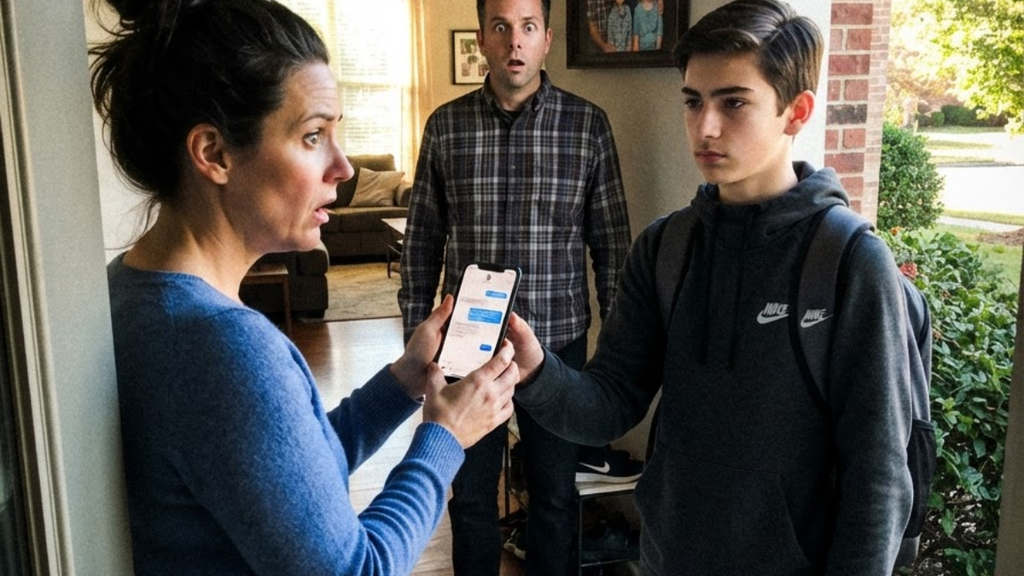
A teenage boy knocked on my front door last Thursday and asked if my husband was home.
I assumed he was selling something.
He looked about seventeen, maybe eighteen, and he was wearing a gray hoodie with the sleeves pulled over his hands.
He had a backpack slung over one shoulder and kept looking toward the street like he was worried someone had followed him.
I told him my husband was at work.
The boy asked when he would be home.
I said probably around six, then asked what this was about.
He looked at me for a long moment before saying, “Are you Daniel’s wife?”
I said yes.
He took his phone out of his pocket.
“Then I think you need to see these.”
My name is Michelle.
I’m fifty-one years old, and I’ve been married to my husband, Daniel, for twenty-seven years.
We have two children, both adults.
Our daughter, Hannah, is twenty-four, and our son, Lucas, is twenty-one.
Daniel is fifty-three and owns a small commercial plumbing company.
I’m an administrative coordinator at a medical practice.
We live in a suburb outside Columbus, Ohio.
We have a normal marriage, or at least I thought we did.
Daniel works hard, sometimes too hard, and he’s the kind of person who knows everybody.
He’s coached youth baseball, volunteered at church fundraisers, and helped neighbors fix things without charging them.
He’s always been particularly good with teenagers.
He talks to them like they’re adults instead of children, which they seem to appreciate.
So when the boy showed up, my first thought was that he was somebody Daniel had helped.
Maybe a former player.
Maybe an apprentice.
Maybe the son of a customer.
Then I looked at his phone.
The first message was from a contact saved as Daniel.
You cannot come to my house. I’ve told you that.
The boy had replied:
You said you would tell her.
Daniel:
I said I would handle it. That’s different.
The boy:
You keep saying that and nothing changes.
Daniel:
I have a family to think about.
The boy:
SO DO I.
I looked up.
The boy was watching my face.
I asked his name.
“Eli.”
I asked his last name.
He hesitated.
Then he said, “Mercer.”
I didn’t recognize it.
I asked how he knew my husband.
Eli said, “That’s what I’m trying to figure out.”
I thought he was being sarcastic.
Then he scrolled further back.
There were months of messages.
Daniel asking whether Eli had eaten.
Daniel asking whether he made it to school.
Daniel offering to pay for a car repair.
Daniel telling him not to tell his mother about something.
Then I saw one that made my stomach drop.
Eli: Does she know about me?
Daniel: Not yet.
Eli: You promised.
Daniel: I know.
I looked at the boy again.
He had Daniel’s eyes.
I know how that sounds.
Once you suspect something, you start seeing similarities everywhere.
But I had spent twenty-seven years looking at those eyes.
The shape.
The slightly heavy upper lids.
The way one eyebrow lifted higher than the other.
I asked how old he was.
“Seventeen.”
I asked when he turned eighteen.
“February.”
I felt like I might faint.
I asked who his mother was.
He said, “Rebecca Mercer.”
I didn’t know the name.
I asked whether she and Daniel had dated.
Eli looked confused.
Then he said, “I don’t think so.”
That was not the answer I expected.
I asked what he meant.
He said, “My mom says he’s not my dad.”
I stared at him.
He continued.
“She says he’s just somebody who helped us when I was little, but he keeps acting like I’m his responsibility, and now he’s telling me I can’t ask questions.”
I asked whether Daniel had told him he was his father.
“No.”
Then why did he think he was?
Eli showed me another message.
This one was from approximately three weeks earlier.
Eli: I found the paperwork.
Daniel: What paperwork?
Eli: The stuff from the hospital.
Daniel: Eli, please don’t do this over text.
Eli: Your name is on it.
Daniel: That doesn’t mean what you think it means.
Eli: Then tell me what it means.
Daniel: I can’t right now.
I asked what hospital paperwork.
Eli reached into his backpack.
He pulled out a folded photocopy.
It was an old hospital document.
The heading said Emergency Contact and Responsible Party.
Patient: Eli Mercer.
Date: March 2012.
Eli would have been three.
Under responsible party, it listed:
Daniel Whitaker.
My husband.
I asked why Daniel would be listed on a hospital document for a three-year-old child I had never heard of.
Eli said, “That’s what I’d like to know.”
I invited him inside.
I know some people will think that was stupid.
A strange teenage boy shows up with screenshots and I let him into my house.
But he was a kid.
He looked exhausted.
And I was starting to understand that whatever this was, he was probably more frightened than I was.
I offered him water.
He asked if I had Coke.
I gave him one.
He sat at our kitchen table and immediately started twisting the tab back and forth.
I asked where his mother was.
“At work.”
Did she know he was here?
“No.”
I asked whether she would be worried.
He said he had told her he was at a friend’s house.
Then I asked how long he’d known Daniel.
“As long as I can remember.”
I stared at him.
Daniel had known this boy for seventeen years.
Almost his entire life.
I asked how often they saw each other.
Eli said it depended.
Sometimes once a month.
Sometimes every week.
When he was little, Daniel came around more.
He took him fishing.
Helped with school projects.
Went to a few baseball games.
When Eli got older, Daniel helped him buy a used car.
I asked whether Daniel paid for it.
“Most of it.”
I asked whether Daniel had ever taken him on vacation.
Eli said no.
Then he thought about it.
“Unless you count the lake.”
I asked what lake.
He said Daniel had a friend with a cabin near Indian Lake.
They went there several times.
I knew the cabin.
Daniel’s business partner, Steve, owned it.
Our family had been there.
I asked whether Steve knew Eli.
“Yeah.”
Of course he did.
I asked who else knew.
Eli started naming people.
A guy named Marcus who worked at Daniel’s company.
A woman named Janet who used to babysit him.
Daniel’s accountant.
His mother’s sister.
People I had met.
People who had sat at my table.
I asked whether Daniel’s parents knew.
Eli shook his head.
I asked whether our children knew.
He said, “I don’t think so.”
Then he asked something that broke my heart a little.
“Are you mad at me?”
I told him no.
I said I was upset, but not with him.
He nodded.
Then he said, “My mom told me not to come here.”
I asked why.
He said she was afraid Daniel would get angry.
I asked whether Daniel had ever hurt him.
“No.”
Had he threatened him?
“No.”
Then why was he afraid?
Eli looked at his phone.
“Because every time I ask him about the past, he tells me to leave it alone.”
I asked what past.
He said, “The thing that happened to my dad.”
I stopped.
I asked whether he knew who his father was.
Eli said yes.
His father’s name was Aaron Mercer.
He died when Eli was four.
I asked how.
“Car accident.”
I asked whether Daniel knew Aaron.
Eli said, “They worked together.”
That was the first thing that made the situation feel familiar.
Daniel had employed a man named Aaron years earlier.
I remembered him.
Not well.
He was young.
Quiet.
He worked for Daniel’s company for approximately three years.
I remembered Daniel attending his funeral.
I remembered sending flowers.
I remembered Daniel being upset afterward.
I asked Eli whether his father had died in 2013.
He nodded.
I asked whether it was a highway accident.
He looked surprised.
“Yeah.”
I remembered.
Aaron was driving home from a job site.
He crashed on a rural road.
There was another vehicle involved.
I remembered Daniel saying the weather was bad.
I remembered him being unusually quiet for weeks.
I asked Eli whether his father had been working when he died.
Eli said yes.
Then he said, “That’s what my mom always said.”
I asked what he meant.
He pulled out another document.
This one was not hospital paperwork.
It was a photocopy of a letter.
Dated April 2013.
Addressed to Rebecca Mercer.
From Daniel Whitaker.
I recognized Daniel’s signature.
The letter said:
Rebecca, I know no amount of money can make up for what happened to Aaron. I am committed to making sure you and Eli are taken care of, and I intend to honor that commitment for as long as necessary.
It continued with information about monthly financial support.
There was no specific amount in the letter.
No explanation of what happened.
Just Daniel promising to help.
I asked Eli where he found it.
His mother’s filing cabinet.
He said he had been looking for his birth certificate because he was applying for a passport.
Instead, he found a folder labeled AARON.
Inside were hospital records, old insurance documents, letters, and photographs.
One photograph showed his father standing beside Daniel at a job site.
Another showed Daniel holding Eli as a baby.
I stared at that one for a long time.
Daniel was smiling.
Eli was maybe six months old.
I asked whether his mother knew Daniel before Aaron died.
“Yeah.”
I asked whether she and Daniel were close.
Eli shrugged.
“Not anymore.”
I asked whether Daniel had been sending them money.
Eli nodded.
How much?
He didn’t know.
His mother never talked about finances.
I asked whether they were struggling.
He said not really.
His mother worked as a dental hygienist.
They lived in a modest house.
He had never thought of them as poor.
I asked whether Daniel paid for his school.
Sometimes.
Car?
Yes.
Sports?
Yes.
He said Daniel had also helped when his mother needed surgery a few years earlier.
I asked why he thought Daniel might be his father if Aaron raised him.
Eli looked embarrassed.
Then he said, “Because my mom got really upset when I asked if I could do one of those DNA tests.”
I asked what she said.
She told him not to.
He asked why.
She said there were things about his family he didn’t understand.
He asked whether Aaron was his biological father.
She said yes.
But she cried.
Then she told him never to ask Daniel about it.
So naturally, he asked Daniel.
Daniel told him to talk to his mother.
His mother told him to talk to Daniel.
Then Eli found the paperwork.
Then Daniel told him to stop asking questions.
I looked at the messages again.
One from two weeks earlier stood out.
Eli: Did you know what was going to happen that night?
Daniel: No.
Eli: Then why did Mom say you were responsible?
Daniel: Because I was.
I felt my stomach turn.
I asked Eli what that meant.
He said, “I don’t know.”
Then he showed me the next message.
Eli: Did you kill my dad?
Daniel replied almost twenty minutes later.
No.
Then:
But I made a decision that night that I have regretted every day since.
I stared at the screen.
Eli said, “That’s why I’m here.”
I asked whether he had gone to the police.
“No.”
Why not?
“Because I don’t know what happened.”
I asked whether his mother had told him anything about the accident.
Only that Aaron died on his way home from work.
The roads were wet.
A truck crossed the center line.
He was killed.
I remembered something slightly different.
I remembered Daniel saying Aaron lost control.
I wasn’t sure.
It had been thirteen years.
I asked whether Eli had a copy of the accident report.
He said yes.
He pulled it out.
The report listed Aaron as the driver of a 2008 Ford F-150.
Single-vehicle collision.
Vehicle left roadway.
Struck a tree.
No other vehicle listed.
I read it twice.
I asked Eli why his mother said a truck crossed the center line.
He said, “That’s what I’ve been asking.”
Then I saw the time.
11:46 p.m.
I remembered Daniel telling me Aaron was driving home after a late job.
But Daniel’s company rarely had crews working that late.
Emergency calls, yes.
Normal commercial work, no.
I asked Eli whether Aaron had been working at a job site that night.
He said he thought so.
Then he showed me a photograph from the folder.
A printed email.
From Daniel to Aaron.
Sent at 8:17 p.m. on the night Aaron died.
Subject: Need to talk.
The email said:
Come by the warehouse tonight after you finish. We need to settle this before Monday. Please don’t bring Rebecca into it yet.
I read it again.
I asked whether Eli had shown this to Daniel.
Yes.
Daniel told him it was a work issue.
I asked whether Aaron ever made it to the warehouse.
Eli said he didn’t know.
Then he said, “I think he did.”
Why?
Because of another text.
He showed me.
Eli: Was Dad at the warehouse that night?
Daniel: Yes.
Eli: Did you argue?
Daniel: Yes.
Eli: About what?
Daniel: Something I should have handled differently.
Eli: Did he leave angry?
Daniel: Yes.
Eli: Did you follow him?
There was no reply.
Not for three days.
Then Daniel wrote:
I need you to stop asking me these questions until I can speak to your mother.
I felt cold.
I asked Eli whether Daniel had ever explained the silence.
No.
I asked whether he had any reason to believe Daniel was involved in the accident itself.
Eli said he didn’t know.
Then he said something that made me feel worse.
“I don’t even think I want him to be my dad anymore. I just want to know why he keeps acting like my dad did something wrong.”
I asked what he meant.
Eli said Daniel sometimes talked about Aaron in a strange way.
Not cruelly.
But carefully.
Like he was afraid of saying too much.
Once, when Eli was fourteen, he asked what his father was like.
Daniel said Aaron was talented and hardworking.
Then Eli asked whether Aaron was a good person.
Daniel said:
“He was trying to be.”
Eli never forgot that.
I didn’t either.
Because I knew my husband.
And that sounded exactly like something Daniel would say when he knew more than he wanted to admit.
I asked Eli if I could photograph the documents.
He said yes.
I asked whether I could keep copies of the texts.
He sent me screenshots.
Then I asked him something important.
“Does your mother know you’re questioning how your father died?”
He said yes.
I asked whether she knew he had found the email.
He said yes.
I asked what she said.
Eli looked down.
“She told me Daniel wasn’t the only person who lied about that night.”
I felt sick.
I asked who else.
He said:
“My mom.”
I stared at him.
He continued.
“She said if I kept digging, I was going to find out things about my dad that I didn’t want to know.”
I asked whether she explained.
No.
Then he said:
“She told me Dad didn’t die coming home from work.”
I waited.
Eli swallowed.
“She said he died because he was trying to get something back.”
I asked what.
Eli shook his head.
“She wouldn’t tell me.”
We sat there for a long time.
Then I asked whether Eli wanted me to call Daniel.
He looked terrified.
I told him I wasn’t going to do anything without telling him first.
He said he wanted Daniel to know he was here.
But he didn’t want to be alone with him.
That told me something.
Not necessarily that Daniel was dangerous.
But that Eli had reached the point where he no longer trusted the man who had been helping raise him.
I called Daniel.
He answered.
I said, “There’s someone here who wants to talk to you.”
He asked who.
I said, “Eli Mercer.”
Silence.
Then Daniel said:
“Michelle, please tell me you didn’t let him into the house.”
I felt my entire body go cold.
I asked why.
Daniel said:
“Because Rebecca has been looking for him.”
I looked at Eli.
He was watching me.
I asked what Daniel meant.
He said:
“Eli left home yesterday. Rebecca called me this morning. She’s terrified.”
I looked at the boy sitting at my kitchen table.
He had told me he left home this morning.
I asked Daniel whether Rebecca had called police.
He said she was about to.
Then he said:
“Michelle, listen carefully. Do not let him leave.”
I asked why.
Daniel’s voice changed.
“Because he has something that doesn’t belong to him, and I don’t know what he’ll do when he finds out what it is.”
I looked at Eli’s backpack.
He saw me looking.
His expression changed.
I asked Daniel what was in the bag.
He said:
“Ask him about the flash drive.”
Eli stood up.
I said his name.
He grabbed his backpack.
I told him to wait.
He said:
“Don’t listen to him.”
Daniel was still talking.
“Michelle, please. He doesn’t understand what he’s carrying.”
I asked what it was.
Daniel said:
“It’s evidence.”
I felt sick.
Evidence of what?
Daniel took a breath.
Then he said:
“Of what his father was doing before he died.”
I looked at Eli.
He was standing near my kitchen door.
His hands were shaking.
I asked him whether he had a flash drive.
He stared at me.
Then he said:
“Yes.”
I asked what was on it.
He swallowed.
Then he said:
“I think it’s the reason my dad is dead.”
I told Daniel I would call him back.
Then I ended the call.
Eli was crying now.
He said:
“My mom told me to destroy it.”
I asked why.
He said:
“Because she said if Daniel found out I had it, he’d do whatever he did to my dad.”
I stared at him.
Then I asked where he found it.
Eli reached into his backpack.
He pulled out a small black flash drive.
There was a piece of masking tape wrapped around it.
Written on the tape in faded blue ink were three words.
WHITAKER — ORIGINAL FILES
My husband’s last name.
I asked Eli whether he knew what was on it.
He nodded.
He said:
“I watched some of it.”
I asked what he saw.
He looked at me for a long moment.
Then he said:
“Your husband wasn’t the only person at the warehouse that night.”
I felt my heart pounding.
I asked who else was there.
Eli said:
“My dad.”
I waited.
He swallowed.
“And your daughter.”
I stared at him.
I said:
“Hannah was eleven.”
Eli nodded.
“I know.”
I asked why my eleven-year-old daughter would have been at my husband’s warehouse at almost midnight on a school night.
Eli looked at the flash drive.
Then back at me.
He said:
“That’s what you need to ask her.”
And suddenly I realized that whatever happened thirteen years ago, my husband had not just been hiding it from me.
He had been hiding it from our daughter too.
Or worse, he had been hiding what our daughter knew.
I asked Eli what he meant by Hannah being at the warehouse.
He said there was a video.
I asked whether he had actually seen my daughter.
He nodded.
I told him to sit down.
He did, although he kept his backpack on his lap.
I asked whether the flash drive was the only copy.
He said he didn’t know.
Then he admitted he had copied some of the files to his laptop.
I asked where the laptop was.
At his friend’s house.
That made me feel slightly better.
Whatever was on that drive, at least it wasn’t the only copy Eli believed existed.
I asked whether he would show me the video.
He hesitated.
Then he said yes.
I got my laptop.
We sat at the kitchen table.
He plugged in the drive.
There were several folders.
INVOICES
SERVICE RECORDS
PHOTOS
WAREHOUSE
And one labeled:
APRIL 2013
Eli clicked the last one.
Inside were six video files.
The first was dated the night Aaron died.
I recognized the warehouse immediately.
Daniel’s company used to operate out of a large brick building near an industrial park.
We sold it approximately seven years ago.
The video was from a security camera mounted above the warehouse entrance.
The picture was grainy.
Black and white.
There was no audio.
At 9:42 p.m., Aaron’s truck pulled into the lot.
He got out.
Walked inside.
At 9:51, Daniel arrived.
He went inside too.
Then at 10:18, another vehicle pulled in.
A silver minivan.
I recognized it.
Our old Honda Odyssey.
Daniel drove it sometimes when his truck was being serviced.
I leaned closer.
The driver’s door opened.
A woman got out.
Not Hannah.
Me.
I stared at the screen.
I had absolutely no memory of being at the warehouse that night.
Then the passenger door opened.
Hannah climbed out.
Eleven years old.
Wearing her pink winter coat.
Carrying a backpack.
I felt like I was going to be sick.
Eli looked at me.
“You didn’t know?”
I shook my head.
I watched myself take Hannah’s hand.
We walked toward the warehouse.
I knocked.
Daniel opened the door.
He looked surprised.
Then angry.
He said something.
I said something back.
There was no sound.
Then Daniel stepped aside and let us in.
I paused the video.
I tried to remember that night.
April 2013.
Hannah was eleven.
Lucas was eight.
Why would I have taken Hannah to Daniel’s warehouse at ten o’clock at night?
Then I remembered.
Hannah had been sick.
Not physically.
Emotionally.
She had been having nightmares.
She was terrified of going to school.
There had been an incident involving another girl.
Bullying.
A teacher.
Something that had caused a huge argument between Daniel and me.
I remembered being furious with him because he wanted to confront the school principal while I wanted to handle it more carefully.
But I did not remember going to the warehouse.
I looked at the timestamp again.
April 18, 2013.
Thursday.
I remembered something else.
That was the night Hannah ran away.
Not far.
She left our house after dinner.
We found her approximately two hours later.
I had always believed Daniel found her at a friend’s house.
He brought her home.
She cried.
We talked.
That was the story.
I asked Eli to play the next video.
At 10:36, I came back outside.
Alone.
I walked to the minivan.
Got in.
Drove away.
Hannah stayed inside.
I stared at the screen.
I asked Eli whether there was another video.
He clicked the second file.
This one showed the interior of the warehouse.
A camera mounted near the office.
The timestamp was 10:21.
I saw Daniel.
Aaron.
Hannah.
And me.
We were standing near a desk.
Daniel was talking.
I was crying.
Hannah was sitting in a chair.
Aaron stood by the door.
Then Daniel handed me something.
A piece of paper.
I read it.
I started shaking my head.
Daniel reached for my arm.
I pulled away.
Then I walked over to Hannah.
I hugged her.
I said something.
She nodded.
Then I left.
I paused the video.
I looked at my younger self.
I was thirty-eight.
I had shorter hair.
I was wearing the green coat I used to love.
I could see tears on my face.
And I had no idea what I had just read.
I asked Eli to play the rest.
At 10:49, Aaron and Daniel began arguing.
Hannah was still sitting in the chair.
Aaron pointed toward her.
Daniel shook his head.
Aaron slammed something onto the desk.
Daniel picked it up.
They argued again.
Then Aaron moved toward Hannah.
Not aggressively.
He crouched beside her.
He said something.
She started crying.
Daniel grabbed Aaron’s shoulder.
Aaron stood.
The argument became physical.
Not a fight exactly.
Daniel pushed Aaron away from Hannah.
Aaron shoved him back.
Then Hannah stood up.
She screamed something.
Both men stopped.
She ran out of the office.
Aaron followed.
Daniel stayed behind for several seconds.
Then he followed too.
I asked Eli whether there was footage from outside.
He clicked the third file.
At 10:57, Hannah ran out of the warehouse.
She was crying.
She stood near the entrance.
Aaron came out behind her.
He was holding something.
A small rectangular object.
He offered it to her.
She refused.
He tried again.
Then Daniel appeared.
He stepped between them.
Aaron said something.
Daniel shook his head.
Aaron walked toward his truck.
He got in.
Daniel approached the driver’s window.
They argued.
Then Aaron drove away.
The timestamp was 11:06 p.m.
The accident happened at 11:46.
Forty minutes later.
I sat there staring at the screen.
Eli said:
“There’s another video.”
I looked at him.
He clicked the fourth file.
It was from a camera facing the warehouse parking lot.
At 11:11, Daniel got into his truck.
He drove away.
I felt cold.
Daniel had followed Aaron.
I asked Eli whether the next video showed what happened.
He said no.
The remaining files were from the warehouse.
Daniel returned at 12:38 a.m.
Alone.
He parked.
Went inside.
Approximately fifteen minutes later, he came back out carrying a cardboard box.
He loaded it into his truck.
Then he drove away again.
I asked Eli whether he knew what was in the box.
He shook his head.
I asked whether the drive contained anything else.
He clicked the invoices folder.
There were hundreds of documents.
Some were ordinary plumbing invoices.
Others were spreadsheets.
Names.
Dates.
Amounts.
I didn’t understand them.
Then I noticed a file labeled:
WHITAKER — PAYMENTS
Eli opened it.
There were transfers.
Thousands of dollars.
Some from Daniel’s business.
Some to a company called Westfield Industrial Services.
Others to individuals.
I recognized one name.
Steve.
Daniel’s business partner.
Another was Marcus, one of his longtime employees.
Then I saw Aaron Mercer.
Several payments.
$4,000.
$6,500.
$3,200.
I asked Eli whether he knew what these were.
He said no.
Then he opened a document labeled:
RECONCILIATION — FINAL
It was a letter from Aaron to Daniel.
Dated two days before the accident.
The letter began:
Daniel, I am not willing to continue signing off on these invoices. I have copies of the original work orders, and the amounts being billed do not match the work performed.
I read further.
Aaron accused Daniel’s company of inflating invoices for commercial customers.
Charging for equipment never installed.
Billing emergency labor hours that never occurred.
Using Westfield Industrial Services as a subcontractor on paper while routing money back to people connected to the business.
I felt sick.
I knew Westfield.
Not personally.
But I remembered Daniel mentioning it.
A subcontractor.
I remembered him complaining about their prices.
Apparently they were not even a real independent subcontractor.
I kept reading.
Aaron wrote:
I have also found payments that appear to have been made to people who were not employees or legitimate vendors. I need an explanation before I take this to an attorney.
Then:
I am particularly concerned about the account associated with H.W.
H.W.
Hannah Whitaker.
I stared at the initials.
I asked Eli whether he knew what that meant.
He shook his head.
Then he said:
“There’s a spreadsheet.”
He opened it.
One tab was labeled:
H.W.
It showed transfers totaling approximately $48,000.
Over three years.
Some entries were labeled:
EDUCATION
CONSULTING
REIMBURSEMENT
I stared at the screen.
Hannah was eleven.
Why would Daniel’s company be paying money into an account associated with her?
I asked Eli where he found the flash drive.
He said it was in his mother’s filing cabinet.
Inside a small envelope.
The envelope was labeled:
FOR ELI — IF NECESSARY
I asked whether Rebecca knew he had taken it.
Yes.
He told her.
She became furious.
She said the drive was not his.
She told him to put it back.
He refused.
They argued.
Then she said something that frightened him.
“Your father tried to use that information once. Look what happened.”
I asked whether she meant Aaron was killed.
Eli said:
“That’s what I thought.”
I asked whether he had asked her directly.
Yes.
She said Aaron’s death was an accident.
Then she said Daniel had not caused the accident.
Eli asked why she was afraid of him.
Rebecca said:
“Because he knows things about our family that you don’t.”
I looked at the screen.
Then at Eli.
I asked whether he knew what those things were.
He shook his head.
I called Daniel.
He answered immediately.
I told him I had watched the videos.
Silence.
Then he said:
“Michelle, where is Eli?”
I said he was with me.
I asked why Hannah was at the warehouse that night.
Daniel said:
“Please don’t do this with him sitting there.”
I asked whether he followed Aaron.
He said yes.
I asked whether he caused the accident.
“No.”
I asked why he returned to the warehouse after midnight and removed a box.
He said:
“Because I was scared.”
I asked what was in it.
He said:
“Records.”
I asked what records.
He said:
“The ones Aaron was threatening to take to the police.”
I stared at the phone.
I asked whether he had been stealing money from customers.
He said:
“Not exactly.”
I almost screamed.
I asked what “not exactly” meant.
He said he would explain.
I told him to come home.
He said:
“Not while Eli is there.”
I asked why.
Daniel said:
“Because his mother needs to be part of this conversation.”
I asked whether Rebecca knew about the invoices.
Yes.
I asked whether she knew about Hannah.
Silence.
Then Daniel said:
“Michelle, there are things about that night that you don’t remember correctly.”
I felt my stomach drop.
I asked what he meant.
He said:
“You were there.”
I told him I had seen the video.
He said:
“Then you know.”
I said I didn’t know anything.
Daniel was quiet.
Then he asked:
“Do you remember what happened to Hannah that spring?”
I said she was being bullied.
He said:
“That wasn’t all.”
I felt cold.
I asked what else.
He said:
“Ask her.”
I said Hannah was twenty-four and lived in Cincinnati.
He said:
“Call her.”
Then he hung up.
I stared at the phone.
Eli looked terrified.
I asked whether he had ever met Hannah.
He said no.
I asked whether Daniel had ever mentioned her.
Only that he had a daughter.
I called Hannah.
She answered on the second ring.
I asked whether she remembered April 18, 2013.
Silence.
Then she said:
“Why?”
I told her I had seen video of us at Dad’s warehouse.
She did not say anything.
I asked why we were there.
Hannah started crying.
Then she said:
“Mom, please tell me you didn’t watch the office video.”
I felt my stomach drop.
I said I had.
She started crying harder.
I asked what happened that night.
She said:
“I thought Dad destroyed it.”
I asked what she meant.
She said:
“He promised me.”
I told her I needed to know.
Then Hannah said something that made me feel like the floor had disappeared.
“Mom, you knew.”
I said I didn’t.
She said:
“You knew everything.”
I asked what she was talking about.
She said:
“You were the one who made Dad promise not to tell anyone.”
I sat down.
I asked what I had made him promise.
Hannah was crying so hard I could barely understand her.
Then she said:
“That he would never tell Lucas what happened.”
I stared at the phone.
I asked what Lucas had to do with any of this.
Hannah whispered:
“Because it was his fault.”
I felt sick.
Lucas had been eight.
I asked what she meant.
Hannah said:
“Mom, I can’t do this over the phone.”
I told her to come home.
She said she would.
Then I called Lucas.
He was at work.
I asked whether he remembered anything unusual happening in April 2013.
He said no.
I asked whether he remembered Hannah running away.
He said vaguely.
I asked whether he remembered Dad taking her to the warehouse.
He said no.
Then he asked why.
I told him I was trying to understand something from years ago.
He became quiet.
Then he said:
“Is this about the accident?”
I stopped breathing.
I asked what accident.
He said:
“The one with Dad’s employee.”
I asked how he knew about it.
Lucas said:
“Because Grandpa told me.”
My father-in-law.
Richard Whitaker.
He died four years ago.
I asked what Grandpa told him.
Lucas said:
“That Dad blamed himself for something that wasn’t his fault.”
I asked what.
Lucas hesitated.
Then he said:
“Grandpa said somebody got hurt because Hannah lied.”
I stared at the phone.
I asked when Richard told him that.
Lucas said:
“Right before he died.”
I asked why.
Lucas said Grandpa was confused.
He had been in the hospital.
He was on medication.
He started talking about old things.
Lucas assumed it was nonsense.
Then he said:
“He told me Dad was trying to protect Hannah from what happened to that man.”
I asked whether Lucas knew what happened.
He said no.
Then he asked:
“Mom, is Hannah in trouble?”
I didn’t know how to answer.
I told him I would call him later.
Then I hung up.
Eli was sitting across from me.
He had heard enough to understand that his father’s death was connected to something involving my children.
He asked:
“What did your daughter do?”
I said I didn’t know.
He stared at me.
Then he said:
“Everybody keeps saying that.”
I didn’t blame him.
I felt the same way.
I called Rebecca Mercer.
Eli gave me her number.
She answered immediately.
I introduced myself.
She was silent for several seconds.
Then she said:
“Where is my son?”
I told her he was safe.
She asked whether he was at my house.
I said yes.
She started crying.
Then she said:
“Please don’t let Daniel near him.”
I asked why.
She said:
“Because he doesn’t understand what he’s asking.”
I told her I had watched the warehouse footage.
She became quiet.
Then she asked:
“How much?”
I said all of it.
She asked whether I had seen the financial records.
Yes.
Then she said:
“Michelle, I’m sorry.”
I asked what she was sorry for.
She said:
“Because I should have told you years ago.”
I felt sick.
I asked what happened that night.
Rebecca said:
“Your husband was trying to protect your daughter.”
I asked from what.
She said:
“From what Aaron was going to tell the police.”
I stared at the phone.
I asked whether Aaron had discovered Daniel was stealing money.
Rebecca said:
“No.”
I asked what the invoices were.
She said:
“They were fake.”
I said I knew that.
She said:
“No, Michelle. You don’t understand.”
Then she explained something I had not considered.
The invoices were not designed to steal money from customers.
They were designed to move money.
Money that did not belong to Daniel’s company.
I asked whose money.
Rebecca said:
“Your father’s.”
My father.
Not Daniel’s father.
Mine.
My father, Robert Collins, was seventy-nine.
He was still alive.
He had owned a commercial property management business before retiring.
Daniel’s plumbing company had done work for him for years.
I asked why my father would need to move money through Daniel’s company.
Rebecca said:
“Because of what happened to Lucas.”
I felt physically ill.
I asked what happened to my son.
Rebecca said:
“Michelle, you need to talk to your father.”
I said everyone kept telling me to talk to somebody else.
She said:
“Because none of us wants to be the person who tells you.”
I screamed.
I am not proud of that.
But I did.
I told her a seventeen-year-old boy had shown up at my house because he was afraid my husband had something to do with his father’s death.
I told her I had watched video of my eleven-year-old daughter crying in a warehouse at midnight.
I told her my husband had hidden financial records.
I told her my son had been told something by his dying grandfather.
And now she was telling me my father was involved.
I said:
“Somebody needs to stop protecting me and tell me what happened.”
Rebecca cried.
Then she said:
“Your son was involved in an accident.”
I stared at the phone.
She continued.
“It happened at school.”
I asked when.
Approximately two months before Aaron died.
I asked what kind of accident.
She said:
“A little girl was hurt.”
I felt cold.
I asked how badly.
Rebecca said:
“Very badly.”
I asked whether she survived.
Silence.
Then:
“Yes.”
I closed my eyes.
I asked whether Lucas hurt her.
Rebecca said:
“That’s what everyone believed.”
I asked what that meant.
She said:
“The girl said Lucas pushed her.”
I felt sick.
Lucas had been eight.
I remembered an incident at his school that year.
A girl fell from playground equipment.
She broke her arm.
I remembered hearing about it.
But I did not remember Lucas being involved.
I asked whether it was that incident.
Rebecca said yes.
I asked why it mattered thirteen years later.
She said the girl had not just broken her arm.
She suffered a serious head injury.
There were complications.
Her parents threatened to sue the school.
And my family.
I asked why.
Because the girl accused Lucas of pushing her.
I stared at the phone.
I asked whether he did.
Rebecca said:
“I don’t know.”
I asked what Hannah had to do with it.
She said:
“Hannah witnessed it.”
I felt sick.
Then she said:
“And she lied about what she saw.”
I asked why.
Rebecca said:
“Because your father paid her to.”
I stopped breathing.
My father.
Paid my eleven-year-old daughter.
To lie about a playground accident involving her eight-year-old brother.
I asked how much.
Rebecca said:
“Not directly.”
Of course.
Nothing was ever direct.
She explained that my father had created an account in Hannah’s name.
The payments listed H.W. in Daniel’s financial records were transfers into that account.
Approximately $48,000.
I asked why my father would pay his granddaughter to lie.
Rebecca said:
“Because he believed Lucas would be blamed.”
I asked whether Lucas actually pushed the girl.
Rebecca said:
“That’s the part Aaron found out.”
I stared at the phone.
I asked what he found.
Rebecca took a breath.
Then she said:
“Lucas didn’t push her.”
I felt relief for approximately one second.
Then I asked who did.
Rebecca said:
“Your daughter.”
I couldn’t speak.
She continued.
“Hannah pushed the little girl. Lucas was standing nearby. The girl was confused when she woke up. She thought Lucas did it.”
I asked whether Hannah admitted that.
Rebecca said:
“To your father.”
I felt sick.
I asked whether Daniel knew.
Yes.
Did I?
Rebecca hesitated.
Then she said:
“Yes.”
I started shaking.
I said I had no memory of any of this.
Rebecca said:
“Michelle, you were the one who insisted Hannah couldn’t be blamed.”
I stared at the wall.
She continued.
“You said she was eleven. You said she didn’t mean to hurt anybody. You said it would ruin her life.”
I felt like I was listening to a story about someone else.
I asked why I couldn’t remember.
Rebecca said:
“I don’t know.”
Then she said something that frightened me even more.
“Your husband told me you stopped talking about it because you couldn’t live with what you did.”
I sat there.
I tried to remember.
The playground.
Hannah’s nightmares.
The bullying.
The warehouse.
The video of myself crying.
The paper Daniel handed me.
The way I hugged Hannah before leaving.
It was all there.
But the explanation did not fit.
I had no memory of participating in a cover-up.
I had no memory of my father paying my daughter.
I had no memory of Aaron discovering it.
I had no memory of any of this.
Then I remembered something.
The girl who fell.
Her name was Olivia Bennett.
I remembered her mother coming to our house.
I remembered her crying.
I remembered Daniel answering the door.
I remembered him telling me not to come downstairs.
I remembered hearing raised voices.
Then nothing.
I asked Rebecca whether Olivia’s family received money.
She said yes.
A settlement.
I asked how much.
Approximately $250,000.
I stared at the phone.
I asked where the money came from.
My father.
Through Daniel’s company.
I asked why they used fake invoices.
Rebecca said because my father wanted to keep the payments hidden from his business partners and from the family.
I asked whether Olivia’s parents knew where the money came from.
They knew it came from a settlement.
They did not know about the fake invoices.
I asked whether Aaron knew.
Yes.
He was the one who discovered the transfers.
I asked why he threatened to go to police.
Rebecca said:
“Because he thought your father was using Daniel’s company to launder money.”
I asked whether that was true.
She said:
“Partly.”
I asked what she meant.
She said Aaron discovered something else.
Something about the settlement.
I asked what.
Rebecca went silent.
Then she said:
“Michelle, I need to come get Eli.”
I told her she could.
But I wanted the answer.
She said:
“The settlement wasn’t just for Olivia.”
I stared at the phone.
I asked what that meant.
Rebecca said:
“There was another child.”
I felt cold.
I asked who.
She said:
“A boy.”
I looked at Eli.
He was watching me.
I asked whether she meant Lucas.
Rebecca said no.
I asked who.
She started crying.
Then she said:
“His name was Nathan.”
I didn’t recognize it.
I asked what happened to Nathan.
Rebecca said:
“He was there when Olivia fell.”
I asked whether he was hurt.
She said no.
I asked why he received money.
Rebecca took a breath.
Then she said:
“Because he saw what really happened.”
I stared at the phone.
I asked what he saw.
Rebecca said:
“He saw your father.”
I felt my stomach drop.
I asked why my father would have been at the playground.
She said:
“Because he was the one who pushed Olivia.”
I couldn’t speak.
Then Rebecca said:
“And Aaron found out.”
I looked at Eli.
He was still sitting at my kitchen table.
His father’s flash drive was plugged into my laptop.
The videos were paused.
My husband.
My daughter.
My father.
A dead employee.
A settlement.
A little girl with a serious head injury.
And a boy who had been paid to keep quiet.
For the first time, I understood why Eli had been told to stop asking questions.
But I still did not understand why my father would push an eight-year-old girl off playground equipment.
Or why my husband would spend thirteen years protecting him.
Then Rebecca said:
“Michelle, there’s something else you need to know.”
I closed my eyes.
She continued.
“Nathan wasn’t just another child at the playground.”
I asked who he was.
Rebecca said:
“He was your father’s son.”
I stared at the phone.
My father was seventy-nine.
Nathan would have been approximately eight in 2013.
I did the math.
My father would have been in his sixties when Nathan was born.
I asked whether she was telling me my father had a secret child.
Rebecca said yes.
I asked whether my mother knew.
Rebecca said:
“I don’t know.”
I asked whether Daniel knew.
Yes.
I asked whether Hannah knew.
Yes.
I asked whether Lucas knew.
No.
Then I asked the question that made everything feel worse.
“Did Aaron know?”
Rebecca said:
“Yes.”
I looked at Eli.
I asked Rebecca how Aaron found out.
She said:
“Because Nathan’s mother told him.”
I asked who Nathan’s mother was.
Rebecca went silent.
Then she said:
“Me.”
I stared at the phone.
I asked her to repeat that.
She said:
“Nathan is my son.”
I looked at Eli.
He was seventeen.
Nathan would now be approximately twenty-one.
I asked whether Eli knew he had a brother.
He shook his head.
I asked Rebecca whether Nathan was Aaron’s child.
She said no.
I asked whether Aaron knew she had a child with my father.
Yes.
I asked when.
Before she married Aaron.
I felt sick.
Then Rebecca said:
“Michelle, I need you to understand something. Aaron didn’t die because he discovered a financial crime.”
I asked why he died.
She said:
“He died because he discovered what your father had done to Nathan.”
I stared at the phone.
I asked what she meant.
Rebecca started crying.
Then she said:
“Your father didn’t push Olivia because she was fighting with Lucas or Hannah.”
I waited.
She continued.
“He pushed her because she saw him grab Nathan.”
I felt physically ill.
I asked why my father would grab his own son.
Rebecca said:
“Because Nathan was trying to run away from him.”
I asked why.
She said:
“Because Nathan was afraid of him.”
I could barely speak.
I asked what my father had done.
Rebecca said:
“That’s what Aaron was going to tell the police.”
I stared at Eli.
He was crying.
Then Rebecca said:
“And that’s why your husband followed Aaron that night.”
I asked whether Daniel killed him.
Rebecca said:
“No.”
Then she said:
“But your father might have.”
I sat there with the phone against my ear.
For thirteen years, I had believed Aaron Mercer died in a tragic accident driving home from work.
Now his widow was telling me my father may have been responsible.
And my husband had known enough to send money to Aaron’s family, maintain contact with his son, and keep the entire thing hidden from me.
I asked Rebecca one final question.
“Where is Nathan now?”
She went completely silent.
Then she said:
“That’s the problem.”
I waited.
She started crying again.
“Nobody knows.”
I stared at the phone.
I asked how long he’d been missing.
Rebecca whispered:
“Thirteen years.”
And suddenly the question was no longer just what happened to Aaron Mercer on the night he died.
It was what happened to the little boy my father had been trying to stop from running away two months earlier.
Because according to Rebecca, Nathan disappeared the same night Aaron was killed.
And my husband had spent the next thirteen years making sure nobody in our family ever mentioned either of them again.
I asked Rebecca why she had never reported Nathan missing.
She said she had.
That surprised me.
I asked how a child could disappear for thirteen years without anyone in our family knowing.
Rebecca told me Nathan had not disappeared in the way I was imagining.
He had been removed from her custody.
I asked by whom.
She said her parents.
I didn’t understand.
Then she explained.
Nathan was born in 2005, before Rebecca married Aaron.
My father had been having an affair with her.
She was twenty-six.
He was fifty-eight.
She worked for one of his property management companies.
When Rebecca became pregnant, my father promised to help financially.
He did not want anyone to know the child was his.
Rebecca agreed to keep his name off the birth certificate.
Her parents helped raise Nathan.
Then she married Aaron.
Aaron knew Nathan was not biologically his, but he loved him.
He helped raise him.
When Eli was born, they became a family of four.
Then my father began demanding more access to Nathan.
At first, he visited occasionally.
He brought gifts.
Took him to baseball games.
Paid for private lessons.
Rebecca said she tolerated it because Nathan liked him.
But as Nathan got older, my father became controlling.
He wanted Nathan to call him Dad.
He wanted him to spend weekends at his house.
He started making comments about Aaron not being Nathan’s real father.
Rebecca tried to set boundaries.
My father threatened to stop helping financially.
Then he threatened something worse.
He said he would tell my mother about the affair and make sure Rebecca lost her job.
I asked why that would frighten Rebecca more than it frightened him.
She said my father had already convinced her that everyone would believe she had pursued him for money.
He had money.
Lawyers.
Connections.
She was raising two children.
She believed him.
In February 2013, Nathan was visiting my father’s house when an argument started.
Nathan wanted to go home.
My father refused to let him leave.
Nathan ran outside.
My father followed him.
They ended up near the playground at the elementary school.
Hannah and Lucas were there with other children.
My mother had taken them to a school event earlier that afternoon.
Nathan ran toward the playground.
Olivia Bennett saw him.
She tried to help.
My father grabbed Nathan by the arm.
Olivia yelled at him to stop.
He shoved her away.
She fell backward from the edge of the play structure.
She struck her head.
It was not a deliberate attempt to seriously injure her.
But it was a grown man shoving an eight-year-old child hard enough to cause a life-changing injury.
And instead of admitting what happened, my father blamed Lucas.
Lucas had been standing nearby.
Olivia was confused after the fall.
Hannah had seen everything.
My father told her that if she said anything, Lucas could be taken away.
He told her the police might arrest him.
He told her our family would be destroyed.
Hannah was eleven.
She believed him.
Then my father told Daniel.
Daniel believed the version my father gave him.
At least initially.
My father claimed Lucas had accidentally pushed Olivia.
He said Hannah had witnessed it.
He insisted they needed to protect Lucas.
Daniel panicked.
He contacted an attorney.
My father arranged a settlement.
Money moved through Daniel’s business because my father wanted the payments hidden.
Aaron discovered the irregularities.
He asked questions.
Then Rebecca told him the truth about Nathan.
And Nathan told Aaron what had actually happened at the playground.
Aaron realized my father had used Daniel’s company to conceal a settlement involving an injury my father himself had caused.
He told Daniel.
That was why they met at the warehouse.
I asked Rebecca what happened to Nathan afterward.
She said my father had threatened to seek custody.
He claimed Rebecca was unstable.
He claimed Aaron was exposing the children to dangerous situations.
He hired an attorney.
Rebecca’s parents became frightened.
They took Nathan to stay with relatives in Kentucky.
It was supposed to be temporary.
Then Aaron died.
And everything changed.
Rebecca said her parents became convinced my father was dangerous.
They refused to bring Nathan home.
They eventually obtained legal guardianship with Rebecca’s consent.
They moved.
Changed their phone numbers.
Kept Nathan away from my father.
I asked whether Rebecca still saw him.
She said yes.
For several years.
Then Nathan turned eighteen.
He left his grandparents’ house.
He stopped answering calls.
Rebecca said she had not seen him in almost four years.
I stared at the phone.
That was very different from a missing eight-year-old child.
Nathan had been alive.
He had grown up.
He had eventually chosen to disappear from his family.
I asked why Rebecca had told Eli nobody knew where Nathan was.
Because it was true.
She had no idea where he lived now.
I asked whether Daniel knew.
She said she didn’t think so.
Then I asked about Aaron.
Rebecca became quiet.
She said Aaron had gone to the warehouse intending to confront Daniel.
He wanted Daniel to help expose my father.
Daniel refused.
He was terrified of what would happen to his business and our family.
Aaron threatened to go to police himself.
Daniel followed him when he left.
I asked whether Daniel caused the crash.
Rebecca said she didn’t know.
That was when I realized I could not keep treating Rebecca’s account as established fact.
She had been lied to.
She had lied herself.
She had spent years protecting people.
And now she was trying to explain a thirteen-year-old death using pieces of information she had never fully verified.
I told her I was calling the police.
She said she understood.
Then she asked me to keep Eli safe until she arrived.
I said I would.
After we hung up, Eli sat silently for several minutes.
Then he asked:
“Do you believe my dad was murdered?”
I told him I didn’t know.
He asked whether Daniel was responsible.
I said I didn’t know that either.
Then he said:
“Everybody knew things about my family except me.”
I looked at him.
I knew exactly how he felt.
Rebecca arrived approximately forty minutes later.
She looked exhausted.
She hugged Eli so tightly he complained he couldn’t breathe.
Then she looked at me.
I asked whether she would come with us to police.
She said yes.
Before we left, I called Hannah.
I told her I knew about Olivia.
About Nathan.
About my father.
Hannah started crying.
Then she said:
“Mom, Grandpa made me say Lucas did it.”
I asked whether she had ever told me the truth.
She said yes.
At the warehouse.
That was why I was there.
Hannah had finally broken down and told Daniel what happened.
Daniel called me.
I drove to the warehouse with Hannah.
I remembered none of it clearly because, as Hannah explained, I had been taking medication for severe insomnia and anxiety at the time.
I remembered that period.
I had been sleeping terribly.
My doctor prescribed a medication I eventually stopped because it made me groggy and forgetful.
I did not know whether it explained my missing memories.
But Hannah remembered the conversation.
She said I was horrified.
I wanted to go to police.
Daniel showed me paperwork from the settlement.
He told me the family could lose everything.
He told me Olivia’s parents had accepted money.
He said exposing my father would hurt Lucas and Hannah too.
Hannah remembered me crying.
She remembered me telling Daniel that Lucas must never be blamed for something he hadn’t done.
Then she remembered me saying:
“We have to tell the truth.”
I stopped breathing.
I asked her to repeat that.
She did.
Then she said:
“Dad told me later that you changed your mind.”
I felt sick.
I asked whether she believed him.
She said she had no reason not to.
Daniel told her I wanted the matter left alone.
He told her I was too upset to discuss it.
He told her never to bring it up again.
For thirteen years, Hannah believed I had chosen silence.
And for thirteen years, Daniel had allowed me to believe there was nothing to remember.
I called him.
I asked one question.
“Did I agree to cover this up?”
He was silent.
Then he said:
“Not exactly.”
I closed my eyes.
I asked whether I had wanted to go to police.
He admitted I had.
I asked why he told Hannah otherwise.
He said:
“Because by then Aaron was dead, and I didn’t know how to undo any of it.”
I asked whether he followed Aaron that night.
Yes.
I asked why.
To convince him not to go to police.
I asked whether they met again after leaving the warehouse.
Daniel said they did.
At a gas station approximately fifteen minutes away.
They argued in the parking lot.
Aaron refused to back down.
Then he drove away.
Daniel followed for several miles.
I asked whether he was chasing him.
He said no.
He said he wanted Aaron to pull over again.
I asked whether he was driving aggressively.
He hesitated.
Then said:
“Probably.”
I asked whether Aaron knew he was following him.
Yes.
I asked whether Daniel saw the accident.
Silence.
Then:
“Yes.”
I started shaking.
Daniel said Aaron accelerated.
Daniel tried to keep up.
The road curved.
Aaron’s truck drifted onto the shoulder.
He overcorrected.
The truck crossed the road and struck a tree.
Daniel stopped.
He ran to the truck.
Aaron was unconscious.
Daniel called 911.
I asked whether he told police he had been following Aaron.
No.
I asked whether he told them they had argued.
No.
He said he had been driving home from work and happened upon the crash.
That was the story in the original report.
I asked whether Aaron was alive when Daniel reached him.
Daniel started crying.
He said yes.
I asked whether he spoke.
Daniel said:
“Not really.”
I asked what that meant.
He said Aaron opened his eyes briefly.
Then lost consciousness.
I asked whether Daniel took anything from the truck.
Silence.
I asked again.
He admitted he took Aaron’s phone.
I felt physically sick.
He said it was lying on the passenger seat.
He knew Aaron had been gathering evidence.
He panicked.
He took it before emergency services arrived.
I asked what happened to the phone.
Daniel said he destroyed it.
I asked whether he took anything else.
No.
I asked why he went back to the warehouse.
To remove the financial records Aaron had copied.
I asked whether he knew Aaron had another copy.
No.
I told him Eli had it.
Daniel cried.
Then he said:
“Good.”
I almost laughed.
Good.
After thirteen years.
After hiding evidence.
After lying to police.
After allowing a widow and two boys to live with unanswered questions.
Now he thought it was good.
I told him not to contact me.
Then I called the detective whose name Rebecca had given me from the original accident report.
By that evening, Rebecca, Eli, and I had all spoken with investigators.
I handed over copies of the warehouse videos and financial records.
I gave them Daniel’s account of following Aaron.
I told them about the phone.
I told them about my father.
I told them about Hannah.
I told them everything I knew.
The investigation is ongoing.
I cannot tell you whether Daniel will face criminal charges.
I cannot tell you whether my father will.
The accident happened thirteen years ago.
The financial records are complicated.
There are questions about what laws apply, what evidence still exists, and whether witnesses can corroborate the accounts.
But the police have reopened their examination of Aaron’s death.
That much I know.
Two days later, I went to my father’s house.
I did not go alone.
My brother, Michael, came with me.
He had no idea about Nathan.
He had no idea about Olivia.
He had no idea about the settlement.
My father answered the door.
He looked surprised to see us together.
I asked him to sit down.
Then I asked:
“Who is Nathan?”
My father went pale.
He did not ask what I meant.
He knew.
I asked whether Nathan was his son.
He said yes.
Michael stood up.
He walked into the kitchen.
I stayed seated.
I asked why my father had never told us.
He said he was ashamed.
I asked whether Mom knew.
He said no.
I asked whether Nathan knew who his father was.
Yes.
I asked whether he had pushed Olivia Bennett.
My father looked down.
Then he said:
“It was an accident.”
I told him that wasn’t what I asked.
He admitted he shoved her.
I asked whether he blamed Lucas.
He said:
“I never meant for Lucas to be blamed.”
I reminded him that he allowed a settlement to be negotiated on that basis.
He said Daniel handled the details.
I asked whether he threatened Hannah.
He said he was trying to protect her.
I asked from what.
He said:
“From getting involved.”
I stared at him.
An eleven-year-old girl had watched her grandfather injure another child.
He frightened her into silence.
Then he convinced her parents to protect him.
And thirteen years later, he was still describing that as protection.
I asked whether he knew Aaron intended to go to police.
Yes.
I asked whether he had anything to do with Aaron’s death.
He said no.
I asked whether he contacted Aaron that night.
He said no.
I asked whether he had ever threatened him.
He said:
“I told him he didn’t understand the situation.”
I asked whether he threatened his job.
My father admitted he had.
I asked whether he threatened Rebecca.
He said:
“Rebecca had no business involving Aaron.”
I could barely stand looking at him.
Then I asked where Nathan was.
My father said he didn’t know.
I asked whether he had tried to find him.
He said:
“For years.”
I asked why.
He said:
“He’s my son.”
I said:
“You treated him like something you owned.”
My father started crying.
I had never seen him cry like that.
He told me he regretted what happened.
He said he wished he had handled everything differently.
I asked whether he regretted pushing Olivia or regretted that the truth had finally come out.
He did not answer.
Michael came back into the room.
He told our father he needed to speak to an attorney and cooperate with police.
My father nodded.
Then he asked whether we would tell our mother.
I stared at him.
I said:
“Yes.”
He started crying again.
I told him that was no longer his decision.
My mother found out that afternoon.
She was devastated.
Not only by the affair.
By Nathan.
By Olivia.
By the money.
By the fact that my father had allowed his grandchildren to become part of his lies.
She asked me whether I had known.
I said no.
Then I explained the warehouse video.
The conversation.
The way Daniel had convinced Hannah I wanted silence.
My mother took my hand.
She said:
“You were always going to tell the truth.”
I started crying.
Because that was the first time in weeks anyone had said something about me that I recognized.
I had been terrified that I was somehow responsible for all of it.
That I had knowingly protected my father.
That I had sacrificed another family to preserve my own.
But the video showed me crying.
Hannah remembered me wanting to go to police.
And Daniel admitted he had told her I changed my mind.
He had taken my uncertainty and his own fear and turned them into a decision I never actually made.
A week later, Hannah came home.
We sat in her childhood bedroom.
She told me what she remembered about Nathan.
She said he was a quiet little boy.
He was frightened of my father.
She remembered him crying at the playground.
She remembered Olivia trying to help him.
She remembered Grandpa grabbing Nathan.
Then pushing Olivia.
She remembered the sound Olivia made when she hit the ground.
Hannah had nightmares for months.
I asked why she never told me again.
She said:
“Because Dad said you couldn’t handle it.”
I cried.
Then I apologized.
Not because I had deliberately hidden the truth.
But because she had carried it alone for thirteen years.
She was eleven.
She should never have been responsible for protecting adults.
Hannah said she spent years believing she had done something unforgivable.
She had lied to police.
She had helped blame Lucas.
She had allowed Olivia’s family to believe the wrong story.
I told her she had been a child.
The adults were responsible.
She asked whether I thought Olivia would forgive her.
I said I didn’t know.
Then Hannah asked whether she could tell Olivia what happened.
I said yes.
But we agreed to speak with investigators first so she would not interfere with their work or place pressure on Olivia.
Lucas found out the next day.
He was furious.
He remembered being questioned after Olivia fell.
He remembered telling everyone he hadn’t touched her.
He remembered Grandpa saying accidents happen.
He remembered Dad telling him to stop worrying.
For years, he had assumed the adults believed him.
Now he knew some of them had been protecting the actual person responsible.
He asked whether Olivia knew.
I said not yet.
He asked whether he could speak to her.
I told him eventually, if she wanted that.
Then he asked about Eli.
I told him Eli had been the one who brought the evidence to me.
Lucas was quiet.
Then he said:
“His dad died trying to tell the truth.”
I said yes.
He asked:
“And our dad helped hide it.”
I couldn’t answer.
Because there was nothing I could say that would make that less painful.
Daniel moved out permanently.
He has cooperated with investigators since then.
He gave them access to old company records.
He identified the accounts my father used.
He provided the names of people who knew about the settlement.
He also admitted he had been sending Rebecca money for thirteen years.
Not because Eli was his son.
Not because he had an affair with Rebecca.
Because he felt responsible for Aaron’s death.
The payments began shortly after the accident.
At first, they were supposed to help Rebecca with funeral expenses and childcare.
Then Daniel kept paying.
He helped Eli with school.
With sports.
With his car.
He attended games.
He took him fishing.
He became a father figure to the boy whose father had died after an argument with him.
I asked Daniel whether he had ever told Eli what happened.
He said no.
I asked why.
He said:
“Because I didn’t want him to hate me.”
I stared at him.
I said:
“So you let him love you without knowing why you were there.”
Daniel started crying.
I told him I had spent twenty-seven years doing the same thing.
Loving a man without knowing what he was hiding.
Then I told him I wanted a divorce.
He did not argue.
I think he knew there was nothing left to argue about.
There is one more thing.
And it is the only genuinely good thing to come out of this entire nightmare.
Nathan is alive.
We found him.
Not through my father.
Not through Daniel.
Through Eli.
After learning about his older brother, Eli began looking for him.
Rebecca gave him the name of the relatives Nathan had lived with.
He contacted them.
They initially refused to provide information.
Then Eli wrote Nathan a letter.
He explained who he was.
He explained that he had only recently learned the truth.
He said he didn’t want money.
He didn’t want explanations.
He just wanted to know his brother was okay.
Two weeks later, Nathan called him.
He’s twenty-one now.
He lives in North Carolina.
He works as an automotive technician.
He has a girlfriend.
He has a dog.
He is doing reasonably well.
He knew about Eli.
He had photographs of him as a baby.
But he believed Rebecca had chosen to protect Eli by letting Nathan disappear from their lives.
There was more pain there than I can explain.
Rebecca cried for almost an hour after their first phone call.
Nathan is not ready to see her.
He is willing to talk to Eli.
That is a beginning.
Eli told me Nathan remembered the playground.
He remembered Olivia.
He remembered my father grabbing him.
He remembered Aaron being furious.
He remembered Aaron promising that nobody would ever force him to visit my father again.
Then Aaron died.
And Nathan’s world fell apart.
When Eli told him the investigation had been reopened, Nathan said he would speak to police.
He has already given a statement.
He also told Eli something I will never forget.
Aaron had promised to take Nathan and Eli fishing that weekend.
He told Nathan they were going to have a fresh start.
He said the grown-ups were finally going to sort things out.
Nathan waited for him.
Aaron never came home.
I think about that constantly.
A man trying to protect his family.
A little boy waiting for him.
Another little boy too young to understand why his father was gone.
A widow trying to survive.
And my husband, who knew more than he admitted, deciding he could make things right by sending money.
Daniel has sent Rebecca hundreds of thousands of dollars over the years.
I don’t know the exact amount.
I don’t care.
Because every dollar was easier for him than telling the truth.
A few days ago, Eli came to see me again.
This time, he called first.
He wanted to thank me.
I told him he didn’t need to.
He said he had spoken to Nathan for almost two hours the night before.
They talked about Aaron.
About Rebecca.
About what they remembered.
Eli said Nathan told him Aaron was a good father.
Not perfect.
But good.
He said Aaron loved both boys equally.
Eli cried when he told me that.
Then he asked whether I thought Daniel was a bad person.
I thought about it.
I told him:
“I think Daniel made terrible decisions. I think he hurt people. I think he spent years trying to make himself feel better without admitting what he’d done.”
Eli nodded.
Then he asked whether Daniel cared about him.
I said yes.
I believe he did.
That is part of what makes everything so awful.
Daniel genuinely cared about Eli.
He genuinely loved our children.
He genuinely loved me.
But he also lied.
He hid evidence.
He allowed my father to escape responsibility.
He let Aaron’s family believe an incomplete story.
And when Eli started asking questions, Daniel tried to stop him.
Not because he didn’t love the boy.
Because he was afraid the truth would cost him everything.
Eli asked whether he should ever speak to Daniel again.
I told him that was his decision.
He didn’t have to make it now.
Then he said something that has stayed with me.
“I thought if he wasn’t my real dad, then maybe he was just being nice to us.”
I asked what he meant.
He said:
“But now I know he was being nice because he felt guilty.”
I told him both could be true.
He looked at me.
Then he said:
“I wish he’d just told me.”
I nodded.
Because that was exactly what I wished too.
Eli left about an hour later.
He hugged me before he went.
I watched him walk down the driveway.
Seventeen years old.
Carrying answers he should never have had to fight so hard to get.
Then I went inside.
My house was quiet.
Daniel’s shoes were gone from the entryway.
His coffee mug was gone from the kitchen counter.
His side of the closet was empty.
I sat at the same table where Eli had first shown me the messages.
I opened the screenshots again.
The first one still made my stomach turn.
You cannot come to my house. I’ve told you that.
I remembered how frightened I had been when I first read it.
I thought my husband had a secret son.
Then I thought he might have killed the boy’s father.
Then I learned about the money.
The accident.
The playground.
My daughter.
My son.
My father.
A brother nobody knew about.
A family that had been quietly destroyed while mine carried on as though nothing had happened.
And I realized something.
Eli had come to my door because he thought I might be the only person who didn’t already know the truth.
He was right.
But he had also done something none of the adults in this story had managed to do for thirteen years.
He refused to accept silence as an answer.
My husband spent thirteen years trying to make up for what happened to Aaron Mercer without ever admitting what he had done.
My father spent thirteen years protecting his reputation.
Rebecca spent thirteen years trying to keep her sons safe from the consequences.
Hannah spent thirteen years believing she had helped destroy a family.
And I spent thirteen years living inside a story my husband had written for me.
Then a seventeen-year-old boy knocked on my door.
He showed me his phone.
And he asked the question every adult around him had spent years avoiding.
What really happened to my father?
I still don’t know what a court will ultimately decide about Aaron’s death.
I don’t know whether Daniel will be prosecuted.
I don’t know whether my father will face charges.
I don’t know whether Nathan will ever forgive Rebecca.
And I don’t know whether Olivia will want anything to do with our family when she learns what happened.
But at least those questions are finally being asked in the open.
For thirteen years, Daniel told himself he was protecting us by keeping everything buried.
In the end, the person who exposed it wasn’t a detective, an accountant, or anyone with power.
It was the boy whose father had died.
And the first thing he did when he found the evidence was come to the home of the woman everyone had decided didn’t need to know.
