

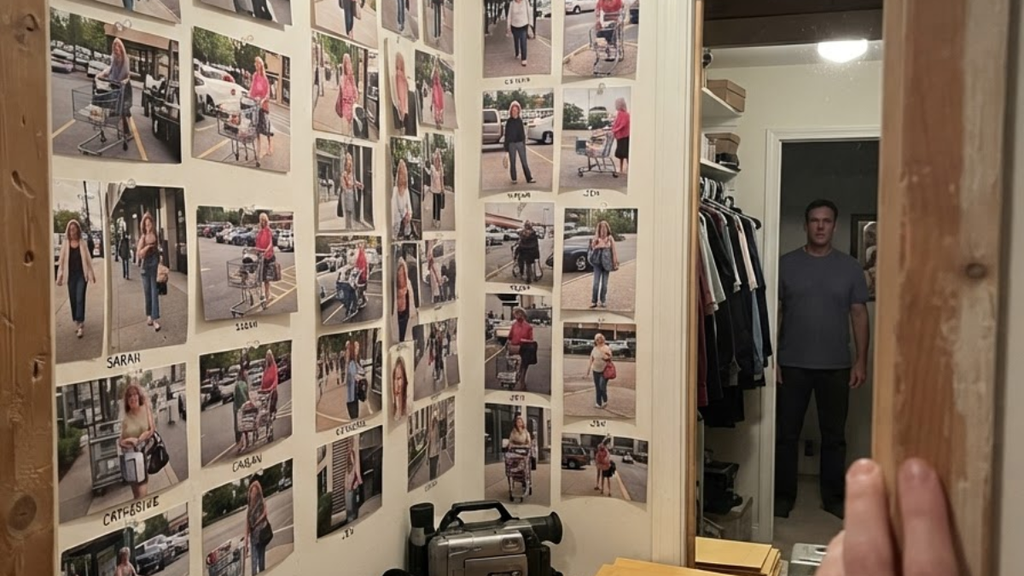
I found the room because I dropped an earring.
My husband, Steven, was sixty-two, and I was fifty-nine.
We had been married for thirty-four years.
Our daughters, Nicole and Paige, were thirty-one and twenty-eight, and both had moved out years earlier.
Steven had retired the previous spring after working in commercial property management for most of his career.
I worked three days a week at a dental office and had recently started talking about retiring too.
We had lived in the same house for twenty-three years.
It was a large 1970s colonial with the kind of strange renovations that accumulate when four different owners decide they know how to improve something.
Our bedroom had two closets.
Mine was a normal walk-in.
Steven’s was deeper and oddly shaped because it backed up against the upstairs hallway and part of our younger daughter’s old bedroom.
I had been inside his closet thousands of times.
I had never noticed anything unusual.
That Saturday morning, I was helping Steven sort clothes for donation.
He was downstairs making coffee when I dropped one of my earrings.
It rolled underneath a built-in shoe cabinet along the back wall.
I got on my knees and reached underneath.
My fingers hit something metallic.
I assumed it was part of the cabinet.
Then I realized it was a small recessed handle.
The cabinet was attached to a narrow section of wall that looked completely solid.
I pulled.
Nothing happened.
I tried again.
The entire cabinet moved.
Not easily.
It swung outward approximately six inches.
Behind it was darkness.
I remember thinking there must be some old storage space we had forgotten existed.
That sounds ridiculous now.
You do not forget a room in your own house.
But old houses have weird spaces.
Crawlspaces.
Access panels.
Dead areas behind renovations.
I pulled harder.
The cabinet opened like a door.
There was a room behind it.
Not a crawlspace.
A room.
Maybe eight feet by ten feet.
There was a light switch immediately inside.
I turned it on.
For several seconds, my brain did not understand what I was looking at.
The walls were covered with women.
Photographs.
Hundreds of them.
Maybe thousands.
Some were professionally printed photographs.
Some were ordinary snapshots.
Some looked like they had been taken with phones.
Some were obviously from a distance.
Women walking dogs.
Women loading groceries.
Women sitting at restaurants.
Women leaving offices.
Women at playgrounds with children.
Women at gas stations.
Women walking through parking lots.
Women inside their own houses, photographed through windows.
There were maps pinned underneath the photographs.
Names.
Addresses.
License plate numbers.
Schedules.
There was a desk against one wall with three monitors.
A filing cabinet.
A corkboard.
A printer.
Shelves filled with labeled boxes.
I did not scream.
I did not call Steven.
I stood there.
Then I noticed the photograph directly in front of me.
A woman approximately my age was walking out of a grocery store.
Underneath it was written:
MARLENE DAVIS
I knew Marlene.
Not well.
She had been our neighbor for nine years before moving to Arizona.
The next photograph showed her taking garbage to the curb.
Another showed her sitting in her backyard.
Another showed her through her kitchen window.
Then I saw a photograph of our older daughter’s high school guidance counselor.
Mrs. Harper.
Then a woman who used to work at my dental office.
Then someone from our church.
I recognized maybe fifteen women.
Most I did not.
I heard Steven downstairs.
He called my name.
I stepped out of the room.
I closed the hidden door.
I walked downstairs.
Steven handed me coffee.
He asked if I found my earring.
I said yes.
Then I sat at the kitchen table across from the man I had been married to for thirty-four years and tried to act normal.
I do not know how I did it.
Steven talked about going to Home Depot.
He complained about the price of lumber.
He asked whether I wanted to go out for dinner.
I kept thinking about the photographs through windows.
Eventually Steven left.
I waited until his truck was gone.
Then I called my daughter Nicole.
I said, “I need you to come over, and I need you not to call your father.”
She asked what happened.
I said, “I found something.”
Nicole arrived twenty minutes later.
I showed her the room.
She walked inside.
She looked around.
Then she backed out.
She said, “Mom, call the police.”
I said I wanted to know what it was first.
Nicole said, “It’s a room full of women Dad secretly photographed. We know what it is.”
She was right.
I called.
The first two officers who arrived went upstairs with us.
One came back down almost immediately and told us not to touch anything else.
Detectives arrived.
Then more officers.
Steven came home while police were still there.
His truck stopped at the end of our driveway.
He sat inside for approximately thirty seconds.
Then he backed out.
One officer followed.
Steven was stopped a few streets away.
He did not resist.
He asked for an attorney before anyone even told him what they had found.
That detail bothered me almost as much as the room.
He knew.
Of course he knew.
But something about him seeing police at our house and immediately understanding which part of his life had finally been discovered made everything feel more deliberate.
The room was not some bizarre hobby that had slowly gotten out of control.
It was a secret he had been actively protecting.
Detective Alicia Morgan became my main contact.
The first question she asked was whether I knew the room existed.
No.
Had Steven built it?
I did not know.
We bought the house in 2003.
The closet already had built-in cabinetry.
I thought.
Morgan checked permits.
The room did not appear on the plans from when we purchased the house.
There should have been approximately eighty square feet between Steven’s closet and the adjacent bedroom.
On the plans, that area was part of Paige’s bedroom.
Except Paige’s bedroom had been renovated in 2005.
Steven managed the project.
He told me the exterior wall had moisture damage.
The contractor rebuilt part of the room.
Paige’s bedroom became slightly smaller.
I remembered complaining that the new closet placement made the room awkward.
Steven said it was necessary because of structural supports.
It was not.
He stole eighty square feet from our daughter’s bedroom and built himself a hidden room.
That happened two years after we moved in.
I asked what he kept before that.
Morgan said they were working on it.
Then police started identifying the women.
There were 214 names.
Not 214 photographs.
Two hundred fourteen women.
Some had only three or four photographs.
Others had hundreds.
The oldest photographs were from 1986.
Steven and I met in 1989.
The newest had been taken six days before I opened the room.
I asked what connected the women.
At first, nobody knew.
Some were coworkers.
Some lived near properties Steven managed.
Some attended our church.
Some worked at stores he visited.
Some were women he apparently encountered once.
There were married women.
Single women.
Young women.
Older women.
Mothers.
Grandmothers.
The ages ranged from nineteen to seventy-three.
I asked whether he was having affairs.
Morgan said they had found no evidence of sexual relationships.
That should have been reassuring.
It was not.
Then they found the index.
Steven had cataloged the women.
Each had a number.
Each had a folder.
Each had a status.
OBSERVE
ACCESS
AWARE
ENDED
Most were OBSERVE.
A smaller number were ACCESS.
Only seventeen were AWARE.
Thirty-one were ENDED.
I asked what the categories meant.
Morgan said they were trying to determine that.
I asked if AWARE meant the women knew Steven was watching them.
She said probably.
I asked what happened to those seventeen.
That was when she stopped answering quickly.
Four were dead.
Two were missing.
The others were alive.
I asked about the missing women.
One was named Michelle Larson.
She disappeared in 1997.
The other was Erin Walsh.
She disappeared in 2012.
Both cases were unsolved.
Steven had files on both.
Michelle’s file contained photographs beginning in 1994.
Steven and I had been married for two years.
We had a toddler.
The photographs showed Michelle leaving an accounting office.
At restaurants.
At her apartment.
With friends.
Then the photographs changed.
Michelle looking directly at the camera.
Michelle approaching Steven’s car.
Michelle pointing.
Then a handwritten note:
AWARE — 3/11/97.
Michelle disappeared April 2.
Her file changed to:
ENDED — 4/2/97.
I asked Morgan if my husband killed her.
She said they did not know.
Erin Walsh’s file was worse.
Erin worked for a property management company Steven occasionally contracted with.
He started photographing her in 2008.
In 2011, her status became ACCESS.
I asked what that meant.
Investigators figured it out by comparing the files.
ACCESS meant Steven had obtained a way into the woman’s private life.
Sometimes physically.
Sometimes socially.
Sometimes digitally.
He volunteered somewhere she volunteered.
Joined an organization.
Became friendly with her husband.
Handled maintenance at her workplace.
Found a reason to be inside her home.
The word did not mean the woman gave him access.
It meant Steven had created it.
Erin’s file contained photographs from inside her apartment.
Her bedroom.
Her bathroom.
Her desk.
Her closet.
I asked whether Steven had broken in.
Morgan said there were no signs he had been invited.
Then in February 2012:
AWARE.
There were no photographs for eleven days.
Then one final photograph.
Erin standing beside her car at night.
She was looking toward the camera.
Underneath:
Confrontation unavoidable.
Erin disappeared the following morning.
Her file:
ENDED.
I asked again whether Steven killed these women.
Morgan said the cases were now being investigated as potentially connected.
Then she asked me about a woman named Diane Mercer.
I knew Diane.
She had been my friend.
Not best friend.
But close for several years.
Our daughters played soccer together.
We went to each other’s houses.
We had dinner as couples.
Then Diane abruptly stopped speaking to me in 2009.
I never understood why.
She stopped returning calls.
When I confronted her at a soccer game, she told me she had personal issues and needed space.
I was hurt.
Eventually our daughters stopped playing together, and the friendship disappeared.
Diane had a file.
Status:
ACCESS — THROUGH MARGARET.
Margaret is me.
Steven used me to get close to her.
I felt physically ill.
Then:
AWARE — 9/18/09.
I remembered September 2009.
That was approximately when Diane stopped speaking to me.
Morgan asked if I knew why.
No.
They contacted Diane.
She agreed to talk.
She asked that I not be there.
I understood.
Afterward, Morgan told me what Diane said.
Diane had caught Steven inside her house.
She came home unexpectedly.
He was upstairs.
Steven claimed I had sent him over to look at a leaking bathroom faucet.
Diane knew that was a lie.
She asked me later, indirectly, whether I had mentioned her bathroom to Steven.
I apparently said no.
I did not remember the conversation.
Diane realized Steven had entered her house without permission.
She did not call police.
She was embarrassed.
She worried nobody would believe her because Steven was our friend.
Instead, she confronted him privately.
Steven told her it was a misunderstanding.
Then Diane found photographs in her mailbox.
Photographs of herself.
At work.
At the grocery store.
With her daughter.
One photograph showed Diane talking to me.
On the back:
You don’t want Margaret involved.
Diane interpreted it as a threat against me.
So she removed herself from our lives.
For seventeen years, I thought my friend stopped liking me.
She was trying to protect me from my husband.
I asked Morgan why Diane was not ENDED.
Her status returned to OBSERVE.
Steven kept photographing her.
Less frequently.
Once or twice a year.
Checking.
Making sure she stayed away.
That was when police realized AWARE did not automatically mean danger.
It meant risk.
Steven’s response depended on what the woman did.
Diane stayed quiet.
She lived.
Michelle apparently did not.
Erin apparently did not.
Then they identified another AWARE woman.
Carolyn Price.
Alive.
Carolyn had reported Steven to his employer in 2001.
She complained that he repeatedly appeared at properties where she worked.
Steven’s company investigated.
He claimed the overlap was work-related.
Nothing happened.
Carolyn started receiving anonymous letters.
She moved.
Her file became:
ENDED — RELOCATED.
Another woman, Melissa Green, confronted Steven in 2018.
Her husband was a police officer.
Steven immediately stopped.
ENDED — HIGH RISK.
He did not hurt every woman who noticed.
He calculated.
That frightened me more than impulsiveness would have.
Then Morgan asked whether I had ever seen Steven photographing women.
I said no.
She asked about cameras.
Steven always liked photography.
He took pictures at family events.
Nature.
Buildings.
Our vacations.
He owned several cameras over the years.
I thought it was a hobby.
Then police showed me photographs from our trip to Charleston in 2006.
Family pictures.
Nicole and Paige.
Me.
Historic houses.
The harbor.
Mixed among them on the original memory card were forty-seven photographs of a woman none of us knew.
She was staying at our hotel.
Steven photographed her for three days.
She became number 88.
OBSERVE — TEMPORARY.
Then:
ENDED — TRAVEL.
He did it while vacationing with his wife and daughters.
I looked at one photograph of Paige and Nicole standing beside a fountain.
Then the next photograph was a stranger walking into a restaurant.
Then me smiling beside Steven.
Then the stranger again.
His two lives were not separate.
They existed on the same memory card.
Then investigators found video.
The hidden room contained old tapes.
Steven had recorded women from parked cars.
Public spaces.
Buildings.
Sometimes through windows.
Nothing sexually explicit.
That distinction did not make it better.
He seemed less interested in bodies than routines.
When they left.
When they returned.
Who visited.
Which lights came on.
Where they parked.
What days they exercised.
What groceries they bought.
He wrote observations.
Changed shampoo.
Mother visits Tuesdays now.
Stopped wearing wedding ring.
New route to work.
Curtains closed earlier than usual.
He was studying their lives.
I asked why.
Nobody knew.
Steven would not talk.
Then police found the oldest box.
It had been stored inside a false bottom beneath the desk.
The box contained photographs from 1978.
Steven was fourteen.
The woman in the photographs was named Helen Ward.
She was twenty-six.
She lived three houses away from Steven’s childhood home.
There were dozens of pictures.
Helen walking to her car.
Helen hanging laundry.
Helen sitting on her porch.
Helen through her kitchen window.
The photographs continued for almost three years.
Then they stopped.
Helen died in 1981.
Car accident.
I asked whether Steven had anything to do with it.
No evidence.
She lost control on an icy road.
Steven was seventeen.
Then another woman.
Mrs. Caldwell.
A teacher.
Then another neighbor.
Then a girl from Steven’s high school.
The room had not begun with some event in adulthood.
He had been watching women since he was a child.
I asked Morgan if Helen was the first.
She said they could not know.
Then they interviewed Steven’s older sister, Barbara.
Barbara was sixty-seven.
She knew about Helen.
Not the photographs.
But she remembered Steven watching her.
Their mother caught him once.
She punished him.
Their father dismissed it as teenage curiosity.
Then Barbara said something strange.
Steven was not attracted to Helen.
At least not in the way everyone assumed.
He was afraid of her.
I asked why.
Barbara said Helen had witnessed something.
When Steven was thirteen, their father hit their mother badly enough that she needed stitches.
The family told everyone she fell.
Helen saw their mother afterward.
She asked questions.
Steven became convinced Helen would tell police.
Their father might go to jail.
The family might break apart.
So Steven watched Helen.
He wanted to know whether she spoke to anyone.
Whether police came.
Whether she visited their house.
That was how it started.
At least according to Barbara.
A frightened thirteen-year-old monitoring a neighbor because he thought she might expose his father.
I almost felt relieved.
It was horrible, but it was an explanation.
Then Barbara said, “But Helen never knew.”
I asked what she meant.
Helen never threatened to report anything.
Steven invented the threat.
Their mother told Helen she fell.
Helen accepted it.
Steven kept watching anyway.
For three years.
After Helen died, he found someone else.
The explanation had become unnecessary almost immediately.
Watching itself was the point.
Then police found something else in Helen’s box.
A lock of hair.
Not Helen’s.
Barbara identified it as their mother’s.
Then a photograph of their mother sleeping.
Then notes.
Steven had been watching her too.
His own mother.
The first woman anyone could definitively prove Steven surveilled was not Helen.
It was his mother.
He documented her bruises.
Her arguments with his father.
Where she hid money.
When she cried.
When she talked on the phone.
At thirteen years old, Steven created a file on his own mother.
I asked whether he was trying to protect her.
Maybe initially.
Then the notes changed.
Mom called Aunt Jean.
Dad doesn’t know.
Money behind flour.
She looked at apartments in paper.
Steven told his father.
His father found the money.
His mother never left.
Barbara remembered the fight.
She never knew how their father discovered the money.
Steven had told him.
I asked why.
Barbara said she once asked Steven that when they were teenagers.
He told her:
“If she leaves, everything changes.”
That sentence stayed with me.
Then Morgan called me one evening and asked if I could come to the station.
They had finally accessed one of Steven’s encrypted drives.
There were more women.
Not 214.
Three hundred eighty-seven.
The hidden room held the active and more important files.
The drive contained everyone else.
Some had been watched once.
Some for weeks.
Some for years.
Then there was another category.
HOME
I assumed it meant women he photographed near our house.
There were four names.
Barbara.
His mother.
Nicole.
Paige.
And me.
I said, “That’s five.”
Morgan said yes.
The category had originally contained four.
Paige was added later.
Steven had files on our daughters.
Not normal family photographs.
Surveillance.
Nicole leaving school.
Nicole with boyfriends.
Nicole at college.
Nicole outside her first apartment.
Paige at work.
Paige walking her dog.
Paige arguing with a boyfriend in a parking lot.
Photographs neither knew existed.
I started crying before I reached my folder.
My file began in 1987.
Two years before Steven and I met.
There were photographs of me leaving work.
At my apartment.
With friends.
With my boyfriend at the time.
I looked at Morgan.
I said, “He followed me.”
She said yes.
I asked how we actually met.
Steven and I supposedly met at a friend’s wedding.
He was a friend of the groom.
I was a friend of the bride.
We sat at the same table.
It felt random.
It was not.
Steven had seen me two years earlier at a shopping center.
He started photographing me.
Then he identified my friend Lisa.
He learned Lisa was engaged to Mark.
He learned Mark knew one of Steven’s coworkers.
Steven became friendly with the coworker.
Then with Mark.
He got invited to the wedding.
He requested our table.
I had spent thirty-four years telling people fate seated me beside my husband.
Steven had arranged the seating chart.
I asked why he picked me.
The notes said:
Stable.
Close family.
Predictable.
No major problems.
Then:
Could be good.
Good for what?
Marriage, apparently.
Steven had watched hundreds of women.
I was the one he decided to enter.
My status changed from OBSERVE to ACCESS.
Then:
HOME.
I asked what HOME meant.
Morgan said they found a definition.
Steven had written it years earlier.
HOME — permanent access, no observation restrictions.
I had not been chosen because he stopped wanting to watch.
I had been chosen because marrying me meant he could watch one woman without hiding.
Then I saw another note.
Written after our second date.
Margaret easier than expected.
Then:
She tells everything voluntarily.
I had spent thirty-four years believing communication was one of the strengths of our marriage.
I told Steven everything.
Office gossip.
Family problems.
Arguments with friends.
Our daughters’ relationships.
Who was divorcing.
Who was struggling.
Who moved.
Who got a new job.
Who was sick.
I suddenly understood why so many women in that hidden room were people I knew.
I had been feeding him information.
Not knowingly.
Not because he asked suspicious questions.
Because he was my husband.
Diane.
My coworker.
Mrs. Harper.
Women from church.
Neighbors.
Mothers from soccer.
I brought them home in conversation.
Steven decided which ones interested him.
Then he watched.
I asked Morgan how many women in his files were connected to me.
One hundred nineteen.
Almost a third.
I had been his directory.
Then she showed me something worse.
A document called:
SOURCE RELIABILITY
It rated people.
Me:
Excellent. Unaware.
Nicole:
Good, but notices questions.
Paige:
Poor. Private.
Church directory:
Excellent for addresses/family.
Facebook:
Useful but curated.
Property records:
Reliable.
My name was listed beside public databases and directories.
I was an information source.
I went home and threw up.
Then I remembered something.
Steven always said I was good at remembering people.
Names.
Relationships.
Who belonged to which family.
He joked that I was his “social encyclopedia.”
I thought it was affection.
Maybe sometimes it was.
But he had literally cataloged my usefulness.
Then police found Michelle Larson’s connection to me.
I had always assumed Michelle was someone Steven encountered through work.
She was not.
Michelle attended my prenatal exercise class when I was pregnant with Nicole.
I barely remembered her.
I mentioned her to Steven because she had an unusual job.
She restored antique furniture.
Steven became interested.
He found her business.
Then her address.
Then he watched her for three years.
I introduced Michelle into his world with a casual dinner conversation.
She disappeared in 1997.
I asked if I had caused it.
Morgan said no.
I knew that logically.
Emotionally, it felt different.
Then they found Michelle’s journal.
Her sister had kept it.
The final month contained repeated references to a man.
Gray car again.
Same man from hardware store.
I think someone is following me.
Then:
He knows my name.
Then:
He said Margaret told him about me.
I stopped reading.
Steven had used my name.
Michelle knew me.
Barely.
But enough that when Steven approached her and said he was Margaret’s husband, she trusted him.
She thought there was a legitimate social connection.
That was ACCESS.
He did not always break into homes.
Sometimes he borrowed credibility.
Mine.
Michelle agreed to meet Steven for coffee because he said I recommended her furniture restoration work.
I never did.
Three weeks later, she disappeared.
Police found a photograph in her file taken inside the coffee shop.
Michelle was smiling.
She had no idea the man sitting across from her had been photographing her secretly for years.
Then the notes changed.
Michelle asking Margaret questions.
I had no memory of Michelle contacting me.
Morgan checked phone records preserved in the original missing-person case.
Michelle called our house twice the week before she disappeared.
Both calls lasted under one minute.
Steven answered.
He never told me.
Then:
AWARE.
Then:
Needs containment.
That was the first time investigators had seen that word.
Containment.
Not ended.
Not closed.
Containment.
They searched every file for it.
Six women.
Michelle.
Erin.
A woman named Valerie Knox who died in 2004.
A woman named Jeanette Morris who survived a serious car accident in 2007.
Karen Bell, who moved suddenly in 2015.
And someone identified only as:
L-1
I asked who L-1 was.
They did not know.
The file was missing.
The index said:
L-1 — CONTAINMENT FAILED.
No name.
No photographs.
No address.
Nothing.
It was the only file apparently removed from the room before police found it.
Then Steven’s attorney contacted mine.
Steven wanted to speak to me.
I refused.
He wrote a letter.
I almost threw it away.
Then I read it.
He said he loved me.
He said our marriage was real.
He said he never intended to hurt our daughters.
He said the photographs were about “understanding people.”
He said the police were interpreting private records without context.
Then he wrote:
Please do not let them turn Laura into something it wasn’t.
Laura.
I called Morgan.
I asked who Laura was.
She went silent.
Then she said, “We think Laura is L-1.”
I asked what happened to her.
Morgan said they were still figuring that out.
Then she asked me whether Steven ever had a first wife.
I laughed.
No.
Steven had never been married before me.
I knew his family.
I knew his history.
I knew his old girlfriends.
At least I thought I did.
Morgan said, “Margaret, we found a marriage certificate.”
Steven had been married in 1983.
He was nineteen.
His wife’s name was Laura Bennett.
The marriage lasted eleven months.
There was no divorce.
Laura disappeared in 1984.
Steven told everyone she left him.
He told his family she moved to California.
His parents apparently believed him.
Barbara believed him.
No missing-person report was ever filed because Laura was estranged from her own family and Steven told everyone she had chosen to leave.
Legally, Steven was still married to her.
Which meant our thirty-four-year marriage had never been legally valid.
I sat there staring at Detective Morgan.
I asked the only question I could think of.
“Where is Laura?”
Morgan said they did not know.
Then she placed another photograph on the table.
It showed Laura at nineteen.
I had never seen her before.
She looked nothing like me.
That somehow made it worse.
Then Morgan showed me the back.
Steven’s handwriting.
First person who knew everything.
Below that:
Never make that mistake again.
There was more.
Laura was not just the first woman who knew everything.
She was the person who helped Steven build the system.
Detective Morgan told me they had found Laura’s name on old property records connected to Steven’s first apartment.
That was expected.
Then they found her handwriting in the earliest surveillance notebooks.
At first, police assumed they were reading Steven’s notes.
They were not.
Two people had been writing them.
Steven’s handwriting was narrow and cramped.
Laura’s was rounder.
She had written names.
Addresses.
Schedules.
Observations.
I asked why Laura would help her husband follow women.
Morgan said they were still reconstructing that.
Then Barbara remembered something else about Laura.
She and Steven had been strange together.
That was the word Barbara used.
Not unhappy.
Not abusive.
Strange.
They played games with people.
They would sit in restaurants and invent stories about strangers.
They drove around at night.
They once showed Barbara a notebook where they had written down which neighbors came home at what times.
Barbara thought they were bored teenagers who had married too young.
Laura was eighteen when she married Steven.
He was nineteen.
Then investigators found Laura’s younger brother, Michael Bennett.
He was sixty.
He had not seen his sister since 1984.
He had spent decades believing she voluntarily abandoned him.
Their parents were dead.
Michael had never filed a missing-person report because Steven told him Laura went to California with another man.
Laura had been fighting with her parents.
She had talked about leaving town.
Everyone accepted it.
Michael did not.
Not completely.
He had kept a letter.
Laura wrote it approximately two weeks before she disappeared.
She said:
Steven’s games aren’t funny anymore.
Then:
He doesn’t understand when to stop.
She described what they had done.
At first, Laura participated.
They followed strangers.
Photographed them.
Made up theories about their lives.
Then Steven started choosing specific women.
He wanted to know whether their theories were correct.
They learned names.
Jobs.
Addresses.
Laura thought it was exciting.
Then Steven began entering places.
A woman’s backyard.
An unlocked garage.
An office after hours.
Laura told him they had crossed a line.
Steven said the line was imaginary because nobody knew they were there.
Laura stopped participating.
Steven did not.
Then Laura discovered he had been watching her.
His own wife.
He had a notebook documenting when she left.
Who she called.
Where she went.
Whether she visited her brother.
Whether she spoke to men.
Laura realized she had never been his partner in the game.
She was another subject.
Michael still had the final page of her letter.
I think the reason he likes watching people is because he hates that they have lives when he isn’t there.
That sentence explained Steven better than anything he ever said himself.
Laura planned to leave.
She told Michael she might stay with a friend.
She never arrived.
Steven said she left for California instead.
Michael asked for an address.
Steven said he did not have one.
Months passed.
Then Steven produced a postcard.
Los Angeles.
Laura’s handwriting.
I’m okay. Please stop looking for me.
Michael believed it.
Police examined the postcard.
Laura probably did write it.
But not from California.
The postmark was Los Angeles.
The card itself could have been written anywhere.
Then they found a photocopy in Steven’s old files.
On the back, in Steven’s handwriting:
Enough to settle Michael.
I asked whether Steven forced Laura to write it.
Nobody knew.
Then investigators found a storage unit.
Not one Steven currently rented.
One he rented from 1983 until 1996.
The company still existed.
Old records had been digitized.
Steven visited the unit repeatedly after Laura disappeared.
Then rarely.
He closed it shortly after Michelle disappeared.
Police located the man who bought the contents when Steven stopped paying.
He was eighty-two.
He remembered almost nothing except that the unit was mostly junk.
Furniture.
Boxes.
An old refrigerator.
Tools.
He sold or discarded everything.
That lead seemed dead.
Then his daughter remembered a trunk.
Her father brought it home because it was antique.
She still had it.
Police searched it.
Inside the lining, they found photographs.
Laura.
Dozens.
Some looked like ordinary marital photographs.
Then others became surveillance.
Laura at a grocery store.
Laura talking to Michael.
Laura entering a motel.
Laura meeting a woman.
That woman was eventually identified as Janet Miller.
Janet was alive.
Seventy-three.
She had been Laura’s friend.
Police contacted her.
Janet cried when they told her why.
Laura had planned to leave Steven.
Janet was helping.
She agreed to let Laura stay with her sister in Indiana.
Laura had saved money.
She had packed clothing.
She had even spoken to an attorney about an annulment.
Then Steven discovered the plan.
Janet knew because Laura called her.
She said Steven found the money.
Found the attorney’s card.
Found everything.
Laura was terrified.
Janet told her to call police.
Laura refused.
She said Steven had never hit her.
She was afraid nobody would take her seriously.
She said:
“He knows things he shouldn’t know.”
That was the last time Janet spoke to her.
I asked what happened next.
Police found the attorney.
Or rather, they found his archived files.
He had died years earlier.
Laura had told him she was afraid Steven was entering women’s homes.
She believed he stole small objects.
She had found jewelry she did not recognize.
Keys.
Photographs.
She wanted out.
The attorney advised her to leave first and deal with legal matters afterward.
Then Laura disappeared.
Steven told everyone she ran away.
Within three years, he started following me.
I asked Morgan why my file said 1987 when Steven and I did not meet until 1989.
She said that part was still accurate.
He noticed me two years before our supposed meeting.
He did not approach until later.
Just like so many others.
Then police found Laura’s missing file.
Not in the house.
Not in the storage unit.
It was at Steven’s office.
His former office had been cleaned out after retirement.
Most of his personal belongings went home.
One locked cabinet remained because Steven told his replacement it contained archived contracts.
Police opened it.
Inside was L-1.
Laura’s file was enormous.
It began before their marriage.
Steven followed Laura before they dated.
He learned her schedule.
Her family.
Her friends.
Then he approached her.
The same thing he did with me.
Except Laura discovered it after they married.
At first, she was flattered.
That was in her own writing.
She thought it was romantic that Steven had noticed her months earlier.
She joined his games.
Then she realized he had not stopped.
The file contained her postcard to Michael.
Original.
Not photocopy.
Steven had somehow mailed it and then recovered or retained the original? That made no sense until investigators examined it more closely.
It was not the same postcard Michael received.
Steven had made Laura write several versions.
Practice.
One said:
I’m okay. I need time.
Another:
Please don’t contact me.
Another:
I’m in California and I’m happy.
Steven selected the version he wanted and mailed it.
Laura had been alive when she wrote them.
I asked whether that meant he held her somewhere.
Morgan said they believed so.
Then they found an entry.
Three days should be enough for her to understand.
Then:
Still angry.
Then:
Promises mean nothing while emotional.
Then:
Need longer.
I asked longer where.
A property.
Steven’s father owned a hunting cabin in 1984.
Remote.
Sold in 1990.
Police searched it.
The current owners allowed access.
The cabin had been renovated several times.
Nothing obvious remained.
Then investigators found an old root cellar behind the property.
It had partially collapsed.
Inside were remnants of bedding.
A rusted lantern.
Food cans from the 1980s.
And a woman’s shoe.
Michael identified photographs of Laura wearing the same style.
DNA testing on material recovered from the cellar matched Laura’s surviving brother.
Steven had kept his nineteen-year-old wife there.
I asked how long.
His notes suggested eleven days.
He called it containment.
That was where the word came from.
Laura was the first.
Not because he killed her immediately.
Because when she tried to expose him and leave, Steven decided the solution was to isolate her until she changed her mind.
The notes became increasingly frustrated.
She says she will tell Michael everything.
Still threatening police.
Says she will never come home.
Then:
Cannot release under current conditions.
Then nothing.
Four days later:
L-1 — containment failed.
I asked what failed meant.
Morgan said they did not know yet.
Then they found Laura.
Her remains were approximately half a mile from the cellar.
Buried in a shallow depression that had long since become forest.
She had a fractured skull.
Whether the injury was intentional could not be determined from the remains alone.
Steven claimed through his attorney that Laura escaped.
He said he followed her.
She ran.
She fell down an embankment.
She hit her head.
She died.
He panicked.
He buried her.
I asked whether anyone believed him.
Morgan said it was one possible explanation.
Then they found Steven’s notes from the following day.
Should have waited until she was calmer.
Not grief.
Not horror.
Not even panic.
A procedural correction.
The problem, according to Steven, was that he released Laura too soon.
That was what he learned from her death.
Not to stop.
To improve containment.
Then Michelle came thirteen years later.
Michelle became AWARE.
Then:
Needs containment.
Police searched properties Steven could access in 1997.
He managed dozens.
One was a vacant duplex owned by his employer.
The basement had a small utility room.
Renovated in 1998.
Original maintenance records showed Steven requested the renovation.
Reason:
Water damage.
Police opened part of the newer wall.
They found Michelle’s purse.
Then they found blood.
DNA matched Michelle’s surviving sister.
No body.
I asked what happened.
The notes told part of it.
M calm after first night.
Says she understands.
Still asks to call Margaret.
Then:
Cannot involve Margaret.
Then:
M tried door during food.
Then:
Restraint necessary.
Then:
Situation deteriorating.
Then:
Move.
That was the final entry.
I asked where he moved her.
Nobody knew.
Then investigators revisited Steven’s work records.
Two days after Michelle disappeared, Steven drove to a property his company managed near a landfill.
The property was an abandoned warehouse.
Demolished in 1999.
Police searched the land.
They found Michelle’s remains beneath what had once been a loading area.
Her family had waited twenty-nine years.
Steven claimed Michelle’s death was accidental too.
I stopped asking for his explanations.
Then Erin.
The third containment.
Her file showed Steven had learned from Laura and Michelle.
He had prepared somewhere before confronting her.
That sentence made me realize how much worse he had become.
Laura’s confinement was improvised.
Michelle’s was improvised.
By Erin, Steven anticipated discovery.
There was an entry three months before she became AWARE:
If awareness occurs, Site B viable.
He had a place ready.
Police identified Site B through property records.
A foreclosed house managed by Steven’s company.
It stood empty for nearly a year.
Investigators searched.
They found Erin’s necklace behind a basement wall.
Then biological evidence.
Then a date scratched into a wooden beam.
3/4/12
Erin disappeared March 6.
Her remains were not there.
Steven had moved her too.
Then Morgan found a note:
E transportation problem solved differently than M.
I asked what that meant.
They did not know.
Then police found Steven’s old company vehicle records.
March 8, he drove more than four hundred miles.
He claimed it was for an inspection.
There was no inspection.
His fuel receipts placed him near a state forest.
They searched.
Weeks passed.
Then they found Erin.
I remember sitting in my sister’s kitchen when Morgan called.
Another family got the call I could now imagine too well.
Erin had been missing fourteen years.
She had been thirty-three.
Her parents were still alive.
Steven’s version was that Erin injured herself while trying to escape.
Again.
Laura fell.
Michelle had an “accident.”
Erin injured herself.
Every woman who died around Steven somehow caused her own death while attempting to get away from him.
Then investigators examined the other containment cases.
Valerie Knox died in 2004.
Officially, she fell down her basement stairs.
Steven had been inside her house the week before.
Her file:
AWARE.
Then:
Containment unnecessary if conversation successful.
Then on the day she died:
V unreasonable.
Afterward:
ENDED.
Police could not establish what happened.
Jeanette Morris survived her car accident.
When police interviewed her, she remembered Steven.
She had discovered photographs of herself in an office Steven used.
She confronted him.
He begged her not to report him.
She left.
Two days later, her brakes failed.
At the time, investigators blamed a damaged brake line.
The car had been scrapped years ago.
Steven’s notes said:
J still intends complaint.
Then:
Alternative containment.
Then after the crash:
Poor outcome. Still alive.
Jeanette had spent nineteen years believing she survived a random mechanical failure.
Now police were investigating whether my husband tried to kill her.
Karen Bell was the only containment case who simply disappeared from Steven’s reach.
She noticed him following her.
Steven approached her.
Karen pretended to believe his explanation.
Then she went home, packed a suitcase, withdrew cash and left the state that night.
She never confronted him again.
She never told anyone why.
She changed her name after remarrying.
Steven searched for her for eleven years.
Her file contained repeated attempts to locate her.
Then:
Probably gone permanently.
Karen survived because she understood something none of us did.
You did not confront Steven.
You disappeared before he could decide how to manage you.
Then Detective Morgan asked me to come back to the hidden room.
Police had finished processing most of it.
The photographs were gone.
The boards were bare.
Without the women, the room looked small.
Pathetic, almost.
An old man had stolen part of his daughter’s bedroom so he could sit in a windowless box and organize other people’s lives.
Morgan showed me something they found underneath the desk.
A floor safe.
Different from the filing cabinet.
Steven’s attorney had provided the combination.
Inside were six envelopes.
Each had a name.
Laura.
Michelle.
Erin.
Valerie.
Jeanette.
Karen.
The containment women.
There was a seventh envelope.
Blank.
Inside were photographs of me.
Recent.
Me leaving work.
Me at my sister’s house.
Me shopping.
Me sitting alone in my car.
Me meeting Nicole for lunch.
I asked when they were taken.
The previous eight months.
Steven had been following me.
After thirty-four years of marriage.
I asked why.
Then Morgan showed me the notes.
Eight months earlier, I had mentioned retirement.
I wanted to travel.
I talked about selling the house.
I suggested converting Steven’s closet area because it seemed like wasted space.
I had no idea the hidden room existed.
Steven panicked.
Margaret wants closet renovation. Delay.
Then:
She mentioned contractor again.
Then:
Retirement gives her too much time at home.
Then:
Need redirect.
Steven started suggesting trips.
A kitchen renovation.
Moving to a condo.
Anything except touching that closet.
Then I told my sister I thought Steven was acting strange.
I had forgotten.
It was nothing dramatic.
I said retirement did not seem to suit him.
He disappeared for hours.
He became irritated when I asked where he had been.
My sister joked that maybe he had a girlfriend.
Steven somehow learned about that conversation.
I asked how.
Morgan showed me a recording.
My kitchen.
Steven had placed an audio recorder beneath a cabinet.
He had been recording me inside our house.
Then:
Margaret discussing me with Christine.
Potential awareness beginning.
I felt cold.
The next note:
Monitor.
Then photographs.
Then:
If she finds room, everything ends.
I asked Morgan whether there was anything after that.
Yes.
Three weeks before I found the room:
Margaret asked about wall dimensions.
I remembered.
We were discussing replacing carpet.
I said Paige’s old room seemed smaller than I remembered.
Steven laughed.
He said furniture always made rooms feel different.
Then:
May need move archive.
A week later:
No safe window yet.
Then two days before I dropped my earring:
Christine visit Thursday. Margaret dental office Friday. Move Saturday?
Saturday.
The morning I found the room.
Steven had planned to move it that day.
That was why he went to Home Depot.
Not lumber.
Police found rented storage space in his name.
He had boxes in his truck.
He was going to begin removing the files while I was home because he apparently decided waiting was more dangerous.
Then I dropped an earring.
I opened the cabinet.
I saw the room.
I called Nicole.
Police arrived.
Steven returned.
He saw the cruisers.
He drove away.
I asked Morgan what the blank envelope meant.
She said they had asked Steven.
He refused to answer.
I knew.
I was becoming AWARE.
The envelope did not have my name because it was not a normal file yet.
It was preparation.
I asked whether Steven intended to contain me.
There was no note saying that.
No plan.
No location.
No proof.
Then investigators found a document on his computer.
It was called:
M OPTIONS
I was M.
The first option:
Explain partial truth. Photography only.
Second:
Blame retirement obsession. Promise treatment.
Third:
Destroy archive before discovery.
Fourth:
If Margaret contacts police, containment impossible at home.
Then:
Do not repeat L.
I stared at that sentence.
Do not repeat Laura.
For days, I interpreted it in the most charitable possible way.
Maybe it meant he would not hurt me.
Then Morgan showed me another document.
An older note about Erin.
Do not repeat M.
M meant Michelle.
Steven did not mean do not harm the next woman.
He meant do not repeat the same mistakes.
Each woman taught him how to manage the next.
Laura taught him not to release someone who was still threatening exposure.
Michelle taught him not to use a location connected directly to work.
Erin taught him transportation created evidence.
Jeanette taught him that an indirect solution could fail.
Karen taught him that a woman who disappeared voluntarily could remain uncontrollable forever.
Thirty-four years of marriage had not put me outside that system.
It only delayed the moment when I entered it.
Then Nicole asked Morgan a question I had been too afraid to ask.
“Was he watching us because we were his daughters, or because we were women?”
Morgan did not know.
The answer came from Steven’s files.
Nicole’s surveillance began when she was sixteen.
Paige’s began at fifteen.
Before that, their folders contained normal family information.
School pictures.
Medical records.
Report cards.
Then each changed when she started dating.
Nicole:
N becoming private. Need independent awareness.
Paige:
P lies easily about location. Verify.
Steven followed his own daughters because they developed lives he could not see.
The same thing Laura wrote forty years earlier.
He hated that people had lives when he was not there.
Nicole asked whether he ever entered their apartments.
Yes.
Both.
He had spare keys.
He photographed rooms.
Read mail.
Checked drawers.
Nicole found a photograph of herself asleep.
She had been twenty-four.
Her father had entered her apartment at night.
That broke something in her that I do not think will ever fit back together exactly the same way.
Paige refused to see any of her file.
I do not blame her.
Then investigators identified one final pattern.
The women were not random.
Not entirely.
Steven often selected someone after a woman already in his system changed.
Moved.
Married.
Confronted him.
Died.
Became inaccessible.
He needed continuity.
Helen died.
Another woman appeared.
Laura tried to leave.
Steven expanded.
Michelle disappeared.
Another file intensified.
Karen escaped.
Erin became more important.
He maintained a portfolio of lives.
When one closed, another filled the space.
I asked Morgan why.
She said there was no answer in the evidence that would satisfy me.
Then she showed me something Steven wrote in 1996.
It was not about any specific woman.
People become unpredictable when you only know what they tell you.
Then:
Watching is better because they don’t perform for you.
That was his philosophy.
He believed ordinary relationships were unreliable because people chose what to reveal.
Surveillance felt truthful.
I thought about our marriage.
Steven knew more about me than anyone.
Not because we were close.
Because he never trusted closeness.
He trusted information I did not know I was giving him.
The hidden room had not been separate from our marriage.
It was his version of marriage.
Know where someone is.
Know who she talks to.
Know what frightens her.
Know what she hides.
Know what she will do before she does it.
Then call that intimacy.
I eventually agreed to one conversation with Steven.
Not alone.
Through glass.
He looked older.
I expected anger.
He looked relieved to see me.
That almost made me hate him more.
He said my name.
I asked one question.
“Were you going to put me in that envelope?”
He said no.
I asked why it existed.
He said he was afraid.
I asked of me.
He said, “Of losing everything.”
I said, “Laura was afraid of losing everything too.”
His face changed.
I asked about Michelle.
He said nothing.
Erin.
Nothing.
Jeanette.
Nothing.
Then I asked why he photographed me before we met.
He said, “You seemed happy.”
I did not expect that.
He said he used to watch me leaving work.
I laughed with coworkers.
Called my mother from a pay phone.
Bought flowers from a street stand.
He said I seemed like someone whose life worked.
I asked whether that was why he married me.
He said yes.
I asked, “Did you love me?”
He said, “More than anyone.”
I believed him.
That was the worst part.
I said, “Then why did you start watching me again?”
Steven looked at me for a long time.
Then he said:
“Because you started changing.”
Retirement.
Travel.
Selling the house.
Renovating the closet.
Asking where he went.
Talking to my sister.
After thirty-four years, I became unpredictable.
So my husband stopped treating me like his wife.
He treated me like every other woman.
I stood up.
Steven said, “Margaret, please.”
I sat back down because there was one more thing I needed to know.
I asked what happened to Michelle.
His attorney tried to interrupt.
Steven answered anyway.
“She wouldn’t believe me.”
I asked what he told her.
“That I wasn’t going to hurt her.”
I said, “Then what happened?”
He looked down.
“She tried to leave.”
That was all.
He would not say more.
I asked about Erin.
He said she tried to leave too.
Laura.
“She ran.”
Jeanette.
“She was going to police.”
Karen.
“She disappeared.”
He said Karen’s name differently.
Almost admiringly.
She beat him.
I asked whether he understood that every one of those women had been right to fear him.
Steven said, “I wasn’t dangerous until they made it dangerous.”
I left.
That sentence was the closest thing to a confession I ever needed.
Steven still believed the danger came from discovery.
Not from him.
As long as a woman did not know he was watching, nothing was wrong.
As long as she did not confront him, nothing needed to happen.
As long as she accepted his explanation, stayed quiet or remained where he expected her to be, she was safe.
That was how he had lived with himself.
I used to wonder how a man could photograph hundreds of women, imprison at least three, bury secrets for decades, spy on his daughters and still come downstairs every morning asking whether his wife wanted coffee.
The answer was that Steven did not think those versions of himself contradicted each other.
He thought he was a good husband.
He thought he was a good father.
He thought he loved us.
He also thought loving someone gave him a reason to know things she had not chosen to tell him.
The hidden room has been opened permanently now.
The cabinet was removed.
You can stand in Steven’s old closet and see straight through to the empty space.
I went inside once after police released the house.
The walls were bare.
The photographs were evidence.
The boxes were gone.
The desk was gone.
All that remained were hundreds of tiny holes where Steven had pinned women’s lives to the walls.
For twenty-three years, that room sat between my husband’s closet and our daughter’s bedroom.
I slept less than fifteen feet away.
Paige grew up with it behind her wall.
Nicole came home from college and walked past it.
Our grandchildren played downstairs.
I folded Steven’s laundry in front of the door.
I dropped shoes beside it.
I vacuumed around it.
The whole time, I thought the wall was a wall.
That is the part I keep returning to.
Not because the room was the worst thing Steven did.
It was not.
Laura was worse.
Michelle was worse.
Erin was worse.
The women who spent years believing they were paranoid were worse.
My daughters discovering their father had watched them sleep was worse.
The room matters because of how ordinary it looked from my side.
From my side, it was a shoe cabinet.
From Steven’s side, it opened into the life he had been hiding since before I knew him.
I spent thirty-four years believing I knew my husband because he told me everything about himself that mattered.
Steven spent those same thirty-four years believing the only way to truly know another person was to watch her when she thought nobody was looking.
In the end, he was the one person in our marriage who had never been watched closely enough.
Then I dropped an earring.
