

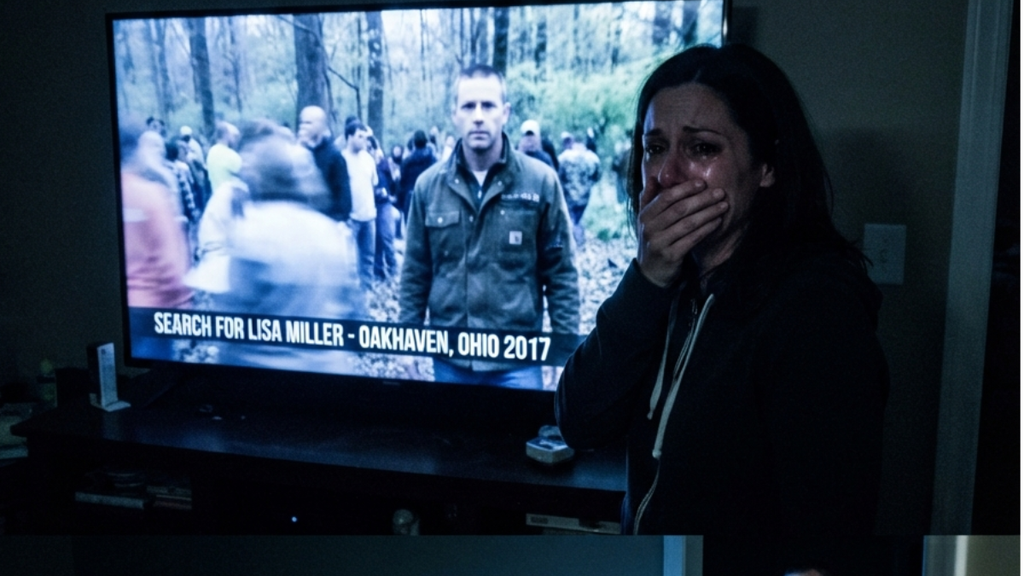
I recognized my husband because of the way he stands.
That sounds ridiculous considering the photograph was almost thirty years old.
The man in it was twenty-four.
My husband is fifty-three now.
His hair was darker.
He was thinner.
The picture was grainy enough that I could not have sworn to his eye color.
But he was standing with his left hand in his pocket and his right shoulder slightly lower than the other.
My husband, Scott, has stood like that for as long as I have known him.
Then I saw the watch.
Black band.
Rectangular silver face.
Scott still has it.
It belonged to his grandfather.
I knew.
The man standing in the background of a photograph from a missing-person case in Tennessee was my husband.
The problem was that Scott had told me, more than once, that he had never been to Tennessee.
My name is Amy.
I am fifty-one.
Scott and I have been married for twenty-six years.
We have two children, Lauren, twenty-three, and Miles, twenty.
We live in Ohio.
Scott owns a small landscaping company.
I work in administration for a community college.
We have had what I would have described, until approximately three weeks ago, as an extremely normal marriage.
Not perfect.
Normal.
Bills.
Kids.
Arguments about whether the dishwasher is actually full.
Vacations.
A mortgage.
A dog.
Two aging parents between us.
Nothing about my husband had ever made me think he possessed a secret life.
I was watching the documentary without him.
Scott hates true crime.
That is not unusual enough that I ever questioned it.
He says real people’s tragedies should not be entertainment.
I actually agreed with him in principle, although clearly not enough to stop watching documentaries.
The one I chose was about a woman named Rebecca Sloan.
Rebecca disappeared from a small town outside Knoxville in October 1997.
She was twenty-six.
She worked at a dental office.
She lived alone.
She had a boyfriend named Craig Mercer.
She was supposed to meet her sister for breakfast on a Saturday morning.
She never showed.
Her car was found two days later in the parking lot of a motel approximately forty miles from her apartment.
The doors were unlocked.
Her overnight bag was inside.
Her wallet was missing.
There was no obvious blood.
No sign of a struggle.
Rebecca has never been found.
The documentary was one of those three-part streaming things where the first episode establishes the disappearance and the second digs into all the people around her.
I was maybe forty minutes into episode one when they showed a photograph taken the night before Rebecca disappeared.
It was outside a bar called McKinley’s.
Rebecca was standing with three friends.
Someone had apparently taken the picture because it was one friend’s birthday.
There were people in the background.
One of them was Scott.
I paused the television.
I stared.
Then I rewound.
I watched the shot again.
The photograph filled the screen.
The documentary narrator was talking about Rebecca’s last confirmed evening.
I paused again.
I walked closer to the television.
I remember actually saying:
“No way.”
Not because I thought anything sinister.
At first I thought it was funny.
What were the chances?
Maybe Scott had been in Tennessee once and forgotten.
Then I remembered a conversation we had approximately two years earlier.
We were planning a road trip.
I suggested going through Tennessee.
Scott said he had never been there.
I teased him because he had traveled extensively in his twenties.
Colorado.
Georgia.
Florida.
Texas.
North Carolina.
Virginia.
He had driven across half the country.
But somehow never Tennessee.
He said:
“Never made it there.”
I remembered that specifically because Miles joked that Tennessee was apparently Scott’s last unexplored state east of the Mississippi.
I took a photograph of the television with my phone.
Then I zoomed in.
The man’s face was turned partly toward the camera.
Scott has a small notch in his left eyebrow from falling off his bike when he was a kid.
I could see it.
I texted Lauren.
Does this look like Dad?
She replied approximately two minutes later.
Why is Dad dressed like it’s 1995 lol
Then:
Is that actually him?
I said I did not know.
She wrote:
That’s absolutely Dad. Look at his stupid stance.
That made me laugh.
Then she asked where the photograph came from.
I said a documentary.
She asked what documentary.
I told her.
There was a pause.
Then:
Wait isn’t that the missing woman one?
I said yes.
Lauren called me.
She asked whether Dad knew Rebecca.
I said I had no idea.
She asked whether he was home.
No.
Scott was at his warehouse.
Lauren said:
“Mom, that’s weird.”
I told her it was probably nothing.
Maybe he went to Tennessee once.
Maybe the photograph was mislabeled.
Maybe the bar was somewhere else.
Then I looked up McKinley’s.
The bar had closed years earlier.
But old newspaper references confirmed it had been in Tennessee.
The documentary had the correct location.
I finished the episode.
I should not have.
I should have waited for Scott.
But curiosity took over.
The timeline was straightforward.
Friday, October 17, 1997.
Rebecca worked until approximately five.
She went home.
At seven-thirty, she met friends for dinner.
At approximately nine-fifteen, they went to McKinley’s.
The photograph containing Scott was timestamped 10:22 p.m.
Rebecca left the bar around eleven-thirty.
A friend saw her speaking to an unidentified man near the parking lot.
Rebecca told her friends she was going home.
At 12:08 a.m., she called her sister.
No answer.
At 12:17, someone used Rebecca’s ATM card approximately three miles from the bar.
At 12:40, a clerk at a convenience store believed she saw Rebecca buying water.
After that, nothing confirmed.
The documentary said police had interviewed everyone they could identify from the bar that night.
Several patrons remained unidentified.
They displayed the photograph again.
This time, red circles appeared around four people.
Scott was one of them.
The narrator said:
Investigators have never publicly identified every person visible in photographs taken at McKinley’s that evening.
I stopped the episode.
My heart started beating faster.
It was still probably nothing.
But “probably nothing” felt different now.
I called Scott.
He answered.
I asked when he would be home.
Approximately six.
I asked whether he had ever been to Knoxville.
He said:
“Tennessee?”
I said yes.
He said:
“No.”
No hesitation.
I asked whether he was sure.
He laughed.
He said:
“Pretty sure I’d remember going to Tennessee.”
I asked where he was in October 1997.
That got a pause.
He asked why.
I said I was watching something and it made me curious.
He said he had no idea.
That was almost thirty years ago.
Probably Ohio.
Maybe Georgia.
He worked seasonal construction then and traveled.
I asked whether he ever worked in Tennessee.
He said no.
Then:
“Why are you asking me this?”
I told him I would show him when he got home.
He sounded irritated.
He said:
“Amy, what are you doing?”
I said nothing.
He asked whether I was watching another murder show.
I said yes.
Then he said:
“Jesus Christ.”
We hung up.
That reaction bothered me.
Not enough to make me think he had harmed anyone.
But enough that I could not stop thinking about it.
Scott came home at approximately six-fifteen.
I had the photograph pulled up on the television.
He walked into the living room.
He looked at the screen.
He stopped.
Exactly the way people stop in movies when they recognize something they hoped never to see again.
I watched his face.
I said:
“That’s you.”
Scott looked at me.
Then back at the television.
He said:
“No, it isn’t.”
I laughed.
I thought he was joking.
He was not.
I said:
“Scott.”
He walked closer.
He said:
“That doesn’t even look like me.”
I told him Lauren recognized him immediately.
That was a mistake.
His head snapped toward me.
“You sent this to Lauren?”
I asked why that mattered.
He said because I was dragging our daughter into something stupid.
I asked why he was angry.
He said because I was accusing him of being in some random photograph.
I said I was not accusing him of anything.
I was asking why he was in Tennessee after telling me he had never been there.
He said again:
“That’s not me.”
I pointed at the watch.
He looked.
Then he looked away.
I said:
“You still own that watch.”
He told me millions of people owned watches like that.
I pointed at his eyebrow.
He said the image was too blurry.
I pointed at the way the man was standing.
Scott laughed in this hard, dismissive way I had almost never heard from him.
Then he said:
“You’ve been watching too much of this shit.”
I stared at him.
I said:
“Okay. Then watch it with me.”
He refused.
I asked why.
He said he was tired.
I said it would take thirty seconds.
He walked into the kitchen.
I followed.
I asked whether he knew Rebecca Sloan.
He stopped.
Not dramatically.
Just enough.
Then he opened the refrigerator.
He said no.
I asked whether he had ever heard her name.
He said:
“Not until you started talking about her.”
I asked whether he knew Craig Mercer.
No.
McKinley’s?
No.
Knoxville?
No.
Then he said:
“Are you done?”
I told him I would be done if he looked me in the eye and told me the man in the photograph was not him.
He looked directly at me.
“It isn’t me.”
That should have settled it.
Instead, it frightened me.
Because I knew it was him.
I had slept beside that face for twenty-six years.
I had watched it age.
I had seen photographs of Scott at twenty-two, twenty-three, twenty-four.
I knew what he looked like.
I knew his grandfather’s watch.
I knew the notch in his eyebrow.
I knew his body.
The man in that photograph was my husband.
So now I had two facts that could not both be true.
Scott had never been to Tennessee.
Scott was photographed in Tennessee.
I did not sleep well.
The next morning, I searched through old photo albums.
Scott and I met in January 1998.
Three months after Rebecca disappeared.
I knew almost nothing firsthand about his life in October 1997.
I knew the general story.
After high school, Scott bounced around.
Community college for a year.
Construction.
Landscaping.
Seasonal jobs.
He spent a summer in Colorado.
Several months in Georgia.
Worked in North Carolina.
Returned to Ohio around the end of 1997.
Then we met.
I pulled out photographs from when we were dating.
The watch was there.
Same black band.
Same silver rectangular face.
I found one photograph from Scott’s twenty-fifth birthday.
Same haircut as the man in the documentary.
Same sideburns.
Same jacket, I thought.
Dark green canvas.
Then I remembered the jacket.
Scott kept it for years.
He wore it when we first dated.
I texted the documentary photograph and our old birthday photograph to my sister, without context.
Same person?
She replied:
Looks like it. Who is it?
I did not answer.
I went to work.
I accomplished almost nothing.
At lunch, I searched Rebecca’s case.
There were old newspaper articles.
Archived discussion boards.
Podcasts.
A Facebook page run by Rebecca’s younger sister, Melissa.
I learned things the documentary had not included.
Rebecca’s boyfriend, Craig, had been the main focus early on.
They had a volatile relationship.
Several friends said Rebecca planned to end it.
Craig claimed he was home the night she disappeared.
His roommate backed him up.
Police searched his car and apartment.
Nothing.
No charges.
Over the years, investigators considered other people.
A coworker.
An ex-boyfriend.
A man Rebecca met at a gym.
A convicted offender who lived nearby.
Nothing stuck.
Then I found an old scanned newspaper article.
POLICE SEEK BAR PATRONS IN SLOAN DISAPPEARANCE
There was the photograph.
Smaller.
Grainier.
But Scott was visible.
The article was from November 1997.
Police were asking several unidentified people who had been at McKinley’s to come forward.
I felt sick.
If Scott had been there, he had to know a missing woman had vanished that night.
It was on local news.
Her photograph was everywhere.
Police were publicly asking people from the bar to contact them.
Did he?
I had no idea.
That evening, I asked him.
I said:
“If that’s you, did you ever speak to police?”
He became angry immediately.
He said:
“We already talked about this.”
I said no, he had lied to me about a photograph.
He told me I was becoming obsessive.
I said:
“Then prove me wrong.”
He asked how.
I said show me where he was in October 1997.
He laughed.
He asked whether I wanted him to produce a thirty-year-old timecard.
I said anything.
Photographs.
Old pay stubs.
Tax records.
He said he did not have them.
Then I asked:
“Who were you working for?”
He said a contractor named Bill Haney.
Where?
Georgia.
I asked what city.
Macon.
I wrote it down.
Scott stared at me.
He asked:
“Are you investigating me now?”
I said:
“I am trying to understand why my husband is lying to my face.”
He slammed his hand on the counter.
Not at me.
But hard enough that I jumped.
Scott has never hit me.
He has never threatened me.
I want to make that clear.
But I had also never seen him react that way to a question.
He immediately apologized.
Then he said:
“I don’t want you digging into this.”
I said:
“Why?”
He rubbed his face.
Then:
“Because you’re going to find things you don’t understand.”
I stared at him.
That was the first crack.
I asked what things.
He said he should not have said that.
I asked again.
He walked away.
I followed him.
I said:
“Were you in Tennessee?”
He did not answer.
“Scott.”
Finally:
“Yes.”
One word.
I felt strangely relieved.
Not because it was good.
Because reality made sense again.
I asked why he lied.
He said:
“Because I knew exactly what documentary you were watching the second you said Knoxville.”
I asked whether he knew Rebecca.
He said:
“Yes.”
My entire body went cold.
I asked how.
He said:
“Not well.”
I asked what that meant.
He had met her several times.
I asked where.
McKinley’s.
Through mutual friends.
I asked whether he spoke to her the night she disappeared.
He said yes.
I asked whether he was the unidentified man seen talking to her in the parking lot.
He said:
“No.”
I asked whether he was sure.
“Yes.”
I asked why he never told police he was there.
He said:
“I did.”
That surprised me.
I asked when.
Approximately three days after Rebecca disappeared.
He went to the police station voluntarily.
I asked why his identity was apparently never publicly attached to the photograph.
He said police knew who he was.
The public did not.
I asked what he told them.
That he was at McKinley’s.
That he spoke briefly to Rebecca inside.
That he left before she did.
I asked whether that was true.
Scott did not answer.
I said:
“Was it true?”
He said:
“Mostly.”
I almost laughed.
I asked what “mostly” meant.
He said he left the bar before Rebecca.
I asked what part was false.
He said:
“I didn’t leave town when I told police I did.”
I asked where he went.
He said he stayed in Tennessee until Sunday.
Rebecca disappeared Friday night.
I asked why he lied to police.
Scott sat down.
Then he said:
“Because Craig asked me to.”
I recognized the name.
Rebecca’s boyfriend.
I asked how Scott knew Craig.
They had worked together.
Not in Tennessee.
In Georgia.
The construction job Scott had mentioned was real.
Craig worked on the same crew.
They became friends.
In October 1997, Craig invited Scott to Tennessee for a long weekend.
Scott drove up Friday afternoon.
They went to McKinley’s that night.
That was why Scott was there.
I asked whether Craig and Rebecca were together at the time.
Sort of.
They had been fighting.
Breaking up.
Getting back together.
Scott said he had met Rebecca twice before.
I asked what happened at the bar.
Scott said Craig was supposed to meet them.
He never showed.
Rebecca was there with friends.
Scott talked to her briefly.
She asked where Craig was.
Scott said he did not know.
At approximately eleven, Scott left with two guys he knew through Craig.
I asked where they went.
A house party.
I asked whose house.
He gave me a name.
Darren Walsh.
I wrote it down.
Scott looked at me.
I told him to continue.
He stayed at Darren’s until approximately two in the morning.
Then he slept on the couch.
I asked where Craig was.
Scott said:
“I don’t know.”
I asked when he saw Craig next.
Saturday morning.
At Craig’s apartment.
I asked what Craig said about Rebecca.
Scott’s face changed.
He said:
“He asked me if I’d seen her.”
I asked whether he seemed worried.
Not yet.
Rebecca had apparently not shown up for breakfast with her sister, but nobody knew she was missing.
Then Craig asked Scott for a favor.
I asked what.
Scott said:
“He asked me to say he’d been with me.”
I stared at him.
I asked when.
Friday night.
I said:
“Craig asked you to give him an alibi.”
Scott said yes.
I asked whether he did.
Not immediately.
Scott asked why.
Craig said he had gone to Rebecca’s apartment after midnight.
They argued.
He left.
He was afraid that if she stayed missing, police would assume he did something.
I asked whether Scott believed him.
At the time, yes.
I asked whether he agreed to lie.
Scott said:
“Eventually.”
I stood up.
I asked what exactly he told police.
When detectives interviewed him, Scott said Craig had met him and Darren after the bar.
He said Craig arrived at the house party around midnight and stayed until approximately two.
That was false.
Craig had never been there.
I asked whether Darren lied too.
Scott said:
“Yes.”
I asked why.
Craig asked both of them.
I asked whether police believed the alibi.
Scott said apparently.
I asked whether that was why Craig was never charged.
He said:
“I don’t know.”
I could barely look at him.
My husband had lied to police during a missing-person investigation.
He had helped a missing woman’s boyfriend fabricate an alibi.
Then he had spent twenty-six years telling me he had never even been to Tennessee.
I asked:
“Did Craig kill her?”
Scott said:
“I don’t know.”
I asked whether he thought Craig killed her.
Scott said:
“I didn’t then.”
I asked:
“Do you now?”
He looked at me.
Then he said:
“Yes.”
I sat down.
I asked what changed.
Scott said approximately six months after Rebecca disappeared, Craig called him.
By then Scott had moved back to Ohio.
We had started dating.
The investigation was still active.
Craig had been questioned multiple times.
Scott said Craig was drunk.
He started talking about Rebecca.
Then he said something Scott had never been able to forget.
“She wasn’t supposed to leave the car.”
I felt cold.
I asked what Scott said.
He asked Craig what he meant.
Craig immediately backtracked.
He said he was talking about an argument they had weeks before Rebecca disappeared.
Scott did not believe him.
I asked whether he called police.
No.
I stared at him.
He said:
“I was scared.”
I asked of what.
Getting charged for lying.
Losing his job.
Getting dragged into the investigation.
Craig.
Everything.
I asked whether he ever told anyone.
No.
Then Scott said:
“I was twenty-four.”
I told him he had been twenty-four when he lied.
He was twenty-five when Craig made the comment.
Thirty when Rebecca had been missing six years.
Forty when she had been missing sixteen.
Fifty when she had been missing twenty-six.
He had not stayed twenty-four.
Scott looked like I had hit him.
Good.
I asked whether Craig was still alive.
Yes.
I asked where.
Scott said he did not know.
I searched.
It took less than a minute.
Craig Mercer lived in Kentucky.
He owned an auto repair shop.
He was fifty-six.
There were photographs.
Wife.
Children.
Grandchildren.
I turned the phone toward Scott.
I asked whether that was him.
Yes.
Then I asked whether Rebecca’s family knew Scott had lied.
He said no.
I asked whether police knew.
“No.”
I asked whether Darren was alive.
Scott believed so.
I searched him too.
Darren still lived in Tennessee.
I asked when Scott last spoke to him.
Approximately fifteen years earlier.
I asked why.
Darren called.
He wanted to know whether Scott had ever told his wife about Rebecca.
I stared at him.
I asked what Scott said.
No.
Darren said neither had he.
Then he said:
“Probably better that way.”
I asked whether that was the last conversation.
No.
They spoke once more.
Approximately six years ago.
This time Darren sounded frightened.
A detective had contacted him.
The case had been assigned to a cold-case investigator.
Darren wanted to make sure their stories still matched.
I could not believe what I was hearing.
I asked whether Scott coordinated his story with Darren.
He said:
“Not exactly.”
I asked what exactly.
Darren reminded him that they had told police Craig arrived around midnight.
Scott told Darren he remembered.
Darren asked whether Scott planned to change anything.
Scott said no.
I said:
“So yes.”
Scott looked down.
I asked whether the cold-case detective contacted him too.
Yes.
I laughed.
I asked when.
Five years earlier.
Scott had told me he was meeting with an insurance adjuster that afternoon.
He was actually speaking to a detective.
I asked what he told the detective.
The same lie.
Craig joined them at the party.
I stared at him.
Five years ago.
My husband was forty-eight.
Not twenty-four.
He had a wife.
Two children.
A business.
He had decades to understand the seriousness of what he had done.
And he lied again.
I asked why.
He said because by then admitting the truth meant admitting he had lied for twenty-four years.
I said:
“Do you hear yourself?”
He said yes.
Then I asked the question I was afraid to ask.
“Is the fake alibi the worst thing you’ve hidden?”
Scott went quiet.
I knew immediately.
I said:
“What else?”
He said:
“Amy.”
I asked again.
He stood up.
He walked to the window.
Then he said:
“Craig came to Darren’s house Saturday morning.”
I reminded him he had already told me that.
Scott shook his head.
“No. He came before I went to his apartment.”
I waited.
Scott said it was approximately six in the morning.
He and Darren were asleep.
Craig pounded on the door.
Darren let him in.
Craig was agitated.
His clothes were dirty.
There was mud on his jeans.
Scott asked what happened.
Craig said his truck got stuck.
I asked where.
Scott said Craig would not say.
Then Craig asked Darren if he could use the washing machine.
I felt sick.
I asked whether they let him.
Yes.
Craig changed into some of Darren’s clothes.
He washed his jeans and sweatshirt.
I asked whether there was blood.
Scott said no.
At least none he saw.
Mud.
Maybe something dark on one sleeve.
He could not remember.
I asked whether Craig showered.
Yes.
I asked what time he left.
Approximately eight.
Then Scott went to Craig’s apartment around ten.
That was when Craig acted as though he had not seen him since earlier in the week and asked whether Scott had seen Rebecca.
I stared at him.
I said:
“You knew he was creating a story.”
Scott said:
“Not immediately.”
I asked when he understood.
When Craig asked for the alibi.
I asked whether Darren understood.
Yes.
I asked why either of them agreed.
Scott said Craig told them Rebecca was alive when he left her.
He said they argued.
She got out of his truck.
She refused to get back in.
He drove away.
I asked where.
Scott said:
“He never told us.”
I asked whether the motel where Rebecca’s car was found was near wherever Craig claimed they argued.
Scott did not know.
Then I asked whether Craig had Rebecca’s car.
Scott said no.
I asked whether he was sure.
He said:
“I never saw it.”
I asked whether Craig had anything belonging to her.
Scott’s face changed again.
I said:
“What?”
He closed his eyes.
Then he said:
“Her purse.”
I felt physically sick.
I asked where.
Craig had a woman’s purse in the cab of his truck.
Scott noticed it when Craig arrived at Darren’s house.
He asked whose it was.
Craig said Rebecca left it in his truck during their argument.
I asked what happened to it.
Scott said he did not know.
I reminded him Rebecca’s wallet was missing when her car was found.
He nodded.
I asked whether he told police Craig had her purse.
No.
I asked whether Darren did.
No.
I stood up.
I told Scott to get away from me.
He did.
He walked into the kitchen.
I followed because I was too angry to sit still.
I said:
“You helped him.”
Scott said:
“I know.”
I said:
“No, I don’t think you understand what I’m saying. You didn’t just lie about a party. You saw him hours after she disappeared. He was covered in mud. He washed his clothes. He had her purse. Then he asked you to give him an alibi, and you did.”
Scott was crying.
He said:
“I know.”
I asked whether he knew where Rebecca was.
No.
I asked whether he ever saw her after the bar.
No.
I asked whether he helped move her car.
“No.”
I asked whether he helped Craig dispose of anything.
“No.”
I asked whether he ever went anywhere with Craig that weekend besides the apartment.
“No.”
I asked whether he had ever seen Rebecca’s body.
“No.”
I asked whether he knew what happened to her.
“No.”
I believed those answers.
I do not know why.
Maybe because he was finally answering quickly.
Maybe because after twenty-six years I still knew something about him.
But I also knew I could not rely on instinct anymore.
I asked whether he would tell police now.
Scott did not answer.
I said:
“If you say no, I’m calling them myself.”
He stared at me.
I told him I had the documentary photograph.
I knew the case.
I knew the detective had contacted him five years earlier.
I knew enough to make someone ask questions.
Scott said:
“You would turn me in?”
I said:
“You’re not the missing person.”
He flinched.
I said there was a woman who had been gone for twenty-nine years.
Her parents might be dead by now.
Her siblings had spent most of their adult lives wondering.
If Scott knew information that could change the investigation, he did not get to keep it because telling the truth was inconvenient.
Then he said something I did not expect.
“Her mother is still alive.”
I stared at him.
I asked how he knew.
Scott said:
“Because she called me.”
I felt cold all over again.
When?
Two years earlier.
Rebecca’s mother, Patricia Sloan, somehow obtained Scott’s number.
She knew he had been at McKinley’s.
She did not know about the false alibi.
She asked whether he remembered her daughter.
Scott told her barely.
Patricia said Rebecca’s sister Melissa had been going through old case files and found Scott’s name in an interview summary.
She was calling everyone she could locate.
I asked what Patricia asked him.
Whether Rebecca seemed frightened that night.
Whether she mentioned Craig.
Whether Scott saw her leave.
Whether he remembered anyone following her.
I asked what he told her.
Nothing useful.
Then Patricia said:
“If you remember anything else before I die, please call me.”
Scott started crying again.
I said:
“And you still didn’t tell her.”
No.
I asked whether he kept her number.
Yes.
I told him to call a lawyer.
He looked at me.
I said:
“Not Craig. Not Darren. A lawyer for you.”
Then call the detective.
Scott asked whether I would sit with him.
I said no.
Not because I wanted to punish him.
Because I did not want to become another person helping him manage his story.
He needed to tell it without looking at my face to decide which parts were safe.
Scott called an attorney that night.
The next morning, he called the cold-case unit.
By afternoon, two detectives were at our house.
I did not sit in the room.
I went upstairs.
They were there for almost four hours.
At one point I heard Scott crying.
At another, one detective raised his voice.
I could not make out the words.
When they left, Scott looked gray.
I asked whether he told them everything.
He said yes.
I asked whether they believed him.
He said:
“I don’t know.”
I asked whether they were going to arrest him.
He said not then.
His lawyer had explained that lying to investigators decades earlier could create legal issues, especially because he repeated the lie during the cold-case interview.
I told him I did not want legal details.
I wanted to know what happened to Rebecca.
Scott said the detectives were now very interested in Craig.
Apparently some parts of Scott’s story matched evidence the public had never known.
I asked what parts.
He said he could not tell me.
I laughed.
Not because it was funny.
Because after everything, I could not tolerate another “I can’t tell you.”
He clarified.
The detectives specifically asked him not to discuss certain evidence while they reinterviewed people.
That was different.
Barely.
Three days later, Darren called Scott.
I was standing in the kitchen.
Scott looked at the screen.
Then at me.
He put it on speaker.
Darren did not say hello.
He said:
“What the fuck did you do?”
Scott said:
“I told them.”
Silence.
Then Darren said:
“You stupid son of a bitch.”
Scott said:
“We should have told them in 1997.”
Darren said:
“You’re going to ruin our lives.”
Scott responded:
“Rebecca didn’t get one.”
Darren went silent.
Then he hung up.
I looked at Scott.
That was the first thing he had done since this started that made me recognize the man I thought I married.
Too late.
Decades too late.
But finally.
The next week, investigators searched Darren’s property.
Not his current house.
A piece of land his parents had owned in 1997.
The news reported it.
The documentary’s Facebook groups exploded.
People speculated wildly.
I did not participate.
Then police searched a former property belonging to Craig’s uncle.
That was when Scott told me something else.
Craig’s truck had supposedly gotten stuck on his uncle’s property the night Rebecca disappeared.
Scott had learned that later.
I asked how much later.
Approximately a year.
Craig mentioned it while drinking.
Scott never connected it to the mud until afterward.
I asked whether he told police.
Yes.
Now.
I asked whether the uncle’s property was near the motel.
Approximately twelve miles.
Then, six days after the search began, police found human remains.
The news alert came through while I was at work.
I stared at my phone.
HUMAN REMAINS DISCOVERED DURING SEARCH RELATED TO 1997 REBECCA SLOAN CASE
I went into an empty conference room.
I called Scott.
He already knew.
He was crying.
Neither of us said much.
Identification took time.
The remains were Rebecca’s.
After twenty-nine years, Rebecca Sloan had been found.
She had been buried on property that belonged to Craig’s uncle in 1997.
The uncle had died years earlier.
Craig was arrested three days after the identification was announced.
The charges were related to Rebecca’s death.
I will not pretend the arrest answered everything.
It did not.
The case is still moving through the legal system.
Craig has pleaded not guilty.
His attorneys have challenged parts of the investigation.
I am not going to declare exactly what happened on a night I was not there when the court process is still ongoing.
But investigators have said publicly that new witness information led them back to the property.
Scott was one of those witnesses.
Darren eventually changed his story too.
I do not know whether he did it because Scott confessed or because police confronted him with Scott’s statement.
Probably both.
What I know is that for twenty-nine years, two men protected a lie because admitting it would expose their own cowardice.
Craig benefited from it.
Rebecca’s family paid for it.
Patricia Sloan got to bury her daughter.
She is eighty-one.
I have never met her.
I do not know if I ever will.
Scott spoke to her.
After police found Rebecca, Patricia asked for his number.
Scott did not want to call.
His lawyer said there was no legal reason he could not, but warned him not to discuss details of the pending case.
Scott called anyway.
He apologized.
I was not in the room.
He told me afterward that Patricia listened.
Then she asked:
“Did you know where she was?”
Scott said no.
Patricia asked:
“Did you know Craig had hurt her?”
Scott said he suspected it.
Then Patricia asked:
“When?”
Scott told her the truth.
By the time Craig made the comment six months later, he strongly suspected.
Patricia cried.
Then she said:
“You could have given me twenty-eight years.”
Scott did not understand.
She explained.
If he had told police then, maybe they would have searched the property.
Maybe Rebecca would have been found.
Maybe Patricia would have buried her daughter at fifty-two instead of eighty-one.
Maybe she would not have spent nearly three decades waking up wondering whether Rebecca was alive somewhere.
Scott told her he was sorry.
Patricia said:
“I know.”
Then she hung up.
Scott has replayed that sentence constantly.
You could have given me twenty-eight years.
I think it will follow him for the rest of his life.
I am not sure whether we are going to stay married.
That is not because I think Scott killed Rebecca.
I do not.
It is not because I believe he helped bury her.
There is no indication he did.
It is because I discovered that my husband had built our entire marriage around a lie he told three months before meeting me.
Think about that.
When we had our first date, he had already lied to police.
When he proposed, he had already heard Craig say Rebecca “wasn’t supposed to leave the car.”
When we married, he already suspected the friend whose alibi he had fabricated might have killed a woman.
When Lauren was born, Rebecca had been missing four years.
When Miles was born, six.
When Rebecca’s case appeared on anniversary news stories, Scott changed the channel.
When I suggested Tennessee vacations, he said he had never been there.
When cold-case detectives called him five years ago, he lied to me about where he was going and then lied to them again.
When Rebecca’s mother called him, he still said nothing.
That is a lot of active choices.
Not one mistake at twenty-four.
A chain of decisions stretching almost thirty years.
Scott says he understands that now.
He has stopped saying he was scared.
He was scared.
That is true.
But fear explains the first lie better than the hundredth.
Lauren is furious with him.
Miles is quieter.
He asked Scott one question.
“If I did what you did, what would you tell me to do?”
Scott said:
“Tell the truth immediately.”
Miles said:
“Exactly.”
Then he left.
Scott has started therapy.
I have too.
Separately.
I am not interested in turning this into a story where one confession magically fixes a marriage.
It does not.
Sometimes I look at Scott and feel enormous compassion.
He was twenty-four.
He made a cowardly choice.
Then shame trapped him inside it.
Other times, I think about Patricia.
Twenty-eight years.
Compassion becomes harder.
A few days ago, I watched the documentary again.
Not the whole thing.
Just the first episode.
They have already added a note at the beginning saying Rebecca’s remains have since been recovered and an arrest has been made.
Eventually someone will probably make another documentary.
Maybe Scott will be in that one.
He has already been contacted by producers.
He said no.
I was glad.
I paused again on the photograph from McKinley’s.
Rebecca was smiling.
Her friends were beside her.
In the background stood my husband at twenty-four.
Left hand in his pocket.
Right shoulder slightly lower.
His grandfather’s watch on his wrist.
The first time I saw the photograph, I was focused entirely on him.
Now I look at Rebecca.
That is the strangest change.
For twenty-nine years, Scott made the story about what would happen to him if he told the truth.
Would he get arrested?
Would people hate him?
Would his career be ruined?
Would I leave?
Would our children look at him differently?
Those fears became so large that the missing woman herself almost disappeared from his version of the story.
Rebecca became the reason he was afraid instead of the person who was gone.
I think that is how people live with terrible secrets.
They make themselves the center of them.
Then the consequences of confessing begin to feel bigger than the consequences someone else is already living with.
Scott told me he had never been to Tennessee because saying he had would have opened a door he had spent almost thirty years holding shut.
I opened it because I recognized a watch.
Behind it was a bar.
A false alibi.
A muddy pair of jeans.
A woman’s purse.
A frightened twenty-four-year-old who chose loyalty to his friend over a missing woman he barely knew.
And twenty-nine years of silence after that.
Rebecca’s family finally knows where she is.
Scott finally told the truth.
Those things matter.
They do not return the years.
And they do not change the fact that if I had watched a different documentary that night, or looked away from the screen for ten seconds, my husband might still be telling me he had never set foot in Tennessee.
