

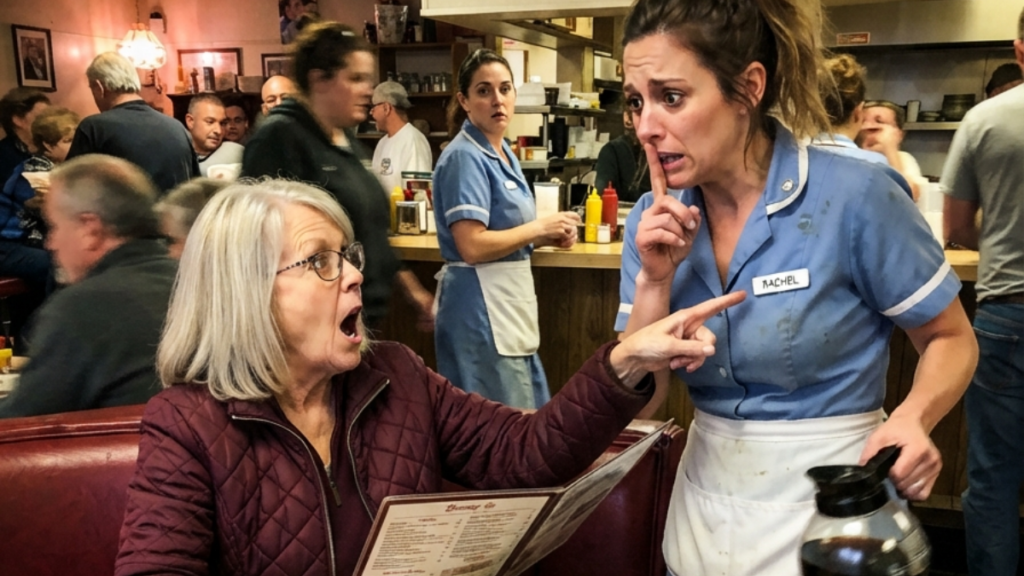
My daughter-in-law was supposedly receiving treatment at a rehabilitation facility in Arizona when I walked into a little restaurant in Pennsylvania and found her clearing dirty dishes from a table.
She’d cut her beautiful blonde hair.
Dyed it dark brown.
Removed her wedding ring.
And according to the name tag pinned to her uniform, she was now called Emily.
I stood beside the hostess station, staring at her.
“Rachel?”
She dropped the glass she was holding.
It shattered across the floor.
Then she grabbed my arm, pulled me toward the kitchen, and whispered something that made my stomach turn.
“Please don’t tell your son you found me. He thinks I’m dead.”
My name is Barbara Mitchell.
I’m sixty-six years old, and until that afternoon, I believed my son was a devoted husband struggling to keep his family together while his wife battled an addiction.
My son, Christopher, was forty-one.
He owned a successful residential real estate company outside Philadelphia.
He’d married Rachel thirteen years earlier.
They had two children.
Sophie, eleven.
And Oliver, eight.
Rachel had always been a wonderful daughter-in-law.
She was thoughtful, hardworking, and extraordinarily patient with Christopher.
She’d worked as an elementary school teacher before Sophie was born, then decided to stay home with the children.
We spoke several times a week.
We went shopping together.
She helped me decorate my house for Christmas.
And after my husband passed away five years earlier, Rachel was the person who made sure I never spent a holiday alone.
That’s why I was so shocked when Christopher arrived at my house one evening in February and told me Rachel had developed a serious addiction to prescription medication.
I immediately began crying.
“Why didn’t she tell me?”
Christopher shook his head.
“She’s embarrassed, Mom.”
He explained that Rachel had been struggling for nearly two years.
He’d supposedly caught her stealing money from their joint checking account.
He claimed she’d been visiting multiple physicians to obtain prescriptions.
And he’d recently discovered her unconscious in their bathroom.
I couldn’t believe it.
I’d seen Rachel less than a week earlier.
We’d gone out for breakfast.
She’d seemed perfectly normal.
Christopher told me she’d become remarkably skilled at concealing her addiction.
He said he’d arranged for her to attend an expensive residential treatment program in Arizona.
She’d agreed to go.
And because the facility encouraged patients to focus exclusively on their recovery, she wouldn’t be permitted to contact family members for an extended period.
I offered to help pay for her treatment.
Christopher initially refused.
Then, approximately two weeks later, he told me their insurance company wouldn’t cover the entire cost.
I wrote him a check for twenty-five thousand dollars.
Over the following four months, I helped care for Sophie and Oliver.
I picked them up from school.
Attended their sporting events.
Prepared meals.
And listened to them cry because they missed their mother.
Sophie frequently asked whether Rachel had forgotten about them.
I assured her that her mother loved her.
That she was receiving help.
That she’d come home as soon as she was healthy enough.
Christopher occasionally showed me text messages he claimed Rachel had sent him.
They were short.
Usually apologetic.
She thanked him for taking care of the children.
She promised she was working hard.
She said she needed more time.
But whenever I asked whether I could send her a letter, Christopher discouraged me.
“She needs space, Mom.”
I respected that.
Until one Saturday afternoon in June, when my sister and I stopped for lunch in a small town nearly two hours from my home.
We’d spent the morning visiting antique stores.
My sister suggested a family-owned restaurant on the main street.
We walked inside.
And there was Rachel.
Wearing black pants, a white shirt, and a little green apron.
She was carrying dirty plates toward the kitchen.
At first, I thought she simply resembled my daughter-in-law.
But then she turned toward the window.
And I noticed the small scar above her left eyebrow.
Rachel had gotten that scar when she fell off a bicycle as a child.
I’d heard the story dozens of times.
There was no question.
It was her.
When she pulled me toward the kitchen and told me Christopher believed she was dead, I stared at her in disbelief.
“What are you talking about?”
She glanced toward the dining room.
“Did he come with you?”
I shook my head.
“No.”
“Does he know you’re here?”
“No!”
She began crying.
I grabbed her hands.
“Rachel, your children think you’re in rehab.”
She covered her mouth.
I continued.
“Sophie cries herself to sleep. Oliver made you a Mother’s Day card that Christopher said he’d mail to Arizona.”
Rachel started sobbing.
“He told me I would never see them again.”
I stared at her.
“What?”
She shook her head.
“I didn’t abandon them, Barbara. I swear to you, I didn’t abandon my babies.”
I felt my eyes fill with tears.
“Then why are you here?”
She looked toward the kitchen door.
Then whispered:
“Because your son tried to kill me.”
I stepped backward.
“No.”
She nodded.
“Barbara, please listen to me.”
I shook my head.
“Christopher told me you had a drug problem.”
Rachel began laughing through her tears.
“I’ve never taken anything stronger than prescription ibuprofen after Oliver was born.”
I stared at her.
“He said he found you unconscious.”
Her expression changed.
Then she whispered:
“He did. But he didn’t tell you why.”
The restaurant manager approached us.
Rachel quickly explained that I was a family member.
He offered her the remainder of the afternoon off.
She thanked him.
Then asked whether I would meet her at a nearby park.
She didn’t want anyone photographing us together.
She didn’t want Christopher discovering where she worked.
And she begged me not to call him.
I agreed.
My sister waited in the restaurant while Rachel and I walked to the park.
We sat at a picnic table beneath a large oak tree.
Rachel looked thinner than I remembered.
There were dark circles beneath her eyes.
Her hands shook as she reached into her handbag.
She removed a phone.
It wasn’t the expensive smartphone Christopher had purchased for her the previous Christmas.
It was an inexpensive prepaid phone.
She opened a folder containing photographs.
Then handed it to me.
The first photograph showed bruises across her upper arm.
The second showed a large bruise near her shoulder.
The third showed a broken bathroom mirror.
I looked toward her.
“Christopher did this?”
She nodded.
I started crying.
Rachel explained that approximately eighteen months earlier, she’d discovered Christopher was having an affair with a woman named Madison.
Madison was twenty-six.
She worked for his real estate company.
When Rachel confronted him, Christopher initially apologized.
He promised to end the relationship.
But several months later, Rachel discovered that Madison was pregnant.
I covered my mouth.
“Pregnant?”
Rachel nodded.
“She had a little boy in January.”
I stared at her.
My son had another child.
A grandson I’d never known existed.
Rachel continued.
Christopher had purchased a townhouse for Madison.
He’d been paying her expenses.
And he’d been transferring substantial amounts of money from their joint accounts.
Rachel had contacted a divorce attorney.
She intended to leave him.
But when Christopher discovered she’d spoken to an attorney, everything changed.
He began threatening her.
He told her that if she attempted to divorce him, he’d make sure she lost custody of Sophie and Oliver.
He claimed he had evidence that she was mentally unstable.
He began telling relatives and friends that she had a substance abuse problem.
And whenever Rachel tried to contradict him, he accused her of being in denial.
I remembered Christopher calling me approximately a year earlier.
He’d asked whether Rachel had seemed unusually forgetful.
Whether she’d ever appeared intoxicated.
Whether she’d behaved strangely around the children.
I’d told him no.
He’d sighed and said he was probably worrying unnecessarily.
At the time, I thought nothing of it.
Now I realized he’d been preparing me to believe his story.
Rachel wiped her face.
“Do you remember when I missed Oliver’s birthday dinner?”
I nodded.
Christopher had told us Rachel had a migraine.
She’d remained upstairs while we celebrated.
Rachel opened another photograph.
It showed her lying in a hospital bed.
There was an IV in her arm.
A hospital bracelet around her wrist.
I stared at it.
“You were in the hospital?”
She nodded.
“I’d been there since the night before.”
I frowned.
“Why?”
She swallowed.
“I woke up on the bathroom floor. I couldn’t remember how I’d gotten there.”
Rachel explained that she’d experienced several unexplained episodes of dizziness and confusion during the weeks leading up to her disappearance.
She’d begun documenting them.
She’d stopped trusting Christopher.
And after the incident that sent her to the hospital, she became convinced that someone had deliberately harmed her.
But when she attempted to explain her concerns, Christopher told the medical staff she had a history of prescription drug misuse.
He portrayed himself as an exhausted husband trying to help his troubled wife.
I shook my head.
“Why didn’t you call me?”
Rachel began crying again.
“Because he told me you were helping him.”
I stared at her.
“What?”
She opened another folder on her phone.
There were screenshots of text messages.
One appeared to be a conversation between Christopher and me.
Except I’d never sent the messages.
I agree that Rachel shouldn’t be alone with the children.
She’s becoming a danger to herself and everyone around her.
Do whatever you need to do, sweetheart. I’ll support you.
I felt physically sick.
“Rachel, I never said any of this.”
She looked toward me.
“He showed me those messages.”
I shook my head.
“I would never say those things about you.”
She started sobbing.
“He told me you’d already agreed to testify against me.”
I reached across the table and grabbed her hands.
Then asked her to tell me what had happened the night she disappeared.
Rachel took a deep breath.
She explained that Christopher had arranged for her to attend what he described as a private mental health assessment.
He told her that if she cooperated, he’d allow her to remain in the children’s lives.
Rachel reluctantly agreed.
Christopher drove her to a remote property outside the city.
He claimed a physician would be meeting them there.
But when they arrived, Rachel realized something was wrong.
There was no physician.
No medical office.
No treatment facility.
Just an isolated house belonging to one of Christopher’s business associates.
She refused to get out of the car.
They argued.
Eventually, Rachel managed to leave the property and reach a nearby road, where a passing motorist stopped to help her.
She was frightened, injured, and convinced Christopher would come looking for her.
The motorist took her to a hospital in another county.
There, Rachel spoke with a domestic violence advocate.
With assistance, she eventually relocated to the town where I’d found her.
I listened in horror.
“But why does Christopher think you’re dead?”
Rachel looked down.
“Because of what happened afterward.”
She explained that approximately two days after she’d escaped, Christopher’s business associate contacted her through an old email account.
He told her Christopher believed she’d died following the incident at the property.
The man claimed he’d deliberately misled Christopher about what had happened because he was afraid of what Christopher would do if he discovered Rachel had survived.
He warned her never to return.
Then he disappeared.
I stared at her.
“Have you spoken to the police?”
She nodded.
“I reported what happened when I got to the hospital. But Christopher’s associate wouldn’t corroborate anything. And Christopher told investigators I’d left voluntarily because of my addiction.”
She’d also learned that Christopher had filed for emergency temporary custody, presenting medical records and allegations concerning her supposed substance abuse.
She was working with a legal aid attorney to challenge his claims.
But she was terrified.
Christopher had money.
Connections.
And documents that made her look like an unstable mother who’d abandoned her children.
I reached for my phone.
“I’m calling him.”
Rachel grabbed my wrist.
“NO!”
I stared at her.
“Barbara, please. Not until we have someone who can protect the children.”
I slowly lowered my phone.
Then asked:
“Does he know where you are?”
She shook her head.
“I don’t think so.”
I looked toward the little restaurant across the street.
Then back at the woman who’d once spent every Sunday afternoon sitting at my kitchen table.
“Rachel, why are you calling yourself Emily?”
She hesitated.
“That’s my middle name. The restaurant owner knows my real name, but he lets me use Emily with customers.”
I nodded.
Then reached into my handbag.
Pulled out my wallet.
And handed her every dollar I had.
She immediately tried to refuse.
I insisted.
Then I asked for her attorney’s contact information.
Because if even half of what she’d told me was true, my grandchildren were living with a man I no longer recognized.
And I needed to find out what was happening inside their house.
When I returned home that evening, Christopher called me.
“Hey, Mom. How was your day?”
I nearly started crying at the sound of his voice.
“Fine.”
He told me Sophie had a soccer game the following morning.
He asked whether I’d be attending.
I said yes.
Then I asked:
“Have you heard from Rachel lately?”
He sighed.
“Actually, I spoke with her treatment coordinator yesterday.”
I gripped the phone.
“How is she?”
“She’s making progress.”
I closed my eyes.
He continued.
“They think she might need another three months.”
I swallowed.
“Three months?”
“Unfortunately.”
I looked toward the photograph of Christopher and Rachel on my mantel.
Then asked:
“Could you give me the name of the facility? I’d like to send her something.”
He immediately became defensive.
“Mom, we’ve discussed this.”
“I know. I just thought—”
“She doesn’t need distractions.”
I nodded, although he couldn’t see me.
Then he said something that made me realize how little I understood about my own son.
“Honestly, the kids are probably better off without her.”
I ended the call shortly afterward.
Then sat at my kitchen table until nearly midnight, going through every message Christopher had sent me concerning Rachel’s treatment.
There were requests for money.
Updates about her progress.
Explanations for why she couldn’t contact the children.
And several photographs Christopher claimed she’d sent from the rehabilitation facility.
I examined them carefully.
One showed a swimming pool surrounded by palm trees.
Another showed a beautiful desert landscape.
A third showed a bedroom with white furniture.
None showed Rachel.
I searched for the images online.
Within minutes, I discovered that two of them belonged to a luxury vacation rental in Scottsdale.
The third was a promotional photograph from a resort.
Christopher had been sending me photographs he’d found on the internet.
And I’d believed every single one.
The following morning, I attended Sophie’s soccer game.
Christopher arrived late.
He was wearing sunglasses and carrying an expensive coffee.
Sophie immediately ran toward me.
“Grandma!”
I hugged her.
Then noticed she was wearing a necklace I’d never seen before.
“That’s pretty, sweetheart.”
She smiled.
“Madison gave it to me.”
I froze.
“Madison?”
Sophie nodded.
“Daddy’s friend.”
I looked toward Christopher.
He was talking to another parent.
I lowered my voice.
“Does Madison come to your house?”
Sophie nodded.
“She lives there sometimes.”
I felt sick.
“Does she have a baby?”
Sophie’s face lit up.
“Yes! His name is Henry.”
I swallowed.
Then asked:
“Does Daddy help take care of Henry?”
She nodded.
“He’s Henry’s daddy.”
I stared at my granddaughter.
She looked confused by my expression.
Then said:
“Madison says when Mommy gets better, she’s going to be our new mommy anyway.”
I closed my eyes.
Christopher had moved his mistress and their baby into the family home.
He’d introduced her to his children.
And he’d apparently begun preparing them for the permanent absence of their mother.
After the soccer game, I offered to take Sophie and Oliver for the afternoon.
Christopher agreed.
He said he had some work to finish.
As soon as we arrived at my house, Oliver ran upstairs to play.
Sophie remained in the kitchen.
She looked toward me.
Then asked:
“Grandma, do people die in rehab?”
I stared at her.
“Why would you ask that?”
She shrugged.
Then whispered:
“I heard Daddy and Madison talking.”
I pulled out a chair.
“What did they say?”
Sophie looked frightened.
“I wasn’t supposed to be listening.”
I reached for her hand.
“You’re not in trouble.”
She swallowed.
“Madison said Daddy needed to stop telling people Mommy was coming home.”
I felt my heart pounding.
“Did she say anything else?”
Sophie nodded.
“She said the insurance company was asking too many questions.”
I stared at her.
“What insurance company?”
She shook her head.
“I don’t know.”
Then she began crying.
“Grandma, is Mommy dead?”
I pulled her into my arms.
“No, sweetheart.”
She looked up at me.
“How do you know?”
I nearly told her.
I wanted to tell her more than anything.
But I didn’t know what Christopher might do if Sophie accidentally revealed that I’d found Rachel.
So I hugged her.
And told her that we were going to figure everything out.
Later that afternoon, while the children were playing in my backyard, I contacted Rachel’s attorney.
I explained who I was.
Told her about the money Christopher had collected from me.
The fake photographs.
The mistress living in the family home.
And Sophie’s comments about an insurance company.
The attorney listened carefully.
Then asked whether Christopher had ever discussed life insurance with me.
I frowned.
“Not recently.”
She explained that Rachel had discovered several unusual financial documents before her disappearance.
Among them were references to a substantial life insurance policy.
Rachel believed Christopher had increased the coverage without her fully understanding the paperwork she’d signed.
The attorney was investigating.
But she hadn’t yet obtained all the relevant records.
I looked toward my backyard.
Then asked:
“How much was the policy worth?”
She hesitated.
“Approximately two million dollars.”
I closed my eyes.
That evening, after Christopher collected the children, I went upstairs to my late husband’s study.
Christopher had used the room occasionally when he needed somewhere quiet to work.
He’d also stored several boxes of business documents there while renovating his office.
I’d never gone through them.
But now I opened every box.
Most contained ordinary real estate contracts.
Tax records.
Property listings.
Invoices.
Then I discovered a folder bearing my name.
I frowned.
Opened it.
And found copies of my bank statements.
My retirement account statements.
My property deed.
And documents relating to the inheritance I’d received when my husband died.
I stared at them.
Why did Christopher have all of this?
I continued searching.
At the bottom of the folder was a document concerning a proposed change to the ownership of my home.
It identified Christopher as the intended recipient.
There was a copy of my signature.
Except I hadn’t signed it.
I sat down.
Then noticed another document.
It was a draft petition concerning the appointment of a legal guardian for an incapacitated adult.
My name appeared at the top.
Christopher’s appeared beneath it.
The petition claimed I’d begun experiencing memory problems following my husband’s death.
It alleged that I’d become increasingly confused about financial matters.
And it suggested that Christopher should be granted authority over my assets.
I stared at the document.
Then noticed the name of a proposed supporting witness.
Rachel Mitchell.
My daughter-in-law.
I immediately called her.
When I explained what I’d found, she started crying.
“Barbara, that’s why I contacted a divorce attorney.”
I frowned.
“What?”
She took a shaky breath.
“I found those documents in Christopher’s office last year.”
I stared at the papers.
“You knew?”
“Yes. He wanted me to sign a statement saying you were showing signs of dementia.”
I covered my mouth.
Rachel continued.
“I refused. I told him there was nothing wrong with you.”
I started crying.
“Why didn’t you tell me?”
“I was going to. But then he found out I’d copied the documents.”
I looked down at the folder.
Then whispered:
“Rachel, how much money does Christopher owe?”
She was silent.
Finally, she said:
“I don’t know exactly. But I think it’s millions.”
I closed my eyes.
My son had been attempting to gain control of my inheritance.
He’d taken out a substantial insurance policy on his wife.
He’d been supporting a mistress and another child.
And he’d collected twenty-five thousand dollars from me for a rehabilitation program that didn’t exist.
But Rachel wasn’t finished.
“Barbara, there’s something else you need to know.”
I wiped my face.
“What?”
She began crying harder.
“It’s about your husband.”
I froze.
“My husband?”
She nodded.
“Before he died, he discovered something about Christopher’s business.”
I stared toward the photograph of my late husband sitting on the desk.
His name was Robert.
He’d died five years earlier following what doctors believed was a sudden cardiac event.
Christopher had been the person who found him.
Rachel continued.
“Your husband was planning to report Christopher to the authorities.”
I gripped the phone.
“What are you talking about?”
“He discovered Christopher had been using his identity to obtain loans.”
I couldn’t breathe.
“Robert never told me that.”
“I know.”
She swallowed.
“He wanted to handle it himself.”
I looked toward the boxes surrounding me.
Then whispered:
“How do you know all this?”
Rachel began sobbing.
“Because I found a recording.”
My heart began pounding.
“What recording?”
She explained that she’d discovered an old audio file on a device Christopher kept in his office.
It contained a conversation between Christopher and his father.
Robert was furious.
He was demanding that Christopher return money he’d taken.
He threatened to contact the police.
And Christopher begged him not to.
I closed my eyes.
“When was the recording made?”
Rachel hesitated.
Then said:
“The morning your husband died.”
I dropped the phone onto the desk.
For five years, I’d believed my son had been the unfortunate person who discovered his father’s body.
I’d comforted him.
I’d told him there was nothing he could have done.
I’d even encouraged him to stop blaming himself.
And now I was learning that he’d argued with his father over stolen money just hours before Robert’s death.
I picked up the phone.
“Rachel, do you still have that recording?”
She nodded.
“I made a copy.”
I began crying.
“Send it to me.”
She agreed.
But before we ended the call, she said something else.
Something that made me immediately look toward the front door of my house.
“Barbara, the last time I heard Christopher and Madison talking about you, they weren’t discussing putting you in a nursing home anymore.”
I swallowed.
“What were they discussing?”
Rachel started sobbing.
Then whispered:
“They were discussing how much money Christopher would inherit if you died before Christmas.”
I looked toward the window overlooking my driveway.
Christopher had a key to my house.
He knew the code to my security system.
He knew where I kept my medications, my financial documents, and the spare keys to my car.
And until that afternoon, I’d never considered any of those things a problem.
He was my son.
I’d given him access to my home because I trusted him more than anyone in the world.
Now I was sitting in my dead husband’s study, wondering whether the little boy I’d raised had been responsible for his father’s death.
“Rachel,” I whispered into the phone. “Did Christopher ever tell you how Robert died?”
She was silent.
Then said:
“He told me something once when we were arguing.”
I gripped the edge of the desk.
“What?”
“He said your husband would still be alive if he’d known when to mind his own business.”
I closed my eyes.
Rachel continued.
“I didn’t know what he meant at the time. But after I found that recording, I couldn’t stop thinking about it.”
I began crying.
“Why didn’t you go to the police?”
“I was going to, Barbara. I had an appointment with my attorney the following Monday.”
I swallowed.
“What happened?”
“Christopher found out about the appointment on Friday. That was the night he took me to that house.”
I looked down at the documents scattered across my husband’s desk.
Then I heard a sound downstairs.
The front door opening.
“Mom?”
Christopher.
My entire body went cold.
Rachel heard his voice through the phone.
“Barbara?”
I whispered:
“He’s here.”
She immediately told me to end the call and get somewhere safe.
I disconnected.
Then heard Christopher climbing the stairs.
“Mom? Your car’s outside.”
I stood.
My hands were shaking so badly that I could barely gather the documents.
Before I could put them away, Christopher appeared in the doorway.
He smiled.
Then looked toward the open boxes.
His smile disappeared.
“What are you doing?”
I forced myself to speak.
“Looking for some of your father’s old paperwork.”
He glanced toward the desk.
“What paperwork?”
“Tax documents.”
He walked closer.
I stepped between him and the folder bearing my name.
Christopher looked down at it.
Then back at me.
“Mom, those are my business records.”
I nodded.
“I didn’t realize.”
He picked up the folder.
Opened it.
And studied my face.
For several seconds, neither of us spoke.
Then he smiled again.
But it wasn’t the smile I remembered from his childhood.
“Have you been feeling confused lately?”
I stared at him.
“What?”
He sighed.
“You’ve been going through things that don’t belong to you.”
I shook my head.
“This is my house, Christopher.”
He nodded slowly.
“I know. I’m just worried about you.”
He gathered several folders and placed them inside one of the boxes.
Then he looked toward me.
“Actually, Madison and I were talking about you yesterday.”
I swallowed.
“Madison?”
He froze.
Apparently, he’d forgotten that he hadn’t officially introduced me to his mistress.
He quickly recovered.
“Someone from work.”
I nodded.
“What were you discussing?”
He lifted the box.
“Whether it might be time for you to consider moving somewhere with a little more support.”
I stared at him.
“Support?”
“You’re getting older, Mom. This house is a lot to manage.”
I laughed nervously.
“I’m sixty-six, Christopher. Not ninety-six.”
He shrugged.
“Sometimes people don’t realize when they’re starting to struggle.”
I looked toward the photograph of my husband on the desk.
Then back at my son.
“Is that what you told Rachel before she went away?”
Christopher stopped moving.
His expression changed.
“What did you say?”
I immediately regretted the question.
I shook my head.
“Nothing. I’m just worried about her.”
He studied me for several seconds.
Then picked up the remaining box.
“I’ll take these home.”
I nodded.
He kissed my cheek.
Told me he loved me.
And carried the boxes downstairs.
The moment his car disappeared, I called my sister.
I told her everything.
She arrived twenty minutes later.
We contacted Rachel’s attorney and the investigator assigned to her original complaint.
I explained that I’d discovered documents suggesting Christopher intended to obtain control of my assets.
I told them about Rachel’s allegations concerning Robert.
And I provided the photographs I’d taken of several documents before Christopher arrived.
Then my sister helped me pack a suitcase.
I wasn’t going to spend another night alone in that house.
But as I was gathering my medications, I noticed something strange.
One of the bottles in my bathroom cabinet was unfamiliar.
It bore my name.
It contained medication I didn’t remember being prescribed.
I showed my sister.
She frowned.
“Did your doctor give you that?”
I shook my head.
“I’ve never seen it before.”
We left it untouched and informed the investigator.
Then I walked out of the house where I’d lived for thirty-seven years.
I didn’t know when I’d feel safe enough to return.
That evening, Rachel sent me the recording she’d discovered.
My sister sat beside me while I listened.
The recording began with my husband’s voice.
He sounded furious.
“How many loans, Christopher?”
There was a long silence.
Then my son answered.
“Dad, I can explain.”
Robert raised his voice.
“HOW MANY?”
Christopher said something I couldn’t understand.
Robert continued.
“You’ve used my name. You’ve used my financial information. You’ve taken money from accounts you had no authorization to access.”
I started crying.
I’d never heard my husband speak to Christopher that way.
Christopher begged him to remain calm.
He claimed he was experiencing temporary financial difficulties.
He promised he’d repay everything.
Robert refused.
Then he said something that made me pause the recording.
“I know what you’ve been doing to your mother, too.”
I stared at my sister.
“What?”
She reached for my hand.
I resumed the recording.
Christopher immediately became defensive.
“What are you talking about?”
Robert responded.
“The withdrawals. The documents you’ve had her sign. The investment you told her was guaranteed.”
I remembered that investment.
Christopher had approached me approximately six years earlier.
He’d told me he was developing several luxury homes.
He needed additional financing.
I’d given him one hundred thousand dollars from an inheritance I’d received from my aunt.
He’d promised I’d receive the money back within eighteen months, plus a substantial return.
When I occasionally asked about it, Christopher told me construction delays had complicated things.
After Robert died, I stopped asking.
I assumed Christopher would repay me when he could.
Now I wondered whether the development had ever existed.
The recording continued.
Robert told Christopher he intended to meet with an attorney the following morning.
He said he was going to protect my assets.
And he threatened to report Christopher’s activities to the authorities.
My son began crying.
“Dad, you’ll destroy my life.”
Robert answered:
“You should’ve thought about that before you started destroying everyone else’s.”
Then the recording ended.
I sat there sobbing.
That was the last conversation I’d ever hear my husband have.
And he’d spent it trying to protect me.
The following morning, investigators contacted me regarding the unfamiliar medication bottle.
They’d discovered that a prescription had been issued in my name approximately six weeks earlier.
The prescribing physician worked at a private medical practice Christopher had visited on several occasions.
I had never been a patient there.
I immediately contacted my own physician.
She reviewed my medical history.
Confirmed that she’d never prescribed the medication.
And arranged for me to undergo an examination.
Fortunately, there was no immediate indication that I’d been exposed to anything harmful.
But investigators wanted to establish how the prescription had been obtained.
Meanwhile, Rachel’s attorney began seeking emergency court intervention concerning Sophie and Oliver.
I provided a statement describing everything I’d witnessed.
And when the attorney asked whether I’d be willing to testify against my own son, I didn’t hesitate.
“Yes.”
Because those children needed their mother.
And I was no longer willing to help Christopher keep her away from them.
Two days later, Christopher called me.
“Mom, where are you?”
I told him I was staying with my sister.
He sounded irritated.
“Why?”
“I wanted some company.”
He sighed.
“You should’ve told me.”
I looked toward my sister.
Then asked:
“How are the children?”
“Fine.”
“Have they spoken to Rachel?”
There was a pause.
“No.”
I swallowed.
“Don’t you think it’s time?”
Christopher became angry.
“Mom, you don’t understand how serious her condition is.”
I closed my eyes.
“Then explain it to me.”
He began describing Rachel’s supposed addiction.
Her alleged emotional instability.
The danger she presented to the children.
And then he said something that made me realize how carefully he’d constructed his story.
“The doctors have warned me she might not survive another relapse.”
I stared at the wall.
He was preparing me.
Preparing everyone.
He was going to announce that Rachel had died.
And because he’d spent months telling us she was an addict, nobody would question it.
I asked whether he’d received another bill from the rehabilitation facility.
He hesitated.
Then said:
“Actually, yes.”
“How much?”
“Another fifteen thousand.”
I nearly laughed.
Even while I was investigating his lies, my son was attempting to extract more money from me.
I told him I’d need to review my finances.
He became frustrated.
“Mom, this is Rachel’s life we’re talking about.”
I swallowed.
“I know.”
Then I ended the call.
Later that afternoon, Rachel contacted me.
She was crying.
Her attorney had obtained copies of several documents Christopher had submitted during the custody proceedings.
Among them was a statement supposedly written by Rachel herself.
It acknowledged that she’d developed a severe substance abuse problem.
It stated that she had voluntarily left the family home.
And it claimed that she believed Sophie and Oliver would be better off remaining permanently with their father.
Rachel had never written it.
But there was something even worse.
Attached to the statement was a photograph of Rachel sitting beside a hospital bed, looking exhausted and disoriented.
Christopher had described it as evidence of her condition following an overdose.
Rachel recognized the photograph immediately.
It had been taken eight years earlier.
Hours after she’d given birth to Oliver.
I stared at the photograph when she sent it to me.
I remembered that day.
I’d been standing beside the window when Christopher took the picture.
Rachel had undergone a difficult delivery.
She’d barely slept.
She was holding a little blue blanket in her lap.
Christopher had cropped the blanket out of the photograph.
And he’d used an image of his wife recovering from childbirth to portray her as a dangerous drug addict.
I began crying.
“Rachel, I’m so sorry.”
She shook her head.
“I just want my children back.”
I promised her that I’d do everything I could.
But neither of us knew that Christopher was already making arrangements to leave the country.
The information came from an unexpected person.
Madison.
She called me late on Thursday evening.
I’d never spoken to her before.
“Mrs. Mitchell?”
I frowned.
“Who’s this?”
She hesitated.
“It’s Madison.”
I sat up.
“What do you want?”
She began crying.
“I need to talk to you about Christopher.”
I immediately contacted the investigator after the call and arranged to meet Madison the following morning with my sister present in a public place.
She arrived carrying her baby.
Henry was five months old.
He had Christopher’s eyes.
Seeing him was an extraordinary experience.
He was my grandson.
But he was also a reminder of everything my son had done to Rachel.
Madison sat across from us.
She looked exhausted.
Then said:
“Christopher told me Rachel died in February.”
I stared at her.
“What?”
She nodded.
“He said there’d been an accident. He told me he was waiting for the authorities to complete their investigation before telling the children.”
I looked directly at her.
“And you believed him?”
She began crying.
“At first.”
I shook my head.
“You moved into her house.”
Madison looked down.
“He told me it was what Rachel would’ve wanted.”
I laughed bitterly.
“His wife would’ve wanted his mistress to raise her children?”
She covered her face.
Then whispered:
“I know how stupid that sounds.”
I wasn’t interested in comforting her.
I wanted information.
“Why are you calling me now?”
Madison wiped her face.
“Because Christopher told me we’re moving.”
I frowned.
“Where?”
“Portugal.”
My sister and I exchanged glances.
Madison explained that Christopher had been discussing the purchase of a property overseas.
He claimed he intended to establish a new business.
He’d told her to begin packing important belongings.
And he’d insisted that Sophie and Oliver would be coming with them.
I felt sick.
“When?”
She swallowed.
“Next week.”
I grabbed my phone.
But Madison reached into her handbag.
“There’s something else.”
She removed an envelope.
Inside were several documents concerning Henry.
His birth certificate.
Medical records.
And correspondence from an attorney.
I frowned.
“What is this?”
Madison started crying harder.
“Christopher wants me to sign something giving him sole custody of Henry.”
I looked toward the baby.
“Why?”
“He says it would make traveling easier.”
I shook my head.
“And you believe that?”
She whispered:
“Not anymore.”
Then she removed another document.
It concerned a proposed guardianship arrangement for Sophie and Oliver.
Madison’s name appeared in several places.
But there was another woman’s name listed as a potential caregiver.
I recognized it immediately.
Denise Parker.
Christopher’s former girlfriend.
They’d dated for nearly four years before he met Rachel.
I hadn’t seen Denise in more than fifteen years.
I looked toward Madison.
“Why is Denise Parker mentioned in these documents?”
Madison stared at me.
“You know her?”
I nodded.
“She dated Christopher before Rachel.”
Madison began sobbing.
Then said:
“He told me Denise was his business partner. I found out last week that she’s actually his wife.”
I stared at her.
“His WHAT?”
Madison opened her phone.
She showed me a photograph of a marriage certificate.
Christopher Mitchell.
Denise Parker.
The marriage had taken place in Nevada.
Sixteen years earlier.
Three years before Christopher married Rachel.
I looked at the document.
Then back at Madison.
“Did they get divorced?”
She shook her head.
“I haven’t found anything showing that they did.”
My sister covered her mouth.
I couldn’t speak.
Christopher had stood inside a beautiful church thirteen years earlier and exchanged vows with Rachel.
Robert and I had paid for half the wedding.
I’d helped Rachel choose her dress.
I’d watched my husband hug Christopher after the ceremony.
And now I was staring at a document suggesting that Christopher might already have been married to another woman.
Madison continued.
“Denise is involved in his company. A lot of the properties are held through businesses registered in her name.”
I swallowed.
“Does she know about you?”
Madison nodded.
“She knows about Henry.”
“And Rachel?”
She nodded again.
I felt physically sick.
“How long has Christopher been seeing Denise?”
Madison shook her head.
“I don’t think he ever stopped.”
Then she showed me photographs she’d discovered on Christopher’s computer.
Christopher and Denise on vacation.
Christopher and Denise standing outside a large house.
Christopher holding a little girl at a birthday party.
Another photograph showed him beside a teenage boy.
I stared at the children.
“Who are they?”
Madison began crying.
“His other children.”
I looked down at the photographs.
A sixteen-year-old boy.
A thirteen-year-old girl.
Both apparently Christopher’s biological children with Denise.
My son had maintained another family throughout his marriage to Rachel.
He’d spent Christmas mornings at my house.
Attended birthday parties.
Gone on vacations with us.
And somewhere else, two children had been growing up with the same father.
I thought about every business trip he’d taken.
Every holiday dinner he’d left early.
Every occasion when Rachel had complained that Christopher was working too much.
He hadn’t simply been cheating on his wife.
He’d been living three separate lives.
And somehow, I’d never noticed.
Madison reached for Henry.
Then said:
“I think Denise knows more about what happened to Rachel than she’s admitting.”
I looked toward her.
“Why?”
She opened a series of messages.
One had been sent by Denise shortly after Rachel disappeared.
You need to stop using the word accident. We agreed on the explanation.
Another read:
Your mother is asking questions. Handle that before it becomes a problem.
I felt my sister grab my arm.
Then Madison showed me the final message.
It had been sent three days earlier.
Shortly after Christopher discovered me searching through his documents.
Your mother found the guardianship paperwork. We can’t wait until December anymore.
I stared at the screen.
My sister immediately stood.
“We need to call the police.”
I nodded.
But Madison grabbed my hand.
“Barbara, there’s one more thing.”
I looked toward her.
She was trembling.
“I don’t think Christopher actually believes Rachel is dead anymore.”
My heart began pounding.
“What do you mean?”
She opened another photograph.
It showed a printed image lying on Christopher’s desk.
The image had been taken outside the little restaurant where Rachel worked.
Rachel was standing beside the entrance.
She was wearing her green apron.
Her dark brown hair was pulled into a ponytail.
And the photograph had been taken through the window of a parked vehicle.
I stared at it.
“Where did you find this?”
“His office.”
I swallowed.
“When?”
“Yesterday.”
I immediately called Rachel.
She didn’t answer.
I called again.
Nothing.
Then I contacted her attorney and the investigator.
They began trying to establish her whereabouts.
I called the restaurant.
The manager answered.
I asked whether Emily was working that morning.
He hesitated.
“She was supposed to be here an hour ago.”
My heart sank.
“Has anyone heard from her?”
He said he’d tried calling her.
She hadn’t answered.
I explained that there was an urgent safety concern and asked him to cooperate with the authorities.
Then I sat there, staring at my phone.
Madison began crying.
My sister kept telling me that the investigators would find Rachel.
But I couldn’t stop thinking about the photograph.
Christopher knew where she worked.
He knew she’d survived.
And he knew that if she returned, his entire life could unravel.
Approximately forty minutes later, my phone rang.
It was Christopher.
I looked toward my sister.
Then answered.
“Hello?”
My son’s voice was remarkably calm.
“Mom, we need to talk.”
I swallowed.
“About what?”
He sighed.
“I know you’ve been speaking to Rachel.”
I closed my eyes.
He continued.
“I know what she’s been telling you.”
I gripped the phone.
“Where is she, Christopher?”
He laughed softly.
“You’re getting yourself involved in something you don’t understand.”
I started crying.
“WHERE IS SHE?”
There was a long silence.
Then my son said something I would remember for the rest of my life.
“Dad made the same mistake you’re making right now.”
I couldn’t breathe.
“What did you say?”
He continued.
“He thought he could take everything away from me.”
I looked toward my sister.
She was already contacting the investigator.
Christopher sighed.
“Please come home, Mom. We can sort this out.”
I shook my head.
“No.”
His voice changed.
“You’re my mother.”
I started sobbing.
“And Robert was your father.”
He didn’t answer.
I asked again where Rachel was.
But instead of responding, Christopher said:
“Before you do anything else, you should probably ask yourself why Dad left you everything in his will.”
I frowned.
“What?”
He laughed.
“Did you really think that was his decision?”
Then he hung up.
I stared at my phone.
My sister looked toward me.
“What did he say?”
Before I could answer, another call came through.
Rachel’s attorney.
I answered immediately.
“Did you find her?”
She took a breath.
“Barbara, Rachel is safe. She’s with investigators.”
I collapsed into my chair.
Thank God.
But the attorney continued.
“She wasn’t answering because she’d been giving a formal statement this morning. She turned her phone off.”
I began crying with relief.
Then she said:
“There’s someone here who came forward last night. Someone connected to the incident at the house in February.”
I sat up.
“Christopher’s business associate?”
“Yes.”
My heart began pounding.
“What’s he saying?”
She hesitated.
“He’s provided information concerning Rachel’s disappearance. But he’s also made allegations concerning your husband’s death.”
I covered my mouth.
The attorney continued.
“Investigators will need to speak with you directly.”
I nodded.
Then whispered:
“What’s his name?”
She told me.
And suddenly, everything around me seemed to stop.
The man who’d helped Rachel escape.
The man who’d allowed Christopher to believe she was dead.
The man who was now providing information concerning Robert’s death.
His name was Andrew Collins.
I’d known Andrew for twenty-eight years.
He’d been Christopher’s closest friend since high school.
He’d attended every important family celebration.
He’d delivered groceries to my house after Robert died.
He’d even helped carry my husband’s coffin at his funeral.
But there was something else about Andrew that nobody outside our immediate family knew.
Robert had helped pay for Andrew’s college education after his parents died.
We’d treated him like a second son.
And when Robert passed away, Andrew had stood beside me at the cemetery, crying harder than Christopher.
I remembered wrapping my arms around him.
I remembered telling him that Robert would’ve been proud of the man he’d become.
Now I wondered whether Andrew had been crying for an entirely different reason.
“Barbara?” the attorney asked.
I swallowed.
“Yes?”
She lowered her voice.
“Andrew says Christopher wasn’t the only person inside your house when Robert died.”
I closed my eyes.
“Who else was there?”
She hesitated.
Then answered:
“Denise Parker.”
I hadn’t seen Denise Parker in fifteen years.
Or at least, I didn’t think I had.
But according to Andrew, she’d been inside my house on the morning my husband died.
I immediately contacted the investigator.
He asked whether I could come to the station that afternoon.
My sister drove me.
When we arrived, Andrew was sitting in a conference room with his attorney.
He looked terrible.
His beard was unkempt.
His eyes were bloodshot.
He’d lost a considerable amount of weight since I’d last seen him at Christmas.
The moment he saw me, he started crying.
“Barbara, I’m so sorry.”
I remained standing.
“Tell me what happened to Robert.”
Andrew looked toward his attorney.
Then back at me.
“I didn’t know what Christopher was going to do.”
I shook my head.
“That’s not what I asked.”
He swallowed.
“Robert called me the night before he died.”
I pulled out a chair.
“Why?”
Andrew explained that Robert had discovered several fraudulent transactions involving Christopher’s real estate company.
Some of those transactions involved properties Andrew had helped manage.
Robert wanted to know whether Andrew had knowingly participated in the fraud.
Andrew insisted he hadn’t.
He promised to gather the relevant records and meet with Robert the following afternoon.
But Christopher discovered their conversation.
He became furious.
And early the next morning, he called Andrew and demanded that he come to our house.
“When I got there, Denise was in the kitchen,” Andrew whispered.
I stared at him.
“What was she doing there?”
“She was going through Robert’s paperwork.”
I felt sick.
“Where was my husband?”
Andrew began sobbing.
“Upstairs.”
I waited.
He wiped his face.
“Christopher told me Robert had collapsed.”
I gripped the edge of the table.
“Was he alive?”
Andrew closed his eyes.
“Yes.”
I started crying.
“What?”
“He was breathing. He wasn’t responding, but he was breathing.”
I stood.
“THEN WHY DIDN’T YOU CALL AN AMBULANCE?”
Andrew began sobbing harder.
“I tried!”
He explained that Christopher had insisted Robert was already beyond help.
He’d told Andrew that calling emergency services before they understood what had happened would create unnecessary complications.
Andrew had argued with him.
But Denise had threatened to implicate Andrew in the financial fraud if he didn’t cooperate.
By the time Christopher finally called for help, Robert was no longer breathing.
I covered my face.
For five years, Christopher had told me he’d arrived at our house and discovered his father already dead.
He’d cried in my arms.
He’d told me he wished he’d arrived sooner.
And I’d spent months assuring him that there was nothing he could have done.
I looked directly at Andrew.
“My husband was dying upstairs while the three of you were worrying about money?”
Andrew lowered his head.
“I’m sorry.”
I slapped my hand against the table.
“STOP SAYING THAT!”
His attorney asked for a moment to speak with him privately.
But before they left the room, Andrew looked toward me.
“Barbara, there’s something else.”
I stared at him.
“Christopher told me Denise had already taken care of the will.”
I sat down.
“What does that mean?”
Andrew shook his head.
“I didn’t understand it then.”
He explained that Christopher had been worried Robert would change his estate plan after discovering the fraudulent transactions.
Denise had apparently obtained access to documents concerning Robert’s estate through her involvement with Christopher’s company.
And Christopher had believed that as long as I inherited Robert’s assets, he’d eventually be able to obtain control of them himself.
I remembered my son’s words on the telephone.
Did you really think that was his decision?
I looked toward the investigator.
“I need someone to examine my husband’s will.”
He nodded.
“We’re already looking into it.”
Andrew then explained what had happened to Rachel.
Christopher had asked him to make the remote property available for what he described as a private intervention.
Andrew had believed Rachel was experiencing serious emotional difficulties.
But when he arrived, he found her frightened and injured.
Christopher was insisting that she needed to remain at the property until she agreed to certain conditions concerning the children and their finances.
Andrew realized Christopher had lied to him.
He’d witnessed enough to understand that Rachel was in danger.
After Rachel escaped, Christopher repeatedly demanded information about her whereabouts.
Andrew had deliberately misled him, eventually allowing Christopher to believe that Rachel had died.
But Andrew hadn’t gone to the authorities because Christopher possessed evidence of his involvement in concealing the circumstances surrounding Robert’s death.
He’d been afraid of going to prison.
Afraid of losing his business.
Afraid of what Christopher might do to him.
I stared at him.
“You watched my husband die, and then you let me spend five years thanking you for being there for my family.”
Andrew began crying again.
I stood.
“Robert paid for your education.”
He nodded.
“He gave you a place to live when you had nowhere to go.”
Andrew covered his face.
“He treated you like his own son.”
I started crying.
“And when he needed you to save his life, you let his actual son stop you.”
I walked out of the room.
I couldn’t look at him anymore.
That evening, Rachel’s attorney contacted me with an important update.
Based on the new evidence, an emergency hearing had been scheduled concerning Sophie and Oliver.
The attorney was also seeking restrictions that would prevent Christopher from removing the children from the jurisdiction.
Investigators were coordinating with the appropriate authorities.
But before the hearing could take place, Christopher attempted to collect the children from school.
Fortunately, the school had already been informed of the developing safety concerns and the emergency legal restrictions.
Christopher became angry when he learned he couldn’t simply leave with them.
He called me repeatedly.
I didn’t answer.
Then he began sending messages.
Mom, you’re destroying this family.
You have no idea what Rachel has done.
Dad would be ashamed of you.
I stared at that final message.
Then responded.
Your father would be ashamed of what you’ve become.
Christopher immediately called again.
This time, I answered.
He was furious.
“How could you do this to your own son?”
I started crying.
“How could you do this to your own children?”
He laughed.
“Rachel’s manipulating you.”
I shook my head.
“I’ve heard the recording, Christopher.”
He went silent.
“I know what your father discovered.”
He didn’t respond.
“I know Denise was there when he died.”
There was another long silence.
Then Christopher said:
“You don’t know anything about that woman.”
I frowned.
“What woman?”
“Denise.”
I swallowed.
“Are you still married to her?”
He didn’t answer.
“Christopher, are you legally married to Denise Parker?”
Finally, he said:
“Yes.”
I closed my eyes.
“And you married Rachel anyway?”
He sighed.
“It’s complicated.”
I began laughing through my tears.
“Complicated?”
He continued.
“Denise and I have business arrangements that would’ve been difficult to separate.”
I stared at the wall.
“You let Rachel believe she was your wife for thirteen years because getting divorced would’ve been inconvenient?”
He became defensive.
“You don’t understand how much money was involved.”
I shook my head.
“You keep talking about money as though it’s supposed to explain why you’ve destroyed people’s lives.”
Christopher hung up.
Approximately three hours later, investigators arrested him.
Denise was arrested the following morning.
Madison agreed to cooperate with the investigation and surrendered documents and communications concerning Christopher’s plans to leave the country.
Andrew continued providing information through his attorney.
And Rachel finally received something she’d spent four months desperately trying to obtain.
The opportunity to see her children.
I was present when Sophie and Oliver were brought to meet her.
We were inside a private room arranged through the professionals overseeing their reunification.
Rachel was sitting on a sofa.
Her hands were trembling.
She’d changed out of her restaurant uniform and was wearing a simple blue sweater.
She kept asking whether the children would recognize her with her darker hair.
I assured her they would.
Then the door opened.
Oliver walked in first.
He looked toward Rachel.
Stopped.
And whispered:
“Mommy?”
Rachel immediately began sobbing.
Oliver ran toward her.
Sophie followed.
Within seconds, both children were in their mother’s arms.
Rachel held them so tightly that I thought she might never let go.
Oliver kept crying.
Sophie kept asking questions.
“Where were you?”
“Why didn’t you call us?”
“Are you better now?”
Rachel looked toward the professional supervising the meeting.
Then gently explained that she’d never stopped loving them and that she’d been trying very hard to come home.
Sophie began crying harder.
“Daddy said you didn’t want to be our mommy anymore.”
Rachel covered her mouth.
Then pulled Sophie against her chest.
“I will always want to be your mommy.”
I walked toward the window.
I couldn’t stop crying.
For four months, I’d helped Christopher maintain his deception.
I’d repeated his lies to those children.
I’d told them their mother was too sick to come home.
I’d encouraged them to be patient.
And every time they’d cried, I’d defended the man responsible for their suffering.
But what Sophie said next made me turn around.
“Mommy, did you get the letters?”
Rachel frowned.
“What letters?”
Sophie explained that she’d been writing to her mother every Sunday evening.
Christopher had given her envelopes.
He’d promised to mail them to Arizona.
Rachel shook her head.
“I didn’t get any letters, sweetheart.”
Sophie looked confused.
“But Daddy said you read them.”
Rachel began crying again.
Sophie continued.
“He said you didn’t want to write back.”
I covered my face.
My son hadn’t simply separated his children from their mother.
He’d deliberately made them believe she didn’t love them anymore.
Several weeks later, while investigators were examining Christopher’s office, they recovered a collection of unopened envelopes.
There were nineteen letters.
Most were written in Sophie’s handwriting.
Some contained little drawings Oliver had made.
There was a Mother’s Day card.
A photograph from Sophie’s school concert.
A picture Oliver had drawn of their family standing outside their house.
And one letter that read:
Dear Mommy, Daddy says you’re sick because you made bad choices. I don’t care about your bad choices. I just want you to come home. I promise I’ll be really good.
Rachel cried when she received them.
So did I.
But the discovery of those letters was only one of many revelations that emerged during the investigation.
Christopher’s real estate company was deeply indebted.
He’d been concealing financial losses for years.
He’d obtained loans using fraudulent information.
He’d diverted funds intended for property developments.
And he’d used money from investors to maintain the extravagant lifestyles of his multiple families.
Denise had helped oversee many of the financial arrangements.
She’d known about Rachel from the beginning.
She’d even attended several events at which Christopher introduced Rachel as his wife.
But she’d used her maiden name and presented herself as a business associate.
When investigators showed me photographs of those events, I recognized several of them.
I’d attended one myself.
Denise had been standing approximately ten feet away from me at a company Christmas party eight years earlier.
Her appearance had changed considerably since Christopher’s younger years.
I’d never recognized her.
And Christopher had made sure we weren’t introduced.
But the most disturbing discovery concerned Denise’s children.
Her son, Jacob, was sixteen.
Her daughter, Natalie, was thirteen.
Both had been told that their paternal grandparents were dead.
Christopher had apparently told them that Robert and I had died years earlier.
He’d explained his absences by claiming that he traveled extensively for business.
Neither child knew about Sophie or Oliver.
Neither knew about Henry.
And neither knew they had a grandmother who lived less than an hour away.
I sat in my attorney’s office staring at photographs of them.
Jacob looked remarkably like Robert at the same age.
Natalie had my mother’s smile.
I’d missed sixteen years of birthday parties.
School concerts.
Christmas mornings.
And ordinary afternoons.
All because my son had decided that acknowledging his children publicly would complicate his financial arrangements.
When Denise was questioned about why she’d allowed Christopher to marry Rachel, she initially claimed their marriage was merely a legal arrangement.
She insisted they hadn’t maintained a conventional relationship.
But the photographs, messages, and financial records suggested otherwise.
They’d celebrated anniversaries.
Taken family vacations.
Purchased a home together.
And discussed Rachel as though she were an inconvenience that would eventually need to be removed.
One message, written by Denise shortly after Oliver was born, was particularly disturbing.
You’ve given her two children now. When exactly are you planning to stop pretending she’s your wife?
Christopher’s response was equally revealing.
When I no longer need her.
I stared at those words for a long time.
Then I asked Rachel whether she understood what Christopher had needed her for.
She nodded.
And told me something she’d only recently discovered through her attorney.
Rachel’s parents had died in an automobile accident shortly before she met Christopher.
She’d inherited approximately nine hundred thousand dollars.
Christopher had encouraged her to invest much of that money in his real estate company after their wedding.
He’d promised that the investments would secure their children’s future.
By the time Rachel discovered his affair with Madison, nearly all of her inheritance had disappeared.
I stared at her.
“Did he know about the money before you met?”
Rachel nodded slowly.
“Apparently, Denise did, too.”
Investigators had recovered correspondence between Christopher and Denise from the months preceding his relationship with Rachel.
In those messages, Christopher discussed Rachel’s inheritance.
He described her as financially secure.
And he mentioned that she was grieving and didn’t have many close relatives.
Denise had encouraged him to pursue the relationship.
I felt sick.
Rachel looked toward me.
“I thought he fell in love with me because I was alone and he wanted to give me a family.”
She wiped her face.
“But I think he chose me because I was alone.”
I reached for her hand.
For thirteen years, she’d believed she’d married a man who loved her.
She’d given up her career.
Entrusted him with her inheritance.
Given birth to two beautiful children.
And built a home with him.
Meanwhile, Christopher and his actual wife had treated her marriage as a financial opportunity.
But there was still one question I desperately needed answered.
What had Christopher done to Robert’s will?
My attorney obtained the relevant estate records and began comparing them with documents recovered during the investigation.
Robert’s last recorded will left the majority of his estate to me.
That had never seemed unusual.
We’d been married for thirty-seven years.
But investigators discovered that Robert had been working on a new estate plan shortly before his death.
He intended to establish additional protections around my inheritance.
He’d wanted independent oversight of certain financial assets.
And he’d planned to restrict Christopher’s ability to obtain money from the estate.
A substantial portion of the remaining assets would eventually have passed into trusts for Sophie and Oliver.
Christopher had discovered the proposed changes.
He’d realized that if Robert completed them, obtaining control of my money would become considerably more difficult.
And Denise had helped him conceal documents concerning the new arrangements after Robert died.
But what devastated me most was a handwritten letter investigators recovered from a folder in Christopher’s office.
It had been addressed to me.
Robert had written it approximately two days before his death.
I opened it at my kitchen table.
My sister sat beside me.
Barbara,
There are some things concerning Christopher’s business that I need to discuss with you. I’ve been putting off the conversation because I know how deeply it will hurt you.
I began crying.
I believe our son has been dishonest with us. I also believe he’s taken advantage of your generosity.
Please don’t blame yourself when you learn what has happened. You have always wanted the best for him. That is not something you should ever apologize for.
I covered my mouth.
Then read the final paragraph.
I’m going to make sure you’re protected. Whatever happens with Christopher, I want you to be able to spend the rest of your life enjoying everything we’ve worked for together.
I pressed the letter against my chest.
For five years, I’d wondered whether Robert had suffered in his final moments.
Whether he’d been frightened.
Whether he’d known I loved him.
And now I knew that shortly before he died, he’d been worrying about me.
Christopher had kept that letter.
He’d known his father intended to warn me.
And instead of delivering it, he’d hidden it while continuing to take money from me.
I finally understood why he’d been so determined to portray me as mentally incapable.
He hadn’t simply wanted my inheritance.
He’d wanted to make sure nobody believed me if I ever discovered the truth.
The criminal proceedings lasted more than two years.
Medical evidence, recovered communications, Andrew’s testimony, and the circumstances surrounding Robert’s death were examined extensively.
Investigators established that Christopher and Denise had deliberately delayed obtaining emergency assistance while Robert was experiencing a medical crisis.
They also uncovered evidence of a coordinated effort to conceal what had happened afterward.
Christopher ultimately faced serious criminal charges connected to Robert’s death, his conduct toward Rachel, and the extensive financial fraud.
Denise faced charges arising from her participation in the conspiracy and the concealment of evidence.
Andrew pleaded guilty to offenses connected to his involvement and received a reduced sentence in recognition of his cooperation.
Madison was also investigated.
Although she’d participated in some of Christopher’s deception concerning Rachel’s whereabouts, investigators determined that she’d provided significant evidence and hadn’t been involved in the original incident at the remote property.
She eventually moved away with Henry.
Christopher was convicted of multiple serious offenses and received a prison sentence that would keep him incarcerated for decades.
Denise also received a substantial prison sentence.
The financial proceedings recovered some of the money Christopher had taken from Rachel and other victims.
My own assets were secured.
The fraudulent guardianship documents were never allowed to become the basis for taking control of my affairs.
And Rachel obtained custody of Sophie and Oliver.
Her attorneys also addressed the legal and financial consequences of Christopher’s existing marriage.
But before Christopher was sentenced, he asked to see me.
I refused twice.
Then, after speaking with my sister, I decided to go.
There were questions I needed to ask him.
When he entered the visitation room, he looked remarkably like the little boy I’d raised.
Older, of course.
But I recognized his expression.
It was the same expression he’d worn whenever he’d gotten into trouble as a teenager.
He sat across from me.
“Mom.”
I started crying.
He reached toward the glass separating us.
“I’m sorry.”
I shook my head.
“Tell me about your father.”
He looked down.
“Mom, please.”
I stared at him.
“Did you know he was still alive when Andrew arrived?”
Christopher began crying.
“Yes.”
I closed my eyes.
“Did you stop Andrew from calling for help?”
He hesitated.
Then nodded.
I covered my face.
“Why?”
He whispered:
“I was scared.”
I looked directly at him.
“Of what?”
“Of losing everything.”
I stared at my son.
“So you let your father lose his life instead?”
He began sobbing.
He told me he’d never intended for Robert to die.
He claimed the situation had gotten out of control.
He insisted he’d panicked.
I listened.
Then asked him about Rachel.
He immediately became defensive.
“She was going to destroy me.”
I shook my head.
“She was going to divorce you.”
He looked down.
I continued.
“She was going to take her children somewhere safe. She was going to tell me what you’d been doing.”
Christopher wiped his face.
“She would’ve taken everything.”
I started laughing bitterly.
“Everything?”
I leaned forward.
“Your father’s money wasn’t yours. Rachel’s inheritance wasn’t yours. My house wasn’t yours. And those children were not possessions you could keep by making their mother disappear.”
He began crying harder.
Then he asked:
“Are you ever going to forgive me?”
I looked at him.
For forty-one years, I’d been his mother.
I’d held him when he was sick.
I’d attended every school event.
I’d helped him purchase his first car.
I’d celebrated his accomplishments.
And I’d defended him whenever someone questioned his character.
But sitting across from him that afternoon, I realized that loving my son had never required me to protect him from the consequences of his actions.
“I don’t know, Christopher.”
He looked devastated.
I continued.
“But I know I’m never going to lie for you.”
I stood.
He began crying.
“Mom, please don’t leave.”
I picked up my handbag.
Then looked directly at him.
“Rachel begged you not to take her children away from her. Your father begged you to stop stealing from us. And you ignored both of them.”
I wiped my face.
“Now you’re going to have to live with what you’ve done.”
I walked out.
I haven’t visited him since.
Nearly three years after the afternoon I discovered Rachel working at the restaurant, we celebrated Thanksgiving at my house.
Rachel arrived early to help prepare dinner.
She’d returned to teaching.
She’d rented a lovely little house near the children’s school.
And although she was still rebuilding her finances, she was happier than I’d seen her in years.
Sophie was fourteen.
Oliver was eleven.
They were both doing well.
I’d also gradually established relationships with Jacob and Natalie through arrangements involving their caregivers.
They’d experienced an extraordinary amount of upheaval.
They were learning that their father had concealed an entire family from them.
And they were discovering that the grandmother they’d believed was dead had been living nearby their entire lives.
I didn’t expect them to immediately embrace me.
I simply made sure they knew I was available.
That Thanksgiving, they joined us for dinner.
Madison brought Henry for dessert.
For the first time, all five of my grandchildren were inside my house together.
Sophie helped Natalie set the table.
Jacob and Oliver played football in the backyard.
Henry followed Rachel around the kitchen, asking whether he could have another cookie.
I stood in the doorway watching them.
Then Rachel approached me.
“Are you okay?”
I nodded.
She smiled.
“Robert would’ve loved this.”
I started crying.
“Yes, he would’ve.”
She put her arm around me.
And I thought about the afternoon I’d walked into that little restaurant.
If my sister had suggested somewhere else for lunch, I might never have found Rachel.
I might have continued sending Christopher money for a rehabilitation facility that didn’t exist.
I might have signed documents transferring my home into his name.
I might have eventually been declared incapable of managing my own affairs.
And Sophie and Oliver might have grown up believing their mother had abandoned them.
Christopher had spent years constructing different versions of his life.
In one, he was a devoted husband caring for an addicted wife.
In another, he was a successful businessman supporting his family.
In another, he was a concerned son worried about his aging mother.
But none of those versions could survive once the people he’d deceived finally began speaking to one another.
After dinner, Sophie handed Rachel a little envelope.
Rachel opened it.
Inside was a handwritten letter.
I watched her read it.
Then begin crying.
Later that evening, she showed it to me.
Dear Mommy,
I’m glad Grandma found you. I’m sorry I ever thought you didn’t want to come home. I know now that you were trying to get back to us the whole time.
I love you.
And you don’t have to write back anymore because I can tell you in person.
I hugged Rachel.
Then looked toward the living room, where Sophie was laughing with her brothers and sister.
My son had told me his wife needed rehabilitation.
He’d told his children their mother didn’t want them.
He’d told his mistress that Rachel was dead.
And he’d told two of his other children that their grandmother was dead.
But Rachel was alive.
I was alive.
And every child he’d attempted to separate from the others was finally learning the truth.
Christopher had believed that his greatest advantage was having a mother who would always love him.
What he’d failed to understand was that I loved my grandchildren, too.
And I loved the woman he’d spent thirteen years pretending to love.
The woman I’d found clearing dirty dishes in a little restaurant, wearing a borrowed name and terrified that she’d never see her children again.
She’d entered my life as my daughter-in-law.
But after everything we’d endured, I no longer thought of her that way.
Christopher’s marriage to Rachel might never have been legally valid.
But as far as I was concerned, she was still family.
And when people asked me how many children I had, I no longer hesitated.
I told them I had a son who was in prison.
And a daughter who was finally free.
