

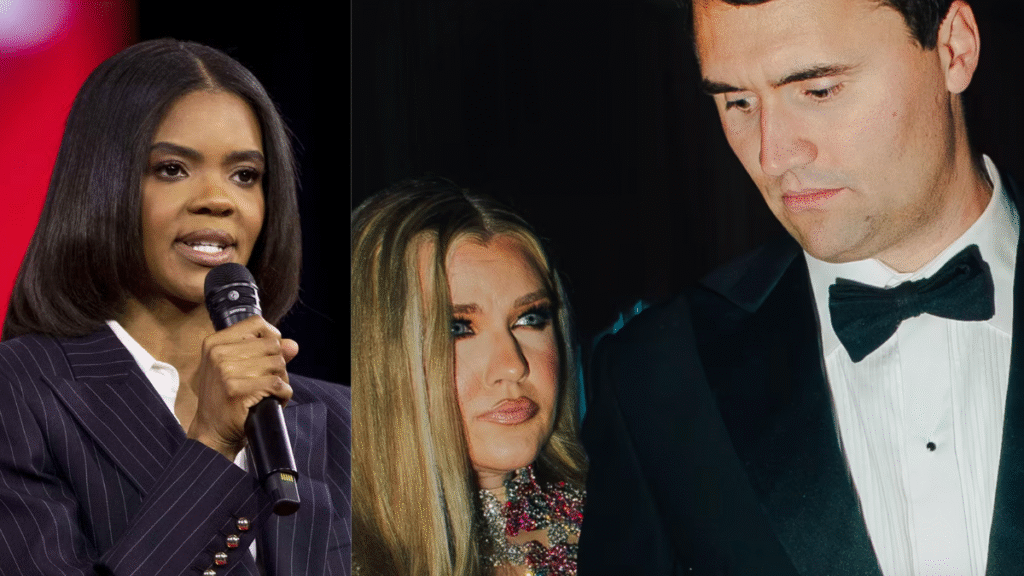
Photo Credit: Chris Dumond/Shutterstock/SIPA; Dina Litovsky/Redux
Candace Owens Takes Aim at CIA Narrative
Conservative commentator Candace Owens has ignited yet another firestorm online by publicly rejecting the official U.S. intelligence explanation for the assassination of Charlie Kirk — the influential conservative activist and founder of Turning Point USA who was fatally shot in September. Owens took to X (formerly Twitter) to dismiss the intelligence community’s account of what happened, calling it a “failed psychological operation” and bluntly asserting that “it’s so stupid it hurts.” Her comments immediately polarized public reaction and drew sharp criticism from across the political spectrum.
What makes this moment especially explosive is that Owens’ critique isn’t limited to casual skepticism — she openly accused the CIA of shaping a narrative designed to “manipulate public opinion,” tapping into deep-seated distrust in government institutions that already exists within segments of American society. Her remarks quickly became one of the most talked-about topics on social media, reigniting intense debates about transparency, accountability, and whether intelligence agencies have too much control over what the public accepts as “official truth.”
This isn’t the first time Owens has found herself at the center of controversy when it comes to the aftermath of Kirk’s assassination. Over the past several months she has repeatedly raised questions about the official version of events, even suggesting there were gaps or inconsistencies in the evidence and calling for deeper scrutiny of the investigation. Those claims have set off a cascade of reactions — from fierce support among some conservative audiences to sharp pushback from others who believe she’s amplifying unproven theories.
As Owens’ comments spread, critics accused her of promoting conspiracy theories without evidence, while supporters defended her right to question powerful institutions. Either way, her latest attack on the CIA narrative has once again brought the unresolved tensions around Kirk’s assassination into the spotlight — raising fundamental questions about trust, power, and narrative control in modern America.
Who Was Charlie Kirk — And Why His Death Still Matters
To understand why Candace Owens’ statements resonate — and rile so many people — it helps to recall who Charlie Kirk was and why his death sparked such intense reaction. Kirk was the high-profile founder of Turning Point USA (TPUSA), a conservative advocacy group that wielded considerable influence among young voters and conservative activists. He was fatally shot at a public event at Utah Valley University in September 2025, an event that shattered many in right-wing political circles and sent shockwaves across the country.
Authorities quickly arrested Tyler Robinson, a 22-year-old suspect who was charged with multiple counts including aggravated murder. Officials said Robinson acted alone, a narrative that was widely reported and reiterated by law enforcement as the accepted version of events. However, almost immediately, alternative theories and questions about the circumstances of Kirk’s killing began to circulate online — particularly among conservative commentators and conspiracy-minded audiences.
Candace Owens, who had been a longtime supporter of Kirk and had professional ties to TPUSA, became one of the most prominent voices challenging the official story. She claimed there were unexplained elements — gaps in footage, unaddressed questions — that made the simplistic lone-gunman explanation unsatisfying and possibly misleading. In some cases, she publicly acknowledged she did not have concrete proof for her assertions, but nevertheless urged deeper public scrutiny of how the incident was investigated and explained.
Many of Owens’ critics — including major media figures and some of Kirk’s supporters — have argued that pushing unverified theories about the case is irresponsible, especially while a criminal prosecution is ongoing. They contend that speculation beyond the evidence can distort public understanding and harm those mourning Kirk’s loss. Meanwhile, her supporters see her as a truth-seeker challenging institutions they already distrust. This ongoing divide shows just how emotionally and politically loaded Kirk’s death remains.
The CIA Narrative — And Why Owens Calls It “Stupid”
The intelligence community’s explanation of Kirk’s assassination — which Owens calls the “CIA narrative” — mirrors the law enforcement version. It asserts a lone gunman acted independently and that no broader conspiracy existed. Officials shared this account to reassure the public and quickly reduce widespread fear and speculation.
But Owens — and others on the fringe of political commentary — openly reject this explanation. In her recent posts, she argues officials designed the narrative as a psychological operation, not a straightforward account of facts. She also claims that presenting a simplified story after Kirk’s public assassination acts as controlled messaging. Owens believes it underestimates the intelligence and instincts of the American public.
In one critique, Owens said the case handling was “so stupid it hurts.” She added that the storytelling felt sloppy and lacked credibility. She specifically criticized the reliance on high-profile voices and media spectacle instead of transparent evidence.
Owens’ questioning reflects a broader trend: people skeptical of government agencies often see intelligence narratives as incomplete or misleading. Historical controversies over transparency and accountability have fueled this mistrust. Her comments resonate with those who believe institutions prioritize narrative control over truth. At the same time, her statements risk deepening societal divides over trust in public institutions.
Polarized Reactions: Support, Backlash, and Internal Conservative Rift
As soon as Candace Owens’ remarks went public, reactions poured in from all corners of the political spectrum. Some supporters praised Owens for questioning authority and rejecting what they considered a simplified explanation of a major political killing. For these followers, Owens represents political bravery, challenging government agencies and elite narratives even when facing ridicule or controversy.
On the other hand, many critics — including high-profile voices within conservative media — have pushed back hard. Some argue that Owens’ claims veer into conspiracy theory territory and lack verifiable evidence. They worry such rhetoric undermines serious discussion and may be disrespectful to both Kirk’s memory and the ongoing legal process. Some of her comments have forced Adam Jones-style satire attacks and mockery online, reflecting how volatile the debate has become.
Even within conservative circles, Owens’ stance has triggered disputes. Some commentators called her claims overblown or irresponsible, while others accused her of alienating potential allies by making unsubstantiated accusations. Figures such as Piers Morgan have directly confronted her, asking probing questions about evidence and accountability. In one interview, Owens acknowledged she didn’t have concrete proof for some of her assertions, which only fueled criticism.
The broader public reaction reveals a deeply polarized information environment in which trust in institutions and the media has fractured. Owens’ words draw supporters who distrust authority and anger critics who call her commentary reckless and harmful. This divide proves public debates turn explosive when trust, truth, and politics collide after major, high-profile events.
What This Means for Trust, Narrative, and the Future
Candace Owens’ latest public criticism of the CIA narrative after Charlie Kirk’s assassination goes beyond media statements. It exposes deeper cultural fault lines within the U.S. political landscape. Divisions over beliefs, trust, and how storytellers shape narratives drive debates about authority, truth, and media influence.
Owens’ outright rejection of the intelligence community’s explanation resonates with the public who already distrust government institutions. For them, the official narrative feels incomplete or too neat to be true. Others see her stance as irresponsible and potentially dangerous because it spreads unverified claims. These claims could overshadow facts and complicate efforts to clarify what happened.
At the heart of this controversy lies a broader question: How should societies handle traumatic, politically charged events without speculation? When influential voices on the left and right challenge official narratives, it can promote transparency and accountability. But when challenges rely on conjecture without evidence, they deepen mistrust and undermine informed public discourse.
In the case of Charlie Kirk’s assassination, the tension between institutional narratives and alternative interpretations will likely continue to simmer. Whether Owens’ critique sparks more debate or deeper polarization depends on how discussions evolve and calls for evidence progress. One thing is certain: in an era of fragile trust, narratives and who shapes them matter more than ever.