

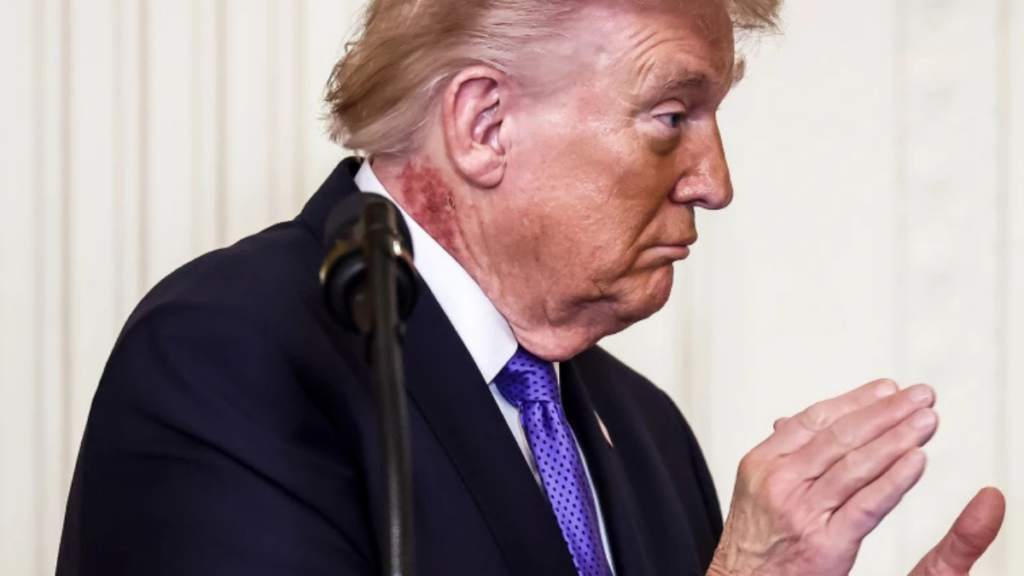
In early March 2026, media outlets and social platforms lit up with images showing President Donald Trump with a noticeable rash on the side of his neck during an official ceremony at the White House. The unusual mark, visible beneath his collar during a Medal of Honor event, quickly prompted questions about what it was, why it appeared, and how the White House was responding.
At 79 years old, Trump is the oldest person ever to serve as U.S. president. As his second term continues, observers and commentators have paid close attention to various signs of aging and health issues — from recurring bruises on his hands to speculation over other health signals captured in public appearances. The neck rash added another visible element to these ongoing discussions, prompting analysis from journalists, medical experts, and the public.
Below, we break down the facts reported so far, the White House’s explanation, expert reactions, and broader implications around public health transparency for sitting presidents.
What Happened: The Neck Rash at the White House
The story began on March 2, 2026, when photos surfaced of President Trump speaking at a Medal of Honor ceremony in the East Room of the White House. The images showed a patch of red, irritated skin extending from behind his ear down the side of his neck — an area that caught the eye of journalists and social media users alike.
Photographers and news outlets noted the rash’s visibility as Trump engaged in official duties, including greeting honorees and speaking from the podium. Along with the rash, some coverage also pointed out that Trump’s previously noted bruise on his right hand was visible despite makeup coverage.
This wasn’t the first time the president’s health or physical appearance generated public attention. Earlier in his term, Trump’s frequent bruising on his hands and instances of apparent swelling had sparked discussion and commentary from medical analysts. The White House has addressed some of those issues in the past, attributing them to benign causes such as frequent handshaking and aspirin use.
What made the rash notable was not just its appearance but the lack of immediate explanation from the White House at first. That vacuum of official information created space for speculation online and among observers, increasing interest in understanding its cause.
The White House Response and Official Explanation
As public curiosity grew, the White House physician, Lieutenant Commander Sean Barbabella, offered an explanation. According to statements reported by outlets including Fox and local news affiliates, the rash was likely a temporary effect of a topical skin cream the president was using as a preventive treatment.
Dr. Barbabella characterized the topical cream as “very common,” noting that Trump would be using it for about a week and that any redness or irritation associated with it was expected to persist for a few weeks. The statement did not clarify the underlying reason for the preventive treatment — for example, whether it was tied to a specific dermatological condition or part of a broader skin-care regimen.
While the White House physician’s statement provided some context, it left several questions unanswered, especially regarding the medical purpose of the treatment. As is often the case with the health of senior political leaders, limited disclosure of details has fueled both legitimate curiosity and speculation.
In the past, the White House has addressed health questions about Trump. For example, when images of persistent bruising appeared on his hands, officials explained it was a result of frequent handshakes and aspirin use — framing it as a benign side effect of common activities and preventive medication.
Despite these explanations, some observers have expressed skepticism or concern over how much information is being shared publicly. The degree of transparency with which presidential health issues are communicated is an ongoing point of discussion in U.S. political discourse, and any visible health sign tends to attract heightened attention.
Medical Commentary and Public Reaction
Once images of the rash circulated widely, the response from medical analysts and social commentators was mixed. Some health professionals emphasized that visible rashes can have many benign causes — including allergic reactions, irritation from topical creams, or common skin conditions such as eczema or dermatitis — and do not necessarily indicate a serious underlying problem.
However, other commentators urged caution. In particular, some media figures and medical analysts highlighted that when high-profile individuals — especially senior political leaders — show unexpected physical signs, it invites careful observation. The fact that the treatment’s purpose was not fully explained led to speculation among critics about possible alternate causes or about the adequacy of the public explanation.
For instance, a medical analyst cited by some outlets suggested that the rash could be a sign of something more serious, such as a pre-cancerous condition, although that view was offered within the context of ongoing commentary rather than as an official medical diagnosis.
Public reaction was similarly varied. On social media, the rash drew humorous commentary and memes, while others debated what it might signal about the president’s overall health and age. Still others questioned whether medical transparency for U.S. presidents should be greater, especially given that the health of a sitting president can factor into public confidence and leadership concerns.
Health, age, and fitness have been recurring themes in discussions about Trump’s presidency. As noted in earlier reporting, questions have arisen around bruising, reports of fatigue or age-related slips, and the broader narrative around how senior presidents’ health is evaluated and communicated.
Understanding the Broader Context of Presidential Health Transparency
When a president shows a visible physical sign — such as a rash, bruise, or other noticeable condition — it naturally draws attention for several reasons:
1. Symbolic Role of the President
The president is not only a political leader but also a public figure whose physical presence and demeanor are under constant observation. Visible marks or changes can trigger public curiosity and varied interpretations, sometimes unconnected to actual medical significance.
2. Age and Leadership
At 79, Trump is the oldest person to have held the U.S. presidency. With age can come visible physical changes and a higher likelihood of chronic conditions, routine skin irritations, or other non-serious ailments. However, age also amplifies public interest in leaders’ health, given concerns about stamina, cognitive sharpness, and general well-being.
3. Balancing Privacy and Public Interest
There is a perennial tension between personal medical privacy and the public’s interest in knowing about a leader’s health. While a president is entitled to medical confidentiality, the office carries a level of public accountability that often prompts calls for more transparency, especially when unexplained or unusual symptoms appear in public.
4. Communication Practices
How the White House communicates about health matters influences the narrative. Clear, proactive explanations tend to reduce speculation, while sparse or unclear information can lead to uncertainty and a proliferation of theories, ranging from benign to worrying.
In this case, the White House physician provided a brief explanation centered on a topical preventive treatment, but without detailing its purpose, leaving some gaps in the public narrative. Observers on all sides interpreted the explanation differently, reflecting broader debates about transparency and trust.
Conclusion: What This Means Going Forward
The red neck rash seen on President Trump during a March 2026 White House ceremony is a visible and noticeable sign that attracted widespread attention, but at this point, there is no evidence that it represents a serious medical condition. The White House’s explanation — that it is a temporary reaction to a common preventive skin cream — frames it within the context of routine treatment, with expectations that the redness may persist for a few weeks.
Medical experts and commentators have different views on what to make of the mark, ranging from reassurance that rashes are common and often harmless, to reminders that public scrutiny increases when health signals appear on leaders. The broader issue of how much medical detail should be shared about a sitting president remains an open question in U.S. public life.
Ultimately, while the rash is noteworthy because it was visible on camera and sparked discussion, it should be understood within the larger — and often unpredictable — world of public appearances, health reporting, and the natural curiosity that accompanies visible signs on high-profile figures.
