

The Month Everything Started to Shrink
The word broke entered our marriage quietly.
It showed up in small ways at first.
A sigh when I picked up oat milk instead of the cheaper one.
A pause before he agreed to dinner with friends.
A new habit of turning off lights behind me.
“We need to be careful,” he said one night, standing in the kitchen with his laptop open. “Things are tighter than I thought.”
How did that happen, I wanted to ask.
We both worked.
We didn’t live wildly.
No luxury trips.
No secret shopping addiction.
Our biggest shared indulgence was takeout on Fridays.
So I nodded.
I trusted him.
He handled the finances.
Always had.
That was the arrangement we fell into without ever really discussing it.
And for years, it felt fine.
Until everything started to feel… smaller.
Cutting Back Without Understanding Why
First, it was the gym membership.
“We don’t need two,” he said gently. “You can run outside.”
Then the streaming services.
Then the weekend coffee ritual.
Then my birthday dinner became “a quiet meal at home.”
Each change came wrapped in concern.
Each one sounded reasonable.
But there was one thing that didn’t change.
His spending.
New shirts appeared in the closet.
A gadget I didn’t recognize showed up on his desk.
He started taking Ubers to work because he was “too tired for the metro.”
When I asked, he had an answer ready.
“Work reimburses this.”
“It was on sale.”
“My mom sent me money for that.”
The explanations were smooth.
Practiced.
And I told myself I was being paranoid.
Because the alternative was uglier.
The Spreadsheet
One Sunday morning I opened our shared banking app to check if we could afford to replace my dying laptop.
I hadn’t done that in years.
I never needed to.
The number in the account made my chest go tight.
It was lower than it should have been.
Much lower.
I refreshed the page like that might fix it.
It didn’t.
So I opened the transaction history.
There were transfers labeled “HOA — Special Assessment.”
Large ones.
Monthly.
We didn’t have an HOA.
We lived in a rented townhouse.
I stared at the screen for a long time, waiting for the obvious explanation to appear in my head.
It didn’t.
When he walked into the room, I turned the phone toward him.
“What’s this?”
He didn’t even blink.
“Oh. That’s for my mom’s place,” he said. “I told you about the repairs in her building, remember?”
He hadn’t.
But he said it with such calm certainty that I felt embarrassed for questioning him.
So I nodded.
And that should have been the end of it.
Except it wasn’t.
Because two days later, his mother called me to ask if we were coming for dinner.
And while we talked, she mentioned she’d just gotten back from a three-week trip to Spain.
“Retirement is expensive,” she laughed.
Not a word about building repairs.
Not a word about financial trouble.
I hung up and sat on the couch with my hands in my lap.
Something didn’t line up.
The Envelope in the Glove Compartment
The first time I went looking for proof, I told myself I was just searching for the car insurance papers.
I opened the glove compartment.
There was an envelope inside with a property management company’s logo on it.
Not our landlord’s.
Inside was a folded letter.
Notice of overdue HOA fees.
Addressed to my husband.
At an address I didn’t recognize.
My heart started beating in my throat.
For a moment, I thought it had to be from before we met.
Some old investment he’d forgotten about.
But the date was from two weeks ago.
And the amount due matched the transfers from our account.
I read the address again.
It was only fifteen minutes away.
Denial Is a Comfortable Place
I didn’t confront him.
Not that night. Not the next.
Instead, I built explanations for him.
Maybe he co-owned something with a friend.
Maybe it was an office space.
Maybe he was helping a relative and didn’t want to worry me.
All of those versions made him generous.
Responsible.
Good.
They let me stay in the marriage I believed I had.
But once you see a crack, you start noticing the others.
He had begun “working late” every Thursday.
His gym bag stayed in the trunk instead of coming into the house.
He stopped asking me where I was going, and started assuming I’d be out on certain evenings.
Like he had a schedule that needed me gone.
That was the thought that made my stomach drop.
Not the money.
The planning.
The Drive
I told myself I just wanted to see the building.
That was all.
I parked across the street like someone in a bad movie, watching people come and go.
It was an ordinary condo complex.
Clean balconies.
Potted plants.
Bikes chained to railings.
Normal life.
I was about to leave when I saw his car.
Pulling into the underground garage.
My body reacted before my brain did.
I got out and walked.
Every step felt unreal, like I was moving through someone else’s dream.
The security door was still open from when he drove in.
I slipped inside.
And there he was.
Standing at the elevator.
Holding a grocery bag.
Not coming home.
The Floor Number
I didn’t speak to him.
I hid behind the row of mailboxes like that was a normal thing to do.
I watched the elevator numbers light up.
3.
He had never once mentioned a third-floor anything.
The elevator doors closed.
And I stood there with a strange, floating feeling.
Because now it wasn’t a theory.
It was a location.
A place that existed in his life that I had never been invited into.
The Mailbox With His Name On It
I should have left.
I know that.
Instead, I walked past the row of mailboxes.
I told myself I was just confirming the address.
That I’d misread something.
But then I saw it.
His name.
Printed neatly next to unit 3B.
I touched it like it might disappear.
It didn’t.
And underneath his name was something else.
A woman’s name.
I didn’t recognize it.
Not a coworker.
Not a cousin.
Not anyone from any story he had ever told me.
Just a stranger, sharing a mailbox with my husband.
Going Home to Play Normal
When he came home that night, he kissed my forehead like always.
Asked what I wanted for dinner.
Complained about traffic.
I watched him move around the kitchen and felt like I was watching an actor who didn’t know the audience had seen backstage.
“Long day?” I asked.
“The worst,” he said.
And I almost laughed.
Not because it was funny.
Because it was so precise.
So polished.
So completely separate from the reality I had just stood inside.
The Thing That Hurt More Than the Lie
I didn’t cry.
That surprised me.
What I felt instead was a slow, spreading clarity.
Every sacrifice suddenly had a shape.
Every “we can’t afford it” had an address.
My smaller life had funded a bigger one for him.
The gym I gave up.
The trips we postponed.
The way I started checking price tags before putting things in the cart.
All of it had gone somewhere.
To unit 3B.
To HOA fees.
To a life he never planned to tell me about.
The Meeting Notice
Three days later, an email arrived in our shared inbox.
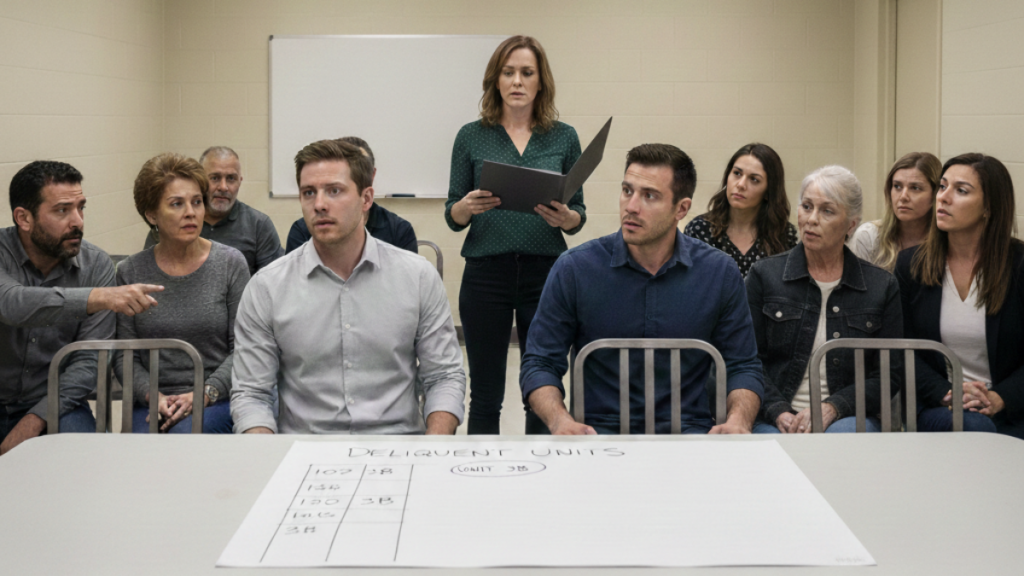
Subject line: HOA Emergency Meeting — Delinquent Units
He forwarded it to me with one sentence.
“Another thing I have to deal with for my mom. Don’t worry about it.”
I read the address.
It was the same building.
The same one.
And the meeting was open to all owners.
All owners.
I sat there with the screen glowing in the dark.
He had lied so easily.
For so long.
He had shrunk our world without a tremor in his voice.
And now he was inviting me — accidentally — into the room where the truth lived.
I didn’t know yet what I was going to do.
But for the first time since I saw that mailbox, I felt something steady settle inside me.
Not rage.
Not revenge.
A decision.
If he wanted to talk about money in public — about what was owed and what was hidden — then I was going to be there.
And I wasn’t going to sit quietly in the back.
Because for months he had been telling me we were broke.
And I had just found the place where all our missing money was living.
The Night I Chose My Seat
I didn’t tell him I was coming.
That was the first decision that felt like it belonged entirely to me.
The meeting was scheduled for Thursday at seven.
His usual “late work” night.
At six-thirty he stood in the hallway adjusting his watch.
“I’ll be back late,” he said. “Don’t wait up.”
“I won’t,” I replied, and that was the truth — just not in the way he thought.
I let five minutes pass after he left.
Then I picked up my coat, my bag, and the folder I had started building like a quiet second life.
Bank transfers.
The photo of the mailbox.
The overdue notice from the glove compartment.
Paper has weight.
I wanted to feel it in my hands.
Walking Into His Other World
The lobby looked different in the evening.
Warmer.
Lived in.
People were gathered near a folding table with a sign-in sheet.
Some held printed agendas.
Others had that tight, annoyed look people get when money is involved.
No one paid attention to me.
That was the strange part.
For months I had been living inside a secret that felt enormous, and here it was just… a building.
A normal place with a normal problem.
I signed my name without hesitating.
Owner/Proxy.
I left the line ambiguous on purpose.
Seeing Him Before He Saw Me
The meeting room was a converted ground-floor apartment.
Rows of metal chairs.
A long table at the front.
Fluorescent lights that made everything look too honest.
He was sitting in the third row.
Talking to a woman with a clipboard.
Calm.
Engaged.
Comfortable.
Like he belonged there.
Like this had always been his life.
For a moment I just watched him.
The way he nodded.
The way he smiled politely.
The way he leaned forward when the board members spoke.
This was the version of him I hadn’t been invited to know.
And then he turned his head.
And saw me.
The Moment the Air Changed
His face didn’t transform dramatically.
That would have been easier.
It was smaller than that.
A pause.
A flicker in his eyes.
His mouth opening slightly, then closing again.
He stood up too fast, his chair scraping loudly against the floor.
“What are you doing here?” he asked in a low voice when he reached me.
“I’m here for the meeting,” I said.
“You shouldn’t be.”
That word — shouldn’t — landed between us like a dropped glass.
“I think I should,” I replied.
The woman with the clipboard called the room to order before he could say anything else.
He stayed standing next to me for a second, like he didn’t know where to put himself.
Then he sat down.
In the seat beside mine.
The Language of Debt
The board president started talking about numbers.
Unpaid fees.
Special assessments.
Legal action if balances weren’t cleared.
Unit numbers were read out loud.
People shifted in their seats.
Whispered to each other.
Shook their heads.
It was all very procedural.
Very calm.
Which made it surreal, because my entire marriage was sitting in those numbers.
When they reached 3B, the president looked up.
“This unit is now six months delinquent.”
Six months.
Six months of “we can’t afford it.”
Six months of my smaller life.
Beside me, my husband stared straight ahead.
Didn’t move.
Didn’t breathe.
When They Asked for the Owner
“Is the owner of 3B present?” the president asked.
There was a pause.
A long one.
My husband raised his hand slowly.
“I’m here,” he said.
His voice was steady.
If I hadn’t known him, I would have believed it meant he was in control.
“Would you like to address the balance?” the president asked.
He stood up.
And in that moment, I realized something.
He thought he was going to manage this.
Like he managed everything else.
With explanations.
With calm.
With just enough truth to keep people from asking more.
His Version of the Story
“There have been some temporary financial constraints,” he began. “But I’m in the process of restructuring my obligations. The balance will be resolved soon.”
Temporary.
Restructuring.
Obligations.
He spoke about our missing money like it was a business presentation.
No mention of me.
No mention of the shared account.
No mention of the life that had been quietly paying for this room.
People nodded politely.
Because that’s what you do in meetings.
You accept the surface.
Unless someone refuses to.
Standing Up
I didn’t plan the exact moment.
I just knew if I didn’t move, I never would.
So I stood.
“I’d like to add something,” I said.
Every head in the room turned.
Including his.
Up close, I could see the fear now.
Not anger.
Fear.
“Who are you?” the president asked.
“I’m his wife.”
The word wife moved through the room like a current.
Because he had never used it here.
Not once.
The Second Account
“We don’t have temporary financial constraints,” I said.
My voice sounded calm.
Distant.
Like it belonged to someone else.
“We have a joint account that has been paying these fees for months while I was told we were broke.”
I opened the folder.
Paper against paper.
A small, ordinary sound that felt louder than anything else in the room.
“These are the transfers,” I continued. “From our shared savings. Labeled as expenses that didn’t exist.”
He said my name quietly.
A warning.
A plea.
I didn’t look at him.
The Life He Didn’t Mention
“And since we’re being transparent,” I added, “I think it’s important to clarify that this isn’t an investment property.”
The room was completely still.
“This is a residence. One he shares with someone whose name is also on the mailbox.”
A ripple of sound.
Someone shifting in their chair.
The clipboard woman looking down at her papers, then back at him.
He looked like the floor had tilted.
Like he was trying to find the version of reality where this wasn’t happening.
The Question No One Had to Ask
“Is that accurate?” the president asked him carefully.
It was such a gentle question.
He didn’t answer.
Because there wasn’t a version of this that could be smoothed over with language.
Not in a room full of people holding printed proof of what was owed.
Not with me standing there holding proof of where it came from.
Leaving Before It Turned Into Something Else
I didn’t stay until the end.
That wasn’t why I came.
I gathered my papers, put them back in the folder, and walked toward the door.
No one stopped me.
No one spoke to me.
As I reached the hallway, I heard my name again.
This time louder.
I kept walking.
Because for months I had been the one being managed.
The one being given partial truths.
The one adjusting her life around his decisions.
And I was done participating in that version of the story.
The First Honest Conversation
He came home after midnight.
I was sitting at the kitchen table with the light on.
Not crying.
Not pacing.
Just waiting.
For once, there was nothing left to discover.
Only what would be said out loud.
He looked different.
Smaller, somehow.
“I was going to tell you,” he started.
“When?” I asked.
He didn’t answer.
Because there isn’t a good time to reveal a second home.
A second life.
A second set of choices funded by someone else’s trust.
“I didn’t know how,” he said finally.
And that was the first true thing he had offered in months.
What Was Actually Broken
We talked until the sky started to lighten.
Not about the other woman.
Not in detail.
Because the real betrayal had a different shape.
It was in the budgeting meetings at our own kitchen table where he told me no.
It was in the way he watched me put things back on shelves.
It was in the word broke being used like a leash.
“You made me live smaller so you could live bigger,” I said.
He didn’t argue.
Packing Without Drama
The next day I packed a suitcase.
Not everything.
Just what was mine.
Clothes.
Laptop.
The mug my friend gave me.
The blanket I used when I worked late.
Ordinary things.
He sat on the edge of the bed while I did it.
“Are you leaving?” he asked.
“Yes,” I said.
The Quiet After
I moved into a small sublet across town.
It wasn’t beautiful.
But it was honest.
I bought the expensive oat milk the first morning just because I could.
Not as revenge.
As proof.
The bank account was divided.
The logistics handled.
The legal conversations started in calm voices across neutral tables.
People kept asking if I felt victorious.
I didn’t.
That wasn’t the feeling.
What Closure Actually Looked Like
Closure was checking my balance and knowing it reflected my life.
Closure was signing up for the gym again.
Closure was realizing I no longer flinched when I added something to my cart.
The meeting didn’t destroy my marriage.
It revealed its actual condition.
Like turning on a light in a room you’ve been navigating in the dark.
The Last Thing I Heard About 3B
Months later, a mutual friend told me he sold the condo.
There was no scandal.
No dramatic fallout.
Just a transaction.
That felt right.
Because the real story had never been about the apartment.
It was about the silence.
The slow shrinking.
The way trust can be spent without the other person seeing the receipt.
The Word I Don’t Use Anymore
I don’t say broke the way he did.
As a tool.
As a warning.
As a way to make life smaller.
Now it just means numbers.
And numbers can be changed.
What I don’t live with anymore is that feeling of something not adding up while being told everything is fine.
That’s the real debt I walked away from.
And unlike the HOA fees, that balance is finally paid.
