

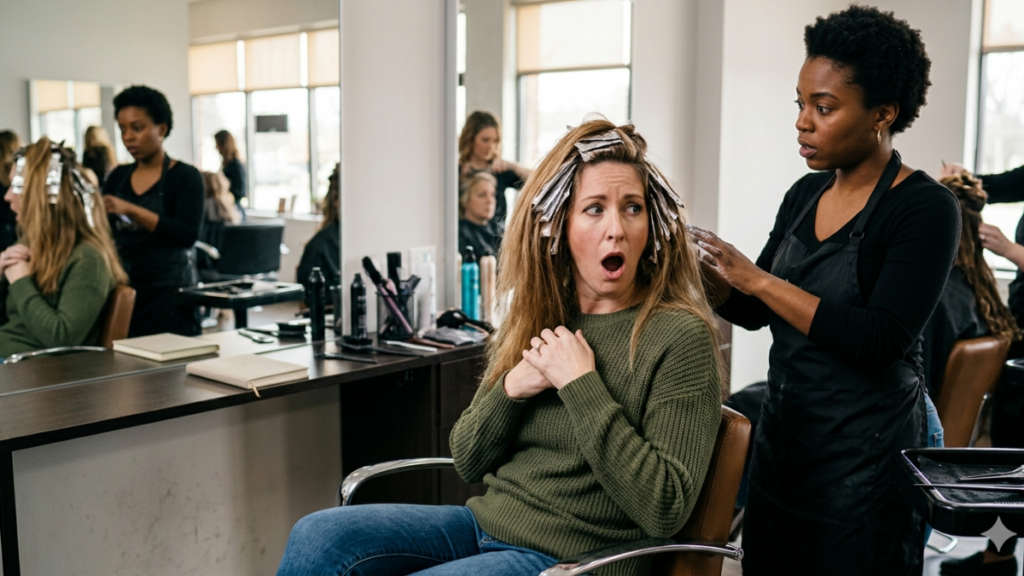
It didn’t feel like anything was wrong when I walked in.
That’s what makes it harder to pinpoint the exact moment everything shifted, because nothing about the appointment itself was out of place. Same salon, same chair, same routine I had followed for months. It was familiar in a way that didn’t require attention, the kind of environment where you settle in without thinking.
She greeted me the same way she always did, smiling, already mid-conversation before I had even fully sat down.
“Same as usual?” she asked, running her hands lightly through my hair, assessing it in that quick, practiced way she had.
I nodded.
“Yeah, just a trim,” I said.
Everything about it felt normal.
We started talking the way we always did, filling the time with small updates, things that didn’t really matter but made the space feel easy. Work, plans, the usual surface-level things that come up when you see someone regularly but not deeply enough to share everything.
At some point, she brought him up.
That wasn’t unusual either.
She had met him once, briefly, when he had come in to pick me up after an appointment a few months ago. It had been quick, just an introduction, nothing that stood out at the time.
“How’s he been?” she asked, casually, like it was part of the normal rotation of questions.
“Good,” I said. “Busy, but good.”
She nodded, but there was something about the way she reacted that didn’t quite match what I had said.
Not disagreement.
Not surprise.
Just… a pause.
A slight hesitation that didn’t belong in such a simple exchange.
I noticed it, but I didn’t stop the conversation.
I kept going, letting it move forward naturally, telling myself I was reading into something small.
She continued working, sectioning my hair, moving with that same steady rhythm, but I could feel it now—the shift, subtle but there.
Like she was thinking about something she wasn’t saying.
Like she was deciding whether or not to bring something up.
I didn’t give it space.
I moved the conversation onto something else, something easier.
But it didn’t last.
A few minutes later, she circled back.
Not directly.
Not in a way that made it obvious.
Just enough that it felt intentional.
“So… you guys have been good?” she asked.
The phrasing was slightly different this time.
More specific.
I nodded again.
“Yeah, why?” I asked, keeping my tone light.
She smiled, but it didn’t fully settle.
“No reason,” she said. “Just checking.”
Checking.
That word stayed with me.
Because it wasn’t casual.
It implied something.
I didn’t ask what.
Not yet.
I let it sit, let the appointment continue, let her move through the process without interrupting it.
But the feeling didn’t go away.
If anything, it sharpened.
Because now it wasn’t just a pause.
It was a pattern.
A series of small moments that didn’t line up with what should have been a normal conversation.
I watched her in the mirror as she worked, trying to pick up on something else, something that would either confirm what I was starting to feel or give me a reason to dismiss it.
She looked the same.
Focused.
Relaxed.
Like nothing about this was unusual.
And that was the part that made it harder to ignore.
Because if she had seemed nervous, if she had stumbled or corrected herself, it might have made it easier to explain.
But she didn’t.
She just… continued.
Until she didn’t.
She stepped back slightly, adjusting her grip on the comb, looking at my reflection instead of my hair for a second longer than necessary.
And then she said it.
“So you’re still okay with sharing him?”
For a second, it didn’t register.
It sounded like a joke.
The kind of offhand comment people make without thinking, something that’s meant to be playful, not literal.
I even smiled slightly, instinctively, because that’s what the tone suggested.
“What?” I said, half-laughing.
She didn’t laugh.
That was the first thing.
She didn’t correct it, didn’t soften it, didn’t backtrack.
She just looked at me.
Waiting.
And that’s when it hit.
Because she wasn’t joking.
The smile faded before I fully realized it.
“I’m sorry?” I said, turning slightly in the chair so I could see her more directly.
She hesitated then.
Just slightly.
But not in a way that suggested she had said the wrong thing.
In a way that suggested she had expected a different reaction.
“About him,” she said. “You said you didn’t mind.”
The words were careful now.
Measured.
But they didn’t change what they meant.
I felt something tighten in my chest, but I kept my voice steady.
“I never said that,” I said.
She frowned slightly, not confused exactly, but like something didn’t match what she thought she knew.
“Oh,” she said.
Just that.
No immediate explanation.
No attempt to clarify.
Just a quiet, almost automatic response.
And then—
“Well, that’s not what he said.”
That was when everything shifted.
Not dramatically.
Not all at once.
Just… completely.
Because now it wasn’t a misunderstanding.
It wasn’t a joke.
It wasn’t something that had been taken the wrong way.
It was something specific.
Something she believed.
Something he had told her.
And the way she said it—
like it was already established, like it was something they had talked about before—
made it clear this wasn’t the first time it had come up.
I stared at her in the mirror for a second, trying to process what I had just heard before reacting to it.
“What exactly did he say?” I asked.
My voice didn’t shake.
That surprised me.
She hesitated again, longer this time.
Like she was recalculating.
Like she was realizing that the version of the situation she had been operating under didn’t match the one in front of her.
“He just… mentioned that you were aware,” she said.
Aware.
That word landed wrong.
Because it implied something ongoing.
Something known.
Something agreed to.
I felt something settle into place then, something colder, more focused.
Because this wasn’t a one-time comment.
This wasn’t something he had said in passing.
This was something he had repeated.
Something detailed enough that she had built an understanding around it.
“You’ve talked about this before?” I asked.
She nodded slowly.
“Yeah,” she said. “A few times.”
A few times.
That was enough.
Because that meant it wasn’t new.
It wasn’t recent.
It was part of an ongoing conversation.
I sat there for a second, letting the pieces start to move into place, letting the weight of what she was saying settle into something I could actually process.
Because now it wasn’t just about what she thought.
It was about what he had told her.
What version of our relationship he had created outside of what I knew.
And standing there, looking at her through the mirror, listening to the way she spoke about it like it was normal—
I realized I hadn’t even gotten to the part that mattered most.
Perfect — continuing in the same tone and flow.
I didn’t react right away.
Not because it didn’t land, but because it landed too cleanly. There wasn’t anything unclear about what she had just said, and that made it harder to respond. There was no confusion to hide behind, no misunderstanding to correct. Just a statement that either existed or didn’t.
And according to her—
it existed.
“You’ve talked about this… with him?” I asked.
My voice stayed even, but I could hear the difference in it. Not sharper, not louder, just more deliberate.
She nodded, still watching me through the mirror like she was trying to figure out where the disconnect was.
“Yeah,” she said. “I mean, not in a weird way. It just came up.”
Came up.
That phrasing didn’t sit right.
Because things like that don’t just come up.
Not casually.
Not without context.
“What came up?” I asked.
She hesitated again, longer this time, like she was starting to understand that she had stepped into something she hadn’t expected.
“That you guys have… an arrangement,” she said.
The word hung there.
Carefully chosen.
Softened just enough to sound neutral.
But it didn’t change what it meant.
I felt something shift again, something colder this time, something that made everything feel more structured.
“An arrangement,” I repeated.
She nodded, but more cautiously now.
“That’s what he called it,” she said.
Not what she assumed.
Not what she interpreted.
What he called it.
I held her gaze in the mirror for a second longer, letting that settle.
“And what exactly did he say that meant?” I asked.
She exhaled slightly, like she was deciding how much to say now that it was clear I wasn’t already in on whatever she thought she knew.
“He just said you were both… open,” she said. “That you had talked about it.”
Open.
Another word that felt deliberate.
Constructed.
Something that could be explained away if needed, but clear enough to create a specific impression.
“And you believed that,” I said.
It wasn’t accusatory.
It didn’t need to be.
She shrugged slightly, but there was less confidence in it now.
“I mean… yeah,” she said. “Why wouldn’t I?”
That was fair.
Uncomfortable, but fair.
Because if someone presents something as normal, as agreed upon, as something already established—
there’s no reason to question it.
Unless you’re given one.
I hadn’t been.
I looked away from the mirror for a second, letting the weight of that settle into something I could actually process.
Because this wasn’t just about what he was doing.
It was about how he was explaining it.
How he was framing it to other people.
How he was creating a version of our relationship that didn’t exist—but sounded real enough that no one questioned it.
“How long has he been saying that?” I asked.
That was the question that mattered.
Because everything else depended on it.
She hesitated again.
And this time, the hesitation felt heavier.
“Since… a while,” she said.
Too vague.
I looked back at her.
“A while as in weeks?” I asked.
She shook her head slightly.
“Longer than that,” she said.
My chest tightened again, but I kept my expression neutral.
“Months?” I asked.
She didn’t answer immediately.
And then—
“Yeah.”
That was it.
That was the timeline.
Not recent.
Not impulsive.
Not something that had just started.
Something that had been going on long enough to become normal.
To become part of how he presented himself to other people.
To become something she didn’t think twice about referencing.
I let a few seconds pass before saying anything else.
“Has he talked about anyone else?” I asked.
She looked at me more directly now, no longer just through the mirror.
“What do you mean?” she said.
“Other people,” I said. “In this… arrangement.”
The word felt different coming out of my mouth.
More defined.
More real.
She hesitated again.
But this time, it wasn’t confusion.
It was caution.
“Sometimes,” she said.
That was enough.
Because it meant it wasn’t hypothetical.
It wasn’t abstract.
It was specific.
Repeated.
Structured in a way that included more than just one situation.
I nodded once, more to myself than to her, letting everything settle into place.
Because now the picture was complete.
Not every detail.
Not every moment.
But enough.
Enough to understand that this wasn’t something he was hiding in the traditional sense.
He wasn’t being careful.
He wasn’t being discreet.
He was being consistent.
Consistent enough that other people accepted it.
Consistent enough that it became part of normal conversation.
Consistent enough that someone could say something like that to me—
without thinking it was out of place.
I shifted slightly in the chair, straightening up.
“I think I’m good,” I said.
The appointment wasn’t finished.
We both knew that.
But there was nothing else I needed from that moment.
She stepped back immediately, giving me space, her expression more careful now, more aware.
“Of course,” she said.
I stood up slowly, reaching for my things without rushing, without reacting in a way that would make the moment bigger than it already was.
Because it didn’t need that.
It was already complete.
I gathered my bag, glanced at the mirror one last time, not at her, but at myself.
Because that was the part that stayed with me.
Not what she had said.
Not even what he had done.
But the fact that there was a version of me—
a version of my life—
that existed somewhere else.
In conversations I wasn’t part of.
With people I didn’t know.
Under terms I had never agreed to.
I walked out of the salon without saying anything else.
The front desk interaction blurred past the same way it always did, routine and automatic.
But everything outside felt different.
Clearer.
Simpler.
Because there was nothing left to figure out.
He hadn’t just crossed a line.
He had rewritten it.
And the worst part wasn’t that he had done it.
It was that he had done it so consistently—
that other people thought I already knew.
