

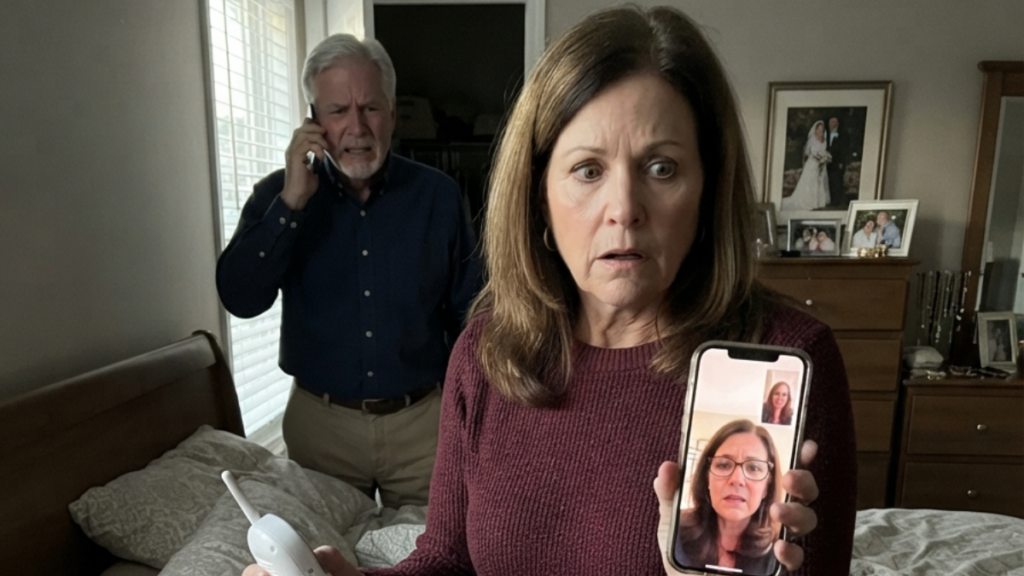
I found the baby monitor inside a decorative clock on my husband’s nightstand.
We didn’t have a baby.
Our youngest child was thirty-two.
Our grandchildren lived three states away.
And the clock had been sitting beside our bed for almost eleven months.
At first, I thought it was some kind of security camera.
Then I noticed the tiny microphone.
The wireless transmitter.
And the little green light blinking behind the clock face.
Someone had been listening to us.
Listening to me.
In my own bedroom.
I was about to confront my husband when the device made a soft clicking sound.
Then a woman’s voice came through the speaker.
“Is she asleep yet?”
I froze.
A moment later, my husband’s voice answered from somewhere downstairs.
“Not yet. She’s still moving around.”
The woman sighed.
“Well, tell her to hurry up. I’ve been waiting thirty-seven years for this.”
My heart stopped.
Thirty-seven years.
That was how long my husband and I had been married.
Then the woman said something that made me grab the edge of the dresser.
“And Robert? Make sure she doesn’t find the photographs. If she sees what we did to her mother, everything falls apart.”
I stood there, staring at the clock.
My mother had died twenty-six years earlier.
At least, that’s what I’d always believed.
And whoever was speaking to my husband knew something about her death.
Something they’d apparently been hiding for thirty-seven years.
I didn’t confront him.
I didn’t scream.
I didn’t even move.
I simply reached for my phone.
Turned on the voice recorder.
And listened.
Because the woman wasn’t finished.
“Tomorrow night, she’ll finally understand why we chose her.”
My name is Catherine Whitmore.
I’m sixty-four years old.
I’ve been married to Robert for thirty-seven years.
We live in a beautiful brick house outside Columbus, Ohio.
Robert is sixty-eight.
A retired insurance executive.
He’s the kind of husband who still warms up my car in the winter and brings me flowers for no reason.
We have three grown children.
Our oldest, Daniel, is thirty-six.
Our daughter, Melissa, is thirty-four.
And our youngest, Jonathan, is thirty-two.
I spent most of my adult life believing I’d been extraordinarily lucky.
A loving husband.
Three healthy children.
A comfortable home.
And a marriage that had survived everything life threw at us.
Until I found that clock.
The strange thing was, Robert had been the one who bought it.
Last Christmas.
He’d come home with a small shopping bag and told me he’d found something perfect for our bedroom.
An antique-style brass clock.
Cream-colored face.
Roman numerals.
Little curved feet.
It looked beautiful on his nightstand.
I’d teased him about buying something so old-fashioned.
He’d laughed.
Said he liked having a clock he could read without reaching for his phone.
And that was that.
For eleven months, the clock sat beside our bed.
While we slept.
While we talked.
While we argued.
While I cried after my sister’s cancer diagnosis.
While I discussed our children’s marriages.
While I told my husband things I’d never told another living person.
And someone had been listening.
The afternoon I found it, Robert had gone to the grocery store.
I was changing the sheets when I knocked the clock off his nightstand.
It hit the carpet.
The back panel popped loose.
And a small black device slid out.
At first, I didn’t understand what I was looking at.
Then I saw the microphone.
The transmitter.
The tiny rechargeable battery.
I picked it up.
Turned it over.
And noticed a sticker on the back.
Nursery Audio Monitor — Model BM-400.
I stared at it.
A baby monitor.
Hidden inside our bedroom clock.
My first thought was that Robert had installed it because he was worried about my health.
I’d had a dizzy spell a few months earlier.
Nothing serious.
My doctor said it was probably dehydration.
But Robert had been unusually attentive afterward.
Asking whether I felt lightheaded.
Whether I’d slept well.
Whether I’d been having headaches.
I thought perhaps he’d bought the monitor to make sure I was safe.
Then I remembered something.
He’d started asking those questions before the dizzy spell.
And suddenly, I wasn’t so sure.
I carried the clock toward the dresser.
That’s when I heard the clicking sound.
Then the woman’s voice.
And my husband’s answer.
I stood perfectly still.
My phone recording everything.
The woman continued.
“Has she mentioned the blue house?”
Robert sighed.
“No.”
“Not even once?”
“No, Evelyn.”
Evelyn.
I knew that name.
Or at least, I thought I did.
My mother had a younger sister named Evelyn.
Aunt Evelyn.
She’d disappeared from our lives when I was twenty-six.
Right around the time I got married.
My mother told me they’d had a falling-out.
Something about money.
I’d tried to contact her once.
But the letter came back unopened.
And eventually, I stopped asking.
I hadn’t seen Evelyn in thirty-eight years.
She’d be in her eighties now.
I gripped my phone.
Then the woman said:
“Good. Because if Catherine remembers the blue house, she’ll remember the basement.”
I stopped breathing.
The basement.
I didn’t know what she meant.
But the moment she said it, something strange happened.
A memory flashed through my mind.
A blue house.
A narrow staircase.
A woman screaming.
Then nothing.
I grabbed the dresser.
My heart pounding.
Because I hadn’t thought about that house in decades.
In fact, I wasn’t even sure it was a real memory.
I’d always assumed it was a childhood nightmare.
Something I’d imagined.
But now, hearing Evelyn mention it, I suddenly wasn’t so sure.
Robert spoke again.
“She’s sixty-four. She hasn’t remembered anything in almost forty years.”
Evelyn laughed.
A dry, unpleasant laugh.
“That’s because you’ve been very careful.”
I felt sick.
Then she continued.
“But the new medication worries me.”
My heart stopped.
Medication?
I wasn’t taking any new medication.
At least, I didn’t think I was.
Then Robert said:
“I told you, I stopped putting it in her tea.”
I nearly dropped my phone.
For a moment, I couldn’t breathe.
Putting what in my tea?
Robert continued.
“She was getting too sleepy.”
Evelyn sighed.
“Well, you should’ve reduced the amount.”
My hands started shaking.
Then she said:
“We can’t have her remembering what happened to that little girl.”
I covered my mouth.
A little girl.
What little girl?
Robert was quiet.
Then he whispered:
“Sometimes I think she already knows.”
Evelyn laughed.
“Then you better hope she doesn’t remember where you buried her.”
I stopped breathing.
I stared at the clock.
Then toward the bedroom door.
And for the first time in thirty-seven years, I was afraid of my husband.
Not disappointed.
Not suspicious.
Afraid.
Because whoever Evelyn was talking about, they believed I’d witnessed something terrible.
Something involving a little girl.
A basement.
And a grave.
And apparently, they’d been drugging me to keep me from remembering.
I looked toward my phone.
The recording was still running.
Then I heard Robert say:
“She’s coming downstairs. I’ll call you later.”
The device clicked.
Silence.
I froze.
Coming downstairs?
I hadn’t moved.
I was still standing beside the dresser.
Then I heard footsteps.
Coming up the stairs.
My heart pounded.
I quickly pushed the monitor back into the clock.
Closed the panel.
Placed it on the nightstand.
And grabbed the sheets.
By the time Robert appeared in the doorway, I was standing beside the bed.
Holding a pillowcase.
He smiled.
“Hey, sweetheart.”
I forced myself to smile.
“Hi.”
He looked around the room.
Then toward the clock.
For one terrible second, I thought he knew.
But he simply asked:
“Everything okay?”
I nodded.
“Just changing the sheets.”
He stepped closer.
Kissed my cheek.
Then said:
“Want some tea?”
My stomach turned.
Tea.
The same tea he’d made me every evening for years.
I swallowed.
“Not right now.”
His expression changed.
Just slightly.
“Are you sure?”
I nodded.
“Maybe later.”
He studied me.
Then smiled.
“All right.”
He turned toward the hallway.
Then stopped.
And asked:
“Catherine, have you been having any strange dreams lately?”
I felt the blood drain from my face.
I looked toward him.
Then said:
“What do you mean?”
He shrugged.
“Just wondering.”
I forced a laugh.
“No.”
He nodded.
“Good.”
Then he walked away.
And I stood there, shaking.
Because I suddenly remembered something.
For the past six months, I’d been having the same dream.
A little girl.
Standing at the bottom of a staircase.
Wearing a yellow dress.
Her hair tied back with a blue ribbon.
She was crying.
And every time I tried to reach her, someone slammed a door.
I’d told Robert about it once.
He’d laughed.
Said I was probably watching too many crime shows.
Then he’d made me tea.
And I’d slept for twelve hours.
I sat on the bed.
My hands shaking.
Then whispered:
“Who are you?”
I wasn’t sure whether I was talking about the little girl.
Or my husband.
That evening, I pretended everything was normal.
I made dinner.
Asked Robert about his day.
Watched television beside him.
And when he offered me tea, I accepted.
I waited until he went into the kitchen.
Then poured it into the potted plant beside the sofa.
I felt ridiculous.
Like I was acting in some terrible television movie.
But I couldn’t bring myself to drink it.
Not after what I’d heard.
Around ten, Robert kissed me goodnight.
Then went upstairs.
I told him I’d follow in a few minutes.
Instead, I sat in the living room.
Staring at my phone.
Listening to the recording again.
We can’t have her remembering what happened to that little girl.
You better hope she doesn’t remember where you buried her.
I listened three times.
Then I called my sister.
Her name is Patricia.
She’s sixty-seven.
Three years older than me.
We’d always been close.
But there were things about our childhood we never discussed.
Mostly because Patricia insisted there was nothing to discuss.
Our father died when I was fourteen.
Our mother raised us alone.
We moved several times.
Money was tight.
Life was difficult.
That was the story.
At least, the story I’d always known.
Patricia answered on the fourth ring.
“Cathy?”
Her voice sounded sleepy.
“Is everything okay?”
I swallowed.
“Patty, I need to ask you something.”
She sighed.
“At this hour?”
I looked toward the staircase.
Then whispered:
“Do you remember a blue house?”
Silence.
Complete silence.
Then Patricia said:
“What blue house?”
My heart pounded.
I swallowed.
“The one we lived in when we were little.”
She didn’t answer.
I continued.
“With the basement.”
I heard her breathing change.
Then she whispered:
“Catherine, where is Robert?”
I froze.
“What?”
She repeated herself.
“Where is your husband?”
I looked toward the stairs.
“Upstairs.”
Patricia went silent.
Then whispered:
“Is he listening?”
My heart stopped.
I gripped the phone.
Then said:
“I don’t think so.”
Patricia started crying.
I could hear it.
Soft.
Desperate.
Then she whispered:
“Oh, Cathy. I prayed this day would never come.”
I stopped breathing.
“Patty?”
She swallowed.
Then said:
“You need to get out of that house.”
My heart pounded.
“Why?”
She was crying harder.
“Just listen to me.”
I stood.
“Patricia, what happened in the blue house?”
She didn’t answer.
I stepped toward the kitchen.
Then whispered:
“Who was the little girl?”
Patricia made a sound like she’d been punched.
Then she whispered:
“You remember her?”
I stopped breathing.
“What?”
Patricia started sobbing.
I gripped the counter.
“Patty, please.”
She took a shaky breath.
Then said:
“Catherine, the little girl wasn’t a stranger.”
My heart pounded.
I stared at the dark kitchen window.
Then whispered:
“Who was she?”
Patricia was quiet for so long I thought she’d hung up.
Then she said:
“She was your daughter.”
I stopped breathing.
For a moment, I couldn’t move.
Then I whispered:
“What?”
Patricia started crying harder.
I shook my head.
“No.”
She whispered:
“Cathy—”
“No.”
My voice rose.
“That’s impossible.”
Patricia was sobbing.
I gripped the phone.
“I didn’t have a daughter before Daniel!”
Silence.
Then Patricia said:
“Yes, you did.”
I couldn’t breathe.
She continued.
“You were seventeen.”
My heart stopped.
Seventeen.
I stared at the wall.
Then whispered:
“What are you talking about?”
Patricia swallowed.
And said:
“You had a baby girl in 1979.”
I shook my head.
“No.”
She continued.
“Her name was Lily.”
My knees weakened.
I grabbed the counter.
Then whispered:
“Lily?”
Patricia started crying.
“Yes.”
I couldn’t move.
Then she said:
“And Cathy, she didn’t die in that basement.”
I stopped breathing.
“What?”
Patricia swallowed.
Then whispered:
“She’s alive.”
I nearly dropped the phone.
Alive.
The little girl in my dreams.
The child I’d supposedly forgotten.
My daughter.
Alive.
I stared toward the stairs.
Then whispered:
“Where is she?”
Patricia started sobbing.
And said:
“Robert knows.”
I stopped breathing.
“What?”
She swallowed.
Then whispered:
“He’s known since before he married you.”
I felt sick.
Then she said:
“And Cathy, there’s something else.”
My heart pounded.
I gripped the phone.
“What?”
Patricia’s voice broke.
Then she whispered:
“Robert isn’t the man you think he is.”
I closed my eyes.
“I know.”
She started crying.
“No, Cathy. You don’t.”
I swallowed.
Then she said:
“He’s the reason you forgot her.”
I stopped breathing.
And before I could ask another question, I heard a sound behind me.
A floorboard creaking.
I turned.
Robert was standing in the kitchen doorway.
Wearing his robe.
Holding two cups of tea.
He looked at my phone.
Then at me.
And smiled.
“Who are you talking to, sweetheart?”
I couldn’t move.
Patricia was still crying on the other end.
Robert stepped closer.
Set one cup on the counter.
Then held out his hand.
“Give me the phone, Catherine.”
I stared at him.
For thirty-seven years, I’d trusted that hand.
Held it.
Kissed it.
Reached for it when I was frightened.
Now, for the first time, I didn’t want him to touch me.
I stepped back.
Robert’s smile disappeared.
Then he said quietly:
“You spoke to Patricia, didn’t you?”
I stopped breathing.
He looked toward the phone.
Then whispered:
“I told her what would happen if she ever told you.”
My heart pounded.
I stared at him.
Then asked:
“What happened to Lily?”
Robert closed his eyes.
And for the first time in thirty-seven years, my husband looked genuinely frightened.
Then he whispered:
“Catherine, put the phone down.”
I shook my head.
He stepped closer.
And said:
“You don’t understand what your mother made us do.”
I stopped breathing.
My mother.
The woman I’d buried twenty-six years earlier.
The woman he’d apparently been discussing with Evelyn.
I stared at him.
Then whispered:
“What did my mother do?”
Robert looked toward the staircase.
Then back at me.
And said:
“She sold your daughter.”
I couldn’t breathe.
He swallowed.
Then whispered:
“And I was the man who bought her.”
For thirty-seven years, I’d believed my husband was the kindest man I’d ever known.
Then he stood in our kitchen, holding two cups of tea, and told me he’d bought my daughter.
A daughter I didn’t even remember having.
I stared at him.
Then whispered:
“You bought my baby?”
Robert looked toward my phone.
“Put Patricia on speaker.”
I stepped back.
“No.”
His expression hardened.
“Catherine.”
I shook my head.
“What do you mean you bought her?”
He set the second cup of tea on the counter.
Very carefully.
Then said:
“Your mother needed money.”
I couldn’t breathe.
He continued.
“She owed some people a considerable amount.”
I stared at him.
“And she arranged an adoption.”
I shook my head.
“An adoption?”
Robert nodded.
“That’s what it was supposed to be.”
My heart pounded.
“Then why did you say you bought her?”
He didn’t answer.
I stepped closer.
“WHY DID YOU SAY YOU BOUGHT MY DAUGHTER?”
Robert closed his eyes.
And whispered:
“Because there was no adoption.”
I stopped breathing.
The kitchen went completely silent.
Then Patricia’s voice came through my phone.
“Cathy, don’t believe him.”
Robert’s face changed.
He stared at the phone.
Then said:
“Patricia, stay out of this.”
My sister started crying.
“You’ve kept her from the truth long enough.”
Robert stepped toward me.
“Give me the phone.”
I backed away.
“No.”
His voice rose.
“Catherine!”
I looked at him.
Then said something I’d never said to my husband in thirty-seven years.
“I’m afraid of you.”
He froze.
For a moment, he looked almost hurt.
Then his expression softened.
“Oh, sweetheart.”
He reached for me.
I stepped back.
“Don’t touch me.”
He lowered his hand.
Then whispered:
“I’ve spent my entire life protecting you.”
I shook my head.
“From what?”
He looked toward the window.
Then said:
“From what you did.”
My heart stopped.
“What?”
Robert swallowed.
Then whispered:
“You weren’t supposed to remember Lily.”
I couldn’t breathe.
Patricia started shouting through the phone.
“Robert, stop!”
He ignored her.
Then looked directly at me.
And said:
“Because you were the one who put her in the basement.”
I stopped breathing.
For a moment, I couldn’t speak.
Then I whispered:
“No.”
Robert nodded.
“You were seventeen.”
I shook my head.
“No.”
He continued.
“You’d just had the baby.”
Silence.
“You weren’t well.”
My heart pounded.
Then he said:
“You tried to kill her.”
I dropped into a chair.
My hands were shaking.
“No.”
Robert stepped closer.
“That’s why your mother took her away.”
Patricia was sobbing.
“Cathy, he’s lying!”
Robert turned toward the phone.
“Patricia, enough.”
She shouted:
“YOU KNOW WHAT HAPPENED IN THAT HOUSE!”
I looked between them.
Then whispered:
“Someone tell me the truth.”
Neither answered.
I started crying.
“Please.”
Robert knelt beside me.
Reached for my hand.
And said:
“Sweetheart, you had a breakdown.”
I pulled away.
He continued.
“You’d been through something terrible.”
Silence.
“You weren’t yourself.”
My heart pounded.
“And your mother was afraid you’d hurt the baby.”
I stared at him.
Then whispered:
“What terrible thing?”
Robert looked away.
For the first time, he seemed uncertain.
Then Patricia spoke.
Her voice was shaking.
“Cathy, ask him who Lily’s father was.”
I stopped breathing.
I looked toward Robert.
He froze.
I swallowed.
Then whispered:
“Who was Lily’s father?”
Robert stood.
“That’s not important.”
My heart pounded.
I stepped closer.
“Who?”
He looked toward the stairs.
Then whispered:
“Catherine, we should talk about this tomorrow.”
I shook my head.
“No.”
He sighed.
“You’re exhausted.”
I stared at him.
Then whispered:
“Who got me pregnant when I was seventeen?”
Robert didn’t answer.
Patricia started crying harder.
Then she said:
“Cathy, it wasn’t when you were seventeen.”
I stopped breathing.
“What?”
She swallowed.
Then whispered:
“You were fifteen.”
I couldn’t move.
Fifteen.
I stared at the wall.
Then whispered:
“But you said Lily was born in 1979.”
Patricia nodded, though I couldn’t see her.
“She was.”
My heart pounded.
“Then I would’ve been seventeen.”
Patricia was quiet.
Then she whispered:
“Lily wasn’t born in 1979.”
I stopped breathing.
I looked toward Robert.
His face had gone white.
Then Patricia said:
“She was born in 1977.”
I couldn’t breathe.
1977.
I would’ve been fifteen.
I stared at the kitchen counter.
Then whispered:
“Why would you lie about the year?”
Patricia started crying.
And said:
“Because that’s what Mother told everyone.”
My heart pounded.
I looked toward Robert.
Then whispered:
“Who was her father?”
He closed his eyes.
I stepped closer.
“ROBERT!”
He opened his eyes.
And whispered:
“Your father.”
I stopped breathing.
The room seemed to tilt.
For a moment, I thought I’d misheard.
Then I whispered:
“What?”
Robert looked down.
“Your father was Lily’s father.”
I couldn’t move.
My father.
The man who’d supposedly died when I was fourteen.
The man whose photograph sat on my mother’s mantel until the day she died.
I stared at Robert.
Then whispered:
“That’s impossible.”
He shook his head.
“No.”
I started crying.
“My father died when I was fourteen.”
Robert looked toward Patricia’s voice coming from the phone.
Then back at me.
And said:
“Your father didn’t die.”
I stopped breathing.
“What?”
He swallowed.
Then whispered:
“He went to prison.”
I couldn’t breathe.
Patricia started sobbing.
And suddenly, something inside my mind shifted.
A memory.
Not a complete memory.
Just a flash.
My mother standing in the kitchen.
A police officer at the door.
Patricia crying.
And my father being led down the front steps.
I grabbed the table.
Then whispered:
“Oh my God.”
Robert reached for me.
I pulled away.
I looked toward my phone.
Then asked:
“Patty, is that true?”
She was crying.
Then whispered:
“Yes.”
I covered my mouth.
For fifty years, I’d believed my father died when I was fourteen.
But he’d been arrested.
Imprisoned.
And erased from our family history.
I started sobbing.
Then asked:
“What happened to him?”
Patricia swallowed.
“He died in prison.”
My heart pounded.
“When?”
She hesitated.
Then whispered:
“1998.”
I stopped breathing.
1998.
Twenty-eight years earlier.
My father had been alive for decades after I believed he died.
And nobody told me.
I stared at Robert.
Then whispered:
“You knew?”
He nodded.
I started crying harder.
Then asked:
“What was he convicted of?”
Robert looked down.
Patricia answered.
Her voice barely audible.
“What he did to you.”
I couldn’t breathe.
For a moment, I couldn’t speak.
Then I whispered:
“What did he do?”
Patricia started sobbing.
And said:
“Cathy, he abused you.”
The room went silent.
I stared at the wall.
My hands shaking.
Then I whispered:
“No.”
Patricia continued.
“For years.”
I closed my eyes.
A strange pressure filled my chest.
A memory surfaced.
My father’s footsteps in the hallway.
My bedroom door opening.
The smell of his aftershave.
Then nothing.
I covered my face.
And started crying.
Because suddenly, the pieces were beginning to fit together.
The missing years.
The blue house.
The nightmares.
The little girl.
The basement.
And my mother.
The woman who’d supposedly protected us.
I looked toward Robert.
Then whispered:
“Did my mother know?”
He nodded.
I started crying harder.
Then Patricia said:
“She knew everything.”
I couldn’t move.
She continued.
“She knew what Dad was doing.”
Silence.
“She knew you were pregnant.”
Silence.
“And she knew Lily was his child.”
I covered my mouth.
Then Patricia whispered:
“She made me promise never to tell you.”
I stared at the phone.
Then asked:
“Why?”
Patricia started crying.
“Because she said the truth would destroy you.”
I shook my head.
“No.”
She continued.
“She told me you’d never recover.”
I started sobbing.
Because my entire childhood had been rewritten.
My father hadn’t died.
My mother hadn’t simply struggled to raise us.
My sister hadn’t been protecting a harmless family secret.
They’d all been hiding something terrible.
And I’d spent decades believing the story they’d given me.
I looked toward Robert.
Then whispered:
“How did you know my mother?”
He froze.
I stepped closer.
“Robert.”
He swallowed.
Then said:
“I worked with her.”
I frowned.
“Where?”
He looked down.
Then whispered:
“At the clinic.”
My heart pounded.
“What clinic?”
He sighed.
“Your mother worked for a private physician.”
I stared at him.
Then he said:
“I was his assistant.”
I stopped breathing.
Robert was sixty-eight.
In 1977, he’d been nineteen.
Old enough to be working.
Old enough to know my mother.
Old enough to know what happened to me.
I stared at him.
Then whispered:
“You knew me when I was fifteen?”
He nodded.
I couldn’t breathe.
Then I asked:
“Did you know about Lily?”
He looked down.
“Yes.”
I started crying.
“And you bought her?”
He closed his eyes.
Then whispered:
“Your mother arranged it.”
I stared at him.
Then asked:
“For whom?”
Robert didn’t answer.
I stepped closer.
“Who did you give my daughter to?”
He swallowed.
Then whispered:
“Evelyn.”
I stopped breathing.
My aunt.
The woman I’d supposedly lost contact with when I got married.
The woman whose voice I’d heard through the baby monitor.
The woman who’d been discussing my mother.
My memories.
And the basement.
I stared at Robert.
Then whispered:
“Aunt Evelyn raised Lily?”
He shook his head.
“No.”
My heart pounded.
“Then what?”
He looked toward the window.
And said:
“Evelyn found the family.”
I couldn’t move.
He continued.
“She arranged the placement.”
I swallowed.
“And you paid for it?”
Robert nodded.
I felt sick.
Then I asked:
“How much?”
He looked down.
“Ten thousand dollars.”
I stopped breathing.
Ten thousand dollars.
In 1977.
A fortune.
I stared at him.
Then whispered:
“You paid ten thousand dollars for my baby?”
He nodded.
I started crying.
Then asked:
“Where did she go?”
Robert closed his eyes.
And whispered:
“To a family in Pennsylvania.”
I couldn’t breathe.
I looked toward my phone.
Then whispered:
“Patty, did you know?”
My sister started crying.
“Not where.”
I swallowed.
“But you knew she was alive?”
Patricia hesitated.
Then whispered:
“Yes.”
I started sobbing.
Because everyone had known.
My mother.
My sister.
My husband.
My aunt.
Everyone.
Except me.
I looked toward Robert.
Then asked:
“Why did you marry me?”
He froze.
I stepped closer.
“You knew what happened to me.”
Silence.
“You knew about Lily.”
Silence.
“You knew about my father.”
My voice broke.
“WHY DID YOU MARRY ME?”
Robert started crying.
Then whispered:
“Because I loved you.”
I stared at him.
Then laughed.
A broken, disbelieving laugh.
“You loved me?”
He nodded.
I shook my head.
“You’ve been drugging my tea.”
He started crying harder.
“You’ve been recording me.”
Silence.
“You’ve been hiding my daughter.”
Silence.
“And you call that love?”
Robert covered his face.
Then whispered:
“I was trying to protect you.”
I stared at him.
And said:
“From the truth?”
He didn’t answer.
I stepped closer.
Then whispered:
“Or from what the truth would do to you?”
Robert looked up.
And for the first time that night, I saw something change in his face.
Fear.
Real fear.
Then he whispered:
“Catherine, there’s something you don’t understand.”
I stared at him.
He continued.
“Your mother didn’t just sell Lily.”
My heart pounded.
I swallowed.
“Then what?”
Robert looked toward the clock on the kitchen wall.
Then whispered:
“She sold you too.”
I stopped breathing.
For a moment, I couldn’t speak.
Then I whispered:
“What?”
Robert closed his eyes.
He looked suddenly exhausted.
Older.
Then he said:
“Your mother agreed that I could marry you.”
I stared at him.
I shook my head.
“That doesn’t make sense.”
He swallowed.
“She knew I wanted you.”
My heart stopped.
“What?”
He looked away.
Then whispered:
“I’d wanted you since you were fifteen.”
I felt sick.
Robert continued.
“Your mother knew.”
Silence.
“She said if I helped her with Lily, she’d make sure you ended up with me.”
I couldn’t move.
I stared at him.
Then whispered:
“You were nineteen.”
He nodded.
I swallowed.
“And I was fifteen.”
He looked down.
I started shaking.
Then asked:
“You were watching me when I was a child?”
Robert started crying.
“Catherine—”
I stepped back.
“Don’t.”
He reached for me.
I pulled away.
Then whispered:
“You didn’t fall in love with me.”
He froze.
I continued.
“You chose me.”
He closed his eyes.
I felt sick.
Then I whispered:
“And my mother helped you.”
Robert nodded.
I started crying.
Because suddenly, my entire marriage looked different.
The way he’d appeared in my life when I was twenty-six.
The way he’d known exactly what to say.
The way he’d seemed to understand me better than anyone.
The way he’d always discouraged me from asking questions about my childhood.
The way he’d insisted I didn’t need therapy.
That the past was better left alone.
That I should focus on our family.
And now I understood.
He hadn’t been protecting me.
He’d been protecting the life he’d arranged for himself.
I looked toward my phone.
Then whispered:
“Patty, I’m coming over.”
My sister started crying.
“Okay.”
I looked toward Robert.
Then said:
“I’m leaving.”
He stepped forward.
“Catherine, please.”
I shook my head.
“Don’t.”
He looked frightened.
“You can’t just leave.”
I stared at him.
Then whispered:
“Watch me.”
I walked toward the hallway.
He followed.
“Catherine.”
I ignored him.
I went upstairs.
Grabbed a suitcase.
Started throwing clothes into it.
My hands were shaking so badly I could barely fold anything.
Robert stood in the doorway.
Watching.
Then he said:
“You’re making a mistake.”
I stopped.
Turned toward him.
And whispered:
“The mistake was trusting you.”
He looked down.
I zipped the suitcase.
Grabbed my purse.
And walked toward the stairs.
Then he said something that stopped me.
“If you leave, Evelyn will come after you.”
I froze.
I turned.
“What?”
Robert swallowed.
“She’s not going to let this go.”
My heart pounded.
I stared at him.
Then whispered:
“Why?”
He looked away.
I stepped closer.
“Robert, why is Evelyn so afraid of me remembering?”
He closed his eyes.
Then whispered:
“Because she was there.”
I stopped breathing.
“Where?”
He looked toward the floor.
Then said:
“In the basement.”
My heart pounded.
I stared at him.
Then whispered:
“What happened in the basement?”
Robert started crying.
And for a moment, I thought he wouldn’t answer.
Then he whispered:
“Your mother brought Lily downstairs.”
I couldn’t breathe.
He continued.
“You were upstairs.”
Silence.
“You’d been crying.”
Silence.
“Your mother said she couldn’t let you keep the baby.”
My heart pounded.
Then he said:
“Evelyn was waiting.”
I stared at him.
Then whispered:
“What did they do?”
Robert swallowed.
And said:
“They took Lily.”
I started crying.
Then asked:
“And the grave?”
He froze.
I stepped closer.
“You told Evelyn I might remember where you buried her.”
Robert closed his eyes.
I swallowed.
“If Lily is alive, who is buried in that basement?”
For a moment, Robert didn’t move.
Then he whispered:
“Your mother.”
I stopped breathing.
My mother.
The woman I’d buried twenty-six years earlier.
The woman whose funeral I’d attended.
The woman whose ashes sat in a beautiful urn at the cemetery.
I stared at him.
Then whispered:
“What?”
Robert looked toward me.
His eyes filled with tears.
And said:
“The woman you buried in 2000 wasn’t your mother.”
I couldn’t breathe.
The room spun.
I grabbed the railing.
Then whispered:
“Who was she?”
Robert shook his head.
“I don’t know.”
I stared at him.
Then whispered:
“Where is my mother?”
He looked toward the window.
Then said:
“Under the blue house.”
I stopped breathing.
For a moment, I couldn’t move.
Then I whispered:
“When did she die?”
Robert swallowed.
And said:
“1977.”
I stared at him.
My heart pounding.
Then whispered:
“But I lived with her until I was twenty-six.”
Robert closed his eyes.
I stepped closer.
“ROBERT!”
He looked at me.
Then whispered:
“No, Catherine.”
I stopped breathing.
He continued.
“You lived with Evelyn.”
I couldn’t move.
My aunt.
The woman who’d supposedly disappeared from my life.
The woman who’d been talking to Robert through the baby monitor.
The woman who’d helped take my daughter.
I stared at him.
Then whispered:
“Evelyn pretended to be my mother?”
Robert nodded.
I started crying.
Then he said:
“After your mother died, Evelyn took her place.”
I couldn’t breathe.
He continued.
“She looked enough like her.”
Silence.
“Your memories were confused.”
Silence.
“And nobody questioned it.”
I stared at him.
Then whispered:
“What happened to my mother?”
Robert looked away.
I stepped closer.
“What happened?”
He started crying.
Then whispered:
“You killed her.”
I stopped breathing.
The room went completely silent.
I stared at him.
Then whispered:
“No.”
Robert nodded.
“You were fifteen.”
I shook my head.
“No.”
He continued.
“You found out she was taking Lily.”
My heart pounded.
“You tried to stop her.”
Silence.
“There was a struggle.”
I couldn’t breathe.
Then he whispered:
“And she fell down the basement stairs.”
I covered my mouth.
Robert started crying.
“You didn’t mean to.”
Silence.
“It was an accident.”
I stared at him.
Then he whispered:
“Evelyn helped us hide the body.”
I couldn’t move.
He continued.
“We told everyone she’d gone away.”
Silence.
“Then Evelyn took her place.”
I started sobbing.
Because suddenly, I understood the dreams.
The blue house.
The basement.
The little girl.
The screaming.
The door slamming.
The memories I’d never been able to explain.
I looked toward Robert.
Then whispered:
“You made me believe I killed my mother?”
He shook his head.
“You did.”
I stared at him.
Then asked:
“Where’s the proof?”
He froze.
I stepped closer.
“Where is it?”
Robert didn’t answer.
I swallowed.
Then whispered:
“You have proof, don’t you?”
He looked toward the hallway.
And suddenly, I understood.
The photographs.
The ones Evelyn had warned him not to let me find.
I stared at Robert.
Then whispered:
“Where are the photographs?”
He shook his head.
“Catherine—”
I stepped closer.
“WHERE?”
Robert closed his eyes.
Then whispered:
“In the attic.”
I stopped breathing.
The attic.
The one room in our house Robert always kept locked.
The room he claimed contained old business records.
The room he’d told me was unsafe because the floorboards were weak.
I stared at him.
Then whispered:
“Give me the key.”
Robert shook his head.
“No.”
I stepped closer.
“Give me the key.”
He looked frightened.
“Catherine, please.”
I held out my hand.
He stared at it.
Then whispered:
“If you see those photographs, you’ll never forgive yourself.”
I felt sick.
Then I said:
“Maybe I don’t need your permission anymore.”
I turned toward the stairs.
Robert grabbed my arm.
Hard.
I cried out.
He pulled me back.
And whispered:
“You’re not going up there.”
I stared at him.
For thirty-seven years, he’d never grabbed me like that.
Never frightened me like that.
And suddenly, I realized something.
He wasn’t afraid I’d remember killing my mother.
He was afraid I’d remember something else.
Something worse.
I pulled away.
Then whispered:
“You didn’t hide those photographs to protect me.”
Robert froze.
I continued.
“You hid them because they prove you lied.”
His face changed.
I stepped closer.
Then said:
“My mother didn’t fall down those stairs, did she?”
Robert didn’t answer.
I stared at him.
Then whispered:
“You pushed her.”
He closed his eyes.
And in that moment, I knew.
I knew because he didn’t deny it.
Because his face crumpled.
Because the man who’d controlled my life for thirty-seven years suddenly looked like a frightened child.
Then he whispered:
“She was going to tell you everything.”
I stopped breathing.
“What?”
Robert swallowed.
“Your mother changed her mind.”
My heart pounded.
He continued.
“She didn’t want Evelyn taking Lily.”
Silence.
“She wanted to go to the police.”
I couldn’t breathe.
Then he whispered:
“She was going to tell them what we’d done.”
I stared at him.
Then asked:
“So you killed her?”
Robert started crying.
And said:
“I didn’t mean to.”
I stopped breathing.
The words hung between us.
Then I whispered:
“You killed my mother.”
He looked down.
I stepped back.
“You stole my daughter.”
Silence.
“You drugged me.”
Silence.
“You married me.”
My voice broke.
“And you’ve spent thirty-seven years making me believe you saved me.”
Robert started sobbing.
I shook my head.
Then whispered:
“You’re a monster.”
He reached for me.
I stepped away.
Then I heard something.
A soft click.
From the bedroom.
The baby monitor.
Robert froze.
We both looked toward the open doorway.
Then a woman’s voice came through.
Evelyn.
“Robert?”
He didn’t move.
The voice continued.
“Robert, I heard everything.”
My heart stopped.
I stared at him.
Then Evelyn said:
“You idiot. You just confessed to killing her mother.”
Robert went completely white.
I couldn’t breathe.
Then the woman continued.
“And Catherine heard every word.”
I looked toward my phone.
Still in my hand.
Still connected to Patricia.
Still recording.
Robert stared at it.
Then at me.
And suddenly, he understood.
For the first time in thirty-seven years, he wasn’t the only one who knew the truth.
I looked toward him.
Then whispered:
“It’s over.”
But before I could move, Evelyn spoke again.
And what she said made both of us freeze.
“Catherine, if you’re listening, there’s something Robert hasn’t told you.”
I stopped breathing.
Evelyn’s voice shook.
“Lily isn’t the only child he took from you.”
My heart pounded.
I stared at Robert.
He closed his eyes.
Then Evelyn whispered:
“Ask him about the twins.”
For thirty-seven years, my husband had controlled almost every detail of my life.
My memories.
My medication.
My relationships.
Even the story of my own childhood.
But nothing prepared me for what I heard through the baby monitor that night.
“Ask him about the twins.”
I stared at Robert.
He was standing at the foot of our staircase, his face completely white.
For a moment, neither of us spoke.
Then I whispered:
“What twins?”
Robert closed his eyes.
“Catherine—”
I shook my head.
“No.”
He reached toward me.
I stepped back.
“WHAT TWINS?”
The baby monitor crackled.
Then Evelyn spoke again.
“Robert, tell her.”
He looked toward the bedroom.
“Shut up, Evelyn.”
She laughed bitterly.
“Thirty-seven years, and you’re still giving orders.”
I stared at him.
Then whispered:
“How many children have you taken from me?”
Robert started crying.
I felt sick.
Because that was an answer.
Not the one I wanted.
But an answer.
I looked toward my phone.
Patricia was still on the line.
“Patty?”
My sister was crying.
“Cathy, I’m here.”
I swallowed.
“Did you know about twins?”
Silence.
Then she whispered:
“No.”
I looked toward Robert.
And said:
“You have ten seconds to tell me the truth.”
He shook his head.
“Catherine, you’re upset.”
I stared at him.
Then said:
“Nine.”
He looked frightened.
“Please.”
“Eight.”
He stepped closer.
“You’re not thinking clearly.”
“Seven.”
His face changed.
Then he whispered:
“They were born in 1988.”
I stopped breathing.
1988.
One year after our wedding.
I stared at him.
Then whispered:
“I wasn’t pregnant in 1988.”
Robert looked down.
I shook my head.
“No.”
He swallowed.
Then said:
“You were.”
I couldn’t move.
For a moment, I couldn’t speak.
Then I whispered:
“What?”
Robert started crying.
“You were pregnant when we got married.”
I stared at him.
That was impossible.
I’d remembered our wedding.
Our honeymoon.
Our first apartment.
The first year of our marriage.
Or at least, I thought I did.
Then something occurred to me.
There had been a hospitalization.
In the spring of 1988.
Robert had told me I’d developed a severe infection.
I’d spent nearly three weeks in a private medical facility.
I’d been weak afterward.
Exhausted.
And for months, I’d struggled with strange dreams.
I remembered asking Robert whether something had happened to me.
He’d told me I’d been delirious.
That I was confusing dreams with reality.
And eventually, I’d stopped asking.
I looked toward him.
Then whispered:
“The hospital.”
Robert closed his eyes.
I stepped closer.
“The hospital in 1988.”
He nodded.
I felt sick.
Then whispered:
“I gave birth?”
Robert started sobbing.
And said:
“Two babies.”
I covered my mouth.
Twins.
Two babies.
My babies.
I stared at him.
Then whispered:
“Where are they?”
He looked down.
I grabbed his arm.
“WHERE ARE MY CHILDREN?”
Robert started crying harder.
Then Evelyn spoke through the monitor.
“They’re alive, Catherine.”
I stopped breathing.
My heart pounded.
I turned toward the bedroom.
Then whispered:
“Where?”
Evelyn hesitated.
Then said:
“One is in Cleveland.”
I couldn’t move.
She continued.
“The other is in Pittsburgh.”
I stared at Robert.
Then whispered:
“You separated them?”
He didn’t answer.
I stepped closer.
“YOU SEPARATED MY TWINS?”
Robert covered his face.
And nodded.
I felt something inside me break.
Because suddenly, I understood that Lily wasn’t the only child I’d lost.
There were two more.
Two babies.
Two lives.
Two children who’d grown up without me.
And my husband had been responsible for all of it.
I started sobbing.
Then asked:
“Why?”
Robert looked toward me.
And whispered:
“Because you wanted to leave.”
I stopped breathing.
“What?”
He swallowed.
“You found out about Lily.”
My heart pounded.
“In 1988?”
He nodded.
“You remembered her.”
I couldn’t breathe.
He continued.
“You started asking questions.”
Silence.
“You found some of Evelyn’s paperwork.”
Silence.
“And you told me you were going to the police.”
I stared at him.
Then whispered:
“So you took my babies?”
Robert started crying.
“I was afraid.”
I shook my head.
“Of what?”
He swallowed.
Then said:
“That you’d leave me.”
I felt sick.
I looked at him.
The man I’d married.
The father of my three grown children.
The man who’d spent decades telling me he loved me.
And whispered:
“You stole two babies because you were afraid I’d leave you?”
He started sobbing.
“I thought if you believed you’d lost them, you’d need me.”
I stopped breathing.
The words were so monstrous that for a moment, I couldn’t process them.
Then I whispered:
“You wanted me to grieve.”
He didn’t answer.
I stepped closer.
“You wanted me broken.”
Silence.
“Because you thought I’d be easier to control.”
Robert closed his eyes.
And nodded.
I started crying.
Not because I was surprised anymore.
But because I finally understood.
My husband hadn’t spent thirty-seven years protecting me.
He’d spent thirty-seven years making sure I never became strong enough to leave him.
I looked toward the bedroom.
Then said:
“Evelyn, tell me their names.”
The monitor crackled.
For a moment, there was silence.
Then she whispered:
“The boy is named Michael.”
I closed my eyes.
A son.
Another son.
Then she continued.
“The girl is named Caroline.”
I started sobbing.
Michael.
Caroline.
My twins.
Thirty-eight years old now.
Somewhere in Ohio and Pennsylvania.
Living lives I knew nothing about.
I looked toward Robert.
Then whispered:
“Do they know about me?”
He shook his head.
I felt sick.
Evelyn spoke.
“They know they were adopted.”
I swallowed.
“Do they know they have a twin?”
Silence.
Then Evelyn whispered:
“No.”
I covered my mouth.
My babies hadn’t even known about each other.
I started crying harder.
Then asked:
“What about Lily?”
Robert looked toward the floor.
I stepped closer.
“Where is she?”
He didn’t answer.
I stared at him.
Then whispered:
“You told me she went to Pennsylvania.”
He nodded.
I swallowed.
“Where?”
Robert looked toward the clock.
Then said:
“Lancaster.”
My heart pounded.
“Who raised her?”
He hesitated.
Then whispered:
“A couple named Franklin.”
I couldn’t breathe.
I looked toward my phone.
Patricia was still crying.
Then I said:
“Patty, call the police.”
Robert’s head snapped up.
“Catherine!”
I ignored him.
“Tell them my husband has confessed to killing our mother.”
Patricia gasped.
I continued.
“Tell them he’s been drugging me.”
Silence.
“Tell them he stole my children.”
Robert stepped forward.
“Catherine, don’t.”
I backed away.
Then said:
“And tell them I’m afraid he won’t let me leave.”
Patricia started crying.
“I’m calling now.”
The line disconnected.
Robert stared at me.
For a moment, he looked stunned.
Then his expression changed.
And I saw something I’d never seen before.
Rage.
Not frustration.
Not disappointment.
Rage.
He stepped toward me.
“You stupid woman.”
I froze.
He’d never spoken to me like that.
Not once.
He continued.
“Do you have any idea what you’ve done?”
I backed toward the front door.
Robert followed.
“Thirty-seven years.”
His voice rose.
“Thirty-seven years I’ve taken care of you.”
I stared at him.
He continued.
“Given you everything.”
Silence.
“A house.”
Silence.
“Children.”
Silence.
“A life.”
I shook my head.
Then whispered:
“You didn’t give me a life, Robert.”
He stopped.
I looked directly at him.
And said:
“You stole mine.”
His face twisted.
Then he lunged toward me.
I screamed.
He grabbed my wrist.
Hard.
I tried to pull away.
But he held on.
“Catherine, you’re not leaving.”
I struggled.
“Let go!”
He tightened his grip.
Then suddenly, a woman’s voice shouted from the bedroom.
“ROBERT, LET HER GO!”
Evelyn.
He froze.
The monitor crackled.
Then she said:
“I’ve already called the police.”
Robert looked toward the clock.
His face went white.
And for the first time that night, he released me.
I stumbled backward.
Grabbed my purse.
And ran.
Out the front door.
Down the steps.
Across the lawn.
I didn’t stop until I reached our neighbor’s house.
I pounded on the door.
Again.
And again.
Finally, the porch light came on.
My neighbor, Linda, opened it.
She looked at me.
Barefoot.
Crying.
Shaking.
And whispered:
“Catherine?”
I collapsed into her arms.
“Please help me.”
She pulled me inside.
Locked the door.
And called 911.
I sat on her sofa.
Wrapped in a blanket.
Watching the flashing lights arrive outside my house.
Two police cars.
Then three.
Then an ambulance.
Officers entered my home.
And a few minutes later, I watched Robert walk down our front steps.
Handcuffed.
His head lowered.
The man who’d controlled my life for thirty-seven years.
The man who’d made me afraid of my own memories.
Was finally being taken away.
I started crying.
Linda held my hand.
And whispered:
“You’re safe now.”
I wanted to believe her.
But I knew the truth was only beginning.
The investigation lasted months.
Then years.
The police searched our house.
They found the baby monitor.
The recording equipment.
Prescription medication that hadn’t been prescribed to me.
Old medical records.
Photographs.
Letters.
And documents connected to the three children Robert had taken.
They also searched the attic.
The room Robert had kept locked for decades.
Inside were dozens of boxes.
Some contained ordinary things.
Tax returns.
Business records.
Old family photographs.
But others contained something much worse.
Files.
Detailed files.
About me.
My childhood.
My pregnancies.
My medical appointments.
My conversations with Patricia.
Even my dreams.
Robert had been documenting my life for decades.
Recording what I remembered.
What I forgot.
What frightened me.
And what made me question him.
One notebook contained a sentence that made me physically ill.
If Catherine begins remembering Lily, increase supervision and limit contact with Patricia.
Another read:
She is becoming too independent. Must reinforce her dependence on me.
I stared at those words.
And realized that what I’d thought was love had actually been a carefully maintained system of control.
My husband hadn’t simply lied to me.
He’d studied me.
Manipulated me.
And deliberately shaped my life around his secrets.
The attic also contained photographs from the blue house.
The ones Evelyn had warned him about.
I saw them at the police station.
Not all at once.
My attorney and a trauma specialist helped me review them.
One showed my mother standing beside the basement stairs.
Another showed Evelyn holding a baby.
Another showed Robert.
Nineteen years old.
Standing in the doorway.
And one photograph showed something that changed everything.
My mother.
Alive.
Holding Lily.
Smiling.
On the back, someone had written:
June 1977.
I stared at it.
Then whispered:
“She loved her.”
The investigator looked toward me.
I touched the photograph.
“My mother loved my baby.”
For decades, Robert had told me she’d sold Lily.
That she’d wanted money.
That she’d agreed to everything.
But the evidence told a different story.
My mother had initially cooperated with Evelyn because she believed Lily was being placed with a family who could care for her.
Then she’d changed her mind.
She’d tried to stop the arrangement.
And Robert had killed her.
Not because I’d pushed her.
Not because she’d fallen during a struggle with me.
But because she’d threatened to expose him.
Investigators eventually located the remains beneath the old blue house.
The property had been abandoned for years.
Then purchased by a developer.
When police excavated the basement, they found human remains.
Forensic testing confirmed they belonged to my mother.
I cried when they told me.
Because for twenty-six years, I’d visited a grave containing the remains of a woman I didn’t even know.
A woman Evelyn had impersonated.
A woman who’d allowed me to believe she was my mother.
The investigation revealed that Evelyn had used forged documents and my mother’s identity after the disappearance.
The deception had been easier because we’d moved frequently, had limited contact with extended family, and I’d been struggling with trauma and memory gaps.
Patricia had known Evelyn was impersonating our mother.
But she hadn’t known the full truth about the death.
She’d been threatened.
Manipulated.
And frightened into silence.
I was angry with her.
Terribly angry.
But eventually, we began talking.
Not because I immediately forgave her.
I didn’t.
But because I wanted to understand what had happened.
And because, after everything, I didn’t want Robert to take my sister from me too.
Evelyn was arrested.
She eventually cooperated with investigators.
Her testimony helped establish what had happened in 1977.
She admitted she’d helped arrange Lily’s illegal placement.
That she’d impersonated our mother.
And that she’d helped conceal the death.
She also admitted she’d participated in the arrangements involving the twins.
Robert faced multiple serious charges.
Including offenses connected to my mother’s death, the unlawful removal of my children, fraudulent documents, and the medication he’d secretly administered.
The legal proceedings were long.
Complicated.
And painful.
But eventually, the truth was established.
And Robert could no longer control it.
The most important part of the investigation, though, wasn’t what happened to him.
It was what happened to my children.
Because for the first time in my life, I knew where they were.
Lily was forty-nine.
She lived outside Lancaster, Pennsylvania.
She was married.
Had three children.
And worked as a nurse.
Michael was thirty-eight.
He lived in Cleveland.
He was an engineer.
Married.
With a little boy.
Caroline was also thirty-eight.
She lived in Pittsburgh.
She was a middle school teacher.
Single.
And had a golden retriever named Charlie.
I learned these things slowly.
Through investigators.
Through adoption records.
Through carefully arranged contact.
I didn’t want to overwhelm them.
I didn’t want to frighten them.
And I didn’t want them to feel obligated to know me.
But I wanted them to know one thing.
That I hadn’t abandoned them.
That I hadn’t chosen to give them away.
And that I’d spent decades not knowing they were alive.
The first person I met was Lily.
My oldest daughter.
The little girl in the yellow dress.
The child I’d seen in my dreams.
We met at a small restaurant halfway between our homes.
I arrived early.
Sat at a table near the window.
And ordered coffee I couldn’t drink.
My hands were shaking.
Then the door opened.
And a woman walked inside.
Dark hair.
Brown eyes.
A familiar smile.
She looked around the restaurant.
Then saw me.
And stopped.
For a moment, neither of us moved.
Then she whispered:
“Catherine?”
I stood.
My eyes filled with tears.
And whispered:
“Lily?”
She nodded.
I started crying.
She walked toward me.
Slowly.
Then stopped a few feet away.
And asked:
“Can I hug you?”
I collapsed into sobs.
“Oh, sweetheart.”
I wrapped my arms around her.
Held her tightly.
And cried.
Because I’d been fifteen when she was born.
A frightened child myself.
And she’d been taken from me before I ever had the chance to know her.
I kissed her cheek.
Then whispered:
“I’m so sorry.”
She started crying.
I shook my head.
“I didn’t know.”
She nodded.
“I know.”
I held her tighter.
“If I’d known where you were, I would’ve found you.”
She started sobbing.
Then whispered:
“I believe you.”
We sat together for nearly five hours.
Talked.
Cried.
Looked at photographs.
She told me about her childhood.
Her adoptive parents.
Her husband.
Her children.
I told her about Rebecca, Melissa, and Jonathan.
About my life.
About the truth.
And about how much I’d wanted to find her.
At one point, Lily reached into her purse.
Pulled out a photograph.
And placed it on the table.
It showed a little girl.
About four years old.
Wearing a yellow dress.
Her hair tied back with a blue ribbon.
I stopped breathing.
I stared at it.
Then whispered:
“Oh my God.”
Lily looked at me.
“What?”
My hands started shaking.
I touched the photograph.
Then whispered:
“I’ve dreamed about this dress.”
She frowned.
I started crying.
“The yellow dress.”
Silence.
“The blue ribbon.”
Lily stared at me.
Then whispered:
“My adoptive mother gave me that dress when I was four.”
I couldn’t breathe.
I looked at the photograph again.
Then realized something.
The little girl in my dreams wasn’t a memory of Lily in the basement.
She was the child I’d imagined growing up.
The little girl my mind had created from fragments of photographs and memories I’d never fully understood.
I started crying.
Because even when I didn’t consciously remember my daughter, some part of me had never stopped searching for her.
A few months later, I met Michael and Caroline.
The twins.
They met each other first.
In a quiet conference room at an adoption agency.
I wasn’t there.
They wanted time alone.
Time to understand what had happened.
Time to look at each other.
To ask questions.
To process the fact that they’d spent thirty-eight years living separate lives.
When they finally agreed to meet me, I was terrified.
We met at my sister’s house.
Patricia made lunch.
I brought photographs.
And when the doorbell rang, I thought my heart might stop.
I opened the door.
And there they were.
Michael.
Caroline.
My babies.
All grown up.
Michael looked like Robert.
That was difficult.
But he also had my eyes.
My smile.
And the same nervous habit of rubbing his thumb against his palm.
Caroline looked like my mother.
Same cheekbones.
Same dark hair.
Same beautiful smile.
I stared at them.
Then started crying.
Caroline stepped forward.
And whispered:
“Hi, Mom.”
I collapsed into sobs.
Michael wrapped his arms around us.
And for the first time in thirty-eight years, I held both my twins together.
I couldn’t stop crying.
Neither could they.
We spent the afternoon talking.
Looking at photographs.
Comparing stories.
Discovering strange similarities.
Michael and Caroline both loved thunderstorms.
Both hated olives.
Both collected old books.
And both had spent their lives feeling like something was missing.
At one point, Caroline looked toward me.
Then whispered:
“I always wondered why I felt so alone.”
I reached for her hand.
She started crying.
Then said:
“I had a good childhood. I was loved. But I always felt like there was someone I was supposed to know.”
Michael looked at her.
His eyes filled with tears.
Then whispered:
“Me too.”
I started crying harder.
Because they’d been separated at birth.
Raised in different states.
Never told about each other.
And somehow, they’d both grown up feeling the absence.
I squeezed their hands.
Then whispered:
“You have each other now.”
Caroline nodded.
Michael smiled through his tears.
And for the first time, I saw something beautiful emerge from all the devastation.
A family finding its way back together.
Over the next two years, my life changed completely.
I divorced Robert.
Sold our house.
And moved into a smaller home closer to Patricia.
I began therapy.
Real therapy.
With someone who helped me understand what had happened without telling me what I was supposed to remember.
I learned that trauma can affect memory.
That prolonged manipulation can make someone doubt their own experiences.
And that I didn’t have to recover every missing detail to know I’d been wronged.
I didn’t need to remember every moment in the blue house.
I didn’t need to understand every decision my mother made.
And I didn’t need Robert to explain himself.
The evidence was enough.
The truth was enough.
And I was allowed to move forward.
My three younger children struggled too.
Daniel, Melissa, and Jonathan had grown up believing Robert was a loving father.
Learning what he’d done devastated them.
They needed time.
Space.
And support.
But eventually, they began building relationships with Lily, Michael, and Caroline.
Our family was complicated.
Six children.
Different childhoods.
Different histories.
Different feelings about the man who’d raised some of them and stolen others.
But slowly, we found our way.
That Christmas, I hosted everyone at my new house.
All six of my children.
Their spouses.
Their children.
Patricia.
And a few close friends.
There were twenty-three people around my dining room table.
I had to borrow chairs from the neighbors.
The kitchen was a disaster.
The children were running everywhere.
And the Christmas tree was leaning slightly to one side because my youngest grandson had tried to climb it.
But I didn’t care.
Because for the first time in my life, all six of my children were under one roof.
I stood in the kitchen.
Watching them.
Lily was helping Melissa frost cookies.
Michael and Jonathan were discussing football.
Caroline was laughing with Rebecca.
And my grandchildren were playing on the living room floor.
I started crying.
Patricia came beside me.
“What’s wrong?”
I shook my head.
“Nothing.”
She looked toward the dining room.
Then back at me.
And whispered:
“They’re all here.”
I nodded.
My voice broke.
“All six.”
Patricia started crying too.
She reached for my hand.
And whispered:
“I’m so sorry, Cathy.”
I looked at her.
For a long moment, neither of us spoke.
Then I said:
“I know.”
She started sobbing.
I squeezed her hand.
And whispered:
“But we’re not losing any more years.”
She nodded.
And we stood there together.
Watching our family.
The family Robert had tried so hard to keep separated.
The family he’d spent decades controlling through secrets.
And I realized something.
He hadn’t won.
Not in the end.
He’d stolen years.
Memories.
Relationships.
But he hadn’t destroyed our ability to love each other.
And that was something he could never take.
A few months later, I returned to the old blue house.
The property had been cleared.
The basement excavated.
The remains removed.
And the building demolished.
There was nothing left but an empty lot.
I stood there with Lily.
Michael.
Caroline.
And Patricia.
The wind was cold.
The sky gray.
And for a moment, I felt like a frightened fifteen-year-old again.
Then Lily reached for my hand.
I looked at her.
She smiled.
“Mom?”
I nodded.
She squeezed my hand.
“You don’t have to be afraid of this place anymore.”
I started crying.
Because she was right.
The house was gone.
My mother had finally been laid to rest.
Robert was no longer part of my life.
And my children were standing beside me.
I looked toward the empty lot.
Then whispered:
“You don’t get to keep me here.”
Nobody asked who I was talking to.
They understood.
I turned away.
And walked back to the car.
With my children beside me.
That evening, I sat in my living room.
Alone.
The house was quiet.
A cup of tea sat on the table.
Tea I’d made myself.
For years, the smell had reminded me of Robert.
Of his evening routine.
Of the way he’d handed me a cup and told me to relax.
Now, it was simply tea.
Something I could choose to drink.
Or not.
Something ordinary.
Something that belonged to me.
I looked toward the mantel.
There were photographs.
Lily with her children.
Michael and Caroline together.
Rebecca, Melissa, and Jonathan.
My grandchildren.
My mother.
The real one.
And one photograph of all six of my children standing together at Christmas.
I smiled.
Then I thought about the clock.
The little brass clock Robert had bought for our bedroom.
The one that had hidden a baby monitor.
The one that had allowed him to listen to me.
Watch me.
Control me.
For eleven months, it had sat beside our bed.
And I’d never questioned it.
I’d never imagined that something so ordinary could hide something so terrible.
But finding that monitor had changed everything.
It had exposed the lies.
The stolen children.
The hidden grave.
The truth about my mother.
And the man I’d married.
I thought about the first words I’d heard through it.
Is she asleep yet?
Then the woman’s voice.
I’ve been waiting thirty-seven years for this.
At the time, I’d been terrified.
I’d thought someone was planning to hurt me.
And in a way, they were.
They were planning to keep me trapped inside the same lies that had controlled my life for decades.
But they hadn’t counted on one thing.
That I’d listen.
That I’d question.
That I’d finally stop believing the man who’d spent thirty-seven years telling me what was real.
I picked up my tea.
Took a sip.
And smiled.
Because I no longer needed Robert to tell me who I was.
I knew.
I was Catherine.
A mother.
A grandmother.
A sister.
A survivor.
A woman who’d lost decades of her life to someone else’s lies.
But who’d finally found the truth.
And with it, found herself.
I found a baby monitor hidden in my bedroom.
Then I heard my husband talking to someone who knew me.
I thought I’d discovered a secret conversation.
But what I really discovered was a lifetime of stolen memories.
And behind those memories were three children I’d been told I never had.
He stole my past.
But he didn’t get to steal my future.
