

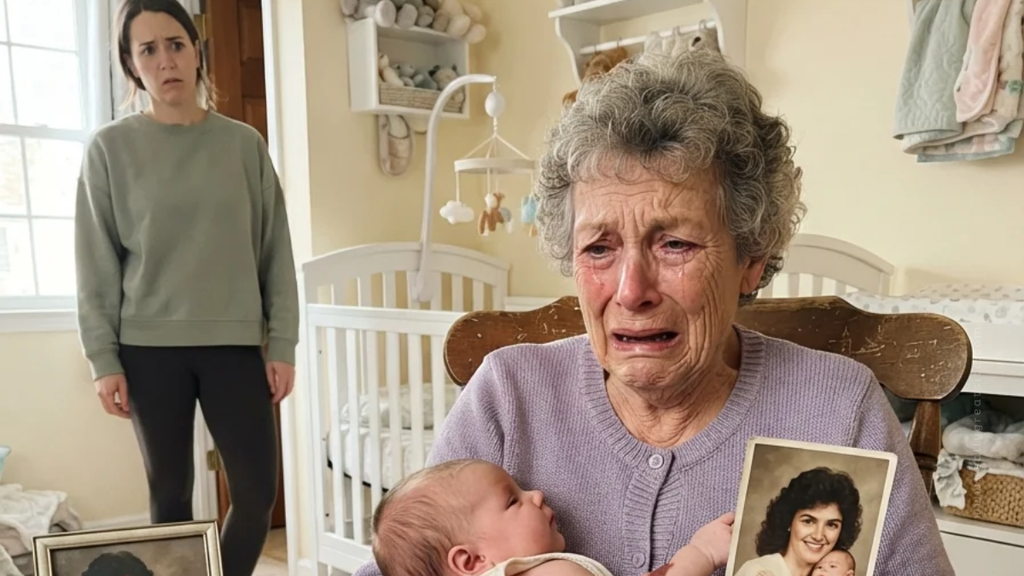
Not because she was crying.
Not because she was sick.
But because when I lifted her little pink sleeve to change her diaper, I saw something on her left shoulder that made my entire body go cold.
A birthmark.
Dark red.
Shaped almost exactly like a butterfly.
I’d seen that birthmark once before.
Thirty years earlier.
On the shoulder of my baby girl.
The daughter I’d been told died when she was eleven days old.
I was sixty-two years old, had been married for thirty-seven years, and had spent three decades trying not to think about the daughter I’d buried.
Her name was Grace.
She was born on September 18, 1996, weighing six pounds, nine ounces.
She had dark hair, long fingers, and the tiniest little dimple in her chin.
And on her left shoulder was a red birthmark that looked like a butterfly with one wing slightly larger than the other.
I remembered that birthmark better than I remembered my own wedding day.
Because when Grace was born, the nurse pointed it out.
“Look at that,” she’d said, smiling. “Your little girl came with her own butterfly.”
I’d laughed.
My husband, Richard, had kissed my forehead.
And I’d whispered to our daughter, “You’re my little butterfly.”
Eleven days later, she was dead.
At least, that’s what Richard told me.
I’d been hospitalized with a severe postpartum infection. I was weak, feverish, and barely conscious when Richard came into my room and said Grace had stopped breathing in her sleep.
I remembered screaming.
I remembered trying to climb out of bed.
And I remembered Richard holding me down while a nurse called for medication.
After that, everything blurred together.
Richard arranged the funeral.
Richard handled the paperwork.
Richard told me the doctors recommended I not see Grace again because of the condition of her body.
I believed him.
I was twenty-eight years old.
Sick.
Grieving.
And completely dependent on my husband.
For thirty years, I visited a little white headstone at St. Mary’s Cemetery.
Grace Elizabeth Sullivan.
September 18, 1996 – September 29, 1996.
Our little butterfly.
I brought flowers on her birthday.
Every year.
Sometimes on Christmas.
Sometimes on Mother’s Day.
And sometimes for no reason other than I missed her.
Then, three years after Grace died, I gave birth to another daughter.
Emily.
My miracle baby.
My reason to keep going.
She grew into a beautiful young woman with dark hair, brown eyes, and her father’s stubbornness.
She was twenty-seven now.
Married to a wonderful man named Andrew.
And eleven days earlier, she’d given birth to her first child.
A little girl named Sophie.
I’d been thrilled.
I’d spent months knitting blankets, buying tiny dresses, and helping Emily prepare the nursery.
When Sophie arrived, I cried so hard the nurses brought me tissues.
A granddaughter.
A beautiful, healthy granddaughter.
I thought it was the happiest moment of my life.
Until the afternoon Emily asked me to babysit.
“Mom, can you watch Sophie for a couple of hours?”
She was standing in my kitchen, looking exhausted.
Her hair was pulled into a messy bun.
She had dark circles beneath her eyes.
I smiled.
“Of course, sweetheart.”
She sighed with relief.
“Andrew and I need to run a few errands. I just need to get out of the house for a little while.”
I laughed.
“Go. Take your time.”
She kissed Sophie’s forehead.
Then handed her to me.
“She’s been fed. There’s milk in the bag. And she might need changing.”
I nodded.
“I think I remember how babies work.”
Emily smiled.
Then she looked toward the living room.
My husband was sitting in his favorite chair, reading the newspaper.
“Dad?”
Richard looked up.
“Yes, sweetheart?”
“Mom’s watching Sophie for a couple of hours.”
He nodded.
“Wonderful.”
Emily smiled.
“Maybe you can help her.”
Richard’s expression changed.
Just slightly.
But I noticed.
He looked at the baby.
Then quickly away.
“I have some work to finish,” he said.
Emily laughed.
“Dad, you’re retired.”
He folded his newspaper.
“That doesn’t mean I don’t have things to do.”
She rolled her eyes affectionately.
Then kissed him goodbye.
I watched her leave.
And for a moment, I thought nothing of Richard’s reaction.
He’d always been uncomfortable around newborns.
He said they made him nervous.
That they were too small.
Too fragile.
Too easy to hurt.
I understood.
After Grace, we’d both been frightened.
But that afternoon, I noticed something different.
Richard wouldn’t look at Sophie.
Not once.
He walked past me while I was rocking her.
Then went upstairs.
And closed his office door.
I shrugged.
Then carried Sophie into the nursery we’d prepared for visiting grandchildren.
She was getting fussy.
I laid her on the changing table.
Unbuttoned her little pink onesie.
And gently lifted her left arm.
That’s when I saw it.
The birthmark.
I stopped moving.
At first, I thought my eyes were playing tricks on me.
I leaned closer.
Dark red.
Two uneven wings.
A tiny darker spot near the center.
A butterfly.
Exactly where Grace’s birthmark had been.
I felt my heart begin to pound.
“No,” I whispered.
Sophie kicked her little legs.
I stared at her shoulder.
Then reached toward the mark.
I didn’t touch it.
I couldn’t.
Because I remembered another baby.
Another changing table.
Another tiny shoulder.
Thirty years earlier.
I remembered tracing the outline with my finger.
And whispering:
My little butterfly.
I stepped backward.
Then sat down in the rocking chair.
Sophie started crying.
The sound brought me back.
I picked her up.
Held her against my chest.
And started sobbing.
I told myself it was coincidence.
Birthmarks happened.
Babies were born with all kinds of markings.
And Sophie was Grace’s niece, if Grace had lived.
Family traits could repeat.
I knew that.
But something about the shape bothered me.
It wasn’t just a red patch.
It was the same butterfly.
The same uneven wings.
The same little darker spot.
I looked down at Sophie.
Then whispered:
“Who are you, sweetheart?”
She blinked up at me.
And I noticed something else.
Her eyes.
Dark brown.
Almost black.
Just like Grace’s.
I started crying harder.
Then I heard footsteps.
Richard.
He stood in the nursery doorway.
“What are you doing?”
I looked up.
He was staring at me.
Then at Sophie.
I swallowed.
“Richard.”
He frowned.
“What’s wrong?”
I looked down at the baby.
Then whispered:
“She has Grace’s birthmark.”
The color drained from his face.
For a moment, he didn’t move.
Then he laughed.
A strange, forced laugh.
“Don’t be ridiculous.”
I stared at him.
“Come look.”
He shook his head.
“Margaret, don’t start.”
I frowned.
“Start what?”
He stepped into the room.
“You’re getting yourself worked up.”
I looked at him.
“Richard, she has the same birthmark.”
He glanced toward Sophie.
Then quickly away.
“Babies have birthmarks.”
I swallowed.
“I know that.”
He sighed.
“Then what’s the problem?”
I stared at him.
And suddenly, something about his reaction frightened me.
He wasn’t surprised.
He wasn’t curious.
He was angry.
I looked down at Sophie.
Then whispered:
“Did you ever see Grace after she died?”
Richard went completely still.
“What?”
I looked up.
“Did you see her?”
He stared at me.
Then said:
“Of course.”
I swallowed.
“At the hospital?”
He nodded.
“Yes.”
I looked toward the window.
Then asked:
“Why wouldn’t you let me see her?”
His jaw tightened.
“Margaret, we’ve been over this.”
I shook my head.
“No. You’ve told me what the doctors said.”
He sighed.
“Because that’s what happened.”
I stared at him.
“Which doctor?”
He frowned.
“What?”
“Which doctor told you I couldn’t see my daughter?”
He looked away.
“It was thirty years ago.”
I nodded.
“Then surely you remember.”
He rubbed his forehead.
“Margaret, stop.”
I looked down at Sophie.
Then back at him.
And whispered:
“Was Grace really dead?”
Richard’s expression changed.
For a moment, he looked almost frightened.
Then he stepped closer.
“Give me the baby.”
I held Sophie tighter.
“What?”
He reached toward her.
“You’re upset. Give her to me.”
I stood.
“No.”
His face hardened.
“Margaret.”
I stepped backward.
“Don’t.”
He stared at me.
Then said something that made my blood run cold.
“You need to leave the past alone.”
I couldn’t move.
The past.
My daughter.
My baby.
The child I’d buried.
I stared at him.
Then whispered:
“What did you do?”
Richard looked toward the doorway.
Then back at me.
And said:
“You don’t understand what you’re asking.”
I felt sick.
I held Sophie against my chest.
Then whispered:
“Tell me.”
He shook his head.
“Not now.”
I stepped closer.
“Richard.”
He looked at me.
And for the first time in thirty-seven years, I saw something in his eyes that frightened me.
Not grief.
Not sadness.
Fear.
Then he whispered:
“If you keep digging, you’re going to destroy this family.”
I stared at him.
And suddenly, I understood something.
He wasn’t afraid of what I’d discover.
He was afraid of what I might remember.
I looked toward Sophie.
Then back at my husband.
And said:
“I think you need to leave this room.”
Richard stared at me.
For a moment, I thought he might refuse.
Then he turned.
Walked out.
And slammed the door.
I stood there shaking.
Holding my granddaughter.
Listening to his footsteps disappear down the hallway.
Then I did something I hadn’t done in thirty years.
I opened the old cedar chest in the nursery closet.
Inside were baby blankets.
Tiny shoes.
A faded pink dress.
And a photograph album.
Grace’s album.
I’d kept it wrapped in tissue paper.
I hadn’t opened it in years.
Not because I’d forgotten her.
But because remembering hurt too much.
I sat on the floor.
Placed Sophie safely in her bassinet.
And opened the album.
The first photograph showed me in the hospital.
Holding Grace.
I was smiling.
Richard stood beside me.
His arm around my shoulders.
The second photograph showed Grace sleeping.
The third showed her tiny hand wrapped around my finger.
Then I turned the page.
And found the photograph I’d been looking for.
Grace.
Lying on a white blanket.
Her left shoulder exposed.
The butterfly birthmark clearly visible.
I stared at it.
Then looked toward Sophie.
The same shape.
The same location.
The same uneven wings.
I felt sick.
Then I noticed something else.
In the corner of the photograph, beside Grace’s head, was a small hospital identification card.
I’d never paid attention to it before.
I leaned closer.
The card showed her name.
Grace Elizabeth Sullivan.
Her birth date.
September 18, 1996.
And a number.
Baby B.
I stopped breathing.
Baby B?
I stared at the card.
Then looked through the rest of the album.
Every photograph.
Every hospital picture.
Every little keepsake.
And suddenly, I noticed something I’d never seen before.
A second identification bracelet.
Tucked into the back of the album.
I picked it up.
It was yellowed with age.
Tiny.
Plastic.
And printed across the front were the words:
SULLIVAN, FEMALE — BABY A.
I couldn’t move.
Baby A.
Baby B.
Two babies.
I stared at the bracelet.
Then whispered:
“Oh my God.”
I’d given birth to twins.
I looked toward Sophie.
Then back at the bracelet.
My hands were shaking so badly I could barely hold it.
Thirty years earlier, I’d been told I delivered one daughter.
Grace.
One baby.
One funeral.
One little white headstone.
But the hospital had labeled Grace Baby B.
And somewhere, there had been a Baby A.
I stared at the bracelet.
Then heard something behind me.
A voice.
Quiet.
Cold.
Familiar.
“I told you not to open that chest.”
I turned.
Richard stood in the doorway.
He was holding my telephone.
And his face was completely expressionless.
I looked at him.
Then at the bracelet.
And whispered:
“Where is my other daughter?”
He didn’t answer.
I stood.
“Richard.”
He looked toward Sophie.
Then back at me.
And said:
“You really don’t remember, do you?”
I felt sick.
“Remember what?”
He stepped closer.
Then whispered:
“Margaret, Grace wasn’t the baby who died.”
I couldn’t breathe.
He looked toward the bracelet.
Then said:
“Grace was the one we kept.”
I stared at him.
Then toward Sophie.
Then back at my husband.
And suddenly, a terrible thought entered my mind.
A thought so horrifying that I couldn’t bring myself to say it.
Richard watched my face.
Then whispered:
“Yes, Margaret.”
He looked toward the photograph of Grace.
Then toward the baby in the bassinet.
And said:
“Emily isn’t who you think she is.”
For thirty years, I’d believed I had two daughters.
One who died.
And one who lived.
Now my husband was standing in the nursery doorway telling me that everything I knew about both of them was a lie.
I looked at the yellowed hospital bracelet in my hand.
Baby A.
Then at the photograph of Grace.
Baby B.
And finally at Sophie, sleeping peacefully in her bassinet.
My granddaughter had the same butterfly-shaped birthmark as the daughter I’d buried.
I looked at Richard.
“What do you mean, Grace was the one we kept?”
He didn’t answer.
I stepped closer.
“Richard, where is my other daughter?”
His eyes flickered toward the hallway.
Then he said, “Lower your voice.”
I stared at him.
“Lower my voice?”
“Emily could come home any minute.”
I almost laughed.
“Emily? You just told me Emily isn’t who I think she is, and you’re worried about her hearing us?”
He rubbed his forehead.
“Margaret, you’re getting hysterical.”
There it was.
The word he’d used for thirty years whenever I asked questions he didn’t want to answer.
Hysterical.
I’d been hysterical when I asked why Grace’s funeral was closed-casket.
Hysterical when I wanted to see the hospital records.
Hysterical when I questioned why Richard had insisted we move away from Philadelphia six months after the baby died.
And hysterical when I cried on Grace’s birthday.
I looked at him.
Then said:
“I’m going to ask you one more time. Where is my daughter?”
Richard sighed.
“She’s right there.”
He pointed toward Sophie.
I stared at him.
“That’s my granddaughter.”
He shook his head.
“No, Margaret. The woman who gave birth to her is your daughter.”
I felt sick.
“Emily?”
He nodded.
I looked toward the photograph.
Then whispered:
“Emily is Grace?”
Richard closed his eyes.
“Yes.”
I couldn’t move.
My beautiful Emily.
The little girl I’d raised.
The daughter who’d just become a mother herself.
She was Grace.
The baby I’d believed died thirty years ago.
I looked at Richard.
Then whispered:
“But Emily is twenty-seven.”
He nodded.
“That’s what she believes.”
My stomach dropped.
“What?”
Richard looked toward the hallway again.
Then said:
“Margaret, sit down.”
I shook my head.
“No.”
“Please.”
I stepped closer.
“Are you telling me our daughter is thirty years old and doesn’t know it?”
He didn’t answer.
I felt the room spinning.
I reached for the rocking chair.
Sat down.
And stared at my husband.
“How?”
Richard swallowed.
Then said:
“After the accident—”
I frowned.
“What accident?”
He stopped.
For a moment, he looked almost surprised.
Then he whispered:
“You really don’t remember.”
I stared at him.
“Richard, what accident?”
He looked toward the photograph album.
Then back at me.
“You were in a car accident.”
I shook my head.
“No.”
He nodded.
“Three weeks after the twins were born.”
I felt sick.
“Twins?”
He looked away.
I stared at him.
Then whispered:
“I had twins?”
Richard nodded.
“Yes.”
I covered my mouth.
Two daughters.
Two babies.
And nobody had told me.
He continued.
“You were driving home from the hospital. You’d gone to visit the girls.”
I frowned.
“Visit them?”
He nodded.
“They were still receiving care.”
I stared at him.
Then whispered:
“Why?”
Richard hesitated.
“Because they were premature.”
I looked toward the hospital photograph.
Grace.
The butterfly birthmark.
The tiny identification card.
Baby B.
I swallowed.
“But I remember bringing Grace home.”
Richard shook his head.
“No. You remember photographs from the hospital.”
I felt sick.
He continued.
“You were in the accident before either baby came home.”
I stared at him.
Then whispered:
“What happened to me?”
Richard took a breath.
“You suffered a head injury.”
I closed my eyes.
“And?”
“You were unconscious for several days.”
I swallowed.
“And when you woke up?”
He looked down.
“You couldn’t remember the pregnancy.”
I stared at him.
Then whispered:
“So you told me one baby died?”
Richard didn’t answer.
I stepped closer.
“Richard.”
He looked at me.
Then said:
“One baby did die.”
I stopped.
“What?”
He swallowed.
“Baby A.”
I felt sick.
The bracelet.
The little yellowed bracelet in my hand.
I stared at it.
Then whispered:
“What was her name?”
Richard looked toward the floor.
“Anna.”
I couldn’t breathe.
Anna.
My daughter.
A little girl I’d never known.
I looked toward Sophie.
Then back at Richard.
“And Grace?”
He swallowed.
“She survived.”
I started crying.
I looked toward the photograph.
Then whispered:
“Why did you tell me Grace died?”
Richard rubbed his forehead.
“Because you couldn’t handle the truth.”
I stared at him.
“What truth?”
He looked away.
I stepped closer.
“Richard, what truth?”
He sighed.
“Margaret, you were very sick.”
I shook my head.
“That doesn’t answer my question.”
He looked toward the doorway.
Then said:
“The doctors thought another pregnancy would be dangerous.”
I frowned.
“What?”
He swallowed.
“You’d had complications.”
I stared at him.
Then he continued.
“And after Anna died, you were devastated.”
I felt sick.
“But you said I couldn’t remember.”
Richard hesitated.
Then said:
“Not everything.”
I stared at him.
His story was changing.
First, I’d forgotten the pregnancy.
Then I’d been devastated by losing Anna.
First, Grace had died.
Then Grace had survived.
And somehow, three years later, she’d become Emily.
I looked at him.
Then whispered:
“You’re lying.”
His face hardened.
“Margaret.”
I stood.
“You’re lying to me.”
He stepped closer.
“Calm down.”
I shook my head.
“No.”
I pointed toward Sophie.
“That baby has the same birthmark as Grace. And you knew it before I did.”
Richard looked toward the bassinet.
Then back at me.
I continued.
“That’s why you wouldn’t hold her.”
He didn’t answer.
“That’s why you got angry when I noticed.”
Silence.
I stepped closer.
“What did you do to my daughters?”
Richard’s expression changed.
For a moment, he looked furious.
Then he said:
“I did what I had to do to keep this family together.”
I stared at him.
Then whispered:
“What does that mean?”
He didn’t answer.
Instead, he reached for the photograph album.
I pulled it away.
“Don’t touch it.”
He stopped.
Then said:
“Margaret, give me the bracelet.”
I shook my head.
“No.”
He stepped closer.
“Give it to me.”
I held it tighter.
“Why?”
His jaw tightened.
“Because you’re upsetting yourself.”
I stared at him.
Then said:
“I think you’re the one who’s upset.”
For a moment, neither of us moved.
Then Richard did something that frightened me more than anything he’d said.
He reached into his pocket.
And removed a small orange prescription bottle.
I stared at it.
“What is that?”
He looked toward me.
“Your medication.”
I frowned.
“My medication?”
He nodded.
“You haven’t been taking it properly.”
I felt sick.
“Richard, I don’t take medication.”
He sighed.
“Margaret.”
I stepped backward.
“What is that?”
He looked at the bottle.
Then said:
“The pills Dr. Harrison prescribed after your accident.”
I stared at him.
Dr. Harrison.
A name I hadn’t heard in years.
He’d been our family physician when we lived in Philadelphia.
He’d retired long ago.
I looked toward the bottle.
Then whispered:
“That was thirty years ago.”
Richard nodded.
“Your symptoms have been coming back.”
I felt sick.
“What symptoms?”
He looked toward the photograph album.
Then back at me.
“Confusion. Memory problems. Obsessive thoughts.”
I stared at him.
Then whispered:
“You think I’m imagining this?”
He sighed.
“Margaret, you need help.”
I almost laughed.
There it was.
The explanation.
The escape route.
If I questioned him, I was confused.
If I remembered something, I was unstable.
If I found evidence, I was obsessed.
I looked at the prescription bottle.
Then at my husband.
And said:
“I’m not taking anything you give me.”
His face changed.
“Margaret—”
I stepped backward.
“Get out.”
He stared at me.
Then looked toward Sophie.
And said:
“You have no idea what you’re doing.”
I reached for my telephone.
“Then maybe Emily can help me understand.”
Richard’s expression changed instantly.
“No.”
I stopped.
“What?”
He stepped closer.
“Don’t call her.”
I stared at him.
“Why?”
He swallowed.
“Because she doesn’t need this.”
I looked at him.
Then whispered:
“She doesn’t need to know who she is?”
Richard didn’t answer.
I reached for the telephone.
And dialed Emily.
Richard lunged toward me.
I stepped backward.
“Don’t touch me!”
Sophie started crying.
The sound stopped us both.
I hurried toward the bassinet.
Picked her up.
And held her against my chest.
Richard stood near the doorway.
Breathing heavily.
Then he whispered:
“You’re going to ruin everything.”
I stared at him.
And said:
“I think you already did.”
Emily answered on the fourth ring.
“Hi, Mom.”
I nearly cried when I heard her voice.
“Sweetheart, where are you?”
She sounded confused.
“At the pharmacy. Why?”
I looked toward Richard.
He was staring at me.
“Can you come home?”
Emily hesitated.
“Is Sophie okay?”
I swallowed.
“She’s fine.”
“Then what’s wrong?”
I looked at my husband.
Then whispered:
“I need to talk to you about something important.”
Richard shook his head.
I ignored him.
Emily sounded worried.
“Mom, you’re scaring me.”
I closed my eyes.
“Just come home, sweetheart.”
She agreed.
I ended the call.
Richard stared at me.
Then said:
“You shouldn’t have done that.”
I held Sophie tighter.
“Why?”
He looked toward the photograph album.
Then back at me.
And whispered:
“Because Emily already knows.”
I stopped breathing.
“What?”
Richard swallowed.
“She knows about Grace.”
I stared at him.
Then whispered:
“What do you mean?”
He looked away.
“She’s known for years.”
I couldn’t move.
Emily.
My daughter.
My beautiful, loving daughter.
The woman who’d just handed me her newborn baby.
She knew?
I looked toward Sophie.
Then back at Richard.
And whispered:
“How long?”
He didn’t answer.
I stepped closer.
“How long has she known?”
Richard looked at me.
Then said:
“Since she was eighteen.”
I felt sick.
Nine years.
My daughter had known for nine years.
I stared at him.
Then whispered:
“Why didn’t she tell me?”
Richard looked toward the floor.
Then said:
“Because she was afraid you’d remember.”
I couldn’t breathe.
“Remember what?”
He looked up.
And for the first time, I saw something in his eyes that wasn’t anger.
It was fear.
Then he whispered:
“Margaret, Anna didn’t die in the hospital.”
I froze.
“What?”
He swallowed.
“She died at home.”
I stared at him.
Then whispered:
“What are you talking about?”
Richard looked toward Sophie.
Then back at me.
And said:
“You were the one who found her.”
I couldn’t move.
He continued.
“You woke up in the middle of the night.”
I felt sick.
“And Anna wasn’t breathing.”
I stared at him.
Then whispered:
“No.”
Richard nodded.
“You tried to save her.”
I shook my head.
“No.”
He stepped closer.
“And when the ambulance came, you were hysterical.”
I covered my mouth.
He continued.
“You blamed yourself.”
I started crying.
Then he whispered:
“You said you’d killed her.”
I couldn’t breathe.
I stared at him.
Then looked toward Sophie.
And suddenly, a memory surfaced.
A dark bedroom.
A baby crying.
A little white blanket.
My hands shaking.
Someone shouting.
And a terrible silence.
I closed my eyes.
Then whispered:
“Oh my God.”
Richard stepped closer.
“Margaret.”
I shook my head.
“No.”
He reached toward me.
“Now you understand why I protected you.”
I stepped backward.
Then whispered:
“I remember a baby.”
Richard nodded.
“Yes.”
I closed my eyes.
“A white blanket.”
He swallowed.
“Yes.”
I started crying.
“And blood.”
Richard froze.
I opened my eyes.
Looked at him.
Then whispered:
“There was blood.”
His face went white.
I stared at him.
Then said:
“Why was there blood?”
He didn’t answer.
I stepped closer.
“Richard.”
He looked toward the door.
Then whispered:
“You’re remembering it wrong.”
I shook my head.
“No.”
I closed my eyes again.
The dark room.
The blanket.
The crying.
The blood.
And a woman’s voice.
Not mine.
Someone else’s.
I opened my eyes.
Then whispered:
“There was another woman.”
Richard went completely still.
I stared at him.
Then said:
“Who was she?”
He didn’t answer.
I stepped closer.
“Richard, who was in the house that night?”
He looked toward Sophie.
Then back at me.
And whispered:
“Margaret, please.”
I felt sick.
Then another memory surfaced.
A woman standing near the nursery door.
Dark hair.
A blue sweater.
A gold necklace.
And a familiar voice.
You promised me she’d never find out.
I stopped breathing.
I knew that voice.
I’d heard it a thousand times.
At birthday parties.
At Christmas dinners.
At family gatherings.
I stared at Richard.
Then whispered:
“It was your sister.”
His face changed.
I stepped closer.
“It was Diane.”
Richard closed his eyes.
I felt sick.
Diane.
My sister-in-law.
The woman who’d helped me after Grace died.
The woman who’d brought meals.
Who’d sat beside me at the funeral.
Who’d told me I needed to stop asking questions and focus on getting better.
I stared at Richard.
Then whispered:
“What did Diane do?”
He shook his head.
“Margaret, don’t.”
I stepped closer.
“WHAT DID SHE DO?”
Richard looked toward the floor.
Then whispered:
“She was supposed to take one baby.”
I stopped breathing.
One baby.
Take?
I stared at him.
Then whispered:
“Take her where?”
Richard didn’t answer.
I felt sick.
Then I remembered something else.
Diane had never been able to have children.
She’d tried for years.
Fertility treatments.
Miscarriages.
A failed adoption.
She’d cried when I announced my pregnancy.
I’d thought they were happy tears.
I looked toward Richard.
Then whispered:
“You were going to give Diane one of my babies.”
He closed his eyes.
I stared at him.
Then said:
“Without telling me.”
Richard didn’t answer.
I felt sick.
I looked toward Sophie.
Then back at him.
And whispered:
“Which baby?”
Richard swallowed.
Then said:
“Anna.”
I couldn’t breathe.
Baby A.
Anna.
The daughter I’d never known.
I looked toward the bracelet in my hand.
Then whispered:
“What happened?”
Richard stared at me.
Then said:
“Diane changed her mind.”
I frowned.
“What?”
He swallowed.
“She wanted Grace instead.”
I felt sick.
I looked toward the photograph.
The butterfly birthmark.
The baby I’d believed died.
I stared at Richard.
Then whispered:
“Why?”
He looked toward Sophie.
Then back at me.
And said:
“Because Grace was healthy.”
I stopped.
Healthy.
Anna.
The baby who’d supposedly died.
I stared at him.
Then whispered:
“What was wrong with Anna?”
Richard didn’t answer.
I stepped closer.
“Richard.”
He looked at me.
Then whispered:
“She had a heart condition.”
I felt sick.
I looked toward the bracelet.
Then toward Sophie.
And suddenly, I understood.
Diane had wanted a baby.
Richard had promised her one of our twins.
But when Anna was born with a heart condition, Diane decided she wanted the healthy baby instead.
Grace.
My little butterfly.
I looked toward Richard.
Then whispered:
“So you gave her Grace?”
He didn’t answer.
I started crying.
“And what happened to Anna?”
Richard looked toward the floor.
Then whispered:
“We kept her.”
I couldn’t breathe.
I stared at him.
Then said:
“But you told me Grace died.”
Richard nodded.
I felt sick.
I looked toward Sophie.
Then back at him.
And whispered:
“Who is Emily?”
Richard didn’t answer.
I stepped closer.
“Richard.”
He looked at me.
Then whispered:
“Emily is Anna.”
I froze.
Anna.
The baby with the heart condition.
The baby I’d been told died.
The baby we’d kept.
I stared at him.
Then whispered:
“Then where is Grace?”
Richard looked toward the doorway.
Then back at me.
And said:
“She’s been living with Diane for thirty years.”
I couldn’t move.
My daughter.
My little butterfly.
Alive.
Somewhere.
Raised by my sister-in-law.
The woman who’d sat beside me at my daughter’s funeral.
The woman who’d watched me grieve.
The woman who’d brought flowers to Grace’s grave.
I stared at Richard.
Then whispered:
“Diane has my daughter?”
He nodded.
I felt sick.
Then something occurred to me.
Diane had a daughter.
A woman named Olivia.
Twenty-nine years old.
Dark hair.
Brown eyes.
A small red birthmark on her left shoulder.
I’d seen it once when she was a teenager.
At a family picnic.
I’d joked that it looked like a butterfly.
Diane had immediately pulled Olivia’s shirt back over her shoulder.
I’d thought she was being protective.
Now I understood.
I stared at Richard.
Then whispered:
“Olivia.”
His face changed.
I stepped closer.
“Olivia is Grace.”
Richard closed his eyes.
I felt sick.
My niece.
The girl I’d watched grow up.
The young woman who’d called me Aunt Margaret for nearly thirty years.
Was my daughter.
My little butterfly.
I looked toward Sophie.
Then back at Richard.
And whispered:
“You let me bury an empty casket.”
He didn’t answer.
I started sobbing.
“You let me visit a grave.”
Richard looked away.
I continued.
“Thirty years.”
My voice broke.
“THIRTY YEARS, RICHARD.”
He stepped closer.
“Margaret, please.”
I backed away.
“Don’t touch me.”
He stopped.
I stared at him.
Then whispered:
“And Emily knows?”
Richard looked toward the floor.
“Yes.”
I felt sick.
“She knows Olivia is her sister?”
He nodded.
I stared at him.
Then asked:
“Why hasn’t she told me?”
Richard hesitated.
Then said:
“Because Diane told her what would happen if she did.”
I frowned.
“What?”
Richard swallowed.
Then whispered:
“Diane told Emily you’d go to prison.”
I stopped breathing.
Prison?
I stared at him.
Then said:
“For what?”
Richard looked toward the doorway.
Then back at me.
And whispered:
“For what happened to Anna.”
I couldn’t move.
Anna.
Emily.
My daughter.
Alive.
I stared at Richard.
Then whispered:
“But Anna didn’t die.”
He nodded.
“I know.”
I felt sick.
Then he continued.
“But Diane convinced Emily that you tried to kill her.”
I couldn’t breathe.
I looked toward Sophie.
Then back at him.
And whispered:
“She told my daughter I tried to kill her?”
Richard closed his eyes.
I started crying.
Then I heard the front door open.
Emily.
She was home.
I looked toward the hallway.
Footsteps approached.
Then my daughter appeared in the nursery doorway.
She looked at me.
Then at Richard.
Then at the photograph album in my hands.
Her face went white.
“Mom?”
I stared at her.
Then whispered:
“Emily, is your name Anna?”
She stopped breathing.
Richard stepped toward her.
“Emily, don’t.”
She looked at him.
Then back at me.
And started crying.
I stepped closer.
“Sweetheart.”
She shook her head.
“Mom, please.”
I reached toward her.
“Tell me the truth.”
She covered her mouth.
Then whispered:
“I wanted to tell you.”
I started crying.
She continued.
“I wanted to tell you so many times.”
I held out my arms.
She collapsed against me.
And sobbed.
I held her.
My daughter.
My Anna.
The baby I’d supposedly lost.
The woman I’d raised under another name.
I kissed her forehead.
Then whispered:
“You didn’t do anything wrong.”
She started crying harder.
Then she whispered something against my shoulder.
So quietly I almost didn’t hear it.
“Mom, Olivia knows too.”
I froze.
“What?”
Emily pulled back.
Her face was pale.
Then she whispered:
“She’s known since she was sixteen.”
I couldn’t move.
My daughter.
Grace.
Living with Diane.
Knowing I was her mother.
Knowing I’d spent thirty years visiting her grave.
I stared at Emily.
Then whispered:
“Why didn’t she come to me?”
Emily started crying.
Then said:
“Because Diane told her you didn’t want her.”
I felt sick.
I closed my eyes.
Then Emily continued.
“She told Olivia you chose me.”
I started sobbing.
“That you gave her away because she wasn’t the baby you wanted.”
I shook my head.
“No.”
Emily grabbed my hands.
“I know, Mom.”
I started crying harder.
Then she whispered:
“But Olivia believes it.”
I looked toward Richard.
He was standing near the doorway.
Silent.
Watching.
And for the first time, I felt something stronger than grief.
Anger.
I looked at him.
Then said:
“Get out of my house.”
Richard stared at me.
“Margaret.”
I shook my head.
“Get out.”
He stepped closer.
“You’re not thinking clearly.”
I looked toward Emily.
Then back at him.
And said:
“I have never thought more clearly in my life.”
Richard’s face hardened.
Then he whispered:
“If you go after Diane, she’ll tell everyone what happened that night.”
I stared at him.
Then said:
“Let her.”
He looked surprised.
I stepped closer.
“Let her tell everyone.”
I pointed toward the door.
“Because I’m done keeping your secrets.”
Richard stared at me.
Then turned.
And walked out.
I stood in the nursery.
Holding Emily.
Listening to his footsteps disappear.
Then my daughter pulled away.
She looked frightened.
“Mom?”
I brushed the tears from her cheeks.
“Yes, sweetheart?”
She swallowed.
Then whispered:
“There’s something else you need to know.”
I felt sick.
“What?”
Emily looked toward the hallway.
Then back at me.
And said:
“Dad and Aunt Diane have been planning something.”
I froze.
“What?”
She started crying.
Then whispered:
“They want to have you declared mentally incompetent.”
I couldn’t move.
Emily continued.
“They’ve been talking to a lawyer.”
I stared at her.
Then she said:
“Dad told them you’ve been having memory problems.”
I felt sick.
The prescription bottle.
The accusations.
The warnings.
The way Richard kept telling me I was confused.
I looked toward Emily.
Then whispered:
“Why?”
She hesitated.
Then said:
“Because of Grandma’s inheritance.”
I frowned.
“What inheritance?”
Emily swallowed.
Then whispered:
“The one Aunt Diane stole.”
I stopped breathing.
Diane.
My sister-in-law.
My daughter.
My inheritance.
I stared at Emily.
Then asked:
“How much?”
She looked toward the floor.
Then whispered:
“Almost four million dollars.”
I couldn’t move.
Then Emily said something that made my blood run cold.
“Mom, Aunt Diane didn’t just steal Grace.”
I stared at her.
She started crying.
Then whispered:
“She stole your mother’s identity too.”
I couldn’t breathe.
I looked toward Sophie.
Then toward the photograph of Grace.
Then back at Emily.
And suddenly, I realized something.
The birthmark hadn’t simply led me to a daughter I’d believed was dead.
It had uncovered a conspiracy that had been unfolding inside my family for thirty years.
And the people responsible were still trying to make sure I never learned the truth.
For thirty years, I’d believed my daughter Grace was dead.
Now I knew she was alive.
She’d been living less than forty minutes away, calling my sister-in-law Mom, while I visited an empty grave every September.
And the two people responsible for it—my husband and his sister—were apparently planning to have me declared mentally incompetent before I could expose them.
I stood in the nursery holding my daughter Emily’s hands.
Or Anna’s hands.
I didn’t even know what to call her anymore.
“Sweetheart,” I whispered, “what do you mean Diane stole Grandma’s identity?”
Emily looked toward the hallway.
“Mom, we need to leave.”
I frowned.
“Why?”
She swallowed.
“Because Dad knows you’re starting to remember.”
I looked toward Sophie, sleeping peacefully in her bassinet.
Then back at Emily.
“Remember what?”
My daughter started crying.
“Something happened the night they took Grace.”
I felt sick.
“What happened?”
Emily shook her head.
“I don’t know everything.”
I stared at her.
Then she whispered:
“But Aunt Diane told me you were supposed to die that night.”
I stopped breathing.
“What?”
Emily started sobbing.
I reached for the rocking chair.
Sat down.
And stared at her.
“Emily, what are you saying?”
She wiped her face.
“Aunt Diane told me you were dangerous.”
I swallowed.
“She said you tried to hurt me when I was a baby.”
I shook my head.
“No.”
Emily nodded.
“I know, Mom.”
She squeezed my hand.
“But she said Dad had to stop you.”
I felt sick.
“Stop me how?”
Emily looked toward the door.
Then whispered:
“She said there was an accident.”
I closed my eyes.
The memory.
The dark bedroom.
The white blanket.
The blood.
The woman in the blue sweater.
I opened my eyes.
Then whispered:
“Richard told me I was in a car accident.”
Emily nodded.
“But Mom, I found your hospital records.”
I stared at her.
“What?”
She reached into her purse.
Pulled out a folded envelope.
And handed it to me.
Inside were photocopies.
Medical records.
Dated October 1996.
I looked at the first page.
My name.
Margaret Sullivan.
My date of birth.
Then a diagnosis.
Traumatic brain injury.
I swallowed.
Below it was another notation.
Suspected assault.
I stopped.
Assault?
I looked toward Emily.
Then whispered:
“Someone hurt me?”
She started crying.
I looked back at the records.
There were photographs.
Bruising around my neck.
A cut near my temple.
A fractured wrist.
I covered my mouth.
Then I saw the physician’s notes.
Patient reportedly fell down stairs. Injuries inconsistent with reported mechanism.
I stared at the words.
Then whispered:
“I didn’t fall.”
Emily shook her head.
“No, Mom.”
I looked toward the doorway.
Then back at my daughter.
And suddenly, the memory came rushing back.
Not all of it.
Not clearly.
But enough.
Diane.
Standing in the nursery.
Holding a baby.
My baby.
Grace.
I remembered reaching for her.
Telling her to put my daughter down.
And Richard standing behind me.
I remembered screaming.
Then something striking the side of my head.
And falling.
I covered my mouth.
“Oh my God.”
Emily grabbed my hand.
“Mom?”
I looked at her.
Then whispered:
“Your father hit me.”
She started crying.
I closed my eyes.
I remembered the stairs.
The cold wooden railing.
The sound of someone shouting.
Then darkness.
And when I woke up, everything was different.
My babies were gone.
My memories were confused.
And my husband had told me a story I’d believed for thirty years.
I looked toward Emily.
Then whispered:
“They didn’t protect me.”
She shook her head.
I started sobbing.
“They made sure I couldn’t remember.”
Emily wrapped her arms around me.
And for a long time, we cried together.
Then I looked toward Sophie.
My beautiful granddaughter.
The baby whose birthmark had started everything.
I reached toward her.
Gently touched her tiny hand.
And whispered:
“You saved us, sweetheart.”
Emily started crying harder.
But I wasn’t finished.
Not even close.
Because somewhere, less than forty minutes away, my other daughter was living with the woman who’d stolen her.
And I was going to bring her home.
The next morning, I called a lawyer.
Her name was Patricia Reynolds.
She was in her late fifties, sharp, direct, and completely unimpressed by Richard Sullivan.
I told her everything.
The twins.
The false death.
The stolen child.
The hospital records.
The inheritance.
The plan to have me declared incompetent.
Patricia listened without interrupting.
Then she asked:
“Margaret, do you have access to your mother’s estate documents?”
I nodded.
“I think so.”
“Where?”
“In Richard’s office.”
She looked at me.
“Does he know you suspect financial wrongdoing?”
I swallowed.
“Yes.”
Patricia leaned forward.
“Then don’t confront him again.”
I frowned.
“Why?”
She looked toward Emily.
Then back at me.
“Because if he’s been planning to take control of your finances, he may already be moving assets.”
I felt sick.
She continued.
“And if the medical records are accurate, this may involve serious criminal conduct.”
I nodded.
“Then what do we do?”
Patricia folded her hands.
“We document everything. We protect you and your daughter. And we go to the authorities.”
For the first time in days, I felt something other than fear.
I felt hope.
Patricia arranged for an independent physician to evaluate me.
I passed every cognitive assessment.
My memory was normal for my age.
My judgment was intact.
And there was no medical basis for declaring me incompetent.
The physician reviewed the old hospital records.
Then said something I’ll never forget.
“Mrs. Sullivan, the injuries described here are consistent with significant physical trauma.”
I swallowed.
“Could that explain why I don’t remember everything?”
He nodded.
“Yes. Traumatic brain injuries can cause gaps in memory, particularly around the injury itself.”
I started crying.
Thirty years.
Thirty years of being told I was confused.
Unstable.
Too emotional.
Too fragile.
And now someone was finally telling me that what happened to me had been real.
I looked toward Patricia.
Then whispered:
“I wasn’t crazy.”
She shook her head.
“No, Margaret.”
I covered my mouth.
And cried.
The investigation began quietly.
Detectives interviewed Emily.
Reviewed my hospital records.
Examined the death certificate for Grace.
And requested records from the hospital where the twins were born.
What they discovered was worse than anything I’d imagined.
There had never been a death certificate issued for Grace Elizabeth Sullivan.
The document Richard had shown me thirty years earlier was a forgery.
The funeral home had no record of receiving a body.
And the cemetery plot I’d visited for three decades contained an empty casket.
I sat in Patricia’s office when she told me.
For a long time, I couldn’t speak.
Then I whispered:
“He made me bury my daughter while she was still alive.”
Patricia nodded gently.
I started crying.
I thought about every birthday.
Every Christmas.
Every Mother’s Day.
Every time I’d stood beside that little white headstone and apologized to Grace for not being there when she died.
I looked toward the window.
Then whispered:
“She was alive the whole time.”
Patricia reached for my hand.
“Yes.”
I closed my eyes.
And cried for the thirty years we’d lost.
Then the detectives uncovered the financial records.
My mother had died in 2008.
She’d left an estate worth approximately four million dollars.
At the time, Richard told me she’d left very little.
He said she’d made poor investments.
That the house had been mortgaged.
That there were debts.
I believed him.
I’d been grieving.
And I trusted my husband.
But the records told a different story.
My mother had left almost everything to me.
The money had been transferred through a series of accounts using documents bearing my signature.
Signatures I didn’t recognize.
Some of the paperwork had been notarized by Diane.
And one account had been opened using my mother’s Social Security number.
Years after she’d died.
I stared at the documents.
Then whispered:
“Diane used my mother’s identity?”
Patricia nodded.
“It appears she did.”
I felt sick.
My sister-in-law.
The woman who’d stolen my baby.
Had also been using my dead mother’s identity to conceal money.
Patricia continued.
“Some of the funds were used to purchase property.”
I frowned.
“What property?”
She turned a page.
Then showed me an address.
I recognized it immediately.
Diane’s house.
The beautiful brick colonial where she’d raised Olivia.
My Grace.
I stared at the address.
Then whispered:
“She bought that house with my money.”
Patricia nodded.
I felt sick.
I remembered visiting Diane there.
Birthday parties.
Christmas dinners.
Summer barbecues.
I’d sat in that living room.
Admired her furniture.
Complimented her garden.
And watched my daughter grow up in a house purchased with the inheritance my mother had left me.
I looked toward Patricia.
Then whispered:
“She stole everything.”
Patricia shook her head.
“Not everything.”
I frowned.
She smiled gently.
“You still have your daughters.”
I started crying.
And for the first time, I realized she was right.
The money mattered.
The lies mattered.
The betrayal mattered.
But Grace was alive.
And nothing Richard or Diane had done could change that.
The next step was the hardest.
I had to see Olivia.
My Grace.
The daughter I’d believed was dead.
Patricia advised me not to confront Diane directly.
Instead, detectives contacted Olivia privately.
They explained that there were questions about her birth records.
That a woman believed she might be her biological mother.
And that they wanted to offer her a DNA test.
Olivia initially refused.
I understood.
For thirty years, she’d believed Diane was her mother.
Then suddenly, strangers were telling her that everything she knew might be wrong.
But three days later, she called the detective back.
She agreed to the test.
And two weeks after that, the results arrived.
I was sitting at my kitchen table when Patricia called.
Emily sat beside me.
Sophie was asleep in her little swing.
I answered.
“Hello?”
Patricia took a breath.
“Margaret, we have the results.”
My heart started pounding.
I gripped Emily’s hand.
“And?”
Patricia paused.
Then said:
“Olivia is your biological daughter.”
I started sobbing.
Emily covered her mouth.
Patricia continued.
“The results also confirm that Olivia and Emily are fraternal twins.”
I couldn’t speak.
Thirty years.
Thirty years of wondering.
Thirty years of grieving.
Thirty years of believing my daughter was dead.
And now I had proof.
Grace was alive.
I looked toward Emily.
Then whispered:
“We found her.”
My daughter started crying.
She wrapped her arms around me.
And we held each other.
For a long time.
But finding Grace was only the beginning.
Because she didn’t want to meet me.
Not at first.
The detective told me gently.
“Mrs. Sullivan, Olivia is struggling with the information.”
I nodded.
“I understand.”
He continued.
“She’s been told a very different version of events.”
I swallowed.
“What version?”
He hesitated.
Then said:
“That you voluntarily gave her away.”
I closed my eyes.
Of course.
Diane had spent thirty years preparing for this.
Thirty years making sure Grace would never come looking for me.
I looked toward the detective.
Then whispered:
“Does she know about the funeral?”
He nodded.
“Yes.”
I swallowed.
“And?”
He looked sympathetic.
“She was very upset.”
I started crying.
I imagined Grace learning that her own mother had spent thirty years visiting her grave.
That I’d mourned her.
Loved her.
Missed her.
And never known she was alive.
I looked toward the detective.
Then said:
“Please tell her I never stopped loving her.”
He nodded.
“I will.”
Three days later, I received a letter.
It was handwritten.
On pale blue stationery.
The envelope said:
Margaret.
Not Mom.
Not Mother.
Margaret.
I sat at my kitchen table.
Opened it.
And read.
Dear Margaret,
I don’t know what to call you.
For thirty years, I believed Diane was my mother.
She told me you gave me away because you couldn’t handle having twins.
She said you chose Emily because she was the baby you wanted.
I believed her.
When I was sixteen, she told me the truth about my birth, or at least what she said was the truth.
She told me you knew where I was.
That you visited sometimes but didn’t want me to know.
I spent years wondering why you didn’t love me.
I started crying.
Then continued.
Now I’m being told you thought I was dead.
That you visited a grave.
That you never knew I was alive.
I don’t know what to believe.
But I want to understand.
Would you be willing to meet me?
I covered my mouth.
Then read the final line.
P.S. I have a butterfly-shaped birthmark on my left shoulder. Diane always told me it was ugly. She made me cover it when I was little. I don’t know why, but I thought you should know.
I started sobbing.
My little butterfly.
The birthmark.
The thing that had started everything.
I reached for my telephone.
Called Patricia.
And whispered:
“She wants to meet me.”
We met at a small café.
A quiet place with flowers on the tables.
I arrived early.
Of course I did.
I was so nervous I could barely sit still.
I kept looking toward the door.
Every time it opened, my heart jumped.
Then, at 2:17 in the afternoon, she walked in.
Grace.
My daughter.
Thirty years old.
Dark hair.
Brown eyes.
A familiar dimple in her chin.
She looked so much like Emily that I started crying before she even reached the table.
She stopped a few feet away.
“Margaret?”
I stood.
“Yes.”
She looked at me.
Then whispered:
“You look like me.”
I laughed through my tears.
“No, sweetheart.”
I reached toward her.
Then stopped.
I didn’t know whether I was allowed to touch her.
She looked at my hands.
Then at my face.
And whispered:
“Can I hug you?”
I started sobbing.
“Of course.”
She stepped into my arms.
And I held my daughter for the first time in thirty years.
I kissed her hair.
Her forehead.
Her cheek.
I couldn’t stop crying.
“I’m so sorry,” I whispered.
She started sobbing.
I held her tighter.
“I’m so sorry, sweetheart.”
She pulled back.
Then looked at me.
And asked:
“Did you really think I was dead?”
I nodded.
“Every day.”
She started crying harder.
I reached into my purse.
Pulled out a photograph.
The little white headstone.
Grace Elizabeth Sullivan.
Our little butterfly.
I handed it to her.
She stared at it.
Then covered her mouth.
“Oh my God.”
I started crying.
“I went every year.”
She looked at me.
I continued.
“On your birthday. On Christmas. On Mother’s Day.”
My voice broke.
“I talked to you.”
Grace started sobbing.
I reached for her hand.
“I told you about Emily.”
She looked toward the photograph.
I continued.
“I told you about our family.”
I swallowed.
“And I told you how much I missed you.”
Grace covered her face.
Then whispered:
“She told me you didn’t want me.”
I shook my head.
“No, sweetheart.”
She started crying harder.
I squeezed her hand.
“I wanted you every single day.”
She looked at me.
Then whispered:
“I wanted you too.”
We sat there for almost four hours.
Talking.
Crying.
Looking at photographs.
Trying to fit thirty years into one afternoon.
She told me about her childhood.
Her school.
Her friends.
Her first job.
The dog she’d loved when she was twelve.
The college she’d attended.
The man she was dating.
I told her about Emily.
About my mother.
About the little pink blanket I’d knitted while I was pregnant.
And about the birthmark.
She smiled through her tears.
“You really called me your butterfly?”
I nodded.
“From the moment you were born.”
She looked down.
Then whispered:
“I always hated that birthmark.”
I started crying.
“Why?”
She shrugged.
“Diane said it was ugly.”
I reached toward her hand.
Then whispered:
“It was the most beautiful thing I’d ever seen.”
Grace started sobbing.
And I held her hand until she stopped.
The criminal investigation continued.
Richard and Diane were eventually arrested.
The charges included fraud, identity theft, falsification of records, and offenses connected to the unlawful separation of the twins.
The old assault allegations were also investigated, although proving exactly what happened thirty years earlier was difficult.
But the financial evidence was overwhelming.
The forged documents.
The stolen inheritance.
The false identities.
The transfers.
The property purchases.
And the records showing Diane had knowingly raised Grace under a false birth history.
Richard tried to blame Diane.
Diane tried to blame Richard.
Both claimed they’d acted out of love.
Both insisted they’d been protecting the children.
But when the prosecutor asked Diane why she’d allowed me to visit an empty grave for thirty years, she had no answer.
And when Richard was asked why he’d never told me Grace was alive, he said something I’ll never forget.
“Margaret wouldn’t have understood.”
I sat in the courtroom.
Listening.
And realized that was what he’d believed all along.
That I wasn’t entitled to understand.
That I wasn’t entitled to make decisions.
That my daughters belonged to him.
That my mother’s money belonged to him.
That my memories could be rewritten whenever they became inconvenient.
I looked at the man I’d married.
The man I’d trusted.
The man who’d stolen thirty years of my daughter’s life.
And for the first time, I felt absolutely nothing for him.
Not love.
Not grief.
Not even hatred.
Just relief that he would never control me again.
The legal proceedings lasted nearly two years.
Some charges were resolved through guilty pleas.
Others went to trial.
Richard and Diane both received prison sentences.
A substantial portion of my mother’s estate was recovered through court-ordered restitution and the sale of property purchased with stolen funds.
It couldn’t give us back the years.
Nothing could.
But it gave us the means to start over.
I divorced Richard.
I sold the house where we’d raised Emily.
And I bought a smaller home with a beautiful garden.
Grace helped me choose the paint colors.
Emily helped me move.
Sophie supervised from her stroller.
And for the first time in decades, I felt like I was building a life that actually belonged to me.
The relationship between Grace and Emily wasn’t easy at first.
They’d grown up as cousins.
Now they were sisters.
Twins.
They had different memories.
Different childhoods.
Different experiences of the same family.
Emily felt guilty.
Grace felt angry.
Sometimes they argued.
Sometimes they cried.
Sometimes they needed space.
But they kept trying.
They started having lunch together every Wednesday.
They went shopping.
They exchanged childhood photographs.
And eventually, they began making new memories.
One afternoon, Grace came over while Emily was visiting.
Sophie was sitting on the living room floor, playing with a stuffed rabbit.
Grace picked her up.
Kissed her forehead.
And smiled.
“Hi, little butterfly.”
I froze.
Emily looked toward me.
Then toward Grace.
And started crying.
Grace frowned.
“What?”
I smiled through my tears.
“That’s what I used to call you.”
She looked at Sophie.
Then at me.
And whispered:
“I know.”
She smiled.
“I thought maybe we could keep it.”
I started sobbing.
Emily wrapped her arms around us.
And for a moment, we were all together.
My two daughters.
My granddaughter.
Three generations of women who’d been separated by lies.
Finally finding their way back to each other.
The following September, on what would have been Grace’s thirtieth birthday, we went to St. Mary’s Cemetery.
Grace wanted to see the grave.
I was nervous.
I didn’t know how she’d feel.
But she insisted.
So Emily and I went with her.
Sophie came too.
We walked through the quiet cemetery.
Past rows of old headstones.
Until we reached the little white marker I’d visited for thirty years.
Grace stopped.
Stared at it.
Then knelt down.
She touched the engraved butterfly.
And started crying.
I stood beside her.
My heart breaking all over again.
Then she looked up at me.
“Mom?”
It was the first time she’d called me that.
I covered my mouth.
“Yes, sweetheart?”
She smiled through her tears.
“I’m right here.”
I started sobbing.
She stood.
Wrapped her arms around me.
And whispered:
“You don’t have to come here anymore.”
I held her tightly.
Then looked toward the headstone.
Thirty years.
Thirty years of flowers.
Thirty years of tears.
Thirty years of whispered prayers.
I reached toward the little stone butterfly.
Touched it one last time.
Then whispered:
“Goodbye, sweetheart.”
Not goodbye to Grace.
Goodbye to the little girl I’d believed was dead.
Goodbye to the grief I’d carried for thirty years.
Goodbye to the lies.
The secrets.
The empty casket.
The husband who’d convinced me I couldn’t trust my own memories.
I turned toward my daughters.
Grace.
Emily.
And little Sophie.
Then smiled.
“Let’s go home.”
We walked toward the car together.
Grace holding one of my hands.
Emily holding the other.
Sophie laughing in her stroller.
And I realized something.
Thirty years earlier, someone had stolen my daughter.
They’d stolen my memories.
My inheritance.
My marriage.
And almost my sanity.
But they hadn’t stolen everything.
Because love had survived.
Somehow.
Through the lies.
Through the years.
Through an empty grave.
And through a little red butterfly-shaped birthmark on a newborn baby’s shoulder.
I was sixty-two years old when I discovered my daughter was alive.
Sixty-two when I learned my husband had betrayed me.
Sixty-two when I finally stopped believing the story he’d told me about my own life.
And sixty-two when I became a mother to two daughters again.
I used to think the worst thing that could happen to a mother was losing her child.
Now I know there’s something worse.
Being told your child is dead while the people you trust most are raising her right in front of you.
But I also know something else.
Sometimes the truth takes thirty years to find you.
Sometimes it arrives in the most unexpected way.
And sometimes, it comes wrapped in a pink blanket, with tiny fingers, sleepy eyes, and a butterfly on her shoulder.
