

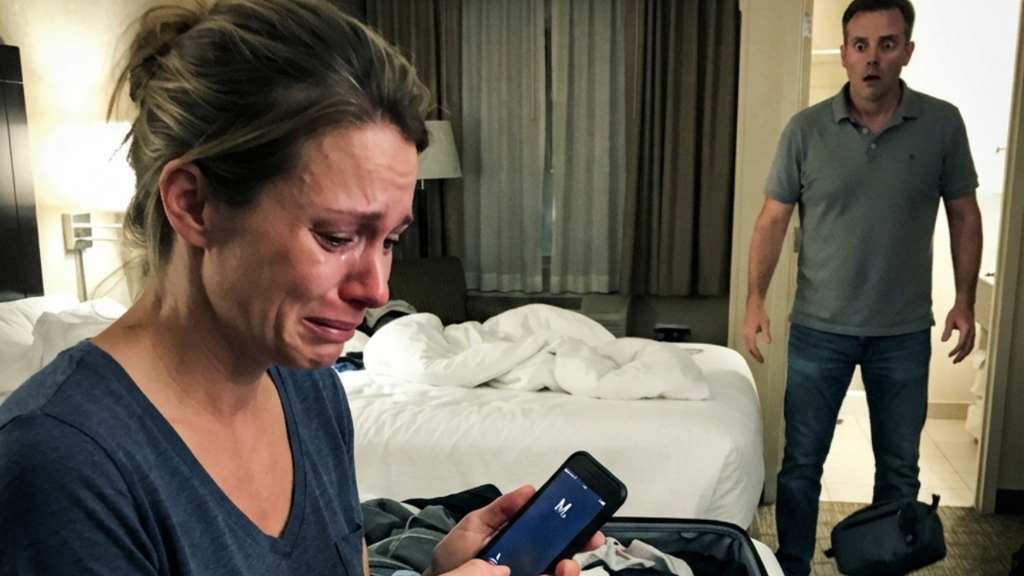
I found my husband’s second phone because a bottle of shampoo exploded in his suitcase. If that had not happened, I do not think I ever would have known it existed.
My husband travels constantly for work.
He has used the same black Samsonite suitcase for at least eight years.
I have packed it for him.
I have unpacked it.
I have complained about one wheel that sticks.
I have threatened to replace it every Christmas.
I thought I knew every pocket.
I did not know there was a phone sewn into the lining.
My name is Claire, I am fifty-four, and I have been married to my husband, Michael, for twenty-nine years.
Michael is fifty-six.
We have two children.
Our daughter, Emma, is twenty-six.
Our son, Ben, is twenty-three.
Michael works in commercial construction management.
His job has always involved travel.
Usually two or three nights.
Sometimes a week.
Occasionally longer.
I never loved it, but it was part of our life.
When the kids were young, I resented it.
As they got older, I adjusted.
Michael became incredibly predictable about travel.
Same suitcase.
Same toiletry bag.
Same packing routine.
He always called when he reached his hotel.
He usually texted before bed.
He brought me terrible airport gifts.
There was nothing about his travel that had ever made me suspicious.
The suitcase came home from Chicago on a Friday.
Michael had another trip scheduled for Monday.
Saturday morning, he went golfing.
I decided to wash some of his clothes and repack the suitcase so neither of us had to deal with it Sunday night.
When I opened it, I smelled shampoo.
A travel bottle had opened.
It had leaked underneath the fabric panel at the bottom.
I removed the panel.
There was shampoo underneath.
I wiped it.
Then I noticed the lining along one side looked strange.
Part of the seam was thicker.
At first, I assumed the shampoo had soaked into it.
I pressed it.
Something hard was inside.
I thought maybe a piece of the suitcase frame had broken.
I pushed again.
It was rectangular.
About the size of a phone.
I stared at it.
Then I found the stitches.
They were black.
Not factory stitching.
Someone had opened the seam and sewn it closed by hand.
I got small scissors from my sewing basket.
I cut three stitches.
Then I reached inside.
There was a phone.
It was an older iPhone.
Small.
Black.
No case.
It was wrapped in a thin plastic bag.
There was also a charging cable.
Nothing else.
I sat on the bedroom floor holding it.
My first thought was affair.
Of course it was.
I think most married people would think the same thing.
Secret phone hidden inside a suitcase used for business travel.
There are not many innocent explanations.
The phone was dead.
I plugged it in.
Then I waited.
Those five minutes felt like an hour.
When the screen finally came on, it asked for a six-digit passcode.
I tried Michael’s birthday.
Wrong.
Our anniversary.
Wrong.
Emma’s birthday.
Wrong.
Ben’s.
Wrong.
I stopped because I was afraid the phone would lock.
Then I noticed something.
There was no wallpaper.
Just the default black screen.
No notifications.
No preview messages.
No indication the phone had been used recently.
I turned it over.
There was a tiny label on the back.
A phone number.
I copied it down.
Then I put the phone on my dresser.
I spent the next two hours imagining every possible explanation.
Mistress.
Gambling.
Drugs.
Work fraud.
Pornography.
Some kind of financial problem.
A second family.
Every possibility was horrible.
None explained why he had physically sewn the phone into his suitcase.
If it were simply an affair phone, why not keep it in his desk?
His car?
His office?
Why hide it somewhere that required scissors to access?
Michael came home around one.
I had put the suitcase back together.
I left the phone plugged in on my dresser.
He walked into the bedroom.
He saw it.
He stopped.
I was sitting on the bed.
I watched his face.
I expected guilt.
Instead, I saw terror.
Not embarrassment.
Not the look of a man realizing his wife found messages from another woman.
He looked genuinely afraid.
He asked:
“Where did you get that?”
I said:
“Your suitcase.”
He stared at the phone.
Then he looked at the suitcase.
He saw the cut stitches.
He said:
“You shouldn’t have done that.”
That made me angry.
I asked whether he was seriously criticizing me for opening my own husband’s suitcase.
He said no.
Then he walked over and picked up the phone.
I told him to put it down.
He said:
“Claire, please.”
I asked whose phone it was.
He said his.
I asked why it was sewn into his suitcase.
He did not answer.
I asked whether he was having an affair.
He said no immediately.
I asked whether there was another woman.
No.
Another family.
No.
Then I asked what was on the phone.
He said nothing I needed to worry about.
I laughed.
I told him he had lost the right to decide what I needed to worry about when he stitched a secret phone into his luggage.
Then I asked him to unlock it.
He refused.
I told him to unlock the phone or leave.
He sat down.
He held the phone in both hands.
Then he said:
“If I show you, you have to promise me you won’t contact the person.”
That was the first time I realized there was a person.
I asked who.
He said:
“Promise me.”
I told him absolutely not.
He said then he could not show me.
I asked whether he understood what this looked like.
He said yes.
I told him I would assume the worst.
He said:
“The worst thing you’re imagining is probably easier than what this is.”
I remember that sentence exactly.
I asked him again to unlock it.
Finally, he did.
There were almost no apps.
Phone.
Messages.
Contacts.
Photos.
Notes.
Calculator.
Weather.
The basic apps that come with an iPhone.
No email.
No social media.
No banking.
No browser history.
No photographs.
Then I opened Contacts.
There was one.
Anna.
No last name.
Just Anna.
I looked at Michael.
I asked who Anna was.
He said:
“Someone I knew a long time ago.”
I opened the messages.
There were hundreds.
Maybe thousands.
The thread went back years.
I did not read from the beginning.
I started with the most recent.
Anna:
Did you make it home?
Michael:
Yes.
Anna:
Good.
Michael:
You okay?
Anna:
I’m always okay.
Michael:
That’s not an answer.
Anna:
It’s the only one you’re getting.
That was from Friday.
The day Michael came home from Chicago.
I looked at him.
I asked whether Anna lived in Chicago.
He said no.
I asked whether he saw her during the trip.
Yes.
I asked whether he slept with her.
No.
I did not believe him.
Then I scrolled.
A message from three weeks earlier:
Michael:
I can be there Thursday.
Anna:
Don’t change your trip because of me.
Michael:
I’m not.
Anna:
You always say that.
Michael:
Because it’s true.
Anna:
You have a life. Go live it.
Michael:
You’re part of my life whether you like it or not.
I looked at him.
I asked what that meant.
He said:
“Claire, you need context.”
I said I would love some.
He did not give it.
So I kept reading.
There were no romantic messages.
No sexual messages.
No photographs.
No “I love you.”
No pet names.
Most of it was strangely practical.
Doctor Tuesday at 11.
Did the landlord fix the heater?
I sent the money.
Don’t send anything else.
Did you pick up the prescription?
Call me when you get home.
I can come next month.
You don’t need to come.
Please answer.
Then I found one that made my stomach drop.
Anna:
She deserves to know.
Michael:
No.
Anna:
You said that twenty years ago.
Michael:
And I’m saying it now.
Anna:
You’re going to die someday and leave her with this.
Michael:
Then she’ll never know.
Anna:
You don’t get to decide that forever.
I asked:
“Who is she?”
Michael said nothing.
I asked whether they were talking about me.
He nodded.
I scrolled further.
Two years earlier.
Anna:
Did Emma get the job?
Michael:
Yes. She starts next month.
Anna:
Tell her congratulations.
Michael:
I can’t exactly say it’s from you.
Anna:
I know.
I stopped.
I asked how Anna knew our daughter.
Michael said she did not.
Then another message.
Anna:
Is Ben still seeing that girl?
Michael:
No. Apparently she was “emotionally exhausting.”
Anna:
He’s twenty-one. Everyone is emotionally exhausting at twenty-one.
Michael:
You would like him.
Anna:
Don’t.
Michael:
What?
Anna:
Don’t tell me things like that.
I looked at Michael.
I asked:
“Why does this woman know about our children?”
He said:
“Because I’ve told her about them.”
I asked why.
He said because she asked.
I asked who she was.
He would not answer.
I kept scrolling.
Five years earlier.
Anna:
Your mother called again.
Michael:
Don’t answer.
Anna:
She’s eighty-two.
Michael:
That’s not relevant.
Anna:
She wants to see me.
Michael:
No.
Anna:
You can’t stop her.
Michael:
Watch me.
His mother.
My mother-in-law, Judith.
Judith died three years ago.
I had known her for thirty-one years.
I looked at Michael.
I asked how his mother knew Anna.
He looked down.
I asked again.
He said:
“She knew her before you did.”
I said:
“Before I did what?”
He said:
“Before you met me.”
I stared at him.
Then I asked whether Anna was an ex-girlfriend.
He said no.
I asked whether she was family.
He did not answer.
That was the first moment I felt truly frightened.
I searched the message thread for Judith’s name.
There were dozens of results.
One from six years ago:
Anna:
Judith sent a birthday card.
Michael:
I’m sorry.
Anna:
Why are you sorry?
Michael:
Because I asked her not to.
Anna:
I wanted it.
Michael:
That’s not the point.
Anna:
Maybe not to you.
Another:
Michael:
Mom says you called her.
Anna:
She called me first.
Michael:
We agreed.
Anna:
You agreed. I stopped arguing. That’s different.
Another from four years ago:
Anna:
She said Claire seems kind.
Michael:
Do not talk about Claire with my mother.
Anna:
Why?
Michael:
Because I said so.
Anna:
You’re still terrified she’ll accidentally tell her.
Michael:
Yes.
I looked at him.
I said:
“Your mother knew.”
He nodded.
I asked whether anyone else knew.
He said his father had known.
His father died fifteen years ago.
I asked whether his brother knew.
Michael has an older brother named Steven.
He said no.
I asked whether my children knew.
No.
I asked whether Anna was related to him.
He said:
“Yes.”
My first thought was sister.
A secret sister.
Maybe Judith had a child before marriage.
Maybe his father had an affair.
I asked whether Anna was his sister.
Michael said no.
Then I asked whether she was his daughter.
He looked at me.
I knew.
I actually felt the room move.
I asked:
“Is Anna your daughter?”
He started crying.
Then he said yes.
I stood up.
I asked how old she was.
He said thirty-four.
I did the math.
Michael and I had been together thirty-one years.
Anna was born three years before I met him.
I should have felt relieved.
At least she was not the result of an affair during our marriage.
I did not feel relieved.
I asked why I had never heard of her.
He said it was complicated.
I told him I was beginning to hate that word.
Then he told me the story.
Michael was twenty-one when Anna was born.
Her mother was named Caroline.
They had dated for approximately a year.
Caroline became pregnant.
Michael panicked.
They were both young.
Neither had money.
Caroline wanted to keep the baby.
Michael said he would help.
Then, shortly before Anna was born, Caroline ended the relationship.
Michael claimed Caroline told him she wanted to raise the baby alone.
I asked whether he agreed.
He said not exactly.
His parents became involved.
Judith and Michael’s father wanted him to finish college.
They believed Caroline was unstable.
There were arguments.
Lawyers.
Then Michael said Caroline moved away when Anna was a baby.
I asked whether he paid child support.
He said yes.
I asked whether he saw Anna.
Sometimes.
Not regularly.
Then when Anna was five, Caroline married another man.
That man eventually adopted Anna.
I asked whether Michael consented.
Yes.
I stared at him.
He said he was twenty-six.
He had recently met me.
His relationship with Caroline was terrible.
He believed Anna would have a more stable life if her mother’s husband became her legal father.
I asked whether he told me any of this.
No.
I asked whether he had already signed away his parental rights when we met.
No.
That stopped me.
I asked when.
He said approximately eighteen months after we started dating.
I felt sick.
I had been dating a man who had a five-year-old daughter.
He never told me.
I asked whether he saw her while we were together.
He said twice.
I asked what he told me he was doing.
He could not remember.
I told him to try.
He said one time he told me he was visiting his parents.
The other time he told me he was seeing an old college friend.
I asked whether Judith knew he was hiding Anna from me.
Yes.
I asked why she went along with it.
He said she hated it.
She repeatedly told him to tell me.
He refused.
I asked why.
He said:
“I thought you’d leave.”
I almost laughed.
We had been together less than two years.
I asked why he assumed I would leave because he had a daughter.
He said because the situation was messy.
Caroline hated him.
There were legal fights.
He was ashamed.
He felt like a failure.
He thought I would see him differently.
So he kept waiting.
Then we got engaged.
Then telling me became harder.
Then he signed the adoption papers.
He convinced himself that Anna was no longer his responsibility.
Then we married.
Then Emma was born.
Then Ben.
Every year made the truth harder to tell.
I asked when he reconnected with Anna.
He said when she was eighteen.
She contacted Judith first.
Judith told Michael.
He initially refused to see her.
I stared at him.
I asked why.
He said because by then Emma was ten and Ben was seven.
He thought telling us would destroy the family.
I asked whether Anna knew he had other children.
Yes.
She found us online.
She knew about me.
She knew about Emma and Ben.
I asked whether she contacted him anyway.
Yes.
She wanted answers.
They met.
Michael said he expected to see her once.
Instead, they remained in contact.
I asked whether that was when he bought the phone.
No.
The phone came later.
At first, they communicated through email.
Then I almost saw a message.
Approximately fourteen years ago, I borrowed Michael’s laptop.
An email notification appeared from Anna.
I vaguely remembered it.
The subject line said something about photographs.
I asked who Anna was.
Michael told me she was a vendor.
I believed him.
After that, he created a separate email account.
Then eventually he bought a separate phone.
I asked how long he had been carrying a secret phone.
Eleven years.
I felt numb.
I asked why it had to be hidden inside his suitcase.
He said because he never wanted me or the kids to find it.
He kept it at his office for years.
Then his company moved buildings.
He started traveling more.
He realized the suitcase was the only thing that was almost always under his control.
So he opened the lining and put the phone inside.
I asked whether he removed it every time he traveled.
Yes.
He would take it out at the hotel.
Charge it.
Contact Anna.
Then put it back.
Sometimes he used it at the office.
Never at home.
Except apparently he had forgotten to remove it after Chicago because he was exhausted.
I asked why Anna was the only contact.
He said because the phone existed only for her.
Then I asked about the money.
The messages mentioned him sending money.
He said he had been helping her financially.
I asked how much.
He said not much.
I asked for a number.
He said approximately a thousand dollars a month.
I stared at him.
He immediately clarified that it was not every month.
Sometimes less.
Sometimes nothing.
Sometimes more.
I asked how long.
Approximately nine years.
I did the math in my head.
I asked whether he had sent her more than $100,000.
He said probably.
I stood up.
I asked where that money came from.
He said his personal account.
I told him we did not have personal money after twenty-nine years of marriage.
We had marital money.
He said he knew.
I asked what else he had paid for.
Medical bills.
A security deposit.
Part of a car.
Some college debt.
I asked whether he paid for her wedding.
He said she was not married.
I asked whether she had children.
He said no.
Then I asked the obvious question.
“Why didn’t she ever contact me?”
Michael said because he begged her not to.
I asked whether she wanted to.
Yes.
Repeatedly.
I asked whether she resented me.
He said no.
I asked whether she resented Emma and Ben.
He said absolutely not.
I asked whether she wanted a relationship with them.
He started crying again.
He said:
“Yes.”
I looked at the messages.
You would like him.
Don’t.
I understood now.
I asked whether she had ever seen them.
Michael said:
“Not exactly.”
That answer bothered me.
I asked what “not exactly” meant.
He said Anna had seen photographs.
I asked whether she had ever seen them in person.
He hesitated.
Then he admitted she had.
Once.
Emma’s college graduation.
I stopped breathing.
I asked whether Anna attended.
He said she stood at the back.
She did not approach anyone.
Michael had told her about the graduation.
She wanted to see her sister graduate.
He told her no.
She came anyway.
I tried to remember that day.
Hundreds of people.
Families everywhere.
I had no idea whether I had walked past her.
Whether Emma had.
Whether Anna had watched us take family photographs.
I asked whether Michael saw her.
Yes.
Afterward.
He told me he was going to the restroom.
He met Anna outside the arena for approximately five minutes.
Then he came back.
I remembered waiting for him.
I remembered being irritated because we were trying to make a dinner reservation.
I asked whether Anna had ever been near our home.
Michael said no.
Then he corrected himself.
Once.
I asked when.
Judith’s funeral.
Anna attended.
I had been there.
My children had been there.
I asked where she was.
He said toward the back of the church.
I tried to picture everyone.
There had been a woman I did not recognize.
Dark hair.
Maybe early thirties.
She hugged Michael after the service.
I asked him who she was.
He said she was the daughter of one of his mother’s old friends.
I stared at him.
“That was Anna?”
He nodded.
I felt sick.
My husband’s daughter hugged him at her grandmother’s funeral while I stood ten feet away believing she was a stranger.
I asked whether Judith had wanted us to know before she died.
He said desperately.
I asked why he stopped her.
He said he was afraid.
I told him he had been afraid for thirty years.
At some point, fear stopped being an explanation.
Then I picked up the phone again.
I searched the messages for my name.
There were hundreds.
Some were mundane.
Michael complaining that I wanted to repaint the kitchen.
Anna asking whether I liked a birthday gift.
Michael telling her I had gotten a promotion.
Then I found a conversation from three years ago.
Shortly before Judith died.
Anna:
She asked me again today.
Michael:
Asked what?
Anna:
If I want her to tell Claire.
Michael:
Jesus Christ.
Anna:
Don’t be angry at her.
Michael:
She promised me.
Anna:
She’s dying, Michael.
Michael:
I know.
Anna:
She doesn’t want to take it with her.
Michael:
It isn’t hers to tell.
Anna:
Maybe it should have been hers twenty-five years ago when you refused.
Then Michael:
If Claire finds out now, she’ll never forgive me.
Anna:
That isn’t a reason she shouldn’t know.
Michael:
Easy for you to say.
Anna:
No, it isn’t.
Then:
I’m the one who has spent my whole life being your secret.
I had to stop.
I looked at Michael.
I asked whether he understood what he had done to her.
He said yes.
I asked whether he really did.
This was not simply a secret he kept from me.
He had required his own daughter to participate in hiding her existence.
She could not contact her siblings.
She could not attend family events openly.
She could not acknowledge her grandmother at a funeral without pretending to be someone else’s child.
Michael said:
“I know.”
I asked whether Emma and Ben knew they had a sister.
No.
I asked whether Anna’s adoptive father was still alive.
Michael said yes.
I asked whether Anna was close to him.
He said very.
I asked about Caroline.
Michael looked away.
He said Caroline died eight years ago.
I asked whether he went to the funeral.
Yes.
I asked what he told me.
He said it was a work trip.
I felt exhausted.
Every answer created another lie.
Then I asked why he had seen Anna in Chicago.
He said she was sick.
I asked what was wrong.
He said:
“That’s hers to tell you.”
I stared at him.
I said:
“Tell me.”
He refused.
I asked whether she was seriously ill.
He said yes.
I asked whether she was dying.
He started crying.
That was enough.
I asked what she had.
He said ovarian cancer.
Stage three.
She had been diagnosed approximately seven months earlier.
I sat down.
I asked whether she was receiving treatment.
Yes.
Surgery.
Chemotherapy.
She had finished one round and recently learned there was still evidence of disease.
Michael had been arranging work trips around her appointments.
Chicago had not been a work trip.
Not really.
He had scheduled one client meeting there because Anna was receiving treatment at a hospital nearby.
I asked whether his company knew.
No.
I asked whether anyone knew.
Her adoptive father.
A few friends.
Her doctors.
Michael.
Not me.
Not her siblings.
I looked back at the messages.
She deserves to know.
I had assumed Anna meant I deserved to know about her.
Maybe she meant something else too.
I asked whether Anna wanted to tell us because she was sick.
Michael said yes.
She had been asking for months.
She wanted to meet Emma and Ben.
She wanted to meet me.
Michael kept telling her to wait until treatment was over.
Anna told him that was exactly the problem.
There might not be an “after.”
I asked:
“And you were still going to keep her secret?”
He said he had been trying to figure out how to tell me.
I asked when.
Next week?
Next year?
At her funeral?
He cried.
I did not comfort him.
Then I picked up the phone.
I opened Anna’s contact.
Michael reached for it.
I pulled it away.
He said:
“Claire, don’t.”
I asked why.
He said she was vulnerable.
I said she had been asking him to tell me.
He said she did not want to find out this way.
I said neither did I.
Then I noticed something about the number.
The area code was familiar.
Not Chicago.
Our area.
I looked at Michael.
I asked where Anna lived.
He did not answer.
I asked again.
He said she had moved.
I asked where.
He said:
“About twenty minutes from here.”
I stared at him.
I asked when.
Two years ago.
I asked why.
He said her adoptive father had moved back to the area after retirement.
Anna came with him.
I asked whether Michael knew before she moved.
Yes.
I asked whether he helped her find somewhere to live.
Yes.
I asked whether the security deposit he mentioned was for an apartment twenty minutes from our house.
Yes.
I asked how often he saw her.
Once or twice a month.
Sometimes more.
I asked whether that was why he had started “working late” more often.
Sometimes.
I asked whether he had been lying about business travel to see her.
Occasionally.
Then I asked where she lived.
He refused to tell me.
I said:
“Michael, I am not asking because I want to hurt her.”
He said he knew.
I asked whether he understood that Anna had done nothing wrong.
He looked surprised.
I told him she was five years old when he decided to erase her from the life he was building with me.
She was eighteen when she came looking for answers.
She was the person in those messages repeatedly telling him I deserved the truth.
I was angry at him.
Not her.
Michael started crying harder.
Then I asked for her address.
He said he wanted to call her first.
I said no.
I did not want him controlling this conversation too.
He had controlled every connection between us for thirty years.
He controlled what I knew.
He controlled what Anna knew about me.
He controlled what Judith could say.
He controlled whether Emma and Ben knew they had a sister.
He did not get to manage the introduction now.
I took the phone into the bathroom and locked the door.
Michael knocked.
I ignored him.
Then I opened the message thread.
I typed:
Anna, this is Claire. I found the phone.
I stared at the words for almost a minute.
Then I sent them.
The typing bubble appeared almost immediately.
Disappeared.
Appeared again.
Disappeared.
Then my husband’s thirty-four-year-old daughter, a woman whose existence he had hidden from me for almost my entire adult life, sent me four words.
He finally told you?
I wrote:
No. I found you.
There was no response for almost five minutes.
Then:
I’m so sorry.
That broke something in me.
She was apologizing to me.
I wrote:
You have nothing to apologize for.
Another long pause.
Then she sent:
I don’t know what he’s told you about me.
I replied:
Not enough.
She asked whether Michael was there.
I said yes.
Then she wrote:
Can I call you?
I stared at the screen.
My husband was still outside the bathroom door.
I could hear him pacing.
I typed:
Yes.
The phone rang.
I answered.
For a few seconds, neither of us spoke.
Then a woman said:
“Claire?”
Her voice shook.
I said yes.
She started crying.
So did I.
Then she said:
“I’ve wanted to talk to you for sixteen years.”
I asked why sixteen.
Michael told me they reconnected when she was eighteen.
Anna went quiet.
Then she said:
“We didn’t reconnect when I was eighteen.”
I felt my stomach tighten.
I asked what she meant.
She said:
“I’ve never lost contact with him.”
I did not understand.
She continued.
“My mom never took me away from him. He never disappeared from my life.”
I stopped breathing.
Outside the bathroom door, Michael knocked again.
I asked Anna to repeat herself.
She said Michael had seen her throughout her childhood.
Not constantly.
But regularly.
Birthdays.
Christmases.
School events.
Weekends.
Judith and Michael’s father saw her too.
Michael paid support.
He attended her eighth-grade graduation.
He helped teach her to drive.
He met her first boyfriend.
He was there when she graduated from high school.
I said:
“He told me your stepfather adopted you when you were five.”
Anna said:
“He did.”
I asked whether that ended Michael’s involvement.
She said:
“No.”
Then she started crying harder.
She said the adoption had never been about replacing Michael.
Her stepfather loved her and wanted to become her legal parent because he was raising her full time.
Michael agreed.
But Michael remained in her life privately.
I asked why privately.
Anna was quiet.
Then she said:
“Because of you.”
I sat on the bathroom floor.
I asked what she meant.
She said when Michael started dating me, he told Caroline he was finally getting his life together.
He told her I came from a stable family.
He was afraid that if I knew he had a child from a chaotic previous relationship, I would leave.
So he asked Caroline not to contact him at home.
Then he asked Judith not to mention Anna around me.
Then we got engaged.
Then it became permanent.
But Michael never actually stopped being Anna’s father.
He simply created two versions of himself.
The man I married.
And Anna’s father.
For almost thirty years, those lives had run beside each other without touching.
I asked Anna whether she knew about me when she was a child.
She said yes.
She knew my name.
She knew when Michael married me.
She knew when Emma was born.
She knew when Ben was born.
I asked what Michael told her about why she could not meet us.
Anna was silent for so long I thought the call dropped.
Then she said:
“He told me you knew about me.”
I felt cold.
I asked what.
She said Michael told her I knew he had a daughter.
He told Anna I was uncomfortable with her being part of our family.
I could not speak.
Anna continued.
When she was little, Michael explained that I was not ready.
When she got older, he told her I had asked him to keep the families separate.
When Emma and Ben were born, he told Anna I was worried that introducing an older half-sister would confuse them.
I said:
“I didn’t know you existed.”
Anna started sobbing.
I pressed my hand over my mouth.
Outside the bathroom, Michael stopped pacing.
I think he heard me.
I asked Anna when she learned I did not know.
She said she was eighteen.
That part was true.
When she was eighteen, she became angry.
She wanted to meet Emma and Ben.
Michael kept saying no.
Finally, she threatened to contact me herself.
Michael panicked.
That was when he admitted I had never known about her.
Anna said:
“I hated you for years.”
I closed my eyes.
She said she grew up believing I was the woman keeping her father away from her siblings.
She thought I knew she existed and wanted nothing to do with her.
She thought every Christmas Michael spent with us instead of her was partly because I demanded it.
She thought every family photograph she eventually found online was evidence that I had gotten the version of her father I wanted while she was hidden.
Then at eighteen, she learned I had never made any of those choices.
Michael had made them for both of us.
I asked whether that was why she wanted to contact me.
She said yes.
She wanted to apologize for hating me.
She wanted to tell me the truth.
Michael begged her not to.
He told her revealing everything would destroy Emma and Ben’s family.
Anna was eighteen.
Her siblings were ten and seven.
She agreed to wait.
Then one year became two.
Then five.
Then ten.
Michael kept finding new reasons.
Emma was struggling in high school.
Ben was having anxiety about college.
I was dealing with my mother’s illness.
Judith was sick.
There was always something.
Anna said:
“I let him make me feel like telling the truth would be something I was doing to all of you.”
I told her he had done the same thing to me in reverse.
He made decisions for everyone and called it protection.
Then I asked about the phone.
Anna said she hated it.
She hated being one contact on a secret phone.
She told Michael repeatedly to use his normal number.
He refused.
She said:
“I told him it made me feel like an affair.”
That sentence made me cry.
Because that was exactly what I had assumed when I found the phone.
Not a daughter.
A mistress.
Michael had hidden his own child using the same methods people use to hide adultery.
I asked whether she really lived twenty minutes away.
Yes.
I asked whether she wanted to meet me.
She said:
“More than anything.”
Then she immediately added:
“But you don’t owe me that.”
I said:
“I think we both owe ourselves that.”
We agreed to meet the next morning.
Not at her apartment.
Not at my house.
A coffee shop.
Then Anna said:
“Claire, there’s something else.”
I almost laughed.
I said of course there was.
She told me Michael had not been completely honest about her cancer either.
I asked what he left out.
Anna said the diagnosis was serious.
But that was not why she had become so insistent about meeting us.
She had undergone genetic testing because of the ovarian cancer.
The results showed a hereditary mutation.
Her doctors recommended that close biological relatives be informed because it could affect their own screening decisions.
Emma was her half-sister.
I felt cold.
I asked whether Michael knew.
Yes.
For seven months.
I asked whether he told Emma.
No.
I asked whether he intended to.
Anna said that was the argument they had been having.
The messages I read.
She deserves to know.
They had not only been about me.
They were about Emma.
Anna had been begging Michael to tell his twenty-six-year-old daughter that her biological half-sister had a potentially relevant hereditary cancer finding.
Michael kept refusing because telling Emma would require explaining who Anna was.
I unlocked the bathroom door.
Michael was standing outside.
I still had Anna on the phone.
I looked directly at him.
Then I asked:
“You knew there could be medical information Emma needed?”
His face changed.
He said:
“Claire, the doctors said—”
I interrupted him.
I asked whether he knew.
He said yes.
I asked whether he had told our daughter.
No.
I asked whether he planned to.
He said he was going to.
I asked when.
He did not answer.
Anna was crying through the phone.
I looked at the man I had been married to for twenty-nine years.
For the first time, the secret stopped feeling like something from his past.
He had always defended himself by saying he was ashamed of a decision he made when he was young.
He had been twenty-six when he hid his daughter from me.
He had been thirty-eight when he bought the secret phone.
He had been fifty-three when his mother begged him to tell me before she died.
And he was fifty-six when he learned information that might matter to Emma’s health and still decided protecting his secret came first.
That was not a frightened twenty-one-year-old.
That was my husband.
Anna said my name.
I lifted the phone back to my ear.
She said:
“I’m sorry you found out like this.”
I told her again that she had nothing to apologize for.
Then she said something I will never forget.
“I think we’ve both spent most of our lives apologizing for decisions he made for us.”
Michael sat down.
I told Anna I would see her tomorrow.
Then I ended the call.
I looked at my husband.
I put his secret phone on the kitchen counter between us.
For eleven years, that phone had contained exactly one contact.
I had thought that meant Michael was protecting one relationship from me.
I was wrong.
He had been using it to keep an entire family separated.
And the next morning, for the first time in thirty-one years, he was not going to be the person deciding what his wife and his oldest daughter were allowed to know about each other.
Michael asked if he could come with me.
I said no.
He asked if I would at least let him call Anna first.
I said no again.
Then he said he did not think it was fair for the two of us to compare stories without him there to explain.
I stared at him.
I asked whether he heard himself.
For almost thirty years, he had been the only person allowed to compare stories.
He told me one version.
He told Anna another.
He told his parents whatever kept them quiet.
He told Caroline whatever kept the arrangement functioning.
He had positioned himself in the middle of every relationship so nobody could speak directly without going through him.
Now the two people he had lied to the longest were finally going to sit in the same room, and suddenly he was concerned about fairness.
I told him he was staying somewhere else that night.
He did not argue.
Before he left, he asked what I planned to tell Emma and Ben.
I said the truth.
He asked me to wait until after I met Anna.
I agreed to that much.
Not for him.
For Anna.
I wanted to understand what had actually happened before I brought our children into it.
Michael packed a bag.
As he was leaving, he stopped beside the kitchen counter and looked at the second phone.
He asked whether I wanted him to take it.
I said no.
He said it belonged to him.
I said technically so did half the furniture, and he could argue about property later.
He left without it.
I barely slept.
I read messages for hours.
Now that I understood who Anna was, everything looked different.
There were conversations about birthdays.
Michael:
Package should arrive Tuesday.
Anna:
You don’t have to keep buying me things.
Michael:
I’m your father. I’m allowed to buy you a birthday present.
Anna:
Then put your name on the card.
Michael:
Anna.
Anna:
Exactly.
There were photographs in the message thread even though the photo library itself had been emptied.
Anna standing beside a Christmas tree.
Anna holding a college diploma.
Anna with an older man I assumed was her adoptive father.
Anna in a hospital bed.
Anna without hair.
Then I found photographs she had sent Michael of our children.
Screenshots from social media.
Emma at prom.
Ben playing baseball.
Our family at Christmas.
At first, that made me uncomfortable.
Then I read the messages around them.
Anna:
Emma looks like Judith.
Michael:
I’ve always thought that.
Anna:
Do you think she’d hate me?
Michael:
No.
Anna:
Then why can’t I meet her?
Michael:
Because it isn’t that simple.
Anna:
It is to me. She’s my sister.
Another from years later:
Anna:
Ben graduated?
Michael:
Yesterday.
Anna:
I thought it was next week.
Michael:
I gave you the wrong date. I’m sorry.
Anna:
You did that on purpose.
Michael:
I knew you’d want to come.
Anna:
I wouldn’t have approached them.
Michael:
I couldn’t risk it.
Anna:
You mean you couldn’t risk me.
I put the phone down.
I had spent one day feeling like my husband had hidden a daughter.
Anna had spent her entire life being treated as something that needed to be hidden.
That distinction mattered.
The next morning, I arrived at the coffee shop twenty minutes early.
Anna was already there.
I knew her immediately.
That surprised me.
I had never seen a clear photograph of her until the night before, but there was something unmistakably Michael about her.
Not enough that I would have identified her as his daughter if I passed her on the street.
But once I knew, I could not unsee it.
Same eyebrows.
Same way of pressing her lips together when nervous.
Same habit of rubbing her thumb against the side of her index finger.
Michael did that constantly.
She stood when she saw me.
For a second, neither of us knew what to do.
Then she said:
“Hi.”
I said hi.
She asked if she could hug me.
I said yes.
She hugged me.
Then she immediately stepped back and apologized.
I told her to stop apologizing.
She laughed through tears and said she would try.
We sat down.
For the first ten minutes, we barely discussed Michael.
I asked how she was feeling.
She said treatment was miserable but she was functioning.
She had another surgery being discussed.
Her doctors were optimistic about some things and cautious about others.
She did not want to turn the conversation into a medical appointment.
I respected that.
Then I asked about her adoptive father.
His name was Robert.
He had married Caroline when Anna was four.
Anna called him Dad.
Michael was Michael.
That alone told me more than Michael had.
Robert had never tried to erase Michael.
In fact, according to Anna, Robert was one of the people who repeatedly told Michael that keeping me in the dark was wrong.
I asked why Robert agreed to participate.
Anna said because when she was young, everyone convinced themselves it was temporary.
Michael would tell me when the timing was better.
After the wedding.
After the honeymoon.
Before we had children.
After Emma was born.
When Emma was old enough to understand.
After Ben was born.
When both children were older.
There was always another milestone.
Then years passed.
By the time Anna understood what was happening, the adults had already normalized it.
I asked whether Caroline hated Michael.
Anna smiled sadly.
She said Caroline had been furious with him for years.
But not because he abandoned Anna.
Because he refused to acknowledge her publicly.
That was another difference.
Michael had made Caroline sound like the person who pushed him out.
According to Anna, Caroline repeatedly invited him in.
She sent school schedules.
She told him about recitals.
She encouraged him to visit.
Michael came when he could do so without disrupting the life he had with me.
I asked whether he ever brought me up.
Constantly.
Anna knew ridiculous things about me.
She knew I hated olives.
She knew I taught fourth grade before becoming a reading specialist.
She knew I had broken my ankle when I was forty-one.
She knew I loved old houses.
She knew my mother made terrible stuffing.
I laughed at that.
Then I realized how strange it was.
This woman knew decades of details about me.
I had learned her name yesterday.
I asked whether she had photographs of Michael with her.
She unlocked her phone.
There were hundreds.
Not thousands.
But hundreds.
Michael at her sixth birthday.
Michael at a park when she was nine.
Michael standing beside a teenage Anna holding a learner’s permit.
Michael at her high school graduation.
Michael helping her move into college.
Michael at dinner with Caroline and Robert.
Michael beside Judith at what looked like a Christmas celebration.
I stopped at that one.
I recognized the sweater Michael was wearing.
I had bought it.
I remembered that Christmas.
Michael told me he needed to visit his parents alone on December 23 because his father needed help with something.
I stayed home with Emma and Ben.
He spent part of that day celebrating Christmas with his daughter.
I asked Anna whether she remembered.
She did.
She said Judith insisted on having everyone together.
I asked whether Michael stayed long.
Approximately three hours.
Then he went home to us.
I kept scrolling.
There were photographs from years when I thought he was on work trips.
There were restaurant meals.
Graduations.
Birthdays.
One photograph showed Anna wearing a white dress.
I stopped.
I asked whether she had been married.
She said no.
It was her college graduation party.
I looked closer.
Michael had his arm around her.
Judith stood on the other side.
I asked whether Michael’s brother Steven had really never known.
Anna said no.
Judith and her husband hid it from him too.
That stunned me.
I asked why.
Anna said Michael was terrified information would reach me.
The fewer people who knew, the safer the secret was.
I asked whether Anna understood how bizarre that was.
She said:
“I grew up inside it, so it took me a long time.”
Then I asked the question I was afraid to ask.
“Did he ever tell you I didn’t want you?”
Anna’s eyes filled.
She nodded.
Not exactly in those words.
He never said I hated her.
He said I was insecure about Caroline.
He said I worried Anna’s presence would complicate our marriage.
He said I wanted clear boundaries between his past and our family.
He said I was not ready for Anna to meet Emma.
Then Ben.
Then either of them.
I asked whether she believed him.
She said:
“I was a kid. Why wouldn’t I?”
I had no answer.
Anna said she spent years trying to understand what was wrong with her.
She knew Michael loved her.
He told her constantly.
He showed up.
He called.
He paid for things.
He remembered birthdays.
Yet she was apparently the one person he could not bring home.
She thought I must see her as a threat.
Then, when she was eighteen, she told Michael she was going to contact me.
He finally admitted the truth.
Anna said:
“I think that was the first time I understood that adults can build an entire reality around a lie and live inside it so long they stop noticing how insane it is.”
I asked whether she hated him.
She said no.
Then she said sometimes.
Then she laughed.
I understood.
I asked whether she wanted a relationship with Emma and Ben.
She said yes.
But she was terrified.
She worried they would think she had participated willingly.
I told her I would make sure they understood.
Then I asked about the hereditary mutation.
Anna explained what she knew without pretending to be a doctor.
Her oncology team had recommended informing biological relatives who might be affected so they could discuss their own family history and appropriate genetic counseling or testing with their clinicians.
Michael knew that.
Anna had given him copies of the relevant information.
He kept saying he needed time.
I asked how long ago.
Seven months.
That was the part I could not forgive.
Not because I had forgiven anything else.
But because Michael could no longer claim he was only protecting feelings.
Once there was potentially relevant medical information for Emma, the secret had consequences beyond embarrassment and family conflict.
Anna agreed.
She said that was why their relationship had deteriorated.
She told him she would contact Emma herself if he did not.
Michael begged her to wait.
Then Anna’s treatment became harder.
She delayed.
I asked why she had not simply contacted me.
She said:
“Because every time I was about to, I thought about what he told me when I was eighteen.”
I asked what.
“He said if I told you, you might leave him, and Emma and Ben would blame me for destroying their family.”
I closed my eyes.
There it was again.
Michael had made everyone responsible for protecting his marriage except himself.
His parents.
Caroline.
Robert.
Anna.
Eventually even his sick daughter.
Everyone had to carry the burden of what would happen if I learned the truth.
Everyone except the person who created the lie.
I asked Anna whether she would come home with me.
She looked startled.
I clarified that I wanted to tell Emma and Ben.
I wanted Anna there if she wanted to be.
She said she did.
Then she asked whether Michael would be there.
I said no.
I called both children.
Emma lived about forty minutes away.
Ben lived almost two hours away.
I told them there was something important I needed to tell them in person.
Ben drove home.
By three that afternoon, both were sitting in my living room.
Anna waited in the kitchen.
I did not want their first introduction to happen before they understood who she was.
I told them their father had another daughter.
Emma thought I meant an affair.
She immediately asked how old the child was.
I said thirty-four.
She looked confused.
I explained that Anna was born before I met Michael.
Then I told them I had never known.
Ben asked whether Michael knew.
I said yes.
He had always known.
Then I explained the rest.
Not every detail.
Enough.
He remained involved in Anna’s life.
He hid her from me.
He told Anna I knew.
He told Anna I did not want the families mixed.
He used a secret phone to communicate with her.
He had been seeing her throughout our marriage.
Emma looked stunned.
Then she asked:
“So I have a sister?”
I said yes.
Ben asked whether Michael had other children.
I said as far as I knew, no.
Then Emma asked where Anna was.
I said:
“In the kitchen.”
Neither spoke.
I asked whether they wanted to meet her.
Emma started crying.
She nodded.
Ben said yes.
I went into the kitchen.
Anna was crying too.
I took her hand.
We walked into the living room.
Emma stood.
For a second, she just stared at Anna.
Then she laughed through tears.
She said:
“You look like Dad.”
Anna laughed too.
She said:
“Unfortunately.”
That broke the tension.
Emma hugged her.
Anna cried into her shoulder.
Then Ben hugged her.
Nobody knew what to say.
There is no normal conversation for meeting your adult sibling because your father concealed her existence for your entire life.
Eventually Emma asked whether Anna had known about them.
Anna said yes.
She apologized.
Emma immediately told her not to.
Then Anna explained what Michael had told her growing up.
Emma became furious.
Not at Anna.
At Michael.
She asked:
“He made you think Mom didn’t want you?”
Anna nodded.
Emma looked at me.
Then she said:
“That is so messed up.”
It was.
Then Anna told them about her cancer.
The room changed.
Emma sat beside her.
Anna explained the genetic finding and said she did not want to scare anyone.
She only wanted Emma to have the information so she could discuss it with her doctor or a genetic counselor and decide what was appropriate.
Emma asked how long Dad had known.
Seven months.
That was when Ben stood up.
He walked outside.
I followed him.
He was pacing in the driveway.
He asked whether Michael had really known for seven months.
I said yes.
Ben said:
“He would rather risk Emma not knowing something important than admit he lied?”
I told him I could not speak for Michael’s reasoning.
Ben said:
“That’s what he did.”
I could not argue.
Then Michael’s truck turned onto our street.
I had not invited him.
He pulled into the driveway.
Ben stared at him.
Michael got out.
He saw Ben.
Then he saw me.
He asked whether Anna was there.
I said yes.
He looked furious.
Not screaming furious.
Controlled furious.
He said:
“You had no right to bring her here without talking to me.”
Ben laughed.
It was an ugly sound.
He said:
“You’ve got to be kidding.”
Michael looked at him.
Ben asked:
“How long were you going to wait to tell Emma?”
Michael said:
“Ben, you don’t understand.”
Ben said:
“Then explain it.”
Michael tried.
He said he had been talking to doctors.
He said hereditary risk was complicated.
He said Anna’s result did not automatically mean anything about Emma.
All technically reasonable statements used for an unreasonable purpose.
I told him none of that justified withholding the existence of her biological half-sister.
Then the front door opened.
Anna stepped outside.
Michael looked at her.
He said:
“You shouldn’t be here.”
Anna went completely still.
I watched her face.
Michael realized immediately how it sounded.
He said:
“That’s not what I mean.”
Anna said:
“It’s exactly what you’ve meant for thirty-four years.”
Michael started toward her.
She stepped backward.
He stopped.
Anna told him she was done.
She said she loved him.
She probably always would.
But she was done being managed.
She was done having meetings in hotels.
She was done pretending not to recognize relatives at funerals.
She was done using a phone number nobody else knew.
She was done receiving Christmas gifts she could not post photographs of because someone might ask who sent them.
She was done being told that telling the truth would hurt everyone.
Then she said:
“You already hurt everyone. You just made me help you hide it.”
Michael cried.
Emma came outside.
Then Michael saw her standing beside Anna.
I watched something collapse in his face.
His daughters.
Together.
The thing he had spent twenty-six years preventing.
Emma asked why.
Michael said he was ashamed.
She asked whether he was ashamed of Anna.
He said absolutely not.
Anna looked away.
Emma asked:
“Then why did you treat her like something shameful?”
Michael had no answer.
Then Ben asked whether Michael had ever planned to tell them.
Michael said yes.
When?
He did not know.
Emma said:
“You’re fifty-six.”
Michael said he knew.
She said:
“Grandma died without getting to acknowledge her own granddaughter in front of us.”
Michael started crying harder.
Then Anna corrected her gently.
Judith had acknowledged Anna privately.
She loved her.
She had been part of her life.
Emma looked at Michael.
That somehow made her angrier.
She said:
“So Grandma knew my sister, and I didn’t.”
Yes.
Emma asked whether Grandpa knew.
Yes.
Then she asked whether Michael understood that he had taken relationships from them that could never be recovered.
Judith was dead.
Michael’s father was dead.
Caroline was dead.
There were people who knew the entire story and could have answered questions.
Now they were gone.
Michael said he understood.
Emma told him he did not.
Then she went back inside.
Michael looked at me.
He asked whether I was going to leave him.
I said yes.
He closed his eyes.
I had not actually said the words until then.
But the moment I did, I knew.
There was no path back.
Not because Michael had a daughter before he met me.
That would never have made me leave.
I told him that.
If twenty-nine-year-old Michael had sat me down and said he had a little girl from a previous relationship, I would have asked questions.
I might have been overwhelmed.
Maybe Caroline and I would not have liked each other.
Maybe blending everything would have been messy.
But I loved him.
I would not have rejected a child for existing.
He never gave me the opportunity to prove that.
Instead, he invented a version of me who would reject Anna.
Then he handed that fictional woman to his daughter and let her hate me.
He invented a version of Anna who had disappeared from his life and handed that story to me.
He kept us separated because each lie protected the other.
Michael said he knew.
I told him the cancer issue was what ended any possibility of me viewing this as an old mistake.
He had received new information seven months ago.
He made the same choice again.
He chose secrecy.
Again.
He asked whether I would reconsider after things settled down.
I said no.
Then I told him to leave.
This time, he did.
Anna stayed for dinner.
That sentence still feels bizarre.
My husband’s daughter stayed for dinner.
My children’s sister sat at my kitchen table.
We ordered pizza because nobody had the emotional capacity to cook.
For the first hour, everyone asked questions.
Then something surprising happened.
The conversation became normal.
Emma and Anna discovered they watched the same terrible reality show.
Ben asked Anna about a tattoo on her wrist.
Anna made fun of Michael’s obsession with loading a dishwasher “correctly.”
All three children realized he had given them the same lecture about credit cards.
They laughed.
Then Emma started crying again.
She said:
“We could have had this.”
Nobody knew what to say.
Anna finally said:
“We have it now.”
I think that was the right answer.
Not because it erased anything.
It did not.
They lost years.
Anna lost an entire childhood with siblings she knew existed.
Emma and Ben lost the opportunity to know their sister as children.
I lost the opportunity to know the truth about the man I married.
But there was nothing any of us could do with the missing years except acknowledge them.
Over the next few weeks, more truth came out.
Not dramatic new secrets.
Details.
Those were almost worse.
Michael had kept a small storage box at his office containing Anna’s childhood photographs, cards, and school pictures.
He could not keep them at home.
Judith had left Anna several pieces of jewelry in her will, but the official will described them vaguely as gifts to a “family friend” because Michael did not want Steven or me asking questions.
Michael had attended Anna’s college graduation by telling me he was at a conference.
He had helped pay part of her tuition from bonuses I thought were being deposited into retirement savings.
The amount of money was significant.
Not enough to financially ruin us.
Enough that I should have known.
I contacted an attorney.
I began gathering financial records.
Michael moved into a furnished apartment.
Emma and Ben barely spoke to him.
I encouraged them not to make permanent decisions while everything was fresh.
I did not defend him.
I simply did not want my anger to become instructions for their relationships.
Anna continued treatment.
I went with her to one appointment when Robert could not.
That was when I met him.
He hugged me.
Then he apologized.
Apparently everyone in this story believed they owed me an apology except the person I blamed least.
Robert said he had pushed Michael to tell me for years.
I asked why he never contacted me himself.
He said because Anna was not his secret to reveal.
He also worried that overriding Michael could hurt Anna.
He admitted that in hindsight, everyone had spent too much time respecting Michael’s boundaries and not enough time asking whether those boundaries were ethical.
I appreciated that.
I also met Caroline’s sister.
She brought photographs.
One was of Anna at seven.
She was missing her front teeth.
Michael was kneeling beside her holding a birthday cake.
The date was written on the back.
I remembered that day.
It was the weekend of our anniversary.
Michael told me he had to help his father with a plumbing emergency.
He came home that evening carrying flowers for me.
I sat in my car afterward and cried.
Not because he went to his daughter’s birthday.
He should have been there.
I cried because he believed being a father to Anna required lying to his wife.
He had created a conflict where none needed to exist.
That became the central tragedy of the entire thing.
Michael kept telling everyone he was trying to protect two families.
There never needed to be two families.
There could have been one complicated family.
Anna did not need to live with us.
Caroline did not need to become my friend.
Robert did not need to become part of every holiday.
But Emma and Ben could have known they had a sister.
Judith could have displayed Anna’s photograph without hiding it before we visited.
Michael could have gone to birthdays without inventing plumbing emergencies.
Anna could have called her father on Father’s Day without using a secret number.
I could have known who I married.
The secrecy created the disaster Michael claimed secrecy was preventing.
Approximately a month after I found the phone, Anna asked if she could come over alone.
She brought a box.
Inside were letters.
Dozens.
All addressed to me.
None sent.
She had written the first when she was nineteen.
Dear Claire,
She had started.
Then crossed it out.
Another when she was twenty-two.
Another at twenty-five.
Another after Judith died.
The most recent was written after her diagnosis.
I asked why she kept them.
She said she thought eventually Michael would tell me, and then maybe she would give them to me.
I read the most recent one.
She wrote that she did not want anything from me.
She did not want money.
She did not want to replace anyone.
She did not expect me to consider her family.
She only wanted me to know that she had never asked Michael to lie.
Then she wrote:
I have spent most of my life being afraid you would hate me for existing, and I recently realized you were never even given the chance to know I existed.
I cried.
Anna did too.
Then I asked whether she wanted to know something embarrassing.
She said yes.
I told her that when I found the phone, I thought she was Michael’s mistress.
Anna laughed so hard she started coughing.
I felt terrible.
She waved me off.
Then she said:
“I told him that phone made me look like one.”
I laughed too.
It was the first time any part of this had been funny.
Then she asked what happened to the phone.
I still had it.
I brought it downstairs.
We put it on the kitchen table.
The same place I had confronted Michael.
Anna picked it up.
She opened her own contact.
One name.
Anna.
She stared at it.
Then she said:
“Can I do something?”
I said yes.
She deleted her contact.
Then she turned the phone off.
She handed it to me.
I asked what I was supposed to do with it.
She said:
“Throw it away.”
I did not.
I kept it.
Not because I wanted evidence.
My attorney had everything relevant.
I kept it because that phone explained my marriage better than almost anything else.
One device.
One contact.
A relationship Michael believed needed an entirely separate channel because he could not tolerate his worlds touching.
But his worlds have touched now.
Emma has Anna’s normal phone number.
So does Ben.
So do I.
Anna has been to my house several times.
She and Emma went to lunch without me.
Ben helped Robert move a piece of furniture.
None of this is magically comfortable.
There are moments when I look at Anna and see thirty years of my husband’s lies.
I hate that reaction because it is not her fault.
There are moments when Anna looks at photographs of Emma and Ben as children and gets quiet.
There are moments when Emma becomes angry because Anna remembers a version of their father she never knew existed.
There are moments when Ben does not want to discuss any of it.
We are figuring it out.
Slowly.
Michael asked Anna whether he could visit during her next treatment.
She told him no.
Not forever.
Just not yet.
She told him she needed one part of her life where she was not managing his guilt.
I respected that.
He asked me once whether I thought Anna would forgive him.
I told him that was between them.
Then he asked whether I would.
I told him forgiveness and marriage were separate questions.
Maybe someday I will forgive him.
I am still divorcing him.
He cried.
I did not change my mind.
The strangest thing is that Michael spent almost thirty years believing the truth would destroy his family.
When the truth finally came out, our family did change.
My marriage ended.
My children were furious.
Anna was furious.
There were arguments and lawyers and tears.
There were questions nobody could answer.
It was painful.
But something else happened too.
My children gained a sister.
Anna stopped being a secret.
She can call Emma without asking permission.
She can send Ben a birthday card with her actual name.
She can come through my front door.
She can talk about Judith without pretending she was somebody else’s grandmother.
She can exist.
A few days ago, Emma posted a photograph online.
It was the three of them.
Emma, Ben, and Anna.
They were sitting at a restaurant.
The caption said:
Apparently Dad has been keeping the cool sibling from us.
I laughed when I saw it.
Then I cried.
Michael called me that evening.
He had seen the photograph.
He said it hurt.
I asked why.
He said because he should have given them that relationship years ago.
I agreed.
Then he said:
“I really thought I was protecting everyone.”
I told him I believed that he eventually convinced himself of that.
But protection requires protecting someone other than yourself.
There was a long silence.
Then he said he was sorry.
I told him I knew.
We hung up.
The suitcase is still upstairs.
I almost threw it away.
Then I decided to keep it for now.
The stitches along the lining are still cut.
If I reach inside, I can feel the little pocket Michael created.
It is empty.
For eleven years, my husband carried that suitcase through airports, hotels, rental cars, and conference centers.
Nobody looking at it would have known there was anything unusual inside.
That was apparently how Michael wanted his entire life to look.
Normal on the outside.
A wife.
Two children.
A long marriage.
Family photographs.
Christmas cards.
And one carefully hidden compartment containing the person who did not fit the story he had decided to tell.
When I first cut those stitches, I thought I was about to find evidence that my husband had another woman.
I did.
Just not the kind I imagined.
She was not his mistress.
She was not his second wife.
She was not someone trying to take my family from me.
She was his daughter.
My children’s sister.
A woman who had spent thirty-four years being treated like the dangerous secret that could destroy our family.
In the end, Anna was never what destroyed it.
The secret was.
