

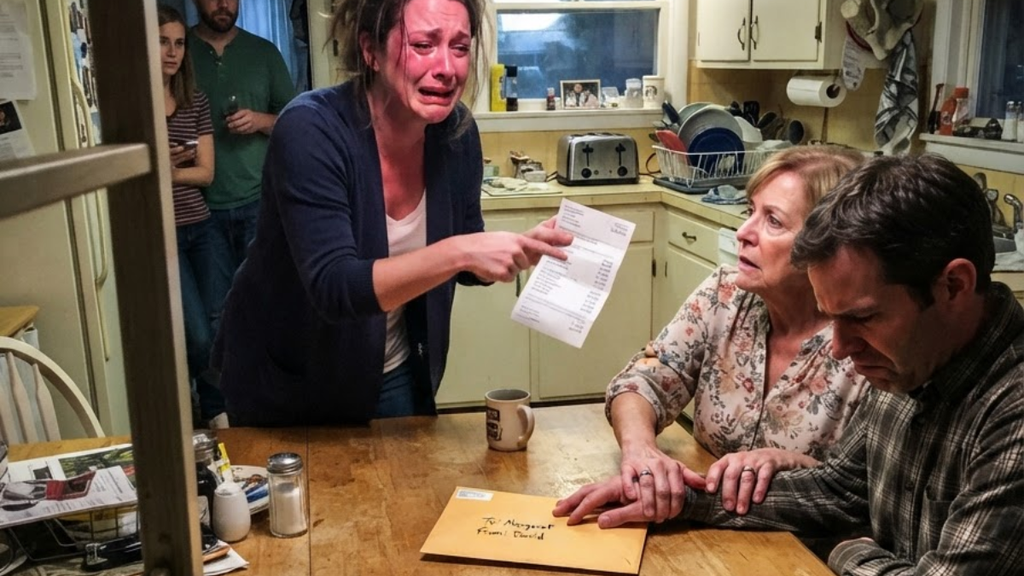
I did not know.
My mother did not need money.
At least I did not think she did.
And when I confronted both of them, neither would tell me why.
That was when I knew the money was not the secret.
It was payment for one.
My name is Rachel.
I am fifty.
My husband, Tom, is fifty-two.
We have been married for twenty-five years.
We have two children.
Grace is twenty-two.
Evan is nineteen.
My mother, Linda, is seventy-four.
My father died eight years ago.
My parents were married for forty-six years.
Tom and my mother have always gotten along.
Not in some unusually close way.
Normal son-in-law and mother-in-law relationship.
He fixes things at her house.
She sends him home with food.
They tease each other.
When my father was dying, Tom was incredible.
He drove my parents to appointments.
He installed grab bars.
He handled insurance calls.
He sat with Dad when Mom needed to sleep.
I loved him more during that period than I ever had.
That matters.
Because when I discovered the payments, my first thought was not affair.
My first thought was that Tom had been helping my parents financially and nobody told me.
That still would have upset me.
But I could have understood it.
I found out because Tom left his laptop open.
I was not snooping.
I want to make that clear.
We were refinancing a small home-equity line we had used for renovations.
The bank needed statements from one of Tom’s accounts.
Tom was outside talking to a contractor.
He told me to download the last three months from his laptop.
I opened the account.
It was an account I knew existed.
Tom uses it for personal spending and some automatic bills.
I downloaded the statements.
Then I noticed a recurring transfer.
LINDA M. — $2,000
First of every month.
I assumed it was recent.
Maybe Mom needed help with something.
Then I scrolled backward.
Same transfer.
Previous month.
Month before.
Month before.
I searched transactions.
The online history went back seven years.
Every single month.
$2,000.
I felt cold.
Seven years was $168,000.
I called Tom.
He came inside.
I turned the laptop toward him.
I asked:
“What is this?”
He looked at the screen.
His entire face changed.
That was the moment I knew it was worse than helping Mom with bills.
He said:
“Rachel.”
I asked again.
He closed the laptop.
Actually closed it.
Like making the screen disappear would somehow put the secret back.
I said:
“Why are you sending my mother two thousand dollars a month?”
He told me we should talk later.
I said we were talking now.
He said:
“It’s complicated.”
I asked whether my mother was in financial trouble.
No.
I asked whether she owed him money.
No.
I asked whether he owed her money.
Silence.
I asked again.
He said:
“Not exactly.”
That phrase made my stomach turn.
I asked how long.
He said:
“A while.”
I told him I could see seven years.
How long?
Tom rubbed his face.
Then he said:
“Eleven.”
Eleven years.
$264,000.
I sat down.
I asked where the money came from.
His salary.
Bonuses.
I asked whether he had been taking it from our joint account.
No.
The account was funded mostly by bonuses and commissions.
Tom earns significantly more than I do.
I knew his income fluctuated.
I did not track every bonus.
That was apparently how $24,000 a year could leave our household without me noticing.
I asked whether the payments were taxable.
He said he did not know.
I asked whether there was a written agreement.
No.
I asked whether Dad knew.
Tom looked away.
“Yes.”
My father knew.
I asked whether Grace knew.
No.
Evan?
No.
Anyone else?
Tom said:
“Rachel, please.”
I asked what my mother was doing with the money.
He said he did not know.
I laughed.
“You’ve sent her a quarter of a million dollars and you don’t know what she does with it?”
He said:
“It’s hers once I send it.”
I asked why.
He would not answer.
So I called my mother.
Tom told me not to.
I did anyway.
She answered on the third ring.
I said:
“Mom, why has Tom been sending you $2,000 a month for eleven years?”
Silence.
Not:
“What?”
Not confusion.
Silence.
Then she said:
“You need to talk to your husband.”
I said:
“I did. He won’t tell me.”
She said:
“Then there’s a reason.”
I felt like I had entered another reality.
I asked whether she was blackmailing him.
My mother actually gasped.
“No.”
I asked whether Tom had done something to her.
“No.”
To Dad?
“No.”
To me?
Another silence.
I said:
“Mom.”
She said:
“Rachel, I love you.”
I told her not to do that.
She started crying.
I asked:
“What did Tom do to me?”
She said:
“He didn’t.”
I asked why she hesitated.
She said:
“Because this isn’t my story to tell.”
I almost screamed.
I said:
“If my husband is paying my mother $24,000 a year, it is absolutely my story.”
She said:
“I promised.”
I asked who.
She would not answer.
I hung up.
Tom was standing across the kitchen.
I asked:
“Who did she promise?”
He said nothing.
I asked whether this had anything to do with him cheating.
No.
A child?
No.
A crime?
He hesitated.
That was enough.
I asked:
“What crime?”
Tom said:
“Not the way you’re thinking.”
I told him I had no idea what I was thinking anymore.
He said nobody was in danger.
I asked whether anyone had been.
Another hesitation.
I felt sick.
I asked whether the payments started eleven years ago because something happened eleven years ago.
Tom said:
“Yes.”
I immediately started doing the math.
Eleven years ago, Grace was eleven.
Evan was eight.
I was thirty-nine.
My father was still alive.
Tom and I had been married fourteen years.
What happened that year?
I could think of normal things.
Grace broke her wrist.
Evan switched schools.
My father had knee surgery.
Tom changed companies.
We remodeled our basement.
Then I remembered something.
I had been in a car accident.
Not a huge one.
At least that was how I remembered it.
It happened in November.
I was driving home from a fundraiser at Grace’s school.
It was raining.
A car ran a red light.
I swerved.
I hit a utility pole.
I had a concussion.
Broken collarbone.
Two cracked ribs.
I spent one night in the hospital.
The other driver left.
Police never found them.
I remembered very little of the crash itself.
The doctors said that was normal with a concussion.
I asked Tom:
“Is this about my accident?”
He went completely still.
I knew.
I said:
“Oh my God.”
Tom sat down.
I asked whether he knew who hit me.
He said:
“Rachel.”
I asked again.
He said:
“There wasn’t another car.”
I stared at him.
I told him that was impossible.
Police told me there were tire marks.
Tom said there were.
Mine.
I asked why I swerved.
He said:
“You weren’t driving.”
I honestly thought I had misheard him.
I said:
“What?”
Tom was crying now.
He said:
“You weren’t driving the car.”
I laughed.
Not because it was funny.
Because the sentence did not fit into my brain.
I remembered driving.
I remembered leaving the school.
I remembered rain on the windshield.
I remembered headlights.
Then nothing.
I woke in the hospital.
My mother was there.
Tom was there.
Dad came later.
Everyone told me I had been driving.
The police report said I was the driver.
Insurance treated me as the driver.
I asked Tom:
“Who was driving?”
He said:
“Your mother.”
I stood up so fast the chair tipped backward.
I called Mom again.
She did not answer.
I called again.
Voicemail.
I grabbed my keys.
Tom stepped in front of the door.
I told him to move.
He said I should not drive upset.
I screamed at him to move.
He did.
Then he said:
“I’ll take you.”
I told him I did not want to be in a car with him.
I drove to my mother’s house.
I barely remember the drive.
Mom’s car was there.
I pounded on the door.
She opened it.
Her face was swollen from crying.
I walked inside.
I said:
“You were driving.”
She closed her eyes.
“Yes.”
I asked why everyone told me I was.
She said:
“Sit down.”
I refused.
I asked what happened.
Mom said the school fundraiser had ended around nine.
She had volunteered too.
I had a migraine.
That part I remembered vaguely.
Mom offered to drive my car home.
She was supposed to sleep at our house because Dad was out of town overnight.
I got into the passenger seat.
Mom drove.
It was raining hard.
Approximately ten minutes from our house, she lost control.
Not because another car ran a red light.
Because she had been drinking.
I stared at her.
My mother barely drinks.
At least now.
Back then, apparently, she drank more than I knew.
She had been sneaking wine during the fundraiser.
Then she had taken something.
I asked what.
A prescription anxiety medication.
Not prescribed to her.
A friend gave her two pills earlier that day.
Mom took one.
Then drank wine.
She believed she was fine.
She was not.
She drove my car off the road.
I asked how I ended up looking like the driver.
Mom started sobbing.
She said after the crash, she panicked.
I was unconscious.
She was bleeding but awake.
She climbed out.
Someone stopped.
A man.
He called 911.
Mom told him I had been driving.
I asked why.
Because she had a prior DUI.
I had not known that either.
It happened when I was in college.
My parents hid it from me.
If Mom got another DUI involving serious injury, she believed she would go to jail.
Dad was furious when he got to the hospital.
Tom was furious.
But by then Mom had already told the first responder I was driving.
The man who stopped had not seen the crash.
He saw Mom outside the vehicle and me inside.
The car had spun.
The passenger side was badly damaged.
I had somehow ended up partially toward the center console.
Mom said the scene was confusing.
I asked about police.
She told them the same story.
I was driving.
She was the passenger.
I asked why they believed her.
Because I could not remember.
Because the car was mine.
Because nobody witnessed the crash.
Because Mom had bruising consistent with being belted on the passenger side.
I asked how.
Mom looked at the floor.
Then I understood.
“You switched seats.”
She nodded.
After the crash.
Before the man stopped.
She dragged me.
I felt physically sick.
My seventy-four-year-old mother stood in front of me telling me that eleven years earlier, while I was unconscious with a concussion and broken bones, she pulled me into the driver’s seat so police would think I caused the accident she caused.
I asked whether Tom knew that night.
Not immediately.
Mom told Dad first.
Dad told Tom at the hospital.
I asked what Tom did.
He wanted to tell police.
Dad begged him not to.
Mom begged.
Dad said Mom would go to jail.
Their insurance would be destroyed.
Mom could lose her job.
She worked for a school district then.
I asked why any of that was more important than telling me.
Mom said:
“It wasn’t.”
I said:
“But you decided it was.”
She cried.
I asked whether I was charged.
No.
I received a citation for failure to maintain control.
I paid it.
My insurance rates increased.
I went to defensive driving.
I spent years believing I had caused an accident I could not remember.
I stopped driving in heavy rain for almost two years.
I had panic attacks.
I blamed myself.
I asked Mom whether she remembered me crying because I thought I could have killed someone.
She nodded.
I asked whether she remembered telling me accidents happen.
She nodded again.
I felt hatred.
I have never felt that toward my mother before.
I asked where the $2,000 came in.
Mom said that was Dad’s idea.
After the accident, Tom wanted to tell me.
Dad convinced him not to.
Tom said he could not live with the lie.
Dad proposed an arrangement.
Tom would keep quiet.
Mom would stop drinking.
She would go to therapy.
She would never drive after taking medication.
And Tom would pay Mom.
That made no sense.
I said:
“Why would Tom pay you? You hurt me.”
Mom said:
“It wasn’t payment for me.”
I asked what it was.
She refused.
I screamed.
I told her I already knew she drove drunk, moved my unconscious body, lied to police, let me take responsibility, and let me spend eleven years believing I caused the crash.
What could possibly be worse?
Mom said:
“The money wasn’t about the accident.”
I stared at her.
Then what?
She said:
“It started because of what they found afterward.”
I asked who “they” were.
She said:
“Your father and Tom.”
I felt cold again.
I asked what they found.
Mom sat down.
She said:
“Your medical records.”
I did not understand.
I had broken bones.
A concussion.
What medical records?
She said when I was admitted, the hospital did routine blood work.
Something came back abnormal.
I asked what.
Mom said:
“You were pregnant.”
I stopped breathing.
I told her no.
I had not been pregnant.
Evan was eight.
Tom had gotten a vasectomy two years earlier.
Mom looked at me.
That was when I realized why she had not wanted to tell me.
I said:
“Was I pregnant?”
She said:
“Yes.”
I asked how far.
Approximately seven weeks.
I stared at her.
I said that was impossible.
Tom had a vasectomy.
Mom said:
“I know.”
I asked whether I lost the pregnancy because of the accident.
She started crying again.
“Yes.”
I sat down.
For a few seconds, I could not hear anything except the clock in my mother’s kitchen.
I had been pregnant.
I had miscarried.
Nobody told me.
I asked how I could possibly not have known.
Mom said the doctor initially believed I knew.
Tom was listed as my emergency contact.
The hospital told him.
I had internal bleeding.
The pregnancy was not viable after the trauma.
I underwent a procedure while I was still confused from medication and the concussion.
I asked:
“A D&C?”
Mom nodded.
I asked whether I consented.
She said Tom did because I was not considered capable of informed consent at the time and the procedure was medically necessary.
I wanted to throw up.
I asked whether the hospital never told me afterward.
Mom said Tom spoke with the doctors.
Because of the concussion and memory loss, they recommended follow-up with my OB-GYN.
Tom arranged it.
I remembered that appointment.
I thought it was to make sure there was no internal injury.
I asked whether my doctor knew.
“Yes.”
I stood up.
I asked whether everyone in my life knew except me.
Mom said:
“Not everyone.”
That was not comforting.
I asked the obvious question.
If Tom had a vasectomy, whose pregnancy was it?
Mom looked at me like I was breaking her heart.
I said:
“Whose baby was I carrying?”
She whispered:
“Tom’s.”
I told her that made no sense.
Then she said:
“His vasectomy had failed.”
I stared at her.
I asked whether that had been confirmed.
Yes.
Tom had testing afterward.
His sperm count was not zero.
Apparently recanalization can happen.
He later had another procedure.
I remembered that too.
He told me he had developed scar tissue and needed a minor correction.
Another lie.
I asked why they hid the pregnancy from me if it was Tom’s.
Mom said:
“Because of what you said before the accident.”
I had no idea what she meant.
She said in the weeks before the fundraiser, I had been struggling.
I was exhausted.
Overwhelmed.
Our marriage was going through a rough patch.
That part was true.
Tom traveled constantly then.
I was working.
Two young kids.
My father had recently had knee surgery.
Mom was dealing with her own issues.
I had apparently told her that if I ever accidentally got pregnant again, I did not think I could handle it.
I vaguely remembered saying something like that.
As a hypothetical.
I asked what that had to do with anything.
Mom said after the accident, Tom believed telling me I had been pregnant and lost the baby would destroy me.
I stared at her.
“He decided that?”
Mom said:
“We all did.”
Tom.
Mom.
Dad.
My doctor knew I had not been told?
Mom said she did not know exactly what the doctor believed I understood.
That was something I would have to investigate myself.
I asked about the money again.
Mom looked terrified.
I said:
“Tell me.”
She said after I recovered, Dad started feeling guilty.
Not just about the accident.
About the pregnancy.
He thought Tom had made the wrong decision by not telling me.
Tom agreed.
They argued.
Repeatedly.
Mom was terrified one of them would confess.
Then approximately six months after the accident, Dad found something in Mom’s things.
A bank statement.
I asked what bank statement.
Mom said:
“I had been taking money.”
From whom?
My parents had a joint savings account.
Mom had been withdrawing cash.
Thousands.
Over several years.
I asked why.
Gambling.
The same mother who had been drinking secretly was also gambling.
Mostly casinos.
Some online.
She had lost approximately $90,000.
Dad had not known.
I stared at her.
She said the accident forced everything into the open.
Drinking.
Pills.
Gambling.
Debt.
Dad considered leaving.
Instead, they made an agreement.
Mom would get treatment.
Dad would take control of their finances.
They would pay down the debt.
I asked what that had to do with Tom sending her money.
Mom said:
“Your father asked him to.”
I asked why my husband would be responsible for my mother’s gambling debt.
She said:
“He wasn’t.”
Then she finally told me.
The $2,000 was not for her.
It was for me.
I actually laughed.
I said:
“I have never received it.”
Mom said she had been putting most of it into an account.
An account in my name.
I asked what account.
She said:
“Your father called it restitution.”
I stared at her.
After the accident, Dad became obsessed with the idea that I had been robbed of something.
Not only the pregnancy.
Choice.
Truth.
Trust.
He knew they could not undo it.
He also knew he could not convince Mom to confess without risking criminal consequences and destroying their marriage.
So he created what he apparently considered a compromise.
Tom would pay $2,000 every month into an account controlled by my parents.
The money would eventually come to me.
I asked why Tom was paying restitution for something Mom did.
Mom said:
“Because he chose the lie too.”
That was the first thing she said that made any sense.
Dad believed Tom was not responsible for the crash.
But Tom was responsible for what happened afterward.
He had allowed me to believe I was driving.
He had hidden the pregnancy.
He had signed medical paperwork.
He had participated in creating the false story I lived with.
Dad told him if he was going to keep the truth from me, there needed to be a tangible cost.
I asked whether Tom agreed willingly.
“Yes.”
I asked how much was in the account.
Mom said:
“Most of it.”
I asked what that meant.
She had used some.
My stomach dropped.
“How much?”
Approximately $40,000.
For what?
After Dad died, Mom’s house needed a new roof.
Then she had dental work.
She replaced her car.
I asked whether she gambled any of it.
She said no.
I did not know whether to believe her.
I asked how much remained.
Approximately $224,000.
I said:
“Show me.”
She did.
There was an investment account.
It was not technically in my name.
Mom was the owner.
I was the beneficiary.
The balance was $271,000 because some of the money had grown.
I stared at it.
My husband had sent my mother $264,000.
She had spent approximately $40,000.
Investment gains had brought the remaining balance to roughly $271,000.
I asked what was supposed to happen to it.
Mom said when she died, it would come to me.
I laughed.
I said:
“So the plan was for me to inherit hush money and never know what it was for?”
Mom said Dad intended to tell me before he died.
I asked why he did not.
His illness progressed quickly.
I reminded her he was sick for almost two years.
There was time.
She said:
“He kept losing his nerve.”
Of course.
Everyone lost their nerve when it came to telling me the truth.
I left.
I did not go home.
I went to a hotel.
Tom called.
I did not answer.
Mom called.
I blocked her temporarily.
I sat in that hotel room and tried to understand what parts of my life were real.
The accident had always been one of my biggest regrets.
I had spent eleven years thinking I caused it.
I had spent eleven years thinking I was lucky nobody else was hurt.
I had changed the way I drove.
I had apologized to my children for scaring them.
I had told Grace, when she learned to drive:
“Never assume you’re okay just because you feel okay.”
That advice came from an accident I did not cause.
Then there was the pregnancy.
That was harder to process.
I had not wanted another child.
I need to say that honestly.
At thirty-nine, with an eleven-year-old and eight-year-old, I probably would have panicked.
I do not know what I would have chosen.
That is exactly the point.
I do not know.
Everyone else decided I was better off not knowing the choice had ever existed.
Then they turned the decision into a secret financial arrangement.
My father created a penalty.
My husband paid it.
My mother collected it.
And I lived in the middle without knowing there was anything to forgive.
The next morning, I called Tom.
I told him to meet me at the hotel restaurant.
He arrived early.
He looked terrible.
I asked one question first.
“Did you know Mom was spending some of the money?”
He said no.
I believed him.
I asked whether Dad really created the payment arrangement.
Yes.
I asked why Tom continued after Dad died.
Tom said:
“Because your father dying didn’t erase what I did.”
I asked whether he planned to continue until Mom died.
Yes.
I asked whether there was a target amount.
No.
I asked whether he thought sending money made what he did better.
He said:
“No.”
Then why do it?
He said:
“Because it was the only punishment your dad could come up with that I couldn’t talk my way out of.”
That sentence surprised me.
I asked whether Dad hated him.
For a while.
Yes.
Dad blamed Mom for driving.
He blamed himself for helping cover it up.
But he especially blamed Tom for hiding the pregnancy.
I asked why.
Tom said:
“Because I was your husband.”
Dad believed Mom was panicking about prison.
He believed his own judgment was compromised because he wanted to protect his wife.
But Tom’s only obligation should have been to me.
He failed it.
I asked Tom why he agreed to hide the pregnancy.
He cried.
Then he said something I will probably remember forever.
“You woke up and asked me if the kids were okay.”
I waited.
“You didn’t ask about yourself. You didn’t ask about the car. You asked if Grace and Evan were okay.”
He told me they were home with a neighbor.
Then I asked what happened.
Tom told me I had been in an accident.
I became hysterical because I could not remember.
I kept asking whether I had hurt anyone.
Then I asked whether I had been drinking.
I had not.
But I was so confused that I did not trust myself.
Tom said watching me panic terrified him.
Then a doctor pulled him aside and told him about the pregnancy loss.
Tom said his first thought was:
“I cannot tell her one more bad thing.”
I asked whether he intended to tell me later.
Yes.
That evening.
Then the next morning.
Then when we got home.
Then after my follow-up.
Every time, someone gave him a reason to wait.
Mom was terrified.
Dad said I was fragile.
My doctor talked about post-concussion symptoms.
I was having nightmares.
I blamed myself for the crash.
Tom convinced himself telling me the truth would make everything worse.
Then a week passed.
Then a month.
Then telling me required explaining why he waited a month.
So he waited longer.
By six months, the truth would not only hurt me.
It would expose everyone.
Tom said:
“I kept thinking there would be a right time.”
I said:
“There was.”
He looked at me.
I said:
“The first time.”
He nodded.
I asked about the accident report.
Had he knowingly allowed me to make false statements?
I apparently told police I remembered headlights and swerving.
Tom said yes.
I asked why I remembered that if it did not happen.
He did not know.
Maybe I remembered headlights from earlier.
Maybe my brain filled in missing pieces after everyone told me another car was involved.
That frightened me.
Memory is not a recording.
Apparently, if enough people you trust hand you a story, your brain can start building around it.
I asked whether Tom ever considered the legal implications.
Constantly.
I asked whether Mom could still get in trouble.
He did not know.
Statutes.
False reports.
Insurance.
He was not a lawyer.
I said I would speak to one.
He said:
“I think you should.”
That was the first time he did not try to manage what I did next.
I asked him whether there was anything else.
He said no.
I told him that answer meant nothing to me now.
He said:
“I know.”
I asked whether the $2,000 had ever caused us financial hardship.
He said no.
I asked whether there were times he told me we could not afford something because he needed to make the payment.
Tom looked down.
I knew.
I asked for examples.
One hurt more than the others.
Grace had been accepted into a summer program in Washington when she was sixteen.
It cost approximately $3,400.
We told her it was too expensive.
She did not go.
That same summer, Tom sent my mother $6,000.
I cried.
Tom said the money would not have directly prevented Grace from going.
We could technically have afforded both.
But he was anxious about spending.
I said:
“So your secret guilt had a budget, but our daughter didn’t.”
He cried too.
I asked whether Grace knew about any of this.
No.
I said she would.
Tom looked frightened.
I said:
“You don’t get to decide anymore.”
Then I asked about Evan.
He would know too.
Not every medical detail.
Not unless I chose.
But they were old enough to know their grandmother caused the accident and their parents had lied about it.
Tom asked me to wait until I had processed more.
I said:
“I’ll decide.”
He nodded.
Then he slid something across the table.
An envelope.
My father’s handwriting.
My name.
I stared at it.
I asked where he got it.
Tom said Dad gave it to him approximately three months before he died.
He told Tom to give it to me if the truth ever came out after his death.
I asked why Tom had not given it to me the night before.
He said:
“Because for once I wanted you to decide whether you wanted to know something before I put it in front of you.”
That was almost enough to make me cry again.
I took the envelope.
I did not open it there.
I went back upstairs.
I sat on the bed.
Then I opened my father’s letter.
It began:
Rachel, if you are reading this, then we failed to tell you while I was alive.
Not Mom.
Not Tom.
We.
Dad did not excuse himself.
He wrote that he made the worst decision of his life in a hospital hallway because he was afraid his wife would go to jail.
He told himself he was protecting our family.
Then he watched the lie spread.
He watched me blame myself.
He watched Tom become consumed with guilt.
He watched Mom get sober.
He watched all of us continue living.
Every passing year made confession feel more destructive.
Then Dad wrote:
There is something I need you to understand about the money. It was never meant to buy your forgiveness. Forgiveness cannot be prepaid.
I had to stop reading.
When I continued, Dad explained the payments.
He believed Tom needed a consequence that lasted as long as the lie lasted.
If Tom told me, the payments could stop.
That was the agreement.
I read that line again.
If Tom told me the truth, he no longer had to pay.
For eleven years, Tom had a $24,000-a-year financial incentive to confess.
He kept paying instead.
Dad wrote:
I thought eventually the cost would force him to do what courage had not. I was wrong.
That changed the way I understood the payments.
They were not hush money.
They were the opposite.
My father had designed them to make silence painful.
Tom could stop them at any time by telling me.
He chose the payment.
Month after month.
Year after year.
Not because Mom was blackmailing him.
Not because Dad demanded permanent money.
Because $2,000 was easier than one conversation.
Dad admitted that he was a hypocrite.
He could have told me himself.
He did not.
He wrote:
I kept waiting for Tom to become braver so I would not have to be.
That line destroyed me.
Then he wrote about Mom.
He asked me not to reduce her entire life to the worst night of it.
He did not ask me to forgive her.
He said she had been sober since the accident.
She completed treatment for alcohol misuse and gambling.
She never gambled again as far as he knew.
She carried enormous shame.
But Dad wrote:
Her recovery does not create an obligation for you to forgive what she did before it.
That mattered too.
Then the pregnancy.
Dad wrote that hiding it was the decision he regretted most.
He did not know what I would have wanted.
Nobody did.
That was why they had no right to decide that ignorance was kinder.
His final paragraph said:
You may spend the rest of your life angry with me. If you do, I earned that. What I hope you do not spend another day doing is blaming yourself for that accident. You were not driving. You were not drinking. You did not lose control of the car. You did not put your mother in danger. She put you in danger, and then the three people who loved you most chose fear over honesty. I am sorry.
I sat there for a long time.
Then I noticed something.
Dad said three people.
Mom.
Dad.
Tom.
But there had been a fourth person involved.
The man who stopped at the accident.
The stranger who called 911.
According to Mom, he saw her outside the vehicle and me inside.
He was the first person she lied to.
I suddenly wondered what he had actually seen.
I pulled the old accident report.
I had requested a copy years earlier for insurance.
I still had it in a file at home.
I drove back.
Tom was not there.
I found the report.
The witness’s name was Daniel Price.
There was a phone number.
Probably ancient.
I searched his name.
There were several.
Then I found an obituary.
Daniel Price had died three years earlier.
But the obituary listed a daughter.
Megan Price Holloway.
I found her online.
I stared at the message box for almost twenty minutes.
Then I wrote:
This is going to sound strange, but I believe your father may have helped me after a car accident eleven years ago. I’m trying to understand what happened that night.
She responded the next morning.
Her father had talked about the accident.
For years.
I called her.
Megan said her father was haunted by it because he always believed something was wrong.
He came upon the car minutes after the crash.
He saw a woman standing beside it.
My mother.
He saw another woman unconscious inside.
Me.
Mom told him I had been driving.
But Daniel noticed something.
My mother’s shoes were off.
One was inside the driver’s footwell.
The other was outside near the driver’s door.
I felt cold.
Megan said her father told police.
It was in his original statement.
I looked at the accident report.
The summary did not mention the shoes.
Megan said her father also remembered Mom repeatedly saying:
“She’s going to be okay, right? I didn’t mean to.”
Not:
“She didn’t mean to.”
I didn’t mean to.
Daniel told police that too.
I asked whether anyone followed up.
He was interviewed once more.
Then never contacted again.
He assumed investigators had resolved it.
Megan said:
“My dad always thought your mom was driving.”
I closed my eyes.
A stranger knew.
A stranger who saw us for maybe fifteen minutes knew something was wrong.
The people closest to me spent eleven years convincing me nothing was.
That realization hurt differently.
I thanked Megan.
Then I called my mother.
I told her about Daniel.
She cried.
I asked whether she remembered him noticing her shoe.
Yes.
I asked whether police questioned her.
Yes.
She told them her shoes came off during the crash.
They accepted it.
I asked whether Dad knew there was evidence contradicting her story.
Yes.
Tom?
“Yes.”
I hung up.
That was the moment I stopped thinking of this as one panicked lie after an accident.
They had actively maintained it.
Questions arose.
They answered them.
Evidence did not fit.
They explained it away.
I asked Tom to move out that week.
He did.
Mom and I stopped speaking for almost two months.
Then she sent me a letter.
I did not read it immediately.
Eventually I did.
She did not ask forgiveness.
She told me where the $271,000 account was.
She transferred control to me.
Every dollar.
She also added $40,000 from her own savings to replace what she had used.
I now have an account with over $300,000 in it.
I hate it.
I have barely touched it.
The first thing I did was pay Grace $3,400.
She was confused.
I told her it was for the Washington program she never got to attend.
She laughed.
Then she realized I was serious.
I eventually told both children a version of the truth.
The accident.
Grandma was driving.
Their father knew.
Grandpa knew.
They hid it.
I told them about the pregnancy because it was my information and I decided I wanted them to understand why this had affected me so deeply.
Grace cried.
Evan got angry.
Not at Mom first.
At Tom.
He asked his father:
“You watched Mom blame herself?”
Tom said yes.
Evan asked:
“For eleven years?”
Tom said yes.
Then Evan said:
“I don’t understand you.”
Tom answered:
“I don’t understand myself either.”
That was the right answer.
Tom and I are separated.
I do not know if we will divorce.
That seems to be the question everyone wants answered.
I am not there yet.
Some days, I miss him so much it physically hurts.
Other days, I remember sitting in the passenger seat of that car while my unconscious body was moved into the driver’s position and feel like my entire marriage was built on someone rearranging the scene before I woke up.
Tom did not cause the crash.
He did not make Mom drink.
He did not move me.
He did not lie first.
But he chose the lie.
Again and again.
Every month, the $2,000 transfer gave him another opportunity.
The first of the month.
January.
February.
March.
Year after year.
He could have stopped paying by telling me.
He opened his banking app instead.
That is difficult to forgive.
Mom and I have started speaking again.
Carefully.
She has been sober for eleven years.
That is true.
She has not gambled.
As far as anyone can verify, that is true too.
She did terrible things that night.
She also did the work afterward to become someone who would never do them again.
I am trying to decide what relationship I can have with that person without pretending the old one did not exist.
Last week, Mom gave me a box.
Inside were photographs.
Hospital paperwork.
Her treatment records.
My father’s notes.
And the dress I wore to the fundraiser the night of the crash.
I had not seen it since.
I asked why she kept it.
She said:
“I don’t know.”
Then she said:
“Maybe because I knew someday you’d ask me to prove I wasn’t making any of this up.”
At the bottom of the box was something else.
A small plastic hospital bag.
Inside was a bracelet.
My name.
Date.
Emergency department.
And another label underneath.
OB/GYN CONSULT.
I held it for a long time.
Mom said:
“I should have given you that eleven years ago.”
I said:
“Yes.”
She did not say anything else.
That is one thing everyone has finally learned.
Sometimes there is no sentence that makes what happened smaller.
I still drive differently in rain.
That might never change.
But now, when I feel the old panic rising, I remind myself:
I did not crash that car.
It is strange how powerful that sentence is.
For eleven years, the people who loved me most believed the truth would destroy me.
The truth did hurt.
It changed my marriage.
It changed my relationship with my mother.
It changed how I remember my father.
It changed the way I understand an entire decade of my own life.
But it did not destroy me.
The lie did far more damage.
A few days ago, I logged into the account where Mom had transferred the money.
The balance was $312,418.
I stared at it.
Then I looked at the transaction history Tom had given me.
One hundred thirty-two payments.
$2,000 each.
The first one arrived one month after the accident.
The last arrived the month I found out.
For years, I thought my husband was secretly paying my mother to keep quiet.
I was wrong.
My father had designed the payments so Tom could end them whenever he wanted.
All he had to do was tell me the truth.
Instead, my husband spent $264,000 because for eleven years, telling me what really happened that night was the one price he was unwilling to pay.
