

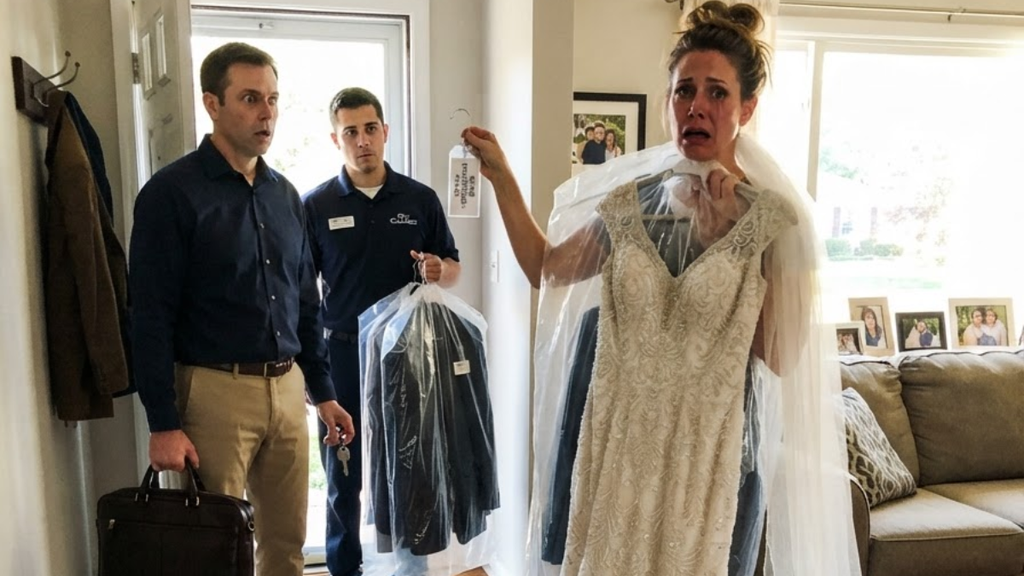
My husband’s dry cleaning was delivered on a Tuesday afternoon, and hanging between his navy suits was a wedding dress.
Not a little white cocktail dress.
Not something that could have been mistaken for a wedding dress.
It was a full-length ivory gown with lace sleeves, a fitted bodice, and a long row of tiny buttons down the back.
There was a veil in a separate plastic sleeve.
And pinned to the garment bag was a receipt with my husband’s name on it.
PICKUP: MICHAEL BENNETT
ITEMS: 4 SUITS, 2 SHIRTS, 1 BRIDAL GOWN, 1 VEIL
I stood in our foyer staring at it for probably a full minute.
Then I called my husband.
He didn’t answer.
I sent him a picture.
Why is there a wedding dress with your dry cleaning?
He called me back almost immediately.
I expected him to laugh.
I expected him to say the cleaner mixed up somebody’s order.
Instead, he asked, “Did you open the bag?”
That was the first moment I knew something was wrong.
My name is Caroline. I’m fifty-three years old, and I’ve been married to Michael for twenty-nine years.
We live outside Philadelphia.
We have two daughters, both grown.
Emily is twenty-six, and Sarah is twenty-three.
Michael is fifty-five and works in commercial real estate.
I’m a high school guidance counselor.
We’ve had a comfortable marriage.
Not perfect, obviously, but good.
We raised our daughters, paid off our house, traveled when we could, and had recently started talking about what retirement might look like.
Michael is meticulous about his clothes.
He has used the same dry cleaner for almost fifteen years.
Every other Tuesday, he drops off his suits on his way to work.
They deliver them to our house the following week.
I rarely pay attention.
That Tuesday, however, the delivery driver had hung the garments on our front porch instead of leaving them inside the mudroom, so I brought them in.
That’s when I saw the dress.
When Michael asked whether I’d opened the bag, I said no.
He told me not to.
I asked why.
He said, “It’s not ours.”
I looked at the receipt again.
I said, “It has your name on it.”
He said the cleaner must have made a mistake.
I asked why he sounded upset.
He said he was in the middle of something at work.
Then he said, “Just leave it alone. I’ll handle it.”
I asked whether he knew whose dress it was.
There was a pause.
Then he said, “Caroline, please.”
I have been married long enough to know the difference between my husband being irritated and my husband being frightened.
He was frightened.
I told him I would call the dry cleaner myself.
He said, “Don’t.”
I asked why not.
He said he’d already spoken to them.
I looked at the delivery receipt.
It had arrived less than ten minutes earlier.
I asked when he’d spoken to them.
He hesitated.
Then he said, “Earlier this week.”
I said, “About a wedding dress?”
He didn’t answer.
I told him we would discuss it when he got home.
Then I hung up.
I wish I could say I immediately opened the garment bag.
I didn’t.
For approximately twenty minutes, I tried to convince myself there was a reasonable explanation.
Maybe Michael had agreed to pick up something for a coworker.
Maybe one of our daughters had borrowed a dress for a costume.
Maybe a client needed a favor.
But the way he reacted bothered me.
So I called the dry cleaner.
A woman named Patricia answered.
I gave her the receipt number.
She asked me to hold.
When she came back, she said, “Yes, Mrs. Bennett. Everything was delivered this afternoon.”
I asked about the wedding dress.
She said, “Yes, ma’am.”
I told her I thought it had been included by mistake.
She sounded confused.
Then she said, “Mr. Bennett brought that in himself.”
I sat down.
I asked when.
“Last Thursday.”
I asked whether he had dropped it off with his suits.
“Yes.”
I asked whether she was certain.
She said, “I checked it in personally.”
I thanked her.
Then I asked whether the dress belonged to someone else.
She said she couldn’t tell me that.
I explained that I was Michael’s wife.
She became uncomfortable.
Then she said, “Mrs. Bennett, I’m sorry, but Mr. Bennett specifically asked us not to discuss the bridal gown with anyone else.”
I felt my stomach drop.
I asked whether he had explained why.
She said no.
Then she added something I hadn’t asked.
“He was very particular about the stain.”
I stared at the phone.
I asked what stain.
She said, “On the front of the skirt.”
I looked toward the foyer.
The dress was hanging from the coat rack.
I asked what kind of stain.
She said she didn’t know.
They had treated it.
She said it was an older stain, and they couldn’t guarantee complete removal.
I thanked her again and hung up.
Then I opened the garment bag.
The dress was beautiful.
Ivory satin underneath delicate lace.
Long sleeves.
A modest neckline.
The kind of dress someone might wear at a church wedding.
There was a label inside.
MARGARET ROSE BRIDAL — SIZE 8
I checked the veil.
It was cathedral length, with small pearls sewn along the edge.
Then I examined the skirt.
Near the hem, slightly to the left, was a faint brownish discoloration.
The cleaner had done a good job.
But I could still see it.
I touched the fabric.
It felt stiff in that area.
I had no idea what the stain was.
Then I noticed something else.
There was a small embroidered label sewn into the inside seam.
Not a manufacturer’s label.
A personalized one.
It read:
E. H. — JUNE 14, 2008
I stared at it.
June 14, 2008.
Michael and I had been married eleven years by then.
Our daughters were eight and five.
I had been teaching at the same high school for six years.
Michael had been working at his real estate firm.
I remembered that summer.
We took the girls to the Jersey Shore.
My mother had knee replacement surgery.
Michael traveled frequently for work.
I tried to think of anyone we knew who got married that June.
Nobody came to mind.
I took pictures of the label.
Then I searched the date online.
Nothing useful.
I searched the bridal shop.
It had closed several years earlier.
Then I searched the dress style.
I found a similar gown in an old bridal catalog.
It was from approximately 2007.
So the date made sense.
The dress was nearly eighteen years old.
Why would my husband have an eighteen-year-old wedding dress dry-cleaned?
I went upstairs and opened our bedroom closet.
Michael has a shelf above his hanging clothes where he keeps travel bags and old boxes.
I don’t usually touch it.
That day, I did.
I found a small black garment bag tucked behind two suitcases.
It was empty.
But there was a dry cleaner’s claim ticket in the side pocket.
The same receipt number.
And underneath it was a folded piece of paper.
A handwritten note.
Michael, please don’t do this. You promised me we would leave it alone.
No signature.
I stared at it.
Then I checked the other side.
Nothing.
I photographed it.
Then I put everything back exactly where I’d found it.
Michael came home at 4:30.
Almost two hours earlier than usual.
He walked into the foyer.
Saw the dress.
Then looked at me.
I was sitting at the kitchen table.
He asked whether I’d opened it.
I said yes.
He closed his eyes.
I asked whose dress it was.
He said, “It’s complicated.”
I told him that was not an answer.
He sat down.
Then he said, “It belonged to someone I knew a long time ago.”
I asked who.
He said, “A woman named Elizabeth.”
I felt cold.
I asked whether Elizabeth was an ex-girlfriend.
He said no.
I asked whether he had an affair with her.
He said no.
I asked whether she was married.
He hesitated.
Then he said, “She was supposed to be.”
I stared at him.
I asked what that meant.
He rubbed his face.
Then he said, “She never made it to the wedding.”
I looked toward the dress.
I asked why not.
Michael said, “She disappeared.”
I sat very still.
I asked when.
He said June 2008.
I asked whether she was still missing.
He looked down.
Then he said, “Yes.”
I couldn’t speak for several seconds.
Then I asked why he had her wedding dress.
Michael said, “Because her family asked me to keep it.”
I asked why.
He said he had been helping them.
I asked with what.
He said, “Looking for her.”
I stared at him.
My husband had apparently been involved in searching for a missing woman eighteen years earlier.
And I had never heard her name.
I asked how he knew Elizabeth.
He said she worked for one of his clients.
I asked whether they were close.
He said not particularly.
Then why was he involved?
He said Elizabeth’s fiancé was a friend.
I asked who.
Michael hesitated.
Then he said, “Thomas.”
I asked for his last name.
“Whitmore.”
I recognized it.
Thomas Whitmore was a real estate developer.
He and Michael had worked together for years.
He was wealthy.
Divorced twice.
He owned several commercial properties.
We had attended charity events with him.
I had met his current wife.
I asked whether Thomas was supposed to marry Elizabeth.
Michael said yes.
I asked whether Thomas had told police she disappeared.
Yes.
I asked whether he was ever a suspect.
Michael said, “They looked at everybody.”
I asked whether Elizabeth had been found.
No.
I asked whether there had been a funeral.
No.
Then I asked why Michael had her wedding dress.
He said Thomas had given it to him after the investigation.
I stared at him.
I asked why Thomas wouldn’t keep it himself.
Michael said it was too painful.
I asked why he didn’t give it to Elizabeth’s family.
He said they didn’t want it.
I asked why he was having it cleaned now.
He looked at the table.
Then he said, “Because Thomas asked for it back.”
I asked why.
Michael said, “He’s selling his house.”
I stared at him.
I said, “You don’t have an eighteen-year-old wedding dress professionally cleaned because somebody’s moving.”
He said it had been stored improperly.
I asked whether he knew about the stain.
He nodded.
I asked what caused it.
He said he didn’t know.
I asked whether it was blood.
He looked up.
Then he said, “No.”
Too quickly.
I asked whether he’d ever had the stain tested.
He said no.
I asked whether police had examined the dress.
He said yes.
I asked whether they returned it to Thomas.
He said yes.
Then I asked why Thomas gave it to Michael.
He repeated that he didn’t want to keep it.
I told him none of this made sense.
Michael said, “I know.”
I asked whether he had been in contact with Elizabeth’s family.
He said not recently.
I asked whether he knew her last name.
He said, “Hart.”
Elizabeth Hart.
I wrote it down.
Then I asked what happened the day she disappeared.
Michael told me she was supposed to marry Thomas at a small church outside Lancaster.
Approximately sixty guests.
Elizabeth never arrived.
Her car was found abandoned the following morning near a state park.
Her purse was inside.
Her phone was missing.
Police searched.
Nothing.
I asked whether there was evidence of foul play.
Michael said nothing conclusive.
I asked whether Thomas was still looking for her.
He said Thomas had accepted she was probably dead.
I asked whether Michael believed that.
He said yes.
Then I asked why the dress had been in our house for eighteen years.
He said he had forgotten about it.
I stared at him.
I said, “You forgot you had the wedding dress of a woman who disappeared on her wedding day?”
He didn’t answer.
I asked where he had kept it.
He said in a storage unit.
I asked what storage unit.
He said a small unit near his old office.
I had never heard of it.
I asked whether he still rented it.
He said yes.
I asked what else was there.
He said old business records.
I asked whether I could see it.
He said no.
I stood up.
He asked where I was going.
I told him I was taking the dress to the police.
He grabbed my arm.
Not hard.
But enough to stop me.
I looked at his hand.
He let go immediately.
He said, “Please don’t.”
I asked why.
He said the police had already investigated.
I asked whether he had anything to hide.
He said no.
Then I asked the question that had been bothering me since the beginning.
“Why did you tell the dry cleaner not to discuss the dress with me?”
He looked ashamed.
Then he said, “Because I knew how it would look.”
I said, “Like what?”
He didn’t answer.
I told him I was calling the police.
He said, “Caroline, please.”
I said, “If a woman disappeared eighteen years ago, and you have her wedding dress with a suspicious stain on it, I am not keeping that secret.”
He sat down.
Then he said something that made me stop.
“The dress wasn’t Elizabeth’s.”
I stared at him.
I asked what he meant.
He said, “It was supposed to be.”
I asked whose dress it actually was.
Michael looked toward the foyer.
Then he said, “Her sister’s.”
I felt cold.
I asked whether Elizabeth had a sister.
He nodded.
I asked her name.
He said, “Rebecca.”
I asked whether Rebecca was alive.
He said yes.
I asked why her wedding dress had Elizabeth’s initials and wedding date sewn inside.
Michael said, “Because Elizabeth was going to wear it.”
I asked why.
He said the sisters had an agreement.
Rebecca had married several years earlier.
Elizabeth loved her dress.
She wanted to wear it too.
Rebecca agreed.
The dress was altered for Elizabeth.
The label was sewn in.
I asked whether Rebecca knew Michael had it.
He said yes.
I asked whether she had asked for it back.
He hesitated.
Then he said, “Several times.”
I stared at him.
I asked why he hadn’t returned it.
He said Thomas didn’t want him to.
I asked why Thomas had any say over Rebecca’s dress.
Michael didn’t answer.
I asked whether Rebecca was the person who wrote the note.
He looked surprised.
I took out my phone and showed him the photograph.
Michael, please don’t do this. You promised me we would leave it alone.
His face changed.
I asked who wrote it.
He said, “Where did you find that?”
I told him.
He closed his eyes.
Then he said, “That was from Rebecca.”
I asked what she wanted him to leave alone.
He said, “The investigation.”
I stared at him.
I asked whether Rebecca wanted him to stop looking for Elizabeth.
He said yes.
I asked why.
He said she believed Elizabeth had run away voluntarily.
I asked whether Michael believed that.
He said no.
Then I asked why Rebecca would write him a note begging him to leave the investigation alone.
Michael was quiet for a long time.
Finally, he said, “Because she knew something.”
I asked what.
He looked at me.
Then he said, “She knew Elizabeth wasn’t going to marry Thomas.”
I stared at him.
I asked whether Elizabeth had called off the wedding.
Michael said yes.
I asked when.
He said, “The night before.”
I asked whether Thomas knew.
He said yes.
I asked whether police knew.
He said yes.
I asked why he had told me Elizabeth simply disappeared on her wedding day.
He said because that was how the story had been reported.
I asked whether Elizabeth actually disappeared the night before.
He nodded.
I felt sick.
I asked whether she had left voluntarily.
Michael said, “At first.”
I stared at him.
I asked what that meant.
He said Elizabeth had discovered something about Thomas.
Something that made her want to end the engagement.
I asked what.
Michael hesitated.
Then he said, “Another woman.”
I felt an awful sense of familiarity.
I asked whether Thomas had been cheating.
Michael said yes.
I asked whether Elizabeth confronted him.
Yes.
I asked whether they fought.
Yes.
Then I asked where Michael came into it.
He looked at me for a long moment.
Then he said, “Elizabeth called me.”
I stared at him.
I asked why she would call him.
He said they had become friends.
I asked whether they were having an affair.
He said no.
I asked why a woman would call her fiancé’s business associate when she discovered he was cheating.
Michael looked down.
Then he said, “Because I was the one who told her.”
I couldn’t speak.
I asked why he had told Elizabeth about Thomas’s affair.
He said because he thought she deserved to know.
I asked how he knew about the affair.
He said Thomas had confided in him.
I asked whether he had met the other woman.
He said yes.
I asked who she was.
Michael was silent.
Then he said, “Rebecca.”
I stared at him.
Elizabeth’s sister.
Thomas had been sleeping with Elizabeth’s sister.
I asked how long.
Michael said approximately six months.
I felt sick.
I asked whether Rebecca was married.
He said yes.
I asked whether her husband knew.
He said no.
I asked whether Elizabeth discovered the affair because Michael told her.
Yes.
I asked when.
Two days before the wedding.
I asked what happened next.
Michael said Elizabeth confronted Rebecca.
Rebecca admitted it.
Elizabeth ended the engagement.
Then she called Michael.
I asked why.
He said she wanted to know how long he had known.
I asked how long.
Michael looked ashamed.
Then he said, “Three months.”
I stared at him.
He had known for three months that his friend was sleeping with his fiancée’s sister.
He waited until two days before the wedding to tell her.
I asked why.
He said he didn’t want to get involved.
I laughed.
I couldn’t help it.
Then I asked why he finally told her.
Michael looked at me.
Then he said, “Because Thomas asked me to help him get rid of something.”
I felt cold.
I asked what.
He said, “Photographs.”
I stared at him.
I asked what photographs.
He said pictures of Thomas and Rebecca together.
I asked why Thomas wanted them destroyed.
Michael said because Elizabeth had found out about the affair.
I asked how.
He said she found messages.
Then Thomas panicked.
He asked Michael to help him remove evidence from an old computer.
I asked whether Michael did.
He said yes.
I stared at him.
I asked why.
He said he didn’t know what else to do.
I asked whether he kept copies.
He said yes.
I asked where.
He said in the storage unit.
I asked whether police knew.
He said no.
I felt sick.
I asked why he had never told police about the photographs.
Michael said because Thomas had threatened him.
I asked with what.
He looked at me.
Then he said, “With something I did.”
I stared at him.
I asked what he’d done.
He didn’t answer.
I asked again.
Finally, he said, “I helped Thomas move Elizabeth’s car.”
I felt my stomach drop.
I asked when.
He said, “The night she disappeared.”
I stared at him.
I asked whether Elizabeth was alive when he moved the car.
Michael started crying.
Then he said, “I don’t know.”
I couldn’t speak.
He continued.
Thomas called him around midnight.
He said Elizabeth had left.
He said she was hysterical.
He said she had abandoned her car at his house.
He asked Michael to help move it somewhere police would find it.
I asked why.
Michael said Thomas wanted it to look like Elizabeth had run away.
I stared at him.
I asked whether he knew that was suspicious.
He nodded.
I asked why he helped.
He said Thomas had been his biggest client.
He owed him money.
He was afraid of losing his business.
I asked whether he believed Thomas had hurt Elizabeth.
Michael said no.
Not at first.
I asked when he started believing it.
He said when police found the car.
I stared at him.
Then I asked where Elizabeth actually was when Michael moved the car.
He said he didn’t know.
I asked whether he saw her that night.
He shook his head.
I asked whether he saw blood.
He hesitated.
Then he said, “In the trunk.”
I felt physically ill.
I asked whether he told police.
He said no.
I asked whether he cleaned it.
He said no.
I asked whether Thomas did.
He said he didn’t know.
Then I asked why he had the wedding dress.
Michael looked toward the foyer.
He said, “Because Thomas gave it to me that night.”
I stared at him.
I asked why.
He said Thomas wanted it out of his house.
I asked whether it was stained.
He nodded.
I asked whether the stain was blood.
He started crying harder.
Then he said, “I think so.”
I couldn’t breathe.
I asked whether the dress had ever been examined by police.
He said no.
I stared at him.
I said, “You told me it had.”
He nodded.
I asked why he’d lied.
He said he was scared.
I asked why he was having it cleaned now.
He looked at me.
Then he said, “Because Thomas called me last week.”
I asked what Thomas wanted.
Michael said Thomas had heard police were reviewing Elizabeth’s disappearance.
A new investigator had contacted Rebecca.
They were looking at old evidence.
Thomas panicked.
He called Michael.
He asked whether he still had the dress.
Michael said yes.
Thomas told him to destroy it.
I stared at him.
I asked why he took it to the dry cleaner instead.
Michael said, “Because I couldn’t do it.”
I asked what he meant.
He said he had spent eighteen years keeping the dress.
Every time he thought about destroying it, he couldn’t.
He knew it might be evidence.
He knew he should turn it over.
But he was afraid.
Then Thomas called again.
He told Michael to get rid of it.
Michael took it to the cleaner because he wanted the stain removed before deciding what to do.
I stared at him.
I asked whether he understood that he might have destroyed evidence.
He nodded.
I asked whether he understood that a woman had been missing for eighteen years while he kept something that might explain what happened to her.
He started crying.
I stood up.
I told him I was calling police.
He didn’t stop me this time.
I called.
Two officers arrived.
Then a detective.
They took the dress.
The veil.
The receipt.
The note.
Michael gave them the storage unit information.
He also gave them his account of moving Elizabeth’s car.
They asked him to come to the station.
He went.
I stayed home.
I sat in the kitchen until almost midnight.
Then my phone rang.
It was Rebecca Hart.
Elizabeth’s sister.
I had never met her.
She said she had heard police were at my house.
I asked how she knew.
She said Thomas called her.
I felt cold.
I asked what he said.
She said he told her Michael had finally talked.
I asked whether she knew about the wedding dress.
She said yes.
I asked why she had never reported it.
Rebecca was silent.
Then she said, “Because I thought Elizabeth was alive.”
I stared at the phone.
I asked what she meant.
Rebecca said, “She called me.”
I couldn’t speak.
I asked when.
She said, “Three days after the wedding.”
I stared at the wall.
I asked whether police knew.
Rebecca said no.
I asked why.
She said Elizabeth told her not to tell anyone.
I asked where Elizabeth was.
Rebecca said she didn’t know.
I asked whether Elizabeth sounded frightened.
She said yes.
I asked what she said.
Rebecca started crying.
Then she said, “She told me she had made a terrible mistake.”
I asked what mistake.
Rebecca said, “She said she should never have trusted Michael.”
I felt cold.
I asked whether Elizabeth meant my husband.
Rebecca said yes.
I asked what else Elizabeth said.
Rebecca took a breath.
Then she said, “She told me Michael knew what Thomas had done.”
I stared at the phone.
I asked what Thomas had done.
Rebecca said, “She wouldn’t tell me.”
I asked whether Elizabeth was still alive.
Rebecca started crying.
Then she said, “I don’t know.”
I asked why she had kept the call secret for eighteen years.
Rebecca said, “Because Elizabeth told me if I said anything, somebody would die.”
I stared at the phone.
Then she said something that made my blood run cold.
“Caroline, I don’t think Thomas killed my sister.”
I asked why.
Rebecca was silent for a long moment.
Then she said, “Because Elizabeth told me she was afraid of your husband.”
I looked toward the front door.
Michael’s car was still gone.
The wedding dress was gone.
The house was quiet.
And for the first time in twenty-nine years, I wondered whether my husband had spent almost two decades hiding evidence of a murder.
Or whether he had spent almost two decades hiding the fact that the missing woman had escaped from him.
I asked Rebecca to repeat what she’d just said.
She told me Elizabeth had been afraid of Michael.
My Michael.
The man who had spent twenty-nine years sleeping beside me.
The father of my children.
The man who had just admitted to helping move a missing woman’s car and keeping her potentially bloodstained wedding dress for eighteen years.
I asked Rebecca why Elizabeth would have been afraid of him.
She said, “Because she thought he was helping Thomas.”
I told her Michael had already admitted that.
Rebecca said there was more.
I asked what.
She told me Elizabeth had called her three days after the wedding from an unfamiliar number.
She was crying.
She sounded exhausted.
Rebecca begged her to come home.
Elizabeth refused.
She said she couldn’t trust anyone.
Then she asked Rebecca whether Michael had been arrested.
Rebecca told her no.
Elizabeth became upset.
She said Michael had lied about what happened the night she disappeared.
I asked what lie.
Rebecca said Elizabeth wouldn’t explain.
She kept repeating that Michael knew where she had gone.
I stared at the phone.
I asked whether Elizabeth had contacted her again.
Rebecca said yes.
Once.
Approximately six months later.
That surprised me.
I asked why she hadn’t mentioned it immediately.
She said because the second call was different.
Elizabeth sounded calmer.
She said she was safe.
She said she had started over somewhere else.
She asked Rebecca not to look for her.
I asked whether she explained why.
Rebecca said, “She told me she didn’t want to spend the rest of her life being the woman whose fiancé slept with her sister.”
I closed my eyes.
That was an explanation I could understand.
Not a good reason to disappear without telling her family.
But an understandable desire to escape a humiliating situation.
I asked whether Rebecca believed Elizabeth was alive.
She said she did for years.
Then she stopped being sure.
I asked why.
Because Elizabeth never contacted her again.
No birthday cards.
No Christmas messages.
Nothing.
Rebecca had written letters to an address Elizabeth gave her during the second call.
The first two came back marked undeliverable.
After that, she stopped.
I asked whether she still had the address.
She said yes.
I asked her to send it to me.
She hesitated.
I told her the police needed it.
She agreed.
Then I asked something that had been bothering me.
“Why did you write Michael that note?”
Rebecca was silent.
I reminded her.
Michael, please don’t do this. You promised me we would leave it alone.
She said she’d written it approximately four years earlier.
Michael had contacted her unexpectedly.
He told her he wanted to reopen the investigation.
He said he had been carrying guilt for years.
Rebecca begged him not to.
I asked why.
She said, “Because I thought Elizabeth had chosen to disappear.”
I asked whether she told Michael about the calls.
Yes.
That was new.
Michael had known Elizabeth was alive after the supposed disappearance.
At least he knew Rebecca claimed to have spoken to her.
I asked how he reacted.
Rebecca said he seemed relieved.
Then he asked where Elizabeth was.
Rebecca refused to tell him.
She said she didn’t trust him.
He became angry.
He accused her of protecting Thomas.
They argued.
Eventually, Michael agreed to leave the matter alone.
Rebecca wrote the note afterward because he kept calling.
I thanked her.
Then I asked whether she’d speak to the detective.
She said yes.
I hung up and sat in the kitchen.
It was almost one in the morning.
Michael still hadn’t come home.
I didn’t call him.
Instead, I called my sister, Diane.
She lives twenty minutes away.
I told her enough that she came over immediately.
She sat with me until morning.
At approximately seven, Michael called.
He said police had finished interviewing him.
He asked whether he could come home.
I said no.
He asked where he was supposed to go.
I told him that was his problem.
He was quiet.
Then he asked whether I was okay.
I almost laughed.
I told him I had spoken to Rebecca.
Silence.
I asked whether he knew Elizabeth had called her after disappearing.
He said yes.
I asked why he hadn’t told me.
He said he’d only learned about it four years earlier.
I asked whether he’d told police.
He said he had.
I asked whether he believed Elizabeth was alive.
He said, “I don’t know anymore.”
Then I asked why Elizabeth was afraid of him.
Michael didn’t answer immediately.
Finally, he said, “Because she thought I betrayed her.”
I asked how.
He said, “I told Thomas where she was going.”
I felt cold.
I asked when.
He said the night she disappeared.
I asked whether Elizabeth had trusted him to help her escape.
He said yes.
I asked whether he told Thomas.
He said yes.
I asked why.
He said, “Because Thomas threatened me.”
I asked with what.
Michael was silent.
Then he said, “With telling you about us.”
I stopped breathing.
I asked what he meant.
He started crying.
Then he said, “Elizabeth and I had been seeing each other.”
I couldn’t speak.
He continued.
“It wasn’t supposed to happen.”
I closed my eyes.
I had heard that phrase before.
From friends.
From coworkers.
From women whose husbands had affairs.
It was never supposed to happen.
As though two adults accidentally fell into bed repeatedly without making any decisions.
I asked how long.
Michael said approximately four months.
I asked whether it was still happening when Elizabeth disappeared.
Yes.
I asked whether Thomas knew.
Michael said he’d suspected.
Then he found messages.
I stared at the wall.
I asked whether Elizabeth knew Thomas was sleeping with Rebecca.
Michael said not initially.
I asked whether Michael told her to make Thomas look bad.
He said no.
I asked whether he told her because he wanted her to leave Thomas for him.
He hesitated.
Then he said, “Partly.”
I felt sick.
I asked whether he planned to leave me.
He said he didn’t know.
I asked whether Elizabeth thought he would.
Silence.
Then yes.
I asked whether he had promised her.
He admitted he had.
I stared at the phone.
At the time, our daughters were eight and five.
I was thirty-five.
We had a mortgage.
We had just finished remodeling our kitchen.
I remembered that summer.
I remembered Michael being distracted.
I remembered him taking business trips.
I remembered asking whether something was wrong.
He told me he was stressed about work.
I believed him.
I asked whether he loved Elizabeth.
He said, “I thought I did.”
I asked whether he still did.
He said no.
I asked why he kept her wedding dress.
He said, “Because I couldn’t bring myself to throw it away.”
I closed my eyes.
For almost eighteen years, my husband had kept the wedding dress of the woman he had been sleeping with while married to me.
A woman who disappeared after discovering her fiancé was sleeping with her sister.
A woman who apparently believed my husband would leave his wife for her.
And a woman whose car he helped move after she vanished.
I asked whether he understood how that looked.
He said yes.
Then I asked the question I was almost afraid to ask.
“Did you hurt her?”
He said no.
I asked whether Thomas did.
Michael said he didn’t know.
I asked whether he had ever seen Elizabeth after she disappeared.
He hesitated.
Then he said, “Once.”
I felt my stomach drop.
I asked when.
He said approximately two weeks later.
I asked where.
A motel outside Harrisburg.
I asked why he went there.
He said Elizabeth called him.
I asked whether he told police.
He said yes, during the interview the night before.
I asked what happened at the motel.
Michael said Elizabeth was furious with him.
She accused him of telling Thomas where she was hiding.
She accused him of choosing his business over her.
She told him she never wanted to see him again.
I asked whether he believed her.
He said yes.
I asked whether he knew where she went afterward.
No.
I asked why he hadn’t told me any of this in eighteen years.
Michael started crying again.
He said, “Because I was ashamed.”
I told him shame was not an explanation for keeping a missing woman’s potentially bloodstained wedding dress in a storage unit.
He said he knew.
Then he asked whether we could talk in person.
I told him no.
I hung up.
Diane was sitting across from me.
She had heard enough.
She asked whether I believed Michael.
I told her I didn’t know.
Then she said something that made me stop.
“Caroline, why would Elizabeth have been wearing a wedding dress if she called off the wedding the night before?”
I stared at her.
She continued.
“If she disappeared before the wedding, why would there be a stain on the dress?”
I looked toward the empty coat rack.
The dress was gone.
Police had it.
But the question remained.
Michael claimed Thomas gave him the dress the night Elizabeth disappeared.
He claimed Elizabeth had left voluntarily.
He claimed she later called him.
He claimed he saw her alive two weeks afterward.
Then why was the dress stained?
Why had Thomas wanted it destroyed?
And why had Michael spent eighteen years keeping it?
I called the detective.
Her name was Laura Mitchell.
I explained what Diane had noticed.
She said investigators had asked the same question.
Then she told me something I hadn’t known.
The dress had been examined in 2008.
Not by police.
By a private laboratory.
I stared at the phone.
I asked who ordered the testing.
She said Michael.
I felt cold.
I asked what the results showed.
She said she couldn’t discuss details yet.
I asked whether the stain was blood.
She said they were reviewing the old report.
Then she asked whether Michael had ever mentioned a woman named Anne Whitmore.
I said no.
She asked whether I knew Thomas had a sister.
I said I didn’t.
She said Anne had died in 2006.
I asked why that mattered.
The detective said Anne had owned the house where Thomas and Elizabeth were supposed to live after the wedding.
I asked what happened to her.
She said Anne had died in a fall down the basement stairs.
I felt sick.
I asked whether Thomas was involved.
She said the death had been ruled accidental.
Then she said something that made me sit down.
“Mrs. Bennett, Elizabeth Hart was not the first woman connected to Thomas Whitmore who disappeared under unusual circumstances.”
I asked who else.
The detective said a woman named Jennifer Cole had gone missing in 2004.
Jennifer had worked for Thomas.
She was twenty-nine.
Her car was found abandoned.
She was never located.
I stared at the phone.
I asked whether Michael knew her.
The detective said that was one of the questions they were investigating.
I asked whether Thomas was a suspect.
She said they were reviewing the connections.
Then she told me not to contact Thomas or Rebecca again without speaking to investigators.
I agreed.
After we hung up, I looked at Diane.
I told her about Jennifer.
She stared at me.
Then she said, “Michael worked with Thomas in 2004.”
I nodded.
She asked whether Michael had ever mentioned Jennifer.
I said no.
Then she asked whether I remembered a trip Michael took that year.
I looked at her.
She said, “The one when Mom was in the hospital.”
I remembered.
Our mother had been hospitalized with pneumonia.
Michael was supposed to watch the girls while I stayed with her.
Instead, he said he had an emergency business trip.
I was furious.
He left anyway.
I had to ask Diane to help.
I remembered that argument vividly.
I asked why she remembered it.
She said because Michael had called her afterward.
He apologized.
He said he had been dealing with a difficult client.
I asked whether he mentioned Thomas.
She said yes.
I felt cold.
I went upstairs and found our old photo albums.
I had kept years of family calendars and travel photographs.
I found 2004.
Michael had been away for four days in October.
I remembered because Emily had a school performance.
He missed it.
I checked the dates against Jennifer Cole’s disappearance.
She went missing October 16, 2004.
Michael’s trip began October 15.
I stared at the calendar.
Then I called the detective again.
She asked me to bring everything I had.
I did.
Over the next several days, investigators searched Michael’s storage unit.
They found boxes of business records.
Old photographs.
Computer disks.
A locked metal filing cabinet.
Inside were documents related to Thomas’s properties.
And a folder labeled JENNIFER.
I learned about it when Detective Mitchell asked me to come to the station.
She showed me a photograph.
Jennifer Cole.
Dark hair.
Brown eyes.
Approximately my age at the time.
She looked familiar.
I couldn’t place her.
Then the detective showed me another photograph.
Jennifer standing beside Michael.
At a charity event.
Dated 2003.
I stared at it.
I remembered that event.
I had attended.
Michael had introduced me to several people.
Jennifer was one of them.
I hadn’t remembered her name.
I asked whether Michael had an affair with Jennifer.
The detective said they had found correspondence suggesting a personal relationship.
I felt physically ill.
I asked whether he was being investigated in her disappearance.
She said yes.
I asked whether Thomas was too.
Yes.
Then she showed me something else.
A copy of an old email.
From Jennifer to Michael.
Sent October 13, 2004.
Three days before she disappeared.
Michael, I can’t keep doing this. Thomas knows about us, and I’m not going to let you both convince me this is my problem. I have copies of everything. If you don’t tell Caroline, I will.
I stared at the screen.
My husband had been having an affair with Jennifer too.
Four years before Elizabeth.
I asked whether Michael had ever told police about Jennifer.
The detective said he had admitted knowing her.
But denied an affair.
I felt sick.
I asked what happened after the email.
The detective said they were still investigating.
Then she asked whether I remembered Michael returning from that October trip with an injury.
I thought for a moment.
Then I remembered.
His right hand.
He had a cut across his palm.
He told me he’d broken a glass at a hotel.
I remembered putting antibiotic ointment on it.
I remembered asking whether he needed stitches.
He said no.
The detective wrote something down.
I asked whether they thought he killed Jennifer.
She said they didn’t know.
I asked whether they thought he killed Elizabeth.
She said they were investigating.
Then she asked whether I would be willing to provide a statement about Michael’s whereabouts in 2004.
I said yes.
I told her everything I remembered.
The trip.
The missed school performance.
The cut on his hand.
The explanation.
The argument when he came home.
Then I remembered something else.
Michael had brought me flowers.
Not unusual.
But I remembered them because he had never apologized so dramatically before.
He came home with roses.
He took the girls out for ice cream.
He promised to be more present.
And for a while, he was.
I had thought it was guilt about missing Emily’s performance.
Now I wondered what else he had been feeling guilty about.
The detective thanked me.
Then she asked whether Michael had ever kept souvenirs from business trips.
I said sometimes.
Hotel pens.
Matchbooks.
Receipts.
She asked whether he had a box of old personal items.
I said yes.
In our basement.
She asked whether investigators could examine it.
I agreed.
That afternoon, officers came to the house.
They took several boxes.
Old photographs.
Travel receipts.
A collection of watches Michael no longer wore.
And a small wooden box I had never paid attention to.
Inside were several pieces of jewelry.
A silver bracelet.
A gold necklace.
A pair of pearl earrings.
None belonged to me.
I stared at them.
I asked the detective whether they were important.
She said they would need to determine ownership.
I felt sick.
Then she showed me a photograph from Jennifer’s missing-person report.
Jennifer was wearing a silver bracelet.
It looked exactly like the one in Michael’s box.
I started crying.
I asked whether the bracelet proved anything.
The detective said not by itself.
But it was significant enough to examine.
I sat on the basement stairs while officers carried the boxes out.
I kept thinking about the wedding dress.
The thing that started all of this.
If the dry cleaner hadn’t delivered it to our house, would I ever have known?
Would Michael have destroyed it?
Would Thomas have gotten it back?
Would Jennifer’s family ever have learned about the email?
Would Elizabeth’s disappearance have remained a cold case?
I didn’t know.
Then my phone rang.
It was Emily.
My oldest daughter.
She sounded upset.
She said Dad had called her.
He told her the police were investigating an old business dispute.
He said I was overreacting.
He asked her to talk to me.
I felt furious.
I told Emily not to get involved.
She asked what was happening.
I told her enough.
Not every detail.
But enough.
She became quiet.
Then she said, “Mom, there’s something I need to tell you.”
I felt cold.
I asked what.
She said she remembered a woman coming to our house when she was little.
I asked when.
She said she thought it was around 2008.
I asked what woman.
She said she didn’t know her name.
But the woman had been crying.
Dad was talking to her in the driveway.
Emily watched from her bedroom window.
I asked what happened.
Emily said the woman tried to give Dad something.
A bag.
He refused.
They argued.
Then Dad took the bag.
The woman left.
I asked whether Emily remembered what the woman looked like.
She said dark hair.
Tall.
Thin.
I asked whether it could have been Elizabeth.
Emily said she didn’t know.
Then she said something that made me stop.
“Mom, I remember Dad telling her that he couldn’t keep it anymore.”
I asked what he meant.
Emily said she didn’t know.
Then she said, “The woman told him he had to.”
I felt cold.
I asked whether Emily remembered anything else.
She said Dad brought the bag inside.
He took it upstairs.
Then he told Emily she hadn’t seen anything.
I stared at the phone.
I asked whether she ever saw the bag again.
Emily said no.
Then she said, “Mom, I think it was the same black bag you found in Dad’s closet.”
I felt sick.
The empty garment bag.
The one that had held the wedding dress.
I asked whether Emily was sure.
She said she remembered the gold zipper.
I thanked her.
Then I called Detective Mitchell.
She asked me to send Emily’s contact information.
I did.
That evening, Michael called again.
I answered.
He sounded exhausted.
He said he wanted to tell me the truth.
I said I’d heard that before.
He said, “This time, all of it.”
I asked why now.
He said because the police had found the jewelry.
I felt cold.
I asked whose jewelry it was.
He said Jennifer’s.
I couldn’t speak.
Then he said, “And Elizabeth’s.”
I asked whether he killed them.
He said no.
I asked why he had their jewelry.
He said, “Because Thomas gave it to me.”
I stared at the phone.
I asked why.
He said Thomas had been using him.
For years.
He said Thomas knew about the affairs.
He used them to control Michael.
He made him do favors.
Move cars.
Store belongings.
Destroy records.
I asked whether Michael had ever refused.
He said yes.
I asked what happened.
He said Thomas threatened to tell me.
I felt sick.
I asked whether Michael had helped cover up Jennifer’s disappearance.
He said yes.
I asked whether he knew she was dead.
He started crying.
Then he said, “I didn’t know at first.”
I couldn’t breathe.
I asked when he learned.
He said, “When Thomas showed me the photographs.”
I asked what photographs.
He said pictures of Jennifer after she died.
I felt physically ill.
I asked why Thomas would show him those.
Michael said, “To make sure I understood what would happen if I talked.”
I stared at the phone.
I asked whether he believed Thomas killed Jennifer.
He said yes.
I asked whether Thomas killed Elizabeth.
He was quiet.
Then he said, “I don’t know.”
I asked why.
He said because Elizabeth was alive when he last saw her.
I asked whether he had seen her since 2008.
He hesitated.
Then he said, “Yes.”
I felt cold.
I asked when.
He said, “Last year.”
I couldn’t speak.
I asked where.
He said, “At a hospital.”
I asked what hospital.
He said one in Delaware.
I asked why she was there.
He said she was visiting someone.
I asked who.
He said, “Thomas.”
I stared at the phone.
I asked whether Thomas was sick.
Michael said yes.
I asked why he hadn’t told me.
He said because he didn’t want me involved.
I almost screamed.
Then I asked whether Elizabeth knew Thomas was alive and well enough to be visited.
Michael said yes.
I asked whether she was still involved with him.
He said no.
Then why was she visiting him?
Michael was silent.
Finally, he said, “Because she wanted him to tell her where Jennifer was buried.”
I stared at the phone.
I asked whether Elizabeth knew about Jennifer.
He said yes.
I asked whether she knew Thomas killed her.
He said yes.
I asked how.
Michael said, “Because Thomas confessed to her.”
I felt sick.
I asked when.
He said, “The night she disappeared.”
I stared at the wall.
Then Michael said something that made everything change.
“Elizabeth didn’t run away because she found out about the affair.”
I asked why she ran.
He said, “Because Thomas told her what he’d done to Jennifer.”
I couldn’t speak.
He continued.
“She was terrified. She thought he was going to kill her too.”
I asked whether Michael helped her escape.
He said yes.
I asked whether Thomas knew.
He said no.
I asked why he moved her car.
He said to make Thomas believe she’d disappeared on her own.
I asked whether Thomas believed him.
He said for a while.
I asked whether he had been lying to me about helping Thomas.
Michael said, “I was trying to explain it without telling you everything.”
I felt furious.
I asked whether he understood that was still lying.
He said yes.
Then I asked why Elizabeth’s dress was stained.
He was quiet.
Then he said, “Because she was wearing it when she came to me.”
I stared at the phone.
I asked what he meant.
He said Elizabeth had gone to Thomas’s house to collect her belongings.
She found the dress.
She was furious.
She put it on.
She wanted to confront Thomas wearing the dress she would never marry him in.
I stared at the wall.
He said Thomas became enraged.
They argued.
He grabbed her.
She fell.
She cut her leg on a broken piece of glass.
The dress was stained with blood.
I asked whether Michael saw that happen.
He said no.
Elizabeth told him afterward.
I asked whether she came to him for help.
Yes.
I asked whether he took her to a hospital.
No.
He said the cut wasn’t serious.
I asked whether he helped her leave town.
Yes.
I asked whether Thomas knew.
Not initially.
I asked why Michael kept the dress.
He said because Elizabeth asked him to.
I asked why.
He said, “Because it was proof.”
I felt cold.
I asked proof of what.
He said Thomas had assaulted her.
I asked why Michael never turned it over.
He said because Elizabeth begged him not to.
She was afraid Thomas would find her.
I asked whether the dress had been tested.
He said yes.
Privately.
I asked what the results showed.
He said it was Elizabeth’s blood.
I asked how they knew.
He said she provided a sample.
I stared at the phone.
I asked why he was cleaning it now.
He said because Thomas had learned Elizabeth was still alive.
I felt sick.
I asked how.
Michael said Elizabeth visited him in the hospital.
Thomas recognized her.
Then he contacted Michael.
He demanded the dress.
He threatened to tell police Michael had helped Elizabeth disappear.
I asked why that would frighten Michael.
He said because he’d lied to police.
I asked why he didn’t just tell the truth.
He said because he’d also helped conceal Jennifer’s death.
I stared at the wall.
Then I asked whether he knew where Jennifer was buried.
Michael was silent.
I asked again.
He said, “I think so.”
I felt sick.
I asked where.
He said, “One of Thomas’s properties.”
I asked which one.
He hesitated.
Then he said, “The old farmhouse.”
I recognized it.
Thomas owned an old farmhouse outside Lancaster.
We had attended a Christmas party there years earlier.
I asked whether Michael had told police.
He said yes.
I asked whether they were searching.
He said they were getting a warrant.
Then I asked the question that mattered most.
“Why didn’t you tell me any of this eighteen years ago?”
Michael started crying.
He said, “Because I thought you’d leave me.”
I sat there staring at the wall.
Twenty-nine years of marriage.
Two daughters.
A home.
A life.
And my husband had helped conceal evidence connected to a woman’s death because he was afraid I would discover he’d been sleeping with her.
Then he helped another woman disappear.
Then he kept her wedding dress.
Then he lied about all of it.
And for eighteen years, he told himself he was protecting me.
I asked whether he understood that he’d made me part of it without my consent.
He said yes.
I asked whether he understood that I’d been living in a house with evidence connected to a missing woman.
He said yes.
I asked whether he understood that he’d let Jennifer’s family spend twenty-two years wondering what happened to her.
He started crying harder.
Then he said, “I know.”
I told him I was filing for divorce.
He didn’t argue.
I hung up.
The next morning, Detective Mitchell called.
She told me investigators had obtained a search warrant for Thomas’s farmhouse.
They were searching the property.
I asked whether they had found anything.
She said not yet.
Then she told me something else.
Elizabeth Hart was alive.
I sat down.
The detective said investigators had located her in Delaware.
She was fifty now.
She had been living under a different name for years.
She had agreed to speak with police.
I asked whether she was safe.
The detective said yes.
I started crying.
Then I asked whether Elizabeth knew Michael had kept her dress.
The detective said yes.
I asked whether she wanted it back.
She said Elizabeth had asked that it remain in evidence.
I understood.
Then the detective told me Elizabeth wanted to speak to me.
I stared at the phone.
I asked why.
She said Elizabeth felt she owed me an explanation.
I didn’t know what to say.
I told her I needed time.
She said that was fine.
Three days later, police found human remains on Thomas’s farmhouse property.
The remains were believed to be Jennifer Cole’s.
Formal identification would take time.
Thomas was questioned.
He denied involvement.
Michael was questioned again.
He gave investigators additional records.
I don’t know what charges will ultimately be filed.
I don’t know whether Thomas will be prosecuted for Jennifer’s death.
I don’t know whether Michael will face charges for his role in concealing evidence.
Those questions are still being investigated.
But I do know this.
Jennifer’s family finally has a possible answer.
Elizabeth is alive.
And my husband has finally stopped pretending that silence was protection.
A week after Elizabeth was located, I agreed to speak with her.
We met at a small office arranged by investigators.
She looked nothing like the photographs I’d seen.
Older.
Shorter hair.
Glasses.
But she had the same eyes.
She looked nervous.
I was nervous too.
She thanked me for coming.
I asked whether she knew Michael was married when they began seeing each other.
She said yes.
I appreciated that she didn’t try to excuse it.
She said she was ashamed.
She said Michael told her his marriage was unhappy.
That he was planning to leave.
That he stayed because of the children.
I almost laughed.
It was such a familiar story.
She said she believed him.
Then she discovered Thomas was sleeping with Rebecca.
She confronted Michael.
He admitted he’d known.
She felt betrayed by both men.
Then Thomas told her about Jennifer.
She said he was drunk.
Angry.
He wanted to frighten her.
He told her Jennifer had threatened to expose him.
He said he’d made sure she couldn’t.
Elizabeth said she didn’t know whether he was telling the truth.
Then Thomas grabbed her.
She fell.
Cut her leg.
She escaped.
She went to Michael because she didn’t know where else to go.
Michael helped her leave.
He gave her money.
Helped arrange a place to stay.
Then he told Thomas where she was.
I stared at her.
I asked why.
She said Thomas threatened to expose the affair.
Michael panicked.
He told Thomas where Elizabeth was hiding.
Thomas showed up.
Elizabeth escaped again.
After that, she stopped trusting Michael.
She called Rebecca.
Then disappeared for good.
I asked why she never came forward about Jennifer.
Elizabeth started crying.
She said she was terrified.
She had no proof.
Thomas was wealthy.
Connected.
He had already threatened her.
She believed he would kill her.
I asked whether she knew Michael had kept the dress.
She said yes.
She had asked him to keep it because she was afraid Thomas would destroy it.
I asked whether she had ever asked him to turn it over.
She said yes.
Several times.
He refused.
I stared at her.
She said, “He told me if the dress became evidence, police would start asking why he helped me disappear.”
I closed my eyes.
There it was.
The same pattern.
Michael wanted to help.
But only as long as helping didn’t cost him anything.
Elizabeth looked at me.
Then she said, “I’m sorry.”
I told her I didn’t know what to do with that.
She nodded.
I asked whether she had loved Michael.
She said yes.
I asked whether she still did.
She shook her head.
Then she said, “I think I loved the person he pretended to be.”
I looked at her.
I understood that more than I wanted to.
We talked for another hour.
She told me about her life.
She had changed her name.
Moved several times.
Worked in healthcare.
Never married.
She had friends.
A small house.
A life she liked.
But she had spent eighteen years looking over her shoulder.
I asked whether she regretted disappearing.
She said yes.
Every day.
She missed her parents.
Her sister.
Her old friends.
She said fear had made her world smaller and smaller.
Then she looked at me.
She said, “I thought if I stayed gone, Thomas couldn’t hurt anyone else because of me.”
I told her Thomas was responsible for his own actions.
She cried.
I cried too.
Before we left, she asked whether I planned to stay with Michael.
I said no.
She nodded.
Then she said, “Good.”
I almost smiled.
It was the first time either of us had.
I drove home afterward.
The house was quiet.
Michael had moved into an apartment.
Our daughters knew enough to understand why.
Emily was furious.
Sarah was devastated.
Both were struggling to reconcile the father they loved with the man who had hidden so much.
I told them they didn’t have to decide how they felt immediately.
Neither did I.
I still don’t know what my life will look like a year from now.
I don’t know whether Michael will face criminal charges.
I don’t know whether Jennifer’s family will ever feel that justice has been done.
I don’t know whether Elizabeth will rebuild relationships with the people she left behind.
But I do know my marriage is over.
Not because Michael had an affair eighteen years ago.
Although that would have been enough.
Not because he kept another woman’s wedding dress.
Although that alone was devastating.
My marriage ended because my husband knew a woman might have been murdered, knew another woman was living in fear, and knew he had evidence that could help.
And he spent eighteen years deciding his reputation mattered more.
A few days ago, I found the original dry cleaning receipt in the drawer where I’d put it.
I almost threw it away.
Then I looked at the list again.
Four suits.
Two shirts.
One bridal gown.
One veil.
Such ordinary words.
A routine delivery.
Something that happened in our house every other Tuesday for fifteen years.
I kept thinking about how easily I could have missed it.
If the driver had hung the clothes in the mudroom.
If I’d been at work.
If Michael had gotten home first.
If the cleaner had used a different bag.
I might never have seen the dress.
Michael might have collected it.
He might have destroyed it.
Jennifer’s family might still be waiting.
Elizabeth might still be hiding.
And I might still be married to a man I thought I knew.
For twenty-nine years, I believed the worst thing my husband could bring home from a business trip was an affair.
I never imagined he’d bring home evidence.
Or that he’d hang it in a closet.
Or that he’d keep it for eighteen years.
And I certainly never imagined that the thing that finally exposed my marriage would arrive on a Tuesday afternoon, wrapped in clear plastic, between two navy suits.
A wedding dress that was never worn down the aisle.
A wedding that never happened.
And a secret my husband had been carrying longer than our youngest daughter had been alive.
