

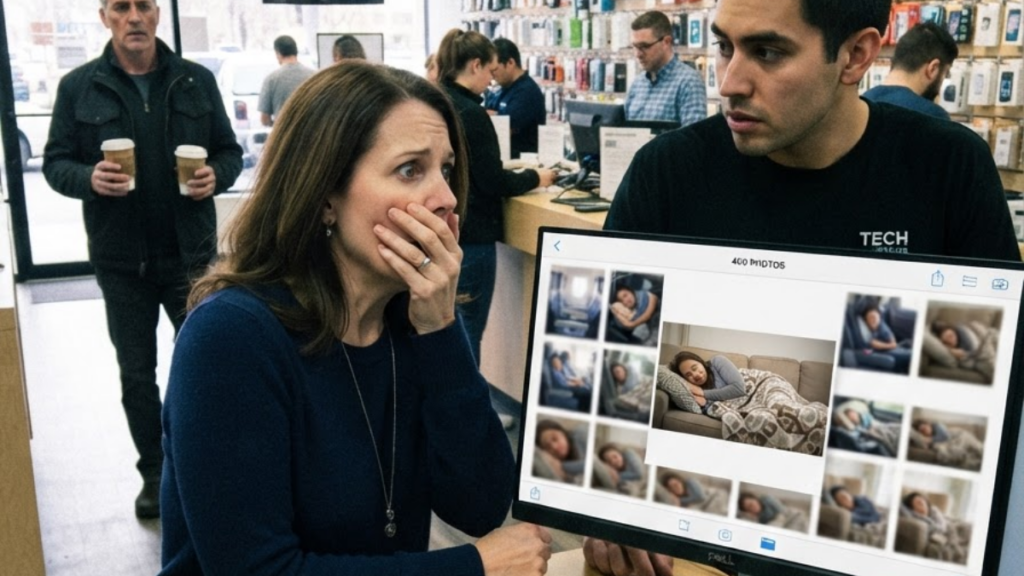
My husband dropped his phone into a bowl of French onion soup.
I wish there were a more dignified beginning to this story.
There isn’t.
We were having dinner at a restaurant with our daughter, Megan, and her husband when David reached across the table for the bread basket and knocked his phone directly into his soup.
Megan laughed so hard she almost choked.
David did not.
He grabbed the phone immediately, wiped it with his napkin, and started pressing buttons.
I told him to stop.
He said it was fine.
Then the screen went black.
David looked genuinely devastated.
“You have insurance.”
“That’s not the point.”
“It is absolutely the point.”
“My work stuff is on there.”
“So is your soup.”
Megan started laughing again.
David gave her a look.
We had been married thirty-one years.
David was sixty-two.
I was sixty.
He owned a small commercial landscaping company with his brother.
He was not technologically sophisticated.
He could use his phone perfectly well, but whenever something stopped working, he handed it to me.
That was how I ended up taking it to the Apple Store the next morning.
David could not go because he had a meeting with a property-management company.
He gave me his passcode.
He gave me his Apple ID password.
He told me to authorize whatever they needed to do.
Nothing about his behavior made me suspicious.
That is important.
He did not hesitate before giving me access.
He did not try to take the phone somewhere himself.
He did not tell me there were confidential work files on it.
He kissed me goodbye and said, “Please save my life.”
I told him, “Your life should not be stored in something you dip into soup.”
He said, “Helpful.”
I arrived at the store shortly after ten.
A technician named Marcus helped me.
He looked approximately twenty-five.
I explained the soup.
He smiled.
“That is a new one.”
“You don’t get soup often?”
“Usually toilets.”
I told him I felt much better.
The phone powered on intermittently, which he said was promising.
The bigger concern was whether everything had backed up properly before the liquid damage.
David had photographs from job sites he needed.
Marcus asked whether I knew the passcode.
I gave it to him.
He connected the phone to something.
I sat on a stool.
For approximately ten minutes, nothing interesting happened.
Then Marcus frowned.
He clicked something.
Frowned again.
I asked, “Is it bad?”
“The phone?”
“Yes.”
“I think the phone is probably replaceable.”
“That sounds suspiciously like you’re about to tell me something else isn’t.”
He looked at me.
“Is this your phone?”
“My husband’s.”
“And he gave you permission to bring it in?”
“Yes.”
“You know the passcode?”
“I just gave it to you.”
“I know.”
He seemed uncomfortable.
I immediately assumed pornography.
That was genuinely my first thought.
Not because David watched pornography constantly.
I had no idea whether he watched it at all.
I simply could not think of another reason a twenty-five-year-old Apple employee would suddenly become afraid to look me in the eye while examining my husband’s phone.
I said, “If you’ve found naked women, I promise I will survive.”
Marcus looked startled.
“No.”
“Men?”
“No.”
“Great. We’ve eliminated two categories.”
He did not laugh.
Then he said, “Can I ask you something?”
“Sure.”
“Do you know this person?”
He turned the screen toward me.
There was a photograph of a woman sleeping.
She looked approximately my age.
Maybe slightly younger.
Brown hair with gray at the roots.
She was lying on her side.
Blanket pulled to her shoulder.
The room was dark.
I leaned closer.
“No.”
Marcus clicked another photograph.
Same woman.
Different position.
Another.
Same woman.
Different pajamas.
Another.
Same woman.
Different room.
I looked at him.
“Who is that?”
“I was hoping you knew.”
“Why would I know?”
He hesitated.
“There are a lot of pictures.”
“How many?”
He clicked back.
The album contained 417 photographs.
Every thumbnail appeared to show the same woman.
Sleeping.
I felt my stomach tighten.
“What the hell?”
Marcus said nothing.
“Are these on David’s phone?”
“Yes.”
“Maybe they downloaded from somewhere.”
“That’s possible.”
I grabbed onto that immediately.
David received ridiculous things in group texts.
Memes.
Videos.
Pictures.
His brother sent him twenty photographs of a raccoon once.
Maybe somebody had sent these.
Maybe the phone backed up something strange.
Maybe they came from a shared album.
I said, “Can you tell where they came from?”
Marcus looked at the metadata.
Some were saved images.
Others were photographs taken by a phone.
David’s phone.
I stopped breathing for a second.
“You’re saying he took them?”
“Some of them appear to have been captured with this device.”
“How?”
“I mean the camera on this phone.”
“I understand what you mean. I’m asking how my husband took four hundred pictures of a woman I’ve never seen before.”
Marcus obviously could not answer that.
I looked closer.
The woman was asleep in a bed.
There was nothing sexual about the photograph.
She was fully covered.
Still, it felt horribly intimate.
People look vulnerable when they sleep.
They are not arranging their face for another person.
They do not know they are being observed.
I asked when the photographs were taken.
Marcus checked.
The oldest one on the phone was from approximately four years earlier.
The newest was six days old.
I stood up.
“Six days?”
“Yes.”
David had been home six days earlier.
I remembered because we had dinner with neighbors.
He had not been traveling.
I asked to see the newest photograph.
Marcus opened it.
The woman was sleeping on a sofa.
There was a knitted green blanket over her.
A lamp beside her.
A stack of books.
The picture had been taken from several feet away.
I stared at the room.
Then something bothered me.
I knew the lamp.
Not personally.
I had seen it.
I looked at the bookshelf.
Then the framed picture on the wall.
I whispered, “I know that house.”
Marcus looked at me.
“My husband does landscaping there.”
I did not know the homeowner’s name.
I knew the property.
It was a large house on Old Mill Road.
David’s company had maintained it for years.
I had been there once for a Christmas party hosted by one of his clients.
I remembered the living room because the house had enormous windows overlooking a pond.
I said, “Maybe she owns the house.”
Marcus waited.
“Maybe she asked him to take pictures.”
He waited again.
I heard myself.
“Okay. That doesn’t make sense.”
Marcus said gently, “I think you should probably talk to your husband.”
I almost called David.
Then I stopped.
I looked at the photographs again.
“Can we tell whether she knows he’s taking them?”
Marcus said he could not determine that from photographs.
I asked whether there were videos.
He did not search.
He said that was outside what he needed to do for the repair.
That was reasonable.
I was embarrassed.
This man was not my private investigator.
He was trying to rescue a phone from onion soup.
I asked whether the photographs would remain if the phone was replaced.
He said anything backed up should.
I told him not to delete anything.
He looked relieved.
Then he said something I did not expect.
“I think you might want to document that these exist before you leave.”
“Why?”
He looked at the screen.
“Because if you don’t know her, this seems concerning.”
I took pictures of the album with my own phone.
Dates.
Thumbnails.
Several individual photographs.
Then I called David from the parking lot.
He answered.
“How’s my patient?”
“Alive.”
“The phone or Marcus?”
“The phone.”
“Good.”
I looked at the photograph of the sleeping woman.
Then I asked, “Who’s the woman on Old Mill Road?”
Silence.
Not long.
Maybe two seconds.
Enough.
David said, “What?”
“The woman whose house you landscape.”
“We landscape a lot of houses.”
“The one on Old Mill.”
Another pause.
“Why?”
“What’s her name?”
“Linda.”
Linda.
I looked at the sleeping woman.
“Linda what?”
“Harper.”
“How old is she?”
David laughed nervously.
“Why are you interrogating me about Linda Harper?”
I said, “Because there are four hundred pictures of her sleeping on your phone.”
Nothing.
I waited.
“David?”
He exhaled.
Then he said, “Oh, Jesus.”
That was not the response I expected.
Not denial.
Not confusion.
Recognition.
I said, “Who is she?”
“Karen, listen to me.”
“Who is she?”
“She isn’t anybody.”
I laughed.
“That is a very strange thing to say about a woman you’ve photographed sleeping four hundred times.”
“I didn’t take all of those.”
“You took some.”
“Yes.”
My hand started shaking.
“Are you having an affair?”
“No.”
“Do you love her?”
“No.”
“Have you slept with her?”
“No.”
“Then why do you have pictures of her sleeping?”
David said, “I can’t explain this over the phone.”
“That sounds convenient.”
“Karen.”
“Is she safe?”
He stopped.
That was the question that changed his voice.
“What do you mean?”
“Does Linda know you’re taking these pictures?”
David said, “Do not call her.”
I felt cold.
“Why?”
“Just don’t.”
“Does she know?”
“Karen, please.”
“Does she know?”
He finally said, “Some of them.”
Some.
I hung up.
Then I searched Linda Harper.
She was fifty-seven.
Widowed.
Former elementary-school principal.
Her husband, Robert, died five years earlier.
She had two adult sons.
Her Facebook page was mostly grandchildren, gardening, and pictures of a golden retriever.
I recognized the green blanket from the photograph.
There it was in a Christmas picture.
Linda sitting on the sofa with her grandchildren.
I scrolled.
Then I found David.
He was in the background of a photograph from a neighborhood block party.
That was not unusual.
His company maintained several properties there.
I kept scrolling.
Linda posted often.
There was something else.
She had health problems.
Not clearly explained.
Posts about appointments.
Fatigue.
Thanking friends for meals.
One post from two years earlier said:
Another test, another “everything looks normal.” I am starting to feel like the world’s most dramatic hypochondriac.
I read it twice.
Then another.
Does anyone else wake up feeling like they’ve run a marathon in their sleep?
Another:
Robert used to tell me I could sleep through a tornado. Apparently now I can’t sleep through anything.
I stopped.
The photographs were all of Linda sleeping.
I called David again.
He did not answer.
I called his brother, Mark.
“Is David with you?”
“No.”
“Where is he?”
“Meeting.”
“With who?”
“I don’t know.”
“Do you know Linda Harper?”
Silence.
There it was again.
“What is wrong with everybody today?”
Mark said, “Why are you asking about Linda?”
“Because apparently my husband photographs her while she sleeps.”
Mark said nothing.
“Do you know about this?”
“I know Linda.”
“That wasn’t my question.”
“Karen, you need to talk to David.”
“I tried.”
“I can’t get involved.”
I laughed.
“You’re already involved.”
I hung up.
Then Marcus came outside.
He had my husband’s phone in a plastic bag.
He said they needed to keep it longer.
I told him that was fine.
Then he said, “I found something I think you should know about.”
My stomach dropped.
“What?”
“When I checked the backup status, I realized those photos aren’t all from this phone.”
“I know some are saved.”
“No. I mean some are from other devices.”
“What devices?”
“They’re synced through the same account.”
I stared at him.
“How many?”
He could not give me an exact number without accessing things he was not authorized to access.
But he could see device identifiers associated with some of the files.
Several different cameras.
One phone.
Something that appeared to be a tablet.
And multiple small network-connected devices.
I asked, “Security cameras?”
“Possibly.”
I thought about Linda’s posts.
Exhaustion.
Bad sleep.
Medical tests.
Then I thought about the photographs.
Different angles.
Different rooms.
Some looked as though someone stood beside the bed.
Others were taken from high corners.
I had assumed David physically photographed her.
Maybe he did sometimes.
Maybe other images came from cameras already inside the house.
I called Linda.
Her number was publicly listed because she still volunteered with the school district.
She answered on the fourth ring.
“Hello?”
“Is this Linda Harper?”
“Yes.”
“My name is Karen Ellis.”
Silence.
Then:
“David’s wife?”
My stomach dropped.
“You know who I am?”
“Yes.”
“How?”
“David talks about you.”
That did not reassure me.
“Linda, I need to ask you something strange.”
“Okay.”
“Does David have cameras inside your house?”
Silence.
Long enough that I checked whether the call disconnected.
Then Linda said, “Why?”
“Because I found photographs.”
Another silence.
“Of what?”
“You.”
Her breathing changed.
“What kind of photographs?”
“Sleeping.”
She did not speak.
“Linda?”
“How many?”
I almost lied.
I do not know why.
Maybe because saying the number aloud made it worse.
“More than four hundred.”
Linda started crying.
Not shocked crying.
Something else.
I asked, “Did you know?”
She said, “I knew about one.”
I sat down in my car.
“One what?”
“Camera.”
“Where?”
“My bedroom.”
I closed my eyes.
“Why does David have access to a camera in your bedroom?”
Linda cried harder.
“Because he installed it.”
I could barely speak.
“Why?”
She said, “Because somebody has been coming into my house while I’m asleep.”
I stopped.
“What?”
“For years.”
Every assumption I had made shifted.
I said, “Who?”
“I don’t know.”
She told me it started approximately four years earlier.
Small things.
A kitchen cabinet left open.
A lamp turned off.
A towel moved.
Her back door unlocked.
She blamed herself.
Her husband had recently died.
She was grieving.
She was not sleeping well.
Then she woke one morning and found a drinking glass beside her bed.
She did not remember bringing it upstairs.
Another time, her phone was charging on the opposite side of the room.
Then she found muddy footprints near the back door.
She called police.
Nothing appeared stolen.
There was no forced entry.
They suggested changing the locks.
She did.
It continued.
She installed a security system.
Nothing.
She started wondering whether she was sleepwalking.
Doctors evaluated her.
Nothing obvious.
Then David noticed something.
His landscaping crew sometimes arrived early.
Twice, David found Linda’s side gate open before she woke.
He asked about it.
She told him everything.
David offered to install a camera.
Not through his landscaping company.
Personally.
A small one in the bedroom.
Linda agreed.
I felt a wave of relief so strong I almost laughed.
There was an explanation.
A bizarre explanation.
But an explanation.
Then I remembered the number.
“Why are there four hundred pictures?”
Linda said, “I don’t know.”
“How long was the camera there?”
“Three weeks.”
“When?”
“Four years ago.”
My relief disappeared.
“What happened?”
“Nothing.”
The camera never captured an intruder.
Linda felt embarrassed.
She asked David to remove it.
He did.
At least, she thought he did.
I looked at the photographs again.
Some were dated last week.
I said, “Linda, there are recent pictures.”
She stopped crying.
“What do you mean recent?”
“Six days ago.”
“That isn’t possible.”
“Where did you sleep six nights ago?”
“My bedroom.”
“The newest picture I saw was on a sofa.”
Silence.
Then Linda whispered, “My basement.”
I felt cold.
“There’s a green blanket?”
“Yes.”
“Lamp with a blue base?”
“Yes.”
She started breathing quickly.
“I fell asleep watching television.”
I said, “Is there supposed to be a camera in your basement?”
“No.”
“Does David still have a key to your house?”
Another pause.
“He shouldn’t.”
“Shouldn’t?”
“I changed the locks last year.”
“Why?”
“Because of him.”
I stared through the windshield.
“Because of David?”
Linda started crying again.
She told me something happened the previous summer.
She caught David inside her house.
Not in the bedroom.
In the hallway.
It was approximately nine in the morning.
Linda had gone to a doctor’s appointment.
The appointment was canceled after she arrived.
She came home early.
David was standing outside her bedroom.
He said he had come to check a leak.
Linda had not reported a leak.
David claimed one of his employees noticed water near the foundation and he wanted to make sure a pipe had not burst.
It made little sense.
Linda became frightened.
She asked for her key back.
David gave it to her.
Then she changed the locks anyway.
I asked, “Why didn’t you tell anyone?”
“I did.”
“Who?”
“Mark.”
David’s brother.
I closed my eyes.
“What did Mark say?”
“He said David was worried about me.”
“Worried about what?”
“My memory.”
I felt sick.
Linda had been forgetting things.
At least, she thought she had.
Objects moved.
Doors unlocked.
Appointments she supposedly canceled but did not remember canceling.
Messages missing from her phone.
David suggested she might be developing early dementia.
Her mother had Alzheimer’s.
That terrified her.
She went through neurological testing.
Nothing definitive.
David told Mark he believed Linda was declining and needed someone checking on her.
Mark believed him.
I asked why David cared so much about a landscaping client.
Linda became quiet.
Then she said, “Because of Robert.”
Her husband.
“What about him?”
“David knew him.”
I had never heard that.
“How?”
“They grew up together.”
I stared at the phone.
“David told me he met you through landscaping.”
“No.”
Linda sounded confused.
“They’d known each other since high school.”
I felt as though I had missed a stair.
David had talked about his high school friends.
I knew names.
I had never heard Robert Harper.
“Were they close?”
“Once.”
“What happened?”
“I don’t know.”
Linda said Robert rarely discussed David.
When David’s landscaping company started servicing their neighborhood, Robert recognized him.
They became friendly again.
Not best friends.
Friendly.
Then Robert died.
Heart attack.
Fifty-three.
Sudden.
David attended the funeral.
I remembered that funeral.
I did not attend.
David told me one of his longtime clients died.
I sent flowers.
I had never known the dead man was his childhood friend.
I asked, “Why would he hide that from me?”
Linda said she did not know.
Then she told me something else.
Robert had been afraid before he died.
Not of David.
Of somebody.
Approximately six months before his heart attack, Robert started checking the locks repeatedly.
He installed outdoor cameras.
He changed passwords.
Linda thought work was stressing him.
Robert worked in commercial real estate.
He told her he had discovered something he wished he had not.
She asked what.
He said:
“If I’m right, I need proof before I drag anyone else into it.”
Then he died.
The death was ruled natural.
Linda never questioned it.
Neither did I.
I asked if David knew about Robert’s concern.
“Yes.”
“How?”
“Robert told him.”
Of course he did.
After Robert died, David started checking on Linda.
He helped with the yard.
Fixed things.
Changed outdoor bulbs.
Eventually, when Linda started noticing things moving inside the house, David became the person she trusted.
He installed the bedroom camera.
Then supposedly removed it.
I asked Linda to leave her house.
“Right now?”
“Yes.”
“Why?”
“I don’t know yet.”
That was the truth.
“I just don’t think you should stay there until we understand where these pictures are coming from.”
She agreed.
Her son lived fifteen minutes away.
She packed a bag.
I told her not to touch anything else.
Then I called the police.
I felt ridiculous again.
My husband had photographs of a sleeping woman.
The woman originally consented to one camera.
Then withdrew that consent.
Now photographs continued from cameras she did not know existed.
The officer I spoke with did not treat it as ridiculous.
Neither did the detective who called me two hours later.
They asked me not to confront David.
That was difficult because David had already texted me eleven times.
Call me.
Please.
This is not what you think.
Linda is confused.
You are scaring her unnecessarily.
Then:
Karen, do not involve police until you understand what is happening.
That was the message that made me stop wanting to call him.
If everything was innocent, police could understand it too.
Investigators went to Linda’s house with her permission.
They found a camera in the basement.
Inside a smoke detector.
Another in the upstairs hallway.
Another in the kitchen.
Another in the bedroom.
The bedroom camera was not the one Linda remembered.
That one had been removed.
This one was newer.
They found microphones too.
One beneath a side table.
One behind her headboard.
One inside the kitchen.
Linda sat beside me at her son’s house while the detective called.
She looked at me.
“How many?”
I told her.
She closed her eyes.
Then she said, “I’m not losing my mind.”
It was not relief.
It was grief.
For four years, Linda had questioned herself.
She kept notebooks because she no longer trusted her memory.
She photographed where she left things.
She set reminders.
She underwent cognitive testing.
She stopped babysitting her grandchildren alone because she worried she might forget something important.
Her son had started managing some of her finances.
She had given up driving at night.
She had reorganized her life around a neurological decline nobody could find.
Now we knew why.
Someone had been moving things.
Someone had been entering her house.
Someone had been deleting messages.
Someone had been creating evidence that her memory was failing.
I looked at David’s texts.
Linda is confused.
The words felt different now.
Police searched David’s phone.
Then our house.
I consented.
They found nothing hidden in our bedroom.
Nothing in our bathrooms.
Nothing recording me.
I felt relieved.
Then guilty.
Linda noticed.
She said, “You’re allowed to be relieved.”
Investigators found equipment in David’s workshop.
Cameras.
Memory cards.
Old phones.
A box containing keys.
One key was labeled HARPER.
Another was labeled R.H. OFFICE.
Robert Harper’s office.
The dead husband.
That was when the investigation stopped being about Linda.
They searched a storage unit David rented through his company.
Inside were boxes of old landscaping records.
Tools.
Christmas decorations.
Then a locked filing cabinet.
The first drawer contained documents about Linda.
Medical appointments.
Bank statements.
Copies of her driver’s license.
Her sons’ addresses.
Her medications.
The second drawer contained records about Robert.
Old emails.
Property documents.
Photographs.
Notes.
The third contained files belonging to people neither Linda nor I recognized.
Seven names.
All connected to a development project Robert had worked on before his death.
I asked what kind of development.
A retirement community.
Not the one from the last story. This was a completely separate project, and investigators initially thought the connection was financial.
Robert had been involved in acquiring land for a large senior-housing development approximately six years earlier.
The project collapsed.
Investors lost millions.
One parcel became the subject of litigation.
Robert discovered that some property appraisals had been manipulated.
Payments had been routed through landscaping and maintenance vendors to disguise where money went.
One of those vendors was David’s company.
I stopped breathing when the detective told me.
“How much?”
They did not know yet.
“Was David stealing?”
They were investigating.
Then they found Robert’s notes.
Robert suspected David had allowed his landscaping company to be used to move money.
He did not know whether David understood the larger scheme.
Robert confronted him.
David denied it.
Then Robert started collecting proof.
That was what he had told Linda.
If I’m right, I need proof before I drag anyone else into it.
I asked the question everyone expected.
“Did David kill him?”
There was no evidence of that.
Robert’s autopsy showed severe coronary disease.
He had a documented family history.
His death was consistent with a heart attack.
Investigators found no evidence David caused it.
That mattered.
The truth was already bad enough.
Robert died before he could expose what he found.
David knew he had been investigating.
David also knew Robert sometimes worked from home.
After the funeral, David became obsessed with finding Robert’s evidence.
He searched the office.
Nothing.
He searched storage.
Nothing.
Then he started searching the house.
That was why he stayed close to Linda.
Not because he was obsessed with her.
Not because they were having an affair.
Not because he wanted to watch her sleep.
Linda was sleeping in the house containing whatever Robert had hidden.
David needed to know when she was unconscious.
The sleeping photographs were not trophies.
They were confirmation.
Linda asleep upstairs.
Safe to enter office.
Linda asleep on sofa.
Do not enter.
Linda asleep in bedroom.
Search basement.
The metadata showed patterns.
Many photographs were followed minutes later by other photographs.
Drawers.
Boxes.
Closets.
Documents.
David photographed Linda sleeping so he could establish where she was before moving through the house.
I stared at the sequence.
11:42 p.m.
Linda asleep.
11:48.
Desk drawer.
11:51.
File cabinet.
11:57.
Bookshelf.
12:03.
Linda asleep.
He checked repeatedly.
That was why there were more than four hundred photographs.
He was not photographing her because he wanted pictures of a sleeping woman.
He was using her unconsciousness as a security system.
Then investigators found something even worse.
David had not initially tried to convince Linda she had dementia.
That started later.
At first, he was careful.
He returned everything exactly where he found it.
Then Linda began noticing.
A drawer slightly open.
A glass moved.
A door unlocked.
She called police.
David realized the searches might become impossible if she became more vigilant.
So he changed strategy.
He started deliberately moving things.
Not dramatically.
Enough.
Keys.
Mail.
A remote control.
A coffee mug.
He canceled an appointment from her phone.
Then put the phone somewhere else.
He opened a cabinet she rarely used.
He moved a framed photograph from one shelf to another.
Then, when Linda mentioned these things, David became concerned.
He asked whether dementia ran in her family.
He knew it did.
He suggested she see a doctor.
Then he offered to install a camera to make her feel safer.
The first camera Linda knew about was not installed to catch an intruder.
It was installed by the intruder.
I sat in the detective’s office and felt physically sick.
David created the problem.
Then offered the solution.
When the camera failed to capture anything, Linda trusted herself less.
Of course it never captured David.
He controlled it.
He deleted himself.
Eventually, Linda asked him to remove it.
He did.
Then he installed cameras she did not know about.
He needed to know when she slept.
He also needed Linda to doubt what she noticed when she woke.
The neurological appointments were useful to him.
The more Linda believed something was wrong with her memory, the less likely she was to trust evidence that somebody had been inside.
I asked whether Mark knew.
David’s brother.
Investigators questioned him.
Mark knew David was entering Linda’s house.
That devastated me.
Then the explanation became more complicated.
David told Mark Linda had given him permission.
He said Robert left important company documents in the house and Linda was too emotionally unstable to deal with them.
When Linda caught David inside and complained to Mark, David told his brother she had forgotten giving permission.
Mark believed him.
Why?
Because David had already been telling him Linda was developing dementia.
Mark was not innocent.
He should have asked Linda directly.
He should have questioned why his brother needed to search a widow’s bedroom.
But there was no evidence Mark knew about hidden cameras or deliberate manipulation.
He had accepted the explanation that required the least discomfort.
Then investigators asked Linda whether Robert had any strange habits.
“What kind?”
“Hiding things.”
She laughed for the first time in days.
“Robert hid everything.”
He hid Christmas presents so well he forgot them.
He kept emergency cash inside books.
He once hid their passports behind a loose baseboard because he thought a contractor might steal them, then spent two days accusing Linda of moving them.
The detective asked whether he had a favorite hiding place.
Linda thought.
Then she said, “Not a place.”
“What do you mean?”
“He liked things that looked useless.”
The detective waited.
Linda said Robert once stored important tax documents inside the box for a broken VCR because he knew nobody would steal a broken VCR.
He kept jewelry inside an old coffee can.
He put a backup hard drive inside a dead smoke detector.
Everyone looked at each other.
Smoke detector.
David had installed cameras inside smoke detectors.
He knew Robert’s habits too.
Investigators searched the house again.
Not for cameras.
For things that appeared useless.
They found nothing.
Then Linda called me at eleven that night.
She was crying.
“I know where it is.”
“Where?”
“The clock.”
“What clock?”
“Robert’s ugly clock.”
I knew exactly what she meant.
I had seen it in photographs.
A large wooden mantel clock.
Linda hated it.
Robert inherited it from his father.
It stopped working years earlier.
Linda wanted to throw it away.
Robert refused.
After he died, she moved it into the guest-room closet.
David had searched the closet.
Multiple times.
Investigators had photographs.
The clock itself looked ordinary.
They took it apart.
Inside the base was a flash drive.
Robert’s evidence.
Emails.
Invoices.
Bank records.
Recorded conversations.
Copies of appraisals.
A spreadsheet tracking payments.
David’s company had received $612,000 connected to the development project.
Not all of it was legitimate landscaping revenue.
David knew.
He had allowed invoices to be created for work his company never performed.
Money passed through his accounts.
He kept a percentage.
Robert discovered it.
Then he confronted David.
There was an audio recording.
Robert had recorded the conversation without David knowing.
I listened to only part of it.
Robert said:
“You’re going to tell me who asked you to invoice this.”
David said:
“You need to leave it alone.”
Robert said:
“You put your company on paperwork for work you know you didn’t do.”
David replied:
“I didn’t take their money.”
Robert said:
“You took enough.”
Then David said something that explained the next four years.
“Where are you keeping this?”
Robert laughed.
“I knew that was what you’d care about.”
The recording ended several minutes later.
No threat.
No violence.
Nothing proving David had anything to do with Robert’s death.
Robert died eleven days later.
David assumed the evidence still existed.
He just did not know where.
Then he spent four years searching for it.
I asked why he did not simply destroy Robert’s computer.
He had tried.
Robert kept copies.
David knew that because Robert told him.
Apparently, during their argument, Robert said:
“You could burn this house down and you still wouldn’t get all of it.”
That sentence haunted David.
Investigators found it written repeatedly in his notes.
BURN HOUSE?
Not as a plan.
As a question.
Where else?
Bank box?
Office?
Linda?
Cloud?
David believed Robert had multiple copies.
The flash drive in the clock was one.
Investigators eventually found another with Robert’s attorney.
Robert mailed it three days before he died.
The attorney never opened the package because Robert instructed him to hold it unless contacted.
After Robert died, the attorney sent a letter to Linda.
Linda never received it.
Investigators found a photograph of the envelope on David’s phone.
He had taken it from her mail.
That was the first documented time he entered the house after Robert died.
Not four years later.
Four days after the funeral.
He had been searching almost from the beginning.
I went home after learning that and looked at my husband differently in every memory.
Thirty-one years.
Birthdays.
Vacations.
Children.
Christmas mornings.
The man who rubbed my feet when I was pregnant had spent four years sneaking into a widow’s house and convincing her she was losing her mind because he needed to find evidence of financial fraud.
There was no second family.
No secret romance.
No hidden sexual obsession.
Somehow, that did not make it less disturbing.
It made it more ordinary.
David had committed fraud.
His friend discovered it.
His friend died naturally before exposing him.
David could have confessed.
He could have hired an attorney.
He could have accepted consequences.
Instead, he spent four years trying to erase the possibility that anyone would ever find out.
Every year required another lie.
Every lie required another intrusion.
Eventually, he was photographing a sleeping woman hundreds of times because that had become easier to him than admitting what he did.
Then investigators found the oldest photograph of Linda sleeping.
It was dated three days after Robert’s funeral.
Not four years earlier.
Three days after the funeral.
Linda was asleep in an armchair.
People were still bringing casseroles.
Flowers from the funeral were visible behind her.
The photograph was taken through the front window.
David had not even entered yet.
He was watching.
Waiting.
I stared at it for a long time.
Then I noticed something on the coffee table.
A sympathy card.
White envelope.
Blue handwriting.
I recognized it.
I had written it.
I remembered buying the card.
I remembered signing both our names.
Karen and David.
I remembered telling David to drop it off because he was going to the funeral home.
There it was beside Linda while she slept.
My handwriting.
My husband’s surveillance photograph.
Three days after we sent our condolences.
That was the moment I stopped thinking of this as something David had done in another part of his life.
I had been standing beside him while it started.
I simply had no idea what I was standing beside.
The phone stayed with investigators.
David did not come home.
I filed for divorce.
The fraud investigation expanded.
Several other people were charged.
Robert’s evidence helped reconstruct much of the development scheme.
David eventually pleaded guilty to charges connected to the financial fraud and to his conduct involving Linda’s home and recordings.
The legal process took more than two years.
Linda’s process took longer.
Her neurologist told her there was no evidence she had dementia.
She still did not trust herself.
That was what David had taken from her.
If she misplaced her glasses, she did not simply think she misplaced her glasses.
She wondered whether someone moved them.
If she forgot an appointment, she wondered whether she had forgotten or someone deleted it.
Her son offered to install security cameras.
She said no.
Then she changed her mind.
This time, she chose the cameras.
She controlled the passwords.
Nobody else had access.
That distinction mattered to her.
She started driving at night again.
She babysat her grandchildren alone.
The first time she did, she texted me afterward.
Nobody died. I remembered to feed them.
I laughed.
Then I cried.
Linda and I became friends.
Not best friends.
Not in the artificial way stories sometimes end where trauma turns strangers into sisters.
We had coffee occasionally.
We texted.
Sometimes months passed.
We were connected by something neither of us would have chosen.
That was enough.
Approximately three years after the French onion soup, Linda invited me to her house.
She had finally renovated the bedroom.
New paint.
New furniture.
No hidden cameras.
She showed me the smoke detector.
“Normal.”
I laughed.
“Did you check?”
“Twice.”
Then she showed me Robert’s mantel clock.
Investigators returned it after the case.
The mechanism still did not work.
She had considered repairing it.
Then decided against it.
“Robert liked it broken.”
We sat in the living room.
The green blanket was folded over the sofa.
I recognized it immediately.
The same blanket from the photograph that started everything.
Linda noticed me looking.
“You know what’s weird?”
“What?”
“That picture was the reason you called me.”
“Yes.”
“I almost threw this blanket away afterward.”
“Why?”
“Because I couldn’t look at it without seeing myself asleep.”
She touched it.
“Then I realized it was my blanket before it was his photograph.”
I understood.
She kept it.
I kept something too.
Not David’s phone.
I never wanted to see it again.
I kept the restaurant receipt from the night he dropped it in soup.
Megan found it in my purse months later.
She asked why I still had it.
I told her I did not know.
Eventually, I figured it out.
The receipt represented the last completely ordinary hour of my marriage.
French onion soup.
Bread.
Megan laughing.
David annoyed about his phone.
Me telling him he was ridiculous.
Then the next morning, a technician turned a screen toward me and asked whether I knew the sleeping woman.
I did not.
Neither of us understood that the photographs were not really about her sleeping.
They were about everything my husband was doing while she could not see him.
Years later, I still think about Marcus sometimes.
He probably repaired thousands of phones.
Cracked screens.
Dead batteries.
Water damage.
People forgetting passwords.
I wonder whether he remembers mine.
The sixty-two-year-old man’s phone full of photographs of the same sleeping woman.
At first, the question seemed to be why my husband had four hundred pictures of a stranger asleep.
The answer turned out to be much worse.
He needed to know when she was sleeping because that was when he could enter her life without being seen.
I thought that was the whole story.
For almost six months, I believed it was.
David committed financial fraud.
Robert discovered it.
Robert died naturally before he could expose him.
David spent years searching Linda’s house for the evidence Robert left behind.
When Linda began noticing the searches, David manipulated her into believing her memory was failing.
It was horrible.
It was also understandable in the most basic cause-and-effect sense.
Then investigators figured out who the other seven people were.
I had nearly forgotten about them.
Their names had been in the third drawer of the filing cabinet in David’s storage unit.
All seven were connected in some way to the failed development project.
I assumed David kept files on them because of the fraud.
That was partly true.
The first was an appraiser.
The second worked for the development company.
The third was an accountant.
The fourth was a county employee.
The fifth owned one of the original parcels of land.
The sixth had been an investor.
The seventh was a woman named Susan Bell.
Susan did not fit.
She had never worked on the development.
She had not invested in it.
She did not own property involved in it.
She was a retired dental hygienist living approximately forty miles away.
The only connection investigators initially found was her husband.
His name was Thomas Bell.
Thomas had been an accountant for one of the companies involved.
He died in 2018.
I asked the detective, “Did David know him?”
“Yes.”
“How?”
“Through Robert.”
That made sense.
Then the detective said, “We spoke to Susan yesterday.”
Something in his voice made me nervous.
“What did she say?”
“She said your husband used to help her.”
I stared at him.
“With what?”
“Her house.”
I stopped moving.
Susan’s husband died approximately eight months before Robert.
After Thomas died, Susan had trouble maintaining their property.
David offered to help.
Gutters.
Leaves.
Snow removal.
Small repairs.
He occasionally came inside.
Susan trusted him.
Then things started disappearing.
Not valuables.
A television remote.
A cookbook.
A bottle of perfume.
Her reading glasses.
Sometimes the missing object returned days later.
Susan thought grief was affecting her concentration.
Then one morning she found her purse in the laundry room.
She never kept it there.
She called her daughter.
Her daughter suggested Susan had moved it and forgotten.
Susan agreed.
That was exactly what Linda had done.
I asked, “Did he put cameras in her house?”
Investigators had not found evidence of cameras.
David did something simpler with Susan.
He had a key.
He entered when she was gone.
He moved things.
Then he waited for her to mention it.
I felt sick.
“Why?”
The detective said, “We think he was looking for records her husband kept.”
Thomas Bell had also suspected something was wrong with the development finances.
Not enough to understand the whole scheme.
Enough to keep copies.
David knew because Thomas had once asked him about an invoice.
Thomas died of cancer.
Afterward, David searched Susan’s house.
The pattern with Linda was not something he invented after Robert died.
He had already done it once.
Susan never found out.
Not until investigators called her.
She had spent eight years believing grief temporarily damaged her memory.
I asked whether David found what he wanted.
“Yes.”
Thomas kept copies of several invoices in a tax folder.
David took them.
That explained why investigators never found them in Susan’s house.
“Did Susan ever suspect him?”
“No.”
“Did she know he was coming inside?”
“No.”
“Did he convince her she had dementia too?”
“No.”
The detective paused.
“Apparently, he told her grief can cause memory problems.”
I put my head in my hands.
Same mechanism.
Different explanation.
Susan’s mother had not had Alzheimer’s.
Dementia would not have been the most believable fear.
Grief was.
David adjusted the explanation to the person.
That realization changed something for me.
I had been thinking of Linda as an escalation.
She was.
But she was also practice.
David learned with Susan that if you moved something small enough, people usually blamed themselves first.
If you returned it, they blamed themselves twice.
He learned that people trust an explanation that matches something they already fear.
Susan feared grief was making her incapable.
Linda feared Alzheimer’s.
David did not invent those fears.
He used them.
Then investigators showed me the dates.
David entered Susan’s house eleven documented times.
Six occurred while he was supposedly somewhere with me.
I did not understand.
“How?”
The detective showed me one.
December 8, 2018.
I remembered that day.
We went Christmas shopping.
Lunch.
Mall.
Home Depot.
Dinner.
David had been with me almost all day.
Then I saw the timestamp.
2:17 p.m.
I remembered.
David left me at the mall.
He said he needed to run to a landscaping supplier before it closed.
He was gone approximately ninety minutes.
I shopped alone.
Then he came back carrying a bag from the supplier.
Investigators found the receipt.
He bought a $6.49 sprinkler fitting.
The store was eleven minutes from Susan’s house.
He used a legitimate errand to create the empty hour.
Another entry occurred while I was at a hair appointment.
Another while David claimed he was meeting Mark.
Another while we were driving home from visiting Andrew at college.
David said he needed to stop at a client’s property because a crew left a gate open.
I waited in the car.
He was inside Susan’s house for nineteen minutes.
I had been sitting approximately seventy feet away.
That one was difficult.
I remembered the house.
Not Susan.
The house.
Brick ranch.
White shutters.
Large maple tree.
David parked along the curb.
He said, “I’ll be two minutes.”
I stayed in the passenger seat scrolling through my phone.
He came back approximately twenty minutes later.
I complained.
He said the gate latch was broken.
I asked why fixing a gate took twenty minutes.
He said:
“Because apparently nobody who works for me knows how to do anything correctly.”
I laughed.
Then we drove home.
There had been no broken gate.
There was no landscaping account at that address.
Susan was visiting her daughter.
David knew.
He let himself inside.
I sat in the car.
I asked the detective whether David knew I was outside while he searched.
“Presumably.”
“What if Susan came home?”
“She was in Wisconsin.”
“What if I got out of the car?”
He could not answer.
I remembered almost doing exactly that.
I needed to use the bathroom.
I considered knocking.
Then I decided I could wait.
For years, I had thought the closest I came to discovering David was the Apple Store.
I was wrong.
I had been seventy feet away.
The investigation into the seven files continued.
Not everyone had been manipulated.
That mattered too.
The appraiser’s file contained only business records.
The county employee’s file contained publicly available information.
The investor’s file was mostly correspondence.
David had not secretly entered seven homes.
He had not installed cameras everywhere.
There was no enormous surveillance network.
There were two women.
Susan.
Linda.
Both widows.
Both wives of men who had possessed information David wanted.
That was the pattern.
I called Susan.
I debated whether I should.
Eventually, she called me first.
She said, “I hear we’re in the same terrible club.”
She had a dry sense of humor.
I liked her immediately.
She was seventy-two.
Her voice sounded younger.
We spoke for nearly two hours.
At one point, she asked:
“Did he ever move things in your house?”
I said no.
Then I stopped.
“I don’t think so.”
There was silence.
Susan understood immediately.
“That is the problem, isn’t it?”
Yes.
That was the problem.
I started remembering things.
A bracelet I thought I lost.
Tax documents I could not find.
A kitchen drawer I was sure I closed.
My spare car key disappearing for three weeks and then turning up inside a winter coat.
I wrote everything down.
Then I gave the list to investigators.
They checked what they could.
Most of it was nothing.
The bracelet fell behind a dresser.
We found it when I moved.
The tax documents were in an old filing box.
The kitchen drawer was a kitchen drawer.
People leave drawers open.
The spare key could not be explained.
That did not mean David moved it.
The detective told me something I needed to hear.
“Do not let what he did make every forgotten object evidence.”
I wrote that sentence down too.
I had watched Linda lose trust in her own memory.
I refused to let David do the same thing to me after he was gone.
Then investigators found one thing involving me that was not ambiguous.
It was on an old external hard drive.
A spreadsheet.
Not elaborate.
David kept track of his movements when he was entering Linda’s house.
He listed dates.
Times.
Excuses.
Where Linda was expected to be.
Where I was expected to be.
There was a column labeled K.
Karen.
My name reduced to an initial.
HAIR.
MEGAN.
GYM.
BOOK CLUB.
WORK.
ANDREW.
Each entry corresponded to somewhere I would be.
He did not need to surveil me.
He knew my schedule because he was my husband.
On one line:
K – MEGAN / BABY SHOWER 12-4.
L – CHURCH / LUNCH.
ENTRY 12:40-1:35.
He scheduled his crimes around my daughter’s baby shower.
I remembered that afternoon vividly.
Megan was pregnant with our first grandchild.
I texted David photographs from the shower.
One showed me holding a ridiculous diaper cake.
He replied:
Beautiful girls. Have fun. ❤️
At 12:43, three minutes after sending that message, he entered Linda’s house.
I stared at the heart.
That was what destroyed me.
Not because the heart was fake.
I think he meant it.
That was worse.
David could love us and do this.
He did not transform into someone else when he entered Linda’s house.
He did not stop being my husband.
He simply placed different parts of his life into different compartments and assumed they would never touch.
The Apple Store made them touch.
David’s attorney eventually requested a plea agreement.
The evidence from Robert’s flash drive was overwhelming.
So was the evidence involving Linda.
Susan’s case was older and legally more complicated, but her testimony became relevant to establishing the pattern.
David pleaded guilty.
I did not attend every hearing.
Linda did.
Susan attended one.
At sentencing, David apologized.
He apologized to me.
To our children.
To Linda.
To Susan.
He apologized to Mark.
Then he said he never intended to make Linda believe she was seriously ill.
Linda made a sound beside me.
Not quite a laugh.
David continued.
He said he only wanted her to doubt whether the small inconsistencies she noticed were meaningful.
That sentence probably hurt him more than if he had simply stayed quiet.
The judge asked:
“How is deliberately causing someone to doubt her own observations meaningfully different from what she says you did?”
David started explaining.
He always explained.
That was something I had not recognized until the end.
David could explain anything.
Why he was late.
Why an invoice looked strange.
Why Linda should see a neurologist.
Why Susan could not find her purse.
Why I should wait in the car.
Why a man with a wife and two children had four hundred photographs of a widow sleeping.
Every explanation was small enough to accept on its own.
The judge eventually interrupted him.
David received his sentence.
I will not pretend I felt triumphant.
Megan cried.
Andrew stared at the floor.
Mark left before we did.
I went home and ate cereal for dinner.
That was sentencing day.
Cereal.
Television.
Laundry.
I remember thinking something enormous should happen.
Nothing did.
Life became ordinary immediately.
That was probably good.
Linda eventually sold her house.
I thought she would.
She surprised me.
She bought another house less than a mile away.
I asked why she stayed in the neighborhood.
She said:
“Because I like my grocery store.”
That made me laugh.
She refused to let David take geography from her.
Susan stayed in her house too.
She had the locks changed even though David no longer had access.
Her daughter helped her install a doorbell camera.
Susan named it David.
Every time her phone notified her, it said:
DAVID DETECTED MOTION.
She thought this was hilarious.
I told her she was insane.
She said, “I have earned it.”
Megan had her baby.
A girl.
David saw photographs through his attorney at first.
Later, Megan made her own decisions about what contact she wanted with him.
I did not interfere.
That became important to me.
I had watched David decide what other people should know because he believed his reasons justified it.
I did not want to become a gentler version of that.
My children were adults.
Their relationship with their father belonged to them.
Andrew wanted none.
Megan allowed letters.
Neither choice was mine.
Approximately four years after the Apple Store, Linda called me.
She sounded strange.
Not frightened.
Excited.
“They found another one.”
My stomach dropped.
“Another camera?”
“No.”
“Another victim?”
“No.”
“Then please stop talking like you’re in a horror movie.”
She laughed.
“Robert’s other copy.”
I sat down.
I had forgotten Robert told David there were copies.
Investigators found two.
The clock.
The attorney.
Apparently, there had been a third.
Linda was renovating her kitchen.
Workers removed an old cabinet.
Behind it was a plastic envelope taped to the wall.
Inside was a memory card.
Linda called investigators.
Most of the contents duplicated what they already had.
Financial records.
Invoices.
Emails.
Then there was a video.
Robert.
Sitting in his home office.
The date was nine days before he died.
Linda watched it first.
Then she asked if I wanted to.
I almost said no.
I watched.
Robert looked tired.
I had only known him from photographs.
Seeing him move was strange.
He introduced himself.
He explained the development fraud.
He named several people.
David was one.
Then Robert said something I did not expect.
“If you’re watching this because something happened to me, do not assume David did it.”
I stared at the screen.
Robert continued.
“I have a heart condition. David knows that. I am recording this because if I die before I resolve this, I don’t want Linda deciding every person I was investigating must have killed me.”
I looked at Linda.
She smiled sadly.
“He knew me.”
Robert went on.
He said David was frightened.
He said David had gotten involved in something larger than he understood, then continued participating after he understood enough to know better.
He said:
“I don’t think David is dangerous in the way people usually mean dangerous.”
I almost laughed.
Then Robert continued.
“I think he’s dangerous because he can justify almost anything once he decides the alternative would cost him too much.”
That sentence stayed with me.
Robert had understood David better than I had.
Then Robert said:
“If David comes to you after I’m gone, do not give him access to the house.”
Linda covered her mouth.
Robert looked directly into the camera.
“He will tell you he’s helping.”
Linda started crying.
The video continued.
“He may actually believe he is.”
That was the worst part.
Robert had predicted it.
Not the cameras.
Not the dementia manipulation.
Not four years of entries.
But the shape of it.
David would arrive as help.
I thought about Susan.
Her gutters.
Her snow.
Her grief.
Linda.
Her locks.
Her camera.
Her memory.
Me.
My soup-covered phone.
David had built much of his life around being useful.
If something broke, David fixed it.
If someone needed a favor, David helped.
If a widow needed her yard maintained, David handled it.
If his wife needed her car serviced, David took it.
If his daughter needed furniture moved, David arrived with a truck.
Being useful made people open doors.
Most of the time, he genuinely helped.
That was why nobody noticed when usefulness became access.
Robert finished the recording by telling Linda where the financial records were.
He did not say the clock.
He said there were multiple copies and she should contact his attorney.
Then he said:
“Lin, if you’re watching this, I’m sorry I didn’t tell you sooner. I kept saying I wanted to protect you until I understood everything. That was arrogant. You deserved to know what was happening in your own life.”
Linda paused the video.
We sat there.
Two wives.
Two husbands.
One dead.
One in prison.
Robert had made a smaller version of the same mistake.
He withheld information because he thought he was protecting Linda.
The difference was that he recognized it.
Too late.
But he recognized it.
Linda said:
“I would have been furious with him.”
“You should be.”
“I am.”
“You can be.”
She nodded.
Then she played the final seconds.
Robert smiled awkwardly at the camera.
“If I am alive when you find this, please pretend you didn’t watch it because I sound ridiculous.”
The video ended.
Linda cried.
Then she laughed.
Then she cried again.
She kept the recording.
I did not.
I did not need another piece of David.
I already had enough.
A few months later, I finally threw away the restaurant receipt.
The French onion soup receipt.
For years, I kept thinking it represented the last ordinary night.
Eventually, I realized that was not true.
There had been no last ordinary night.
Ordinary life had continued the entire time.
That was what frightened me about the story in the first place.
David did not spend four years lurking in darkness.
He went to Costco.
He complained about property taxes.
He watched football.
He made pancakes for our granddaughter.
He kissed me goodnight.
Then, on certain evenings, he waited until Linda was asleep and entered her house.
Both realities existed at once.
I did not need the receipt to prove I had once been innocent of knowing that.
I threw it away.
The phone itself was eventually returned after the case ended.
Not repaired.
Evidence technicians had extracted everything they needed.
It sat in a property bag.
Megan asked what I wanted to do with it.
“Nothing.”
“You don’t want to keep it?”
“Why would I?”
“I don’t know.”
Neither did I.
I turned it over.
There was still a faint cloudy mark near the charging port from the soup.
That made me laugh.
Megan looked at me like I had lost my mind.
“What?”
“Nothing.”
I told her the truth.
“If your father had ordered the tomato soup, we might still not know.”
Megan stared at me.
Then she started laughing too.
It was horrible.
It was also funny.
French onion soup exposed her father’s crimes.
Life is ridiculous sometimes.
I recycled the phone through the proper evidence-release process once I was allowed to.
I kept no photographs.
No screenshots.
No copies of Linda sleeping.
Those images belonged to something done to her.
They did not belong in my memories.
The only photograph from that period I kept was one Linda sent me years later.
She was asleep.
Her granddaughter took it.
Linda was stretched across the green sofa under the same green blanket, mouth slightly open, one sock missing.
Her granddaughter had captioned it:
GRANDMA SAID SHE WASN’T TIRED.
Linda sent it to me herself.
That distinction meant everything.
I texted:
You look terrible.
She replied:
I WAS ASLEEP, ASSHOLE.
I laughed so hard I had to put my phone down.
Then I looked at the picture again.
Same woman.
Same sofa.
Same blanket.
Completely different photograph.
For years, David had treated sleep as access.
If Linda was asleep, he believed he had an opportunity.
An unlocked hour.
A chance to search.
A chance to know something she did not know he knew.
Now Linda was asleep because she was tired.
Her granddaughter thought she looked funny.
Linda chose to send me the picture.
Nothing was hidden.
Nothing was stolen.
Nobody was waiting for her eyes to close so they could enter her life.
The first time I saw Linda Harper, she was asleep on my husband’s phone, and I had no idea who she was.
Four hundred photographs later, investigators finally understood why David kept taking them.
He was never interested in watching Linda sleep.
He was interested in everything he believed he could get away with while she wasn’t watching.
