

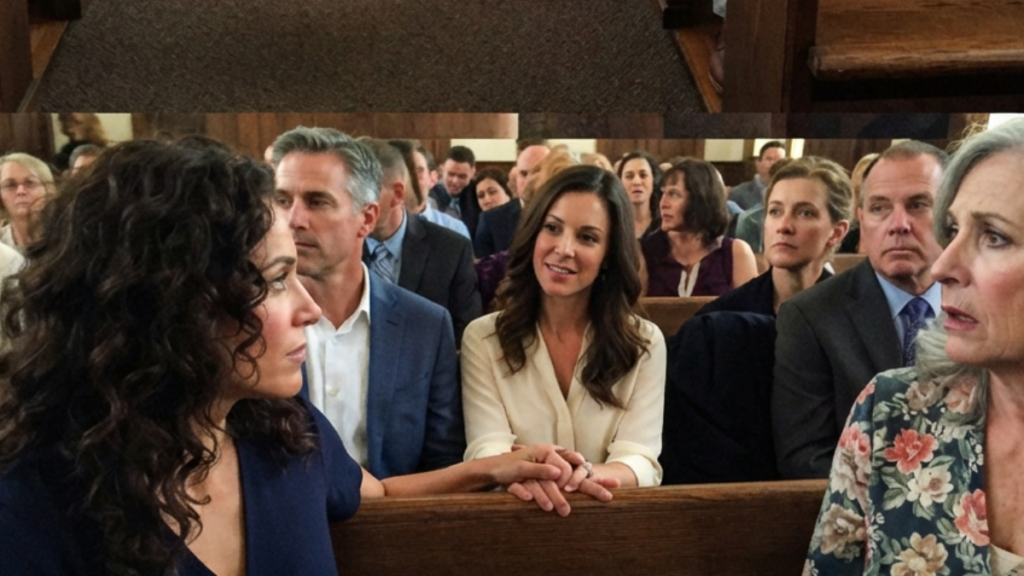
I found out my husband was having an affair because I took his eighty-two-year-old mother to surprise him at church and found another woman sitting in our family pew with her hand resting on his knee.
My name is Margaret, I was 60 years old, and I had been married to my husband, Robert, for thirty-seven years when this happened.
Robert was 63, and for as long as I had known him, Sunday morning church had been one of the few things in his life that never changed.
He could skip the gym.
He could cancel golf.
He could complain about family dinners.
He could forget an anniversary reservation until I reminded him three times.
He did not miss church.
We attended the same Methodist church for almost twenty years, and although I would not describe either of us as especially strict or religious, it had become part of the structure of our family.
We had watched our children participate in Christmas pageants there.
Our daughter, Emily, had been married there eight years earlier.
Our son, Andrew, had been baptized there as an infant and had somehow grown into a thirty-two-year-old man who still complained every Christmas Eve that the sanctuary was too hot.
Robert’s father’s funeral had been held there.
His mother, Helen, had attended with us for years before mobility problems made it harder for her to come regularly.
We even had what everyone jokingly referred to as “our pew,” although technically the church did not assign seats.
It was the fourth pew from the front on the left side.
Robert always sat on the aisle.
I sat beside him.
Helen sat beside me whenever she came.
It was simply where our family had ended up sitting for so many years that people naturally left room for us.
That is why seeing another woman sitting in my place felt so strange before I even understood what I was looking at.
The Sunday it happened, I was not supposed to be at church.
I had been staying at my sister’s house about an hour away because she had undergone a minor surgery and needed someone around for a few days.
Robert knew I was coming home Sunday afternoon.
On Saturday night, Helen called me and said she had been feeling lonely and wished she could attend church because the choir was singing one of her favorite hymns.
She no longer drove, and Robert had told her earlier in the week that Sunday morning was going to be hectic because he had volunteered to help with something before the service.
I told Helen I would pick her up.
She became excited immediately.
Then she suggested we not tell Robert because she thought it would be fun to surprise him.
I agreed.
There was nothing suspicious in my mind.
I thought I was bringing an elderly mother to surprise her son.
That was all.
I picked Helen up shortly after nine.
She wore a lavender blouse, pearls, and the same navy coat she had owned for at least fifteen years.
She spent most of the drive talking about Robert as a child and reminding me that he had once refused to participate in a church Christmas program because they made him dress as a shepherd instead of one of the kings.
We arrived about ten minutes before the service started.
The parking lot was crowded, so I dropped Helen near the accessible entrance and parked farther away.
By the time I caught up with her, she was already talking to two women she knew from the congregation.
Everyone was happy to see her.
One woman hugged her.
Another asked where Robert was.
Helen smiled and said, “We’re surprising him.”
I remember that exact sentence because it became much less charming approximately three minutes later.
We entered the sanctuary through the side doors.
The choir was already assembling.
People were talking quietly.
The organist was playing.
Helen took my arm because the aisle sloped slightly and she was afraid of losing her balance.
Then she stopped walking.
I thought she needed to catch her breath.
Instead, she stared toward our pew.
Robert was there.
He was sitting in his usual spot on the aisle.
A woman was sitting beside him.
She looked somewhere in her late forties.
Maybe fifty.
Dark blond hair cut just above her shoulders.
Cream-colored coat folded beside her.
Green dress.
She had one hand on Robert’s knee.
He was leaning toward her while she whispered something in his ear.
Then he smiled.
Not the polite smile people give acquaintances.
Not the smile he used with church friends.
The private kind.
I knew it immediately because I had seen it directed at me for most of my adult life.
Helen looked at me.
I looked at her.
She said, very quietly, “Who is that?”
I did not know.
We stood there long enough that a man behind us had to step around.
Then the woman placed her hand over Robert’s hand.
He turned his palm upward.
Their fingers intertwined.
That removed any remaining ambiguity.
Helen whispered, “Margaret.”
I could hear the panic in her voice.
I told her I was fine, even though I was not.
Then I said we should sit down.
She asked whether I wanted to leave.
I said no.
I wanted to know exactly what was happening.
We continued down the aisle.
Robert did not see us immediately because he was turned toward the woman.
Helen reached the end of the pew first.
Robert looked up.
I have never seen color leave somebody’s face so quickly.
His hand jerked away from hers.
The woman followed his eyes.
She saw Helen.
Then she saw me.
Her expression changed too, but not in the same way.
Robert looked terrified.
She looked annoyed.
That was the first thing I noticed.
She did not look confused.
She did not look shocked to discover that Robert had a wife.
She looked irritated that I had appeared somewhere I apparently was not supposed to be.
Helen said, “Robert?”
He stood.
The woman stood too.
Robert said, “Mom.”
Then he looked at me.
“Margaret.”
I said, “We thought we would surprise you.”
It was the only sentence I could think of.
The irony did not occur to me until later.
Helen looked at the woman.
Robert did not introduce her.
That made everything even worse.
Finally, the woman said, “I’m Diane.”
I said, “I’m Margaret.”
She nodded.
“I know.”
Those two words told me immediately that this was not some misunderstanding.
She knew who I was.
Then Helen asked, “How do you know my son?”
Nobody answered.
The organ music stopped.
The service was about to begin.
People around us had started noticing.
Robert said, “Can we please talk after?”
I looked at Diane.
Then I looked at the place where she had been sitting.
My place.
There was a church bulletin on the pew beside her.
A Bible.
A travel mug.
And one of Robert’s gloves resting on top of her purse.
I said, “Are you sitting here with him?”
Diane said nothing.
Robert whispered, “Margaret, please.”
I asked, “Are you sleeping with my husband?”
Helen gasped.
Robert looked around because people were openly listening now.
Then Diane said, “This is not the place.”
I stared at her.
“You were holding his hand in my pew, so apparently you thought it was the place.”
Robert told me not to make a scene.
That phrase almost made me laugh because I had not created the situation.
I had simply arrived early enough to see it.
Then the pastor walked toward the front.
We had maybe thirty seconds before the service formally began.
Helen surprised me.
She looked at Diane and said, “You need to move.”
Diane stared at her.
Helen pointed to the seat.
“That is Margaret’s seat.”
Technically, it was not.
Emotionally, everyone knew it was.
Diane picked up her purse.
Robert whispered something to her.
I could not hear it.
Then Diane moved farther down the pew.
Not out of it.
Farther down.
That told me a great deal about her personality too.
Helen sat beside Robert.
I sat beside Helen.
Diane sat two seats away from me.
The pastor began speaking.
I have almost no memory of the first ten minutes.
I remember people singing.
I remember seeing Robert’s hand shaking when he opened the hymnal.
I remember Helen refusing to look at him.
I remember Diane sitting perfectly straight with her hands folded.
Then the pastor welcomed visitors.
That was when something happened that made my stomach drop even further.
He looked toward our pew and smiled.
“It’s wonderful to have Diane back with us this morning.”
Back.
Not here for the first time.
Back.
Then he said, “And we are continuing to keep you and your sister in our prayers.”
Diane smiled.
“Thank you.”
I looked at Robert.
He stared straight ahead.
I leaned toward him.
“How often has she been here?”
He whispered, “We will talk later.”
That was not an answer.
Then one of the ushers came down our aisle during the offering.
He handed Diane the basket and said, “Good morning, Diane.”
He knew her too.
She passed it to me.
I looked inside, then back at her.
“How often have you been here?”
She whispered, “Several times.”
Several.
I asked, “With my husband?”
Robert hissed, “Margaret.”
I ignored him.
Diane said, “Yes.”
I spent the rest of the service realizing that people around me recognized her.
An older couple across the aisle smiled at her during the peace greeting.
A woman from choir touched her shoulder afterward.
One of Robert’s friends leaned over and said, “Good to see you again.”
Again.
I had been gone four days.
This was not something that began during those four days.
When the service ended, I did not let Robert escape into the crowd.
I told Helen we were going downstairs to the fellowship hall because she needed to sit.
Then I looked at Robert and told him to come with us.
Diane started to leave.
I said, “No. You should come too.”
Robert said that was unnecessary.
I told him I would decide what was necessary after I found out how long his girlfriend had been attending our church.
Diane crossed her arms.
Then she followed us.
We found an empty classroom near the fellowship hall.
Helen sat at a table.
I closed the door.
Then I asked the question again.
“How long?”
Robert said it had been about a year.
Diane said, “Fourteen months.”
I looked at him.
He said he did not remember the exact date.
Diane clearly did.
Fourteen months.
I asked how long she had been coming to church.
About six months.
I stared at Robert.
“You brought your mistress to our church for six months?”
He said she had only come occasionally.
Diane corrected him.
She had attended nine times.
Nine.
I asked whether she had sat in our pew before.
Yes.
How many times?
Diane said five or six.
I looked at Robert.
He said he did not keep count.
Of course he did not.
Then Helen asked a question I had not expected.
“Did you bring her here while Margaret was in town?”
Silence.
I looked at Robert.
He admitted he had.
Twice.
I asked where I had been.
One Sunday I was visiting Emily after she had a minor surgery.
The other time I had stayed home with a stomach virus.
I remembered both.
I remembered Robert coming home after church and telling me who he had seen.
I remembered asking what the sermon was about.
I remembered him standing in our kitchen drinking coffee and lying to my face while Diane had spent the morning sitting where I usually sat.
Helen looked devastated.
She said, “You brought her here while your wife was sick at home?”
Robert told her not to make it sound worse than it was.
Helen said, “I do not know how to make that sound better.”
I almost smiled despite myself.
Then I asked how Diane had been introduced.
Robert said as a friend.
Diane said, “A friend from work.”
I looked at her.
“What work?”
She was an interior designer.
Robert worked in commercial development, so apparently their paths had crossed professionally.
That was how they met.
Then I asked whether people at church knew they were together.
Robert said no.
Diane said, “Some do.”
I looked at her.
That answer came too quickly.
“Who?”
She named three couples.
I knew all of them.
One couple had been at our house for dinner that spring.
Another had attended our anniversary party the year before.
The third included one of Robert’s closest church friends, Tom.
I stared at Robert.
“Tom knows?”
Yes.
How long?
Around four months.
Tom had confronted Robert after seeing him kiss Diane in the parking lot.
Instead of telling me, Tom accepted Robert’s explanation.
What explanation?
That our marriage was effectively over.
Of course.
I asked whether Robert had told Tom we were separated.
Not physically.
He said we had been emotionally separated for years and were waiting for family circumstances to make an actual split easier.
I laughed because the lie was so familiar in its construction.
Our marriage had problems.
Every marriage does.
We were not emotionally separated.
We still slept together.
We traveled together.
We had dinner with friends.
We discussed replacing the roof.
We were planning a lake trip with our children the following summer.
Robert had simply taken ordinary marital frustrations and rewritten them as a quiet separation.
Then I asked Diane what he had told her.
She said essentially the same thing.
He told her we had not been intimate in more than a year.
False.
He told her we slept in separate rooms.
False.
He told her I had known for some time that divorce was likely.
False.
Then I asked the question that mattered.
“When did you learn those things were not true?”
Diane looked at me.
“About five months ago.”
There it was.
She had been lied to initially.
Then she learned.
And stayed.
I asked how she found out.
She saw us together at a restaurant.
Robert and I had gone out for dinner after attending a retirement party.
We were holding hands across the table.
Diane saw us through the window.
She confronted him.
He admitted we were still living as a married couple more than he had portrayed.
Then she stayed.
I said, “So from that point forward, you knew.”
“Yes.”
“Did you know we were still sleeping together?”
Eventually.
Robert looked at her.
Apparently that detail was not supposed to come up.
Diane said she found out because she saw a text from me one morning.
I had written:
You left your glasses on the nightstand again. I put them in your work bag.
Nightstand.
Not guest room.
Not separate bedroom.
Then she confronted him again.
He admitted we still shared a bed.
Diane stayed.
I asked why.
She said she loved him.
I said that did not answer why she continued involving herself in my life after learning that the story he told her was false.
That was when her tone changed.
She said, “Because he told me he was still leaving.”
There was anger in her voice.
Not guilt.
She had begun to view me as the obstacle.
Then she said something even more revealing.
“He kept telling me there was never a good time.”
I asked when the good time was supposed to be.
After Christmas.
Then after Emily’s birthday.
Then after Andrew finished a major work transition.
Then after Helen’s medical procedure.
Then after our summer family trip.
There was always another date.
I looked at Robert.
He had apparently been waiting for our family to finish existing before he felt comfortable disrupting it.
Then I asked why church had become part of the affair.
That was the piece I still did not understand.
Diane answered.
She wanted to attend.
Why?
Because church mattered to Robert.
Because he talked about it.
Because he had friends there.
Because she wanted to understand that part of his life.
That sounded almost innocent until she kept talking.
She said she became tired of hearing about people she had never met.
Tom.
Pastor Jim.
The choir director.
The couples who went to brunch.
The annual charity auction.
The Christmas Eve service.
She wanted to know the community Robert kept saying she might someday be part of.
Someday.
Again.
Robert initially refused.
Then he allowed her to attend on Sundays when he knew I would not be there.
Diane called it a compromise.
I called it rehearsal.
Neither of them argued.
Then Helen asked whether Diane had ever attended a church event besides Sunday service.
Yes.
The food pantry.
A Wednesday night fundraiser.
A spring volunteer day.
I knew those events.
I had skipped the fundraiser because I was helping Emily move.
I had missed the volunteer day because I had a migraine.
Robert had told me afterward that church attendance was low.
Apparently not low enough to prevent his mistress from volunteering beside him.
I asked whether she had met Helen before.
That question changed the room.
Diane looked at Robert.
Helen noticed.
She asked, “Have we met?”
Diane said yes.
Helen stared at her.
Where?
A church luncheon eight months earlier.
Helen had attended with a friend while I was away.
Diane had been there.
Robert introduced her as a designer working on one of his projects.
Helen remembered.
I watched recognition spread across her face.
“You were wearing a red coat.”
Diane nodded.
Helen looked at Robert.
“You introduced her to me.”
Robert said it had been brief.
Helen ignored him.
Then she remembered something else.
“You carried my plate.”
Diane had helped Helen because she was using a cane.
She carried her lunch tray to the table.
She sat beside her for almost half an hour.
Helen had talked about her family.
About me.
About Robert.
About our children.
About how long we had been married.
Diane sat there knowing she was sleeping with Helen’s son.
I asked Diane what she had been thinking.
She said she felt guilty.
Helen said, “You still came back.”
Diane said yes.
Then Helen asked, “Did you know who I was before you sat beside me?”
Diane hesitated.
“Yes.”
That hurt Helen more than anything so far.
I could see it.
Then Diane admitted Robert had shown her pictures beforehand.
She knew what Helen looked like.
She knew my children.
She knew me.
She knew people at church before she met them.
That gave her a massive advantage none of us had.
She could enter a room prepared.
We met her blind.
Then I asked whether she had met Emily.
Robert said no.
Diane said, “Once.”
He looked at her.
I looked at both of them.
“When?”
Emily had come to church with Robert one Sunday about four months earlier because her husband was out of town and she wanted to have lunch with her father afterward.
I remembered.
I had been at my sister’s.
Diane was there too.
Robert introduced her as someone from work.
Emily shook her hand.
They spoke for perhaps five minutes.
Then Diane joined the same group for coffee after service.
Emily had no idea.
I asked whether Diane knew who she was.
Of course.
Diane said she had heard so much about Emily that meeting her felt strange.
I said, “It should have.”
Then she admitted something worse.
Afterward, she asked Robert whether Emily liked her.
I stared.
She wanted a review.
Robert told her Emily seemed comfortable.
Then he said it was a good sign.
A sign of what?
He did not answer.
Diane did.
Their future.
That was when I understood what church had really been doing for them.
It was not simply a place they could see each other.
It was a testing ground.
Robert was introducing Diane to pieces of his life under an innocent label and then reporting back on how everyone reacted.
His mother.
His daughter.
His friends.
The congregation.
He was measuring resistance before telling anyone the truth.
I asked if Andrew had met her too.
No.
At least not in person.
Diane knew everything about him anyway.
His job.
His girlfriend.
His apartment.
The fact that he was considering proposing.
I looked at Robert.
“You told her that?”
Yes.
Andrew had told us privately he was thinking about buying a ring.
Robert shared it with Diane.
Then Diane said she knew which jeweler Andrew was considering.
That information had absolutely nothing to do with her.
I asked why she knew.
Because Robert talked about his children constantly.
That defense was beginning to infuriate me.
Talking proudly about your children is normal.
Giving your mistress private family information while she waits to enter their lives is different.
Then Diane said she had helped Robert pick out a Christmas gift for Emily the previous year.
I stared at her.
Which one?
A leather handbag.
Emily loved it.
She had thanked Robert for weeks because he had somehow chosen exactly the style she wanted.
He had not.
Diane had.
I remembered telling him how impressed I was.
I had actually joked that after thirty-seven years he finally learned how to shop for women.
Apparently another woman had done it for him.
Then Helen asked whether Diane had ever chosen anything for her.
Silence.
I looked at Robert.
He said, “Mom.”
Helen knew.
“What?”
The scarf.
Her birthday scarf.
I remembered it.
Soft blue cashmere.
Helen wore it constantly.
Robert told her he saw it in a store window and thought the color looked like her.
He did not.
Diane picked it.
She had gone shopping with him.
Helen removed the scarf she was wearing.
It was the same one.
She folded it slowly and placed it on the table.
That was the first time Diane looked genuinely ashamed.
Helen said, “You helped him buy this for me while I did not know who you were.”
Diane said yes.
Then Helen looked at her son.
“You brought this woman into my life through gifts and church before you had the courage to tell me she existed.”
Robert said he never meant to involve us.
Helen replied that he had involved everyone.
That was true.
Then the door opened.
Tom stood there.
Robert’s church friend.
He had probably been looking for us.
He saw the four of us and immediately understood.
I said, “Come in.”
He started to say it was not his business.
I told him he had made it his business when he learned about the affair and helped keep it from me.
He came inside.
I asked what exactly Robert had told him.
Tom said Robert told him our marriage was ending and that I wanted privacy.
I laughed.
My imaginary privacy request had apparently been extremely useful.
It prevented anyone from checking with me.
Then Tom admitted that Robert had asked him for something else.
A favor.
What favor?
He wanted Tom to help Diane become more comfortable at church.
I looked at him.
“How?”
Introductions.
Committee work.
Volunteer opportunities.
Tom had introduced Diane to the food pantry coordinator.
He had invited her to the fundraiser.
He had included her in a Sunday brunch group.
He thought he was helping a woman who would eventually be publicly part of Robert’s life.
I asked whether he knew I did not know.
Tom said he believed I knew Robert was seeing someone.
Why?
Robert told him.
Again.
Then Tom said something else.
He believed Robert planned to make the relationship public after Easter.
That had been months earlier.
Why Easter?
Because Robert and Diane had discussed attending church together openly beginning after Easter.
I stared at them.
They had a church debut date.
Apparently it changed.
Why?
My sister got sick and I spent more time helping her.
Then Emily had marital problems and leaned on us.
Then Helen had a fall.
There was always another reason.
Diane said that was why she had become angry.
She was tired of waiting.
Then I asked whether sitting in my pew that morning was deliberate.
She looked at me.
Robert said no.
Diane said yes.
He turned toward her.
She continued.
She had deliberately sat there.
I asked why.
She said, “Because I’m tired of sitting somewhere else.”
That was the moment I stopped seeing her as merely another person Robert had lied to.
She knew I existed.
She knew I did not know.
She knew that pew had been part of our family routine for almost twenty years.
She sat there anyway because she wanted to claim something.
I asked whether she expected me to come.
No.
She knew I was at my sister’s.
How?
Robert told her.
So she knew exactly when my seat would be empty.
She chose it because I was not supposed to appear.
Then she admitted she had sat there once before.
Only once?
No.
Three times.
Robert had said five or six earlier.
She clarified that she had been in the pew six times, but three of those times she specifically sat in my usual seat.
That detail mattered to her.
I could tell.
She said the first time made her uncomfortable.
The second time less so.
The third time felt normal.
Normal.
I said, “That was the point, wasn’t it?”
She asked what I meant.
“You wanted it to feel normal before it was yours.”
She did not answer.
Then Tom looked down.
That made me suspicious.
I asked what else he knew.
He said there had been discussions about Christmas Eve.
I felt my stomach drop again.
What discussions?
Robert wanted Diane to attend the Christmas Eve service.
Our family always attended together.
Helen.
Emily and her husband.
Andrew.
Me.
Robert.
Sometimes extended family.
I asked how that was supposed to work.
Tom said Robert had considered having Diane sit with another group.
Then afterward, if circumstances allowed, she might join everyone for coffee in fellowship hall.
I stared at him.
“With us?”
Eventually.
Robert had apparently imagined introducing her as a friend first.
Again.
Not girlfriend.
Not mistress.
Friend.
Then months later, after separation, everyone would already know her.
That was the strategy.
Familiarity before truth.
Then Diane said she had not liked that plan.
Why?
Because she did not want to stand in front of me pretending.
Interesting boundary to discover after fourteen months.
Then she said she wanted Robert to tell me before Christmas.
He refused.
I asked whether he had planned to tell me after Christmas.
He had.
Then after New Year’s.
Then another delay.
The church attendance continued anyway.
Then Helen asked something that none of us had considered.
“Does the pastor know?”
Everybody looked at Robert.
That was answer enough.
Pastor Jim knew something.
Not everything.
Apparently Robert had met with him privately two months earlier.
He told Pastor Jim he was considering ending our marriage and was involved with another woman.
I stared at him.
He had discussed our marriage with our pastor before discussing it with me.
I asked what Pastor Jim said.
He told Robert to end affair, tell truth, and stop bringing Diane to church as though situation were already resolved.
Good.
At least one person had behaved normally.
Did Robert listen?
Obviously not.
Then Robert admitted Pastor Jim specifically told him it was inappropriate to use church community to normalize Diane before I knew.
There was the exact thing I had just figured out.
He had been warned.
He kept doing it.
Then I asked whether Diane knew about that conversation.
Yes.
She had been angry.
At pastor.
Why?
Because she felt judged.
I almost laughed.
Then Tom said Pastor Jim had refused to meet with them as a couple while Robert remained married and I was unaware.
That explained why Diane seemed colder when his name came up.
She wanted institutional recognition.
He refused.
Then I remembered the prayer request.
At the beginning of service, Pastor Jim had said they were praying for Diane’s sister.
I asked what was wrong.
Her sister had breast cancer.
That was awful.
Then I asked how church knew.
Diane had submitted prayer request.
Under her own name.
Six weeks earlier.
That meant her presence was not casual anymore.
She was becoming part of the congregation.
She had signed up for email list.
Volunteer schedule.
Women’s luncheon.
I looked at Robert.
“You were building her a place here.”
He said she did that herself.
Diane said, “You encouraged me.”
Good.
Then I asked whether she had joined anything else.
A Bible study.
Tuesday mornings.
I knew that group.
My friend Carol attended.
Did Carol know who Diane was?
Not fully.
She believed Diane was separated and dating someone from another church.
Who told her that?
Diane.
I stared at her.
“So you lied too.”
She said she did not want to explain situation.
That is called lying.
Then she admitted she had talked about Robert during Bible study without naming him.
She had asked for prayer about a relationship with a man who was “trying to untangle a long marriage.”
I felt almost dizzy.
My husband’s mistress had been asking women from my church to pray for their affair without telling them who she was talking about.
Tom looked horrified.
He had not known that.
Robert had not either.
I asked Diane what exactly she had told the group.
She said she was in love with someone whose marriage had emotionally ended long ago but whose family circumstances made leaving difficult.
She said she was struggling with patience and guilt.
They encouraged her to set boundaries and not accept indefinite waiting.
Reasonable advice based on false information.
Then Carol apparently told her that if man truly loved her, he needed to act honestly.
Also reasonable.
Diane took that as encouragement to pressure Robert.
I stared at her.
“You recruited my friends to advise you about stealing my husband.”
She said they did not know it was me.
That was precisely the problem.
Then I asked whether she had ever heard them talk about me.
Yes.
Of course.
Carol had once mentioned that I was helping my sister after surgery.
Another woman mentioned seeing me at a fundraiser.
Diane sat there quietly.
She knew exactly who they meant.
I could barely process level of overlap.
Then Helen said, “Has she been to the house?”
Robert said no immediately.
Diane said nothing.
I looked at her.
“Has she?”
Not inside.
That phrase always means something.
She had been in driveway.
Once.
Robert had driven past our house with her.
Why?
Because she wanted to see it.
He showed her where we lived.
She knew which bedroom was ours.
Which room had been Emily’s.
Which room belonged to Andrew.
Where Christmas tree went.
Where Helen sat during holidays.
I asked how she knew those details.
Robert told her while parked across the street.
I felt sick.
Then Diane admitted she had been inside our garage.
I looked at Robert.
He looked surprised.
Apparently he did not know that.
When?
Three months earlier.
Robert had left garage remote in her car after moving some boxes for her.
She drove by to return it while she knew I was out.
The side garage door was open because Andrew had stopped by earlier.
She stepped inside.
For how long?
Maybe a minute.
Why?
Curiosity.
That answer told me everything.
She wanted to see.
Our bikes.
Robert’s tools.
My gardening shelves.
Family storage.
Whatever evidence existed of life he kept promising to leave.
Then she saw photographs pinned to refrigerator through kitchen doorway.
She did not enter kitchen.
She stood there looking.
I asked whether she saw me.
Photographs of me.
Yes.
Family Christmas card.
Wedding picture of Emily.
One of Andrew with Robert.
Then she left.
Robert was furious.
Not because she invaded home.
Because she had done it without telling him.
They started arguing.
I watched them.
For about thirty seconds, I became invisible while husband and mistress fought over boundaries inside my garage.
That was when Helen slammed her hand on table.
She looked at Robert and said, “Do you hear yourselves?”
They stopped.
Then she said, “You are arguing about whether your girlfriend had permission to enter your wife’s garage.”
That ended argument.
I asked Diane if there was anything else she had done without Robert knowing.
She hesitated.
Yes.
What?
She had driven past Emily’s house.
I stared.
Why?
She wanted to see where she lived.
How did she get address?
Robert had sent it months earlier when talking about neighborhood.
Did she stop?
No.
Did Emily know?
No.
Then she drove past Andrew’s apartment too.
Once.
I asked whether this was becoming a hobby.
She got defensive.
She said she wanted to understand family that Robert talked about constantly.
I said people were not landmarks on tour.
Then she admitted something else.
She had looked up Emily and Andrew online.
Facebook.
Instagram.
LinkedIn.
Normal enough in affair context, perhaps.
Then she followed Emily from a secondary Instagram account.
That was different.
Emily had accepted because account looked like local woman with mutual connections.
Diane had been quietly watching my daughter’s posts for almost a year.
Family dinners.
Vacation photos.
Pictures of Robert.
Pictures of me.
Christmas.
Birthdays.
I asked why.
Diane said because Robert’s stories did not always match what Emily posted.
There it was.
Evidence checking.
Robert told Diane our marriage was dead.
Then Emily posted a picture of us holding hands at a concert.
Robert said holidays were strained.
Then Emily posted Christmas picture where we were laughing.
Diane used my daughter’s social media to verify my husband’s lies.
Then she stayed anyway.
I said, “You knew.”
She looked at me.
“Yes.”
Then I asked whether she ever messaged Emily.
Not from fake account.
Never.
Good.
Then she admitted she saved photographs.
Why?
Some included Robert.
Of course.
She had a folder on her phone.
Pictures of him taken from family posts.
I could not believe it.
My daughter had unknowingly supplied husband’s mistress with photographs of our family.
Then Robert said, “Enough.”
I turned to him.
“No, this is finally enough information.”
He looked exhausted.
I did not care.
Then Pastor Jim knocked.
He had been told we were in classroom.
He entered carefully.
He looked at Helen.
Then me.
Then Robert.
Then Diane.
His face told me he understood.
I asked one question.
“Did you know she had been sitting in our pew?”
He said no.
Then he looked at Robert.
“You told me she had stopped attending.”
Interesting.
Robert had lied to pastor too.
I asked when.
Two months earlier.
After pastor told him church could not become staging ground for affair.
Robert said Diane would stop coming until he had spoken to me.
She did not.
Pastor Jim looked genuinely angry.
Then he asked Diane whether she had joined Tuesday Bible study.
She said yes.
He had not known.
That was when he said something I will never forget.
He looked at both of them and said, “You have been using other people’s ignorance as permission.”
That was exactly it.
Nobody gave informed consent.
Not me.
Not Helen.
Not Emily.
Not Andrew.
Not Carol.
Not church volunteers.
Not even most people who had been unknowingly helping Diane become established there.
They kept telling themselves that because nobody objected, things must be acceptable.
Nobody objected because nobody knew.
Then Pastor Jim said there was another issue.
Robert closed his eyes.
I asked what issue.
Church directory.
New directory photographs were being taken the following month.
Robert had contacted office.
He asked whether individual adult members could schedule separate photographs.
Normal question.
Then he asked whether photographs could later be combined digitally into household groups if family circumstances changed before directory printed.
I stared at him.
He had been planning the church directory.
He wanted current family photograph with me.
Then possibly later one with Diane?
Pastor Jim said he did not know that was why until now.
Robert admitted it.
He had thought if separation happened before printing deadline, he might update listing.
Diane had already scheduled her own portrait.
Of course.
Then I asked whether they expected to appear under same household.
Eventually.
That word again.
They had already discussed address change.
Membership listing.
Which service to attend.
Whether Diane would join choir.
Where they would sit.
I stared at the pew through the classroom window in my mind.
That was why she had chosen my seat.
Not because it was convenient.
Because she had already imagined it belonging to her.
Then Helen said quietly, “You were replacing Margaret one church bulletin at a time.”
Nobody answered.
There was nothing left to correct.
I had walked into church that morning thinking I was surprising my husband with his mother.
Instead, I discovered that for months he had been quietly teaching another woman how to live inside his life.
He introduced her to his mother before she knew the truth.
He introduced her to our daughter before she knew the truth.
He brought her into our church before I knew the truth.
He helped her make friends there.
He let her volunteer.
He let her join a Bible study.
He discussed Christmas.
Family photographs.
The church directory.
My seat.
Even the people around us had been given different versions of reality so that nobody would ask the one person whose answer actually mattered.
Me.
The affair was bad enough.
What made it feel almost impossible to process was realizing that the two of them had not merely been waiting for my marriage to end.
They had been practicing what my absence would look like while I was still there.
The comment about Diane and Robert practicing what my absence would look like should have been the most disturbing realization of the morning, but it turned out to be only the beginning of what they had been planning.
We were still sitting in the small classroom beside the fellowship hall when Pastor Jim asked Robert whether there was anything else connected to the church that I needed to know before somebody else discovered it for me.
Robert said there was not.
Diane looked at him immediately, and by then I had learned that her expression was usually more reliable than anything my husband said.
I asked her what he was leaving out.
She hesitated before telling me that they had spoken to someone in the church office about the memorial garden.
Our church had a small memorial garden behind the sanctuary where some longtime members chose to have their ashes interred. Robert’s father had been there for almost nine years, and although Robert and I had occasionally discussed whether we might someday choose the same place, we had never completed paperwork or made any formal arrangements.
I asked Robert what he had done.
He said he had only asked a few questions.
Diane corrected him and explained that they had completed preliminary paperwork for two adjacent spaces near his father.
I stared at both of them.
“You were planning where the two of you would be buried together?”
Robert immediately insisted that nothing had been finalized and that they had only been exploring possibilities.
Helen, who had been sitting quietly for several minutes, looked at her son as though she could no longer recognize him.
“You were going to put her beside your father?”
Robert said he had not decided anything.
Diane looked at him and said, “You told me it mattered to you that you stayed near him.”
That detail hurt Helen in a way I could see immediately.
Her husband had been buried there, and for years she had assumed that if Robert ever chose the memorial garden, I would probably be beside him. Instead, Robert had already started imagining that family space with another woman while I was still very much married to him and completely unaware that he was considering leaving.
Pastor Jim explained that the church office had never processed the request because he had told staff to hold it after Robert admitted there was another relationship involved.
That was the first moment I realized the pastor had been quietly blocking pieces of Robert’s plan for longer than I understood.
I asked whether there had been other requests.
Pastor Jim said there had been a few.
Robert had asked whether the annual Christmas flower memorial that had always been listed from “Robert and Margaret” could be changed to simply “Robert” if our circumstances changed before the next Christmas service.
For years, we had sponsored poinsettias in memory of his father and my parents. It was a tiny church tradition that had never seemed important until I realized my husband had already considered removing my name from it.
I asked why he would even be thinking about something that specific when he had not told me our marriage was supposedly ending.
Robert said he wanted to avoid awkwardness later.
I told him that he seemed to have spent an extraordinary amount of time preparing for awkwardness that only existed because he refused to be honest.
Pastor Jim then mentioned that Robert had also asked about changing household listings in the church directory after publication if someone moved or remarried.
I turned toward Diane.
She admitted that she had already scheduled an individual directory photograph for the following month.
I asked whether they had discussed eventually appearing under the same household.
They had.
That meant they had already talked about the church directory, the memorial garden, Christmas flowers, and where they would sit during services, all before Robert had said a single truthful word to me.
I looked at Diane and said, “You wanted his church, his family memorial space, his household listing, and my seat before he had even told me he was leaving.”
Diane said she understood why it looked terrible.
I told her that I was no longer interested in hearing that phrase, because everything looked terrible precisely because of what they had chosen to do.
Helen had another question.
She asked Robert whether he had ever taken Diane to the family cottage.
Our family cottage was about two hours away on a lake where Robert and his sister had grown up. After his father died, Helen kept half ownership and divided the remaining half between Robert and his sister, Paula. I had spent summers there for more than thirty years, our children had learned to swim there, and almost every major family holiday had at some point included that house.
Robert said he had never taken Diane inside.
I had already learned to be suspicious whenever he answered a question that narrowly.
I asked whether he had taken her to the property.
Diane admitted that he had driven her there twice.
The first time, they stayed in the car.
The second time, they parked at the end of the driveway and walked down toward the lake while nobody else was there.
Helen stared at her son.
“You brought her onto family property?”
Robert said they had only stayed outside.
Helen asked whether Diane knew who actually owned the cottage.
Diane said she did.
Then she added that Robert had told her Helen would probably transfer the rest of her share to him eventually.
Helen’s face hardened.
“You told her I was giving you my half?”
Robert said he had only assumed that might happen because they had discussed estate planning before.
Helen told him they had never discussed anything of the sort.
That was when I understood that Robert had not only been planning around my future choices. He had also been planning around his mother’s property as though her decisions had already been made.
I asked whether he and Diane had discussed what they would do with the cottage.
They had.
Diane said they had talked about replacing the kitchen, opening the wall between the dining area and the living room, updating the screened porch, and changing some of the furniture.
Helen actually laughed in disbelief when she heard that.
“That porch was your father’s favorite place in the world.”
Diane said she had not known that.
Helen answered that Diane had not known because it was never her house to redesign.
Then Diane admitted that she had created a Pinterest board for the cottage.
She had saved kitchen ideas, paint colors, porch furniture, and lake-house decor. Robert had sent her photographs of the rooms, including some older family pictures that happened to show me.
I asked whether she had saved those photographs.
She had.
Then I asked what she did when I appeared in them.
Diane looked embarrassed and admitted that she had cropped me out of several pictures because she only wanted to save the rooms.
That explanation was so revealing that I did not know whether to be furious or amused.
Helen asked whether any of those photographs included her late husband.
One did.
It showed the living room with his portrait hanging on the wall.
Diane had apparently asked Robert whether he intended to keep the portrait after they renovated.
Robert said yes.
Helen looked at me and said, “You were right. They were practicing another version of the family.”
That was exactly what it felt like.
They were keeping the people, the property, the stories, the traditions, and even the dead relatives while quietly removing me from the picture.
Pastor Jim then remembered that Diane had attended the church’s annual lake service the previous summer.
Every year, one family from the congregation hosted an outdoor service at their lake property, followed by lunch. Robert and I usually went together, but I had missed the previous year because I was helping Emily move.
Diane had attended instead.
Robert brought her and introduced her as someone from work who was interested in becoming more involved with the church.
People welcomed her.
She ate lunch with them.
She spoke to people who had known me for decades.
The church newsletter even included a photograph of her standing beside Robert near a picnic table.
There was nothing obviously romantic about the photograph, but the affair was literally sitting in a church newsletter while I had no idea.
Then Diane admitted that she had specifically wanted to attend because she knew Robert and I normally went together.
I asked why she would want to attend something associated with our marriage.
She said she wanted to see what it felt like to be there with him.
That answer explained more than she probably intended.
She had been trying on parts of my life one at a time to see how they felt when I was absent.
She had tried my pew.
She had tried our church events.
She had tried our family cottage.
She had met his mother.
She had met our daughter.
She had joined his social circle.
Every time I was absent, she stepped into the open space and asked herself whether she could imagine staying there permanently.
I asked whether there were other places from my life that she had tried in the same way.
She looked at Robert before answering.
He told her not to.
I told her she was going to answer anyway.
She admitted that Robert had taken her to the restaurant where we usually celebrated anniversaries.
It was a small Italian restaurant near downtown where we had gone for birthdays, anniversaries, and special occasions for almost twenty years.
Robert had taken Diane there on a Tuesday evening because he thought the restaurant would be quieter.
I asked where he had told me he was that night.
He said he was having dinner with Tom.
I turned toward Tom.
His expression told me he had known.
I asked whether he had agreed to cover for Robert.
Tom admitted that Robert asked him to confirm they had been together if I ever questioned it.
I asked why he would agree to something like that.
Tom said Robert told him he was about to leave me and did not want one dinner to cause an explosion before he was ready to have the larger conversation.
I told him that he had knowingly helped my husband lie to me.
He said he was sorry.
By then, apologies had stopped having much effect.
Diane then admitted that she had wanted to sit at the table Robert and I usually requested near the window.
Robert refused.
That was apparently one of the few places he considered too obviously connected to us.
Diane had been angry about it.
I asked why she cared which table they used.
She said she was tired of being given what felt like second-best versions of everything.
That sentence told me what I needed to know about her.
She had not been satisfied merely to have Robert privately.
She wanted proof that he would eventually choose her for the same places, traditions, and relationships that had belonged to our marriage.
The church pew was not really about church.
The restaurant table was not really about dinner.
The cottage was not really about property.
They were symbols of rank.
She wanted to know whether Robert would let her occupy the places associated with me.
I then asked whether she had ever inserted herself into one of our holidays.
She said she had never attended a family holiday openly.
Then she admitted that she had come very close.
The previous Christmas Eve, our family went to the later church service and then returned to our house for dinner and gifts.
Diane had attended the earlier service.
Afterward, she waited at a coffee shop two blocks from our house.
Robert left our family gathering for approximately forty minutes after we got home.
I remembered it clearly.
He told me that he had forgotten something at church and needed to pick it up before the building was locked.
He returned carrying a box of candles and said Pastor Jim had asked him to store them for a January event.
Pastor Jim stared at Robert.
“There were no candles.”
I almost laughed.
Robert had apparently found a random church box somewhere to complete the lie.
He had actually spent those forty minutes with Diane.
On Christmas Eve.
While his mother, wife, daughter, and son were sitting at home waiting for him.
Diane gave him a watch that evening.
I remembered the watch because Robert wore it the following morning and told me his business partner had given it to him.
I had complimented it.
He had thanked me.
I asked what Robert gave Diane.
A necklace.
He bought it from the same jeweler where he had purchased my anniversary earrings earlier that year.
I asked whether she wore the necklace to church.
She had, but Robert warned her not to wear it when he thought I might attend because he was worried I would recognize the style or ask where it came from.
That told me he understood perfectly well how much their worlds were overlapping.
Then Helen asked whether he had seen Diane around Thanksgiving too.
He had.
The night before Thanksgiving, Robert told me he was helping Tom with something at church.
Tom looked surprised.
He had not known about that lie.
Robert had gone to Diane’s apartment for dinner instead.
She had cooked turkey, stuffing, sweet potatoes, and several of the side dishes our family normally ate.
I asked why she had made a Thanksgiving dinner the night before our actual family Thanksgiving.
Diane said she wanted to learn which recipes Robert liked.
I asked where she got the recipes.
Robert had sent them.
One of them was Helen’s sweet potato recipe.
Another was my lasagna.
Another was the cinnamon roll recipe I made every Christmas morning.
Diane had created a digital folder for all of them.
The folder was called Someday.
I told her I wanted to see it.
She resisted for a moment and then opened it.
The folder contained far more than recipes.
There were holiday ideas, photographs of the cottage, church events, travel plans, gift ideas for Helen, gift ideas for Emily and Andrew, places they might live, and a document titled People I Need to Meet Eventually.
I asked her to open that too.
The list included Emily, Andrew, Andrew’s girlfriend, Emily’s husband, Helen, Paula, several of Robert’s friends, Pastor Jim, Tom and his wife, and even my sister.
I asked why my sister’s name would possibly be on a list of people Diane needed to meet.
Diane said Robert and my sister had always gotten along well at family gatherings, so she assumed he might still see her occasionally after a divorce.
The arrogance of that assumption was almost breathtaking.
Then I noticed that the list had categories.
One heading said People Who May Be Difficult.
My name was first.
Emily was second.
Helen was third.
Helen leaned forward and asked why she was considered difficult.
Diane said she had been worried Helen would never accept her.
Helen told her that concern was well founded.
There was another category called Probably Easier.
Andrew’s name was there.
Paula.
Tom.
Several of Robert’s business friends.
I looked at Robert and asked why our children had been ranked according to how easily they might accept his mistress.
He said Diane had created the list.
Diane immediately said Robert had helped.
Andrew was considered easier because Robert believed he was more independent and less emotionally attached to family traditions.
Emily was considered difficult because she was close to me.
They had analyzed our children’s personalities as part of planning how to integrate Diane.
Then Diane opened another note titled First Year.
It was essentially a projected timeline for what they expected to happen after Robert finally told me.
The first item was to tell Margaret.
The second was for Robert to move out.
Then they planned to give the children space for several weeks, begin attending church openly after some time passed, avoid social media for three months, skip the first Thanksgiving together, possibly attend separate Christmas services, introduce Diane more formally after the New Year, and avoid pushing family members to accept her too quickly.
There was also a note about the cottage that said they should only use it if Helen approved.
I looked at Helen.
At least somebody had remembered she actually owned part of it.
Then I noticed another line.
Anniversary date?
I asked what that meant.
Diane explained that they had discussed the problem of having an anniversary date that would reveal how long the affair had actually lasted.
If they ever became public, celebrating the true date of their relationship would immediately show that it began while Robert was still married to me.
Their solution was to choose a later date.
They considered using the date of their first trip after our separation as their public anniversary.
I stared at them.
“You were planning to invent when your relationship started.”
Robert said they were not inventing anything because people did not need to know every detail.
Pastor Jim corrected him.
“That would be a lie.”
Robert looked away.
Diane seemed more bothered by that particular plan than I expected.
She said she had already spent more than a year being hidden, and she hated the idea that even after Robert left me, she would still be expected to pretend that a large part of their relationship never existed.
I told her that the problem was not that their affair history was being erased. The problem was that they were planning to erase it specifically so people would not understand what they had done.
Then I asked her something I had been wondering since the beginning.
I wanted to know when she had finally stopped believing Robert’s version of our marriage and consciously decided she did not care that it was false.
She had initially believed we were emotionally separated.
Later, she learned we still shared a bedroom.
She saw us holding hands at dinner.
She saw family photographs online.
She met his mother.
She met our daughter.
At some point, she had to know that the marriage was not what Robert had described.
I asked when that happened.
She thought about it for a long time.
Then she said it was Christmas Eve.
Sitting in that coffee shop two blocks from my house finally made everything undeniable.
She knew I was home.
She knew both of our children were there.
She knew Helen was there.
She knew Robert was leaving an active family Christmas gathering to spend forty minutes with her before returning home to me.
She understood then that Robert had not emotionally left the family either.
He still loved the traditions.
He still wanted the holidays.
He still enjoyed being my husband in many ways.
He simply also wanted Diane.
That was when Diane stopped waiting politely.
She told us that after Christmas, she became more determined to establish her own place in Robert’s life.
She joined the Bible study.
She attended more Sunday services.
She started sitting in our pew.
She asked more questions about the cottage.
She followed Emily online.
She pushed Robert to discuss the church directory.
She agreed to look at the memorial garden.
The more evidence she saw that I was still fully present in Robert’s life, the more aggressively she tried to create places where she could imagine herself replacing me.
I said, “So once you realized I was not disappearing on my own, you started rehearsing my disappearance.”
Diane looked at me for several seconds before saying yes.
That admission silenced the room.
Then Helen asked whether Robert had ever taken Diane to his father’s grave before the ashes were moved into the church memorial garden.
Robert said he had.
Helen looked devastated.
It happened on his father’s birthday.
Robert told me he wanted to go alone that year because he needed quiet time.
I had asked whether he wanted me to come.
He said no.
He brought Diane instead.
She took white lilies.
Those were the flowers Helen always brought.
I asked how Diane knew.
Robert had told her.
Helen looked at her son and said, “You gave her my ritual.”
Robert said he had not thought of it that way.
Helen told him that was becoming a useless excuse.
Then Andrew called.
Emily had apparently contacted him after Helen texted her, and he wanted to know what was happening.
I gave him the shortest truthful explanation I could.
His father had been having an affair for fourteen months, the woman had been attending our church, and we had discovered that she had already been quietly introduced to several family members and friends under false pretenses.
Andrew asked her name.
When I told him, he went silent.
Then he asked for her last name.
Diane gave it.
Andrew swore.
I asked why he knew her.
He had met her at the gym.
Robert and Andrew occasionally worked out together on Saturday mornings. Around five months earlier, Diane had been there at the same time.
Robert introduced her as someone from church.
Not work.
Not a consultant.
This time she was a church friend.
Andrew spoke to her for about twenty minutes.
They talked about running and his job.
He thought she was friendly.
Then she followed him on LinkedIn.
A few weeks later, she sent him an article related to his industry, and he replied politely.
He had no idea he was exchanging messages with his father’s girlfriend.
I asked Diane why she had contacted him.
She said she genuinely thought he would find the article interesting.
Andrew asked whether that was really the only reason.
She admitted it was not.
She wanted an excuse to interact with him.
Robert knew.
In fact, he encouraged it because he thought Andrew and Diane having something in common would make things easier later.
Andrew said, “You were trying to make me like her before you told me who she was.”
Robert said he wanted the transition to be less painful.
Andrew told him that secretly arranging familiarity was not the same thing as making anything easier.
Then Diane admitted she had seen Emily outside of church too.
At first, Robert looked confused.
Apparently he did not know about this one.
Diane had seen online that Emily was speaking at a charity luncheon through work.
She purchased a ticket.
She attended alone.
She did not approach Emily.
Instead, she sat two tables away and watched her.
I asked why she would do something like that.
Diane said she wanted to understand why Robert was so certain Emily would have the hardest time accepting their relationship.
She watched my daughter speak.
She watched her interact with coworkers.
She watched her laugh.
She noticed how much Emily resembled me.
Then she went home.
Robert looked genuinely disturbed.
“You never told me that.”
Diane snapped that he had spent more than a year feeding her details about his family, so he did not suddenly get to act horrified because she looked at the people he talked about constantly.
For several seconds, they actually started arguing with each other about whether Diane had crossed a boundary by attending my daughter’s charity luncheon.
Pastor Jim finally interrupted them.
He said, “The two of you are arguing about boundaries after spending more than a year denying everyone else the opportunity to set any.”
That ended the argument immediately.
Then Carol appeared at the classroom door.
Carol was one of my friends from church and a member of Diane’s Tuesday Bible study.
Somebody had apparently told her enough to make her come looking for us.
She took one look at Diane sitting beside Robert and then looked at me.
Her face went pale.
She said, “Oh my God.”
I told her what we had discovered.
Carol immediately started crying.
She said she had no idea Diane was involved with Robert.
I believed her.
Then she looked at Diane and said, “You told us his marriage was already over.”
Diane said she had described it as emotionally over.
Carol shook her head.
“No. You said they were living separately.”
I looked at Diane.
That was another lie.
She admitted she had told the Bible study group that Robert and I were already living separately because she was embarrassed by the truth.
Carol looked disgusted.
For weeks, the women in that group had encouraged Diane to stop accepting secrecy and to insist on a healthier relationship.
They thought they were supporting a woman dating a man whose marriage had effectively ended but who was dragging his feet about making a separation official.
Instead, their advice had been strengthening an affair.
Carol said, “You let us pray for this.”
Diane tried to argue that she had never asked anyone to pray for adultery.
Carol answered, “You changed the facts so we would pray for what you wanted.”
There was no reasonable response to that.
Then Carol remembered something else.
The church women’s retreat was coming up the following month.
Diane had registered.
She had requested Carol as her roommate.
I stared at both of them.
My friend was about to share a hotel room with my husband’s mistress at a church retreat without knowing who she was.
Carol looked horrified.
She asked Diane whether she had planned to talk about Robert during the retreat.
Diane admitted that she probably would have.
Then Pastor Jim asked the church administrator to bring him Diane’s membership paperwork.
I had not known she had applied for formal membership.
She had submitted the forms two weeks earlier.
Robert and Tom had agreed to sponsor her application.
Tom looked miserable when that came out.
He said he agreed because Robert told him the marriage was ending and that Pastor Jim understood the situation.
Pastor Jim said he had deliberately refused to approve the application until Robert clarified what was happening.
On the paperwork, Diane listed herself as single, which was technically true.
Then I saw the emergency contact.
Robert.
Under relationship, she had written partner.
My husband had signed the sponsorship form underneath it.
I stared at him.
He had been willing to identify himself in writing as another woman’s partner inside the same church where his wife was still an active member.
Pastor Jim turned the page.
There was a handwritten note beneath Diane’s address.
Will update after move, likely spring.
I asked what move.
Robert said nothing.
Diane said they had looked at a townhouse the previous month.
They had not bought it or leased it, but they had toured it together.
It was about fifteen minutes away.
Three bedrooms.
I asked why they needed three bedrooms.
One would be theirs.
One would be an office.
The third would be a guest room.
I asked who they expected to stay there.
Robert had apparently imagined that Emily and Andrew might visit.
Helen could stay overnight if necessary.
Maybe future grandchildren would someday use it.
Helen laughed bitterly.
“You selected a bedroom for me in a house I would never visit.”
Diane said Robert believed she would eventually come around.
Helen replied that Robert had apparently built his entire future on the assumption that everyone would eventually do what he wanted.
Then Diane showed us pictures from the townhouse.
One photograph included the floor plan.
There were handwritten labels on it.
Primary bedroom.
Office.
Guest room.
Dining room.
Then, in the living room, someone had written:
Family photo wall.
I asked what family photographs they intended to use.
Robert said pictures of the children and older family photographs.
I asked whether I would appear in them.
Nobody answered immediately.
Diane finally said that I probably would not be in most of them.
Then she admitted she had already created a digital folder of photographs she thought might work.
Pictures of Emily.
Andrew.
Helen.
Robert’s father.
The cottage.
Church events.
Some were photographs from our family albums where I happened to be included.
She had cropped me out of several of them.
I asked whether she had saved any photographs from our wedding.
One.
It showed Robert standing with his parents.
I had originally been standing beside him.
Diane cropped me out.
Helen closed her eyes.
That photograph seemed like the simplest possible explanation of what Robert and Diane had been doing.
The family existed.
The history existed.
The people existed.
The only thing they kept trying to remove was me.
Pastor Jim eventually reminded us that another church group needed the classroom soon, and we would have to leave.
Before anyone stood, Helen looked at Robert and asked what he had planned to do if we had not surprised him that morning.
Robert said he and Diane were going to brunch.
After brunch, they were going to see another townhouse.
Then he planned to go home before I returned from my sister’s house.
He was going to make dinner.
He was going to ask about my sister.
He was going to behave as though nothing had happened.
I asked whether he intended to tell me anything that evening.
No.
I asked when he planned to tell me.
He said he had been thinking sometime after Thanksgiving.
Diane turned toward him.
“You told me October.”
That was another surprise.
She believed he was leaving within weeks.
He had already moved the deadline again without telling her.
I asked what happened to all the previous deadlines.
After Easter.
After the summer.
After Helen’s medical procedure.
After various family events.
Robert said timing kept becoming more complicated.
I told him that timing had not become more complicated. Lying had simply become easier.
Diane then asked Robert directly whether he actually intended to leave me.
He said he did.
She asked for a date.
He could not give one.
For the first time that morning, she looked less angry than frightened.
Then she said something that was almost painfully honest.
“I sat in that pew today because I thought if I could finally sit where she sits, maybe you would stop treating me like I was temporary.”
That explained the entire morning.
Her choice of seat had never really been about where she could see the altar.
It was about rank.
She wanted to know whether Robert would allow her to occupy something that everyone associated with me.
He had allowed it because he knew I was supposed to be an hour away.
I asked what she planned to do when I returned the following Sunday.
She said she would have moved back to another pew.
That was the insanity of everything we had uncovered.
Nothing had actually been transferred to her.
She had only been borrowing pieces of my life when I was absent.
She borrowed my seat when I was out of town.
She attended our church events when I could not go.
She toured the cottage when nobody was there.
She ate at our restaurant on a quiet night.
She practiced our holiday recipes before the actual holidays.
She met our children under false descriptions.
She imagined a future family photo wall using photographs from a family she had never been part of.
Every part of the relationship depended on temporary openings created by my absence.
Helen stood slowly and reached for the blue cashmere scarf Diane had helped Robert choose for her birthday.
For a moment, I thought she might leave it behind.
Instead, she folded it over her arm.
Then she looked at Diane and said, “I like the scarf, so I am keeping it. You do not get that either.”
It was such a perfectly Helen response that I almost laughed.
She took my arm, and we walked back toward the fellowship hall together.
People were still drinking coffee and talking after the service.
Several people greeted me.
Several greeted Diane.
Most of them had no idea what had happened in the classroom.
As I looked around the room, I could suddenly see the invisible structure Robert had been building around us.
I could see the people Diane had met because Robert arranged introductions.
I could see the Bible study she had joined using a false version of my marriage.
I could see the pew she used when I was away.
I could see the church directory she hoped to enter later.
I could see the memorial garden where she imagined being buried beside my husband.
I could see the Christmas services they had already discussed.
I could see the cottage she had redecorated on a Pinterest board.
I could see the townhouse where she had already labeled a room for my mother-in-law and a wall for my children’s photographs.
None of those plans existed because my marriage had already ended.
They existed because Robert and Diane had decided to begin living around its imagined ending while I was still completely inside it.
I had taken Helen to church that morning because she wanted to surprise her son.
Instead, I discovered that my husband had spent more than a year teaching another woman how to move through his life as though my absence were inevitable.
The affair itself was terrible, but the part I could not stop thinking about was how methodically they had rehearsed a future that depended on everyone else eventually accepting decisions none of us had been allowed to make.
