

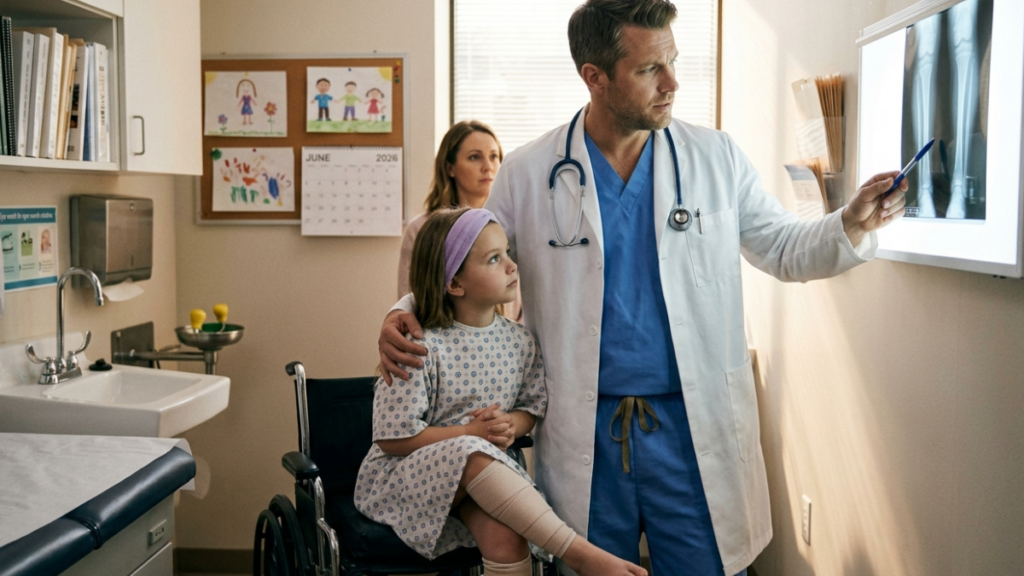
The doctors had stopped promising miracles.
At some point, even the hopeful ones stopped using words like “recovery.”
They switched to different words.
Adjustment.
Acceptance.
Adaptation.
The kinds of words people use when they think a battle is over.
Ten-year-old Charlotte knew exactly what those words meant.
They meant nobody believed she would ever walk again.
Not her doctors.
Not her physical therapists.
Not even most of her family anymore.
Three years earlier, a car accident had changed everything.
One moment she had been racing through a neighborhood park with her friends.
The next—
hospital lights.
Surgeries.
Months of rehabilitation.
And eventually a wheelchair that became as permanent as her own shadow.
Now she spent most afternoons sitting in the enormous backyard of her family’s oceanfront mansion.
The backyard was bigger than most public parks.
Perfectly trimmed hedges.
A sparkling pool.
Imported stone pathways.
Everything beautiful.
Everything expensive.
Everything she couldn’t enjoy the way she once had.
Charlotte stared across the lawn.
The gardeners were working near the edge of the property.
Normally she ignored them.
Today she couldn’t.
Because one of them kept staring at her.
A boy.
About her age.
Barefoot.
Dirty jeans.
Oversized shirt.
Definitely not somebody who belonged in places like this.
Every few minutes he’d glance toward her.
Then go back to helping his father.
Then look again.
Charlotte finally rolled her eyes.
“Can I help you?”
The boy looked startled.
Like he didn’t expect her to notice.
Then he walked toward her.
Slowly.
Carefully.
Not nervous.
Just certain.
Which somehow felt stranger.
When he reached her, he stopped.
Studied her for a moment.
Then asked a question nobody had asked in years.
“Do your feet still get cold?”
Charlotte frowned.
“What?”
The boy pointed at her legs.
“Do they get cold?”
She stared at him.
Of all the questions people asked—
How are you feeling?
Are you okay?
Have you tried this doctor?
Have you tried that therapy?
Nobody had ever asked that.
“Sometimes.”
The boy nodded.
Like she’d just confirmed something important.
Then he turned and ran toward the gardening shed.
Charlotte watched him disappear.
Two minutes later he came back carrying a small white basin.
Steam drifted from the water inside.
Charlotte blinked.
“What are you doing?”
The boy set the basin carefully on the grass in front of her.
Then knelt.
Calm.
Focused.
Certain.
The way somebody looks when they’re following instructions.
Not guessing.
Following.
Then he looked up at her.
“Just trust me.”
Charlotte laughed.
Actually laughed.
For the first time all day.
“You don’t even know what’s wrong with me.”
The boy smiled.
A tiny smile.
Then gently took hold of the wheelchair footrests.
“No.”
A pause.
“But I think your feet do.”
He slowly lowered them into the warm water.
The backyard fell silent.
The wind.
The pool.
The distant sounds from the house.
Everything disappeared.
Charlotte felt nothing.
Just like always.
Then—
her breath caught.
Her eyes widened.
The water rippled.
And for the first time in three years—
something moved beneath the silence.
“Wait…”
Charlotte’s voice cracked.
The single word barely escaped.
Then louder:
“Wait.”
The boy froze.
The basin sat between them.
Tiny ripples spread across the surface of the water.
Charlotte stared at her feet.
She couldn’t breathe.
Couldn’t blink.
Couldn’t think.
Because after three years of nothing—
there was something.
The sensation was faint.
Almost impossible to describe.
Not movement.
Not strength.
Just awareness.
Like a light turning on in a room she thought had been abandoned forever.
“I can feel it.”
A tear slipped down her cheek.
“I can actually feel it.”
The boy didn’t celebrate.
That was the strange part.
He simply nodded.
Like he’d been expecting this.
Across the yard, Charlotte’s mother had stopped walking.
A tray of iced tea slipped from her hands.
Glasses shattered across the stone patio.
Neither of them noticed.
“Charlotte?”
Her mother’s voice trembled.
“Sweetheart… what did you just say?”
Charlotte looked up.
Her face pale.
Eyes wide.
Almost frightened.
Because hope can be terrifying when you’ve lost it.
“I can feel the water.”
Silence.
Heavy.
Absolute.
The family physician happened to be visiting that afternoon.
He had known Charlotte for years.
He had watched every surgery.
Every treatment.
Every setback.
Every disappointment.
He immediately hurried forward.
Kneeling beside the wheelchair.
“Charlotte.”
His voice was calm.
Professional.
Careful.
“What exactly are you feeling?”
She swallowed.
Trying to find the words.
“It’s warm.”
A pause.
Then:
“And when the water moves…”
She looked down.
“…I know where it moves.”
The doctor’s expression changed.
Subtly.
But Charlotte saw it.
Her mother saw it.
Even the boy saw it.
Doubt.
The kind of doubt that only appears when something impossible starts looking possible.
The doctor reached into the basin.
Very gently.
He touched the little toe on her left foot.
Charlotte jumped.
Not physically.
Emotionally.
“That one.”
The doctor froze.
He touched another.
A different toe.
Charlotte pointed immediately.
“That one.”
The doctor looked up.
And suddenly nobody liked the look on his face.
Because he seemed to be replaying three years of medical records inside his head.
“Doctor?” her mother asked.
He didn’t answer.
Instead, he looked toward the boy.
The gardener’s son.
The barefoot kid kneeling in the grass.
“How did you know?”
The boy shrugged.
“My grandma.”
Nobody understood.
The doctor frowned.
“What about your grandmother?”
The boy looked embarrassed.
Like he wasn’t used to adults paying attention to him.
“After her stroke, everybody said she couldn’t feel one side of her body.”
A pause.
“But she said sometimes it felt asleep.”
The doctor said nothing.
The boy continued.
“So my grandpa would soak her feet in warm water every night.”
Charlotte’s mother blinked.
“And?”
The boy smiled.
A small one.
“One day she kicked him because the water was too hot.”
Charlotte laughed.
A short, surprised laugh.
The first real laugh she’d had in months.
The doctor didn’t.
Because something about the story bothered him.
Not in a bad way.
In a professional way.
He stood.
Slowly.
Then looked toward Charlotte.
“Have you had sensation tests recently?”
Her mother shook her head.
“No. Not for over a year.”
The doctor looked back at Charlotte.
Then at the basin.
Then at the boy.
Finally, he said something nobody expected.
“I want to run every test again.”
Charlotte stared.
“What?”
The doctor took a long breath.
“Because if you can consistently identify touch and temperature…”
He paused.
Choosing his words carefully.
“…then there are some assumptions we may need to revisit.”
The backyard went silent again.
But this silence felt different.
Less like grief.
More like possibility.
Charlotte looked down at her feet.
Still resting in the warm water.
Still feeling the warmth.
Still feeling the movement.
Then she noticed something.
Something tiny.
Something so small nobody else could have seen it.
One of her toes had moved.
Just slightly.
Barely at all.
A twitch.
Nothing more.
Except—
Charlotte knew she hadn’t imagined it.
And judging by the expression suddenly appearing on the doctor’s face—
he had seen it too.
The doctor’s face changed instantly.
Not dramatically.
Not the way it happens in movies.
Something smaller.
More dangerous.
The expression of a man realizing he might have been wrong.
“Did you see that?”
Charlotte asked.
Her voice barely above a whisper.
Almost afraid to say it out loud.
The doctor didn’t answer immediately.
He was still staring at her foot.
At the smallest toe on her right foot.
At the movement he’d just witnessed.
Then he slowly nodded.
“Yes.”
Charlotte’s mother sat down so suddenly she nearly missed the chair behind her.
Because for three years she’d trained herself not to hope.
Hope was expensive.
Hope was exhausting.
Hope was what happened right before disappointment.
And yet—
there it was.
Standing in the middle of her backyard.
Barefoot.
Holding a plastic basin.
The gardener’s son looked confused by everyone’s reaction.
“What?”
The doctor stared at him.
“What exactly did your grandmother tell you?”
The boy thought for a moment.
Then shrugged.
“She said bodies forget things.”
The doctor frowned.
“Forget things?”
The boy nodded.
“Like when your hand falls asleep.”
Nobody spoke.
“Or when you don’t ride a bike for a long time.”
The adults exchanged looks.
Because the explanation sounded childish.
Too simple.
Too easy.
Then the boy added:
“She said sometimes the body remembers before the brain does.”
The doctor froze.
Because that wasn’t childish at all.
That sounded suspiciously close to something he’d heard during a neurology conference years ago.
A discussion about neural pathways.
Dormant connections.
Signals interrupted but not completely destroyed.
The doctor looked back toward Charlotte.
“Can you try something for me?”
She swallowed.
Immediately nervous.
“What?”
“I want you to think about moving your foot.”
Charlotte almost laughed.
“I’ve been doing that for three years.”
“I know.”
The doctor’s voice softened.
“But this time I don’t want you to try.”
A pause.
“I just want you to imagine it.”
The backyard became silent.
Even the workers had stopped gardening.
Everyone watching now.
Charlotte looked down.
At her feet.
At the water.
At the tiny toe that had twitched.
Then she closed her eyes.
Nothing happened.
Ten seconds.
Twenty.
Thirty.
The familiar disappointment started creeping in.
The feeling she knew too well.
The feeling that always came when people asked her to believe.
Then—
the warm water shifted.
Charlotte opened her eyes.
Her right foot had moved.
Not much.
Less than an inch.
Barely enough to create a ripple.
But it moved.
The basin rocked slightly.
Water splashed over the edge.
Nobody spoke.
Nobody could.
The doctor looked like he’d seen a ghost.
Charlotte stared.
Frozen.
Then she looked at the boy.
“You knew.”
He immediately shook his head.
Hard.
“No.”
“Yes, you did.”
“No.”
The boy looked genuinely uncomfortable now.
Like he wished everyone would stop looking at him.
“My grandma just said you looked sad.”
Charlotte blinked.
“What?”
The answer seemed so random that everyone frowned.
The boy pointed toward the wheelchair.
“You don’t look like somebody whose legs are broken.”
The doctor stared at him.
Charlotte stared at him.
Her mother stared at him.
“What does that even mean?” Charlotte asked.
The boy shifted awkwardly.
Trying to explain.
“My grandma couldn’t move because her body stopped listening.”
A pause.
“But when I looked at you…”
He pointed toward her feet.
“…it looked like your legs were still waiting.”
Nobody knew what to say.
Because it wasn’t medical.
It wasn’t scientific.
And yet somehow it felt important.
Then the doctor slowly stood.
“Charlotte.”
She looked up.
“I want to get you into the hospital tomorrow morning.”
Her stomach dropped.
“Why?”
The doctor smiled.
The first genuine smile she’d seen from him in years.
“Because if I’m right…”
A pause.
“…you were never supposed to be in that wheelchair this long.”
And for the first time since the accident—
Charlotte felt something even stranger than the movement in her foot.
Anger.
Because suddenly she wasn’t wondering if she could walk again.
She was wondering if someone had given up on her too soon.
The drive home from the hospital was quiet.
Too quiet.
Charlotte sat in the back seat of her mother’s SUV staring out the window.
The wheelchair folded beside her.
The same wheelchair she’d spent three years learning to live with.
The same wheelchair she’d cried in.
Hated.
Decorated.
Accepted.
And now—
for the first time—
questioned.
The doctor’s words refused to leave her alone.
You were never supposed to be in that wheelchair this long.
What did that even mean?
At dinner she barely touched her food.
Her mother barely did either.
Every few minutes Charlotte caught her staring.
Then looking away.
Then staring again.
Finally Charlotte put down her fork.
“Just say it.”
Her mother blinked.
“What?”
“You keep looking at me like I’m about to explode.”
For a second, neither of them laughed.
Then unexpectedly—
both of them did.
The tension cracked.
Just a little.
Her mother’s smile disappeared first.
“I’m scared.”
Charlotte looked down.
The honesty surprised her.
“Of what?”
A long silence.
“Of hoping.”
The answer landed harder than Charlotte expected.
Because she understood.
Perfectly.
Her mother had sat through three surgeries.
Two rehabilitation centers.
Hundreds of appointments.
Thousands of exercises.
And every time somebody offered hope—
they eventually took it back.
Charlotte reached across the table.
Took her mother’s hand.
“I’m scared too.”
It was the first time either of them admitted it.
That night Charlotte couldn’t sleep.
The house was enormous.
Usually she liked that.
Tonight it felt empty.
Around midnight she rolled herself toward the large bedroom window.
Moonlight covered the gardens.
The fountain.
The pathways.
Everything silver and quiet.
Then she noticed something.
A figure moving near the greenhouse.
Small.
Barefoot.
The gardener’s son.
Charlotte frowned.
What was he doing here this late?
Curiosity won.
Ten minutes later she was outside.
Wrapped in a blanket.
Rolling down the stone pathway.
The boy sat beside the greenhouse.
Looking at the stars.
He didn’t seem surprised to see her.
“Can’t sleep?”
Charlotte rolled her eyes.
“Neither can you.”
“Fair.”
For a while they sat in silence.
Not awkward silence.
Comfortable silence.
The kind that happens when two people aren’t trying to impress each other.
Finally Charlotte looked at him.
“Why were you so sure?”
The boy kept staring at the sky.
“I wasn’t.”
“Yes you were.”
“No.”
He smiled.
“I was hopeful.”
Charlotte hated that answer.
Mostly because she liked it.
The boy picked up a small pebble.
Tossed it across the grass.
“My grandma used to say something.”
Charlotte groaned.
“Everything comes back to your grandma.”
“Pretty much.”
That actually made her laugh.
Then he continued.
“She said people stop listening too soon.”
Charlotte frowned.
“To what?”
The boy pointed toward her.
“Themselves.”
A breeze moved through the garden.
Charlotte looked down at her legs.
Three years.
Three years of doctors.
Therapists.
Tests.
Machines.
Treatments.
When was the last time she’d actually listened to her own body?
Not measured it.
Not tested it.
Not fought it.
Just listened.
The thought lingered.
Then the boy suddenly asked:
“Do you remember the accident?”
The question hit unexpectedly hard.
Charlotte’s stomach tightened.
“Some of it.”
The boy nodded.
“Do you remember being scared?”
Immediately.
The twisted metal.
The screaming.
The ambulance.
The chaos.
She remembered all of it.
The boy looked thoughtful.
“My grandma said fear can get stuck.”
Charlotte rolled her eyes again.
“That’s definitely not medical science.”
“No.”
He smiled.
“But it sounds true.”
For some reason, Charlotte couldn’t argue.
The next morning the hospital ran every test again.
Hours of scans.
Nerve studies.
Muscle tests.
Questions.
More questions.
By afternoon, the doctor called her family into a private consultation room.
Charlotte knew the room.
Everyone did.
It was where bad news happened.
The doctor sat across from them.
A stack of images on the table.
And for the first time in three years—
he looked nervous.
Not worried.
Nervous.
Charlotte immediately knew something was different.
The doctor took a deep breath.
Then turned one of the scans around.
“Charlotte.”
His voice was careful.
Measured.
“We found something.”
Her heart started racing.
“What?”
The doctor looked down at the scan.
Then back at her.
“The original injury healed.”
Silence.
Nobody understood.
Not at first.
Then her mother leaned forward.
“What do you mean healed?”
The doctor swallowed.
And quietly answered:
“I mean… according to these images, the damage we thought was preventing movement isn’t there anymore.”
Charlotte stared.
“What?”
The doctor nodded slowly.
“Which means the question isn’t whether you can walk.”
A pause.
A long one.
Then:
“The question is why nobody realized it sooner.”
And suddenly the mystery wasn’t inside Charlotte’s body anymore.
It was inside her medical history.
For several seconds, nobody in the consultation room spoke.
The doctor’s words seemed to hang in the air.
The original injury healed.
Charlotte kept waiting for the rest of the sentence.
The catch.
The bad news.
The thing doctors always added afterward.
But it never came.
Her mother was the first to speak.
“What exactly are you saying?”
The doctor slid the scans across the table.
“There was significant damage after the accident.”
A pause.
“We can clearly see that.”
He pointed to one image.
Then another.
Then another.
Years of scans.
Years of records.
Years of appointments.
“But this scan was taken six months ago.”
He tapped the image.
“The damage had already improved substantially.”
Charlotte frowned.
“Six months ago?”
The doctor nodded.
“Yes.”
Her mother’s face changed.
Because suddenly they were both doing the same math.
Six months.
Twenty-four weeks.
Hundreds of hours spent believing something that apparently wasn’t true anymore.
The doctor took off his glasses.
Something Charlotte had never seen him do during an appointment.
It made him look older.
Less certain.
More human.
“Charlotte…”
He hesitated.
Then continued.
“I don’t think you’ve been physically incapable of walking for quite some time.”
The room went completely silent.
The words hit harder than the original diagnosis ever had.
Because the diagnosis had taken something away.
This gave something back.
And somehow that was scarier.
Charlotte looked down at her hands.
“If that’s true…”
Her voice trembled.
“…why can’t I stand?”
The doctor didn’t answer immediately.
Because apparently there wasn’t an easy answer.
Instead, he opened another file.
Older notes.
Therapy records.
Progress reports.
Then he pointed to a phrase that appeared over and over again.
Fear response.
Again.
And again.
And again.
Charlotte frowned.
“What does that mean?”
The doctor leaned back.
“It means every time therapists tried certain exercises…”
A pause.
“…your body reacted as if it was still in danger.”
The room grew quiet.
Because suddenly everyone was thinking about the accident.
The screaming.
The metal.
The impact.
The pain.
The moment her life split into before and after.
The doctor folded his hands.
“Sometimes people recover physically before they recover neurologically.”
Charlotte blinked.
“What’s the difference?”
“The brain.”
A pause.
“The brain is trying to protect you.”
The answer frustrated her immediately.
“Protect me from what?”
The doctor looked at her kindly.
“The last time your legs worked, something terrible happened.”
The sentence landed heavily.
Because it wasn’t entirely wrong.
The last time she’d run—
she’d ended up in an ambulance.
The last time she’d sprinted across a street—
she’d almost died.
For the first time, Charlotte wondered if a small part of her had never stopped being that terrified little girl.
The doctor closed the file.
“There’s one more thing.”
Nobody liked the sound of that.
Then he smiled.
A real smile.
“We want to try something.”
Three Days Later
The rehabilitation center looked nothing like the places Charlotte remembered.
No dark rooms.
No endless machines.
No gloomy hallways.
This place was bright.
Open.
Full of windows.
And annoyingly optimistic.
Charlotte sat on a padded therapy table.
Her heart racing.
The doctor stood nearby.
Two physical therapists beside him.
Her mother in the corner.
Trying very hard not to look nervous.
Failing completely.
Then the door opened.
Charlotte looked up.
And immediately groaned.
The gardener’s son walked inside.
Barefoot.
Again.
“Why are you here?”
He shrugged.
“They invited me.”
One therapist laughed.
“Actually, Charlotte insisted.”
Charlotte opened her mouth.
Then closed it.
Because unfortunately—
that was true.
The boy sat quietly against the wall.
Not saying anything.
Not trying to help.
Just there.
For some reason, that made her feel calmer.
The therapist stepped forward.
“Today we’re not trying to walk.”
Charlotte immediately relaxed.
Good.
Because that sounded impossible.
The therapist smiled.
“We’re just trying to stand.”
Her stomach dropped.
Not good.
Across the room, the gardener’s son tilted his head.
Then said something that made everyone laugh.
“That’s basically walking’s first cousin.”
Even Charlotte laughed.
Which turned out to be important.
Because for the first time all week—
she wasn’t terrified.
And that was exactly when the therapists decided to try.
They helped her move to the parallel bars.
Her hands gripped the metal tightly.
Her breathing became shallow.
The familiar fear returned.
Fast.
The room disappeared.
The hospital.
The accident.
The screaming.
The impact.
Everything rushed back.
Then a voice cut through it.
Not the doctor’s.
Not her mother’s.
The boy’s.
“Hey.”
Charlotte looked up.
He was standing at the end of the bars.
Not worried.
Not nervous.
Just smiling.
“Don’t think about standing.”
She frowned.
“Then what am I supposed to think about?”
The boy grinned.
“Think about proving everybody wrong.”
For the first time all day—
Charlotte smiled.
Then, gripping the bars with both hands—
she pushed upward.
And for one brief, unbelievable second—
she was no longer sitting.
For one brief, unbelievable second—
Charlotte was standing.
Not fully.
Not steadily.
Not the way she used to.
But she wasn’t sitting.
And after three years—
that felt like magic.
Nobody in the room spoke.
Not the therapists.
Not the doctor.
Not her mother.
Not even the gardener’s son.
Because everyone was afraid of the same thing.
If they reacted too quickly—
she might fall.
Charlotte’s arms trembled violently.
Her hands gripped the parallel bars so hard her knuckles turned white.
Every muscle in her body felt confused.
Like they’d been asleep for years and suddenly someone had flipped on the lights.
Then her knees buckled.
The therapists immediately moved forward.
But Charlotte surprised everyone.
“No.”
The word came out sharp.
Determined.
The therapists froze.
Charlotte swallowed.
Breathing hard.
“Not yet.”
Across the room, her mother started crying.
Quietly.
Trying to hide it.
Failing.
Because for three years she’d heard Charlotte say things like:
“I can’t.”
“It hurts.”
“What’s the point?”
“Maybe they’re right.”
This was different.
This sounded like the daughter she’d had before the accident.
The stubborn one.
The competitive one.
The girl who once spent two hours teaching herself to ride a skateboard because another kid said she couldn’t.
Charlotte tightened her grip.
Then she pushed upward again.
The room held its breath.
One second.
Two.
Three.
Standing.
Actually standing.
Not supported by a wheelchair.
Not sitting.
Standing.
The gardener’s son smiled.
Not because she was standing.
Because he recognized the look on her face.
The look of somebody remembering who they were.
Two Weeks Later
The videos spread through the mansion first.
Then through the therapy center.
Then through Charlotte’s family.
The first video showed her standing.
The second showed her taking a step.
A tiny one.
Ugly.
Awkward.
But a step.
The third showed her laughing after falling onto a padded mat.
The fourth showed her refusing help to get back up.
Every day looked a little different.
Every day looked a little better.
And every day—
the gardener’s son showed up after school.
Sometimes he sat quietly.
Sometimes he helped with exercises.
Sometimes he just made jokes.
Charlotte never admitted it out loud.
But she looked for him every time she entered the room.
The Question
One afternoon, nearly a month later, Charlotte was practicing with a walker when she finally asked him something she’d been wondering from the beginning.
“Why did you keep coming back?”
The boy looked confused.
“What do you mean?”
“You don’t even know me.”
He thought about that.
Then shrugged.
“My dad says people shouldn’t have to do hard things alone.”
Charlotte smiled.
“Your dad sounds smart.”
The boy laughed.
“Not really.”
A pause.
“He just talks a lot.”
For some reason that made Charlotte laugh harder than anything else all week.
Six Weeks Later
The doctor reviewed her progress in complete disbelief.
Not because she was walking.
Because of how quickly things changed once she believed it was possible.
The scans looked better.
The strength tests looked better.
The balance tests looked better.
Everything looked better.
But the doctor knew something nobody else did.
The biggest change wasn’t in her body.
It was in her eyes.
For years, Charlotte had entered every appointment expecting bad news.
Expecting disappointment.
Expecting limits.
Now she entered expecting progress.
And that changed everything.
The Garden Party
Two months later, Charlotte’s parents hosted a large charity event at the mansion.
Doctors.
Business owners.
Friends.
Reporters.
Dozens of people.
The event was supposed to celebrate the rehabilitation center.
Instead—
everyone ended up watching Charlotte.
The guests gathered on the lawn.
Music played softly.
The sun began setting.
Then Charlotte appeared at the edge of the garden.
No wheelchair.
No walker.
No crutches.
Just Charlotte.
The crowd fell silent.
Her mother immediately covered her mouth.
Her father looked like he might cry.
The doctor smiled.
And standing near the back of the crowd—
the gardener’s son looked completely unimpressed.
Charlotte walked slowly across the lawn.
Not perfectly.
Not effortlessly.
But independently.
Every step felt impossible.
Every step felt earned.
When she finally reached the crowd, the applause started.
Then grew louder.
And louder.
And louder.
Charlotte looked around.
At the doctors.
At her parents.
At the therapists.
At everyone who had helped.
Then her eyes found the gardener’s son.
The kid who carried a plastic basin into her backyard.
The kid who asked strange questions.
The kid who never treated her like she was broken.
She smiled.
“You know something?”
He raised an eyebrow.
“What?”
Charlotte looked down at her feet.
Then back at him.
“I think my body remembered.”
The boy grinned.
“Told you.”
And for the first time since the accident—
Charlotte believed him.
The End
Years later, people would tell the story differently.
They’d say a boy performed a miracle.
They’d say warm water changed everything.
They’d say it happened in one afternoon.
But Charlotte always told it another way.
The warm water didn’t give her back her legs.
The boy didn’t perform a miracle.
What he gave her was something much harder to find.
A reason to stop believing the worst thing she’d ever been told.
And once that happened—
the rest was just one step at a time.
