

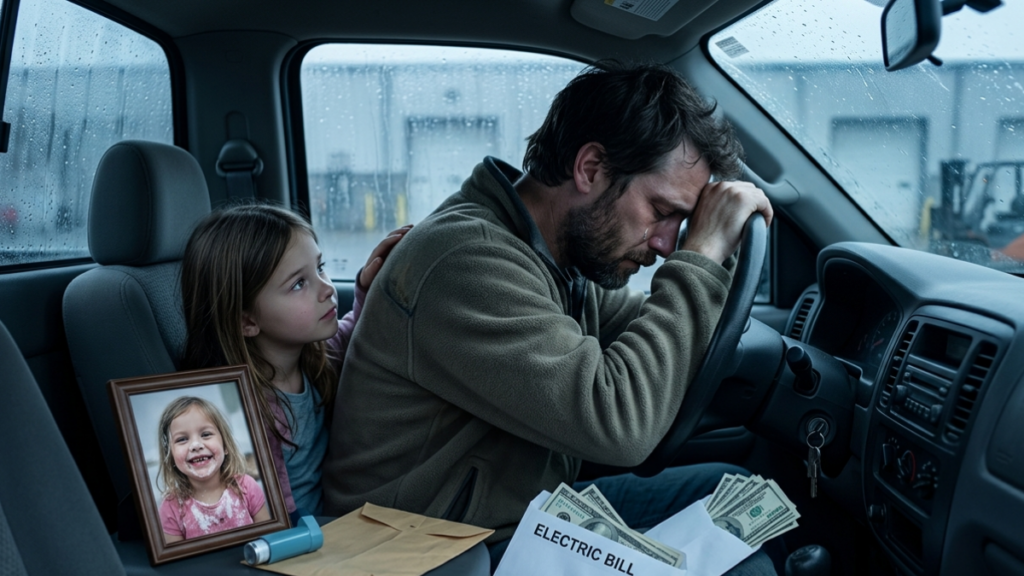
Ryan Hail lost his job on the coldest morning of October.
The heater in the breakroom had been broken for three weeks, and Ryan could see his own breath curling in front of him as he signed out at exactly 6:47 a.m.
His hands ached from lifting freight crates all night.
Twelve straight hours at the Regis Hollister warehouse.
No breaks.
No overtime approval.
Just exhaustion layered over panic.
Because every minute Ryan worked lately, he was secretly calculating numbers in his head.
Rent.
Asthma medication.
Groceries.
His daughter’s school lunch account already negative again.
And now—
winter.
Before Ryan could even grab his jacket from the locker, the warehouse supervisor appeared in the doorway.
Carl Voss.
Heavyset.
Coffee breath.
Permanent expression like everyone disappointed him personally.
Carl didn’t even pretend to feel bad.
“They’re cutting staff.”
Ryan immediately froze.
“What?”
Carl shrugged.
“Seasonal downsizing.”
“It’s October.”
“Exactly.”
Ryan stared at him in disbelief.
“I worked here four years.”
Carl avoided eye contact while shoving paperwork into his hands.
“Nothing personal.”
That sentence almost made Ryan laugh.
Because people only ever said “nothing personal” right before detonating somebody’s life.
Ryan looked down at the termination form.
Effective immediately.
No severance.
No extension on health insurance.
Nothing.
His chest tightened instantly.
“My daughter’s medication—”
Carl interrupted immediately.
“HR already explained COBRA.”
Ryan just stared at him.
Because poor people always know when someone says something intentionally useless.
COBRA.
As if Ryan had hundreds of extra dollars lying around for replacement insurance.
As if he could even afford groceries anymore.
Carl shifted awkwardly.
“You can clean out your locker.”
That was it.
Four years.
Gone in less than three minutes.
Ryan walked back through the freezing warehouse in silence while forklifts beeped somewhere behind him.
Nobody looked directly at him anymore.
Coworkers always did that when someone got fired.
Like unemployment was contagious.
Inside his locker sat exactly three things:
A framed photo of his daughter.
An inhaler.
And forty dollars folded inside an envelope labeled ELECTRIC BILL.
Ryan stared at the money for a long time.
Because that was everything left after rent.
Everything.
He grabbed the photo carefully.
Eight-year-old Emma smiling toothlessly at the county fair last summer with powdered sugar all over her hoodie.
Ryan swallowed hard.
Because Emma still thought he could fix anything.
That was the worst part about being a parent.
Kids believe in you long after life stops giving them reasons to.
Outside, freezing rain hit the parking lot sideways.
Ryan sat in his truck for almost twenty minutes before turning the key.
Nothing happened.
His stomach dropped instantly.
“No no no…”
He tried again.
Dead.
The battery finally gave out.
Ryan laughed once.
A horrible exhausted laugh.
Of course.
Of course the truck died today.
He lowered his forehead against the steering wheel trying not to completely fall apart before picking Emma up from school.
Then someone knocked on the window.
Ryan looked up sharply.
An older woman stood outside the truck shivering beneath a thin grocery store jacket.
Maybe late sixties.
Gray curls soaked from freezing rain.
She looked terrified.
Ryan rolled the window down slightly.
“Sir…”
Her voice shook badly.
“I’m so sorry to ask this…”
Ryan immediately knew.
That look.
That humiliation.
The look people get right before begging strangers for help.
The woman clutched a folded pharmacy receipt in trembling hands.
“My husband’s insulin…”
Ryan closed his eyes instantly.
Because life had a sick sense of timing.
The woman kept talking nervously.
“I only need thirty-seven dollars.”
Thirty-seven.
Ryan physically looked down at the envelope in his lap.
Forty dollars.
Electric bill money.
The woman noticed immediately.
“Oh no no, forget I asked.”
She started backing away instantly.
“I’m sorry.”
Ryan stared at the photo of Emma sitting on the passenger seat.
Then at the inhaler.
Then at the envelope.
His entire body screamed not to do this.
Because when you’re poor, forty dollars isn’t money.
It’s survival.
It’s heat.
It’s medicine.
It’s whether the lights stay on long enough for your kid to finish homework.
The woman turned to leave.
And Ryan heard himself say:
“Wait.”
She stopped.
Ryan opened the envelope slowly.
His hands shook from exhaustion and fear and the horrifying awareness that this decision could destroy the rest of his month.
Then he pulled out the cash.
All of it.
The woman stared at him in disbelief.
“Sir…”
Ryan forced a tired smile.
“Sounds like your husband needs it more.”
The woman immediately burst into tears.
Not polite tears.
Full-body shaking sobs in the freezing rain beside the dead truck.
People in the parking lot started staring.
Ryan awkwardly handed her the money through the cracked window.
“I’m serious. Go.”
The woman kept crying.
“You don’t understand.”
Ryan laughed softly.
“No, I think I probably do.”
That somehow made her cry harder.
Then suddenly—
she grabbed his hand.
Tightly.
And whispered something strange.
“My son is going to want to meet you.”
Ryan frowned immediately.
“What?”
The woman quickly wiped her face like she regretted saying it already.
“Nothing.”
Then she hurried away through the freezing rain clutching the money against her chest.
Ryan watched her disappear into the parking lot feeling vaguely unsettled.
But honestly?
He had bigger problems.
Like the fact his truck was dead.
And his power might get shut off tomorrow.
And he still had to smile normally when Emma asked what was for dinner tonight.
So he pushed the interaction out of his mind completely.
Until two days later.
When four black SUVs pulled up outside his house at exactly 6:13 a.m.
Ryan thought they had the wrong house.
Honestly?
That was his first thought.
Because people like Ryan Hail did not wake up to four identical black SUVs parked outside their collapsing rental house before sunrise.
People like Ryan woke up to overdue notices.
Collection calls.
Second jobs.
Not tinted windows and men in dark coats stepping onto cracked sidewalks.
Emma stood beside him in dinosaur pajamas gripping a bowl of cereal.
“Dad…”
Her voice shook slightly.
“Did you do something?”
Ryan almost laughed.
Because somehow that sounded more believable than the truth.
He carefully moved Emma behind him while staring through the front window.
The SUVs idled silently outside the house.
Too clean.
Too expensive.
One of the men stepped onto the porch holding an umbrella against the freezing rain.
Then knocked.
Three calm knocks.
Not police knocks.
Worse somehow.
Ryan’s stomach tightened instantly.
Because poor people know authority by sound.
Debt collectors knock aggressively.
Police pound.
Landlords bang impatiently.
This?
This felt controlled.
Ryan opened the door halfway.
“Can I help you?”
The man outside looked mid-fifties.
Tailored charcoal coat.
Silver hair.
The kind of posture expensive people have when they’ve never had to apologize for taking up space.
But the strangest thing?
He looked emotional.
Actually emotional.
“Mr. Ryan Hail?”
Ryan nodded cautiously.
The man visibly exhaled in relief.
Then looked past him toward Emma standing in the hallway.
His eyes softened immediately.
“My God…”
Ryan stepped forward instantly blocking the view.
“What is this about?”
The man collected himself.
“My name is Theodore Vale.”
That meant absolutely nothing to Ryan.
Theodore carefully removed leather gloves while speaking.
“My mother met you two days ago outside St. Agnes Pharmacy.”
Ryan froze.
The old woman.
The insulin.
The forty dollars.
Theodore’s expression shifted slightly watching recognition hit him.
“She told me what you did for her.”
Ryan immediately shook his head.
“Look, it was nothing.”
“No,” Theodore said quietly.
“It really wasn’t.”
The freezing wind moved through the open doorway.
Emma whispered behind him:
“Dad, who is that?”
Ryan looked back quickly.
“Go finish breakfast.”
“But—”
“Emma.”
She reluctantly disappeared toward the kitchen.
Theodore watched her leave with an unreadable expression.
Then softly—
“She looks like you.”
Ryan frowned.
“What is this?”
Theodore hesitated strangely.
Like he wasn’t sure how to say what came next.
Then:
“My mother was diagnosed with stage four pancreatic cancer last month.”
Ryan went still.
Theodore glanced toward the SUVs.
“She stopped treatment three weeks ago.”
The freezing rain suddenly sounded louder somehow.
“She told us she wanted to spend whatever time she had left helping strangers.”
Ryan swallowed hard.
“Oh.”
Theodore nodded slowly.
“She’s spent most mornings driving around the city trying to give money away anonymously.”
Ryan frowned in confusion.
“What?”
Theodore actually smiled slightly.
“She said she spent seventy years surrounded by wealthy people who only donated when cameras were around.”
Dead silence.
“She wanted to see if kindness still existed when nobody was watching.”
Ryan stared at him.
Completely lost now.
Theodore reached into his coat slowly.
Ryan instinctively stiffened.
But instead of a weapon—
Theodore pulled out a folded photograph.
Then handed it carefully to Ryan.
It showed the old woman sitting beside a hospital bed smiling weakly into the camera.
Beside her sat Theodore.
And several other people Ryan didn’t recognize.
Family.
Real family.
Theodore pointed toward the woman softly.
“My mother asked us to find you.”
Ryan handed the photo back immediately.
“You don’t need to do that.”
Theodore’s face changed.
Not pity.
Something heavier.
“Mr. Hail…”
He looked toward the house quietly.
“My mother told me you gave her your last forty dollars.”
Ryan didn’t answer.
Because technically…
he had.
Theodore nodded slightly.
“She recognized the envelope.”
Ryan’s stomach dropped instantly.
Electric bill.
The old woman saw the label.
Oh God.
Ryan suddenly felt embarrassed in a way he couldn’t explain.
Like his poverty had become visible.
Theodore continued softly:
“She said you looked at your daughter’s photograph before making the decision.”
Ryan looked away immediately.
Theodore’s voice lowered.
“My father died when I was ten.”
Ryan frowned slightly.
“My mother raised four children alone.”
Theodore glanced back toward the SUVs.
“We were homeless for almost a year.”
Ryan blinked.
No way.
This man looked like he belonged on magazine covers.
Not shelters.
Theodore gave a sad little smile.
“My mother never forgot the people who helped us survive.”
The freezing rain continued hammering the porch roof.
Then Theodore quietly said:
“She made me promise to repay every act of kindness we were lucky enough to receive.”
Ryan immediately shook his head again.
“Seriously, man, I don’t need anything.”
Theodore looked at him carefully.
Then softly—
“That’s what she said you’d say.”
One of the SUV doors opened behind him.
A younger woman stepped out carrying a thick folder against her chest.
Theodore took it from her.
Then handed it toward Ryan.
Ryan frowned.
“What is this?”
Theodore hesitated.
Then:
“My mother owns Regis Hollister.”
Dead silence.
Ryan physically stopped breathing.
The warehouse.
Carl.
The firing.
No.
No no no.
Theodore nodded once.
“She reviewed the layoff reports yesterday after meeting you.”
Ryan’s chest tightened violently.
“She was very upset.”
The folder suddenly felt heavier in Ryan’s hands.
Inside sat paperwork.
Official paperwork.
Ryan stared at the top page while his hands started shaking.
FULL RESTORATION OF EMPLOYMENT.
Then another page.
SALARY ADJUSTMENT.
Another.
HEALTHCARE REINSTATEMENT.
Another.
HOME MORTGAGE ASSISTANCE PROGRAM.
Ryan looked up immediately.
“I don’t own a home.”
Theodore smiled softly.
“You do now.”
Ryan actually stepped backward.
“What?”
Theodore glanced toward the small rental house.
“My mother purchased the property yesterday.”
Ryan’s brain genuinely stopped processing words.
Theodore continued calmly like he understood shock took time.
“The title transfers this afternoon.”
Emma suddenly appeared in the hallway again.
“Dad?”
Ryan turned slowly toward her.
Still holding the paperwork.
Still unable to breathe correctly.
Theodore looked at Emma again.
Then quietly added:
“There’s also a college trust in your daughter’s name.”
Ryan looked like he might collapse.
“No.”
Theodore nodded once.
“My mother insisted.”
Ryan’s eyes immediately filled.
Because suddenly—
all at once—
the stress hit him.
The job.
The truck.
The bills.
The humiliation of losing everything while trying to pretend he wasn’t drowning in front of his daughter.
And now this.
This impossible kindness arriving at his door before he even had time to fully panic.
Ryan whispered:
“Why would she do all this for me?”
Theodore looked genuinely confused by the question.
Then softly answered:
“Because you did it for her first.”
Dead silence.
Then from inside the SUV behind Theodore—
the old woman slowly stepped out holding an oxygen tube beneath her nose.
Ryan immediately straightened up.
“Oh my God.”
The old woman smiled weakly from beneath the umbrella while freezing rain drifted around the black SUVs.
Up close, she looked much sicker than she had outside the pharmacy.
Smaller somehow.
Fragile.
But her eyes stayed warm.
Theodore moved instantly toward her.
“Mom, you shouldn’t be standing out here.”
She ignored him completely.
Instead she looked directly at Ryan.
Then toward Emma peeking nervously from the hallway.
And softly said:
“There’s my favorite little family.”
Ryan’s throat tightened instantly.
Because nobody had called them that in a very long time.
Not since Emma’s mother left.
The old woman slowly climbed the porch steps while Theodore hovered protectively beside her.
Ryan opened the door wider automatically.
“Please come inside.”
The woman smiled.
“That’s exactly what I hoped you’d say.”
The house suddenly felt embarrassingly small.
Peeling paint.
Secondhand couch.
Tiny kitchen with dishes still drying beside the sink because Ryan worked too much to fully keep up anymore.
But the old woman looked around like she’d entered somewhere sacred.
Emma stood frozen near the hallway clutching her cereal bowl.
The woman smiled softly.
“You must be Emma.”
Emma nodded cautiously.
“How do you know my name?”
Ryan immediately looked at Theodore.
Theodore raised both hands slightly.
“Your school registration paperwork was included with the property transfer.”
Emma looked even more confused now.
“What’s a property transfer?”
Nobody answered immediately.
The old woman slowly lowered herself onto the couch while breathing carefully through the oxygen tube.
Then she looked at Emma gently.
“It means nobody can make you move anymore.”
Dead silence.
Emma blinked once.
Then looked toward her father.
“Dad?”
Ryan’s eyes filled instantly.
Because children who grow up poor understand instability earlier than they should.
Emma had heard the late-night phone calls with landlords.
Seen the overdue notices.
Caught him crying once in the truck when he thought she was asleep.
So the second she heard:
you don’t have to move—
she understood exactly how important that was.
Her little lip started trembling immediately.
“We get to stay?”
Ryan physically couldn’t speak for a second.
Then finally—
“Yeah, baby.”
Emma burst into tears instantly.
Real little-kid tears.
She ran across the living room and threw herself into Ryan’s arms while the old woman quietly wiped her eyes from the couch.
Theodore looked away toward the kitchen pretending to study the refrigerator magnets.
Probably to give them privacy.
But honestly?
Nobody in that room had privacy anymore.
Not after this.
Emma held onto her father tightly.
“Really really?”
Ryan laughed through tears.
“Really really.”
The old woman smiled watching them.
Then softly—
“That’s what my Theodore looked like when we got our first apartment.”
Theodore groaned quietly from the kitchen.
“Mom…”
She ignored him again.
“Cockroaches everywhere.”
Emma immediately looked horrified.
“What?!”
The old woman laughed weakly.
“Oh yes.”
Theodore shook his head.
“She tells this story every chance she gets.”
“Because you screamed when you saw one.”
“I was nine.”
“You jumped onto the table.”
Emma immediately started laughing through her tears.
And suddenly—
for the first time in months—
Ryan’s house didn’t feel heavy anymore.
Then the old woman’s expression slowly softened again.
She looked toward Ryan carefully.
“You remind me of my husband.”
Ryan blinked.
“What?”
“He gave away grocery money once.”
Theodore smiled faintly from the kitchen.
Mom…
She kept going anyway.
“We were living out of our station wagon.”
Ryan sat quietly listening now.
“Another man’s daughter needed antibiotics.”
The room grew still.
The old woman smiled sadly.
“I was furious with him.”
Emma frowned.
“Why?”
The old woman looked toward her.
“Because I was scared.”
That answer landed hard.
Because suddenly Ryan realized something.
Kindness feels beautiful when you receive it.
Terrifying when it risks the people you love.
The old woman looked back toward Ryan now.
“But your father and my husband understood something I didn’t yet.”
Ryan swallowed hard.
“What?”
She smiled softly.
“That desperate people recognize each other.”
Dead silence.
Then Theodore quietly added from the kitchen:
“And they remember who helped them.”
The old woman’s breathing suddenly hitched slightly.
Theodore noticed instantly.
“Mom.”
“I’m fine.”
But she wasn’t.
Ryan could tell immediately.
The oxygen.
The trembling hands.
The exhaustion behind her smile.
And suddenly he understood something awful.
This woman wasn’t here because she had time left.
She was here because she didn’t.
The realization hollowed him out instantly.
The old woman slowly reached into her coat pocket.
Then handed Emma a folded piece of paper.
Emma looked confused.
“What’s this?”
The old woman smiled.
“A promise.”
Emma unfolded it carefully.
Then gasped.
“Dad!”
Ryan looked down.
It was a handwritten receipt for a fully paid piano.
Along with lessons at one of the best music academies in the state.
Ryan stared at it in disbelief.
“How did you know she played?”
The old woman smiled softly.
“She told my mother while she was crying in the pharmacy parking lot.”
Emma immediately looked embarrassed.
“I didn’t cry that much.”
Ryan laughed weakly.
“Baby, you cried because the school took music away.”
Emma looked down sadly.
The old woman nodded.
“The arts budget cuts.”
Ryan stared at her.
How much research had they done?
Theodore answered quietly:
“My mother made us look into the programs they canceled after layoffs at the warehouse.”
Ryan frowned slightly.
“What does that have to do with me?”
Theodore looked at him carefully.
“Thirty-seven families lost jobs that morning.”
Dead silence.
Ryan’s stomach tightened again.
Theodore continued quietly:
“My mother wanted to know how many children would be affected.”
The room went silent.
Because suddenly this wasn’t just about Ryan anymore.
The old woman looked toward her son.
“Tell him.”
Theodore hesitated.
Then slowly nodded.
“My mother dissolved the executive bonus pool yesterday.”
Ryan blinked.
“What?”
Theodore looked grim now.
“She redirected it into an employee emergency fund.”
Ryan immediately thought of Carl.
The layoffs.
The freezing warehouse.
The broken heater.
Theodore’s jaw tightened slightly.
“Carl Voss was terminated this morning.”
Emma whispered:
“Oh…”
The old woman looked tired suddenly.
Very tired.
But satisfied.
“He said workers should be grateful to have jobs at all.”
Ryan looked stunned.
Theodore added quietly:
“My mother disagreed.”
Then the old woman slowly looked around Ryan’s tiny living room one last time.
At the peeling walls.
The thrift-store furniture.
The exhausted single father trying his best anyway.
And softly whispered:
“You gave away your last forty dollars…”
Her eyes filled slightly.
“…while richer men kept millions they didn’t need.”
Nobody spoke.
Because there was nothing left to say after that.
Then suddenly—
the old woman started coughing violently into a handkerchief.
And when Theodore rushed toward her—
Ryan saw blood.
The handkerchief hit the floor first.
Then the blood.
Bright red against cream-colored fabric.
Emma gasped instantly.
“Theo—”
Theodore was already beside his mother grabbing her shoulders while she coughed violently into her sleeve.
The room exploded into motion.
“Mom.”
“I’m okay—”
“You’re NOT okay.”
Ryan instinctively stepped forward too.
Years of exhaustion had taught him how to recognize when people lied about being fine.
And this woman—
this woman was dying.
The old woman finally caught her breath slightly while Theodore knelt beside the couch looking terrified in a way rich people usually hide better.
Emma stood frozen clutching the piano paperwork against her chest.
Theodore grabbed his phone immediately.
“We’re going back to the hospital.”
“No.”
The word came out sharp enough to stop him instantly.
The old woman slowly wiped blood from her mouth.
“No hospitals today.”
“Mom—”
“I said no.”
Theodore looked like he might break apart right there in Ryan’s living room.
And suddenly Ryan realized something horrifying.
This wasn’t new.
They’d had this argument before.
Probably many times.
The old woman slowly leaned back against the couch cushions breathing carefully through the oxygen tube again.
Then she looked toward Emma apologetically.
“Well…”
She forced a tiny smile.
“That was dramatic.”
Emma immediately burst into tears.
Not because of the blood.
Because children know when adults are scared.
And Theodore Vale looked terrified.
The old woman’s face softened instantly.
“Oh sweetheart…”
Emma wiped her eyes hard.
“Are you gonna die?”
Dead silence.
Theodore closed his eyes immediately.
Ryan’s chest tightened so hard it physically hurt.
Because nobody teaches you what to do when a child asks that question out loud.
But the old woman?
She answered immediately.
“Yes.”
The honesty stunned the room.
Emma started crying harder.
The old woman reached out gently.
“But not today.”
Emma hesitated.
Then slowly walked toward the couch.
The old woman carefully took her little hand.
“My doctors gave me a very expensive list of things I’m supposed to do before I die.”
Theodore whispered:
“Mom…”
But she kept going.
“Rest more.”
Tiny smile.
“Eat kale.”
Emma sniffled through tears.
“Ew.”
The old woman laughed softly.
“Exactly.”
Even Theodore smiled slightly at that.
Then the old woman looked directly at Emma.
“But I realized something.”
The room quieted again.
“I don’t actually want to spend my last months surrounded by people pretending money matters more than kindness.”
Ryan looked away instantly hearing that.
Because suddenly he understood why she’d been driving around alone helping strangers.
She wasn’t trying to save other people.
Not really.
She was trying to save herself from dying surrounded by the wrong things.
The old woman squeezed Emma’s hand gently.
“Your father reminded me of someone I loved very much.”
Ryan swallowed hard.
“You barely know me.”
The old woman smiled sadly.
“Oh, I know enough.”
Dead silence.
Then she looked around the tiny house again.
The patched cabinets.
The thrift-store curtains.
The exhausted father who still gave away his last forty dollars anyway.
“You know what wealthy people fear most?”
Ryan shook his head slightly.
The old woman’s eyes filled.
“Needing each other.”
Nobody spoke.
Because somehow that felt deeply true.
Theodore slowly sat down beside his mother now looking emotionally exhausted.
Ryan realized he probably hadn’t slept much lately either.
Being rich didn’t stop people from watching their parents die.
The old woman suddenly looked toward Ryan carefully.
“What’s your dream?”
Ryan blinked.
“What?”
“Your real one.”
He laughed weakly.
“I’m thirty-seven.”
“And?”
Ryan looked embarrassed suddenly.
Because poor adults learn to stop talking about dreams eventually.
Dreams become luxuries.
Emma answered for him immediately.
“He builds furniture.”
Ryan turned sharply.
“Emma.”
But she kept going.
“He makes tables in the garage sometimes.”
The old woman’s eyes lit up slightly.
“Really?”
Ryan rubbed the back of his neck awkwardly.
“It’s nothing.”
Emma frowned.
“It’s not nothing.”
Theodore looked interested now too.
“You sell them?”
Ryan laughed again.
“No.”
“Why not?”
Because life happened.
Because medical bills happened.
Because grief happened.
Because his wife leaving happened.
Because dreams are fragile things and survival crushes fragile things first.
Ryan quietly answered:
“Didn’t really seem realistic.”
The old woman studied him carefully for a long moment.
Then softly—
“That’s what poverty does.”
Dead silence.
“It convinces good people they’re only allowed to survive.”
The room went completely still.
Because Ryan had never heard anyone explain it so perfectly before.
The old woman slowly stood again despite Theodore immediately trying to stop her.
“I’m fine.”
“You just coughed blood.”
“I’ve done that before.”
Theodore looked devastated hearing how casually she said it.
Then she walked slowly toward the front door.
Ryan frowned.
“You’re leaving?”
She smiled gently.
“Oh sweetheart…”
Her eyes moved around the little house one final time.
“…I’m just getting started.”
Before Ryan could ask what that meant—
another black SUV suddenly pulled up outside.
Then another.
And another.
Ryan frowned.
“What now?”
Theodore looked out the window.
Then immediately started laughing.
Actual laughing.
For the first time all morning.
“Oh my God.”
Ryan looked confused.
“What?”
Theodore wiped his face smiling.
“My mother called the press.”
Dead silence.
The old woman looked completely unbothered.
“People should know what your warehouse did to families.”
Ryan stared at her.
“You’re serious?”
The old woman opened the front door while freezing rain blew inward.
Then calmly said the sentence that changed Ryan’s life forever:
“Nobody humiliates my workers and gets away with it.”
Within twenty minutes, Ryan’s street looked like a crime scene.
News vans.
Satellite trucks.
Cameras everywhere.
Neighbors standing on porches in robes filming through their phones while black SUVs lined both sides of the road beneath freezing rain.
Emma stood at the front window whispering:
“Oh my God…”
Ryan honestly felt the same.
Because none of this made sense anymore.
Two days ago he was trying to figure out whether forty dollars could somehow stretch through another week.
Now reporters were setting up lights outside his house before sunrise while one of the richest families in the state sat in his living room drinking coffee from chipped mugs.
The old woman looked delighted by the chaos.
Theodore looked exhausted by it.
“Mom, this is becoming a circus.”
She smiled weakly.
“Good.”
Then she started coughing again.
Not as violently this time.
But enough for Theodore’s entire body to tense instantly.
Ryan quietly asked:
“Should she really be doing this?”
Theodore looked toward the window.
“She’s spent forty years letting wealthy men make decisions for her.”
Pause.
“She’s making up for lost time.”
That sentence sat heavily in the room.
Because suddenly Ryan realized something else.
This woman wasn’t just fighting the warehouse.
She was fighting the life she’d lived before now too.
Outside, reporters started gathering near the porch.
One woman shouted:
“Mrs. Vale! Is it true you fired multiple executives this morning?”
The old woman smiled.
“Oh, I fired more than multiple.”
Theodore rubbed his forehead.
“Mom…”
She ignored him again.
Ryan was starting to notice that happened a lot.
Then the old woman suddenly looked toward him.
“Do you know how much your supervisor made last year?”
Ryan frowned slightly.
“What?”
“Carl Voss.”
She looked genuinely disgusted now.
“Eight hundred and seventy thousand dollars.”
Ryan stared at her.
No.
Impossible.
Theodore nodded grimly.
“Mostly bonuses tied to labor reductions.”
Dead silence.
Emma whispered:
“That means firing people made him richer?”
Nobody answered immediately.
Because unfortunately—
yes.
The old woman’s expression hardened.
“Meanwhile your father worked night shifts while the warehouse heater stayed broken.”
Ryan looked down instantly.
Embarrassment crawled through him hearing his life described out loud like that.
But the old woman noticed.
And softly said:
“You should never feel ashamed for surviving difficult things.”
The sentence hit him harder than he expected.
Because Ryan had spent years ashamed.
Ashamed of the overdue notices.
Ashamed Emma qualified for free lunches.
Ashamed his daughter knew what eviction sounded like before fourth grade.
Ashamed he couldn’t fix everything.
Outside, another reporter shouted:
“Mrs. Vale! Is it true you’re dissolving executive compensation?”
The old woman calmly walked toward the front door.
Theodore stood instantly.
“Mom, you don’t owe these people anything.”
She looked back at him gently.
“Yes I do.”
Then she opened the door.
The freezing rain and camera flashes exploded instantly.
“Mrs. Vale!”
“Is this related to the viral pharmacy story?”
“Did the employee really give your mother his last forty dollars?”
Ryan froze.
Viral?
Theodore closed his eyes.
“Oh…”
Ryan looked at him sharply.
“What does that mean?”
Theodore looked uncomfortable for the first time all morning.
“My niece posted the pharmacy security footage online.”
Dead silence.
Ryan’s stomach dropped.
“What?”
Theodore immediately raised both hands.
“She didn’t know who you were.”
Emma whispered:
“There’s VIDEO?”
Oh God.
Theodore nodded slowly.
“It has around twelve million views now.”
Ryan physically sat down.
No.
No no no no.
The old woman stood on the porch beneath the freezing rain while cameras flashed relentlessly around her.
And calmly said:
“Yes. The employee gave away his last forty dollars to help my husband.”
The reporters erupted instantly.
“Was it really his last money?”
“Yes.”
“Did your company lay him off the same day?”
The old woman’s face hardened.
“Yes.”
“Will executives be held responsible?”
Her voice sharpened immediately.
“Oh, absolutely.”
Inside the house, Ryan looked like he might throw up.
Emma grabbed his sleeve excitedly.
“Dad, you’re famous!”
Ryan whispered:
“That’s not good.”
Because poor people understand attention differently.
Attention usually means danger.
Humiliation.
Judgment.
Theodore quietly sat beside him.
“I know this is overwhelming.”
Ryan laughed weakly.
“That’s one word for it.”
Outside, reporters continued shouting questions while freezing rain soaked everyone on the lawn.
Then suddenly—
the old woman said something that silenced every camera instantly.
“I invited you all here because people should understand what’s happening to working families.”
The reporters leaned forward immediately.
The old woman pointed back toward Ryan’s tiny house.
“That man worked twelve-hour shifts in freezing conditions.”
Her voice trembled slightly now.
“And still gave away his last forty dollars to help someone else survive.”
Dead silence.
Then she quietly added:
“Meanwhile executives inside my own company received million-dollar bonuses for eliminating healthcare coverage.”
The cameras practically exploded.
Inside, Ryan whispered:
“Oh my God…”
Theodore nodded grimly.
“She’s declaring war.”
And somehow…
that’s exactly what it sounded like.
The old woman continued speaking beneath the rain while cameras rolled.
“People like Ryan Hail are called unskilled labor while wealthy men who exploit them are called visionaries.”
The reporters stopped interrupting now.
Because suddenly this wasn’t gossip anymore.
It was a reckoning.
The old woman looked directly into the cameras.
“My family built wealth off men like him.”
Her voice cracked slightly.
“And I spent too many years benefiting from that quietly.”
Even Theodore looked emotional hearing that.
Then the old woman took a shaky breath.
And publicly announced something that made the entire street erupt.
“Starting today, every laid-off warehouse employee will receive full salary continuation and restored healthcare coverage through the winter.”
Reporters started shouting over each other instantly.
“What?!”
“How much will that cost?”
“Mrs. Vale, are shareholders aware of this?”
The old woman smiled coldly.
“They are now.”
Inside the house, Ryan stared through the doorway in complete disbelief.
Thirty-seven families.
Thirty-seven families wouldn’t lose heat this winter because one dying woman decided she was tired of watching rich people destroy workers quietly.
Then suddenly—
Emma tugged his sleeve hard.
“Dad.”
Ryan looked down.
Emma pointed toward the television mounted in the corner of the living room.
The local news had already picked up the story live.
And splashed across the bottom of the screen in giant red letters read:
WAREHOUSE WORKER’S FINAL $40 SPARKS CORPORATE UPRISING.
By nightfall, Ryan Hail’s face was everywhere.
National news.
TikTok clips.
Facebook lives.
People were reposting the pharmacy footage faster than networks could keep up.
The grainy security video showed Ryan sitting inside his dead truck staring at the envelope in his hands before giving the old woman every dollar anyway.
And for some reason…
that tiny pause before he handed over the money destroyed people emotionally.
Because you could actually SEE him thinking about his daughter first.
You could see the fear.
The hesitation.
The calculation.
Then the decision.
The internet lost its mind.
Comment sections filled with:
THIS MAN DESERVES THE WORLD.
PROTECT HIM AT ALL COSTS.
HOW MANY PEOPLE LIKE HIM ARE WE IGNORING?
But Ryan hated all of it.
By the second morning, reporters were waiting outside Emma’s school.
Neighbors kept knocking on the door bringing casseroles and winter coats and grocery gift cards.
Someone mailed them a brand-new truck.
An actual truck.
Ryan refused to even touch it.
Because none of this felt real.
It felt dangerous.
And honestly?
The attention terrified him more than poverty ever had.
Meanwhile, Regis Hollister stock collapsed thirteen percent in two days.
Shareholders erupted publicly.
Executives started resigning.
Three former warehouse employees came forward accusing Carl Voss and upper management of forcing injured workers to stay on shift without medical treatment.
One man revealed he lost two fingers in machinery and got written up for “slowing productivity.”
Another woman admitted she worked through pneumonia because missing hours meant losing insurance for her son’s chemotherapy.
The story became bigger than Ryan almost overnight.
It became every exhausted worker people stopped seeing.
And at the center of all of it—
sat an old dying woman with an oxygen tube calmly detonating her own company on live television.
Theodore looked like he aged ten years in forty-eight hours.
But weirdly…
he also looked freer.
Like watching his mother finally say what she actually believed cracked something open inside him too.
Then came Carl.
Of course it did.
Because men like Carl Voss always think humiliation makes them victims.
Three days after the story exploded, Carl appeared on television claiming Ryan manipulated Mrs. Vale emotionally.
“He targeted an elderly woman for sympathy.”
Ryan almost turned the TV off immediately.
But Emma grabbed his sleeve.
“Wait.”
Carl kept talking smugly from inside some cheap local news interview.
“This guy’s pretending to be some saint.”
Then he laughed.
“I guarantee you he knew exactly who she was.”
Ryan sat frozen on the couch.
Not angry.
Just tired.
Because somehow even kindness had become something people argued about publicly now.
Emma looked confused.
“But you didn’t know her.”
Ryan rubbed his face slowly.
“I know.”
Then the front door opened.
Theodore walked in carrying takeout containers and immediately saw the television.
His expression darkened instantly.
“Oh, screw this guy.”
Ryan laughed weakly despite himself.
That surprised Theodore.
Then Theodore quietly admitted:
“My mother had Carl escorted off company property yesterday.”
Ryan blinked.
“What?”
“He tried threatening warehouse employees into silence.”
Theodore handed Emma a milkshake.
“She threw a stapler at him.”
Emma gasped.
“No way.”
Theodore smiled for the first time all week.
“She missed.”
Ryan actually laughed out loud this time.
A real laugh.
The kind that catches you off guard after too many hard days.
And for one second—
the house felt warm again.
Then Theodore’s smile faded slightly.
“She asked me to bring you to the hospital tonight.”
Ryan’s stomach dropped immediately.
Because suddenly he knew.
The old woman was getting worse.
Theodore looked down quietly.
“She doesn’t have much time.”
Dead silence.
Emma’s little face immediately fell.
That night, freezing rain covered the roads again while Ryan drove Theodore’s car toward St. Agnes Medical Center.
The same hospital where the old woman first received her diagnosis.
Emma sat quietly in the backseat clutching a stuffed penguin someone mailed her after the viral story.
Nobody spoke much during the drive.
Because everyone already understood this wasn’t a social visit.
This was goodbye.
Theodore led them upstairs silently.
Past security.
Past private wings.
Past wealthy people hiding sickness behind expensive curtains.
Then finally—
Room 814.
The old woman looked tiny in the hospital bed.
Smaller than Ryan remembered.
Machines beeped softly around her while snow drifted past the windows outside.
But the second she saw Emma—
she smiled immediately.
“There’s my musician.”
Emma burst into tears before she even reached the bed.
The old woman opened her arms weakly.
Emma climbed carefully beside her while Theodore quietly turned away toward the window pretending not to cry.
Ryan stood frozen near the doorway.
Because suddenly he realized something devastating.
This woman changed his entire life…
and he barely knew her name a week ago.
The old woman looked toward him softly.
“Ryan.”
His throat tightened instantly.
“Yeah?”
She smiled.
“You gave me something very few people ever do.”
Ryan frowned slightly.
“What?”
Hope.
The word destroyed the room completely.
The old woman reached slowly toward the bedside table.
Then handed Ryan a thick envelope.
Inside sat legal documents.
Transfer papers.
Corporate filings.
Ryan frowned in confusion.
“What is this?”
Theodore finally turned around.
Eyes red.
“My mother dissolved her controlling shares this morning.”
Ryan blinked.
“What?”
The old woman smiled weakly.
“Regis Hollister belongs to the employees now.”
Dead silence.
Ryan physically stopped breathing.
Theodore nodded quietly.
“A worker ownership trust.”
Ryan stared at the papers.
No.
No way.
The old woman looked exhausted now.
But peaceful.
“For fifty years,” she whispered, “wealthy men told workers they should be grateful to survive.”
Tears slid slowly down her cheeks.
“I think they deserve to own what they built.”
Ryan couldn’t speak.
Nobody could.
Then the old woman carefully reached for Emma’s hand again.
“And you…”
Emma sniffled.
“…you play piano loudly, okay?”
Emma nodded through tears.
“No hiding.”
The old woman smiled faintly.
“Exactly.”
Those were the last clear words she spoke that night.
She passed away just before sunrise while snow covered the city outside.
Theodore held one of her hands.
Emma held the other.
And Ryan stood quietly beside the hospital window realizing a stranger had walked into his life asking for thirty-seven dollars…
…and somehow left behind an entirely different future.
Six months later, Ryan opened Hail & Home Furniture in a renovated downtown workshop funded through the employee trust.
Every table carried a small engraved brass plate underneath.
Not visible unless someone looked carefully.
It read:
WHAT YOU KEEP CHANGES NOTHING.
WHAT YOU GIVE AWAY CHANGES EVERYTHING.
Emma played piano at the grand opening.
Theodore sat front row crying harder than anyone.
And outside the workshop—
parked beside the curb—
sat four black SUVs quietly covered in snow.
