

I Almost Kept Walking
I was late when it happened.
Not dramatically late.
Just the kind where every red light feels personal and every slow walker in front of you makes your jaw tighten a little.
The city was crowded that night.
Warm lights hung over the sidewalks between buildings, glowing softly above the traffic.
People moved around me carrying shopping bags and paper coffee cups, talking too loudly into phones.
Somewhere nearby, music was playing from a restaurant patio.
I barely noticed any of it.
I had my coat pulled tight against the wind and my mind fixed on work emails I still hadn’t answered.
Then something tugged my purse.
Hard.
I spun around instantly, my heel scraping against the pavement.
“Hey! Don’t touch me.”
The words came out sharper than I intended.
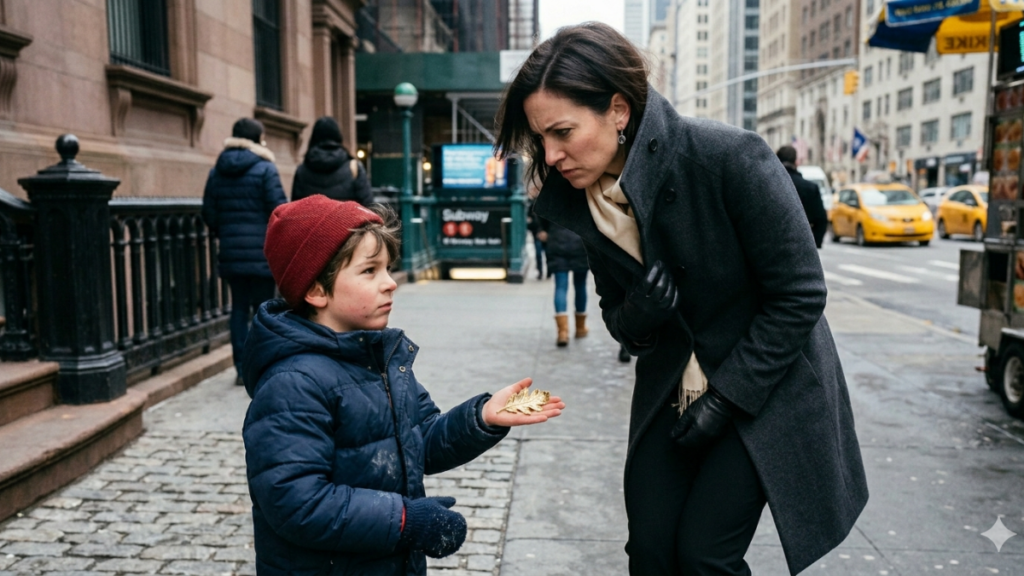
A little boy stood there staring at me.
He couldn’t have been older than eight.
His jacket was too thin for the weather.
Dirt smudged his cheeks.
His dark hair stuck out in uneven pieces like he’d been running his hands through it for hours.
And he looked terrified.
For a second I thought he was going to bolt.
Instead, he lifted his hand slowly.
Something gold rested in his palm.
My stomach tightened before my brain even caught up.
It was a pin.
Leaf-shaped.
Gold edges.
A bright blue teardrop jewel in the center.
Exactly like mine.
Without thinking, my fingers moved to my collar where my own pin was clipped.
The boy noticed immediately.
“You have the same one,” he whispered.
Everything around me seemed to go quiet.
Not literally.
The traffic was still there.
People were still brushing past us.
But suddenly all I could hear was my own heartbeat.
“What are you talking about?”
The boy swallowed hard.
“It’s just like my mom’s.”
I stared at him.
“That’s impossible.”
Because it was.
The pins had been custom made decades ago.
One for me.
One for my baby sister.
The sister who supposedly died twenty years ago.
The Story I Grew Up With
Her name was Lucia.
I was eleven when she disappeared.
She was four years old at the time, all curls and huge dark eyes.
I still remembered how she used to grab my fingers with both hands like she was afraid I’d leave the room without her.
Then came the fire.
At least that’s what I was told.
My mother had taken Lucia to the hospital because of a respiratory infection.
During the night, a fire broke out in one wing of the building.
My father arrived too late.
They told him there were survivors, but not everyone made it out.
My mother and Lucia were among the dead.
That was the story.
The official story.
And for most of my life, I forced myself to accept it.
But there were always things that didn’t sit right with me.
My father never talked about that night.
Not once.
No details.
No memories.
Nothing.
Whenever I asked questions, he would shut down completely or leave the room.
As I got older, I stopped asking.
Partly because grief changes shape over time.
And partly because I learned some people would rather carry silence than truth.
Still, every year on Lucia’s birthday, I would take out the matching pin box.
Mine sat inside.
The other slot remained empty.
I never understood why my father kept it.
If Lucia really died that night, why keep the box at all?
I remember asking him once when I was sixteen.
He looked at me for a long time before saying quietly, “Some things are harder to bury than people.”
Then he walked away.
At the time, I thought it was grief talking.
Standing there on the sidewalk with that little boy, I realized maybe it wasn’t.
He Knew My Name
The boy looked close to crying now.
People moved around us without stopping.
Nobody noticed what was happening.
“Where did you get this?” I asked.
“My mom.”
“Who is your mother?”
He hesitated.
Like he wasn’t sure if he should answer.
Then he said something that made my knees feel weak.
“She told me if I ever saw your pin, I had to stop you.”
I stared at him.
“What’s your mother’s name?”
He looked down at the pavement.
“Lucy.”
My chest tightened instantly.
Lucia hated her full name.
Even as a child, everyone called her Lucy.
Nobody outside family would know that.
Nobody.
I crouched slightly so I was closer to his height.
“Where is she?”
His eyes filled with tears.
“In the hospital.”
Cold spread through me.
“What happened?”
“She fainted yesterday. She kept asking for you before they took her away.”
I felt completely frozen.
The boy wiped his face with the sleeve of his jacket.
“She said if I found you, you’d help us.”
Us.
Not me.
Us.
That word stayed with me.
Because children don’t accidentally choose words like that.
The Hospital
The hospital sat across town near the river.
The entire drive there felt unreal.
The boy — his name was Mateo — sat quietly in the passenger seat clutching the pin in both hands.
Every now and then he glanced at me like he was trying to decide whether he trusted me yet.
I didn’t know what to ask first.
There were too many questions.
If his mother was Lucia, where had she been for twenty years?
Why hadn’t she come back?
Why would anyone fake the death of a baby?
And why did my father spend decades pretending she was gone?
By the time we arrived, my hands were shaking against the steering wheel.
Mateo led me upstairs to a cardiac ward.
“She’s in there,” he whispered.
I stopped outside the door.
For one terrible second, I couldn’t move.
Because part of me still believed this had to be some mistake.
Then I stepped inside.
And saw her.
Older.
Paler.
Thinner than I imagined.
But unmistakably her.
I knew immediately.
Not because we looked alike.
Because memory doesn’t really disappear.
It waits.
And suddenly I remembered the exact shape of her eyes.
The room tilted slightly.
She turned her head toward me slowly.
Then she smiled.
And started crying before I did.
My Sister Was Alive
“Ellie,” she whispered.
Nobody had called me that in twenty years.
I sat beside her bed in complete silence at first because I honestly thought if I opened my mouth, I might fall apart.
She reached for my hand carefully.
“You found him.”
I looked over at Mateo standing near the doorway.
“He found me.”
Lucia laughed softly through tears.
“That sounds more accurate.”
For a while, neither of us knew where to begin.
How do you explain losing twenty years?
How do you fit an entire stolen life into one conversation?
Finally I asked the question that had been tearing through my head since the sidewalk.
“What happened?”
Her expression changed immediately.
Not fear exactly.
Something heavier.
Exhaustion, maybe.
Then she said quietly, “Mom took me.”
The words landed like a physical blow.
I stared at her.
“What?”
“She took me after the fire.”
She looked toward the window for a moment before continuing.
“There was a custody investigation before the hospital fire. You were old enough not to notice it fully, but Mom was trying to leave Dad.”
I stared at her without speaking.
“That night at the hospital, everything became chaos. Smoke everywhere. Nurses moving patients. Fire alarms.” She swallowed hard. “Mom thought Dad would take me from her if she stayed.”
A cold feeling spread through my chest.
“So she ran?”
Lucia nodded.
“She took me and disappeared before anyone could stop her. By the time Dad arrived, nobody could find us.”
I tried to process it.
“But he told me you both died.”
“He probably believed it at first,” she said softly. “Or maybe it became easier than admitting we were gone.”
The room fell silent.
“Mom changed our names after that. We moved constantly for years because she was terrified he’d find us.”
I thought about my father sitting alone at the kitchen table every night drinking coffee in silence.
The flowers he left at the cemetery every year.
The way grief hollowed him out slowly over time.
Not rehearsed.
Real.
Then another realization hit me.
“He spent twenty years mourning people who were still alive.”
The Things She Wouldn’t Say
Over the next few days, I barely slept.
I stayed with Mateo while Lucia recovered.
And slowly, pieces of the story came out.
Not all at once.
Never all at once.
That was the hardest part.
Trauma doesn’t tell stories in order.
It leaks.
Sometimes late at night after Mateo fell asleep, Lucia would suddenly mention a different city.
A different school.
A fake last name she’d used for years.
Then she’d go quiet again.
One night I finally asked the question sitting between us.
“Why didn’t you come find me when you turned eighteen?”
She stared at her hands for a long time.
“Because by then, I didn’t know who I was anymore. Mother had died a year earlier and I was left all alone. I didn’t know where I belonged. Who I could trust.”
That answer hurt more than anger would have.
She explained that our mother convinced her for years that everyone from her old life was dangerous.
That people were searching for them.
That staying hidden was survival.
Children believe what keeps them safe.
Even when it destroys them later.
Then she told me something else.
Something she had clearly avoided saying.
“She wasn’t always kind.”
I felt my stomach drop.
Lucia noticed immediately.
“She loved me,” she said quickly. “In her own way.”
People only say things like that when they’re protecting someone.
Or protecting themselves.
I didn’t push further.
But I started seeing our mother differently after that.
The Funeral That Changed Everything
Three weeks later, our father died.
A stroke.
Sudden.
I found out from a neighbor.
For a long time I just sat in my kitchen staring at the wall after the call ended.
I never got a chance to talk to him.
He never found out the truth.
And now he never would.
The funeral was small.
A few old coworkers.
Neighbors.
Close family members.
And Lucia.
Nobody knew the truth.
At least not yet.
She wore black gloves the entire service even though it wasn’t cold.
Mateo stayed close beside her.
I watched people walk up to us saying the same things over and over.
“He loved his family.”
“He never recovered from losing them.”
“He carried that grief forever.”
Each sentence felt stranger than the last.
At one point I thought Lucia might walk out.
Instead, she stood completely still.
Then near the end of the service, someone approached us.
An older woman.
Maybe seventy.
The second she saw Lucia, her face lost all color.
“No,” she whispered.
Lucia froze too.
“You’re supposed to be dead.”
The woman started trembling.
And suddenly I understood.
Someone else knew.
The Secret Was Bigger Than Our Family
Her name was Teresa.
She had worked administration at the hospital twenty years earlier.
We met her two days after the funeral in a quiet café far from downtown.
She looked nervous from the second she sat down.
“I wondered for years if I imagined it,” she admitted.
Then she told us what she remembered.
The fire had caused total confusion that night.
Records disappeared.
Staff were evacuated.
Families got separated.
And during that chaos, our mother signed discharge paperwork using false information.
Teresa noticed because the names didn’t match earlier records.
But before she could report it properly, management shut everything down.
“Why?” I asked.
She looked uncomfortable.
“Because the hospital was already under investigation for negligence. They didn’t want more scandal.”
I leaned back slowly.
“So they helped cover it up?”
“I think they convinced themselves it was temporary.”
Temporary.
Twenty years temporary.
Teresa looked directly at Lucia.
“I’m sorry.”
Lucia didn’t answer immediately.
Finally she said quietly, “I spent most of my life thinking nobody was looking for me.”
That sentence stayed with me for days afterward.
Because what damages a person more?
Being abandoned?
Or believing you were?
When The Story Became Public
I never planned to tell anyone.
At first, neither did Lucia.
We just wanted peace.
But secrets have weight.
And eventually they start pressing against everything around them.
A local reporter somehow heard about the story.
Then another one called.
Then another.
Apparently someone from the hospital had talked.
Within days, articles started appearing online.
“Woman Declared Dead As Child Found Alive Twenty Years Later.”
People became obsessed with the story almost instantly.
Strangers debated our lives like television characters.
Some painted our mother as a monster.
Others treated her like a tragic woman broken by grief and mental illness.
Nobody really knew her.
Not fully.
Maybe we didn’t either.
Reporters camped outside Lucia’s apartment building for nearly a week.
Mateo got overwhelmed quickly.
One afternoon he asked me quietly, “Are they trying to take Mom away again?”
That nearly broke me.
Because children inherit fear so easily.
Lucia finally agreed to one interview only because she wanted control over the story before everyone else twisted it further.
I sat beside her during filming.
The interviewer asked if she hated our mother.
Lucia thought about it for a long time.
Then she answered softly.
“No. That’s the problem.”
The room went completely silent after that.
What I Finally Understood
People kept expecting some dramatic ending after the interview aired.
A lawsuit.
An arrest.
Public outrage.
But life usually moves quieter than that.
The hospital issued a formal apology.
There were investigations.
Meetings.
Paperwork.
Lawyers called constantly for months.
None of it gave us back time.
And none of it untangled what our mother did to us.
Because love and damage can exist inside the same person.
That’s the uncomfortable truth nobody likes talking about.
Lucia still keeps one photo of her in her apartment.
I asked her once why.
She looked at it for a long moment before answering.
“Because if I erase every part of her, I erase part of myself too.”
I understood exactly what she meant.
The Last Thing She Told Me
A few months ago, Lucia and I walked through the city together at night while Mateo ran ahead of us chasing pigeons across the sidewalk.
The same street where he first stopped me.
The same lights overhead.
The same traffic humming in the distance.
Lucia touched the blue jewel pin clipped to her coat and smiled faintly.
“You know what’s strange?” she said.
“What?”
“I used to imagine you constantly when I was little. I’d picture you living somewhere beautiful and happy.”
I laughed softly.
“It wasn’t that beautiful.”
“Still,” she said. “It helped.”
We kept walking after that in comfortable silence.
Then she said something I still think about all the time.
“Sometimes people survive terrible things,” she told me. “But the harder part is learning they survived them for nothing.”
I looked at her.
She smiled a little after saying it.
Not bitter.
Just honest.
And for the first time in twenty years, I realized neither of us was trying to recover what was stolen anymore.
We were finally trying to build something new instead.
