

The Meeting That “Wasn’t About Me”
The calendar invite came in at 8:12 a.m.
“Quick sync – restructuring updates.”
That was all it said.
No context.
No agenda.
Just my manager’s name and a 15-minute slot that sat in the middle of my morning like a loose tooth.
I told myself it was nothing.
We had been hearing the word restructuring for weeks.
It floated through Slack threads and hallway conversations.
People said it in lowered voices, like it might trigger something if spoken too loudly.
Still, I brought my notebook.
He didn’t look up when I walked into his office.
Just kept typing, smiling at his screen like he was answering a message that mattered more than I did.
“Hey,” he said finally, like he had just remembered I existed. “So, big picture — some changes are coming.”
Not your role is changing.
Not we need to talk about your future.
Just… changes.
I nodded.
Calm.
Professional.
The version of me that had survived every performance review without ever giving him a reason to criticize me.
He folded his hands. “You’ve been doing solid work. No issues there.”
That should have reassured me.
It didn’t.
Because he said it the way you tell someone their flight is delayed, not canceled.
Then he added, “We’re going to bring in someone new. Different skill set. Fresh perspective.”
I waited.
He smiled.
“And I’d like you to train them.”
For a second, I thought I had misunderstood the sentence.
Train them.
My replacement.
But he hadn’t used that word.
Not yet.
The Language of Almost
I asked what this meant for my role.
He leaned back in his chair, steepled his fingers like he had practiced this in a mirror.
“It’s not about replacing you,” he said. “It’s about evolving the team.”
Evolving.
Such a clean word.
“So I stay?” I asked.
“We’ll figure out where you fit after the transition.”
After.
That word landed heavier than anything else.
He started talking about timelines, onboarding plans, documentation.
He spoke in bullet points.
Deliverables.
Milestones.
Like my job had already become a project plan.
And the strangest part?
He never once said my position was safe.
The Slack Message
The announcement went out that afternoon.
“Excited to welcome Steve to the team!”
A smiling headshot.
A list of achievements that sounded suspiciously similar to my job description.
Cross-functional collaboration.
Process optimization.
Client reporting.
I stared at the screen long enough for the green dot next to my name to turn yellow.
Then gray.
My coworker Mia sent me a private message.
“Wait… isn’t that literally what you do?”
I typed back: “Looks like I’m training him.”
She sent one word.
“WHAT?”
I didn’t respond.
Because I didn’t have an answer that didn’t make me feel small.
Denial, the Professional Way
The next morning I built an onboarding plan.
Shared drive access.
Workflow walkthroughs.
Weekly checkpoints.
I even added a section called “Tips for success in this role.”
That was the moment I almost laughed.
Because I was documenting how to be me.
But I told myself a story.
Maybe they were creating a new role for me.
Maybe this was a promotion in disguise.
Maybe my manager was just bad at communication.
That last one was the easiest to believe.
It required the least amount of pain.
So I scheduled the training sessions.
And when Steve walked in for his first day, I smiled like none of this was strange.
The First Crack
He was nice.
That made it worse.
Friendly.
Grateful.
Eager.
“I’ve heard so much about how you’ve built this system,” he told me.
From who?
Not from my manager.
He had never once credited me in a meeting.
But Steve said it casually, like it was common knowledge.
Then he added, “Yeah, Mark and I go way back, so when he told me about this opportunity…”
Mark.
My manager.
Go way back.
The sentence didn’t finish in my head.
It just hung there, unfinished and loud.
I kept the training moving.
Showed him dashboards. Introduced him to stakeholders.
Walked him through the reporting cadence.
My voice sounded steady.
But something had shifted.
Because this wasn’t a restructure.
This was a handoff.
Performance Concerns
Two days later, HR scheduled a “check-in.”
That phrase again.
Soft.
Harmless.
The HR rep smiled too much.
“We’ve received some feedback about your recent performance,” she said.
Recent.
My last review had been the strongest of my career.
I asked what kind of feedback.
She glanced at her notes. “Concerns about missed deadlines. Communication gaps. Difficulty adapting to new processes.”
Each sentence felt like it belonged to someone else.
“Can you give examples?” I asked.
She said she’d follow up.
She never did.
But she did say something else.
“Your manager wants to support you through this transition.”
Transition.
So now there was a narrative.
And I hadn’t been part of writing it.
The Document
That night I opened my performance files.
Every review.
Every quarterly goal.
Every email where a client had thanked me for fixing something that had been broken for months before I joined.
I wasn’t looking for proof.
I was looking for reality.
Because I could feel it slipping.
There was one folder I had almost forgotten about.
A shared project archive from the previous year.
Inside it were the original process maps.
The ones I had built from scratch.
The metadata still had my name on them.
Creation date: 11:48 p.m.
I remembered that night.
Ordering takeout.
Working past midnight because the system kept crashing and no one else knew how to fix it.
That was the moment I stopped feeling confused.
And started feeling… alert.
Because if my performance was suddenly a problem, someone had decided it needed to be.
Training My Replacement
Steve learned fast.
Of course he did.
I had built everything to be teachable.
Every time he thanked me, I said, “No problem.”
Every time my manager joined our sessions, he praised Steve’s “fresh ideas.”
Ideas that were, word for word, the same suggestions I had made six months earlier.
Back then, he had called them “premature.”
Now they were “exactly the direction we need to go.”
I started taking notes.
Not the kind you share.
The kind you keep.
Dates.
Phrases.
Meeting summaries.
Little things.
Like how my access to one reporting tool suddenly disappeared.
Like how my name stopped appearing on recurring client calls.
Like how Steve was introduced as the new point of contact before anyone had officially told me my role was changing.
Mia’s Question
We were in the communal kitchen when she asked it.
“So… are you going to say something?”
I poured coffee I didn’t want.
“I don’t have anything to say yet.”
“You trained him,” she said quietly. “You built all of it. Everyone knows that.”
Not everyone.
Not the people who mattered.
Because the story was being rewritten in real time.
And I was the only one who still had the original version.
The Town Hall Announcement
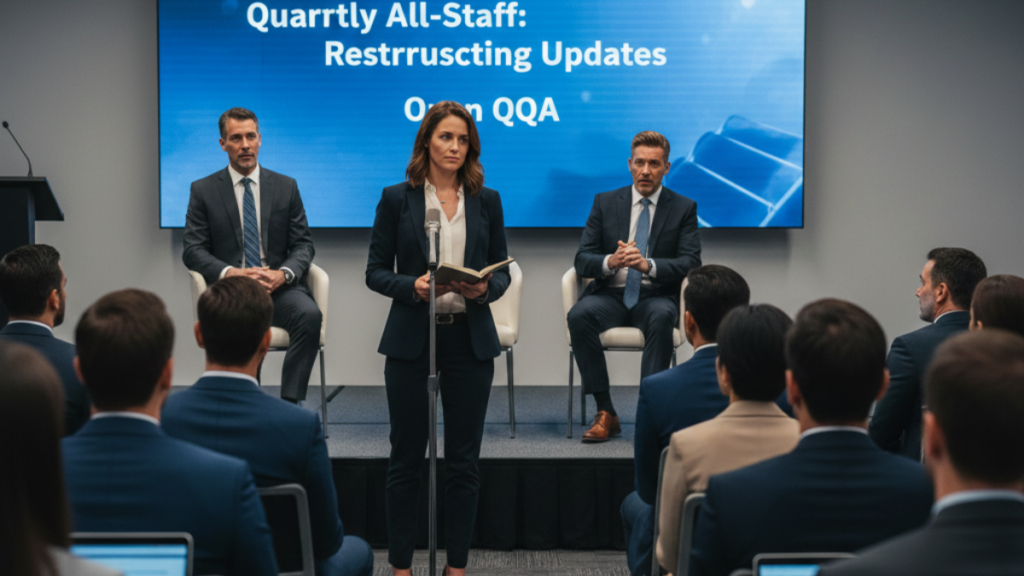
A company-wide meeting popped up on the calendar.
Quarterly all-staff.
CEO hosting.
“Open Q&A at the end.”
That part was new.
Our CEO liked transparency.
That was the brand.
“Ask me anything,” he always said.
Most people never did.
Because questions have consequences.
I closed the invite and went back to my onboarding checklist.
But the words stayed with me.
Open Q&A.
Ask me anything.
The Email I Wasn’t Supposed to See
It came to me by accident.
Or maybe not.
A forwarded thread.
Sent to the wrong distribution list.
Deleted two minutes later.
But not before I opened it.
Subject line: “Backfill plan.”
Backfill.
Not restructure.
Not evolve.
Backfill.
My role.
Mark had written it.
“Given ongoing performance concerns, we’ll transition responsibilities to Steve over the next four weeks.”
Ongoing.
Concerns.
There was a bullet point underneath.
“Need to manage messaging carefully – she’s well liked.”
I read that line three times.
Not valued.
Not essential.
Well liked.
Like I was a mood.
The Shift
The next morning, I stopped trying to be agreeable.
Not outwardly.
On the surface, nothing changed.
I trained Steve.
Updated documentation.
Joined meetings.
But inside, something had gone very still.
I wasn’t trying to save my job anymore.
I was trying to understand the story that was being told about me.
And who was telling it.
Because if performance issues had been fabricated, there would be a trail.
There is always a trail.
Calendar edits.
Version histories.
Messages sent late at night when people think no one is watching.
I knew where everything lived.
I had built the system.
The Question I Couldn’t Unhear
At the end of the week, my manager Mark stopped by my desk.
“Really appreciate how professional you’re being about all this,” he said.
All what?
He still hadn’t said the words.
He still hadn’t told me my job was gone.
He gave my shoulder a quick, friendly squeeze.
“We’ll find a place for you,” he added.
Find.
Like I was something misplaced.
That was the moment I realized something else.
He thought this was already over.
Deciding What to Do
That night I sat at my kitchen table with my laptop open and the town hall invite on the screen.
I replayed the past month in my head.
Every meeting.
Every sentence.
Every document.
I had two choices.
Leave quietly.
Or ask one question in a room where the entire company would hear the answer.
Not emotional.
Not accusatory.
Just factual.
A question about restructuring.
About performance metrics.
About hiring decisions.
A question that only made sense if you knew the truth.
And I did.
I closed the laptop.
Because for the first time since that 8:12 a.m. calendar invite, I wasn’t wondering what was happening to me.
I was wondering what would happen when I said it out loud.
And the town hall was in three days.
The Room Where Transparency Lived
The town hall was standing room only.
Rows of chairs for the speakers filled the center.
People lined the walls with laptops pressed to their chests like shields.
The leadership team sat in the front row, relaxed in the way people are when they believe the script has already been approved.
Mark waved when he saw me.
A small, friendly wave.
Like we were on the same side of something.
I waved back and took a seat near the aisle.
Close enough to reach a microphone.
Far enough that no one would think I had planned this.
Because I hadn’t planned it.
I had prepared.
There’s a difference.
The Performance Slide
The CEO walked through the usual updates.
Revenue.
Growth.
Future vision.
Words like alignment and efficiency floated across the screen in large, confident fonts.
Then came the restructuring slide.
“Some roles are evolving to better match our strategic direction,” he said. “And we’re proud of how professionally everyone has handled these transitions.”
Handled.
I wrote the word down.
Because my transition had never been announced.
My manager Mark clapped.
So did everyone else.
It sounded like approval.
Open Q&A
The CEO smiled. “Let’s open it up. Ask me anything.”
The microphones were placed in the aisles.
No one moved at first.
They never do.
You could feel the room doing that silent math.
Is my question safe?
Is it worth it?
Will it follow me back to my desk?
Then someone asked about office parking.
A soft laugh rolled through the room.
The kind that releases tension without changing anything.
Another question about hybrid work.
Safe.
Contained.
Mark leaned back in his chair, one ankle resting on his knee, completely at ease.
That’s when I stood up.
Walking to the Microphone
The walk felt longer than it was.
I could hear my own steps.
I could also hear Mia’s voice in my head from the kitchen.
Are you going to say something?
When I reached the microphone, the CEO smiled at me.
I had worked directly with him on two projects.
He knew my name.
“Hi,” I said. My voice came out steady. “I have a question about restructuring and performance evaluations.”
Mark stopped leaning back.
Just slightly.
“Of course,” the CEO said. “Go ahead.”
The Question
“I’m trying to understand how performance concerns are documented before a role is backfilled,” I said. “Specifically, what the process is for communicating those concerns to the employee, and how that aligns with the decision to hire someone who already has a personal relationship with the higher-ups.”
Silence.
Not shocked.
Focused.
The kind of silence where people start replaying their own experiences.
I kept my eyes on the CEO.
“This matters,” I added, calm, “because in my case, the first time I heard about any performance issue was after I was asked to train the person who was hired to take over my responsibilities. And the documentation I’ve seen doesn’t match my last formal review.”
You could feel the room shift.
Not loudly.
But physically.
The First Crack in the Story
The CEO’s smile didn’t disappear.
But it changed.
He looked down at the front row.
At HR.
At Mark.
“Is this something we can follow up on later?” HR said quickly, already half-standing.
I shook my head.
“I’d prefer clarity on the process,” I said. “So everyone understands how these decisions are made.”
I didn’t raise my voice.
I didn’t say the word friend.
I didn’t have to.
Because half the room had already opened Slack.
The Receipts Without Showing Them
“I built the current reporting system,” I continued. “Every version is time-stamped. My last performance review rated me as exceeding expectations. So I’m trying to understand when the concerns began, and how they were measured.”
The CEO looked at Mark.
Not aggressively.
Just… waiting.
Markleaned forward. “We’ve had ongoing conversations—”
“We haven’t,” I said.
Still calm.
Still controlled.
“If there are records of those conversations, I’d welcome seeing them.”
That was the moment.
Because there were no records.
And everyone who had ever worked with me knew how obsessive I was about documentation.
The Room Chooses
No one clapped.
This wasn’t that kind of moment.
But people were looking.
At me.
At Mark.
At the CEO.
At each other.
And in that looking, the original story started to fall apart.
Because it wasn’t about me anymore.
It was about process.
Fairness.
The quiet fear that this could happen to anyone.
The CEO’s Answer
“Thank you for raising this,” he said finally.
Formal.
Careful.
“Our policy is that performance concerns are documented and communicated clearly before any staffing changes are made. If that hasn’t happened, we need to review it immediately.”
He didn’t look at me when he said the last part.
He looked at Mark.
And HR.
Which told me everything.
After the Applause That Wasn’t Applause
The meeting moved on.
Someone asked about the holiday party.
People laughed too loudly.
But the energy had changed.
When it ended, no one rushed for the exits.
They clustered in small groups.
Mia found me near the door.
“You just…” she started, then stopped. “You were so calm.”
“I know,” I said.
That was the only way it would work.
The Conversation in the Glass Office
An hour later, I was in a conference room with the CEO and HR.
Mark wasn’t there.
That was the first sign.
The second was the stack of printed documents in front of them.
My reviews.
My project timelines.
The original process maps.
“I didn’t bring these,” I said.
“We pulled them,” the CEO replied.
There was a long pause.
“The hiring relationship wasn’t disclosed,” HR said carefully.
Of course it wasn’t.
“That’s a problem,” the CEO added.
What I Got Back
They didn’t offer me my old role.
That would have made the story too clean.
But they did offer me a choice.
Stay, in a newly defined position that reported to a different department.
Or leave with a severance package that came with words like recognition and contribution and thank you for everything you’ve built.
I took the package.
Not because I lost.
But because I was finished.
Mark
He didn’t speak to me again.
His name disappeared from Slack two weeks later.
No announcement.
Just gone.
Someone told me he had “decided to pursue other opportunities.”
That seemed like a nice way to put it.
The Last Day
I packed my desk slowly.
Not because there was a lot.
Because I wanted to feel it.
The ending that wasn’t an ending.
Mia hugged me.
“You changed something,” she said.
I shook my head.
“I just asked a question.”
But we both knew that wasn’t true.
Closure
On my last walk out of the building, I didn’t feel victorious.
I felt steady.
The story they had tried to write about me wasn’t the one people remembered.
That was enough.
Because I hadn’t exposed him to ruin him.
I had done it to keep my reality intact.
And as the elevator doors closed, I realized something that hadn’t been true for months.
I wasn’t wondering what was going to happen to me anymore.
I already knew.
I was going somewhere I wouldn’t have to prove I existed in a system I built with my own hands.
