

She Called Me Every Night
It started slowly, the way crises usually do.
One late-night phone call turned into another, then another after that.
My friend Lena said her relationship was falling apart.
She described constant arguments, emotional manipulation, and feeling trapped.
I listened for hours while pacing my kitchen, offering reassurance and advice.
She cried often, and I believed every word without hesitation.
That’s what friends do when someone says they’re hurting.
You show up.
I Became Her Safe Place
Soon, my routine revolved around her emergencies.
Lunch breaks turned into therapy sessions.
Weekend plans shifted depending on whether she needed support.
Even my husband joked that I had taken on a second job as her counselor.
I didn’t mind.
Helping her felt important, almost necessary.
She told me I was the only person who truly understood her.
At the time, I thought that meant trust.
I didn’t realize it also meant influence.
The Relationship Sounded Horrible
According to Lena, her boyfriend controlled everything.
He questioned her friendships and monitored her whereabouts.
She said he twisted arguments until she apologized for things she hadn’t done.
She described feeling isolated and emotionally exhausted.
Every story painted him as unstable and cruel.
I encouraged her to leave gently at first.
Then more firmly as weeks passed.
Eventually, she agreed.
And I felt proud of her courage.
I Helped Her Leave
The breakup happened on a rainy Tuesday evening.
I drove across town to help her pack essentials quickly.
She cried while folding clothes into suitcases.
I reassured her she was doing the right thing.
She moved into my guest room temporarily.
I told her she could stay as long as she needed.
She hugged me tightly that night and said I saved her life.
I believed her.
My World Started Revolving Around Her Recovery
We created routines meant to rebuild her confidence.
Morning walks. Journaling. Therapy appointments.
She posted inspirational quotes online about healing and self-worth.
Friends praised her strength publicly.
I watched her slowly become lighter, calmer.
At least that’s what it looked like from the outside.
But sometimes she asked strange questions.
What would I do if someone betrayed me?
Did I think friends could secretly compete with each other?
I assumed therapy was bringing up complicated emotions.
I didn’t question it.
The First Message Arrived Late at Night
A stranger messaged me on Instagram around midnight.
The account had no profile photo and barely any followers.
The message read:
“Do people know what you’re really like?”
I ignored it immediately.
Online weirdness happens sometimes, especially when accounts are public.
I deleted the message and went to sleep.
But another arrived the next morning.
Then another that afternoon.
Each one slightly more personal.
The Accusations Began Subtly
The anonymous account claimed I manipulated people emotionally.
That I inserted myself into others’ relationships for attention.
I laughed when I first read it.
It sounded absurd.
But then the messages referenced details only close friends would know.
Conversations from private dinners. Jokes shared in confidence.
My stomach tightened.
Someone wasn’t guessing.
Someone was narrating.
Lena Reacted Strongly
When I showed her the messages, she looked outraged on my behalf.
She insisted the sender must be her ex trying to retaliate.
“That sounds exactly like something he’d do,” she said quickly.
Her certainty comforted me.
She helped me block the account and told me not to engage.
Said toxic people thrive on attention.
I trusted her judgment completely.
After all, she had just escaped toxicity herself.
The Posts Went Public
A week later, screenshots began circulating in mutual friend circles.
Anonymous posts appeared describing a “fake supportive friend” who sabotaged relationships.
The descriptions felt disturbingly familiar.
The writer claimed this friend encouraged breakups to feel important.
That she thrived on being needed.
I recognized phrases I had used privately with Lena.
Word for word.
Friends Started Acting Strange
Nothing dramatic happened at first.
Just small shifts.
A delayed reply in group chats.
Canceled plans without explanation.
One friend asked casually if everything was okay between Lena and me.
The question felt oddly loaded.
I brushed it off, assuming people were misunderstanding online gossip.
But doubt had already begun spreading quietly.
The Group Chat Changed Tone
Our friend group’s messages became careful.
Neutral.
Jokes stopped landing the same way.
When I offered advice, responses were shorter than usual.
Like people were reassessing something about me.
I reread conversations repeatedly, searching for what changed.
That was when I realized people weren’t distancing themselves from drama.
They were distancing themselves from me.
The Post That Made My Heart Drop
One evening, a longer anonymous post appeared.
It described helping a friend leave a toxic relationship — but framed the helper as manipulative.
The writer claimed the friend exaggerated abuse because she was influenced.
That the helper wanted control over her life.
Specific details matched moments only Lena and I shared.
Packing night.
Conversations in my kitchen.
Even phrases I said while comforting her.
My hands shook as I read it.
Because suddenly one possibility became impossible to ignore.
I Asked Lena Directly
I approached her carefully that night.
Trying not to sound accusatory.
“Do you think your ex could know all these details?” I asked.
She hesitated.
Just briefly.
Then said maybe he had accessed her phone earlier in the relationship.
The explanation felt thin, but I wanted to believe it.
Believing her meant our friendship was still intact.
Questioning her meant everything changed.
The Overlap I Couldn’t Ignore
The anonymous posts appeared shortly after conversations between us.
Almost like summaries.
If we discussed something emotional, a related accusation surfaced online within hours.
I started testing it unintentionally.
Mentioning small details and waiting.
They appeared again.
Rewritten publicly.
Reframed negatively.
And slowly, the realization formed in a way I couldn’t push away anymore.
The person telling my story online wasn’t overhearing it.
They were living it with me.
The Invitation That Changed Everything
A group brunch was scheduled that weekend.
Something casual we had planned weeks earlier.
Lena encouraged me to go despite everything happening online.
She said normal social time would help distract me.
Her enthusiasm felt almost urgent.
That should have been my warning.
Because the morning of brunch, another anonymous post appeared.
This one ended with a sentence that stopped me cold:
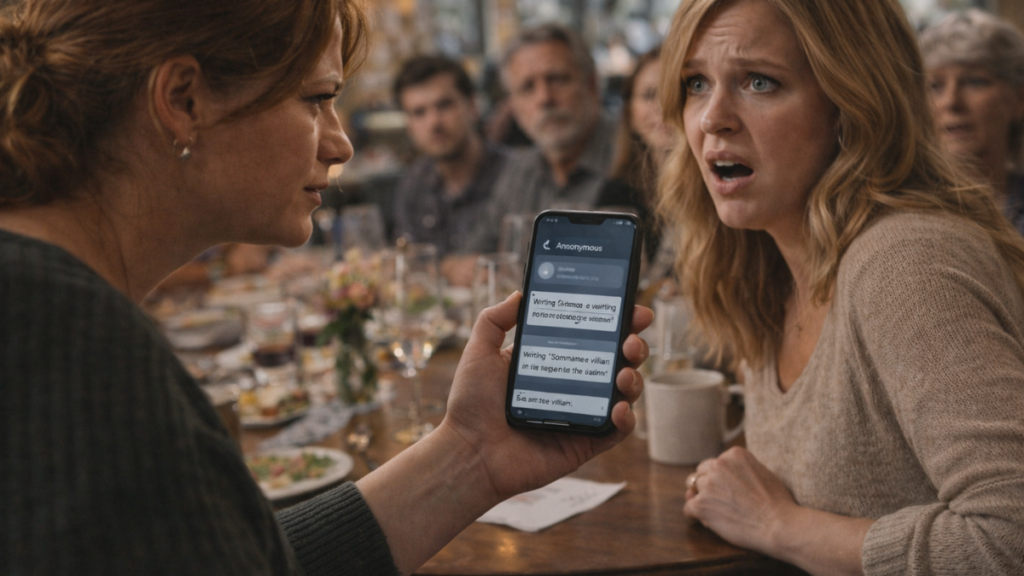
“Sometimes the villain doesn’t realize she’s the villain.”
And suddenly, I knew exactly where I needed to go.
Not to defend myself.
But to ask one question in front of everyone who had been quietly watching.
I Didn’t Cancel Brunch
Instead, I arrived early.
I sat at the table reviewing screenshots one last time.
Patterns. Timing. Language.
The pieces fit together too perfectly now.
Friends began arriving, greeting me politely but cautiously.
I could feel curiosity hanging in the air.
Then Lena walked in smiling.
Relaxed. Confident.
Like someone whose version of the story had already been accepted.
And as she hugged me hello, I realized something unsettling.
She wasn’t afraid of being exposed.
She was sure I wouldn’t do it.
Everyone Was Already Watching
By the time the last person sat down, the table felt unusually careful.
Conversations stayed polite, safe, almost rehearsed.
Normally brunch with our group was loud and chaotic.
Now it felt like a meeting no one admitted was happening.
I noticed phones placed face-up on the table.
Not scrolling — just ready.
People were waiting for something.
And I realized they weren’t sure which version of me was about to show up.
Lena Played Her Role Perfectly
She laughed easily, telling stories about her “new peaceful life.”
She thanked everyone for supporting her through a difficult breakup.
Several friends nodded sympathetically.
A few glanced at me briefly before looking away.
I recognized the dynamic immediately.
She had already told her story.
I just hadn’t heard it yet.
The Moment I Decided Not to Be Careful
For weeks I had tried to stay reasonable.
Quiet. Understanding.
But sitting there, listening to half-truths framed as healing, something shifted inside me.
I wasn’t angry.
I was tired of being confused about my own reality.
So when the server asked if anyone wanted to say something before the food arrived — a casual joke about celebrations — I raised my hand slightly.
“I actually do,” I said.
The table went still.
I Started Gently
“I want to talk about something weird that’s been happening,” I said calmly.
No accusations. No tension yet.
I explained the anonymous messages.
The posts describing me as manipulative.
Several people exchanged looks.
They already knew.
That realization stung more than the posts themselves.
I Asked One Question
“I’ve been trying to figure out who’s writing them,” I continued.
Lena shifted slightly beside me but kept smiling.
Her confidence almost impressed me.
“So I started paying attention to timing,” I said.
I placed my phone on the table and opened screenshots.
Posts appearing minutes after private conversations.
Phrases copied nearly word for word.
Silence settled heavier now.
Then I turned toward her.
“Lena,” I said softly, “why do these posts only appear after I talk to you?”
The Smile Finally Cracked
Her expression froze.
Not shocked.
Calculated.
She laughed lightly at first.
“You don’t seriously think I’d do that.”
But her voice carried tension underneath.
And the group noticed.
Because people sense truth before they admit it aloud.
The Pattern Became Impossible to Ignore
I showed timestamps calmly.
Conversations we had in my living room.
Posts uploaded thirty minutes later.
Messages sent while she was alone in my guest room.
Someone across the table whispered, “Wait…”
Another friend leaned closer to read the screen.
The energy shifted from awkward to investigative instantly.
Her Story Came Out Fast
She exhaled sharply and set down her coffee.
“You don’t understand,” she said, voice shaking slightly.
That sentence told me everything.
Not denial.
Justification.
She explained she felt overwhelmed after the breakup.
That people only supported her when she appeared fragile.
She said online posts helped her process emotions.
But she insisted she never expected them to spread.
The Truth Beneath the Explanation
“You made me the villain,” I said quietly.
She didn’t deny it.
Instead, she said something that stunned everyone.
“I needed people to understand how controlling you were.”
The table erupted with confused reactions.
Controlling?
I barely spoke.
Because suddenly I understood the narrative she had built.
Her Version of Reality
She claimed my advice influenced her decisions too strongly.
That encouraging her to leave her boyfriend felt like pressure.
She said she began believing I wanted her dependent on me.
The accusation felt surreal.
Every late-night call. Every reassurance. Every moment I showed up — rewritten as manipulation.
And the worst part was realizing some people had already believed it.
The Group Began Asking Questions
Friends started speaking over one another.
“Why post anonymously?”
“Why not talk to her directly?”
Someone asked if she fabricated details.
Another friend admitted they had felt uncomfortable reading the posts but assumed there was truth behind them.
The conversation spun beyond her control quickly.
Because once public doubt starts, narratives collapse fast.
The Message That Ended It
I opened one final screenshot.
A draft message accidentally saved publicly — one she never meant to post.
It read:
“If I make her look toxic, no one will question why I needed saving.”
The table went silent.
Completely silent.
She stared at the screen, realizing what everyone else now saw clearly.
This wasn’t emotional processing.
It was reputation management.
The Fallout Was Immediate
One friend stood up abruptly, shaking her head.
Another grabbed her purse without finishing her drink.
Phones buzzed simultaneously as people messaged others in the group chat.
The atmosphere fractured instantly.
Trust doesn’t disappear slowly once deception becomes undeniable.
It collapses all at once.
Her Final Attempt
She turned toward me, eyes filling with tears.
“I was hurting,” she said.
“I didn’t know how else to explain things.”
For a moment, I almost felt sympathy.
Because pain can make people rewrite stories to survive emotionally.
But survival shouldn’t require destroying someone else.
“You could have talked to me,” I said quietly.
She had no answer.
Leaving the Table
I stood first.
Not because I won anything — but because staying felt unnecessary now.
The truth existed in the open.
As I walked toward the door, conversations erupted behind me.
Questions. Arguments. Shock.
The group dynamic we’d built for years dissolved within minutes.
And strangely, I felt lighter with every step.
The Group Chat Imploded
By the time I reached my car, notifications flooded my phone.
Apologies. Confusion. Screenshots being shared rapidly.
People realizing they had unknowingly participated in spreading harm.
Others admitting they had doubted me silently.
The chat divided into smaller conversations almost instantly.
Exactly the kind of fracture anonymous narratives create.
What Hurt the Most
It wasn’t losing the friendship.
It was realizing how easily perception changes when someone controls the story first.
I had believed support meant loyalty.
She believed sympathy required a villain.
And I had unknowingly volunteered for the role.
The Final Understanding
Helping someone doesn’t always mean they see you clearly.
Sometimes they reshape you into whatever version justifies their choices.
I thought I was rescuing a friend from toxicity.
She thought she was escaping mine.
And sitting alone in my car afterward, one realization settled quietly but permanently.
The most dangerous stories aren’t lies strangers tell.
They’re the ones told by people who once trusted you enough to know exactly how to rewrite you.
