

The First Message Felt Like a Mistake
It started with a DM from a stranger asking why I had stopped replying to him.
I assumed he had the wrong person.
His message was polite but confused, referencing conversations I had never had and plans I had never made.
I responded quickly, telling him he must be mistaken.
He sent a screenshot.
The profile picture was my face.
My exact Instagram photos, captions copied word for word, even stories I remembered posting months earlier.
But the username wasn’t mine.
At first, I laughed nervously.
Fake accounts happen all the time.
Until he asked why I had given him a different phone number.
And that was when the laughter stopped.
The Account Looked Almost Perfect
The fake profile used my name with one extra letter added.
Easy to miss unless you looked closely.
Every photo came directly from my page.
Vacation pictures, selfies, group photos cropped carefully to remove other people.
Even my graduation photo was there.
The one my mom loved.
Scrolling through it felt like looking at a distorted version of myself — familiar but wrong.
Like someone had stolen my reflection and taught it to lie.
The bio described hobbies and interests that sounded like me but slightly exaggerated.
More confident, more flirtatious.
Someone had studied me closely enough to recreate me.
And they had done it intentionally.
Then More Messages Arrived
Within two days, three more strangers contacted me.
Each one confused.
Each one asking why I had disappeared after weeks of talking.
Each one convinced they knew me.
One man said we had FaceTimed — except the camera had always been “broken.”
Another claimed I had promised to visit him.
Their stories overlapped in unsettling ways.
Same jokes, same phrases, same emotional tone.
Whoever was behind the account wasn’t improvising.
They had built a character.
And that character was me.
I Reported the Account Immediately
I filed impersonation reports and sent proof to the platform.
Friends helped report it too.
For a few hours, I felt reassured.
Surely it would disappear quickly.
But instead, the account blocked me.
That meant whoever ran it knew I had found them.
The realization sent a chill through me.
This wasn’t random identity theft by a stranger across the internet.
This was someone paying attention in real time.
The Detail That Changed Everything
One of the men who messaged me mentioned a restaurant I loved but rarely posted about.
A small café near my apartment.
I had only talked about it privately.
Mostly to close friends.
The fake account had referenced specific conversations I remembered having in person.
Not online.
Which meant the person behind it didn’t just know my photos.
They knew my life.
I Started Mentally Listing People
Roommates.
Coworkers.
Friends.
Anyone who had access to my stories, habits, or personal conversations.
The list felt ridiculous at first.
Why would someone I knew do this?
But the alternative — a stranger somehow knowing intimate details — made even less sense.
I told myself not to jump to conclusions.
Still, one name kept resurfacing quietly in my thoughts.
My friend Lauren.
She Knew Everything About Me
Lauren and I had been friends for years.
She had helped take half the photos on my profile.
She knew my dating history, insecurities, favorite restaurants, even the way I typed messages.
We shared memes constantly.
She often joked that she could impersonate me perfectly.
At the time, it felt harmless.
Now the memory felt different.
Uncomfortable.
The Clue I Almost Missed
One night, while scrolling through old messages, I noticed something small.
Lauren had recently started asking oddly specific questions about my schedule.
When I was home.
When I traveled.
Whether I was seeing anyone new.
I had answered casually, assuming it was normal curiosity.
Now it felt like data collection.
My stomach tightened as realization slowly formed.
I needed proof before accusing her of something unbelievable.
The Fake Account Made a Mistake
A new victim messaged me with screenshots showing recent conversations.
In one message, the impersonator referenced a private joke Lauren and I shared.
A joke I had never posted online.
Never texted anyone else.
Only Lauren knew it.
I stared at the screen for a long time, hoping I was wrong.
But denial became impossible.
My friend wasn’t just impersonating me.
She was living as me.
I Didn’t Confront Her Immediately
Instead, I watched.
I created a secondary account and followed the fake profile quietly.
Within hours, it accepted.
I saw her messaging multiple people simultaneously, switching tone depending on who she talked to.
Romantic with some, sympathetic with others.
She wasn’t just catfishing.
She was performing.
And she was good at it.
That might have been the most disturbing part.
The Birthday Party Invitation
A week later, Lauren invited me to her birthday party.
A crowded rooftop gathering with mutual friends.
She sounded excited, completely normal.
Like nothing unusual existed between us.
I almost declined.
The idea of seeing her made my skin crawl.
But then another message arrived from a stranger asking why “I” had stopped replying again.
And suddenly I realized something.
If she could pretend to be me publicly online, she probably believed she could deny everything privately.
Unless there were witnesses.
I Decided the Party Would Be the Moment
I saved screenshots.
Downloaded conversations.
Printed messages just in case phones weren’t enough.
I didn’t want a screaming confrontation.
I wanted undeniable truth.
Because confronting someone alone gives them space to rewrite reality.
Confronting them in public removes that option.
And a crowded birthday party guaranteed an audience.
The Night of the Party
Music echoed through the rooftop as people laughed and drank under string lights.
Lauren greeted me with a hug like nothing had changed.
She introduced me to new friends, smiling proudly.
Acting exactly like the person I thought I knew.
Watching her move through the crowd felt surreal.
Like seeing an actor play two roles at once.
I wondered how many people there had unknowingly spoken to “me” online.
The thought made my chest tighten.
I Waited for the Right Moment
I didn’t rush it.
I talked to friends, accepted a drink, even laughed at a joke.
The longer I waited, the calmer I felt.
Because I knew something she didn’t.
The truth was already bigger than the two of us.
Across the room, I noticed unfamiliar faces watching me closely.
People I didn’t recognize.
One of them approached slowly, hesitating before speaking.
“Hey,” he said carefully.
“Are you… actually you?”
And in that moment, I realized the confrontation wasn’t going to unfold the way I planned.
Because I wasn’t the only person who had shown up looking for answers.
The Stranger Wasn’t Alone
When he asked if I was “actually me,” I assumed he was joking.
But his expression wasn’t playful.
It was cautious.
Almost relieved.
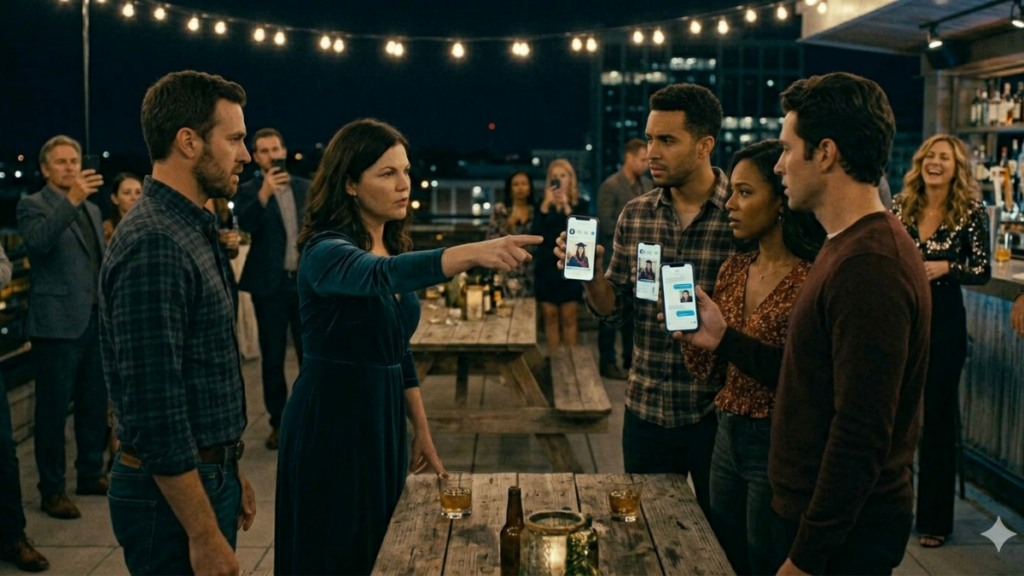
Before I could answer, another person stepped closer, then another, forming a small circle around me near the drink table.
Each of them looked confused in the exact same way.
“I think we’ve been talking,” one woman said carefully.
Online.
My stomach dropped.
Because suddenly the situation was no longer private.
They Thought They Knew Me
One man pulled out his phone and showed me a chat thread.
My face stared back from the profile picture.
The messages sounded like me at first glance — same humor, same phrasing — but the tone was slightly different.
More intimate.
More personal than I would ever be with strangers.
Another person opened their phone too.
Then another.
Each conversation stretched back weeks, sometimes months.
Plans made, feelings shared, promises hinted at.
And every single one of them believed they had been talking to me.
The Crowd Started Noticing
Voices grew louder as screenshots appeared one after another.
People nearby turned to watch.
The music kept playing, but attention shifted away from the birthday celebration and toward our growing group.
Confusion spread quickly.
Someone asked what was happening.
Another person started recording without even thinking.
I felt strangely calm.
Because the truth was revealing itself without me needing to force it.
Lauren Was Still Across the Room
She laughed with another group near the bar, completely unaware of what was unfolding.
Watching her felt surreal.
I wondered how many times she had stood beside me while secretly living another version of my life online.
How easily she had switched between identities.
One of the victims asked quietly, “Do you know who’s doing this?”
I nodded slowly.
And the energy around us shifted instantly.
I Walked Toward Her
The group followed without planning to.
Curiosity pulled them forward.
Conversations quieted as people noticed movement across the rooftop.
Lauren looked up, smiling when she saw me approaching.
“Are you having fun?” she asked brightly.
I stopped a few feet away.
Close enough that she could see the seriousness on my face.
“We need to talk,” I said.
Her smile faltered slightly.
The Phones Came Out Immediately
Someone behind me began recording openly now.
Others followed.
Lauren glanced around, confusion turning into discomfort as she noticed strangers standing nearby.
People she didn’t recognize.
“What’s going on?” she asked, laughing nervously.
I held up my phone, opening the fake profile page.
Her eyes flicked toward it — and froze.
The recognition was instant.
I Asked One Simple Question
“Why are you pretending to be me online?”
The words cut cleanly through the music.
The nearby conversations stopped completely.
Even the DJ glanced over.
Lauren shook her head quickly.
“I don’t know what you’re talking about.”
But denial sounded weaker when five strangers were standing behind me holding identical evidence.
The First Victim Spoke Up
“I’ve been talking to this account for two months,” one man said.
He showed his screen.
Another person added, “She told me she lived alone.”
A woman stepped forward next.
“She sent me voice messages.”
Lauren’s face drained of color as realization hit her all at once.
This wasn’t a private accusation.
It was a room full of witnesses.
The Story Fell Apart Fast
She tried laughing again, insisting someone must be framing her.
That it was a misunderstanding.
But then I opened the screenshot containing our private inside joke — the one only she knew.
The crowd reacted immediately.
Murmurs spread outward through the party.
People started whispering to each other, piecing together what was happening in real time.
And suddenly, her birthday party wasn’t hers anymore.
She Finally Snapped
“Why would you do this here?” she demanded, voice rising.
Her composure cracked for the first time.
I kept my voice steady.
“Because you did this publicly first.”
That landed harder than yelling ever could.
Someone near the back muttered, “That’s actually insane.”
Another person shook their head in disbelief.
The moral shift in the crowd was immediate.
The Truth Came Out Piece by Piece
Under pressure, her explanations changed rapidly.
At first she claimed curiosity.
Then loneliness.
Then boredom.
She said it started as a joke.
That she never meant for it to go this far.
But the victims standing around us told a different story — emotional conversations, late-night confessions, genuine attachment.
This wasn’t casual impersonation.
It was emotional manipulation.
The Party Fully Stopped
The music cut off entirely.
Everyone was watching now.
Even people who didn’t know either of us sensed something serious had happened.
The atmosphere shifted from celebration to confrontation.
Lauren looked around desperately, searching for support.
But no one stepped forward.
Because intent matters less than impact when harm becomes visible.
Someone Asked the Question Out Loud
“How many people were you talking to?”
Lauren didn’t answer.
Silence stretched long enough to become its own confession.
One victim quietly said, “There were group chats too.”
Gasps followed.
The scale of it suddenly felt larger than anyone expected.
And Lauren realized she had lost control of the narrative completely.
She Left Before Anyone Asked Her To
Without another word, she grabbed her bag and pushed through the crowd toward the exit.
No dramatic goodbye.
Just escape.
Phones followed her movement as people documented the moment instinctively.
The rooftop door slammed behind her.
The party didn’t resume.
Because no one knew how to return to normal after that.
What Happened After
People stayed around me for nearly an hour, comparing stories and timelines.
Some laughed nervously, others looked genuinely shaken.
A few apologized to me, even though they had done nothing wrong.
Shared confusion creates strange bonds.
We exchanged contact information — this time intentionally real.
And slowly, the shock turned into clarity.
The Message She Sent Later
That night, long after I got home, Lauren texted me.
“I never thought you’d humiliate me like that.”
I stared at the message for a long time before replying.
“You used my face to lie to people for months.”
Three dots appeared, then disappeared.
She never responded again.
The Part I Didn’t Expect
In the weeks that followed, several victims told me they felt relieved seeing the truth publicly.
It helped them understand they hadn’t imagined the connection.
That closure mattered more than anger.
And I realized something important.
The confrontation wasn’t about revenge.
It was about reclaiming identity.
Looking Back Now
Sometimes people ask why I didn’t confront her privately.
Why I chose a party.
The answer is simple.
She built the lie in public spaces — online, with real people and real emotions.
So the truth deserved the same visibility.
Because pretending to be someone else might feel harmless to the person doing it.
But to the person being replaced, it feels like disappearing.
And that night, surrounded by strangers holding proof, I finally stepped back into my own life.
