

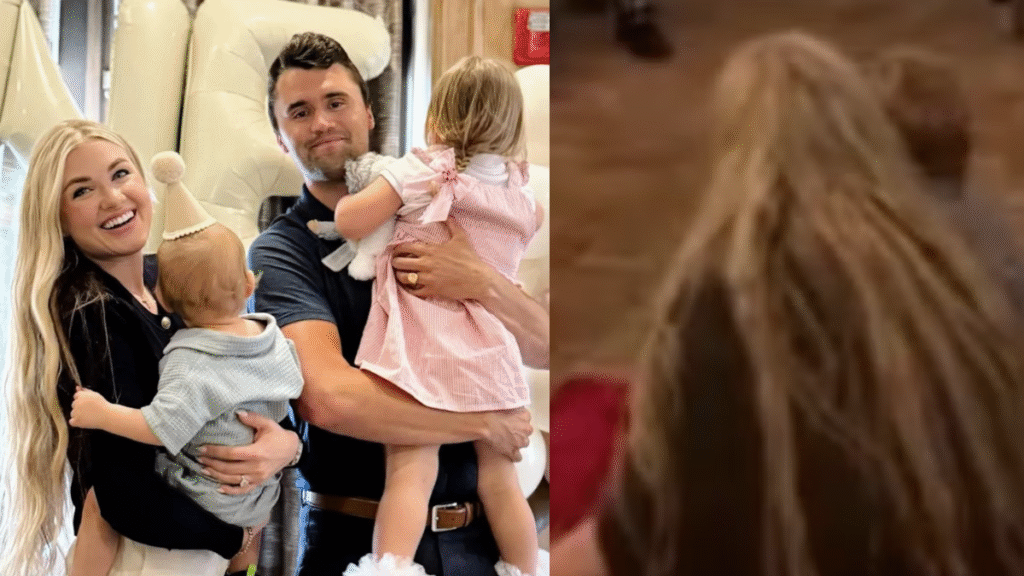
Photo Credit: charliekirk1776/ Instagram; Erika Kirk/ Instagram
A Christmas Like No Other: Erika Kirk’s First Holiday Without Charlie
Erika Kirk — widow of conservative activist Charlie Kirk — recently shared a deeply personal and emotional reflection as she marked her first Christmas without her husband. The couple had built a life together centered around family, faith, and shared passions, until Charlie’s tragic murder on September 10, 2025. In an intimate Instagram post, Erika opened up about the holidays — a time of joy for many, but much more complicated for her this year.
Rather than trying to mask her grief or rush into new routines, Erika chose to preserve the memory of her husband in their home. She wrote that she has kept everything exactly as it was, leaving Charlie’s socks on the floor, his shoes by the door, and even his vitamins scattered on the counter. For her, these familiar details are not painful relics but living reminders of the life they shared — anchors in a world that feels “new, but strange. Familiar, but not.”
This holiday snapshot paints a picture of someone navigating grief in an intensely personal way. Erika explained that balancing old traditions with new ones has been her strategy for “harmonizing into a normalcy for the babies” — referring to their two young children. Through it all, she insisted that Christmas this year was a quiet, inward-focused experience, one rooted in healing rather than celebration.
Her words resonate with anyone who has faced loss during a major holiday. Christmas — a season of warmth, family, and celebration — can also magnify absence, especially after losing a partner. Erika’s bravery in sharing her experience gives others permission to grieve authentically, without shame or forced optimism.
Balancing Memory and Healing: The Emotional Landscape
Erika acknowledged that life now is fundamentally different, and her reflections on this change capture both the tenderness of remembrance and the rawness of loss. “Life is a little different,” she said, recognizing that while routines may continue, their emotional textures have shifted dramatically. Instead of discarding physical reminders of Charlie, she keeps them present in her daily life — a decision that embodies her commitment to memory and continuity.
This approach illustrates a powerful truth about grief: it’s not something to simply “get over” but something to integrate into the rhythms of everyday life. Erika’s choice to leave Charlie’s belongings in place — visible, tactile, and unavoidable — allows her to honor his presence while shaping a new normal that includes their children. It’s a process of weaving memory into daily existence rather than erasing it.
Notably, Erika also reflected on the importance of maintaining traditions while creating new ones. In her Instagram message she described this blend as a “rhythm” — a word that suggests ongoing movement rather than sudden change. This notion of rhythm speaks to the emotional cadence of grief: sometimes steady, sometimes uneven, always evolving.
Her focus on family, especially her children, underscores a central theme of her holiday reflections. Even amid raw emotion, there’s a clear intention to cultivate a space of love and reassurance for her kids. Erika’s deeply honest portrayal of this challenging Christmas season serves as a reminder that healing isn’t linear — it’s a mosaic of moments that blend sorrow with resilience.
Addressing Criticism: Erika’s Response to Public Scrutiny
Erika Kirk’s public reflections on her first Christmas alone haven’t come without criticism. In the aftermath of Charlie’s death, she has faced online commentary accusing her of exploiting his tragic passing or seeking public attention through her visibility. In her holiday message, she confronted this kind of scrutiny head-on, declaring that she owes no one an explanation for the way she grieves or lives her life.
She wrote that the world is already quick to judge, assume, and slander — but these comments “don’t land” and “don’t burn.” This statement reveals a protective layer of emotional resilience that she has had to develop amid intense public and media attention. For someone in the national spotlight, navigating grief is not only a private process; it also unfolds under public view, with many voices weighing in — often without context.
Despite the criticism, Erika seems to remain grounded in her faith and conviction. In her Christmas post, she shared words meant to encourage other wives and families — a message of deep devotion and love, even through hardship. She asserted that choosing a marriage grounded in self-sacrifice and devotion can leave a legacy that is profound, difficult to articulate, and deeply meaningful.
Her response to criticism reflects a larger conversation about how society discusses grief, tragedy, and public figures. In an age where every personal moment can become public fodder, Erika’s insistence on defining her own narrative — rather than letting outsiders shape it — is an important act of agency. Instead of retreating from the spotlight due to judgment, she has chosen to speak openly about her lived experience, offering both vulnerability and strength.
The Role of Faith and Family in Grief
Throughout Erika Kirk’s Christmas reflections, a consistent theme emerges: the centrality of faith and family in her process of healing. In her message, she emphasized that despite pain and loss, “God is still so good.” This affirmation underscores how her Christian faith provides a framework for processing grief, finding meaning, and moving forward — not by forgetting, but by recognizing grace amid heartbreak.
For many people, faith serves as a source of solace when confronting life’s most difficult moments. Erika’s reflections gesture toward a spiritual interpretation of suffering — one in which pain is acknowledged fully, but not as a reason to abandon hope. Her expression of gratitude even in the midst of sorrow highlights a conviction that life still contains beauty and purpose, even when it is profoundly altered.
Family — particularly her role as mother to two children — remains a guiding light for Erika during this holiday season. While Charlie’s physical presence is gone, his role as father lives on through their kids. Erika’s dedication to creating a stable, loving environment for them — even as she grieves — speaks to her commitment to legacy and continuity.
Her description of blending traditions and crafting new ones reflects a balance between honoring the past and nurturing the future. Activities like visiting Father Christmas and setting up a nativity scene with her children demonstrate that while the holidays are different, they can still be meaningful. These moments of familial closeness serve as anchors in a period of emotional upheaval and uncertainty.
In this way, Erika’s story resonates beyond personal tragedy. It illustrates how individuals — especially parents — find strength in faith, family ties, and creating pockets of normalcy for those they love, even in the most challenging seasons of life.
Reflections on Loss, Legacy, and Moving Forward
Erika Kirk’s Christmas reflections offer a candid look at one woman’s journey through grief — one marked by love, remembrance, strength, and faith. Her decision to keep her husband’s belongings visible in the home symbolizes not just memory, but a continued emotional connection that persists even in absence. These visible reminders are, for her, acts of love rather than reminders of loss.
Her holiday message also spoke to the broader idea that loss does not erase meaning. Instead, it can deepen it. By choosing to honor her husband’s memory publicly and privately, Erika demonstrates how grief and gratitude can coexist. Her children’s experiences of Christmas — though marked by absence — are interwoven with love, presence, and family continuity.
In confronting both loss and criticism, Erika has remained unflinching in her agency. She refused to let external judgments dictate how she processes her grief, asserting that her story is her own. This insistence on self-definition, even in the face of scrutiny, is a testament to her resilience and resolve.
Ultimately, Erika Kirk’s reflections remind us that grief is not an event with a defined endpoint, but a lifelong process — one shaped by personal choices, memories, faith, and love. Her Christmas message, grounded in honesty and vulnerability, invites others to consider how they too might honor lost loved ones while continuing to build lives full of depth and meaning.