

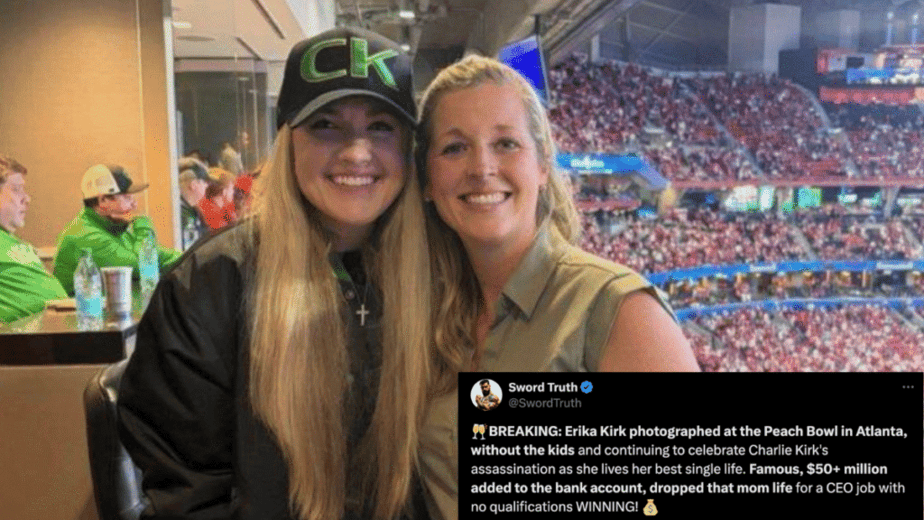
Photo Credit: Sword Truth/ X
The Peach Bowl Photo That Sparked a Firestorm
Erika Kirk recently attended the Peach Bowl in Atlanta without her children. Photos of her at the college football semifinal circulated widely online, quickly going viral. Thousands saw her smiling in the stadium as fans debated her presence. Many commenters reacted strongly because her appearance came just months after her husband’s death. Charlie Kirk, a high-profile conservative activist, was assassinated in September 2025, leaving Erika a widow and single parent.
The viral images triggered widespread criticism of Erika’s parenting choices. Social media users questioned why she attended a major event alone. Critics insisted she should spend more time with her young children during their loss. Some comments claimed attending a sports game had “bad optics” for a grieving widow. Others framed her attendance as evidence of misplaced priorities.
Online users framed the situation in stark terms, often ignoring nuance. Many asked, “Who watches her kids while she cheers and networks?” One commenter called her actions “not normal.” Another said her children needed stability more than stadium outings. These harsh lines of judgment spread rapidly across platforms like X and TikTok.
At the same time, defenders weighed in with empathy. They reminded critics that grief looks different for everyone. Supporters argued that Erika may have valid reasons for attending, including work or community engagement. Other replies noted cameras capture only a moment, not her everyday parenting. These supporters urged empathy over quick judgment.
This online chatter highlights how quickly public figures face scrutiny. A single image prompted discussions about motherhood, grief, and societal expectations. Public reactions ranged from cruelty to compassion, revealing deep divisions in how people view modern parenting. The Peach Bowl incident became more than a snapshot — it turned into a cultural flashpoint online.
Online Criticism and Cultural Expectations
Social media users responded with strong language after Erika Kirk’s Peach Bowl appearance. Many claimed she needed to stay at home with her kids. They argued that young children who recently lost a father require constant attention and comfort. Some posts went further, calling her behavior “sickening.” Critics suggested the time at a public event was inappropriate during mourning.
Several voices on X claimed they had “never seen her with her kids” since her husband’s death. These claims circulated widely, amplifying judgment rather than context. People often base opinions on snippets, not entire realities. Online, emotional responses quickly escalate when public figures are involved.
But not all commentary attacked her. Many defended Erika, noting that coping mechanisms differ. They pointed out that attending an event does not mean neglecting her children. Supporters reminded critics that she might have trusted caregivers or family with her kids at home. These voices stressed that compassion should guide public discourse.
Cultural expectations about motherhood can shape harsh reactions. Many believe a grieving mother must always stay close to her children. Social norms influence how people see motherhood, loss, and public life intersections. These beliefs can intensify criticism of parents who behave differently.
Public figures often pay a higher price for choices that private individuals make without notice. A simple action, like attending a game, morphs into symbolic meaning online. People project expectations onto others without knowing personal context. This amplifies pressures on parents navigating grief and public visibility.
The online reaction to Erika’s appearance shows how quickly empathy can give way to judgment. It illustrates how culture often interprets a parent’s actions through a narrow lens. Public expectations remain strict, especially for mothers. These conversations reveal broader tensions in social media culture and collective judgment.
Grief, Public Life, and Personal Choices
Erika Kirk faced public scrutiny partly because grief remains a private experience for most. Her husband’s death was traumatic and sudden, upending family life. Coping with such loss differs by individual, and no single path suits everyone. Some find strength in community engagement, while others withdraw into solitude.
Erika stepped into leadership of Turning Point USA after her husband’s passing, becoming CEO and chair. This role placed her even more in the public eye. She balanced organizational duties with her responsibilities as a mother of two. Her public commitments may have influenced her decision to attend events.
Psychological research shows that grief does not follow a set timeline. Parents often try to maintain normalcy for their children’s sake, even when personally struggling. Some public appearances provide a sense of routine or purpose during a difficult period. This context matters when judging actions that seem unconventional.
The debate over Erika’s attendance shows broader cultural discomfort with non-traditional grieving behavior. Many expect visible signs of distress rather than composed composure. In online discourse, calm public behavior sometimes gets misread as detachment or opportunism, rather than resilience.
Public figures often have fewer opportunities for solitude. Cameras capture moments that represent only slices of their lives. Social media amplifies those moments without context. This amplification affects how people interpret actions of those in the spotlight.
Grief, work, and parenting collide uniquely for new single parents. Erika’s experience highlights these intersecting pressures. Her situation reminds us that appearances rarely tell the full story. Patience and empathy can foster healthier discussions about grief, especially online.
Support, Defense, and Online Backlash Dynamics
Amid criticism, many voices rallied in support of Erika Kirk online. Supporters argued that judgment lacks compassion and context. They maintained that a parent’s life includes many roles beyond caregiving alone. Social media users reminded critics that caregiving often involves trusted networks of support.
Supporters also pointed out that attending a major event could serve essential purposes. It might involve work, professional networking, or emotional renewal. Even simple breaks can provide necessary strength for long-term caregiving responsibilities. These arguments encouraged readers to broaden their understanding.
Others noted that treasuring personal time does not diminish a parent’s love for their children. Grieving parents must find ways to function while raising young kids. Some stressed that online debates should allow space for nuance and individuality.
The backlash also revealed how quickly online opinion can devolve into personal attacks. Many discussions shifted from constructive debate to hostile accusations. Some critics accused Erika of hypocrisy and inconsistency with her previous statements on parenting and family. These arguments often lacked evidence and relied on assumptions.
Conversely, defenders emphasized that public criticism should not overshadow the real struggles of parenting after loss. They urged followers to offer compassionate support, not condemnation. Healthy discourse about grief and parenting can strengthen, not divide, online communities.
The online dynamics around Erika’s case reflect broader trends. People quickly judge without complete information. Platforms amplify extreme viewpoints because they attract attention. Yet, thoughtful voices calling for empathy can shift the tone of discussions and challenge snap judgments.
Redefining Public Conversations About Parenting and Grief
The debate over Erika Kirk reminds us how social media shapes parenting norms. People often judge others through the lens of personal expectations. These standards create unfair pressure for parents, especially those in the public eye. Understanding should replace quick condemnation online.
Social media rewards bold, emotional reactions more than careful analysis. This environment fosters harsh criticism and rewards outrage. In Erika’s case, many users responded emotionally without complete information. Empathy is a necessary tool in online dialogue, yet it remains scarce at times.
Constructive conversations about parenting and grief need support rather than shaming. Parents around the world grapple with similar challenges, regardless of public status. A community that uplifts, not attacks, fosters better outcomes for children and adults alike.
Public figures like Erika Kirk face heightened scrutiny, but private individuals encounter similar judgment offline. People often overlook the complexities of life beyond a photo or headline. This case encourages us to consider the whole person before forming judgments.
Judgment often becomes a barrier to compassionate understanding. But empathy and thoughtful discussion can transform how we talk about sensitive topics like grief and parenting. By choosing kindness over criticism, communities strengthen collectively.
In the end, Erika Kirk’s situation should prompt deeper reflection. It should remind us that judging others based on isolated moments does little good. Instead, we can choose to listen, learn, and support one another more generously.