Home Blog Page 2

My Husband Has Been Sleeping With My Son’s Father-in-Law — Then I Learned Our Kids’ Marriage Wasn’t How They Met

My husband and my son’s father-in-law have been having an affair for eleven years.

My son has only been married for four.

For the past month, I have been trying to understand how two men who supposedly met when their children started dating could have been involved for almost a decade before the wedding.

Then I found out that my husband introduced our son to his future wife.

And apparently, that introduction was not nearly as innocent as I thought.

My name is Diane, I am fifty-six, and I have been married to my husband, Robert, for thirty-two years.

Robert is fifty-eight.

We have two children, our son Michael, who is thirty, and our daughter Emily, who is twenty-six.

Michael married his wife, Lauren, four years ago.

Lauren is twenty-nine, and her parents are Thomas and Susan.

Thomas is fifty-nine.

Susan is fifty-seven.

Until recently, I considered Thomas and Susan some of our closest friends.

We spent holidays together, went on vacations, celebrated birthdays, and frequently had dinner at each other’s houses.

Robert and Thomas were particularly close.

They played golf together.

Went fishing.

Attended sporting events.

Occasionally traveled together for work.

I thought it was wonderful that our families got along so well.

Michael and Lauren had a beautiful wedding, and both families were thrilled when they announced they were expecting their first child last year.

Our granddaughter, Charlotte, is now eight months old.

I thought we were incredibly lucky.

Then Susan called me one Tuesday afternoon and asked whether I could come over.

She sounded upset.

I assumed something had happened with Lauren or Charlotte.

Instead, Susan told me she thought Thomas was having an affair.

I was shocked.

Thomas had always seemed like a devoted husband.

He and Susan had been married for thirty-four years.

They had three children.

They were affectionate, involved grandparents, and the kind of couple everyone assumed would remain together forever.

I asked Susan why she suspected an affair.

She said Thomas had been increasingly secretive.

He frequently disappeared for several hours.

He had started protecting his phone.

He became defensive whenever she asked about his schedule.

Then she found a hotel receipt in his jacket.

The reservation was for two people.

Susan initially thought he was seeing another woman.

She confronted him.

He denied everything.

Then she found messages on his tablet.

Messages from someone saved under the name R. Miller.

I felt my stomach tighten.

My husband’s name is Robert Miller.

But I told myself it was a common name.

There could be hundreds of men with that name.

Susan showed me the messages.

The first one said:

I can’t keep doing this. Diane is starting to ask questions, and I don’t know how much longer I can pretend we’re just friends.

I stopped breathing.

Then I read the next message.

Thomas had written:

We’ve been doing this for eleven years. You don’t get to panic now just because our families are closer than they used to be.

Robert replied:

That’s exactly why I’m panicking. Michael and Lauren have a baby now. If this comes out, it doesn’t just destroy our marriages. It destroys their family too.

I stared at the screen.

Susan started crying.

She asked whether I knew.

I told her I had absolutely no idea.

Then she showed me the rest of the conversation.

There were messages about hotel rooms.

Private weekends.

Arguments.

Anniversaries.

Plans to meet while Susan and I were watching Charlotte.

There were photographs.

Nothing explicit in the messages Susan showed me, but enough to make the relationship unmistakable.

My husband had been sleeping with my son’s father-in-law.

For eleven years.

I asked Susan whether Thomas had admitted it.

She said she had not confronted him yet.

She wanted to speak to me first.

Then she said something that made me stop.

“I think they knew each other before Michael and Lauren started dating.”

I stared at her.

Michael and Lauren had been together for approximately seven years.

They met when Michael was twenty-three and Lauren was twenty-two.

Robert and Thomas had supposedly met when our children introduced us.

But the messages suggested their relationship had started eleven years earlier.

That meant they had been involved for approximately four years before Michael and Lauren even started dating.

I asked Susan whether she was certain about the timeline.

She showed me another message.

Thomas had written:

I should have known this would get complicated when you suggested Michael meet Lauren.

Robert replied:

I didn’t suggest it because of us. I thought they’d like each other.

Thomas:

You knew exactly what you were doing. You wanted a reason for us to spend more time together without anyone questioning it.

I felt physically sick.

My husband had apparently encouraged our son to date his lover’s daughter.

Then our children fell in love.

Then they got married.

Then they had a baby.

And throughout all of it, Robert and Thomas continued their affair.

I asked Susan how she thought the men originally met.

She said she did not know.

Then she told me something I had never heard before.

Thomas had been involved in a men’s social group approximately twelve years earlier.

It was a group that organized golf outings, fishing trips, and weekend retreats.

Susan said Thomas frequently attended events with the group, but she never met most of the members.

She thought Robert might have been involved.

I remembered Robert joining a similar group around that time.

He told me it was a professional networking organization.

He attended monthly dinners and occasional weekend events.

I never questioned it.

Now I wondered whether the two groups were the same.

Susan and I spent the next hour going through the messages.

Then we found something that made everything worse.

Robert and Thomas had been discussing our children’s marriage long before the wedding.

They talked about whether Michael and Lauren were compatible.

Whether they were moving too quickly.

Whether they should move in together.

Whether they were ready to get engaged.

Then we found a message from approximately six months before Michael proposed.

Thomas wrote:

Lauren is starting to wonder why Michael hasn’t proposed. If this doesn’t work out, we’re going to have a problem.

Robert replied:

I’ll talk to him. He loves her. He just needs a little push.

I stared at the screen.

My husband had apparently been encouraging our son to propose to his lover’s daughter.

Then Thomas wrote:

We can’t afford to have them break up now.

Robert replied:

They aren’t going to break up. Stop worrying.

I felt sick.

I asked Susan whether she thought the men had deliberately encouraged our children’s relationship to protect their affair.

She said she did not know.

But the messages suggested they had been discussing that possibility for years.

Then we found an exchange from shortly after Michael and Lauren got engaged.

Thomas wrote:

Once they’re married, nobody will ever question why we’re always together.

Robert replied:

I know. I just wish we didn’t have to keep pretending.

I put the tablet down.

For seven years, I had believed Robert and Thomas were close because their children were in a serious relationship.

Now I was beginning to understand that our children’s relationship might have been encouraged because Robert and Thomas were already close.

Then Susan asked whether we should tell Michael and Lauren.

I said we needed to confront our husbands first.

I wanted to understand exactly what had happened before involving our children.

Susan agreed.

Then she asked whether I wanted to confront them together.

I said yes.

We arranged to meet the following evening.

Robert and Thomas both believed we were having dinner at Susan and Thomas’s house.

They had no idea what we knew.

I spent the next twenty-four hours feeling as though I was going to be sick.

Robert came home from work and asked what I wanted for dinner.

I stared at him.

This was the man I had been married to for thirty-two years.

The father of my children.

The grandfather of my granddaughter.

The man who had held my hand through my mother’s funeral and sat beside me when our daughter was hospitalized as a teenager.

And apparently, he had been maintaining a secret relationship with another man for more than a decade.

I asked whether he was going golfing with Thomas that weekend.

He said yes.

I asked where.

He named a course approximately an hour away.

I asked whether anyone else was going.

He said two friends.

I wondered whether those friends existed.

Then I asked whether he had known Thomas before Michael started dating Lauren.

Robert stopped cutting his food.

He looked at me.

Then he asked why I wanted to know.

I said I was curious.

He told me they had met through the children.

I asked whether he was certain.

He laughed.

Then he said:

“Diane, I think I’d remember meeting my son’s father-in-law.”

I looked at him.

He smiled.

Then he changed the subject.

That was when I realized Robert was not simply hiding an affair.

He was actively maintaining a false history of how our families came together.

The next evening, we went to Susan and Thomas’s house.

Susan had prepared dinner.

Thomas opened a bottle of wine.

Robert seemed relaxed.

He asked Thomas about their upcoming golf trip.

Thomas said he was looking forward to it.

Susan looked at me.

I put my phone on the table.

Then I asked how long they had been sleeping together.

Robert froze.

Thomas put down his glass.

For several seconds, neither man spoke.

Then Robert asked what I was talking about.

Susan opened the messages on her tablet.

She placed it in front of Thomas.

He looked at the screen.

Then he closed his eyes.

Robert started crying.

I asked whether they had been having an affair for eleven years.

Thomas said yes.

Susan started sobbing.

Robert reached for my hand.

I pulled away.

Then I asked how they originally met.

Robert said through a networking group.

I asked why he had lied when I questioned him the previous evening.

He said he panicked.

Then I asked whether he had deliberately introduced Michael to Lauren because he wanted a reason to spend more time with Thomas.

Robert looked at Thomas.

Thomas looked away.

I told them I wanted an answer.

Robert said:

“It wasn’t that simple.”

I laughed.

I told him it was apparently complicated enough that he had spent eleven years sleeping with another man while encouraging our children to build a family together.

Then Thomas said:

“We didn’t make them fall in love.”

Susan stared at him.

She asked whether he was seriously suggesting that made the situation acceptable.

Thomas said no.

Then he admitted that Robert had suggested introducing Michael and Lauren.

I asked why.

Robert said he genuinely believed they would be compatible.

I asked whether their compatibility had anything to do with the fact that their fathers were having an affair.

He said it made things easier.

I stared at him.

Then he admitted that when Michael and Lauren started dating, Robert and Thomas were thrilled.

They had been struggling to find opportunities to spend time together without raising suspicion.

Now they had a perfectly reasonable explanation.

They could attend family dinners.

Spend holidays together.

Go on vacations.

Help their children move.

Celebrate birthdays.

Nobody questioned why they were constantly together.

I asked whether they had encouraged the relationship to become serious.

Robert said they supported it.

I asked whether they had ever considered that Michael and Lauren might not be right for each other.

Thomas said they seemed happy.

Then Susan asked whether they would have encouraged the relationship even if they were not.

Neither man answered.

I felt sick.

Then I asked whether they had pressured Michael to propose.

Robert said he had encouraged him.

I asked whether he did it because Michael was ready or because Thomas was worried the relationship might end.

Robert started crying.

Then he admitted it was both.

I stood up.

I told him I needed some air.

I went outside.

Susan followed me.

We stood on the patio for several minutes.

Then she said something I had not considered.

“What if they planned the whole thing before our children even met?”

I looked at her.

She said Thomas had always been unusually invested in Lauren’s dating life.

He frequently asked whether she was seeing anyone.

He encouraged her to attend family events.

He became especially interested when she started dating Michael.

Susan thought he was simply excited that his daughter had found someone he liked.

Now she wondered whether he had been looking for an opportunity to connect their families.

I told her we needed to go back inside.

When we returned, Robert and Thomas were sitting together at the dining room table.

They had been talking privately.

I asked what they had been discussing.

Robert said they were trying to figure out how to explain everything.

I told him they could start by explaining why they had lied about when they met.

Thomas said they met in 2014.

Eleven years earlier.

At a professional networking event.

Robert was forty-seven.

Thomas was forty-eight.

They started talking.

They discovered they had similar interests.

They exchanged numbers.

They began meeting for lunch.

Then they started having an affair.

I asked whether either of them had been involved with another man before.

Robert said no.

Thomas said yes.

Susan looked at him.

She asked whether he had been unfaithful before Robert.

Thomas said he had.

I asked whether Robert knew.

He said yes.

Then I asked whether their relationship had been continuous for eleven years.

Robert said there had been periods when they tried to end it.

I asked how long those periods lasted.

A few months.

Sometimes less.

Then I asked whether they had ever considered leaving their wives.

Robert said yes.

Thomas said no.

They looked at each other.

That was the first time I realized they might not have been telling each other the same story either.

I asked Robert whether he had wanted to divorce me.

He said he had considered it.

I asked when.

He said approximately five years earlier.

That was around the time Michael and Lauren moved in together.

I asked whether he had planned to leave me for Thomas.

He said yes.

Then Thomas interrupted.

He said Robert had never seriously intended to leave.

Robert became angry.

He accused Thomas of refusing to discuss their future.

Thomas said he had always been clear that he was not leaving Susan.

Susan stood up.

She asked whether Thomas had been telling Robert he loved him while refusing to consider a future together.

Thomas said yes.

Then she asked whether he had been using our children’s relationship to keep Robert satisfied with the arrangement.

Thomas did not answer.

Robert started crying.

Then he said:

“That’s exactly what he did.”

I stared at him.

Robert said Thomas had repeatedly promised that once their children married, things would become easier.

They would be family.

They could spend more time together.

They could travel.

They could maintain their relationship without anyone questioning their closeness.

Robert believed him.

Then Michael and Lauren got engaged.

Thomas became even more enthusiastic.

He started talking about how wonderful it would be when they had children.

How they would become grandparents together.

How they could eventually buy vacation properties near each other.

I asked whether he had been planning a future with Robert through our children’s marriage.

Thomas said he wanted everyone to be happy.

Susan told him that was not an answer.

Then I asked whether Michael and Lauren knew their fathers had been involved before they met.

Robert said no.

I asked whether they knew their fathers had deliberately encouraged their relationship.

Thomas said they knew Robert had suggested introducing them.

I asked whether they knew why.

He said no.

Then Susan asked something that made both men go silent.

“Did you introduce them because you wanted them to fall in love, or because you wanted to make sure neither of you could ever leave the other?”

Robert looked at Thomas.

Thomas looked down.

I felt my stomach tighten.

Then Robert said:

“We thought if they got married, we’d always be part of each other’s lives.”

I stared at him.

Our children had not simply been introduced because their fathers thought they would be compatible.

They had been encouraged to build a life together because their fathers wanted a permanent connection.

Then I asked whether they had ever considered what would happen if Michael and Lauren divorced.

Thomas said they hoped that would never happen.

I asked whether they would have encouraged them to remain married even if they were unhappy.

Robert said he did not know.

Then Thomas said:

“We would have wanted them to work things out.”

Susan started crying again.

She said she had spent years believing Thomas was an unusually devoted father.

Now she was wondering whether his involvement in Lauren’s marriage had been motivated partly by his desire to maintain access to Robert.

Then I remembered something from Michael and Lauren’s engagement.

Michael had been uncertain about proposing.

He loved Lauren, but he was worried about his career.

He had recently changed jobs.

He wanted to become more financially stable before getting married.

Robert encouraged him to propose anyway.

He told Michael that money would always be a concern and that he should not risk losing someone wonderful because he was afraid of commitment.

I agreed.

We helped Michael buy the ring.

We organized a surprise engagement party.

Thomas and Susan were thrilled.

Now I wondered whether Robert had been encouraging Michael to propose because Thomas was worried their children might break up.

I asked Robert.

He admitted Thomas had been anxious.

I asked whether he had pressured Michael because of that anxiety.

Robert said he had encouraged him.

I told him that was not what I asked.

Then he said yes.

I felt sick.

Then Susan asked whether Thomas had been encouraging Lauren to accept the proposal.

He said yes.

She asked whether he had ever considered that Lauren might not be ready.

He said she seemed happy.

Then he admitted he had been worried she might reconsider because she had recently received a job offer in another state.

Susan looked at him.

Lauren had been offered a position in Denver shortly before Michael proposed.

She considered taking it.

Thomas strongly discouraged her.

He told her the move would be difficult for her relationship.

He encouraged her to stay.

Lauren declined the offer.

Then Michael proposed.

I stared at Thomas.

I asked whether he had encouraged his daughter to turn down a career opportunity because he was worried she might break up with Michael.

Thomas said he thought staying was the right decision.

Susan asked whether he had discussed it with Robert.

He said yes.

Then she asked whether they had agreed that Lauren should stay because it would protect their relationship.

Thomas started crying.

I felt sick.

Our children had been making major decisions about their lives while their fathers secretly coordinated advice designed partly to preserve an affair.

Then I asked whether they had been involved in any other decisions.

Robert said they had discussed Michael and Lauren’s finances.

Their house.

Their wedding.

Their plans to have children.

I asked whether they had ever pressured them to have a baby.

Robert said no.

Thomas said they had encouraged them.

I asked why.

Thomas said they wanted grandchildren.

Then he admitted that having a grandchild would make the families even more connected.

Susan put her head in her hands.

I stared at Robert.

I asked whether he had ever considered that Charlotte was a person, not a guarantee that he and Thomas would remain in each other’s lives.

Robert started crying.

Then he said:

“We love her.”

I told him I knew he loved her.

But loving her did not change the fact that he had been using our children’s marriage to maintain a relationship he was unwilling to acknowledge publicly.

Then Thomas said something that made me stop.

He said Robert had been the one who suggested introducing the children because he was afraid Thomas would end their relationship.

I looked at Robert.

He denied it.

Thomas said Robert had been threatening to leave me for him.

He wanted Thomas to make a decision.

Thomas refused.

Then Robert suggested introducing Michael and Lauren.

He said it would give them a reason to remain close even if their romantic relationship became difficult.

I asked whether that was true.

Robert looked down.

Then he admitted it was.

I felt sick.

My husband had deliberately encouraged our son to date his lover’s daughter because he was afraid of losing the man he had been sleeping with.

Then Thomas admitted he had supported the idea because he wanted Robert to stop pressuring him to leave Susan.

Their children’s relationship had become a compromise.

Robert got a permanent connection to Thomas.

Thomas got to remain married to Susan.

Both men got a convenient explanation for spending time together.

And Michael and Lauren got a relationship their fathers had been encouraging for reasons they never disclosed.

Then Susan asked whether the men had ever discussed what would happen if their children discovered the truth.

Thomas said they assumed they would eventually understand.

I laughed.

I asked whether they genuinely believed Michael and Lauren would understand that their fathers had encouraged their marriage partly to maintain an affair.

Robert said they loved each other.

I told him that was not the point.

The point was that our children had been making decisions without knowing their fathers had personal interests in the outcome.

Then I asked whether Robert and Thomas had ever considered telling us the truth.

Robert said yes.

Thomas said no.

They looked at each other again.

Then Robert admitted he had wanted to confess approximately three years earlier.

Shortly after Michael and Lauren’s wedding.

He said he could not bear the guilt.

Thomas begged him not to.

He told Robert that confessing would destroy four people’s marriages.

I asked what he meant by four.

Robert looked confused.

Then Thomas said:

“Diane, Susan, Michael, and Lauren.”

I stared at him.

He considered our children’s marriage something that would be destroyed by the truth about their fathers.

I asked whether he had ever considered that our children might remain happily married even if their parents’ marriages ended.

Thomas said he hoped they would.

Then I asked why he had been using that possibility to discourage Robert from confessing.

He did not answer.

Then Susan stood up.

She said she was filing for divorce.

Thomas started begging her to reconsider.

She told him she had spent thirty-four years trusting him and that she was not going to remain married to someone who had deliberately manipulated their daughter’s relationship to conceal an affair.

Then she left the room.

I looked at Robert.

I told him I wanted a divorce too.

He started crying.

He said he loved me.

I told him I believed he loved me.

But he had spent eleven years maintaining another relationship while making decisions about our son’s life that were influenced by his desire to keep his lover close.

Then I asked whether he was going to move in with Thomas.

Robert said he did not know.

Thomas said he was not ready to make that decision.

Robert looked devastated.

I almost felt sorry for him.

Then I remembered that I had spent thirty-two years believing I was the only person my husband was building a future with.

And apparently, he had spent the last eleven years trying to build another future through our son’s marriage.

I left.

The next morning, Michael called me.

He said Robert had contacted him.

Apparently, Robert told him that Susan and I had discovered something about his friendship with Thomas and were overreacting.

Michael asked what happened.

I told him I wanted to speak to him and Lauren together.

He sounded frightened.

Then he asked whether Robert and Thomas had been having an affair.

I went silent.

Michael started crying.

He said he had suspected something.

I asked what he meant.

He told me that approximately two years earlier, he found Robert and Thomas together at our family’s vacation cabin.

They claimed they had gone fishing.

But Michael noticed they were sharing the primary bedroom.

Robert said the other bedroom was being renovated.

Michael thought it was strange.

Then he noticed Thomas had brought a suitcase containing clothes for several days.

Robert had told me he was only going away overnight.

Michael asked why they were staying longer.

Robert said their plans had changed.

Michael did not believe him.

But he never confronted them.

He said he convinced himself he was imagining things because the alternative was too disturbing.

Then he said something that made my stomach tighten.

“Mom, I think Lauren knows more than she’s telling me.”

I asked why.

Michael said Lauren had always been unusually defensive whenever he questioned how close their fathers were.

She insisted they were simply friends.

She became upset whenever Michael suggested they spent too much time together.

Then he told me something else.

Approximately six months before their wedding, Lauren had asked whether Michael would still marry her if he discovered something terrible about her family.

Michael assumed she was worried about ordinary family problems.

He told her he loved her and that nothing her parents had done would change that.

Lauren started crying.

Then she said she hoped he would remember that promise.

I felt sick.

I asked whether Michael had ever questioned her about it.

He said he had.

She told him she was simply nervous about getting married.

He believed her.

Now he wondered whether she had already discovered the affair.

I told Michael he needed to speak to Lauren.

Then he said:

“Mom, what if she knew before we got married?”

I did not know what to say.

Because until that moment, I had believed our children were equally unaware of what their fathers had been doing.

Now I was beginning to wonder whether Lauren had known something before the wedding.

And whether our son’s marriage had been built on another secret that neither Susan nor I had discovered yet.

Michael called me at almost midnight.

I had been lying in bed, unable to sleep, wondering whether my marriage had ever been what I thought it was and how much of our family life had been arranged around Robert’s relationship with Thomas.

When I answered, Michael was crying so hard that I could barely understand him.

He told me Lauren had known about the affair before their wedding.

I sat up.

Then he said she had known before they got engaged.

I asked where he was.

He said he was sitting in his car outside their house because he could not bear to be in the same room as his wife.

I told him he could come to my house.

He said he needed to calm down first.

Then he told me what had happened.

After our conversation, Michael went home and asked Lauren whether she knew their fathers had been having an affair.

She initially denied it.

Then Michael told her Robert and Thomas had already admitted everything.

Lauren started crying.

She admitted she had discovered the relationship approximately five years earlier, when she was twenty-four.

She had been visiting her parents for the weekend and borrowed Thomas’s laptop to print something for work.

His email was open.

She found messages from Robert.

At first, she thought they were simply close friends.

Then she found messages that made their romantic relationship unmistakable.

She confronted Thomas.

He admitted the affair.

Then he begged her not to tell Susan.

He said he loved Susan and had no intention of leaving her.

He claimed his relationship with Robert was complicated and that he was trying to end it.

Lauren asked whether Robert’s wife knew.

Thomas said no.

She asked whether Robert was still sleeping with me.

Thomas said yes.

Then Lauren asked whether he understood that he was helping Robert betray the mother of her boyfriend.

Thomas started crying.

He told her he had made terrible mistakes.

Then he said something that apparently changed the entire conversation.

He told Lauren that if she exposed the affair, Michael might never forgive her family.

Their relationship could end.

Lauren was horrified.

She told Thomas that Michael deserved to know.

Thomas agreed.

Then he asked her to give him time to tell Susan and allow Robert to tell me.

Lauren agreed to wait two weeks.

Two weeks became a month.

Then Thomas told her Robert was struggling with the idea of confessing.

He said Robert was frightened that Michael would blame Lauren for her father’s behavior.

Lauren became increasingly anxious.

Then Thomas told her that Robert was considering ending his marriage and that the entire family might fall apart.

He said Michael would probably be devastated.

He said Lauren would have to decide whether she wanted to risk losing the man she loved over something that had nothing to do with her.

Lauren decided not to tell him.

I sat there holding the phone.

I asked Michael whether she had ever intended to tell him.

He said she claimed she had.

But then they got engaged.

Then they started planning the wedding.

Then she became frightened that telling him would destroy everything.

She told herself the affair would eventually end.

She told herself it was her father’s responsibility to confess.

And she convinced herself that remaining silent was protecting her relationship with Michael.

I asked whether she had told Thomas that she would keep the secret indefinitely.

Michael said yes.

Then he told me something that made my stomach drop.

Thomas had promised Lauren that he would end his relationship with Robert if she agreed not to tell anyone.

She believed him.

Then, approximately six months before the wedding, she discovered they were still involved.

She confronted Thomas again.

He admitted they had never stopped seeing each other.

Lauren threatened to tell Michael.

Thomas told her that if she exposed the affair immediately before the wedding, she would be responsible for destroying the marriage before it even began.

She became frightened.

Then he promised to end things after the wedding.

I asked whether she believed him.

Michael said she claimed she did not know what to believe.

But she married him anyway.

She walked down the aisle knowing that her father and his father were sleeping together.

She smiled for photographs.

She watched Robert and Thomas give speeches.

She watched Susan and me dance with our husbands.

And she said nothing.

I felt physically sick.

Then Michael told me something else.

Lauren had been attending therapy for approximately three years.

She started because she was struggling with anxiety and guilt.

Michael knew she was seeing a therapist, but she told him the sessions concerned work stress and difficulties with her parents.

She never told him the real reason.

Then she admitted she had been terrified of having children.

Not because she did not want to become a mother.

Because she knew that having a child would connect the families permanently, and she felt guilty about bringing a baby into a situation where so many people were lying.

I asked whether she had discussed that with Thomas.

Yes.

He told her she was overthinking things.

He said Robert and he loved their families and that their relationship did not change that.

Then he encouraged her to have children because he wanted grandchildren.

I closed my eyes.

Thomas had convinced his daughter to keep his affair secret, then encouraged her to make decisions that would tie her even more closely to the family of the man he was sleeping with.

I asked Michael whether Lauren knew Robert and Thomas had deliberately encouraged their relationship.

He said she claimed she did not.

Then he told me she had admitted something else.

When she first started dating Michael, Thomas was unusually enthusiastic.

He encouraged her to invite Michael to family dinners.

He offered to pay for their first vacation together.

He helped Michael find a better job through one of his professional contacts.

Lauren thought he simply liked Michael.

Then, after discovering the affair, she realized Thomas had been encouraging their relationship partly because he wanted Robert to remain involved in their family.

She never told Michael.

I asked whether Michael believed her.

He said he did not know.

Then he started crying again.

He said:

“Mom, I don’t even know whether my wife married me because she loved me or because she was afraid of what would happen if we broke up.”

I told him I could not answer that question for her.

Then I asked whether he loved Lauren.

He said yes.

I asked whether he believed she loved him.

He said yes.

Then he said he did not know how to reconcile that with the fact that she had spent five years concealing something that directly affected him.

I understood.

I had spent thirty-two years loving Robert.

I believed he loved me.

But I had also discovered that he was willing to maintain an affair and influence our son’s relationship to protect his own interests.

Love did not erase the decisions he had made.

Then Michael said he was coming over.

He arrived approximately twenty minutes later.

I made him tea.

He sat at my kitchen table and cried.

I wanted to tell him everything would be fine.

But I had no idea whether that was true.

Then he asked whether I was going to divorce Robert.

I said yes.

He asked whether Susan was divorcing Thomas.

I said she intended to.

Then he asked whether I thought he should divorce Lauren.

I told him that was a decision he would have to make after he had time to process what happened.

I was not going to make another decision about his marriage for him.

Then he looked at me.

He said:

“That’s what makes this so awful. Dad and Thomas have been making decisions about my marriage since before I even met her.”

I started crying.

Because he was right.

Robert and Thomas had encouraged the relationship.

They had pressured Michael and Lauren when they considered moving apart.

They had encouraged the engagement.

They had helped plan the wedding.

They had encouraged them to have children.

And apparently, they had been doing all of it while maintaining an affair they believed our children’s marriage would help conceal.

Then Michael asked whether Robert knew Lauren had discovered the affair before the wedding.

I said I did not know.

He called Robert.

I could hear Robert answering.

Michael asked whether he knew Lauren had discovered the affair five years earlier.

Robert went silent.

Then he said yes.

Michael looked at me.

I felt my stomach drop.

He asked how long Robert had known.

Robert said Thomas told him shortly after Lauren discovered the messages.

Michael asked whether Robert had ever considered telling him.

Robert said yes.

Then he claimed Thomas begged him not to because Lauren had promised to keep the secret.

Michael asked whether Robert understood that he had allowed his son’s girlfriend to carry the burden of concealing his affair.

Robert started crying.

Then he said:

“We thought it was better if nobody else knew.”

Michael asked whether Robert had ever considered that Lauren’s silence might damage their relationship.

Robert said he assumed Lauren would eventually understand that the affair had nothing to do with her marriage.

Michael became furious.

He told Robert that the affair had everything to do with his marriage because Robert and Thomas had deliberately encouraged the relationship to keep themselves close.

Then he hung up.

He sat at my kitchen table for another hour.

Then he went home.

The following morning, Lauren called me.

She was crying.

She said she knew I probably hated her.

I told her I was extremely hurt and angry, but I wanted to understand what had happened.

She said she had been terrified for years.

She loved Michael.

She loved her parents.

She loved Robert and me.

She did not want to destroy either family.

Then she admitted something I had not expected.

She said she had tried to tell me approximately two years earlier.

I asked when.

She reminded me of a lunch we had together shortly after she and Michael bought their house.

I remembered it.

Lauren seemed unusually anxious.

She asked whether I thought people could have happy marriages even if they had been dishonest about something important.

I thought she was worried about an argument with Michael.

I told her that every marriage had difficulties and that people sometimes made mistakes.

She asked whether I thought some secrets were too serious to forgive.

I told her that depended on the secret.

Then she started crying.

I asked what was wrong.

She said she was simply overwhelmed.

I comforted her.

I had no idea she was trying to decide whether to tell me my husband was sleeping with her father.

Lauren said she almost confessed that afternoon.

Then I told her how wonderful it was that our families were so close.

She panicked.

She convinced herself that telling me would destroy something everyone valued.

I asked whether she understood that she had been protecting a relationship between our husbands at the expense of our marriages.

She said yes.

Then I asked whether she had ever considered that Michael and I might have preferred to know the truth even if it meant our family gatherings became uncomfortable.

She started crying harder.

She said she had been selfish.

She wanted to marry Michael.

She wanted a family with him.

She was afraid he would leave her if he discovered she knew about the affair.

I asked whether she had ever considered telling him after the wedding.

She said she had.

But every time she thought about confessing, she became more frightened because she had been lying for longer.

Then she said:

“I kept thinking that if Dad and Robert finally ended it, there would be no reason to hurt everyone.”

I told her that ending the affair would not erase the fact that it happened.

She said she knew that now.

Then I asked whether she had ever discussed the affair with Susan.

She said no.

I asked whether she had ever considered telling her mother.

She said constantly.

Then she admitted that Thomas had been telling her Susan was emotionally fragile and would not survive the humiliation of discovering he had been involved with another man for years.

I felt sick.

Thomas had been using his daughter’s concern for her mother to keep her silent.

Then Lauren told me something else.

Approximately three years earlier, Thomas had threatened to stop helping her and Michael financially if she exposed the affair.

I stared at the phone.

I asked what she meant.

Thomas had helped them with the down payment on their house.

He also contributed to their wedding.

When Lauren threatened to tell Michael, Thomas reminded her how much he had done for them.

He said he would not continue supporting someone who deliberately destroyed the family.

Lauren said she knew he was manipulating her.

But she and Michael had just purchased their house, and she was terrified of losing the financial support they had been relying on.

I asked whether Michael knew Thomas had threatened her.

She said she had told him the previous evening.

Then she said Michael was furious.

He had called Thomas and told him he never wanted another dollar from him.

I sat there holding the phone.

I was angry with Lauren for keeping the secret.

But I was also beginning to understand how much pressure Thomas had placed on her.

She had been twenty-four when she discovered the affair.

Her father convinced her that exposing him would destroy her relationship, devastate her mother, and potentially jeopardize her financial security.

Then she spent five years trying to maintain a marriage while carrying a secret that became more difficult to confess with every passing year.

That did not excuse her decisions.

But it explained why she had become trapped in them.

Then Lauren asked whether I thought Michael would leave her.

I told her I did not know.

She started crying.

I told her that Michael needed time and that she would have to accept whatever decision he made.

Then she asked whether I would ever forgive her.

I said I was not ready to answer.

She said she understood.

Then she told me something that made me stop.

She said Robert and Thomas had been arguing for months before Susan discovered the messages.

Apparently, Thomas wanted to end the affair.

Robert refused.

I asked why.

Lauren said Thomas had become increasingly uncomfortable with the situation after Charlotte was born.

He was terrified that the affair would eventually be exposed and damage his relationship with his granddaughter.

He told Robert they needed to stop.

Robert became angry.

He accused Thomas of using their children’s marriage to keep him close for years, then abandoning him once he had everything he wanted.

I asked whether Lauren knew about those arguments.

She said Thomas had confided in her.

I stared at the wall.

Thomas had been discussing his relationship problems with his daughter while she was married to his lover’s son.

Then Lauren admitted that Thomas had asked her to help him persuade Robert to end the affair.

I felt physically sick.

I asked whether she had agreed.

She said no.

Then she admitted she had spoken to Robert privately.

I asked what she said.

She told him she knew about the affair and wanted it to stop.

Robert promised he would end it.

Then he asked her not to tell Michael.

I asked whether he had threatened her.

She said no.

But he reminded her that exposing the affair would hurt Michael.

Then he told her he loved her like a daughter.

I closed my eyes.

My husband had been asking my daughter-in-law to protect his affair by appealing to her love for my son.

Then Lauren said:

“I think your husband was more afraid of losing my dad than he was of losing you.”

I sat there in silence.

Because that was what I had been trying not to admit to myself.

Robert had been willing to risk our marriage.

He had been willing to risk his relationship with Michael.

He had been willing to allow Lauren to carry a secret that was damaging her marriage.

But when Thomas tried to end their relationship, Robert became desperate.

He had built his entire future around maintaining access to Thomas.

And our children’s marriage had become the foundation of that arrangement.

Then I asked Lauren whether Thomas had ever told her why he and Robert originally met.

She said yes.

They met at a networking event.

I told her that was what they had told Susan and me.

Then she said:

“That’s not the whole story.”

I felt my stomach tighten.

I asked what she meant.

Lauren said Thomas had been attending a private social group for men who were questioning their sexuality or struggling with relationships they could not discuss openly.

Robert was involved in the same group.

They met there.

I sat there holding the phone.

Robert had told me he joined a professional networking organization.

He attended monthly dinners and occasional weekend retreats.

I thought he was trying to advance his career.

Apparently, he had been attending a group where he could discuss feelings and relationships he was not comfortable sharing with me.

I asked whether Lauren was certain.

She said Thomas had told her.

Then she admitted something else.

Robert and Thomas had been communicating online before they met in person.

I asked how long.

Approximately six months.

They connected through an online community associated with the group.

They exchanged messages.

Then they started speaking privately.

Then they arranged to attend the same event.

I felt sick.

Robert had not simply met Thomas by chance.

They had been communicating privately for months before their first meeting.

Then Lauren said something that made me stop.

Thomas had told her Robert initially used a different name online.

I asked why.

She said he was afraid someone would recognize him.

I asked whether Thomas knew Robert was married.

Yes.

I asked whether Robert knew Thomas was married.

Yes.

Then I asked whether they had discussed their families before meeting.

Lauren said they had.

I felt my stomach tighten.

I asked whether Robert knew Thomas had a daughter approximately Michael’s age.

She said yes.

Then she told me something I had not expected.

Robert had mentioned Michael in their earliest conversations.

He told Thomas his son was struggling to find a serious relationship.

Thomas told Robert his daughter was single.

They joked that their children might be compatible.

At the time, they had not even met in person.

I sat there staring at the wall.

Robert and Thomas had been discussing the possibility of introducing our children before their affair officially began.

I asked whether they had exchanged photographs.

Lauren said Thomas told her they had.

I felt sick.

My husband had apparently been showing photographs of our son to a man he was developing a romantic relationship with online.

Then, years later, he introduced Michael to that man’s daughter.

I asked whether Lauren knew why they waited so long.

She said their relationship was initially unstable.

They were frightened of being discovered.

They tried to end it several times.

Then, approximately four years into the affair, Robert suggested that introducing Michael and Lauren would give them a legitimate reason to spend more time together.

Thomas agreed.

I sat there holding the phone.

The introduction had not been a spontaneous idea that occurred to Robert after years of friendship.

It had been a possibility they discussed before they even met.

Then they returned to it when their affair became difficult to maintain.

I thanked Lauren for telling me.

Then I hung up.

I sat in my kitchen for a long time.

For thirty-two years, I had believed Robert was a devoted husband.

For eleven years, he had been maintaining a relationship with another man.

For seven years, he had been encouraging our son to build a life with that man’s daughter.

And apparently, he had been discussing the possibility of connecting our families before he and Thomas even met in person.

Then I remembered something from Michael’s wedding.

Robert gave a speech.

He talked about how wonderful it was that Michael and Lauren had found each other.

He said he believed some people were meant to come into our lives.

Then he looked at Thomas.

He said:

“Sometimes the best friendships bring the best things into our lives.”

Everyone applauded.

Thomas smiled.

Susan cried.

I remember feeling grateful that our families were so close.

Now I wondered whether Robert had been speaking about Michael and Lauren’s marriage or his own relationship with Thomas.

Then I remembered the photograph taken immediately after the ceremony.

Robert and Thomas were standing beside each other.

Their arms were around each other’s shoulders.

They were smiling.

Behind them, Michael and Lauren were kissing.

I had always thought it was a beautiful photograph of two proud fathers celebrating their children’s marriage.

Now I understood that the two men in the foreground had been sleeping together for seven years.

And the marriage taking place behind them had been encouraged partly because they wanted to remain in each other’s lives.

Then Susan called.

She said Thomas had moved out.

He was staying in an apartment approximately twenty minutes away.

Robert had been calling him constantly.

Thomas told Susan he wanted to end the affair.

He said he wanted to repair their marriage.

Susan told him she was filing for divorce.

Then Thomas became furious.

He accused Robert of destroying his family.

I almost laughed.

Apparently, after eleven years of participating in the affair, Thomas had decided Robert was responsible for the consequences.

Then Susan told me something else.

Thomas had contacted Lauren.

He was angry that she told Michael she had known about the affair before the wedding.

He accused her of betraying his confidence.

Lauren told him she was done keeping his secrets.

Then Thomas threatened to stop helping her financially.

Michael called him.

He told Thomas he would never accept another dollar from him.

Then he said Thomas was not welcome in their house until he took responsibility for what he had done.

Susan started crying.

She said she was proud of Lauren for finally standing up to her father.

Then she asked whether Michael and Lauren were going to stay together.

I told her I did not know.

They had agreed to attend counseling.

Michael wanted to understand why Lauren had kept the secret.

Lauren wanted to explain how frightened she had been.

They both wanted to protect Charlotte from the chaos surrounding their families.

But Michael had not decided whether he could forgive her.

Susan said she understood.

Then she told me something that made me stop.

Thomas had admitted that he and Robert had been discussing buying a vacation property together.

Not recently.

Years earlier.

They wanted a place where they could spend time together without their wives.

Then Michael and Lauren got engaged.

They abandoned the idea.

Instead, they started encouraging our families to take vacations together.

I remembered those trips.

The beach house.

The mountain cabin.

The cruise.

The long weekends when Robert and Thomas went fishing while Susan and I stayed with the children.

I thought we were making wonderful family memories.

Apparently, the men had been using those trips as opportunities to spend time together.

Then Susan said:

“I keep wondering whether they ever actually wanted our children to be happy, or whether they just wanted an excuse to keep seeing each other.”

I told her I believed they wanted both.

And that was what made the situation so disturbing.

Robert and Thomas did not necessarily want Michael and Lauren to be unhappy.

They wanted our children to have a successful marriage.

But they also wanted that marriage to serve their own relationship.

They encouraged decisions that benefited them.

They concealed information that might have changed those decisions.

And they convinced themselves that because Michael and Lauren genuinely loved each other, their manipulation did not matter.

Then Robert came to my house.

He said he wanted to talk.

I told him I was not interested in another explanation.

He said he needed me to understand something.

I asked what.

He said he had never intended to hurt Michael.

I stared at him.

Then I asked whether he had considered that deliberately encouraging our son to marry his lover’s daughter might eventually hurt him.

Robert started crying.

He said he believed Michael and Lauren were right for each other.

I told him that might be true.

But he had no right to use their relationship to maintain his affair.

Then Robert said something that made me stop.

He said Thomas had originally suggested introducing the children.

I stared at him.

I reminded him that he had already admitted the idea was his.

He said they had both discussed it.

But Thomas was the one who suggested making the introduction happen.

I asked why.

Robert said Thomas was afraid Robert would leave him.

He wanted a permanent connection between their families.

I asked whether Robert had agreed because he wanted the same thing.

He said yes.

Then he admitted that Thomas had promised their relationship would become easier once Michael and Lauren were together.

They would have legitimate reasons to spend time together.

They would no longer need to invent elaborate excuses.

They could travel as a family.

They could celebrate holidays together.

They could become grandparents together.

Robert said he believed that would be enough.

Then he started crying harder.

He said:

“I thought if we were family, he wouldn’t be able to leave me.”

I stared at him.

For eleven years, Robert had been trying to secure a permanent place in Thomas’s life.

And he had used our son’s marriage to do it.

Then I asked whether he had ever considered leaving me.

He said yes.

I asked whether he had ever considered leaving Thomas.

He said yes.

Then I asked why he had not done either.

He said he loved both of us.

I told him that loving two people did not justify lying to them, manipulating their children, and using family relationships to conceal an affair.

Then he asked whether I thought he was a terrible person.

I told him I was not interested in giving him a verdict about his character.

I was interested in what he had done.

He had betrayed me.

He had betrayed our son.

He had allowed Lauren to carry a secret that damaged her marriage.

He had helped Thomas deceive Susan.

And he had spent years making decisions about our family that were influenced by his relationship with another man.

Then Robert said:

“I never meant for any of this to happen.”

I told him that he had made the same decisions repeatedly for eleven years.

At some point, he had to stop describing the consequences as something that simply happened to him.

Then he asked whether I would consider counseling.

I said no.

He started crying.

I told him I was filing for divorce.

Then I asked him to leave.

He stood in the doorway for several minutes.

Then he said:

“I really did love our life.”

I looked at him.

I told him I had loved it too.

Then he left.

That evening, Michael called.

He said he and Lauren had agreed to take some time apart.

She was staying with Susan.

Michael was remaining at their house with Charlotte.

They had arranged a temporary schedule so both parents could care for her.

He said they were continuing counseling, but he needed space to decide what he wanted.

I told him I supported him.

Then he said something that made me cry.

“Mom, I keep thinking that if Dad and Thomas hadn’t introduced us, I might never have met Lauren.”

I told him that was possible.

Then he said:

“But I love her. And I love Charlotte. I don’t want to feel like my whole family was a mistake.”

I told him his marriage and his daughter were not mistakes simply because the people who introduced him to Lauren had dishonest motives.

He and Lauren had built a relationship of their own.

They had made memories.

They had loved each other.

They had become parents.

Those experiences were real.

But he was also entitled to feel betrayed by the circumstances surrounding them.

Then Michael asked whether I regretted marrying Robert.

I thought about it.

I said I regretted the deception.

I regretted the years I spent making decisions without knowing the truth.

I regretted the trust I placed in someone who repeatedly chose to betray it.

But I did not regret having Michael and Emily.

And I did not regret every happy memory simply because Robert had been dishonest.

Then Michael started crying.

He said he hoped he could eventually feel the same way about his marriage.

I told him he did not have to decide that immediately.

Then we talked about Charlotte.

She had started crawling.

She was trying to pull herself up on the furniture.

Michael said she had spent the afternoon laughing at the dog.

For a few minutes, we talked about ordinary things.

And I realized how desperately I wanted our children to have a life that was not defined by what their fathers had done.

Then I remembered something from Michael and Lauren’s wedding.

During the reception, the photographer took a photograph of both families.

Robert and I stood on one side.

Thomas and Susan stood on the other.

Michael and Lauren stood in the middle.

Everyone was smiling.

I had that photograph framed in our living room for four years.

I thought it represented two families becoming one.

Now I understand that Robert and Thomas had already been involved for seven years when it was taken.

They had already encouraged our children to date.

They had already influenced their engagement.

They had already spent years using the relationship as an excuse to spend time together.

And Lauren had already discovered their affair.

She stood beside Michael in her wedding dress, smiling for a photograph while carrying a secret that would eventually threaten their marriage.

I used to look at that picture and think about how fortunate we were that our families got along so well.

Now I look at it and see how many people were making decisions based on information they did not have.

Susan and I believed our husbands were close friends.

Michael believed his father and father-in-law had become friends because of his relationship with Lauren.

Lauren knew they were having an affair but did not know they had discussed connecting the families before she and Michael met.

And Robert and Thomas knew that the marriage being celebrated was also providing the permanent connection they had wanted for years.

Then I thought about Charlotte.

She is eight months old.

She has no idea what has happened.

She does not know why her grandparents are divorcing.

She does not know why her parents are struggling.

She does not know that her grandfathers had been having an affair long before her parents met.

And I hope that when she is older, the adults in her life will have learned to stop using family relationships to protect their own secrets.

Because that is what Robert and Thomas did.

They did not simply have an affair.

They encouraged their children to build a life together because it gave them a way to remain close without anyone questioning their relationship.

They celebrated the engagement.

They helped plan the wedding.

They encouraged their children to have a baby.

And they convinced themselves that because Michael and Lauren genuinely loved each other, the reasons behind their involvement did not matter.

For years, I thought our families became close because our children fell in love.

Now I know our children were introduced because their fathers were already in love.

And while Michael and Lauren were building a marriage, Robert and Thomas were using that marriage to protect a relationship they had never been willing to acknowledge.

I do not know whether my son and his wife will stay together.

I do not know whether Robert and Thomas will continue their relationship now that both of their marriages are ending.

I do not know whether Susan and I will ever be able to attend a family gathering without remembering what happened.

But I know one thing.

My son’s marriage was supposed to be the beginning of a new chapter for our family.

For Robert and Thomas, it was the continuation of a relationship they had been hiding for years.

And the most painful part is that they were willing to let our children make lifelong commitments without ever telling them that their fathers had a personal interest in making sure those commitments lasted.
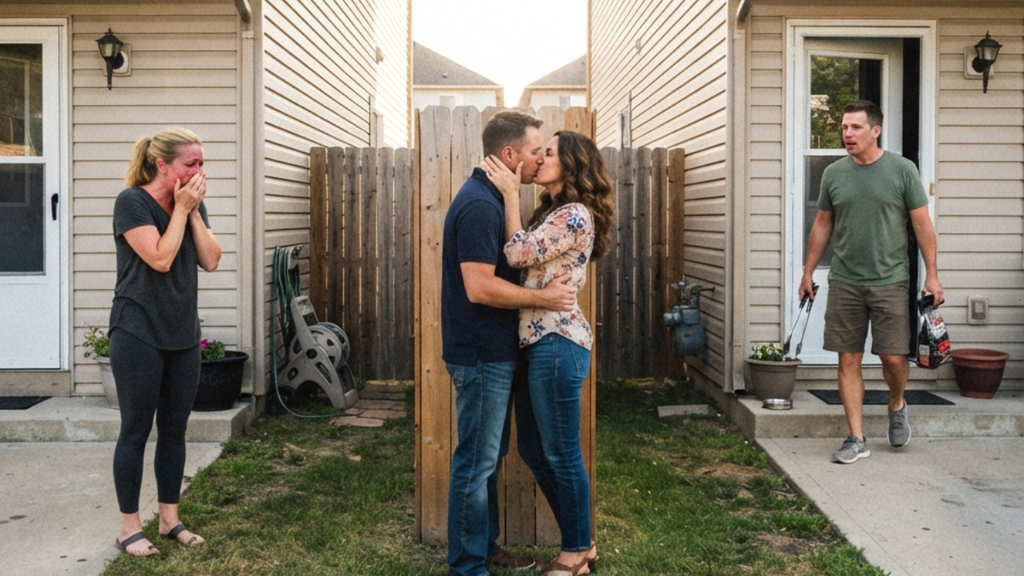
My husband has been sleeping with my brother’s wife for seventeen years

We have lived next door to my brother and his wife for fourteen of them.

Until last month, I thought buying neighboring houses was one of those ridiculous pieces of family luck that became more valuable as the years went on.

Our children grew up together.

We shared a backyard gate.

We had each other’s garage codes.

My brother and my husband built a firepit between the two properties.

There were summers when I honestly could not tell you which children belonged in which house because somebody was always running barefoot through that gate looking for a snack, a swimsuit, a parent, or a cousin.

We called our little setup the compound.

Our friends joked that we had somehow created the perfect extended family.

Now I know the houses were never a coincidence.

My name is Laura, I am fifty-one, and I have been married to my husband, Matt, for twenty-six years.

Matt is fifty-three.

We have two children, Hannah, twenty-three, and Luke, twenty.

My older brother, Brian, is fifty-four.

He has been married to his wife, Nicole, for twenty-two years.

They have two children, Sophie, twenty-one, and Jack, eighteen.

Nicole and I were close.

I want to make that clear because I think it is easy to imagine the stereotypical sister-in-law relationship where two women tolerate each other because they married into the same family.

That was not us.

Nicole was in my wedding.

I was in hers.

She was at the hospital when Hannah was born.

I was one of the first people she called when she found out she was pregnant with Sophie.

We took girls’ trips together.

We went shopping together.

We complained about our husbands together.

There are photographs of Nicole holding my children when they were babies.

There are photographs of me holding hers.

When my mother died nine years ago, Nicole helped me clean out her house.

When Nicole’s father died, I stayed with her children for three days so she and Brian could travel to handle everything.

I loved her.

I considered her a sister.

That is part of why I am still struggling to describe what happened without sounding completely detached from reality.

Because every time I tell someone one piece, I hear how unbelievable the next piece sounds.

It started with a garage door.

Our garage door opener stopped working.

Matt was away on a work trip, so I called the company that had installed it several years earlier.

A technician came out.

He replaced the motor.

Then he asked whether I wanted him to clear the old remotes from the system before programming the new ones.

I said yes.

He told me there were six remotes registered.

I said that seemed like too many.

We had one in my car, one in Matt’s truck, one mounted inside the garage, and a spare in a kitchen drawer.

Four.

The technician said there were six.

I assumed the previous homeowners had left something connected.

He said that was unlikely because the system had been installed after we bought the house.

I did not think much of it.

Then he asked whether we had given remotes to family members.

I said my brother and sister-in-law lived next door, so maybe Matt had given them one.

That would not have surprised me.

We had keys to their house.

They had keys to ours.

Our families had operated that way for years.

The technician cleared everything and programmed the remotes I had.

That evening, Nicole texted me.

Did something happen to your garage?

I said we had replaced the opener.

She asked whether that was why her remote stopped working.

I stared at the message.

I asked why she had a remote.

She replied:

For emergencies? Matt gave it to me forever ago lol.

Again, that was not inherently strange.

Except I had never known she had one.

I asked when Matt gave it to her.

She said she did not remember.

Maybe when the kids were younger.

Then she added:

Probably when you guys went to Florida that year and we watched the house.

That explanation made sense.

I dropped it.

Two days later, Matt came home.

I mentioned that the garage company found six remotes.

He barely reacted.

I told him Nicole apparently had one.

He said yes.

I asked why.

He gave me essentially the same explanation Nicole had.

Emergencies.

Watching the house.

Kids.

Whatever.

Then I asked who had the sixth remote.

Matt said he had no idea.

I probably would have forgotten the entire thing if he had not immediately changed the subject.

It was subtle.

After twenty-six years, I knew him.

Matt did this thing when he was uncomfortable where he became excessively interested in something else.

He started asking me about a package on the counter.

Who was it from?

What did I order?

Was it for Hannah?

I remember thinking his reaction was odd.

Not suspicious.

Just odd.

The following week, I was helping Nicole prepare for Jack’s graduation party.

We were in her kitchen making a list.

She asked whether Matt would be home that weekend.

I said yes.

Then she said:

“Good.”

Something about the way she said it bothered me.

I asked why.

She immediately said because Matt was good at setting up the tents.

Again, perfectly reasonable.

Except suddenly I was noticing things I had never noticed before.

Nicole knew Matt’s schedule extremely well.

She knew when he traveled.

She knew when he golfed.

She knew when he worked from home.

I had always assumed that was because we lived next door and our families were intertwined.

Then I started thinking about the garage remote.

A few days later, I was looking for a screwdriver in Matt’s workbench.

There was a drawer that stuck.

I pulled harder than usual.

The entire drawer came out.

Behind it was an envelope.

I assumed it was some old receipt.

Instead, I found a small stack of photographs.

They were printed photographs.

That alone was strange because Matt had not printed photographs in years.

The first was Nicole.

She was sitting on a hotel balcony.

The second was Nicole standing near a lake.

The third was Nicole asleep in a bed.

I sat down on the garage floor.

There were approximately twenty photographs.

Some were clearly old.

In one, Nicole looked like she was in her thirties.

In another, she was wearing a swimsuit I remembered from a family vacation approximately ten years earlier.

There were photographs of her in restaurants.

In hotel rooms.

In Matt’s truck.

One photograph had been taken in our backyard.

Nicole was looking directly at the camera.

Behind her, I could see the fence separating our houses.

I knew immediately.

There was no possible innocent explanation.

I called Matt.

He did not answer.

I called Nicole.

She did.

I asked her to come over.

She asked why.

I said I needed help with something.

She came through the backyard gate approximately three minutes later.

That gate.

I cannot explain how much I hate that gate now.

Nicole walked into the kitchen smiling.

She asked what was wrong.

I put the photographs on the counter.

Her face changed.

She did not ask what they were.

She did not pretend.

She looked at them.

Then she looked at me.

I asked:

“How long?”

She started crying.

I asked again.

She said:

“Laura, please let me explain.”

I told her she could explain after she answered the question.

She sat down.

Then she said:

“Seventeen years.”

I genuinely thought I misheard her.

I asked her to repeat it.

She said seventeen.

My daughter was six.

Her daughter was four.

Luke was three.

Jack was not even born.

Seventeen years.

I asked whether it had been continuous.

She said no.

There had been periods when they stopped.

I asked how long the longest period was.

She said approximately a year.

I asked when the last time was.

She did not answer.

I asked again.

She said:

“Last week.”

I stood up.

I do not remember deciding to stand.

I asked where.

She looked toward the backyard.

I knew before she answered.

“My house.”

Her house.

Next door.

My husband had been sleeping with my brother’s wife approximately sixty feet from my kitchen.

I asked whether Brian was home.

She said no.

I asked whether I was home.

She said yes.

That was the first time I screamed.

I asked whether she was telling me that my husband walked out of our house, crossed the backyard, went through the gate, entered my brother’s house, slept with his wife, and then came home to me.

Nicole was sobbing.

She said it was not normally like that.

I asked what “normally” looked like in a seventeen-year affair.

She said they met other places.

Hotels.

Work trips.

Sometimes our family cabin.

That one almost knocked me over.

The cabin belonged to my parents.

After my mother died, Brian and I inherited it together.

Our children learned to swim there.

We celebrated birthdays there.

Matt proposed to me near that lake.

I asked how many times.

Nicole said she did not know.

I told her to get out.

She asked me not to tell Brian until she had a chance to talk to him.

I laughed.

I actually laughed.

I asked how many chances she thought seventeen years contained.

Then I asked how it started.

She said she and Matt had always been close.

I told her everyone was close.

That was our family.

She said it became different after Luke was born.

I had a difficult postpartum period.

Matt and I were exhausted.

Brian was traveling constantly for work.

Nicole and Matt started talking more.

Then one night after a family barbecue, everyone else went to bed and they stayed outside drinking.

They kissed.

A few weeks later, they slept together.

I asked where.

She said a hotel.

I asked who paid.

Matt.

I asked how long before they did it again.

Two weeks.

I asked whether either of them ever intended to leave their spouses.

She said no.

I asked why they continued for seventeen years.

She said they loved each other.

I asked whether she loved Brian.

She said yes.

I asked whether Matt loved me.

She said yes.

I told her I did not need her explaining my husband’s emotions to me.

Then I asked about the photographs.

She said Matt liked keeping them.

I asked whether Brian had ever suspected.

She said no.

I asked whether anyone else knew.

She said no.

Then I asked about the garage remote.

Nicole stopped crying.

It was subtle.

Her entire body stiffened.

I asked why she had a remote to my garage.

She repeated the emergency explanation.

I told her not to lie to me anymore.

She said Matt gave it to her years ago because sometimes it was easier for her to enter our house through the garage.

I asked why she needed to enter our house when I was not there.

She said sometimes they met there.

I felt sick.

I asked whether they had slept together in my house.

She said yes.

I asked whether they had slept together in my bed.

She said no.

Guest room.

Basement.

Once in Matt’s office.

I told her to leave.

She stood up.

Then I asked one more question.

“Did you move next door because of him?”

Nicole froze.

It was not a question I had planned to ask.

I do not know where it came from.

Maybe because I was looking through the kitchen window at her house.

Maybe because suddenly the sheer convenience of our living arrangement looked completely different.

Fourteen years earlier, Brian and Nicole bought the house next door.

We had already lived in ours for six months.

That was the story I had always believed.

Matt and I had been looking for a larger house because Luke and Hannah were sharing a bedroom.

We found this neighborhood.

We bought our house.

Six months later, the older couple next door decided to sell.

They had not listed yet.

Matt heard about it.

He immediately told Brian.

Brian and Nicole had been casually house hunting.

They came over.

They loved the house.

They made an offer before it ever officially hit the market.

Everyone called it incredible luck.

Our parents were thrilled.

Our kids were ecstatic.

Brian and I had grown up close, and now we would raise our families side by side.

It became one of the defining stories of our adult lives.

Nicole stared at me.

I asked again.

“Did you buy that house because of Matt?”

She said:

“It wasn’t only because of Matt.”

That was an answer.

I sat back down.

I asked what she meant.

She said they genuinely liked the neighborhood.

The school district was excellent.

The house was within their budget.

Brian wanted to live near me.

All of those things were true.

I said:

“But?”

Nicole started crying again.

Then she told me Matt knew the house next door was going to become available before we bought ours.

I stared at her.

I said that was impossible.

The neighbors did not decide to sell until months later.

Nicole shook her head.

She said:

“They were already thinking about it.”

I asked how Matt knew.

Apparently, the owner of our house and the owner of the house next door had been friends.

When Matt and I first toured our house, Matt spoke with the neighbor.

The neighbor mentioned that he and his wife were considering downsizing within the next year.

Matt told Nicole.

Not Brian.

Nicole.

This was before we made our offer.

I asked whether Matt chose our house because he thought she could eventually live next door.

Nicole said:

“I don’t know.”

I told her she absolutely did know.

She looked down.

Then she admitted they had discussed it.

The affair had been going on for approximately three years at that point.

Matt told Nicole there was a chance the neighboring house would become available.

Nicole said it would be crazy if both families ended up next to each other.

Matt said it would make everything easier.

I asked what everything meant.

She did not answer.

I already knew.

Seeing each other.

They would no longer need hotels as often.

They would have endless legitimate reasons to be together.

Nobody would question why Matt was at Brian’s house.

Nobody would question why Nicole was at mine.

Their children would play together.

Our families would share meals.

There would always be a reason for someone to cross the property line.

I asked whether Nicole encouraged Matt to buy our house.

She said yes.

I asked whether Matt had wanted a different house before that.

She said yes.

I remembered.

There had been another house.

I loved it.

It had a bigger kitchen, a finished basement, and a wooded lot.

Matt originally preferred it too.

Then suddenly he changed his mind.

He said our current house was the smarter investment.

He said the neighborhood was better for the kids.

He said the other property needed too much work.

I trusted him.

I asked Nicole whether she and Matt discussed my house before I agreed to buy it.

She whispered yes.

I asked whether they discussed the house next door.

Yes.

Then I asked whether Brian knew the neighbors might sell before Matt told him.

No.

Matt and Nicole waited.

Six months after we moved in, the neighbors told Matt they were preparing to list.

Matt immediately called Brian.

Except now I knew that call was not spontaneous.

Nicole had been waiting.

She had already discussed the house with Matt.

She had already seen photographs.

She knew the approximate price.

She knew the layout.

She knew she wanted it.

Then she and Matt presented the entire thing to Brian and me as an incredible coincidence.

I asked whether Brian had initially wanted the house.

Nicole hesitated.

I asked again.

She said he liked it, but he had concerns.

His commute would be longer.

The mortgage was slightly higher than he wanted.

He thought living directly next door to family might be too much.

I remembered that.

Brian had joked that he loved me but did not necessarily want to see me every time he took out the trash.

Nicole was the one who convinced him.

She talked about the children growing up together.

She talked about shared childcare.

She talked about holidays.

She talked about how rare it was to get an opportunity like this.

I had agreed with her.

I helped convince my own brother.

I told him he would regret letting the house go to strangers.

I told him our kids would have the childhood we wished we had with our cousins.

I told him Mom and Dad would love having both families in one place.

Nicole sat across from me while I realized that I had unknowingly helped my husband’s mistress convince her husband to move next door.

I asked whether the affair continued immediately after they moved in.

She said they tried to stop.

I laughed again.

Of course they did.

Every person who has maintained a seventeen-year affair apparently has dozens of stories about all the times they almost became decent.

I asked how long they stopped.

Six weeks.

Then they started again.

I asked where.

She said mostly during the day.

Matt worked from home several days a week.

Nicole was a freelance designer at the time.

Brian worked in an office.

I was teaching.

They had hours.

Years of hours.

While I was standing in front of a classroom.

While Brian was commuting.

While our children were at school.

Sometimes Matt went next door.

Sometimes Nicole came to our house.

Sometimes they met in the backyard shed.

I asked her to repeat that.

The shed.

Matt and Brian built it together.

It was technically on our property but close to the fence.

They stored tools, lawn equipment, pool supplies, and bicycles there.

Apparently, years ago, Matt put a small lock on the interior side of the door.

I had never noticed.

I asked whether my brother had ever been in the yard while they were together in there.

Nicole said she did not think so.

I asked whether I had.

She started crying.

I knew.

I told her to leave.

This time she did.

I locked the back door after her.

Then I walked outside.

I stood in the middle of my backyard.

I looked at the gate.

The shed.

The firepit.

The patio.

The two houses.

I saw seventeen years of my life arranged around me.

Every physical detail suddenly looked like evidence.

The gate Matt installed because the kids kept climbing the fence.

The patio Brian and Matt extended so both families could fit around one table.

The firepit.

The shed.

The spare keys.

The garage remotes.

The security codes.

Our children had grown up believing there was almost no boundary between the two homes.

Neither had I.

That had been the beauty of it.

Now I understood that the absence of boundaries had benefited two people more than anyone else.

I called Brian.

He answered from work.

I asked him to come over.

He asked what was wrong.

I told him I needed him to come home.

He said he had a meeting.

I said:

“Brian, Nicole has been sleeping with Matt for seventeen years.”

There was silence.

Then he laughed.

Not because he thought it was funny.

It was the confused little laugh people make when their brain rejects a sentence.

He said:

“What?”

I repeated it.

He said:

“No.”

I told him I found photographs.

He said:

“Of what?”

I said Nicole.

Hotels.

Beds.

Matt’s truck.

Our backyard.

Brian stopped talking.

Then he asked where Nicole was.

I said next door.

He told me not to go anywhere.

Twenty-five minutes later, his car pulled into his driveway.

I watched from my kitchen window.

He did not come to my house.

He went home.

I could not hear the beginning.

Then I heard yelling.

Our houses are close.

The windows were open.

I heard Brian scream Matt’s name.

I heard Nicole crying.

I heard something slam.

Then my phone rang.

Brian.

I answered.

He asked:

“Did you know they planned this?”

I asked what he meant.

He said:

“The houses.”

I told him Nicole had just admitted it.

There was another silence.

Then my brother said something I will never forget.

“She picked this house before I ever saw it.”

I asked what he meant.

Brian told me that when Matt called about the house next door becoming available, Nicole already knew details she should not have known.

At the time, Brian assumed I had told her.

She knew the asking price.

She knew the sellers wanted a quick closing.

She knew the upstairs bathroom had recently been renovated.

She knew there was an easement along the back property line.

Brian had asked how she knew so much.

Nicole said I told her.

I had not.

Then Brian said:

“Laura, there’s more.”

I asked what.

He said he had just asked Nicole whether she and Matt had discussed the houses before either family bought.

She admitted they had.

Not just our house.

Both houses.

Then Brian told me something Nicole had not.

Before Matt and I bought our house, Matt had apparently gone inside the house next door.

I said that made no sense.

The neighbors were not selling yet.

Brian said Matt had been invited over.

During our inspection, Matt struck up a conversation with the older man next door.

A few days later, he went back without me.

He told me at the time that he was meeting the contractor at our house.

Instead, he spent almost an hour with the neighbor.

He toured their house.

He asked what they thought they might sell it for.

He asked how soon they planned to move.

Then he told Nicole everything.

Before I had signed the final paperwork on my own home, my husband was already investigating whether his mistress could eventually live beside us.

I asked Brian how he knew.

He said Nicole admitted it.

Then he said:

“She says they had a plan.”

I felt my stomach drop.

I asked what plan.

Brian said Nicole would not explain it.

She kept saying it was not what he thought.

I asked what he thought.

He said:

“I don’t know, Laura. I don’t know what to think anymore.”

Then I heard Nicole in the background telling him to give her the phone.

Brian told her no.

She said she needed to explain something to me.

I told Brian to put her on speaker.

He did.

Nicole said my name.

I asked:

“What was the plan?”

She said there had never been some elaborate scheme.

I told her to stop minimizing everything.

She said when Matt learned the neighboring house might eventually become available, they talked about how incredible it would be if both families lived side by side.

I asked why.

She said because they hated lying about where they were.

They hated hotels.

They hated constantly inventing work excuses.

If the families were neighbors, they could see each other every day without suspicion.

I asked:

“So you decided to move your spouses and children next door to each other so you could have an easier affair?”

Nicole said:

“When you say it like that—”

I screamed:

“How else would anyone say it?”

She started crying again.

Then Brian asked something I had not.

“Was that why you wanted another baby?”

Nicole stopped.

I felt every hair on my arms stand up.

I asked what he meant.

Brian said Jack was conceived around the time they began seriously discussing the move.

He and Nicole had previously decided they were done having children.

Then Nicole suddenly changed her mind.

She told Brian she wanted Sophie to have a sibling closer in age to my kids.

At the time, Brian thought it was sweet.

Now he wanted to know whether that had anything to do with Matt.

Nicole said no.

Brian asked again.

She said no more firmly.

Then he asked:

“Is Jack mine?”

I stopped breathing.

Nicole immediately said yes.

Brian asked whether she was certain.

She said yes.

Then he said:

“Because if you’ve been sleeping with him for seventeen years and Jack is eighteen, your timeline is already starting to look pretty convenient.”

Nicole said the affair began after Jack was conceived.

Brian said she had just told him seventeen years.

Jack had turned eighteen four months earlier.

That left very little room.

Nicole started insisting she knew exactly when the affair became physical.

Brian asked whether she and Matt had done anything before that.

She said they had kissed.

He asked when.

She would not answer.

Then Brian said:

“I’m getting a DNA test.”

Nicole screamed that he did not need one.

Brian said that was no longer her decision.

I was still standing in my kitchen listening to my brother question whether the child he had raised for eighteen years was biologically his when my front door opened.

Matt walked in.

He saw my face.

Then he saw the photographs spread across the counter.

He stopped.

I told Brian I had to go.

Then I hung up.

Matt said:

“Laura.”

I asked him whether Jack was his.

His face went completely white.

That was not the reaction I wanted.

I asked again.

He said no.

I asked whether he was sure.

He said yes.

I asked whether he and Nicole were sleeping together before Jack was conceived.

He said no.

I asked whether they were doing anything.

He hesitated.

Then he admitted they had kissed twice.

I asked whether he knew Nicole and Brian were trying for another baby.

He said yes.

I asked whether that was why he waited.

He said:

“Waited for what?”

I told him not to play stupid.

He said he and Nicole did not have sex until several months after she became pregnant.

I asked whether they continued while she was pregnant.

He said yes.

I sat down.

I asked how long.

He said he did not know.

I said seventeen years seemed like something a person should be able to estimate.

Then I asked him about the houses.

He looked toward the window.

That tiny movement told me everything.

I asked whether he chose our house because he knew the neighbors were considering selling.

He said our house was a good house.

I told him that was not what I asked.

He said the possibility of Brian and Nicole moving next door was one factor.

One factor.

I asked whether he had taken me through dozens of houses while secretly evaluating which ones could eventually put his mistress nearby.

He said no.

I asked why this house.

He said he liked it.

I asked why he suddenly stopped liking the house I wanted.

He said there were problems with it.

I asked whether Nicole disliked it.

He did not answer.

I asked again.

He admitted she did.

Nicole had seen the listing.

She told Matt that if we bought the other house, we would be almost forty minutes from her and Brian.

She preferred this neighborhood.

Then Matt learned the neighbors were considering moving.

That changed everything.

I asked:

“So my sister-in-law had veto power over where I raised my children?”

He said it was not like that.

I told him apparently every horrible thing he had ever done came with that sentence.

Then I asked whether he and Nicole planned for Brian to buy next door before I agreed to purchase our house.

He said they discussed the possibility.

I asked whether that was why he pushed so hard.

He said it was not the only reason.

I asked what other reasons mattered.

Schools.

Property values.

Commute.

The yard.

All reasonable things.

All things that allowed him to pretend the hidden reason did not count.

Then I asked about the gate.

Matt looked confused.

I asked whose idea it was.

He said his.

I remembered him suggesting it almost immediately after Brian and Nicole moved in.

The kids were constantly running around the block to use the front doors.

Matt said it was ridiculous.

He cut an opening in the fence and installed a gate.

I thought it was for the children.

I asked whether it was.

He said yes.

Then I asked whether it was also for Nicole.

He said:

“Sometimes.”

I asked about the shed.

He closed his eyes.

That was enough.

I asked about the garage remote.

He admitted he gave it to Nicole.

I asked whether there were really two extra remotes because she had both.

He said yes.

One stayed in her car.

One stayed in a drawer at her house.

I asked why she needed two ways to enter my home secretly.

He said because sometimes one of the kids borrowed her car.

The casualness of that explanation almost made me throw something.

They had procedures.

That was what I was beginning to understand.

This was not two people occasionally losing control.

They had systems.

Backup remotes.

Schedules.

Codes.

Cover stories.

A shared physical environment designed so nobody would notice them moving between houses.

I asked whether Brian had ever almost caught them.

Matt said yes.

I asked when.

There were several times.

Once Brian came home early while Matt was at their house.

Matt went through the back door and crossed into our yard.

Another time I came home while Nicole was in our basement.

She heard my car and left through the garage.

Once, years ago, Hannah nearly caught them in the shed.

Matt claimed he was helping Nicole find camping equipment.

I remembered that.

Hannah had been maybe eleven.

She came inside and said Dad and Aunt Nicole were being weird in the shed.

I laughed.

I told her they were probably arguing about where Brian stored something.

That memory made me cry harder than almost anything else.

My child had noticed.

I taught her not to trust what she saw.

Not intentionally.

But I did.

Because I trusted Matt.

Then I asked the question that had been sitting underneath everything.

“Why?”

Matt said he did not know.

I told him seventeen years required a better answer.

He said he loved Nicole.

I asked whether he loved me.

He said yes.

I asked why he did not leave me.

He said he never wanted to.

I asked why Nicole did not leave Brian.

He said she never wanted to either.

Then what exactly had they wanted?

His answer was so simple that I think it was worse than anything elaborate could have been.

“Both.”

They wanted both.

Their marriages.

Their children.

Their homes.

Their family traditions.

Their spouses.

And each other.

They did not want to choose.

So instead, they arranged their lives in a way that made choosing unnecessary.

Two marriages.

Two houses.

One backyard.

I asked whether moving next door was supposed to make the affair permanent.

Matt said no.

Then he said:

“I think we thought it would make things easier.”

I asked whether it did.

He looked at me.

Then he said yes.

I told him to get out.

He asked where he should go.

I told him anywhere that was not next door.

Then my phone buzzed.

It was Brian.

He had sent me a photograph.

At first, I did not understand what I was looking at.

It was an old real estate listing.

Our house.

The listing date was seventeen years earlier.

Three years before Matt and I supposedly stumbled across the house during our search.

Underneath the screenshot, Brian wrote:

Nicole had this saved on an old hard drive.

Then another photograph arrived.

It was the house next door.

The listing was from the same period.

Three years before either family moved into the neighborhood.

That house had apparently been listed once before.

It had not sold.

Then the owners took it off the market.

I looked at Matt.

I asked whether he had known about this neighborhood before we started house hunting.

He said nothing.

I showed him the photographs.

His face changed.

I asked again.

Finally, he sat down.

Then he told me the part Nicole had not.

The neighboring houses were not an opportunity they discovered three years into the affair.

They were an idea they had been talking about almost from the beginning.

Years before either family moved here, Matt and Nicole had found these two houses for sale at the same time.

They joked about buying them.

They could not afford to move then.

The timing was wrong.

Neither spouse was looking.

One of the houses sold.

The other was taken off the market.

So they let it go.

But they kept watching the neighborhood.

For three years.

Every few months, one of them checked listings.

When our current house eventually came back onto the market, Matt saw it within a day.

That was why he had suddenly become interested in moving.

That was why he pushed me to start seriously looking at houses that spring.

That was why he insisted we tour this one immediately.

He already knew the neighborhood.

He already knew the house next door had previously been for sale.

He already knew the owners were older.

He and Nicole had been waiting for an opportunity.

I stared at my husband.

Then I asked:

“Did you buy me a house so you could live next to your mistress?”

Matt started crying.

He said:

“I bought our family a home.”

I told him to answer the question.

He said nothing.

I asked again.

Finally, he whispered:

“Yes.”

And somehow, after everything I had already learned, that was the moment I realized I had not simply discovered an affair.

I had discovered that the place where I raised my children, celebrated birthdays, buried pets, planted gardens, hosted Christmases, and built fourteen years of memories had been selected partly because my husband wanted his mistress close enough to walk home from.

And I still had not learned the worst thing they had done to keep us there.

I asked Matt what that meant.

He looked confused.

I showed him the last message Brian had sent me.

Nicole says there’s more about the houses. Call me when he’s gone.

Matt asked what Nicole had told him.

I said I did not know yet.

Then I asked what they had done to keep us there.

He said he did not know what I was talking about.

I told him to leave.

He wanted to pack clothes.

I told him he had ten minutes.

He went upstairs.

I called Brian.

He answered immediately.

I asked what Nicole had told him.

He said she had admitted something about my job.

I had been teaching at the same elementary school for almost twenty years.

The school was twelve minutes from our house.

Before we moved, my commute had been approximately thirty-five minutes.

One of the reasons Matt used to convince me to buy our house was the shorter commute.

At the time, I was working in a different district.

Then, approximately a year after we moved, a position opened at my current school.

Matt found it.

He sent me the listing.

I almost did not apply.

I liked my school.

I had friends there.

I had tenure.

I did not want to start over.

Matt kept encouraging me.

He said the new district paid better.

The commute was dramatically shorter.

Our children attended school nearby.

He said I would have more time with the family.

I applied.

I got the job.

I had always considered that one of the best decisions I made.

Brian told me Nicole claimed Matt pushed me toward the job because he wanted to make sure I would not suggest moving again.

I asked why I would have suggested moving.

Then I remembered.

Approximately a year after we bought the house, before Brian and Nicole moved next door, I told Matt I was not sure I liked the neighborhood.

The house was fine.

The commute was exhausting.

We had underestimated how much time I would spend driving.

I casually suggested that maybe in a few years we could move closer to my school.

Matt reacted as though I had proposed setting the house on fire.

He said we had barely unpacked.

He said moving again would be financially irresponsible.

He said the kids needed stability.

I dropped it.

Then he found the job listing.

Once I changed schools, the commute problem disappeared.

Six months later, Brian and Nicole bought next door.

I asked Brian whether Nicole had somehow influenced the job.

He said she claimed she had not.

Matt simply saw the listing and realized that if I took the job, one of my biggest objections to staying in the house would disappear.

I almost felt relieved.

At least they had not secretly bribed a principal or done something equally insane.

Then Brian said:

“That isn’t the worst part.”

I asked what was.

He said:

“The addition.”

I knew exactly what he meant.

Seven years after we moved in, Matt and I nearly moved.

Our children were older.

The house suddenly felt cramped.

Hannah wanted more privacy.

Luke had friends over constantly.

I wanted a bigger kitchen.

We started looking.

This time, I was serious.

We found a house about twenty-five minutes away that I loved.

Four bedrooms.

Finished basement.

Large kitchen.

More land.

We made an offer.

The inspection found several problems.

Nothing catastrophic.

Roof nearing replacement.

Some moisture in the basement.

Old electrical panel.

Matt immediately wanted out.

I thought he was overreacting.

Our realtor told us every house had issues.

Matt insisted we terminate.

We did.

Then he suggested renovating our current house instead.

We added a family room, expanded the kitchen, and built a bedroom over the garage.

It cost more than I wanted to spend.

Matt argued that it made more sense than moving.

Brian and Nicole renovated their house the following year.

For years, we joked that we had both accidentally created our forever homes.

I asked Brian what Nicole said.

He told me she and Matt had panicked when I wanted to move.

They knew I was serious.

Nicole was terrified we would leave.

Matt promised her we would not.

Then he became intensely critical of every house I liked.

Too far.

Bad schools.

Small yard.

Busy road.

Overpriced.

Too much work.

I remembered.

At the time, I thought he was being practical.

Eventually, the house with the inspection issues was the only one he could not talk me out of.

So we made the offer.

Brian said Nicole admitted Matt had exaggerated the inspection problems to me.

I felt something inside me go cold.

I asked whether the problems were real.

Yes.

The report was legitimate.

But Matt had repeatedly told me the inspector believed the basement moisture indicated foundation problems.

The inspector had never said that.

Matt told me replacing the electrical panel could cost tens of thousands of dollars.

It would have cost a fraction of that.

He told me the roof might fail within a year.

The inspector estimated it had another five to seven years.

I had trusted Matt’s interpretation because he understood home repairs better than I did.

He had used that trust to scare me out of moving.

Then he proposed the addition.

I asked Brian whether Nicole had helped plan it.

He said yes.

Not the architectural details.

The idea.

She told Matt if he made our house bigger, I would stop looking.

Then Nicole convinced Brian they should renovate too.

They both spent money improving houses neither spouse realized had been chosen partly to facilitate an affair.

I looked around my kitchen.

I had designed that kitchen.

I picked the cabinets.

I obsessed over countertops.

I remember standing in the unfinished room with Nicole holding tile samples.

She helped me choose the backsplash.

The entire time, she knew one reason Matt was willing to spend that much money was because he was desperate to keep living beside her.

I told Brian I needed to hang up.

Matt came downstairs carrying a duffel bag.

I asked whether he had lied to me about the inspection.

He stopped.

I said:

“The house on Meadow Ridge.”

He knew.

He sat his bag down.

I asked whether the inspector ever said there were foundation problems.

Matt said there had been moisture.

I told him that was not what I asked.

No.

I asked whether the electrical panel would have cost tens of thousands of dollars.

No.

I asked whether he exaggerated every issue because Nicole did not want us moving.

He said:

“I didn’t want us moving either.”

I asked why.

He started listing reasons.

The children.

Our friends.

The neighborhood.

The money.

I interrupted him.

I asked how much of it was Nicole.

He said he could not assign a percentage.

I told him that was convenient.

Then I asked whether the addition had been his way of trapping me in the house.

He said trapping was unfair.

I told him manipulating sounded fine too.

He said he genuinely believed renovating was the smarter financial decision.

I asked whether he discussed it with Nicole before discussing it with me.

He looked away.

Yes.

That was becoming the answer to everything.

Every decision I thought we made as husband and wife apparently had an invisible third person in the room.

The house.

My job.

The addition.

The gate.

The garage.

Even the landscaping.

I suddenly remembered something so stupid that I almost laughed.

Several years earlier, I wanted to replace the fence with a taller privacy fence.

Our old fence was deteriorating.

I wanted something solid.

Matt hated the idea.

He said it would make the yard feel small.

Nicole agreed.

She said she loved being able to see the kids between the yards.

Brian did not care.

We repaired the existing fence instead.

I asked Matt whether he opposed the privacy fence because of Nicole.

He said:

“Partly.”

Of course.

I asked him to leave.

He picked up his bag.

Then he stopped at the door.

He asked whether I was going to tell the kids.

I said yes.

He asked me to wait until we knew what was happening.

I asked what he meant by that.

He said:

“With us.”

I laughed.

I told him there was no us.

He started crying.

He said twenty-six years could not disappear in one afternoon.

I told him they had not disappeared.

They had changed.

There was a difference.

I still had twenty-six years of memories.

I just no longer knew which ones meant what I thought they meant.

Then he said something that made me furious.

He said:

“Most of our marriage was good.”

I told him that was not his argument to make.

He had information I did not have.

He got to experience our marriage knowing the full truth.

I experienced it under false circumstances.

He could not now tell me how I was supposed to evaluate it.

He left.

I watched him walk to his truck.

For one insane second, I expected him to turn toward Nicole’s house.

Instead, he drove away.

I locked the door.

Then I went next door.

I did not knock.

For fourteen years, nobody knocked.

I opened the back door and walked into Brian’s kitchen.

He was sitting at the table.

Nicole was on the opposite side.

They looked exactly like Matt and me probably had an hour earlier.

Two people who had lived together for decades suddenly sitting like strangers.

Brian asked where Matt went.

I said I did not know.

Nicole asked whether she could talk to me.

I said no.

Then I sat beside my brother.

He had been crying.

I had not seen Brian cry since our mother died.

He asked whether Matt admitted the inspection lie.

I said yes.

Brian shook his head.

Then he said:

“They planned our lives around each other.”

Nicole said that was not fair.

Brian snapped.

He asked what part was unfair.

Nicole said she and Matt did not control everything.

They did not choose where we worked.

They did not choose when we had children.

They did not choose our friends.

They did not choose every family vacation.

Brian said:

“You chose where we lived.”

Nicole said they influenced it.

Brian laughed.

He said:

“You knew this house before I did.”

Then he asked her how many times she had slept with Matt inside it.

She refused to answer.

Brian asked again.

Nicole said she did not know.

He asked whether it was more than a hundred.

She started crying.

He asked whether it was more than five hundred.

She said:

“Brian, please.”

He said:

“Seventeen years, Nicole.”

Then he asked whether she had ever slept with Matt in their bedroom.

She said no.

He asked whether she had ever slept with him in our bedroom.

No.

He asked whether they used the guest room.

Yes.

Office.

Yes.

Laundry room.

Once.

Garage.

Yes.

I told them to stop.

I did not need a map.

Then Brian asked about family vacations.

Nicole admitted there had been times.

I asked which ones.

She said the lake house.

A beach rental.

One ski trip.

I remembered all three.

The ski trip was the one that hurt.

I had gotten food poisoning on the second night.

I stayed in bed.

Matt took the kids tubing.

At least that was what he told me.

Apparently, Brian took the kids tubing.

Matt stayed behind.

Nicole told Brian she had a migraine.

They spent approximately two hours together in her room while I was sick two doors away.

I told Nicole I hated her.

I had never said that to anyone.

She nodded.

She said she understood.

I told her she did not.

Then Brian asked about our mother.

That confused me.

He asked whether Nicole and Matt had been together while Mom was sick.

Nicole said yes.

Our mother had pancreatic cancer.

She died seven months after diagnosis.

During those months, our families essentially merged even more than usual.

Brian and I spent enormous amounts of time with Mom.

Nicole and Matt handled the kids.

They made meals.

They coordinated schedules.

They drove the children to school and activities.

I had been grateful.

I remembered telling people I did not know how I would have survived without my husband and sister-in-law.

Now Brian asked whether they had used that time to be together.

Nicole said:

“Not like you’re thinking.”

I almost screamed.

Brian asked whether they slept together while we were caring for our dying mother.

Nicole admitted they did.

Not frequently.

As if frequency mattered.

I stood up.

I walked outside.

Brian followed me.

We sat on the back steps between the two houses.

For a while, neither of us spoke.

Then he said:

“I feel stupid.”

I told him I did too.

He said he kept replaying everything.

Every time Matt came over to borrow a tool.

Every time Nicole brought something to our house.

Every barbecue where they disappeared at different times.

Every family trip.

Every time one of us watched the other’s children.

There were thousands of opportunities.

That was the genius of what they created.

Nobody questioned anything because there was nothing unusual about Matt being with Nicole.

She was his sister-in-law.

She lived next door.

Their children were cousins.

Our families functioned like one household.

They had built the perfect cover and convinced us it was a gift.

Then Brian said he was going to get a DNA test for Jack.

I asked whether he really thought Jack could be Matt’s.

He said he did not know.

Nicole insisted no.

Matt insisted no.

But both of them had lied about almost everything else.

Brian said he needed one fact that did not depend on their word.

I understood.

He ordered the test.

Jack was away at college, and Brian did not want to tell him why immediately.

That created another problem.

How do you ask your eighteen-year-old son for a DNA sample without explaining that his mother has been sleeping with his uncle for essentially his entire life?

Eventually, Brian told him.

Not everything.

Enough.

Jack drove home that weekend.

Sophie came too.

Hannah and Luke came to our house.

It was the worst family meeting of my life.

Matt wanted to attend.

I told him no.

Nicole wanted to explain herself to all four children together.

Brian said absolutely not.

So we told our children separately.

I told Hannah and Luke that their father had been having an affair with Aunt Nicole.

Hannah immediately asked how long.

When I said seventeen years, she started crying.

Luke stared at me.

Then he asked:

“Since I was three?”

I said yes.

He got up and walked outside.

Hannah asked whether Uncle Brian knew.

I said yes.

Then she asked whether Sophie and Jack knew.

I said they were being told.

She covered her face.

Then she said:

“Oh my God, Sophie.”

That was the part I had not emotionally prepared for.

Our children were not just cousins.

Hannah and Sophie were best friends.

They had grown up more like sisters.

Luke and Jack were extremely close.

Now they had to process that their parents had been betraying each other throughout essentially their entire childhood.

Then Hannah asked:

“Was that why Dad and Aunt Nicole were always together?”

I said I did not know.

She looked at me.

Then she said:

“I thought something was weird once.”

My stomach dropped.

She told me she remembered the shed.

She had been eleven.

She opened the door and found Matt and Nicole inside.

They were standing too close.

Nicole looked frightened.

Matt immediately started talking about camping equipment.

Hannah told herself she had imagined it.

Then later, she mentioned it to me.

I remembered.

I told her they were probably arguing.

Hannah started crying.

She said:

“You made me think I was being weird.”

I apologized.

She immediately said she was not blaming me.

She knew I did not know.

But hearing her say it still hurt.

Then she remembered another time.

She was maybe fifteen.

She came home from school early because soccer practice was canceled.

Nicole was leaving our house through the garage.

Nicole said she had borrowed a baking pan.

Hannah thought it was strange because Nicole was not carrying anything.

She never told me.

Luke had memories too.

Everyone did.

That was the horrifying part.

Once the truth existed, seventeen years of tiny moments reorganized themselves around it.

Two days later, Sophie came to see me.

She walked through the backyard gate out of habit.

Then she stopped halfway through.

She looked at it.

She started crying.

I went outside and hugged her.

She said:

“I don’t know if I’m supposed to come over anymore.”

That broke me.

I told her she never had to ask.

Whatever happened between the adults, she was my niece.

She was family.

She could walk into my house for the rest of my life.

Then she asked whether I hated her mother.

I said I was extremely angry.

She said that was not what she asked.

I told her yes.

Right now, I did.

She nodded.

Then she said:

“I do too.”

I told her she did not have to.

She said she knew.

She asked whether her mother and Matt loved each other.

I said they claimed they did.

She asked whether they were going to be together now.

I had not considered that.

I told her I did not know.

That question bothered me for days.

Because suddenly the obstacle was gone.

Brian was leaving Nicole.

I was leaving Matt.

They had spent seventeen years claiming they loved each other.

They had arranged homes around each other.

They had risked marriages.

They had betrayed siblings.

They had used our children’s childhood as camouflage.

So what happened now?

Would they finally be together?

I asked Matt.

He had been texting me constantly.

Mostly apologies.

Occasionally practical questions.

I finally agreed to meet him at a coffee shop.

I asked whether he and Nicole planned to be together.

He said no.

I asked why.

He said everything had changed.

I almost laughed.

I told him that was an extraordinary answer.

He said their relationship only existed within the lives they already had.

He never wanted a life without me.

Nicole never wanted a life without Brian.

I asked whether he understood how selfish that sounded.

He said yes.

Then he said:

“Nicole and I weren’t building a life together.”

I stared at him.

I said:

“You literally built your lives next door to each other.”

He closed his eyes.

I told him they had done more planning around their relationship than most married couples did.

They monitored real estate.

They influenced two home purchases.

They created physical access between the properties.

They coordinated schedules.

They protected the arrangement for seventeen years.

How was that not building a life?

Matt said:

“Because the life was all of us.”

That sentence made me understand something I had not before.

Matt and Nicole did not want to run away together.

They liked the compound.

They liked Brian grilling while Matt made drinks.

They liked me and Nicole sitting on the patio.

They liked all four kids around the firepit.

They liked Christmas morning.

They liked vacations.

They liked the cabin.

They liked the giant blended family we had created.

Their affair was not an escape from that life.

It was embedded inside it.

They wanted the family and the affair simultaneously.

The closeness that made our lives wonderful was the exact thing that made their betrayal sustainable.

I asked whether he understood that he had destroyed the thing he supposedly loved.

He cried.

He said yes.

Then I asked whether he regretted buying the house.

He said no.

That surprised me.

I asked why.

He said because our children had an incredible childhood there.

I told him he did not get to use our children’s happiness to justify his choices.

He said he was not trying to.

I said he was.

He had done it for seventeen years.

Every time the affair threatened something, he found a good family reason for the decision he wanted.

The house was good for the kids.

The gate was good for the kids.

Staying in the neighborhood was good for the kids.

The addition was good for the kids.

The shared vacations were good for the kids.

All of those things could be true.

That did not erase the hidden reason.

Matt asked whether there was any chance I would reconsider divorce.

I said no.

Then he asked whether he could eventually move back into the neighborhood.

I stared at him.

He said he did not mean our house.

He meant somewhere nearby.

He wanted to remain close to Luke and Hannah when they visited.

He wanted to be close to the family.

I asked whether he had completely lost his mind.

He apologized.

I left.

The DNA results came back approximately two weeks later.

Brian called me before he told Nicole.

Jack was his biological son.

I cried when he told me.

So did Brian.

Not because biology would have changed how he loved Jack.

He made that clear.

But because for the first time since this started, we had received an answer that did not create another catastrophe.

Jack was Brian’s.

Matt was not his father.

The timeline Nicole and Matt gave us about when the physical affair began was apparently true, at least enough that Jack’s paternity was not another secret.

That should have been reassuring.

Instead, it made me realize how low our expectations had become.

We were relieved that my husband had not fathered my brother’s child with my sister-in-law.

That was where the bar was.

Brian filed for divorce.

So did I.

Nicole moved out of the house next door.

For the first time in fourteen years, it went dark at night.

Brian stayed.

I stayed.

People asked whether one of us planned to move.

At first, I assumed I would.

I could not imagine staying.

Every room held a memory that felt contaminated.

Every window looked toward their house.

Every time I walked into the backyard, I saw the gate.

Then one afternoon, Brian came over with a toolbox.

He walked toward the gate.

I asked what he was doing.

He said:

“I’m taking it down.”

I almost told him not to.

The kids had used that gate their entire childhood.

Sophie still came through it.

Jack did too.

It felt like destroying something that belonged to them because of what their parents had done.

Then Brian said we could put another one in someday if we wanted.

But right now, he did not want to look at the thing Matt installed so he could move between our houses without anyone asking questions.

So we took it down.

Brian removed the hinges.

I helped him carry the wooden gate to the curb.

Then we repaired the opening in the fence.

It was strangely emotional.

Not because I wanted the gate.

Because for fourteen years, I believed it symbolized how close our family was.

Our kids did not need front doors.

We did not need invitations.

We belonged in each other’s homes.

Now there was a fence again.

But something unexpected happened afterward.

Sophie came over the next day.

She walked around the block and used my front door.

I hugged her.

Luke went to Brian’s house that evening.

He used the front door too.

Nobody stopped being family.

The kids still saw each other.

Brian still came over.

I still brought him dinner one night when he was working late.

He fixed my garbage disposal when it broke.

The closeness did not disappear just because the shortcut did.

That helped me understand something.

Matt and Nicole did not create our family.

They exploited it.

There is a difference.

Our children genuinely love each other.

Brian and I genuinely love each other.

The birthdays were real.

The Christmases were real.

The nights around the firepit were real.

The way our kids grew up was real.

The fact that two people were using those same moments as cover does not mean the moments belonged to them.

I am still deciding what to do with the house.

Some days I want to sell it.

Other days I refuse to let Matt’s betrayal chase me out of a home I spent fourteen years making mine.

Brian feels the same way.

Neither of us has made a decision.

The shed is gone.

Brian and Luke tore it down.

I did not watch.

The garage opener has been completely reset.

There are exactly four remotes now.

I changed every lock.

I changed the alarm code.

I replaced the fence.

The firepit is still there.

I considered removing it.

Then Hannah told me not to.

She said some of her favorite childhood memories happened around that fire.

She did not want to surrender them.

So I did not.

Matt and Nicole are not together.

As far as I know, they barely speak.

There is something almost pathetic about that.

They spent seventeen years protecting a relationship they claimed they could not live without.

They shaped where two families lived around it.

They lied.

They planned.

They waited.

They watched listings.

They created access.

They protected the arrangement every time one of us threatened to disrupt it.

Then the moment the marriages disappeared, so did whatever they thought they had.

Maybe secrecy was part of what held it together.

Maybe they really did love us more than they understood.

Maybe neither one ever wanted the other enough to accept the actual cost.

I do not care anymore.

The last conversation I had with Nicole was about a month after everything came out.

She came to my front door.

She did not use the backyard.

She asked if she could apologize.

I let her speak.

She told me she had loved me like a sister.

I said sisters do not do this.

She said she knew.

She said the house was the thing she regretted most.

I asked why that and not the affair.

She said because the affair was something she and Matt did.

The houses were something they made all four of us do.

For once, I thought she understood.

She told me that when they first found the two listings seventeen years ago, it felt like a fantasy.

Two families side by side.

Their children growing up together.

Everyone they loved in one place.

And she and Matt could be close without destroying anything.

I told her:

“You didn’t find a way to have everything without destroying it. You just found a way to delay the destruction.”

She cried.

I did not.

Then she left.

Sometimes I stand at my kitchen window and look at the house next door.

For fourteen years, I thought the luckiest thing that ever happened to our family was that the house beside ours became available at exactly the right time.

I thought our children had been given something rare.

I thought my brother and I had somehow managed to recreate the closeness of childhood while raising families of our own.

I thought we had stumbled into the perfect arrangement.

We had not.

My husband had been watching that neighborhood for years.

His mistress had been watching it with him.

They waited until one house became available.

Then they waited for the other.

They convinced their spouses.

They moved their children.

They built a gate.

And for fourteen years, they let the rest of us call it luck.

The houses were never the coincidence.

The family inside them was.

And that is the part they do not get to take from us.

I Found a Second Phone Sewn Into the Lining of My Husband’s Suitcase — It Only Had One Contact

I found my husband’s second phone because a bottle of shampoo exploded in his suitcase. If that had not happened, I do not think I ever would have known it existed.

My husband travels constantly for work.

He has used the same black Samsonite suitcase for at least eight years.

I have packed it for him.

I have unpacked it.

I have complained about one wheel that sticks.

I have threatened to replace it every Christmas.

I thought I knew every pocket.

I did not know there was a phone sewn into the lining.

My name is Claire, I am fifty-four, and I have been married to my husband, Michael, for twenty-nine years.

Michael is fifty-six.

We have two children.

Our daughter, Emma, is twenty-six.

Our son, Ben, is twenty-three.

Michael works in commercial construction management.

His job has always involved travel.

Usually two or three nights.

Sometimes a week.

Occasionally longer.

I never loved it, but it was part of our life.

When the kids were young, I resented it.

As they got older, I adjusted.

Michael became incredibly predictable about travel.

Same suitcase.

Same toiletry bag.

Same packing routine.

He always called when he reached his hotel.

He usually texted before bed.

He brought me terrible airport gifts.

There was nothing about his travel that had ever made me suspicious.

The suitcase came home from Chicago on a Friday.

Michael had another trip scheduled for Monday.

Saturday morning, he went golfing.

I decided to wash some of his clothes and repack the suitcase so neither of us had to deal with it Sunday night.

When I opened it, I smelled shampoo.

A travel bottle had opened.

It had leaked underneath the fabric panel at the bottom.

I removed the panel.

There was shampoo underneath.

I wiped it.

Then I noticed the lining along one side looked strange.

Part of the seam was thicker.

At first, I assumed the shampoo had soaked into it.

I pressed it.

Something hard was inside.

I thought maybe a piece of the suitcase frame had broken.

I pushed again.

It was rectangular.

About the size of a phone.

I stared at it.

Then I found the stitches.

They were black.

Not factory stitching.

Someone had opened the seam and sewn it closed by hand.

I got small scissors from my sewing basket.

I cut three stitches.

Then I reached inside.

There was a phone.

It was an older iPhone.

Small.

Black.

No case.

It was wrapped in a thin plastic bag.

There was also a charging cable.

Nothing else.

I sat on the bedroom floor holding it.

My first thought was affair.

Of course it was.

I think most married people would think the same thing.

Secret phone hidden inside a suitcase used for business travel.

There are not many innocent explanations.

The phone was dead.

I plugged it in.

Then I waited.

Those five minutes felt like an hour.

When the screen finally came on, it asked for a six-digit passcode.

I tried Michael’s birthday.

Wrong.

Our anniversary.

Wrong.

Emma’s birthday.

Wrong.

Ben’s.

Wrong.

I stopped because I was afraid the phone would lock.

Then I noticed something.

There was no wallpaper.

Just the default black screen.

No notifications.

No preview messages.

No indication the phone had been used recently.

I turned it over.

There was a tiny label on the back.

A phone number.

I copied it down.

Then I put the phone on my dresser.

I spent the next two hours imagining every possible explanation.

Mistress.

Gambling.

Drugs.

Work fraud.

Pornography.

Some kind of financial problem.

A second family.

Every possibility was horrible.

None explained why he had physically sewn the phone into his suitcase.

If it were simply an affair phone, why not keep it in his desk?

His car?

His office?

Why hide it somewhere that required scissors to access?

Michael came home around one.

I had put the suitcase back together.

I left the phone plugged in on my dresser.

He walked into the bedroom.

He saw it.

He stopped.

I was sitting on the bed.

I watched his face.

I expected guilt.

Instead, I saw terror.

Not embarrassment.

Not the look of a man realizing his wife found messages from another woman.

He looked genuinely afraid.

He asked:

“Where did you get that?”

I said:

“Your suitcase.”

He stared at the phone.

Then he looked at the suitcase.

He saw the cut stitches.

He said:

“You shouldn’t have done that.”

That made me angry.

I asked whether he was seriously criticizing me for opening my own husband’s suitcase.

He said no.

Then he walked over and picked up the phone.

I told him to put it down.

He said:

“Claire, please.”

I asked whose phone it was.

He said his.

I asked why it was sewn into his suitcase.

He did not answer.

I asked whether he was having an affair.

He said no immediately.

I asked whether there was another woman.

No.

Another family.

No.

Then I asked what was on the phone.

He said nothing I needed to worry about.

I laughed.

I told him he had lost the right to decide what I needed to worry about when he stitched a secret phone into his luggage.

Then I asked him to unlock it.

He refused.

I told him to unlock the phone or leave.

He sat down.

He held the phone in both hands.

Then he said:

“If I show you, you have to promise me you won’t contact the person.”

That was the first time I realized there was a person.

I asked who.

He said:

“Promise me.”

I told him absolutely not.

He said then he could not show me.

I asked whether he understood what this looked like.

He said yes.

I told him I would assume the worst.

He said:

“The worst thing you’re imagining is probably easier than what this is.”

I remember that sentence exactly.

I asked him again to unlock it.

Finally, he did.

There were almost no apps.

Phone.

Messages.

Contacts.

Photos.

Notes.

Calculator.

Weather.

The basic apps that come with an iPhone.

No email.

No social media.

No banking.

No browser history.

No photographs.

Then I opened Contacts.

There was one.

Anna.

No last name.

Just Anna.

I looked at Michael.

I asked who Anna was.

He said:

“Someone I knew a long time ago.”

I opened the messages.

There were hundreds.

Maybe thousands.

The thread went back years.

I did not read from the beginning.

I started with the most recent.

Anna:

Did you make it home?

Michael:

Yes.

Anna:

Good.

Michael:

You okay?

Anna:

I’m always okay.

Michael:

That’s not an answer.

Anna:

It’s the only one you’re getting.

That was from Friday.

The day Michael came home from Chicago.

I looked at him.

I asked whether Anna lived in Chicago.

He said no.

I asked whether he saw her during the trip.

Yes.

I asked whether he slept with her.

No.

I did not believe him.

Then I scrolled.

A message from three weeks earlier:

Michael:

I can be there Thursday.

Anna:

Don’t change your trip because of me.

Michael:

I’m not.

Anna:

You always say that.

Michael:

Because it’s true.

Anna:

You have a life. Go live it.

Michael:

You’re part of my life whether you like it or not.

I looked at him.

I asked what that meant.

He said:

“Claire, you need context.”

I said I would love some.

He did not give it.

So I kept reading.

There were no romantic messages.

No sexual messages.

No photographs.

No “I love you.”

No pet names.

Most of it was strangely practical.

Doctor Tuesday at 11.

Did the landlord fix the heater?

I sent the money.

Don’t send anything else.

Did you pick up the prescription?

Call me when you get home.

I can come next month.

You don’t need to come.

Please answer.

Then I found one that made my stomach drop.

Anna:

She deserves to know.

Michael:

No.

Anna:

You said that twenty years ago.

Michael:

And I’m saying it now.

Anna:

You’re going to die someday and leave her with this.

Michael:

Then she’ll never know.

Anna:

You don’t get to decide that forever.

I asked:

“Who is she?”

Michael said nothing.

I asked whether they were talking about me.

He nodded.

I scrolled further.

Two years earlier.

Anna:

Did Emma get the job?

Michael:

Yes. She starts next month.

Anna:

Tell her congratulations.

Michael:

I can’t exactly say it’s from you.

Anna:

I know.

I stopped.

I asked how Anna knew our daughter.

Michael said she did not.

Then another message.

Anna:

Is Ben still seeing that girl?

Michael:

No. Apparently she was “emotionally exhausting.”

Anna:

He’s twenty-one. Everyone is emotionally exhausting at twenty-one.

Michael:

You would like him.

Anna:

Don’t.

Michael:

What?

Anna:

Don’t tell me things like that.

I looked at Michael.

I asked:

“Why does this woman know about our children?”

He said:

“Because I’ve told her about them.”

I asked why.

He said because she asked.

I asked who she was.

He would not answer.

I kept scrolling.

Five years earlier.

Anna:

Your mother called again.

Michael:

Don’t answer.

Anna:

She’s eighty-two.

Michael:

That’s not relevant.

Anna:

She wants to see me.

Michael:

No.

Anna:

You can’t stop her.

Michael:

Watch me.

His mother.

My mother-in-law, Judith.

Judith died three years ago.

I had known her for thirty-one years.

I looked at Michael.

I asked how his mother knew Anna.

He looked down.

I asked again.

He said:

“She knew her before you did.”

I said:

“Before I did what?”

He said:

“Before you met me.”

I stared at him.

Then I asked whether Anna was an ex-girlfriend.

He said no.

I asked whether she was family.

He did not answer.

That was the first moment I felt truly frightened.

I searched the message thread for Judith’s name.

There were dozens of results.

One from six years ago:

Anna:

Judith sent a birthday card.

Michael:

I’m sorry.

Anna:

Why are you sorry?

Michael:

Because I asked her not to.

Anna:

I wanted it.

Michael:

That’s not the point.

Anna:

Maybe not to you.

Another:

Michael:

Mom says you called her.

Anna:

She called me first.

Michael:

We agreed.

Anna:

You agreed. I stopped arguing. That’s different.

Another from four years ago:

Anna:

She said Claire seems kind.

Michael:

Do not talk about Claire with my mother.

Anna:

Why?

Michael:

Because I said so.

Anna:

You’re still terrified she’ll accidentally tell her.

Michael:

Yes.

I looked at him.

I said:

“Your mother knew.”

He nodded.

I asked whether anyone else knew.

He said his father had known.

His father died fifteen years ago.

I asked whether his brother knew.

Michael has an older brother named Steven.

He said no.

I asked whether my children knew.

No.

I asked whether Anna was related to him.

He said:

“Yes.”

My first thought was sister.

A secret sister.

Maybe Judith had a child before marriage.

Maybe his father had an affair.

I asked whether Anna was his sister.

Michael said no.

Then I asked whether she was his daughter.

He looked at me.

I knew.

I actually felt the room move.

I asked:

“Is Anna your daughter?”

He started crying.

Then he said yes.

I stood up.

I asked how old she was.

He said thirty-four.

I did the math.

Michael and I had been together thirty-one years.

Anna was born three years before I met him.

I should have felt relieved.

At least she was not the result of an affair during our marriage.

I did not feel relieved.

I asked why I had never heard of her.

He said it was complicated.

I told him I was beginning to hate that word.

Then he told me the story.

Michael was twenty-one when Anna was born.

Her mother was named Caroline.

They had dated for approximately a year.

Caroline became pregnant.

Michael panicked.

They were both young.

Neither had money.

Caroline wanted to keep the baby.

Michael said he would help.

Then, shortly before Anna was born, Caroline ended the relationship.

Michael claimed Caroline told him she wanted to raise the baby alone.

I asked whether he agreed.

He said not exactly.

His parents became involved.

Judith and Michael’s father wanted him to finish college.

They believed Caroline was unstable.

There were arguments.

Lawyers.

Then Michael said Caroline moved away when Anna was a baby.

I asked whether he paid child support.

He said yes.

I asked whether he saw Anna.

Sometimes.

Not regularly.

Then when Anna was five, Caroline married another man.

That man eventually adopted Anna.

I asked whether Michael consented.

Yes.

I stared at him.

He said he was twenty-six.

He had recently met me.

His relationship with Caroline was terrible.

He believed Anna would have a more stable life if her mother’s husband became her legal father.

I asked whether he told me any of this.

No.

I asked whether he had already signed away his parental rights when we met.

No.

That stopped me.

I asked when.

He said approximately eighteen months after we started dating.

I felt sick.

I had been dating a man who had a five-year-old daughter.

He never told me.

I asked whether he saw her while we were together.

He said twice.

I asked what he told me he was doing.

He could not remember.

I told him to try.

He said one time he told me he was visiting his parents.

The other time he told me he was seeing an old college friend.

I asked whether Judith knew he was hiding Anna from me.

Yes.

I asked why she went along with it.

He said she hated it.

She repeatedly told him to tell me.

He refused.

I asked why.

He said:

“I thought you’d leave.”

I almost laughed.

We had been together less than two years.

I asked why he assumed I would leave because he had a daughter.

He said because the situation was messy.

Caroline hated him.

There were legal fights.

He was ashamed.

He felt like a failure.

He thought I would see him differently.

So he kept waiting.

Then we got engaged.

Then telling me became harder.

Then he signed the adoption papers.

He convinced himself that Anna was no longer his responsibility.

Then we married.

Then Emma was born.

Then Ben.

Every year made the truth harder to tell.

I asked when he reconnected with Anna.

He said when she was eighteen.

She contacted Judith first.

Judith told Michael.

He initially refused to see her.

I stared at him.

I asked why.

He said because by then Emma was ten and Ben was seven.

He thought telling us would destroy the family.

I asked whether Anna knew he had other children.

Yes.

She found us online.

She knew about me.

She knew about Emma and Ben.

I asked whether she contacted him anyway.

Yes.

She wanted answers.

They met.

Michael said he expected to see her once.

Instead, they remained in contact.

I asked whether that was when he bought the phone.

No.

The phone came later.

At first, they communicated through email.

Then I almost saw a message.

Approximately fourteen years ago, I borrowed Michael’s laptop.

An email notification appeared from Anna.

I vaguely remembered it.

The subject line said something about photographs.

I asked who Anna was.

Michael told me she was a vendor.

I believed him.

After that, he created a separate email account.

Then eventually he bought a separate phone.

I asked how long he had been carrying a secret phone.

Eleven years.

I felt numb.

I asked why it had to be hidden inside his suitcase.

He said because he never wanted me or the kids to find it.

He kept it at his office for years.

Then his company moved buildings.

He started traveling more.

He realized the suitcase was the only thing that was almost always under his control.

So he opened the lining and put the phone inside.

I asked whether he removed it every time he traveled.

Yes.

He would take it out at the hotel.

Charge it.

Contact Anna.

Then put it back.

Sometimes he used it at the office.

Never at home.

Except apparently he had forgotten to remove it after Chicago because he was exhausted.

I asked why Anna was the only contact.

He said because the phone existed only for her.

Then I asked about the money.

The messages mentioned him sending money.

He said he had been helping her financially.

I asked how much.

He said not much.

I asked for a number.

He said approximately a thousand dollars a month.

I stared at him.

He immediately clarified that it was not every month.

Sometimes less.

Sometimes nothing.

Sometimes more.

I asked how long.

Approximately nine years.

I did the math in my head.

I asked whether he had sent her more than $100,000.

He said probably.

I stood up.

I asked where that money came from.

He said his personal account.

I told him we did not have personal money after twenty-nine years of marriage.

We had marital money.

He said he knew.

I asked what else he had paid for.

Medical bills.

A security deposit.

Part of a car.

Some college debt.

I asked whether he paid for her wedding.

He said she was not married.

I asked whether she had children.

He said no.

Then I asked the obvious question.

“Why didn’t she ever contact me?”

Michael said because he begged her not to.

I asked whether she wanted to.

Yes.

Repeatedly.

I asked whether she resented me.

He said no.

I asked whether she resented Emma and Ben.

He said absolutely not.

I asked whether she wanted a relationship with them.

He started crying again.

He said:

“Yes.”

I looked at the messages.

You would like him.

Don’t.

I understood now.

I asked whether she had ever seen them.

Michael said:

“Not exactly.”

That answer bothered me.

I asked what “not exactly” meant.

He said Anna had seen photographs.

I asked whether she had ever seen them in person.

He hesitated.

Then he admitted she had.

Once.

Emma’s college graduation.

I stopped breathing.

I asked whether Anna attended.

He said she stood at the back.

She did not approach anyone.

Michael had told her about the graduation.

She wanted to see her sister graduate.

He told her no.

She came anyway.

I tried to remember that day.

Hundreds of people.

Families everywhere.

I had no idea whether I had walked past her.

Whether Emma had.

Whether Anna had watched us take family photographs.

I asked whether Michael saw her.

Yes.

Afterward.

He told me he was going to the restroom.

He met Anna outside the arena for approximately five minutes.

Then he came back.

I remembered waiting for him.

I remembered being irritated because we were trying to make a dinner reservation.

I asked whether Anna had ever been near our home.

Michael said no.

Then he corrected himself.

Once.

I asked when.

Judith’s funeral.

Anna attended.

I had been there.

My children had been there.

I asked where she was.

He said toward the back of the church.

I tried to picture everyone.

There had been a woman I did not recognize.

Dark hair.

Maybe early thirties.

She hugged Michael after the service.

I asked him who she was.

He said she was the daughter of one of his mother’s old friends.

I stared at him.

“That was Anna?”

He nodded.

I felt sick.

My husband’s daughter hugged him at her grandmother’s funeral while I stood ten feet away believing she was a stranger.

I asked whether Judith had wanted us to know before she died.

He said desperately.

I asked why he stopped her.

He said he was afraid.

I told him he had been afraid for thirty years.

At some point, fear stopped being an explanation.

Then I picked up the phone again.

I searched the messages for my name.

There were hundreds.

Some were mundane.

Michael complaining that I wanted to repaint the kitchen.

Anna asking whether I liked a birthday gift.

Michael telling her I had gotten a promotion.

Then I found a conversation from three years ago.

Shortly before Judith died.

Anna:

She asked me again today.

Michael:

Asked what?

Anna:

If I want her to tell Claire.

Michael:

Jesus Christ.

Anna:

Don’t be angry at her.

Michael:

She promised me.

Anna:

She’s dying, Michael.

Michael:

I know.

Anna:

She doesn’t want to take it with her.

Michael:

It isn’t hers to tell.

Anna:

Maybe it should have been hers twenty-five years ago when you refused.

Then Michael:

If Claire finds out now, she’ll never forgive me.

Anna:

That isn’t a reason she shouldn’t know.

Michael:

Easy for you to say.

Anna:

No, it isn’t.

Then:

I’m the one who has spent my whole life being your secret.

I had to stop.

I looked at Michael.

I asked whether he understood what he had done to her.

He said yes.

I asked whether he really did.

This was not simply a secret he kept from me.

He had required his own daughter to participate in hiding her existence.

She could not contact her siblings.

She could not attend family events openly.

She could not acknowledge her grandmother at a funeral without pretending to be someone else’s child.

Michael said:

“I know.”

I asked whether Emma and Ben knew they had a sister.

No.

I asked whether Anna’s adoptive father was still alive.

Michael said yes.

I asked whether Anna was close to him.

He said very.

I asked about Caroline.

Michael looked away.

He said Caroline died eight years ago.

I asked whether he went to the funeral.

Yes.

I asked what he told me.

He said it was a work trip.

I felt exhausted.

Every answer created another lie.

Then I asked why he had seen Anna in Chicago.

He said she was sick.

I asked what was wrong.

He said:

“That’s hers to tell you.”

I stared at him.

I said:

“Tell me.”

He refused.

I asked whether she was seriously ill.

He said yes.

I asked whether she was dying.

He started crying.

That was enough.

I asked what she had.

He said ovarian cancer.

Stage three.

She had been diagnosed approximately seven months earlier.

I sat down.

I asked whether she was receiving treatment.

Yes.

Surgery.

Chemotherapy.

She had finished one round and recently learned there was still evidence of disease.

Michael had been arranging work trips around her appointments.

Chicago had not been a work trip.

Not really.

He had scheduled one client meeting there because Anna was receiving treatment at a hospital nearby.

I asked whether his company knew.

No.

I asked whether anyone knew.

Her adoptive father.

A few friends.

Her doctors.

Michael.

Not me.

Not her siblings.

I looked back at the messages.

She deserves to know.

I had assumed Anna meant I deserved to know about her.

Maybe she meant something else too.

I asked whether Anna wanted to tell us because she was sick.

Michael said yes.

She had been asking for months.

She wanted to meet Emma and Ben.

She wanted to meet me.

Michael kept telling her to wait until treatment was over.

Anna told him that was exactly the problem.

There might not be an “after.”

I asked:

“And you were still going to keep her secret?”

He said he had been trying to figure out how to tell me.

I asked when.

Next week?

Next year?

At her funeral?

He cried.

I did not comfort him.

Then I picked up the phone.

I opened Anna’s contact.

Michael reached for it.

I pulled it away.

He said:

“Claire, don’t.”

I asked why.

He said she was vulnerable.

I said she had been asking him to tell me.

He said she did not want to find out this way.

I said neither did I.

Then I noticed something about the number.

The area code was familiar.

Not Chicago.

Our area.

I looked at Michael.

I asked where Anna lived.

He did not answer.

I asked again.

He said she had moved.

I asked where.

He said:

“About twenty minutes from here.”

I stared at him.

I asked when.

Two years ago.

I asked why.

He said her adoptive father had moved back to the area after retirement.

Anna came with him.

I asked whether Michael knew before she moved.

Yes.

I asked whether he helped her find somewhere to live.

Yes.

I asked whether the security deposit he mentioned was for an apartment twenty minutes from our house.

Yes.

I asked how often he saw her.

Once or twice a month.

Sometimes more.

I asked whether that was why he had started “working late” more often.

Sometimes.

I asked whether he had been lying about business travel to see her.

Occasionally.

Then I asked where she lived.

He refused to tell me.

I said:

“Michael, I am not asking because I want to hurt her.”

He said he knew.

I asked whether he understood that Anna had done nothing wrong.

He looked surprised.

I told him she was five years old when he decided to erase her from the life he was building with me.

She was eighteen when she came looking for answers.

She was the person in those messages repeatedly telling him I deserved the truth.

I was angry at him.

Not her.

Michael started crying harder.

Then I asked for her address.

He said he wanted to call her first.

I said no.

I did not want him controlling this conversation too.

He had controlled every connection between us for thirty years.

He controlled what I knew.

He controlled what Anna knew about me.

He controlled what Judith could say.

He controlled whether Emma and Ben knew they had a sister.

He did not get to manage the introduction now.

I took the phone into the bathroom and locked the door.

Michael knocked.

I ignored him.

Then I opened the message thread.

I typed:

Anna, this is Claire. I found the phone.

I stared at the words for almost a minute.

Then I sent them.

The typing bubble appeared almost immediately.

Disappeared.

Appeared again.

Disappeared.

Then my husband’s thirty-four-year-old daughter, a woman whose existence he had hidden from me for almost my entire adult life, sent me four words.

He finally told you?

I wrote:

No. I found you.

There was no response for almost five minutes.

Then:

I’m so sorry.

That broke something in me.

She was apologizing to me.

I wrote:

You have nothing to apologize for.

Another long pause.

Then she sent:

I don’t know what he’s told you about me.

I replied:

Not enough.

She asked whether Michael was there.

I said yes.

Then she wrote:

Can I call you?

I stared at the screen.

My husband was still outside the bathroom door.

I could hear him pacing.

I typed:

Yes.

The phone rang.

I answered.

For a few seconds, neither of us spoke.

Then a woman said:

“Claire?”

Her voice shook.

I said yes.

She started crying.

So did I.

Then she said:

“I’ve wanted to talk to you for sixteen years.”

I asked why sixteen.

Michael told me they reconnected when she was eighteen.

Anna went quiet.

Then she said:

“We didn’t reconnect when I was eighteen.”

I felt my stomach tighten.

I asked what she meant.

She said:

“I’ve never lost contact with him.”

I did not understand.

She continued.

“My mom never took me away from him. He never disappeared from my life.”

I stopped breathing.

Outside the bathroom door, Michael knocked again.

I asked Anna to repeat herself.

She said Michael had seen her throughout her childhood.

Not constantly.

But regularly.

Birthdays.

Christmases.

School events.

Weekends.

Judith and Michael’s father saw her too.

Michael paid support.

He attended her eighth-grade graduation.

He helped teach her to drive.

He met her first boyfriend.

He was there when she graduated from high school.

I said:

“He told me your stepfather adopted you when you were five.”

Anna said:

“He did.”

I asked whether that ended Michael’s involvement.

She said:

“No.”

Then she started crying harder.

She said the adoption had never been about replacing Michael.

Her stepfather loved her and wanted to become her legal parent because he was raising her full time.

Michael agreed.

But Michael remained in her life privately.

I asked why privately.

Anna was quiet.

Then she said:

“Because of you.”

I sat on the bathroom floor.

I asked what she meant.

She said when Michael started dating me, he told Caroline he was finally getting his life together.

He told her I came from a stable family.

He was afraid that if I knew he had a child from a chaotic previous relationship, I would leave.

So he asked Caroline not to contact him at home.

Then he asked Judith not to mention Anna around me.

Then we got engaged.

Then it became permanent.

But Michael never actually stopped being Anna’s father.

He simply created two versions of himself.

The man I married.

And Anna’s father.

For almost thirty years, those lives had run beside each other without touching.

I asked Anna whether she knew about me when she was a child.

She said yes.

She knew my name.

She knew when Michael married me.

She knew when Emma was born.

She knew when Ben was born.

I asked what Michael told her about why she could not meet us.

Anna was silent for so long I thought the call dropped.

Then she said:

“He told me you knew about me.”

I felt cold.

I asked what.

She said Michael told her I knew he had a daughter.

He told Anna I was uncomfortable with her being part of our family.

I could not speak.

Anna continued.

When she was little, Michael explained that I was not ready.

When she got older, he told her I had asked him to keep the families separate.

When Emma and Ben were born, he told Anna I was worried that introducing an older half-sister would confuse them.

I said:

“I didn’t know you existed.”

Anna started sobbing.

I pressed my hand over my mouth.

Outside the bathroom, Michael stopped pacing.

I think he heard me.

I asked Anna when she learned I did not know.

She said she was eighteen.

That part was true.

When she was eighteen, she became angry.

She wanted to meet Emma and Ben.

Michael kept saying no.

Finally, she threatened to contact me herself.

Michael panicked.

That was when he admitted I had never known about her.

Anna said:

“I hated you for years.”

I closed my eyes.

She said she grew up believing I was the woman keeping her father away from her siblings.

She thought I knew she existed and wanted nothing to do with her.

She thought every Christmas Michael spent with us instead of her was partly because I demanded it.

She thought every family photograph she eventually found online was evidence that I had gotten the version of her father I wanted while she was hidden.

Then at eighteen, she learned I had never made any of those choices.

Michael had made them for both of us.

I asked whether that was why she wanted to contact me.

She said yes.

She wanted to apologize for hating me.

She wanted to tell me the truth.

Michael begged her not to.

He told her revealing everything would destroy Emma and Ben’s family.

Anna was eighteen.

Her siblings were ten and seven.

She agreed to wait.

Then one year became two.

Then five.

Then ten.

Michael kept finding new reasons.

Emma was struggling in high school.

Ben was having anxiety about college.

I was dealing with my mother’s illness.

Judith was sick.

There was always something.

Anna said:

“I let him make me feel like telling the truth would be something I was doing to all of you.”

I told her he had done the same thing to me in reverse.

He made decisions for everyone and called it protection.

Then I asked about the phone.

Anna said she hated it.

She hated being one contact on a secret phone.

She told Michael repeatedly to use his normal number.

He refused.

She said:

“I told him it made me feel like an affair.”

That sentence made me cry.

Because that was exactly what I had assumed when I found the phone.

Not a daughter.

A mistress.

Michael had hidden his own child using the same methods people use to hide adultery.

I asked whether she really lived twenty minutes away.

Yes.

I asked whether she wanted to meet me.

She said:

“More than anything.”

Then she immediately added:

“But you don’t owe me that.”

I said:

“I think we both owe ourselves that.”

We agreed to meet the next morning.

Not at her apartment.

Not at my house.

A coffee shop.

Then Anna said:

“Claire, there’s something else.”

I almost laughed.

I said of course there was.

She told me Michael had not been completely honest about her cancer either.

I asked what he left out.

Anna said the diagnosis was serious.

But that was not why she had become so insistent about meeting us.

She had undergone genetic testing because of the ovarian cancer.

The results showed a hereditary mutation.

Her doctors recommended that close biological relatives be informed because it could affect their own screening decisions.

Emma was her half-sister.

I felt cold.

I asked whether Michael knew.

Yes.

For seven months.

I asked whether he told Emma.

No.

I asked whether he intended to.

Anna said that was the argument they had been having.

The messages I read.

She deserves to know.

They had not only been about me.

They were about Emma.

Anna had been begging Michael to tell his twenty-six-year-old daughter that her biological half-sister had a potentially relevant hereditary cancer finding.

Michael kept refusing because telling Emma would require explaining who Anna was.

I unlocked the bathroom door.

Michael was standing outside.

I still had Anna on the phone.

I looked directly at him.

Then I asked:

“You knew there could be medical information Emma needed?”

His face changed.

He said:

“Claire, the doctors said—”

I interrupted him.

I asked whether he knew.

He said yes.

I asked whether he had told our daughter.

No.

I asked whether he planned to.

He said he was going to.

I asked when.

He did not answer.

Anna was crying through the phone.

I looked at the man I had been married to for twenty-nine years.

For the first time, the secret stopped feeling like something from his past.

He had always defended himself by saying he was ashamed of a decision he made when he was young.

He had been twenty-six when he hid his daughter from me.

He had been thirty-eight when he bought the secret phone.

He had been fifty-three when his mother begged him to tell me before she died.

And he was fifty-six when he learned information that might matter to Emma’s health and still decided protecting his secret came first.

That was not a frightened twenty-one-year-old.

That was my husband.

Anna said my name.

I lifted the phone back to my ear.

She said:

“I’m sorry you found out like this.”

I told her again that she had nothing to apologize for.

Then she said something I will never forget.

“I think we’ve both spent most of our lives apologizing for decisions he made for us.”

Michael sat down.

I told Anna I would see her tomorrow.

Then I ended the call.

I looked at my husband.

I put his secret phone on the kitchen counter between us.

For eleven years, that phone had contained exactly one contact.

I had thought that meant Michael was protecting one relationship from me.

I was wrong.

He had been using it to keep an entire family separated.

And the next morning, for the first time in thirty-one years, he was not going to be the person deciding what his wife and his oldest daughter were allowed to know about each other.

Michael asked if he could come with me.

I said no.

He asked if I would at least let him call Anna first.

I said no again.

Then he said he did not think it was fair for the two of us to compare stories without him there to explain.

I stared at him.

I asked whether he heard himself.

For almost thirty years, he had been the only person allowed to compare stories.

He told me one version.

He told Anna another.

He told his parents whatever kept them quiet.

He told Caroline whatever kept the arrangement functioning.

He had positioned himself in the middle of every relationship so nobody could speak directly without going through him.

Now the two people he had lied to the longest were finally going to sit in the same room, and suddenly he was concerned about fairness.

I told him he was staying somewhere else that night.

He did not argue.

Before he left, he asked what I planned to tell Emma and Ben.

I said the truth.

He asked me to wait until after I met Anna.

I agreed to that much.

Not for him.

For Anna.

I wanted to understand what had actually happened before I brought our children into it.

Michael packed a bag.

As he was leaving, he stopped beside the kitchen counter and looked at the second phone.

He asked whether I wanted him to take it.

I said no.

He said it belonged to him.

I said technically so did half the furniture, and he could argue about property later.

He left without it.

I barely slept.

I read messages for hours.

Now that I understood who Anna was, everything looked different.

There were conversations about birthdays.

Michael:

Package should arrive Tuesday.

Anna:

You don’t have to keep buying me things.

Michael:

I’m your father. I’m allowed to buy you a birthday present.

Anna:

Then put your name on the card.

Michael:

Anna.

Anna:

Exactly.

There were photographs in the message thread even though the photo library itself had been emptied.

Anna standing beside a Christmas tree.

Anna holding a college diploma.

Anna with an older man I assumed was her adoptive father.

Anna in a hospital bed.

Anna without hair.

Then I found photographs she had sent Michael of our children.

Screenshots from social media.

Emma at prom.

Ben playing baseball.

Our family at Christmas.

At first, that made me uncomfortable.

Then I read the messages around them.

Anna:

Emma looks like Judith.

Michael:

I’ve always thought that.

Anna:

Do you think she’d hate me?

Michael:

No.

Anna:

Then why can’t I meet her?

Michael:

Because it isn’t that simple.

Anna:

It is to me. She’s my sister.

Another from years later:

Anna:

Ben graduated?

Michael:

Yesterday.

Anna:

I thought it was next week.

Michael:

I gave you the wrong date. I’m sorry.

Anna:

You did that on purpose.

Michael:

I knew you’d want to come.

Anna:

I wouldn’t have approached them.

Michael:

I couldn’t risk it.

Anna:

You mean you couldn’t risk me.

I put the phone down.

I had spent one day feeling like my husband had hidden a daughter.

Anna had spent her entire life being treated as something that needed to be hidden.

That distinction mattered.

The next morning, I arrived at the coffee shop twenty minutes early.

Anna was already there.

I knew her immediately.

That surprised me.

I had never seen a clear photograph of her until the night before, but there was something unmistakably Michael about her.

Not enough that I would have identified her as his daughter if I passed her on the street.

But once I knew, I could not unsee it.

Same eyebrows.

Same way of pressing her lips together when nervous.

Same habit of rubbing her thumb against the side of her index finger.

Michael did that constantly.

She stood when she saw me.

For a second, neither of us knew what to do.

Then she said:

“Hi.”

I said hi.

She asked if she could hug me.

I said yes.

She hugged me.

Then she immediately stepped back and apologized.

I told her to stop apologizing.

She laughed through tears and said she would try.

We sat down.

For the first ten minutes, we barely discussed Michael.

I asked how she was feeling.

She said treatment was miserable but she was functioning.

She had another surgery being discussed.

Her doctors were optimistic about some things and cautious about others.

She did not want to turn the conversation into a medical appointment.

I respected that.

Then I asked about her adoptive father.

His name was Robert.

He had married Caroline when Anna was four.

Anna called him Dad.

Michael was Michael.

That alone told me more than Michael had.

Robert had never tried to erase Michael.

In fact, according to Anna, Robert was one of the people who repeatedly told Michael that keeping me in the dark was wrong.

I asked why Robert agreed to participate.

Anna said because when she was young, everyone convinced themselves it was temporary.

Michael would tell me when the timing was better.

After the wedding.

After the honeymoon.

Before we had children.

After Emma was born.

When Emma was old enough to understand.

After Ben was born.

When both children were older.

There was always another milestone.

Then years passed.

By the time Anna understood what was happening, the adults had already normalized it.

I asked whether Caroline hated Michael.

Anna smiled sadly.

She said Caroline had been furious with him for years.

But not because he abandoned Anna.

Because he refused to acknowledge her publicly.

That was another difference.

Michael had made Caroline sound like the person who pushed him out.

According to Anna, Caroline repeatedly invited him in.

She sent school schedules.

She told him about recitals.

She encouraged him to visit.

Michael came when he could do so without disrupting the life he had with me.

I asked whether he ever brought me up.

Constantly.

Anna knew ridiculous things about me.

She knew I hated olives.

She knew I taught fourth grade before becoming a reading specialist.

She knew I had broken my ankle when I was forty-one.

She knew I loved old houses.

She knew my mother made terrible stuffing.

I laughed at that.

Then I realized how strange it was.

This woman knew decades of details about me.

I had learned her name yesterday.

I asked whether she had photographs of Michael with her.

She unlocked her phone.

There were hundreds.

Not thousands.

But hundreds.

Michael at her sixth birthday.

Michael at a park when she was nine.

Michael standing beside a teenage Anna holding a learner’s permit.

Michael at her high school graduation.

Michael helping her move into college.

Michael at dinner with Caroline and Robert.

Michael beside Judith at what looked like a Christmas celebration.

I stopped at that one.

I recognized the sweater Michael was wearing.

I had bought it.

I remembered that Christmas.

Michael told me he needed to visit his parents alone on December 23 because his father needed help with something.

I stayed home with Emma and Ben.

He spent part of that day celebrating Christmas with his daughter.

I asked Anna whether she remembered.

She did.

She said Judith insisted on having everyone together.

I asked whether Michael stayed long.

Approximately three hours.

Then he went home to us.

I kept scrolling.

There were photographs from years when I thought he was on work trips.

There were restaurant meals.

Graduations.

Birthdays.

One photograph showed Anna wearing a white dress.

I stopped.

I asked whether she had been married.

She said no.

It was her college graduation party.

I looked closer.

Michael had his arm around her.

Judith stood on the other side.

I asked whether Michael’s brother Steven had really never known.

Anna said no.

Judith and her husband hid it from him too.

That stunned me.

I asked why.

Anna said Michael was terrified information would reach me.

The fewer people who knew, the safer the secret was.

I asked whether Anna understood how bizarre that was.

She said:

“I grew up inside it, so it took me a long time.”

Then I asked the question I was afraid to ask.

“Did he ever tell you I didn’t want you?”

Anna’s eyes filled.

She nodded.

Not exactly in those words.

He never said I hated her.

He said I was insecure about Caroline.

He said I worried Anna’s presence would complicate our marriage.

He said I wanted clear boundaries between his past and our family.

He said I was not ready for Anna to meet Emma.

Then Ben.

Then either of them.

I asked whether she believed him.

She said:

“I was a kid. Why wouldn’t I?”

I had no answer.

Anna said she spent years trying to understand what was wrong with her.

She knew Michael loved her.

He told her constantly.

He showed up.

He called.

He paid for things.

He remembered birthdays.

Yet she was apparently the one person he could not bring home.

She thought I must see her as a threat.

Then, when she was eighteen, she told Michael she was going to contact me.

He finally admitted the truth.

Anna said:

“I think that was the first time I understood that adults can build an entire reality around a lie and live inside it so long they stop noticing how insane it is.”

I asked whether she hated him.

She said no.

Then she said sometimes.

Then she laughed.

I understood.

I asked whether she wanted a relationship with Emma and Ben.

She said yes.

But she was terrified.

She worried they would think she had participated willingly.

I told her I would make sure they understood.

Then I asked about the hereditary mutation.

Anna explained what she knew without pretending to be a doctor.

Her oncology team had recommended informing biological relatives who might be affected so they could discuss their own family history and appropriate genetic counseling or testing with their clinicians.

Michael knew that.

Anna had given him copies of the relevant information.

He kept saying he needed time.

I asked how long ago.

Seven months.

That was the part I could not forgive.

Not because I had forgiven anything else.

But because Michael could no longer claim he was only protecting feelings.

Once there was potentially relevant medical information for Emma, the secret had consequences beyond embarrassment and family conflict.

Anna agreed.

She said that was why their relationship had deteriorated.

She told him she would contact Emma herself if he did not.

Michael begged her to wait.

Then Anna’s treatment became harder.

She delayed.

I asked why she had not simply contacted me.

She said:

“Because every time I was about to, I thought about what he told me when I was eighteen.”

I asked what.

“He said if I told you, you might leave him, and Emma and Ben would blame me for destroying their family.”

I closed my eyes.

There it was again.

Michael had made everyone responsible for protecting his marriage except himself.

His parents.

Caroline.

Robert.

Anna.

Eventually even his sick daughter.

Everyone had to carry the burden of what would happen if I learned the truth.

Everyone except the person who created the lie.

I asked Anna whether she would come home with me.

She looked startled.

I clarified that I wanted to tell Emma and Ben.

I wanted Anna there if she wanted to be.

She said she did.

Then she asked whether Michael would be there.

I said no.

I called both children.

Emma lived about forty minutes away.

Ben lived almost two hours away.

I told them there was something important I needed to tell them in person.

Ben drove home.

By three that afternoon, both were sitting in my living room.

Anna waited in the kitchen.

I did not want their first introduction to happen before they understood who she was.

I told them their father had another daughter.

Emma thought I meant an affair.

She immediately asked how old the child was.

I said thirty-four.

She looked confused.

I explained that Anna was born before I met Michael.

Then I told them I had never known.

Ben asked whether Michael knew.

I said yes.

He had always known.

Then I explained the rest.

Not every detail.

Enough.

He remained involved in Anna’s life.

He hid her from me.

He told Anna I knew.

He told Anna I did not want the families mixed.

He used a secret phone to communicate with her.

He had been seeing her throughout our marriage.

Emma looked stunned.

Then she asked:

“So I have a sister?”

I said yes.

Ben asked whether Michael had other children.

I said as far as I knew, no.

Then Emma asked where Anna was.

I said:

“In the kitchen.”

Neither spoke.

I asked whether they wanted to meet her.

Emma started crying.

She nodded.

Ben said yes.

I went into the kitchen.

Anna was crying too.

I took her hand.

We walked into the living room.

Emma stood.

For a second, she just stared at Anna.

Then she laughed through tears.

She said:

“You look like Dad.”

Anna laughed too.

She said:

“Unfortunately.”

That broke the tension.

Emma hugged her.

Anna cried into her shoulder.

Then Ben hugged her.

Nobody knew what to say.

There is no normal conversation for meeting your adult sibling because your father concealed her existence for your entire life.

Eventually Emma asked whether Anna had known about them.

Anna said yes.

She apologized.

Emma immediately told her not to.

Then Anna explained what Michael had told her growing up.

Emma became furious.

Not at Anna.

At Michael.

She asked:

“He made you think Mom didn’t want you?”

Anna nodded.

Emma looked at me.

Then she said:

“That is so messed up.”

It was.

Then Anna told them about her cancer.

The room changed.

Emma sat beside her.

Anna explained the genetic finding and said she did not want to scare anyone.

She only wanted Emma to have the information so she could discuss it with her doctor or a genetic counselor and decide what was appropriate.

Emma asked how long Dad had known.

Seven months.

That was when Ben stood up.

He walked outside.

I followed him.

He was pacing in the driveway.

He asked whether Michael had really known for seven months.

I said yes.

Ben said:

“He would rather risk Emma not knowing something important than admit he lied?”

I told him I could not speak for Michael’s reasoning.

Ben said:

“That’s what he did.”

I could not argue.

Then Michael’s truck turned onto our street.

I had not invited him.

He pulled into the driveway.

Ben stared at him.

Michael got out.

He saw Ben.

Then he saw me.

He asked whether Anna was there.

I said yes.

He looked furious.

Not screaming furious.

Controlled furious.

He said:

“You had no right to bring her here without talking to me.”

Ben laughed.

It was an ugly sound.

He said:

“You’ve got to be kidding.”

Michael looked at him.

Ben asked:

“How long were you going to wait to tell Emma?”

Michael said:

“Ben, you don’t understand.”

Ben said:

“Then explain it.”

Michael tried.

He said he had been talking to doctors.

He said hereditary risk was complicated.

He said Anna’s result did not automatically mean anything about Emma.

All technically reasonable statements used for an unreasonable purpose.

I told him none of that justified withholding the existence of her biological half-sister.

Then the front door opened.

Anna stepped outside.

Michael looked at her.

He said:

“You shouldn’t be here.”

Anna went completely still.

I watched her face.

Michael realized immediately how it sounded.

He said:

“That’s not what I mean.”

Anna said:

“It’s exactly what you’ve meant for thirty-four years.”

Michael started toward her.

She stepped backward.

He stopped.

Anna told him she was done.

She said she loved him.

She probably always would.

But she was done being managed.

She was done having meetings in hotels.

She was done pretending not to recognize relatives at funerals.

She was done using a phone number nobody else knew.

She was done receiving Christmas gifts she could not post photographs of because someone might ask who sent them.

She was done being told that telling the truth would hurt everyone.

Then she said:

“You already hurt everyone. You just made me help you hide it.”

Michael cried.

Emma came outside.

Then Michael saw her standing beside Anna.

I watched something collapse in his face.

His daughters.

Together.

The thing he had spent twenty-six years preventing.

Emma asked why.

Michael said he was ashamed.

She asked whether he was ashamed of Anna.

He said absolutely not.

Anna looked away.

Emma asked:

“Then why did you treat her like something shameful?”

Michael had no answer.

Then Ben asked whether Michael had ever planned to tell them.

Michael said yes.

When?

He did not know.

Emma said:

“You’re fifty-six.”

Michael said he knew.

She said:

“Grandma died without getting to acknowledge her own granddaughter in front of us.”

Michael started crying harder.

Then Anna corrected her gently.

Judith had acknowledged Anna privately.

She loved her.

She had been part of her life.

Emma looked at Michael.

That somehow made her angrier.

She said:

“So Grandma knew my sister, and I didn’t.”

Yes.

Emma asked whether Grandpa knew.

Yes.

Then she asked whether Michael understood that he had taken relationships from them that could never be recovered.

Judith was dead.

Michael’s father was dead.

Caroline was dead.

There were people who knew the entire story and could have answered questions.

Now they were gone.

Michael said he understood.

Emma told him he did not.

Then she went back inside.

Michael looked at me.

He asked whether I was going to leave him.

I said yes.

He closed his eyes.

I had not actually said the words until then.

But the moment I did, I knew.

There was no path back.

Not because Michael had a daughter before he met me.

That would never have made me leave.

I told him that.

If twenty-nine-year-old Michael had sat me down and said he had a little girl from a previous relationship, I would have asked questions.

I might have been overwhelmed.

Maybe Caroline and I would not have liked each other.

Maybe blending everything would have been messy.

But I loved him.

I would not have rejected a child for existing.

He never gave me the opportunity to prove that.

Instead, he invented a version of me who would reject Anna.

Then he handed that fictional woman to his daughter and let her hate me.

He invented a version of Anna who had disappeared from his life and handed that story to me.

He kept us separated because each lie protected the other.

Michael said he knew.

I told him the cancer issue was what ended any possibility of me viewing this as an old mistake.

He had received new information seven months ago.

He made the same choice again.

He chose secrecy.

Again.

He asked whether I would reconsider after things settled down.

I said no.

Then I told him to leave.

This time, he did.

Anna stayed for dinner.

That sentence still feels bizarre.

My husband’s daughter stayed for dinner.

My children’s sister sat at my kitchen table.

We ordered pizza because nobody had the emotional capacity to cook.

For the first hour, everyone asked questions.

Then something surprising happened.

The conversation became normal.

Emma and Anna discovered they watched the same terrible reality show.

Ben asked Anna about a tattoo on her wrist.

Anna made fun of Michael’s obsession with loading a dishwasher “correctly.”

All three children realized he had given them the same lecture about credit cards.

They laughed.

Then Emma started crying again.

She said:

“We could have had this.”

Nobody knew what to say.

Anna finally said:

“We have it now.”

I think that was the right answer.

Not because it erased anything.

It did not.

They lost years.

Anna lost an entire childhood with siblings she knew existed.

Emma and Ben lost the opportunity to know their sister as children.

I lost the opportunity to know the truth about the man I married.

But there was nothing any of us could do with the missing years except acknowledge them.

Over the next few weeks, more truth came out.

Not dramatic new secrets.

Details.

Those were almost worse.

Michael had kept a small storage box at his office containing Anna’s childhood photographs, cards, and school pictures.

He could not keep them at home.

Judith had left Anna several pieces of jewelry in her will, but the official will described them vaguely as gifts to a “family friend” because Michael did not want Steven or me asking questions.

Michael had attended Anna’s college graduation by telling me he was at a conference.

He had helped pay part of her tuition from bonuses I thought were being deposited into retirement savings.

The amount of money was significant.

Not enough to financially ruin us.

Enough that I should have known.

I contacted an attorney.

I began gathering financial records.

Michael moved into a furnished apartment.

Emma and Ben barely spoke to him.

I encouraged them not to make permanent decisions while everything was fresh.

I did not defend him.

I simply did not want my anger to become instructions for their relationships.

Anna continued treatment.

I went with her to one appointment when Robert could not.

That was when I met him.

He hugged me.

Then he apologized.

Apparently everyone in this story believed they owed me an apology except the person I blamed least.

Robert said he had pushed Michael to tell me for years.

I asked why he never contacted me himself.

He said because Anna was not his secret to reveal.

He also worried that overriding Michael could hurt Anna.

He admitted that in hindsight, everyone had spent too much time respecting Michael’s boundaries and not enough time asking whether those boundaries were ethical.

I appreciated that.

I also met Caroline’s sister.

She brought photographs.

One was of Anna at seven.

She was missing her front teeth.

Michael was kneeling beside her holding a birthday cake.

The date was written on the back.

I remembered that day.

It was the weekend of our anniversary.

Michael told me he had to help his father with a plumbing emergency.

He came home that evening carrying flowers for me.

I sat in my car afterward and cried.

Not because he went to his daughter’s birthday.

He should have been there.

I cried because he believed being a father to Anna required lying to his wife.

He had created a conflict where none needed to exist.

That became the central tragedy of the entire thing.

Michael kept telling everyone he was trying to protect two families.

There never needed to be two families.

There could have been one complicated family.

Anna did not need to live with us.

Caroline did not need to become my friend.

Robert did not need to become part of every holiday.

But Emma and Ben could have known they had a sister.

Judith could have displayed Anna’s photograph without hiding it before we visited.

Michael could have gone to birthdays without inventing plumbing emergencies.

Anna could have called her father on Father’s Day without using a secret number.

I could have known who I married.

The secrecy created the disaster Michael claimed secrecy was preventing.

Approximately a month after I found the phone, Anna asked if she could come over alone.

She brought a box.

Inside were letters.

Dozens.

All addressed to me.

None sent.

She had written the first when she was nineteen.

Dear Claire,

She had started.

Then crossed it out.

Another when she was twenty-two.

Another at twenty-five.

Another after Judith died.

The most recent was written after her diagnosis.

I asked why she kept them.

She said she thought eventually Michael would tell me, and then maybe she would give them to me.

I read the most recent one.

She wrote that she did not want anything from me.

She did not want money.

She did not want to replace anyone.

She did not expect me to consider her family.

She only wanted me to know that she had never asked Michael to lie.

Then she wrote:

I have spent most of my life being afraid you would hate me for existing, and I recently realized you were never even given the chance to know I existed.

I cried.

Anna did too.

Then I asked whether she wanted to know something embarrassing.

She said yes.

I told her that when I found the phone, I thought she was Michael’s mistress.

Anna laughed so hard she started coughing.

I felt terrible.

She waved me off.

Then she said:

“I told him that phone made me look like one.”

I laughed too.

It was the first time any part of this had been funny.

Then she asked what happened to the phone.

I still had it.

I brought it downstairs.

We put it on the kitchen table.

The same place I had confronted Michael.

Anna picked it up.

She opened her own contact.

One name.

Anna.

She stared at it.

Then she said:

“Can I do something?”

I said yes.

She deleted her contact.

Then she turned the phone off.

She handed it to me.

I asked what I was supposed to do with it.

She said:

“Throw it away.”

I did not.

I kept it.

Not because I wanted evidence.

My attorney had everything relevant.

I kept it because that phone explained my marriage better than almost anything else.

One device.

One contact.

A relationship Michael believed needed an entirely separate channel because he could not tolerate his worlds touching.

But his worlds have touched now.

Emma has Anna’s normal phone number.

So does Ben.

So do I.

Anna has been to my house several times.

She and Emma went to lunch without me.

Ben helped Robert move a piece of furniture.

None of this is magically comfortable.

There are moments when I look at Anna and see thirty years of my husband’s lies.

I hate that reaction because it is not her fault.

There are moments when Anna looks at photographs of Emma and Ben as children and gets quiet.

There are moments when Emma becomes angry because Anna remembers a version of their father she never knew existed.

There are moments when Ben does not want to discuss any of it.

We are figuring it out.

Slowly.

Michael asked Anna whether he could visit during her next treatment.

She told him no.

Not forever.

Just not yet.

She told him she needed one part of her life where she was not managing his guilt.

I respected that.

He asked me once whether I thought Anna would forgive him.

I told him that was between them.

Then he asked whether I would.

I told him forgiveness and marriage were separate questions.

Maybe someday I will forgive him.

I am still divorcing him.

He cried.

I did not change my mind.

The strangest thing is that Michael spent almost thirty years believing the truth would destroy his family.

When the truth finally came out, our family did change.

My marriage ended.

My children were furious.

Anna was furious.

There were arguments and lawyers and tears.

There were questions nobody could answer.

It was painful.

But something else happened too.

My children gained a sister.

Anna stopped being a secret.

She can call Emma without asking permission.

She can send Ben a birthday card with her actual name.

She can come through my front door.

She can talk about Judith without pretending she was somebody else’s grandmother.

She can exist.

A few days ago, Emma posted a photograph online.

It was the three of them.

Emma, Ben, and Anna.

They were sitting at a restaurant.

The caption said:

Apparently Dad has been keeping the cool sibling from us.

I laughed when I saw it.

Then I cried.

Michael called me that evening.

He had seen the photograph.

He said it hurt.

I asked why.

He said because he should have given them that relationship years ago.

I agreed.

Then he said:

“I really thought I was protecting everyone.”

I told him I believed that he eventually convinced himself of that.

But protection requires protecting someone other than yourself.

There was a long silence.

Then he said he was sorry.

I told him I knew.

We hung up.

The suitcase is still upstairs.

I almost threw it away.

Then I decided to keep it for now.

The stitches along the lining are still cut.

If I reach inside, I can feel the little pocket Michael created.

It is empty.

For eleven years, my husband carried that suitcase through airports, hotels, rental cars, and conference centers.

Nobody looking at it would have known there was anything unusual inside.

That was apparently how Michael wanted his entire life to look.

Normal on the outside.

A wife.

Two children.

A long marriage.

Family photographs.

Christmas cards.

And one carefully hidden compartment containing the person who did not fit the story he had decided to tell.

When I first cut those stitches, I thought I was about to find evidence that my husband had another woman.

I did.

Just not the kind I imagined.

She was not his mistress.

She was not his second wife.

She was not someone trying to take my family from me.

She was his daughter.

My children’s sister.

A woman who had spent thirty-four years being treated like the dangerous secret that could destroy our family.

In the end, Anna was never what destroyed it.

The secret was.

I Found a Key Taped Under My Husband’s Desk — It Opened a Storage Unit He Swore Wasn’t His

I found the key because I dropped an earring. That is the stupid part I keep coming back to.

If the back of my earring had not rolled underneath my husband’s desk, I would probably still be married to the version of him I thought existed.

My name is Allison, I am fifty-one, and I have been married to my husband, Greg, for twenty-seven years.

Greg is fifty-three.

We have two children, Sophie, twenty-four, and Connor, twenty-one.

Both are out of the house now.

Sophie lives about an hour away with her boyfriend.

Connor is finishing college.

Greg and I were supposed to be entering the easy part.

That is literally what we called it.

The easy part.

We had spent twenty-five years raising children, paying mortgages, dealing with aging parents, college applications, sports schedules, braces, broken furnaces, and everything else that consumes your forties.

Now the kids were grown.

Our house was almost paid off.

Greg had been talking about retiring at sixty.

We had started looking at trips we wanted to take.

Then I crawled underneath his desk looking for a tiny gold earring back.

Greg works from home two days a week.

His office is the smallest bedroom upstairs.

I go in there all the time.

There has never been any rule about it being private.

I vacuum it.

I bring him coffee.

I use the printer.

That is important because I was not snooping.

I was sitting at his desk printing return labels when I touched my ear and realized the back was missing.

I saw the earring back on the carpet.

It rolled when I reached for it.

I got on my knees.

I put my hand underneath the desk.

My fingers touched tape.

I thought a cord had been taped underneath to keep it out of the way.

Then I felt metal.

I pulled.

A small envelope came loose.

It had been secured to the underside of the desk with black duct tape.

Inside was a key.

There was a white plastic tag attached.

H-114.

That was it.

No name.

No address.

I stared at it.

My first thought was a safe-deposit box.

Then I realized the shape was wrong.

It looked like a padlock key.

I put it on the desk.

I found my earring back.

Then I waited for Greg.

He came home approximately forty minutes later.

He had gone to pick up lunch.

I was still sitting in his office.

He walked in carrying a sandwich.

He saw the key.

He stopped.

I asked:

“What is this?”

He looked at it.

Then at me.

He said:

“Where did you find that?”

I told him.

He picked it up.

I asked what H-114 was.

He said he did not know.

I laughed because I assumed he was joking.

He was not.

I asked why he had a key taped underneath his desk if he did not know what it opened.

He said:

“I forgot that was even there.”

I asked again what it opened.

He said he genuinely could not remember.

That was my first indication something was wrong.

Greg remembers everything.

This man can tell you the combination to the lock on the shed we owned at our first house twenty-two years ago.

He remembers old phone numbers.

He remembers hotel room numbers from vacations.

He remembers which garage door remote belongs to which car.

But he could not remember what a key taped underneath his desk opened.

I said:

“Try harder.”

He became defensive.

He said it was probably an old work key.

I asked why he taped an old work key under his home desk.

He said he did not know.

Then he put it in his pocket.

That bothered me more than the key.

I asked why he was taking it.

He said because it was his.

I told him I found it in our house.

He said that did not make it mine.

The conversation became weirdly tense.

Then he walked downstairs.

I followed him.

I asked whether he was hiding something.

He said no.

I asked whether the key opened something he did not want me to see.

He said:

“Allison, you’re turning a random key into something ridiculous.”

I asked him to give it back.

He refused.

Then he left.

He said he was going to the hardware store.

He was gone almost two hours.

When he came home, he did not have anything from the hardware store.

I asked what he bought.

He said they did not have what he needed.

That night, I waited until he was asleep.

Then I checked his pants.

The key was gone.

I did not sleep much.

The next morning, Greg went to work.

I went back into his office.

I looked under the desk.

The tape was still there.

Then I looked through the drawers.

I did not find anything.

I checked his filing cabinet.

Taxes.

Insurance.

Old car titles.

Nothing unusual.

I almost stopped.

Then I remembered the tag.

H-114.

I searched the number online.

Nothing useful.

Then I searched:

storage unit H-114 near me

Several storage facilities came up.

Most used numbers.

One used letters and numbers.

I recognized the logo immediately.

Hillside Storage.

It was approximately fifteen minutes from our house.

I knew it because we rented a unit there briefly when we moved my mother out of her house six years earlier.

The buildings were divided into lettered sections.

I called.

I asked whether they had a unit H-114.

The woman said she could not provide information about renters.

I said I was not asking who rented it.

I only wanted to know whether H-114 was a valid unit number.

She hesitated.

Then she said yes.

My hands started shaking.

I texted Greg.

Does the key open a storage unit?

He did not answer for twenty minutes.

Then:

No.

I wrote:

Are you sure?

He replied:

Yes. Drop this please.

I stared at that message.

Then I drove to Hillside Storage.

I do not know exactly what I expected to accomplish without the key.

Maybe I wanted to prove H-114 existed.

The facility had a keypad gate.

I could not get inside.

I parked across the street.

I felt ridiculous.

Then someone drove out.

The gate stayed open.

I drove in.

I know I should not have.

At that point, I was operating almost entirely on adrenaline.

I found Building H.

Unit 114 was near the end.

Gray metal door.

Padlock.

Nothing identifying the renter.

I took a photograph.

Then I left.

That evening, I showed Greg.

He looked at the picture.

I asked whether that was what the key opened.

He said no.

I asked whether he had ever been to Hillside Storage.

He said yes.

We had both been there when we stored Mom’s furniture.

I asked whether he currently rented a unit there.

No.

I asked whether he had ever rented H-114.

No.

I asked whether the key I found opened that padlock.

He said:

“I have no idea.”

I said:

“Then let’s find out.”

He asked what I meant.

I said we could drive there together.

If the key did not open it, I would apologize.

I would never mention it again.

He stared at me.

Then he said:

“No.”

I asked why.

He said because it was insane.

I told him it was a fifteen-minute drive.

He still refused.

Then I asked where the key was.

He said he threw it away.

I could not believe him.

I asked why he would throw it away after I specifically asked him what it opened.

He said because he did not want to keep fighting about a meaningless key.

I said:

“You threw away the one thing that could prove you’re telling the truth.”

He told me I was being paranoid.

That word did something to me.

I stopped arguing.

I said okay.

Then I walked away.

The following morning, I called Hillside Storage again.

This time, I asked a different question.

I told the manager I believed my husband might be renting a unit and asked what documentation would be required for me to access it.

She said if the lease was only in his name, being his spouse did not automatically authorize me.

Fair enough.

I asked whether she could at least tell me if my own name was associated with any account.

She checked.

It was not.

Then she asked why I thought there was a unit.

I told her I found a key labeled H-114.

She became quiet.

Then she said she still could not disclose account information.

But she said something else.

“If you have the key, you should talk to whoever gave it to you.”

I said nobody gave it to me.

I found it hidden.

Another pause.

Then she said:

“I really can’t help you.”

Her tone bothered me.

Not because she sounded suspicious.

Because she sounded uncomfortable.

I called Sophie.

I did not tell her everything.

I asked whether her father had ever mentioned renting a storage unit.

She said no.

Then she asked why.

I told her I was looking for some old furniture.

She said:

“Didn’t Dad have one for Grandpa’s stuff?”

I froze.

Greg’s father, Harold, died nine years ago.

I asked what she meant.

Sophie said she vaguely remembered Greg mentioning years earlier that he still had boxes of Grandpa’s things somewhere.

I remembered that too.

After Harold died, Greg and his brother, Patrick, cleaned out Harold’s apartment.

Patrick lived across the country.

Greg handled most of it.

We kept a few things.

Tools.

Photographs.

A grandfather clock.

Boxes of documents.

I assumed everything else had been donated or thrown away.

I called Patrick.

We are not particularly close, but we get along.

I asked what happened to Harold’s belongings.

Patrick said Greg handled most of them.

I asked whether Greg rented a storage unit.

Patrick said:

“For a while, I think.”

I asked where.

He did not know.

I asked what was stored there.

He said old furniture, paperwork, some things Greg was not ready to sort.

I asked whether the unit still existed.

Patrick laughed.

He said:

“God, I hope not. That was nine years ago.”

Then he asked why.

I said I found a key.

He asked what number.

I told him.

He went quiet.

Then he said:

“H-114?”

I said yes.

He asked me to repeat it.

I did.

Patrick said:

“I’ve seen that before.”

I felt my stomach tighten.

I asked where.

He said after their father died, Greg mailed Patrick a small box of things.

Inside was an envelope with copies of Harold’s documents.

One page had H-114 written in the corner.

Patrick did not know what it meant.

He assumed it was some filing notation.

I asked whether he still had it.

He said probably.

I asked him to look.

An hour later, Patrick texted me a photograph.

It was an old handwritten inventory.

Harold’s handwriting.

At the top:

H-114

Below it was a list.

Blue trunk

Helen’s boxes

Albums

Tapes

Letters

Bank records

Cedar chest

Desk

Then one line at the bottom.

Greg knows.

I read it five times.

I called Patrick.

I asked who Helen was.

He said he had no idea.

Their mother was named Margaret.

She died when Greg was seventeen and Patrick was twenty.

Neither had ever mentioned anyone named Helen.

I asked whether Harold remarried.

No.

Girlfriend?

Not that Patrick knew.

Sister?

No.

Cousin?

Maybe, but nobody he remembered.

I asked whether Greg might know.

Patrick said:

“Apparently.”

I sent Greg the photograph.

He called immediately.

Not texted.

Called.

I answered.

He asked where I got it.

I told him Patrick.

He swore.

I asked who Helen was.

He said:

“No one.”

I told him that was obviously not true.

He said his father had known a woman named Helen years ago.

I asked how.

He said he did not know.

I asked why Harold had boxes belonging to her.

He said:

“Allison, this has nothing to do with us.”

I asked why he had hidden the key.

He said because his father made him promise.

I stopped.

That was the first honest answer.

I asked:

“Promise what?”

He said he could not tell me.

I asked whether Harold asked him to keep the storage unit.

Yes.

I asked whether Greg had been paying for it for nine years.

Yes.

I asked with what money.

His money.

I reminded him we were married.

He corrected himself.

Our money.

I asked how much.

Approximately $180 a month.

I did the math.

Nearly $20,000.

I asked whether he had spent almost $20,000 preserving a dead man’s secret from his wife.

He said it was not like that.

I asked what it was like.

He said:

“My dad asked me to keep some things safe.”

I asked why he lied when I found the key.

He said because once I knew about the unit, I would ask questions he had promised not to answer.

I said that was exactly what was happening.

Then I asked whether he had gone to Hillside Storage during his fake hardware-store trip.

Silence.

I asked again.

Yes.

I asked why.

He said he moved the key.

I asked where.

He refused to tell me.

I asked whether he removed anything from the unit.

No.

I asked whether he was sure.

Yes.

Then I said:

“I want to see it.”

He said no.

I asked why.

He said because it was not his secret to show me.

I told him Harold had been dead for nine years.

He said that did not matter.

I asked whether the secret involved Greg.

He hesitated.

Then he said:

“Yes.”

That changed everything.

I asked whether it involved our children.

He said no.

I asked whether it involved me.

He said:

“Not directly.”

I hated those two words.

I asked whether Helen was alive.

He said he did not know.

I asked whether he had ever met her.

Yes.

I asked when.

He said when he was young.

I asked what she was to Harold.

Greg said:

“I can’t do this over the phone.”

I told him to come home.

He did.

He arrived approximately forty minutes later.

He looked exhausted.

We sat at the kitchen table.

I asked again who Helen was.

Greg rubbed his face.

Then he said:

“She was my father’s girlfriend.”

I asked when.

He said while his mother was alive.

I stared at him.

I asked whether Harold had an affair.

Yes.

I asked how long.

Greg said he did not know exactly.

Years.

I asked whether Margaret knew.

Eventually.

I asked whether that was why his parents’ marriage had been so miserable near the end.

Greg nodded.

I knew very little about that period.

Margaret died of breast cancer at forty-six.

Greg rarely talked about it.

I always assumed his parents’ marriage had become strained because she was sick.

Apparently there had been much more.

I asked what was in the storage unit.

Greg said Harold kept things from his relationship with Helen.

Letters.

Photographs.

Gifts.

Some furniture.

I almost laughed.

I asked why on earth Harold needed a storage unit for an affair that ended decades ago.

Greg said:

“It didn’t end when Mom died.”

I stared at him.

Harold and Helen continued seeing each other.

For years.

Then why had I never heard of her?

Greg said Harold never married her.

Never lived with her.

He kept the relationship largely separate from his family.

I asked why.

Greg said because Patrick hated her.

I asked whether Patrick knew.

Greg looked surprised.

Then he said Patrick knew Harold had cheated but never knew who the woman was.

I asked why Greg knew.

Because Greg found them together.

He was fifteen.

He came home from school early.

Helen was in the house.

Margaret was at a doctor’s appointment.

Greg understood immediately.

He told his mother.

That revelation apparently destroyed whatever was left of his parents’ marriage.

Margaret wanted Harold out.

Then she became sicker.

Harold stayed.

They never formally separated.

Greg blamed himself for years.

I told him he had been a child.

He said he knew that now.

Then I asked why Harold made him responsible for the storage unit.

Greg looked at the table.

He said:

“Because Dad knew I already knew everything.”

I asked what everything meant.

He said after Margaret died, Harold became more open with him about Helen.

Not Patrick.

Patrick blamed Harold for the affair and refused to discuss it.

Greg was different.

He had complicated feelings.

He hated what his father did.

He also watched Harold take care of Margaret during the final year of her life.

Then he watched Harold grieve.

Then he watched Harold continue a relationship with Helen.

Over time, Greg stopped seeing the situation in simple terms.

I said none of that explained the storage unit.

He agreed.

Then he said:

“Helen disappeared.”

I asked what he meant.

Approximately nineteen years ago, Helen stopped contacting Harold.

No goodbye.

No explanation.

Her phone was disconnected.

She moved out of her apartment.

Her job said she had resigned.

Harold became obsessed with finding her.

I felt a chill.

I asked whether he reported her missing.

Greg said no.

I asked why not.

Because Helen was married.

I stared at him.

I asked:

“To someone else?”

Yes.

The affair had not simply been Harold cheating on Margaret.

Helen had a husband too.

Her husband apparently discovered the relationship.

Shortly afterward, Helen disappeared from Harold’s life.

Harold believed her husband forced her to move.

I asked whether anyone knew where.

No.

Harold spent years trying to find her.

The storage unit contained everything connected to her.

I asked whether that was all.

Greg did not answer.

I knew immediately.

I said:

“What else is in there?”

He said nothing.

I asked again.

Then he said:

“Things Dad collected while he was looking for her.”

I asked what kind of things.

Newspaper clippings.

Addresses.

Returned letters.

Private investigator reports.

Photographs.

I stared at him.

I asked whether Harold stalked this woman.

Greg became defensive.

He said Harold was trying to find out what happened.

I asked whether Helen wanted to be found.

He said nobody knew.

Then I asked why Greg kept all of it after Harold died.

He said Harold asked him to.

I said that still made no sense.

Greg looked sick.

Then he said:

“Because Dad never believed she left voluntarily.”

I asked what he believed happened.

Greg said Harold thought Helen’s husband had done something to her.

I sat back.

I asked whether there was any evidence.

Not really.

I asked whether the police were ever involved.

No.

I asked whether Helen had family.

A sister.

Harold contacted her once.

The sister told him Helen was fine and to leave her alone.

I asked whether Harold believed her.

No.

I asked whether Greg believed her.

He said he did not know.

I asked why this had to remain secret after Harold died.

Greg said because Harold made him promise that if anything ever happened to him, Greg would keep everything in case Helen resurfaced.

I stared at him.

I said:

“Your father died at seventy-eight. How long exactly were you planning to keep paying for this?”

Greg said he did not know.

I asked whether he had been inside the unit recently.

He said no.

Then I reminded him he went there the day I found the key.

He corrected himself.

Before that, not for approximately three years.

I asked what he did when he went.

He checked that everything was there.

I asked whether it was.

Yes.

Then I asked why the key had been taped underneath his desk instead of on his key ring.

He said because he did not want me finding it.

At least he had stopped pretending.

I asked whether he would take me there.

No.

I said:

“Greg, I already know what is in it.”

He said I knew generally.

I asked what he was still hiding.

He said nothing.

I told him then there was no reason I could not see it.

He refused.

We argued for almost an hour.

Eventually he left the kitchen.

That night, he slept in the guest room.

The next morning, I called Patrick.

I told him everything Greg had admitted.

Patrick was furious.

Not about the affair.

He knew that part.

He had apparently discovered Harold was cheating shortly before Margaret died.

He never knew Helen’s identity.

He never knew the relationship continued.

He definitely did not know about the search.

Then Patrick said something strange.

He asked me to read Harold’s inventory again.

I did.

Blue trunk.

Helen’s boxes.

Albums.

Tapes.

Letters.

Bank records.

Cedar chest.

Desk.

Patrick stopped me.

He asked:

“What desk?”

I said I did not know.

He said Harold’s old desk was in his house.

He had shipped it to Patrick after their father died.

I asked whether Harold owned another desk.

Patrick said not that he remembered.

Then he asked about the blue trunk.

I did not know.

He said their mother had owned a blue trunk.

I asked whether Harold might have kept it after she died.

Patrick said no.

He remembered it disappearing while she was still alive.

Margaret used to store old family photographs in it.

Patrick assumed she donated it when she was cleaning out the basement during treatment.

Now it was listed in a storage unit supposedly dedicated to Helen.

That bothered him.

It bothered me too.

I asked whether he remembered any boxes labeled Helen.

No.

Then Patrick said:

“Ask him what’s in the blue trunk.”

I did.

Greg was in the kitchen making coffee.

I walked in.

I said:

“Patrick says the blue trunk belonged to your mother.”

Greg froze.

I asked what was inside.

He said he did not know.

I told him to stop lying.

He put down his mug.

Then he asked whether Patrick was coming here.

I said no.

I asked why that mattered.

He said it did not.

I asked again what was in Margaret’s trunk.

Greg said:

“Letters.”

I asked whose.

He said his mother’s.

That made no sense.

I asked why his mother’s letters were stored with evidence of his father’s affair.

Greg said because they were about Helen.

I asked whether Margaret wrote to Helen.

Yes.

I asked when.

During the last year of Margaret’s life.

I had not expected that.

I asked what the letters said.

Greg said he had never read all of them.

I asked whether Harold had.

Yes.

I asked why Harold kept them.

Because Margaret never sent them.

I asked how Greg knew.

He said he found them after Harold died.

That contradicted his earlier story.

If Greg found the letters after Harold died, Harold could not have intentionally put them in the storage unit.

I pointed that out.

Greg closed his eyes.

Then he admitted something else.

The storage unit had not belonged to Harold.

I stared at him.

I asked:

“What?”

Greg said Harold had a storage unit.

But not H-114.

The unit Harold rented was somewhere else.

After Harold died, Greg moved everything.

I asked why.

He said the old facility was closing.

He rented H-114 himself.

There it was.

The unit Greg swore was not his was absolutely his.

His name was on the lease.

He had rented it nine years earlier.

He had been paying for it.

He chose what went inside.

I asked why he lied.

He said because the unit contained more than Harold’s things.

I felt my stomach tighten.

I asked:

“What did you put in there?”

He would not answer.

I asked whether it involved me.

He said:

“Yes.”

I sat down.

For the first time since finding the key, Greg looked genuinely ashamed.

I asked whether he had cheated on me.

He said no.

I asked whether there was another woman.

No.

I asked whether there was another child.

No.

I asked whether he had stolen money.

No.

I asked whether he had committed a crime.

He said:

“Not exactly.”

I told him that was not an acceptable answer.

He corrected himself.

No.

Then I asked why anything involving me was in a storage unit I did not know existed.

Greg stared at his coffee.

Finally he said:

“Because after Dad died, I started going through everything.”

I waited.

He said Harold had kept records.

Not only about Helen.

About our family.

About Greg.

About me.

About Sophie and Connor.

I asked why.

Greg said:

“Because he thought what happened with Helen was connected to us.”

I did not understand.

I asked how a woman who disappeared from Harold’s life nineteen years earlier could possibly be connected to me.

Greg said:

“She didn’t disappear nineteen years ago.”

I stared at him.

He said Harold lost contact with Helen nineteen years ago.

That was true.

But after Harold died nine years ago, Greg found something among his papers.

A Christmas card.

It had been mailed to Harold approximately eleven years earlier.

Eight years after Helen supposedly vanished.

There was no return address.

Inside was a generic Christmas card.

Signed:

H.

I asked how he knew it was Helen.

He said there was a message.

I am okay. Please stop looking. You have already caused enough damage.

I asked whether Harold received any others.

Greg found three.

Spread across approximately six years.

Each postmarked from a different state.

Each telling Harold to stop trying to find her.

I said that sounded like pretty convincing evidence she left voluntarily.

Greg agreed.

Harold apparently did not.

He believed Helen’s husband forced her to write them.

Then Greg found the final card.

It arrived approximately ten years ago.

One year before Harold died.

This one was different.

It was mailed locally.

From our city.

I stared at him.

I asked what it said.

Greg looked directly at me.

Then he said:

“It mentioned you.”

I felt my stomach drop.

I asked how.

He said:

“It said, ‘Tell Greg his wife still doesn’t know what you did.’”

I could not speak.

I asked what Harold had done.

Greg said he did not know.

I asked what I did not know.

He said he did not know that either.

I told him he was lying.

He said he was not.

He found the card after Harold died.

There was no explanation with it.

He searched Harold’s papers.

He found nothing that directly explained the message.

So he started looking himself.

I asked what that meant.

He said he went through old records.

He hired a private investigator.

He tried to find Helen.

He contacted people his father had known.

He searched property records.

I stared at him.

The storage unit was not a shrine Greg had inherited.

It was his investigation.

I asked how long he had been doing it.

Nine years.

I asked whether he had spent nine years secretly investigating something his dead father might have done to me.

Yes.

I asked why he never told me.

He said:

“Because I didn’t know if it was real.”

I stood up.

I asked whether he understood how insane that sounded.

A woman connected to his father’s affair sent a card saying his wife did not know what Harold had done.

Greg then spent nine years investigating instead of asking his wife whether Harold had ever done anything to her.

He said he did ask questions.

Just indirectly.

He asked about my memories of Harold.

He asked whether Harold ever made me uncomfortable.

He asked whether I remembered meeting any of his old friends.

I remembered some of those conversations.

I thought he was reminiscing after his father died.

I said I had always liked Harold.

He could be difficult.

He was secretive.

But he had never done anything to me that I remembered as frightening or inappropriate.

Greg said that was why he did not tell me.

He did not want to plant a suspicion in my mind without knowing what the message meant.

I asked whether he ever figured it out.

He looked at me.

Then he said:

“I think so.”

I sat back down.

I asked what his father did.

Greg said:

“Before I tell you, I need to show you something.”

I laughed.

I told him he had refused to show me anything for three days.

He said:

“I know.”

Then he went upstairs.

He returned with the key.

The same key he told me he had thrown away.

I looked at it.

He said nothing.

I took my coat.

We drove to Hillside Storage without speaking.

Greg entered the gate code.

We drove to Building H.

Unit 114.

The same gray door I had photographed.

Greg got out.

He unlocked the padlock.

Then he stopped with his hand on the door.

He asked whether I was sure.

I told him I had not been sure of anything since I found the key.

He lifted the door.

I expected boxes.

There were boxes.

Dozens.

Shelves.

File cabinets.

A cedar chest.

A blue trunk.

An old wooden table.

Photograph albums.

Plastic containers.

A small television with a built-in VCR.

Stacks of cassette tapes.

Banker’s boxes labeled by year.

Then I saw something that made me stop walking.

On the wall at the back of the unit were photographs.

Not of Helen.

Not of Harold.

Of me.

I walked closer.

There were photographs of Greg and me at our wedding.

Photographs of Sophie and Connor as babies.

A picture of our first house.

A photograph of me pregnant.

One of me walking into the elementary school where I worked.

One of our minivan parked outside our old house.

One of me at a grocery store.

One of Sophie playing soccer.

One of Connor getting off a school bus.

I turned around.

I asked:

“What the hell is this?”

Greg said:

“Those are Dad’s.”

I asked why his father had photographs of me taken from across parking lots.

Greg said he did not know.

I looked closer.

Some photographs were obviously family pictures.

Others were not.

They had been taken without my knowledge.

I asked when he found them.

After Harold died.

I asked why he had not told me.

Greg said:

“Because I didn’t know who took them.”

I said:

“They were in your father’s possession.”

He said yes.

But several were dated after Harold had become too sick to drive.

He thought someone had sent them.

I asked who.

He said:

“I think Helen.”

I stared at the wall.

Then I noticed something else.

A photograph of our first house had a date written underneath.

Twenty-six years ago.

The year after Greg and I married.

On the back, in handwriting I did not recognize, were four words.

She has no idea.

I looked at Greg.

He said:

“That’s why I kept everything.”

I asked what I supposedly had no idea about.

He walked toward one of the file cabinets.

He opened the second drawer.

He removed a folder.

My maiden name was written across the tab.

I felt cold.

Greg handed it to me.

Inside was a photocopy of my college transcript.

An old apartment lease.

A copy of the announcement from my engagement to Greg.

A newspaper clipping from when I was hired for my first teaching job.

A photograph of my parents’ house.

I asked why Harold had collected information about me.

Greg said:

“He didn’t.”

I looked at him.

He pointed to the handwriting.

It was the same handwriting from the photograph.

Helen’s.

I asked why his father’s mistress had a file about me.

Greg said:

“That is what I’ve spent nine years trying to figure out.”

Then he reached into the folder.

He pulled out a photograph.

It was old.

Probably from the late seventies.

Harold stood beside a woman.

She was maybe thirty.

Dark hair.

Thin.

Beautiful.

Helen.

I knew immediately.

Not because Greg told me.

Because I had seen her before.

I stared at the photograph.

Greg watched my face.

He asked:

“You recognize her?”

I did.

I had not seen that woman in more than thirty years.

But I remembered her.

Her name was not Helen when I knew her.

She called herself Ellen.

And when I was twenty-one years old, before I had ever met Greg, she had been my landlord.

I sat down on the blue trunk.

Greg asked whether I was sure.

I said yes.

I had not thought about Ellen in years, but I remembered her.

I met her when I was twenty-one.

I had just graduated from college and gotten my first teaching job.

I needed an apartment.

A friend of a friend told me about a woman renting the upstairs of a converted house.

The rent was cheap.

The neighborhood was decent.

The apartment was small but clean.

The owner’s name was Ellen Mercer.

At least that was the name she gave me.

She lived downstairs.

I rented from her for approximately eleven months.

I told Greg all of this.

He looked stunned.

He asked whether I had ever mentioned her to him.

I said maybe.

Thirty years ago.

I had probably mentioned my old landlord at some point.

But there had never been anything remarkable enough to remember.

Ellen was friendly.

Sometimes overly friendly.

She invited me downstairs for coffee.

She asked about my job.

She asked about my family.

She gave me leftover food.

Once when I had the flu, she brought me soup.

She was maybe fifteen years older than I was.

I remember thinking she seemed lonely.

Then I met Greg.

That was the year we started dating.

I remembered Ellen asking about him.

His name.

What he did.

Where he grew up.

Nothing that seemed strange at the time.

I asked Greg whether Helen’s last name was Mercer.

No.

Her married name had been Wallace.

Her maiden name was Brennan.

I said:

“Then Ellen Mercer wasn’t real.”

Apparently not.

I felt nauseated.

I asked why she would rent me an apartment under a false name.

Greg did not know.

I opened the folder again.

There was a copy of my lease.

I recognized my signature.

The landlord signature said Ellen Mercer.

Then I found something else.

A photocopy of my rental application.

Emergency contact.

My parents’ names.

Their address.

My employer.

My previous address.

My Social Security number.

Everything.

I stared at it.

Greg said he had found that among Harold’s papers.

I asked whether Harold had ever met me before Greg introduced us.

He said not that he knew.

I asked whether Helen knew I was dating Harold’s son.

Greg said that was what he had been trying to determine.

Then I remembered something.

The first time Greg came to my apartment, Ellen saw him.

We were leaving.

She was getting her mail.

Greg said hello.

She stared at him.

I remembered because afterward I joked that my landlord seemed to disapprove of him.

Greg did not remember.

Why would he?

It was thirty years ago.

I asked whether Greg had recognized her.

He said no.

The Helen he remembered from childhood had looked different.

Different hair.

Younger.

He had only seen her a handful of times.

The last time he saw her before that would have been approximately seven years earlier.

I looked at the photograph again.

I could understand it.

If I had not known what I was looking for, I might not have connected them either.

Then another memory came back.

Approximately two months after I started dating Greg, Ellen told me she was selling the house.

My lease would not be renewed.

I was disappointed.

Greg and I were becoming serious.

I eventually moved into another apartment closer to him.

Ellen gave me my security deposit.

She hugged me.

Then I never saw her again.

I asked Greg when Helen supposedly disappeared from Harold’s life.

He calculated.

Approximately ten years after that.

So she had not disappeared when she rented to me.

She was actively involved with Harold.

I asked whether Harold knew she was my landlord.

Greg said:

“I think he arranged it.”

I stared at him.

Then he opened another file.

Inside were copies of bank statements.

One showed payments from Harold to Helen.

Most were checks.

Several were made around the time I lived in that apartment.

I asked whether Harold was paying my rent.

Greg said no.

Not exactly.

But the payments increased while I lived there.

Then there was a letter.

Greg handed it to me.

It was from Helen to Harold.

No date, but Greg believed it was from approximately the year I met him.

The letter was several pages.

Greg had highlighted one section.

She seems happy. She talks about the school constantly. I think she is going to be fine here. She has no idea who I am, and I intend to keep it that way.

I read it twice.

I asked:

“Who am I to her?”

Greg said he did not know.

I kept reading.

Another paragraph:

She mentioned your son yesterday. I almost laughed. Of all the people in this city, of course she finds him. I asked a few questions without making it obvious. It sounds new. Do you want me to interfere?

I stopped.

I looked at Greg.

He had gone pale.

I continued.

I will not do anything unless you tell me to. I have done enough for you already.

I asked whether there was a response from Harold.

Greg said no.

But there was another letter from Helen several weeks later.

You were right. I left it alone. If this becomes serious, you are going to have to decide whether you tell him. I will not be the one to do it.

I put the papers down.

I asked:

“Tell you what?”

Greg said:

“I don’t know.”

I yelled at him.

Not because I thought he was lying.

Because I was overwhelmed.

He had spent nine years sitting on these letters.

Nine years knowing his father and Helen had discussed me before Greg and I became serious.

Nine years knowing Helen had been placed in my life for some reason.

He said he had tried to find the answer.

I told him he should have asked me.

He said:

“What would I have asked?”

I said anything.

Had I known Helen?

Had anything strange happened before we met?

Had Harold ever contacted my family?

Had my parents known him?

Then Greg looked at me.

He asked:

“Did they?”

I stopped.

My father died twelve years ago.

My mother was still alive.

She was seventy-nine.

I tried to think.

My parents met Harold after Greg and I became engaged.

At least I thought they did.

The families were not close.

They were cordial.

My father and Harold were very different men.

Dad was an accountant.

Quiet.

Careful.

Harold was charismatic.

Salesman personality.

They got along fine.

Nothing more.

I called my mother from the storage unit.

She answered on the third ring.

I asked whether she remembered Greg’s father.

Of course.

I asked whether she or Dad knew him before I started dating Greg.

She said no.

Then she paused.

I heard it.

I asked:

“Mom?”

She said:

“Why are you asking?”

I told her I needed the truth.

She asked whether something happened.

I said I had found some old papers.

Another pause.

Then she said:

“Your father knew him.”

I closed my eyes.

I asked when.

She said before I was born.

I asked how.

She did not know all the details.

They had worked together briefly.

Not at the accounting firm where Dad spent most of his career.

Before that.

Dad had worked for a regional development company for several years after college.

Harold worked in sales for one of its contractors.

I asked why nobody ever told me.

Mom said because Dad did not think it mattered.

When he met Harold again after Greg and I got engaged, he recognized him.

Harold recognized Dad.

They spoke privately.

Then Dad came home and told Mom they had crossed paths years earlier.

I asked whether Dad seemed upset.

She said:

“A little.”

I asked why.

She said Dad told her Harold had been involved in some kind of problem at the company.

Money.

Maybe falsified invoices.

She could not remember.

I asked whether Dad had been involved.

She said no.

Then she said:

“Your father testified.”

I felt cold.

I asked in court.

No.

There had never been a criminal case.

It was an internal investigation.

Dad had found irregularities.

He reported them.

Several people lost their jobs.

Harold was one of them.

I looked at Greg.

He could hear enough of the conversation to understand.

I asked Mom whether Dad and Harold discussed that after our engagement.

Yes.

I asked what Harold said.

She did not know.

Dad never told her.

Then Mom said something that made my skin crawl.

“Your father wanted you to reconsider marrying Greg.”

I stood up.

I asked why.

She said not because of Greg.

Dad liked Greg.

But he did not trust Harold.

He worried there might be something wrong with the family.

Mom thought that was unfair.

She told Dad Greg was not responsible for his father.

Eventually Dad agreed.

I asked whether Dad ever mentioned a woman named Helen Brennan, Helen Wallace, or Ellen Mercer.

Silence.

I asked again.

Mom said:

“Ellen?”

I almost dropped the phone.

I asked whether she knew her.

Mom said no.

But Dad did.

I asked how.

She said Ellen had called our house once.

Before I met Greg.

Mom answered.

The woman asked for Dad.

They spoke for approximately twenty minutes.

Afterward, Dad was upset.

Mom asked who it was.

Dad said an old work acquaintance.

Her name was Ellen.

I asked when.

Mom thought I was in college.

Maybe my senior year.

I asked whether Ellen ever called again.

Not that she remembered.

Then I asked whether Dad ever went to see her.

Mom said she did not know.

I ended the call eventually because Mom was becoming frightened.

I promised I would explain once I understood.

Then I looked at Greg.

I said:

“Your father’s mistress contacted my father before you and I met.”

Greg nodded slowly.

That was apparently new information even to him.

We spent the next two hours going through the storage unit.

For the first time, Greg stopped deciding what I should see.

The blue trunk contained Margaret’s letters.

Most were addressed to Harold.

Some were never sent.

Margaret knew about Helen for years before Greg discovered them.

She knew Helen was married.

She knew Harold refused to end it.

She threatened divorce more than once.

Then I found my father’s name.

It was in a letter Margaret wrote approximately thirty-four years earlier.

Before I met Greg.

Before I rented from Ellen.

Before any of this should have involved me.

You told me Daniel Foster is the reason you lost that job, but I spoke to Bill and he said Daniel only reported what he found. If you and Richard were billing for work that wasn’t done, that isn’t Daniel’s fault. Stop blaming that man for what you did.

Daniel Foster was my father.

I read the sentence again.

I asked who Richard was.

Greg did not know.

We searched.

Richard Wallace.

Helen’s husband.

I felt sick.

Harold and Helen had not met randomly.

Their husbands knew each other.

Harold and Richard had apparently been involved in the same business scheme.

My father discovered it.

My father reported it.

Harold and Richard lost their jobs.

Sometime after that, Harold began sleeping with Richard’s wife.

I said:

“This is insane.”

Greg agreed.

Then we found another letter.

Margaret again.

I know you think taking Helen away from Richard is some kind of revenge. It isn’t. You are destroying two families because you cannot accept responsibility for what happened.

That changed the affair.

At least at the beginning.

Harold may have pursued Helen partly to hurt Richard.

Whether Helen knew that, I could not tell.

Whether the relationship became genuine later, probably.

They stayed involved for decades.

But it started inside a mess involving my father.

Then we found a cassette tape.

The label said:

H — 1993

That was the year before Greg and I met.

The storage unit had a cassette player.

Greg put it in.

At first, there was static.

Then Harold’s voice.

I had not heard it in nine years.

It was strange how quickly I recognized it.

Then Helen.

They were arguing.

The recording quality was terrible.

Apparently Harold had recorded phone calls.

I do not know whether Helen knew.

We listened.

Helen said:

“You need to leave Allison out of it.”

My entire body went cold.

Harold said something muffled.

Helen said:

“She was a child when any of this happened.”

Harold:

“She’s Daniel’s daughter.”

Helen:

“Exactly. His daughter. Not him.”

Harold said:

“And now she’s here.”

Helen:

“Because she got a job here.”

Harold:

“You don’t know that.”

Helen laughed.

Then:

“You think Daniel sent his twenty-year-old daughter to spy on you thirty years later? Listen to yourself.”

I looked at Greg.

Neither of us moved.

Harold said something about my father.

Helen responded:

“He doesn’t even know where you live.”

Then Harold said:

“I want to know why she’s here.”

Helen:

“Then hire someone.”

Harold:

“I need someone close.”

There was silence.

Then Helen said:

“No.”

Harold:

“You have the upstairs apartment.”

Helen:

“Absolutely not.”

Harold:

“She needs somewhere to live.”

Helen:

“How would you even know that?”

Harold did not answer.

Helen said:

“You’re watching her?”

Another silence.

Then Helen:

“Jesus Christ, Harold.”

I felt nauseated.

The tape continued.

Harold had apparently been keeping track of my family.

Not constantly.

But enough to know I graduated.

Enough to know I got a job in the same city where he lived.

Enough to know I was looking for an apartment.

Helen repeatedly refused.

Then Harold said:

“I just need to know whether Daniel sent her.”

Helen called him paranoid.

Eventually the tape ended.

I stared at the machine.

I asked Greg whether he had listened to that before.

Yes.

I asked when.

Approximately eight years ago.

I wanted to hit him.

I asked how he could listen to his father discuss surveilling me and not tell me.

He said he did not know what to do.

I said:

“You tell your wife.”

He said he was afraid I would think he was involved.

I asked whether he was.

No.

I believed him.

Not because I trusted him much at that moment.

Because the timeline supported it.

Greg did not know me yet.

According to the tape, Harold did not even know I would eventually meet Greg.

The absurd coincidence Helen mentioned was real.

Harold had placed his mistress in my life to watch me because I was the daughter of a man he blamed for destroying his career.

Then I independently met his son.

I asked how.

Greg and I met at a friend’s birthday party.

There was no family connection.

No setup.

Nothing.

That apparently terrified Harold.

Suddenly the young woman he had been secretly monitoring was dating his son.

I remembered meeting Harold for the first time.

He stared at me.

I thought he was being protective.

He asked dozens of questions about my father.

Where he worked.

Whether he still worked.

Whether my parents lived nearby.

I thought he was making conversation.

He already knew the answers.

Then I remembered my father meeting Harold at our engagement party.

Dad’s face changed.

I had noticed.

He recovered quickly.

Later he asked me whether I was absolutely sure about Greg.

I thought he was having normal father-of-the-bride anxiety.

He was looking at the son of a man whose fraud he had exposed decades earlier.

I sat on the floor.

Greg sat beside me.

Neither of us spoke for a long time.

Then I asked why Helen stayed involved.

If she thought Harold was paranoid, why did she rent me the apartment?

Greg said he believed Harold eventually convinced her.

The letters showed she agreed reluctantly.

She watched me.

Reported ordinary details.

My job.

My friends.

Whether my father visited.

Whether I mentioned Harold.

Then I met Greg.

Helen wanted out.

I asked whether Harold told Greg who my father was when we started dating.

Greg said no.

I asked whether he knew Harold had ever worked with my father.

No.

I asked whether my father told him.

No.

Both fathers kept it from us.

That made me furious in a different way.

They had their history.

They had their shame.

They had their suspicions.

And they let Greg and me build a marriage on top of it without telling either of us.

Then I found another tape.

H — after wedding

I did not want to listen.

I did anyway.

Helen’s voice.

She sounded furious.

They’re married now. This ends.

Harold said:

Nothing ends.

Helen:

You were wrong about her. Daniel didn’t send her. She didn’t even know your name.

Harold:

I know.

Helen:

Then why are there still photographs?

Harold:

Habit.

Helen:

That isn’t an answer.

Then she said:

If Greg ever finds out you put me in Allison’s apartment, he will never forgive you.

Harold responded:

Greg doesn’t need to know.

I laughed when I heard that.

Apparently secrecy was hereditary.

Then Helen said:

And if Allison finds out, what do you think she’s going to believe?

Harold:

She won’t.

Helen:

You don’t know that.

Then the recording ended.

I asked Greg whether the surveillance stopped.

He said he believed Helen stopped participating.

But Harold did not.

That explained the later photographs.

The grocery store.

The school.

Our house.

Our children.

I asked who took them.

Greg thought Harold hired private investigators over the years.

Not continuously.

Usually when something triggered his paranoia.

When my father retired.

When we moved.

When Harold’s old business partner died.

I asked whether Harold thought my father was still somehow investigating him.

Apparently.

I said:

“For what? A thirty-year-old billing scheme?”

Greg said Harold was obsessed with the idea that there had been evidence my father never turned over.

Evidence that could prove Harold and Richard had done more than pad invoices.

I asked what more meant.

Greg did not know.

Then he said there were bank records.

We found them.

Old photocopies.

Transfers.

Checks.

Companies I did not recognize.

I was not going to solve a decades-old financial scheme sitting in a storage unit.

But one thing was clear.

Harold had spent much of his adult life afraid something from his past would surface.

My father had become the person he blamed.

Then, by sheer coincidence, my father’s daughter married his son.

Harold never trusted that it was coincidence.

I asked whether Helen eventually disappeared because of this.

Greg said he believed so.

Years of Harold’s paranoia wore her down.

Richard eventually discovered the affair.

Helen left him.

But instead of moving in with Harold, she left both men.

She disappeared.

Then she sent cards asking Harold to stop looking.

I said:

“And he didn’t.”

No.

Then I remembered the local card.

Tell Greg his wife still doesn’t know what you did.

I asked Greg whether he now believed Helen wrote it.

Yes.

I asked what she meant.

He pointed around the unit.

This.

The surveillance.

The apartment.

The file.

The fact that Harold had secretly inserted Helen into my life.

I asked whether that was all.

Greg said:

“I thought it was.”

I hated the word thought.

I asked what changed.

He walked to a shelf.

He pulled down a small cardboard box.

Inside were documents he said he found approximately six months ago.

That surprised me.

I asked why they were not in the file cabinet.

He said he had not known what to do with them.

The first was an envelope addressed to Harold.

No stamp.

Apparently hand-delivered.

Inside was a letter from my father.

I recognized Dad’s handwriting immediately.

The date was twenty-five years ago.

One year after Greg and I married.

Harold,

I know what you did.

That was the first sentence.

My hands started shaking.

I continued.

I know Ellen Mercer is Helen Wallace. I know you arranged for Allison to rent from her, and I know you had people following my daughter after she began seeing Greg.

I looked at Greg.

He had read it.

Of course.

I continued.

My father told Harold to stay away from me.

He said if Harold ever involved me in their old dispute again, he would tell Greg and me everything.

Then:

Your son is not responsible for you. My daughter is not responsible for me. Whatever happened between us ends with us.

I started crying.

My father had known.

Maybe not immediately.

But he figured it out.

He protected me.

I asked why he never told me.

Greg said maybe because Harold stopped.

Maybe Dad believed telling us would destroy our relationship for something neither of us had done.

I understood that.

I did not necessarily agree.

But I understood.

Then I reached the final paragraph.

Helen came to me. She told me enough to understand what you have been doing. She is afraid of you. If she asks me for help again, I will help her.

I stopped.

I read it again.

Helen came to my father.

That explained the phone call Mom remembered.

I asked whether there was anything showing what happened afterward.

Greg nodded.

He handed me another document.

It was written by Helen.

Not to Harold.

To my father.

Daniel,

Thank you for believing me. I have decided not to involve Allison. She is happy with Greg, and he appears to be nothing like his father. Please do not punish either of them for choices they did not make.

Then:

I am leaving Richard. Harold believes that means I will finally be with him. I will not. I need to get away from both of them.

I felt a chill.

She wrote that Harold had become controlling.

He monitored her.

He appeared unexpectedly.

He wanted to know where she went.

He had spent years framing their relationship as the one true thing in both of their lives.

When Helen tried to pull away, Harold refused to accept it.

Then:

If I disappear, it is because I chose to. Please make sure Allison understands someday that I am sorry for allowing Harold to use me to watch her. She was kind to me. I hated lying to her.

I covered my mouth.

Helen had not been missing.

Not in the way Harold claimed.

She left.

Deliberately.

My father helped her.

I asked whether Greg knew where she went.

He said no.

But he believed Dad did.

I asked whether that was why Harold continued watching our family.

Greg thought so.

Harold suspected my father had helped Helen disappear.

He thought maybe Helen would eventually contact Dad again.

Maybe she would contact me.

So Harold kept watching.

I felt sick.

My children had been photographed because my father once helped a woman escape my father-in-law’s obsession.

I asked whether Harold ever confronted Dad.

Greg found evidence that he did.

Several angry letters.

Dad never responded.

Then my father died.

A year later, Harold received the final card from Helen.

The local one.

Tell Greg his wife still doesn’t know what you did.

Maybe she had learned Dad was dead.

Maybe she came back.

Maybe she wanted Harold to confess.

He never did.

He died the following year.

I looked around the storage unit.

The mystery was no longer really about Helen.

It was about Greg.

I asked him why he kept this from me after he knew.

Not when Harold died.

Not before he understood.

After.

After he heard the tapes.

After he read my father’s letter.

After he knew I had been watched.

After he knew my landlord had been placed in my life.

Greg said:

“I was ashamed.”

I said:

“You didn’t do it.”

He said:

“I know.”

Then why?

He said because he had already hidden the unit.

Then he discovered more.

Every new discovery made admitting the previous secrecy harder.

He told himself he would finish the investigation first.

Find Helen.

Understand everything.

Then tell me one complete story.

I stared at him.

I said:

“You sound exactly like your father.”

He flinched.

I did not mean that as cruelty.

But it was true.

Harold decided what everyone else was allowed to know.

He called it protection.

Greg did the same thing.

Maybe for better reasons.

Maybe without malice.

But he still spent nine years controlling information about my own life.

I asked whether he had found Helen.

He said no.

I asked whether he had tried recently.

He looked away.

I knew.

I asked:

“When?”

Six months ago.

That was when he found the newer documents.

He hired another investigator.

I asked what they found.

Greg said:

“A possible address.”

I stared at him.

I asked where.

He said:

“About three hours away.”

I almost laughed.

Nine years.

He had been secretly investigating.

He might finally know where Helen was.

And he still had not told me.

I asked whether he contacted her.

No.

I asked why.

He said he wanted to be sure.

I asked whether the investigator was sure.

Approximately eighty percent.

The woman was the right age.

She had used a different surname for decades.

She had lived in several states.

She had returned to ours approximately four years ago.

I asked what name she used now.

Greg said:

“Elaine Foster.”

I stared at him.

Foster.

My maiden name.

I asked why she was using my family’s last name.

Greg said he did not know.

Then he pulled out the investigator’s photograph.

An older woman.

White hair.

Glasses.

Maybe seventy-five.

I could still see Ellen.

I sat down.

Then Greg said:

“There is one more thing.”

I nearly screamed.

He handed me a photocopy of a driver’s license record.

Elaine Foster.

Date of birth matched Helen.

Address three hours away.

Then another page.

Emergency contact.

A man’s name.

Thomas Foster.

I did not recognize it.

I asked who Thomas was.

Greg said the investigator had traced him.

He was sixty-one.

I said that meant nothing to me.

Then Greg handed me a birth certificate.

Thomas had been born when Helen was approximately seventeen.

Mother:

Helen Brennan.

Father:

Daniel Foster.

My father.

I stared at it.

I read it again.

Then again.

I said:

“No.”

Greg said nothing.

I told him my father did not have another child.

Greg said:

“I don’t know if the certificate is legitimate.”

I looked at him.

The document was old.

A certified copy obtained through whatever records process the investigator used.

I asked whether my mother knew.

He did not know.

I asked whether Harold knew.

Greg believed he did.

Suddenly the entire story shifted again.

Helen had not been merely Harold’s mistress.

She had known my father before any of them.

She had a child whose birth certificate named my father.

A child born years before my parents married.

Thomas would be my half-brother.

I felt dizzy.

Then I remembered Margaret’s letter.

You told me Daniel Foster is the reason you lost that job.

Harold already knew my father’s name.

Maybe not only because of work.

Maybe because Helen knew him.

I asked Greg whether this was what Harold had been afraid of.

He said he did not know.

Maybe Harold believed my father and Helen remained connected.

Maybe the affair with Helen had started partly as revenge against Richard and partly because Harold knew she had history with Dad.

Maybe Helen’s relationship with every man in that mess was more complicated than the letters showed.

I asked why Helen had rented me the apartment.

Greg said:

“Maybe Harold didn’t have to force her.”

I understood.

Maybe she agreed because I was Daniel Foster’s daughter.

Maybe she wanted to know me.

I thought about the soup.

The coffee.

The questions about my parents.

The way she looked at me sometimes.

I thought she was lonely.

Maybe she was looking at the daughter of the man who had fathered her first child.

I asked whether Thomas knew.

Greg did not know.

I asked whether the investigator had contacted him.

No.

Greg had specifically told him not to contact anyone.

I was furious.

Again, he had information involving my family and decided nobody should know until he understood it.

I told him we were done doing that.

He asked what I wanted to do.

I said first, I wanted to talk to my mother.

Not over the phone.

We drove there.

I brought copies of the birth certificate and Helen’s letter.

Mom knew the moment she saw Thomas’s name.

She sat down.

She started crying.

I asked:

“You knew?”

She nodded.

Not everything.

But Thomas.

Yes.

Dad told her before they married.

When Dad was twenty, he dated Helen Brennan.

She became pregnant.

Their families pressured them.

Dad wanted to marry her.

Helen refused.

Their relationship was volatile.

They separated before Thomas was born.

Helen eventually married Richard Wallace.

Richard raised Thomas.

Dad had limited contact for the first few years.

Then Helen asked him to step back because Richard wanted to adopt Thomas.

Dad agreed.

There had been no legal adoption as far as Mom knew, but Richard became Thomas’s father in every meaningful sense.

I asked whether Dad ever saw Thomas again.

A few times as an adult.

I asked whether I had ever met him.

No.

I asked why Dad never told me.

Mom said he intended to.

Then years passed.

Thomas apparently wanted no relationship.

Dad respected that.

Then I started dating Greg.

Dad met Harold.

And suddenly a secret from his youth collided with Harold’s family.

I asked whether Dad knew Helen was Harold’s mistress.

Not at first.

When he found out, he was horrified.

Then he realized Helen was also my landlord.

That was when he confronted her.

Helen admitted Harold had asked her to rent me the apartment.

But she also admitted she agreed partly because she wanted to see me.

She knew I was Daniel’s daughter.

She wanted to know what kind of person I had become.

Mom said:

“Your father was furious with her.”

I asked whether he was furious because she watched me.

Yes.

But also because she had allowed Harold to drag me into their history.

Then Helen eventually contacted Dad for help leaving.

Dad helped her find an attorney.

He gave her money.

He connected her with someone in another state.

He did not create a false identity.

He did not do anything illegal.

He simply helped her leave two men and start over somewhere neither knew.

I asked about Elaine Foster.

Mom looked confused.

She did not know Helen later used our surname.

I asked whether Dad stayed in contact.

For a few years.

Then communication faded.

I asked whether Mom resented it.

She said no.

She knew.

Dad showed her the letters.

He did not hide Helen from her.

That distinction hit me.

My father had a complicated history.

A child before marriage.

An old girlfriend.

A woman who later needed help.

But he told his wife.

My husband had inherited a complicated history and hidden it from his.

Mom asked how I found all of this.

I looked at Greg.

He told her.

The storage unit.

The key.

Nine years.

Mom stared at him.

She said:

“You knew for nine years that Harold had been following Allison?”

Greg said he learned pieces gradually.

Mom asked how long he had known enough to understand.

Greg admitted approximately seven years.

My mother became angrier than I had ever seen her.

She asked why he did not tell me.

Greg gave the same explanation.

He wanted the complete story.

Mom said:

“She isn’t a story you’re entitled to complete before she gets to know her own life.”

That sentence stayed with me.

I asked Mom whether Thomas was alive.

As far as she knew.

I asked whether she had contact information.

No.

Dad’s old files might.

We searched.

We found an address from almost twenty years earlier.

Different state.

But the name matched the investigator’s records.

Thomas Foster.

Apparently at some point, Thomas had legally changed his surname from Wallace to Foster.

I asked why.

Mom did not know.

Maybe he reconnected with Dad.

Maybe he simply wanted his biological father’s name.

Maybe there was another explanation.

For once, I refused to guess.

I went home without Greg.

He stayed at a hotel.

The next day, I called the number the investigator had found for Helen.

Elaine.

Ellen.

Whatever name she wanted now.

I almost hung up.

Then a woman answered.

“Hello?”

I knew the voice.

Older.

Weaker.

But I knew it.

I said:

“Ellen?”

Silence.

Then:

“Who is this?”

I said:

“Allison.”

Another silence.

Longer.

Then she said:

“Oh.”

Not surprise exactly.

Recognition.

I said:

“I found the storage unit.”

She started crying.

I asked whether she knew it existed.

She said:

“Harold’s?”

I said Greg had moved everything after Harold died.

She was quiet.

Then she asked whether Greg knew.

I said he had known for years.

She sighed.

Then she said:

“I’m sorry.”

I told her I was tired of everyone apologizing before telling me what they had done.

She said that was fair.

I asked whether Thomas was my brother.

Yes.

I asked whether he knew about me.

Yes.

I asked whether he wanted contact.

She said that had to be his decision.

I agreed.

Then I asked why she used Foster now.

She said when Richard died, she changed her name.

Not to pretend to be part of my father’s family.

Because Foster had once been Thomas’s name, and after everything that happened, she wanted to share a name with her son.

Thomas had changed his surname years earlier after reconnecting with Dad.

I asked whether she loved my father.

She laughed softly.

She said:

“When I was seventeen, I thought I did.”

Then she said she had loved a lot of people badly.

That included Harold.

I asked why she agreed to watch me.

She was quiet.

Then she said:

“Because I wanted to see you.”

Harold did pressure her.

He was suspicious of Dad.

He wanted information.

But Helen had her own reason.

She had spent years wondering about Dad’s later children.

She knew I existed.

Then I moved into the same city.

She told herself renting me the apartment was harmless.

She would make sure I was safe.

She would satisfy her curiosity.

Then I started dating Greg.

She said:

“When you brought him downstairs that first time, I thought God had a terrible sense of humor.”

I laughed despite myself.

Then she said she should have told me.

I asked why she did not.

Because telling me who she was meant telling me about Thomas.

She did not think that was her secret to reveal.

I almost laughed again.

Every person in this story had used that sentence.

Not my secret to tell.

I told her that phrase had done a lot of damage.

She agreed.

I asked whether Harold ever physically harmed her.

She said no.

He frightened her near the end.

He followed her.

He called constantly.

He appeared at work.

He believed she was leaving him for my father.

She was not.

Dad helped because she asked.

Nothing romantic happened between them.

Mom knew.

I believed her.

Then I asked about the photographs of my children.

Helen became quiet.

She said:

“I didn’t know about those.”

I believed that too.

She had been gone by then.

Harold continued on his own.

I asked why she sent the final card from our city.

She said she came back for Dad’s funeral.

I froze.

She had attended.

Quietly.

She did not approach Mom.

She did not approach me.

She mailed Harold the card because seeing my family reminded her that I still had no idea what he had done.

She wanted him to confess.

He did not.

Then she said:

“I thought Greg would find everything after Harold died and tell you.”

I looked across my empty kitchen.

I said:

“He found it.”

She understood.

Neither of us said anything for several seconds.

Then she asked whether I wanted Thomas’s number.

I said only if Thomas had agreed.

She said she would ask him.

Two days later, Thomas called me.

I had a brother.

That is a separate relationship I am still figuring out.

He did not want a dramatic reunion.

Neither did I.

We spoke for forty minutes.

Then again the following week.

He told me Dad had contacted him when Thomas was in his thirties.

They developed a quiet relationship.

Dad visited him several times.

Mom knew.

Thomas never wanted to disrupt Dad’s family.

I told him I wished someone had given me the choice.

He said he did too.

Then he said:

“Our parents were very good at deciding silence was kindness.”

I thought about Greg.

I said apparently that habit had spread.

Greg and I are separated.

I do not know yet whether we will divorce.

That surprises people.

They assume the answer should be obvious.

Greg did not create Harold’s obsession.

He did not arrange for Helen to watch me.

He did not know any of it when we married.

He was a victim of Harold’s secrecy too.

But then Harold died.

Greg found the truth.

And instead of bringing it into the light, he built another room around it.

He rented H-114.

He moved the boxes.

He hung the photographs.

He organized the files.

He hired investigators.

He listened to tapes.

He found letters from my father.

He discovered a brother I did not know existed.

Then he taped the key underneath his desk and came downstairs every night to eat dinner with me.

That is what I cannot get past.

He says he was trying to protect me until he understood everything.

I believe him.

I also believe that somewhere along the way, the investigation became his.

He needed to solve it.

He needed to understand his father.

He needed to know what happened to Helen.

He needed a complete explanation before he allowed me into a story that had been about me from the beginning.

We emptied the storage unit last weekend.

Patrick flew in.

He wanted Margaret’s letters and family photographs.

I took everything involving me, my father, or my children.

Greg kept Harold’s personal belongings.

We threw away a lot.

The wall of photographs came down first.

I took every photograph of Sophie and Connor that had been taken without our knowledge.

I almost burned them.

I did not.

They are evidence of something I am still trying to understand.

The blue trunk went to Patrick.

The cassette tapes are in a box with Greg.

The file with my maiden name is with me.

Then we reached the old desk listed on Harold’s inventory.

Patrick had been right.

It was not Harold’s desk.

It belonged to Helen.

She had left it behind when she disappeared.

Greg asked whether I wanted it.

I said no.

We donated it.

Finally, the unit was empty.

Greg swept the floor.

I stood outside.

When he finished, he pulled down the metal door.

He removed the padlock.

Then he handed me the key.

The same little key I found taped underneath his desk.

H-114.

I asked why he was giving it to me.

He said:

“Because it should have been yours the moment you found it.”

I told him no.

It should never have existed.

He nodded.

We turned it in at the office.

The manager closed the account.

Nine years after Greg opened it.

I still think about how small the key was.

That was what shocked me most when I first found it.

It weighed almost nothing.

I could hold it between two fingers.

Yet it opened a room containing thirty years of other people’s decisions about what I was allowed to know.

My father decided not to tell me about Thomas.

Helen decided not to tell me who she was.

Harold decided I needed to be watched.

My father decided not to tell me I had been watched.

Harold decided Greg never needed to know.

Then Greg learned everything and decided I needed to wait until he understood it.

Every one of them had a reason.

Some were selfish.

Some were frightened.

Some genuinely thought they were protecting me.

The result was the same.

They all knew pieces of my life that I did not.

I found the key because I dropped an earring.

Greg swore it opened nothing that belonged to him.

Technically, that was a lie.

The unit was in his name.

He paid the rent.

He held the key.

But standing inside H-114 for the last time, I realized something.

The contents did not really belong to Greg.

They belonged to Harold.

To Helen.

To my father.

To Thomas.

To me.

They were the remains of a secret that had been passed from one person to another for more than thirty years.

Greg thought his job was to keep it safe until he understood it.

He was wrong.

Some secrets are not yours to keep.

Especially when the person you are keeping them from is the person they are about.

A missing woman’s parents knocked on my door on a Sunday afternoon and asked to speak to my husband

I knew their daughter’s face.

Everyone in our area did.

Her name was Natalie Pierce.

She had been missing for eleven days.

Her photograph was everywhere.

Facebook.

Local news.

Flyers taped to the windows of gas stations and grocery stores.

Thirty-two years old.

Brown hair.

Green eyes.

Last seen leaving a restaurant downtown on a Wednesday night.

Her car was found the next morning in the parking lot of a trailhead approximately six miles outside town.

Her purse was inside.

Her phone was gone.

Police had searched the woods.

Volunteers had organized weekend searches.

There had been no sign of her.

I had shared one of the missing-person posts myself.

Then her parents showed up at my house.

My name is Laura.

I am fifty.

My husband, Eric, is fifty-two.

We have been married for twenty-four years.

We have two children.

Megan is twenty-two and finishing college.

Caleb is nineteen and in his first year.

Eric owns a small commercial electrical company.

I work for a medical billing company.

We are not exciting people.

At least I did not think we were.

The doorbell rang at approximately two in the afternoon.

Eric was in the garage.

I opened the door.

A man and woman stood on the porch.

Both looked exhausted.

The woman was holding her phone.

The man asked:

“Is Eric Dalton here?”

I said yes.

Then I asked who they were.

The woman said:

“We’re Natalie Pierce’s parents.”

My stomach dropped immediately.

I knew the last name.

I looked at her face.

She looked like Natalie.

Same eyes.

I said:

“Oh my God.”

I assumed they were canvassing.

Maybe asking about cameras.

Maybe Natalie had driven through our neighborhood.

I told them how sorry I was.

The woman’s face changed.

Not softened.

Tightened.

Then she said:

“We need to talk to Eric.”

I asked why.

The father said:

“Your husband was the last person our daughter called before she disappeared.”

I actually looked behind me.

I do not know why.

Maybe part of my brain thought there must be another Eric Dalton in the house.

I said:

“I’m sorry, what?”

The mother held up her phone.

She had a screenshot.

Call log.

Natalie’s number.

Outgoing call.

Wednesday, 10:41 p.m.

Eric Dalton — 7 minutes.

I stared at it.

I asked whether that was definitely my husband.

The father said:

“We called the number.”

My home phone was not ringing.

Eric’s cell was.

From the garage.

I could hear it.

The father said:

“That’s the number.”

I did not know what to say.

Then Eric came inside.

He had apparently heard voices.

He was wiping his hands on a rag.

He saw the couple.

He stopped walking.

That was the moment I knew he knew exactly who they were.

Natalie’s mother said:

“Eric.”

He said:

“Denise.”

Not Mrs. Pierce.

Not “I’m sorry, do I know you?”

Denise.

I looked at him.

I asked:

“You know them?”

Eric did not answer me.

He looked at Natalie’s father.

He said:

“Tom.”

Tom stepped toward him.

I thought he was going to hit him.

He did not.

He said:

“Where is she?”

Eric said:

“I don’t know.”

Denise started crying.

She asked:

“Then tell us what she said.”

Eric looked at me.

I said:

“What is happening?”

He told me we should go inside.

Tom said he was not going anywhere until Eric explained why Natalie called him.

I asked the same question.

Eric said:

“Laura, please.”

I told everyone to come in.

We sat in my living room.

Nobody took off their coats.

Eric sat beside me.

The Pierces sat across from us.

I asked Eric how he knew Natalie.

He said:

“She used to work for me.”

That was technically plausible.

Eric employs approximately twenty people depending on the season.

Office staff.

Electricians.

Apprentices.

Temporary workers.

I do not know everyone.

I asked when.

He said approximately eight years earlier.

I looked at Denise.

She said:

“Natalie never worked for you.”

Eric said:

“Yes, she did.”

Tom said:

“No, she didn’t.”

Eric said she worked in the office for several months.

Denise shook her head.

Natalie had been twenty-four eight years ago.

She worked at an insurance agency.

Before that, she worked at a restaurant.

She never worked for an electrical contractor.

Eric said:

“It wasn’t official.”

I asked what that meant.

He said Natalie helped with some bookkeeping.

Cash.

Occasionally.

I asked why.

He said:

“Because she needed money.”

Denise looked furious.

She said:

“Our daughter did not do your bookkeeping for cash.”

Eric said:

“You didn’t know everything Natalie did.”

Tom stood up.

I thought again he might hit him.

I told everyone to stop.

Then I asked Eric why Natalie called him at 10:41 at night on the evening she disappeared.

He said she was upset.

About what?

He would not answer.

Denise said:

“She called you for seven minutes.”

Eric said he knew.

I asked whether he told police.

Yes.

That surprised me.

I asked when.

The morning after Natalie disappeared.

He said detectives contacted him because his number appeared in her records.

I stared at him.

I asked:

“The police interviewed you?”

Yes.

I asked why he had not told me.

He said because they asked him not to discuss the investigation.

Tom laughed.

He said:

“They didn’t tell you not to tell your wife you knew our missing daughter.”

Eric said nothing.

I asked where police interviewed him.

At the station.

I asked when.

Nine days earlier.

Eric had told me that morning he had an early supplier meeting.

I looked at him.

He said:

“I didn’t want to scare you.”

I asked whether he understood that I was considerably more scared now.

Then Denise asked:

“What did she say?”

Eric rubbed his hands together.

He said Natalie was frightened.

I asked of what.

He said:

“She thought someone was following her.”

Tom and Denise both went still.

Apparently Eric had not told them that.

Denise asked who.

Eric said Natalie did not know.

She said she had seen the same vehicle several times.

She thought someone had been outside her apartment.

She asked Eric what she should do.

I asked why she called my husband instead of the police.

Eric said:

“Because she trusted me.”

I asked why.

He looked at me.

Then he said:

“I’ve known Natalie since she was a teenager.”

Everything stopped.

Denise started crying.

Tom stared at Eric.

I asked how.

Eric said he met her through a youth mentoring program.

I knew about the program.

Years ago, Eric volunteered with an organization that paired adults with teenagers who were aging out of foster care or dealing with difficult home situations.

He stopped volunteering approximately thirteen years ago.

Natalie would have been nineteen thirteen years ago.

I looked at her parents.

That made no sense.

Denise said:

“Natalie was never in foster care.”

Eric said he knew.

I asked whether Natalie had been part of the program.

No.

Then how did he meet her?

He said:

“Through someone who was.”

I asked who.

He would not answer.

Tom said:

“Say his name.”

Eric looked at him.

Tom already knew.

I could see it.

He said:

“Say it.”

Eric finally said:

“Daniel.”

Denise covered her face.

I had never heard the name.

I asked who Daniel was.

Nobody answered me.

Then Tom said:

“Daniel was our son.”

Was.

I asked what happened.

Denise said:

“He died.”

I said I was sorry.

She said it happened fourteen years earlier.

Daniel was twenty.

Natalie was eighteen.

I asked how Eric knew him.

Daniel had gotten into trouble as a teenager.

Nothing violent.

Car theft.

Drugs.

Skipping school.

He was referred to the mentoring program.

Eric became his mentor.

I vaguely remembered a boy.

Not his name.

Eric used to mention a teenager he was helping.

I remembered him leaving the house some evenings.

Basketball.

Job applications.

Driving lessons.

Then one day it stopped.

Eric told me the kid moved away.

I looked at him.

I said:

“You told me he moved.”

Eric nodded.

I asked why.

He said he did not know how to tell me Daniel died.

That made absolutely no sense.

Why would he hide the death of someone he mentored?

Then Denise said:

“Because Eric was with him.”

I felt cold.

I asked what she meant.

Tom looked at Eric.

Then at me.

He said:

“Your husband was the last person to see our son alive too.”

I could hear the clock on our wall.

That is what I remember.

The stupid ticking.

I looked at Eric.

He said:

“It isn’t what you’re thinking.”

I said:

“I don’t know what I’m thinking.”

Then Tom told me.

Daniel died in a car accident.

He had been driving alone.

His car went off a rural road and hit a tree.

He died at the scene.

Police determined speed and alcohol were factors.

I asked where Eric came into it.

Eric had been with Daniel approximately forty minutes earlier.

Daniel called him from a party.

He was drunk.

He asked Eric for a ride.

Eric went.

I asked whether Eric drove him home.

No.

He drove Daniel to a gas station.

I stared at him.

Why?

Because Daniel became angry.

They argued.

Daniel demanded Eric stop.

Eric let him out.

Daniel said a friend would pick him up.

Instead, Daniel apparently walked approximately half a mile to where he had left his own car earlier.

Then he drove.

He crashed.

I asked why Eric had lied to me.

He said he felt responsible.

I asked whether the Pierces blamed him.

Tom said:

“Yes.”

Denise said:

“Not anymore.”

Tom looked at her.

She said they had blamed him for years.

Eric had been the adult.

Daniel was drunk.

Eric knew it.

He left him at a gas station anyway.

Eric said he did not know Daniel would retrieve his car.

Tom said:

“You knew my son.”

Eric said:

“Yes.”

Tom said:

“You knew exactly what he would do.”

Eric looked down.

I asked whether police investigated Eric.

No crime.

He did not give Daniel alcohol.

He did not give him the car.

He tried to help.

He made a terrible decision.

Then I asked why this connected him to Natalie fourteen years later.

Denise said after Daniel died, Natalie contacted Eric.

At first, she hated him.

She blamed him.

She called him.

Emailed him.

Once she showed up at his workplace.

I asked whether I knew any of this.

No.

Eventually, Natalie and Eric started talking.

Eric told her about Daniel.

Things Daniel had shared during mentoring.

His plans.

His fears.

The night he died.

Natalie wanted to understand her brother.

Over time, anger turned into something else.

Not romantic.

Denise was adamant about that.

A strange relationship built out of grief.

Eric became someone Natalie called when she was struggling.

I asked how often.

Eric said it varied.

Sometimes they went a year without speaking.

Sometimes several times in a month.

I asked whether he saw her.

Occasionally.

Coffee.

Lunch.

I asked whether he gave her money.

He hesitated.

Yes.

That was the “bookkeeping.”

There had been no bookkeeping.

He gave Natalie cash because she was struggling financially.

He invented work to make her feel less embarrassed about accepting it.

I asked how much.

Over fourteen years?

Maybe $30,000.

I stared at him.

I asked where it came from.

Mostly his personal spending account.

Sometimes business cash.

I told him business cash was not personal.

He said he knew.

I asked whether he ever told me.

No.

Then Denise said:

“We didn’t know either.”

Apparently Natalie kept her relationship with Eric mostly hidden from her parents because they hated him.

Tom still blamed him for Daniel.

Natalie knew bringing up Eric caused fights.

So she did what Eric did.

She created a private compartment in her life.

I asked why the Pierces came to our house now.

Tom said police told them Eric was cooperating.

But the detective would not give them details of the call.

Natalie’s phone had not been recovered.

The family obtained some records themselves.

They saw Eric’s number.

Denise recognized it.

She had kept his number from years earlier.

They came because they wanted answers.

I asked Eric what exactly Natalie said during the seven-minute call.

He said she was leaving dinner.

She was walking toward her car.

She thought she saw the vehicle again.

I asked what vehicle.

A dark SUV.

Maybe black.

She had seen it outside her apartment twice.

Then near her job.

Then that night.

I asked whether she described the driver.

No.

I asked whether Eric told her to call police.

Yes.

I asked whether she did.

He did not know.

I asked why he did not call police himself after she hung up.

He said Natalie told him she was probably being paranoid.

She said she was going to drive home.

He told her to call when she got there.

She never did.

I asked whether he called her back.

Three times.

No answer.

I asked what he did next.

He waited.

Then approximately thirty minutes later, he drove toward her apartment.

I stared at him.

I asked:

“You went looking for her?”

Yes.

He drove by her apartment.

Her car was not there.

He called again.

Then he drove toward the restaurant.

He did not see her.

I asked whether he told police that.

Yes.

I asked whether that was why they interviewed him.

Partly.

His movements placed him near areas relevant to the investigation.

I asked where he went after the restaurant.

Home.

I remembered that night.

Eric came home around midnight.

He told me there had been a problem at a job site.

I was already in bed.

He showered.

He seemed distracted.

The next morning, Natalie was reported missing.

I asked whether he knew before the news broke.

Yes.

Her mother called him at approximately seven.

I looked at Denise.

She nodded.

She had found Eric’s number in an old notebook Natalie kept from the period after Daniel died.

She asked whether he had heard from Natalie.

He told her about the call.

Then police became involved.

I asked Eric why he had not told me any of this when Natalie appeared on the news.

He said:

“Because then I would have had to tell you everything.”

I laughed.

It was becoming a familiar sentence.

I asked whether he understood how suspicious that made him look.

He said yes.

Then Tom asked:

“Did she tell you about the envelope?”

Eric looked confused.

“What envelope?”

Tom said Natalie had been acting strangely for approximately a month.

She told Denise she had found something of Daniel’s.

Something she thought had been lost.

She would not explain.

Denise thought it was photographs.

Then Natalie said she needed to talk to “someone who was there.”

Tom now believed she meant Eric.

Eric said Natalie never mentioned an envelope.

Tom did not believe him.

Neither did I.

I asked whether Natalie had been asking about Daniel recently.

Eric hesitated.

Yes.

More than usual.

I asked why.

He said approximately six weeks earlier, Natalie called and asked him to tell her again what happened the night Daniel died.

I asked what she wanted to know.

Everything.

What Daniel was wearing.

What he said.

Where Eric picked him up.

Where they drove.

Why they argued.

Where Eric dropped him.

I asked whether that was unusual.

Yes.

Natalie had asked those questions years earlier.

She knew the story.

This time she wanted exact times.

I asked why.

Eric said she would not tell him.

Then she asked one question that frightened him.

“What happened to Daniel’s backpack?”

Tom sat forward.

He asked what Eric said.

Eric said he did not know.

Tom said Daniel had a backpack at the party.

It was never recovered from the crash.

The family assumed he left it at the party.

The people hosting the party said they never found it.

I asked what was inside.

Nobody knew.

Daniel carried everything in it.

Clothes.

Notebooks.

CDs.

Probably drugs.

Who knew.

But Natalie apparently believed something important had been inside.

I asked why.

Denise reached into her purse.

She pulled out a folded piece of paper.

A photocopy.

She handed it to me.

It was a page from what looked like a journal.

Daniel’s handwriting.

Dated three days before he died.

Most of it was ordinary.

Angry twenty-year-old writing.

Complaints about work.

His parents.

A girlfriend.

Then:

E says I need to stop asking questions about the money. Says I’m getting into something I don’t understand.

I looked at Eric.

I asked whether E was him.

Eric said he did not know.

Tom laughed.

He said:

“Who else?”

I continued.

I told him I copied everything. He got pissed. Says I’m trying to act like a hero. Maybe I am.

Then:

If something happens, Nat knows where I keep it.

Natalie.

I read it again.

I asked where the page came from.

Denise said Natalie found an old box in their attic approximately two months earlier.

It contained Daniel’s journals.

Most had been packed away after his death.

That page was inside.

I asked whether police had it.

Yes.

They had copies of everything.

I asked what “the money” meant.

Tom looked at Eric.

Eric looked sick.

I asked again.

Then Eric said:

“Daniel thought someone at the mentoring program was stealing.”

Everything went quiet.

I asked who.

He said he did not know.

The program received grants.

Donations.

Money for job training.

Transportation.

Emergency housing.

Daniel claimed some of it was being diverted.

I asked whether Eric believed him.

At the time, no.

Daniel had a history of making accusations when he was angry.

Eric thought he had misunderstood something.

I asked whether Daniel showed him evidence.

No.

He said he had copied records.

Eric told him to stay out of it and bring anything real to the program director.

Daniel refused.

He did not trust the director.

I asked whether Eric was the “E” in the journal.

Probably.

I asked why he had never mentioned this.

Eric said because it had nothing to do with Daniel’s death.

I asked how he knew.

The crash was investigated.

Daniel was intoxicated.

There were no other vehicles involved.

No sign of foul play.

I asked about the backpack.

Eric said he never saw it.

Tom said:

“You picked him up.”

Eric said Daniel did not have it when he got into the car.

Tom asked whether Eric was sure.

Yes.

Then Denise said something quietly.

“Natalie said you did.”

Eric looked at her.

Denise said approximately three weeks before disappearing, Natalie told her she had spoken to someone from the party.

A woman named Kelly.

Kelly remembered Daniel leaving with his backpack.

She remembered because he nearly forgot it.

She handed it to him before he got into a truck.

Eric’s truck.

I looked at my husband.

He said:

“That’s not true.”

Tom stood.

He asked whether Eric was calling Kelly a liar.

Eric said memories from fourteen years ago were unreliable.

Tom said:

“Convenient.”

I asked whether police had spoken to Kelly.

Yes.

I asked what she told them.

The same thing.

Daniel left the party carrying a dark backpack.

He got into Eric’s truck with it.

I asked Eric again.

He said:

“I don’t remember a backpack.”

Not the same as no.

I pointed that out.

He became angry.

He said he had spent fourteen years replaying the worst night of his life.

He remembered Daniel screaming at him.

He remembered pulling into the gas station.

He remembered Daniel slamming the door.

He did not remember what was on the floor of his truck.

I asked whether he cleaned the truck afterward.

He said probably.

I asked whether he found a backpack.

No.

Then Tom said:

“Natalie thought you took it.”

Eric looked at him.

Tom said Natalie had been investigating the last weeks of Daniel’s life.

She had spoken to former employees of the mentoring program.

Former volunteers.

Kids who had been there.

She believed Daniel had discovered financial fraud.

She believed he copied records.

She believed the records were in the missing backpack.

And she believed Eric knew more than he had admitted.

I looked at my husband.

I asked whether that was why Natalie called him the night she disappeared.

He said he did not know.

I asked whether she accused him.

He hesitated.

Then he said:

“She asked me if I had lied about Daniel.”

Tom moved toward him.

Denise grabbed her husband’s arm.

I asked what Eric said.

He told Natalie no.

Then she said she had spoken to Kelly.

She told him Kelly remembered the backpack.

Eric told her Kelly was wrong.

Then Natalie said:

“I know what was in it.”

I felt cold.

I asked what happened next.

Eric said Natalie told him she had found a copy.

A copy of what Daniel had collected.

I asked where.

She did not say.

I asked whether Eric asked.

Yes.

She refused.

Then she said:

“Daniel was right.”

I asked what that meant.

Eric said he did not know.

Then Natalie noticed the SUV.

The conversation changed.

She said someone had been following her.

Eric told her to get in her car.

Lock the doors.

Call police.

Then the call ended.

I asked whether Eric believed the SUV was connected to whatever Natalie found.

He said:

“I do now.”

I asked whether he told police that.

Yes.

Then Denise asked:

“Why didn’t you tell us?”

Eric said because detectives asked him not to interfere.

Tom told him to stop hiding behind the police.

I agreed.

Then I asked the question nobody had asked.

If Daniel discovered financial fraud fourteen years earlier, who from the mentoring program was still around now?

Eric looked at me.

The organization had closed eleven years ago.

The executive director died six years ago.

Several staff members moved.

One person still lived locally.

The former finance director.

His name was Raymond Cole.

I recognized the name.

Not from the mentoring program.

From Eric’s company.

I asked:

“Ray Cole?”

Eric looked at the floor.

Ray had been Eric’s accountant for almost eighteen years.

He still did our business taxes.

He had been in my house.

He attended our company Christmas party.

I asked whether Ray worked for the mentoring program.

Eric said yes.

I felt sick.

I asked whether Daniel suspected Ray.

Eric said:

“I don’t know.”

Tom said:

“Bullshit.”

Eric stood.

He said he genuinely did not know.

Daniel never named anyone.

He only said “they.”

I asked why Eric hired Ray later.

Because they knew each other through the program.

Ray was good at his job.

I asked whether Eric ever told Ray about Daniel’s accusations.

Eric said no.

Then he corrected himself.

Once.

I stared at him.

When?

The day after Daniel died.

Eric was distraught.

He went to the program office.

He told Ray that Daniel had been saying strange things about missing money and copied records.

Ray told him Daniel had probably been confused.

He said there had been an audit recently and everything was fine.

Eric believed him.

I asked whether Ray knew about the backpack.

Eric said he mentioned Daniel claiming he had copies.

I could barely speak.

If Daniel had discovered something involving Ray, then Eric had potentially told the person Daniel suspected that evidence existed.

Eric said:

“I didn’t know.”

I said I understood.

But fourteen years later, Natalie started investigating.

Then someone began following her.

Then she disappeared.

I asked whether Ray knew Natalie.

Eric said probably.

She came to the program several times to see Daniel.

I asked whether Ray knew she had been asking questions recently.

Eric said he had no idea.

Then his face changed.

I asked what.

He said approximately two months earlier, Ray called him unexpectedly.

Not about taxes.

Ray asked whether Eric ever heard from Daniel’s family.

I felt every hair on my arms rise.

I asked what Eric said.

He told Ray he occasionally spoke to Natalie.

Ray asked how she was.

Eric said fine.

Then Ray said something like:

“Funny how people start digging through the past when their parents clean out the attic.”

I asked whether Eric thought that was strange.

Yes.

I asked whether he asked how Ray knew about the attic.

No.

He assumed small-town gossip.

I asked whether he told Natalie.

No.

I asked whether he told police.

He said:

“Yes.”

I was relieved.

Then Tom asked when.

Eric said three days earlier.

Tom became furious.

He asked why Eric waited eight days after Natalie disappeared.

Eric said he did not remember the conversation with Ray immediately.

Then something reminded him.

I asked what.

A voicemail.

Ray called Eric two days after Natalie disappeared.

I asked what he said.

Eric pulled out his phone.

The police already had a copy.

He played it.

Ray’s voice.

Calm.

Casual.

Hey, Eric. Heard about Natalie. Crazy stuff. I know you two stayed in touch after Daniel, so I figured I’d check in. If police ask you about the old program, just remember there was a lot of confusion back then. Those kids said all kinds of things. Call me.

Nobody spoke.

I asked whether Ray had ever called Eric to “check in” about Natalie before.

No.

I asked whether he knew Eric was the last person she called.

Eric said that information was not public.

Tom swore.

Denise started crying again.

Then there was a knock on our door.

All four of us froze.

I stood.

Eric told me not to answer.

I asked why.

He said he was not expecting anyone.

I almost laughed.

Neither had I when a missing woman’s parents arrived.

The knock came again.

Then someone called:

“Eric?”

I recognized the voice.

Ray.

Nobody moved.

Ray knocked again.

Then:

“Your truck’s here, man. I know you’re home.”

Tom stood.

Eric told him to sit down.

Tom ignored him.

I whispered that we should call police.

Eric already was.

He walked toward the door but did not open it.

He told the dispatcher who was outside.

Ray knocked a third time.

Then his phone rang.

Eric’s.

Ray calling.

We watched it vibrate on the coffee table.

Eric did not answer.

Approximately thirty seconds later, we heard footsteps.

Then a car door.

Then an engine.

Eric looked through the window.

He said Ray was leaving.

Police arrived twelve minutes later.

By then, I was shaking.

They separated us.

A detective I later learned was named Morales spoke to Eric first.

Another officer took statements from me and the Pierces.

I told them everything I had heard.

The officer did not react much.

When I mentioned Ray arriving unexpectedly, she wrote for a long time.

Eventually Detective Morales asked to speak to me.

He told me Ray was already someone they wanted to interview again.

Again.

Apparently police had spoken to him two days after Natalie disappeared because his name appeared in notes found in her apartment.

I asked whether he was a suspect.

Morales said he could not discuss that.

I asked whether they knew someone had been following Natalie.

Yes.

I asked whether they knew about the SUV.

Yes.

I asked whether Ray owned one.

Morales did not answer.

Then he asked me something.

“Does your husband still have the truck he owned fourteen years ago?”

No.

Eric sold it approximately ten years earlier.

I asked why.

Morales said they were trying to establish what happened to Daniel’s backpack.

I asked whether they believed Eric took it.

He said they did not know.

Then he asked whether Eric ever kept boxes from the mentoring program.

I said not that I knew.

He asked about our garage.

Basement.

Attic.

Business office.

Storage units.

I said Eric had a locked records room at his company.

The detective wrote that down.

I asked whether Eric had consented to searches.

Morales said:

“Your husband has been cooperative.”

That did not answer the question.

Eventually police left.

The Pierces left too.

Denise hugged me before she went.

I do not know why.

Maybe because we were both standing inside versions of our lives that had changed in one afternoon.

Eric and I were alone.

I asked him:

“Is there anything else?”

He said no.

I told him to think carefully.

He said:

“Laura, I swear.”

I asked whether he had ever taken anything from Daniel’s backpack.

He said he did not remember seeing the backpack.

I asked whether he had ever found papers in his truck after Daniel died.

No.

I asked whether he had ever helped Ray hide money.

Absolutely not.

I asked whether his business had any financial relationship with Ray beyond accounting.

Yes.

Ray had helped Eric obtain his first major business loan.

He had introduced him to clients.

He had helped him structure the company.

I asked whether any money from the old mentoring organization had gone into Eric’s business.

Eric looked horrified.

No.

I asked whether he was sure.

Yes.

Then I asked whether Ray invested in the company.

Silence.

I knew.

I asked how much.

When Eric started the business seventeen years earlier, Ray loaned him $40,000.

I stared at him.

I knew Eric had borrowed startup money.

He told me it came from a private investor connected to the mentoring program.

He never told me it was Ray.

I asked whether he repaid it.

Yes.

Within five years.

Interest and everything.

I asked why he hid Ray’s name.

He said I did not know Ray then, so it did not seem important.

I said:

“You have a very flexible definition of important.”

Then I asked when Daniel started asking about missing money.

Fourteen years ago.

Three years after Ray gave Eric the $40,000.

I asked whether Eric had ever wondered whether the loan came from the program.

He said no.

I asked whether he was wondering now.

He did not answer.

That night, Eric slept on the couch.

I went through our old financial records.

I found the original loan agreement.

Raymond Cole.

$40,000.

The money had been wired from an LLC.

Northfield Community Holdings.

I searched the name online.

Nothing obvious.

Old company.

Dissolved.

Then I found an archived state business record.

Northfield Community Holdings had been registered by Raymond Cole.

The address was familiar.

It was the same building where the youth mentoring program had operated.

I woke Eric.

I showed him.

He sat up.

He said:

“Oh my God.”

I asked whether he genuinely had never noticed.

He said no.

Ray told him Northfield was an investment company.

Eric was thirty-five.

Desperate to start his business.

Ray offered financing.

Eric accepted.

I asked whether there were other loans.

Eric did not know.

I asked whether he still had records from the program.

Maybe.

When the organization closed, Eric took several boxes because nobody knew what to do with them.

I stared at him.

I asked where.

His company’s records room.

I almost screamed.

Police had asked about boxes.

Eric said he forgot.

I told him to call Detective Morales immediately.

He did.

The police collected the boxes the next morning.

Eric was not allowed to go through them first.

Good.

I did not trust anyone’s memory anymore.

Two days passed.

Natalie was still missing.

Searches continued.

Ray stopped answering calls.

His office was closed.

Police would not tell us where he was.

Then, on Wednesday morning, Denise called me.

She was crying so hard I could barely understand her.

Police had found Natalie.

Alive.

She was in a hospital.

That was all Denise could tell me.

I sat on my kitchen floor and cried.

Eric cried too.

We did not know what happened.

We did not know whether Ray was involved.

We did not know where Natalie had been for fourteen days.

But she was alive.

Hours later, news reports said Natalie had been found approximately seventy miles away after walking into a roadside convenience store and asking the clerk to call police.

No other details.

Eric wanted to go to the hospital.

I told him absolutely not.

Natalie and her family would decide whether they wanted him anywhere near her.

The next evening, Tom called.

He asked if Eric was there.

I said yes.

He asked to speak on speakerphone.

Then Natalie came on.

Her voice was weak.

She said:

“Eric?”

He started crying.

He said:

“I’m here.”

Natalie said:

“You lied to me.”

Eric went silent.

I felt cold.

He asked about what.

She said:

“The backpack.”

Eric said:

“Natalie, I swear I don’t remember—”

She interrupted him.

“You took it.”

I stared at my husband.

Eric went completely still.

Natalie said:

“You told me yourself.”

Eric said:

“What?”

Then she said:

“You just don’t remember why.”

And for the first time since her parents knocked on our door, I realized the biggest secret in the story might not be something my husband had deliberately kept from me.

It might be something he had spent fourteen years trying not to remember.

Eric asked Natalie what she meant.

She said:

“You took Daniel’s backpack out of your truck after he died.”

Eric kept saying no.

Not angrily.

Almost desperately.

He said he did not remember doing that.

Natalie said:

“I know.”

That confused me.

I asked how she knew he took it.

There was a pause.

Then Natalie said she needed to start earlier.

Approximately two months before she disappeared, her parents decided to finally clean out several boxes that had been sitting in their attic since Daniel died.

Most contained his things.

Clothes.

School papers.

CDs.

Photographs.

Journals.

Natalie took the journals home.

That was where she found the page about the money.

But there was something else.

A microcassette.

Daniel used to carry a tiny handheld recorder.

I remembered those things.

People used them for notes before everyone had smartphones.

Daniel apparently used his to record song ideas, reminders, and sometimes conversations.

Natalie found one tape loose at the bottom of a box.

She bought an old recorder online so she could listen to it.

Most of the tape was meaningless.

Daniel talking to himself.

Music from a car radio.

Someone laughing.

Then she heard Eric.

The recording was from the night Daniel died.

I looked at my husband.

He looked terrified.

Natalie said she had given police the original recording before she disappeared.

That was why police knew far more than they had told us.

Then she told us what was on it.

Daniel had apparently turned the recorder on while he was in Eric’s truck.

Maybe deliberately.

Maybe accidentally.

The tape began in the middle of their argument.

Daniel was drunk.

That part was obvious.

He was slurring.

He was angry.

Eric kept telling him to calm down.

Then Daniel said:

“You already told him.”

Eric asked:

“Told who?”

Daniel said:

“Ray.”

There was silence.

Then Eric said:

“I asked him about the money.”

Daniel:

“You told him I copied it.”

Eric said:

“I didn’t know it was some huge secret.”

Daniel called him an idiot.

Eric told him not to speak to him that way.

Then Daniel said:

“If anything happens to me, this is on you.”

That sentence had apparently haunted Eric for fourteen years.

I looked at him.

He was crying.

Natalie continued.

On the recording, Eric told Daniel he was being dramatic.

Daniel said the records proved Ray had been moving grant money through fake companies.

One of those companies was Northfield Community Holdings.

The same company that loaned Eric $40,000.

Eric said:

“What are you talking about?”

Daniel told him.

According to what Daniel found, Northfield received payments supposedly for transitional housing and transportation services.

Those services either did not exist or were wildly inflated.

Money went into Northfield.

Then some of it was loaned or invested elsewhere.

Including Eric’s company.

On the recording, Eric sounded genuinely shocked.

That mattered.

He was not arguing because he had been caught.

He sounded like a man realizing his business might have been funded with stolen money.

Daniel told him the documents were in his backpack.

Then Eric said:

“Give it to me.”

Daniel refused.

They argued.

Eric said Daniel was drunk and could lose everything.

Daniel said he was taking the records to a reporter.

Eric told him he needed to go to police.

Daniel said he did not trust police because Ray knew everyone.

Then the truck stopped.

Eric told Daniel:

“Give me the bag and I’ll deal with it tomorrow.”

Daniel refused again.

Then there was movement.

A door.

Shouting.

The recording became muffled.

Finally Eric said:

“Fine. Walk home.”

Then the tape ended.

I asked Eric whether hearing that brought anything back.

He was staring at the floor.

He said:

“I remember asking for the bag.”

I asked whether Daniel gave it to him.

Eric said no.

Then Natalie said:

“He did.”

Eric asked how she knew.

She said there was more.

Not on that tape.

Another recording.

This one was made the next morning.

Daniel was already dead.

Eric had called the Pierces’ house.

Natalie answered.

She was eighteen.

She remembered the call vaguely, but grief had swallowed most of it.

She had forgotten the details.

Daniel’s recorder had apparently been running beside the phone because Natalie had been listening to his messages.

The tape captured part of her conversation with Eric.

Eric’s voice:

“I have his bag.”

Natalie’s younger voice:

“What?”

Eric:

“Daniel left his backpack in my truck.”

Natalie:

“Bring it here.”

Eric:

“I can’t yet.”

Natalie:

“Why?”

Then Eric said:

“There’s stuff in it I need to understand first.”

I felt sick.

Eric put his head in his hands.

He said:

“I don’t remember that.”

Natalie said she believed him.

I asked why.

She said because of what happened next.

The recording continued.

Young Natalie was crying.

She asked whether Eric caused the accident.

Eric said no.

She called him a liar.

She blamed him.

Then Eric said:

“I should have taken him home.”

Natalie said:

“You should have.”

Eric said:

“I know.”

Then Natalie said:

“Bring me Daniel’s bag.”

Eric said:

“Tomorrow.”

The call ended.

But the backpack never arrived.

I asked Eric what he did with it.

He said he genuinely did not know.

I wanted to believe him.

That was becoming increasingly difficult.

Then Natalie said:

“Ray took it.”

We all went silent.

She explained.

After she found the recordings, she began reconstructing those days.

She found an old calendar belonging to her mother.

The day after Daniel died, Denise had written down visitors.

People brought food.

Friends came.

A pastor.

Relatives.

Eric.

And Ray Cole.

Ray had come to the house that afternoon.

He told the Pierces he was representing the mentoring program.

He offered condolences.

He stayed approximately twenty minutes.

Natalie had no memory of speaking to him.

Then she found something else in Daniel’s journals.

A phone number for a woman named Cynthia.

Natalie tracked her down.

Cynthia had been the program’s administrative assistant.

She was seventy now.

She remembered the investigation into missing money.

Not an official investigation.

Rumors.

Questions.

Daniel asking for copies of invoices.

Then, after Daniel died, Ray told everyone Daniel had been stealing documents and possibly money himself.

I asked:

“Ray blamed Daniel?”

Yes.

According to Cynthia, Ray said Daniel had become unstable.

He implied Daniel’s death might have been related to guilt or substance abuse.

The organization quietly tightened access to records.

Nothing went further.

Cynthia left the following year.

Natalie asked whether Cynthia remembered Eric.

She did.

Then Cynthia said something that changed the timeline.

Eric came to the office the morning after Daniel died carrying a backpack.

I looked at my husband.

He whispered:

“No.”

Natalie said Cynthia was certain.

Dark canvas backpack.

Eric asked for Ray.

Cynthia told him Ray was not there yet.

Eric said he would wait.

Ray arrived approximately twenty minutes later.

They went into Ray’s office.

Eric left without the backpack.

Eric stood up from our couch.

He walked into the kitchen.

I followed him.

I asked whether he remembered.

He leaned against the counter.

Then he said:

“Pieces.”

I asked what pieces.

He remembered finding the backpack in his truck the morning after the crash.

He remembered opening it.

He remembered papers.

He remembered seeing Northfield’s name.

Then he remembered Ray’s.

I asked why he took it to Ray.

Eric looked at me.

“Because I trusted him.”

That was it.

Daniel had told Eric Ray might be stealing.

Eric found documents suggesting Ray’s company was receiving money.

And instead of going to police, he took the evidence directly to Ray and asked him to explain it.

I wanted to scream.

Eric said he was thirty-eight.

Daniel was dead.

He was in shock.

Ray had been his accountant.

His friend.

The person who helped fund his business.

Eric desperately wanted there to be an innocent explanation.

Ray gave him one.

He said Northfield legitimately contracted with the nonprofit.

He said Daniel had stolen incomplete records and misunderstood them.

He said the $40,000 loan came from his own profits.

He told Eric if he gave the backpack to Daniel’s parents, they would see accusations Daniel had written and become obsessed with the idea that his death was connected.

Eric said:

“I believed him.”

I asked what happened to the backpack.

Eric said he left it with Ray.

I asked why.

Ray said he would turn the records over to the program’s attorney and then return Daniel’s personal things.

I asked whether Eric ever followed up.

Yes.

A few days later.

Ray said police had the documents.

Eric assumed the backpack had been given to them.

I asked whether he told the Pierces.

No.

Why?

Because by then they blamed him for Daniel’s death.

He could barely face them.

Then why did he tell Natalie he had the backpack?

Eric said he had forgotten that conversation entirely.

I asked whether grief could really erase something that specific.

He said:

“I don’t know.”

Natalie answered from the speakerphone.

“I think Ray helped.”

I asked what that meant.

Natalie said this was part of what police were investigating.

After Daniel died, Eric started drinking heavily.

I remembered.

Not every day.

But much more than usual.

He had nightmares.

He stopped volunteering.

He was depressed.

I thought it was guilt over the accident.

Apparently there was more.

Eric began seeing a therapist.

I remembered that too.

What I did not know was who recommended the therapist.

Ray.

I looked at Eric.

He nodded.

The therapist was legitimate.

There was no conspiracy involving him.

But Ray repeatedly told Eric that he was traumatized, that memory after trauma could be unreliable, and that obsessing over the backpack or Daniel’s accusations would only worsen his guilt.

Ray kept reinforcing the same story.

The records were meaningless.

The backpack had been handled.

Police knew everything.

Daniel died because he drove drunk.

Eric had tried to help.

Move on.

Eventually Eric did.

Or tried.

The memory of the backpack blurred into everything else he was trying not to think about.

I asked whether police believed that explanation.

Natalie said they had not told her.

Then I asked what happened to her.

There was a long pause.

Natalie said:

“Ray followed me.”

I looked at Eric.

Natalie had confronted Ray approximately three weeks before she disappeared.

She did not tell anyone.

Not her parents.

Not Eric.

She wanted to see his reaction.

She went to his office.

She asked about Northfield.

Ray acted confused.

Then she mentioned Daniel’s backpack.

His expression changed.

He told her grief could make people create stories.

She said she had recordings.

That was a mistake.

Afterward, she started seeing the SUV.

Ray owned a dark gray Lexus SUV.

But Natalie could never clearly see the driver.

She began believing he was following her.

Then she received an envelope under her apartment door.

Inside were photocopies of documents.

Old invoices.

Checks.

Northfield records.

Someone had written:

Your brother was right.

I asked who sent it.

She still did not know.

Those were the copies she told Eric about during their final call.

She had photographed everything and uploaded it to a cloud account.

Then she gave the physical envelope to a friend for safekeeping.

That friend turned it over to police after Natalie disappeared.

I asked what the documents proved.

Natalie said she did not know the full scope.

Police and federal investigators were handling it now.

But they appeared to show that Ray had diverted money through multiple shell companies.

Northfield was one.

Eric’s business loan was one destination.

I looked at my husband.

He looked destroyed.

Natalie said:

“Eric, I don’t think you knew.”

He started crying.

He thanked her.

Then she said:

“But you helped him.”

Eric closed his eyes.

She was right.

Not knowingly.

But he helped.

He delivered Daniel’s evidence directly to Ray.

Then accepted Ray’s explanation.

Then stayed silent for fourteen years.

I asked Natalie how she disappeared.

She said after dinner that night, she walked toward her car.

She saw the SUV.

She called Eric.

During the call, she saw someone get out.

Not Ray.

A man she did not recognize.

She panicked.

She got into her car.

She told Eric she would call police.

Then the man approached her window.

He said her name.

He told her he knew about Daniel.

Natalie thought he was working for Ray.

She drove away.

The SUV followed.

She called 911.

That was the part none of us knew.

Police had a partial emergency call.

Natalie told the dispatcher she was being followed.

Then the call dropped.

She drove toward the trailhead because she knew there were usually people there.

But the parking lot was empty.

The SUV pulled in behind her.

She got out and ran.

I asked why her purse was left in the car.

She did not intentionally leave it.

She was terrified.

Her phone was in her hand.

She ran into the woods.

The man followed.

She hid.

Eventually she heard him leave.

Then she tried to find her way back.

She became disoriented.

Her phone battery was nearly dead.

She finally reached a road several hours later.

Then a vehicle stopped.

A woman was driving.

Natalie asked for help.

The woman told her to get in.

I expected this to be the rescue.

It was not.

The woman knew her name too.

Natalie realized almost immediately.

She tried to get out.

The woman locked the doors.

She told Natalie that if she cooperated, nobody would hurt her.

I asked who she was.

Natalie said:

“Ray’s sister.”

Her name was Monica.

I had met her.

Once.

At a company Christmas party.

She worked in real estate.

Natalie said Monica drove her to a cabin.

Approximately fifty miles away.

The man from the trailhead was Monica’s boyfriend.

They took Natalie’s phone.

They kept her at the cabin.

I asked why.

Natalie said they wanted to know where the documents were.

They believed she had the originals Daniel copied fourteen years earlier.

She did not.

They did not believe her.

I asked whether Ray was there.

Natalie paused.

Then:

“Once.”

Eric stood.

Natalie said Ray came on the third day.

He apologized.

He told her things had gotten out of control.

He said he never wanted anyone hurt.

He said Daniel’s death had been an accident.

I asked whether that was true.

Natalie said:

“Yes.”

That mattered.

Daniel had not been murdered.

There was no secret car chasing him.

No sabotage.

No one forced him off the road.

He was drunk.

He drove.

He crashed.

Ray had stolen money.

Eric had made a terrible mistake with the backpack.

But Daniel’s death was still the tragic accident everyone originally believed.

That distinction made the story almost worse.

There had been no murder to cover up.

Ray spent fourteen years hiding financial crimes that had nothing to do with Daniel’s actual cause of death.

Then Natalie uncovered them.

And that was when he crossed into something far worse.

I asked how she escaped.

Ray apparently told Monica and her boyfriend to let Natalie go.

Monica refused.

She believed Natalie would immediately go to police.

They argued.

Natalie heard part of it.

Ray left.

The next morning, Monica’s boyfriend drove away.

Monica stayed.

Natalie had been zip-tied at night but allowed to move around the cabin during the day under supervision.

Monica went outside to take a call.

Natalie found her car keys on the counter.

She took them.

She ran.

Monica chased her.

Natalie reached the car first.

She drove until she ran out of gas.

Then she walked.

Eventually she found the convenience store.

I asked whether Monica and her boyfriend had been arrested.

Yes.

Ray too.

That information had not yet been released publicly when we spoke.

Natalie said police had asked her family to keep details quiet.

I asked why she was telling us.

Because Eric needed to remember.

And because she was done protecting people with silence.

Then she said something I will never forget.

“Daniel died because he made one terrible decision after another that night. That doesn’t mean everything he discovered before he died was wrong.”

For fourteen years, everyone had allowed the circumstances of Daniel’s death to discredit him.

He was drunk.

He had drugs in his system.

He had a criminal history.

He was angry.

Therefore, the fraud accusation became another example of Daniel being unstable.

Ray benefited from that.

I asked Natalie whether she blamed Eric.

She said:

“For Daniel’s death? Not anymore.”

Eric cried harder.

Then she continued.

“For what happened after? Some.”

That was fair too.

Eric apologized.

Not the vague kind.

He told her exactly what he was sorry for.

He was sorry he left Daniel at the gas station.

He was sorry he took the backpack.

He was sorry he trusted Ray over Daniel.

He was sorry he did not give the bag to the Pierces.

He was sorry he allowed shame to convince him that silence was the same thing as moving on.

Natalie listened.

Then she said:

“I believe you.”

She did not say she forgave him.

Those are different things.

After the call, Eric and I sat in silence.

Eventually I asked why he never told me about Daniel.

He said:

“Because I couldn’t stand who I was in that story.”

That answer was more truthful than anything he had said before.

He wanted me to know him as the man who mentored troubled kids.

Not the man who lost his temper with one.

Not the man who left a drunk twenty-year-old at a gas station.

Not the man who ignored the kid’s accusations.

Not the man who unknowingly delivered evidence to the person accused.

Not the man who then spent years accepting an easier version because the real one made him ashamed.

So he told me Daniel moved away.

Then he kept telling that lie through omission for fourteen years.

I asked whether he understood that I had spent eleven days sharing missing-person posts about a woman he knew intimately through one of the worst events of his life.

He said yes.

I asked whether he understood what it felt like to have her parents explain my husband’s history to me in my own living room.

Yes.

I asked whether there were any other people he had erased from his life before presenting it to me.

He said no.

I told him I would need more than his word eventually.

He said he understood.

The investigation exploded publicly over the next several weeks.

Ray was charged with offenses related to Natalie’s abduction, along with Monica and her boyfriend.

The financial investigation was separate and much larger.

I will not pretend I understand every charge or every company involved.

What became clear was that Daniel had identified real irregularities.

Northfield was one of several entities Ray controlled.

Money intended for youth services had been routed through businesses and contracts connected to him.

Some went to legitimate expenses.

Some did not.

The $40,000 loan to Eric’s company was traced to an account that had received nonprofit funds.

Eric cooperated fully.

He gave investigators business records going back as far as he could.

Our attorney told us the fact that Eric had a written loan agreement, repaid it with interest, and apparently did not know where the funds originated mattered.

That did not make him feel better.

He kept saying:

“My whole company started with that money.”

I reminded him that he had spent seventeen years building the company.

Twenty employees did not become complicit because the first $40,000 came from someone else’s crime without Eric knowing.

But I understood why it contaminated the story for him.

He had built part of his identity around being self-made.

Ray had been standing underneath that story the entire time.

Police eventually found some of Daniel’s personal belongings.

Not the backpack.

That appears to be gone.

But Ray had kept several pages of copied records.

Why, I do not know.

Maybe arrogance.

Maybe insurance against someone else.

Maybe he simply forgot them.

They were found among old business files.

One page had Daniel’s handwriting across the top.

COPY — ORIGINALS WITH ME.

The originals have never been found.

Natalie believes Daniel may have hidden them somewhere before the party.

Maybe that was what his journal meant when he wrote that she knew where he kept it.

Natalie does not remember knowing.

She was eighteen.

Her brother said strange things constantly.

She had no reason to catalog every sentence in case he died three days later.

That is one mystery that may never be solved.

The Pierces came back to our house approximately a month after Natalie was found.

This time they called first.

Natalie came with them.

Seeing her was strange.

I had known her face before I knew her.

Missing posters flatten people.

One photograph.

One expression.

One description.

Natalie in my kitchen was funny.

Sarcastic.

Shorter than I expected.

She hated coffee.

She drank Diet Coke.

She had a scar on her wrist from trying to loosen the restraints at the cabin.

She caught me looking at it.

She said:

“It’s okay.”

It was not.

But I appreciated her saying it.

Eric could barely look at her.

Eventually Natalie told him:

“You can stop acting like I came here to punish you.”

He said he did not know how else to act.

She said:

“Try acting normal.”

He laughed.

So did she.

It was the first time I saw what their relationship must have been like before she disappeared.

Not father-daughter exactly.

Not siblings.

Not friendship in the ordinary sense.

They were connected by Daniel.

By guilt.

By grief.

By fourteen years of conversations nobody else knew were happening.

I asked Natalie why she kept calling Eric all those years if she blamed him.

She thought about it.

Then she said:

“Because he was the last person who heard my brother’s voice when he was alive.”

That answered more than I expected.

Eric had something nobody else had.

The final version of Daniel.

Not the police report.

Not the body.

Not the crash.

Daniel angry.

Daniel drunk.

Daniel accusing people.

Daniel making terrible choices.

Daniel still alive.

Natalie could not let go of the person who carried that memory.

Then she said:

“And because eventually I realized he missed him too.”

Eric cried.

Tom looked away.

Denise reached for Natalie’s hand.

There was no dramatic forgiveness.

Tom still struggles with Eric.

I do not blame him.

He can understand intellectually that Eric did not cause Daniel to drive.

That does not erase the fact that Eric left his intoxicated son at a gas station.

Both things can be true.

Denise seems more willing to separate the mistake from the intention.

Natalie has had fourteen years to get there.

I am only beginning to understand any of it.

My marriage is not back to normal.

I do not even know what normal means now.

Eric and I are still living together.

We are in counseling.

There are days I look at him and see my husband.

There are other days I look at him and see a stranger who carried an entire dead young man through our marriage without ever saying his name.

That sounds dramatic.

But it is exactly how it feels.

Daniel existed in our house without existing.

He was why Eric stopped volunteering.

Why Eric drank too much for two years.

Why he sometimes became quiet when our son turned twenty.

Why he hated when Caleb drove after even one beer.

Why he donated money every Christmas to youth programs.

Why he once completely lost his temper when Megan got into a car with a friend who had been drinking.

I thought those were disconnected pieces of Eric’s personality.

They were Daniel.

I asked Eric why Caleb turning twenty had been so hard for him.

He said he did not realize it was.

I did.

That year, he called Caleb constantly.

Asked where he was.

Whether he needed a ride.

Whether his friends were drinking.

I thought Eric was having trouble accepting our son was an adult.

Now I know he was watching our twenty-year-old son live through the age Daniel never survived.

That broke my heart.

It also made me angry.

I could have understood him.

For fourteen years, he denied me the opportunity.

That is the part people sometimes miss when they talk about secrets.

They think keeping something painful from your spouse spares them pain.

Sometimes it only spares you vulnerability.

Eric says he was protecting me from something that had nothing to do with me.

I told him that was never his decision to make.

It affected our finances.

His business.

His mental health.

The way he parented our children.

The places he went.

The people he spoke to.

The lies he told about where he was.

It was already part of my life.

I just did not know its name.

Natalie is recovering.

She moved temporarily into her parents’ house.

She says she hates it.

Denise says she does not care.

They argue about whether Natalie is allowed to go to the grocery store alone.

I suspect that argument will continue for a while.

She started therapy.

She has not returned to work yet.

She also told me she will never investigate anything again.

Then, approximately ten seconds later, she told me she still wants to figure out who put the envelope under her apartment door.

So I do not entirely believe her.

Police have not identified that person.

It may have been Cynthia.

It may have been another former employee.

It may have been someone involved with Ray who developed a conscience.

Natalie says whoever it was probably saved her in one sense and endangered her in another.

Without those documents, she might never have confronted Ray.

Without confronting Ray, she might never have been abducted.

But without the documents, Ray might also have continued getting away with everything.

Life does not arrange itself into clean moral equations.

Daniel’s story certainly did not.

He was right about the money.

He was wrong to drive drunk.

Eric tried to help him.

Eric failed him.

Ray stole money.

Ray did not kill Daniel.

Ray later helped cover up what Daniel discovered.

Then fourteen years later, people acting for Ray abducted Natalie because she uncovered it again.

None of those truths cancel the others.

The hardest thing for me has been resisting the urge to turn the story into something simpler.

It would almost be easier if Eric were secretly evil.

If he had stolen the money.

If he had hurt Daniel.

If he had abducted Natalie.

Then I would know what to do.

Instead, I am married to a man who made a terrible decision, then another one, then allowed shame to turn those decisions into a fourteen-year lie.

I can understand him.

That does not mean I automatically trust him.

Those are different things too.

A few weeks ago, Natalie came by alone.

She brought something for Eric.

Daniel’s journal.

Not the original.

A photocopy.

She had copied several pages she thought Eric should read.

One was written approximately six months before Daniel died.

It mentioned Eric.

E says I could actually be good at electrical work if I stop acting like an idiot.

Another:

E made me fill out three applications today. Says I’m not allowed to complain about being broke if I refuse every job. Annoying but probably right.

Then:

E says he trusts me. Not sure why.

Eric had to stop reading.

The last page Natalie copied was written four days before Daniel died.

The day before the entry about the money.

E thinks I can still fix my life. Maybe I should let him be right.

Eric cried harder than I have ever seen him cry.

Natalie sat beside him.

She did not tell him it was not his fault.

Because some of it was.

She did not tell him Daniel would forgive him.

Nobody gets to speak for dead people.

She just sat there.

Eventually Eric said:

“I should have taken him home.”

Natalie said:

“Yes.”

Then Eric said:

“I wish I had.”

She said:

“I know.”

That was all.

After she left, Eric put the photocopies in his desk.

Not hidden.

Just in the drawer.

I know where they are.

That matters to me now.

Last Sunday was exactly four months since the Pierces first came to our house.

I thought about that afternoon.

I remembered opening the door.

Denise holding her phone.

Tom asking for my husband.

I remembered hearing that Natalie had called Eric at 10:41 p.m.

At the time, I thought the question was simple.

Why would a missing thirty-two-year-old woman call my fifty-two-year-old husband seven minutes before she vanished?

I assumed the answer would tell me what kind of secret relationship they had.

It did.

Just not the kind I imagined.

Natalie called Eric because fourteen years earlier, her brother called him too.

Daniel trusted Eric with the truth about something dangerous.

Eric did not understand what he had been given.

Then Daniel died.

Eric handed the evidence to the wrong person.

For fourteen years, he buried the memory underneath guilt about the accident.

Natalie dug it back up.

Then she called the same man her brother had trusted because, despite everything, part of her still trusted him too.

The police eventually returned Eric’s phone.

The call log was still there.

Natalie Pierce.

10:41 p.m.

Seven minutes.

For a while, Eric could not bring himself to delete it.

I told him he did not have to.

Then one night he asked me whether I thought keeping it was unhealthy.

I said I did not know.

He asked what I would do.

I told him:

“I think you’ve spent enough of your life deciding what to preserve and what to hide because you’re afraid of what happens if you let something go.”

He nodded.

Then he deleted the call.

Not Natalie.

Not Daniel.

Not what happened.

Just the call.

The next morning, someone knocked on our door.

For one irrational second, my entire body went cold.

It was a delivery driver.

I laughed after I closed the door.

Then I cried.

I do not think I will ever hear an unexpected knock the same way again.

Because the last time I opened that door to strangers, they asked me where their daughter was.

I did not know.

Neither did my husband.

But they knew something about him that I did not.

They knew their missing daughter had trusted him.

They knew their dead son had trusted him before her.

And by the time the truth finally came out, I understood why both of them had called Eric when they were scared.

The tragedy was never that my husband was the last person Natalie called.

It was that fourteen years earlier, her brother had tried to tell him something important too.

Eric spent the rest of his life wishing he had listened the first time.

Natalie survived because when the past came calling again, this time he finally did.

I Saw My Husband in the Background of a Missing-Person Documentary — He Told Me He’d Never Been to That State

I recognized my husband because of the way he stands.

That sounds ridiculous considering the photograph was almost thirty years old.

The man in it was twenty-four.

My husband is fifty-three now.

His hair was darker.

He was thinner.

The picture was grainy enough that I could not have sworn to his eye color.

But he was standing with his left hand in his pocket and his right shoulder slightly lower than the other.

My husband, Scott, has stood like that for as long as I have known him.

Then I saw the watch.

Black band.

Rectangular silver face.

Scott still has it.

It belonged to his grandfather.

I knew.

The man standing in the background of a photograph from a missing-person case in Tennessee was my husband.

The problem was that Scott had told me, more than once, that he had never been to Tennessee.

My name is Amy.

I am fifty-one.

Scott and I have been married for twenty-six years.

We have two children, Lauren, twenty-three, and Miles, twenty.

We live in Ohio.

Scott owns a small landscaping company.

I work in administration for a community college.

We have had what I would have described, until approximately three weeks ago, as an extremely normal marriage.

Not perfect.

Normal.

Bills.

Kids.

Arguments about whether the dishwasher is actually full.

Vacations.

A mortgage.

A dog.

Two aging parents between us.

Nothing about my husband had ever made me think he possessed a secret life.

I was watching the documentary without him.

Scott hates true crime.

That is not unusual enough that I ever questioned it.

He says real people’s tragedies should not be entertainment.

I actually agreed with him in principle, although clearly not enough to stop watching documentaries.

The one I chose was about a woman named Rebecca Sloan.

Rebecca disappeared from a small town outside Knoxville in October 1997.

She was twenty-six.

She worked at a dental office.

She lived alone.

She had a boyfriend named Craig Mercer.

She was supposed to meet her sister for breakfast on a Saturday morning.

She never showed.

Her car was found two days later in the parking lot of a motel approximately forty miles from her apartment.

The doors were unlocked.

Her overnight bag was inside.

Her wallet was missing.

There was no obvious blood.

No sign of a struggle.

Rebecca has never been found.

The documentary was one of those three-part streaming things where the first episode establishes the disappearance and the second digs into all the people around her.

I was maybe forty minutes into episode one when they showed a photograph taken the night before Rebecca disappeared.

It was outside a bar called McKinley’s.

Rebecca was standing with three friends.

Someone had apparently taken the picture because it was one friend’s birthday.

There were people in the background.

One of them was Scott.

I paused the television.

I stared.

Then I rewound.

I watched the shot again.

The photograph filled the screen.

The documentary narrator was talking about Rebecca’s last confirmed evening.

I paused again.

I walked closer to the television.

I remember actually saying:

“No way.”

Not because I thought anything sinister.

At first I thought it was funny.

What were the chances?

Maybe Scott had been in Tennessee once and forgotten.

Then I remembered a conversation we had approximately two years earlier.

We were planning a road trip.

I suggested going through Tennessee.

Scott said he had never been there.

I teased him because he had traveled extensively in his twenties.

Colorado.

Georgia.

Florida.

Texas.

North Carolina.

Virginia.

He had driven across half the country.

But somehow never Tennessee.

He said:

“Never made it there.”

I remembered that specifically because Miles joked that Tennessee was apparently Scott’s last unexplored state east of the Mississippi.

I took a photograph of the television with my phone.

Then I zoomed in.

The man’s face was turned partly toward the camera.

Scott has a small notch in his left eyebrow from falling off his bike when he was a kid.

I could see it.

I texted Lauren.

Does this look like Dad?

She replied approximately two minutes later.

Why is Dad dressed like it’s 1995 lol

Then:

Is that actually him?

I said I did not know.

She wrote:

That’s absolutely Dad. Look at his stupid stance.

That made me laugh.

Then she asked where the photograph came from.

I said a documentary.

She asked what documentary.

I told her.

There was a pause.

Then:

Wait isn’t that the missing woman one?

I said yes.

Lauren called me.

She asked whether Dad knew Rebecca.

I said I had no idea.

She asked whether he was home.

No.

Scott was at his warehouse.

Lauren said:

“Mom, that’s weird.”

I told her it was probably nothing.

Maybe he went to Tennessee once.

Maybe the photograph was mislabeled.

Maybe the bar was somewhere else.

Then I looked up McKinley’s.

The bar had closed years earlier.

But old newspaper references confirmed it had been in Tennessee.

The documentary had the correct location.

I finished the episode.

I should not have.

I should have waited for Scott.

But curiosity took over.

The timeline was straightforward.

Friday, October 17, 1997.

Rebecca worked until approximately five.

She went home.

At seven-thirty, she met friends for dinner.

At approximately nine-fifteen, they went to McKinley’s.

The photograph containing Scott was timestamped 10:22 p.m.

Rebecca left the bar around eleven-thirty.

A friend saw her speaking to an unidentified man near the parking lot.

Rebecca told her friends she was going home.

At 12:08 a.m., she called her sister.

No answer.

At 12:17, someone used Rebecca’s ATM card approximately three miles from the bar.

At 12:40, a clerk at a convenience store believed she saw Rebecca buying water.

After that, nothing confirmed.

The documentary said police had interviewed everyone they could identify from the bar that night.

Several patrons remained unidentified.

They displayed the photograph again.

This time, red circles appeared around four people.

Scott was one of them.

The narrator said:

Investigators have never publicly identified every person visible in photographs taken at McKinley’s that evening.

I stopped the episode.

My heart started beating faster.

It was still probably nothing.

But “probably nothing” felt different now.

I called Scott.

He answered.

I asked when he would be home.

Approximately six.

I asked whether he had ever been to Knoxville.

He said:

“Tennessee?”

I said yes.

He said:

“No.”

No hesitation.

I asked whether he was sure.

He laughed.

He said:

“Pretty sure I’d remember going to Tennessee.”

I asked where he was in October 1997.

That got a pause.

He asked why.

I said I was watching something and it made me curious.

He said he had no idea.

That was almost thirty years ago.

Probably Ohio.

Maybe Georgia.

He worked seasonal construction then and traveled.

I asked whether he ever worked in Tennessee.

He said no.

Then:

“Why are you asking me this?”

I told him I would show him when he got home.

He sounded irritated.

He said:

“Amy, what are you doing?”

I said nothing.

He asked whether I was watching another murder show.

I said yes.

Then he said:

“Jesus Christ.”

We hung up.

That reaction bothered me.

Not enough to make me think he had harmed anyone.

But enough that I could not stop thinking about it.

Scott came home at approximately six-fifteen.

I had the photograph pulled up on the television.

He walked into the living room.

He looked at the screen.

He stopped.

Exactly the way people stop in movies when they recognize something they hoped never to see again.

I watched his face.

I said:

“That’s you.”

Scott looked at me.

Then back at the television.

He said:

“No, it isn’t.”

I laughed.

I thought he was joking.

He was not.

I said:

“Scott.”

He walked closer.

He said:

“That doesn’t even look like me.”

I told him Lauren recognized him immediately.

That was a mistake.

His head snapped toward me.

“You sent this to Lauren?”

I asked why that mattered.

He said because I was dragging our daughter into something stupid.

I asked why he was angry.

He said because I was accusing him of being in some random photograph.

I said I was not accusing him of anything.

I was asking why he was in Tennessee after telling me he had never been there.

He said again:

“That’s not me.”

I pointed at the watch.

He looked.

Then he looked away.

I said:

“You still own that watch.”

He told me millions of people owned watches like that.

I pointed at his eyebrow.

He said the image was too blurry.

I pointed at the way the man was standing.

Scott laughed in this hard, dismissive way I had almost never heard from him.

Then he said:

“You’ve been watching too much of this shit.”

I stared at him.

I said:

“Okay. Then watch it with me.”

He refused.

I asked why.

He said he was tired.

I said it would take thirty seconds.

He walked into the kitchen.

I followed.

I asked whether he knew Rebecca Sloan.

He stopped.

Not dramatically.

Just enough.

Then he opened the refrigerator.

He said no.

I asked whether he had ever heard her name.

He said:

“Not until you started talking about her.”

I asked whether he knew Craig Mercer.

No.

McKinley’s?

No.

Knoxville?

No.

Then he said:

“Are you done?”

I told him I would be done if he looked me in the eye and told me the man in the photograph was not him.

He looked directly at me.

“It isn’t me.”

That should have settled it.

Instead, it frightened me.

Because I knew it was him.

I had slept beside that face for twenty-six years.

I had watched it age.

I had seen photographs of Scott at twenty-two, twenty-three, twenty-four.

I knew what he looked like.

I knew his grandfather’s watch.

I knew the notch in his eyebrow.

I knew his body.

The man in that photograph was my husband.

So now I had two facts that could not both be true.

Scott had never been to Tennessee.

Scott was photographed in Tennessee.

I did not sleep well.

The next morning, I searched through old photo albums.

Scott and I met in January 1998.

Three months after Rebecca disappeared.

I knew almost nothing firsthand about his life in October 1997.

I knew the general story.

After high school, Scott bounced around.

Community college for a year.

Construction.

Landscaping.

Seasonal jobs.

He spent a summer in Colorado.

Several months in Georgia.

Worked in North Carolina.

Returned to Ohio around the end of 1997.

Then we met.

I pulled out photographs from when we were dating.

The watch was there.

Same black band.

Same silver rectangular face.

I found one photograph from Scott’s twenty-fifth birthday.

Same haircut as the man in the documentary.

Same sideburns.

Same jacket, I thought.

Dark green canvas.

Then I remembered the jacket.

Scott kept it for years.

He wore it when we first dated.

I texted the documentary photograph and our old birthday photograph to my sister, without context.

Same person?

She replied:

Looks like it. Who is it?

I did not answer.

I went to work.

I accomplished almost nothing.

At lunch, I searched Rebecca’s case.

There were old newspaper articles.

Archived discussion boards.

Podcasts.

A Facebook page run by Rebecca’s younger sister, Melissa.

I learned things the documentary had not included.

Rebecca’s boyfriend, Craig, had been the main focus early on.

They had a volatile relationship.

Several friends said Rebecca planned to end it.

Craig claimed he was home the night she disappeared.

His roommate backed him up.

Police searched his car and apartment.

Nothing.

No charges.

Over the years, investigators considered other people.

A coworker.

An ex-boyfriend.

A man Rebecca met at a gym.

A convicted offender who lived nearby.

Nothing stuck.

Then I found an old scanned newspaper article.

POLICE SEEK BAR PATRONS IN SLOAN DISAPPEARANCE

There was the photograph.

Smaller.

Grainier.

But Scott was visible.

The article was from November 1997.

Police were asking several unidentified people who had been at McKinley’s to come forward.

I felt sick.

If Scott had been there, he had to know a missing woman had vanished that night.

It was on local news.

Her photograph was everywhere.

Police were publicly asking people from the bar to contact them.

Did he?

I had no idea.

That evening, I asked him.

I said:

“If that’s you, did you ever speak to police?”

He became angry immediately.

He said:

“We already talked about this.”

I said no, he had lied to me about a photograph.

He told me I was becoming obsessive.

I said:

“Then prove me wrong.”

He asked how.

I said show me where he was in October 1997.

He laughed.

He asked whether I wanted him to produce a thirty-year-old timecard.

I said anything.

Photographs.

Old pay stubs.

Tax records.

He said he did not have them.

Then I asked:

“Who were you working for?”

He said a contractor named Bill Haney.

Where?

Georgia.

I asked what city.

Macon.

I wrote it down.

Scott stared at me.

He asked:

“Are you investigating me now?”

I said:

“I am trying to understand why my husband is lying to my face.”

He slammed his hand on the counter.

Not at me.

But hard enough that I jumped.

Scott has never hit me.

He has never threatened me.

I want to make that clear.

But I had also never seen him react that way to a question.

He immediately apologized.

Then he said:

“I don’t want you digging into this.”

I said:

“Why?”

He rubbed his face.

Then:

“Because you’re going to find things you don’t understand.”

I stared at him.

That was the first crack.

I asked what things.

He said he should not have said that.

I asked again.

He walked away.

I followed him.

I said:

“Were you in Tennessee?”

He did not answer.

“Scott.”

Finally:

“Yes.”

One word.

I felt strangely relieved.

Not because it was good.

Because reality made sense again.

I asked why he lied.

He said:

“Because I knew exactly what documentary you were watching the second you said Knoxville.”

I asked whether he knew Rebecca.

He said:

“Yes.”

My entire body went cold.

I asked how.

He said:

“Not well.”

I asked what that meant.

He had met her several times.

I asked where.

McKinley’s.

Through mutual friends.

I asked whether he spoke to her the night she disappeared.

He said yes.

I asked whether he was the unidentified man seen talking to her in the parking lot.

He said:

“No.”

I asked whether he was sure.

“Yes.”

I asked why he never told police he was there.

He said:

“I did.”

That surprised me.

I asked when.

Approximately three days after Rebecca disappeared.

He went to the police station voluntarily.

I asked why his identity was apparently never publicly attached to the photograph.

He said police knew who he was.

The public did not.

I asked what he told them.

That he was at McKinley’s.

That he spoke briefly to Rebecca inside.

That he left before she did.

I asked whether that was true.

Scott did not answer.

I said:

“Was it true?”

He said:

“Mostly.”

I almost laughed.

I asked what “mostly” meant.

He said he left the bar before Rebecca.

I asked what part was false.

He said:

“I didn’t leave town when I told police I did.”

I asked where he went.

He said he stayed in Tennessee until Sunday.

Rebecca disappeared Friday night.

I asked why he lied to police.

Scott sat down.

Then he said:

“Because Craig asked me to.”

I recognized the name.

Rebecca’s boyfriend.

I asked how Scott knew Craig.

They had worked together.

Not in Tennessee.

In Georgia.

The construction job Scott had mentioned was real.

Craig worked on the same crew.

They became friends.

In October 1997, Craig invited Scott to Tennessee for a long weekend.

Scott drove up Friday afternoon.

They went to McKinley’s that night.

That was why Scott was there.

I asked whether Craig and Rebecca were together at the time.

Sort of.

They had been fighting.

Breaking up.

Getting back together.

Scott said he had met Rebecca twice before.

I asked what happened at the bar.

Scott said Craig was supposed to meet them.

He never showed.

Rebecca was there with friends.

Scott talked to her briefly.

She asked where Craig was.

Scott said he did not know.

At approximately eleven, Scott left with two guys he knew through Craig.

I asked where they went.

A house party.

I asked whose house.

He gave me a name.

Darren Walsh.

I wrote it down.

Scott looked at me.

I told him to continue.

He stayed at Darren’s until approximately two in the morning.

Then he slept on the couch.

I asked where Craig was.

Scott said:

“I don’t know.”

I asked when he saw Craig next.

Saturday morning.

At Craig’s apartment.

I asked what Craig said about Rebecca.

Scott’s face changed.

He said:

“He asked me if I’d seen her.”

I asked whether he seemed worried.

Not yet.

Rebecca had apparently not shown up for breakfast with her sister, but nobody knew she was missing.

Then Craig asked Scott for a favor.

I asked what.

Scott said:

“He asked me to say he’d been with me.”

I stared at him.

I asked when.

Friday night.

I said:

“Craig asked you to give him an alibi.”

Scott said yes.

I asked whether he did.

Not immediately.

Scott asked why.

Craig said he had gone to Rebecca’s apartment after midnight.

They argued.

He left.

He was afraid that if she stayed missing, police would assume he did something.

I asked whether Scott believed him.

At the time, yes.

I asked whether he agreed to lie.

Scott said:

“Eventually.”

I stood up.

I asked what exactly he told police.

When detectives interviewed him, Scott said Craig had met him and Darren after the bar.

He said Craig arrived at the house party around midnight and stayed until approximately two.

That was false.

Craig had never been there.

I asked whether Darren lied too.

Scott said:

“Yes.”

I asked why.

Craig asked both of them.

I asked whether police believed the alibi.

Scott said apparently.

I asked whether that was why Craig was never charged.

He said:

“I don’t know.”

I could barely look at him.

My husband had lied to police during a missing-person investigation.

He had helped a missing woman’s boyfriend fabricate an alibi.

Then he had spent twenty-six years telling me he had never even been to Tennessee.

I asked:

“Did Craig kill her?”

Scott said:

“I don’t know.”

I asked whether he thought Craig killed her.

Scott said:

“I didn’t then.”

I asked:

“Do you now?”

He looked at me.

Then he said:

“Yes.”

I sat down.

I asked what changed.

Scott said approximately six months after Rebecca disappeared, Craig called him.

By then Scott had moved back to Ohio.

We had started dating.

The investigation was still active.

Craig had been questioned multiple times.

Scott said Craig was drunk.

He started talking about Rebecca.

Then he said something Scott had never been able to forget.

“She wasn’t supposed to leave the car.”

I felt cold.

I asked what Scott said.

He asked Craig what he meant.

Craig immediately backtracked.

He said he was talking about an argument they had weeks before Rebecca disappeared.

Scott did not believe him.

I asked whether he called police.

No.

I stared at him.

He said:

“I was scared.”

I asked of what.

Getting charged for lying.

Losing his job.

Getting dragged into the investigation.

Craig.

Everything.

I asked whether he ever told anyone.

No.

Then Scott said:

“I was twenty-four.”

I told him he had been twenty-four when he lied.

He was twenty-five when Craig made the comment.

Thirty when Rebecca had been missing six years.

Forty when she had been missing sixteen.

Fifty when she had been missing twenty-six.

He had not stayed twenty-four.

Scott looked like I had hit him.

Good.

I asked whether Craig was still alive.

Yes.

I asked where.

Scott said he did not know.

I searched.

It took less than a minute.

Craig Mercer lived in Kentucky.

He owned an auto repair shop.

He was fifty-six.

There were photographs.

Wife.

Children.

Grandchildren.

I turned the phone toward Scott.

I asked whether that was him.

Yes.

Then I asked whether Rebecca’s family knew Scott had lied.

He said no.

I asked whether police knew.

“No.”

I asked whether Darren was alive.

Scott believed so.

I searched him too.

Darren still lived in Tennessee.

I asked when Scott last spoke to him.

Approximately fifteen years earlier.

I asked why.

Darren called.

He wanted to know whether Scott had ever told his wife about Rebecca.

I stared at him.

I asked what Scott said.

No.

Darren said neither had he.

Then he said:

“Probably better that way.”

I asked whether that was the last conversation.

No.

They spoke once more.

Approximately six years ago.

This time Darren sounded frightened.

A detective had contacted him.

The case had been assigned to a cold-case investigator.

Darren wanted to make sure their stories still matched.

I could not believe what I was hearing.

I asked whether Scott coordinated his story with Darren.

He said:

“Not exactly.”

I asked what exactly.

Darren reminded him that they had told police Craig arrived around midnight.

Scott told Darren he remembered.

Darren asked whether Scott planned to change anything.

Scott said no.

I said:

“So yes.”

Scott looked down.

I asked whether the cold-case detective contacted him too.

Yes.

I laughed.

I asked when.

Five years earlier.

Scott had told me he was meeting with an insurance adjuster that afternoon.

He was actually speaking to a detective.

I asked what he told the detective.

The same lie.

Craig joined them at the party.

I stared at him.

Five years ago.

My husband was forty-eight.

Not twenty-four.

He had a wife.

Two children.

A business.

He had decades to understand the seriousness of what he had done.

And he lied again.

I asked why.

He said because by then admitting the truth meant admitting he had lied for twenty-four years.

I said:

“Do you hear yourself?”

He said yes.

Then I asked the question I was afraid to ask.

“Is the fake alibi the worst thing you’ve hidden?”

Scott went quiet.

I knew immediately.

I said:

“What else?”

He said:

“Amy.”

I asked again.

He stood up.

He walked to the window.

Then he said:

“Craig came to Darren’s house Saturday morning.”

I reminded him he had already told me that.

Scott shook his head.

“No. He came before I went to his apartment.”

I waited.

Scott said it was approximately six in the morning.

He and Darren were asleep.

Craig pounded on the door.

Darren let him in.

Craig was agitated.

His clothes were dirty.

There was mud on his jeans.

Scott asked what happened.

Craig said his truck got stuck.

I asked where.

Scott said Craig would not say.

Then Craig asked Darren if he could use the washing machine.

I felt sick.

I asked whether they let him.

Yes.

Craig changed into some of Darren’s clothes.

He washed his jeans and sweatshirt.

I asked whether there was blood.

Scott said no.

At least none he saw.

Mud.

Maybe something dark on one sleeve.

He could not remember.

I asked whether Craig showered.

Yes.

I asked what time he left.

Approximately eight.

Then Scott went to Craig’s apartment around ten.

That was when Craig acted as though he had not seen him since earlier in the week and asked whether Scott had seen Rebecca.

I stared at him.

I said:

“You knew he was creating a story.”

Scott said:

“Not immediately.”

I asked when he understood.

When Craig asked for the alibi.

I asked whether Darren understood.

Yes.

I asked why either of them agreed.

Scott said Craig told them Rebecca was alive when he left her.

He said they argued.

She got out of his truck.

She refused to get back in.

He drove away.

I asked where.

Scott said:

“He never told us.”

I asked whether the motel where Rebecca’s car was found was near wherever Craig claimed they argued.

Scott did not know.

Then I asked whether Craig had Rebecca’s car.

Scott said no.

I asked whether he was sure.

He said:

“I never saw it.”

I asked whether Craig had anything belonging to her.

Scott’s face changed again.

I said:

“What?”

He closed his eyes.

Then he said:

“Her purse.”

I felt physically sick.

I asked where.

Craig had a woman’s purse in the cab of his truck.

Scott noticed it when Craig arrived at Darren’s house.

He asked whose it was.

Craig said Rebecca left it in his truck during their argument.

I asked what happened to it.

Scott said he did not know.

I reminded him Rebecca’s wallet was missing when her car was found.

He nodded.

I asked whether he told police Craig had her purse.

No.

I asked whether Darren did.

No.

I stood up.

I told Scott to get away from me.

He did.

He walked into the kitchen.

I followed because I was too angry to sit still.

I said:

“You helped him.”

Scott said:

“I know.”

I said:

“No, I don’t think you understand what I’m saying. You didn’t just lie about a party. You saw him hours after she disappeared. He was covered in mud. He washed his clothes. He had her purse. Then he asked you to give him an alibi, and you did.”

Scott was crying.

He said:

“I know.”

I asked whether he knew where Rebecca was.

No.

I asked whether he ever saw her after the bar.

No.

I asked whether he helped move her car.

“No.”

I asked whether he helped Craig dispose of anything.

“No.”

I asked whether he ever went anywhere with Craig that weekend besides the apartment.

“No.”

I asked whether he had ever seen Rebecca’s body.

“No.”

I asked whether he knew what happened to her.

“No.”

I believed those answers.

I do not know why.

Maybe because he was finally answering quickly.

Maybe because after twenty-six years I still knew something about him.

But I also knew I could not rely on instinct anymore.

I asked whether he would tell police now.

Scott did not answer.

I said:

“If you say no, I’m calling them myself.”

He stared at me.

I told him I had the documentary photograph.

I knew the case.

I knew the detective had contacted him five years earlier.

I knew enough to make someone ask questions.

Scott said:

“You would turn me in?”

I said:

“You’re not the missing person.”

He flinched.

I said there was a woman who had been gone for twenty-nine years.

Her parents might be dead by now.

Her siblings had spent most of their adult lives wondering.

If Scott knew information that could change the investigation, he did not get to keep it because telling the truth was inconvenient.

Then he said something I did not expect.

“Her mother is still alive.”

I stared at him.

I asked how he knew.

Scott said:

“Because she called me.”

I felt cold all over again.

When?

Two years earlier.

Rebecca’s mother, Patricia Sloan, somehow obtained Scott’s number.

She knew he had been at McKinley’s.

She did not know about the false alibi.

She asked whether he remembered her daughter.

Scott told her barely.

Patricia said Rebecca’s sister Melissa had been going through old case files and found Scott’s name in an interview summary.

She was calling everyone she could locate.

I asked what Patricia asked him.

Whether Rebecca seemed frightened that night.

Whether she mentioned Craig.

Whether Scott saw her leave.

Whether he remembered anyone following her.

I asked what he told her.

Nothing useful.

Then Patricia said:

“If you remember anything else before I die, please call me.”

Scott started crying again.

I said:

“And you still didn’t tell her.”

No.

I asked whether he kept her number.

Yes.

I told him to call a lawyer.

He looked at me.

I said:

“Not Craig. Not Darren. A lawyer for you.”

Then call the detective.

Scott asked whether I would sit with him.

I said no.

Not because I wanted to punish him.

Because I did not want to become another person helping him manage his story.

He needed to tell it without looking at my face to decide which parts were safe.

Scott called an attorney that night.

The next morning, he called the cold-case unit.

By afternoon, two detectives were at our house.

I did not sit in the room.

I went upstairs.

They were there for almost four hours.

At one point I heard Scott crying.

At another, one detective raised his voice.

I could not make out the words.

When they left, Scott looked gray.

I asked whether he told them everything.

He said yes.

I asked whether they believed him.

He said:

“I don’t know.”

I asked whether they were going to arrest him.

He said not then.

His lawyer had explained that lying to investigators decades earlier could create legal issues, especially because he repeated the lie during the cold-case interview.

I told him I did not want legal details.

I wanted to know what happened to Rebecca.

Scott said the detectives were now very interested in Craig.

Apparently some parts of Scott’s story matched evidence the public had never known.

I asked what parts.

He said he could not tell me.

I laughed.

Not because it was funny.

Because after everything, I could not tolerate another “I can’t tell you.”

He clarified.

The detectives specifically asked him not to discuss certain evidence while they reinterviewed people.

That was different.

Barely.

Three days later, Darren called Scott.

I was standing in the kitchen.

Scott looked at the screen.

Then at me.

He put it on speaker.

Darren did not say hello.

He said:

“What the fuck did you do?”

Scott said:

“I told them.”

Silence.

Then Darren said:

“You stupid son of a bitch.”

Scott said:

“We should have told them in 1997.”

Darren said:

“You’re going to ruin our lives.”

Scott responded:

“Rebecca didn’t get one.”

Darren went silent.

Then he hung up.

I looked at Scott.

That was the first thing he had done since this started that made me recognize the man I thought I married.

Too late.

Decades too late.

But finally.

The next week, investigators searched Darren’s property.

Not his current house.

A piece of land his parents had owned in 1997.

The news reported it.

The documentary’s Facebook groups exploded.

People speculated wildly.

I did not participate.

Then police searched a former property belonging to Craig’s uncle.

That was when Scott told me something else.

Craig’s truck had supposedly gotten stuck on his uncle’s property the night Rebecca disappeared.

Scott had learned that later.

I asked how much later.

Approximately a year.

Craig mentioned it while drinking.

Scott never connected it to the mud until afterward.

I asked whether he told police.

Yes.

Now.

I asked whether the uncle’s property was near the motel.

Approximately twelve miles.

Then, six days after the search began, police found human remains.

The news alert came through while I was at work.

I stared at my phone.

HUMAN REMAINS DISCOVERED DURING SEARCH RELATED TO 1997 REBECCA SLOAN CASE

I went into an empty conference room.

I called Scott.

He already knew.

He was crying.

Neither of us said much.

Identification took time.

The remains were Rebecca’s.

After twenty-nine years, Rebecca Sloan had been found.

She had been buried on property that belonged to Craig’s uncle in 1997.

The uncle had died years earlier.

Craig was arrested three days after the identification was announced.

The charges were related to Rebecca’s death.

I will not pretend the arrest answered everything.

It did not.

The case is still moving through the legal system.

Craig has pleaded not guilty.

His attorneys have challenged parts of the investigation.

I am not going to declare exactly what happened on a night I was not there when the court process is still ongoing.

But investigators have said publicly that new witness information led them back to the property.

Scott was one of those witnesses.

Darren eventually changed his story too.

I do not know whether he did it because Scott confessed or because police confronted him with Scott’s statement.

Probably both.

What I know is that for twenty-nine years, two men protected a lie because admitting it would expose their own cowardice.

Craig benefited from it.

Rebecca’s family paid for it.

Patricia Sloan got to bury her daughter.

She is eighty-one.

I have never met her.

I do not know if I ever will.

Scott spoke to her.

After police found Rebecca, Patricia asked for his number.

Scott did not want to call.

His lawyer said there was no legal reason he could not, but warned him not to discuss details of the pending case.

Scott called anyway.

He apologized.

I was not in the room.

He told me afterward that Patricia listened.

Then she asked:

“Did you know where she was?”

Scott said no.

Patricia asked:

“Did you know Craig had hurt her?”

Scott said he suspected it.

Then Patricia asked:

“When?”

Scott told her the truth.

By the time Craig made the comment six months later, he strongly suspected.

Patricia cried.

Then she said:

“You could have given me twenty-eight years.”

Scott did not understand.

She explained.

If he had told police then, maybe they would have searched the property.

Maybe Rebecca would have been found.

Maybe Patricia would have buried her daughter at fifty-two instead of eighty-one.

Maybe she would not have spent nearly three decades waking up wondering whether Rebecca was alive somewhere.

Scott told her he was sorry.

Patricia said:

“I know.”

Then she hung up.

Scott has replayed that sentence constantly.

You could have given me twenty-eight years.

I think it will follow him for the rest of his life.

I am not sure whether we are going to stay married.

That is not because I think Scott killed Rebecca.

I do not.

It is not because I believe he helped bury her.

There is no indication he did.

It is because I discovered that my husband had built our entire marriage around a lie he told three months before meeting me.

Think about that.

When we had our first date, he had already lied to police.

When he proposed, he had already heard Craig say Rebecca “wasn’t supposed to leave the car.”

When we married, he already suspected the friend whose alibi he had fabricated might have killed a woman.

When Lauren was born, Rebecca had been missing four years.

When Miles was born, six.

When Rebecca’s case appeared on anniversary news stories, Scott changed the channel.

When I suggested Tennessee vacations, he said he had never been there.

When cold-case detectives called him five years ago, he lied to me about where he was going and then lied to them again.

When Rebecca’s mother called him, he still said nothing.

That is a lot of active choices.

Not one mistake at twenty-four.

A chain of decisions stretching almost thirty years.

Scott says he understands that now.

He has stopped saying he was scared.

He was scared.

That is true.

But fear explains the first lie better than the hundredth.

Lauren is furious with him.

Miles is quieter.

He asked Scott one question.

“If I did what you did, what would you tell me to do?”

Scott said:

“Tell the truth immediately.”

Miles said:

“Exactly.”

Then he left.

Scott has started therapy.

I have too.

Separately.

I am not interested in turning this into a story where one confession magically fixes a marriage.

It does not.

Sometimes I look at Scott and feel enormous compassion.

He was twenty-four.

He made a cowardly choice.

Then shame trapped him inside it.

Other times, I think about Patricia.

Twenty-eight years.

Compassion becomes harder.

A few days ago, I watched the documentary again.

Not the whole thing.

Just the first episode.

They have already added a note at the beginning saying Rebecca’s remains have since been recovered and an arrest has been made.

Eventually someone will probably make another documentary.

Maybe Scott will be in that one.

He has already been contacted by producers.

He said no.

I was glad.

I paused again on the photograph from McKinley’s.

Rebecca was smiling.

Her friends were beside her.

In the background stood my husband at twenty-four.

Left hand in his pocket.

Right shoulder slightly lower.

His grandfather’s watch on his wrist.

The first time I saw the photograph, I was focused entirely on him.

Now I look at Rebecca.

That is the strangest change.

For twenty-nine years, Scott made the story about what would happen to him if he told the truth.

Would he get arrested?

Would people hate him?

Would his career be ruined?

Would I leave?

Would our children look at him differently?

Those fears became so large that the missing woman herself almost disappeared from his version of the story.

Rebecca became the reason he was afraid instead of the person who was gone.

I think that is how people live with terrible secrets.

They make themselves the center of them.

Then the consequences of confessing begin to feel bigger than the consequences someone else is already living with.

Scott told me he had never been to Tennessee because saying he had would have opened a door he had spent almost thirty years holding shut.

I opened it because I recognized a watch.

Behind it was a bar.

A false alibi.

A muddy pair of jeans.

A woman’s purse.

A frightened twenty-four-year-old who chose loyalty to his friend over a missing woman he barely knew.

And twenty-nine years of silence after that.

Rebecca’s family finally knows where she is.

Scott finally told the truth.

Those things matter.

They do not return the years.

And they do not change the fact that if I had watched a different documentary that night, or looked away from the screen for ten seconds, my husband might still be telling me he had never set foot in Tennessee.

My Husband Told Me His College Girlfriend Died — Then She Appeared in a Missing-Person Appeal

My husband told me his college girlfriend died when they were twenty-one

I knew her name.

I knew how she supposedly died.

I knew he had been devastated.

I knew it was part of the reason he dropped out of college for a semester.

I knew he still hated driving in heavy rain because it reminded him of the night she died.

Her name was Caroline Hayes.

For twenty-seven years, I thought Caroline was dead.

Then her younger sister appeared on television asking for information about Caroline’s disappearance.

Not her death.

Her disappearance.

The appeal was for the thirtieth anniversary of the last time Caroline had been seen alive.

My husband was sitting beside me when it came on.

I watched his face before I even understood what I was hearing.

He went completely white.

My name is Julie.

I am fifty-two.

My husband, Andrew, is fifty-four.

We have been married for twenty-seven years and together for twenty-nine.

We have two children, Samantha, twenty-four, and Noah, twenty-one.

Andrew is an architect.

I am an elementary school librarian.

We live in Pennsylvania now, but Andrew went to college in upstate New York.

That was where he met Caroline.

I knew about her from fairly early in our relationship.

Andrew and I had been dating approximately four months when we had the conversation about serious past relationships.

I told him about my college boyfriend.

He told me about Caroline.

They dated for almost two years.

He loved her.

Then, during their junior year, she died in a car accident.

That was the story.

There were not many details.

Andrew said Caroline had been driving home late at night during a storm.

Her car went off the road.

He said he did not like talking about it.

I respected that.

Over the years, Caroline occasionally came up.

Not constantly.

Enough that she was real to me.

Once, when Samantha was learning to drive, Andrew became unusually upset when she wanted to drive during a thunderstorm.

Afterward, he apologized.

He said:

“Caroline died in weather like that.”

Another time, we passed a bad accident on the highway.

Andrew was quiet for the rest of the drive.

That night, he said seeing wreckage still brought him back to what happened to Caroline.

I never felt threatened by her.

How could I?

She was someone he loved before me who died young.

If anything, I felt tenderness toward that part of him.

I thought losing her had shaped him.

I thought I understood one of the deepest wounds in my husband’s life.

Then, on a Tuesday evening, I learned the wound I had spent twenty-nine years treating carefully was built around a lie.

We were eating dinner in the living room because Noah had come over and there was a basketball game on.

The local news was playing beforehand.

I was barely paying attention.

Then I heard the name.

“Caroline Hayes.”

I looked up.

There was an old photograph on the television.

Young woman.

Dark curly hair.

Wide smile.

I had seen that photograph before.

Andrew had shown it to me once.

It was Caroline.

I expected the segment to be about an old accident.

Maybe some memorial.

Instead, the reporter said:

“Tomorrow marks thirty years since twenty-one-year-old Caroline Hayes vanished from her college campus.”

I stopped chewing.

I looked at Andrew.

His fork was halfway to his mouth.

He did not move.

The reporter continued.

Caroline was last seen leaving a student apartment complex shortly after midnight on November 6, 1996.

Her vehicle was found three days later at a bus station approximately thirty miles away.

There had been no confirmed sightings since.

Her family had never stopped searching.

Then a woman appeared on screen.

She looked like an older version of Caroline.

Her sister.

She said:

“We are asking anyone who knew Caroline in 1996, anyone who saw her that week, or anyone who has information they may have been afraid to share at the time to please come forward.”

My stomach turned.

I looked at Andrew.

He was staring at the television.

Noah said:

“Dad?”

Andrew stood.

He picked up his plate.

He walked into the kitchen.

I followed him.

I asked:

“What the hell was that?”

He put the plate in the sink.

I asked again.

He said:

“I don’t know.”

I said:

“You don’t know why the girlfriend you’ve told me was killed in a car accident is apparently a missing person?”

Noah had followed us.

Andrew looked at him.

Then at me.

He said:

“Can we not do this right now?”

I asked when he suggested we do it.

He said after Noah left.

Noah said:

“I’m not five.”

Andrew told him this had nothing to do with him.

I said:

“It apparently has something to do with your entire life.”

Andrew rubbed his face.

Then he said:

“I was told she died.”

I stared at him.

I asked who told him.

He said:

“Her parents.”

I almost laughed.

I said Caroline’s sister had just appeared on television saying the family had been searching for her for thirty years.

Andrew said:

“I know.”

I asked:

“Then how could her parents have told you she died?”

He did not answer.

Noah asked:

“Dad, did you know she was missing?”

Andrew looked at our son.

Then he said:

“Yes.”

That was the first real answer.

I told Noah I needed to talk to his father alone.

Noah refused at first.

Then Andrew told him to please go home and promised we would explain later.

Noah looked at me.

I nodded.

He left.

The second the door closed, I asked Andrew to start talking.

He sat at the kitchen table.

He looked exhausted.

I had never seen him look that old.

He said:

“Caroline didn’t die in a car accident.”

I said I had figured that out.

He said she disappeared.

I asked whether he knew that when we met.

Yes.

I asked why he told me she died.

He said:

“Because that’s what I believed.”

I asked whether he believed she was literally dead or whether he had decided she was probably dead.

He said:

“Both.”

I told him those were not the same thing.

He knew.

Then I asked what actually happened.

Andrew met Caroline their sophomore year.

They dated for approximately twenty months.

By the fall of junior year, the relationship was bad.

Not abusive, according to Andrew.

Just intense.

They fought constantly.

Caroline wanted more independence.

Andrew was jealous.

Caroline had become close to a group of people Andrew disliked.

They broke up and reconciled repeatedly.

I asked whether they were together when she disappeared.

He said:

“Technically no.”

They had broken up approximately two weeks earlier.

I asked when he last saw her.

Andrew looked down.

Then he said:

“The night she disappeared.”

I felt cold.

The news report had said Caroline was last seen leaving an apartment complex.

I asked whether that was his apartment.

No.

It belonged to his friend, Michael.

There had been a small party.

Andrew was there.

Caroline showed up around ten.

I asked why.

She knew everyone.

It was not unusual.

Andrew said they avoided each other at first.

Then Caroline started drinking.

So did he.

Eventually they argued.

I asked about what.

Their breakup.

Caroline had started seeing someone else.

Andrew believed she had been seeing him before they broke up.

I asked who.

Andrew said:

“His name was Jason Reed.”

I asked whether Jason was at the party.

Yes.

I asked whether that was why they fought.

Partly.

Andrew confronted Caroline.

Caroline told him her relationship with Jason was none of his business.

Andrew said something cruel.

She slapped him.

People separated them.

I asked whether police knew about the argument.

Yes.

Andrew had been interviewed.

I asked whether he was ever considered a suspect.

He hesitated.

Then:

“Yes.”

I sat down.

I asked how seriously.

Very.

He was the recent ex-boyfriend.

They had a public argument hours before she vanished.

He had no solid alibi for part of the night.

I asked what that meant.

Andrew left the party around 11:30.

Caroline left approximately forty minutes later.

Andrew said he walked back to his dorm.

His roommate was away.

Nobody saw him until approximately eight the next morning.

I asked whether police believed him.

Not entirely.

They searched his room.

His car.

His parents’ house.

They questioned him repeatedly.

Nothing tied him to Caroline’s disappearance.

I asked about the car accident.

Andrew said:

“That came later.”

I asked how much later.

Approximately a year.

I told him to explain.

Caroline’s car was found at the bus station.

There was no obvious evidence of violence.

Her coat was inside.

So were several cassette tapes and a textbook.

Her wallet was missing.

Her bank account was never used again.

Police initially considered the possibility she left voluntarily.

Her family rejected it.

Caroline was close to her younger sister.

She had plans.

She had left clothes, photographs, personal items.

Over time, investigators increasingly suspected foul play.

Andrew became obsessed.

He followed every update.

He called Caroline’s family.

Her parents hated him.

I asked why.

They knew about the volatile breakup.

They knew police had questioned him.

Caroline had apparently told her mother that Andrew was controlling.

I asked whether he had been.

He said:

“Yes.”

That answer came quickly.

He said he was twenty-one and insecure and jealous.

He checked where Caroline was.

He got angry when she went out without him.

He called repeatedly if she did not answer.

He once waited outside a class because she had ignored him all morning.

He said he was ashamed of it.

I asked whether he ever hit her.

No.

Threatened her?

He said:

“Not the way you’re asking.”

I asked what that meant.

During their final argument at the party, Andrew told Caroline:

“If you walk out with him, don’t ever come back to me.”

I said that was not a threat.

Andrew said there was another comment.

Caroline told him he needed to leave her alone.

He said:

“You’ll regret treating me like this.”

I asked whether he meant he would hurt her.

No.

He meant she would regret ending the relationship.

But after she disappeared, the sentence sounded different.

People at the party heard it.

Police heard about it.

Caroline’s parents heard about it.

For months, Andrew thought he might be arrested.

I asked why he was not.

No evidence.

Then approximately nine months after Caroline disappeared, Andrew received a letter.

I asked from whom.

Caroline.

I stared at him.

He said:

“At least I thought it was.”

The envelope was postmarked in Arizona.

No return address.

The letter was handwritten.

Short.

It said:

Andrew, I need you to stop looking for me. I am alive. I left because I needed to get away from everything, including you. Please tell my family I am safe, but do not tell them where this came from. I will contact them when I am ready. If you ever loved me, let me go.

I asked whether he still had it.

No.

I asked what he did with it.

He gave it to police.

That surprised me.

They tested it.

The handwriting looked similar to Caroline’s but was not conclusive.

No usable fingerprints.

The postmark was real.

Police in Arizona found no trace of her.

I asked whether her family believed the letter.

No.

Her mother said Caroline would never contact Andrew before contacting her sister.

Andrew agreed.

But he wanted to believe it.

Then another letter arrived approximately three months later.

This one was different.

I asked what it said.

Andrew took a long time answering.

Then:

You got what you wanted. She’s gone. Stop pretending you’re looking for her.

I felt sick.

I asked who sent that.

He did not know.

No signature.

Postmarked in New York.

He gave that one to police too.

I asked why any of this resulted in him telling me Caroline died.

Andrew said approximately four months after the second letter, he received a phone call.

A man said he was calling on behalf of Caroline’s family.

He told Andrew that Caroline’s remains had been found in another state.

The family did not want Andrew at the funeral.

They did not want him contacting them.

They wanted him to leave them alone permanently.

I stared at him.

I asked whether he verified it.

He said:

“No.”

I could not believe it.

I asked whether there was a news story.

He said he stopped following the case.

I asked whether he called police.

No.

Her parents?

No.

Her sister?

No.

I asked why.

He said:

“Because I was relieved.”

That answer stunned me more than almost anything else.

I asked what he meant.

He said:

“Not that she was dead.”

He had spent more than a year wondering whether Caroline was alive somewhere because of him.

Whether she ran because of him.

Whether someone killed her.

Whether police would arrest him.

Whether she would suddenly appear.

Whether another letter would arrive.

The phone call gave him an ending.

A horrible ending.

But an ending.

He believed it because he wanted the uncertainty to stop.

Then, several months later, Andrew transferred schools.

A year after that, he met me.

When I asked about his serious college girlfriend, saying “she disappeared and police thought I might have killed her” felt impossible.

So he said she died.

I asked whether he knew at any point during our marriage that Caroline was still officially missing.

Andrew said:

“Yes.”

I stood up.

That changed everything.

I asked when he found out.

He said approximately eight years after we married.

The internet had become more useful.

One night he searched Caroline’s name.

He found a missing-person page.

Her case was still open.

Her family was still looking.

I asked what he did.

Nothing.

I asked whether he realized the phone call had been a lie.

Yes.

I asked whether he told me.

No.

I asked whether he contacted police.

No.

I asked whether he contacted Caroline’s family.

No.

I asked whether he did anything at all.

He closed the browser.

I asked why.

He said:

“I had a wife. A daughter. A son. A career. I didn’t know what reopening it would do.”

I stared at him.

I said:

“Reopening what? She was still missing. It was already open.”

He started crying.

I did not care.

Not then.

I asked how many times over the years he checked.

He admitted he searched Caroline’s name every few years.

He knew there had been anniversary appeals.

He knew her parents eventually divorced.

He knew her father died without knowing what happened to her.

He knew her mother was still alive.

He knew Caroline’s sister had become the public face of the search.

He knew all of it.

And every time I mentioned Caroline, he continued referring to her as someone who had died in a car accident.

I asked why he invented the car accident specifically.

Andrew said he needed something ordinary.

Something nobody would question.

Something that explained why he hated discussing it.

I said:

“You used a dead woman who wasn’t dead to build yourself a tragic backstory.”

He said:

“I know how it sounds.”

I told him it sounded exactly like what he did.

Then I asked whether the police still considered him a suspect.

He did not know.

I asked whether they had contacted him since the nineties.

He hesitated.

That was becoming the sound of another lie.

I asked:

“When?”

Seven years earlier.

A detective called him.

I asked whether I knew.

No.

Andrew had told me he was going to New York for an architecture conference.

There was a conference.

He attended one day.

Then he drove three hours to the town where Caroline disappeared and met with investigators.

I asked why they contacted him.

The case had been reassigned.

They were reinterviewing people.

I asked what Andrew told them.

Most of the truth.

I asked what he left out.

The second letter.

I stared at him.

Police knew about it originally.

But apparently part of the old case file had been damaged in a basement flood years earlier.

Some documents survived.

Some did not.

The new detective asked Andrew whether he remembered receiving any communications after Caroline vanished.

Andrew mentioned the Arizona letter.

Not the anonymous one.

I asked why.

He said because the second letter scared him.

I asked what he thought it meant.

He said:

“I thought someone believed I did something to her.”

I said maybe someone knew he did.

Andrew looked at me.

I asked:

“Did you?”

He said no.

I asked again.

He said:

“I did not hurt Caroline.”

I believed he believed that.

I was no longer sure what that meant.

Then I asked something that had been bothering me.

Who knew Andrew had been searching for Caroline?

Who knew enough to call him and falsely claim her remains had been found?

He said he had wondered about that for years.

I asked whether he recognized the caller’s voice.

No.

I asked whether the caller knew details.

Yes.

He knew Andrew had been told not to contact the Hayes family.

He knew Caroline’s parents disliked him.

He knew Andrew had been questioned.

That information was not entirely secret, but it was not something a random person would necessarily know.

I asked who Andrew suspected.

He said:

“Jason.”

Caroline’s new boyfriend.

I asked what happened to Jason after she disappeared.

He left school.

I asked when.

Three weeks later.

I stared at Andrew.

Why?

Jason told people his father was sick.

Was he?

Andrew did not know.

I asked whether Jason was investigated.

Yes.

But apparently he had an alibi.

I asked what it was.

Jason said he left the party with Caroline.

That surprised me.

The news report said Caroline left the apartment complex after midnight.

Andrew had said she left approximately forty minutes after him.

Jason left with her.

According to Jason, they argued in the parking lot.

Caroline told him she wanted to be alone.

Jason walked back inside.

Several people remembered seeing him again around 12:45.

He stayed until after two.

I asked who saw him.

Andrew listed three people.

One name stood out.

Michael.

The friend whose apartment hosted the party.

I asked whether Andrew still knew Michael.

No.

They had not spoken in approximately twenty years.

I asked whether Michael had ever contacted him about Caroline.

Andrew said:

“Once.”

When?

Approximately six years after she disappeared.

Michael called Andrew unexpectedly.

He asked whether Andrew had ever heard from Caroline.

Andrew said no.

Michael said:

“Good.”

I asked what that meant.

Andrew said he asked the same thing.

Michael claimed he meant it was probably better not to keep getting dragged back into the case.

Then Michael asked whether Andrew still had the anonymous letter.

Andrew said police had it.

Michael became quiet.

I asked whether that struck Andrew as strange.

Yes.

I asked whether he told investigators about that conversation.

No.

I felt like I was losing my mind.

Every answer created another thing he had decided not to tell someone.

I asked where Michael lived now.

Andrew did not know.

I searched his name.

There were too many results.

Then Andrew gave me his middle name.

I found him.

Michael Bennett.

Fifty-four.

Colorado.

I clicked through photographs.

I asked whether that was him.

Andrew said yes.

Then I found something else.

Michael was friends online with Jason Reed.

Thirty years later.

I turned the screen toward Andrew.

He looked surprised.

I asked whether Michael and Jason had been friends in college.

Not really.

They knew each other through Caroline.

I asked whether Andrew had ever known they stayed in touch.

No.

Then I found Jason.

He lived in Colorado too.

Twenty-seven minutes from Michael.

I said:

“That’s interesting.”

Andrew did not answer.

I kept searching.

Jason had moved to Colorado in 1997.

The same year Caroline disappeared.

Michael moved there in 2001.

That did not prove anything.

But I was beginning to understand why missing-person families spend decades staring at ordinary details until every coincidence feels radioactive.

I asked Andrew whether Caroline had ever mentioned Colorado.

His face changed.

I said:

“What?”

He told me Caroline wanted to move there.

She loved mountains.

She talked about transferring to the University of Colorado.

I asked whether Jason knew.

Of course.

I asked whether Michael knew.

Probably.

Then Andrew said something else.

Approximately a month before Caroline disappeared, she asked Andrew if he would give her money.

I asked how much.

Two thousand dollars.

That was a lot for college students in 1996.

I asked why.

She would not say.

Andrew refused.

He thought she wanted money to travel with Jason.

They fought.

I asked whether she asked anyone else.

He did not know.

I asked whether she had money when she disappeared.

Police believed she had approximately $600 in her checking account.

Her ATM card was never used.

But cash could have been separate.

Then I asked:

“What did Caroline mean when she said she needed to get away from everything, including you?”

Andrew said that was exactly why he believed the Arizona letter might be genuine.

Caroline had talked about leaving.

Not disappearing forever.

But leaving school.

Leaving New York.

Starting over somewhere else.

I asked whether she had problems beyond Andrew.

Yes.

Her relationship with her parents was difficult.

Her father was controlling.

She was failing two classes.

She had recently learned something about Michael.

I stopped.

“What about Michael?”

Andrew said he did not know.

Caroline called him approximately a week before she disappeared.

They were technically broken up, but she was upset.

She said:

“Michael isn’t who we thought he was.”

Andrew asked what she meant.

Caroline refused to explain.

She told him:

“Just don’t trust him with anything important.”

I asked whether Andrew told police.

Yes.

That was in his original statement.

I asked what investigators found.

Nothing that Andrew knew.

Michael denied knowing what Caroline meant.

I asked whether Andrew ever asked Michael afterward.

Once.

Michael laughed.

He said Caroline had been angry because he told Jason she had kissed someone else.

Andrew accepted that.

I asked whether he believed it now.

“No.”

I asked what he thought Caroline had discovered.

Andrew said he had no idea.

Then his phone rang.

It was Samantha.

She had apparently spoken to Noah.

I looked at Andrew.

I told him to answer.

He did.

Samantha immediately asked:

“Dad, why is Noah telling me your dead girlfriend isn’t dead?”

Andrew closed his eyes.

That was how our children found out.

Not elegantly.

Not carefully.

There was no way to make it elegant.

We told them enough.

Caroline was missing.

Andrew had lied.

He had been questioned.

He had known for years the case remained open.

We did not tell them every detail.

Samantha asked the obvious question.

“Did Dad do something?”

I said:

“I don’t know.”

Andrew looked at me.

That hurt him.

I could tell.

But I was not going to reassure our daughter with certainty I no longer possessed.

Andrew said:

“I did not hurt Caroline.”

Samantha asked why he lied then.

He said:

“Because I was ashamed and scared.”

She said:

“For thirty years?”

Nobody had an answer.

The next morning, I called the number shown at the end of the missing-person appeal.

Andrew was standing in the kitchen.

He knew what I was doing.

I told the person who answered that my husband had known Caroline Hayes in college and had information he believed might be relevant.

They transferred me to an investigator.

I handed Andrew the phone.

He talked for approximately twenty minutes.

He told them about the anonymous letter.

The phone call claiming Caroline had died.

Michael’s later phone call.

Michael and Jason both living in Colorado.

The investigator was particularly interested in the anonymous letter.

Andrew said police had the original in 1997.

The investigator asked him to describe it.

Andrew did.

Then there was a long silence.

The investigator asked:

“Are you sure it said, ‘You got what you wanted’?”

Andrew said yes.

Another pause.

Then the investigator asked:

“Did it say anything else?”

Andrew looked at me.

He said:

“No.”

The investigator asked again.

Andrew said he did not think so.

Then the investigator said something I could not hear.

Andrew’s face changed.

He sat down.

He said:

“Where did you find that?”

I mouthed:

“What?”

Andrew held up a hand.

He listened.

Then he said:

“I need to come in.”

After he hung up, I asked what happened.

He said investigators had found a photocopy of the anonymous letter in a box of old evidence.

Not the original.

A photocopy.

There was another line on it.

A line Andrew had completely forgotten.

Or claimed he had.

After:

You got what you wanted. She’s gone. Stop pretending you’re looking for her.

It said:

You should have let her leave when she asked you to.

I asked what that meant.

Andrew looked terrified.

He said:

“I don’t know.”

I asked whether Caroline had asked him to let her leave.

He said no.

Then he stopped.

I waited.

He said:

“There was one night.”

Approximately three weeks before she disappeared.

Caroline came to Andrew’s dorm room.

She was crying.

She said she needed his car.

I asked why.

She wanted to go somewhere.

She refused to say where.

Andrew thought she was being dramatic.

He refused.

Caroline said:

“Please, Andrew. I need to leave tonight.”

He asked whether she was in danger.

She said:

“Maybe.”

I asked what he did.

He made her stay.

Not physically.

He talked her out of going.

He told her she was upset.

He told her to sleep.

He said whatever problem she had could wait until morning.

She stayed in his room that night.

The next morning, she acted embarrassed.

She told him to forget it.

He did.

I asked who knew about that conversation.

Andrew said:

“No one.”

I said somebody did.

Because someone wrote:

You should have let her leave when she asked you to.

Andrew stared at me.

Then he said:

“Unless Caroline wrote it.”

That possibility changed everything.

If Caroline wrote the anonymous letter, she was alive more than a year after she disappeared.

But if she wrote it, why accuse Andrew of getting what he wanted?

Why tell him to stop pretending to look?

Why not contact her family?

And why had someone later called Andrew and falsely told him she was dead?

Andrew went to New York two days later.

I went with him.

Not into the interview.

I sat in the hotel.

He spent nearly six hours with investigators.

When he returned, he told me they believed the anonymous letter might not have been written by Caroline.

The wording mattered.

So did the postmark.

It had been mailed from the same county where Michael’s parents lived.

I asked whether police knew that in 1997.

Apparently yes.

But there had been no way to prove who mailed it.

Then investigators told Andrew something they had never told him before.

Michael had also received a letter.

Approximately five months after Caroline disappeared.

It was unsigned.

It said:

She made her choice. Stop looking.

Michael told police he threw it away.

Jason claimed he received nothing.

I asked whether investigators believed the letters were connected.

They did now.

Then Andrew told me the part that made my stomach drop.

The police had recently reexamined photographs from Caroline’s dorm room using higher-quality scans.

There was a photograph of Caroline with several friends at a lake.

Michael.

Jason.

Two women.

Caroline.

On the back, in Caroline’s handwriting, she had written everyone’s names.

Next to Michael’s name, she added:

Ask him about Sarah.

I asked who Sarah was.

Andrew said:

“No one knew.”

Then investigators searched old university records.

There had been a student named Sarah Whitmore.

She attended the same college.

She disappeared in 1994.

Two years before Caroline.

I had never heard of her.

Andrew had not either.

Sarah was nineteen.

She left school halfway through spring semester.

Her family believed she ran away.

There was never a major missing-person investigation because Sarah called her mother several weeks later and said she was fine.

I asked whether she ever came back.

No.

I asked whether anyone saw her again.

Not according to what Andrew had been told.

I asked what Michael had to do with her.

They dated.

Briefly.

Before Andrew knew him.

I felt the room tilt.

Two young women.

Same college.

Both connected to Michael.

Both disappeared.

One supposedly called home afterward.

The other supposedly sent letters.

I asked Andrew whether investigators thought Michael killed them.

He said they had not said that.

Then I asked the question that mattered more.

“Did Caroline know something happened to Sarah?”

Andrew said:

“I think that’s what she was trying to tell me.”

The next development came less than a week later.

And it did not come from police.

It came from Caroline herself.

At least that was what the email claimed.

Andrew received it at his work address.

Subject line:

Please don’t give this to Julie until you read it.

He showed it to me without opening it.

That was the first genuinely good decision he had made since this began.

I told him to call the investigator.

He did.

Police told him not to respond.

They came to our house.

They opened the email with us.

It contained four sentences.

Andrew, I saw the appeal.

I know you’re talking now.

You were right about one thing all those years ago: I should have told you the truth.

But if you want to know why everyone thought I was dead, ask Michael what happened at Lake Marston.

There was no signature.

Andrew whispered:

“Lake Marston.”

I asked what it was.

The lake in the photograph.

The one with Caroline.

Michael.

Jason.

And the handwritten note on the back:

Ask him about Sarah.

Investigators traced what they could.

The email had been deliberately routed to conceal its origin.

It could have been Caroline.

It could have been someone pretending to be her.

Then police searched Lake Marston.

Not because of the email alone.

Because when they went back through old interviews, they discovered Michael had lied about something.

He told police in 1996 that he had not been to Lake Marston since sophomore year.

Photographs showed otherwise.

So did a receipt recovered from Caroline’s old belongings.

Three days before she disappeared, Caroline bought gas at a station less than two miles from the lake.

Investigators searched a wooded area near an old access road.

They found a car.

Not Caroline’s.

It had been down an embankment, heavily overgrown and partially buried in debris.

The vehicle had been reported stolen in 1994.

The registered owner had no connection to Caroline.

But police found human remains inside.

They were not Caroline.

They were Sarah Whitmore.

The girl everyone believed had run away.

The girl who supposedly called her mother and said she was fine.

The girl Michael dated two years before Caroline disappeared.

And suddenly, the question was no longer whether my husband had lied about a missing college girlfriend.

It was why Caroline had apparently discovered another missing woman was dead three days before she vanished herself.

And why, thirty years later, someone who knew exactly what Caroline had uncovered was still watching closely enough to know that Andrew had finally started talking.

The identification of Sarah’s remains was not released publicly for almost three weeks.

That was deliberate.

Police wanted time to reinterview people before anyone knew exactly what had been found.

Andrew was told not to contact Michael or Jason.

He did not.

I checked.

I hate admitting that.

Before this, I had never checked my husband’s phone.

Now I found myself noticing when he carried it upstairs.

When it buzzed.

When he took a call outside.

Twenty-nine years of trust had become something I inspected.

Andrew noticed.

He never complained.

During those three weeks, investigators learned that the phone call Sarah supposedly made to her mother in 1994 had never been independently verified.

Sarah’s mother was dead.

Her father was dead.

Her older brother remembered the call.

His mother answered.

She cried.

Then she told the family Sarah was alive and did not want to come home.

That was enough in 1994.

Sarah was nineteen.

Adults were allowed to disappear.

Police closed the missing-person report.

Nobody traced the call.

Nobody demanded Sarah appear in person.

Her family spent years believing she chose not to return.

That made me think about Caroline.

The Arizona letter.

The anonymous letter.

The phone call telling Andrew she was dead.

Every time one of these women disappeared, someone provided just enough communication afterward to muddy what had happened.

Not proof.

Just enough uncertainty.

Then investigators arrested Michael.

Not for Caroline.

For Sarah.

The news broke on a Friday morning.

Michael Bennett, fifty-four, had been charged in connection with Sarah Whitmore’s death.

Details were limited.

The probable-cause documents said new forensic evidence connected him to the stolen vehicle.

I asked Andrew what that meant.

He did not know.

Jason was not arrested.

Police searched both men’s homes.

They searched a storage unit belonging to Michael.

They seized electronics.

The missing-person appeal for Caroline suddenly became national news.

And then something happened I had not expected.

People started contacting Andrew.

Old classmates.

Former friends.

People he had not spoken to in decades.

Some wanted gossip.

Some wanted to ask whether he had known.

Some remembered Caroline.

One woman named Tracy called him crying.

Andrew put her on speaker because by then he was trying very hard not to have private conversations about any of this.

Tracy had lived down the hall from Caroline.

She said:

“I should have told them.”

Andrew asked what.

Tracy said approximately a week before Caroline disappeared, Caroline asked if she could keep a duffel bag in Tracy’s room.

Tracy agreed.

Caroline said it was temporary.

After Caroline vanished, Tracy completely forgot about it.

That sounded impossible to me.

Then Tracy explained that the dorm emptied into chaos.

Police.

Parents.

Students leaving for Thanksgiving.

Caroline’s belongings were eventually packed up by her family.

Tracy found the duffel in the back of her closet months later.

She opened it.

There were clothes.

Approximately $1,800 in cash.

A road atlas.

Toiletries.

A photograph of Sarah.

And a bus schedule.

Tracy panicked.

She called Michael.

Not police.

Michael.

I asked why.

Tracy said Michael had been one of their closest friends.

He came over.

He looked through the bag.

Then he told Tracy the police already knew Caroline had been planning to leave.

He said giving them the bag would only cause more pain for her parents.

Tracy asked what to do with it.

Michael took it.

Andrew said:

“You gave him Caroline’s bag?”

Tracy started crying.

She said she was twenty.

She trusted him.

She assumed Michael would turn it over to police if it mattered.

I asked whether she ever followed up.

Once.

Michael said he gave it to Caroline’s father.

That was a lie.

Caroline’s family had never received it.

I asked whether Tracy had told investigators now.

Yes.

That was why she was calling Andrew.

She wanted to know if Caroline had ever told him she planned to leave.

Andrew said yes.

Once.

The night she asked for his car.

Tracy said:

“She was scared of Michael.”

Everything went quiet.

Andrew asked how she knew.

Tracy said Caroline told her.

Not that Michael had hurt her.

That he had done something to Sarah.

Caroline did not know exactly what.

She had discovered Sarah existed because she found an old photograph in Michael’s apartment.

She asked who Sarah was.

Michael said an ex-girlfriend who transferred.

Later Caroline mentioned Sarah to someone else who remembered that Sarah had not transferred.

She had vanished.

That started Caroline digging.

She found Sarah’s family.

She called Sarah’s mother.

The mother told her about the phone call saying Sarah was alive.

Caroline apparently became convinced something was wrong with that call.

I asked why.

Tracy said Caroline learned Sarah had been terrified of driving.

That detail seemed irrelevant.

Then she explained.

Sarah’s mother said during the call, Sarah claimed she had driven west with friends.

Sarah did not have a driver’s license.

She had never driven.

Caroline thought whoever made the call either was not Sarah or had been coached badly.

I asked whether Sarah’s mother recognized her daughter’s voice.

Tracy did not know.

Then Andrew said:

“Lake Marston.”

Tracy became quiet.

Andrew asked whether Caroline went there.

Tracy said yes.

Three days before she disappeared.

Caroline took Jason with her.

That was new.

Andrew asked why Jason.

Because she trusted him.

That was apparently part of why Caroline and Andrew’s relationship ended.

Jason was not simply the new guy.

Caroline had begun confiding in him about Michael.

Jason helped her investigate Sarah.

I asked what they found at the lake.

Tracy did not know.

Caroline came back terrified.

She told Tracy:

“We found where it happened.”

I asked whether she said what “it” was.

No.

Then Caroline started packing.

That was the duffel.

She planned to leave campus.

She told Tracy she needed a few days somewhere Michael could not find her.

I asked why she did not go to police.

Tracy said:

“She wanted proof.”

That sentence made me furious.

Not at Caroline.

At the entire idea.

A twenty-one-year-old woman believed she needed to solve another woman’s disappearance before authorities would take her fear seriously.

Maybe she was right.

Maybe she was wrong.

Either way, she tried.

I asked whether Jason knew Caroline planned to leave.

Yes.

He was supposed to help her.

Then why did Caroline ask Andrew for his car three weeks earlier?

Tracy did not know.

The timelines did not line up perfectly.

Maybe Caroline had been frightened longer than anyone realized.

Maybe she tried to leave once, backed out, then made a real plan later.

Andrew asked Tracy the question I was thinking.

“Why didn’t you tell police any of this?”

Tracy cried harder.

She said she did tell them some of it.

She told them Caroline was afraid of Michael.

She told them about Sarah.

She did not tell them about the duffel because by the time she found it, Michael had convinced her the family knew.

Then years passed.

The longer she waited, the worse admitting it became.

I looked at Andrew.

He looked at me.

Neither of us needed to say anything.

It was the same disease.

Different secret.

Same excuse.

I waited too long.

Now telling the truth will make me look guilty.

So I will wait longer.

Then longer becomes years.

Years become decades.

Andrew asked Tracy whether she knew anything about the anonymous letter he received.

No.

The call claiming Caroline was dead?

No.

The email?

She had heard about it from investigators but knew nothing.

Before hanging up, Tracy said:

“I don’t think Caroline is dead.”

I asked why.

Tracy said:

“Because she was planning to disappear before she disappeared.”

That stayed with me.

There were two possibilities.

Someone harmed Caroline.

Or Caroline succeeded.

Maybe the disappearance itself had been the plan.

The abandoned car at the bus station.

The cash.

The duffel.

The road atlas.

The Arizona letter.

Maybe Caroline escaped.

Then what was the anonymous letter?

What was the fake death call?

And why had she never contacted her family?

Andrew said there was something about Caroline I needed to understand.

She could be incredibly stubborn.

If she decided something was dangerous, she did not necessarily explain.

She acted.

I asked whether she would let her family think she was dead for thirty years.

He said:

“No.”

Then he corrected himself.

“I don’t think so.”

Approximately two weeks after Michael’s arrest, investigators contacted Andrew again.

They wanted him to look at photographs.

We drove back to New York.

This time they allowed me into part of the meeting.

An investigator placed six photographs on the table.

All were women.

Different ages.

Different hair.

Different settings.

I did not immediately understand.

Then I realized they were asking Andrew whether any could be Caroline.

The photographs had been taken over decades.

Security cameras.

Driver’s license photos.

A wedding photograph.

Something that looked like a newspaper clipping.

Andrew studied them.

He rejected the first.

Second.

Third.

Then he reached the fourth.

His hand stopped.

The woman looked approximately thirty-five.

Blonde hair.

Different eyebrows.

Heavier than Caroline had been.

She was standing outside what looked like a library.

Andrew stared.

Then:

“Maybe.”

The investigator asked what he recognized.

Andrew pointed to her hand.

Caroline had broken her left pinky playing volleyball as a teenager.

It healed crooked.

The woman’s finger appeared slightly bent.

That was not enough.

Then Andrew pointed to her ear.

Caroline had a small notch at the top of her right ear.

Childhood injury.

The woman did too.

I asked where the photograph came from.

The investigator would only say New Mexico.

Year 2010.

Fourteen years after Caroline disappeared.

Andrew looked like he might be sick.

Then they showed him the sixth photograph.

A woman approximately fifty.

Gray beginning in dark hair.

Walking through an airport.

Andrew immediately said:

“That’s her.”

The investigator asked how sure.

He said:

“I don’t know.”

Then he cried.

He kept staring at the photograph.

I looked too.

I had only known Caroline as twenty-one.

Photographs freeze missing people.

They do not age.

Seeing a possible fifty-year-old Caroline felt almost obscene.

She looked ordinary.

Alive.

Carrying a tote bag.

The photograph was from 2025.

One year earlier.

I asked where.

Denver.

Colorado.

The same state where Michael and Jason lived.

I thought that had to mean something sinister.

The investigator told me not necessarily.

The image came from a facial-recognition lead generated after the anniversary appeal.

They had not confirmed the woman’s identity.

They were pursuing it.

I asked whether the email had come from Colorado.

They would not say.

Andrew asked whether Jason knew about the photographs.

No answer.

Then the investigator asked Andrew something strange.

“Did Caroline ever use the name Mara?”

Andrew said no.

“What about Marie?”

No.

“Claire?”

No.

I asked why.

They would not explain.

We drove home.

Andrew barely spoke.

Approximately four hours into the drive, he said:

“If she’s alive, I’m going to hate her.”

I looked at him.

He immediately said:

“I know how awful that sounds.”

I asked why.

He said because he had spent thirty years believing something terrible happened to her.

Her mother had spent thirty years.

Her sister.

Everyone.

If Caroline simply chose not to tell them she was alive, he did not know how to understand that.

I said:

“You managed.”

He looked at me.

I told him he had spent twenty-one years knowing she was still missing while telling his wife she died in a car accident.

He said that was different.

I asked:

“How?”

He did not answer.

Three days later, Caroline’s sister Melissa called our house.

I had never spoken to her.

She asked for Andrew.

He put her on speaker.

Melissa said investigators had told her Andrew was cooperating.

Then she said:

“I know you lied to Julie.”

Andrew looked at me.

He said yes.

Melissa said:

“Good.”

He seemed confused.

She clarified.

“Good that she knows. I’m tired of everybody deciding what women are allowed to know because the truth is uncomfortable.”

I liked her immediately.

Then she asked Andrew about the night Caroline asked for his car.

He told her.

Melissa became quiet.

Then she said:

“She called me that night.”

Andrew had not known.

Caroline called her sister from Andrew’s dorm room.

Melissa was sixteen.

Caroline told her she might be going away for a little while.

Melissa asked where.

Caroline said:

“Somewhere safe.”

Melissa thought she meant staying with a friend.

Then Caroline said something Melissa had never told police.

Not because she deliberately hid it.

Because at sixteen it had not made sense.

Caroline said:

“If anybody tells you I ran away because of Andrew, don’t believe them.”

Andrew started crying.

Melissa continued.

“She said you were being an asshole, but you weren’t the reason.”

That sounded so specific and so twenty-one that I almost laughed.

Andrew did.

Through tears.

Melissa said Caroline told her:

“Michael did something bad.”

Then:

“Jason knows.”

I asked whether Melissa told investigators now.

Yes.

I asked why she had never told them thirty years earlier.

She had told her parents Caroline mentioned Michael.

Her parents assumed she meant relationship drama.

Melissa herself did not understand.

By the time Sarah’s name surfaced, years had passed.

Then Melissa asked Andrew:

“Did Caroline ever tell you she was pregnant?”

Silence.

Andrew said no.

I felt my stomach drop.

Melissa said Caroline was approximately seven weeks pregnant when she disappeared.

I looked at Andrew.

He looked genuinely shocked.

Melissa said only she and Caroline knew.

Caroline had taken two tests.

She had not told their parents.

Melissa did not know who the father was.

Andrew whispered:

“Jason.”

Melissa said:

“Maybe.”

I asked whether Andrew could have been the father.

He looked at me.

Then he said yes.

He and Caroline had slept together approximately a month before she disappeared, during one of their brief reconciliations.

Jason could also have been the father.

Melissa said Caroline did not know.

That added another layer to why she might have wanted to leave.

But Melissa insisted pregnancy was not the primary reason.

Caroline was already afraid of Michael.

She had already been asking about Sarah.

Then Melissa said:

“She told me she had something that could put Michael in prison.”

I asked what.

Melissa did not know.

Maybe something from Lake Marston.

Maybe something Michael told her.

Maybe something she found.

Then Andrew asked whether Melissa believed Caroline was alive.

There was a long pause.

Melissa said:

“I didn’t yesterday.”

Apparently investigators had shown the family the same photographs.

Caroline’s mother had identified the airport woman immediately.

Not maybe.

Not possibly.

She said:

“That’s my daughter.”

I asked whether the woman had been located.

Not yet.

Then Melissa said something else.

The possible Caroline in the 2010 New Mexico photograph had been identified under the name Claire Morgan.

There was no birth record matching Claire Morgan’s claimed birth date.

The driver’s license application had relied on documentation that investigators now believed might have been fraudulent.

Claire Morgan disappeared from public records in 2014.

The airport image from 2025 was connected to a woman traveling under another name.

Marie Keller.

Marie Keller had a New Mexico address.

No obvious connection to Caroline.

Except one.

Her emergency contact was Jason Reed.

Andrew stood so quickly his chair fell backward.

I asked Melissa to repeat it.

She did.

Jason.

The man Caroline had supposedly started dating before she disappeared.

The man who helped her investigate Sarah.

The man who left college three weeks after Caroline vanished.

The man who moved to Colorado.

The man who remained friends with Michael for thirty years.

The man police had always believed was at the party during the critical hours.

Jason was listed as emergency contact for a woman investigators believed might be Caroline.

Andrew said:

“He knows where she is.”

Melissa said:

“Yes.”

Then I asked the obvious question.

“If Jason has been helping Caroline hide for thirty years, why is he still friends with Michael?”

Melissa said:

“That’s what we’re trying to understand.”

We did not have to wait long.

Jason was interviewed the next morning.

By that evening, investigators knew where Caroline was.

She was alive.

Fifty-one years old.

Living in New Mexico.

Under another name.

She had been alive the entire time.

I cannot explain what that did to Andrew.

He laughed.

Then cried.

Then vomited.

Then sat on the bathroom floor.

He kept saying:

“She is alive.”

I did not know whether to comfort him.

So I sat outside the bathroom door.

Caroline spoke to her mother first.

Then Melissa.

Those conversations were private.

They should be.

Two days later, Caroline agreed to speak to investigators in person.

She was not arrested.

That mattered.

She had committed some offenses over the years related to false identification, but authorities were primarily interested in Sarah’s death and Michael.

Then Caroline asked to speak to Andrew.

Not alone.

She specifically said:

“His wife should be there.”

So, thirty years after Caroline disappeared and twenty-nine years after I began dating the man who told me she was dead, I sat beside my husband on a video call with the woman whose ghost had been living in my marriage.

Caroline looked like the airport photograph.

Older.

Obviously.

But I could see the twenty-one-year-old from the pictures.

She looked at Andrew.

For a long time, neither spoke.

Then Caroline said:

“You got old.”

Andrew laughed.

He said:

“So did you.”

Caroline said:

“Apparently.”

Then she looked at me.

“Julie?”

I said yes.

She said:

“I’m sorry.”

I asked for what.

She said:

“For being dead in your marriage when I wasn’t dead.”

That sentence nearly broke me.

I asked whether she knew Andrew told me she died.

No.

She learned only after investigators contacted her.

She said:

“That sounds like Andrew.”

He flinched.

Caroline smiled slightly.

Not kindly.

Not cruelly.

Like someone recognizing an old flaw.

Then Andrew asked:

“Why?”

Caroline knew what he meant.

Why disappear?

Why thirty years?

Why let everyone believe she might be dead?

She said:

“Because Sarah tried to leave and Michael found her.”

Then she told us.

Sarah had dated Michael in 1994.

Their relationship became controlling.

Sarah tried to break up.

Michael stalked her.

One night, Sarah threatened to report him for stealing.

I asked stealing what.

Prescription medication.

Michael had been taking pills from his mother’s medicine cabinet and selling them on campus.

Sarah knew.

She also knew about forged checks.

Michael panicked.

They argued near Lake Marston.

Sarah tried to leave in the stolen car.

Michael got into the passenger side.

There was a struggle.

The car went down the embankment.

Sarah was badly injured.

Michael could have called for help.

He did not.

He left her.

She died inside the car.

Michael later told Jason.

I asked why.

Because Jason was Michael’s closest friend at the time.

Jason helped him.

Not move the body.

Not push the car.

But create the story.

Jason was the one who called Sarah’s mother.

I felt sick.

He impersonated someone from a pay phone and played a recording.

Sarah’s voice.

Michael had an answering-machine tape where Sarah said:

“Mom, I’m fine.”

The words came from an old message.

Jason played enough to convince Sarah’s mother she was hearing her daughter.

Then he spoke briefly, pretending to be a friend Sarah was traveling with.

Sarah’s mother wanted Sarah back on the phone.

Jason said the connection was bad.

Then he hung up.

It was primitive.

It was sloppy.

It worked.

Caroline discovered the truth two years later.

Not because Michael confessed.

Because she found Sarah’s photograph and started asking questions.

Jason eventually broke.

He told Caroline what happened.

I asked why Caroline did not go directly to police.

She intended to.

But she wanted to find the car first.

She did.

Three days before she disappeared, she and Jason went to Lake Marston.

Jason showed her approximately where it happened.

They found the embankment.

They could see part of the vehicle through the trees.

Caroline took photographs.

She put the film somewhere safe.

Then Michael found out.

Jason told him.

I stared at the screen.

“Jason told Michael?”

Caroline nodded.

Jason panicked.

He had helped cover up Sarah’s death.

If Caroline went to police, Jason believed he would go to prison too.

So he told Michael Caroline knew.

Michael confronted her.

He threatened her.

Not directly with death.

With Andrew.

With her family.

With Jason.

He told Caroline that if she went to police, he would say Andrew killed Sarah.

I asked how that could possibly work.

Caroline said Michael had Andrew’s fingerprints on items he could place near the lake.

That sounded absurd.

Then she explained.

Andrew had borrowed Michael’s camping gear repeatedly.

Michael said he could plant something.

Maybe police would believe him.

Maybe they would not.

The point was to terrify a twenty-one-year-old.

It worked.

Caroline already knew Andrew was under scrutiny because of their breakup.

She knew how easy it was for people to believe the jealous ex-boyfriend was dangerous.

She became convinced Michael could redirect suspicion toward Andrew.

That was why she asked Andrew for his car.

She wanted to leave campus before Michael knew she had found Sarah.

Andrew talked her out of it.

The next morning she decided she needed a better plan.

She packed the duffel.

She collected cash.

She arranged to leave with Jason.

I asked why she trusted Jason after he had helped Michael.

Caroline said:

“I shouldn’t have.”

The night she disappeared, Jason told her Michael was at the party.

He said it was safe to leave.

They walked out together.

Then Jason told Caroline he could not go through with the plan.

He wanted her to give Michael the film and forget everything.

Caroline refused.

They argued.

Jason went back inside.

That part of his original story was mostly true.

Caroline left alone.

She took a taxi.

Not her car.

She went to a motel.

The next morning, she took a bus.

Her car was moved later.

By Jason.

I asked why.

To make police believe Caroline had driven to the bus station herself.

Jason thought that would support the runaway theory.

I asked where Caroline went.

Arizona.

The first letter to Andrew really was from her.

I looked at Andrew.

He closed his eyes.

Caroline said:

“I wrote it.”

She had been alive.

She had asked him to stop looking.

Andrew asked why she contacted him before her family.

She said because she was afraid her family’s phones might be watched.

By Michael.

That sounds paranoid now.

At twenty-one, after discovering a dead woman in a car because Michael had left her there, it did not feel paranoid.

Caroline wanted Andrew to tell her family she was alive without giving them information they could accidentally reveal.

I asked why she did not trust police.

Because Jason told her Michael had friends who knew officers.

That was probably exaggerated.

Again, fear does not require accurate information.

Then I asked about the anonymous letter.

Caroline said:

“I didn’t write that.”

Michael did.

Investigators now believed the same.

The letter was meant to frighten Andrew and make him stop looking.

Michael knew about the night Caroline asked Andrew for his car because Jason told him.

That was how the writer knew she had asked Andrew to let her leave.

I asked about the phone call claiming Caroline was dead.

Michael again.

Caroline did not know about it until now.

Andrew said:

“You disappeared and then he convinced me you were dead.”

Caroline said:

“Yes.”

Andrew asked why she never corrected it.

She said:

“I didn’t know.”

Then he asked the question that had been waiting for thirty years.

“Why didn’t you come home?”

Caroline started crying.

She said she almost did.

Many times.

But then Jason contacted her.

He found her in Arizona.

He told her Michael was still looking.

Jason said Michael believed Caroline had copies of the photographs from the lake.

She did.

She had mailed them to herself under a different name.

Jason begged her not to surface.

He said Michael would destroy all of them.

Caroline moved.

New Mexico.

Then Nevada.

Back to New Mexico.

She worked cash jobs.

She changed names.

Years passed.

Then Michael’s life stabilized.

So did Jason’s.

Caroline began realizing nobody was actively searching for her anymore except her family.

I asked why that did not make her come forward.

She looked ashamed.

“Because by then I had done something unforgivable.”

She had allowed her mother and sister to grieve for years.

The longer she waited, the harder returning became.

She told herself she would come back when Michael was arrested.

Michael was never arrested.

She told herself when her mother was older.

Then her father died.

Caroline watched his obituary online.

She nearly called.

She did not.

She said:

“After that, I didn’t know how to walk back into their lives and explain that I’d been alive while Dad died thinking I might be in a ditch somewhere.”

I understood the psychology.

I hated it.

Both could be true.

Andrew asked about Jason.

Why was Jason her emergency contact?

Caroline said because Jason had never fully left her life.

For thirty years, he lived between guilt and fear.

He helped her get documents.

Money.

Housing.

He occasionally warned her when Michael was suspicious.

Then he would disappear for years.

He stayed friendly with Michael because Michael believed Jason was still loyal.

Jason believed that was the only way to know whether Michael was looking for Caroline.

I asked whether Caroline trusted Jason.

She said:

“No.”

Then:

“But he was the only person who knew both versions of my life.”

That sounded painfully familiar.

Andrew had been something similar for me.

The keeper of two realities.

Caroline told us the 2025 airport photograph was real.

She had flown to Denver to see Jason.

She wanted to finally go to police.

Jason talked her out of it again.

Then the thirtieth-anniversary appeal aired.

Caroline watched Melissa on television.

Her mother appeared.

Her mother was eighty.

Caroline said:

“I realized if I waited any longer, I was going to do to my mother what I had already done to my father.”

So she sent Andrew the email.

I asked why Andrew.

Why not police?

Why not Melissa?

Caroline looked at him.

“Because Andrew always needed somebody to force him to do the thing he already knew he should do.”

I almost laughed.

Andrew did not.

She was right.

She knew him at twenty-one.

I knew him at fifty-four.

Apparently that part had not changed.

Caroline sent the email knowing Andrew would panic.

She hoped he would contact police.

He already had.

That accelerated everything.

Then I asked about the pregnancy.

Caroline looked surprised.

Melissa had apparently told investigators but had not yet discussed it with her.

Andrew asked:

“Was it mine?”

Caroline looked at him for a long time.

Then she said:

“I don’t know.”

She miscarried approximately six weeks after leaving.

Alone.

In a motel in Arizona.

She never knew whether Andrew or Jason was the father.

Andrew cried.

Caroline did too.

I sat there listening to my husband and the woman I had believed was dead mourn a pregnancy from thirty years earlier that neither had known how to name.

It was one of the strangest moments of my life.

I did not feel jealous.

There was nothing to be jealous of.

It was grief.

Old and new at the same time.

Eventually the call ended.

Caroline said she was going to see her mother in person.

She was terrified.

I told her she should be.

She laughed.

Then she said:

“I like you.”

I said:

“You don’t know me.”

She said:

“I know.”

Then she looked at Andrew.

“Apparently neither did you.”

I could not argue.

The investigation into Sarah is ongoing.

Michael has been charged.

Jason is cooperating.

Whether he will face charges for what he did thirty years ago is not something I know enough about to predict.

Caroline has turned over the photographs she took at Lake Marston.

She had kept them all these years.

They show the car down the embankment.

They show enough of Sarah’s belongings to establish Caroline had found it in 1996.

They also show Jason standing near the site.

He apparently did not realize Caroline photographed him.

That was part of why she kept them.

Proof that she was not imagining what she knew.

Caroline’s reunion with her mother was not beautiful.

At least not initially.

Melissa told us later.

Her mother slapped her.

Then hugged her.

Then slapped her again.

Then screamed for almost an hour.

Caroline let her.

Her mother asked why she had not called.

Caroline explained.

Her mother said:

“For thirty years?”

There is no explanation big enough for thirty years.

Eventually they sat together.

That is where they are now.

Sitting together.

Trying to understand what relationship can exist after something like this.

I understand that better than I wish I did.

Andrew and I separated approximately two weeks after the video call.

He moved into a furnished apartment.

I did not throw him out in some dramatic scene.

I told him I needed to know what my life felt like without constantly checking whether the person beside me was editing reality.

He understood.

Our children are struggling.

Samantha is angrier than Noah.

She says her father made us mourn someone who was not ours to mourn.

Noah sees more of the frightened twenty-something Andrew had been.

I fall somewhere between them.

I do not think Andrew is a monster.

I do not think he hurt Caroline.

I believe he loved her.

I believe her disappearance traumatized him.

I believe receiving that fake phone call claiming she was dead gave him an ending he desperately needed.

If the lie had ended there, I might understand.

But it did not.

Eight years into our marriage, Andrew learned Caroline was still missing.

That was the moment the story changed for me.

He had a choice.

He could have told me.

He could have called investigators.

He could have called Caroline’s family.

Instead, he closed the browser.

Then he repeated the lie for more than twenty years.

When cold-case investigators contacted him, he hid part of the story again.

When Caroline’s name appeared on television, his first instinct was still to tell me I had the wrong person.

That is not trauma alone.

That is a habit.

A way of surviving uncomfortable truths by deciding other people are better off without them.

Andrew says he understands that.

He is in therapy.

He has apologized to me without asking me to forgive him.

That helps.

Caroline sent me an email last week.

Not Andrew.

Me.

She said she had been thinking about something I told her during the video call.

I had said I was angry because Andrew let me build compassion around a tragedy that did not exist.

Caroline wrote:

The tragedy existed. He just gave you the wrong one.

I read that several times.

She was right.

A young woman did disappear.

Her family did suffer.

Andrew did lose someone.

He just turned uncertainty into death because death was easier to explain.

Then he made up the car accident because an accident was easier than telling his future wife:

My girlfriend vanished.

Police suspected me.

I do not know what happened.

Someone sent me strange letters.

I am terrified she left because of me.

I am terrified she did not leave at all.

That would have required vulnerability.

A car accident required sympathy.

I think that distinction will decide whether our marriage survives.

Not Caroline.

Not Sarah.

Not Michael.

Not what happened in 1996.

Whether Andrew can finally stop replacing difficult truths with easier stories.

Last weekend, I went to our house to get some winter clothes from the attic.

Andrew was there because we are still figuring out logistics.

I found an old box from when we were dating.

Photographs.

Ticket stubs.

Birthday cards.

At the bottom was a card I wrote him for our first anniversary.

I had forgotten it.

Inside, twenty-eight-year-old me had written:

I know you’ve lost people you loved before. I hope you know you never have to hide the sad parts of yourself from me.

I sat on the attic floor and cried.

Andrew found me.

He saw the card.

He knew.

He sat several feet away.

He did not touch me.

After a while he said:

“I wish I’d believed you.”

I told him:

“I wish you’d given me the chance.”

That is where we are.

I do not know whether we will divorce.

I do not know whether Caroline will ever have anything resembling a normal relationship with her family.

I do not know what will happen to Michael.

I do not know what consequences Jason will face.

I do know where Sarah is now.

Her family buried her last month.

I watched the service online because it was streamed publicly.

I did not know her.

Neither did Andrew.

But somehow Sarah was the first domino in a chain that ran through thirty years of our lives.

At the end of the service, her brother spoke.

He said their mother died believing Sarah chose to leave them.

He said he was grateful to finally know that she did not.

That sentence destroyed me.

Because so much of this story was people being given the wrong explanation for somebody’s absence.

Sarah’s family was told she ran away.

Caroline’s family wondered whether she was murdered.

Andrew was told Caroline died.

I was told she died in a car accident.

Michael told everyone whatever version kept them from looking in the right direction.

Jason told himself silence was protecting Caroline.

Caroline told herself silence was protecting her family.

Andrew told himself silence was protecting me.

Everyone kept replacing the truth with a story they thought would be easier for somebody else to live with.

None of those stories were easier.

They were only quieter.

A few nights ago, the missing-person appeal came on again.

This time it was an update.

Caroline Hayes had been located alive.

The reporter said she had voluntarily contacted authorities and asked for privacy while reconnecting with her family.

They showed the same college photograph.

Caroline at twenty-one.

Dark curls.

Wide smile.

The woman my husband told me died before I ever met him.

Then they showed Sarah.

Nineteen.

Finally identified.

Finally brought home.

I watched the entire segment.

Andrew was not beside me this time.

When it ended, I thought about the first night Caroline appeared on my television.

I had looked at my husband’s face and watched all the color disappear.

For a few seconds, I had believed I was watching a man discover that someone he thought was dead had somehow survived.

I know better now.

I was watching a man realize that the truth he had spent twenty-nine years outrunning had finally found the one place he could not hide it.

Our living room.

Right in front of his wife.

And all it took was a missing woman’s sister going on television and asking the people who had been afraid to tell the truth thirty years ago to finally start talking.

My husband has been sending my mother $2,000 every month for eleven years

I did not know.

My mother did not need money.

At least I did not think she did.

And when I confronted both of them, neither would tell me why.

That was when I knew the money was not the secret.

It was payment for one.

My name is Rachel.

I am fifty.

My husband, Tom, is fifty-two.

We have been married for twenty-five years.

We have two children.

Grace is twenty-two.

Evan is nineteen.

My mother, Linda, is seventy-four.

My father died eight years ago.

My parents were married for forty-six years.

Tom and my mother have always gotten along.

Not in some unusually close way.

Normal son-in-law and mother-in-law relationship.

He fixes things at her house.

She sends him home with food.

They tease each other.

When my father was dying, Tom was incredible.

He drove my parents to appointments.

He installed grab bars.

He handled insurance calls.

He sat with Dad when Mom needed to sleep.

I loved him more during that period than I ever had.

That matters.

Because when I discovered the payments, my first thought was not affair.

My first thought was that Tom had been helping my parents financially and nobody told me.

That still would have upset me.

But I could have understood it.

I found out because Tom left his laptop open.

I was not snooping.

I want to make that clear.

We were refinancing a small home-equity line we had used for renovations.

The bank needed statements from one of Tom’s accounts.

Tom was outside talking to a contractor.

He told me to download the last three months from his laptop.

I opened the account.

It was an account I knew existed.

Tom uses it for personal spending and some automatic bills.

I downloaded the statements.

Then I noticed a recurring transfer.

LINDA M. — $2,000

First of every month.

I assumed it was recent.

Maybe Mom needed help with something.

Then I scrolled backward.

Same transfer.

Previous month.

Month before.

Month before.

I searched transactions.

The online history went back seven years.

Every single month.

$2,000.

I felt cold.

Seven years was $168,000.

I called Tom.

He came inside.

I turned the laptop toward him.

I asked:

“What is this?”

He looked at the screen.

His entire face changed.

That was the moment I knew it was worse than helping Mom with bills.

He said:

“Rachel.”

I asked again.

He closed the laptop.

Actually closed it.

Like making the screen disappear would somehow put the secret back.

I said:

“Why are you sending my mother two thousand dollars a month?”

He told me we should talk later.

I said we were talking now.

He said:

“It’s complicated.”

I asked whether my mother was in financial trouble.

No.

I asked whether she owed him money.

No.

I asked whether he owed her money.

Silence.

I asked again.

He said:

“Not exactly.”

That phrase made my stomach turn.

I asked how long.

He said:

“A while.”

I told him I could see seven years.

How long?

Tom rubbed his face.

Then he said:

“Eleven.”

Eleven years.

$264,000.

I sat down.

I asked where the money came from.

His salary.

Bonuses.

I asked whether he had been taking it from our joint account.

No.

The account was funded mostly by bonuses and commissions.

Tom earns significantly more than I do.

I knew his income fluctuated.

I did not track every bonus.

That was apparently how $24,000 a year could leave our household without me noticing.

I asked whether the payments were taxable.

He said he did not know.

I asked whether there was a written agreement.

No.

I asked whether Dad knew.

Tom looked away.

“Yes.”

My father knew.

I asked whether Grace knew.

No.

Evan?

No.

Anyone else?

Tom said:

“Rachel, please.”

I asked what my mother was doing with the money.

He said he did not know.

I laughed.

“You’ve sent her a quarter of a million dollars and you don’t know what she does with it?”

He said:

“It’s hers once I send it.”

I asked why.

He would not answer.

So I called my mother.

Tom told me not to.

I did anyway.

She answered on the third ring.

I said:

“Mom, why has Tom been sending you $2,000 a month for eleven years?”

Silence.

Not:

“What?”

Not confusion.

Silence.

Then she said:

“You need to talk to your husband.”

I said:

“I did. He won’t tell me.”

She said:

“Then there’s a reason.”

I felt like I had entered another reality.

I asked whether she was blackmailing him.

My mother actually gasped.

“No.”

I asked whether Tom had done something to her.

“No.”

To Dad?

“No.”

To me?

Another silence.

I said:

“Mom.”

She said:

“Rachel, I love you.”

I told her not to do that.

She started crying.

I asked:

“What did Tom do to me?”

She said:

“He didn’t.”

I asked why she hesitated.

She said:

“Because this isn’t my story to tell.”

I almost screamed.

I said:

“If my husband is paying my mother $24,000 a year, it is absolutely my story.”

She said:

“I promised.”

I asked who.

She would not answer.

I hung up.

Tom was standing across the kitchen.

I asked:

“Who did she promise?”

He said nothing.

I asked whether this had anything to do with him cheating.

No.

A child?

No.

A crime?

He hesitated.

That was enough.

I asked:

“What crime?”

Tom said:

“Not the way you’re thinking.”

I told him I had no idea what I was thinking anymore.

He said nobody was in danger.

I asked whether anyone had been.

Another hesitation.

I felt sick.

I asked whether the payments started eleven years ago because something happened eleven years ago.

Tom said:

“Yes.”

I immediately started doing the math.

Eleven years ago, Grace was eleven.

Evan was eight.

I was thirty-nine.

My father was still alive.

Tom and I had been married fourteen years.

What happened that year?

I could think of normal things.

Grace broke her wrist.

Evan switched schools.

My father had knee surgery.

Tom changed companies.

We remodeled our basement.

Then I remembered something.

I had been in a car accident.

Not a huge one.

At least that was how I remembered it.

It happened in November.

I was driving home from a fundraiser at Grace’s school.

It was raining.

A car ran a red light.

I swerved.

I hit a utility pole.

I had a concussion.

Broken collarbone.

Two cracked ribs.

I spent one night in the hospital.

The other driver left.

Police never found them.

I remembered very little of the crash itself.

The doctors said that was normal with a concussion.

I asked Tom:

“Is this about my accident?”

He went completely still.

I knew.

I said:

“Oh my God.”

Tom sat down.

I asked whether he knew who hit me.

He said:

“Rachel.”

I asked again.

He said:

“There wasn’t another car.”

I stared at him.

I told him that was impossible.

Police told me there were tire marks.

Tom said there were.

Mine.

I asked why I swerved.

He said:

“You weren’t driving.”

I honestly thought I had misheard him.

I said:

“What?”

Tom was crying now.

He said:

“You weren’t driving the car.”

I laughed.

Not because it was funny.

Because the sentence did not fit into my brain.

I remembered driving.

I remembered leaving the school.

I remembered rain on the windshield.

I remembered headlights.

Then nothing.

I woke in the hospital.

My mother was there.

Tom was there.

Dad came later.

Everyone told me I had been driving.

The police report said I was the driver.

Insurance treated me as the driver.

I asked Tom:

“Who was driving?”

He said:

“Your mother.”

I stood up so fast the chair tipped backward.

I called Mom again.

She did not answer.

I called again.

Voicemail.

I grabbed my keys.

Tom stepped in front of the door.

I told him to move.

He said I should not drive upset.

I screamed at him to move.

He did.

Then he said:

“I’ll take you.”

I told him I did not want to be in a car with him.

I drove to my mother’s house.

I barely remember the drive.

Mom’s car was there.

I pounded on the door.

She opened it.

Her face was swollen from crying.

I walked inside.

I said:

“You were driving.”

She closed her eyes.

“Yes.”

I asked why everyone told me I was.

She said:

“Sit down.”

I refused.

I asked what happened.

Mom said the school fundraiser had ended around nine.

She had volunteered too.

I had a migraine.

That part I remembered vaguely.

Mom offered to drive my car home.

She was supposed to sleep at our house because Dad was out of town overnight.

I got into the passenger seat.

Mom drove.

It was raining hard.

Approximately ten minutes from our house, she lost control.

Not because another car ran a red light.

Because she had been drinking.

I stared at her.

My mother barely drinks.

At least now.

Back then, apparently, she drank more than I knew.

She had been sneaking wine during the fundraiser.

Then she had taken something.

I asked what.

A prescription anxiety medication.

Not prescribed to her.

A friend gave her two pills earlier that day.

Mom took one.

Then drank wine.

She believed she was fine.

She was not.

She drove my car off the road.

I asked how I ended up looking like the driver.

Mom started sobbing.

She said after the crash, she panicked.

I was unconscious.

She was bleeding but awake.

She climbed out.

Someone stopped.

A man.

He called 911.

Mom told him I had been driving.

I asked why.

Because she had a prior DUI.

I had not known that either.

It happened when I was in college.

My parents hid it from me.

If Mom got another DUI involving serious injury, she believed she would go to jail.

Dad was furious when he got to the hospital.

Tom was furious.

But by then Mom had already told the first responder I was driving.

The man who stopped had not seen the crash.

He saw Mom outside the vehicle and me inside.

The car had spun.

The passenger side was badly damaged.

I had somehow ended up partially toward the center console.

Mom said the scene was confusing.

I asked about police.

She told them the same story.

I was driving.

She was the passenger.

I asked why they believed her.

Because I could not remember.

Because the car was mine.

Because nobody witnessed the crash.

Because Mom had bruising consistent with being belted on the passenger side.

I asked how.

Mom looked at the floor.

Then I understood.

“You switched seats.”

She nodded.

After the crash.

Before the man stopped.

She dragged me.

I felt physically sick.

My seventy-four-year-old mother stood in front of me telling me that eleven years earlier, while I was unconscious with a concussion and broken bones, she pulled me into the driver’s seat so police would think I caused the accident she caused.

I asked whether Tom knew that night.

Not immediately.

Mom told Dad first.

Dad told Tom at the hospital.

I asked what Tom did.

He wanted to tell police.

Dad begged him not to.

Mom begged.

Dad said Mom would go to jail.

Their insurance would be destroyed.

Mom could lose her job.

She worked for a school district then.

I asked why any of that was more important than telling me.

Mom said:

“It wasn’t.”

I said:

“But you decided it was.”

She cried.

I asked whether I was charged.

No.

I received a citation for failure to maintain control.

I paid it.

My insurance rates increased.

I went to defensive driving.

I spent years believing I had caused an accident I could not remember.

I stopped driving in heavy rain for almost two years.

I had panic attacks.

I blamed myself.

I asked Mom whether she remembered me crying because I thought I could have killed someone.

She nodded.

I asked whether she remembered telling me accidents happen.

She nodded again.

I felt hatred.

I have never felt that toward my mother before.

I asked where the $2,000 came in.

Mom said that was Dad’s idea.

After the accident, Tom wanted to tell me.

Dad convinced him not to.

Tom said he could not live with the lie.

Dad proposed an arrangement.

Tom would keep quiet.

Mom would stop drinking.

She would go to therapy.

She would never drive after taking medication.

And Tom would pay Mom.

That made no sense.

I said:

“Why would Tom pay you? You hurt me.”

Mom said:

“It wasn’t payment for me.”

I asked what it was.

She refused.

I screamed.

I told her I already knew she drove drunk, moved my unconscious body, lied to police, let me take responsibility, and let me spend eleven years believing I caused the crash.

What could possibly be worse?

Mom said:

“The money wasn’t about the accident.”

I stared at her.

Then what?

She said:

“It started because of what they found afterward.”

I asked who “they” were.

She said:

“Your father and Tom.”

I felt cold again.

I asked what they found.

Mom sat down.

She said:

“Your medical records.”

I did not understand.

I had broken bones.

A concussion.

What medical records?

She said when I was admitted, the hospital did routine blood work.

Something came back abnormal.

I asked what.

Mom said:

“You were pregnant.”

I stopped breathing.

I told her no.

I had not been pregnant.

Evan was eight.

Tom had gotten a vasectomy two years earlier.

Mom looked at me.

That was when I realized why she had not wanted to tell me.

I said:

“Was I pregnant?”

She said:

“Yes.”

I asked how far.

Approximately seven weeks.

I stared at her.

I said that was impossible.

Tom had a vasectomy.

Mom said:

“I know.”

I asked whether I lost the pregnancy because of the accident.

She started crying again.

“Yes.”

I sat down.

For a few seconds, I could not hear anything except the clock in my mother’s kitchen.

I had been pregnant.

I had miscarried.

Nobody told me.

I asked how I could possibly not have known.

Mom said the doctor initially believed I knew.

Tom was listed as my emergency contact.

The hospital told him.

I had internal bleeding.

The pregnancy was not viable after the trauma.

I underwent a procedure while I was still confused from medication and the concussion.

I asked:

“A D&C?”

Mom nodded.

I asked whether I consented.

She said Tom did because I was not considered capable of informed consent at the time and the procedure was medically necessary.

I wanted to throw up.

I asked whether the hospital never told me afterward.

Mom said Tom spoke with the doctors.

Because of the concussion and memory loss, they recommended follow-up with my OB-GYN.

Tom arranged it.

I remembered that appointment.

I thought it was to make sure there was no internal injury.

I asked whether my doctor knew.

“Yes.”

I stood up.

I asked whether everyone in my life knew except me.

Mom said:

“Not everyone.”

That was not comforting.

I asked the obvious question.

If Tom had a vasectomy, whose pregnancy was it?

Mom looked at me like I was breaking her heart.

I said:

“Whose baby was I carrying?”

She whispered:

“Tom’s.”

I told her that made no sense.

Then she said:

“His vasectomy had failed.”

I stared at her.

I asked whether that had been confirmed.

Yes.

Tom had testing afterward.

His sperm count was not zero.

Apparently recanalization can happen.

He later had another procedure.

I remembered that too.

He told me he had developed scar tissue and needed a minor correction.

Another lie.

I asked why they hid the pregnancy from me if it was Tom’s.

Mom said:

“Because of what you said before the accident.”

I had no idea what she meant.

She said in the weeks before the fundraiser, I had been struggling.

I was exhausted.

Overwhelmed.

Our marriage was going through a rough patch.

That part was true.

Tom traveled constantly then.

I was working.

Two young kids.

My father had recently had knee surgery.

Mom was dealing with her own issues.

I had apparently told her that if I ever accidentally got pregnant again, I did not think I could handle it.

I vaguely remembered saying something like that.

As a hypothetical.

I asked what that had to do with anything.

Mom said after the accident, Tom believed telling me I had been pregnant and lost the baby would destroy me.

I stared at her.

“He decided that?”

Mom said:

“We all did.”

Tom.

Mom.

Dad.

My doctor knew I had not been told?

Mom said she did not know exactly what the doctor believed I understood.

That was something I would have to investigate myself.

I asked about the money again.

Mom looked terrified.

I said:

“Tell me.”

She said after I recovered, Dad started feeling guilty.

Not just about the accident.

About the pregnancy.

He thought Tom had made the wrong decision by not telling me.

Tom agreed.

They argued.

Repeatedly.

Mom was terrified one of them would confess.

Then approximately six months after the accident, Dad found something in Mom’s things.

A bank statement.

I asked what bank statement.

Mom said:

“I had been taking money.”

From whom?

My parents had a joint savings account.

Mom had been withdrawing cash.

Thousands.

Over several years.

I asked why.

Gambling.

The same mother who had been drinking secretly was also gambling.

Mostly casinos.

Some online.

She had lost approximately $90,000.

Dad had not known.

I stared at her.

She said the accident forced everything into the open.

Drinking.

Pills.

Gambling.

Debt.

Dad considered leaving.

Instead, they made an agreement.

Mom would get treatment.

Dad would take control of their finances.

They would pay down the debt.

I asked what that had to do with Tom sending her money.

Mom said:

“Your father asked him to.”

I asked why my husband would be responsible for my mother’s gambling debt.

She said:

“He wasn’t.”

Then she finally told me.

The $2,000 was not for her.

It was for me.

I actually laughed.

I said:

“I have never received it.”

Mom said she had been putting most of it into an account.

An account in my name.

I asked what account.

She said:

“Your father called it restitution.”

I stared at her.

After the accident, Dad became obsessed with the idea that I had been robbed of something.

Not only the pregnancy.

Choice.

Truth.

Trust.

He knew they could not undo it.

He also knew he could not convince Mom to confess without risking criminal consequences and destroying their marriage.

So he created what he apparently considered a compromise.

Tom would pay $2,000 every month into an account controlled by my parents.

The money would eventually come to me.

I asked why Tom was paying restitution for something Mom did.

Mom said:

“Because he chose the lie too.”

That was the first thing she said that made any sense.

Dad believed Tom was not responsible for the crash.

But Tom was responsible for what happened afterward.

He had allowed me to believe I was driving.

He had hidden the pregnancy.

He had signed medical paperwork.

He had participated in creating the false story I lived with.

Dad told him if he was going to keep the truth from me, there needed to be a tangible cost.

I asked whether Tom agreed willingly.

“Yes.”

I asked how much was in the account.

Mom said:

“Most of it.”

I asked what that meant.

She had used some.

My stomach dropped.

“How much?”

Approximately $40,000.

For what?

After Dad died, Mom’s house needed a new roof.

Then she had dental work.

She replaced her car.

I asked whether she gambled any of it.

She said no.

I did not know whether to believe her.

I asked how much remained.

Approximately $224,000.

I said:

“Show me.”

She did.

There was an investment account.

It was not technically in my name.

Mom was the owner.

I was the beneficiary.

The balance was $271,000 because some of the money had grown.

I stared at it.

My husband had sent my mother $264,000.

She had spent approximately $40,000.

Investment gains had brought the remaining balance to roughly $271,000.

I asked what was supposed to happen to it.

Mom said when she died, it would come to me.

I laughed.

I said:

“So the plan was for me to inherit hush money and never know what it was for?”

Mom said Dad intended to tell me before he died.

I asked why he did not.

His illness progressed quickly.

I reminded her he was sick for almost two years.

There was time.

She said:

“He kept losing his nerve.”

Of course.

Everyone lost their nerve when it came to telling me the truth.

I left.

I did not go home.

I went to a hotel.

Tom called.

I did not answer.

Mom called.

I blocked her temporarily.

I sat in that hotel room and tried to understand what parts of my life were real.

The accident had always been one of my biggest regrets.

I had spent eleven years thinking I caused it.

I had spent eleven years thinking I was lucky nobody else was hurt.

I had changed the way I drove.

I had apologized to my children for scaring them.

I had told Grace, when she learned to drive:

“Never assume you’re okay just because you feel okay.”

That advice came from an accident I did not cause.

Then there was the pregnancy.

That was harder to process.

I had not wanted another child.

I need to say that honestly.

At thirty-nine, with an eleven-year-old and eight-year-old, I probably would have panicked.

I do not know what I would have chosen.

That is exactly the point.

I do not know.

Everyone else decided I was better off not knowing the choice had ever existed.

Then they turned the decision into a secret financial arrangement.

My father created a penalty.

My husband paid it.

My mother collected it.

And I lived in the middle without knowing there was anything to forgive.

The next morning, I called Tom.

I told him to meet me at the hotel restaurant.

He arrived early.

He looked terrible.

I asked one question first.

“Did you know Mom was spending some of the money?”

He said no.

I believed him.

I asked whether Dad really created the payment arrangement.

Yes.

I asked why Tom continued after Dad died.

Tom said:

“Because your father dying didn’t erase what I did.”

I asked whether he planned to continue until Mom died.

Yes.

I asked whether there was a target amount.

No.

I asked whether he thought sending money made what he did better.

He said:

“No.”

Then why do it?

He said:

“Because it was the only punishment your dad could come up with that I couldn’t talk my way out of.”

That sentence surprised me.

I asked whether Dad hated him.

For a while.

Yes.

Dad blamed Mom for driving.

He blamed himself for helping cover it up.

But he especially blamed Tom for hiding the pregnancy.

I asked why.

Tom said:

“Because I was your husband.”

Dad believed Mom was panicking about prison.

He believed his own judgment was compromised because he wanted to protect his wife.

But Tom’s only obligation should have been to me.

He failed it.

I asked Tom why he agreed to hide the pregnancy.

He cried.

Then he said something I will probably remember forever.

“You woke up and asked me if the kids were okay.”

I waited.

“You didn’t ask about yourself. You didn’t ask about the car. You asked if Grace and Evan were okay.”

He told me they were home with a neighbor.

Then I asked what happened.

Tom told me I had been in an accident.

I became hysterical because I could not remember.

I kept asking whether I had hurt anyone.

Then I asked whether I had been drinking.

I had not.

But I was so confused that I did not trust myself.

Tom said watching me panic terrified him.

Then a doctor pulled him aside and told him about the pregnancy loss.

Tom said his first thought was:

“I cannot tell her one more bad thing.”

I asked whether he intended to tell me later.

Yes.

That evening.

Then the next morning.

Then when we got home.

Then after my follow-up.

Every time, someone gave him a reason to wait.

Mom was terrified.

Dad said I was fragile.

My doctor talked about post-concussion symptoms.

I was having nightmares.

I blamed myself for the crash.

Tom convinced himself telling me the truth would make everything worse.

Then a week passed.

Then a month.

Then telling me required explaining why he waited a month.

So he waited longer.

By six months, the truth would not only hurt me.

It would expose everyone.

Tom said:

“I kept thinking there would be a right time.”

I said:

“There was.”

He looked at me.

I said:

“The first time.”

He nodded.

I asked about the accident report.

Had he knowingly allowed me to make false statements?

I apparently told police I remembered headlights and swerving.

Tom said yes.

I asked why I remembered that if it did not happen.

He did not know.

Maybe I remembered headlights from earlier.

Maybe my brain filled in missing pieces after everyone told me another car was involved.

That frightened me.

Memory is not a recording.

Apparently, if enough people you trust hand you a story, your brain can start building around it.

I asked whether Tom ever considered the legal implications.

Constantly.

I asked whether Mom could still get in trouble.

He did not know.

Statutes.

False reports.

Insurance.

He was not a lawyer.

I said I would speak to one.

He said:

“I think you should.”

That was the first time he did not try to manage what I did next.

I asked him whether there was anything else.

He said no.

I told him that answer meant nothing to me now.

He said:

“I know.”

I asked whether the $2,000 had ever caused us financial hardship.

He said no.

I asked whether there were times he told me we could not afford something because he needed to make the payment.

Tom looked down.

I knew.

I asked for examples.

One hurt more than the others.

Grace had been accepted into a summer program in Washington when she was sixteen.

It cost approximately $3,400.

We told her it was too expensive.

She did not go.

That same summer, Tom sent my mother $6,000.

I cried.

Tom said the money would not have directly prevented Grace from going.

We could technically have afforded both.

But he was anxious about spending.

I said:

“So your secret guilt had a budget, but our daughter didn’t.”

He cried too.

I asked whether Grace knew about any of this.

No.

I said she would.

Tom looked frightened.

I said:

“You don’t get to decide anymore.”

Then I asked about Evan.

He would know too.

Not every medical detail.

Not unless I chose.

But they were old enough to know their grandmother caused the accident and their parents had lied about it.

Tom asked me to wait until I had processed more.

I said:

“I’ll decide.”

He nodded.

Then he slid something across the table.

An envelope.

My father’s handwriting.

My name.

I stared at it.

I asked where he got it.

Tom said Dad gave it to him approximately three months before he died.

He told Tom to give it to me if the truth ever came out after his death.

I asked why Tom had not given it to me the night before.

He said:

“Because for once I wanted you to decide whether you wanted to know something before I put it in front of you.”

That was almost enough to make me cry again.

I took the envelope.

I did not open it there.

I went back upstairs.

I sat on the bed.

Then I opened my father’s letter.

It began:

Rachel, if you are reading this, then we failed to tell you while I was alive.

Not Mom.

Not Tom.

We.

Dad did not excuse himself.

He wrote that he made the worst decision of his life in a hospital hallway because he was afraid his wife would go to jail.

He told himself he was protecting our family.

Then he watched the lie spread.

He watched me blame myself.

He watched Tom become consumed with guilt.

He watched Mom get sober.

He watched all of us continue living.

Every passing year made confession feel more destructive.

Then Dad wrote:

There is something I need you to understand about the money. It was never meant to buy your forgiveness. Forgiveness cannot be prepaid.

I had to stop reading.

When I continued, Dad explained the payments.

He believed Tom needed a consequence that lasted as long as the lie lasted.

If Tom told me, the payments could stop.

That was the agreement.

I read that line again.

If Tom told me the truth, he no longer had to pay.

For eleven years, Tom had a $24,000-a-year financial incentive to confess.

He kept paying instead.

Dad wrote:

I thought eventually the cost would force him to do what courage had not. I was wrong.

That changed the way I understood the payments.

They were not hush money.

They were the opposite.

My father had designed them to make silence painful.

Tom could stop them at any time by telling me.

He chose the payment.

Month after month.

Year after year.

Not because Mom was blackmailing him.

Not because Dad demanded permanent money.

Because $2,000 was easier than one conversation.

Dad admitted that he was a hypocrite.

He could have told me himself.

He did not.

He wrote:

I kept waiting for Tom to become braver so I would not have to be.

That line destroyed me.

Then he wrote about Mom.

He asked me not to reduce her entire life to the worst night of it.

He did not ask me to forgive her.

He said she had been sober since the accident.

She completed treatment for alcohol misuse and gambling.

She never gambled again as far as he knew.

She carried enormous shame.

But Dad wrote:

Her recovery does not create an obligation for you to forgive what she did before it.

That mattered too.

Then the pregnancy.

Dad wrote that hiding it was the decision he regretted most.

He did not know what I would have wanted.

Nobody did.

That was why they had no right to decide that ignorance was kinder.

His final paragraph said:

You may spend the rest of your life angry with me. If you do, I earned that. What I hope you do not spend another day doing is blaming yourself for that accident. You were not driving. You were not drinking. You did not lose control of the car. You did not put your mother in danger. She put you in danger, and then the three people who loved you most chose fear over honesty. I am sorry.

I sat there for a long time.

Then I noticed something.

Dad said three people.

Mom.

Dad.

Tom.

But there had been a fourth person involved.

The man who stopped at the accident.

The stranger who called 911.

According to Mom, he saw her outside the vehicle and me inside.

He was the first person she lied to.

I suddenly wondered what he had actually seen.

I pulled the old accident report.

I had requested a copy years earlier for insurance.

I still had it in a file at home.

I drove back.

Tom was not there.

I found the report.

The witness’s name was Daniel Price.

There was a phone number.

Probably ancient.

I searched his name.

There were several.

Then I found an obituary.

Daniel Price had died three years earlier.

But the obituary listed a daughter.

Megan Price Holloway.

I found her online.

I stared at the message box for almost twenty minutes.

Then I wrote:

This is going to sound strange, but I believe your father may have helped me after a car accident eleven years ago. I’m trying to understand what happened that night.

She responded the next morning.

Her father had talked about the accident.

For years.

I called her.

Megan said her father was haunted by it because he always believed something was wrong.

He came upon the car minutes after the crash.

He saw a woman standing beside it.

My mother.

He saw another woman unconscious inside.

Me.

Mom told him I had been driving.

But Daniel noticed something.

My mother’s shoes were off.

One was inside the driver’s footwell.

The other was outside near the driver’s door.

I felt cold.

Megan said her father told police.

It was in his original statement.

I looked at the accident report.

The summary did not mention the shoes.

Megan said her father also remembered Mom repeatedly saying:

“She’s going to be okay, right? I didn’t mean to.”

Not:

“She didn’t mean to.”

I didn’t mean to.

Daniel told police that too.

I asked whether anyone followed up.

He was interviewed once more.

Then never contacted again.

He assumed investigators had resolved it.

Megan said:

“My dad always thought your mom was driving.”

I closed my eyes.

A stranger knew.

A stranger who saw us for maybe fifteen minutes knew something was wrong.

The people closest to me spent eleven years convincing me nothing was.

That realization hurt differently.

I thanked Megan.

Then I called my mother.

I told her about Daniel.

She cried.

I asked whether she remembered him noticing her shoe.

Yes.

I asked whether police questioned her.

Yes.

She told them her shoes came off during the crash.

They accepted it.

I asked whether Dad knew there was evidence contradicting her story.

Yes.

Tom?

“Yes.”

I hung up.

That was the moment I stopped thinking of this as one panicked lie after an accident.

They had actively maintained it.

Questions arose.

They answered them.

Evidence did not fit.

They explained it away.

I asked Tom to move out that week.

He did.

Mom and I stopped speaking for almost two months.

Then she sent me a letter.

I did not read it immediately.

Eventually I did.

She did not ask forgiveness.

She told me where the $271,000 account was.

She transferred control to me.

Every dollar.

She also added $40,000 from her own savings to replace what she had used.

I now have an account with over $300,000 in it.

I hate it.

I have barely touched it.

The first thing I did was pay Grace $3,400.

She was confused.

I told her it was for the Washington program she never got to attend.

She laughed.

Then she realized I was serious.

I eventually told both children a version of the truth.

The accident.

Grandma was driving.

Their father knew.

Grandpa knew.

They hid it.

I told them about the pregnancy because it was my information and I decided I wanted them to understand why this had affected me so deeply.

Grace cried.

Evan got angry.

Not at Mom first.

At Tom.

He asked his father:

“You watched Mom blame herself?”

Tom said yes.

Evan asked:

“For eleven years?”

Tom said yes.

Then Evan said:

“I don’t understand you.”

Tom answered:

“I don’t understand myself either.”

That was the right answer.

Tom and I are separated.

I do not know if we will divorce.

That seems to be the question everyone wants answered.

I am not there yet.

Some days, I miss him so much it physically hurts.

Other days, I remember sitting in the passenger seat of that car while my unconscious body was moved into the driver’s position and feel like my entire marriage was built on someone rearranging the scene before I woke up.

Tom did not cause the crash.

He did not make Mom drink.

He did not move me.

He did not lie first.

But he chose the lie.

Again and again.

Every month, the $2,000 transfer gave him another opportunity.

The first of the month.

January.

February.

March.

Year after year.

He could have stopped paying by telling me.

He opened his banking app instead.

That is difficult to forgive.

Mom and I have started speaking again.

Carefully.

She has been sober for eleven years.

That is true.

She has not gambled.

As far as anyone can verify, that is true too.

She did terrible things that night.

She also did the work afterward to become someone who would never do them again.

I am trying to decide what relationship I can have with that person without pretending the old one did not exist.

Last week, Mom gave me a box.

Inside were photographs.

Hospital paperwork.

Her treatment records.

My father’s notes.

And the dress I wore to the fundraiser the night of the crash.

I had not seen it since.

I asked why she kept it.

She said:

“I don’t know.”

Then she said:

“Maybe because I knew someday you’d ask me to prove I wasn’t making any of this up.”

At the bottom of the box was something else.

A small plastic hospital bag.

Inside was a bracelet.

My name.

Date.

Emergency department.

And another label underneath.

OB/GYN CONSULT.

I held it for a long time.

Mom said:

“I should have given you that eleven years ago.”

I said:

“Yes.”

She did not say anything else.

That is one thing everyone has finally learned.

Sometimes there is no sentence that makes what happened smaller.

I still drive differently in rain.

That might never change.

But now, when I feel the old panic rising, I remind myself:

I did not crash that car.

It is strange how powerful that sentence is.

For eleven years, the people who loved me most believed the truth would destroy me.

The truth did hurt.

It changed my marriage.

It changed my relationship with my mother.

It changed how I remember my father.

It changed the way I understand an entire decade of my own life.

But it did not destroy me.

The lie did far more damage.

A few days ago, I logged into the account where Mom had transferred the money.

The balance was $312,418.

I stared at it.

Then I looked at the transaction history Tom had given me.

One hundred thirty-two payments.

$2,000 each.

The first one arrived one month after the accident.

The last arrived the month I found out.

For years, I thought my husband was secretly paying my mother to keep quiet.

I was wrong.

My father had designed the payments so Tom could end them whenever he wanted.

All he had to do was tell me the truth.

Instead, my husband spent $264,000 because for eleven years, telling me what really happened that night was the one price he was unwilling to pay.

A Teenage Boy Knocked on My Door and Asked for My Husband — Then He Showed Me Their Texts

A teenage boy knocked on my front door last Thursday and asked if my husband was home.

I assumed he was selling something.

He looked about seventeen, maybe eighteen, and he was wearing a gray hoodie with the sleeves pulled over his hands.

He had a backpack slung over one shoulder and kept looking toward the street like he was worried someone had followed him.

I told him my husband was at work.

The boy asked when he would be home.

I said probably around six, then asked what this was about.

He looked at me for a long moment before saying, “Are you Daniel’s wife?”

I said yes.

He took his phone out of his pocket.

“Then I think you need to see these.”

My name is Michelle.

I’m fifty-one years old, and I’ve been married to my husband, Daniel, for twenty-seven years.

We have two children, both adults.

Our daughter, Hannah, is twenty-four, and our son, Lucas, is twenty-one.

Daniel is fifty-three and owns a small commercial plumbing company.

I’m an administrative coordinator at a medical practice.

We live in a suburb outside Columbus, Ohio.

We have a normal marriage, or at least I thought we did.

Daniel works hard, sometimes too hard, and he’s the kind of person who knows everybody.

He’s coached youth baseball, volunteered at church fundraisers, and helped neighbors fix things without charging them.

He’s always been particularly good with teenagers.

He talks to them like they’re adults instead of children, which they seem to appreciate.

So when the boy showed up, my first thought was that he was somebody Daniel had helped.

Maybe a former player.

Maybe an apprentice.

Maybe the son of a customer.

Then I looked at his phone.

The first message was from a contact saved as Daniel.

You cannot come to my house. I’ve told you that.

The boy had replied:

You said you would tell her.

Daniel:

I said I would handle it. That’s different.

The boy:

You keep saying that and nothing changes.

Daniel:

I have a family to think about.

The boy:

SO DO I.

I looked up.

The boy was watching my face.

I asked his name.

“Eli.”

I asked his last name.

He hesitated.

Then he said, “Mercer.”

I didn’t recognize it.

I asked how he knew my husband.

Eli said, “That’s what I’m trying to figure out.”

I thought he was being sarcastic.

Then he scrolled further back.

There were months of messages.

Daniel asking whether Eli had eaten.

Daniel asking whether he made it to school.

Daniel offering to pay for a car repair.

Daniel telling him not to tell his mother about something.

Then I saw one that made my stomach drop.

Eli: Does she know about me?

Daniel: Not yet.

Eli: You promised.

Daniel: I know.

I looked at the boy again.

He had Daniel’s eyes.

I know how that sounds.

Once you suspect something, you start seeing similarities everywhere.

But I had spent twenty-seven years looking at those eyes.

The shape.

The slightly heavy upper lids.

The way one eyebrow lifted higher than the other.

I asked how old he was.

“Seventeen.”

I asked when he turned eighteen.

“February.”

I felt like I might faint.

I asked who his mother was.

He said, “Rebecca Mercer.”

I didn’t know the name.

I asked whether she and Daniel had dated.

Eli looked confused.

Then he said, “I don’t think so.”

That was not the answer I expected.

I asked what he meant.

He said, “My mom says he’s not my dad.”

I stared at him.

He continued.

“She says he’s just somebody who helped us when I was little, but he keeps acting like I’m his responsibility, and now he’s telling me I can’t ask questions.”

I asked whether Daniel had told him he was his father.

“No.”

Then why did he think he was?

Eli showed me another message.

This one was from approximately three weeks earlier.

Eli: I found the paperwork.

Daniel: What paperwork?

Eli: The stuff from the hospital.

Daniel: Eli, please don’t do this over text.

Eli: Your name is on it.

Daniel: That doesn’t mean what you think it means.

Eli: Then tell me what it means.

Daniel: I can’t right now.

I asked what hospital paperwork.

Eli reached into his backpack.

He pulled out a folded photocopy.

It was an old hospital document.

The heading said Emergency Contact and Responsible Party.

Patient: Eli Mercer.

Date: March 2012.

Eli would have been three.

Under responsible party, it listed:

Daniel Whitaker.

My husband.

I asked why Daniel would be listed on a hospital document for a three-year-old child I had never heard of.

Eli said, “That’s what I’d like to know.”

I invited him inside.

I know some people will think that was stupid.

A strange teenage boy shows up with screenshots and I let him into my house.

But he was a kid.

He looked exhausted.

And I was starting to understand that whatever this was, he was probably more frightened than I was.

I offered him water.

He asked if I had Coke.

I gave him one.

He sat at our kitchen table and immediately started twisting the tab back and forth.

I asked where his mother was.

“At work.”

Did she know he was here?

“No.”

I asked whether she would be worried.

He said he had told her he was at a friend’s house.

Then I asked how long he’d known Daniel.

“As long as I can remember.”

I stared at him.

Daniel had known this boy for seventeen years.

Almost his entire life.

I asked how often they saw each other.

Eli said it depended.

Sometimes once a month.

Sometimes every week.

When he was little, Daniel came around more.

He took him fishing.

Helped with school projects.

Went to a few baseball games.

When Eli got older, Daniel helped him buy a used car.

I asked whether Daniel paid for it.

“Most of it.”

I asked whether Daniel had ever taken him on vacation.

Eli said no.

Then he thought about it.

“Unless you count the lake.”

I asked what lake.

He said Daniel had a friend with a cabin near Indian Lake.

They went there several times.

I knew the cabin.

Daniel’s business partner, Steve, owned it.

Our family had been there.

I asked whether Steve knew Eli.

“Yeah.”

Of course he did.

I asked who else knew.

Eli started naming people.

A guy named Marcus who worked at Daniel’s company.

A woman named Janet who used to babysit him.

Daniel’s accountant.

His mother’s sister.

People I had met.

People who had sat at my table.

I asked whether Daniel’s parents knew.

Eli shook his head.

I asked whether our children knew.

He said, “I don’t think so.”

Then he asked something that broke my heart a little.

“Are you mad at me?”

I told him no.

I said I was upset, but not with him.

He nodded.

Then he said, “My mom told me not to come here.”

I asked why.

He said she was afraid Daniel would get angry.

I asked whether Daniel had ever hurt him.

“No.”

Had he threatened him?

“No.”

Then why was he afraid?

Eli looked at his phone.

“Because every time I ask him about the past, he tells me to leave it alone.”

I asked what past.

He said, “The thing that happened to my dad.”

I stopped.

I asked whether he knew who his father was.

Eli said yes.

His father’s name was Aaron Mercer.

He died when Eli was four.

I asked how.

“Car accident.”

I asked whether Daniel knew Aaron.

Eli said, “They worked together.”

That was the first thing that made the situation feel familiar.

Daniel had employed a man named Aaron years earlier.

I remembered him.

Not well.

He was young.

Quiet.

He worked for Daniel’s company for approximately three years.

I remembered Daniel attending his funeral.

I remembered sending flowers.

I remembered Daniel being upset afterward.

I asked Eli whether his father had died in 2013.

He nodded.

I asked whether it was a highway accident.

He looked surprised.

“Yeah.”

I remembered.

Aaron was driving home from a job site.

He crashed on a rural road.

There was another vehicle involved.

I remembered Daniel saying the weather was bad.

I remembered him being unusually quiet for weeks.

I asked Eli whether his father had been working when he died.

Eli said yes.

Then he said, “That’s what my mom always said.”

I asked what he meant.

He pulled out another document.

This one was not hospital paperwork.

It was a photocopy of a letter.

Dated April 2013.

Addressed to Rebecca Mercer.

From Daniel Whitaker.

I recognized Daniel’s signature.

The letter said:

Rebecca, I know no amount of money can make up for what happened to Aaron. I am committed to making sure you and Eli are taken care of, and I intend to honor that commitment for as long as necessary.

It continued with information about monthly financial support.

There was no specific amount in the letter.

No explanation of what happened.

Just Daniel promising to help.

I asked Eli where he found it.

His mother’s filing cabinet.

He said he had been looking for his birth certificate because he was applying for a passport.

Instead, he found a folder labeled AARON.

Inside were hospital records, old insurance documents, letters, and photographs.

One photograph showed his father standing beside Daniel at a job site.

Another showed Daniel holding Eli as a baby.

I stared at that one for a long time.

Daniel was smiling.

Eli was maybe six months old.

I asked whether his mother knew Daniel before Aaron died.

“Yeah.”

I asked whether she and Daniel were close.

Eli shrugged.

“Not anymore.”

I asked whether Daniel had been sending them money.

Eli nodded.

How much?

He didn’t know.

His mother never talked about finances.

I asked whether they were struggling.

He said not really.

His mother worked as a dental hygienist.

They lived in a modest house.

He had never thought of them as poor.

I asked whether Daniel paid for his school.

Sometimes.

Car?

Yes.

Sports?

Yes.

He said Daniel had also helped when his mother needed surgery a few years earlier.

I asked why he thought Daniel might be his father if Aaron raised him.

Eli looked embarrassed.

Then he said, “Because my mom got really upset when I asked if I could do one of those DNA tests.”

I asked what she said.

She told him not to.

He asked why.

She said there were things about his family he didn’t understand.

He asked whether Aaron was his biological father.

She said yes.

But she cried.

Then she told him never to ask Daniel about it.

So naturally, he asked Daniel.

Daniel told him to talk to his mother.

His mother told him to talk to Daniel.

Then Eli found the paperwork.

Then Daniel told him to stop asking questions.

I looked at the messages again.

One from two weeks earlier stood out.

Eli: Did you know what was going to happen that night?

Daniel: No.

Eli: Then why did Mom say you were responsible?

Daniel: Because I was.

I felt my stomach turn.

I asked Eli what that meant.

He said, “I don’t know.”

Then he showed me the next message.

Eli: Did you kill my dad?

Daniel replied almost twenty minutes later.

No.

Then:

But I made a decision that night that I have regretted every day since.

I stared at the screen.

Eli said, “That’s why I’m here.”

I asked whether he had gone to the police.

“No.”

Why not?

“Because I don’t know what happened.”

I asked whether his mother had told him anything about the accident.

Only that Aaron died on his way home from work.

The roads were wet.

A truck crossed the center line.

He was killed.

I remembered something slightly different.

I remembered Daniel saying Aaron lost control.

I wasn’t sure.

It had been thirteen years.

I asked whether Eli had a copy of the accident report.

He said yes.

He pulled it out.

The report listed Aaron as the driver of a 2008 Ford F-150.

Single-vehicle collision.

Vehicle left roadway.

Struck a tree.

No other vehicle listed.

I read it twice.

I asked Eli why his mother said a truck crossed the center line.

He said, “That’s what I’ve been asking.”

Then I saw the time.

11:46 p.m.

I remembered Daniel telling me Aaron was driving home after a late job.

But Daniel’s company rarely had crews working that late.

Emergency calls, yes.

Normal commercial work, no.

I asked Eli whether Aaron had been working at a job site that night.

He said he thought so.

Then he showed me a photograph from the folder.

A printed email.

From Daniel to Aaron.

Sent at 8:17 p.m. on the night Aaron died.

Subject: Need to talk.

The email said:

Come by the warehouse tonight after you finish. We need to settle this before Monday. Please don’t bring Rebecca into it yet.

I read it again.

I asked whether Eli had shown this to Daniel.

Yes.

Daniel told him it was a work issue.

I asked whether Aaron ever made it to the warehouse.

Eli said he didn’t know.

Then he said, “I think he did.”

Why?

Because of another text.

He showed me.

Eli: Was Dad at the warehouse that night?

Daniel: Yes.

Eli: Did you argue?

Daniel: Yes.

Eli: About what?

Daniel: Something I should have handled differently.

Eli: Did he leave angry?

Daniel: Yes.

Eli: Did you follow him?

There was no reply.

Not for three days.

Then Daniel wrote:

I need you to stop asking me these questions until I can speak to your mother.

I felt cold.

I asked Eli whether Daniel had ever explained the silence.

No.

I asked whether he had any reason to believe Daniel was involved in the accident itself.

Eli said he didn’t know.

Then he said something that made me feel worse.

“I don’t even think I want him to be my dad anymore. I just want to know why he keeps acting like my dad did something wrong.”

I asked what he meant.

Eli said Daniel sometimes talked about Aaron in a strange way.

Not cruelly.

But carefully.

Like he was afraid of saying too much.

Once, when Eli was fourteen, he asked what his father was like.

Daniel said Aaron was talented and hardworking.

Then Eli asked whether Aaron was a good person.

Daniel said:

“He was trying to be.”

Eli never forgot that.

I didn’t either.

Because I knew my husband.

And that sounded exactly like something Daniel would say when he knew more than he wanted to admit.

I asked Eli if I could photograph the documents.

He said yes.

I asked whether I could keep copies of the texts.

He sent me screenshots.

Then I asked him something important.

“Does your mother know you’re questioning how your father died?”

He said yes.

I asked whether she knew he had found the email.

He said yes.

I asked what she said.

Eli looked down.

“She told me Daniel wasn’t the only person who lied about that night.”

I felt sick.

I asked who else.

He said:

“My mom.”

I stared at him.

He continued.

“She said if I kept digging, I was going to find out things about my dad that I didn’t want to know.”

I asked whether she explained.

No.

Then he said:

“She told me Dad didn’t die coming home from work.”

I waited.

Eli swallowed.

“She said he died because he was trying to get something back.”

I asked what.

Eli shook his head.

“She wouldn’t tell me.”

We sat there for a long time.

Then I asked whether Eli wanted me to call Daniel.

He looked terrified.

I told him I wasn’t going to do anything without telling him first.

He said he wanted Daniel to know he was here.

But he didn’t want to be alone with him.

That told me something.

Not necessarily that Daniel was dangerous.

But that Eli had reached the point where he no longer trusted the man who had been helping raise him.

I called Daniel.

He answered.

I said, “There’s someone here who wants to talk to you.”

He asked who.

I said, “Eli Mercer.”

Silence.

Then Daniel said:

“Michelle, please tell me you didn’t let him into the house.”

I felt my entire body go cold.

I asked why.

Daniel said:

“Because Rebecca has been looking for him.”

I looked at Eli.

He was watching me.

I asked what Daniel meant.

He said:

“Eli left home yesterday. Rebecca called me this morning. She’s terrified.”

I looked at the boy sitting at my kitchen table.

He had told me he left home this morning.

I asked Daniel whether Rebecca had called police.

He said she was about to.

Then he said:

“Michelle, listen carefully. Do not let him leave.”

I asked why.

Daniel’s voice changed.

“Because he has something that doesn’t belong to him, and I don’t know what he’ll do when he finds out what it is.”

I looked at Eli’s backpack.

He saw me looking.

His expression changed.

I asked Daniel what was in the bag.

He said:

“Ask him about the flash drive.”

Eli stood up.

I said his name.

He grabbed his backpack.

I told him to wait.

He said:

“Don’t listen to him.”

Daniel was still talking.

“Michelle, please. He doesn’t understand what he’s carrying.”

I asked what it was.

Daniel said:

“It’s evidence.”

I felt sick.

Evidence of what?

Daniel took a breath.

Then he said:

“Of what his father was doing before he died.”

I looked at Eli.

He was standing near my kitchen door.

His hands were shaking.

I asked him whether he had a flash drive.

He stared at me.

Then he said:

“Yes.”

I asked what was on it.

He swallowed.

Then he said:

“I think it’s the reason my dad is dead.”

I told Daniel I would call him back.

Then I ended the call.

Eli was crying now.

He said:

“My mom told me to destroy it.”

I asked why.

He said:

“Because she said if Daniel found out I had it, he’d do whatever he did to my dad.”

I stared at him.

Then I asked where he found it.

Eli reached into his backpack.

He pulled out a small black flash drive.

There was a piece of masking tape wrapped around it.

Written on the tape in faded blue ink were three words.

WHITAKER — ORIGINAL FILES

My husband’s last name.

I asked Eli whether he knew what was on it.

He nodded.

He said:

“I watched some of it.”

I asked what he saw.

He looked at me for a long moment.

Then he said:

“Your husband wasn’t the only person at the warehouse that night.”

I felt my heart pounding.

I asked who else was there.

Eli said:

“My dad.”

I waited.

He swallowed.

“And your daughter.”

I stared at him.

I said:

“Hannah was eleven.”

Eli nodded.

“I know.”

I asked why my eleven-year-old daughter would have been at my husband’s warehouse at almost midnight on a school night.

Eli looked at the flash drive.

Then back at me.

He said:

“That’s what you need to ask her.”

And suddenly I realized that whatever happened thirteen years ago, my husband had not just been hiding it from me.

He had been hiding it from our daughter too.

Or worse, he had been hiding what our daughter knew.

I asked Eli what he meant by Hannah being at the warehouse.

He said there was a video.

I asked whether he had actually seen my daughter.

He nodded.

I told him to sit down.

He did, although he kept his backpack on his lap.

I asked whether the flash drive was the only copy.

He said he didn’t know.

Then he admitted he had copied some of the files to his laptop.

I asked where the laptop was.

At his friend’s house.

That made me feel slightly better.

Whatever was on that drive, at least it wasn’t the only copy Eli believed existed.

I asked whether he would show me the video.

He hesitated.

Then he said yes.

I got my laptop.

We sat at the kitchen table.

He plugged in the drive.

There were several folders.

INVOICES

SERVICE RECORDS

PHOTOS

WAREHOUSE

And one labeled:

APRIL 2013

Eli clicked the last one.

Inside were six video files.

The first was dated the night Aaron died.

I recognized the warehouse immediately.

Daniel’s company used to operate out of a large brick building near an industrial park.

We sold it approximately seven years ago.

The video was from a security camera mounted above the warehouse entrance.

The picture was grainy.

Black and white.

There was no audio.

At 9:42 p.m., Aaron’s truck pulled into the lot.

He got out.

Walked inside.

At 9:51, Daniel arrived.

He went inside too.

Then at 10:18, another vehicle pulled in.

A silver minivan.

I recognized it.

Our old Honda Odyssey.

Daniel drove it sometimes when his truck was being serviced.

I leaned closer.

The driver’s door opened.

A woman got out.

Not Hannah.

Me.

I stared at the screen.

I had absolutely no memory of being at the warehouse that night.

Then the passenger door opened.

Hannah climbed out.

Eleven years old.

Wearing her pink winter coat.

Carrying a backpack.

I felt like I was going to be sick.

Eli looked at me.

“You didn’t know?”

I shook my head.

I watched myself take Hannah’s hand.

We walked toward the warehouse.

I knocked.

Daniel opened the door.

He looked surprised.

Then angry.

He said something.

I said something back.

There was no sound.

Then Daniel stepped aside and let us in.

I paused the video.

I tried to remember that night.

April 2013.

Hannah was eleven.

Lucas was eight.

Why would I have taken Hannah to Daniel’s warehouse at ten o’clock at night?

Then I remembered.

Hannah had been sick.

Not physically.

Emotionally.

She had been having nightmares.

She was terrified of going to school.

There had been an incident involving another girl.

Bullying.

A teacher.

Something that had caused a huge argument between Daniel and me.

I remembered being furious with him because he wanted to confront the school principal while I wanted to handle it more carefully.

But I did not remember going to the warehouse.

I looked at the timestamp again.

April 18, 2013.

Thursday.

I remembered something else.

That was the night Hannah ran away.

Not far.

She left our house after dinner.

We found her approximately two hours later.

I had always believed Daniel found her at a friend’s house.

He brought her home.

She cried.

We talked.

That was the story.

I asked Eli to play the next video.

At 10:36, I came back outside.

Alone.

I walked to the minivan.

Got in.

Drove away.

Hannah stayed inside.

I stared at the screen.

I asked Eli whether there was another video.

He clicked the second file.

This one showed the interior of the warehouse.

A camera mounted near the office.

The timestamp was 10:21.

I saw Daniel.

Aaron.

Hannah.

And me.

We were standing near a desk.

Daniel was talking.

I was crying.

Hannah was sitting in a chair.

Aaron stood by the door.

Then Daniel handed me something.

A piece of paper.

I read it.

I started shaking my head.

Daniel reached for my arm.

I pulled away.

Then I walked over to Hannah.

I hugged her.

I said something.

She nodded.

Then I left.

I paused the video.

I looked at my younger self.

I was thirty-eight.

I had shorter hair.

I was wearing the green coat I used to love.

I could see tears on my face.

And I had no idea what I had just read.

I asked Eli to play the rest.

At 10:49, Aaron and Daniel began arguing.

Hannah was still sitting in the chair.

Aaron pointed toward her.

Daniel shook his head.

Aaron slammed something onto the desk.

Daniel picked it up.

They argued again.

Then Aaron moved toward Hannah.

Not aggressively.

He crouched beside her.

He said something.

She started crying.

Daniel grabbed Aaron’s shoulder.

Aaron stood.

The argument became physical.

Not a fight exactly.

Daniel pushed Aaron away from Hannah.

Aaron shoved him back.

Then Hannah stood up.

She screamed something.

Both men stopped.

She ran out of the office.

Aaron followed.

Daniel stayed behind for several seconds.

Then he followed too.

I asked Eli whether there was footage from outside.

He clicked the third file.

At 10:57, Hannah ran out of the warehouse.

She was crying.

She stood near the entrance.

Aaron came out behind her.

He was holding something.

A small rectangular object.

He offered it to her.

She refused.

He tried again.

Then Daniel appeared.

He stepped between them.

Aaron said something.

Daniel shook his head.

Aaron walked toward his truck.

He got in.

Daniel approached the driver’s window.

They argued.

Then Aaron drove away.

The timestamp was 11:06 p.m.

The accident happened at 11:46.

Forty minutes later.

I sat there staring at the screen.

Eli said:

“There’s another video.”

I looked at him.

He clicked the fourth file.

It was from a camera facing the warehouse parking lot.

At 11:11, Daniel got into his truck.

He drove away.

I felt cold.

Daniel had followed Aaron.

I asked Eli whether the next video showed what happened.

He said no.

The remaining files were from the warehouse.

Daniel returned at 12:38 a.m.

Alone.

He parked.

Went inside.

Approximately fifteen minutes later, he came back out carrying a cardboard box.

He loaded it into his truck.

Then he drove away again.

I asked Eli whether he knew what was in the box.

He shook his head.

I asked whether the drive contained anything else.

He clicked the invoices folder.

There were hundreds of documents.

Some were ordinary plumbing invoices.

Others were spreadsheets.

Names.

Dates.

Amounts.

I didn’t understand them.

Then I noticed a file labeled:

WHITAKER — PAYMENTS

Eli opened it.

There were transfers.

Thousands of dollars.

Some from Daniel’s business.

Some to a company called Westfield Industrial Services.

Others to individuals.

I recognized one name.

Steve.

Daniel’s business partner.

Another was Marcus, one of his longtime employees.

Then I saw Aaron Mercer.

Several payments.

$4,000.

$6,500.

$3,200.

I asked Eli whether he knew what these were.

He said no.

Then he opened a document labeled:

RECONCILIATION — FINAL

It was a letter from Aaron to Daniel.

Dated two days before the accident.

The letter began:

Daniel, I am not willing to continue signing off on these invoices. I have copies of the original work orders, and the amounts being billed do not match the work performed.

I read further.

Aaron accused Daniel’s company of inflating invoices for commercial customers.

Charging for equipment never installed.

Billing emergency labor hours that never occurred.

Using Westfield Industrial Services as a subcontractor on paper while routing money back to people connected to the business.

I felt sick.

I knew Westfield.

Not personally.

But I remembered Daniel mentioning it.

A subcontractor.

I remembered him complaining about their prices.

Apparently they were not even a real independent subcontractor.

I kept reading.

Aaron wrote:

I have also found payments that appear to have been made to people who were not employees or legitimate vendors. I need an explanation before I take this to an attorney.

Then:

I am particularly concerned about the account associated with H.W.

H.W.

Hannah Whitaker.

I stared at the initials.

I asked Eli whether he knew what that meant.

He shook his head.

Then he said:

“There’s a spreadsheet.”

He opened it.

One tab was labeled:

H.W.

It showed transfers totaling approximately $48,000.

Over three years.

Some entries were labeled:

EDUCATION

CONSULTING

REIMBURSEMENT

I stared at the screen.

Hannah was eleven.

Why would Daniel’s company be paying money into an account associated with her?

I asked Eli where he found the flash drive.

He said it was in his mother’s filing cabinet.

Inside a small envelope.

The envelope was labeled:

FOR ELI — IF NECESSARY

I asked whether Rebecca knew he had taken it.

Yes.

He told her.

She became furious.

She said the drive was not his.

She told him to put it back.

He refused.

They argued.

Then she said something that frightened him.

“Your father tried to use that information once. Look what happened.”

I asked whether she meant Aaron was killed.

Eli said:

“That’s what I thought.”

I asked whether he had asked her directly.

Yes.

She said Aaron’s death was an accident.

Then she said Daniel had not caused the accident.

Eli asked why she was afraid of him.

Rebecca said:

“Because he knows things about our family that you don’t.”

I looked at the screen.

Then at Eli.

I asked whether he knew what those things were.

He shook his head.

I called Daniel.

He answered immediately.

I told him I had watched the videos.

Silence.

Then he said:

“Michelle, where is Eli?”

I said he was with me.

I asked why Hannah was at the warehouse that night.

Daniel said:

“Please don’t do this with him sitting there.”

I asked whether he followed Aaron.

He said yes.

I asked whether he caused the accident.

“No.”

I asked why he returned to the warehouse after midnight and removed a box.

He said:

“Because I was scared.”

I asked what was in it.

He said:

“Records.”

I asked what records.

He said:

“The ones Aaron was threatening to take to the police.”

I stared at the phone.

I asked whether he had been stealing money from customers.

He said:

“Not exactly.”

I almost screamed.

I asked what “not exactly” meant.

He said he would explain.

I told him to come home.

He said:

“Not while Eli is there.”

I asked why.

Daniel said:

“Because his mother needs to be part of this conversation.”

I asked whether Rebecca knew about the invoices.

Yes.

I asked whether she knew about Hannah.

Silence.

Then Daniel said:

“Michelle, there are things about that night that you don’t remember correctly.”

I felt my stomach drop.

I asked what he meant.

He said:

“You were there.”

I told him I had seen the video.

He said:

“Then you know.”

I said I didn’t know anything.

Daniel was quiet.

Then he asked:

“Do you remember what happened to Hannah that spring?”

I said she was being bullied.

He said:

“That wasn’t all.”

I felt cold.

I asked what else.

He said:

“Ask her.”

I said Hannah was twenty-four and lived in Cincinnati.

He said:

“Call her.”

Then he hung up.

I stared at the phone.

Eli looked terrified.

I asked whether he had ever met Hannah.

He said no.

I asked whether Daniel had ever mentioned her.

Only that he had a daughter.

I called Hannah.

She answered on the second ring.

I asked whether she remembered April 18, 2013.

Silence.

Then she said:

“Why?”

I told her I had seen video of us at Dad’s warehouse.

She did not say anything.

I asked why we were there.

Hannah started crying.

Then she said:

“Mom, please tell me you didn’t watch the office video.”

I felt my stomach drop.

I said I had.

She started crying harder.

I asked what happened that night.

She said:

“I thought Dad destroyed it.”

I asked what she meant.

She said:

“He promised me.”

I told her I needed to know.

Then Hannah said something that made me feel like the floor had disappeared.

“Mom, you knew.”

I said I didn’t.

She said:

“You knew everything.”

I asked what she was talking about.

She said:

“You were the one who made Dad promise not to tell anyone.”

I sat down.

I asked what I had made him promise.

Hannah was crying so hard I could barely understand her.

Then she said:

“That he would never tell Lucas what happened.”

I stared at the phone.

I asked what Lucas had to do with any of this.

Hannah whispered:

“Because it was his fault.”

I felt sick.

Lucas had been eight.

I asked what she meant.

Hannah said:

“Mom, I can’t do this over the phone.”

I told her to come home.

She said she would.

Then I called Lucas.

He was at work.

I asked whether he remembered anything unusual happening in April 2013.

He said no.

I asked whether he remembered Hannah running away.

He said vaguely.

I asked whether he remembered Dad taking her to the warehouse.

He said no.

Then he asked why.

I told him I was trying to understand something from years ago.

He became quiet.

Then he said:

“Is this about the accident?”

I stopped breathing.

I asked what accident.

He said:

“The one with Dad’s employee.”

I asked how he knew about it.

Lucas said:

“Because Grandpa told me.”

My father-in-law.

Richard Whitaker.

He died four years ago.

I asked what Grandpa told him.

Lucas said:

“That Dad blamed himself for something that wasn’t his fault.”

I asked what.

Lucas hesitated.

Then he said:

“Grandpa said somebody got hurt because Hannah lied.”

I stared at the phone.

I asked when Richard told him that.

Lucas said:

“Right before he died.”

I asked why.

Lucas said Grandpa was confused.

He had been in the hospital.

He was on medication.

He started talking about old things.

Lucas assumed it was nonsense.

Then he said:

“He told me Dad was trying to protect Hannah from what happened to that man.”

I asked whether Lucas knew what happened.

He said no.

Then he asked:

“Mom, is Hannah in trouble?”

I didn’t know how to answer.

I told him I would call him later.

Then I hung up.

Eli was sitting across from me.

He had heard enough to understand that his father’s death was connected to something involving my children.

He asked:

“What did your daughter do?”

I said I didn’t know.

He stared at me.

Then he said:

“Everybody keeps saying that.”

I didn’t blame him.

I felt the same way.

I called Rebecca Mercer.

Eli gave me her number.

She answered immediately.

I introduced myself.

She was silent for several seconds.

Then she said:

“Where is my son?”

I told her he was safe.

She asked whether he was at my house.

I said yes.

She started crying.

Then she said:

“Please don’t let Daniel near him.”

I asked why.

She said:

“Because he doesn’t understand what he’s asking.”

I told her I had watched the warehouse footage.

She became quiet.

Then she asked:

“How much?”

I said all of it.

She asked whether I had seen the financial records.

Yes.

Then she said:

“Michelle, I’m sorry.”

I asked what she was sorry for.

She said:

“Because I should have told you years ago.”

I felt sick.

I asked what happened that night.

Rebecca said:

“Your husband was trying to protect your daughter.”

I asked from what.

She said:

“From what Aaron was going to tell the police.”

I stared at the phone.

I asked whether Aaron had discovered Daniel was stealing money.

Rebecca said:

“No.”

I asked what the invoices were.

She said:

“They were fake.”

I said I knew that.

She said:

“No, Michelle. You don’t understand.”

Then she explained something I had not considered.

The invoices were not designed to steal money from customers.

They were designed to move money.

Money that did not belong to Daniel’s company.

I asked whose money.

Rebecca said:

“Your father’s.”

My father.

Not Daniel’s father.

Mine.

My father, Robert Collins, was seventy-nine.

He was still alive.

He had owned a commercial property management business before retiring.

Daniel’s plumbing company had done work for him for years.

I asked why my father would need to move money through Daniel’s company.

Rebecca said:

“Because of what happened to Lucas.”

I felt physically ill.

I asked what happened to my son.

Rebecca said:

“Michelle, you need to talk to your father.”

I said everyone kept telling me to talk to somebody else.

She said:

“Because none of us wants to be the person who tells you.”

I screamed.

I am not proud of that.

But I did.

I told her a seventeen-year-old boy had shown up at my house because he was afraid my husband had something to do with his father’s death.

I told her I had watched video of my eleven-year-old daughter crying in a warehouse at midnight.

I told her my husband had hidden financial records.

I told her my son had been told something by his dying grandfather.

And now she was telling me my father was involved.

I said:

“Somebody needs to stop protecting me and tell me what happened.”

Rebecca cried.

Then she said:

“Your son was involved in an accident.”

I stared at the phone.

She continued.

“It happened at school.”

I asked when.

Approximately two months before Aaron died.

I asked what kind of accident.

She said:

“A little girl was hurt.”

I felt cold.

I asked how badly.

Rebecca said:

“Very badly.”

I asked whether she survived.

Silence.

Then:

“Yes.”

I closed my eyes.

I asked whether Lucas hurt her.

Rebecca said:

“That’s what everyone believed.”

I asked what that meant.

She said:

“The girl said Lucas pushed her.”

I felt sick.

Lucas had been eight.

I remembered an incident at his school that year.

A girl fell from playground equipment.

She broke her arm.

I remembered hearing about it.

But I did not remember Lucas being involved.

I asked whether it was that incident.

Rebecca said yes.

I asked why it mattered thirteen years later.

She said the girl had not just broken her arm.

She suffered a serious head injury.

There were complications.

Her parents threatened to sue the school.

And my family.

I asked why.

Because the girl accused Lucas of pushing her.

I stared at the phone.

I asked whether he did.

Rebecca said:

“I don’t know.”

I asked what Hannah had to do with it.

She said:

“Hannah witnessed it.”

I felt sick.

Then she said:

“And she lied about what she saw.”

I asked why.

Rebecca said:

“Because your father paid her to.”

I stopped breathing.

My father.

Paid my eleven-year-old daughter.

To lie about a playground accident involving her eight-year-old brother.

I asked how much.

Rebecca said:

“Not directly.”

Of course.

Nothing was ever direct.

She explained that my father had created an account in Hannah’s name.

The payments listed H.W. in Daniel’s financial records were transfers into that account.

Approximately $48,000.

I asked why my father would pay his granddaughter to lie.

Rebecca said:

“Because he believed Lucas would be blamed.”

I asked whether Lucas actually pushed the girl.

Rebecca said:

“That’s the part Aaron found out.”

I stared at the phone.

I asked what he found.

Rebecca took a breath.

Then she said:

“Lucas didn’t push her.”

I felt relief for approximately one second.

Then I asked who did.

Rebecca said:

“Your daughter.”

I couldn’t speak.

She continued.

“Hannah pushed the little girl. Lucas was standing nearby. The girl was confused when she woke up. She thought Lucas did it.”

I asked whether Hannah admitted that.

Rebecca said:

“To your father.”

I felt sick.

I asked whether Daniel knew.

Yes.

Did I?

Rebecca hesitated.

Then she said:

“Yes.”

I started shaking.

I said I had no memory of any of this.

Rebecca said:

“Michelle, you were the one who insisted Hannah couldn’t be blamed.”

I stared at the wall.

She continued.

“You said she was eleven. You said she didn’t mean to hurt anybody. You said it would ruin her life.”

I felt like I was listening to a story about someone else.

I asked why I couldn’t remember.

Rebecca said:

“I don’t know.”

Then she said something that frightened me even more.

“Your husband told me you stopped talking about it because you couldn’t live with what you did.”

I sat there.

I tried to remember.

The playground.

Hannah’s nightmares.

The bullying.

The warehouse.

The video of myself crying.

The paper Daniel handed me.

The way I hugged Hannah before leaving.

It was all there.

But the explanation did not fit.

I had no memory of participating in a cover-up.

I had no memory of my father paying my daughter.

I had no memory of Aaron discovering it.

I had no memory of any of this.

Then I remembered something.

The girl who fell.

Her name was Olivia Bennett.

I remembered her mother coming to our house.

I remembered her crying.

I remembered Daniel answering the door.

I remembered him telling me not to come downstairs.

I remembered hearing raised voices.

Then nothing.

I asked Rebecca whether Olivia’s family received money.

She said yes.

A settlement.

I asked how much.

Approximately $250,000.

I stared at the phone.

I asked where the money came from.

My father.

Through Daniel’s company.

I asked why they used fake invoices.

Rebecca said because my father wanted to keep the payments hidden from his business partners and from the family.

I asked whether Olivia’s parents knew where the money came from.

They knew it came from a settlement.

They did not know about the fake invoices.

I asked whether Aaron knew.

Yes.

He was the one who discovered the transfers.

I asked why he threatened to go to police.

Rebecca said:

“Because he thought your father was using Daniel’s company to launder money.”

I asked whether that was true.

She said:

“Partly.”

I asked what she meant.

She said Aaron discovered something else.

Something about the settlement.

I asked what.

Rebecca went silent.

Then she said:

“Michelle, I need to come get Eli.”

I told her she could.

But I wanted the answer.

She said:

“The settlement wasn’t just for Olivia.”

I stared at the phone.

I asked what that meant.

Rebecca said:

“There was another child.”

I felt cold.

I asked who.

She said:

“A boy.”

I looked at Eli.

He was watching me.

I asked whether she meant Lucas.

Rebecca said no.

I asked who.

She started crying.

Then she said:

“His name was Nathan.”

I didn’t recognize it.

I asked what happened to Nathan.

Rebecca said:

“He was there when Olivia fell.”

I asked whether he was hurt.

She said no.

I asked why he received money.

Rebecca took a breath.

Then she said:

“Because he saw what really happened.”

I stared at the phone.

I asked what he saw.

Rebecca said:

“He saw your father.”

I felt my stomach drop.

I asked why my father would have been at the playground.

She said:

“Because he was the one who pushed Olivia.”

I couldn’t speak.

Then Rebecca said:

“And Aaron found out.”

I looked at Eli.

He was still sitting at my kitchen table.

His father’s flash drive was plugged into my laptop.

The videos were paused.

My husband.

My daughter.

My father.

A dead employee.

A settlement.

A little girl with a serious head injury.

And a boy who had been paid to keep quiet.

For the first time, I understood why Eli had been told to stop asking questions.

But I still did not understand why my father would push an eight-year-old girl off playground equipment.

Or why my husband would spend thirteen years protecting him.

Then Rebecca said:

“Michelle, there’s something else you need to know.”

I closed my eyes.

She continued.

“Nathan wasn’t just another child at the playground.”

I asked who he was.

Rebecca said:

“He was your father’s son.”

I stared at the phone.

My father was seventy-nine.

Nathan would have been approximately eight in 2013.

I did the math.

My father would have been in his sixties when Nathan was born.

I asked whether she was telling me my father had a secret child.

Rebecca said yes.

I asked whether my mother knew.

Rebecca said:

“I don’t know.”

I asked whether Daniel knew.

Yes.

I asked whether Hannah knew.

Yes.

I asked whether Lucas knew.

No.

Then I asked the question that made everything feel worse.

“Did Aaron know?”

Rebecca said:

“Yes.”

I looked at Eli.

I asked Rebecca how Aaron found out.

She said:

“Because Nathan’s mother told him.”

I asked who Nathan’s mother was.

Rebecca went silent.

Then she said:

“Me.”

I stared at the phone.

I asked her to repeat that.

She said:

“Nathan is my son.”

I looked at Eli.

He was seventeen.

Nathan would now be approximately twenty-one.

I asked whether Eli knew he had a brother.

He shook his head.

I asked Rebecca whether Nathan was Aaron’s child.

She said no.

I asked whether Aaron knew she had a child with my father.

Yes.

I asked when.

Before she married Aaron.

I felt sick.

Then Rebecca said:

“Michelle, I need you to understand something. Aaron didn’t die because he discovered a financial crime.”

I asked why he died.

She said:

“He died because he discovered what your father had done to Nathan.”

I stared at the phone.

I asked what she meant.

Rebecca started crying.

Then she said:

“Your father didn’t push Olivia because she was fighting with Lucas or Hannah.”

I waited.

She continued.

“He pushed her because she saw him grab Nathan.”

I felt physically ill.

I asked why my father would grab his own son.

Rebecca said:

“Because Nathan was trying to run away from him.”

I asked why.

She said:

“Because Nathan was afraid of him.”

I could barely speak.

I asked what my father had done.

Rebecca said:

“That’s what Aaron was going to tell the police.”

I stared at Eli.

He was crying.

Then Rebecca said:

“And that’s why your husband followed Aaron that night.”

I asked whether Daniel killed him.

Rebecca said:

“No.”

Then she said:

“But your father might have.”

I sat there with the phone against my ear.

For thirteen years, I had believed Aaron Mercer died in a tragic accident driving home from work.

Now his widow was telling me my father may have been responsible.

And my husband had known enough to send money to Aaron’s family, maintain contact with his son, and keep the entire thing hidden from me.

I asked Rebecca one final question.

“Where is Nathan now?”

She went completely silent.

Then she said:

“That’s the problem.”

I waited.

She started crying again.

“Nobody knows.”

I stared at the phone.

I asked how long he’d been missing.

Rebecca whispered:

“Thirteen years.”

And suddenly the question was no longer just what happened to Aaron Mercer on the night he died.

It was what happened to the little boy my father had been trying to stop from running away two months earlier.

Because according to Rebecca, Nathan disappeared the same night Aaron was killed.

And my husband had spent the next thirteen years making sure nobody in our family ever mentioned either of them again.

I asked Rebecca why she had never reported Nathan missing.

She said she had.

That surprised me.

I asked how a child could disappear for thirteen years without anyone in our family knowing.

Rebecca told me Nathan had not disappeared in the way I was imagining.

He had been removed from her custody.

I asked by whom.

She said her parents.

I didn’t understand.

Then she explained.

Nathan was born in 2005, before Rebecca married Aaron.

My father had been having an affair with her.

She was twenty-six.

He was fifty-eight.

She worked for one of his property management companies.

When Rebecca became pregnant, my father promised to help financially.

He did not want anyone to know the child was his.

Rebecca agreed to keep his name off the birth certificate.

Her parents helped raise Nathan.

Then she married Aaron.

Aaron knew Nathan was not biologically his, but he loved him.

He helped raise him.

When Eli was born, they became a family of four.

Then my father began demanding more access to Nathan.

At first, he visited occasionally.

He brought gifts.

Took him to baseball games.

Paid for private lessons.

Rebecca said she tolerated it because Nathan liked him.

But as Nathan got older, my father became controlling.

He wanted Nathan to call him Dad.

He wanted him to spend weekends at his house.

He started making comments about Aaron not being Nathan’s real father.

Rebecca tried to set boundaries.

My father threatened to stop helping financially.

Then he threatened something worse.

He said he would tell my mother about the affair and make sure Rebecca lost her job.

I asked why that would frighten Rebecca more than it frightened him.

She said my father had already convinced her that everyone would believe she had pursued him for money.

He had money.

Lawyers.

Connections.

She was raising two children.

She believed him.

In February 2013, Nathan was visiting my father’s house when an argument started.

Nathan wanted to go home.

My father refused to let him leave.

Nathan ran outside.

My father followed him.

They ended up near the playground at the elementary school.

Hannah and Lucas were there with other children.

My mother had taken them to a school event earlier that afternoon.

Nathan ran toward the playground.

Olivia Bennett saw him.

She tried to help.

My father grabbed Nathan by the arm.

Olivia yelled at him to stop.

He shoved her away.

She fell backward from the edge of the play structure.

She struck her head.

It was not a deliberate attempt to seriously injure her.

But it was a grown man shoving an eight-year-old child hard enough to cause a life-changing injury.

And instead of admitting what happened, my father blamed Lucas.

Lucas had been standing nearby.

Olivia was confused after the fall.

Hannah had seen everything.

My father told her that if she said anything, Lucas could be taken away.

He told her the police might arrest him.

He told her our family would be destroyed.

Hannah was eleven.

She believed him.

Then my father told Daniel.

Daniel believed the version my father gave him.

At least initially.

My father claimed Lucas had accidentally pushed Olivia.

He said Hannah had witnessed it.

He insisted they needed to protect Lucas.

Daniel panicked.

He contacted an attorney.

My father arranged a settlement.

Money moved through Daniel’s business because my father wanted the payments hidden.

Aaron discovered the irregularities.

He asked questions.

Then Rebecca told him the truth about Nathan.

And Nathan told Aaron what had actually happened at the playground.

Aaron realized my father had used Daniel’s company to conceal a settlement involving an injury my father himself had caused.

He told Daniel.

That was why they met at the warehouse.

I asked Rebecca what happened to Nathan afterward.

She said my father had threatened to seek custody.

He claimed Rebecca was unstable.

He claimed Aaron was exposing the children to dangerous situations.

He hired an attorney.

Rebecca’s parents became frightened.

They took Nathan to stay with relatives in Kentucky.

It was supposed to be temporary.

Then Aaron died.

And everything changed.

Rebecca said her parents became convinced my father was dangerous.

They refused to bring Nathan home.

They eventually obtained legal guardianship with Rebecca’s consent.

They moved.

Changed their phone numbers.

Kept Nathan away from my father.

I asked whether Rebecca still saw him.

She said yes.

For several years.

Then Nathan turned eighteen.

He left his grandparents’ house.

He stopped answering calls.

Rebecca said she had not seen him in almost four years.

I stared at the phone.

That was very different from a missing eight-year-old child.

Nathan had been alive.

He had grown up.

He had eventually chosen to disappear from his family.

I asked why Rebecca had told Eli nobody knew where Nathan was.

Because it was true.

She had no idea where he lived now.

I asked whether Daniel knew.

She said she didn’t think so.

Then I asked about Aaron.

Rebecca became quiet.

She said Aaron had gone to the warehouse intending to confront Daniel.

He wanted Daniel to help expose my father.

Daniel refused.

He was terrified of what would happen to his business and our family.

Aaron threatened to go to police himself.

Daniel followed him when he left.

I asked whether Daniel caused the crash.

Rebecca said she didn’t know.

That was when I realized I could not keep treating Rebecca’s account as established fact.

She had been lied to.

She had lied herself.

She had spent years protecting people.

And now she was trying to explain a thirteen-year-old death using pieces of information she had never fully verified.

I told her I was calling the police.

She said she understood.

Then she asked me to keep Eli safe until she arrived.

I said I would.

After we hung up, Eli sat silently for several minutes.

Then he asked:

“Do you believe my dad was murdered?”

I told him I didn’t know.

He asked whether Daniel was responsible.

I said I didn’t know that either.

Then he said:

“Everybody knew things about my family except me.”

I looked at him.

I knew exactly how he felt.

Rebecca arrived approximately forty minutes later.

She looked exhausted.

She hugged Eli so tightly he complained he couldn’t breathe.

Then she looked at me.

I asked whether she would come with us to police.

She said yes.

Before we left, I called Hannah.

I told her I knew about Olivia.

About Nathan.

About my father.

Hannah started crying.

Then she said:

“Mom, Grandpa made me say Lucas did it.”

I asked whether she had ever told me the truth.

She said yes.

At the warehouse.

That was why I was there.

Hannah had finally broken down and told Daniel what happened.

Daniel called me.

I drove to the warehouse with Hannah.

I remembered none of it clearly because, as Hannah explained, I had been taking medication for severe insomnia and anxiety at the time.

I remembered that period.

I had been sleeping terribly.

My doctor prescribed a medication I eventually stopped because it made me groggy and forgetful.

I did not know whether it explained my missing memories.

But Hannah remembered the conversation.

She said I was horrified.

I wanted to go to police.

Daniel showed me paperwork from the settlement.

He told me the family could lose everything.

He told me Olivia’s parents had accepted money.

He said exposing my father would hurt Lucas and Hannah too.

Hannah remembered me crying.

She remembered me telling Daniel that Lucas must never be blamed for something he hadn’t done.

Then she remembered me saying:

“We have to tell the truth.”

I stopped breathing.

I asked her to repeat that.

She did.

Then she said:

“Dad told me later that you changed your mind.”

I felt sick.

I asked whether she believed him.

She said she had no reason not to.

Daniel told her I wanted the matter left alone.

He told her I was too upset to discuss it.

He told her never to bring it up again.

For thirteen years, Hannah believed I had chosen silence.

And for thirteen years, Daniel had allowed me to believe there was nothing to remember.

I called him.

I asked one question.

“Did I agree to cover this up?”

He was silent.

Then he said:

“Not exactly.”

I closed my eyes.

I asked whether I had wanted to go to police.

He admitted I had.

I asked why he told Hannah otherwise.

He said:

“Because by then Aaron was dead, and I didn’t know how to undo any of it.”

I asked whether he followed Aaron that night.

Yes.

I asked why.

To convince him not to go to police.

I asked whether they met again after leaving the warehouse.

Daniel said they did.

At a gas station approximately fifteen minutes away.

They argued in the parking lot.

Aaron refused to back down.

Then he drove away.

Daniel followed for several miles.

I asked whether he was chasing him.

He said no.

He said he wanted Aaron to pull over again.

I asked whether he was driving aggressively.

He hesitated.

Then said:

“Probably.”

I asked whether Aaron knew he was following him.

Yes.

I asked whether Daniel saw the accident.

Silence.

Then:

“Yes.”

I started shaking.

Daniel said Aaron accelerated.

Daniel tried to keep up.

The road curved.

Aaron’s truck drifted onto the shoulder.

He overcorrected.

The truck crossed the road and struck a tree.

Daniel stopped.

He ran to the truck.

Aaron was unconscious.

Daniel called 911.

I asked whether he told police he had been following Aaron.

No.

I asked whether he told them they had argued.

No.

He said he had been driving home from work and happened upon the crash.

That was the story in the original report.

I asked whether Aaron was alive when Daniel reached him.

Daniel started crying.

He said yes.

I asked whether he spoke.

Daniel said:

“Not really.”

I asked what that meant.

He said Aaron opened his eyes briefly.

Then lost consciousness.

I asked whether Daniel took anything from the truck.

Silence.

I asked again.

He admitted he took Aaron’s phone.

I felt physically sick.

He said it was lying on the passenger seat.

He knew Aaron had been gathering evidence.

He panicked.

He took it before emergency services arrived.

I asked what happened to the phone.

Daniel said he destroyed it.

I asked whether he took anything else.

No.

I asked why he went back to the warehouse.

To remove the financial records Aaron had copied.

I asked whether he knew Aaron had another copy.

No.

I told him Eli had it.

Daniel cried.

Then he said:

“Good.”

I almost laughed.

Good.

After thirteen years.

After hiding evidence.

After lying to police.

After allowing a widow and two boys to live with unanswered questions.

Now he thought it was good.

I told him not to contact me.

Then I called the detective whose name Rebecca had given me from the original accident report.

By that evening, Rebecca, Eli, and I had all spoken with investigators.

I handed over copies of the warehouse videos and financial records.

I gave them Daniel’s account of following Aaron.

I told them about the phone.

I told them about my father.

I told them about Hannah.

I told them everything I knew.

The investigation is ongoing.

I cannot tell you whether Daniel will face criminal charges.

I cannot tell you whether my father will.

The accident happened thirteen years ago.

The financial records are complicated.

There are questions about what laws apply, what evidence still exists, and whether witnesses can corroborate the accounts.

But the police have reopened their examination of Aaron’s death.

That much I know.

Two days later, I went to my father’s house.

I did not go alone.

My brother, Michael, came with me.

He had no idea about Nathan.

He had no idea about Olivia.

He had no idea about the settlement.

My father answered the door.

He looked surprised to see us together.

I asked him to sit down.

Then I asked:

“Who is Nathan?”

My father went pale.

He did not ask what I meant.

He knew.

I asked whether Nathan was his son.

He said yes.

Michael stood up.

He walked into the kitchen.

I stayed seated.

I asked why my father had never told us.

He said he was ashamed.

I asked whether Mom knew.

He said no.

I asked whether Nathan knew who his father was.

Yes.

I asked whether he had pushed Olivia Bennett.

My father looked down.

Then he said:

“It was an accident.”

I told him that wasn’t what I asked.

He admitted he shoved her.

I asked whether he blamed Lucas.

He said:

“I never meant for Lucas to be blamed.”

I reminded him that he allowed a settlement to be negotiated on that basis.

He said Daniel handled the details.

I asked whether he threatened Hannah.

He said he was trying to protect her.

I asked from what.

He said:

“From getting involved.”

I stared at him.

An eleven-year-old girl had watched her grandfather injure another child.

He frightened her into silence.

Then he convinced her parents to protect him.

And thirteen years later, he was still describing that as protection.

I asked whether he knew Aaron intended to go to police.

Yes.

I asked whether he had anything to do with Aaron’s death.

He said no.

I asked whether he contacted Aaron that night.

He said no.

I asked whether he had ever threatened him.

He said:

“I told him he didn’t understand the situation.”

I asked whether he threatened his job.

My father admitted he had.

I asked whether he threatened Rebecca.

He said:

“Rebecca had no business involving Aaron.”

I could barely stand looking at him.

Then I asked where Nathan was.

My father said he didn’t know.

I asked whether he had tried to find him.

He said:

“For years.”

I asked why.

He said:

“He’s my son.”

I said:

“You treated him like something you owned.”

My father started crying.

I had never seen him cry like that.

He told me he regretted what happened.

He said he wished he had handled everything differently.

I asked whether he regretted pushing Olivia or regretted that the truth had finally come out.

He did not answer.

Michael came back into the room.

He told our father he needed to speak to an attorney and cooperate with police.

My father nodded.

Then he asked whether we would tell our mother.

I stared at him.

I said:

“Yes.”

He started crying again.

I told him that was no longer his decision.

My mother found out that afternoon.

She was devastated.

Not only by the affair.

By Nathan.

By Olivia.

By the money.

By the fact that my father had allowed his grandchildren to become part of his lies.

She asked me whether I had known.

I said no.

Then I explained the warehouse video.

The conversation.

The way Daniel had convinced Hannah I wanted silence.

My mother took my hand.

She said:

“You were always going to tell the truth.”

I started crying.

Because that was the first time in weeks anyone had said something about me that I recognized.

I had been terrified that I was somehow responsible for all of it.

That I had knowingly protected my father.

That I had sacrificed another family to preserve my own.

But the video showed me crying.

Hannah remembered me wanting to go to police.

And Daniel admitted he had told her I changed my mind.

He had taken my uncertainty and his own fear and turned them into a decision I never actually made.

A week later, Hannah came home.

We sat in her childhood bedroom.

She told me what she remembered about Nathan.

She said he was a quiet little boy.

He was frightened of my father.

She remembered him crying at the playground.

She remembered Olivia trying to help him.

She remembered Grandpa grabbing Nathan.

Then pushing Olivia.

She remembered the sound Olivia made when she hit the ground.

Hannah had nightmares for months.

I asked why she never told me again.

She said:

“Because Dad said you couldn’t handle it.”

I cried.

Then I apologized.

Not because I had deliberately hidden the truth.

But because she had carried it alone for thirteen years.

She was eleven.

She should never have been responsible for protecting adults.

Hannah said she spent years believing she had done something unforgivable.

She had lied to police.

She had helped blame Lucas.

She had allowed Olivia’s family to believe the wrong story.

I told her she had been a child.

The adults were responsible.

She asked whether I thought Olivia would forgive her.

I said I didn’t know.

Then Hannah asked whether she could tell Olivia what happened.

I said yes.

But we agreed to speak with investigators first so she would not interfere with their work or place pressure on Olivia.

Lucas found out the next day.

He was furious.

He remembered being questioned after Olivia fell.

He remembered telling everyone he hadn’t touched her.

He remembered Grandpa saying accidents happen.

He remembered Dad telling him to stop worrying.

For years, he had assumed the adults believed him.

Now he knew some of them had been protecting the actual person responsible.

He asked whether Olivia knew.

I said not yet.

He asked whether he could speak to her.

I told him eventually, if she wanted that.

Then he asked about Eli.

I told him Eli had been the one who brought the evidence to me.

Lucas was quiet.

Then he said:

“His dad died trying to tell the truth.”

I said yes.

He asked:

“And our dad helped hide it.”

I couldn’t answer.

Because there was nothing I could say that would make that less painful.

Daniel moved out permanently.

He has cooperated with investigators since then.

He gave them access to old company records.

He identified the accounts my father used.

He provided the names of people who knew about the settlement.

He also admitted he had been sending Rebecca money for thirteen years.

Not because Eli was his son.

Not because he had an affair with Rebecca.

Because he felt responsible for Aaron’s death.

The payments began shortly after the accident.

At first, they were supposed to help Rebecca with funeral expenses and childcare.

Then Daniel kept paying.

He helped Eli with school.

With sports.

With his car.

He attended games.

He took him fishing.

He became a father figure to the boy whose father had died after an argument with him.

I asked Daniel whether he had ever told Eli what happened.

He said no.

I asked why.

He said:

“Because I didn’t want him to hate me.”

I stared at him.

I said:

“So you let him love you without knowing why you were there.”

Daniel started crying.

I told him I had spent twenty-seven years doing the same thing.

Loving a man without knowing what he was hiding.

Then I told him I wanted a divorce.

He did not argue.

I think he knew there was nothing left to argue about.

There is one more thing.

And it is the only genuinely good thing to come out of this entire nightmare.

Nathan is alive.

We found him.

Not through my father.

Not through Daniel.

Through Eli.

After learning about his older brother, Eli began looking for him.

Rebecca gave him the name of the relatives Nathan had lived with.

He contacted them.

They initially refused to provide information.

Then Eli wrote Nathan a letter.

He explained who he was.

He explained that he had only recently learned the truth.

He said he didn’t want money.

He didn’t want explanations.

He just wanted to know his brother was okay.

Two weeks later, Nathan called him.

He’s twenty-one now.

He lives in North Carolina.

He works as an automotive technician.

He has a girlfriend.

He has a dog.

He is doing reasonably well.

He knew about Eli.

He had photographs of him as a baby.

But he believed Rebecca had chosen to protect Eli by letting Nathan disappear from their lives.

There was more pain there than I can explain.

Rebecca cried for almost an hour after their first phone call.

Nathan is not ready to see her.

He is willing to talk to Eli.

That is a beginning.

Eli told me Nathan remembered the playground.

He remembered Olivia.

He remembered my father grabbing him.

He remembered Aaron being furious.

He remembered Aaron promising that nobody would ever force him to visit my father again.

Then Aaron died.

And Nathan’s world fell apart.

When Eli told him the investigation had been reopened, Nathan said he would speak to police.

He has already given a statement.

He also told Eli something I will never forget.

Aaron had promised to take Nathan and Eli fishing that weekend.

He told Nathan they were going to have a fresh start.

He said the grown-ups were finally going to sort things out.

Nathan waited for him.

Aaron never came home.

I think about that constantly.

A man trying to protect his family.

A little boy waiting for him.

Another little boy too young to understand why his father was gone.

A widow trying to survive.

And my husband, who knew more than he admitted, deciding he could make things right by sending money.

Daniel has sent Rebecca hundreds of thousands of dollars over the years.

I don’t know the exact amount.

I don’t care.

Because every dollar was easier for him than telling the truth.

A few days ago, Eli came to see me again.

This time, he called first.

He wanted to thank me.

I told him he didn’t need to.

He said he had spoken to Nathan for almost two hours the night before.

They talked about Aaron.

About Rebecca.

About what they remembered.

Eli said Nathan told him Aaron was a good father.

Not perfect.

But good.

He said Aaron loved both boys equally.

Eli cried when he told me that.

Then he asked whether I thought Daniel was a bad person.

I thought about it.

I told him:

“I think Daniel made terrible decisions. I think he hurt people. I think he spent years trying to make himself feel better without admitting what he’d done.”

Eli nodded.

Then he asked whether Daniel cared about him.

I said yes.

I believe he did.

That is part of what makes everything so awful.

Daniel genuinely cared about Eli.

He genuinely loved our children.

He genuinely loved me.

But he also lied.

He hid evidence.

He allowed my father to escape responsibility.

He let Aaron’s family believe an incomplete story.

And when Eli started asking questions, Daniel tried to stop him.

Not because he didn’t love the boy.

Because he was afraid the truth would cost him everything.

Eli asked whether he should ever speak to Daniel again.

I told him that was his decision.

He didn’t have to make it now.

Then he said something that has stayed with me.

“I thought if he wasn’t my real dad, then maybe he was just being nice to us.”

I asked what he meant.

He said:

“But now I know he was being nice because he felt guilty.”

I told him both could be true.

He looked at me.

Then he said:

“I wish he’d just told me.”

I nodded.

Because that was exactly what I wished too.

Eli left about an hour later.

He hugged me before he went.

I watched him walk down the driveway.

Seventeen years old.

Carrying answers he should never have had to fight so hard to get.

Then I went inside.

My house was quiet.

Daniel’s shoes were gone from the entryway.

His coffee mug was gone from the kitchen counter.

His side of the closet was empty.

I sat at the same table where Eli had first shown me the messages.

I opened the screenshots again.

The first one still made my stomach turn.

You cannot come to my house. I’ve told you that.

I remembered how frightened I had been when I first read it.

I thought my husband had a secret son.

Then I thought he might have killed the boy’s father.

Then I learned about the money.

The accident.

The playground.

My daughter.

My son.

My father.

A brother nobody knew about.

A family that had been quietly destroyed while mine carried on as though nothing had happened.

And I realized something.

Eli had come to my door because he thought I might be the only person who didn’t already know the truth.

He was right.

But he had also done something none of the adults in this story had managed to do for thirteen years.

He refused to accept silence as an answer.

My husband spent thirteen years trying to make up for what happened to Aaron Mercer without ever admitting what he had done.

My father spent thirteen years protecting his reputation.

Rebecca spent thirteen years trying to keep her sons safe from the consequences.

Hannah spent thirteen years believing she had helped destroy a family.

And I spent thirteen years living inside a story my husband had written for me.

Then a seventeen-year-old boy knocked on my door.

He showed me his phone.

And he asked the question every adult around him had spent years avoiding.

What really happened to my father?

I still don’t know what a court will ultimately decide about Aaron’s death.

I don’t know whether Daniel will be prosecuted.

I don’t know whether my father will face charges.

I don’t know whether Nathan will ever forgive Rebecca.

And I don’t know whether Olivia will want anything to do with our family when she learns what happened.

But at least those questions are finally being asked in the open.

For thirteen years, Daniel told himself he was protecting us by keeping everything buried.

In the end, the person who exposed it wasn’t a detective, an accountant, or anyone with power.

It was the boy whose father had died.

And the first thing he did when he found the evidence was come to the home of the woman everyone had decided didn’t need to know.

My Husband’s Dry Cleaning Came Back With a Wedding Dress

My husband’s dry cleaning was delivered on a Tuesday afternoon, and hanging between his navy suits was a wedding dress.

Not a little white cocktail dress.

Not something that could have been mistaken for a wedding dress.

It was a full-length ivory gown with lace sleeves, a fitted bodice, and a long row of tiny buttons down the back.

There was a veil in a separate plastic sleeve.

And pinned to the garment bag was a receipt with my husband’s name on it.

PICKUP: MICHAEL BENNETT

ITEMS: 4 SUITS, 2 SHIRTS, 1 BRIDAL GOWN, 1 VEIL

I stood in our foyer staring at it for probably a full minute.

Then I called my husband.

He didn’t answer.

I sent him a picture.

Why is there a wedding dress with your dry cleaning?

He called me back almost immediately.

I expected him to laugh.

I expected him to say the cleaner mixed up somebody’s order.

Instead, he asked, “Did you open the bag?”

That was the first moment I knew something was wrong.

My name is Caroline. I’m fifty-three years old, and I’ve been married to Michael for twenty-nine years.

We live outside Philadelphia.

We have two daughters, both grown.

Emily is twenty-six, and Sarah is twenty-three.

Michael is fifty-five and works in commercial real estate.

I’m a high school guidance counselor.

We’ve had a comfortable marriage.

Not perfect, obviously, but good.

We raised our daughters, paid off our house, traveled when we could, and had recently started talking about what retirement might look like.

Michael is meticulous about his clothes.

He has used the same dry cleaner for almost fifteen years.

Every other Tuesday, he drops off his suits on his way to work.

They deliver them to our house the following week.

I rarely pay attention.

That Tuesday, however, the delivery driver had hung the garments on our front porch instead of leaving them inside the mudroom, so I brought them in.

That’s when I saw the dress.

When Michael asked whether I’d opened the bag, I said no.

He told me not to.

I asked why.

He said, “It’s not ours.”

I looked at the receipt again.

I said, “It has your name on it.”

He said the cleaner must have made a mistake.

I asked why he sounded upset.

He said he was in the middle of something at work.

Then he said, “Just leave it alone. I’ll handle it.”

I asked whether he knew whose dress it was.

There was a pause.

Then he said, “Caroline, please.”

I have been married long enough to know the difference between my husband being irritated and my husband being frightened.

He was frightened.

I told him I would call the dry cleaner myself.

He said, “Don’t.”

I asked why not.

He said he’d already spoken to them.

I looked at the delivery receipt.

It had arrived less than ten minutes earlier.

I asked when he’d spoken to them.

He hesitated.

Then he said, “Earlier this week.”

I said, “About a wedding dress?”

He didn’t answer.

I told him we would discuss it when he got home.

Then I hung up.

I wish I could say I immediately opened the garment bag.

I didn’t.

For approximately twenty minutes, I tried to convince myself there was a reasonable explanation.

Maybe Michael had agreed to pick up something for a coworker.

Maybe one of our daughters had borrowed a dress for a costume.

Maybe a client needed a favor.

But the way he reacted bothered me.

So I called the dry cleaner.

A woman named Patricia answered.

I gave her the receipt number.

She asked me to hold.

When she came back, she said, “Yes, Mrs. Bennett. Everything was delivered this afternoon.”

I asked about the wedding dress.

She said, “Yes, ma’am.”

I told her I thought it had been included by mistake.

She sounded confused.

Then she said, “Mr. Bennett brought that in himself.”

I sat down.

I asked when.

“Last Thursday.”

I asked whether he had dropped it off with his suits.

“Yes.”

I asked whether she was certain.

She said, “I checked it in personally.”

I thanked her.

Then I asked whether the dress belonged to someone else.

She said she couldn’t tell me that.

I explained that I was Michael’s wife.

She became uncomfortable.

Then she said, “Mrs. Bennett, I’m sorry, but Mr. Bennett specifically asked us not to discuss the bridal gown with anyone else.”

I felt my stomach drop.

I asked whether he had explained why.

She said no.

Then she added something I hadn’t asked.

“He was very particular about the stain.”

I stared at the phone.

I asked what stain.

She said, “On the front of the skirt.”

I looked toward the foyer.

The dress was hanging from the coat rack.

I asked what kind of stain.

She said she didn’t know.

They had treated it.

She said it was an older stain, and they couldn’t guarantee complete removal.

I thanked her again and hung up.

Then I opened the garment bag.

The dress was beautiful.

Ivory satin underneath delicate lace.

Long sleeves.

A modest neckline.

The kind of dress someone might wear at a church wedding.

There was a label inside.

MARGARET ROSE BRIDAL — SIZE 8

I checked the veil.

It was cathedral length, with small pearls sewn along the edge.

Then I examined the skirt.

Near the hem, slightly to the left, was a faint brownish discoloration.

The cleaner had done a good job.

But I could still see it.

I touched the fabric.

It felt stiff in that area.

I had no idea what the stain was.

Then I noticed something else.

There was a small embroidered label sewn into the inside seam.

Not a manufacturer’s label.

A personalized one.

It read:

E. H. — JUNE 14, 2008

I stared at it.

June 14, 2008.

Michael and I had been married eleven years by then.

Our daughters were eight and five.

I had been teaching at the same high school for six years.

Michael had been working at his real estate firm.

I remembered that summer.

We took the girls to the Jersey Shore.

My mother had knee replacement surgery.

Michael traveled frequently for work.

I tried to think of anyone we knew who got married that June.

Nobody came to mind.

I took pictures of the label.

Then I searched the date online.

Nothing useful.

I searched the bridal shop.

It had closed several years earlier.

Then I searched the dress style.

I found a similar gown in an old bridal catalog.

It was from approximately 2007.

So the date made sense.

The dress was nearly eighteen years old.

Why would my husband have an eighteen-year-old wedding dress dry-cleaned?

I went upstairs and opened our bedroom closet.

Michael has a shelf above his hanging clothes where he keeps travel bags and old boxes.

I don’t usually touch it.

That day, I did.

I found a small black garment bag tucked behind two suitcases.

It was empty.

But there was a dry cleaner’s claim ticket in the side pocket.

The same receipt number.

And underneath it was a folded piece of paper.

A handwritten note.

Michael, please don’t do this. You promised me we would leave it alone.

No signature.

I stared at it.

Then I checked the other side.

Nothing.

I photographed it.

Then I put everything back exactly where I’d found it.

Michael came home at 4:30.

Almost two hours earlier than usual.

He walked into the foyer.

Saw the dress.

Then looked at me.

I was sitting at the kitchen table.

He asked whether I’d opened it.

I said yes.

He closed his eyes.

I asked whose dress it was.

He said, “It’s complicated.”

I told him that was not an answer.

He sat down.

Then he said, “It belonged to someone I knew a long time ago.”

I asked who.

He said, “A woman named Elizabeth.”

I felt cold.

I asked whether Elizabeth was an ex-girlfriend.

He said no.

I asked whether he had an affair with her.

He said no.

I asked whether she was married.

He hesitated.

Then he said, “She was supposed to be.”

I stared at him.

I asked what that meant.

He rubbed his face.

Then he said, “She never made it to the wedding.”

I looked toward the dress.

I asked why not.

Michael said, “She disappeared.”

I sat very still.

I asked when.

He said June 2008.

I asked whether she was still missing.

He looked down.

Then he said, “Yes.”

I couldn’t speak for several seconds.

Then I asked why he had her wedding dress.

Michael said, “Because her family asked me to keep it.”

I asked why.

He said he had been helping them.

I asked with what.

He said, “Looking for her.”

I stared at him.

My husband had apparently been involved in searching for a missing woman eighteen years earlier.

And I had never heard her name.

I asked how he knew Elizabeth.

He said she worked for one of his clients.

I asked whether they were close.

He said not particularly.

Then why was he involved?

He said Elizabeth’s fiancé was a friend.

I asked who.

Michael hesitated.

Then he said, “Thomas.”

I asked for his last name.

“Whitmore.”

I recognized it.

Thomas Whitmore was a real estate developer.

He and Michael had worked together for years.

He was wealthy.

Divorced twice.

He owned several commercial properties.

We had attended charity events with him.

I had met his current wife.

I asked whether Thomas was supposed to marry Elizabeth.

Michael said yes.

I asked whether Thomas had told police she disappeared.

Yes.

I asked whether he was ever a suspect.

Michael said, “They looked at everybody.”

I asked whether Elizabeth had been found.

No.

I asked whether there had been a funeral.

No.

Then I asked why Michael had her wedding dress.

He said Thomas had given it to him after the investigation.

I stared at him.

I asked why Thomas wouldn’t keep it himself.

Michael said it was too painful.

I asked why he didn’t give it to Elizabeth’s family.

He said they didn’t want it.

I asked why he was having it cleaned now.

He looked at the table.

Then he said, “Because Thomas asked for it back.”

I asked why.

Michael said, “He’s selling his house.”

I stared at him.

I said, “You don’t have an eighteen-year-old wedding dress professionally cleaned because somebody’s moving.”

He said it had been stored improperly.

I asked whether he knew about the stain.

He nodded.

I asked what caused it.

He said he didn’t know.

I asked whether it was blood.

He looked up.

Then he said, “No.”

Too quickly.

I asked whether he’d ever had the stain tested.

He said no.

I asked whether police had examined the dress.

He said yes.

I asked whether they returned it to Thomas.

He said yes.

Then I asked why Thomas gave it to Michael.

He repeated that he didn’t want to keep it.

I told him none of this made sense.

Michael said, “I know.”

I asked whether he had been in contact with Elizabeth’s family.

He said not recently.

I asked whether he knew her last name.

He said, “Hart.”

Elizabeth Hart.

I wrote it down.

Then I asked what happened the day she disappeared.

Michael told me she was supposed to marry Thomas at a small church outside Lancaster.

Approximately sixty guests.

Elizabeth never arrived.

Her car was found abandoned the following morning near a state park.

Her purse was inside.

Her phone was missing.

Police searched.

Nothing.

I asked whether there was evidence of foul play.

Michael said nothing conclusive.

I asked whether Thomas was still looking for her.

He said Thomas had accepted she was probably dead.

I asked whether Michael believed that.

He said yes.

Then I asked why the dress had been in our house for eighteen years.

He said he had forgotten about it.

I stared at him.

I said, “You forgot you had the wedding dress of a woman who disappeared on her wedding day?”

He didn’t answer.

I asked where he had kept it.

He said in a storage unit.

I asked what storage unit.

He said a small unit near his old office.

I had never heard of it.

I asked whether he still rented it.

He said yes.

I asked what else was there.

He said old business records.

I asked whether I could see it.

He said no.

I stood up.

He asked where I was going.

I told him I was taking the dress to the police.

He grabbed my arm.

Not hard.

But enough to stop me.

I looked at his hand.

He let go immediately.

He said, “Please don’t.”

I asked why.

He said the police had already investigated.

I asked whether he had anything to hide.

He said no.

Then I asked the question that had been bothering me since the beginning.

“Why did you tell the dry cleaner not to discuss the dress with me?”

He looked ashamed.

Then he said, “Because I knew how it would look.”

I said, “Like what?”

He didn’t answer.

I told him I was calling the police.

He said, “Caroline, please.”

I said, “If a woman disappeared eighteen years ago, and you have her wedding dress with a suspicious stain on it, I am not keeping that secret.”

He sat down.

Then he said something that made me stop.

“The dress wasn’t Elizabeth’s.”

I stared at him.

I asked what he meant.

He said, “It was supposed to be.”

I asked whose dress it actually was.

Michael looked toward the foyer.

Then he said, “Her sister’s.”

I felt cold.

I asked whether Elizabeth had a sister.

He nodded.

I asked her name.

He said, “Rebecca.”

I asked whether Rebecca was alive.

He said yes.

I asked why her wedding dress had Elizabeth’s initials and wedding date sewn inside.

Michael said, “Because Elizabeth was going to wear it.”

I asked why.

He said the sisters had an agreement.

Rebecca had married several years earlier.

Elizabeth loved her dress.

She wanted to wear it too.

Rebecca agreed.

The dress was altered for Elizabeth.

The label was sewn in.

I asked whether Rebecca knew Michael had it.

He said yes.

I asked whether she had asked for it back.

He hesitated.

Then he said, “Several times.”

I stared at him.

I asked why he hadn’t returned it.

He said Thomas didn’t want him to.

I asked why Thomas had any say over Rebecca’s dress.

Michael didn’t answer.

I asked whether Rebecca was the person who wrote the note.

He looked surprised.

I took out my phone and showed him the photograph.

Michael, please don’t do this. You promised me we would leave it alone.

His face changed.

I asked who wrote it.

He said, “Where did you find that?”

I told him.

He closed his eyes.

Then he said, “That was from Rebecca.”

I asked what she wanted him to leave alone.

He said, “The investigation.”

I stared at him.

I asked whether Rebecca wanted him to stop looking for Elizabeth.

He said yes.

I asked why.

He said she believed Elizabeth had run away voluntarily.

I asked whether Michael believed that.

He said no.

Then I asked why Rebecca would write him a note begging him to leave the investigation alone.

Michael was quiet for a long time.

Finally, he said, “Because she knew something.”

I asked what.

He looked at me.

Then he said, “She knew Elizabeth wasn’t going to marry Thomas.”

I stared at him.

I asked whether Elizabeth had called off the wedding.

Michael said yes.

I asked when.

He said, “The night before.”

I asked whether Thomas knew.

He said yes.

I asked whether police knew.

He said yes.

I asked why he had told me Elizabeth simply disappeared on her wedding day.

He said because that was how the story had been reported.

I asked whether Elizabeth actually disappeared the night before.

He nodded.

I felt sick.

I asked whether she had left voluntarily.

Michael said, “At first.”

I stared at him.

I asked what that meant.

He said Elizabeth had discovered something about Thomas.

Something that made her want to end the engagement.

I asked what.

Michael hesitated.

Then he said, “Another woman.”

I felt an awful sense of familiarity.

I asked whether Thomas had been cheating.

Michael said yes.

I asked whether Elizabeth confronted him.

Yes.

I asked whether they fought.

Yes.

Then I asked where Michael came into it.

He looked at me for a long moment.

Then he said, “Elizabeth called me.”

I stared at him.

I asked why she would call him.

He said they had become friends.

I asked whether they were having an affair.

He said no.

I asked why a woman would call her fiancé’s business associate when she discovered he was cheating.

Michael looked down.

Then he said, “Because I was the one who told her.”

I couldn’t speak.

I asked why he had told Elizabeth about Thomas’s affair.

He said because he thought she deserved to know.

I asked how he knew about the affair.

He said Thomas had confided in him.

I asked whether he had met the other woman.

He said yes.

I asked who she was.

Michael was silent.

Then he said, “Rebecca.”

I stared at him.

Elizabeth’s sister.

Thomas had been sleeping with Elizabeth’s sister.

I asked how long.

Michael said approximately six months.

I felt sick.

I asked whether Rebecca was married.

He said yes.

I asked whether her husband knew.

He said no.

I asked whether Elizabeth discovered the affair because Michael told her.

Yes.

I asked when.

Two days before the wedding.

I asked what happened next.

Michael said Elizabeth confronted Rebecca.

Rebecca admitted it.

Elizabeth ended the engagement.

Then she called Michael.

I asked why.

He said she wanted to know how long he had known.

I asked how long.

Michael looked ashamed.

Then he said, “Three months.”

I stared at him.

He had known for three months that his friend was sleeping with his fiancée’s sister.

He waited until two days before the wedding to tell her.

I asked why.

He said he didn’t want to get involved.

I laughed.

I couldn’t help it.

Then I asked why he finally told her.

Michael looked at me.

Then he said, “Because Thomas asked me to help him get rid of something.”

I felt cold.

I asked what.

He said, “Photographs.”

I stared at him.

I asked what photographs.

He said pictures of Thomas and Rebecca together.

I asked why Thomas wanted them destroyed.

Michael said because Elizabeth had found out about the affair.

I asked how.

He said she found messages.

Then Thomas panicked.

He asked Michael to help him remove evidence from an old computer.

I asked whether Michael did.

He said yes.

I stared at him.

I asked why.

He said he didn’t know what else to do.

I asked whether he kept copies.

He said yes.

I asked where.

He said in the storage unit.

I asked whether police knew.

He said no.

I felt sick.

I asked why he had never told police about the photographs.

Michael said because Thomas had threatened him.

I asked with what.

He looked at me.

Then he said, “With something I did.”

I stared at him.

I asked what he’d done.

He didn’t answer.

I asked again.

Finally, he said, “I helped Thomas move Elizabeth’s car.”

I felt my stomach drop.

I asked when.

He said, “The night she disappeared.”

I stared at him.

I asked whether Elizabeth was alive when he moved the car.

Michael started crying.

Then he said, “I don’t know.”

I couldn’t speak.

He continued.

Thomas called him around midnight.

He said Elizabeth had left.

He said she was hysterical.

He said she had abandoned her car at his house.

He asked Michael to help move it somewhere police would find it.

I asked why.

Michael said Thomas wanted it to look like Elizabeth had run away.

I stared at him.

I asked whether he knew that was suspicious.

He nodded.

I asked why he helped.

He said Thomas had been his biggest client.

He owed him money.

He was afraid of losing his business.

I asked whether he believed Thomas had hurt Elizabeth.

Michael said no.

Not at first.

I asked when he started believing it.

He said when police found the car.

I stared at him.

Then I asked where Elizabeth actually was when Michael moved the car.

He said he didn’t know.

I asked whether he saw her that night.

He shook his head.

I asked whether he saw blood.

He hesitated.

Then he said, “In the trunk.”

I felt physically ill.

I asked whether he told police.

He said no.

I asked whether he cleaned it.

He said no.

I asked whether Thomas did.

He said he didn’t know.

Then I asked why he had the wedding dress.

Michael looked toward the foyer.

He said, “Because Thomas gave it to me that night.”

I stared at him.

I asked why.

He said Thomas wanted it out of his house.

I asked whether it was stained.

He nodded.

I asked whether the stain was blood.

He started crying harder.

Then he said, “I think so.”

I couldn’t breathe.

I asked whether the dress had ever been examined by police.

He said no.

I stared at him.

I said, “You told me it had.”

He nodded.

I asked why he’d lied.

He said he was scared.

I asked why he was having it cleaned now.

He looked at me.

Then he said, “Because Thomas called me last week.”

I asked what Thomas wanted.

Michael said Thomas had heard police were reviewing Elizabeth’s disappearance.

A new investigator had contacted Rebecca.

They were looking at old evidence.

Thomas panicked.

He called Michael.

He asked whether he still had the dress.

Michael said yes.

Thomas told him to destroy it.

I stared at him.

I asked why he took it to the dry cleaner instead.

Michael said, “Because I couldn’t do it.”

I asked what he meant.

He said he had spent eighteen years keeping the dress.

Every time he thought about destroying it, he couldn’t.

He knew it might be evidence.

He knew he should turn it over.

But he was afraid.

Then Thomas called again.

He told Michael to get rid of it.

Michael took it to the cleaner because he wanted the stain removed before deciding what to do.

I stared at him.

I asked whether he understood that he might have destroyed evidence.

He nodded.

I asked whether he understood that a woman had been missing for eighteen years while he kept something that might explain what happened to her.

He started crying.

I stood up.

I told him I was calling police.

He didn’t stop me this time.

I called.

Two officers arrived.

Then a detective.

They took the dress.

The veil.

The receipt.

The note.

Michael gave them the storage unit information.

He also gave them his account of moving Elizabeth’s car.

They asked him to come to the station.

He went.

I stayed home.

I sat in the kitchen until almost midnight.

Then my phone rang.

It was Rebecca Hart.

Elizabeth’s sister.

I had never met her.

She said she had heard police were at my house.

I asked how she knew.

She said Thomas called her.

I felt cold.

I asked what he said.

She said he told her Michael had finally talked.

I asked whether she knew about the wedding dress.

She said yes.

I asked why she had never reported it.

Rebecca was silent.

Then she said, “Because I thought Elizabeth was alive.”

I stared at the phone.

I asked what she meant.

Rebecca said, “She called me.”

I couldn’t speak.

I asked when.

She said, “Three days after the wedding.”

I stared at the wall.

I asked whether police knew.

Rebecca said no.

I asked why.

She said Elizabeth told her not to tell anyone.

I asked where Elizabeth was.

Rebecca said she didn’t know.

I asked whether Elizabeth sounded frightened.

She said yes.

I asked what she said.

Rebecca started crying.

Then she said, “She told me she had made a terrible mistake.”

I asked what mistake.

Rebecca said, “She said she should never have trusted Michael.”

I felt cold.

I asked whether Elizabeth meant my husband.

Rebecca said yes.

I asked what else Elizabeth said.

Rebecca took a breath.

Then she said, “She told me Michael knew what Thomas had done.”

I stared at the phone.

I asked what Thomas had done.

Rebecca said, “She wouldn’t tell me.”

I asked whether Elizabeth was still alive.

Rebecca started crying.

Then she said, “I don’t know.”

I asked why she had kept the call secret for eighteen years.

Rebecca said, “Because Elizabeth told me if I said anything, somebody would die.”

I stared at the phone.

Then she said something that made my blood run cold.

“Caroline, I don’t think Thomas killed my sister.”

I asked why.

Rebecca was silent for a long moment.

Then she said, “Because Elizabeth told me she was afraid of your husband.”

I looked toward the front door.

Michael’s car was still gone.

The wedding dress was gone.

The house was quiet.

And for the first time in twenty-nine years, I wondered whether my husband had spent almost two decades hiding evidence of a murder.

Or whether he had spent almost two decades hiding the fact that the missing woman had escaped from him.

I asked Rebecca to repeat what she’d just said.

She told me Elizabeth had been afraid of Michael.

My Michael.

The man who had spent twenty-nine years sleeping beside me.

The father of my children.

The man who had just admitted to helping move a missing woman’s car and keeping her potentially bloodstained wedding dress for eighteen years.

I asked Rebecca why Elizabeth would have been afraid of him.

She said, “Because she thought he was helping Thomas.”

I told her Michael had already admitted that.

Rebecca said there was more.

I asked what.

She told me Elizabeth had called her three days after the wedding from an unfamiliar number.

She was crying.

She sounded exhausted.

Rebecca begged her to come home.

Elizabeth refused.

She said she couldn’t trust anyone.

Then she asked Rebecca whether Michael had been arrested.

Rebecca told her no.

Elizabeth became upset.

She said Michael had lied about what happened the night she disappeared.

I asked what lie.

Rebecca said Elizabeth wouldn’t explain.

She kept repeating that Michael knew where she had gone.

I stared at the phone.

I asked whether Elizabeth had contacted her again.

Rebecca said yes.

Once.

Approximately six months later.

That surprised me.

I asked why she hadn’t mentioned it immediately.

She said because the second call was different.

Elizabeth sounded calmer.

She said she was safe.

She said she had started over somewhere else.

She asked Rebecca not to look for her.

I asked whether she explained why.

Rebecca said, “She told me she didn’t want to spend the rest of her life being the woman whose fiancé slept with her sister.”

I closed my eyes.

That was an explanation I could understand.

Not a good reason to disappear without telling her family.

But an understandable desire to escape a humiliating situation.

I asked whether Rebecca believed Elizabeth was alive.

She said she did for years.

Then she stopped being sure.

I asked why.

Because Elizabeth never contacted her again.

No birthday cards.

No Christmas messages.

Nothing.

Rebecca had written letters to an address Elizabeth gave her during the second call.

The first two came back marked undeliverable.

After that, she stopped.

I asked whether she still had the address.

She said yes.

I asked her to send it to me.

She hesitated.

I told her the police needed it.

She agreed.

Then I asked something that had been bothering me.

“Why did you write Michael that note?”

Rebecca was silent.

I reminded her.

Michael, please don’t do this. You promised me we would leave it alone.

She said she’d written it approximately four years earlier.

Michael had contacted her unexpectedly.

He told her he wanted to reopen the investigation.

He said he had been carrying guilt for years.

Rebecca begged him not to.

I asked why.

She said, “Because I thought Elizabeth had chosen to disappear.”

I asked whether she told Michael about the calls.

Yes.

That was new.

Michael had known Elizabeth was alive after the supposed disappearance.

At least he knew Rebecca claimed to have spoken to her.

I asked how he reacted.

Rebecca said he seemed relieved.

Then he asked where Elizabeth was.

Rebecca refused to tell him.

She said she didn’t trust him.

He became angry.

He accused her of protecting Thomas.

They argued.

Eventually, Michael agreed to leave the matter alone.

Rebecca wrote the note afterward because he kept calling.

I thanked her.

Then I asked whether she’d speak to the detective.

She said yes.

I hung up and sat in the kitchen.

It was almost one in the morning.

Michael still hadn’t come home.

I didn’t call him.

Instead, I called my sister, Diane.

She lives twenty minutes away.

I told her enough that she came over immediately.

She sat with me until morning.

At approximately seven, Michael called.

He said police had finished interviewing him.

He asked whether he could come home.

I said no.

He asked where he was supposed to go.

I told him that was his problem.

He was quiet.

Then he asked whether I was okay.

I almost laughed.

I told him I had spoken to Rebecca.

Silence.

I asked whether he knew Elizabeth had called her after disappearing.

He said yes.

I asked why he hadn’t told me.

He said he’d only learned about it four years earlier.

I asked whether he’d told police.

He said he had.

I asked whether he believed Elizabeth was alive.

He said, “I don’t know anymore.”

Then I asked why Elizabeth was afraid of him.

Michael didn’t answer immediately.

Finally, he said, “Because she thought I betrayed her.”

I asked how.

He said, “I told Thomas where she was going.”

I felt cold.

I asked when.

He said the night she disappeared.

I asked whether Elizabeth had trusted him to help her escape.

He said yes.

I asked whether he told Thomas.

He said yes.

I asked why.

He said, “Because Thomas threatened me.”

I asked with what.

Michael was silent.

Then he said, “With telling you about us.”

I stopped breathing.

I asked what he meant.

He started crying.

Then he said, “Elizabeth and I had been seeing each other.”

I couldn’t speak.

He continued.

“It wasn’t supposed to happen.”

I closed my eyes.

I had heard that phrase before.

From friends.

From coworkers.

From women whose husbands had affairs.

It was never supposed to happen.

As though two adults accidentally fell into bed repeatedly without making any decisions.

I asked how long.

Michael said approximately four months.

I asked whether it was still happening when Elizabeth disappeared.

Yes.

I asked whether Thomas knew.

Michael said he’d suspected.

Then he found messages.

I stared at the wall.

I asked whether Elizabeth knew Thomas was sleeping with Rebecca.

Michael said not initially.

I asked whether Michael told her to make Thomas look bad.

He said no.

I asked whether he told her because he wanted her to leave Thomas for him.

He hesitated.

Then he said, “Partly.”

I felt sick.

I asked whether he planned to leave me.

He said he didn’t know.

I asked whether Elizabeth thought he would.

Silence.

Then yes.

I asked whether he had promised her.

He admitted he had.

I stared at the phone.

At the time, our daughters were eight and five.

I was thirty-five.

We had a mortgage.

We had just finished remodeling our kitchen.

I remembered that summer.

I remembered Michael being distracted.

I remembered him taking business trips.

I remembered asking whether something was wrong.

He told me he was stressed about work.

I believed him.

I asked whether he loved Elizabeth.

He said, “I thought I did.”

I asked whether he still did.

He said no.

I asked why he kept her wedding dress.

He said, “Because I couldn’t bring myself to throw it away.”

I closed my eyes.

For almost eighteen years, my husband had kept the wedding dress of the woman he had been sleeping with while married to me.

A woman who disappeared after discovering her fiancé was sleeping with her sister.

A woman who apparently believed my husband would leave his wife for her.

And a woman whose car he helped move after she vanished.

I asked whether he understood how that looked.

He said yes.

Then I asked the question I was almost afraid to ask.

“Did you hurt her?”

He said no.

I asked whether Thomas did.

Michael said he didn’t know.

I asked whether he had ever seen Elizabeth after she disappeared.

He hesitated.

Then he said, “Once.”

I felt my stomach drop.

I asked when.

He said approximately two weeks later.

I asked where.

A motel outside Harrisburg.

I asked why he went there.

He said Elizabeth called him.

I asked whether he told police.

He said yes, during the interview the night before.

I asked what happened at the motel.

Michael said Elizabeth was furious with him.

She accused him of telling Thomas where she was hiding.

She accused him of choosing his business over her.

She told him she never wanted to see him again.

I asked whether he believed her.

He said yes.

I asked whether he knew where she went afterward.

No.

I asked why he hadn’t told me any of this in eighteen years.

Michael started crying again.

He said, “Because I was ashamed.”

I told him shame was not an explanation for keeping a missing woman’s potentially bloodstained wedding dress in a storage unit.

He said he knew.

Then he asked whether we could talk in person.

I told him no.

I hung up.

Diane was sitting across from me.

She had heard enough.

She asked whether I believed Michael.

I told her I didn’t know.

Then she said something that made me stop.

“Caroline, why would Elizabeth have been wearing a wedding dress if she called off the wedding the night before?”

I stared at her.

She continued.

“If she disappeared before the wedding, why would there be a stain on the dress?”

I looked toward the empty coat rack.

The dress was gone.

Police had it.

But the question remained.

Michael claimed Thomas gave him the dress the night Elizabeth disappeared.

He claimed Elizabeth had left voluntarily.

He claimed she later called him.

He claimed he saw her alive two weeks afterward.

Then why was the dress stained?

Why had Thomas wanted it destroyed?

And why had Michael spent eighteen years keeping it?

I called the detective.

Her name was Laura Mitchell.

I explained what Diane had noticed.

She said investigators had asked the same question.

Then she told me something I hadn’t known.

The dress had been examined in 2008.

Not by police.

By a private laboratory.

I stared at the phone.

I asked who ordered the testing.

She said Michael.

I felt cold.

I asked what the results showed.

She said she couldn’t discuss details yet.

I asked whether the stain was blood.

She said they were reviewing the old report.

Then she asked whether Michael had ever mentioned a woman named Anne Whitmore.

I said no.

She asked whether I knew Thomas had a sister.

I said I didn’t.

She said Anne had died in 2006.

I asked why that mattered.

The detective said Anne had owned the house where Thomas and Elizabeth were supposed to live after the wedding.

I asked what happened to her.

She said Anne had died in a fall down the basement stairs.

I felt sick.

I asked whether Thomas was involved.

She said the death had been ruled accidental.

Then she said something that made me sit down.

“Mrs. Bennett, Elizabeth Hart was not the first woman connected to Thomas Whitmore who disappeared under unusual circumstances.”

I asked who else.

The detective said a woman named Jennifer Cole had gone missing in 2004.

Jennifer had worked for Thomas.

She was twenty-nine.

Her car was found abandoned.

She was never located.

I stared at the phone.

I asked whether Michael knew her.

The detective said that was one of the questions they were investigating.

I asked whether Thomas was a suspect.

She said they were reviewing the connections.

Then she told me not to contact Thomas or Rebecca again without speaking to investigators.

I agreed.

After we hung up, I looked at Diane.

I told her about Jennifer.

She stared at me.

Then she said, “Michael worked with Thomas in 2004.”

I nodded.

She asked whether Michael had ever mentioned Jennifer.

I said no.

Then she asked whether I remembered a trip Michael took that year.

I looked at her.

She said, “The one when Mom was in the hospital.”

I remembered.

Our mother had been hospitalized with pneumonia.

Michael was supposed to watch the girls while I stayed with her.

Instead, he said he had an emergency business trip.

I was furious.

He left anyway.

I had to ask Diane to help.

I remembered that argument vividly.

I asked why she remembered it.

She said because Michael had called her afterward.

He apologized.

He said he had been dealing with a difficult client.

I asked whether he mentioned Thomas.

She said yes.

I felt cold.

I went upstairs and found our old photo albums.

I had kept years of family calendars and travel photographs.

I found 2004.

Michael had been away for four days in October.

I remembered because Emily had a school performance.

He missed it.

I checked the dates against Jennifer Cole’s disappearance.

She went missing October 16, 2004.

Michael’s trip began October 15.

I stared at the calendar.

Then I called the detective again.

She asked me to bring everything I had.

I did.

Over the next several days, investigators searched Michael’s storage unit.

They found boxes of business records.

Old photographs.

Computer disks.

A locked metal filing cabinet.

Inside were documents related to Thomas’s properties.

And a folder labeled JENNIFER.

I learned about it when Detective Mitchell asked me to come to the station.

She showed me a photograph.

Jennifer Cole.

Dark hair.

Brown eyes.

Approximately my age at the time.

She looked familiar.

I couldn’t place her.

Then the detective showed me another photograph.

Jennifer standing beside Michael.

At a charity event.

Dated 2003.

I stared at it.

I remembered that event.

I had attended.

Michael had introduced me to several people.

Jennifer was one of them.

I hadn’t remembered her name.

I asked whether Michael had an affair with Jennifer.

The detective said they had found correspondence suggesting a personal relationship.

I felt physically ill.

I asked whether he was being investigated in her disappearance.

She said yes.

I asked whether Thomas was too.

Yes.

Then she showed me something else.

A copy of an old email.

From Jennifer to Michael.

Sent October 13, 2004.

Three days before she disappeared.

Michael, I can’t keep doing this. Thomas knows about us, and I’m not going to let you both convince me this is my problem. I have copies of everything. If you don’t tell Caroline, I will.

I stared at the screen.

My husband had been having an affair with Jennifer too.

Four years before Elizabeth.

I asked whether Michael had ever told police about Jennifer.

The detective said he had admitted knowing her.

But denied an affair.

I felt sick.

I asked what happened after the email.

The detective said they were still investigating.

Then she asked whether I remembered Michael returning from that October trip with an injury.

I thought for a moment.

Then I remembered.

His right hand.

He had a cut across his palm.

He told me he’d broken a glass at a hotel.

I remembered putting antibiotic ointment on it.

I remembered asking whether he needed stitches.

He said no.

The detective wrote something down.

I asked whether they thought he killed Jennifer.

She said they didn’t know.

I asked whether they thought he killed Elizabeth.

She said they were investigating.

Then she asked whether I would be willing to provide a statement about Michael’s whereabouts in 2004.

I said yes.

I told her everything I remembered.

The trip.

The missed school performance.

The cut on his hand.

The explanation.

The argument when he came home.

Then I remembered something else.

Michael had brought me flowers.

Not unusual.

But I remembered them because he had never apologized so dramatically before.

He came home with roses.

He took the girls out for ice cream.

He promised to be more present.

And for a while, he was.

I had thought it was guilt about missing Emily’s performance.

Now I wondered what else he had been feeling guilty about.

The detective thanked me.

Then she asked whether Michael had ever kept souvenirs from business trips.

I said sometimes.

Hotel pens.

Matchbooks.

Receipts.

She asked whether he had a box of old personal items.

I said yes.

In our basement.

She asked whether investigators could examine it.

I agreed.

That afternoon, officers came to the house.

They took several boxes.

Old photographs.

Travel receipts.

A collection of watches Michael no longer wore.

And a small wooden box I had never paid attention to.

Inside were several pieces of jewelry.

A silver bracelet.

A gold necklace.

A pair of pearl earrings.

None belonged to me.

I stared at them.

I asked the detective whether they were important.

She said they would need to determine ownership.

I felt sick.

Then she showed me a photograph from Jennifer’s missing-person report.

Jennifer was wearing a silver bracelet.

It looked exactly like the one in Michael’s box.

I started crying.

I asked whether the bracelet proved anything.

The detective said not by itself.

But it was significant enough to examine.

I sat on the basement stairs while officers carried the boxes out.

I kept thinking about the wedding dress.

The thing that started all of this.

If the dry cleaner hadn’t delivered it to our house, would I ever have known?

Would Michael have destroyed it?

Would Thomas have gotten it back?

Would Jennifer’s family ever have learned about the email?

Would Elizabeth’s disappearance have remained a cold case?

I didn’t know.

Then my phone rang.

It was Emily.

My oldest daughter.

She sounded upset.

She said Dad had called her.

He told her the police were investigating an old business dispute.

He said I was overreacting.

He asked her to talk to me.

I felt furious.

I told Emily not to get involved.

She asked what was happening.

I told her enough.

Not every detail.

But enough.

She became quiet.

Then she said, “Mom, there’s something I need to tell you.”

I felt cold.

I asked what.

She said she remembered a woman coming to our house when she was little.

I asked when.

She said she thought it was around 2008.

I asked what woman.

She said she didn’t know her name.

But the woman had been crying.

Dad was talking to her in the driveway.

Emily watched from her bedroom window.

I asked what happened.

Emily said the woman tried to give Dad something.

A bag.

He refused.

They argued.

Then Dad took the bag.

The woman left.

I asked whether Emily remembered what the woman looked like.

She said dark hair.

Tall.

Thin.

I asked whether it could have been Elizabeth.

Emily said she didn’t know.

Then she said something that made me stop.

“Mom, I remember Dad telling her that he couldn’t keep it anymore.”

I asked what he meant.

Emily said she didn’t know.

Then she said, “The woman told him he had to.”

I felt cold.

I asked whether Emily remembered anything else.

She said Dad brought the bag inside.

He took it upstairs.

Then he told Emily she hadn’t seen anything.

I stared at the phone.

I asked whether she ever saw the bag again.

Emily said no.

Then she said, “Mom, I think it was the same black bag you found in Dad’s closet.”

I felt sick.

The empty garment bag.

The one that had held the wedding dress.

I asked whether Emily was sure.

She said she remembered the gold zipper.

I thanked her.

Then I called Detective Mitchell.

She asked me to send Emily’s contact information.

I did.

That evening, Michael called again.

I answered.

He sounded exhausted.

He said he wanted to tell me the truth.

I said I’d heard that before.

He said, “This time, all of it.”

I asked why now.

He said because the police had found the jewelry.

I felt cold.

I asked whose jewelry it was.

He said Jennifer’s.

I couldn’t speak.

Then he said, “And Elizabeth’s.”

I asked whether he killed them.

He said no.

I asked why he had their jewelry.

He said, “Because Thomas gave it to me.”

I stared at the phone.

I asked why.

He said Thomas had been using him.

For years.

He said Thomas knew about the affairs.

He used them to control Michael.

He made him do favors.

Move cars.

Store belongings.

Destroy records.

I asked whether Michael had ever refused.

He said yes.

I asked what happened.

He said Thomas threatened to tell me.

I felt sick.

I asked whether Michael had helped cover up Jennifer’s disappearance.

He said yes.

I asked whether he knew she was dead.

He started crying.

Then he said, “I didn’t know at first.”

I couldn’t breathe.

I asked when he learned.

He said, “When Thomas showed me the photographs.”

I asked what photographs.

He said pictures of Jennifer after she died.

I felt physically ill.

I asked why Thomas would show him those.

Michael said, “To make sure I understood what would happen if I talked.”

I stared at the phone.

I asked whether he believed Thomas killed Jennifer.

He said yes.

I asked whether Thomas killed Elizabeth.

He was quiet.

Then he said, “I don’t know.”

I asked why.

He said because Elizabeth was alive when he last saw her.

I asked whether he had seen her since 2008.

He hesitated.

Then he said, “Yes.”

I felt cold.

I asked when.

He said, “Last year.”

I couldn’t speak.

I asked where.

He said, “At a hospital.”

I asked what hospital.

He said one in Delaware.

I asked why she was there.

He said she was visiting someone.

I asked who.

He said, “Thomas.”

I stared at the phone.

I asked whether Thomas was sick.

Michael said yes.

I asked why he hadn’t told me.

He said because he didn’t want me involved.

I almost screamed.

Then I asked whether Elizabeth knew Thomas was alive and well enough to be visited.

Michael said yes.

I asked whether she was still involved with him.

He said no.

Then why was she visiting him?

Michael was silent.

Finally, he said, “Because she wanted him to tell her where Jennifer was buried.”

I stared at the phone.

I asked whether Elizabeth knew about Jennifer.

He said yes.

I asked whether she knew Thomas killed her.

He said yes.

I asked how.

Michael said, “Because Thomas confessed to her.”

I felt sick.

I asked when.

He said, “The night she disappeared.”

I stared at the wall.

Then Michael said something that made everything change.

“Elizabeth didn’t run away because she found out about the affair.”

I asked why she ran.

He said, “Because Thomas told her what he’d done to Jennifer.”

I couldn’t speak.

He continued.

“She was terrified. She thought he was going to kill her too.”

I asked whether Michael helped her escape.

He said yes.

I asked whether Thomas knew.

He said no.

I asked why he moved her car.

He said to make Thomas believe she’d disappeared on her own.

I asked whether Thomas believed him.

He said for a while.

I asked whether he had been lying to me about helping Thomas.

Michael said, “I was trying to explain it without telling you everything.”

I felt furious.

I asked whether he understood that was still lying.

He said yes.

Then I asked why Elizabeth’s dress was stained.

He was quiet.

Then he said, “Because she was wearing it when she came to me.”

I stared at the phone.

I asked what he meant.

He said Elizabeth had gone to Thomas’s house to collect her belongings.

She found the dress.

She was furious.

She put it on.

She wanted to confront Thomas wearing the dress she would never marry him in.

I stared at the wall.

He said Thomas became enraged.

They argued.

He grabbed her.

She fell.

She cut her leg on a broken piece of glass.

The dress was stained with blood.

I asked whether Michael saw that happen.

He said no.

Elizabeth told him afterward.

I asked whether she came to him for help.

Yes.

I asked whether he took her to a hospital.

No.

He said the cut wasn’t serious.

I asked whether he helped her leave town.

Yes.

I asked whether Thomas knew.

Not initially.

I asked why Michael kept the dress.

He said because Elizabeth asked him to.

I asked why.

He said, “Because it was proof.”

I felt cold.

I asked proof of what.

He said Thomas had assaulted her.

I asked why Michael never turned it over.

He said because Elizabeth begged him not to.

She was afraid Thomas would find her.

I asked whether the dress had been tested.

He said yes.

Privately.

I asked what the results showed.

He said it was Elizabeth’s blood.

I asked how they knew.

He said she provided a sample.

I stared at the phone.

I asked why he was cleaning it now.

He said because Thomas had learned Elizabeth was still alive.

I felt sick.

I asked how.

Michael said Elizabeth visited him in the hospital.

Thomas recognized her.

Then he contacted Michael.

He demanded the dress.

He threatened to tell police Michael had helped Elizabeth disappear.

I asked why that would frighten Michael.

He said because he’d lied to police.

I asked why he didn’t just tell the truth.

He said because he’d also helped conceal Jennifer’s death.

I stared at the wall.

Then I asked whether he knew where Jennifer was buried.

Michael was silent.

I asked again.

He said, “I think so.”

I felt sick.

I asked where.

He said, “One of Thomas’s properties.”

I asked which one.

He hesitated.

Then he said, “The old farmhouse.”

I recognized it.

Thomas owned an old farmhouse outside Lancaster.

We had attended a Christmas party there years earlier.

I asked whether Michael had told police.

He said yes.

I asked whether they were searching.

He said they were getting a warrant.

Then I asked the question that mattered most.

“Why didn’t you tell me any of this eighteen years ago?”

Michael started crying.

He said, “Because I thought you’d leave me.”

I sat there staring at the wall.

Twenty-nine years of marriage.

Two daughters.

A home.

A life.

And my husband had helped conceal evidence connected to a woman’s death because he was afraid I would discover he’d been sleeping with her.

Then he helped another woman disappear.

Then he kept her wedding dress.

Then he lied about all of it.

And for eighteen years, he told himself he was protecting me.

I asked whether he understood that he’d made me part of it without my consent.

He said yes.

I asked whether he understood that I’d been living in a house with evidence connected to a missing woman.

He said yes.

I asked whether he understood that he’d let Jennifer’s family spend twenty-two years wondering what happened to her.

He started crying harder.

Then he said, “I know.”

I told him I was filing for divorce.

He didn’t argue.

I hung up.

The next morning, Detective Mitchell called.

She told me investigators had obtained a search warrant for Thomas’s farmhouse.

They were searching the property.

I asked whether they had found anything.

She said not yet.

Then she told me something else.

Elizabeth Hart was alive.

I sat down.

The detective said investigators had located her in Delaware.

She was fifty now.

She had been living under a different name for years.

She had agreed to speak with police.

I asked whether she was safe.

The detective said yes.

I started crying.

Then I asked whether Elizabeth knew Michael had kept her dress.

The detective said yes.

I asked whether she wanted it back.

She said Elizabeth had asked that it remain in evidence.

I understood.

Then the detective told me Elizabeth wanted to speak to me.

I stared at the phone.

I asked why.

She said Elizabeth felt she owed me an explanation.

I didn’t know what to say.

I told her I needed time.

She said that was fine.

Three days later, police found human remains on Thomas’s farmhouse property.

The remains were believed to be Jennifer Cole’s.

Formal identification would take time.

Thomas was questioned.

He denied involvement.

Michael was questioned again.

He gave investigators additional records.

I don’t know what charges will ultimately be filed.

I don’t know whether Thomas will be prosecuted for Jennifer’s death.

I don’t know whether Michael will face charges for his role in concealing evidence.

Those questions are still being investigated.

But I do know this.

Jennifer’s family finally has a possible answer.

Elizabeth is alive.

And my husband has finally stopped pretending that silence was protection.

A week after Elizabeth was located, I agreed to speak with her.

We met at a small office arranged by investigators.

She looked nothing like the photographs I’d seen.

Older.

Shorter hair.

Glasses.

But she had the same eyes.

She looked nervous.

I was nervous too.

She thanked me for coming.

I asked whether she knew Michael was married when they began seeing each other.

She said yes.

I appreciated that she didn’t try to excuse it.

She said she was ashamed.

She said Michael told her his marriage was unhappy.

That he was planning to leave.

That he stayed because of the children.

I almost laughed.

It was such a familiar story.

She said she believed him.

Then she discovered Thomas was sleeping with Rebecca.

She confronted Michael.

He admitted he’d known.

She felt betrayed by both men.

Then Thomas told her about Jennifer.

She said he was drunk.

Angry.

He wanted to frighten her.

He told her Jennifer had threatened to expose him.

He said he’d made sure she couldn’t.

Elizabeth said she didn’t know whether he was telling the truth.

Then Thomas grabbed her.

She fell.

Cut her leg.

She escaped.

She went to Michael because she didn’t know where else to go.

Michael helped her leave.

He gave her money.

Helped arrange a place to stay.

Then he told Thomas where she was.

I stared at her.

I asked why.

She said Thomas threatened to expose the affair.

Michael panicked.

He told Thomas where Elizabeth was hiding.

Thomas showed up.

Elizabeth escaped again.

After that, she stopped trusting Michael.

She called Rebecca.

Then disappeared for good.

I asked why she never came forward about Jennifer.

Elizabeth started crying.

She said she was terrified.

She had no proof.

Thomas was wealthy.

Connected.

He had already threatened her.

She believed he would kill her.

I asked whether she knew Michael had kept the dress.

She said yes.

She had asked him to keep it because she was afraid Thomas would destroy it.

I asked whether she had ever asked him to turn it over.

She said yes.

Several times.

He refused.

I stared at her.

She said, “He told me if the dress became evidence, police would start asking why he helped me disappear.”

I closed my eyes.

There it was.

The same pattern.

Michael wanted to help.

But only as long as helping didn’t cost him anything.

Elizabeth looked at me.

Then she said, “I’m sorry.”

I told her I didn’t know what to do with that.

She nodded.

I asked whether she had loved Michael.

She said yes.

I asked whether she still did.

She shook her head.

Then she said, “I think I loved the person he pretended to be.”

I looked at her.

I understood that more than I wanted to.

We talked for another hour.

She told me about her life.

She had changed her name.

Moved several times.

Worked in healthcare.

Never married.

She had friends.

A small house.

A life she liked.

But she had spent eighteen years looking over her shoulder.

I asked whether she regretted disappearing.

She said yes.

Every day.

She missed her parents.

Her sister.

Her old friends.

She said fear had made her world smaller and smaller.

Then she looked at me.

She said, “I thought if I stayed gone, Thomas couldn’t hurt anyone else because of me.”

I told her Thomas was responsible for his own actions.

She cried.

I cried too.

Before we left, she asked whether I planned to stay with Michael.

I said no.

She nodded.

Then she said, “Good.”

I almost smiled.

It was the first time either of us had.

I drove home afterward.

The house was quiet.

Michael had moved into an apartment.

Our daughters knew enough to understand why.

Emily was furious.

Sarah was devastated.

Both were struggling to reconcile the father they loved with the man who had hidden so much.

I told them they didn’t have to decide how they felt immediately.

Neither did I.

I still don’t know what my life will look like a year from now.

I don’t know whether Michael will face criminal charges.

I don’t know whether Jennifer’s family will ever feel that justice has been done.

I don’t know whether Elizabeth will rebuild relationships with the people she left behind.

But I do know my marriage is over.

Not because Michael had an affair eighteen years ago.

Although that would have been enough.

Not because he kept another woman’s wedding dress.

Although that alone was devastating.

My marriage ended because my husband knew a woman might have been murdered, knew another woman was living in fear, and knew he had evidence that could help.

And he spent eighteen years deciding his reputation mattered more.

A few days ago, I found the original dry cleaning receipt in the drawer where I’d put it.

I almost threw it away.

Then I looked at the list again.

Four suits.

Two shirts.

One bridal gown.

One veil.

Such ordinary words.

A routine delivery.

Something that happened in our house every other Tuesday for fifteen years.

I kept thinking about how easily I could have missed it.

If the driver had hung the clothes in the mudroom.

If I’d been at work.

If Michael had gotten home first.

If the cleaner had used a different bag.

I might never have seen the dress.

Michael might have collected it.

He might have destroyed it.

Jennifer’s family might still be waiting.

Elizabeth might still be hiding.

And I might still be married to a man I thought I knew.

For twenty-nine years, I believed the worst thing my husband could bring home from a business trip was an affair.

I never imagined he’d bring home evidence.

Or that he’d hang it in a closet.

Or that he’d keep it for eighteen years.

And I certainly never imagined that the thing that finally exposed my marriage would arrive on a Tuesday afternoon, wrapped in clear plastic, between two navy suits.

A wedding dress that was never worn down the aisle.

A wedding that never happened.

And a secret my husband had been carrying longer than our youngest daughter had been alive.