He Was Always There
The first time I noticed him, I was sitting in the pickup line outside my son’s elementary school.
It was raining that day.
Not hard.
Just enough to turn the sidewalks dark and leave water hanging from the chain-link fence around the playground.
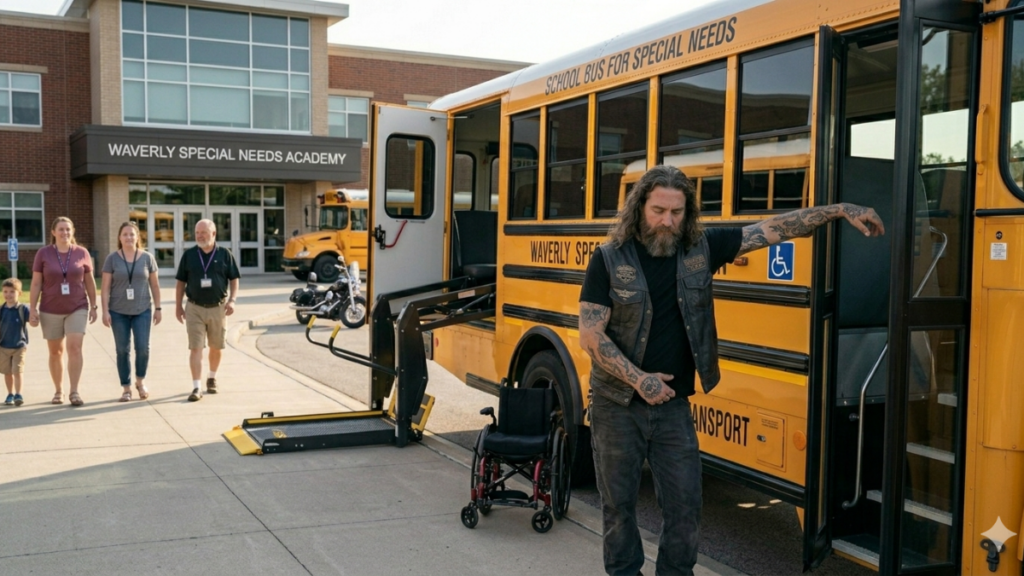
The special needs bus pulled up near the side entrance like it always did.
And the biker standing across the street took off his gloves, bowed his head, and crossed himself.
Not quickly, either.
Slowly.
Like he meant it.
I remember watching him through my windshield because it felt strange in a way I couldn’t explain.
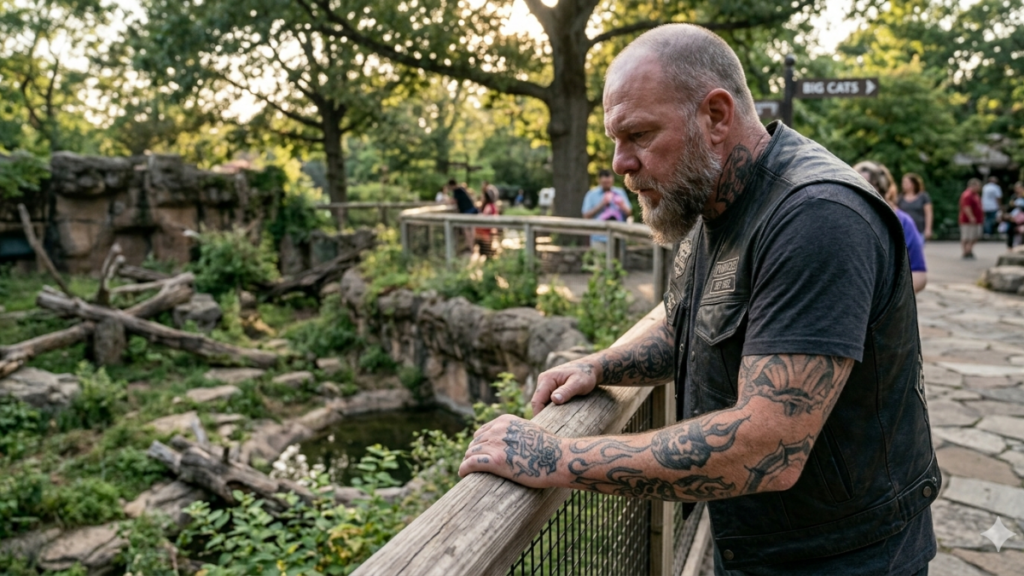
He was big.
Long beard.
Leather vest.
Tattoos climbing up his neck.
The kind of man parents usually pulled their kids away from without thinking.
But he just stood there quietly beside his motorcycle.
Then the bus doors opened.
And he crossed himself again.
That was the part that stayed with me.
Not the tattoos.
Not the bike.
The second cross.
I told myself maybe he had a child on the bus.
But he didn’t move toward the school.
Didn’t wave.
Didn’t speak to anyone.
He just watched until every kid disappeared inside.
Then he put his gloves back on and rode away.
At the time, it felt like one of those weird little moments you forget after dinner.
Except I kept seeing him.
And every time I did, it got harder to explain.
The Man By The Fence
The next week, he was back.
Same spot across the street.
Same motorcycle.
Same silent stare toward the special needs bus.
Crossing himself again.
I started arriving a few minutes early just to see if he’d show up.
Part of me felt ridiculous for caring.
Parents notice strange things at schools all the time.
Most of them mean nothing.
But there was something about how routine it felt for him.
Like this mattered.
One morning, another mom noticed him too.
“Creepy,” she muttered while buckling her daughter into a booster seat.
I almost agreed.
But then I hesitated.
Because creepy men usually try not to be seen.
This man stood in the open every single time.
Rain or cold or wind.
Always there before the bus arrived.
Always gone after it left.
And then I noticed something else.
He never looked at the other children.
Only the special needs bus.
That realization sat with me the rest of the day.
By Friday, I had built an entire story in my head.
Maybe he had lost a child.
Maybe his son used to ride that bus.
Maybe grief had frozen him in some routine he couldn’t let go of.
It felt sad more than dangerous.
Until the office secretary mentioned him casually during volunteer check-in.
“Oh, him? We’ve called about him before.”
I stopped writing my visitor sticker halfway through my name.
“Called who?”
“The police.”
My stomach tightened immediately.
“And?”
She shrugged.
“They talked to him. Didn’t do anything.”
That should’ve made me feel better.
It didn’t.
Because if the police had already spoken to him and he still came back every day, that meant he either knew he wasn’t doing anything wrong…
Or he didn’t care.
The Story Started Spreading
Parents talk.
Especially when they’re worried.
Within two weeks, the biker became part of morning conversation like weather or school lunches.
People took pictures of him from inside their cars.
Someone posted about him in the neighborhood Facebook group.
The comments got ugly fast.
“He’s probably scouting kids.”
“Why is nobody stopping this?”
“Look at those tattoos. Absolutely not.”
One woman claimed she saw him talking to himself.
Another said she spotted a knife on his belt.
By then, the story had already become bigger than facts.
And I participated in it more than I want to admit.
Not publicly.
But privately.
At dinner, I mentioned him to my husband almost every night.
“He’s there every morning.”
“That’s weird,” he said without looking up from his plate.
“And he crosses himself when the special needs bus arrives.”
That finally made him pause.
“Maybe he knows somebody on it.”
“Then why not just say that?”
My husband shrugged.
“Some people are strange.”
Maybe that should’ve been the end of it.
But once your brain labels someone as suspicious, everything they do starts looking suspicious.
The way he stood too still.
The fact he never smiled.
The fact that nobody at the school knew his name.
One morning I saw him holding something small in his hand while the bus arrived.
For a second my chest tightened.
Then I realized it was rosary beads.
That should’ve humanized him.
Instead, somehow, it made him feel even more unsettling.
Because now it seemed personal.
Religious.
Intense.
And I still had no idea why.
I Decided To Follow Him
I didn’t plan to.
That’s the truth.
But one Thursday morning, after the bus doors closed and he drove off, I found myself pulling out behind him.
At first I told myself I just wanted his license plate number.
Something practical.
Something responsible.
But I kept following him through three stoplights.
Then five.
He drove carefully.
Almost annoyingly careful.
No speeding.
No weaving through traffic.
Eventually he pulled into a small diner near the edge of town.
I parked across the street and watched him go inside.
For a moment, I nearly left.
Then I saw something through the window that made me stay.
The waitress hugged him.
Not politely.
Not cautiously.
Like she knew him well.
A few minutes later, an older man came out from the kitchen and shook his hand.
Then another customer waved at him from a booth.
It completely disrupted the image I’d built in my head.
Predators aren’t usually regulars at family diners.
At least that’s what I told myself while sitting there gripping the steering wheel.
Then the biker noticed me.
Even from across the street, I knew immediately.
His expression didn’t change.
He just looked directly at my car.
And held the look long enough for my face to go hot.
I drove away before he came outside.
The entire ride home, I felt embarrassed.
Like I had crossed some invisible line.
But underneath the embarrassment was another feeling.
Curiosity.
Because now I knew something that didn’t fit the story anymore.
And once a story stops fitting, you start pulling at every loose thread.
The Bus Driver Finally Spoke
The answer almost came out accidentally.
A month after I first noticed him, I was helping at field day when I recognized the special needs bus driver near the gym entrance.
I nearly didn’t ask.
But the question had been sitting inside me for weeks.
“You know that biker who stands across the street every morning?”
The driver looked at me carefully before answering.
“Big guy? Gray beard?”
I nodded.
He sighed through his nose like he was already tired of the conversation.
“He bothering people again?”
“So you do know him.”
Another pause.
Then the driver said something I didn’t expect.
“He used to ride that bus.”
I honestly thought I heard him wrong.
“What?”
“When he was a kid.”
I stared at him.
The driver adjusted the stack of cones in his hands.
“Long time ago,” he said. “Back before I worked here. Different program. Different building.”
“That can’t be right.”
“It is.”
I felt my entire understanding of the situation shift sideways.
The biker.
The leather vest.
The tattoos.
The motorcycle.
Suddenly my brain was trying to fit those things together with the image of a disabled child riding a school bus.
It didn’t connect cleanly.
And maybe that was my mistake from the beginning.
The driver looked toward the parking lot before speaking again.
“He had a rough childhood. Real rough.”
“What does he want now?”
The driver’s expression softened a little.
“He says he prays for the kids.”
That was it.
Nothing dramatic.
Nothing criminal.
Just that.
He says he prays for the kids.
I should’ve felt relieved.
Instead, I felt ashamed.
Because I realized how badly I wanted there to be a darker explanation.
But That Wasn’t The Whole Story
For a few days, I avoided looking at him.
I’d pull into the pickup line and keep my eyes forward.
No staring.
No speculation.
No Facebook comments.
But once you learn part of a story, you start wondering about the rest.
And there was still one thing bothering me.
Why cross himself every single morning?
Not once.
Twice.
Like clockwork.
Eventually curiosity won again.
One rainy morning, I got out of my car before I could talk myself out of it.
I crossed the street while parents watched from their windows.
The biker saw me coming immediately.
Up close, he looked older than I expected.
Deep lines around his eyes.
Worn leather gloves.
A small silver cross hanging against his shirt.
For a second, neither of us spoke.
Then I asked the question that had been living in my head for weeks.
“Why do you do that every morning?”
He looked toward the bus before answering.
“My brother rode that bus too.”
The words landed quietly.
“He died when we were kids.”
I didn’t know what to say.
The bus pulled up beside the curb.
The biker watched the doors open.
“He was scared every morning,” he said softly. “Kids used to throw things at him when he got off.”
Something cold moved through my chest.
“He’d make me promise to watch until he got inside.”
The children started filing off the bus one by one.
“And after he died,” the biker continued, “I figured somebody should still watch.”
Then he crossed himself again.
Slowly.
Carefully.
Exactly the way I’d seen him do a hundred times before.
And suddenly it didn’t look frightening at all.
It looked protective.
That was the moment I realized how wrong we’d all been.
But the damage had already started spreading beyond school gossip.
And none of us understood how bad it had gotten yet.
The Post That Changed Everything
Two days later, somebody uploaded a photo of him online.
Not just in the neighborhood group this time.
A public post.
His face.
His motorcycle.
The school name visible in the background.
The caption called him a predator.
By evening, the post had thousands of shares.
People claimed he was “targeting disabled children.”
Others said he was part of trafficking rings.
Complete strangers were analyzing his appearance like it proved something.
The comments got uglier by the hour.
I sat in bed scrolling through them with a sick feeling in my stomach because I knew most of it wasn’t true.
But I also knew I’d helped create the atmosphere that allowed it to happen.
Every suspicious conversation.
Every whispered theory.
Every photograph taken from behind a windshield.
It all added up.
And now the story belonged to the internet.
Which meant nobody could control it anymore.
Someone Recognized Him
The next morning, he wasn’t outside the school.
For the first time in months, the curb across the street sat empty.
I should’ve felt relieved.
Instead, the absence felt awful.
Parents noticed immediately.
Some celebrated.
Others looked uneasy.
Then around lunchtime, everything shifted again.
A woman commented under the viral post.
She said the biker had once helped rescue her after a car accident during a snowstorm.
Another man said he was a volunteer with a veterans’ group.
Then someone else posted an old newspaper clipping.
The biker’s brother had died at eleven years old.
Special needs student.
Hit by a driver while walking home after school decades earlier.
I stared at the article for a long time.
Because suddenly his routine made horrible sense.
Watching the bus.
Waiting until every child got inside safely.
Crossing himself.
Every single piece fit together now.
And the internet had turned him into a monster anyway.
He Came Back One Last Time
Three days passed before anyone saw him again.
It was Monday morning.
Cold wind.
Gray sky.
The special needs bus pulled up right on schedule.
And there he was across the street beside his motorcycle.
Same spot.
Same gloves.
Same quiet posture.
But this time parents were watching him differently.
Not suspiciously.
Carefully.
Like people confronting their own guilt.
Nobody took pictures.
Nobody whispered.
When the bus doors opened, he removed his gloves and crossed himself once.
Then again.
The children disappeared safely into the building.
And before he could leave, something unexpected happened.
The bus driver walked across the street and hugged him.
Not a quick handshake.
A real hug.
The biker looked embarrassed by the attention.
A few parents clapped softly from the sidewalk.
Others looked down at the ground.
I stayed inside my car because I suddenly understood that apologies don’t always belong in public.
Some things become performative too easily.
The biker glanced briefly toward the parking lot before putting his gloves back on.
For a second, I thought he recognized me from the diner.
Maybe he did.
But if he held any anger toward us, he didn’t show it.
He just started his motorcycle and rode away.
What I Keep Thinking About
He still comes sometimes.
Not every day anymore.
Just once in a while.
And now nobody panics when they see him.
The strange thing is, the scene itself never changed.
Not really.
A man stood near a school every morning and prayed while disabled children got off a bus.
That was always the truth.
The only thing that changed was the story we attached to it.
I think about that more than I’d like to admit.
How quickly we filled empty space with fear.
How badly we wanted appearances to confirm our assumptions.
How easy it became once the internet got involved.
And honestly, I still understand why people were uneasy at first.
A school is the one place where fear overrides logic fast.
Especially when children are involved.
But I also think about his brother now.
A little boy scared to walk into school alone.
A promise between siblings that somehow lasted decades longer than it was supposed to.
There’s something painfully human about that.
The last time I saw the biker, the bus doors folded open and the kids started stepping onto the sidewalk one by one.
He crossed himself quietly.
Then he whispered something I couldn’t hear.
Maybe a prayer.
Maybe a name.
This time, nobody looked away.