

The Night Everything Became Urgent
The night Daniel told me he needed a kidney transplant, he didn’t ease into it or try to soften the weight of what he was saying, which is probably why it felt so real to me right away.
We were sitting in the living room, halfway through a completely normal evening, when he suddenly went quiet, like he had been building up to something and finally couldn’t hold it in anymore.
“I need to tell you something,” he said.
I remember laughing a little, because I thought it was going to be something small, something ordinary.
But then he said:
“My kidneys are failing.”
And just like that, everything shifted.
The Diagnosis That Took Over Our Lives
Within a week, our entire routine revolved around doctors, tests, and appointments that all seemed to confirm the same thing.
Daniel was sick.
Not in a vague or uncertain way.
In a specific, clinical, urgent way.
The kind of sick that came with charts and numbers and specialists who spoke in careful tones.
“They’re declining faster than we expected,” one doctor said.
“He’s going to need a transplant.”
It didn’t feel optional.
It didn’t feel like something we could wait on.
It felt immediate.
The Decision That Felt Automatic
“I’ll do it.”
I said it before anyone even asked.
Before Daniel could object.
Before the doctor could explain alternatives.
Because when you’re sitting in a room being told that the person you love needs something to survive, there isn’t really a decision to make.
You just act.
Daniel shook his head at first.
“You don’t have to—”
“Yes, I do,” I said.
And I meant it.
The Testing
The testing process took a few weeks, and during that time, everything in our lives started to feel like it was moving in fast-forward.
Blood work.
Compatibility checks.
Consultations.
Every appointment brought us closer to something that felt both terrifying and necessary.
“You’re a match,” the doctor said eventually.
And instead of feeling afraid, I felt relieved.
Because it meant I could fix this.
The Way He Looked at Me
After we found out I was a match, Daniel started looking at me differently.
Not in a bad way.
Just…
Intensely.
Like he was trying to memorize something.
“You don’t have to do this,” he said again one night.
“I know,” I said.
“But I’m going to.”
He nodded slowly.
And for a second, something about his expression felt off.
But I ignored it.
Because nothing about that situation felt normal anyway.
The Timeline That Moved Too Fast
Everything after that happened quickly.
Faster than I expected.
Faster than I thought medical processes like this usually moved.
“We want to schedule the surgery as soon as possible,” the doctor said.
“Is that normal?” I asked.
“In cases like this, yes.”
And I believed him.
Because why wouldn’t I?
The Detail I Didn’t Question
There was one thing, though.
Something small.
Something that didn’t feel like a big deal at the time, but stood out just enough that I remember it clearly now.
I didn’t meet the recipient team.
Not directly.
Everything was handled through Daniel’s doctors.
Separate.
Coordinated.
But not overlapping.
“They’ll handle the rest,” I was told.
And again—
I didn’t question it.
The Hospital
The day of the surgery felt surreal in a way that’s hard to explain.
Hospitals always have that sterile, controlled energy, but when you’re the one being wheeled down the hallway, everything feels sharper.
Brighter.
More real.
Daniel walked beside me until they stopped him at the doors.
“I’ll see you after,” he said.
I nodded.
Because that’s what we had both been working toward.
The moment where everything would be okay again.
The Last Thing I Remember
The last thing I remember before going under was looking at him.
Standing there.
Watching me.
And thinking—
This is worth it.
Waking Up
When I woke up, everything felt heavy.
My body.
My head.
The room itself.
There was a nurse adjusting something near my bed.
“You’re awake,” she said.
I nodded slowly.
“Did it work?” I asked.
She smiled.
“The surgery went well.”
Relief hit me immediately.
“Is he okay?”
She paused.
Just slightly.
Then said:
“Everything went as planned.”
The First Confusion
I didn’t think much of it at first.
Not right away.
Because I was still coming out of anesthesia, still trying to reconnect with my body and my surroundings.
But after a few minutes, I realized something.
Daniel wasn’t there.
The Question That Didn’t Get Answered
“Where is my husband?” I asked.
The nurse adjusted something on the monitor.
“He’s not in recovery here,” she said.
That didn’t make sense.
“What do you mean?”
“He’s in a different unit.”
A different unit?
“Can I see him?”
“Not yet,” she said.
“Just rest for now.”
The Feeling I Couldn’t Shake
Something about the way she said it didn’t sit right.
Not because it was obviously wrong.
But because it didn’t match what I expected.
If the surgery had gone the way it was supposed to…
We should have been near each other.
Recovering at the same time.
That’s how I had pictured it.
That’s how it had been explained.
The First Real Question
A few hours later, when I was more awake, I asked again.
“Can I see him now?”
This time, the nurse hesitated longer.
“I’ll check,” she said.
And that hesitation—
That was the moment something inside me shifted.
Because suddenly, for the first time since all of this started, I felt something I hadn’t allowed myself to feel before.
Doubt.
The Sentence That Changed Everything
When she came back, she wasn’t alone.
There was another nurse with her.
And a doctor.
Which was already more than I expected for a simple question.
“Is everything okay?” I asked.
The doctor looked at me carefully.
Then said:
“There’s something we need to clarify.”
The Truth Begins to Surface
“What do you mean?”
He glanced at the chart in his hand.
Then back at me.
“The kidney you donated—”
I sat up slightly.
“Yes?”
“—was not transplanted into your husband.”
The Sentence That Didn’t Make Sense
For a moment after the doctor said it, I genuinely thought I had misheard him, or that the anesthesia was still affecting my ability to process what he was saying, because the sentence itself didn’t just sound wrong—it sounded impossible in a way that didn’t fit with everything I had been told leading up to the surgery.
“I’m sorry,” I said slowly, trying to push myself up slightly despite the pain in my side, “what do you mean it wasn’t transplanted into my husband?”
The doctor exchanged a quick glance with the nurse beside him, the kind of look that happens when people are trying to decide how much to say and how quickly to say it, before turning his attention back to me.
“The procedure that was performed used your kidney for a different recipient,” he said carefully, as if the wording itself might somehow soften the reality of what he was telling me.
I stared at him.
Because that wasn’t just unexpected.
That was completely outside of anything I understood about how this was supposed to work.
“That doesn’t make any sense,” I said, my voice tightening despite my effort to stay calm, “I was approved specifically as a match for my husband, so how would it go to someone else without me knowing?”
The Explanation That Raised More Questions
He took a breath, clearly aware that whatever he said next was going to determine whether this conversation stayed controlled or turned into something else entirely.
“In some cases,” he began, “patients are enrolled in paired donation programs or redirected based on compatibility needs, but that is typically discussed and consented to beforehand.”
“Typically?” I repeated.
The word felt like it didn’t belong in this situation at all.
“Was that done here?” I asked, already knowing that if it had been, I would remember agreeing to it.
He hesitated.
“No,” he said.
And that single word confirmed what I had already started to feel building in the back of my mind.
Something had happened that I had not agreed to.
The Moment the Doubt Became Something Else
I felt my heart start to race, not from the physical strain of the surgery, but from the realization that the entire situation I thought I understood was now shifting into something much more complicated, and much more deliberate, than a simple medical misunderstanding.
“Then where is my husband?” I asked again, this time more directly, because the question suddenly felt more important than anything else.
The doctor didn’t answer immediately, and that delay—longer this time, heavier—told me more than anything he could have said.
“He is not currently recovering from a transplant procedure,” he said finally.
The words settled into the room slowly.
Too slowly.
Because now there was only one possible conclusion.
The Question I Was Afraid to Ask
I looked at him, then at the nurse, then back at him again, trying to find some version of this that made sense, some explanation that didn’t completely unravel everything I had been told over the past few weeks.
“So he didn’t need it?” I asked.
My voice sounded quieter now.
Not calmer.
Just… thinner.
The doctor didn’t say yes.
But he didn’t say no either.
And that was enough.
The Realization That Hit Next
Because if Daniel hadn’t needed the kidney—
Then why had we done any of this?
Why had we rushed into surgery, why had we followed every step, why had we trusted every conversation, if the entire premise was wrong from the beginning?
Unless—
It wasn’t a mistake.
The First Piece That Didn’t Fit
“Who got it?” I asked.
This time, the doctor didn’t hesitate.
“Another patient in the transplant unit.”
“That’s not what I’m asking,” I said, my voice sharpening despite the exhaustion pulling at me.
“I want to know who.”
He held my gaze for a second longer than was comfortable.
Then said:
“You would need to speak with your husband about that.”
The Moment Everything Became Clear
That was the exact moment the confusion turned into something else entirely.
Because suddenly, this wasn’t about hospital protocols or administrative errors or medical decisions that had somehow gone wrong.
This was about Daniel.
And the fact that every answer I needed seemed to lead directly back to him.
The Walk I Shouldn’t Have Made
I didn’t wait for permission.
I didn’t wait for another explanation or for someone to tell me to rest or for the pain in my side to settle enough that I could think clearly.
I pushed myself out of the bed, ignoring the way the room tilted slightly as I stood, and reached for the IV pole to steady myself as I moved toward the door.
“Ma’am, you shouldn’t be walking right now—” the nurse started.
“I need to see him,” I said, cutting her off, because at that point there was nothing else I could do except find him and make him explain it himself.
The Hallway That Felt Too Long
The hallway outside my room felt endless, the kind of long, sterile corridor that hospitals are known for, where every step echoes slightly and every door looks the same, but this time it felt different.
Heavier.
Because with every step I took, the reality of what I was walking into became harder to ignore.
If he hadn’t needed the kidney—
Then he had lied.
And not just about something small.
About something that had cost me part of my body.
The Room at the End
When I finally reached the transplant unit, I didn’t know exactly what I was looking for, only that I would know it when I saw it.
And then I did.
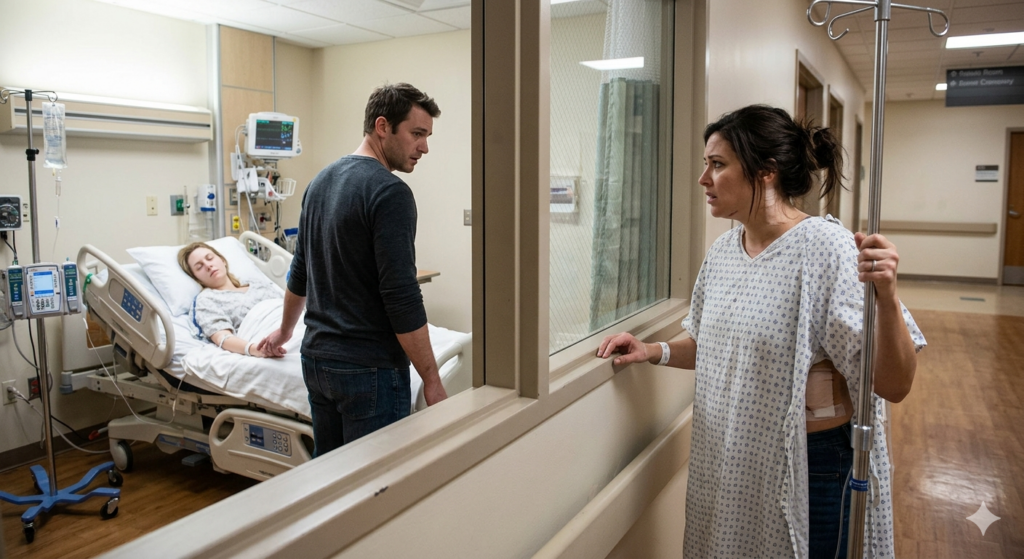
Because through one of the partially open doors, I saw him.
Daniel.
Standing at the side of a hospital bed.
Holding someone’s hand.
The Person in the Bed
At first, I didn’t recognize her.
She was pale.
Connected to monitors.
Still coming out of surgery.
But the way he was standing there—
Close.
Focused.
Not like someone visiting a stranger.
Like someone who belonged there.
The Moment He Saw Me
He turned.
And the second his eyes met mine, everything on his face changed.
Not confusion.
Not surprise.
Recognition.
Like he had known this moment was coming.
The Truth Without Words
I stepped into the room slowly, my entire body tense with a mixture of pain and adrenaline that was making it hard to think clearly but impossible to stop moving.
“Who is she?” I asked.
He didn’t answer.
He didn’t have to.
Because the way he looked at her—
And then back at me—
Told me everything.
The Question That Broke It Open
“Is that where my kidney went?” I asked, my voice steady in a way that surprised even me.
Silence.
And then—
“Yes.”
The Reality I Hadn’t Considered
The room felt smaller suddenly, like the walls had closed in just enough to make it hard to breathe.
“Who is she?” I asked again.
And this time, he said it.
“She’s someone I care about.”
The Final Piece
I laughed.
Not because anything was funny.
But because the sentence was so small compared to what it actually meant.
“Someone you care about?” I repeated.
“You had me go through surgery for someone you ‘care about’?”
He tried to step toward me.
“Listen—”
“No,” I said immediately, stepping back, because I couldn’t let him get close enough to make this feel like something that could be explained away.
The Explosion
“Do you have any idea what you just did?” I said, my voice rising now, echoing slightly in the room as the machines around us continued their steady beeping.
“You told me you were dying,” I continued, each word sharper than the last, “you let me believe I was saving your life, and this whole time—”
I gestured toward the bed.
“—this was the plan?”
The Moment Everything Collapsed
The woman in the bed stirred slightly, the movement drawing my attention back to her, and suddenly the reality of the situation hit in a way that words couldn’t fully capture.
She wasn’t just someone random.
She was someone he had chosen.
Over me.
Over the truth.
Over everything.
The Aftermath
By the time the nurses rushed in, trying to calm the situation and separate us, the damage had already been done.
Because there was no version of this where I walked away still believing anything he had told me before.
No version where this could be fixed.
The Final Realization
As I stood there, being guided back into the hallway, one thought settled into place more clearly than anything else.
It wasn’t just that he had lied.
It was how far he had gone to make that lie real.
And how easily I had believed it.
