

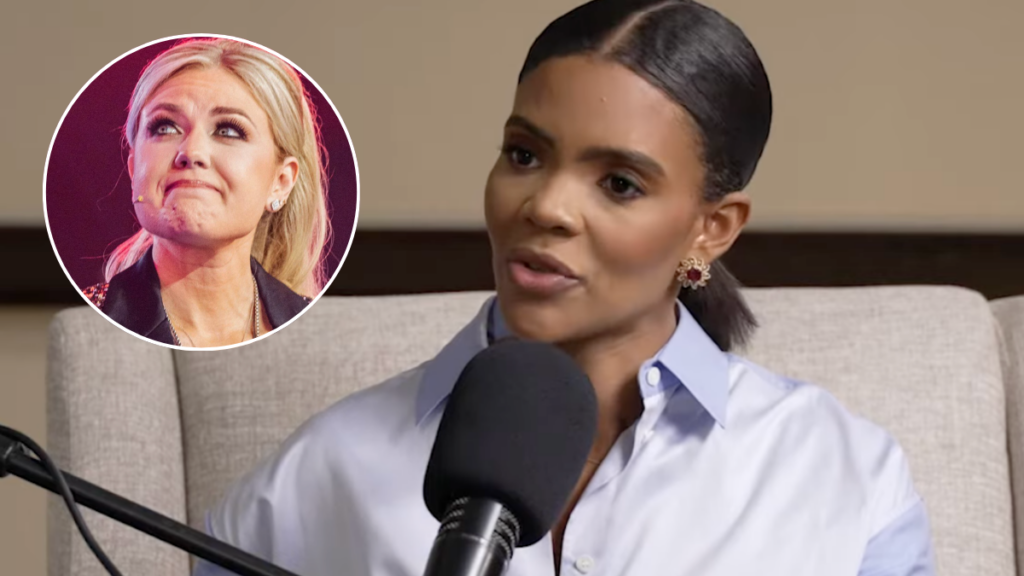
Photo Credit: Abich Financial Services / Youtube; ZUMAPRESS.com / MEGA
Alleged Ex Claims Pageant Warnings
Candace Owens’ recent docuseries Bride of Charlie re-examined Erika Kirk’s past pageant involvement. In episode three, Owens said one of Erika’s former partners spoke to her. According to Owens, that ex said someone in pageantry warned him about Erika’s ambition. The warning reportedly described how Erika would “do anything to get to the top.” Owens also said the ex claimed Erika’s mother supported her drive. This became a major point in Owens’ critique of Kirk’s pageant origin story.
Owens used the ex’s alleged comments to argue that Erika’s public narrative might be incomplete. Erika once described her entry into pageants as random, stating someone sent her a nomination letter. Owens challenged that account as unlikely for minors, who typically need parental consent to enter pageant contests.
The unnamed ex’s alleged warning was framed as corroboration of Owens’ theory that Erika’s pageant involvement was part of a long-standing pursuit of visibility. Owens asserted that family ties and personal ambition drove Kirk’s early public life. This perspective is controversial, as few concrete details about the ex or the relationship have surfaced.
Some former competitors in the beauty world agreed that Kimberly’s story seemed improbable, noting minor pageant entrants usually require photo submissions and parental signatures. Owens seized on this as support for the ex’s warning. However, critics argue that pageant culture varies widely by state and organization.
Social media bounced back with mixed reactions. Some users assumed Owens’ narrative was credible because it included “insider” testimony. Others said anonymous sources rarely prove anything. Many commenters questioned how much weight an unnamed ex’s warning should carry in a complex personal history.
The Ex’s Warning and Pageant Ambition
Owens framed the alleged ex’s warning as evidence of Erika’s long-term ambition. The warning supposedly came from someone familiar with pageant circles. This person allegedly told the ex that Erika would “do anything to get to the top.” That phrasing became a much-quoted line in online discussions.
According to Owens, the warning also included a claim about Erika’s mother. Owens said the mother would “do anything to help her get to the top.” This added a family dimension to the accusation. Owens used this to question whether Erika’s involvement in pageants was as coincidental as she once suggested.
If true, the warning from pageant contacts challenges Kirk’s explanation that she entered contests randomly. Critics could interpret the ex’s claim as confirmation that parental influence was central to Erika’s pageant history. This reinforces the idea that her competitive participation was intentional from a young age.
However, the accuracy of these warnings remains uncertain. Owens did not name the ex or the pageant contact. Without identified sources, critics argue the comments function more as narrative fuel than verified fact. This raises questions about how much weight to place on anonymous recollections.
Regardless of the controversy, the alleged ex’s warning became a focal point in online debates. For some, it affirmed suspicions about ambition behind Kirk’s early public path. For others, it exemplified how easily unverified claims can spread in the internet age.
Dating History Under Scrutiny
Candace Owens also attacked Kirk’s personal history beyond pageants. She claimed Erika lied about dating anyone before meeting her late husband, Charlie Kirk. Owens highlighted photos of Erika with past partners, contradicting her statement that she did not date for five years.
Owens noted Erika once lived in New York for five years and reportedly said she stayed single during that period. However, Owens said resurfaced media showed Erika with a boyfriend named JT Massey in 2014, when they auditioned for The Amazing Race. That timeline overlaps with what Erika described as her single phase.
The ex’s warning about her drive and ambition tied into Owens’ claims about Erika’s romantic life. Owens suggested Erika pursued high-status partners rather than average individuals. She said Erika “never dated a normal guy with a nine-to-five job.”
Whether dating scenes influence how someone advances professionally is a matter of personal interpretation. Owens framed it as documentary evidence of calculated ambition. Others saw it as Owens overreaching to build a narrative about personality and intent.
The resurfaced evidence from Erika’s past generated more debate about what constitutes a reliable test of truth. Anonymous warnings, Instagram posts, and casting tapes complicate the line between real history and online speculation.
What the Ex’s Warning Means in Context
The ex’s warning has implications beyond pageants. Some commentators tied it to larger questions about public authenticity. They asked whether early ambition naturally leads to later prominence. In that sense, the warning about doing “anything” might be hyperbolic rather than literal.
Owens leans on the ex’s anonymous statements to build a theory of calculated progression. She argues that early signs of ambition foreshadowed Erika’s later public prominence. However, critics say ambition is a common trait many public figures share. They argue ambition does not equate to unethical behavior.
Some observers note that pageantry itself encourages competitiveness and self-presentation. Participating in pageants does not automatically prove a person will pursue fame at any cost. The ex’s warning might reflect personal bias rather than objective observation.
Moreover, anonymity of the ex means the comment cannot be verified independently. Owens’ reliance on unnamed sources makes the claim a talking point rather than an established fact. This distinction matters when shaping public narratives.
Despite these uncertainties, many discussions about Erika’s past incorporate the alleged warning. It has become a shorthand for critics who believe underlying motives shape public figures. Others view it as a reminder to evaluate anonymous claims with skepticism.
Reactions and Broader Impacts
Reaction to the ex’s warning and Owens’ documentary has been deeply divided online. Some social media users appreciated Owens for drawing attention to details about Erika’s pageant and romantic history. They felt anonymous sourcing was acceptable for raising questions.
Other commenters condemned the approach. They argued that attacking a grieving widow with unverified anecdotes was inappropriate. Critics noted that Erika’s husband was assassinated in 2025, and public scrutiny since then has been intense. Many online observers called for empathy over speculation.
Some defended Erika’s involvement in pageants as a legitimate part of her past without moral implications. They pointed out that many people use pageantry as a platform for self-confidence and networking. The ex’s warning was cast by defenders as common gossip rather than proof of intent.
Still, the debate reflects larger cultural tensions about evidence and narrative. Anonymous claims can gain traction quickly, especially when amplified by influential figures. The ex’s warning, even without verification, influenced conversations about ambition and authenticity.
In the end, Erika Kirk’s alleged ex remains unnamed, and her response to these claims has been limited. Whether individuals choose to believe the ex’s warning or see it as speculation, it has added a persistent thread to the story of her public life.