

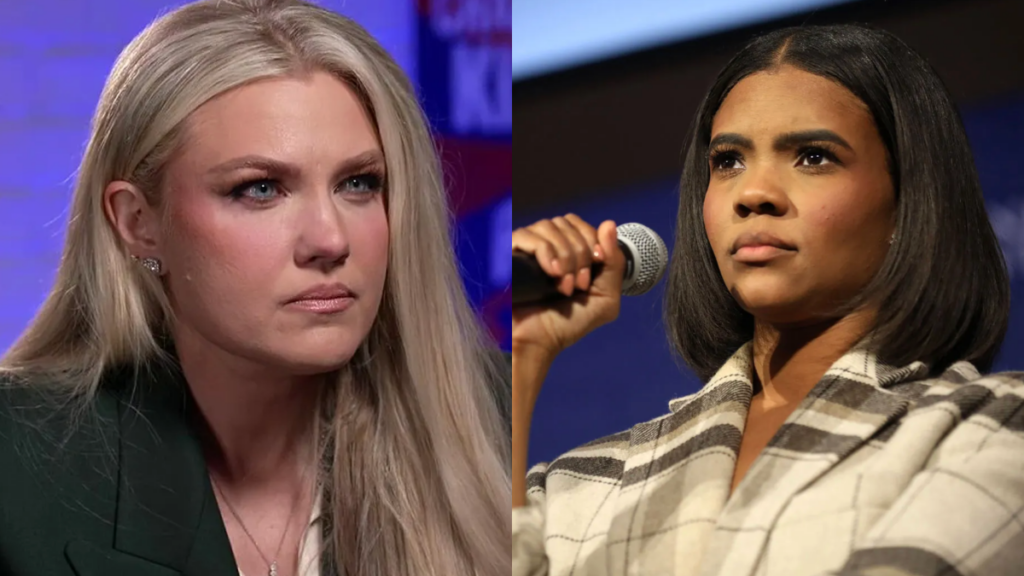
Photo Credit: Jesse Watters Primetime; ZUMA Press Wire/Shutterstock.com
Candace Owens’ Shocking Allegations Against Erika Kirk
In early 2026, conservative commentator Candace Owens made stunning claims about Erika Kirk. Owens alleged that someone close to Kirk had prior knowledge of Charlie Kirk’s assassination before it occurred. These claims surfaced during a public commentary push filled with conspiracy elements. Charlie Kirk, founder of Turning Point USA, was fatally shot at Utah Valley University in September 2025. Owens suggested that the widow or her circle may have known about the attack before it happened — an accusation she did not substantiate with hard evidence.
Owens’ remarks triggered controversy within conservative media and social platforms. She did not provide official documents or law-enforcement confirmation to back her theory. Instead, she drew connections between speculation and unnamed sources, which alarmed many watchers. Before these allegations, Owens and Kirk had tangled publicly about conspiracy theories surrounding the tragic event. Their earlier disagreements set the stage for even more intense scrutiny after this latest claim.
The alleged scenario quickly spread across social media, stirring heated debate. Critics argued Owens crossed a boundary by tying Kirk’s name to unverified pre-knowledge. They said this timing exploited a personal tragedy for public attention. Many users called Owens out for making serious accusations without authoritative proof. Observers stressed that such claims can cause emotional harm without factual foundation.
By mid-February 2026, Owens’ claims remained largely uncorroborated by independent reporting. Law enforcement and major outlets continued to treat the assassination as a criminal act, not a conspiracy. The suspect, Tyler Robinson, was charged, and officials stated no known associates acted in a coordinated plot. Still, the online narrative expanded, illustrating how quickly controversial theories can spread without evidence.
Erika Kirk Breaks Her Silence
Shortly after these allegations spread online, Erika Kirk publicly denied the claims tied to her or her circle’s supposed prior knowledge. In an interview with conservative commentator Graham Allen, a close friend testified against Owens’ assertions. That friend, Tracy Martin, described Owens’ allegations as “manipulative” and lacking basic context. Owens had claimed Martin’s daughter, allegedly an assistant to Erika, feared she should not attend the Utah Valley University event. Martin denied ever having such foreknowledge or conversation.
In her public remarks, Martin emphasized that false statements twist reality. She said conspiracy theories often spread when people misinterpret circumstantial information. Martin explained that confusion can grow when narratives are eagerly repeated without verification. She also defended Erika’s character, praising her resilience amid grief. The interview came as various online users began defending Erika and condemning Owens for spreading unverified claims.
Erika herself addressed rumors in interviews and televised appearances. She focused on her late husband’s legacy and her family’s wellbeing. During a Fox News segment, she rebuked allegations and called for focus on meaningful issues. She emphasized that speculation and gossip did little to honor Charlie’s memory. These remarks echo her broader efforts to steer conversation toward unity and grief-healing rather than conspiracy.
Social media reactions varied. Some praised her courage for speaking out, while others accused her of avoiding tough questions. But most reputable outlets noted she did not provide any admissions supporting Owens’ allegations. Instead, Erika reaffirmed that the tragedy was a crime, not a premeditated scene known in advance by insiders. Her approach aimed to de-escalate online drama and maintain dignity under intense public scrutiny.
Charlie Kirk’s Assassination and Aftermath
To understand the controversy, readers must grasp the context of Charlie Kirk’s tragic death. Charlie Kirk was a high-profile conservative activist and founder of Turning Point USA. On September 10, 2025, he spoke at an event at Utah Valley University when a gunman shot him. He succumbed to his injuries, shocking political communities across the United States.
The suspect in the killing, 22-year-old Tyler Robinson, was arrested shortly after the shooting. Authorities treated the case as an isolated criminal incident, not a widespread conspiracy or coordinated plot. Their investigation found no evidence linking Kirk’s inner circle to prior knowledge. Law enforcement officials publicly refuted suggestions of advance awareness by any acquaintances.
In the aftermath, Erika Kirk emerged as a central public figure. She delivered powerful speeches at memorial services, where she revealed she forgave her husband’s killer. Her messages emphasized faith and love in the face of profound loss. She also vowed to continue Charlie’s mission and leadership legacy, later becoming CEO of Turning Point USA.
Erika’s emotional responses resonated with many Americans. Tens of thousands attended memorial services, drawing political leaders and supporters alike. Amid grief, she urged unity and revival, which some commentators contrasted with the growth of conspiracy narratives. Her forgiveness message drew both praise and critique. Some lauded her compassion, while critics questioned her stance in light of rising speculation.
Understanding this backdrop helps explain why allegations of conspiracy stirred deep feelings online. Many saw the spreading rumors as disrespectful or harmful to a grieving widow. Others embraced them due to deep political polarization around modern media. Either way, the assassination and its fallout underscored intense ideological and emotional fault lines in public discourse.
Online Backlash and Political Divisions
The viral spread of these claims ignited strong reactions across social media platforms. Many users condemned Owens for targeting a woman still grieving her late husband. They called her allegations reckless and morally questionable. Critics argued that conjecture should not override compassion. These reactions came from audiences across political backgrounds.
Others defended Owens’ right to raise questions, however controversial. They pointed to the need for transparency in public figures’ associations and actions. Some argued that examination of all angles is a valid journalistic pursuit. Supporters said nobody should be immune from scrutiny, even after tragedy. However, those arguments often lacked grounded evidence.
A growing chorus online urged responsible conversation instead of amplification of unverified claims. Many pointed out that spreading unqualified allegations about murder invites harm. Some social commentators highlighted how conspiracy theories distort public understanding of actual events. They blamed misinformation for encouraging fear and distrust. This backlash against rumor was widespread, touching users both inside and outside political circles.
Meanwhile, conservative discussions revealed deeper fractures. Some right-wing commentators criticized Owens for creating division within their own movement. They argued her actions shifted focus away from Charlie Kirk’s legacy and toward personal drama. Others defended her as a provocative thinker challenging conventional narratives. This internal disagreement showed how divergent storytelling shaped group solidarity and conflict.
Overall, the online backlash illustrated how quickly rumor escalates into debate, especially when tied to high-profile tragedies. Within hours of initial claims, social platforms amplified reactions globally. Analysts noted that online dynamics often prioritize sensational content over cautious reporting. This episode became a case study in digital era controversy and the power of viral claims.
Lessons on Rumors, Evidence, and Respect
This controversy highlights how modern discourse grapples with rumor versus fact. Serious allegations demand solid evidence before publication. When public figures make unsubstantiated claims, the consequences can ripple widely. In this case, allegations about assassination preknowledge intensified emotional debates and political fissures. The absence of verified proof made the claims more about speculation than reporting.
Observers reminded audiences that public tragedies deserve respectful discourse. Many voices emphasized empathy for grieving families over sensational theories. Advocacy for careful investigation and confirmed facts rose in response. These appeals came from media critics, public commentators, and ordinary social media users alike. They underlined that misinformation often thrives where verification is absent.
Experts say online platforms must balance free expression with responsibility. Amplifying unverified accusations can damage reputations and inflame tensions unnecessarily. Fact-checking remains a critical tool for separating truth from rumor. Readers and viewers alike must approach sensational claims with caution. Developing digital literacy helps users distinguish between grounded reporting and speculation.
For Erika Kirk, this episode demonstrates the challenge of living in the public eye after personal loss. She continues to defend her family and late husband’s legacy while confronting controversial narratives. Whether in interviews or speeches, she emphasizes unity and dignity. Her refusal to validate unproven allegations reflects a broader attempt to focus on healing rather than division.
Ultimately, this story shows how powerful narratives form around high-profile events, especially in an era of political polarization. It underscores the need for evidence, empathy, and thoughtful engagement from the public and media alike. As discussions evolve, many hope the focus can return to factual clarity rather than speculation.