

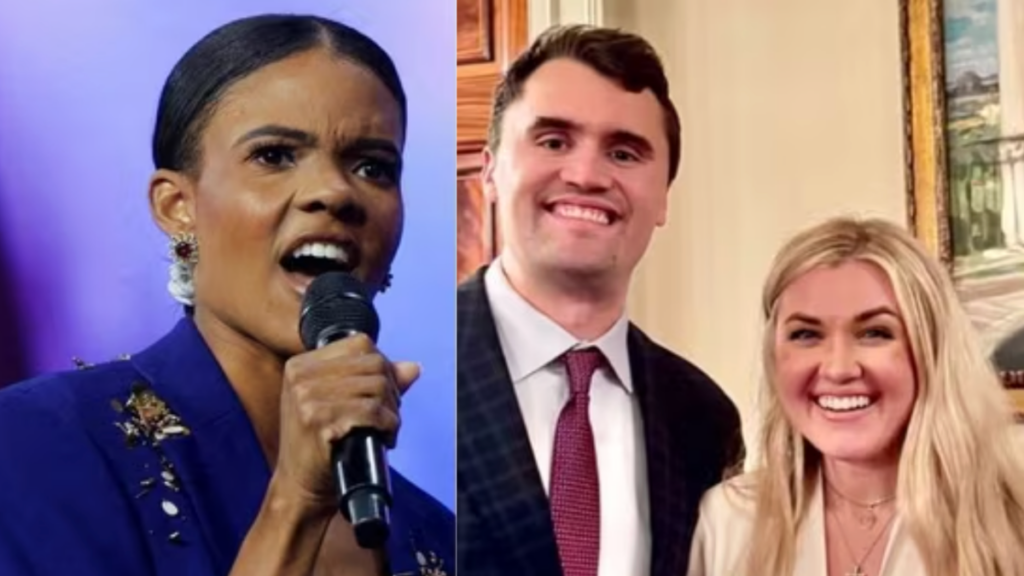
Photo Credit: REUTERS/Rebecca Cook, mrserikakirk/Instagram
The Latest Claims in the Candace Owens–Erika Kirk Feud
Conservative commentator Candace Owens has launched another wave of public accusations against Erika Kirk, widening their ongoing feud. Owens took to social media after internet users noticed a wedding photo of Erika and her late husband, Charlie Kirk, had vanished from a familiar bookshelf. Owens responded to the viral post with a controversial theory that linked the missing photo to Charlie’s wedding ring removal the night before his assassination. She wrote that “it’s entirely possible Charlie removed it when he removed his wedding ring the night before,” hinting at deeper issues in their relationship.
Owens paired her wedding photo observation with past statements about Charlie’s final hours, repeating doubts about details of the night before his death. She referenced a priest visiting the couple to pray over their marriage and implied this event could signify marital strain. Owens even questioned why Charlie’s wedding ring was not on his finger when he was killed. Her remarks amplified speculation instead of focusing on confirmed facts.
The feud between Owens and Erika Kirk began months earlier after Charlie Kirk, founder of Turning Point USA, was shot and killed at an event in Utah. Since that tragedy, Owens has publicly questioned circumstances around the assassination and raised doubts about the official narrative. Her comments have drawn significant backlash, including from other conservative voices who see her remarks as inappropriate or rash. This latest flare-up reflects broader tensions in conservative media circles.
Owens’s remarks have drawn attention far beyond the initial online post. She has continued to comment about Erika’s choices and life since Charlie’s death, and her tone has grown sharply accusatory. She has also suggested law enforcement should question Erika further, though she frames this as a call for clarity rather than an official allegation. Regardless, her rhetoric has kept the controversy in public conversation. The ongoing tenor of these comments shows how strongly political figures can shape narratives after a tragedy.
The Wedding Photo and Ring Controversy
The controversy began when social media users compared two video clips featuring Charlie and Erika Kirk. In the footage featuring Charlie, a framed photo of the couple’s wedding sat prominently on a shelf behind him. However, in a later clip with Erika speaking, that photo was no longer visible behind her. This discrepancy sparked speculation that Erika removed the photo. Some users claimed this suggested a change in their relationship prior to Charlie’s death.
Candace Owens seized on those comparisons and expanded the speculation. She wrote that the missing wedding photo could have something to do with Charlie removing his wedding ring the night before the fatal shooting. According to Owens’s narrative, Charlie and Erika had asked a priest to pray for their marriage on the eve of his death. She linked the absence of the ring to that moment, implying it suggested deeper marital conflict or uncertainty.
Many commentators, including political figures and online observers, responded to her claims in various ways. Some rallied behind Owens, echoing the view that something about the timeline seemed unusual. The idea that Charlie removed his wedding band stirred online discussion, including theories about what that gesture might signify. Conspiracy theories quickly took hold in online spaces, despite a lack of independent verification.
Others criticized this approach, noting that the absence of a wedding photo from a shelf or the removal of jewelry does not necessarily indicate anything definitive. Photos can be moved for simple reasons such as redecorating or reframing. A missing ring can also have mundane explanations unrelated to personal relationships. Still, social media chatter and rumor amplification have kept the issue alive in public discourse.
Responses and Pushback from Public Figures
Candace Owens has not been the only voice weighing in on this feud. Conservative activist Laura Loomer has publicly encouraged Erika Kirk to take legal steps against Owens’s comments. Loomer said Owens’s behavior is “beyond depraved” and that Erika should seek a restraining order to halt further personal attacks. Such calls reflect the degree to which Owens’s statements have polarized even members of her own broader ideological community.
Loomer shared a clip from one of Owens’s recent podcasts where Owens suggested Erika should be dragged into a police precinct for questioning. In response to that, Loomer called on Erika to involve the legal system for protection. She described Owens’s remarks as harmful and dehumanizing, pushing back against the narrative Owens is trying to build.
Erika Kirk herself has not remained silent throughout these developments. She has publicly rejected other claims from Owens’s commentary team, particularly those involving Charlie’s final messages before his death. Erika stated that Charlie did not text anyone predicting his death or expressing foreknowledge of harm. Her account paints their last night together as one of prayer and normalcy rather than fear or suspicion.
This counter-narrative offers a stark contrast to Owens’s implications. Erika’s response has focused on preserving the memory of her late husband and rejecting sensational claims that could distort the truth about their relationship. The difference in tone between Owens’s provocative questioning and Erika’s measured rebuttals highlights the intensity of this public dispute.
Broader Speculation and Online Reaction
The optics surrounding Charlie Kirk’s final hours have fueled endless speculation on social media. Users have dissected interviews, photos, and small details that may or may not hold significance. Some have focused on why Charlie and Erika spent the night apart before the assassination. Others have asked why he chose to retrieve personal items in the morning. These questions have been spread widely without official confirmation.
Online sleuths also debated whether a missing wedding photo implies emotional distance or an intention to update decor. Some theories suggested the photo was simply reframed or relocated and meant nothing deeper. Still, speculation thrives because there is no single authoritative explanation for these changes.
Candace Owens’s continuing commentary has also extended beyond photos and rings. She has aired other theories linking Erika and people close to Charlie to unexplained sightings near restricted locations just before his death. These claims, presented on Owens’s podcast, cited an alleged eyewitness at a military base. That specific account has not been verified by law enforcement, yet it has fed further online debate and speculation.
Amid all this, conspiracy theories about Charlie’s death have spread widely in political media circles, ranging from allegations about government involvement to foreign intelligence links. These narratives are often debunked or labeled unsubstantiated by credible reporters. Nonetheless, they gain traction in polarized communities where official findings may be questioned.
The combination of grief, shock, political affiliation, and online rumor culture makes this a uniquely complex situation. It shows how personal tragedy can become subject to intense public scrutiny, especially when high-profile figures like Charlie Kirk are involved.
The Impact of Public Feuding on Private Grief
Beyond the assertions of Candace Owens and the speculation of netizens, this feud underscores a larger issue: how public commentary can affect private grieving. Erika Kirk continues to handle life after Charlie’s death through quiet reflection, family focus, and focused public appearances. She has shared moments of remembrance and emphasized the peaceful, prayerful nature of their last night together. Her approach contrasts sharply with the more sensational tone of online narratives.
Owens’s repeated questioning of Erika’s motives and marriage dynamics has intensified public debate. It also illustrates how influential commentators can shape emotional discourse around bereavement and suspicion. Some view these tactics as attempts to spark interest or controversy; others see them as crossing a line into personal attack. Regardless, the impact on those directly affected is profound. Media and political commentators often forget that real human grief underlies these stories. Publicizing theories without evidence can strain the reputations of living individuals. It can also make an already painful situation more stressful and divisive.
There are calls from some in the conservative movement urging restraint and respect for Erika’s loss. These voices argue for respecting privacy during mourning rather than fueling speculation for clicks or political gain. This emphasis on empathy and decorum reflects a pushback against sensational online culture. Recognizing the difference between informed discussion and harmful rumor spreading remains vital in responsible public dialogue.
In sum, the continued feud illustrates broader challenges in how society handles narratives tied to tragedy. When personal loss intersects with politics and media influence, the boundaries between accountability and intrusion can blur. The way this story unfolds may set examples for future public conversations about grieving families in the spotlight.