



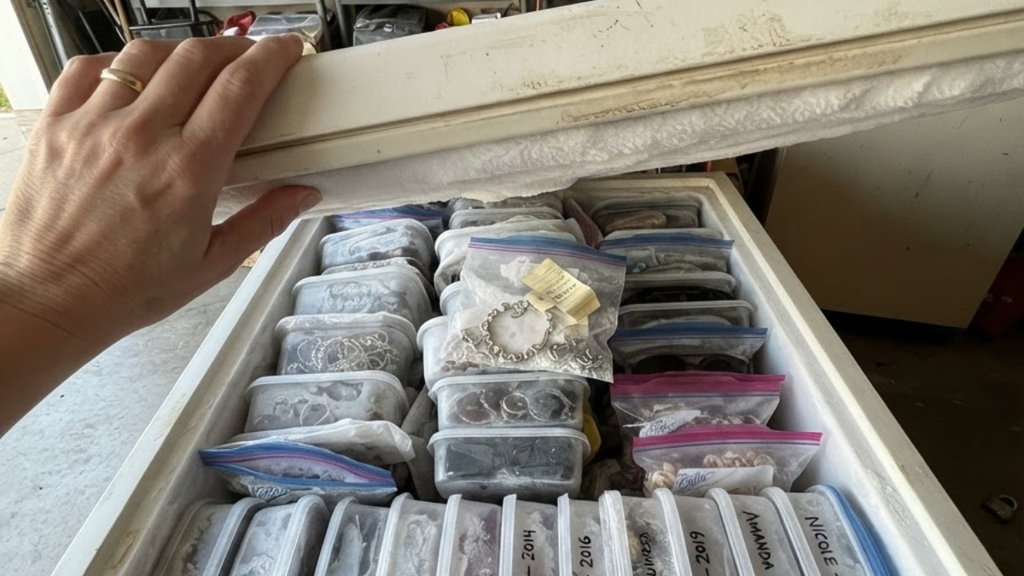
My husband had a locked chest freezer in our garage for twelve years, and until he died, I genuinely believed it contained venison.
That was the explanation.
Venison, fish and occasionally expensive cuts of meat he bought in bulk.
My husband, Paul, hunted when he was younger, although by the time I met him he mostly went to deer camp to drink beer with his brother and complain about his knees.
He still had friends who hunted.
Every November, somebody gave him venison.
He fished.
He smoked meat.
He had a vacuum sealer and enough opinions about freezer burn to make you regret asking him a question.
So when he bought a second chest freezer in 2014 and put a padlock on it, I asked why exactly once.
He said he was tired of our son, Luke, leaving the freezer lid cracked when he grabbed popsicles from the garage.
Luke was fourteen at the time.
That explanation made perfect sense.
Paul said the new freezer was for meat only.
The regular garage freezer could stay unlocked.
I never questioned it again.
That is the part people seem to have trouble understanding when I tell this story.
Why did I let my husband keep something locked in our shared garage for twelve years?
Because marriages contain thousands of things you stop seeing.
Paul had a locked toolbox.
I had a locked jewelry box.
He had a gun safe.
I had a filing cabinet with personal documents.
A padlock on a freezer was unusual for about three days.
Then it became part of the garage.
Paul died in May.
Heart attack.
He was sixty-one.
I was fifty-eight.
We had been married thirty-one years.
Luke was twenty-six by then, and our daughter, Emma, was twenty-nine.
There was nothing suspicious about Paul’s death.
He had high blood pressure.
His father died young from heart disease.
Paul complained about indigestion after dinner, went upstairs and collapsed in our bathroom.
I called 911.
Paramedics tried for almost forty minutes.
He was gone.
The first month afterward barely exists in my memory.
Funeral.
Flowers.
Casseroles.
Insurance forms.
Thank-you cards.
People telling me Paul had been one of the good ones.
People telling me how lucky we were to have thirty-one years.
People telling me he adored me.
I believed them.
I still believe parts of that.
That is what makes everything harder.
About seven weeks after Paul died, Luke came over to help me clean the garage.
I wanted to sell Paul’s fishing boat.
We needed to find the title.
There were shelves full of things I could not identify.
Motor oil.
Fishing tackle.
Old extension cords.
Containers of screws.
Half-empty bottles of chemicals.
Three coolers.
Four fishing poles Paul had apparently considered fundamentally different from one another.
Then Luke pointed at the locked freezer.
He said, “What are you doing with Dad’s murder freezer?”
That was what the kids called it.
I had forgotten.
When they were teenagers, they joked that nobody locked a freezer unless there was a body inside.
Paul thought it was funny.
He used to tell them, “That’s where I keep the kids who don’t do their chores.”
Completely normal stupid dad joke.
I told Luke I would probably unplug it once we emptied it.
Luke asked if I had the key.
I said it was probably on Paul’s key ring.
It was not.
We tried every key.
Nothing fit.
Luke said we could cut the lock.
I almost told him not to.
That reaction bothers me now.
Paul was dead.
The freezer belonged to me.
There was no reason not to open it.
Still, some part of my brain treated it as Paul’s private thing.
I said we could deal with it later.
Luke looked at me and said, “Mom, whatever meat is in there is probably older than my car.”
He got bolt cutters.
The lock snapped.
The freezer lid had frost around the seal.
Luke opened it.
There was meat.
For approximately five seconds, I felt stupid for making the moment feel strange.
Vacuum-sealed packages.
White butcher paper.
Plastic containers.
Everything packed tightly.
Then Luke moved a package.
Underneath it was a purse.
Not an old purse of mine.
A small red leather handbag.
Luke picked it up.
I said, “Whose is that?”
He said, “I don’t know.”
There was a wallet inside.
Driver’s license.
The woman in the photograph was named Sarah Whitcomb.
I knew the name.
Everybody in our town knew the name.
Sarah Whitcomb disappeared in 2016.
She was thirty-four.
She left work on a Tuesday afternoon and never came home.
Her car was found two days later at a state park approximately twenty miles away.
There had been searches.
Posters.
News coverage.
Her parents appeared on television.
Her husband was questioned publicly and eventually cleared.
For years, there were occasional anniversary stories asking what happened to Sarah.
Her driver’s license was in my husband’s freezer.
I called police before Luke finished going through the purse.
They told us to close the freezer and leave the garage.
Within an hour, my house was full of people.
I kept saying the same thing.
“It’s just her purse.”
I do not know why.
Maybe because if it was only a purse, there were explanations.
Paul found it.
Paul knew her.
Paul was keeping it for someone.
Paul was stupid.
Paul was secretive.
Paul was anything except what my brain was beginning to suggest.
Detective Angela Ruiz asked how long the freezer had been there.
I said twelve years.
She asked whether it had always been locked.
Yes.
She asked whether I had ever opened it.
No.
She asked who had access.
Paul.
Only Paul as far as I knew.
She asked if Paul knew Sarah.
I said no.
Then I remembered something.
Sarah worked for a property management company.
Paul was an electrician.
He did commercial work.
He could have been in one of her buildings.
I said maybe professionally.
Ruiz wrote it down.
Police removed everything from the freezer.
There was no body.
I need to say that because when I tell people there was a locked freezer and a missing woman’s purse inside, everyone assumes the next thing was a body.
It was not.
There were approximately eighty pounds of frozen meat.
Mostly venison.
Some fish.
Several containers of soup.
Underneath everything were four objects that did not belong.
Sarah’s purse.
A man’s wallet.
A silver bracelet.
And a pink flip phone.
The wallet belonged to a man named Anthony Keller.
He died in 2018.
Car accident.
I did not know him.
The bracelet was engraved:
M + J 6.14.09
The phone was old enough that nobody immediately knew whether it still worked.
I asked Ruiz if Paul had stolen things from people.
She said they did not know.
That became my favorite phrase for a while.
We don’t know.
I wanted somebody to know.
Paul was dead.
He could not explain anything.
Every object became a question nobody could ask him.
Police searched our house.
I gave permission.
I wanted them to.
I wanted them to find something stupid.
Receipts.
An explanation.
A hobby I did not know about.
Anything.
They found a notebook in Paul’s workshop.
Not hidden.
Sitting among electrical manuals.
It contained dates.
Addresses.
Initials.
At first, police thought they were job notes.
That was what I thought too.
Paul kept records of everything.
Then Detective Ruiz asked if the date October 11, 2016 meant anything to me.
No.
That was the day Sarah disappeared.
Beside the date, Paul had written:
SW — 4:42 — west lot.
Another date.
March 3, 2018.
AK — 11:10 — Route 16.
Anthony Keller died March 4.
The next morning.
I asked what the note meant.
Ruiz said they were investigating.
Then she asked where Paul had been the day Sarah disappeared.
I laughed.
Not because it was funny.
Because she was asking me where my husband had been on a Tuesday ten years earlier.
I had no idea.
Then she showed me Sarah’s workplace.
I recognized it.
Paul had done electrical work there.
I remembered because the company had been renovating an older office building, and Paul complained constantly about the wiring.
He worked there for almost four months.
I asked whether Sarah and Paul had an affair.
Ruiz said there was no evidence of that.
At least not yet.
I hated that I almost wanted it to be an affair.
An affair was something I understood.
Then they got the pink phone working.
It belonged to a woman named Melissa Grant.
She was alive.
Police contacted her.
Melissa was forty-seven.
She lived in Indiana.
The phone had been stolen from her in 2015.
Not misplaced.
Stolen.
She had reported it.
She remembered exactly when.
She had been staying at a hotel outside Toledo for a work conference.
Her purse disappeared from her hotel room.
The purse was eventually found in a stairwell.
Cash missing.
Phone missing.
Nothing else.
I asked whether Paul had been at the hotel.
Yes.
Electrical conference.
Same week.
I said, “So he stole phones?”
Ruiz looked at me.
I knew how desperate I sounded.
Maybe Paul was a thief.
Maybe he had some bizarre compulsion.
Maybe the missing woman’s purse and dead man’s wallet were trophies from thefts.
That was horrible.
It was also better than the alternative.
Then Melissa told police something she had never reported.
The night before her phone disappeared, she woke up because somebody was inside her hotel room.
She saw a man near the door.
He ran.
She thought she had dreamed it.
The next morning, her purse was gone.
Investigators showed her photographs.
She could not identify Paul.
It had been dark.
More than a decade had passed.
Nothing definitive.
Then they identified the bracelet.
It belonged to a woman named Jessica Monroe.
M + J.
Melissa and Jessica.
Different people.
The M was Michael.
Jessica’s husband.
Jessica disappeared in 2011.
Five years before Sarah.
Her body was found six months later in a wooded area outside Fort Wayne.
Her death was ruled homicide.
The case remained unsolved.
Paul’s locked freezer did not exist yet in 2011.
He bought it in 2014.
The bracelet had been somewhere else for at least three years.
I asked Ruiz whether they thought Paul killed Jessica.
She said they were investigating whether Paul had any connection to her.
He did.
Paul had worked in Fort Wayne for almost a year on a hospital renovation.
Jessica worked at the hospital.
Not as a nurse.
Billing.
Their schedules overlapped for seven months.
I called my daughter.
Emma had been trying to protect herself by staying away from the investigation.
Luke wanted every detail.
Emma wanted me to stop telling her things.
I respected that until I could not.
I told her about Jessica.
Emma was silent.
Then she said, “Mom, Dad used to go to Fort Wayne after that job ended.”
I had forgotten.
Paul had friends there.
That was what he told me.
For several years, he occasionally spent a weekend in Fort Wayne.
Fishing.
Poker.
Seeing guys from the job.
I asked Emma why she remembered.
She said because when she was in high school, she once asked to go with him.
She wanted to visit a friend who had moved nearby.
Paul became weirdly angry.
He told her it was a work trip.
Emma pointed out that he had said it was fishing.
They argued.
He went alone.
I remembered the argument.
I remembered telling Emma to stop interrogating her father.
That memory has bothered me ever since.
Police pulled Paul’s old phone records.
Getting records that old was difficult.
Some no longer existed.
But financial records did.
Credit cards.
Bank statements.
Toll records.
Paul had been in Fort Wayne multiple times after Jessica disappeared.
He had also been there the weekend before her remains were found.
I asked why.
Nobody knew.
Then police searched a storage unit.
I did not know Paul had a storage unit.
He rented it in 2010.
Four years before buying the freezer.
Six years before Sarah disappeared.
Eleven years before he died.
I asked what was inside.
Ruiz told me she wanted me to hear it from her before I saw it on the news.
There were boxes.
Twenty-seven.
Most were labeled with dates.
Some contained ordinary things.
Clothing.
Shoes.
Purses.
Wallets.
Jewelry.
Phones.
Identification cards.
Hairbrushes.
Keychains.
Photographs.
None belonged to me.
None belonged to our children.
Police began identifying owners.
Some were alive.
Some dead.
Some missing.
The freezer had not been where Paul kept everything.
It was where he kept four things.
I asked why those four.
Ruiz did not know.
Then investigators noticed something about the dates.
The storage unit began in 2010.
The earliest identified item was from 1998.
Paul and I had been married three years.
It was a driver’s license belonging to a woman named Diane Holloway.
Diane died in 1998.
House fire.
I knew Diane.
Not well.
She had been Paul’s coworker’s wife.
We attended a barbecue at their house once.
I remembered her because she had a beautiful kitchen with blue cabinets, and I spent years telling Paul I wanted the same color.
I had stood in Diane Holloway’s kitchen.
Less than a year later, she died when her house caught fire while her husband was working overnight.
Paul went to the funeral.
I went with him.
Her driver’s license had been in my husband’s possession for twenty-eight years.
I asked Ruiz if Paul started fires.
She said they were reviewing the original investigation.
The fire began in the basement.
Electrical.
I started crying before she finished.
Paul was an electrician.
Ruiz immediately told me that did not prove anything.
Electrical fires happen.
Diane’s house had older wiring.
The original investigation found no evidence of arson.
Then they found Paul’s notebook entry.
DH — basement panel replaced 4/98.
That could have been a work record.
Paul may have worked on her electrical panel.
If anything, that made an accidental electrical fire more plausible.
Then police found another notebook.
Older.
This one was in the storage unit.
It covered 1996 through 2009.
There were initials.
Dates.
Locations.
No explanations.
Diane was there.
DH — 9:15 — home.
The date was the night she died.
I asked where I had been.
That question surprised Ruiz.
I said, “If Paul was there, where was I?”
We figured it out from an old photo album.
I had been pregnant with Emma.
My mother threw me a baby shower that weekend.
I stayed overnight at my parents’ house.
Paul said he had to work Saturday morning.
I had believed that for twenty-eight years.
Then Ruiz asked whether Paul knew Diane personally.
I said only through her husband.
That was wrong.
Diane’s sister remembered Paul.
Very well.
She said Paul and Diane had dated.
Before Diane married her husband.
Before Paul met me.
Nobody ever told me.
I asked if the relationship ended badly.
Diane’s sister said Paul ended it.
That surprised me.
Then she said Diane had become afraid of him before the breakup.
She never explained why.
I asked whether Diane told her husband.
Apparently not.
Diane’s sister had always thought Paul was controlling and strange.
She remembered him showing up unexpectedly.
Waiting outside Diane’s work.
Asking her friends where she was.
Then one day, Paul ended the relationship.
He told Diane he had met someone else.
That woman was me.
I had met Paul in February 1995.
He told me he had been single for almost a year.
He was still seeing Diane.
I asked whether Diane confronted him.
Yes.
She called me once.
I did not remember.
Then her sister described it.
A woman called my apartment and asked for Paul.
I said he did not live there.
She asked who I was.
I hung up because I thought she had the wrong number.
I remembered that.
Barely.
One meaningless phone call from thirty-one years earlier.
It had been Diane.
I asked whether Paul killed her because she threatened to tell me.
Ruiz said they did not know.
Then she showed me something from the notebook.
Two months before Diane died:
DH — called Anne.
My name.
Then:
Says she will tell everything.
Then nothing until the night of the fire.
That was the first time I understood that whatever Paul had been doing did not begin with strangers.
It began before our children.
Before the locked freezer.
Before the storage unit.
Possibly before our marriage.
Investigators identified nine women from the storage unit within the first week.
Diane Holloway.
Jessica Monroe.
Sarah Whitcomb.
A woman named Rebecca Price who died in a hiking accident in 2007.
A woman named Elaine Foster who disappeared in 2003 and was never found.
A woman named Monica Reed who was alive and living in Ohio.
Melissa Grant, whose phone had been in the freezer.
Two women whose belongings had been stolen during burglaries.
And a woman named Carol Benson who died of an apparent accidental overdose in 2005.
Every one of them had crossed paths with Paul.
Work.
Hotels.
Friends.
Job sites.
Fishing trips.
A restaurant.
A wedding.
Not all of them were dead.
That mattered.
It meant possession of an item did not automatically mean Paul killed someone.
Maybe he stole things.
Maybe he stalked women.
Maybe there were several behaviors overlapping.
I clung to that distinction because the alternative was too enormous.
Then Monica Reed spoke to police.
She was the first living woman who remembered Paul clearly.
She worked as a receptionist for a contractor Paul used in 2004.
Paul asked her out.
She knew he was married.
She said no.
He kept asking.
Then he started appearing places.
Grocery store.
Gym.
A bar where she met friends.
She complained to her boss.
Her boss told Paul to leave her alone.
Paul stopped.
Three months later, Monica’s apartment was broken into.
Nothing valuable was taken.
Only underwear, photographs, an address book and a silver necklace.
The silver necklace was in Paul’s storage unit.
Monica had never known who broke in.
I asked Ruiz whether Paul had been sexually assaulting women.
She said there was no evidence establishing that.
I asked what he was doing.
She said, “I think we’re still figuring out what the behavior was before we decide what to call all of it.”
Then Sarah Whitcomb’s case changed everything.
Police went back through her disappearance.
Her husband had been cleared.
Her car had been found at a state park.
Search teams focused on the surrounding woods.
Nothing.
Paul’s notebook said:
SW — 4:42 — west lot.
Investigators pulled archived security footage information from Sarah’s workplace.
The footage itself was gone.
But the original police report documented a white service van leaving the west lot at 4:47.
Paul drove a white electrical service van.
That still did not prove it was him.
Then investigators found an old parking invoice in the storage unit.
State park.
The night Sarah disappeared.
Paul had paid cash.
Why keep the invoice?
I had no idea.
Ruiz said some offenders keep souvenirs.
I said, “Don’t call him that.”
She stopped.
I do not know why I said it.
I knew what this looked like.
I just was not ready to hear a word that turned my husband into someone I would have recognized on the news.
Then they found Sarah’s blood.
Not in our house.
Not in the freezer.
In Paul’s old work van.
The van had been sold in 2019.
Police tracked it through two owners.
It was sitting behind a landscaping company.
The interior had been modified repeatedly.
Seats removed.
Shelving replaced.
Flooring damaged.
Investigators still found biological material in a seam beneath an old mounting bracket.
It matched Sarah.
I asked if there could be an innocent explanation.
Ruiz said Sarah had never been a passenger in Paul’s van according to anyone they had interviewed.
I said maybe she cut herself at work.
Maybe Paul transported equipment with blood on it.
Maybe anything.
Ruiz let me talk.
Then she said, “Anne, Sarah’s purse was in his freezer.”
My name is not Anne.
That is how disoriented I was.
I had spent so much time reading about cases and talking to detectives that I actually started confusing myself with women in stories I had seen on television.
My name is Linda.
I corrected myself.
Ruiz did not.
She just waited.
Sarah’s blood was in Paul’s van.
Sarah’s purse was in Paul’s freezer.
Paul wrote her initials, time and workplace parking lot on the day she vanished.
That was enough for me.
I asked where Sarah was.
Ruiz said they did not know.
Then Luke remembered the freezer had not always been in the same place.
I had forgotten.
Paul bought it in 2014.
Originally, it sat against the back wall of the garage.
In 2016, he moved it.
After Sarah disappeared.
He told me the outlet kept tripping.
He moved it to the opposite corner.
Luke remembered helping him.
There was nothing strange about moving a freezer.
Except Paul installed a new outlet himself.
Police examined the old location.
Concrete floor.
Nothing.
Then Luke said, “Dad patched that.”
He pointed at a section of concrete near the wall.
Paul told us a pipe had cracked underneath the slab.
He cut out a section.
Repaired something.
Poured new concrete.
I remembered complaining because the garage smelled strange for days.
The repair happened in November 2016.
Three weeks after Sarah disappeared.
Police excavated the patch.
There was no body.
There was a key.
A small brass key sealed inside a plastic bag underneath the concrete.
I asked what it opened.
Nobody knew.
Paul had intentionally buried a key under our garage floor.
That was the first thing I could not explain as a trophy.
A driver’s license could be stolen.
A bracelet could be taken.
A purse could be kept.
A key buried beneath concrete meant Paul expected nobody to find it unless they knew exactly where to look.
Police tested every lock they had connected to him.
House.
Storage unit.
Toolboxes.
Boat.
Gun safe.
Old vehicles.
Nothing.
Then Detective Ruiz asked whether Paul owned property I did not know about.
I said no.
She asked whether his parents had.
Paul’s parents were dead.
Their house had been sold.
His brother, Gary, inherited a small hunting property in northern Michigan.
Paul used it sometimes.
I said Gary owned it.
Ruiz checked.
Gary did not own it.
Paul did.
He had purchased Gary’s share eleven years earlier.
I had never known.
The property had an old cabin.
I had been there twice.
Once when the kids were little.
Once for Gary’s fiftieth birthday.
I asked whether the key could be for the cabin.
It was not.
Then Gary told police about the root cellar.
I had never seen it.
The cabin was built in the 1940s.
There was a detached underground storage room approximately fifty yards behind it.
Gary said they stopped using it decades ago.
The door had collapsed.
Paul rebuilt it in 2016.
Nobody knew why.
Gary thought Paul wanted somewhere cold to store deer.
The brass key opened the new lock.
I asked to be there when police opened it.
They said no.
I am grateful now.
They called me afterward.
There was no person inside.
Again, that distinction mattered for about ten seconds.
There were shelves.
Plastic bins.
A folding chair.
A battery lantern.
And another freezer.
Unplugged.
Empty.
I asked why Paul needed another freezer.
Ruiz said they did not know.
Then she said the floor had been recently disturbed.
Not recently as in weeks.
Recently compared to a seventy-year-old root cellar.
Concrete poured approximately ten years earlier.
They excavated it.
They found Sarah Whitcomb.
After ten years, Sarah finally came home.
I watched her parents on television.
Her mother was eighty-two.
Her father was using a walker.
They stood outside a courthouse while a reporter shouted questions.
I turned the television off.
I could not stop thinking about the freezer.
Paul had kept Sarah’s purse in our garage.
Her body was beneath concrete at a property I did not know he owned.
The key to that room was beneath concrete in our garage.
It was like he had built a private map only he could read.
Then police identified why Anthony Keller’s wallet was in the freezer.
Anthony had not been random.
He had been Sarah’s boyfriend before she married.
They remained friends.
After Sarah disappeared, Anthony became obsessed with finding her.
Her husband hated him.
Police initially suspected both men.
Anthony created a website about Sarah.
He posted theories.
He contacted people from her workplace.
One of those people was Paul.
Anthony interviewed him in 2017.
Paul told Anthony he barely knew Sarah.
Anthony did not believe him.
According to emails found on Anthony’s computer, he planned to meet Paul again.
He wrote to a friend:
The electrician lied about how well he knew her.
Four months later, Anthony died in a car accident.
His wallet ended up in Paul’s freezer.
I asked Ruiz whether Paul caused the crash.
She said investigators were reopening it.
I asked what Anthony had discovered.
They found notes.
Sarah had complained about Paul before she disappeared.
Not to police.
To a coworker.
Paul had become overly friendly.
He brought her coffee.
Waited near her car.
Asked personal questions.
Sarah told a coworker she thought he had gone through her desk.
Then a photograph disappeared.
A photograph of Sarah and her husband.
Sarah confronted Paul.
He denied it.
The photograph was found in the storage unit.
That was why Anthony suspected him.
He had spoken to Sarah’s coworker.
Paul knew Anthony was getting close.
Then Anthony died.
His wallet went into the freezer beside Sarah’s purse.
The freezer was not where Paul kept trophies from people he had killed.
It was where he kept things from people connected to Sarah.
Sarah’s purse.
Anthony’s wallet.
Jessica’s bracelet.
Melissa’s phone.
The last two still did not fit.
Then Melissa told police something she had forgotten.
She had known Sarah.
Not well.
They attended the same college.
They were Facebook friends.
After Sarah disappeared, Melissa shared missing-person posts.
That was all.
Jessica had known Sarah too.
They worked together briefly in 2009.
Four objects.
Four people.
All connected to Sarah.
One missing and murdered.
One murdered years earlier.
One dead in a suspicious accident after investigating Sarah’s disappearance.
One alive.
The freezer had not been Paul’s general collection.
It was a Sarah collection.
I asked why.
Ruiz said that was what they were trying to understand.
Then Melissa called me.
Not police.
Me.
I almost did not answer.
She said there was something she had not told investigators because she was embarrassed.
Years before Sarah disappeared, Sarah contacted her about Paul.
I asked why.
Melissa said Sarah knew she had met him at the hotel conference.
Apparently Paul mentioned Melissa to Sarah.
Sarah asked whether anything strange happened.
Melissa told her about waking up and thinking someone had been inside her room.
Sarah became frightened.
I asked why Paul would tell Sarah about Melissa.
Melissa said she did not know.
Then she said:
“Linda, Sarah wasn’t afraid of him because he was hitting on her.”
I asked what she meant.
Melissa said Sarah believed Paul was following women.
Not only her.
Sarah had started keeping track.
She had names.
Dates.
Places.
Jessica Monroe was one of the names.
Melissa was another.
I stopped breathing.
Sarah had been investigating my husband.
Years before Anthony investigated Sarah’s disappearance, Sarah herself had been investigating Paul.
I asked what happened to her notes.
Melissa did not know.
Then Detective Ruiz called me that evening.
They had found them.
Not in Sarah’s house.
Not in the storage unit.
In my house.
Inside the locked freezer.
The meat packages were evidence too.
Some of them were not venison.
One package contained a flash drive vacuum-sealed between layers of butcher paper.
Nobody noticed it during the first inventory because it looked like part of the packaging.
The flash drive contained scanned pages.
Sarah’s notes.
Paul had kept them.
There were twenty-six names.
Some I recognized from the storage unit.
Some police had not connected to Paul yet.
At the top of the first page Sarah had written:
I think Paul D. keeps something from every woman.
Underneath:
I don’t know what happens when they realize it.
Sarah had figured out the storage unit before police did.
Not the physical location.
The collection.
Her notes went back to 2014, two years before she disappeared.
She had twenty-six names.
Some had question marks beside them.
Some had dates.
Some had descriptions of objects.
Monica Reed — necklace?
Melissa Grant — phone missing after Toledo conference.
Jessica Monroe — bracelet missing according to sister.
Rebecca Price — wallet never returned?
Then there were women investigators had not connected to Paul because they were alive and had never reported anything.
A woman named Tina Collins.
Another named Heather Walsh.
A woman named Susan Delaney.
A woman named Marjorie Ellis.
One line stopped me.
Linda D. — wife. Unknown.
I was on Sarah’s list.
I asked Ruiz why.
She said they did not know.
I was getting very tired of those words.
Sarah had apparently been trying to determine whether I knew.
Knew what, exactly, was still unclear.
Theft.
Stalking.
Deaths.
All of it.
There were several notes about me.
Married 1995.
Daughter 1996? Son 2000?
Her dates were slightly wrong.
Then:
Does she know about Diane?
And:
Possibly safest way in.
I read that several times.
I asked whether Sarah had planned to contact me.
Ruiz said it looked that way.
Then they found an email draft in Sarah’s old account.
It had never been sent.
My email address was in the recipient field.
The subject was:
Your husband Paul
The message said:
Linda, you don’t know me, and I realize this is going to sound insane, but I think there is something you need to know about your husband. I have been trying to decide whether contacting you would put you in danger.
That was where it ended.
Sarah never sent it.
Three weeks later, she disappeared.
I asked Ruiz whether Paul knew about the draft.
There was no way to know.
Then investigators examined Sarah’s flash drive more closely.
Some files had been deleted before Paul apparently copied or took possession of it.
Several were recoverable.
One was a photograph.
Paul standing outside a woman’s apartment.
Timestamped 2007.
The woman was Rebecca Price.
Rebecca died later that year after falling from a hiking trail.
Another photograph showed Paul’s van outside Jessica Monroe’s workplace.
Another showed Paul sitting in his truck outside Monica Reed’s apartment.
Sarah had been photographing him.
I asked how she got so close without Paul noticing.
Ruiz said maybe he did notice.
That was probably why Sarah ended up underneath the root cellar.
Then there was a document titled DIANE.
Sarah had discovered the connection between Paul and Diane Holloway.
She had spoken to Diane’s sister.
Everything I learned after Paul’s death, Sarah had started learning ten years earlier.
The secret relationship.
The threatening phone call.
The fire.
Paul’s electrical work at Diane’s house.
Sarah wrote:
Diane may be first, but I doubt it.
She was right.
Police found earlier names.
One came from a newspaper clipping stored with Sarah’s files.
Michelle Avery.
Twenty-two years old.
Died in 1992.
Paul was twenty-seven.
I had not met him yet.
Michelle died in an apartment fire.
Again, electrical.
She had dated Paul’s best friend, Gary Benson.
Not his brother Gary.
Different Gary.
Paul and Gary Benson had grown up together.
Michelle and Gary broke up.
Several months later, Michelle began dating Paul.
Then she broke up with Paul too.
Her apartment caught fire six weeks later.
Paul had helped her install a ceiling fan two months before the fire.
The fire began in the ceiling wiring.
At the time, investigators ruled it accidental.
I asked whether Michelle’s belongings were in the storage unit.
No.
Then police searched Paul’s parents’ old property.
Not because they expected to find anything.
Because Sarah’s notes included:
Before storage unit — where did he keep things?
Paul’s father had owned a large detached garage.
Paul used it constantly.
The house had been sold after George died.
The current owners allowed a search.
There was a crawlspace above the garage.
Inside were two plastic tubs shoved behind old insulation.
The tubs had probably been there for decades.
One contained ordinary family things.
The other contained women’s belongings.
Michelle’s earrings.
A driver’s license belonging to another woman.
A scarf.
Two wallets.
Photographs.
A key.
A hospital identification badge.
Paul had started collecting long before the storage unit.
The earliest identifiable item belonged to a woman named Patricia Lowe.
She disappeared in 1989.
Paul was twenty-four.
Her remains were found in 1993.
Her death had never been solved.
I asked whether Paul knew her.
Yes.
They went to high school together.
I asked if they dated.
Nobody knew.
Then Patricia’s brother remembered Paul.
He said Paul had been obsessed with her.
That was the word he used.
Obsessed.
Patricia was not interested.
Paul sent flowers.
Called.
Waited outside her work.
Patricia’s brother confronted him once.
Paul stopped.
Then Patricia disappeared.
Her driver’s license was in the garage crawlspace.
I asked Ruiz how many women there were now.
She said they had identified thirty-one names connected to either Sarah’s list or Paul’s collections.
I asked how many were dead.
Eleven.
How many missing.
Three, although Sarah was no longer officially missing.
How many had died violently or under unusual circumstances.
Eight.
I said, “So he killed eight women.”
Ruiz said, “We can establish connections. That isn’t the same as proving eight homicides.”
I knew why she had to say that.
I also knew what I believed.
Then she said something I did not expect.
“We’re not sure all of the objects were taken after the women died.”
I asked what that meant.
Some were taken years before.
Monica’s necklace was stolen while she was alive.
Melissa’s phone.
Several wallets.
A photograph.
A scarf.
Paul collected objects from women he was interested in long before anything happened to them.
Most of those women never died.
That changed the pattern.
The objects were not necessarily murder trophies.
They were markers.
Paul noticed a woman.
He learned about her.
He took something.
Then most of the time, apparently, nothing else happened.
I asked what made some women different.
That became the central question.
Sarah had been asking it too.
Her notes divided women into categories.
She called them A, B and C.
Nobody knew what the letters meant.
At first.
Then investigators compared the women.
Category A women had missing objects but no known confrontation with Paul.
Most were alive.
Category B women had confronted Paul, rejected him or complained about him.
Several experienced suspicious incidents afterward.
Category C women were dead or missing.
I asked if Sarah had categorized herself.
She had.
C?
Question mark included.
She wrote that four months before she disappeared.
I could not stop thinking about that.
Sarah knew enough to wonder whether she had moved into the category of women who died.
She still kept investigating.
Then investigators found what the categories actually meant.
Not from Sarah.
From Paul.
One of the notebooks in the storage unit had letters beside women’s initials.
A.
B.
C.
Paul had created the categories.
Sarah had somehow seen enough of his records to copy them.
A meant acquired.
B meant problem.
C meant closed.
I asked Ruiz to repeat it.
Acquired.
Problem.
Closed.
Women were not people in Paul’s private records.
They were statuses.
Monica had been A.
Then she complained to her boss.
B.
After she moved away and stopped being part of his life, Paul wrote:
MR — closed without action.
Closed did not necessarily mean dead.
That mattered.
Some women simply disappeared from his orbit.
Changed jobs.
Moved.
Married.
Stopped responding.
Paul marked them closed.
Then why were so many dead?
Ruiz said that was exactly what investigators were trying to separate.
Paul had been a stalker and thief for decades.
That was becoming clear.
Whether every suspicious death connected to him was homicide was not.
Then they found a fourth status.
D.
Only six names had it.
Diane Holloway.
Jessica Monroe.
Rebecca Price.
Sarah Whitcomb.
Anthony Keller.
And one name I did not recognize.
Evelyn Hart.
D was not defined anywhere.
Sarah had not discovered it.
Police searched Evelyn.
She was seventy-three.
Alive.
Living approximately thirty miles from me.
I asked how she knew Paul.
She refused to speak to police at first.
Then she learned Paul was dead.
She changed her mind.
Evelyn had been Paul’s high school English teacher.
I asked why a teacher was in notebooks about women he stalked.
Ruiz said Evelyn claimed Paul came to see her in 1993.
He was twenty-eight.
He wanted to talk about Patricia Lowe.
The missing girl from his high school.
Evelyn had taught both of them.
Paul asked whether Patricia had ever written about him in school assignments.
Evelyn thought the question was strange.
She said no.
Paul kept returning.
Eventually Evelyn told him to stop.
One night, somebody broke into her house.
Nothing valuable was taken.
Her filing cabinet was opened.
Old student papers were disturbed.
Evelyn believed Paul had done it.
She confronted him.
Paul denied it.
Then Evelyn did something almost nobody else had done.
She told him she had made copies of everything she knew about him and given them to another person.
Whether that was true did not matter.
Paul stopped contacting her.
I asked why she was marked D.
Evelyn did not know.
Then she told police something else.
Patricia had written about Paul.
Evelyn lied to him.
Patricia wrote an essay during senior year about being followed by a boy she knew.
She did not name Paul directly.
Evelyn kept the essay because she was worried.
After Patricia disappeared, she gave it to police.
Police interviewed Paul.
I had not known Paul was ever questioned.
He told investigators Patricia had misunderstood his interest.
Nothing tied him to her disappearance.
The case went cold.
Evelyn had kept a photocopy.
She still had it.
Patricia described Paul taking small objects from her.
A hair clip.
A photograph from her locker.
A bracelet.
She wrote:
He gives some of them back later so I know he had them.
That was new.
Paul did not always keep the objects.
Sometimes he wanted the woman to know.
The collection was not merely souvenirs.
It was communication.
Proof he could enter their spaces.
Proof he had access.
Proof he knew things.
I thought about the locked freezer sitting in our garage for twelve years.
I thought about Paul joking with our children.
That is where I keep the kids who don’t do their chores.
I had interpreted the lock as privacy.
Maybe Paul interpreted locks differently.
Locks were proof of access.
He could enter other people’s spaces.
They could not enter his.
Then police figured out D.
It stood for danger.
Not dangerous women.
Women who were dangerous to Paul.
People who knew enough to expose him.
Diane knew about me and threatened to tell me things about Paul.
Jessica apparently discovered his collection after seeing him with another woman’s property.
Rebecca Price had caught Paul following her and photographed him.
Sarah investigated him.
Anthony investigated Sarah.
Evelyn had information about Patricia and told Paul she had distributed copies.
Five of those six people were dead.
Evelyn survived.
I asked why.
Ruiz said, “Maybe because she told him killing her wouldn’t solve his problem.”
Evelyn had invented the perfect defense without realizing it.
She told Paul other people had copies.
If she died, the information remained.
Paul could not close the problem by closing Evelyn.
That was why she lived.
I thought about Sarah’s unfinished email to me.
I have been trying to decide whether contacting you would put you in danger.
Sarah made the opposite decision.
She kept her investigation mostly to herself.
She collected evidence quietly.
She planned to tell me when she understood enough.
Paul found out.
Sarah became a D.
Then she disappeared.
I asked how Paul knew Sarah was investigating him.
The answer came from the flash drive.
There was a text file Sarah created six days before she disappeared.
Paul knows.
Underneath:
He asked why I talked to Melissa.
Then:
He said Jessica’s name. I never told him I knew about Jessica.
Sarah realized she had exposed herself.
Then she wrote:
Need to tell Linda now.
The next file was the unfinished email to me.
She never sent it.
I spent days thinking about what would have happened if she had.
Would I have believed her?
That question still makes me ashamed.
If a woman I barely knew had emailed me in 2016 saying my husband stole personal belongings from women and might be connected to several deaths, what would I have done?
I probably would have shown Paul.
I probably would have said, “Do you know this woman?”
I might have gotten Sarah killed faster.
Maybe Sarah understood that.
Maybe that was why she hesitated.
Then Detective Ruiz asked to meet with Luke and Emma together.
Emma did not want to.
Ruiz said it was important.
We met at Julie’s house because I could no longer stand being in mine.
Ruiz brought photographs.
Not graphic.
Family photographs.
Our family.
Some I recognized.
Some I did not.
Paul had taken hundreds of photographs of me and the children without our knowledge.
Sleeping.
Walking into stores.
Sitting at restaurants.
Talking to neighbors.
Driving.
Most were mundane.
That somehow made them worse.
I asked why.
Ruiz said the photographs were found on an external drive inside the storage unit.
There were folders.
LINDA.
EMMA.
LUKE.
I felt my daughter stiffen beside me.
Emma said, “Was Dad stalking us?”
Ruiz said they did not know what Paul’s purpose was.
Then she showed us the dates.
The photographs started in 2002.
Seven years after we married.
Not earlier.
I asked what changed in 2002.
Luke was two.
Emma was six.
Nothing obvious.
Then Ruiz showed me a folder inside mine.
L — A
Acquired.
My stomach turned.
Another folder:
L — B
Problem.
There were only four photographs inside.
All taken in 2010.
I tried to remember 2010.
Our marriage had been bad that year.
Not terrible.
Normal bad.
Paul worked constantly.
I thought he might be having an affair.
We argued.
I told Julie once that I wondered whether I would be happier alone.
I never seriously planned to leave.
Apparently Paul knew.
One photograph showed me sitting with Julie at a coffee shop.
I remembered that conversation.
I told Julie I was tired.
I said if the kids were older, maybe I would leave.
Paul had photographed us through the window.
I asked how he knew we were there.
Nobody knew.
Then another photograph.
My car outside an attorney’s office.
I had gone there for work.
The attorney was a client of the nonprofit where I worked.
Paul apparently thought I was consulting a divorce attorney.
A notebook entry from the same day said:
L may be preparing.
Then:
Need to know before status changes.
Status.
I had almost become a problem.
I asked whether there was a D folder for me.
No.
I felt relief so intense it was embarrassing.
Then Ruiz said:
“There is another designation.”
She showed me the folder.
L — X
I asked what X meant.
They did not know.
There was only one X in all of Paul’s records.
Me.
My husband had categorized dozens of women for thirty years.
Acquired.
Problem.
Closed.
Danger.
Only his wife had a separate category.
I asked what was inside.
Photographs.
Financial records.
My medical information.
Copies of my emails.
Passwords.
My work schedule.
My menstrual calendar from when we were trying to conceive.
Old letters.
A copy of my diary from college that I thought I lost during a move.
I had not met Paul when I wrote that diary.
I asked how he got it.
No answer.
Then they found the earliest photograph of me.
Two years before I met Paul.
I was twenty-five.
Standing outside a bar with friends.
I recognized my coat.
I recognized my college roommate.
I had never seen Paul before 1995.
Apparently Paul had seen me.
I said there had to be a mistake.
Ruiz showed me another.
Me walking into the office where I worked.
Another.
My apartment building.
Another.
My car.
My license plate.
I asked how long Paul had been following me before we met.
At least eighteen months.
Then they found my name in the older notebook from his parents’ garage.
Linda F. — acquired.
Dated September 1993.
I had spent thirty-one years believing I met my husband at a friend’s Labor Day barbecue in 1995.
Paul had introduced himself near the cooler.
He said he liked my earrings.
We talked for two hours.
He asked for my number.
I thought it was one of those lucky accidents people build a marriage around.
It was not.
He had known my name for two years.
I asked how.
Ruiz said they were still trying to determine the original connection.
Then my sister figured it out.
Julie looked at the 1993 photograph and said, “That’s Marcy’s.”
Marcy was an old friend.
The bar was near her apartment.
Julie remembered that night because she had driven.
Paul knew Marcy.
Not well.
They attended the same community college years earlier.
Paul had asked Marcy about me.
She had forgotten.
When police contacted her, she remembered him saying he had seen me somewhere and thought I was pretty.
She told him my first name.
Then apparently more.
Where I worked.
That I was single.
What neighborhood I lived in.
Normal information given to a man she vaguely knew who said he wanted to ask her friend out.
Paul did not ask me out.
Not for two years.
He watched me first.
I asked why.
Ruiz said the notebooks suggested Paul had rules.
He observed women before approaching them.
Most never knew.
Sometimes he stole an object.
Sometimes that was the end.
Sometimes he initiated contact.
Sometimes he became part of their lives.
I asked why he married me.
That was the question nobody could answer.
Until they found a letter.
Not to me.
To Diane Holloway.
Never sent.
Dated December 1994.
Paul was still seeing Diane.
He wrote about another woman.
He did not use my name.
He called me the one from Marcy.
He wrote:
She has a sister she is close to, parents still together, same job almost three years, no drugs, no serious ex in picture. Stable.
I read it twice.
He had evaluated me.
Family.
Employment.
Relationships.
Risk.
Then:
I think I could have a normal life with someone like that.
That sentence hurt more than the photographs.
Paul did not initially choose me because he wanted to kill me.
He chose me because he wanted to become normal.
Diane knew what he was like.
Patricia had been afraid of him.
Other women had rejected him.
Paul had spent years stealing things, following women and possibly doing much worse.
Then he saw me.
Stable.
Boring.
Close family.
Good job.
No complicated ex-boyfriend.
I was not a target in the same category.
I was camouflage.
That was what X meant.
Not victim.
Not danger.
Not closed.
Exception.
I was the person Paul built his normal life around.
Wife.
Children.
House.
Church Christmas parties.
Little League.
Barbecues.
Thirty-one anniversaries.
The respectable electrician with a wife who packed potato salad for neighborhood cookouts did not look like a man police should connect to missing women.
Sarah had understood that too.
One of her recovered notes said:
Linda may not be part of it. Linda may be why nobody sees it.
I sat in Julie’s house and cried harder over that sentence than anything else.
Because Sarah, a woman I never really knew, had understood my marriage better than I did.
I was not Paul’s partner.
I was not his accomplice.
I was not even his primary victim.
I was his proof.
Proof he was ordinary.
Proof women trusted him.
Proof he had a family.
Proof he could not possibly be the man Patricia feared or Monica complained about or Sarah suspected.
Then Ruiz told me there was one final thing from Sarah’s files they had not shown me.
A recording.
Audio only.
Sarah recorded a conversation with Paul two days before she disappeared.
It was short.
She confronted him.
Not directly about the deaths.
About the collection.
Sarah said she knew he took things from women.
Paul denied it.
Sarah named Jessica.
Paul told her she was confused.
Sarah named Monica.
Paul told her to stop.
Then Sarah said:
“I talked to your wife.”
I had never spoken to Sarah.
She lied.
There was silence on the recording.
Then Paul said:
“What did Linda tell you?”
Sarah said:
“Enough.”
Another silence.
Then Paul said something that explained why my name was on her list.
“Linda doesn’t know anything.”
Sarah said:
“Maybe she should.”
Paul’s voice changed.
Not loud.
Not angry.
Calm.
He said:
“You leave my wife out of this.”
Sarah said:
“You’re worried she’ll leave you.”
Paul answered:
“No. I’m worried she’ll finally see me.”
Two days later, Sarah disappeared.
For months after Paul’s death, I kept asking myself whether there had been signs.
People always ask that.
There must have been signs.
Maybe there were.
A locked freezer.
A storage unit.
Trips I never questioned.
Women whose names I never heard.
A hunting property I thought belonged to his brother.
A husband who remembered everyone’s schedule.
A man who always wanted to know when I would be home.
A man who did his own electrical work and hated hiring strangers.
A man who could disappear for six hours on Saturday and come home smelling like gasoline or lake water or sawdust, and I never asked where he had been because married people are allowed to have lives that do not require accounting for every hour.
The problem with signs is that they only become signs after you know what they point to.
Before that, they are just your life.
Paul died before anyone could put him on trial.
Some families will never get the certainty they deserve.
Investigators eventually connected him strongly enough to several deaths that police publicly identified him as a suspect.
Other cases remain open.
Some of the belongings may have come from women he never physically harmed.
Some deaths may genuinely have been accidents.
I have forced myself to accept that I may never know exactly where Paul’s stalking ended and his killing began.
But I know about Sarah.
Sarah had been buried beneath that root cellar for ten years.
Paul knew where she was every day.
He kept her purse in our garage.
He kept the key to where he buried her underneath our garage floor.
He kept her investigation hidden inside a package in the freezer.
Then he put venison on top.
For ten years, I parked my car beside it.
I carried groceries past it.
My grandchildren played in that garage.
Paul stood beside that freezer drinking beer with neighbors.
Luke leaned against it while talking to his father.
Emma put boxes on top of it when she moved apartments.
Every Thanksgiving, Paul unlocked it and took out meat.
Then he locked it again.
I used to think the lock was there to keep us from getting into the freezer.
Now I think it served another purpose.
Paul liked knowing the truth could sit three feet away from his family and still belong only to him.
The last time I saw that freezer was when police returned our garage months later.
It was gone.
They had taken it as evidence.
There was an empty rectangle on the concrete where it had sat.
For twelve years, that rectangle had been occupied by the strangest object in our house.
I never opened it.
Not because Paul threatened me.
Not because I was afraid.
Because my husband told me it contained meat.
And after thirty-one years of marriage, believing him was the most ordinary thing in the world.
Sarah had written that she did not know what happened when women realized what Paul was doing.
Now I know.
Monica moved.
Evelyn protected herself by making Paul believe the truth existed elsewhere.
Jessica died.
Rebecca died.
Sarah disappeared.
Anthony started asking questions and died too.
And me?
I slept beside him for thirty-one years and never realized there was anything to discover.
That was why I was the exception.
Paul never needed to silence me.
He had something much safer.
He had my trust.
