



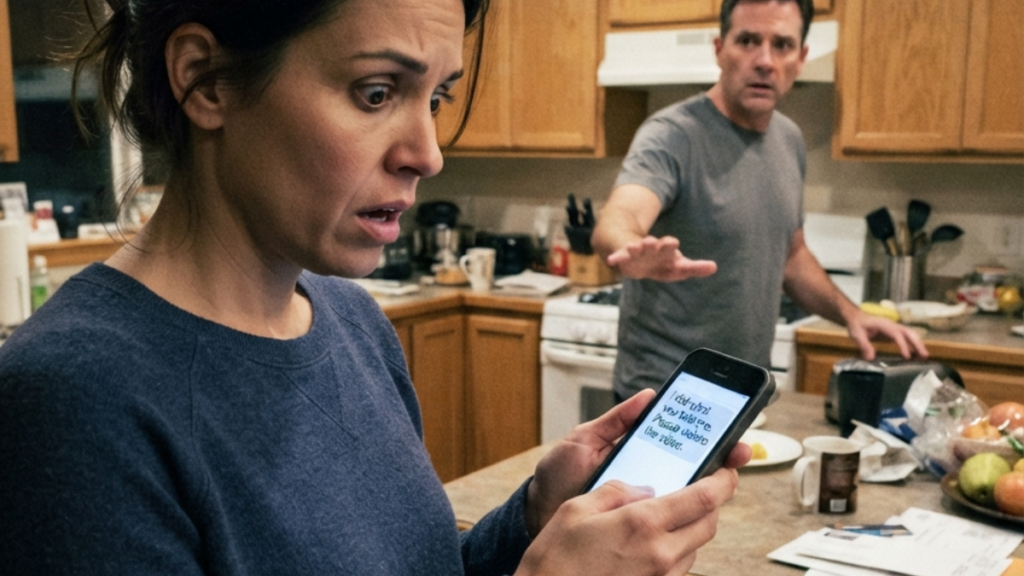
My phone died while I was trying to order Chinese food.
That is how I found out.
There had been no strange behavior from my husband.
No unexplained trips.
No suspicious charges.
No feeling in my stomach telling me something was wrong.
I was sitting at the kitchen island on a Friday night, repeatedly pressing the power button on a phone that had been at three percent for the previous hour.
My husband, Scott, was upstairs taking a shower.
His phone was on the counter beside me.
We had been married for twenty-six years. Using his phone was not unusual. I knew the passcode, and he knew mine.
I picked it up because I wanted the phone number for the Chinese restaurant.
I unlocked it.
Before I could open the browser, a message appeared across the top of the screen.
MAYA C.
I did what you told me. Please delete the video.
I stared at it.
Another message appeared.
Please. You promised.
I forgot about dinner.
I knew a Maya C.
Maya Carson lived four houses away.
She was sixteen years old.
I had known her since she was six.
She sold us Girl Scout cookies. She watered our plants when we went on vacation. Scott taught her how to change a tire the previous summer after she got her license.
I told myself it could be another Maya.
Then I opened the conversation.
There were only a few messages because most of the older ones had apparently been deleted.
Scott had written that afternoon:
Do it before 5. Send me a picture when you’re finished.
Maya responded:
I can’t.
Scott wrote:
Yes, you can.
Then, several hours later:
I did what you told me. Please delete the video.
Please. You promised.
I tapped the contact information.
Maya Carson.
Her photograph was beside her name.
My stomach dropped.
There are combinations of words you never want to see between your fifty-seven-year-old husband and a sixteen-year-old girl.
“Please delete the video” is near the top of that list.
My brain went somewhere horrible immediately.
Then I forced myself to stop.
I had no idea what the video was.
Maybe Scott had caught her drinking.
Maybe she had been vaping.
Maybe she had done something stupid at a party.
Maybe he recorded her damaging someone’s property.
There had to be an explanation that did not involve what I was imagining.
I scrolled upward.
Nothing.
Whatever conversation came before had been deleted.
I heard the shower running upstairs.
I had maybe two minutes.
My own phone was useless, so I grabbed the old iPad we kept on the counter and photographed Scott’s screen.
Then I put his phone exactly where I found it.
He came downstairs a few minutes later wearing sweatpants and rubbing his hair with a towel.
“Did you order?”
“No.”
“Why?”
“My phone died.”
Scott pointed toward his phone.
“Use mine.”
I looked at him.
He had no idea I already had.
“I will.”
He opened the refrigerator.
His phone buzzed.
I watched him glance at it.
Something changed in his expression.
It lasted less than a second.
He picked up the phone and typed.
Then he slipped it into his pocket.
I asked, “Who was that?”
“Mike.”
Mike was his business partner.
“What did he want?”
Scott looked at me.
“Why?”
“No reason.”
“He’s asking about Monday.”
I nodded.
Then I went upstairs and plugged in my phone.
I sat on our bed while it charged.
My hands were shaking.
I wanted to call Maya’s mother immediately.
Then I worried that I would make an accusation I could never take back.
Scott had known Maya since she was a child.
Her parents trusted him.
I trusted him.
Our children trusted him.
Scott was the person neighborhood kids called when their cars would not start.
He helped teenagers prepare for job interviews.
His company gave two small scholarships every year.
He hired high school kids for summer work.
Parents described him as someone who was “good with kids.”
I had said it myself.
I needed to know what the video was before I turned one horrifying sentence into something it might not be.
When my phone reached three percent, I texted Maya.
Hi honey. It’s Mrs. Bennett. Are you home?
The typing bubble appeared.
Then disappeared.
Finally:
Yes.
I wrote:
Can I come over for a minute?
She responded almost immediately.
Why?
I stared at the word.
I wrote:
I just need to ask you something. You’re not in trouble.
The typing bubble appeared again.
Then:
Did he tell you?
My heart started pounding.
I wrote:
Who?
She did not answer.
My phone rang.
Maya.
I answered.
“Hi.”
Her voice was barely audible.
“Mrs. Bennett?”
“Yes.”
“Are you with him?”
I stood up.
“No.”
“Is he home?”
“He’s downstairs.”
Maya started crying.
I closed the bedroom door.
“Maya, I saw the message you sent Scott.”
She stopped speaking.
“I need you to tell me what video you’re talking about.”
“I can’t.”
“Did Scott record you?”
A long silence followed.
Then she whispered, “Yes.”
I sat down.
“What is on the video?”
She cried harder.
I asked the questions I was terrified to ask.
“Did he touch you?”
“No.”
“Did he ask you for anything sexual?”
“No.”
Relief went through me so quickly that I felt guilty for experiencing it.
Something was obviously still terribly wrong.
“What did he record?”
Maya whispered, “Me stealing.”
I did not understand.
“Stealing what?”
“Money.”
“From whom?”
“My mom.”
I stared at the wall.
Maya told me what happened.
Approximately three months earlier, she had been caught shoplifting makeup with two friends.
The store called her parents.
Her father was furious.
Her mother cried.
Maya felt as though everyone suddenly saw her as a criminal.
Scott heard about it because her father mentioned the incident while they were talking outside.
A few days later, Scott saw Maya walking home.
He offered her a ride.
He told her everyone made mistakes.
Maya started crying.
She told him her parents would never trust her again.
Scott said he could help her prove she had learned her lesson.
His first “test” was ridiculous.
He told Maya to take fifty dollars from her mother’s dresser.
Maya refused.
Scott congratulated her.
He told her that refusing proved she could resist doing something wrong even when an adult gave her permission.
Then, several days later, he changed the test.
He told her to take the money and bring it to him.
Maya questioned him.
Scott said this was the real exercise.
He wanted her to confront what it felt like to make the wrong choice deliberately.
Maya trusted him.
Eventually, she did it.
She took fifty dollars from her mother’s dresser.
She met Scott in his truck.
Scott recorded her handing him the money.
Then he gave it back.
He told her to return it.
Maya thought the lesson was over.
It was actually the beginning.
A few weeks later, Scott asked her for a favor.
Her father, Jeff, worked in county zoning administration.
Scott wanted Maya to look at some papers on her father’s desk and tell him whether a particular company appeared anywhere.
Ridgeway Development.
I knew the name.
Scott had spent almost two years publicly opposing a commercial development Ridgeway wanted to build near property he owned.
Maya initially refused.
Scott reminded her about the video.
He did not say, “Do this or I will show your parents.”
He was subtler.
He told her he would hate for her parents to discover that the shoplifting incident had not been a one-time mistake.
Maya looked at the papers.
Then Scott wanted photographs.
She refused again.
He reminded her that he still had the video.
She took the photographs.
I asked, “Is that what you did today?”
“No.”
“What did he have you do today?”
Maya started crying again.
“He gave me an envelope.”
“What was in it?”
“I don’t know.”
“What did you do with it?”
“He told me to put it in my dad’s desk.”
I stood up.
“At his office?”
“Yes.”
“How did you get inside?”
Maya sometimes brought her father lunch.
Nobody questioned her.
That afternoon, Scott gave her a sealed envelope.
He told her exactly which drawer to put it in.
Then he told her to photograph the envelope inside the drawer.
That photograph was the proof he demanded before five.
I asked whether she opened the envelope.
“No.”
“Did Scott tell you what was inside?”
“No.”
“Did you feel anything?”
“Like what?”
“Was it papers? Was it heavy?”
“Both.”
I felt cold.
Then Maya said, “He told me not to touch anything inside.”
I looked toward the bedroom door.
My husband was downstairs.
I asked, “Has Scott ever asked you to do anything else?”
Maya hesitated.
Then she told me about the tracker.
Scott gave her a small black device approximately six weeks earlier.
He told her to place it underneath the passenger seat of her father’s car.
He called it a tracker.
Maya did it.
She did not know whether it was still there.
I asked why she had not told her parents.
“Because of the video.”
“You returned the money.”
“He said it doesn’t matter.”
“Maya, he is a grown man who convinced you to take it.”
“I still did it.”
That sentence told me exactly how Scott maintained control.
He did not need Maya to believe he was innocent.
He needed her to believe she was guilty too.
I told her not to communicate with Scott again.
Then I told her to save anything she still had.
She said most of his messages disappeared because he regularly deleted them.
She had screenshots of a few.
I asked her to keep them.
Then she whispered, “There are other kids.”
I stopped.
“What other kids?”
“I don’t know all of them.”
“How do you know there are others?”
“He calls us his helpers sometimes.”
Us.
I sat down again.
Maya gave me three names.
Evan Schultz.
Nora Blake.
Tyler Mason.
I knew all three.
Evan was seventeen.
His mother had worked with me for years.
Nora was eighteen now but had known Scott since she was a child.
Tyler was sixteen.
He mowed our lawn the previous summer.
“What does he have them doing?”
“I don’t know everything.”
“Tell me what you do know.”
Maya said Evan had gone into his father’s computer for Scott.
Evan’s father was an attorney.
Nora took photographs inside her mother’s office.
Her mother worked at a bank.
Tyler followed people.
“What do you mean, follows people?”
“He drives behind them and tells Mr. Bennett where they go.”
I closed my eyes.
Scott was using teenagers to enter places where he could not easily go himself.
Homes.
Offices.
Computers.
Cars.
Nobody questioned a daughter standing near her father’s desk.
Nobody searched a teenager bringing lunch into an office.
Nobody wondered why a sixteen-year-old was inside his own house.
Scott did not need access.
The children already had it.
I told Maya to wake her parents if necessary.
She said they were both downstairs.
She begged me to come over.
I said I would.
Then I hung up.
I went downstairs.
Scott was watching television.
He looked at me.
“Did your phone come back to life?”
“Yes.”
“Great. I’m starving.”
I stared at him.
Twenty-six years.
Two children.
A granddaughter.
Mortgages.
Vacations.
Deaths.
Christmas mornings.
Hospital waiting rooms.
The man on our sofa was still my husband.
I could not make him fit with the conversation I had just had.
I almost confronted him.
Then I thought about the envelope inside a county office.
I thought about the tracker.
I thought about Evan, Nora, and Tyler.
I needed Scott not to know Maya had talked.
I said, “Rachel called.”
Our daughter.
Scott sat up.
“What’s wrong?”
“Something with the baby.”
“Is Emma okay?”
“I think so. Rachel wants me to come over.”
“I’ll come.”
“No.”
He looked surprised.
“She just wants me.”
That was plausible.
Rachel and I were close.
Scott nodded.
“Call me if you need anything.”
He kissed my forehead.
I walked outside.
I sat in my car for several seconds before starting it.
That was the last time my husband kissed me.
I drove directly to the Carsons’ house.
Jeff opened the door.
Maya stood behind him.
Her eyes were swollen.
Her mother, Andrea, had an arm around her.
Jeff said, “What the hell is going on?”
I walked inside.
Then Maya told them.
It was awful.
Her father became angry, but not at her.
He kept asking why she did not tell him.
Maya finally screamed, “Because I stole from Mom!”
Andrea said, “You took fifty dollars and put it back.”
“You would have hated me.”
“No.”
“He said you would.”
The room became quiet.
Jeff asked, “Who said?”
Maya looked at me.
Then she said, “Mr. Bennett.”
That was the first time I heard my husband’s name spoken like the name of someone dangerous.
Jeff called the police.
He also called someone at work.
Nobody went to retrieve the envelope.
An officer arrived.
Then another.
They asked Maya questions.
They photographed her phone.
They asked about the tracker.
Jeff did not touch his car.
One officer inspected it.
The device was still underneath the passenger seat.
I felt sick when they removed it.
At approximately eleven, I went home.
Scott was asleep.
Apparently, he gave up on Chinese food and made a sandwich.
I stood in our bedroom doorway watching him.
I was not afraid he would hit me.
Scott had never been violent.
His weapon appeared to be information.
He found the thing someone was most ashamed of.
Then he made himself useful.
He helped.
He reassured.
He protected.
Then, when he needed something, he reminded them what he knew.
I slept in the guest room.
The next morning, investigators recovered the envelope from Jeff’s office.
Jeff called me later.
He sounded shaken.
I asked what was inside.
He said he had been told not to discuss details.
Then he said, “Linda, he was trying to frame me.”
My stomach dropped.
“For what?”
The envelope contained a large amount of cash and copies of documents connected to Ridgeway Development.
Placed together inside the private desk drawer of a county employee involved in zoning matters, they looked like evidence of a bribe.
Scott had sent Jeff’s own sixteen-year-old daughter into the building to plant them.
I knew immediately why.
Scott owned twelve acres near the proposed Ridgeway project.
He publicly opposed the development.
I thought he cared about traffic and environmental issues.
Months earlier, another developer had expressed interest in Scott’s land.
If Ridgeway’s project failed, Scott’s property became substantially more valuable.
I had never connected the two things.
Investigators did.
By afternoon, they had a warrant.
Scott did not come home.
Police intercepted him elsewhere.
They searched our house.
I sat in the backyard while investigators carried electronics through my kitchen.
Computers.
Old phones.
Hard drives.
A tablet.
Then they opened a locked cabinet in Scott’s office.
Inside were dozens of flash drives.
Each had a label.
Not names.
Initials.
Dates.
Short descriptions.
MC — THEFT.
I knew immediately.
Maya Carson.
The video Scott promised to delete was still there.
Then:
ES — PILLS.
NB — CAR.
TM — VANDALISM.
I recognized the initials.
Evan.
Nora.
Tyler.
There were more.
Dozens more.
The investigation expanded.
Evan talked first.
At sixteen, he had been caught with prescription pills.
Scott found out.
He told Evan he could help prevent one stupid mistake from destroying his future.
He recorded Evan admitting what happened.
Months later, Scott asked Evan to access his father’s computer.
Evan’s father was an attorney.
Scott wanted information about one of his clients.
Evan refused.
Scott reminded him about the video.
Evan accessed the computer.
Nora had driven after drinking when she was seventeen.
She hit a curb and damaged her mother’s car.
Nobody was hurt.
Terrified, she called Scott because her parents were out of town.
Scott arrived.
He filmed her admitting she had been drinking.
Then he helped her make the damage look less serious before her mother came home.
Months later, he asked Nora to photograph paperwork in her mother’s home office.
She did.
Tyler and several friends broke windows at an abandoned warehouse.
Scott obtained security footage through someone he knew.
He told Tyler he could make sure the owner never saw it.
After that, Tyler followed cars for Scott.
Photographed license plates.
Delivered envelopes.
Watched buildings.
Each teenager believed the arrangement was unique.
None understood the others.
That was how Scott kept them from comparing stories.
Then investigators found the spreadsheet.
Thirty-two names.
The oldest entries went back eleven years.
The youngest person listed was fifteen.
Beside each name was a short description of the leverage Scott possessed.
Shoplifting.
Drugs.
Car.
Fight.
Money.
Cheating.
Vandalism.
Test.
Pregnancy.
The investigators did not show me unredacted information that did not concern me.
They did not need to.
I recognized fourteen names from initials and context alone.
Children of friends.
Former employees.
Neighbors.
Kids from church.
Teenagers from sports teams.
Then I saw:
RB — ACCIDENT.
My daughter was Rachel Bennett.
Eleven years earlier, Rachel was twenty-one.
I stared at the page.
“That could be my daughter.”
The detective asked me to call her.
Rachel came to the station.
She looked confused.
Then the detective mentioned the accident.
Rachel’s face changed.
She looked at me.
“Dad told you?”
I said, “What did he tell me?”
Rachel started crying.
When she was twenty-one, she drove after drinking.
She hit a parked car.
Nobody was injured.
She panicked.
She called Scott.
He came.
He filmed her admitting she had been drinking.
He told her he would keep the recording as insurance that she never did it again.
Rachel agreed.
She was ashamed.
She never drove after drinking again.
She believed Scott eventually deleted the video.
He did not.
I asked whether he ever requested anything from her.
Rachel said no.
Then she stopped.
I knew.
“What did he ask you to do?”
“It wasn’t anything.”
“Rachel.”
She looked down.
Approximately a year later, Scott asked Rachel to go through my desk.
He said I was hiding financial information from him.
I had an investment account funded with money I inherited from my mother.
It was not secret.
Scott simply did not have access to it.
He told Rachel he wanted information because he was planning an anniversary investment surprise.
Rachel knew the explanation was strange.
Then Scott reminded her about the accident.
She photographed my statements.
She sent them to him.
I felt cold.
“Was that all?”
Rachel hesitated.
Then she said, “He had me sign something.”
“What?”
“I don’t remember.”
“When?”
“A few years later.”
“What did he say it was?”
“Insurance paperwork.”
I thought about our finances.
Scott handled almost everything.
Then I remembered 2016.
That year, I moved a significant portion of my inheritance into a joint investment account.
Scott recommended the adviser.
At the time, I thought it was my decision.
I suddenly wanted every financial record we had ever created.
The investigators did too.
That was when I understood the teenagers were not Scott’s hobby.
They were infrastructure.
He used them to obtain information.
Influence business disputes.
Access private documents.
Track people.
Manipulate financial decisions.
They were useful precisely because nobody viewed them as agents of a fifty-seven-year-old man.
They were somebody’s daughter.
Somebody’s son.
Some kid dropping off lunch.
Some teenager borrowing a car.
They belonged in the rooms Scott needed entered.
Then investigators showed me a photograph.
A fifteen-year-old boy sat in the passenger seat of Scott’s truck.
I recognized him.
Caleb Foster.
Eight years earlier, Caleb disappeared for three days.
The entire neighborhood searched.
Scott organized volunteers.
He printed flyers.
He drove around until two in the morning.
I brought coffee to the searchers.
Caleb eventually returned.
His parents said he had been hiding with a friend because he was afraid to come home.
We all celebrated.
I remembered Scott hugging Caleb’s father in our driveway.
I remembered telling my husband he was a good man.
The photograph was taken on the first night Caleb was missing.
Caleb was sitting inside Scott’s truck.
I whispered, “He found him.”
The detective nodded.
“Why didn’t he bring him home?”
They were still trying to answer that.
More photographs showed Caleb eating fast food.
Sleeping in the truck.
Standing outside a motel.
Scott knew exactly where the missing fifteen-year-old boy was while dozens of people searched.
Then investigators recovered a video.
Caleb admitted he ran away because he had stolen several thousand dollars from his parents.
He believed his father would send him away if he returned.
Scott told him he could help.
He kept Caleb hidden for three days.
He convinced Caleb’s parents that their son came home voluntarily.
Caleb believed Scott had saved him from criminal charges and from his father.
Afterward, Scott began asking for favors.
Investigators documented at least nine over the following four years.
Caleb entered buildings.
Delivered packages.
Obtained information.
Once, he used identification that was not his.
Then, approximately two years before I found Maya’s message, Caleb disappeared from his parents’ lives again.
This time, nobody filed a missing-person report.
He was an adult.
His parents believed he chose to cut contact.
The detective told me they were trying to locate him.
I thought about the spreadsheet.
Thirty-two names.
Then I asked the question that had been bothering me since I saw it.
“What does ‘pregnancy’ mean?”
The detective looked at me.
“I can’t discuss another person’s information.”
“I understand.”
I pointed toward the list.
“I’m not asking who. I’m asking whether that means what I think it means.”
He said, “We are still investigating.”
That answer was enough.
Scott had not merely collected evidence of crimes.
Some of these kids had not committed crimes at all.
They had secrets.
Things they feared their parents discovering.
Things that could embarrass them.
Things that could change relationships.
Scott did not care whether the leverage represented wrongdoing.
He cared whether the person believed disclosure would hurt.
That was the common denominator.
Shame.
Then the detective asked me something.
“Mrs. Bennett, did Scott ever help you with a problem before you started dating?”
I almost laughed.
“We’ve been married twenty-six years.”
“I understand.”
“We met when I was twenty-seven.”
“Did he help you with anything around that time?”
I started answering no.
Then I remembered my brother.
My younger brother, Kevin, was twenty-three when Scott and I started dating.
Kevin had gotten into trouble.
Nothing enormous.
He was arrested after a bar fight.
My parents were devastated.
I was terrified he would lose his job.
Scott knew someone.
That was how I always told the story.
Scott knew someone who knew an attorney.
The charge was reduced.
Kevin kept his job.
My family adored Scott afterward.
My father said, “That man showed up when we needed him.”
I looked at the detective.
“Yes.”
“What happened?”
I told him.
He wrote it down.
I asked why he wanted to know.
He said they had found older materials.
“How old?”
“Older than the spreadsheet.”
My stomach tightened.
“Does Kevin’s name appear?”
The detective would not answer yet.
I went home and called my brother.
Kevin remembered the bar fight.
Of course he did.
He also remembered something I did not.
Scott arrived at the police station before I did.
I stopped.
“How?”
“I thought you called him.”
“I barely knew him.”
Kevin became quiet.
“You were dating.”
“We had been on three dates.”
Kevin said Scott was already there when my parents arrived.
He talked to the attorney.
He talked to police.
He told everyone he was my boyfriend.
I had not called him.
My mother did not call him.
My father did not call him.
Kevin assumed I did.
I asked who told Scott about the arrest.
Kevin did not know.
Then he said, “Why does this matter?”
I did not answer.
The next morning, investigators called.
They had opened another storage box from Scott’s office.
Not flash drives this time.
Videotapes.
The oldest was twenty-nine years old.
One was labeled:
KB — FIGHT.
Kevin Bennett.
My brother.
The bar fight happened before Scott and I were officially a couple.
Scott had recorded Kevin discussing it.
I sat at my kitchen table.
Twenty-nine years.
For days, I believed Scott had spent eleven years building a system around vulnerable teenagers.
Then the timeline moved backward.
He had used the same basic method on my twenty-three-year-old brother before he married me.
Help first.
Record the secret.
Become indispensable.
Keep the evidence.
Wait.
I asked whether Scott ever used Kevin for anything.
Investigators had found one note.
Approximately six months after the arrest, Scott asked Kevin to do him a favor.
Nothing criminal.
Nothing dramatic.
Scott wanted to know whether I was still seeing an ex-boyfriend.
Kevin checked.
He told Scott I was not.
I closed my eyes.
The first person I could prove Scott ever turned into a “helper” was my own brother.
The favor was about me.
I had spent twenty-six years believing Scott entered my family because we fell in love.
Now I had evidence that before we were serious, he had already discovered something about my family that made him useful.
He helped Kevin.
My parents trusted him.
Kevin owed him.
Then Kevin quietly answered questions about me.
That did not prove Scott engineered our entire relationship.
It did prove the method was older than our marriage.
I called Rachel.
She came over.
We sat at the kitchen table until midnight.
At one point, she asked, “Do you think Dad ever helped anyone just because he wanted to help them?”
I thought about it.
“Yes.”
She looked surprised.
“How can you know?”
“Because if I decide every good thing he ever did was manipulation, then I’m doing exactly what he did. I’m deciding the answer before I have the information.”
Rachel cried.
So did I.
Scott had genuinely helped people.
That was part of what made him effective.
He did not fake kindness every time.
Sometimes he solved a problem and asked for nothing.
Sometimes he solved a problem and remembered it for years.
Sometimes he created leverage.
The person receiving the help never knew which kind it was.
Two days later, investigators located Caleb.
He was alive.
He lived three states away.
He initially refused to speak.
Then he learned Scott had been arrested.
He changed his mind.
I did not meet Caleb.
I learned pieces through investigators later.
Caleb had not cut off his parents because he stopped loving them.
Scott told him he had to.
By then, Caleb had performed years of favors.
Some were serious.
Scott convinced him that if investigators ever connected them, Caleb would go to prison.
Scott told him his parents would be safer if they knew nothing.
Then Scott helped Caleb move.
He found him work.
He found him an apartment.
Caleb thought Scott was protecting him.
Even after everything.
That was the most disturbing part.
When investigators first told Caleb that Scott had kept the original video from when he was fifteen, Caleb apparently said:
“He promised he deleted that.”
The same sentence.
Different child.
Different year.
Same promise.
Scott never deleted the videos.
That was not because he forgot.
The videos were the system.
Then investigators discovered something inside Caleb’s files that changed the entire Ridgeway case.
Three years earlier, Scott had instructed Caleb to create a company.
A small consulting business.
Caleb barely understood why.
Money moved through it.
Scott told him it was legitimate subcontracting work.
It was not.
The company connected Scott financially to the developer that would benefit if Ridgeway’s project failed.
The same developer interested in Scott’s land.
Scott was not simply opposing Ridgeway because another project might increase his property value.
He had a hidden financial arrangement with its competitor.
Jeff Carson was in the way.
Scott needed Jeff discredited.
He could not put cash in Jeff’s desk himself.
He could not risk entering a county office.
Maya could.
A sixteen-year-old girl bringing something to her father belonged there.
If the envelope had been discovered before Maya confessed, Jeff could have faced an investigation for corruption.
Even if he were eventually cleared, Ridgeway’s approval process could have been damaged.
Delayed.
Maybe derailed.
Scott would remain outside the entire thing.
That was what the teenagers gave him.
Distance.
Scott created the objective.
A child performed the visible act.
Then the child stayed quiet because Scott possessed a video proving something embarrassing.
I thought again about Maya’s text.
I did what you told me.
Please delete the video.
She believed she was completing a transaction.
One final favor.
Then Scott would return her secret.
He never intended to.
There would always have been another favor.
That was when I stopped thinking of the thirty-two names as a list.
It was a chain.
Scott did not collect people because he knew exactly how he would use them.
He collected leverage.
Then he waited until a need appeared.
A lawyer’s computer.
A bank employee’s office.
A county official’s desk.
A car that needed following.
A document that needed photographing.
A person who needed watching.
He looked at the adults around him and saw locked doors.
Then he looked at their children and saw keys.
For years, everybody thought Scott was wonderful with teenagers.
He remembered their problems.
He listened without judging.
He showed up when they were scared.
He told them one mistake did not define them.
That part was true.
One mistake did not define them.
It simply gave Scott something to hold.
And when he finally needed the door their family could open for him, he reminded them that he still had the key.
Caleb was alive.
Investigators found him six days later in Colorado.
He was twenty-three years old.
He had a job installing commercial flooring, a girlfriend, an apartment, and almost no relationship with his parents.
When detectives first contacted him, he refused to speak.
Then they told him why they were calling.
They mentioned Scott.
Caleb hung up.
He called back forty minutes later.
According to the detective who later explained it to me, Caleb’s first question was not whether Scott had been arrested.
He asked, “Did he lose the videos?”
That sentence told them almost everything.
Caleb had spent eight years believing Scott still had something that could destroy him.
The theft from his parents had been real.
At fifteen, Caleb stole approximately $3,800 his father kept in a home safe.
He planned to run away.
Scott found him at a bus station.
Instead of calling his parents, Scott took him to a motel.
For three days, while Caleb’s family and half the neighborhood searched, Scott brought him food and convinced him that going home immediately would lead to police, juvenile detention, and possibly his parents sending him away.
None of that had come from Caleb’s parents.
It came from Scott.
Then Scott offered to fix it.
Caleb recorded a confession.
Scott held the stolen money.
Scott eventually returned most of it anonymously.
Then he coached Caleb on what to tell his parents.
Caleb came home.
Everyone celebrated.
Scott was one of the people standing in the driveway when he returned.
I remembered that afternoon.
His mother screamed when she saw him.
His father grabbed him so hard they nearly fell over.
Scott stood beside me with his hands in his jacket pockets.
I cried.
Scott put his arm around me.
I said, “Thank God.”
He said, “I knew they’d find him.”
He already had.
That realization was difficult enough.
Then Caleb explained what happened afterward.
Scott started asking for favors.
At first, they seemed harmless.
Write down a license plate.
Tell him whether a certain car was outside a house.
Drop an envelope into a mailbox.
Take a photograph of a document.
Caleb did them because Scott had saved him.
That was how he understood the relationship initially.
Then he tried to stop.
Scott reminded him about the confession.
He reminded Caleb that his parents believed the missing money had been returned by whoever found it.
He suggested that if they learned the truth, they might decide Caleb had lied about everything.
By sixteen, Caleb understood he was not repaying a favor.
He was trapped.
Over four years, Scott used him repeatedly.
Caleb followed people.
He photographed houses.
He retrieved documents from unlocked offices.
Once, Scott sent him to a hotel lobby to photograph a man meeting someone.
Another time, Caleb was told to leave an envelope inside a parked vehicle.
He never knew why.
That became a pattern investigators encountered repeatedly.
The teenagers knew their assignments.
They rarely knew the larger purpose.
That made reconstructing everything difficult.
Thirty-two names did not mean thirty-two people knowingly participating in one scheme.
There was no secret club.
No meetings.
No group chat.
Most of them had no idea the others existed.
Scott kept them separate.
That was essential.
If Maya had talked to Evan, and Evan had talked to Nora, and Nora had talked to Caleb, they might have realized something much earlier.
Instead, each believed his or her situation was uniquely shameful.
Scott made embarrassment do the work that physical threats would have done.
The more investigators examined the spreadsheet, the more they realized it was not really a list of accomplices.
It was an inventory of leverage.
Some entries had only one or two notes.
Others had years.
Several teenagers apparently never did anything for Scott at all.
He had collected information and never used it.
One boy had been caught cheating on the SAT.
A girl had secretly terminated a pregnancy at seventeen.
Another teenager had been stealing medication from his grandmother.
One girl had sent intimate photographs to a boyfriend.
I never saw those materials, and I did not want to.
Investigators handled anything involving minors and intimate imagery separately.
What mattered to me was that Scott had written these vulnerabilities down as though they were assets.
Beside some names, he had written:
AVAILABLE.
Others said:
UNRELIABLE.
One said:
PARENTS TOO INVOLVED.
Another:
PANICS EASILY.
Maya’s entry said:
WANTS APPROVAL. FEAR OF DISAPPOINTING MOTHER.
I cried when I learned that.
Scott did not simply know what Maya had done.
He knew which part of it hurt her most.
She was not primarily afraid of police.
She was afraid her mother would look at her differently.
Scott identified that fear and used it.
Rachel’s entry was worse for me.
RB — ACCIDENT.
Then:
MOTHER DOES NOT KNOW FULL STORY.
Then:
RESPONDS TO GUILT.
My daughter had been reduced to three lines.
I asked whether there was an entry for me.
There was.
It did not appear on the same spreadsheet.
Investigators found a separate folder connected to our finances.
I expected fraud.
There was some.
Not in the way I imagined.
Scott had not emptied our accounts.
He had not secretly transferred everything overseas.
He had not taken out enormous loans in my name.
That almost would have been easier to understand.
Instead, he had spent years quietly influencing where my money went.
Rachel’s photographs of my inheritance statements helped him determine exactly what I had.
The document she signed in 2016 turned out to be related to a financial-information release.
It did not transfer ownership of anything.
Scott had presented it to Rachel as an insurance document because he wanted access to information connected to an account where she was listed as a contingent beneficiary.
It gave him information he was not supposed to have.
Then he used that information to pressure me toward moving money.
Not directly.
Scott rarely operated directly.
He introduced me to an adviser.
He showed me projections.
He talked about simplifying our finances.
He told me separate accounts created unnecessary complications if something happened to one of us.
He never forced me.
I signed everything myself.
That fact tortured me until my attorney said something useful.
“You made decisions based on information selected by someone who had secretly obtained information about you.”
That was different from saying every financial decision I made was invalid.
Some investments performed well.
Some did not.
The violation was that Scott had secretly mapped my finances before presenting himself as a husband casually suggesting what we should do with our money.
Investigators eventually identified why he wanted access to Jeff Carson’s zoning information too.
It was partly about Ridgeway.
Scott owned land near the proposed development.
He had also quietly partnered with another investor who stood to benefit if Ridgeway’s application failed.
Jeff was not necessarily capable of killing the project himself.
Scott apparently believed discrediting him could delay approvals and create enough political chaos to make the developer withdraw.
The cash Maya planted was supposed to be discovered later.
Scott had prepared an anonymous complaint.
Investigators found a draft.
It alleged Jeff was accepting payments from Ridgeway.
That was the part I could not get over.
Scott had spent years publicly opposing Ridgeway.
Then he planned to make it look like Jeff was secretly helping them for money.
If the envelope had been discovered without Maya coming forward, Jeff might have spent months trying to prove cash planted inside his own desk did not belong to him.
His sixteen-year-old daughter would have known exactly how it got there.
She would also have believed admitting the truth meant exposing herself as a thief.
Scott had created two people in the same family who could be destroyed by the same envelope for opposite reasons.
That was how his mind worked.
He built situations where silence seemed safer than truth.
The police arrested him before the anonymous complaint was ever sent.
Jeff kept his job.
The Ridgeway investigation became its own mess, but authorities eventually made clear there was no evidence Jeff accepted a bribe.
Maya’s cooperation mattered enormously.
So did the messages.
Scott had deleted many conversations from his phone.
He had not deleted everything everywhere.
Teenagers had screenshots.
Old backups existed.
Some messages were recovered.
Receipts matched dates.
Location records matched assignments.
Photographs contained metadata.
The flash drives connected names to recordings.
Scott had spent years believing the teenagers were his weakest point.
They became the strongest witnesses against him.
Then there was Rachel.
I had been afraid to ask whether Scott ever used her again.
Eventually, she told me herself.
The bank statements were not the only thing.
When Rachel was twenty-three, Scott asked her to find a key in my jewelry box.
She did.
She photographed it.
Scott asked whether there was a label.
There wasn’t.
Then he told her to put it back.
Rachel had forgotten about it until investigators began asking questions.
I knew which key.
It belonged to a safe-deposit box my mother opened with me years earlier.
Scott had always known the box existed.
He claimed he did not care what was inside because it was “between you and your mom.”
Apparently, he cared enough to use my daughter to locate the key.
Investigators found photographs of documents from that box on one of Scott’s drives.
I asked how he got them.
Nobody knew for certain.
There was no evidence Rachel ever gave him the key.
She insisted she had not.
I believed her.
The photographs were taken years later.
Maybe Scott found the key himself.
Maybe he accessed the box through some other means.
Investigators could not establish it.
For once, I accepted not knowing.
I had learned something important by then.
Once you discover someone has deceived you extensively, there is a temptation to make him responsible for every unexplained thing that ever happened.
I refused.
If evidence showed Scott did something, I accepted it.
If evidence did not show it, I left it alone.
Otherwise, he would continue controlling my understanding of my own life even after he was gone.
The investigation lasted more than a year.
Not all thirty-two people became part of the criminal case.
Some entries involved conduct too old to prosecute.
Some teenagers had refused Scott entirely.
Some situations were ambiguous.
Some people wanted nothing to do with the investigation.
Others spoke immediately.
There were also names investigators could not connect to any illegal act by Scott.
The spreadsheet showed he had collected vulnerabilities.
It did not prove he successfully exploited every one.
I was grateful prosecutors kept those distinctions.
The truth did not need exaggeration.
The truth was already grotesque.
Scott’s attorney initially described some of the relationships as mentorship.
That word made me furious.
A mentor helps a teenager survive a mistake without becoming defined by it.
Scott preserved the mistake because it made the teenager useful.
He did not forgive.
He collected.
That was the difference.
The case ultimately involved coercion, unlawful access to information, attempted framing of Jeff, financial offenses, and other conduct tied to specific incidents prosecutors could prove.
I will not pretend I understood every charge.
I attended meetings.
I read documents.
Eventually, legal language began blurring together.
The emotional truth was simpler.
Scott found young people at the moment they believed one mistake could ruin their lives.
He offered rescue.
Then he made himself the only person who could keep them rescued.
The strangest part was how many parents had thanked him.
Maya’s father had thanked Scott for being a good influence.
Evan’s mother once told me Scott was “the only adult Evan listens to.”
Nora’s mother sent him a bottle of bourbon for helping Nora after the car accident.
Caleb’s father hugged him after Caleb came home.
I had thanked him for helping Rachel.
Scott built a reputation as the person you called when something went wrong.
Nobody realized that sometimes he needed the problem to remain useful after he solved it.
My divorce was finalized before the criminal case ended.
Scott wrote to me several times.
I read the first letter.
He said the situation had been “mischaracterized.”
He said he had never forced anyone.
That sentence sounded familiar.
Maya could have refused.
Evan could have refused.
Rachel could have told me.
Caleb could have gone home.
Technically, everyone had choices.
Scott simply made one choice feel catastrophic and another feel survivable.
That was enough.
He also said some of the teenagers benefited from his intervention.
Caleb came home.
Evan stopped using pills.
Rachel never drove after drinking again.
Maya stopped shoplifting.
Scott seemed to believe those outcomes proved something good about what he did.
They did not.
People can grow after being manipulated.
That does not turn manipulation into treatment.
I did not answer.
Rachel did.
I did not know until months later.
She sent him one sentence.
“You don’t get credit for the person I became after being afraid of you.”
I was proud of her.
Maya struggled more than I expected.
Her parents did not punish her for the fifty dollars.
That surprised her.
Andrea told her she cared much more about why her daughter had been terrified to tell her the truth.
Maya confessed everything.
The shoplifting.
The money.
The documents.
The tracker.
The envelope.
Her parents were angry.
They were also devastated that their daughter had spent months believing honesty would cost her family.
Jeff later told me, “I would rather have found out she stole every dollar in my wallet than have her spend one more day thinking she owed Scott.”
Maya started counseling.
She graduated high school.
I attended the party.
I almost did not go because I worried my presence would remind everyone of Scott.
Andrea told me to stop making decisions for other people.
That made me laugh because I needed to hear it.
Maya went to college two hours away.
She studied social work.
I do not know whether that had anything to do with what happened.
I never asked.
Evan repaired his relationship with his father.
Nora moved out of state.
Tyler refused to speak publicly about anything and asked everyone to leave him alone.
We did.
Caleb was the hardest.
He eventually returned to Michigan to meet with investigators.
He did not stay with his parents.
He stayed at a hotel.
His mother asked me whether she should go there.
I told her I had no idea.
I had stopped pretending I knew what other people needed.
Caleb eventually met them.
It did not fix eight years.
His parents learned that while they searched for their missing fifteen-year-old son, Scott knew exactly where he was.
His father had called Scott twice during those three days.
Scott answered both times.
He told him to keep looking.
Caleb’s father could barely talk about that.
He said, “I asked him where I should search.”
Scott suggested parks.
Bus stations.
Friends’ houses.
At the time, Caleb was sleeping in a motel room Scott paid for.
Caleb’s parents had blamed themselves for years.
They thought they failed to notice their son was planning to run away.
Some of that was true.
Families miss things.
Teenagers hide things.
But the three days of disappearance had been artificially extended by an adult who found the child and chose not to bring him home.
Caleb eventually told his parents the entire story.
They did not magically become close.
They started speaking.
That was enough.
The criminal case ended almost two years after I picked up Scott’s phone.
He entered guilty pleas to multiple charges rather than take everything to trial.
His sentence was long.
I attended.
So did Rachel.
Maya came with her parents.
Caleb sat several rows away from his.
Several people from the spreadsheet submitted statements.
Some spoke.
I did too.
I had not planned to.
Then the prosecutor asked whether I wanted to.
I realized I did.
I did not talk about my marriage.
I talked about the phone.
I told the judge that the message I saw contained two sentences.
I did what you told me.
Please delete the video.
I said those sentences explained Scott better than anything I had heard during the investigation.
The first sentence described what he wanted.
The second described how he got it.
Do what I tell you, and I will make the thing you fear disappear.
Except he never deleted it.
He kept the videos.
He kept the photographs.
He kept the confessions.
He kept the screenshots.
He kept the mistakes.
He needed people to believe their worst moment belonged to him.
Then I sat down.
Scott did not look at me.
I was glad.
After sentencing, Maya hugged me.
She was eighteen by then.
She said, “I’m sorry this happened because of my text.”
I pulled away from her.
“No.”
She looked confused.
“This did not happen because of your text.”
“You know what I mean.”
“I do, and I don’t want you saying it that way.”
I told her Scott created everything that happened.
Her text exposed it.
Those were not the same thing.
She nodded.
Then she smiled.
“I guess your phone dying helped.”
I laughed.
For the first time, I realized how absurd the beginning sounded.
If my phone had been charged, I would have ordered Chinese food from it.
I would not have touched Scott’s phone.
Maya’s message would have appeared.
Scott would have read it.
He probably would have deleted it.
Maybe she would have told someone eventually.
Maybe another teenager would have.
Maybe investigators would have discovered Jeff’s planted envelope.
Maybe Scott’s plan would have worked.
I do not know.
I stopped building alternate timelines.
The one that happened was enough.
I sold our house.
Rachel helped me move.
While packing Scott’s office, investigators had already cleared everything they needed, so I went through the remaining junk.
Pens.
Old tax folders.
Business cards.
Charging cables.
Receipts.
At the back of one drawer, I found a stack of thank-you cards.
Most were from parents.
Thank you for talking to Evan.
Thank you for helping Nora.
Thank you for looking out for Maya.
Thank you for everything you did for Caleb.
I sat on the floor reading them.
For years, those cards would have proved to me that Scott was a good man.
Now they proved something else.
Nobody saw the whole person.
Not even me.
Each parent saw the adult who showed up.
Each teenager saw the adult who knew their secret.
Each business associate saw the man who could get information.
Each person had one piece.
Scott survived because nobody compared them.
I threw the cards away.
I kept one thing from his office.
An old charger.
It happened to fit my phone.
Rachel laughed when she saw me put it in the kitchen drawer at my new house.
“You couldn’t buy a new one?”
“This one works.”
She said that was fair.
My relationship with Rachel changed after everything.
For years, she had carried shame about that accident.
She thought I would see her differently if I knew.
When she finally told me the entire story, I was angry.
She had driven after drinking.
She could have killed someone.
I told her that.
Then I hugged her.
She cried harder because both things could happen at once.
I could be angry about what she did and still love her.
That was the lesson Scott prevented all those teenagers from learning.
He convinced them discovery meant destruction.
If your parents learn you stole, they will stop loving you.
If your mother learns you drove drunk, she will never trust you.
If your father learns you took pills, your future is over.
If everyone learns you ran away, you can never go home.
Scott’s power lived inside the distance between making a mistake and admitting it.
Once people crossed that distance, he became much less powerful.
Three years after the text, I was at Rachel’s house when my phone died again.
Her daughter wanted to show me a video.
I reached for Rachel’s phone without thinking.
Then I stopped.
Rachel laughed.
“What?”
“My phone is dead.”
“So?”
I looked at hers.
For half a second, I was back at my kitchen island.
Scott upstairs in the shower.
His phone on the counter.
A message appearing across the screen.
Rachel handed me hers.
“You know my code.”
I did.
I unlocked it.
Nothing terrible appeared.
We watched the video.
It was my granddaughter attempting to teach their dog to shake hands.
The dog refused.
That was all.
Later that night, I thought about Maya.
She had been sixteen years old when she finally became more afraid of Scott than she was of telling the truth.
She sent one message asking him to destroy the thing he had used to control her.
He never got the chance.
I saw it first.
For years, Scott made people believe their secrets were safest with him.
In the end, the first person who stopped keeping his secret was the girl he thought was too frightened to tell anyone.
She did what he told her.
Then she did the one thing he never expected.
She told us why.
