

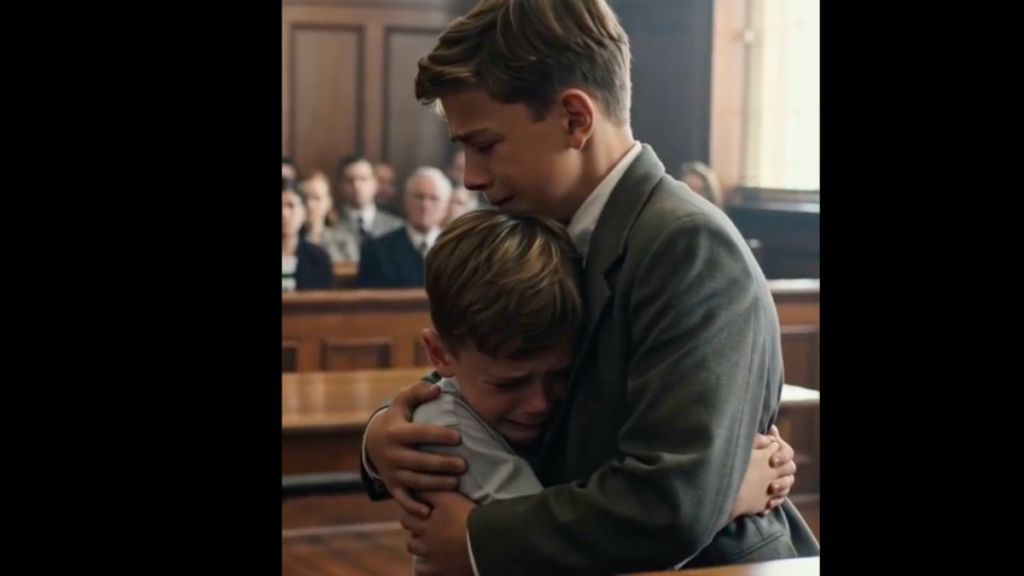
The Promise I Made Outside the Courthouse
I was fourteen years old when I told my little brother I would bring him home.
I didn’t know how I was supposed to do that.
I didn’t have a job.
I didn’t have a driver’s license.
I didn’t even know how court worked.
But Caleb looked at me like I could fix everything.
So I lied.
Not the cruel kind of lie.
The kind you tell a six-year-old because the truth would break them.
“This isn’t forever,” I told him outside the courthouse. “I’m going to bring you home.”
He stood beside a gray caseworker’s car with tears running down his face.
His stuffed bear was tucked under one arm, and both his hands were gripping my jacket like if he held on tight enough, nobody could separate us.
“You’re coming too, right?” he asked.
That question still lives in my head.
I remember crouching down so I could look him in the eye.
I remember forcing myself to smile because he was already scared enough.
And I remember the moment the caseworker gently pulled him away from me.
I watched that car disappear from the parking lot while I stood there with my fists clenched so tight my nails cut into my palms.
That was the moment my life stopped being about me.
Everything after that was about keeping a promise I had no idea how to keep.
Before Everything Fell Apart
People always ask when things started going wrong with our family.
The truth is, I don’t know.
When you grow up inside chaos, it doesn’t feel chaotic at first.
It just feels normal.
Our mom could be amazing sometimes.
She would dance around the kitchen while making grilled cheese sandwiches.
She told stories that made Caleb laugh so hard milk came out of his nose.
On good days, our apartment felt warm even in winter.
But the bad days slowly became more common.
Some mornings she wouldn’t get out of bed.
Some nights she disappeared for hours and came back acting like nothing happened.
By the time I hit middle school, I already knew how to cook boxed macaroni, stretch cereal for three days, and make excuses when Caleb showed up late to school.
“He was sick.”
“The bus didn’t come.”
“Mom had an appointment.”
I became good at lying for survival.
And Caleb believed me every time.
That made it worse somehow.
Learning How to Be the Adult
I don’t think there was one exact moment I became more of a parent than a brother.
It happened slowly.
I tied Caleb’s shoes before school.
I checked his homework.
I sat beside him during thunderstorms because he hated loud noises.
If he woke up crying from nightmares, he came to me.
Not our mom.
Me.
I remember one winter night when the heat stopped working in our apartment.
Caleb was shivering under two blankets, asking if we were going to freeze.
I told him no.
Then I stayed awake until morning pretending not to be cold because I didn’t want him to panic.
I was thirteen.
Sometimes I look back and realize how strange that was.
At the time, it just felt like another Tuesday.
The Night Everything Changed
The social workers came on a Thursday evening.
I remember that because Caleb and I were eating pancakes for dinner.
Breakfast food was cheap, and he loved it, so I made pancakes a lot.
There was a knock at the door.
Then another.
Harder.
My stomach dropped before I even opened it.
Two women stood outside with tired eyes and heavy coats.
A police officer waited near the stairs.
One of the women asked if our mother was home.
She wasn’t.
I already knew what was happening before they stepped inside.
Caleb didn’t understand at first.
He just sat at the table holding his fork while the women spoke softly to each other and looked around our apartment.
Then one of them started putting his clothes into a trash bag.
That’s when he started crying.
Not loud at first.
Just confused.
“What’s happening?”
Nobody answered him directly.
The whole apartment suddenly felt smaller.
Too bright.
Too quiet except for Caleb crying harder and harder while clutching that stuffed bear against his chest.
I tried to calm him down.
I tried to sound older than I was.
“It’s okay,” I kept saying. “I’m right here.”
But the truth was, I had no control over any of it.
And deep down, I think he knew that.
Separate Directions
They didn’t take us together.
That was the part I couldn’t understand.
I kept asking why.
One of the caseworkers explained that I was too old for the same foster placement Caleb qualified for.
They said they were “working on options.”
I hated that phrase.
Working on options.
It sounded clean and organized.
Like people weren’t tearing apart what little family we had left.
The next morning, we sat outside the courthouse waiting for transportation.
Caleb leaned against me quietly.
He looked so small.
When the caseworker finally called his name, he grabbed my sleeve in panic.
“You’re coming too, right?”
That was when I made the promise.
The one that followed me for years afterward.
The Visits That Never Got Easier
At first, I thought things would move quickly.
I honestly believed the adults had some kind of plan.
Instead, weeks turned into months.
Caleb bounced between foster homes while I stayed behind in Cedar Rapids, trying to survive high school while meeting with counselors and court workers who kept telling me to “focus on my future.”
My future was six years old and sleeping in strangers’ houses.
But nobody seemed to understand that.
During supervised visits, Caleb always asked the same thing.
“When can I live with you again?”
And every single time, I said, “Soon.”
I started hating that word.
Soon meant nothing.
Soon was just another way of saying not yet.
Every Dollar Meant Something
I got my first real job at fifteen.
A grocery store let me stock shelves before school because the manager felt bad for me.
That job turned into two jobs.
Then three.
I cleaned tables at a diner after school.
I hauled boxes at a warehouse on weekends.
I studied for my GED late at night because regular school stopped making sense with my schedule.
I was always tired.
The kind of tired where your bones hurt.
But every dollar had a purpose.
I rented a tiny basement apartment the week I turned eighteen.
The carpet smelled old, the pipes rattled, and the kitchen barely fit one person at a time.
I loved it instantly.
Because it was the first place that could eventually become ours.
I bought secondhand furniture from thrift stores.
I clipped grocery coupons.
I kept an envelope taped beneath my mattress labeled “Caleb’s Room.”
Inside was every extra dollar I could save.
There was also a small photo of Caleb holding his dinosaur blanket.
Whenever I felt exhausted, I looked at that picture.
Then I kept going.
The Problem With “Not Enough”
The hardest part wasn’t working.
The hardest part was realizing effort didn’t automatically matter.
Every court review felt the same.
“Mason is making progress.”
“Mason has shown responsibility.”
“Mason clearly cares deeply for his brother.”
Then came the part that crushed me every time.
“However…”
There was always a however.
My apartment was too small.
My income wasn’t stable enough.
I was too young.
Too inexperienced.
Too something.
I started feeling like I was climbing stairs that never ended.
And Caleb was getting older while I climbed them.
Mrs. Whitaker Upstairs
My landlady lived above me.
Mrs. Whitaker.
Retired school secretary.
Silver hair.
Sharp eyes.
The kind of person who acted nosy without technically being nosy.
She noticed everything.
If I came home late, she noticed.
If I skipped meals to save money, she noticed.
If I looked exhausted after court, she definitely noticed.
One evening, she knocked on my basement door holding a plate of oatmeal cookies.
“Another hearing?” she asked.
I nodded.
“They said this place still isn’t enough.”
She looked past me into the apartment.
The couch was old but clean.
Caleb’s school drawings were taped carefully onto one wall even though he didn’t live there yet.
Mrs. Whitaker stayed quiet for a moment.
Then she asked, “Have they seen the upstairs room?”
I frowned. “What upstairs room?”
“The spare bedroom,” she said casually. “Been empty for years.”
I stared at her.
And suddenly, for the first time in months, something inside me shifted.
The Room Upstairs
The room upstairs wasn’t fancy.
Small bed.
Slanted ceiling.
Old wooden dresser.
But it had a window overlooking the street and enough space for a child.
Enough space for Caleb.
Mrs. Whitaker stood in the doorway while I looked around silently.
“You could rent it cheap,” she said. “If the court needs him to have his own room.”
I honestly didn’t know what to say.
Nobody had really helped before.
Most people just told me how sad my situation was.
But this woman was handing me an actual solution.
“I can’t afford much extra,” I admitted.
“We’ll figure it out.”
That sentence almost broke me.
We’ll figure it out.
I hadn’t heard words like that in years.
The Home Inspection
The inspection happened three weeks later.
I barely slept the night before.
I cleaned the apartment twice.
Then I cleaned it again.
I stocked the fridge with groceries I could barely afford because I was terrified they’d think I wasn’t prepared.
When the social worker arrived, my hands were shaking so badly I kept dropping things.
She walked through every room quietly while writing notes on a clipboard.
Kitchen.
Bathroom.
Smoke detectors.
Bedroom upstairs.
I watched her face the whole time trying to guess what she was thinking.
At one point she stopped beside the dresser in Caleb’s room.
There was a photo taped to the mirror.
Just me and Caleb sitting on a park swing years earlier.
She looked at it for a long moment.
Then she wrote something down.
I spent the next two weeks replaying that moment over and over in my head.
“He Needs Stability”
The hearing came in November.
I wore the only button-up shirt I owned.
The courtroom felt too warm.
Too quiet.
The state attorney argued Caleb needed “long-term stability.”
They talked about foster placement continuity and emotional adjustment.
I understood the words.
What I didn’t understand was how strangers could decide my brother belonged somewhere else permanently.
Then one of them said something that hit me harder than anything else.
“Mr. Reed has admirable intentions, but intention alone does not create a stable home.”
I remember staring down at the table because I could feel anger crawling up my throat.
Admirable intentions.
Like loving my brother was some kind of hobby.
Caleb’s Voice
Then the judge asked Caleb if he wanted to speak.
I wasn’t prepared for that.
Neither was anyone else, apparently.
Caleb looked tiny sitting in that courtroom chair.
His feet didn’t even reach the floor.
At first, his voice barely came out.
Then he looked directly at the judge and said something I will never forget.
“My brother already raised me.”
The entire room went silent.
Caleb swallowed hard and kept going.
“He made dinner when nobody else did. He walked me to school. He stayed awake when I got scared.”
I couldn’t even look at him anymore.
I was trying too hard not to cry.
Then Caleb said the sentence that changed everything.
“Everyone keeps asking if Mason is ready now. But he’s been ready since he was fourteen.”
Even the judge looked shaken.
And for the first time in years, I thought maybe somebody was finally listening.
The Decision
The ruling didn’t happen immediately.
We waited another month.
Longest month of my life.
I barely slept.
Every phone call made my chest tighten.
Then one afternoon, while unloading boxes at work, I got the call.
I walked outside into the freezing Iowa air to answer it.
The caseworker sounded different this time.
Softer.
“The court approved reunification,” she said.
I stopped breathing for a second.
She kept talking about transition plans and paperwork, but I honestly don’t remember most of it.
Because all I could think was this:
I kept my promise.
Bringing Him Home
The day Caleb moved in, he carried one duffel bag and the same stuffed bear from years earlier.
It looked smaller now.
So did he, somehow.
Mrs. Whitaker cried before either of us did.
She hugged Caleb tightly, then pointed upstairs.
“Your room’s waiting.”
He ran up the stairs two at a time.
I stood there listening to his footsteps moving around above me.
Opening drawers.
Closing them.
Walking back and forth.
Like he was making sure it was real.
Then he shouted down the stairs, “Mason?”
“Yeah?”
“Can I put glow-in-the-dark stars on the ceiling?”
I laughed so suddenly it caught me off guard.
“Yeah,” I said. “You can.”
That night, after he fell asleep upstairs, I sat alone in the kitchen for a long time.
The apartment was finally quiet in a different way.
Not lonely quiet.
Safe quiet.
What Nobody Talks About After
People think endings feel bigger than they actually do.
Like everything suddenly becomes perfect.
It doesn’t.
Caleb had nightmares for a while after moving in.
I still worried constantly about money.
Sometimes he panicked if I came home late from work because part of him still thought people disappeared.
And honestly?
Part of me thought that too.
Healing turned out to be slower than survival.
But it was still healing.
That mattered.
The Promise Changed Me Too
I’m older now than I ever imagined being back then.
Sometimes I look at fourteen-year-old me and wonder how that kid kept going.
He should’ve been worried about homework or football games or dumb teenage problems.
Instead, he was learning court procedures and budgeting grocery money.
But if I could talk to him now, I think I’d understand why he kept pushing.
Because some promises become part of who you are.
And once that happens, quitting stops being an option.
One Last Thing Caleb Told Me
A few months after moving in, Caleb and I were building cheap furniture for his room.
The instructions made no sense. We were both frustrated.
At one point he looked at me and said, “You know what I used to think?”
“What?”
“I used to think maybe you forgot about me.”
That hit harder than anything said in court.
I set the screwdriver down and stared at him.
“Never,” I said.
He nodded like he already knew the answer.
Then he picked up another piece of the bookshelf and said quietly, “I know.”
And somehow, after everything, those two words healed something in me too.
