

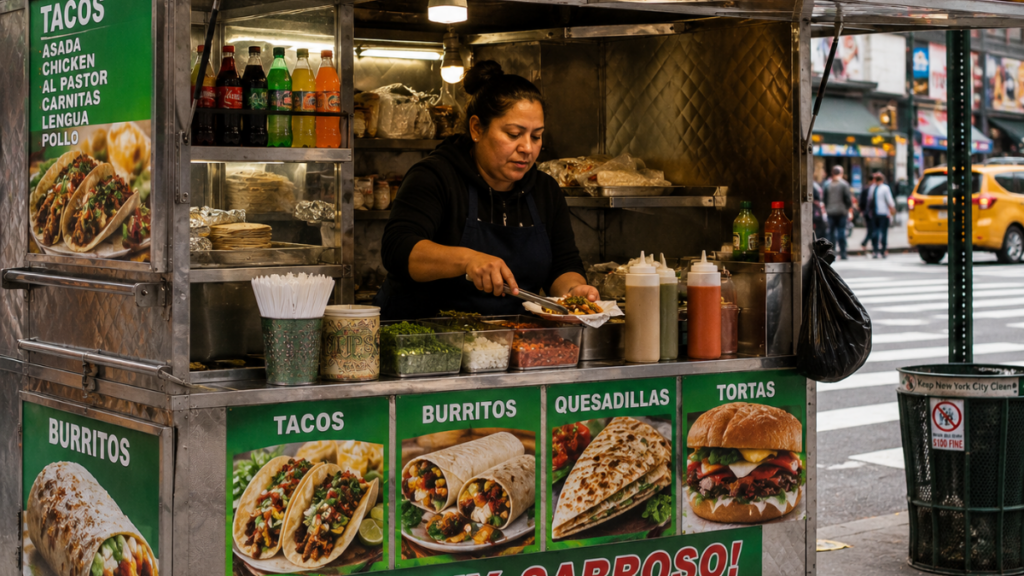
Maribel Ortega never planned to own a food cart.
When she was younger, she dreamed about a restaurant.
A real one.
White walls.
Fresh flowers on every table.
A menu she designed herself.
The kind of place families visited for birthdays and celebrations.
Life had other plans.
Her husband died when she was thirty-four.
The medical bills took almost everything.
The restaurant dream disappeared shortly afterward.
What remained was a small food cart.
A borrowed permit.
And a corner in East Baltimore where office workers, construction crews, and exhausted parents could afford a hot meal.
It wasn’t the life she’d imagined.
But it was a life.
And Maribel had learned a long time ago that there was dignity in feeding people.
Every morning she arrived before sunrise.
The city looked different at that hour.
Quieter.
More honest.
Streetlights still glowing.
Storefronts still dark.
The smell of coffee drifting through empty streets.
She would unlock the cart, start the burners, and begin cooking before most people were awake.
Rice.
Beans.
Chicken.
Soup during winter.
Fresh bread when she could afford the extra ingredients.
By seven o’clock, regular customers started appearing.
The bus driver who always ordered the same breakfast.
The nurse finishing a night shift.
The retired teacher who tipped too much.
The construction workers who joked too loudly.
Maribel knew all of them.
And they knew her.
Then one November morning she noticed three boys standing across the street.
They weren’t together exactly.
Not close enough to look like a group.
But she could tell.
The oldest leaned against a telephone pole pretending not to watch the cart.
The middle boy sat on a bench with his hood pulled low.
The youngest stared openly at the food until one of his brothers gently nudged his shoulder.
The correction was immediate.
The little boy looked away.
Maribel watched them for nearly twenty minutes.
Nobody approached.
Nobody ordered.
Nobody left.
Then she noticed something else.
Every time a customer walked away carrying food, all three boys followed it with their eyes.
Not greedily.
Hungrily.
There was a difference.
And Maribel knew it the moment she saw it.
Because years earlier she’d watched her own son look at food the same way.
Back when money was scarce.
Back when she skipped meals so he wouldn’t have to.
Then the youngest boy accidentally made eye contact with her.
The child immediately looked terrified.
As though being noticed was dangerous.
Maribel’s heart broke on the spot.
Then she reached for three containers.
Because some stories begin with grand gestures.
And some begin with a woman filling three paper boxes with chicken and rice.
Because some stories begin with grand gestures.
And some begin with a woman filling three paper boxes with chicken and rice.
Maribel didn’t call attention to it.
Didn’t wave them over.
Didn’t make a scene.
She simply filled the containers.
Added extra chicken.
Added extra rice.
Then walked across the street herself.
The boys immediately tensed.
The oldest stepped in front of the other two.
Protectively.
Instinctively.
He couldn’t have been older than thirteen.
Yet somehow he already carried himself like a parent.
Then Maribel stopped a few feet away.
And held out the food.
Nobody moved.
The youngest stared.
The middle brother looked at the ground.
The oldest shook his head.
“We can’t pay.”
The words came automatically.
Like he’d said them a hundred times before.
Then Maribel smiled.
The same smile she’d given frightened children her entire life.
“Eat first.”
The boy hesitated.
Then:
“We really don’t have any money.”
Maribel nodded.
“I heard you.”
The youngest brother swallowed hard.
His eyes locked onto the food.
Then Maribel said the words that would stay with them for years.
“You don’t have to worry while you’re here.”
Silence.
Then she gently pushed the containers toward them.
The oldest finally accepted them.
Slowly.
Carefully.
Like accepting kindness was somehow more dangerous than hunger.
Then Maribel returned to her cart.
Pretending not to watch.
Giving them dignity.
Giving them space.
But she saw everything.
The way the oldest immediately handed the largest portion to the youngest.
The way the middle brother split his bread in half without being asked.
The way all three ate like they hadn’t seen a hot meal in days.
And something about it broke her heart.
The next morning they came back.
Not to ask for food.
Just to stand across the street again.
Watching.
Waiting.
Trying not to look hungry.
Maribel laughed softly when she saw them.
Then she started filling three containers.
Again.
After a week she learned their names.
Daniel.
Isaac.
Mateo.
After two weeks she learned Daniel carried all three of their birth certificates in a plastic bag inside his jacket.
After a month she learned they slept wherever they could.
Abandoned buildings.
Church basements.
Sometimes bus stations.
Anywhere warm.
Anywhere safe.
Or at least safe enough.
Then one snowy December morning she noticed something.
Mateo wasn’t there.
Only Daniel and Isaac.
Immediately she felt cold.
Not because of the weather.
Because children disappear for bad reasons.
Then Daniel arrived at the cart alone.
His face pale.
Exhausted.
Scared.
Maribel didn’t ask questions.
She simply handed him food.
Then Daniel whispered:
“He’s sick.”
The words barely came out.
Then Maribel stopped everything.
The lunch rush.
The customers.
The orders.
Everything.
Twenty minutes later she was sitting beside a feverish ten-year-old boy in the back room of a church shelter.
Holding a damp cloth against his forehead.
The same way she’d once cared for her own son.
That was the day everything changed.
Because after that…
the boys stopped treating her like a food vendor.
And started treating her like family.
Then one afternoon Daniel arrived carrying something.
A small folded piece of paper.
He placed it on the cart.
Then immediately looked embarrassed.
Maribel unfolded it.
A drawing.
Crayon.
Uneven lines.
Three boys standing beside a food cart.
A woman smiling behind the counter.
Above it Mateo had written:
Food Mom.
Maribel cried the moment she saw it.
And for the first time since her husband died…
she didn’t feel quite so alone anymore.
And for the first time since her husband died…
she didn’t feel quite so alone anymore.
The years that followed were never easy.
But they became predictable.
And sometimes predictable is its own kind of blessing.
Every morning Maribel opened the cart.
Every morning the brothers appeared.
Some days before school.
Some days after.
Some days looking hopeful.
Some days looking exhausted.
But always together.
Always.
Then one spring afternoon Daniel arrived carrying a report card.
He tried to act casual about it.
Failed completely.
Maribel immediately noticed.
“What is that?”
Daniel shrugged.
“Nothing.”
Maribel laughed.
“Daniel.”
The boy reluctantly handed it over.
Straight A’s.
Every single class.
Maribel stared.
Then looked back at him.
“Nothing?”
Daniel looked embarrassed.
“It doesn’t matter.”
The answer made her furious.
Not at him.
At whoever had convinced him that accomplishment didn’t matter.
Then she marched across the street.
Bought the largest chocolate cake she could afford.
And stuck a candle in the top.
The brothers looked shocked.
Customers laughed.
Construction workers cheered.
And Daniel spent the entire afternoon pretending not to smile.
It didn’t work.
Then came Isaac.
The middle brother.
Quiet.
Thoughtful.
Always carrying books.
Even when he barely had a place to sleep.
One rainy afternoon Maribel found him sitting beneath the cart’s awning.
Reading.
Again.
Then she noticed the library stamp.
Expired.
Weeks overdue.
Isaac immediately looked nervous.
“I’ll take it back.”
“When?”
The boy looked away.
Eventually.
Maribel knew what that meant.
Then she reached into the cash box.
Pulled out forty dollars.
And handed it to him.
Isaac immediately shook his head.
“No.”
“Yes.”
“I can’t.”
Maribel pointed at the book.
“You already did.”
The boy stared.
Confused.
Then Maribel smiled.
“You cared enough to keep reading.”
That night she paid the fine.
The next week Isaac got his library card back.
And carried it in his wallet for years.
Then there was Mateo.
Sweet Mateo.
The youngest.
The one who never stopped believing impossible things could happen.
The one who hugged people without warning.
The one who cried during movies.
The one who always saved half his dessert for someone else.
One day he walked up to the cart holding a wilted dandelion.
The flower was barely alive.
The stem bent.
The petals falling apart.
Then he handed it to Maribel like it was treasure.
“For you.”
Maribel smiled.
“It’s beautiful.”
Mateo looked relieved.
Then whispered:
“I found it behind the gas station.”
She kept it anyway.
Pressed it inside a cookbook.
And years later it would still be there.
Then one morning everything changed.
Daniel arrived alone.
No Isaac.
No Mateo.
No smiles.
No report cards.
Nothing.
Just silence.
The moment Maribel saw his face…
she knew.
Something had happened.
Then Daniel handed her an envelope.
The paper shook in his hands.
“What is this?”
The boy swallowed.
Hard.
Then:
“We got accepted.”
The world stopped.
Accepted?
Then Daniel smiled.
A real smile.
One she hadn’t seen in months.
Then:
“A family.”
The words hit her like a train.
Because suddenly she understood.
The social worker.
The interviews.
The paperwork.
All the things Daniel never talked about.
Then Maribel realized something else.
This wasn’t just good news.
It was goodbye.
Then Daniel’s eyes filled with tears.
The same realization hitting him.
Then:
“They’re adopting all three of us.”
Maribel immediately started crying.
Right there on the sidewalk.
Not because she was sad.
Because she’d spent years praying for exactly this.
Then Daniel stepped forward.
And hugged her.
The first hug he’d ever initiated.
Then Isaac arrived.
Then Mateo.
And suddenly all four of them were crying.
Right in the middle of Baltimore.
While traffic passed.
While customers awkwardly pretended not to stare.
Then Mateo whispered:
“We’ll come back.”
Maribel smiled through tears.
“Of course you will.”
The little boy nodded confidently.
Absolutely certain.
Then:
“We promise.”
The next morning they were gone.
And for a while…
the corner felt emptier than she thought possible.
And for a while…
the corner felt emptier than she thought possible.
The first week was the hardest.
Every morning Maribel found herself looking across the street.
Expecting to see Daniel leaning against the telephone pole.
Expecting Isaac with a book under his arm.
Expecting Mateo waving before he’d even crossed the road.
Instead there was only empty sidewalk.
Empty benches.
Empty space.
Then months passed.
Life continued.
Because life always does.
Customers came and went.
Children grew up.
Stores closed.
New businesses opened.
The city changed around her.
Then one Christmas a card arrived.
No return address.
Just Maribel’s name written across the front.
Inside was a photograph.
Three boys.
Healthier.
Cleaner.
Smiling.
Standing in front of a house.
A real house.
Then she noticed something.
Daniel was taller.
Isaac wore glasses.
Mateo had braces.
Maribel laughed and cried at the same time.
Then she read the message written on the back.
Food Mom, we’re okay.
That was all.
Nothing else.
Nothing needed.
The next year another card arrived.
Then another.
Then another.
Always short.
Always simple.
Always enough.
Then eventually the cards stopped.
Life got busy.
Years passed.
Maribel understood.
Children become adults.
Adults become occupied.
That’s how the world works.
And honestly…
she was happy they were busy.
Busy meant safe.
Busy meant successful.
Busy meant alive.
Then one rainy afternoon she opened an old tin box beneath the cart.
Inside sat the things she’d saved.
Daniel’s report card.
Isaac’s first library card.
Mateo’s drawing.
The dried dandelion.
The Christmas cards.
Eight years of memories.
Then she smiled.
Closed the box.
And went back to work.
Never realizing what was happening hundreds of miles away.
Because Daniel never forgot.
Not for one day.
Neither did Isaac.
Neither did Mateo.
The three brothers carried Maribel with them everywhere.
College applications.
Graduations.
First apartments.
Job interviews.
Business meetings.
Every milestone.
Every achievement.
Every success.
Because whenever people asked how they’d survived…
the answer always started in the same place.
A food cart.
A corner.
A woman who fed them before asking questions.
Then one evening Daniel sat in a boardroom overlooking the harbor.
A contract worth millions spread across the table.
Investors talking.
Lawyers negotiating.
Numbers everywhere.
Then someone asked him a simple question.
“What made you keep going when everything was against you?”
The room expected a business answer.
They got something else.
Daniel smiled.
Then said:
“Chicken and rice.”
The room laughed.
Daniel didn’t.
Then he told them about Maribel.
Everything.
The food.
The kindness.
The note.
The way she’d made three homeless boys feel seen.
The room fell silent.
Then one investor quietly asked:
“Have you ever paid her back?”
Daniel stared out the window.
Toward the city lights.
Then answered honestly.
“No.”
The word sat heavily between them.
Because suddenly he realized something.
Sending Christmas cards wasn’t paying her back.
Neither was gratitude.
Neither were memories.
Then Daniel picked up his phone.
And called Isaac.
Then Mateo.
The conversation lasted almost three hours.
By the time it ended…
a plan existed.
A very big plan.
Then six months later…
on an ordinary Tuesday morning…
three luxury cars rolled slowly onto a familiar Baltimore street.
And a woman named Maribel looked up from a pot of rice.
Wondering why everyone around her had suddenly stopped walking.
Wondering why three successful strangers were stepping out of expensive cars.
Wondering why they were all staring at her food cart like it meant something.
She had no idea.
Not yet.
But before the day was over…
the little blue umbrella she patched with tape…
the rusted wheel she kicked every morning…
and the food cart she’d spent fifteen years pushing through rain and heat…
would become the most famous corner in Baltimore.
Because three boys had finally come home.
And they hadn’t forgotten a single meal.
Because three boys had finally come home.
And they hadn’t forgotten a single meal.
The Baltimore sidewalk stood silent.
Nobody moved.
Nobody left.
Even customers waiting for breakfast had stopped pretending to be interested in anything except what was happening in front of them.
Then Daniel picked up the keys.
The brass tag glinted in the morning sunlight.
Maribel’s Kitchen and Community Center
Maribel stared.
Certain she’d misunderstood.
Then she laughed nervously.
“What is this?”
The brothers exchanged smiles.
The same smiles they’d shared as children whenever they were hiding a surprise.
Then Mateo grinned.
“It’s yours.”
The street froze.
Maribel blinked.
“What?”
Isaac stepped forward.
Then carefully unfolded a packet of documents.
Architectural drawings.
Building permits.
Photographs.
Plans.
Pages and pages of plans.
Then he placed them on the cart.
Maribel looked down.
And stopped breathing.
Because the building in the pictures was beautiful.
A real restaurant.
Not a food cart.
Not a temporary stand.
A restaurant.
With large windows.
A commercial kitchen.
A dining room.
Fresh flowers on every table.
The exact kind of place she’d once dreamed about.
Forty years earlier.
Then her hands began shaking.
“No.”
The word escaped before she could stop it.
Then:
“No no no.”
The brothers started crying immediately.
Because they knew.
They knew exactly what she had just recognized.
Then Daniel quietly said:
“You used to talk about it.”
Maribel looked up.
Confused.
“What?”
Daniel smiled.
“The restaurant.”
The world stopped.
Then memories came rushing back.
Conversations she’d barely remembered.
Comments made while stirring soup.
Dreams mentioned between customers.
Things she’d said decades ago.
Thinking nobody was listening.
Then Daniel laughed softly.
“We were listening.”
The tears came immediately.
Then Isaac pointed toward the documents.
“You said every table would have flowers.”
Maribel covered her mouth.
Then Mateo added:
“You said nobody should ever eat alone if they didn’t want to.”
The crowd was crying now.
Openly crying.
Then Daniel continued.
“You said people should be able to afford good food no matter what.”
A pause.
Then:
“We wrote everything down.”
The world blurred.
Because suddenly she realized this wasn’t charity.
It wasn’t generosity.
It was memory.
The boys had remembered everything.
Then Daniel pointed down the street.
Toward a large brick building three blocks away.
Recently renovated.
Fresh paint.
New windows.
A giant blue ribbon stretched across the entrance.
The crowd collectively turned.
Then Daniel smiled.
“Go look.”
Maribel couldn’t move.
Then Mateo gently took her hand.
The same way she’d taken his years ago.
And together they walked.
The entire neighborhood followed.
People emerged from businesses.
Apartments.
Stores.
Everyone curious.
Everyone wondering.
Then they reached the building.
The ribbon fluttered in the breeze.
Maribel looked up.
And completely broke down.
Because above the entrance hung a sign.
A beautiful sign.
Hand-painted.
Elegant.
Permanent.
The letters read:
Maribel’s Kitchen
Then smaller words beneath.
No One Eats Alone
The crowd erupted.
Applause.
Cheers.
Tears.
But the brothers weren’t finished.
Not even close.
Then Isaac opened the front door.
The smell of fresh paint drifted outside.
Maribel stepped inside.
And immediately stopped.
Because every detail was there.
The flowers.
The tables.
The colors.
The layout.
Everything.
Everything she’d once described.
Then Daniel pointed toward the back.
“Keep going.”
Maribel walked deeper.
Past the kitchen.
Past the dining room.
Then she found another wing.
A much larger space.
Classrooms.
Offices.
Meeting rooms.
A library.
Computer labs.
Then she looked back.
Confused.
“What is this?”
Isaac smiled.
Then answered:
“The community center.”
The room fell silent.
Then:
“Free tutoring.”
Another.
“Job placement.”
Another.
“Food assistance.”
Then Mateo finished:
“And a place for kids who need somewhere safe after school.”
The tears returned instantly.
Because suddenly she understood.
The brothers hadn’t built a restaurant.
They’d built the thing they needed when they were children.
Then Daniel handed her one final item.
A framed napkin.
The same napkin she’d written on all those years ago.
Protected behind glass.
The faded words still visible.
The world is hard enough. Be kind anyway.
Then Daniel looked around the building.
At the people.
At the neighborhood.
At the future.
And quietly said:
“You fed three hungry boys.”
A pause.
Then:
“We’re just helping you feed thousands more.”
The room stood silent.
Then Maribel finally looked at the three men standing before her.
No longer homeless boys.
No longer frightened children.
Just family.
Then she smiled through tears.
And asked the same question she’d asked them years ago.
“Have you eaten yet?”
The three brothers laughed.
Because some things never change.
