

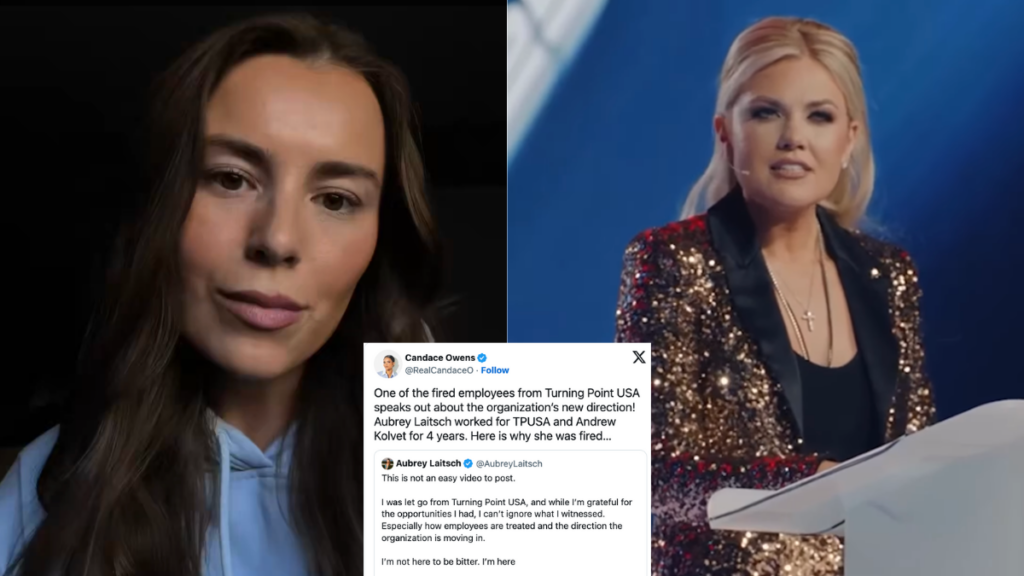
Photo Credit: Aubrey Laitsch / X; Erika Kirk / Instagram
Tragedy at Turning Point USA and Aftermath
Charlie Kirk, co-founder of Turning Point USA (TPUSA), died after he was shot while speaking at a Utah college event. Federal and local law enforcement immediately began a manhunt for the suspect. Kirk’s assassination shook political circles and sparked nationwide concern over political violence. Officials described the shooting as targeted, with a person of interest spotted fleeing the scene. As of recent reports, the FBI continues to pursue leads in the case, but no motive or suspect has been made public.
In the days after Kirk’s death, his wife, Erika Kirk, delivered a powerful public address from TPUSA headquarters. She vowed that her husband’s mission would not end. Erika praised law enforcement and expressed her grief while publicly committing to carry on the organization’s goals. She declared that the movement would grow stronger and louder in his absence.
Erika Kirk soon became CEO and chairwoman of TPUSA, replacing her late husband. Her appointment was unanimous among the board members, and she stepped forward to lead the organization during its most challenging period.
The organization remains influential in conservative youth politics, with a large network of chapters and supporters across the United States. The leadership transition from Charlie to Erika has united many inside TPUSA, but it has also sparked internal conflict. As the organization adapts to new leadership, high-profile staff changes have raised eyebrows among observers.
The Fired TPUSA Staffer’s Claims
After Charlie Kirk’s death, an internal conflict emerged within TPUSA’s leadership team. Aubrey Laitsch, a PR staffer, posted a video detailing her firing from the organization after working there for more than four years. She said that the termination occurred after ant internal meeting involving senior executives. Laitsch alleged that leaders accused her of disliking Erika Kirk based on third-party comments and speculation.
In the video, Laitsch described her relationship with Erika Kirk as neutral prior to the incident. She said they had known each other socially for years and had never had serious personal issues. Laitsch denied involvement in any drama or conversations that might have triggered her firing.
Laitsch also suggested that her questioning of the official narrative surrounding Charlie Kirk’s assassination may have played a role in her dismissal. She said she felt the organization wanted to enforce a singular story rather than allow uncertainty. She expressed heartbreak over speaking publicly about her firing, stating she did it because she believed Charlie Kirk would have expected honesty from his team.
Several conservative commentators shared Laitsch’s remarks on social media, which fueled broader discussion about transparency and leadership dynamics at TPUSA. Critics began questioning how TPUSA has handled staff relations and public messaging under Erika Kirk’s leadership.
TPUSA has not publicly confirmed Laitsch’s claims or detailed reasons for her departure. The organization declined to comment, citing internal personnel matters. As of now, Laitsch’s account remains unverified outside her own statements and social media amplification.
Leadership Change and Organizational Tension
Turning Point USA’s leadership change took effect soon after Charlie Kirk’s assassination. The board unanimously selected Erika Kirk as CEO and chairperson, positioning her at the helm of the influential political youth organization. The move aimed to keep Kirk’s mission intact while providing continuity for supporters.
Erika Kirk’s transition into leadership followed her emotional public speeches about her husband’s work. She vowed not to let his message die, and she repeatedly urged members to continue activism. Her statements emphasized faith, resolve, and strength in the face of tragedy.
Some observers praised Erika Kirk’s courage and leadership during a painful period. They said her public presence helped unify the organization’s base and bolster morale. The surge in interest and outreach efforts under her watch reflects broad support among many TPUSA chapters.
Others have raised concerns about the pace and style of the leadership transition. Critics argue that internal dissent over strategy and communication has become more visible. Allegations from former staff and social media discussions have highlighted fractures within the organization.
TPUSA’s rapid fundraising growth after the assassination adds another layer to the debate about leadership and priorities. Supporters see it as a sign of resilience, while detractors question governance and internal accountability. The differing perspectives suggest the organization faces both opportunity and friction under its new leadership.
Public Debate and Media Reactions
The public and media quickly picked up on the controversy surrounding the fired TPUSA staffer. Conservative commentators shared clips and commentary about internal turmoil at the organization. Many of these discussions occurred on social media platforms, where users debated the merits of Laitsch’s statements and the broader implications for TPUSA.
Some commentators used the staffer’s claims to question TPUSA’s culture under Erika Kirk. They suggested that disputes over narrative control and leadership style could weaken the group’s cohesion. Opponents of the organization framed the controversy as evidence of deeper structural issues.
Supporters of TPUSA and Erika Kirk pushed back against public criticism. They emphasized the organization’s mission and the emotional strain of coping with Charlie Kirk’s death. Supporters argued that leadership decisions made under grief should be approached with empathy rather than speculation.
Mainstream outlets have generally treated the staffer’s allegations as unverified and centered their reporting on verified events, such as Kirk’s assassination and Erika’s public addresses. Journalists have stressed the importance of separating confirmed facts from hearsay circulating online.
The contrast between public speculation and documented facts highlights the challenges of reporting on politically divisive organizations. In this environment, narratives can quickly take on a life of their own, amplified by viral posts and partisan commentary.
What This Means for TPUSA Going Forward
Turning Point USA stands at a critical moment in its history. The organization must balance honoring Charlie Kirk’s legacy with adapting to new leadership and internal changes. Erika Kirk’s role as CEO puts her at the center of that effort. Her leadership will shape TPUSA’s direction in the years ahead.
The firing of a long-time staffer has raised questions about internal governance and transparency. Critics argue that open dialogue and clear policies are necessary for organizational health. Supporters counter that decisive leadership is essential during turbulent periods.
External perception of TPUSA will likely influence its ability to expand and attract new members. Some university communities have shown resistance to chapter formation, partly due to political polarization. Yet others remain enthusiastic, citing Charlie Kirk’s message as inspirational and motivating.
How TPUSA manages internal debate and public scrutiny may determine its future stability. Leaders will need to address both the legacy of loss and the practical realities of political organizing in a divided environment. Observers will watch closely as the organization evolves.
Ultimately, the organization’s trajectory depends on its ability to balance mission with accountability. Whether TPUSA can maintain unity while accommodating differing perspectives inside and outside the group remains to be seen.